First published at New Politics.
[New Politics editors’ note: This article is reprinted from Nancy Holmstrom’s From a Marxist-Feminist Point of View: Essays on Freedom, Rationality and Human Nature (2025) with the kind permission of the author and the publisher, Haymarket Books. The article originally appeared a decade ago in the online journal Logos: A Journal of Modern Society and Culture; although the use of technology in sex work has increased since it was published, we believe the arguments in this essay remain highly relevant today. For an interview with the author about the book, see here.]
The current debate regarding sex work is frustrating, which is one of the reasons I am writing this article. Counter-posed positions are a good way to generate debate, but when they are false counter-positions, it is not likely to be a fruitful debate. The title of this symposium, “Sex Work: Emancipation or Oppression,” is an example of this, but unfortunately it reflects the discussion. Actually this is not a new debate but harks back to debates among feminists in the 1980s and resembles debates that went on in the nineteenth century. Recent legal changes regarding sex work in some countries and under consideration elsewhere have given the debates a practical focus and a feeling of urgency. Unfortunately the “sides” in this debate seem so solidified, it is difficult to trust a lot of what is written, as writers pick cases and evidence that fit their perspective.
Most feminists now agree that sex work should not be criminalized; this just drives it underground and causes further hardship to those doing the work. However, this position does not take us very far, as there are countless public and private actions which might be morally/politically problematic, but where legal prohibitions would be impractical, intrusive, or counterproductive. Socialist feminists need to say more about the nature and context of sex work, the effects of different legal policies on women and to analyze these within our anti-capitalist and anti-patriarchal values. In this paper I will primarily be focusing on the political philosophical issues central to the debate, but in conclusion I will indicate the practical directions to which I think my analysis points. Others will be addressing different programs and policies in detail.
What is sex work?
“Sex work” can be conceived broadly or narrowly. Women’s bodies are objectified and commodified throughout our capitalist and patriarchal society. Whether the commodity is toothpaste, cars, clothes, music, or food, women’s bodies or body parts are used to attract buyers and excite or calm customers. (I once had to wear an abbreviated leopard print outfit for a waitress job.) So even many “normal” jobs done by women could be seen as being to some extent sex work. Then there are the jobs more usually understood as sex work, which are quite varied, from stripping, pole dancing or lap dancing, “dirty-talking” conversation, erotic massage, fetish work, pornographic modeling or acting, and selling sexual services. So the category of sex work should be seen as a continuum.
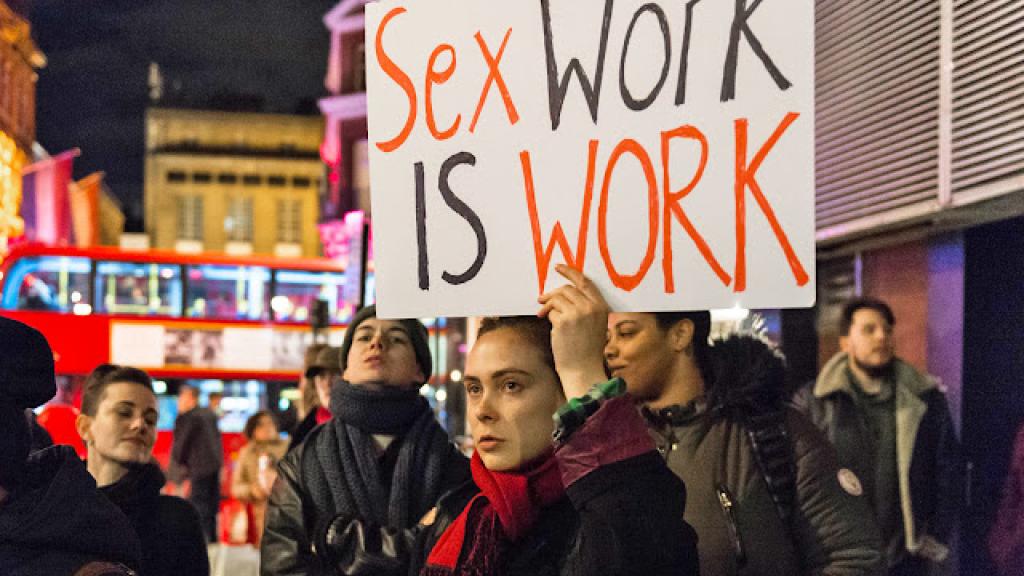
There is no question these are all work and should be recognized as such. However, although it is useful politically to unite all sex workers, for this paper I will concentrate on the sale of sexual services, usually called prostitution, as the paradigm case of sex work. It is the most stigmatized and also the most controversial and problematic from a feminist moral/political point of view. It is imperative in the discussion that we recognize and keep in mind the huge variations within the business of prostitution, depending on whether it is part-time, occasional, or full-time, whether it is in hotel suites or on the streets, whether it is high paid and relatively safe or highly dangerous and poorly paid, whether the prostitute is an adult or very young, addicted or not, subject to direct coercion or not, and so on. When we are urged, therefore, to consider the experience of prostitutes themselves, it is important to know who it is that is speaking. But leaving aside these differences for the moment, all forms of prostitution — by definition — involve “payment for unilateral use of a woman’s body without desire or erotic attraction on her part.” I am limiting my discussion to the sale of sex by women to men, as women make up 80 percent of “the commercial sex workforce” and men are the vast majority of buyers of sex from men as well. Transgender people appear to be over-represented in prostitution, perhaps because their access to other employment is limited by transphobia. (Despite these clear gender patterns, an odd feature of some of the debate is that it is carried on in gender-neutral language!) What I have to say about prostitution should apply to the other occupations on the sex work continuum to a greater or lesser extent depending on their proximity to prostitution.
Political/economic context
We live in days of hyper-charged global capitalism with greater inequality globally and domestically than at any point in history. Neoliberalism has meant cutbacks in already-meager or nonexistent social supports. Some have profited enormously in this environment, some a little, and others not at all. Women are disproportionately among the latter group. Everywhere peoples’ aspirations are higher. This political/economic context has created both a greater supply and a greater demand for sex workers. Women now make up half of the world’s migrants, legal and illegal. Some women migrate in order to become sex workers, some are recruited and helped to get into the business, often under false pretenses, and others are trafficked by criminal gangs—and these should not be conflated. Undocumented immigrants, often racialized, are particularly vulnerable to abuse. The newly rich in some countries buy a night at a brothel for colleagues and friends the way one buys a round of drinks; most men working in a globalized industry can now afford a prostitute. Sex is a multi-billion-dollar growth industry globally, and it is a central piece of many developing countries’ economies. Our pensions may be invested in huge “entertainment” and “hospitality” corporations where sex is available for purchase. At the lowest end of the industry, the women are literally enslaved.
Empowerment vs power, agency and freedom
To say that all kinds of sex work are work, as they certainly are, says nothing about their voluntariness (after all, slaves work) or about what moral value we should place on this work. These are the questions to be addressed next.
The word empowerment is often used in this discussion, and it is important to distinguish it from actual power. Empowerment refers to a psychological quality of an individual. Power, on the other hand, can be used to apply to individuals or very large groups, but it refers to objective, not subjective phenomena. Note that something could be “empowering” for certain women, but dis-empowering for women in general. Also note that if something is empowering for an individual, it does not follow that they have more power. In the literature about sex services there is a lot of ethnographic evidence that prostitutes have different kinds and levels of negotiating power. Some have little or none and others have more, for example, whether or not they can refuse to work with a particular customer or refuse to do certain acts. One study of prostitutes in New Zealand found that many said that the new law, which makes it illegal to purchase sex without a condom, had increased their ability to force clients to wear them.
Along with empowerment, the concepts of agency, emancipation, and free or voluntary choice are employed in this debate, but often in unclear ways. Acts and choices are not simply free or unfree. Rather, freedom is always relative, on a continuum, in a context. So to counter-pose oppression and empowerment, as so many writers do, is misleading. An act/choice could be more free than the alternatives, it could be an expression of agency and personal empowerment to that extent, but still be profoundly unfree because of the paucity of choices that the agent would prefer.
A poignant and extreme, non-sexual, example of this point is found in the prize-winning book Behind the Beautiful Forevers about life in a Mumbai slum: Meena, a young woman who is forbidden to go to school, often beaten, facing an arranged marriage in a village, has a friend, Manju, whom she only talks with at the public toilets. “The minutes in the night stench with Manju were the closest she had ever come to freedom.” Shortly thereafter she eats rat poison.…
“She wasn’t acting out of anger.… She’d thought it through — had consumed two tubes of rat poison on two other days, but had started to vomit, which led her this time to mix the poison with milk. She hoped the milk would keep the poison in her stomach long enough to kill her.
“This was one decision about her life she got to make. It wasn’t easily shared with a best friend.” In hospital she says “I decided for myself.…” “She was fed up with what the world had to offer,” the Tamil women concluded. Meena’s family, upon consideration, decided that Manju’s modern influence was to blame.”
If Meena had chosen to run away and become a prostitute the same point would apply; an agent can judge an option to be the best of the available options and choose it carefully and deliberately; hence the act could be said to be free, or empowering, or an expression of agency — but only in the most minimal sense — because at the same time, a choice is profoundly unfree if it is merely the least evil of the options available.
Consider an example further toward the free end of the continuum, of poor single mothers who choose sex work “not simply as a survival strategy, [but] as an advancement strategy.” They believe that sex work will be more lucrative than factory or domestic work, especially in a sex tourist destination like Sosua, Dominican Republic. Seeking to escape not only poverty, but the machismo of their countrymen, their goal is to find a tourist who will take them out of the country. In most cases, that hope turns out to be illusory and they return home as poor as when they left; this is true even for the ones who do manage to get a visa. Faced as they are both with capitalism and patriarchy, their carefully thought-out strategies, which the researcher takes pains to stress, can take them only so far. Again, this example shows there is no inconsistency between saying people are exercising resourcefulness and agency, attempting to maximize their possibilities, but within very oppressive constraints.
Thus, the conditions under which people choose determine to what extent their choices are free; these conditions can pose obstacles to doing something or they can enable them. More precisely, to say one is free is to say one is free from an obstacle preventing one from doing something; one is unfree to do something because an obstacle prevents one from doing it. Thus one can be free to do something with respect to one obstacle and unfree to do it with respect to another obstacle. The obstacles may be physical or may involve persons in some significant way. Thus legal restrictions have been obstacles to women living their lives as they want, as has direct force or threat of force, both of which count as coercion. But people can limit others’ freedom in less overt ways. Certain kinds of proposals or offers can also prevent someone from acting freely. For example, if an employer offers a dangerous and low-paid job to someone whose only alternative is starvation for her and her family, this should count as a “forcing offer.”
Not only individuals, but social institutions may limit someone’s freedom. This can be missed if we focus only on individuals. The absence of childcare can prevent a woman from taking a job and the need for medical care can force someone to take a dangerous job they hate. More generally, lack of money functions as an obstacle to people acting freely, despite the opinion of many learned philosophers to the contrary. Certainly, it is experienced as such. Finally, internal obstacles (often caused by the external constraints) can limit one’s freedom: mental illness or addiction, or lack of self-confidence, fears, patriarchal ideas of gender roles, guilt, or shame. All these kinds of obstacles would have to be eliminated for women to choose more freely whether or not to be prostitutes.
A “work ethic instead of a sex ethic”?
Calling prostitution work is an attempt to remove it from sexual moralizing and from the picture of all prostitutes as victims, thereby opening up possibilities for prostitutes to organize for rights as workers. But some critics, in particular, Kathi Weeks and Peter Frase, have argued that calling prostitution sex work buys into a different morality, the work ethic, claiming legitimacy by association with traditional work values. And this ethic must be resisted by radicals. From their perspective, the problem with sex work is “not the sex, but the work.” Frase quotes a sex worker who says yes, it’s degraded; but so is all work in capitalist society. While this anti- (or post-) work politics has some political validity, we think it is over-simplified and unhelpful in this debate. After discussing work in general we turn to the question of sex work in particular.
If selling sexual services is work, how should we understand that work? To address this question it is worth a detour into Karl Marx’s rich discussions of work/labor, which I believe are unrivaled in their subtlety, but which have often been misinterpreted. As readers know, Marxists contend that all wage labor involves exploitation and alienation and that this is a chief reason why capitalism should be replaced by “a higher form of society,” as Marx often put it. In capitalist societies, workers are free of legal bonds but also free of any means of subsistence. Hence, they have no choice but (i.e., they are forced) to work for the owners of the means of production who control the labor process and the laborer and who get to keep the product of their labor. This — in great brevity — is exploitation and also alienation.
Defenders of capitalism describe the situation differently, of course. In capitalism they say, everyone owns something, even if it is only “themselves,” and hence their own labor power, and therefore that the wage relation is a voluntary exchange between two individual commodity owners, simply a buyer and a seller. The two principal classes that constitute capitalism, with their vastly unequal power vis-à-vis this “transaction,” disappear. But to call either labor or labor power a commodity is essentially a legal fiction (like declaring corporations persons). Certainly labor power is unlike other commodities; unlike other things I “own,” it can’t be stolen or left on the bus! This is because it consists of mental and physical energies, capacities, potentials, and hence cannot be separated from the laborer to whom they belong, but exist only in “his living self,” Marx says. Labor is the expression of these. Wherever my labor power/labor goes, I have to go with it; whatever is done to it, is done to me. So the worker who “sells their labor power” is selling their selves to the owner, albeit with temporal and other limitations. The domination of capitalists over workers due to their monopoly of the means of production is continually reproduced and increased through the process of production.
Behind Marx’s condemnation of wage labor as exploited and alienated is a very different view of what human labor can and should be. In a very early work, The Economic and Philosophical Manuscripts on alienation, Marx says, “The whole character of a species — its species character — is contained in the character of its life-activity; and free, conscious activity is man’s species character.” Thus one aspect of alienation is alienation from the human species character. This view of the special character of human labor is elaborated upon in a much later work The Grundrisse, where he criticizes Adam Smith’s account of work as sacrifice, saying that while this is true of exploited work (“external, forced labor”), this is not true of work as such. Yes, work always involves some external goal, he says, but overcoming obstacles can be liberating when they are goals set by the individual; then work is “self-realization, objectification of the subject, hence real freedom, whose action is, precisely, labor.” In the same passage he criticizes the utopian socialist Fourier, whose views sound like the anti-work writers. In contrast to Fourier’s vision of labor in a socialist society as essentially play, Marx says “Really free working, e.g., composing, is at the same time precisely the most damned seriousness, the most intense exertion.” [author’s emphasis]
In Capital III Marx distinguishes different kinds of necessity and different kinds of freedom. He distinguishes a realm of necessity and a realm of freedom. In any society, he says there will always be some labor required by physical necessity — but this, he says, is consistent with a different kind of freedom:
Freedom in this field can only consist in socialized man, the associated producers, rationally regulating their interchange with Nature, bringing it under their common control, instead of being ruled by it as by the blind forces of Nature; and achieving this with the least expenditure of energy and under conditions most favorable to, and worthy of, their human nature. But it nevertheless remains a realm of necessity. Beyond it begins that development of human energy which is an end in itself, the true realm of freedom, which, however, can blossom forth only with the realm of necessity as its basis. The shortening of the working day is its basic prerequisite.
This account of freedom within necessity as consisting of rational collective control underscores the connection between Marx’s view of human nature and his commitment to a radical democratic vision of socialism.
So in Marx’s view labor (work) is not inherently oppressive. In fact, when it is determined by an individual’s wants, needs, passions, it is free in the fullest possible sense. When on the other hand, the work is required by the facts of nature (i.e., what satisfies our physical needs requires work to get it), it can still be free in a more limited sense, if it is we who decide how to do it. Finally, within wage work, though always exploited from a Marxist point of view, there are many variations which make the work better or worse for the worker: the amount of control exercised by the worker, how direct is the capitalist’s control over the worker/work, the remuneration and respect accorded to it, how intrinsically attractive or repulsive the work is to the worker, how difficult and how dangerous it is, physically or emotionally, and so on.
Marx’s accounts in Capital of the degradation of work as capitalism developed, of the loss of all “charm” and “interest,” making the work a kind of “torture,” of the de-skilling of the worker, of transforming the worker into “an appendage of the machine,” are eloquent testimony to his appreciation of this fact (as is the participation of Marxists in struggles for better working conditions.) Some workers in capitalism enjoy their work, believing it to be worthy work, some few are even fortunate enough to do for pay what they would want to do anyway. Thus Marx’s general account and condemnation of wage labor as exploited and alienated in no way denies these qualitative and quantitative differences — which we will draw on when we discuss sex work in particular. But his concluding line in the quote above about the necessity of a shorter work day reaffirms that we all need more time to pursue the activities we most care about, “really free working,” whether these be composing music, teaching children, or working on machines. We also need more time for “eating, sleeping, procreating,” but these activities do not have the same distinctively human importance for Marx.
Notice that this critique of wage labor is distinct from a critique of the work itself. A great deal of the work done in capitalism would not be done in a socialist society (e.g., wasteful production of junk or products designed for obsolescence, figuring out how to get people to buy things they don’t need, or manufacturing instruments of torture). On the other hand, much other work that is done today would be necessary in any society, including an ideal non-capitalist one, although it would be done in humane and environmentally sustainable ways. The latter point entails that there would have to be substantially less production of things altogether. This eco-socialist argument dovetails with the goal of the anti-work writers. Meanwhile, however, an anti- (or post-) work politics should not be used to deny the important qualitative and political differences between types of work or the importance of the struggle for better jobs. Therefore we can ignore this perspective in our analysis of sex work.
Is sex special?
Most prostitution, and sex work in general, is exploited in a Marxist sense in that pimps, brothel owners, and perhaps multinational corporations are making a profit from the sale of the prostitute’s labor. But if this exploitation were removed because the prostitute worked for herself, as some do today, or for a sex workers’ cooperative, would it still be problematic? In other words, does the moral/political objection to prostitution go beyond the exploitative character of most of the work? If it were decriminalized, should it be seen as similar to any other service work? The Economist recently editorialized for just this position with a cover depicting a sexy young woman cutting her ball and chain, and some feminists agree. The key to her freedom according to The Economist is the Internet, allowing her to transact freely with prospective clients, negotiate the services and price, and pointed to websites where clients can evaluate their experience, like on Trip Advisor, and sites where prostitutes can expose bad clients, e.g., Blacklist. The web service would be something like Task Rabbit, but instead of selling babysitting, shopping, housework, painting, paper work, etc., the services would be sexual intercourse (anal intercourse at a higher price), fellatio (without a condom at a higher price), spanking or heavier S&M (also more expensive), masturbation, etc.
Though the precarity of the working conditions are similar and perhaps the average pay might be the same (because so many can enter the business so easily), or better, I do not think that the latter commodified sexual services are the same as the service work done by the Task Rabbits. This opinion is not based on sexual prudery (on the contrary), on outdated romantic notions, or on the belief that all prostitutes are victims (though many are). In part, my judgment regarding most instances of prostitution is based on the political economic context discussed earlier; economic pressures put the choice to do this work decidedly on the unfree side of the free/unfree continuum for the great majority. However, even for those in a situation allowing a greater variety of choices that are not totally awful, I believe that prostitution is not “simply a kind of service work” and is not work that feminists should regard as unproblematic.
What is the prostitute selling? Certain sexual services. But just as rape is not primarily about sex, prostitution is about more than that. For most individuals, sexual satisfaction is, after all, as Carole Pateman has pointed out, always “at hand.” And sexual services cannot be separated from the sale (or rent) of the body that supplies those services. The client is buying the right to use a woman’s body as he wishes, without any desire on her part. Once she has contracted to provide a particular service — assuming she has this power to set limits — she has to allow him to enter into her body, her vagina, her mouth, her anus, to put his hands all over her body, and she must do whatever she has contracted to do to his body with her hands and mouth. This is domination at a most intimate level, whether or not he plays the dominating role in the interaction; it may be he who wants to be penetrated or spanked. It is the client’s power to determine that and how he gets sexual satisfaction from a prostitute that makes male domination central to prostitution, not a male desire to dominate.
And, except at the lowest end of the business where there is no pretense, she must pretend to be enjoying it; the interaction, therefore, is always a charade, a performance on the prostitute’s part. Thus what the client is buying (renting) is not only her body, but the (appearance of) her emotions. If she just lies there and looks at her watch, he will not be satisfied; an important part of what he is buying is the appearance of her pleasure. His motivation may be to dominate a woman, to affirm his masculinity to himself or others, to have (particular kinds of) sexual experiences because he cannot get them without paying for them, or he may be looking for bodily/emotional connection (kissing costs more too), or to have a “girlfriend experience” without responsibilities. Whichever it is, the prostitute is selling him the right to use her body in this way. This indicates an important difference from the employment contract, as Pateman has pointed out. What the capitalist is paying workers for is to use their bodies to make products, and workers’ bodies can be replaced by machines. Not so in prostitution.
Of course, “emotional labor” is not unique to prostitutes. Arlie Hochschild’s work has shown how much work today, especially by women, involves emotional labor, where workers pretend to feel what they do not feel because delivering the service in a certain way is part of the service. She shows that there is a serious cost: the alienation of workers from their feelings. The flight attendant becomes estranged from her smile, she says; it is not hers anymore. Hochschild’s powerful work is illuminating of the emotional dimension of most prostitutes’ work, but it does not convey the half of it since other emotional labor jobs do not involve letting a client use her body as he wishes. While Pateman’s distinction between the employment contract and the prostitute/client relationship is less true of service work, many services — from bank tellers to sales people to financial planners—are now self-service through machines and the Internet. Even flight attendants, because of speed-up and feminism, are no longer required to give such personal feminized service.
It is because human sexual experiences are highly intimate and both physical and emotional that they can range from ecstatic to horrific and everything in between. Only with great effort of dissociation is sex ever purely physical, which can be a useful defense, but this often takes a psychic toll. Consider the fact that prostitutes, especially street prostitutes, as well as soldiers and war victims, often suffer from PTSD, whereas other low-status, dangerous, physically demanding jobs don’t have that particular effect, which is due to its emotionally damaging experiences, as much as violence and fear of violence. The body is where we experience pleasure and pain. Indeed, it is the original site of emotions, of our very selves. Research has shown that babies who are not picked up and held are damaged emotionally and may “fail to thrive” physically, even when their basic physical needs are met. So the right kind of physical contact is crucial to emotional and physical well-being. On the other hand, the wrong kind of physical contact can be traumatic. Even when conscious memory is gone the body retains experiences, e.g., of abuse, which is why abusers were usually abused as children. That’s why we tell children that they should decide if they want to be touched and how. Thus selling sexual services is not like selling other services. Selling intimate bodily experiences is a kind of ultimate alienation (which has degrees, as discussed above).
In a non-patriarchal, non-capitalist society, would this still be true? Yes and no. Since human beings are simultaneously physical and emotional/social beings, the body and its experiences, early and throughout life, including how an individual decides to use it, would still be crucial to that person’s physical and emotional well-being. In the absence of patriarchal and capitalist pressures to use their bodies in dangerous and degrading ways, some women might nevertheless choose to provide sex to strangers without desire on their part. (Let us take at face value their answer to the question of why they choose this.) Some might even choose to do it as a regular thing, as a service to those who were unable to satisfy their sexual and emotional needs through personal relationships. But if so, that would be more like being a sex therapist than what is understood today as a prostitute (consider the film The Sessions). The crucial point is that the power relationships of the society at large and between the two people would be totally different — and hence both its nature and its effects, both individually and socially, would be different.
My description of sex in prostitution as ultimate alienation is similar to sex in patriarchal marriages in that husbands control when and how they have sex with their wives. (Consider how recently the very concept of marital rape was considered incoherent.) Sometimes women do not get to choose their husbands in the first place or they do so for financial reasons. Thus socialist feminists have always been fierce critics of traditional marriages. Emma Goldman referred to “prostitution — public and private,” saying “…it is merely a question of degree whether she sells herself to one man, in or out of marriage, or to many men….” From the nineteenth and early twentieth century figures like Emma Goldman and Alexandra Kollontai to socialist feminists today, the central goal has been sexual liberation: the freedom to choose if and when and how and with whom to have sexual relations. Women should be free to choose whatever partner, male or female, they want and to have sex for love, for lust, for friendship, for fun, for procreation, for comfort, or whatever else the lovers want. Fortunately, in developed countries especially, women and men are more and more able to form personal relationships based on love and friendship rather than direct coercion from families and the law. Same-sex couples are a dramatic example of the enormous expansion of human freedom and personal happiness that this has brought.
The fiction at the heart of capitalist ideology that one can sell parts of one’s self without selling oneself, and that doing so is an exercise of freedom rather than domination has led to the commodification of everything that people do not resist in defense of other values, intruding into the most intimate areas of our lives. Libertarians see nothing wrong with selling one’s organs. But while that may be all a person has to sell, this should never be construed as a free act. The same is true of sex; it may in fact be the only “commodity” a woman has to offer on the market, but this should be understood as an expression of the poverty of her choices in our capitalist patriarchal system.
What is to be done?
Given our global political/economic system, both the demand for prostitutes and their supply are not likely to be eliminated anytime soon. The challenge for socialist feminists therefore is how to support women working as prostitutes without giving up our critique of the work and the institution of prostitution. But support for the women in the business must always be conjoined with struggles to change the political economic conditions that push so many into it. We should fight for jobs with living wages, affordable housing and childcare, substance abuse programs, help with immigration problems, and whatever else sex workers say they need.
A first step is recognizing that prostitution is work and that those in the business deserve the same protections as citizens and as workers as everyone else. Egregious conditions sometimes exist in the industry, including debt bondage and other slavery or slavery-like conditions. However, these are neither inherent nor unique to the sex industry. Women and men are trafficked or caught in debt bondage to work in agriculture, manufacture, carpet weaving, and as domestics. But of these super-exploited people, prostitutes are the only ones who are also criminalized, depriving them of what international and local legal protections exist. Though not enforced as they should be, these conventions provide some basis for pressure by those affected and by their supporters. Therefore all laws against the selling of sex should be removed. Then prostitutes will be free to organize and work with other sex workers and activist organizations to improve their conditions and those in other industries. Given their limited options some women will choose prostitution as the best available option; indeed some go to great lengths to get into the industry. They should not be deprived of their right to make this choice.
In recent years other legal changes have been put into effect that seek to protect prostitutes and promote feminist goals. In 1999 Sweden adopted a law de-criminalizing the selling of sex, but criminalizing the client, the pimp, and the brothel owner. It has since been enacted elsewhere and has become known as the Nordic model. I am sympathetic to their goals of protecting the women in the trade, but reducing the number of women choosing it, which, they argue, is in the best interests both of prostitutes and women throughout society (and ultimately of men as well). However, I have some doubts about the model. If in fact prostitution is the best option for a woman given her particular circumstances, then criminalizing her clients will make it difficult for her to do the job. Sweden’s social support system gives women better choices than in most countries. However even there it is not clear how the law has worked. (I leave others to examine this question in detail.) In poorer countries, and less generous countries like the United States, such a law would be counterproductive to prostitutes’ interests. They are doing the work because they feel they have to.
A variant of the Nordic model that would not have this disadvantage is more attractive to me: de-criminalizing both the selling and the buying of sex, but criminalizing pimps and brothel owners. The reasons are simple. First, no one should be allowed to profit from the labor of prostitutes except prostitutes themselves. Second, the profitability of the sex business creates an enormous incentive to recruit women into the business. Such a law would help to eliminate that incentive. One line of objection to this proposal would be that prostitutes need the protection they get from pimps and brothels. My response is that prostitutes could organize to provide for themselves whatever benefits they may sometimes get from pimps and brothels. They can hire someone as a driver or bodyguard; they can rent an apartment from which they can work and organize the work themselves in a cooperative way. Another objection would be that such a law could expose friends, relatives, employees, and landlords of the prostitute to arrest because they are mistaken as pimps and brothel owners. This is possible, just as innocent parents are occasionally arrested for child abuse. This shows the importance of careful crafting of the law to minimize the arrest or harassment of those who are not pimps or brothel owners. It also would require education and training of the police and active involvement by prostitutes’ organizations to monitor the effects of the law.
I offer the above proposal in a very tentative way. I am far from an expert and the crucial question is how it would work in practice. At this stage I think we need to experiment with different legal and social models and see what works and what does not, working toward best practices to advance the interests of those in the sex business and support those who wish to leave. Whatever legal changes and social policies are considered vis-à-vis the sex industry, the organizations of sex workers themselves should be given a central role in formulating and implementing them. But finally, legislation should never be the central part of the discussion.