Iran’s War: A Pyrrhic Victory
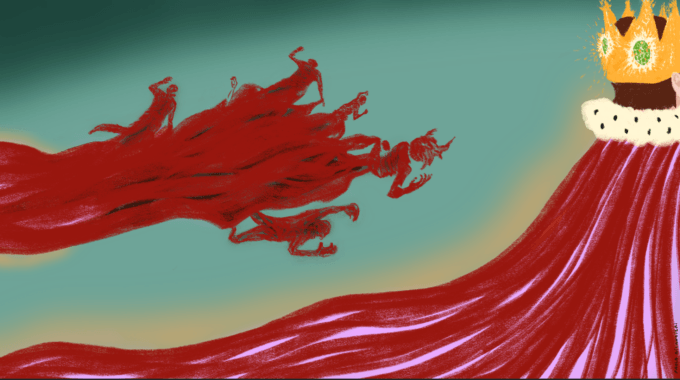
Illustration by Paola Bilancieri.
History gave us the term “Pyrrhic victory” to describe triumphs so costly they hollow out the very meaning of success. King Pyrrhus of Epirus learned this the hard way. After defeating the Romans at Heraclea and Asculum in the third century BC, he surveyed his decimated forces and reportedly declared, “One more victory over the Romans and we are completely done for.” His words endure because they capture a truth that transcends eras: a victory that destroys the victor is no victory at all.
Today, that ancient warning echoes with painful clarity in the aftermath of the war in Iran. Some leaders insist on calling the outcome a victory, but the landscape they leave behind tells a different story — one of immense civilian loss, environmental devastation, and a profound erosion of moral and political credibility. If this is victory, it resembles defeat in every meaningful sense.
The U.S.–Israel strikes on oil facilities, water infrastructure, and industrial sites have caused profound environmental damage. As a result, civilians of all ages — especially children, the elderly, people with chronic illnesses, and those displaced from their homes — bear the greatest suffering.
UNICEF has issued increasingly stark warnings that Iran’s children are paying the highest price for the violence unleashed in the country. In some of its latest statements, the agency condemns the strikes that have leveled schools and hospitals, including the attack in Minab that killed 168 girls between the ages of seven and twelve. UNICEF calls these deaths “a brutality measured in children’s lives” and insists that classrooms and clinics are protected spaces under international law. With strikes reported across eighteen provinces and families describing widespread trauma, the agency urges all parties to protect civilians, safeguard essential infrastructure, and prevent a generation from being shaped by unrelenting fear.
The human toll is immeasurable. Beyond those killed directly by bombs and missiles are the millions whose lives have been upended by displacement, hunger, disease, and the collapse of essential services.
Hospitals and medical services are under increasing strain, with disruptions affecting the delivery of critical health care. Damage to 442 health facilities across the country is disrupting access to essential services for an estimated 10 million people, according to Iran’s Ministry of Health and the Iranian Red Crescent Society (IRCS). Save the Children reports that pregnant women across the region are being forced to give birth in unsafe conditions, without essential supplies and sometimes without electricity.
Schools, hospitals, homes, bridges — the architecture of everyday life — have been reduced to rubble. These are not the trophies of victory; they are unmistakable signs of a society’s future being dismantled. In the name of victory, justice has been sidelined. Accountability has evaporated, and the international norms meant to restrain the powerful have been treated as optional. When nations abandon the principles they once pledged to uphold, the world becomes more dangerous for everyone, not only those living in the conflict zone.
Pope Leo XIV, addressing bishops of the Chaldean Catholic Church, condemned the war unequivocally. He reminded them — and the world — that no cause can justify the spilling of innocent blood. He urged them to proclaim that God does not bless conflict, and that disciples of peace cannot stand with those who wield the sword one day and drop bombs the next.
The economic costs of the attack on Iran are staggering. University of Michigan professor Justin Wolfers casts serious doubt on the Pentagon’s estimates. He argues that when all factors are considered — the Tomahawk and Patriot missiles fired, the warplanes flown and, in some cases, lost, and the rest of the gear consumed — the costs are far higher.
Only in Iran, the US and Israel bombings have killed more than 3,000 people, and injured more than ten times that number. To these must be added the medical care of all those injured and in need of permanent rehabilitation. His estimate is that the war will ultimately cost hundreds of billions of dollars.
As in all wars, arms manufacturers and dealers gain is humanity’s loss. Arms manufacturers are experiencing significant profit surges from the Iran war, driven by rising stock prices tied to new Pentagon contracts. In addition, the near shutdown in oil and gas deliveries has led some countries, like South Korea and Japan, to an increased use of dirtier fuels like coal.
The war has not resulted in almost any of the objectives set by the US and Israel. The Iranian regime has not been eliminated, just replaced by even more aggressive leaders, and there has not been a total destruction of Iran’s capacity to build missiles, which are able to reach Israeli main urban areas.
What remains after this confrontation is a landscape of ruins — quiet, but deeply incriminating. They reveal a truth that official narratives cannot conceal: when victory is measured in poisoned rivers, shattered homes, grieving families, and the collapse of justice, what has been achieved is not victory at all. It is a defeat — not only of human rights and international law, but of the very spirit that makes us
Dissecting the US-Iran Agreement
June 19, 2026
The US-Iran memorandum of understanding (MOU) has now been revealed, and it is clear why it took days before a US official read it out to reporters in advance of the signing ceremony. The deal commits the US to steps Trump vowed never to take, while for Iran there is much to celebrate despite the scale of destruction by US bombs. In a word, Iran retains the leverage it discovered it has always had—closure of the Strait of Hormuz—plus future economic benefits that will strengthen the regime.
Trump’s Shallow Defense
Trump’s defense of the deal with Iran comes down to two points.
First, the world would have faced “economic catastrophe” if the war had continued. “If we didn’t do this deal, we could have dropped more bombs for another three weeks . . . four weeks . . . two years . . . you would never have the Hormuz strait open.”
Second, he had to do something about Iran’s nuclear capability, since “If they had a nuclear weapon, they would have used it within moments.” Utter nonsense: He caused the economic crisis, dropped bombs for over three months nevertheless, and is still threatening to resume bombing if Iran doesn’t abide by the deal. (“If I don’t like it, if they don’t behave, we’ll go right back to dropping bombs right smack in the middle of their head,” Trump said.) His real worry is that the stock market kept going down—“at levels that nobody ever saw before, maybe, except for 1929,” he said at a press briefing after the G7 meeting in Paris. Trump said he didn’t want to be the next Herbert Hoover.
As for Iran having and using a nuclear weapon, well, we know—and US intelligence has concluded several times since 2003—that Iran was not close to having a nuclear weapon. Even if it had one, using it would, like North Korea, risk regime elimination.
The MOU repeats Iran’s pledge of 2015 that it “shall not procure or develop nuclear weapons.” Both sides also commit to “resolve the disposition of stockpiled enriched material pursuant to a mechanism that will be mutually agreed upon.” That translates to allowing Iran’s nuclear establishment—the facilities, the expertise, the nuclear stockpile—to remain in place, with Iran committed only to diluting its enriched uranium.
Moreover, Iran’s ballistic missiles are fine with Trump. The 2015 agreement concluded under Barack Obama was roundly criticized for not including limits on Iran’s ballistic missiles. Now Trump has agreed that Iran can have “some” missiles, since others in the region have missiles. Such generosity will not sit well with the Saudis and other Gulf governments, not to mention Israel, where the US-Iran agreement is being attacked from all sides as a Trump sellout of Israel.
So Much for Red Lines
It’s impossible to believe what Trump and other US officials say. Consider the red line that once existed on providing financial and economic benefits to Iran. Under the MOU, Iran is free to export its oil without hindrance. A $300 billion fund for reconstruction of Iran has been set up in lieu of war reparations.
Trump called it an investment fund, one in which the US would not contribute “ten cents.” Actually, it’s a reconstruction fund that supposedly will rely on private money. Yet it allows for contributions by governments from the Gulf and elsewhere. You can bet that US corporations will jump at the chance to invest in rebuilding the Iranian economy. Trump even commits the US to “terminate all types of sanctions” on Iran, though Trump later said that sanctions relief depended on whether or not Iran “behaved well.”
Trump will also have some explaining to do on returning frozen assets to Iran. His most important reason for terminating the Obama administration’s Joint Comprehensive Plan of Action (JCPOA) in 2015 was that it had rewarded Iran with the return of over $1.7 billion in funds that had been intended for the purchase of US weapons. Now Trump says: “We have taken a lot of their money. It’s not our money, it’s their money, and we froze it at a certain point in time. I guess we’re going to have to give it back, you know, if we didn’t give it back, nobody would ever invest in the dollar again.” Strange that he didn’t think of that in 2018 or in February of this year.
In summary, all the red lines have been disregarded in favor of doing business with Iran, which will put the regime in a much stronger situation than before the war. Its oil economy will be back up; roads, bridges, and other infrastructure will have money to rebuild. Sometime in the future, if the Iranian leadership judges that the country’s security is threatened, it may finally take the plunge and seek to produce a nuclear weapon.
On the political side, there’s the matter of regime change. Where once Trump & Co. were looking for a more “pragmatic” Iranian leader, under the new agreement the US accepts the regime’s legitimacy and security. The two sides now agree to “respect each other’s sovereignty and territorial integrity, and to refrain from interfering in each other’s internal affairs.” That’s an extraordinary—and welcome—step back from a longstanding US policy, carried out by Trump himself in his first term, to destabilize Iran’s economy and undermine its repressive regime.
The Devil is in the Details
Donald Trump deserves vigorous criticism and even impeachment for illegally starting a war, for causing immense and needless destruction in human life and property (including the as yet unexplained bombing of a school that killed over 100 children), and for conniving with Israel at the expense of real US security.
Yet if the agreement with Iran is followed through, it would be largely favorable to Middle East peace and to the world economy. It would mean an end to US threats to Iran, a return to safe passage in the Strait of Hormuz, Israel’s withdrawal from Lebanon, and a non-nuclear Iran. On the other hand, this agreement does not disempower the repressive regime in Iran, change the calculations of militant groups in the region, or provide security and justice for the Palestinian people.
As always, however, the devil is in the details. The MOU contains the seeds of future disagreements and confrontations, as a US official made plain when he said the MOU “commits us to quite literally nothing, but of course, if Iranians do a lot of good, then we want to reward that good behavior and transform their relationship with the Middle East and the world.”
That arrogance bodes ill. Sixty days from now, it is highly likely that the far right in Israel will still be ascendant, with dire consequences for Palestinians in Gaza and the West Bank; that the US will still be providing Israel with bombs and other military aid; that Israeli forces will still be in Lebanon (Netanyahu responded to the US-Iran agreement by saying that it “requires maintaining the security zone in southern Lebanon, and it requires that we not withdraw from it as long as Israel’s security needs demand it”); that Iran’s nuclear establishment will still be functioning; that Iran will be demanding sanctions relief, payment for passage in the Strait, and fulfillment of the $300 billion reconstruction bill; and that Iran will be jailing and executing dissidents.
French Foreign Minister Jean-Noël Barrot says France will not agree to lift United Nations Security Council sanctions on Iran unless it is satisfied by the terms of a final accord on Tehran’s nuclear programme.
Issued on: 19/06/2026 - RFI

Barrot said that the region will not achieve stability unless US talks with Iran address Tehran's ballistic missile programme and its support for allied groups.
"We need a radical change in Iran’s stance," he said in an interview with broadcaster franceinfo.
His comments followed a US-Iran pact signed electronically on Tuesday to end four months of hostilities across all fronts, including Lebanon. Under the text, Washington commits to immediately waive oil sanctions that are crippling Iran's economy.
"The return for major concessions that will be asked of Iran is the lifting of sanctions, sanctions that were taken at the United Nations," Barrot said, referring to a vote in September last year.
As a permanent member of the United Nations Security Council, France holds the power to veto any accords.
"So, as was the case 10 years ago, France will have to give its approval for the sanctions to be lifted," Barrot declared, a reference to the landmark nuclear deal that suspended international sanctions on Iran in January 2016.
France seeks greater role
The agreement reached between the United States and Iran this week calls for negotiations over Teheran's nuclear programme to take place over the next 60 days, with a final deal to be endorsed by the Security Council.
The agreement, due to be signed on Friday in Switzerland, has been postponed, Swiss authorities announced.
It followed the announcement late Thursday from the White House that US Vice President JD Vance's trip was cancelled, with a spokesperson saying the "logistics of these negotiations have never been simple or predictable".
European powers fear an inexperienced US negotiating team may fail to secure a robust nuclear agreement or address Iran’s ballistic missile programme in the next phase, risking a prolonged standoff.

After being sidelined in recent months, France, the UK and Germany now want a role in shaping the coming talks.
The three countries first engaged Iran on its nuclear programme in 2003 and later worked with then US president Barack Obama to secure the 2015 deal to curb Iran's nuclear programme in exchange for relief on sanctions.
US President Donald Trump has been disparaging of that accord, pulling the US out during his first presidency.
France's diplomatic chief also said Israel must stop its hostilities in Lebanon and the US must put pressure on Israel.
Israel on Thursday said it would not rule out carrying out attacks targeting Hezbollah beyond a military control zone in southern Lebanon, challenging the terms of the US-Iran pact that called for the respect of Lebanon’s sovereignty.
Barrot said France was still working to hold an international conference to mobilise support for the Lebanese army.
(with newswires)