Showing posts sorted by date for query UKRAINE. Sort by relevance Show all posts

Friday, December 05, 2025

THE GREAT REPLACEMENT THEORY

White House claims Europe facing "civilizational erasure" in 2 decades


Haley Ott
Fri, December 5, 2025 

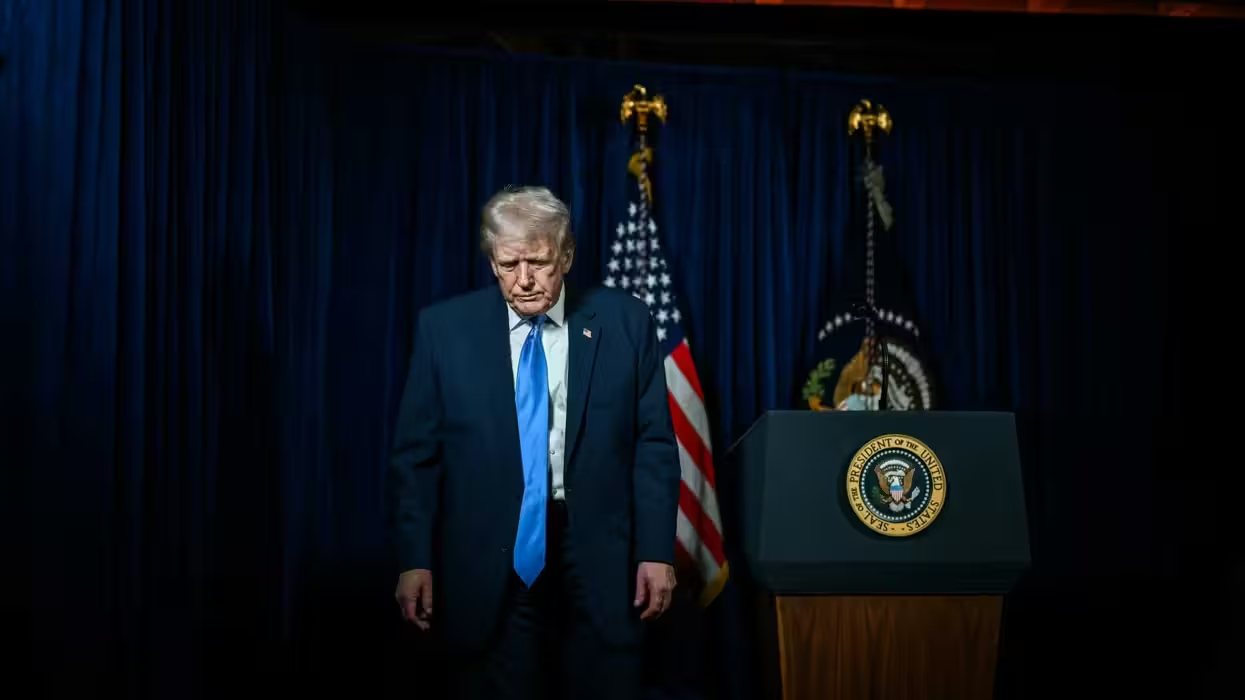
The Trump administration claims in its new National Security Strategy, published early Friday morning, that some of America's oldest allies in Europe face "the real and more stark prospect of civilizational erasure" due to immigration and the purported erosion of democratic principles.

Accusing the European Union and other unnamed transnational bodies of allowing unchecked immigration and curbing free speech, the document claims that, "should present trends continue, the continent will be unrecognizable in 20 years or less," and that "it is far from obvious whether certain European countries will have economies and militaries strong enough to remain reliable allies" to the United States.

The document claims Europe suffers from a "lack of self-confidence" that "is most evident in Europe's relationship with Russia."

It says that European countries have a "significant hard power advantage" over Russia, but because of Russia's war in Ukraine, they now "regard Russia as an existential threat."

President Trump recently proposed a plan to end the brutal war sparked by Russia's February 2022 full-scale invasion of Ukraine, which was drafted without Ukrainian or European involvement and largely reflected Russian demands.

The plan drew a careful diplomatic response from Ukraine's President Volodymyr Zelenskyy, and from America's NATO allies, which have been trying to show a united front and continue supporting Kyiv's defensive efforts.

The National Security Strategy attacks the positions of some European governments on Ukraine, accusing unspecified officials of holding "unrealistic expectations for the war" as they lead "unstable minority governments" in their own countries.

The White House strategy makes the unsubstantiated claim that the populations of some European countries want an end to the war, but that their governments are subverting democratic processes and not delivering it.

The document says "it is more than plausible that within a few decades at the latest, certain NATO members will become majority non-European. As such, it is an open question whether they will view their place in the world, or their alliance with the United States, in the same way as those who signed the NATO charter."

Some of the sentiments in the strategy document, particularly on the purported erosion of free speech rights in Europe, echo remarks delivered by Vice President JD Vance at a security conference in Germany early this year. He berated European leaders and accused some American allies of politically censoring right-wing ideas within their own nations.

The 33-page document breaks down American foreign policy for five broad regions: the Western Hemisphere, Asia, Europe, the Middle East and Africa.

The strategy notes the reestablishment of strategic stability with Russia, enabling Europe to take primary responsibility for its own defense, and "ending the perception, and preventing the reality, of NATO as a perpetually expanding alliance" among other U.S. priorities.

The document does say Europe remains "strategically and culturally vital to the United States," and that America's "goal should be to help Europe correct its current trajectory."


Scandal-mired Republican illegally shipped arms to foreign govs while in Congress: report


Matthew Chapman
December 4, 2025  
RAW STORY


Rep. Cory Mills (R-FL). (Photo credit: Gage Skidmore)

A scandal-plagued Republican congressman was illegally running an arms-export business to foreign countries while serving in the House of Representatives, reporter Roger Sollenberger revealed in an investigative Substack post — and his company to do so was run into the ground and is now in foreclosure.

Rep. Cory Mills (R-FL) has faced a series of other allegations and controversies this year, including a physical abuse claim from a woman he was involved with; an eviction from his Washington, D.C. penthouse after defaulting on $85,000 in rent; an ongoing Congressional ethics investigation into unprofessional conduct, stolen valor, and failure to disclose gifts; and accusations he hired sex workers during a 2021 trip to Afghanistan.

This new controversy involves PACEM, a security contracting company that Mills and his wife co-founded in 2014.

Congressional inquiry into Mills involves "roughly $2 million in 'personal loans' Mills gave his 2022 congressional campaign," noted Sollenberger. "But according to legal experts and a review of court records, campaign filings, and personal and corporate financial statements, those 'personal' funds appear more likely tied to a different source: tens of millions of dollars in corporate loans Mills secured from a foreign lender to bail out his moribund weapons dealing business."

"The amount of PACEM’s debt is existential. Today, PACEM owes a whopping $66 million, according to recent court filings. That’s anywhere between six and 33 times what Mills’s disclosures say the company is worth," wrote Sollenberger. Making matters worse, Mills, who serves on the House Armed Services and Foreign Affairs Committees, has never disclosed any of this debt on his ethics forms, despite the fact that since 2019, he has been personally liable for the debt, requiring it to be disclosed.

Over the summer, Ninepoint Partners, a Canadian asset management firm that serves as PACEM's lender, terminated their debt fund and moved to foreclose on PACEM's factory.

Even further complicating all this, PACEM was not just a federal contractor but also exporting arms to foreign governments, including Ukraine, as it fights to defend itself from Russian invasion. "Legal and industry experts, citing federal statutes, told me that, as with PACEM’s government contracts, Mills’s ownership means those exports are likely illegal in the first place," said the report.

Sollenberger, who has conducted a nine-month investigation into Mills, has promised more revelations about the embattled congressman are coming.

Stop The Drive To War With Venezuela – OpEd


LIBERTARIAN ANTI-IMPERIALIST WAR

December 4, 2025 
MISES
By Ryan McMaken

On October 23, the Trump administration announced to Congress that it is planning “land attacks” within Venezuelan territory. Such attacks, of course, would be acts of war, and there are no plans for Congress to declare war on any foreign state.

Moreover, on Tuesday, Trump declared that any country deemed by the administration to be making drugs for US markets is a possible target for US military attack. Trump also stated that military strikes on Venezuela territory would “start very soon.”

Meanwhile, the administration has been using the US military to engage in extrajudicial killings of persons in the Caribbean alleged to be “narco-terrorists.” The administration admits it doesn’t actually know who these people are. The US military is simply killing people without any evidence of actual crimes or of a military threat. Nor has the administration attempted to offer any evidence. The justification for the killings is simply—to use a phrase from meme culture—”trust me, bro.”

The attacks are also meant to serve as a provocation and a threat to the Venezuelan regime, and to serve as an “example” of what will be done on Venezuelan territory if the current Venezuelan president does not go into exile.

So much for the president who, while a candidate, claimed he would oppose any new wars and end existing ones.

Instead, what we have now is a president who advocates for a new war in South America—in addition to his proxy wars in Palestine and Ukraine—and has no intention of adhering to any sort of rule of law in doing so.

So, this is yet another case of “here we go again.” Every few years, no matter who is president, the US regime—i.e., the “foreign policy blob“—comes up with yet another country that we’re told requires “regime change.” And, as with all drives to war, the result is more runaway federal spending, more disregard for the rule of law, and more unmitigated power for the American executive state.


Forget about the US Constitution


By now it’s very quaint to protest the American warfare state by suggesting that presidents should adhere to the US constitution. No president has taken the US constitution seriously in decades, and Congress has done precious little about it.

Nonetheless, whatever opposition can be mustered to the untrammeled bellicosity of US presidents is a good thing. This week, a handful of members of Congress introduced legislation prohibiting Trump from launching “hostilities within or against Venezuela” without congressional approval.

Only a very small handful of Republicans have spoken out against the president on the administration’s accelerating threats and on the killings of supposed “narco-terrorists” in boats outside US territory. Unsurprisingly, Thomas Massie of Kentucky supports the war-powers legislation. Senator Rand Paul, meanwhile, has condemned the killings of passengers and operators on “drug” boats. And rightly so. As Judge Andrew Napolitano noted this week, one of the most recent “drug-boat” attacks clearly violated international law when the US disabled one boat, and then, rather than arrest the survivors, simply killed them. Napolitano correctly described this as a war crime.

Of course, even if Congress does pass legislation reining in the President’s power to commit acts of war against Venezuela, it’s unclear the legislation would have any effect. The US regime is far beyond accepting any legal limits on warmaking imposed by the US constitution—a document that is obviously defunct except in the minds of those clinging to a romantic fantasy about the state of modern American politics.

A Threat to Actual Americans?

It’s a given that the rule of law will be ignored in this conflict, just as it has been ignored for many decades. But an important political question is this: does the Venezuelan regime pose any threat to actual Americans?

With questions like these, the burden of proof is always on those who want a new war and are demanding tax dollars to do it. So where is the evidence of a Venezuelan threat? If there were one posed by the actual regime, we’d be sure to hear about it, since it would greatly help the warmongers. But, it seems the best the administration can do is deem the Venezuelan regime as a “terrorist” organization. But here they don’t even make the case for any real terrorism—such as the bombing of buildings. No, the administration has been clinging to the idea that Venezuela is sponsoring “narco terrorism.” This term is extremely flexible, and could include anything from cartel activity to the mere selling of drugs within the United States.

(The GOP, the party of “personal responsibility,” now tells us that when Americans voluntarily buy drugs, then it’s the drug dealer’s fault. I wonder if these people also think that gun crime is the fault of gun merchants.)

In any case, all of this is a very long way from “weapons of mass destruction” or “dirty bombs” or even anthrax in your mail—the sort of things that could plausibly be called terrorism. No, the new “terrorism” requiring a US bombing campaign against Venezuela is apparently some people on small boats that the regime swears—cross-my-heart-and-hope-to-die—are totally “drug boats.”

In the end, the “narco-terrorism” angle is simply political cover for helping carry out the longtime plans of neoconservatives who have dreamed for many years of installing a US puppet in Venezuela. The fact that Trump recently pardoned Honduran drug lord Juan Orlando Hernandez, who served only one year of a 45-year sentence, illustrates that the administration is not actually concerned about drug trafficking.

Trump’s neoconservative bona fides are now firmly in place, after all. This is a president who vehemently supports Senator Lindsey Graham, one of the most committed warmongering neoconservatives in Congress. The administration also has resurrected the career of Elliott Abrams who was appointed during the first Trump term as a “Special Representative” for both Iran and Venezuela. Abrams—a die-hard Zionist, of course—has been working for many years for regime change in Venezuela, and Trump may be the one to get it for him. Abram’s most recent column at Foreign Affairs shows he isn’t giving up.
Headed Toward another Regime Change “Success”?

It’s always difficult to guess any politician’s true intentions, and this is certainly true of Trump. Regime change, in any case, remains one of the worst options going forward. After all, what success has the US had with regime change in recent decades? The US spent twenty years replacing the Taliban with the Taliban in Afghanistan. After years of allying with terrorists in Syria to effect regime change, al-Qaeda and ISIS terrorists are now the dictators of Syria. Trump now invites Syrian terrorists to the White House. In Iraq, the country’s ancient Christian community was decimated in the wake of the US invasion. The standard of living there utterly collapsed, and the Iraqi regime is now far more friendly toward Iran that it was under Saddam Hussein. Libya is now a hotbed for terrorism with slave markets and a ruined economy. These are the American regime’s “success” stories.

What horrors await the people of Venezuela if the US carries out regime change there? I hope we don’t find out. But one likely outcome is this: an enormous wave of Venezuelan refugees moving north.

Nonetheless, perennial calls for regime change somewhere are now standard operating procedure in Washington, with or without Trump in the White House. Every minute of every day, the American empire is dreaming up new wars and new excuses for new wars. Trump apparently has no problem with playing along so long as it helps him spend more money on key constituents, especially his Zionist funders and the corporate welfare queens at organizations like Raytheon.

Some “MAGA” supporters have expressed disappointment in the administration’s refusal to do much to change course on this. But, as Tom Mullen recently noted:


Part of the problem is that Trump’s anti-war platform was never as radical as the true American First crowd would like to believe. He talks a good game about ending “forever wars,” but he doesn’t question the core of the empire—the global standing army, the 800-plus bases warehousing hundreds of thousands of troops overseas, and the non-defensive use of them, as long as the war isn’t a “forever war.”

Indeed, Trump’s posture reminds one of Madeleine Albright’s famous complaint to Colin Powell during the Clinton Years: “What’s the point of having this superb military that you’re always talking about if we can’t use it?”

An empire with a huge offensive military is likely to use it. And Donald Trump clearly likes the idea.


About the author: Ryan McMaken (@ryanmcmaken) is editor in chief at the Mises Institute, a former economist for the State of Colorado, and the author of two books: Breaking Away: The Case of Secession, Radical Decentralization, and Smaller Polities and Commie Cowboys: The Bourgeoisie and the Nation-State in the Western Genre. He is also the editor of The Struggle for Liberty: A Libertarian History of Political Thought. Ryan has a bachelor’s degree in economics and a master’s degree in public policy, finance, and international relations from the University of Colorado. Send in your article submissions for the Mises Wire and Power and Market, but read article guidelines first.
Source: This article was published by the Mises Institute


MISES

The Mises Institute, founded in 1982, teaches the scholarship of Austrian economics, freedom, and peace. The liberal intellectual tradition of Ludwig von Mises (1881-1973) and Murray N. Rothbard (1926-1995) guides us. Accordingly, the Mises Institute seeks a profound and radical shift in the intellectual climate: away from statism and toward a private property order. The Mises Institute encourages critical historical research, and stands against political correctness.


‘Drill, Baby, Drill’: Europe Aims To Reduce Reliance on US LNG

  • High energy prices are forcing Europe to reconsider its anti-hydrocarbon stance.

  • Greece, Italy, and the UK are reopening offshore oil and gas exploration as domestic output becomes essential to curb reliance on costly LNG imports.

  • This energy security pivot clashes with Europe’s long-term climate goals and trade promises.

Notions of renewable energy and reducing greenhouse gases are nice, but costly energy prices are forcing a shift in Europe’s priorities.

Reuters reported this week that two members of the European Union — Greece and Italy — and the UK are loosening their opposition to new oil and gas drilling, even as the continent builds out renewables to slash greenhouse gas emissions and meet climate targets.

Greece in November issued its first offshore oil and gas exploration license in more than 40 years to a trio of companies including Exxon Mobil. The Block 2 license in the Ionian Sea could hold up to 200 billion cubic meters of gas; drilling is expected to begin in late 2026 or 2027.

The country also awarded Chevron and Helleniq Energy exploration rights in the blocks south of the Peloponnese peninsula, Reuters said.

The Italian government too is considering reviving offshore oil and gas exploration, which it shelved in 2019.

And in Britain, the UK government last week loosened its ban on new exploration activity in the North Sea; companies will be allowed to expand production in existing fields. Reuters said the government is expected to give the green light to two major new fields in the coming months.

Meanwhile, a major discovery in Poland earlier this year has sparked interest in the country’s offshore prospects, while in Norway, state-owned Equinor plans to drill 250 exploration wells over the next decade.

EU member countries bucking the trend include Denmark, which banned all new exploration in 2020; and the Netherlands, which nixed new onshore fields in 2023 but still allows offshore exploration.

The change in tack caused by the 2022 energy shock when Russia invaded Ukraine means that natural gas will likely be part of Europe’s energy paradigm for decades.

Reuters said the European Union depends on gas imports for 85% of its consumption, according to Eurostat, compared with a peak domestic production of 50% of demand in the 1990s.

The top importing country is the United States by far. An October Reuters article said the United States will supply around 70% of Europe's LNG in 2026-2029, up from 58% so far this year, as the EU plans to ban Russian LNG from 2027 and Russian gas from 2028, Energy Aspects analysts said.

The US today accounts for 16.5% of the EU’s total gas consumption.

(It’s important to note that, despite Western sanctions on Russia, the EU still buys plenty of gas from there. In fact, it was the bloc’s second-largest importer of LNG in 2024. The EU has imposed several sanctions on Russian energy products since the war started, but not on natural gas delivered for direct use by member states (neither piped nor LNG), states Cipher News.

Europe’s dependency on US LNG is increasing due to lower storage and a decline in pipeline flows from Russia and Algeria. The continent will need to import up to 160 additional LNG cargoes this winter. LNG imports will jump from 820 tankers this year from 660 last year, representing 48% of all EU gas supply, Reuters said.

Developing domestic energy sources could reduce Europe’s reliance on gas imports and potentially lower the costs of foreign fuel. According to the Institute for Energy Economics and Financial Analysis (IEEFA)The EU paid about €225 billion for LNG imports in the last three years, including €100 billion for US LNG. This high amount is partly because US LNG is more expensive for EU buyers than LNG from any other supplier.

But for a couple of reasons, the energy security push is puzzling.

For one, it contradicts Europe’s long-term climate aspirations. The EU and Britain both aim to achieve carbon neutrality by 2050 by expanding renewables and phasing out fossil fuels.

The IEEFA argues that dependency on natural gas could lead the EU to miss its 2040 target of reducing net greenhouse gas emissions by 90% compared to 1990.

The IEEFA also notes that the weighted average cost of utility-scale solar PV projects in Europe has more than halved in the last decade. The organization adds that there have also been significant cost declines for onshore and offshore wind.

Second, it appears to contradict a promise the EU made earlier this year to buy more US LNG. The Trump administration and the bloc reached a trade deal whereby the EU commits to purchasing $250 billion in US energy products (mostly LNG) a year for the next three years, totaling $750 billion in 2028. In exchange, the US lowered tariffs on EU goods from 30% to 15% and secured an additional $600B in non-energy investments from the EU.

The IEEFA says the annual $250 billion is unrealistic and risks placing too much reliance on one supplier, i.e., the US:

To meet the commitment of buying US$250 billion (€215 billion) of energy products from the US per year, the EU would need to source about 70% of its energy imports from the country. The deal effectively ties the bloc's energy supply to a single seller.

Meanwhile, the United States is exporting LNG in record volumes.

The federal government is considering further steps to speed up the buildout of liquefied natural gas export infrastructure as flows of natural gas to LNG plants hit a record high.

The Federal Energy Regulatory Commission's chairwoman announced the coming changes in a statement that said, in part, “Energy infrastructure needs to be built now.”

The Energy Information Administration projects that if all currently planned LNG facilities get built, it would more than double the United States' liquefaction capacity.

The FERC’s news coincided with data suggesting the United States was on track to post another record month for LNG exports as Europe soaks in whatever volumes are available to stock up on gas ahead of winter.


Argentina Sees Greenlight for $20 Billion LNG Project in Mid-2026


Argentina’s state-run energy firm YPF expects to take together with its foreign partners the final investment decision for the $20-billion Argentina LNG project in the middle of 2026, YPF’s chief executive Horacio Marin told Reuters on Thursday.

YPF, Italy’s Eni, and XRG, the new energy investment company of Abu Dhabi’s national oil firm ADNOC, are developing the Argentina LNG (ARGLNG) project. Argentina LNG will be an integrated upstream and midstream gas development project designed to develop the resources of the huge shale basin Vaca Muerta field and serve international markets, exporting LNG in various phases, with first exports potentially by 2030.

Eni and YPF signed in October the Final Technical Project Description, which involves gas production, processing, transportation, and liquefaction for export through two floating gas liquefaction units (FLNG) with a capacity of 6 million tons per year each.
Last month, Eni and YPF signed a non-binding agreement with XRG for the potential involvement of ADNOC’s company in the 12 MTPA phase of the integrated project. 

LNG exports from the 12 MTPA project phase involving Eni and XRG will likely start in 2030 or 2031, Marin said told Reuters today. 

Early next year, YPF will retain JP Morgan to seek project financing for this phase, the executive said, adding that project financing usually covers 70% to 80% of similar large-scale projects. 

Huge shale gas reserves are laying the foundations of pipeline and LNG exports out of Argentina, which could make South America’s second-largest economy a major force in regional and global gas supply. 

Argentina has the resource base—the vast unconventional reserves in the Vaca Muerta shale basin in the Neuquen province. But it needs to build up infrastructure to ship the gas from supply centers to interstate regional pipelines and planned LNG export facilities. 

Argentina could see its natural gas production peak at 180 million cubic feet per day (Mmcd) by 2040 under a base-case scenario, with the potential to reach as high as 270 Mmcd if the country successfully develops all its planned LNG export projects, Wood Mackenzie said in a July outlook on the country’s gas and power markets.  

By Michael Kern for Oilprice.com 


The Trump Peace Plan: A Study in Diplomatic Malfeasance

PUTIN'S MAN IN AMERIKA


 December 3, 2025

Image by charlesdeluvio.

Coaching Russia

The official US line on how the peace plan to end the Ukraine war emerged has Steve Witkoff, Trump’s special envoy, and Jared Kushner developing it, Marco Rubio endorsing it, and then Russia assenting to it. But that story does not hold up.

First, Rubio told two Senators that the plan was made in Moscow and was one-sided. Later, having been told this was Trump’s plan, he changed his story to say he was all aboard.

Then Bloomberg reported on a telephone conversation between Witkoff and Yuri Ushakov, a foreign policy aide to Vladimir Putin. In it, Witkoff tells Yuri, “here’s what I would do.” Yuri is all ears. Witkoff advises that the Russians compliment Trump on his peace initiative and say Russia supports it. Then “maybe we set out like a 20-point peace proposal, just like we did in Gaza.”

Don Bacon, a Republican congressman, said of Witkoff: “Would a Russian paid agent do less than he? He should be fired.”

He won’t be, of course. Asked about the conversation, Trump said: “I haven’t heard it, but it’s a standard thing. That’s what a deal maker does.”

In other words, he knew all about it and supported Witkoff. Why not? These are real estate guys, and that’s the way they always operate. In fact, Trump said he had “thought this [deal] would be one of the easier ones because of my relationship with President Putin. But this is probably one of the more difficult ones because there’s a lot of hatred.”

Well, not just hatred but kickback from all the parties, including the Russians, who continue to believe that they can bomb their way to victory, notwithstanding the enormous benefits for them of the 28-point peace proposal. Putin said the plan “forms the basis for future agreements,” but “if they [the Ukrainians] don’t withdraw” from all the territory in eastern Ukraine, “we will achieve this through military means.” As usual, the Russians haven’t abandoned their maximalist goals at all.

A Recipe for Failure

Little wonder that the Ukrainians and other Europeans reacted so negatively to the peace plan and devised their own. The Trump-Russia plan was as partial to Moscow as the Gaza plan is to Israel’s far right. The European and Ukrainian opposition has forced Trump to move from a take-it-or-leave-it demand to not-my-final-offer. Trump must feel deflated; his usual optimism about a quick agreement has proven unwarranted. He and his advisers refused to consult with all the parties to the conflict—a recipe for failure.

The other notable thing about the administration’s conduct is its chaotic, self-interested diplomacy. The Secretary of State/National Security Adviser isn’t in charge. Instead, it’s Witkoff and Kushner (wasn’t he supposed to be out of this business?), wheeling and dealing.

Their eyes, and probably Trump’s as well, are on the potential financial rewards from an agreement with Moscow, as Anne Applebaum suggests: the investment opportunities in energy, rare earth minerals in the Arctic, Russian infrastructure, and resources, according to the plan document.

That approach, which ignores Ukraine’s and Europe’s security, must leave heads spinning, particularly among Russia and Europe experts in the State Department and the intelligence community. But then, that’s Trumpworld, where the personal interest is the national interest.

Mel Gurtov is Professor Emeritus of Political Science at Portland State University, Editor-in-Chief of Asian Perspective, an international affairs quarterly and blogs at In the Human Interest.


Most Brits believe Trump is a hindrance to

peace in Ukraine – not a help


Gabrielle Pickard-Whitehead 
30 November, 2025 


The President has insisted he could end the war in a single day, an assertion that has fuelled scepticism.


Another deadly Russian barrage of missiles and drones struck Kyiv this week, killing at least seven people and injuring 20 more.

The attack came as the Trump administration sought to maintain diplomatic momentum behind its efforts to end the nearly four-year-old war.

American and Russian officials met on Tuesday in Abu Dhabi, to discuss a proposed peace deal. The plan, which initially heavily favoured Russia, was revised and streamlined during talks between Ukraine and the Trump administration over the weekend. President Zelensky said Moscow’s assault on Kyiv directly contradicted ongoing efforts to secure peace.

After presenting a 28-point peace plan, Donald Trump claimed Russia was “making concessions” in negotiations to end the war and that Kyiv was “happy” with the progress.

But for many in Britain, Trump’s optimism rings hollow. The President has insisted he could end the war in a single day, an assertion that has fuelled scepticism.

Polling by More in Common, published this week, found that nearly half (47 percent) of British voters view the US president as a hindrance to efforts to stop the fighting in Ukraine. Only 21 percent believe he is helping, while another 21 percent say he is neither a help nor a hindrance. Eleven percent are unsure.

The survey also showed there is overwhelming British support for Ukraine’s sovereignty. 75 percent of voters believe it is important for the UK to stand by Kyiv, compared with just 8 percent who think it is not.

The poll was conducted among 2,062 British adults between November 22 and 24, as US and Ukrainian officials worked on a peace agreement in Geneva, almost four years after Russia launched its full-scale invasion.

British voters have consistently backed aiding Ukraine, a position shared across much of Britain’s political spectrum.

“One rare public opinion constant since Russia’s invasion of Ukraine has been Brits steadfast support for Ukraine and belief that Ukraine’s future matters not just for the country itself but for the UK today,” said More in Common’s Executive Director Luke Tryl.

“As Zelenskyy faces pressure to adopt a peace plan, Brits continue to say that concessions on Russia’s terms are unacceptable and want our leaders to help secure a better deal.”


France and Germany warn US could 'betray' Ukraine in push for peace, Speigel reports


French President Emmanuel Macron and German Chancellor Friedrich Merz warned Ukraine that the US might "betray" Kyiv during peace negotiations with Russia, according to a confidential call reported by German magazine Spiegel.


Issued on: 04/12/2025 
By: FRANCE 24

French President Emmanuel Macron and German Chancellor Friedrich Merz have voiced severe scepticism about efforts by the US government and its envoys to negotiate a peace between Ukraine and Russia, according to a transcript of a confidential call cited by German magazine Spiegel.

In a report on Thursday, Spiegel said that during the call with Ukrainian President Volodymyr Zelensky and other European leaders, Macron warned that the United States could "betray" Kyiv when it comes to territorial concessions and guarantees to secure any deal.

"There is a chance that the US will betray Ukraine on territory without clarity on security guarantees," he said, according to the magazine.

In the call that took place on Monday, Merz warned Zelensky that US negotiators are "playing games" and that he should be "very careful" for the next few days, the Spiegel report said.


Berlin declined to comment, while the French president's office did not immediately respond to a request for comment.

European leaders on Monday rallied to show support for Zelensky after US-Ukrainian talks to revise a peace proposal that initially favoured Russia.

Russian President Vladimir Putin received US envoys Steve Witkoff and Jared Kushner in the Kremlin on Tuesday.

(FRANCE 24 with Reuters)


The Global impact of the war in Ukraine – Kate Hudson, CND


“According to the UN World Food Programme figure, just in the war’s first year the number of people suffering from acute food insecurity in the 81 countries they monitor jumped by 17%”

CND Vice President Kate Hudson spoke at the CND conference a few days after Trump’s 28-point peace plan was made public, setting out why the world could be on course for war in Europe and the dangerous possibility of a nuclear conflict. You can read an edited version of her speech published below:

There is not only a European element to the war in Ukraine, it also has a global impact. I want to touch on a few of those global elements, including the economy and the climate crisis.

The war is pushing the cost of living up
There is an enormous impact on the global economy. That’s what’s making our energy and food prices higher here in the UK. But of course, it’s making them higher and scarcer across the world as well, resulting in increased inflation, slower growth, disruption of supply chains, and economic uncertainty. Actually, these cone on top of the negative aspects of the COVID-19 economic experience which we saw resulted in the massive inflation at the time. The war, coming almost directly after, has doubled down on a lot of those economic problems.

The Ukraine war is making a big contribution to de-globalisation, which is something we’ve seen over the last few years, and a fragmentation of the global political economy. This kind of economic flux is affecting more than Europe; it’s having an effect worldwide. In some countries of course, which are very heavily reliant on imports, things like food and fuel are very much more expensive. In fact, we’ve seen a major increase in global food insecurity, with medium to long-term impacts on malnutrition and social unrest.

According to the UN World Food Programme figure, just in the war’s first year the number of people suffering from acute food insecurity in the 81 countries they monitor jumped by 17% –   from 276 million to 323 million. That figure has increased by another 10% every year. So it’s an escalating problem, particularly for countries in the global south.

The war has generated more greenhouse gas emissions than several EU countries combined
As well as the economic impact, there is a climate impact as well. I’m sure we’ve all got a general impression about that. There are massively increased greenhouse gas emissions, over 230 million tonnes of carbon dioxide in the first three years of the conflict. That’s equivalent to the combined emissions of Austria, Hungary, the Czech Republic and Slovakia.

The source of those is the war itself, the military activity taking place. There is also the destruction of the infrastructure and subsequent need for reconstruction. In the reconstruction process, there will be carbon emissions too. There are terrible fires both from military action and damage to facilities like oil refineries. They are really pumping out carbon emissions too. There is also direct environmental damage like pollution, oil spills, threats to biodiversity and so on. Those have long-lasting effects on Russia and Ukraine, but their impact obviously spills out beyond.

The third impact I want to talk about is the very immediate risks that result from global polarisation. We see this all the time: the US and Europe on the one side, the ‘liberal democracies’, posed against an increasing alliance between Russia and China. That is the kind of global polarization narrative we are seeing. The world is in a state of flux over this.

Trump’s 28-point peace plan includes asset stripping and war profiteering
One of the things that really struck me about the new peace plan is the possibility of improving US-Russian cooperation. It looks like Trump or his advisors are building in the kind of cooperation and reconstruction that is based on asset stripping and making profits from Ukraine! That is embedded within the 28 point plan. The narrative we have, which I think is correct, is that Trump wants Europe to deal with the problem of Russia, while he deals with the problem of China. That is an underlying dynamic within the peace plan.

At the same time, Trump seem to want to hedge his bets by doing deals and get better relations with Russia for himself and the US. Of course, that’s annoying Europe. It is not only a kind of flux in the global political economy, but in international relations. as well.

And finally, to touch on the wider global dynamic of the peace plan – as unfortunately, we tend always to focus on what’s happening in Europe and North America, a kind of western Eurocentric perspective. The attitudes from the global South are very interesting on this, I’m sure you’ve all have been aware of this. The approach of the global South has generally been one of active non-alignment or neutrality in the war. They have refused to sign up to the US condemn-and-attack approach to Russia or to participate in sanctions.

The global South is not buying into the US narrative
I think it’s pretty obvious to this audience why: there is a big element of distrust of western motives, double standards, based on the experience of colonialism. The global South has a preference, as does CND, for a multipolar world, so they’re not buying into the US narrative. Many see BRICS as a route to a more just order.

For CND, the issue of how to move forward as a movement is a difficult question. As you probably know, CND has opposed NATO since 1960s when the great intellectual Stuart Hall moved a motion at CND conference. That’s been our position ever since, and it’s correct one for the reasons that we all know.

In my experience in CND, the Ukraine war has been the most difficult point for us. We are anti-war and pro-peace as is the peace movement and our allies across Europe. But the US and NATO does affects what you call the peace periphery and some of our allies too. There are two obvious examples. The Green Party, whom CND has always worked well with, have changed their position on NATO, I think largely in response to the government narrative.

The second is the TUC. Three years ago, we saw pro-military spending and strong support for Ukraine coming up. This has now been somewhat reversed at the recent TUC. As you probably know that there was a for the peace and anti-war movement with a motion against military spending. Nevertheless, that win was based on a welfare not warfare argument, not on the principled issue of NATO, and not about being against the Ukraine war continuing and getting a peace settlement.

CND has to get all the political implications across
So in conclusion, although we’ve made some headway, and there is a growing desire for a settlement particularly among the people of Ukraine, we have to do a lot of work to do, to make sure the politics is understood.

So although we’ve made some headway and as people, as the speakers have said, the kind of strong desire, particularly in Ukraine for a settlement, we have to do a lot of work to fight to make sure the politics of it is understood. Because if we don’t understand and fight on the politics of it, then things will keep on going wrong.


  • Kate Hudson is the Vice-President of the Campaign for Nuclear Disarmament (CND). 
  • You can follow Kate on Twitter/X; and follow the CND on Facebook, Instagram and Twitter/X.
  • Kate’s speech was originally published by Labour CND here.