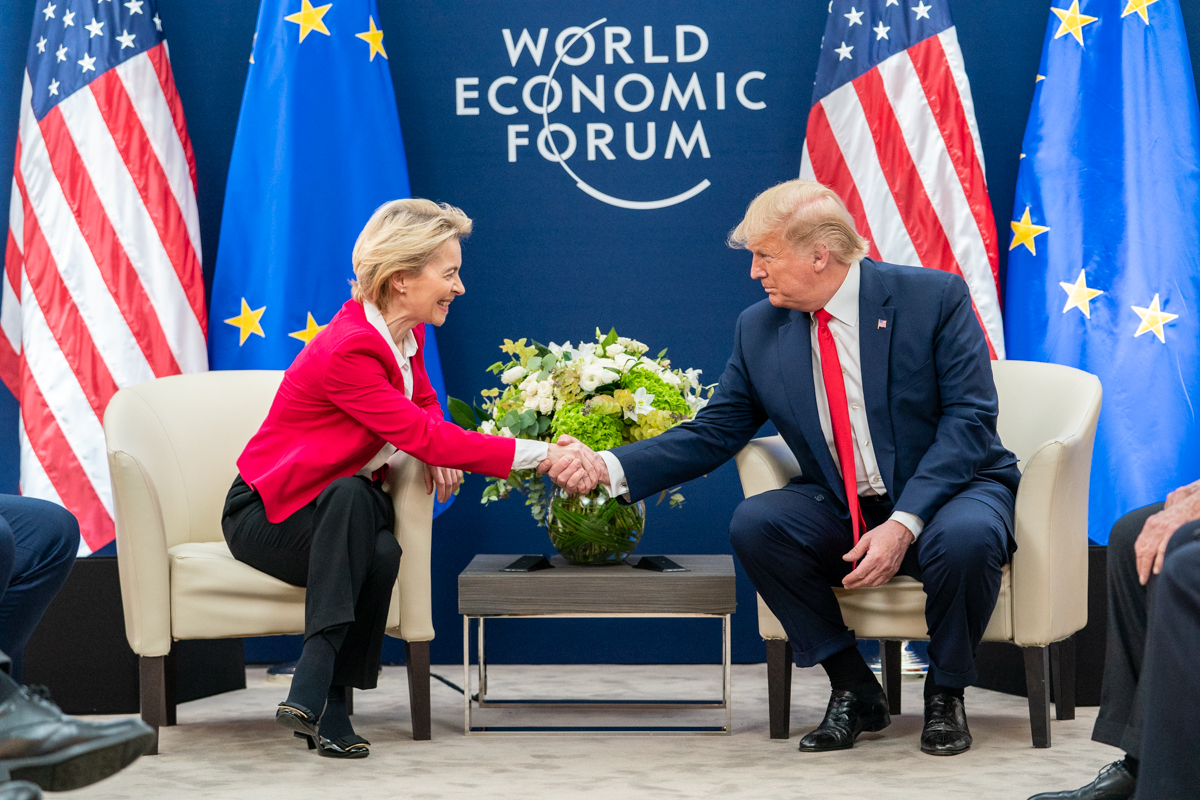
US President Donald Trump arrived at the Economic World Forum in Davos on Wednesday, where he used his keynote speech to hector world leaders in the audience, boast about his domestic policies and reiterate claims that Washington should own Greenland.
Issued on: 21/01/2026
By: FRANCE 24
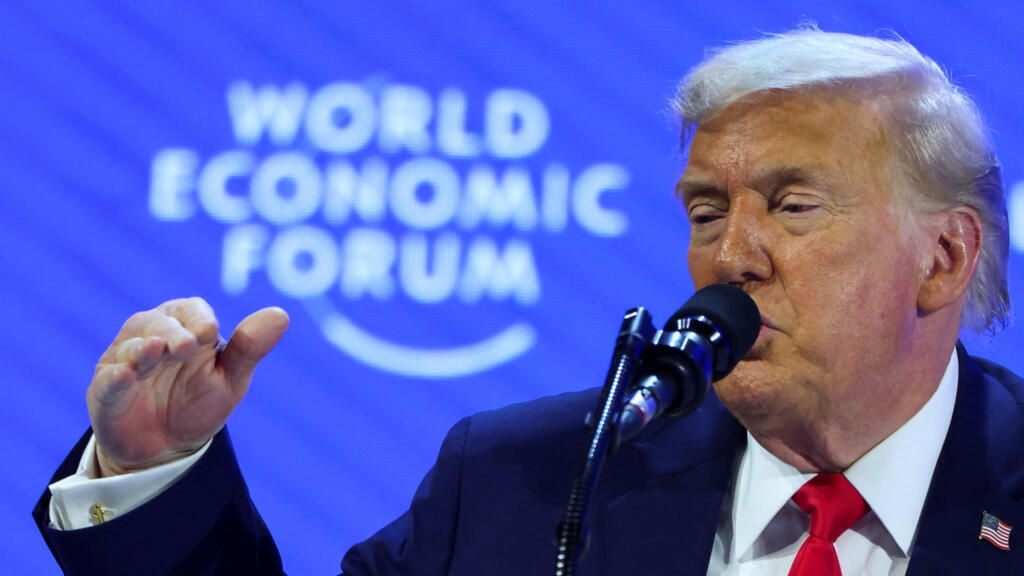
President Donald Trump arrived at the international forum at Davos amid soaring tensions as he threatened steep US import taxes on Denmark and seven other allies unless they negotiate a transfer of the semi-autonomous territory of Greenland – a concession the European leaders indicated they are not willing to make.
Trump said the tariffs would start at 10 percent in February and climb to 25 percent in June, rates that would be high enough to increase costs and slow growth, potentially hurting Trump’s efforts to tamp down the high cost of living in the US.
The president in a text message that circulated among European officials this week linked his aggressive stance on Greenland to last year’s decision not to award him the Nobel Peace Prize. In the message, he told Norway’s Prime Minister Jonas Gahr Store that he no longer felt “an obligation to think purely of Peace”.
Replay: US President Donald Trump gives speech at Davos forum
1:11:00!!!
Onlookers, including some skiers, lined the route as Trump’s motorcade arrived in the Swiss mountain town. Some made obscene gestures, and one held up a paper cursing the president.
Billionaires and business leaders nonetheless sought seats inside the forum’s Congress Hall, which had a capacity of around 1,000, to hear Trump. By the time he began, it was standing room only.
Trump addresses World Economic Forum in Davos, making many "false statements"
04:15
Trump is expected to have around five bilateral meetings with foreign leaders while at the forum, where more than 60 other heads of state are in attendance, though further details weren't provided.
Here are the highlights of Trump's speech:
The US 'will not take Greenland by force'
Trump insisted he wants to “get Greenland, including right, title and ownership”, but he said he wouldn’t employ force to achieve that.
“What I’m asking for is a piece of ice, cold and poorly located,” Trump said, declaring of NATO: “It’s a very small ask compared to what we have given them for many, many decades.”
He urged NATO to allow the US to take Greenland from Denmark and added an extraordinary warning, saying alliance members can say yes “and we’ll be very appreciative. Or you can say, ‘No,’ and we will remember.”
“This enormous unsecured island is actually part of North America,” Trump said. “That’s our territory.”
On several occasions during a speech which lasted more than an hour, Trump mistakenly referred to Greenland as Iceland.
Trump "does not appear to give regard to US softpower" as he addresses economic leaders
05:55
Trump said that the US is booming but Europe is “not heading in the right direction" which he blamed on European leaders' policy missteps in areas ranging from wind power and the environment to immigration and geopolitics.
“I love Europe and I want to see Europe go good, but it’s not heading in the right direction,” Trump said. He added, “We want strong allies, not seriously weakened ones."
Trump also proclaimed that, “When America booms the whole world booms,” and, “You all follow us down and you follow us up.”
Macron 'acting tough', Carney 'should be grateful'
Trump took a hectoring tone, chastising the United States' European allies for their insolence and disloyalty to the US.
He singled out French President Emmanuel Macron, taking aim at sunglasses his French counterpart wore a day earlier for health issues and accusing him of playing tough over pharmaceutical price negotiations.
"I watched him yesterday with those beautiful sunglasses – what the hell happened? But I watched him sort of be tough" over his hesitation to raise drug prices to be more in line with US rates, Trump said in an address to the economic forum.
"I said, 'Emmanuel you've been taking advantage of the United States for 30 years with prescription drugs. You really should do it, and you will do it,'" Trump said.
Trump also targeted Canadian Prime Minister Mark Carney saying he "should be grateful" to Washington, a day after Carney warned of a rupture to the US-led global system.
"Canada lives because of the United States. Remember that, Mark, the next time you make your statements," Trump added.
No concessions for affordable housing
Trump planned to use his Davos appearance to talk about making housing more attainable and other affordability issues that are top priorities for Americans, but his appearance at the gathering of global elites focused more on his gripes with other countries.
When he finally did mention housing, meanwhile, Trump suggested he didn't support a measure to encourage affordability. He said bringing down rising home prices hurts property values and makes homeowners who once felt wealthy because of the equity in their houses feel poorer.
White House officials had promoted the speech as a moment for Trump to try to rekindle populist support back in the US, where many voters who backed him in 2024 view affordability as a major problem.
About six in 10 US adults now say that Trump has hurt the cost of living, according to the latest survey by The Associated Press-NORC Center for Public Affairs Research.
US home sales are at a 30-year low with rising prices and elevated mortgage rates keeping many prospective buyers out of the market. So far, Trump has announced plans to buy $200 billion in mortgage securities to help lower interest rates on home loans, and has called for a ban on large financial companies buying houses.
(FRANCE 24 with AP and Reuters)
Trump’s Greenland Delusion Runs Aground in Davos
Trump is a narcissistic, psychopathic bully. But a weak one.
I started listening to Trump’s speech at Davos with anger and outrage. But as he went on and on, I slowly felt a growing sense of relief. I realised that all his bullying, taunts and threats reflected weakness. He sounded like a needy, spoilt child frustrated that he could not get his own way.
His deranged tendencies were on full display with repeated hints at all the damage he could cause to those who did not bend to his will – like a mafia boss threatening to cut off a former partner’s fingers if he did not cooperate. “I really like you, actually. I don’t want to hurt you. It’s a shame. I tried my best to be nice. But, I gotta do what I gotta do.”
His neediness was on full display with his repeated mentions of how much everyone loves him, and appreciates his achievements. Only someone unsure of his popularity needs to keep claiming he has lots of friends.
His childishness was on full display with his petty taunts and jibes at other global figures – such as French President Emmanuel Macron, Canadian Premier Mark Carney, California Gavin Newsom, and Fed Chair Jerome Powell, even as he simultaneously claimed that they were “great guys, actually” and that he liked them.
His vanity was on full display with his repeated boasts about how brilliant he was, and how great America had become under his leadership.
His insecurity was on full display with his continued need to lash out at defeated foes, such as Joe Biden. A truly self-confident person would not need to repeatedly big up his own alleged achievements in office, rather than letting them speak for themselves.
His self-delusion was on full display with his claims that he really cares about Europe and NATO, respects the people of Greenland and Denmark, and is only trying to do what’s best for them. A genuine friend does not bully and threaten allies.
His dishonesty was on full display with his claim that he is only motivated to end the war in Ukraine because he is concerned about how many young men and women are dying there, when what he has actually been doing since returning to office is trying to extort Ukraine’s natural wealth and force it into an unjust peace deal.
His bullying tendency was on full display with his repeated reminders of the strength of the US military and economy. Trump is not a man to “speak softly and carry a big stick” – but a schoolyard bully who inadvertently reveals weakness by over-emphasising his physical attributes. “Yah, boo, I’m bigger than you. I could beat you up if I wanted to.”
His greed, and cavalier disregard for the fate of the planet, was on full display with his attacks on Europe for pursuing its “scam” green agenda, exhortations on the UK to do more more to extract oil from the North Sea, and boasts about how much oil the US was going to pick up from Venezuela.
His whiny tendency was on full display with his complaints about how NATO has treated the US “unfairly” and that he personally never gets enough credit for his achievements – such as allegedly ending eight wars – an obvious reflection of his continued frustration at not being awarded the Nobel Peace Prize.
His ignorance, or is it deteriorating mental health, was on full display with his repeated reference to Iceland, when he meant Greenland, and his false claims that the US “gave back” Greenland to Denmark.
However, the ultimate hollowness of his threats was revealed when he effectively made a climbdown on Greenland, by suggesting that he would not use military force to seize it.
Though he repeatedly tried to play down the outrageous nature of his claim – dismissively describing Greenland several times as just a “piece of ice” – and though he tried to run the argument that in fact the US deserved to own it, given its role in defending Denmark in World War 2, he was tacitly admitting that he could not just take it.
In this sense his entire speech was like the self-indulgent tantrum of a spoilt child not being allowed one more scoop of ice-cream.
The danger of this man remains real. The damage he has already caused to the transatlantic alliance is real. The potential for him to cause even more harm both at home and abroad is real too.
But, even Trump may secretly be starting to recognize that simply demanding “I want, I want, I want”, stamping his feet, and issuing dire threats, will not always result in him getting his own way.
"We're going to have total access to Greenland," the president said on Thursday. "We'll have all the military access that we want."
Andrew Romano,
Thu, January 22, 2026

President Trump and NATO Secretary-General Mark Rutte at the World Economic Forum in Davos, Switzerland, on Jan. 21.(Jonathan Ernst/Reuters)More
President Trump backed down on Wednesday from his threats to acquire the whole of Greenland by force if necessary and impose new tariffs on any European allies who resist his expansionist efforts, saying instead that he had reached the “framework” of a deal with NATO over the future of the massive, largely uninhabited Arctic island.
Multiple reports say that framework does not include Greenland becoming part of the United States.
“Based upon a very productive meeting that I have had with the Secretary General of NATO, Mark Rutte, we have formed the framework of a future deal with respect to Greenland and, in fact, the entire Arctic Region,” Trump wrote in a Truth Social post from the World Economic Forum in Davos, Switzerland. “This solution, if consummated, will be a great one for the United States of America, and all NATO Nations.”
But so far, neither Trump nor NATO has offered any details about this so-called solution — and leaders from both Denmark and Greenland have expressed concern about being cut out of negotiations.
When pressed by reporters in Davos about whether he still planned to “acquire Greenland” — a semiautonomous territory currently controlled by Denmark — the president would say only that “it’s a really good deal for everybody.” Asked whether the deal still involved “the United States having ownership of Greenland like you’ve said you wanted,” he declined to answer.
“Um,” Trump said as he paused to consider his words. “It’s a long-term deal. It’s the ultimate long-term deal, and I think it puts everybody in a really good position.”
On Thursday, the president told Fox Business “I don’t know if I could say” that the U.S. would be acquiring Greenland, but argued that regardless, “we're getting everything we want at no cost."
“We’re going to have total access to Greenland,” Trump insisted. “We’ll have all the military access that we want.”
Here’s everything we know so far about Trump’s emerging Greenland deal.
Report: Territorial compromise over ‘small pockets’ of Greenland
Citing three “senior Western officials familiar with the talks,” the New York Times reported Wednesday evening that top military officers from NATO’s member states had “separately” discussed a territorial compromise hours earlier in Brussels.
“Alliance officials separately discussed the possibility of the United States’ obtaining sovereignty over land for military bases,” the Times wrote, but “they did not know if the concept of the United States’ having some sovereignty over small pockets of Greenland for military bases was part of the framework announced by Mr. Trump.”
Two of the Times’ sources likened the possible arrangement to the United Kingdom’s bases on the Mediterranean island country of Cyprus, which are regarded as sovereign British territory.
A former prime minister of the Netherlands who has been described as a “mild-mannered technocrat,” Rutte has reportedly been “pursuing a compromise this week” in Davos and met with Trump immediately before the latter announced that he’d agreed to the framework of a deal.
Speaking to Fox News, Rutte claimed that the question of who would control Greenland "did not come up" in his meeting with Trump. Instead, Rutte said he had outlined a proposal that involved all of NATO doing more to protect the Arctic region.
Axios reported on Thursday that Rutte’s plan includes “updating the 1951 ‘Greenland Defense Agreement’ between the U.S. and Denmark, which allowed the U.S. to build military bases in the island and establish ‘defense areas’ if NATO believed it necessary”; “increasing security in Greenland and NATO activity in the Arctic, as well as additional work on raw materials”; and “language on positioning [Trump’s] ‘Golden Dome’ [missile defense system] in Greenland and on countering ‘malign outside influence’ by Russia and China.”
It does not include “the transfer of overall sovereignty over Greenland from Denmark to the United States,” according to Axios’s sources.
A subsequent New York Times report added that the proposed framework would also “restrict non-NATO member countries, particularly Russia and China, from obtaining rights to mine the rare-earth minerals that lie deep under Greenland’s ice sheet.”
In a statement, NATO declined to provide further details, saying only that “negotiations between Denmark, Greenland and the United States will go forward aimed at ensuring that Russia and China never gain a foothold — economically or militarily — in Greenland.”
The U.S. currently has one base in Greenland — a remote missile defense station with around 150 personnel. The American-Danish defense pact already grants the U.S. sweeping military access to the island.
But Trump has repeatedly repeatedly insisted that the U.S. must own Greenland, for national security reasons, despite vehement opposition from leaders there and across Europe.
Are Denmark and Greenland on board?
It doesn’t sound like it — at least not yet.
On Thursday, Danish Prime Minister Mette Frederiksen told reporters that Rutte cannot negotiate on behalf of Denmark or Greenland — then added in a statement that Denmark’s sovereignty would never be on the table.
“We can negotiate on everything political; security, investments, economy. But we cannot negotiate on our sovereignty,” Frederiksen said. “Only Denmark and Greenland themselves can make decisions on issues concerning Denmark and Greenland.”
Greenland’s prime minister, Jens-Frederik Nielsen, quickly agreed, telling reporters that he would not favor giving the U.S. sovereignty over military bases there.
“We are ready to discuss a lot of things,” Nielsen said. “Sovereignty is a red line.”
At the moment, part of the issue seems to be that neither leader has been looped in with Trump and Rutte. While Frederiksen said on Thursday that she has been coordinating with Nielsen and speaking with the NATO chief “on an ongoing basis” — including before and after his meeting with Trump — even they don’t have any real details.
“I don’t know what there is in the agreement or the deal about my country, over some discussions I didn’t attend,” Nielsen said on Thursday. “I don’t know what’s concrete in it.
Posting to Facebook on Wednesday night, Aaja Chemnitz, one of the two Greenlandic members of the Danish parliament and a major political figure in Greenland, called Trump’s deal announcement “completely absurd.”
“Nothing about us, without us,” she said. “There is total confusion being created.”
Why did Trump back down?
Trump has long mused about acquiring the whole of Greenland, saying it would be “psychologically important for me.”
But in recent weeks his rhetoric had become increasingly ominous. “One way or the other, we’re going to have Greenland,” Trump told reporters aboard Air Force One. “If we don’t do it the easy way, we’re going to do it the hard way,” he vowed a few days earlier. At the same time, the White House confirmed that “utilizing the U.S. military is always an option” there, and Trump repeatedly refused to rule out the use of force.
Then, last weekend, Trump announced that NATO allies who oppose his plan to acquire Greenland — Denmark, Norway, Sweden, France, Germany, the United Kingdom, the Netherlands and Finland — would face new, escalating tariffs designed to remain in effect until Denmark hands over the island.
But Trump’s trip to Davos seems to have changed his mind. Early Wednesday, the president said he "won't use force" to acquire Greenland; a few hours later, he backed off his threat to impose new tariffs.
The question now is why. According to Trump, Rutte’s deal "gives us everything we needed” (even though it doesn’t appear to give the U.S. Greenland itself).
“We’re going to work together with something to do with the Arctic as a whole, but also Greenland,” Trump told CNBC on Wednesday. “It has to do with the security — great security, strong security, and other things.”
Trump went on to say the details around sovereignty are a “little bit complex, but we’ll explain it down the line.”
The White House framed Trump’s announcement as a big win for the president, implying that his tariff threats and bellicose rhetoric had just been negotiating tactics.
"If this deal goes through, and President Trump is very hopeful it will, the U.S. will be achieving all of its strategic goals with respect to Greenland, at very little cost, forever," White House press secretary Karoline Leavitt told Axios. "President Trump is proving once again he's the Dealmaker in Chief.”
But there may be other reasons why Trump was suddenly willing to compromise. A Yahoo/YouGov poll conducted earlier this month found that just 14% of Americans would favor U.S. forces intervening in Greenland, while a full 62% would oppose it. Even Republicans were more likely to oppose (36%) than favor (32%) taking military action there. By the same token, just 20% of Americans said they wanted the U.S. to annex the Arctic island in the first place.
Meanwhile, Wall Street posted its biggest daily drop in three months after Trump threatened to start a new trade war with Europe over Greenland — then recovered as soon as he reversed course on the tariffs.
This was a headline in the New York Times on Tuesday: “With Threats to Greenland, Trump Sets America on the Road to Conquest: After a century of defending other countries against foreign aggression, the United States is now positioned as an imperial power trying to seize another nation’s land.” Here is a sentence from the article that followed: “Never in the past century has America gone forth to seize other countries’ land and subjugate its citizens against their will.”
Setting aside Alaska and Hawaii where, respectively, the people were never asked, and the people had been violently taken over years earlier against the will of most of them, it’s true that straightforward conquest went out of fashion around the time of the 1928 Kellogg-Briand Pact, which became law 98 years ago. But to state so simply the popular wisdom that the United States has supposedly not seized any land in 100 years, one has to pretend that military bases do not exist. Here’s a small sampling of the problems with believing that lie:
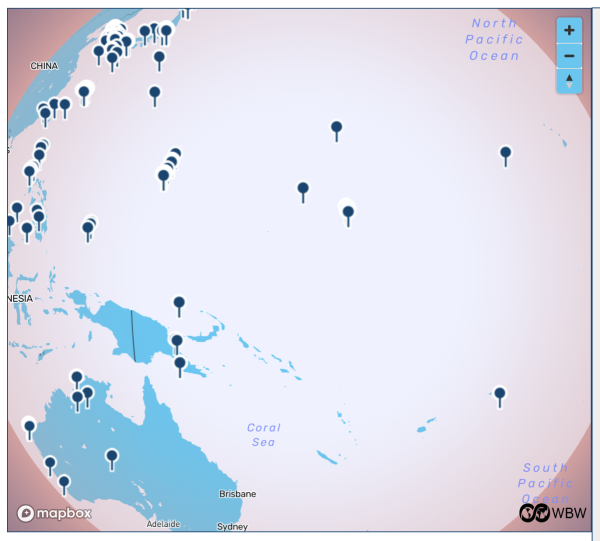
During World War II the U.S. Navy seized the small Hawaiian island of Koho’alawe for a weapons testing range and ordered its inhabitants to leave. The island has been devastated. In 1942, the U.S. Navy displaced Aleutian Islanders. President Harry Truman made up his mind that the 170 native inhabitants of Bikini Atoll had no right to their island in 1946. He had them evicted in February and March of 1946, and dumped as refugees on other islands without means of support or a social structure in place. In the coming years, the United States would remove 147 people from Enewetak Atoll and all the people on Lib Island. U.S. atomic and hydrogen bomb testing rendered various depopulated and still-populated islands uninhabitable, leading to further displacements. Up through the 1960s, the U.S. military displaced hundreds of people from Kwajalein Atoll. A super-densely populated ghetto was created on Ebeye. Portions and the entirety of numerous islands were not given freely:
On Vieques, off Puerto Rico, the U.S. Navy displaced thousands of inhabitants between 1941 and 1947, announced plans to evict the remaining 8,000 in 1961, but was forced to back off and — in 2003 — to stop bombing the island. On nearby Culebra, the Navy displaced thousands between 1948 and 1950 and attempted to remove those remaining up through the 1970s.
Beginning during World War II but continuing right through the 1950s, the U.S. military displaced a quarter million Okinawans, or half the population, from their land, forcing people into refugee camps and shipping thousands of them off to Bolivia — where land and money were promised but not delivered.
In 1953, the United States made a deal with Denmark to remove 150 Inughuit people from Thule, Greenland — GREENLAND!– giving them four days to get out or face bulldozers. They are being denied the right to return.
Between 1968 and 1973, the United States and Great Britain exiled all 1,500 to 2,000 inhabitants of Diego Garcia, rounding people up and forcing them onto boats while killing their dogs in a gas chamber and seizing possession of their entire homeland for the use of the U.S. military.
The South Korean government, which evicted people for U.S. base expansion on the mainland in 2006, has, at the behest of the U.S. Navy, in recent years been devastating a village, its coast, and 130 acres of farmland on Jeju Island in order to provide the United States with another massive military base.
So, it is true that between 125 and 75 years ago the U.S. government transitioned from traditional conquest to coups, threats, sanctions, blockades, election-rigging, and the imposition of military bases. But those bases required, and still require, land — often land stolen from the least powerful and most easily forgotten.
The people from whom the land was taken for the current U.S. base in Greenland, and other bases in Greenland that were used for years, are erased so thoroughly that the New York Times can report on a threat to take over Greenland as the first threat to steal land in a century.
The sad truth is that the U.S. government has not spent the past century refraining from stealing any land. Nor has it devoted itself entirely to “defending other countries against foreign aggression.” The United States is holding onto various pieces of Iraq for military bases that it created during one of the twenty-first century’s most famous wars of aggression, that of the United States against Iraq. We call that war over. Yet the bases remain — not secret, but not integrated into our knowledge of how the world works.
Since World War II, during a supposed golden age of peace, the United States military has killed or helped kill some 20 million people, overthrown at least 36 governments, interfered in at least 86 foreign elections, attempted to assassinate over 50 foreign leaders, and dropped bombs on people in over 30 countries. The United States is responsible for the deaths of 5 million people in Vietnam, Laos, and Cambodia, and over 1 million just since 2003 in Iraq.
Since 2001, the United States has been systematically destroying a region of the globe, bombing Afghanistan, Iraq, Pakistan, Libya, Somalia, Yemen, and Syria, not to mention the Philippines. The United States has “special forces” operating in two-thirds of the world’s countries and non-special forces in three-quarters of them.
Just in the past year, Trump has threatened or attacked: Greenland, Canada, Mexico, Colombia, Venezuela, Nigeria, Sudan, Yemen, Syria, Iraq, Iran, and China. Depicted the war in Ukraine as defensive requires pretending that the U.S. government hasn’t prevented ending it. Depicting the Gulf War as defensive required lies about babies in incubators. Depicting the later wars on Afghanistan and Iraq required a catalogue of infamous lies. Depicting the current war on Venezuela as defensive requires depicting fictional drug dealing and/or immigration by people with the wrong skin tone as a military attack.
This behavior is made possible by an empire of nearly 900 U.S. military bases outside the United States. The U.S. government calls attacks on its bases and troops agression, no matter what those bases and troops were doing. Thus all of its wars are pseudo-defensive. Trying to make Greenland a formal part of the United States is an interesting twist, but cannot be best understood while avoiding the reality that leads people in dozens of other countries to call themselves “the fifty-first state.”
Nor can we solve problems we bury. That’s why some of us are organizing for February 21-23, 2026, Global Days of Action to #CloseBases. See https://daytoclosebases.org


No comments:
Post a Comment