Monday, August 24, 2026

Zelenskiy tops Ukraine's anti-rating for the first time, pollster says

By Ben Aris in Berlin August 23, 2026

President Volodymyr Zelenskiy has for the first time topped the list of candidates Ukrainians say they would not vote for under any circumstances, according to the pollster SOCIS.

The finding was attributed to Ihor Hryniv, who is associated with SOCIS, and was reported by the Ukrainian news site Censor.NET. Leading an anti-rating is a different measurement from a low approval score: it counts the voters a candidate can never win, which in a two-round system is the number that decides the second round.

Zelenskiy's headline numbers have not collapsed. SOCIS itself had him finishing first in a hypothetical first round this month on 22%, ahead of former commander-in-chief Valery Zaluzhny on 21% and digital transformation minister Mykhailo Fedorov on 13%. The same poll put him behind Fedorov, Zaluzhny and intelligence chief Kyrylo Budanov in every projected runoff - which is what an anti-rating in first place does to a candidate.

Nobody is voting yet. Martial law bars elections while it remains in force, and the practical question is not who would win but how much political authority the president can spend - on mobilisation, on an unpopular settlement, on a budget that needs tax rises - when polling says a majority has already ruled him out.

Pressure to hold a vote has been building through the summer, and Zelenskiy's trust rating fell earlier this year after the attempt to curb Ukraine's anti-corruption agencies, the point at which corruption overtook Russia as the threat Ukrainians named most often.

The provenance of this particular number needs stating. Hryniv was Petro Poroshenko's chief ideologist, and SOCIS's association with him gives the firm an interest in the finding. That does not make the number wrong - it tracks a trend other pollsters have also recorded - but it is not a neutral source on this particular president.

  

UK to share SCALP missile blueprints with Ukraine as Coalition of the Willing meets in Kyiv

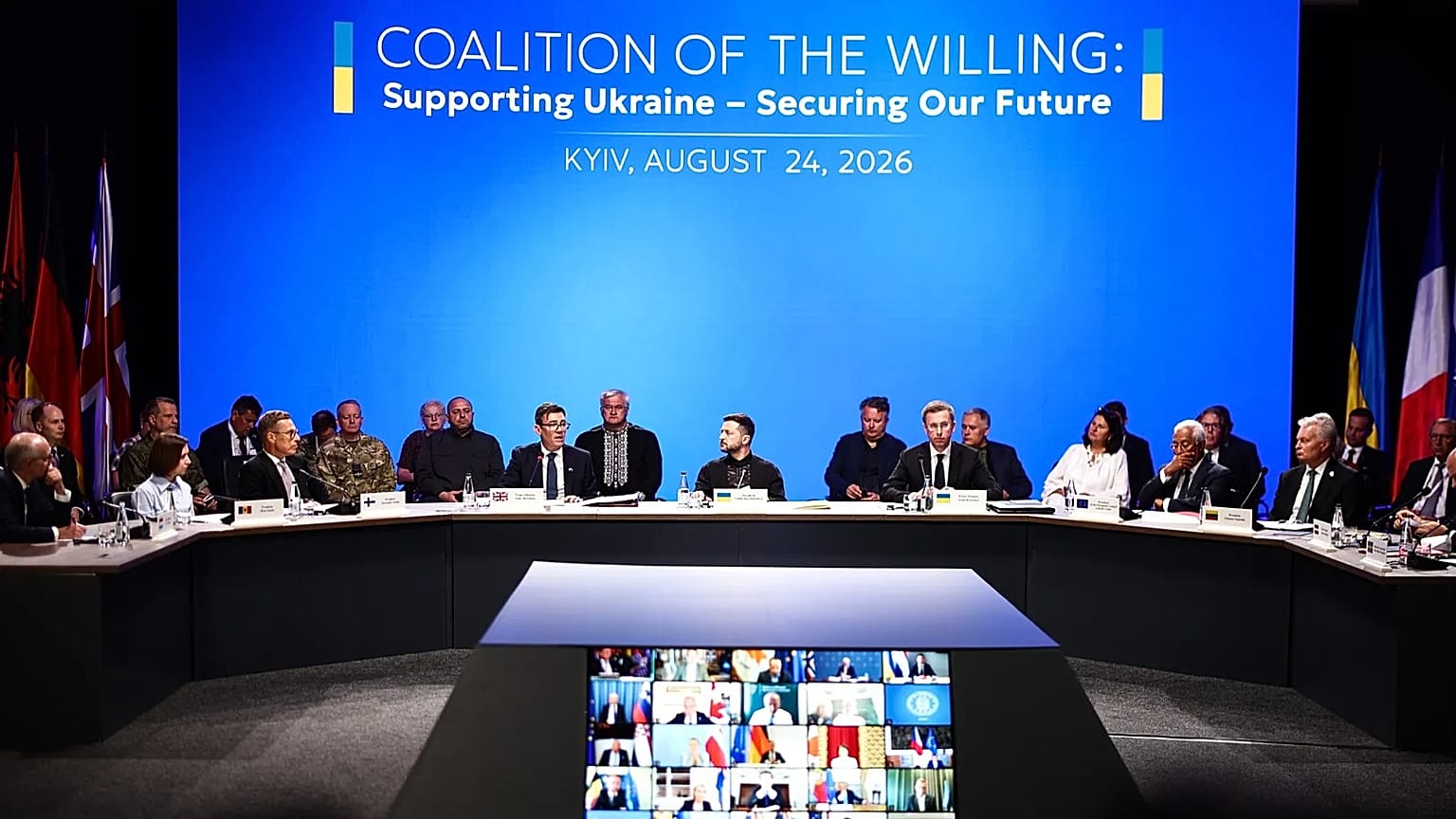
Coalition of the Willing meeting in Kyiv, Ukraine, Monday, Aug. 24, 2026.
Copyright AP Photo

By Sasha Vakulina
Published on

Britain will share technical information on the SCALP cruise missile with Ukraine, bringing Kyiv closer to producing the long-range strike weapon at home. Ukraine is still seeking US approval to manufacture Patriot interceptors.

Ukraine has moved a step closer to producing SCALP cruise missiles at home after Britain agreed to provide information on UK-made components of the Franco-British weapon.

The decision clears the way for the missiles to be assembled in Ukraine following months of negotiations between Kyiv and Paris over licensing and local production.

Luke Pollard, the UK's Minister for Defence Readiness and Industry, said the move should strengthen Ukraine’s defensive capabilities.

The air-launched cruise missile, known as SCALP in France and Storm Shadow in Britain, has a range of more than 250km and is designed for precision strikes against pre-planned, fixed targets.

Ukraine has already used the missiles against Russian military targets and infrastructure, including command posts and defence-industry facilities in occupied Ukrainian territory and inside Russia.

The UK became the first country to provide Ukraine with long-range cruise missiles in 2023.

Three years later, the technology transfer marks a further shift in western support - as governments move from supplying finished weapons to helping Ukraine manufacture its own sophisticated systems.

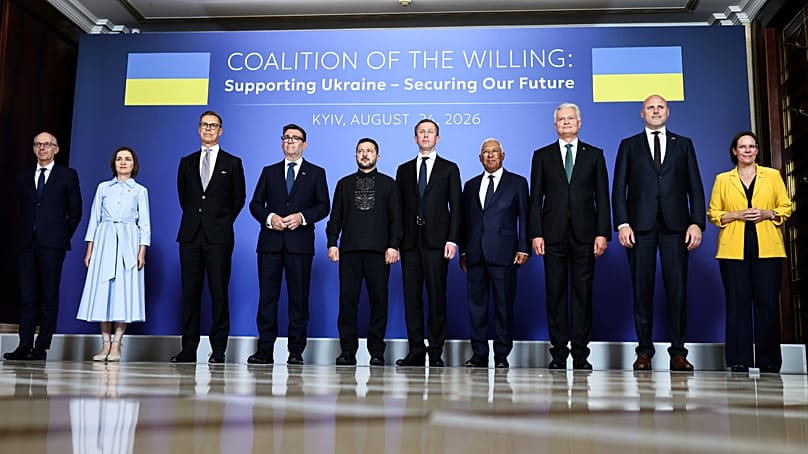
The announcement came as the Coalition of the Willing met in Kyiv, where protecting Ukraine from intensifying Russian missile attacks was high on the agenda.

In a joint declaration, the allies condemned Russia’s “systematic and escalating strikes against Ukraine’s cities, critical infrastructure and civilians” and pledged to strengthen Ukraine’s air defences “as a matter of urgent priority”.

The gathered leaders also committed to sharing relevant technologies, including through the Anti-Ballistic Missile Coalition, as Ukraine prepares for another winter of Russian attacks on its cities and energy infrastructure.

Coalition of the Willing meeting, in Kyiv, Ukraine, Monday, Aug. 24, 2026. AP Photo

Ukraine’s most urgent military need remains defences against ballistic missiles, for which it is critically dependent on US-made Patriot systems and PAC-3 interceptors.

Kyiv has been pressing Washington not only for additional interceptor missiles but also for permission to manufacture them domestically, which would give Ukraine a more reliable long-term supply.

US President Donald Trump had previously appeared to green light the idea.

At the NATO summit in early July, Trump said Washington would grant Ukraine a licence to produce the interceptors.

But three weeks later, he said no final decision had been taken, describing the transfer of the technology as a significant step.

US ambassador to NATO Matthew Whitaker subsequently said no long-term production agreement was likely before the winter and stressed that PAC-3 technology remained tightly controlled under US export rules.

The mixed signals come as Ukraine runs low on Patriot interceptors amid an intensifying Russian ballistic missile campaign and ahead of expected attacks on the country's energy network over the winter.


Ukraine puts its first home-built jet drone-hunter into service

Ukraine puts its first home-built jet drone-hunter into service
The Alexa Spatium is designed to chase down Russia's jet-powered Gerans - and, if it finds nothing, to fly home and go up again. / bne IntelliNewsFacebook
By Ben Aris in Berlin August 23, 2026

Ukraine's armed forces have taken into service the Alexa Spatium, the first jet-powered interceptor drone designed and built in the country to shoot down Russian attack drones.

The aircraft is aimed squarely at Russia's Geran-3, Geran-4 and Geran-5 attack drones and the Shahed-131, and can also go after reconnaissance UAVs and helicopters. It runs on a turbojet, has a high service ceiling and works at low and medium altitudes, Ukrinform reported.

It measures roughly 1.5 by 1.7 metres, is built from composite so it can turn hard without losing control, and launches from a mobile catapult in minutes. It can carry fragmentation, shaped-charge or thermobaric warheads, and flies on preset coordinates or under direct control using television and infrared seekers.

The reusability is the unusual part. An interceptor that goes up, finds nothing and comes back to its launch point can fly again, which changes the cost arithmetic of air defence more than any single performance figure does.

Ukraine has spent this war shooting cheap Iranian-designed drones down with expensive Western missiles, and its interceptor stocks have been running dry. Moscow made the gap worse by bolting jet engines onto the Geran so it outruns the propeller-driven interceptors Kyiv had been fielding. A domestic jet answer that can be built in quantity is the first credible reply.

The manufacturer has not been named.

Ukraine's missile programmes are moving at the same time. Fire Point has finished ground testing of its FP-9 ballistic missile and is preparing to test it over Russian territory, chief executive and chief technology officer Iryna Terekh said, declining to give a date beyond "in the near future". An extended-range version is in development.

Fire Point systems are already flying between five and 20 missions a day over enemy territory, Terekh said. The company's Flamingo cruise missile is one of three candidates Germany is weighing for its own low-cost long-range weapon, which is a measure of how far Ukraine's defence industry has travelled from importing everything to selling into Nato markets.

Trump says Canada wants 'benefits of being a State, without being one' as trade war deepens


US President Donald Trump slammed Canada on Sunday, saying the country wanted "the benefits of being a State, without being one", in response to Canadian Prime Minister Mark Carney announcing retaliatory tariffs following failed trade negotiations.


Issued on: 23/08/2026 

By: FRANCE 24


US President Donald Trump in Myrtle Beach, S.C., Friday, August 21, 2026. © Jacquelyn Martin, AP


Canadian Prime Minister Mark Carney announced retaliatory tariffs on the United States on Saturday, after walking away from a "bad deal" on trade in a deepening rift between the longtime allies.

Negotiations between the neighboring countries broke down Friday in Washington, putting into force new 50-percent US tariffs impacting about $20 billion worth of goods, or 5.5 percent of Canadian exports to the United States.

Impacted products range from hockey sticks to cement.

"You're at war when you get attacked. We got attacked," Carney said.


US President Donald Trump hit back at Canada on Sunday, saying, "Canada wants the benefits of being a State, without being one!!!"

"They have also charged our great farmers, for many years, massive amounts of Tariffs. No more!!!" Trump added in a post on Truth Social.
Trump's post on Canada © Truth Social


New Canadian tariffs will notably target the US steel and dairy industries and take effect on September 8. More details would come next week, Carney said.

Trump had previously said Washington "should be able to have a deal with Canada", citing his "good relationship" with Carney.

But on Saturday, Canada's prime minister said Trump set conditions that were ultimately unacceptable even though earlier talks had been positive.

"In recent days, the United States proposed new terms that were uneconomic, unfair and undermined the net benefits for Canada, and called into question the reliability of any deal," Carney said in Ottawa.

"We cannot accept what they've offered, and we will not give what they've asked."

US Trade Representative Jamieson Greer told the New York Times on Saturday that the US had offered to reduce its tariffs on steel, aluminum and autos, as well as eliminate a recently imposed tariff on Canadian lumber.

Cover image: © France 24
01:47


Greer said those measures would have given Canada "the most preferential treatment of any trading partner", according to the Times.

Greer told Fox News on Saturday that Washington was "moving forward with measures that respond to Canadian retaliation." He said no new talks were planned with Canadian negotiators.

A senior US official characterized this week's talks in Washington as candid and not acrimonious.
'Significant pressure'

Canada has been seeking relief from Trump's tariffs on autos, steel and aluminum, which have battered the country's economy, forced job losses and strained what was once an iron-clad trade relationship.

The White House had alleged "discriminatory treatment" by Canada against US alcohol, automobile and dairy products in introducing the duties.

They were originally set to take effect on Wednesday, before Trump issued a three-day reprieve citing progress in talks.

Carney said one reason the deal collapsed was US negotiators at the 11th hour introducing restrictions on Canadian trade deals with other countries.

US negotiators also made unacceptable "threats" to the French language and "Quebec culture", he said, referring to the French-speaking province in eastern Canada.

The escalating trade war was met with anger by Democratic lawmakers and governors from border states including Minnesota, New York and Washington, who blamed Trump for triggering chaos that will raise costs on US businesses and families.

"Needlessly picking fights with our allies and raising prices here at home. That's Trump's economic policy in a nutshell," New York Governor Kathy Hochul posted on X.

Beyond the latest tariffs, the US and Canada still have to agree on revisions to the North American free trade agreement, USMCA, which Trump declined to renew in its current form.

Trump's threats to make Canada the 51st US state have also antagonized Canadians.
Lunch money

Carney has repeatedly said relations with the US have been forever altered, and that Canada must reduce reliance on its southern neighbor, which currently accounts for roughly 70 percent of Canadian exports.

"We've been under no illusions. We recognized from the start that America has changed," Carney said Saturday. "We recognize that sometimes, its signature was written in pencil."

Carney spoke with provincial leaders to outline next steps.

One of them, Ontario Premier Doug Ford, said Canadians must remain united.

Trump "can't be trusted, simple as that", Ford told reporters. "President Trump is the type of person who would steal your lunch money."

The Business Roundtable, a group of 200 chief executives of leading US corporations, warned the new tariffs "risk raising costs for American businesses and families", and urged both governments to resume negotiations.

(FRANCE 24 with AFP)


BEYOND THE BOSPORUS: Erdogan’s patronage on display as Turkish labour union inaugurates new HQ

BEYOND THE BOSPORUS: Erdogan’s patronage on display as Turkish labour union inaugurates new HQ
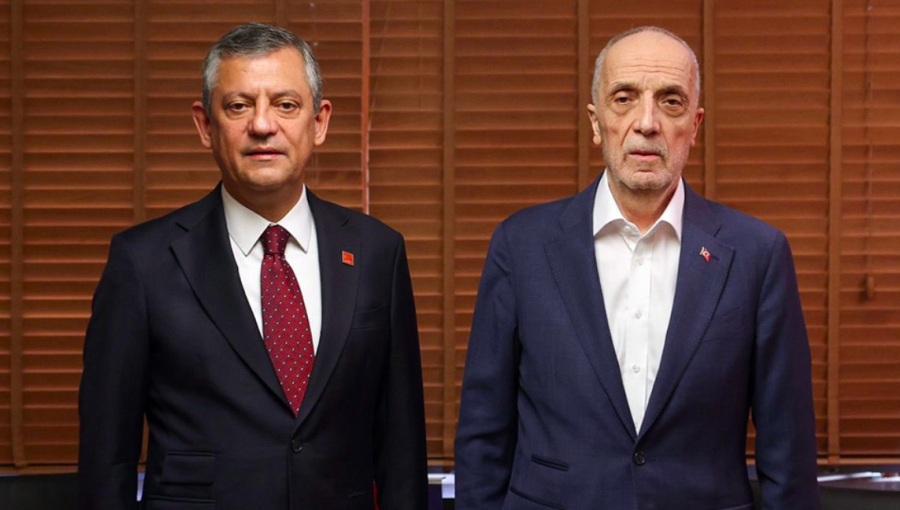
Turkey’s main opposition leader, Ozgur Ozel (left), regularly visits Turk-Is chairman Ergun Atalay (right) at the union HQ. He has a new address to go to now. / turkis.org.tr
By Akin Nazli in Belgrade August 23, 2026

Labour union Turk-Is has opened its expansive new headquarters complex, abandoning its modest 65-year-old home in the Kizilay quarter in central Ankara, Turkish daily Cumhuriyet has reported.

The families of the workers were among those who attended the opening of the new building. Following a moment of silence and the singing of the national anthem, opening speeches took place. Prayers were offered and a sacrifice was performed.

‘The Tall Man’

During the inauguration ceremony, Ergun Atalay, who has led Turkey’s largest trade union confederation since 2013, shared insights on the achievement he secured in bagging the new HQ.

When Turkey’s president, Recep Tayyip Erdogan, visited the previous headquarters of Turk-Is in September 2020, he made a characteristic observation about the state of the building. Finding the low ceilings uncomfortable, he remarked that his head was nearly touching the ceiling. Atalay seized the moment.

“I told him: ‘Mr President, grant us a parcel of land and we will build a new headquarters,’” Atalay recalled.

Erdogan promptly instructed Murat Kurum, his minister of environment and urbanisation, to allocate a generous 21-dunam (5.2-acre) plot in Ankara’s upscale Mustafa Kemal district. Six years later, as Turk-Is celebrated its 74th anniversary, the confederation moved to its new base.

“Uzun Adam”, or “The Tall Man”, is among the marketing slogans used in Erdogan’s PR campaigns. He is around 1.85 metres tall.

“Like the state itself”

The new HQ is at the heart of Ankara’s emerging power corridor. It is surrounded by the state’s most formidable security and diplomatic installations.

“Directly diagonal to us, 1.5 kilometres ahead, is the 'Ay Yildiz' complex, Turkey’s Pentagon, where the entire military apparatus will be resident in six months,” Atalay told attendees at the opening.

“To one side of us, the new foreign ministry is under construction, and on our left, the National Intelligence Organisation [MIT]. Behind us is a university. Like the state itself, Turk-Is is stood right in the middle,” he added.

Paradoxically, to workers, Turk-Is is their sole representative on the committee that sets Turkey’s minimum wage each year. Atalay always comes under heavy criticism. He regularly leaves the committee or misses press conferences to protest against lower-than-demanded figures.

The construction process was not without legal friction. Three professional institutions filed lawsuits challenging the zoning, arguing the site was inappropriate for a major labour headquarters. The legal battle stretched on for two years before the Council of State (Danistay) on July 31 ruled in favour of Turk-Is.

“If Ataturk were alive today”

Dismissing the legal challenge, Atalay employed national memory: “I told them that if Mustafa Kemal Ataturk [the founder of the Republic of Turkey and a main symbol in the contemporary laicist-Islamist division in the country] were alive today, he would have given this land to Turk-Is and the workers.”

As of July, only around 2.4mn of the 17.6mn registered workers in Turkey were members of a labour union, suggesting a unionisation rate of 14%. Turk-Is has approximately 1.2mn members, making it the largest labour confederation in the country.

The second and third largest confederations are Hak-Is, which boasts an Islamist ideology, and DISK, which offers a leftist ideology. All three confederations work in harmony and Turk-Is represents them on the minimum wage committee.

Ataturk’s republic, it can be recalled, was also not too receptive to labour rights while New Turkey has turned the screw to a painful extent.

Iceland's moment of reckoning: What the referendum means for the EU

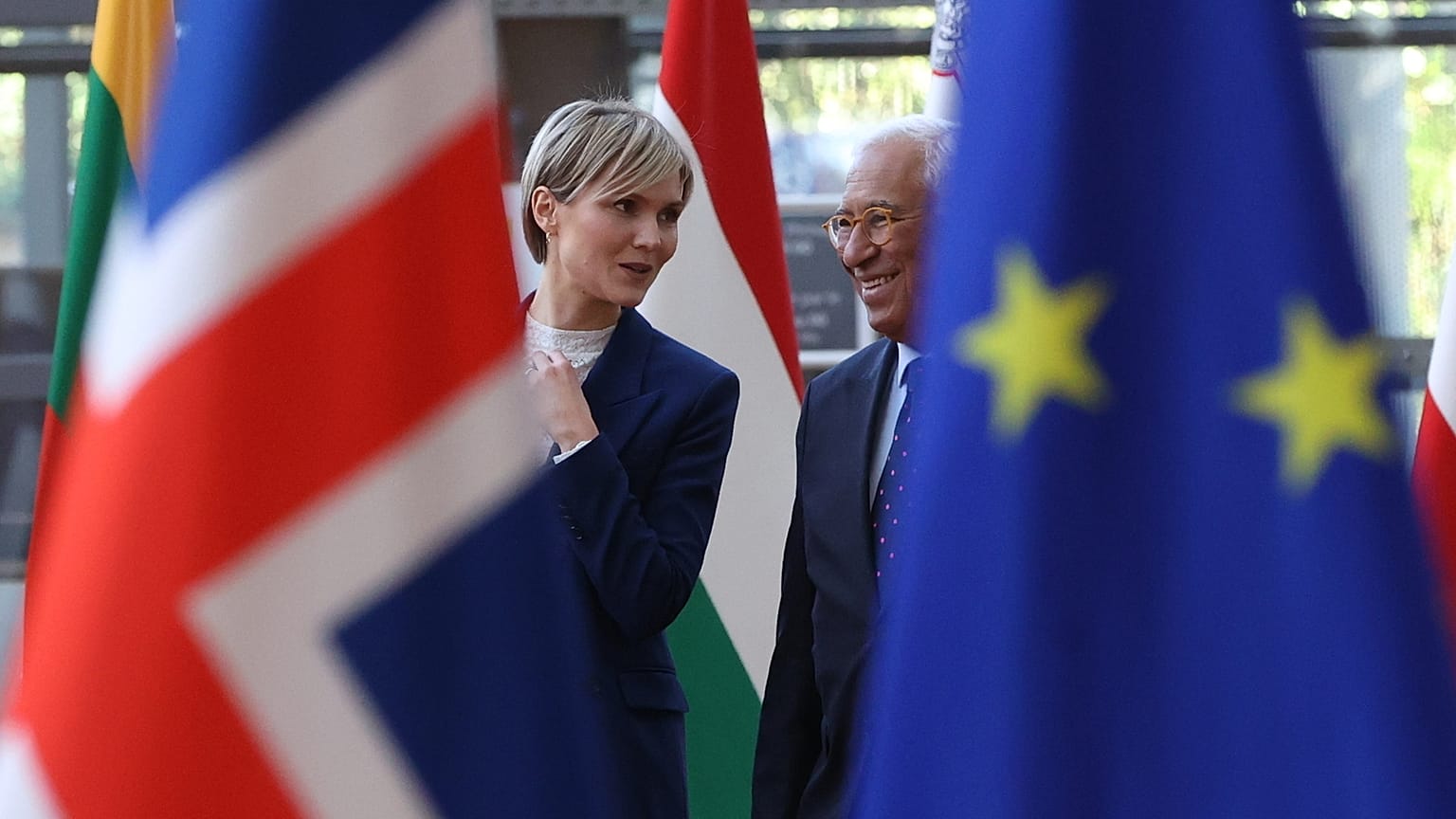
Kristrún Frostadóttir, Prime Minister of Iceland, and António Costa. President of the European Council
Copyright FRANCOIS LENOIR/EUROPEAN UNION

By Luca Bertuzzi & Mared Gwyn Jones
Published on

Iceland votes Saturday on resuming EU membership talks. A "Yes" would restart negotiations with Brussels, with fisheries likely to emerge as the key sticking point. A "No" could provide a setback for the EU's enlargement drive.

Icelanders have been called to vote on whether to resume negotiations to join the European Union, or shelve the prospect of full membership for the foreseeable future.

The August 29 vote has been framed by the Icelandic government as a "now or never" opportunity to embrace the prospect of EU membership, or maintain the country's status quo in the European Economic Area, a position that guarantees Reykjavík access to the European single market but not a seat at Brussels' table.

Crucially, the referendum will only decide whether Iceland resumes talks with Brussels. Any decision to formally join the EU could require a second referendum, potentially as early as 2028.

"It is quite clear that this vote is about getting a mandate to negotiate," Prime Minister Kristrún Frostadóttir said in the national parliament in May. "I do not think we should be getting hung up on rhetoric here. We are going to conclude a good agreement. The people will have the first say in this and they will have the last say in this.

Euronews breaks down what happens in both scenarios.

Why now?

Iceland's relationship with the EU has been far from linear. The island country applied to join the bloc in 2009, following a deep financial crisis. Accession negotiations were eventually suspended when a Eurosceptic coalition came to power in 2013.

By then, Iceland's economy had recovered strongly, removing one of the main incentives for joining, and public support for EU membership had faded as negotiations got stuck on the sensitive issue of fisheries.

As a result, in 2015 the Icelandic government told Brussels it had no intention of resuming the accession talks, and that Iceland was no longer to be regarded as a candidate country.

The reversal came in 2024, when a pro-EU coalition government took office. Its coalition agreement included a commitment to hold a referendum on whether to resume the accession talks before 2027.

Since then, major geopolitical developments have reshaped the international landscape, with US President Donald Trump threatening to seize Greenland — at times mistaking it for Iceland — and the Arctic becoming a hotspot for rare earth minerals and new trade routes.

In a report published earlier this year, Foreign Minister Þorgerður Katrín Gunnarsdóttir wrote that "the international system we have lived with since the end of the Second World War is shaking," adding that deeper cooperation with the EU was "a key variable" in safeguarding Iceland's interests.

Still, the decision to hold a referendum was made before these shifts in international politics, and considerations regarding Iceland's defence alliances and security have yet to make their way into a campaign that remains largely focused on economic issues.

How is the referendum campaign going?

Opinion polls suggest the vote could go down to the wire.

A July poll by Maskína put support for "Yes" at 53% and "No" at 47%, suggesting that turnout could be pivotal in determining the outcome.

Another poll by Gallup earlier this month found that 46% of voters supported 'Yes', 46% supported 'No' and 8% were undecided.

While the vote has been framed as crucial against the backdrop of a shifting geopolitical landscape, bread-and-butter issues such as farming and fishing have emerged as voters' top concerns.

Fishing has become a central and sensitive part of the debate, not only for economic reasons — fish and marine products account for around 40% of Iceland’s exports — but also because control over the country’s territorial waters is deeply tied to national sovereignty and identity.

The main sticking point in any future negotiations would likely be Iceland's relationship with the EU's Common Fisheries Policy (CFP), which sets catch limits and fishing quotas among EU member states.

Iceland's main fishing industry federation, SFS, has said that EU membership would leave Iceland without "the power to act as an independent coastal state".

Icelandic government figures have acknowledged that the chapters covering agriculture and fisheries are likely to be the most difficult to close. The accession process was suspended in 2013 before a formal negotiating position on fisheries had been adopted.

An Icelandic government report on the matter points to "issues such as formal authority over marine resources, limitations to investments and advocacy at international level."

The dispute was particularly acute over mackerel, the so-called "mackerel wars," because Iceland had adopted a unilateral position on mackerel quotas that the EU considered excessive, while Iceland objected to arrangements reached between the EU, Norway and the Faroe Islands.

What happens if 'Yes' wins?

Crucially, a "Yes" vote would not mean Iceland joins the bloc; it would jump-start intense negotiations with Brussels on the conditions under which the Nordic country would become a new member state.

In practice, that would require the European Commission to establish a task force similar to the one already in place for the current frontrunner in EU accession talks, Montenegro, putting further pressure on an already strained enlargement machinery.

"Should Icelanders choose to pursue EU membership, Iceland would certainly be a frontrunner in this process," EU foreign policy chief Kaja Kallas said, commenting on the referendum.

Iceland has already closed 11 of the 33 chapters that make up the accession negotiations, with Brussels expecting the process to conclude within one or two years since the country is already deeply integrated in the European single market.

Still, the main sticking point — fisheries — is bound to remain.

"Accession negotiations always reflect the specific realities of each candidate country," European Commissioner for Enlargement Marta Kos wrote on Bluesky, suggesting Brussels might be open to finding common ground on the sensitive issue.

Reykjavik is highly likely to seek special arrangements or exemptions from the CFP, which Brussels may be forced to contemplate in the negotiations. Yet this could also open a Pandora's box, with Irish fishing organisations now calling for the same exemptions for its industry as any granted to Iceland under future accession talks.

The Commission has made enlargement a top political priority. Iceland's formal decision to resume accession talks would give the enlargement agenda welcome momentum, adding geographical and economic balance to the roster of prospective members — and possibly making the ratification process easier to swallow for the most sceptical member states.

What happens if 'No' wins?

A “no” vote would be a setback for the EU’s expansion drive, which has gathered momentum over the past four years following Russia’s invasion of Ukraine and the Trump administration's erratic foreign policy agenda that projected Brussels as an anchor of stability.

EU officials reined back public commentary on the referendum in order to avoid appearing to interfere in Reykjavík's affairs. But privately, there is acknowledgement that a green light to negotiations would be a major boost to its policy of enlargement.

A "No" vote would also suggest that the prospect of EU membership remains insufficiently attractive to wealthier, northern states, especially as a coalition of Nordic countries is seeking to reduce Brussels' budget as part of intense negotiations.

Unlike Iceland, the EU’s other candidate countries are poorer than the bloc’s existing members, with markedly lower GDP per capita levels.

Iceland itself has also framed the vote as a pivotal decision, meaning a “no” vote would silence the debate around the country’s prospective EU membership for years or even decades, as PM Frostadóttir and the ruling pro-European parties would suffer a major defeat, whilst anti-EU forces would be bolstered.

A negative response would be particularly burning, since voters would not reject EU membership, but even to find out what a membership deal would look like.

For Brussels, it would mean a major setback in its enlargement momentum and also close off a strategic opportunity to expand its positioning in the North Atlantic and Arctic region for generations.

A "No" vote would also raise fresh questions about how Reykjavík can use the current frameworks to deepen cooperation with the EU on issues like security and defence in a shifting geopolitical landscape.

TORY GOVT
New Zealand moves to ban social media for under-16s


Wellington (AFP) – New Zealand's government introduced legislation on Monday to ban under 16s from using social media, joining a number of countries seeking to keep youngsters off sites such as Instagram and TikTok.

A team of Australia-based researchers in a peer-reviewed study published in June found little evidence to suggest teenagers have turned away from social media as a consequence, however.


Issued on: 24/08/2026 - RFI

New Zealand's ruling National Party has been investigating a social media ban after neighbouring Australia implemented its world-first ban in December © Saeed KHAN / AFP/File

Australia implemented world-first legislation banning children from social media in December, with the UK, France and others following suit.

Under New Zealand's proposed law, firms like Meta could be fined up to 10 percent of their global revenue if they fail to comply.

"We simply cannot accept the harm being done to a generation of New Zealand children," Prime Minister Christopher Luxon said.

"One in three children aged between 13 and 17 are now spending at least five hours on social media a day," he said.

"Social media is exposing them to harmful content, addictive technology and pressures they are not equipped to deal with, and it's affecting their family life, mental health, sleep and education."

Luxon specifically called out platforms Instagram, TikTok, Snapchat and Facebook, saying they would be required to take "reasonable steps to check users are over the age of 16".

They would have to use "existing account information, facial age estimation, digital ID services and formal ID" to verify age.

Platforms would also be required to assess the risks they pose as well as report on how those dangers are being reduced, with penalties slapped on companies that fail to comply.

Education Minister Erica Stanford said the Bill "places legal obligations on platforms".

"No penalties are proposed for children, their parents or caregivers," Stanford said.
'Safety of young people at stake'

It's unclear whether the bill will pass, as both National Party's coalition partners -- the libertarian ACT party and populist NZ First -- have said they oppose it.

In a statement, the populist NZ First said they could not support the law given the "colossal failure" of the legislation in Australia, while ACT said they believed the law "won't work" and that teenagers would easily get around the ban.

The main opposition party Labour has submitted a list of dozens of questions it wanted answered before deciding whether it would offer support -- including how age verification will work and which platforms will be affected.

"We take this legislation very seriously," spokesman Reuben Davidson said.

"The safety of young people in Aotearoa New Zealand is at stake and the risks they face in increasingly complex online environments are significant," he added, using the Maori-language name for the country.

Australia banned under 16s last year from the likes of Facebook, Instagram and TikTok, in a crackdown designed to protect children from online bullying and "predatory algorithms".

A team of Australia-based researchers in a peer-reviewed study published in June found little evidence to suggest teenagers have turned away from social media as a consequence, however.

© 2026 AFP
UEFA's Ceferin tells Infantino to go, but 'not interested' in replacing him

London (AFP) – UEFA chief Aleksander Ceferin says he is "not interested" in replacing Gianni Infantino but warned the under-fire FIFA president must quit or face a leadership challenge.


Issued on: 24/08/2026 - FRANCE24

UEFA president Aleksander Ceferin and FIFA president Gianni Infantino are in open conflict © Odd ANDERSEN / AFP/File

Infantino has come under increasing pressure to step down as head of world football's governing body over his now-abandoned plan to secure private investment in FIFA tournaments, including the World Cup.

UEFA, which oversees European football, has threatened a boycott of FIFA competitions with several continental and national federations also withdrawing their support for Infantino.

But Ceferin ruled himself out of a bid to take Infantino's place, the 58-year-old Slovenian on Monday telling The Rest is Politics podcast: "I'm not interested because of two reasons.

"One reason is that I love UEFA and I love working here, and I think that at a certain point... it's time to also enjoy life a bit.

"And the second point is, my credibility is much, much higher if I'm not interested in the position."

Ceferin has been vocal in his criticism since Infantino revealed his controversial plans to seek private investment in a company to run FIFA tournaments.

He now believes Infantino's previously impregnable position is under threat, with Ceferin forecasting the Swiss will have to stand down or face a leadership challenge if he seeks re-election at the next FIFA Congress, in Morocco in March.

Infantino, a former UEFA secretary general, had the broad backing of European nations when he succeeded Sepp Blatter as FIFA president in 2016.

But Ceferin, who revealed he has not spoken to Infantino since the start of the controversy, insisted the current situation was very different.

"There are two options," he said.

"One option is that he (Infantino) realises that he doesn't have the support, and that's not only a political support of the ones who vote, but the political support of the football community, the political support of fans, the political support of the players, former players, coaches.

"And the second option, that he goes to the elections in March, but in that case I think he will have a candidate against him. I don't know yet who."

CONCACAF president Victor Montagliani and AFC boss Sheikh Salman bin Ebrahim al-Khalifa are considered two of the most likely challengers for Infantino's position.
Infantino 'support'

Infantino was in the Dominican Republic over the weekend for meetings with local and regional football officials, despite Montagliani reportedly asking him to stay away from a youth tournament there.

In video remarks released by FIFA on Sunday, the 56-year-old Infantino appeared to reference the furore surrounding him.

"It's important to engage, to have a dialogue, to express views and opinions," he said.

"A lot has been happening the last few weeks and it's important that you hear, you listen, and you're able to also express what your feelings are.

"So I think overall positive, very, very happy with all the support I get here."

© 2026 AFP
Who are the eight candidates running to succeed Antonio Guterres as UN chief?

The United Nations Security Council held a second informal straw poll to gauge the popularity of candidates seeking to succeed Secretary-General Antonio Guterres, who will complete his second five-year term at the end of the year. Eight candidates are currently vying for the position against a backdrop of deep divisions within the organisation.


Issued on: 21/08/2026 
By: FRANCE 24

The United Nations Security Council holds an emergency meeting on the Ukraine-Russia war at UN Headquarters in New York, on July 27, 2026. © Leonardo Munoz, AFP

The United Nations' most powerful body, the Security Council, met Friday to hold another straw poll to gauge the popularity of a growing field of contenders to lead the embattled organisation.

Guyanese ex-foreign minister Carolyn Rodrigues-Birkett narrowly led the second round, a diplomatic source and specialist media said Friday.

Costa Rica's Rebeca Grynspan was the front-runner last month when the 15-member Security Council held a first informal vote, behind closed doors and by secret ballot.

She dipped slightly to second place, while Argentina's Rafael Mariano Grossi, the current head of the UN nuclear watchdog, came in third, according to the diplomatic source and specialist publication Pass Blue

Chile's Michelle Bachelet is also a candidate, alongside Ecuador's Maria Fernanda Espinosa, Uganda's Olara Otunnu and Senegal's Macky Sall.

After the first round concluded, Ecuador's Ivonne A-Baki threw her hat into the race to succeed Antonio Guterres, who will complete his second five-year term on December 31, 2026.

Even if one candidate gets the required nine votes on the 15-member Security Council – which chooses the future UN chief before submitting the name for approval by the General Assembly – that candidate must also avoid a veto from one of the council's five permanent members.

Here is a look at the eight contenders:

Rebeca Grynspan


Grynspan – Costa Rica's former vice president – leads UNCTAD, the UN's trade and development body, but took leave from her duties to campaign for the top UN post.

File photo: Former vice president Rebeca Grynspan gives a news conference in San Jose, Costa Rica, October 8, 2025. © Jose Diaz, AP

In 2022, she pulled off a diplomatic feat by brokering the Black Sea Grain Initiative between Moscow and Kyiv to allow grain exports following Russia's invasion.

The 70-year-old plays up her personal story as the daughter of Jewish parents who she says "barely survived" the Holocaust before emigrating to Costa Rica.

She has lamented that the UN has become what she calls a "risk-conservative organisation".

Michelle Bachelet

A Chilean socialist brutally tortured by the regime of Augusto Pinochet, Bachelet became her country's first woman president in 2006.

She went on to be the UN rights chief, a sensitive role in which she alienated some countries – especially China, after her reporting on Beijing's alleged abuses of the country's Uighur minority group.

Michelle Bachelet Jeria speaks with the media after attending a dialogue with delegations at UN headquarters in New York City on April 21, 2026. © Eduardo Munoz, Reuters


Bachelet, 74, has said the UN secretary-general should have the "moral voice" to lead, even under pressure from major powers.

She is backed by Mexico and Brazil – but Chile withdrew its support after far-right President Jose Antonio Kast took office. The United States has criticised her, especially on her support for abortion rights.


Maria Fernanda Espinosa

Espinosa, a former foreign minister of Ecuador, has called the UN the only universal platform for handling humanity's common challenges, but also wants deeper reform of the world body.

Latin American and Caribbean candidate for UN secretary-general, Ecuador's Maria Fernanda Espinosa, attends a meeting to discuss proposals in Montevideo, Uruguay, Monday, August 3, 2026. © Matilde Campodonico, AP Photo

The 61-year-old, a previous president of the UN General Assembly, has suggested creating an "early warning" system to detect and flag signs of impending conflict.

Espinosa's candidacy has been backed by Antigua and Barbuda, but not her own country.


Rafael Mariano Grossi


The 65-year-old Grossi, an Argentine career diplomat, has led the International Atomic Energy Agency since 2019, propelling him into the middle of the battle over Iran's nuclear program as well as the Russian occupation of Ukraine's Zaporizhzhia nuclear plant.

Rafael Mariano Grossi, candidate for the position of UN Secretary-General, greets attendees during a dialogue with delegations while candidates for the position of new United Nations Secretary General are interviewed at UN headquarters in New York City, April 21, 2026. © Eduardo Munoz, Reuters

He did not step down from his current post to campaign for secretary-general, saying it would be a "dereliction of duty".

Some observers say he's been more strident in pushing for UN reform and believes the UN secretary-general should take a more hands-on approach.

Carolyn Rodrigues-Birkett


Rodrigues-Birkett, the 52-year-old former foreign minister of Guyana, is currently her country's ambassador to the UN.

Guyana UN Ambassador and current Security Council President Carolyn Rodrigues-Birkett addresses a United Nations Security Council meeting on Monday, June 30, 2025. © Richard Drew, AP

She has said the United Nations needs to restore its "credibility" on the global stage.

"The UN is judged through the peace and security lens. But the UN is much wider than that and it's delivering in many, many areas – in development, in human rights," she said.

Ivonne A-Baki

Ivonne A-Baki speaks to the press following a hearing to be considered as a candidate to the position of Secretary-General of the United Nations at UN headquarters in New York on August 20, 2026. © Charly Triballeau, AFP

A-Baki, 75, is an Ecuadoran diplomat and politician who represented Quito as ambassador to Washington where she was seen as forging close ties with US President Donald Trump.

Nominated by Tonga, A-Baki has strong Gulf connections having served as Ecuador's ambassador to Qatar.

A-Baki, born to Lebanese parents, was instrumental in brokering dialogue between Ecuador and Peru following their brief 1995 border war.

"I have lived through the ravages of war," she wrote on social media. "I stand ready to help renew the UN Charter's foundational promise: to save succeeding generations from the scourge of war."

Macky Sall


Sall, 64, is the current chair of the African Union.

The former Senegalese president has stressed the link between peace and development.

File photo: Senegal President Macky Sall poses before an interview with The Associated Press at the presidential palace in Dakar, Senegal, February 9 , 2024. © Sylvain Cherkaoui, AP

Proposed by Burundi, Sall finally got the backing of his own country in July.

Senegalese authorities accuse him of bloodily repressing violent political demonstrations that left dozens dead between 2021 and 2024.


Olara Otunnu

Otunnu, 75, served as UN under-secretary general and special representative for children and armed conflict from 1997 to 2005 under then UN chief Kofi Annan.

He also served as Uganda's UN envoy, and as his country's foreign minister for a brief period.

In this photo provided by the Uganda Media Center, Ambassador Olara Otunnu, Uganda's candidate for UN secretary-general, poses for a photo in Kampala, Uganda, Tuesday, August 4, 2026. Uganda Media Center via AP

Otunnu stood as the presidential candidate for the opposition Uganda People's Congress in the 2011 election, losing to longtime leader Yoweri Museveni, in office since 1986.

(FRANCE 24 with AFP)