Thursday, August 27, 2026

French PM visits Mayotte to speed up 'slow' reconstruction after cyclone

Prime Minister Sébastien Lecornu arrives in the French overseas territory of Mayotte on Wednesday to try to speed up the reconstruction of the archipelago, 18 months after Cyclone Chido caused widespread destruction.


Issued on: 26/08/2026 - RFI

Cyclone Chido had a devastating impact on shelters and houses in the town of Vahibe, on the outskirts of Mamoudzou. © PATRICK MEINHARDT / AFP

While Mayotte’s children returned to school on Monday, Lecornu said there was still a need to build and renovate schools following the deadly cyclone, which struck on 14 December, 2024.

He also raised the issue of delays in the delivery or opening of public facilities.

“These difficulties fuel an impatience that I understand and share,” he wrote in a letter to the mayors of the French Indian Ocean territory on Monday, adding that progress with the reconstruction was "too slow".

A law passed in August last year provides €4bn in funding over five years to repair damage caused by the cyclone, which devastated the archipelago and killed at least 40 people.


But only 12 percent of the funding committed and allocated for 2026 has been spent, the government said.

Lecornu promised to get projects approved under the law up and running.

Despite the delays, he stressed the “definitive and irreversible nature” of projects set out in the law, including a second hospital, a new airport, a second prison and a desalination plant.


Immigration issues

This is Lecornu’s first visit to France’s overseas territories since he became prime minister in autumn 2025.

He is expected to visit a security post and an urban renewal area, and meet schoolchildren.

He is also due to address the Mayotte Assembly and meet mayors to discuss reconstruction efforts.

Leading trade unions, including the CFDT and CGT have called for strikes and demonstrations during his visit.

Unions are demanding higher wages to compensate for the high cost of living, as well as equal rights for residents of France’s overseas territories.

In his letter, Lecornu referred to upcoming decisions on tackling illegal immigration. Around half of Mayotte’s 323,000 residents are foreign nationals, according to France’s national statistics agency Insee. Most of them are from neighbouring Comoros.

Anchya Bamana, an MP from the far-right National Rally, has called on the prime minister to dismantle the Tsoundzou 2 camp, where more than 1,000 asylum seekers live in poor conditions. She also called for a French Navy vessel to be deployed to improve surveillance of the coast.


Presidential candidate visits

A number of leading politicians have begun visiting the predominantly Muslim territory, where far-right leader Marine Le Pen won 59 percent of the vote in the second round of the 2022 presidential election.

She is expected to remain the favourite in Mayotte in the 2027 presidential election in April and May

Former prime minister Edouard Philippe, a candidate for the centre-right Horizons party, visited Mayotte last week and made a series of proposals aimed at “closing the immigration floodgates” on the archipelago

, prompting criticism from the left.

Republican presidential candidate Bruno Retailleau visited before the March local elections to denounce a state that “no longer responds to emergencies” over insecurity and “migratory pressure”.

Lecornu has promised to return to the archipelago in early 2027 and set up an inter-ministerial monitoring committee before then.

(with newswires)


French soldiers disciplined over Rhodesian flags linked to white supremacists

France's Ministry of the Armed Forces has launched disciplinary proceedings against several soldiers photographed holding flags linked to Rhodesia, a former white minority-ruled territory in southern Africa whose symbols have been embraced by white supremacists.


Issued on: 26/08/2026 - RFI

France's Ministry of the Armed Forces has launched disciplinary proceedings against several soldiers photographed displaying Rhodesian flags, which have become associated with white supremacist movements. AFP - LUDOVIC MARIN

Two separate groups of French soldiers – one in Nîmes in southern France and another in the United Arab Emirates – have been pictured displaying the same banner, with the images later shared in online groups glorifying the former British colony – which operated a white-minority ruled system similar to South African apartheid – investigative website Mediapart revealed.

One image posted on social media shows three soldiers holding a flag with three green and white stripes. At its centre is a coat of arms depicting a pick axe on a green background, flanked by antelopes and topped with a golden bird.

Another image shows four French soldiers in front of a tank holding the same banner.

The Ministry of the Armed Forces said the soldiers involved had been identified and disciplinary proceedings were under way. It said the two incidents were separate, with no connection between the soldiers involved or their activities.

“The ministry's position is unambiguous: French armed forces do not tolerate any manifestation of a racist, supremacist or extremist nature,” it said.

“Military personnel are subject to a particular requirement of exemplary conduct and neutrality, which also applies to their behaviour and posts on social media.”

Defying decolonisation

Rhodesia's prime minister, Ian Smith, unilaterally declared independence from the United Kingdom on 11 November, 1965 in an effort to preserve political power for the white European minority – which made up just 5 percent of the population, fewer than 250,000 people.

Rhodesia's green and white flag was first raised on 11 November, 1968, three years after Smith's declaration, which was made without British agreement or international recognition.

“Rhodesia wanted to signal to the world what it regarded as a betrayal: the fact that the United Kingdom was accepting the decolonisation of Africa,” South African historian Saul Dubow, who teaches Commonwealth history at the University of Cambridge, said.

Rhodesian propaganda portrayed the territory as “threatened by Communism” and therefore forced to defend “civilised standards”.

In practice, this meant defending the social and political superiority of white people, Zimbabwean researcher Bruce Berry wrote in his thesis on Rhodesian identity and its symbols.

African nationalist movements resisted Smith's government, particularly Joshua Nkomo's Zimbabwe African People's Union, known as ZAPU, and Robert Mugabe's Zimbabwe African National Union, or ZANU.

The conflict between Rhodesia's white minority government and African nationalist movements became known as the Bush War, or Second Chimurenga. It killed thousands of people, most of them African nationalists and civilians, and led to the militarisation of Rhodesian society.

As this civil war intensified in the country during the 1970s, Rhodesia became heavily dependent on neighbouring South Africa, then operating an apartheid regime, for its survival.

Negotiations and a ceasefire followed, and Rhodesia became the independent and renamed state of Zimbabwe on 18 April, 1980 – with ZANU leader Mugabe as prime minister.

Military mythology


With the white population having rallied behind its soldiers and the country's founding myths, those narratives survived beyond the ceasefire and the birth of the new country, feeding nostalgia for a “heroic” past – one in which the suffering of the black population was concealed.

“There is an enormous body of literature written by people who took part in the Bush War. They celebrate their victory and talk about black people in very insulting terms,” Dubow explained.

Many white Rhodesians, he said, became convinced that they had not lost the war, but had instead been abandoned by their leaders and cheated by politics.

“It is the myth of the small white minority that resisted the black majority for 15 years,” said Hugh W Macmillan, a professor from the region.

That fascination with Rhodesia's military past has also surfaced among soldiers elsewhere.

In 2018, Canada's military opened an investigation into some of its personnel accused of running a website selling equipment and memorabilia inspired by the "Fireforce" – a tactic developed by Rhodesian forces to surround and attack independence fighters in the bush.

Flags from apartheid-era South Africa and Rhodesia were among the items sold by the online shop.

Symbol of a 'lost cause'

In some white supremacist circles, Rhodesia provides a similar function to the southern Confederate States in the United States, with both seen as “lost causes” unjustly condemned by history.

In June 2015, white supremacist Dylann Roof opened fire in a church in Charleston, South Carolina, killing nine African American worshippers who had gathered for bible study.

Roof had written a racist manifesto published on a website called The Last Rhodesian. In a photograph that became notorious, he wore the former orange, white and blue South African flag on his jacket lapel, with the green and white Rhodesian flag immediately below it.

As Berry wrote in his thesis: “These flags – Rhodesian and South African – are popular in white supremacist circles because they allow people to signal their beliefs to others who share the same ideas, without exposing themselves as openly as they would by wearing or displaying a swastika."

This article has been adapted from the original version in French by Liza Fabbian
Eroding coastlines unearth and destroy slave graves in French Caribbean

Rising seas and coastal erosion are exposing the graves of enslaved people on beaches in the French Caribbean departments of Martinique and Guadeloupe, bringing long-buried remains back into view. Archaeologists say the retreating coastline is revealing new information about people who were enslaved centuries ago, but also destroying sites of historical and cultural importance.


Issued on: 22/08/2026 -  RFI

Archaeologists excavate the Anse-Bellay slave cemetery in Martinique in 2019. Coastal erosion is exposing former slave burial grounds across the French Caribbean while threatening to erase valuable historical evidence. © Thomas Romon / Inrap

In Saint-François, a town on the eastern tip of Guadeloupe, human remains have been appearing for several years on Raisins-Clairs, one of the island's best-known beaches.

The popular tourist destination is also home to a cemetery for enslaved people.

France's National Institute for Preventive Archaeological Research, Inrap, identified 48 graves there during excavations in 2013 and 2014. Researchers believe the cemetery may still contain hundreds more, dating from roughly the 17th to the 19th centuries.

But the cemetery was probably much larger in the past before parts of it were lost to the sea.

“On aerial photographs from the 1950s, you can see that the cemetery was in the forest. Now it is disappearing into the sea. We are seeing a very significant retreat,” Jérôme Rouquet, an archaeo-anthropologist at Inrap, told RFI.

“We struggle to estimate how many graves have already been lost.”

Accelerating erosion


As waves eat away at the coastline, long-hidden burial sites are gradually exposed and destroyed.

“The sea creates a small ledge that cuts into the buried graves,” explained Patrice Courtaud, a retired archaeo-anthropologist and scientific adviser to the documentary Buried Memories.

“If erosion comes from the east, the feet are carried away first, then it moves up towards the skull.”

Each grave lost to the sea takes with it evidence that could help researchers better understand the lives of enslaved people and how they were buried.

But the loss is not only archaeological. These sites are also places of remembrance.

“For local communities, this goes beyond archaeology because it touches on the memory of the people buried here,” said Inrap archaeologist Thomas Romon. “There are archaeological concerns, but there are memorial ones too.

In many cases, the same forces now threatening these cemeteries were also responsible for revealing them. Storms and cyclones exposed human remains that had lain hidden for centuries.

Courtaud began working on slave cemeteries in the late 1990s, after Hurricane Luis uncovered bones and possible graves at Anse Sainte-Marguerite, a coastal site near the town of Le Moule in Guadeloupe.

The Anse-Bellay cemetery in Martinique was discovered in 2007 after Hurricane Dean.

Similar discoveries have been made elsewhere in France's overseas territories. On Réunion, a French island in the Indian Ocean, Cyclone Gamède exposed human remains on the coast near the town of Saint-Paul in 2007.

Excavations later linked the remains to a former slave cemetery near Saint-Paul that has also been weakened by waves and storms.

Pressure on these burial grounds is not new, but it is increasing.

“This acceleration of coastal erosion is leading to the irreversible destruction of all these sites,” Rouquet explained.

Rising sea levels and increasingly violent tropical storms are contributing to the erosion, pushing coastlines back at “a frightening speed”.

Data from coastal observatories points in the same direction.

In Guadeloupe, significant stretches of beaches and low-lying sandy coastlines are retreating by several tens of centimetres each year, with some storms causing losses of three to five metres.

Not all of Martinique's coastline is affected, but on 40 percent of monitored beaches the shoreline is retreating by more than 50 centimetres a year.

Loss and discovery


For many years, beaches in the French Antilles were viewed mainly as tourist destinations. Now, archaeological research shows that slave owners also used them as burial grounds.

“Beaches were land that could not be farmed. That is why some enslaved people were buried there,” Courtaud said.

“There was no historical evidence showing that enslaved people were buried on beaches. Archaeology following marine erosion is what allowed us to establish that.”

Despite saltwater, wave action and disturbance from living organisms, many graves continue to provide valuable information.

“We found coffin remains. The wood and the nails were preserved on graves that may be between 250 and 300 years old,” Rouquet said.

The human remains were also relatively well preserved, allowing researchers to document burial practices and learn more about the individuals themselves.

Genetic and isotopic analyses currently under way could provide further insight into where they came from and the conditions in which they lived on plantations.

Protecting the graves

Several measures are being considered to preserve what remains of these archaeological sites.

Since May, the Saint-François town hall has installed markers to inform visitors and prevent people from walking over graves.

“These markers allow anyone arriving at the site to understand that they are entering a protected archaeological area,” deputy mayor Barbara Camier told Guadeloupe La 1ère, a regional broadcaster.

At the same time, projects such as sea walls are being considered to reduce the impact of the waves.

A different solution has already been implemented at Anse-Bellay in Martinique, put forward by a citizens' group called Kolektif Anse-Bellay.

“These were people who came to observe the excavations, realised the true memorial value of the archaeological remains and demanded that the site be made a sanctuary,” Romon said.

After excavations were completed, the remains were transferred to the group with authorisation from the prefecture, the French state's regional authority, so they could be reburied in a memorial monument in 2023.

The site now serves as a place of remembrance for enslaved people whose traces had been deliberately erased by colonists.

Saint-François is only one example of a much wider challenge facing archaeologists in Guadeloupe.

Speaking at a conference in 2024, Jean-François Modat, the regional curator of archaeology, warned that 160 archaeological sites across the territory are under threat.

“About 15 of them are already disappearing into the sea,” he said. Some may be protected through local initiatives, but not all of them.

“We know we will not be able to protect everything and that we will have to choose what we save, what we study and what we allow to disappear.”

This story has been adapted from the original version in French by Yann Le Ny.
From Nashville to Nairobi: Dolly Parton’s enduring African influence

Country music icon Dolly Parton's remarkable career spanned generations and inspired people around the world – including across Africa. The star, who died in Tennessee on Tuesday at the age of 80, was particularly appreciated in South Africa thanks to her collaboration with renowned Zulu group Ladysmith Black Mambazo.


Issued on: 26/08/2026 - RFI


Dolly Parton’s music found devoted audiences across Africa, from Kenya to South Africa, where she collaborated with renowned Zulu vocal group Ladysmith Black Mambazo in the 1990s. AP Photo/George Walker IV - George Walker IV


By:  Ollia Horton with RFI

Affectionately known as the "Queen of Country Music", Parton wrote some 3,000 songs during a prolific career that even inspired a Broadway musical.

The singer-songwriter became one of the most recognisable figures in country music while also successfully crossing into pop, film, television, business and philanthropy.

Her hits included "Jolene", "Coat of Many Colors" and the ballad "I Will Always Love You", which became an international success for Whitney Houston when it was used as the main song for the 1992 film The Bodyguard.

With 100 million albums sold, she influenced artists such as Beyoncé, Miley Cyrus, Taylor Swift, The White Stripes, and sparked the career of the French singer Pomme.


Robben Island radio


She also left a distinct mark on Africa, influencing artists and reaching listeners from Kenya and Zambia to Nigeria and South Africa.

Her music even reached former South African leader Nelson Mandela during the 18 years he spent imprisoned on Robben Island from 1964 to 1982.

When political prisoners were occasionally allowed to choose music to be played over the loudspeakers, Mandela selected Parton's 1973 hit "Jolene", fellow anti-apartheid activist and Robben Island prisoner Tokyo Sexwale told US public broadcaster NPR's podcast Dolly Parton's America.

In 1982, Parton performed at the Sun City Superbowl in South Africa, a resort in the former Bophuthatswana homeland, at a time when many international artists were avoiding the country because of the cultural boycott against apartheid.

Parton later expressed regret over the booking, publicly acknowledging her lack of awareness of the political situation at the time. She became one of the early high-profile international artists to pledge not to perform in South Africa under apartheid.


South African collaboration


Parton later struck a more positive chord in South Africa when she recorded with Ladysmith Black Mambazo, the renowned Zulu vocal group founded by Joseph Shabalala.

The collaboration brought together the storytelling traditions of American country music and South African isicathamiya choral singing.

They collaborated on Bob Dylan's "Knockin' on Heaven's Door" in 1995, followed by "Peace Train", a cover of the Cat Stevens song that appeared on Parton's 1996 album Treasures.

Ladysmith Black Mambazo travelled to the United States and joined Parton for a live CBS television special in November 1996.

The collaboration came just after the end of apartheid, when South African artists were becoming more visible internationally.

Parton was a "cultural ambassador", Joseph Shabalala's son Sibongiseni Shabalala told South Africa's TimesLIVE website.

"Her songs, filled with warmth, storytelling and honesty reached diverse audiences and connected people of varying backgrounds," he said.

Ladysmith Black Mambazo pictured with former South African leader Nelson Mandela. © Bret Love

"Many South Africans were deeply honoured that this global country icon chose to sing alongside one of the nation’s greatest cultural treasures," journalist Lelo Mzaca wrote in a tribute published on South Africa's Mail & Guardian website.

"It affirmed a mutual respect and created a lasting bridge of shared humanity through song... Fans recognised in her the same resilience, humour and spiritual depth that run through so much of the country’s own musical heritage.

"She was not a distant star, she was someone who had reached across oceans with warmth and sincerity."


Kenyan connection

The fourth of 12 children, Parton was born on 19 January 1946 into a very poor family. She grew up in the foothills of the Appalachians, the daughter of a tobacco farmer and a homemaker.

Her uncle Bill Owens taught her to play the guitar and encouraged her to perform on stage from a very young age. At 13, she was introduced by Johnny Cash at the Grand Ole Opry, a major country music radio show.

Her personal stories had universal appeal and reached radio audiences as far away as Kenya, where country music has a big following.

The themes Parton sang about appealed to African listeners, Henry Makhoka, programming head at Kenya Broadcasting Corporation, told NPR correspondent Gwen Thompkins in 2007.

"Most of the country music we play talks about country life, talks about the farm life and so on. That kind of environment was abundantly available where I was born."

Parton's song "Coat of Many Colors" particularly struck a chord with Kenyan listeners, Jeremiah Lemeriah wrote in The Kenyan Diaspora Media.

The song tells the story of Parton's mother sewing her a winter coat out of rags while telling her the biblical story of Joseph. Although other children mocked her at school for wearing the patched coat, Parton wore it proudly, believing she was rich because of her mother's love.


Les Paul, right, and Chet Atkins, left, are presented Grammies by Dolly Parton and Freddie Fender, second from right, at 19th annual Grammy Awards, 19 February, 1977 in Los Angeles. ASSOCIATED PRESS - George Brich

"For countless Kenyans who similarly rose from humble, impoverished beginnings to ultimately make something of themselves in life, that anthem became a badge of honor, teaching that true wealth is measured by character, dignity, and love rather than material possessions," Lemeriah wrote.

Parton's storytelling also had a strong influence on Kenya's Mugithi scene, a musical genre and popular dance originating from the Kikuyu community and characterised by rhythmic guitar melodies.

Humble, generous

Despite becoming a globally recognised musician, Parton also took the time to encourage up-and-coming singers.

Although she never performed in Zimbabwe, she had an impact on Canada-based Zimbabwean singer Nomathamsanqa Treatie "Nkwali" Mkwananzi.

The pair met in 2013 at Parton's Dollywood theme park in Tennessee during a performance by the Mother Africa Circus show.

Parton went backstage to meet the performers before surprising them by joining them on stage.

"I remember her warmth and humility so clearly. She even told me, ‘You have a lovely voice.’ Those words stayed with me and meant so much coming from someone I had admired for years," Nkwali told Zimbabwe's Herald Online website.

"For me, Dolly represented more than just an incredible musician and entertainer. She was an example of what it means to remain humble, generous and encouraging even after achieving such incredible success."


Nigerian armed groups net nearly $6m in ransoms: study

Abuja (AFP) – Criminal groups in Nigeria raised nearly $6 million in ransom payments in the last year, a report said Wednesday, with two mass kidnappings by Boko Haram responsible for nearly 90 percent of the total.


Issued on: 26/08/2026 - EDU

The Nigerian government was accused of paying a ransom after a mass kidnapping St Mary's school. © Ifeanyi Immanuel Bakwenye / AFP/File

Abductions have become a key moneymaker for criminal groups in Africa's most populous country, especially jihadists and non-ideological armed gangs known as bandits.

Some 7.78 billion naira in ransom was paid between July 2025 and June 2026, the report, from Lagos-based consultancy SBM Intelligence, said – more than triple the 2.56 billion naira paid during the same period last year.

At least 7,825 people were abducted, up 66 percent compared with the same period last year, based on SBM's figures, which may be conservative since many victims do not want to speak about ransom payments, which are illegal in Nigeria.

A minimum of 1,142 people were killed, including 895 civilians, it added.

Security forcesare overstretched fighting a 17-year jihadist insurgency in the northeast and banditry in northwest and central Nigeria.

Farmers and herders clash over land in the centre of the country while a simmering separatist movement festers in the southeast.

The northwest, increasingly home to jihadists as well, remains the hardest hit by the kidnapping crisis, SBM said.

Millions paid to Boko Haram

Two abductions blamed on Boko Haram drove 7 billion in payments – the kidnapping of more than 400 people from Ngoshe, in Borno state, the epicentre of the jihadist insurgency, and the abduction of some 300 pupils and staff from St Mary's Catholic school in north-central Niger state.

AFP reported at the time, citing intelligence sources, that the government paid at least 2 billion naira to Boko Haram for the release of the St Mary's victims – which authorities denied.

That kidnapping came amid a wave of international pressure on Nigeria as it battled a boom in mass kidnappings.

Indeed, "mass abduction is now the dominant mode", SBM said, noting that 80 percent of victims were taken in "group seizures".

"Breaking this cycle demands action on two fronts," the report said, including "disrupting the financial flows that now underwrite an insurgency".

It also called for "economic stabilisation" in the impoverished country, which "might narrow the pool from which footsoldiers are drawn".

Security and the economy are set to feature heavily in Nigeria's January elections, where President Bola Tinubu is seeking a second term.

Scores of people were kidnapped and dozens killed in a jihadist attack in Niger state last week.

SPACE ENTHUSIASTS

Looking up: Amateur meteorite hunters search for clues to origins of universe

French astronaut Sophie Adenot made history this month as the first French woman to perform a spacewalk. Back on Earth, space enthusiasts across France are finding their own ways to reach for the stars. In the third of a five-part series, RFI hears from volunteers in south-west France who are searching for meteorites as part of a citizen science project designed to help researchers recover fragments from space.


Issued on: 26/08/2026 - RFI

Concentration, patience and sharp eyesight are needed to find a meteorite no bigger than a golf ball. © Baptiste Coulon / RFI

At the Fleurance Astronomy Festival in south-west France, 50 volunteers have gathered across four freshly cut fields of wheat. The group, kitted out in caps, rucksacks and trainers, includes space enthusiasts as well as families with young children.

The volunteers have been told that a meteorite fell to Earth during the night, just a few hundred metres from where they are standing.

“We saw a huge flash of light at an altitude of 30 kilometres, then the fireball broke into many pieces. The aim is to find them,” said planetary scientist Sylvain Bouley, who is leading the search.

This meteorite hunt is actually just an exercise, a fact the volunteers are aware of. An hour before the public arrived, Bouley hid 20 meteorite fragments across the fields. The group then split into four teams and began searching.

The task quickly proves tougher than it first appears. The fragments are no bigger than a dice and the search area covers about five hectares.

“When we have to find a two-centimetre stone over such a large area, we need members of the public – citizens who've learned how to observe,” Bouley said. “So the aim is to train people all over France so we can call on them when a real meteorite falls to Earth.”

That is not a hypothetical scenario. In February 2023, a 650-kilogramme fireball broke apart over Normandy and scattered around 100 fragments across an area seven kilometres wide.

Within hours of the impact, Bouley and his team had gathered 200 volunteers to search the area. Several pieces were found.


A meteorite fragment about two centimetres across and weighing around 10g, found by a participant. © Baptiste Coulon / RFI


'Fan of rocks'

The apprentice hunters in Fleurance are hoping to do the same. Their search involves two hours of walking in closely spaced lines, eyes fixed on the ground.

Aurélie has joined the exercise with her daughter Abygaëlle, an energetic little girl who describes herself as a “fan of rocks”.

“I'm a very big collector,” Abygaëlle says, making her mother laugh.

“She has a whole shelf in her bedroom,” her mother says, suggesting the collection has become somewhat overwhelming.

So far, Abygaëlle has found only “pretty rocks” rather than meteorites. She thinks she knows how to tell them apart.

“Meteorites don't have too many holes, whereas other rocks have very deep holes,” she says.

The reality is a little more complicated.

“A meteorite has a black fusion crust, caused by the heating of the rock through compression and friction as it enters the atmosphere," Bouley explains. "It also has flat, rounded and fairly clean surfaces that can be distinguished from rocks that have been there for some time. They might look like meteorites, but they aren't.”

The possibility of finding a meteorite only to discover that it is an ordinary rock makes the search demanding. After an hour of careful observation, none of the meteorites has been found.

The teams turn around and begin searching in the opposite direction, led by Claire Loubière, one of the supervisors. A physics and chemistry teacher at a school in the Paris region, Loubière says she was excited by the citizen science project.

“It's great to think that we've helped a scientist move forward with their research. It's not at all the image of the researcher alone in their laboratory or out in the field," she explains. "You realise that it's a field open to everyone, including 10-year-olds who can find rocks that are useful to science."

Adults and children take part in the hunt for meteorites. © Baptiste Coulon / RFI


Clues from space

The first find is eventually made by 10-year-old Emmanuel, to applause from his group. He immediately puts the fragment into their bag.

Brigitte Zanda, the astrophysicist who first recovered the fragment – dated to 4.56 billion years old – says it could provide information about the origins of the universe.

“Most meteorites come from small bodies that have changed very little since the formation of the solar system and were therefore present when the sun was forming," Zanda explains. "Until we've analysed a new meteorite, we can't know whether it might have incredible information to teach us."

Involving members of the public has become increasingly important because the number of meteorites recovered in France has fallen sharply over the past 200 years.

"We found 45 during the 19th century, but only nine during the 20th century," Zanda says. Yet the number of impacts remains stable, at about two to three per year in France and several tens of thousands worldwide each year.

“To find a meteorite, you have to see it fall,” Zanda says. “But our lifestyles have changed. We look at the sky less than we used to because fewer of us live in the countryside. And television and smartphones also distract us from the stars.”


The 364-kg Mont Dieu meteorite, found in the Ardennes region in 2010, is 4.65 billion years old and one of the largest ever found in France. Sold for €51,000 at auction, the owner refused to let it go, considering the price too low. AP - Thibault Camus

Watching the skies

Some of the search work is now automated. In 2014, Zanda and Bouley created the FRIPON programme – a network of about 100 cameras installed at observatories, universities and museums. The cameras monitor the sky day and night to detect meteorite falls.

Since then, similar networks have been established across Europe as well as in Africa.

After two hours, the organisers signal the end of the hunt. Not all the hidden meteorites have been found. Fortunately, Bouley and his teams had recorded the exact location of every fragment they had hidden, so the remaining pieces can be recovered.

At the end of the day, all the participants – including those who found nothing – leave with a meteorite and a certificate of authenticity.

Abygaëlle and her mother Aurélie found two fragments.

“We'll be able to add them to our collection, but these ones will have a special value,” Aurélie says with a smile.

Abygaëlle already knows where they will go: “On the shelves of the bookcase in the living room.”

This article has been adapted from the original version in French by Baptiste Coulon.

Looking up: French collector gathers lunar photos that changed our view of space

Astronaut Sophie Adenot made history this month as the first French woman to perform a spacewalk. Back on Earth, space enthusiasts across France are finding their own ways to reach for the stars. In the last of a five-part series, space historian and collector Victor Martin-Malburet talks to RFI about his passion for Nasa's Moon missions and the photos they produced. He began searching around the world for original prints aged 15 and has now amassed a collection of 1,500 photographs.


Issued on: 27/08/2026 - RFI

Martin-Malburet holding one of 1,500 photographs he's collected from Nasa's lunar programmes. He inherited his passion from his father, a collector of modern and contemporary art. © Baptiste Coulon / RFI

Martin-Malburet keeps his precious photo collection in 50 acid-free boxes, protected by plastic film. They're stacked away from the light on a shelf in his Paris living room.

The pictures trace 11 years of Nasa's race to the Moon, from 1961 to 1972. They include the US space agency's Mercury, Gemini and Apollo missions, all painstakingly catalogued.

He carefully takes the "Apollo 11" box, documenting the first mission to put humans on the Moon in July 1969, and selects the picture that kicked off his collection.

“In this image, we see Buzz Aldrin in his spacesuit on the lunar surface. In the reflection of his visor, we can see Neil Armstrong taking the photograph. It's a bit like the Mona Lisa of the Moon,” Martin-Malburet says.


An original Nasa print showing Buzz Aldrin in his spacesuit, photographed by Neil Armstrong, whose reflection can be seen in the astronaut's visor. © Baptiste Coulon / RFI


A new perspective

The photographs show all of Nasa's crewed space missions from Mercury to Apollo.

“We don't realise that these missions were also photographic missions,” Martin-Malburet says. “At that time, every minute was a first and every mission was an opportunity for a new, extraordinary view that humans had never seen before and that the astronauts captured.”

Nasa produced the prints a few days after the astronauts returned to Earth. Their value comes from their authenticity, the texture of the paper and the quality of the colours captured by Kodak cameras.

“They record light in a way that digital doesn't,” Martin-Malburet says.

Each photograph also has an identification number and an original Nasa stamp, adding to the value of the prints.

The collector began the painstaking search for the photographs when he was 15. In some cases, it took him as long as 10 years to find the original prints.

“I went to get them from the archives of astronauts, former Nasa employees or scientists who worked on these lunar programmes,” he says.


Nasa astronaut and Artemis II mission specialist Christina Koch peers out of one of the Orion spacecraft's main cabin windows, looking back at Earth, as the crew travels towards the Moon, 2 April 2024. @ NASA via REUTERS

Astronaut artists

Part of the reason the search took so long is that Nasa simply threw away some of the prints. Their value was not always recognised at the time.

“Photography was mainly used for scientific purposes. We didn't realise its artistic value,” Martin-Malburet says.

He regards the astronauts themselves as artists.

“They have the status of explorers. They brought humanity a new visual vocabulary that goes beyond science and becomes art,” he insists.

The collection is not intended to remain in Martin-Malburet's living room.

He is in contact with museums about displaying the photographs to the public and sharing this visual record of the space race.

The idea is particularly fitting, the collector says, as Nasa prepares for another Moon landing in 2028.

This article was adapted from the original version in French by Baptiste Coulon.
INTERVIEW

Climate change is ‘very visible from space’, France's Sophie Adenot tells RFI

In an exclusive interview with RFI and sister TV channel France 24 from the International Space Station, French astronaut Sophie Adenot described the signs of climate change she can see from orbit and how she overcame major technical problems during her second spacewalk earlier this week.

Issued on: 27/08/2026 - RFI

Sophie Adenot answered questions from RFI's Baptiste Coulon and France 24's Sylvain Rousseau from the ISS on 26 August. © RFI

For her second spacewalk, Adenot and her American crew mate Anil Menon installed the new Space to Ground Antenna (SGANT) on Tuesday, in an operation lasting six and a half hours.

This antenna allows the International Space Station (ISS) to communicate with mission control in Houston, Texas.

Nasa has announced a third spacewalk before 1 September, this time involving Adenot and her Swedish-American crew mate Jessica Meir.

Adenot spoke to France 24's Sylvain Rousseau and RFI's Baptiste Coulon, from 400 kilometres above the Earth.


Sylvain Rousseau: You carried out two spacewalks in the past week for maintenance operations. We know that this is very physically demanding. How are you feeling?

Sophie Adenot: Psychologically and mentally, I feel great. It’s mission accomplished. We managed to repair that antenna despite all the issues we ran into with the electrical connectors, the screws, and so on. Honestly, we faced it all – every mechanical glitch imaginable, we had them. And yet, we succeeded in completing the mission. The new antenna is installed.

The teams have already begun the initial tests; we are awaiting the final results soon and hope the testing proves fruitful. But for now, everything seems to be going well. So, psychologically and mentally, it is a major victory.

It wasn't easy, but we succeeded as a team – working with the Houston teams guiding us, the internal Station teams here, and Jack and Jessica, who operated the robotic arm and helped us get ready in the morning and out of our gear in the evening. And, of course, there was the partnership with Anil; we were truly in sync and managed to work in a highly coordinated way to accomplish what we needed to do.

Physically, I’m a bit sore right now – but then again, I think that’s normal the day after a spacewalk. The spacesuit is a beast to tame – it’s huge and heavy, really heavy. Every movement is exhausting, every movement of the arm or hand. Just holding an object takes an incredible amount of energy. So yes, to be honest, I am a little sore, but it’s no big deal, it’ll pass.
French astronaut Sophie Adenot has been using her Instagram account to share her experiences on the ISS. © Instagram / Sophie Adenot / Screen grab by Nina Carel / RFI

French astronaut Adenot takes giant leap with historic spacewalk

Baptiste Coulon: Tell us about the moment the door opened and you took your first steps into space. What does it feel like? Was this consistent with what you had anticipated?

SA: Yes and no. Because, in fact, everyone experiences it in their own way. I had prepared myself precisely by gathering accounts from various people to get a sense of what their experiences were like. As for what happened between the first and second spacewalks – I experienced them a bit differently.

The first extravehicular activity was a moment of intense joy – a real "wow" feeling: "This is it, the airlock is opening, here I am." But at the same time, there was a bit of apprehension because, inevitably, it’s a giant leap into the unknown, so to speak. So it was a mix of joy and a touch of apprehension.

As for the second spacewalk – since it was a continuation of the first, and we’d run into so many technical issues during that initial outing – there was a certain amount of pressure. We really wanted to succeed in installing that new antenna.

Sometimes the mechanical aspects play tricks on you, which creates a certain amount of pressure. To deal with that, I relied on advice from Claudie [Haigneré, France's first female astronaut to go into space]. She sent me an email the day before telling me: "Sophie, have faith – trust the teams, trust everything you’ve learned, trust the procedures, trust the tethers connecting you to the station, and trust the tethers connecting your tools to your suit." So, I really held on to that advice and I sincerely thank her for it.

Sylvain Rousseau: Did you feel any sense of frustration as an astronaut about having finished this mission in two spacewalks instead of just one as was originally planned?

SA: No frustration at all because really, given all the technical glitches we ran into, it’s a miracle we managed to get through it in just two outings. We had every problem imaginable – electrical connectors, bolts, you name it. The teams were prepared; we had about 30 pages listing every possible non-conformance scenario, and we encountered almost all of them. So, ultimately, I think it was a pretty good achievement to pull this off in two outings and end up with equipment that actually works. So, I’m going to stay positive.

Who is Sophie Adenot, the French engineer destined for space?

Baptiste Coulon: We are wrapping up a summer marked by extreme heat and massive wildfires. To what extent can you see the consequences of climate change from where you are?

SA: You can certainly see this climate change, or at least the hot, dry summers – it’s glaringly obvious. What struck me most was the difference in colours. We had left in February, when France was green – or generally green, anyway. But since the summer, everything has been grey and yellow, like a field of harvested wheat. The difference in the colour of France as a whole was really striking. That’s the first thing.

The second thing is that you can see the fires, but what really stands out is the smoke – specifically, the clouds of smoke rising from them. When there’s wind, you can see the long trail of smoke being carried away, that’s quite striking.

Regarding climate change, you can also see lakes drying up – the most glaring example being the Aral Sea, which is visibly shrinking very rapidly. Furthermore, in the areas where the water has receded, you can see the land transforming into forest. That is really interesting to observe.

I also saw something that really struck me the first time I saw it, I hadn't expected to see that from up there: submerged islands where you could see just a thin layer of water covering the atoll. I realised that right underneath there had been an island, probably just a few years ago. So yes, the consequences of climate change are very visible from space.

French astronaut Thomas Pesquet describes devastating climate change from space station

Sylvain Rousseau: Has spending time at this vantage point changed your perspective? Do you feel a greater sense of purpose?

SA: Absolutely. It really is a transformative experience, and I hope many people get the chance to live something like it. The way you see Earth changes. I haven't actually returned to Earth yet, so I’ll see when I get back – but it’s clear that the experience has been truly transformational.

I’d really like to share the perspective of what you see from up here and engage with people. And if this can spark dialogue, ideas, or encourage progress in certain areas regarding caring for the Earth, then I consider that to be part of my mission when I return.

Baptiste Coulon: You are expected back on Earth in about a month's time. What conclusions can you draw from your first foray into space?

SA: I think things have gone very well so far. We’ve managed to carry out almost all the scientific experiments we planned. We’ve succeeded in ticking every box regarding the mission objectives. There are still a few left to complete before the return to Earth, plus the spacewalks. [Plus there's] the fact that we’ve managed to share the experience with France and other countries who were interested in listening, but the French people in particular. My experience could potentially inspire others to pursue this path.


Polls too close to call in Iceland's pivotal EU membership referendum

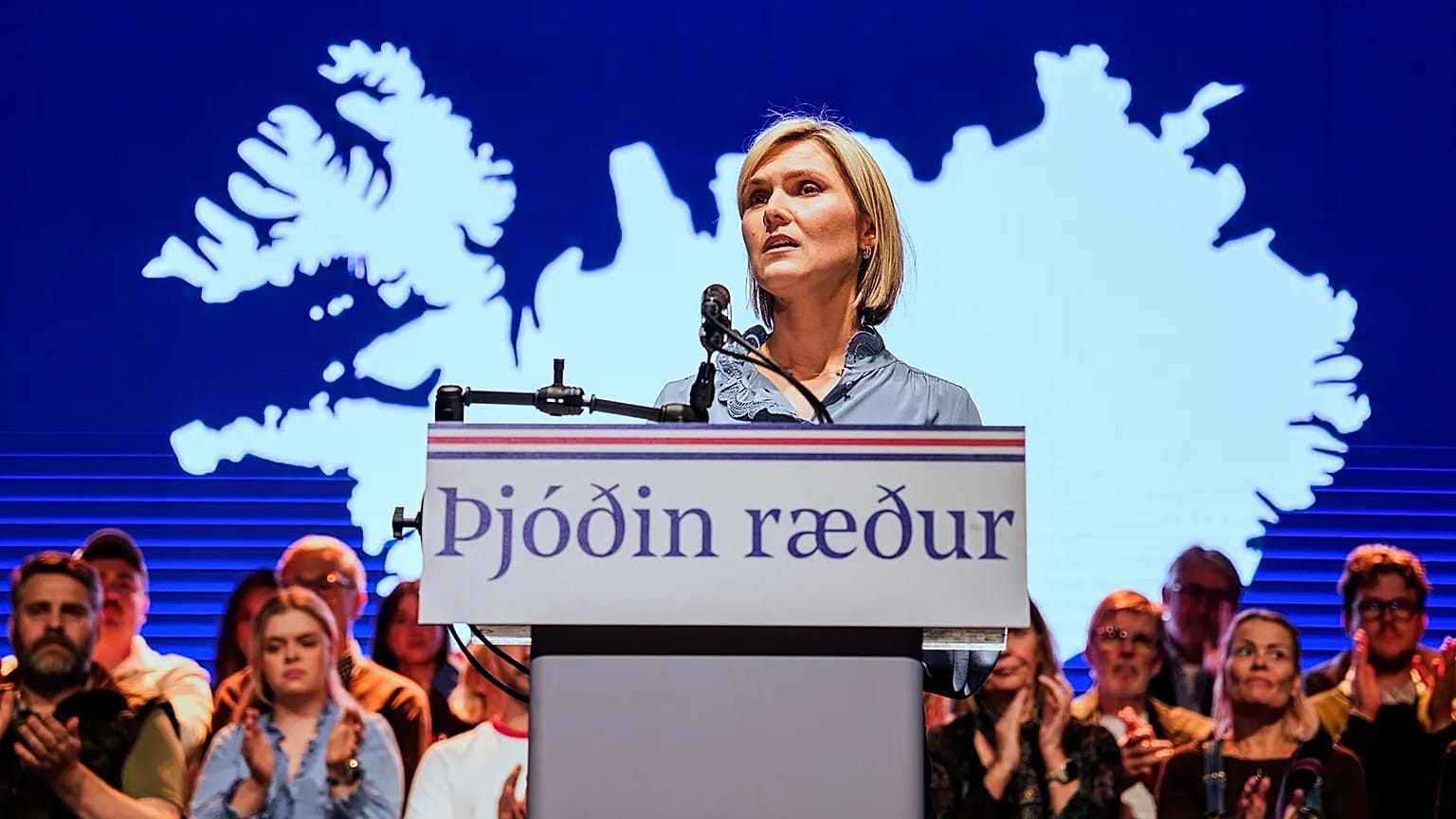
Icelandic Prime Minister Kristrun Frostadottir speaks at an event about a referendum on whether to resume accession negotiations with the EU in Reykjavik, Aug. 26, 2026.
Copyright AP Photo/Marco Di Marco

By Luca Bertuzzi
Published on

The gap between the two camps appears to be steadily closing ahead of Saturday's vote.

Iceland's referendum on whether to restart EU accession negotiations is heading for a knife-edge result, the latest polls show, with the gap between "yes" and "no" narrowing sharply ahead of Saturday's vote.

Maskína, a polling and market research company, says its survey of voting intentions for the high-stakes referendum put the "Yes" camp ahead on 51.3% and "No" on 48.7%.

Previous polls have consistently shown a lead for the pro-accession camp, but also a steady closing of the gap.

In earlier surveys commissioned by the Icelandic news outlet Vísir, Maskína put the "Yes" lead at 6.2 percentage points in June, shrinking to 4.4 points by early August.

A Gallup poll released on 17 August found similar results: 51.5% of voters were set to back the resumption of talks against 48.5% opposed, with a 2.5-point margin of error.

Maskína's latest poll, published on Wednesday, surveyed around 1,000 respondents between 21 and 25 August – a relatively large sample from Iceland's population of roughly 400,000.

The same survey asked voters whether they were concerned about Iceland's sovereignty in the event of EU accession; 40% said they were concerned, while 47% said they had little or no concern.

Much of the campaign has centred on economic issues, particularly fishing and farming, the same sticking points that halted the accession process in 2015.

Voting takes place on Saturday, with polling stations closing at 22:00 local time. Pollsters typically hold off releasing new projections in the final two or three days before a vote.

REST IN POWER

Tim Curry, legendary star of ‘The Rocky Horror Picture Show’ and 'It', dies aged 80


By David Mouriquand
Published on

The prolific British stage, screen and voice actor was best known for his starring roles in the cult ‘The Rocky Horror Picture Show’, ‘Clue’, ‘It’ and ‘Muppet Treasure Island’.

Beloved British actor Tim Curry has died aged 80.

A cause of death was not immediately available, though Curry had suffered from several health issues since a severe stroke in 2012 left him unable to walk.

Best known for his role as Frank-N-Furter, the “sweet transvestite from transsexual Transylvania”, in the cult musical comedy The Rocky Horror Picture Show (1975), Curry was considered one of the most charismatic performers of his generation.

Born in Cheshire, England, on 19 April 1946, Curry began his professional acting career in a 1968 West End production of the rock musical Hair shortly after graduating from the University of Birmingham.

He followed that up with roles in stage performances of Shakespeare, Brecht and Stoppard, before the subversive camp classic Rocky Horror launched him to worldwide stardom. It is still considered a classic of musical cinema and continues to run in limited release to this day, making it the longest-running film release of all time.

The prolific actor is also remembered for playing Bill Sikes in the 1982 TV movie of “Oliver Twist”, the terrifying villain Darkness in Ridley Scott’s fantasy Legend (1985), Wadsworth in the 1985 comedy Clue – the underseen but utterly brilliant adaptation of board game Cluedo - and Long John Silver in Muppet Treasure Island (1996).

Other memorable big screen roles include Rooster Hannigan in Annie, Dr. Yevgeniy Petrov in The Hunt for Red October, Hector in Home Alone 2: Lost in New York, and Cardinal Richelieu in The Three Musketeers.

Beyond Rocky Horror, Curry also made quite the lasting impression in the 1990 miniseries It, based on Stephen King’s novel of the same name. He played the main antagonist Pennywise the Clown, and scared an entire generation of children in the process.


Tim Curry as Pennywise in It ABC screenshot

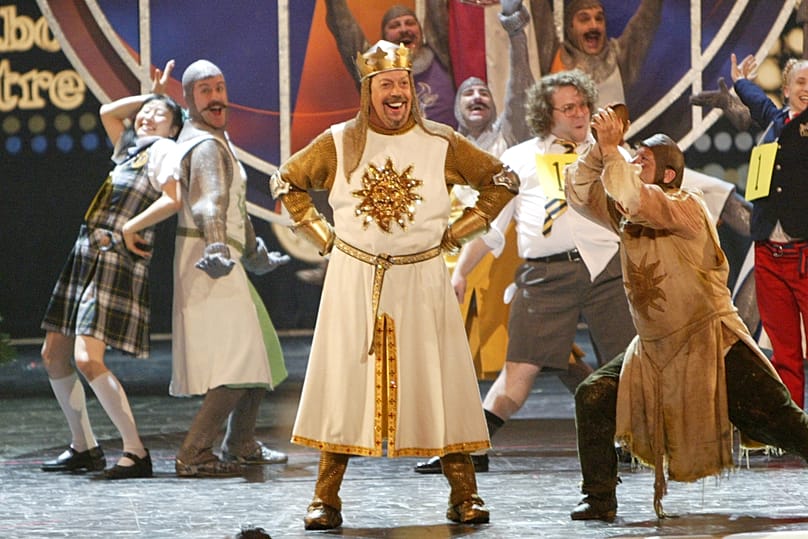
Curry continued to act on stage throughout his career, with a Tony-nominated performance as Mozart in 1981’s Amadeus. Other memorable roles followed in The Pirates of Penzance, The Rivals, My Favourite Year (which earned him a second Tony nomination) and Spamalot, the stage adaptation of Monty Python and the Holy Grail in which he played King Arthur. That role earned him his third Tony nomination.

Tim Curry in Spamalot - 2005


Following his stroke in July 2012, Curry pivoted to voice acting. Among his voice acting projects were FernGully: The Last Rainforest, Star Wars: The Clone Wars, and Peter Pan & the Pirates - with the latter winning him an Emmy Award.

Curry, who never married and had no children, was deeply private about his personal life. However, he wrote in his 2025 memoir, "Vagabond", that he was convinced to tell his story thanks to so many moving encounters with fans.

“The notion that my experiences might resonate helps me persevere - if they strike a chord with only one teenager, alone with a book in his room, as I so often was; or that young woman reading this on an interminably long bus ride; or that older queen, hopefully still in his fishnets, who saw ‘Rocky Horror’ upstairs at the Royal Court; or that middle-aged mother who organizes ‘Clue’ watching parties and refuses entry to anybody out of costume; or that buttoned-up bank clerk who relishes musicals; or that woman who kicked me out of the Waverly for being myself,” he wrote.

RIP Tim Curry 1946 - 2026


Gdansk Shipyard: Art atelier fights to save site's historical legacy amid redevelopment threat


By Chris Burns
Published on

Gdansk Shipyard - the place where Lech Wałęsa led the strikes that brought about the fall of communism and Poland's transition to democracy - is now undergoing another transformation. Private developers are turning the site into new housing estates and business spaces.

Adriana Majdzińska, an artist and professor at the Gdańsk Academy of Fine Arts, runs an art atelier called WL4 at the shipyard together with her husband, sculptor and ceramicist Dr. Czesław Podleśny. She hopes this will help preserve the site's cultural and historical legacy. Podleśny himself creates his human-shaped sculptures from rusting ship parts.

"WL4 is a group of independent artists not affiliated with any institution, for whom art is the paramount value. Our circle includes both established artists and those just beginning their creative journey, working across different fields of art. Our diversity is our strength," reads a statement on the Art Space's website.

The initiative has organized exhibitions, symposiums, workshops, concerts, and performances. Among its guests was Lech Wałęsa himself - Nobel Peace Prize laureate and former President of Poland.

However, Polish developer Develia has signed an agreement to purchase the plot where the collective is based and to build 3,000 apartments, leaving the artists worried that WL4 could eventually be forced to leave the site.

"Of course, we hope and expect that the new owner, a major Polish development company, will be favorable toward culture and art. But that might not happen, and in that case, we'll have to leave this place," Adriana Majdzińska, a professor at the Gdańsk Academy of Fine Arts and co-founder of WL4, told Euronews.

Piotr Grzelak, Gdańsk's Deputy Mayor, stresses that WL4 plays an important role.

"I can't imagine shaping this part of the city without preserving its heritage and spirit of solidarity, or the shipyard as a whole - it's also a competitive advantage for an investor. WL4 is a gallery that's exceptionally important for how this part of the city functions," the official told Euronews.

A PR agency representing Develia says it's too early at this stage to comment on the future use of individual buildings, while assuring that the company will work with local authorities in a way that respects the area's character and history.

Grzelak notes that dialogue should be part of the solution - just as it was during Poland's transition to democracy.


Ceuta faces second night of tense protests: government and media in the crosshairs

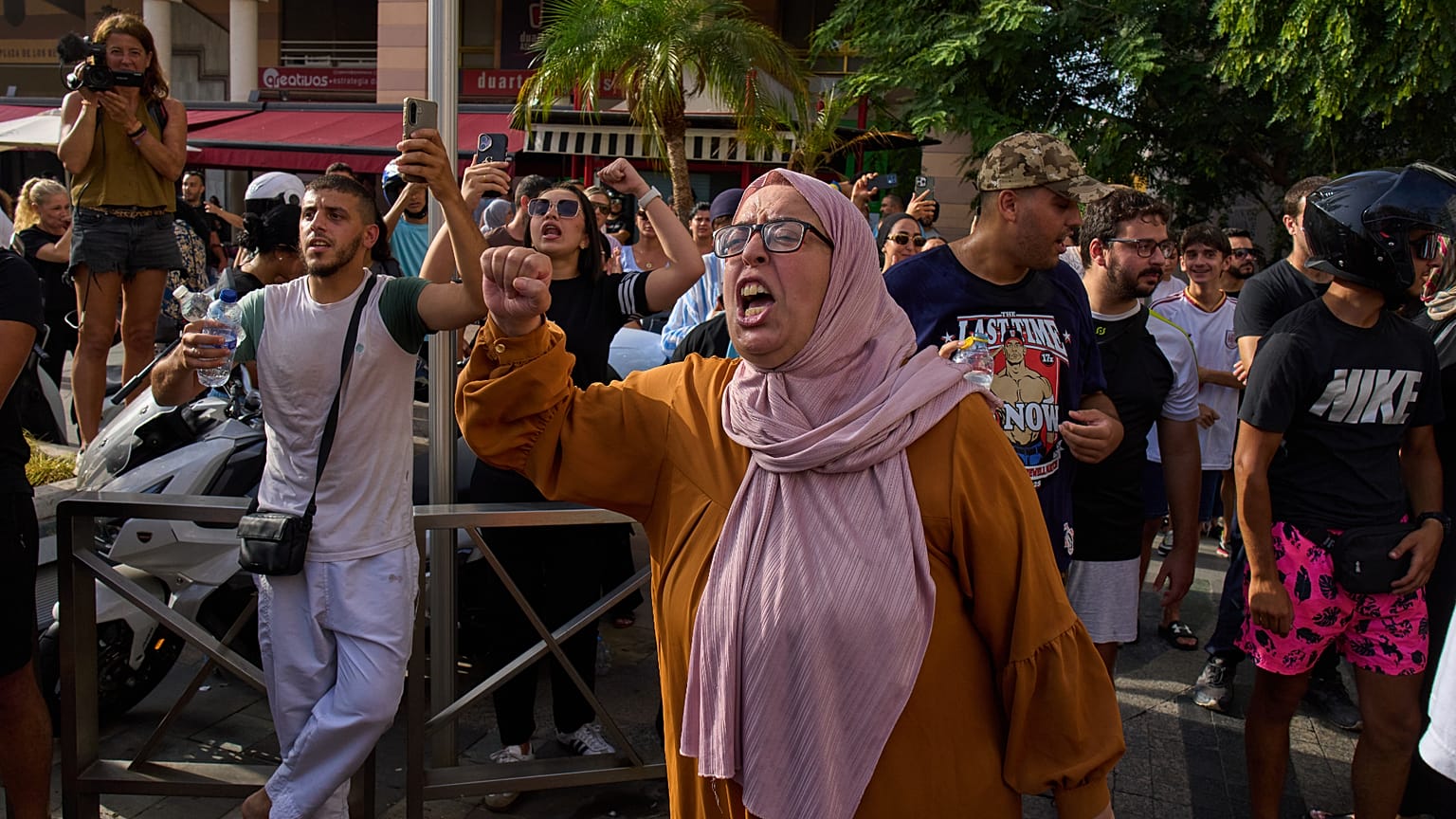
Local residents protest and express outrage at a Vox rally in the city
Copyright AP Photo
By Cristian Caraballo
Published on

Ceuta has seen two days of protests over the migration crisis, with barricades and rubber bullets fired on Trampolin beach. Crews from La Sexta and RTVE were harassed while reporting, amid an escalation of tensions condemned by journalists' associations.

Ceuta has faced its second consecutive night of protests over the migration crisis, and social tensions continue to rise. Tuesday's demonstrations against the alleged plan by the government to house migrants in the Coronel Fiscer barracks were followed on Wednesday by a new wave of protests that ended with barricades, rubber bullets fired by police and blockades on the streets around the port.

Both days share a common denominator that is starting to repeat itself as the crisis persists: the press covering the situation has also become a target of criticism.

Two nights, two TV crews harassed

On Tuesday, a reporter from Spanish television channel La Sexta and his cameraman had to take shelter behind the tables of a pavement terrace when several residents surrounded them, shouting "Fuera, fuera!" ("Out, out!") as they covered the protest. A video recorded by 'El Faro de Ceuta', which went viral hours later, showed insults and shoving, including by several minors, with police failing to intervene until someone pushed the journalist.

That same day, a journalist from Spanish public broadcaster RTVE chose to cover the story without the microphone's branded foam cover, a gesture that was interpreted on social media as an attempt to go unnoticed.

The following day, caution was not enough. While the National Police were sealing off access to the Government Delegation, where the single-command monitoring committee was meeting, chaired by the Minister for Territorial Policy, Angel Víctor Torres, alongside the president of Ceuta, Juan Jesús Vivas, the Minister for Migration, Elma Saiz, and representatives of other ministries joining by videoconference, several demonstrators hurled abuse at journalists covering the meeting, including an RTVE crew, as the Spanish public broadcaster itself confirmed.

The Federation of Spanish Journalists' Associations (FAPE) and the party Movimiento por la Dignidad y la Ciudadanía (MDyC) see both episodes as part of an escalation of harassment against the press in the city, adding to the expulsion several weeks ago of RTVE crews and EFE news agency staff from the Moroccan town of Fnideq by the Rabat authorities.

These are not the first attacks of this kind: a couple of weeks ago, another journalist was assaulted in Ceuta after being mistaken for a migrant. MDyC insists that residents' exhaustion, however understandable after almost a month of crisis, cannot turn those who report the news into targets of the tension: "They are doing their job, just like the State's law-enforcement agencies," the party said in its statement.

Barricades on Trampolín beach and a blocked port

The second day of protests began at 19:00, with hundreds of residents, many carrying Spanish flags, chanting slogans such as "Ceuta se defiende" and "un caballa nunca se rinde" and demanding that the deportations of foreign nationals in an irregular situation who do not have the right to asylum be sped up.

As night fell, the tone hardened: small barricades were erected and a group of young people tried to dismantle some of the huts in the migrant settlement on Trampolín beach, where police blocked access and fired rubber bullets to deter them.

The march, which was heading towards the Government Delegation, finally dispersed in Plaza de África without reaching the Otero flour factory as planned, according to RTVE. One group, however, continued and blocked Avenida Teniente General Muslera, near the port, by dragging containers into the carriageway, according to Radio Television Ceuta.

"We can't go out, the children can't get to school, we can't go out feeling safe," one resident summed up; others complain that public services are overwhelmed: "Our police, our ambulances, our cleaning services, can't cope," said the president of the San Daniel neighbourhood association. Since Wednesday, municipal workers have been holding a minute's silence, joined by Vivas himself.

In the background, one figure continues to define the crisis: nearly 80,000 migrants entered on 30 and 31 July, according to Interior Minister Fernando Grande-Marlaska, most of whom have already been returned. The focus is now on minors: the National Police has identified around 1,500 minors who entered irregularly, a number revised down from the initial 2,168 after duplicate records were removed.

Pre-dawn ambush

Amid escalating tensions, an incident has occurred that makes the situation even more serious. Four soldiers were injured in an ambush carried out by a group of between 30 and 40 people who arrived in Ceuta during the mass migrant entries, in the Benzú area. The incident took place at around 5:30 a.m., when the personnel were heading to the observation post set up in that part of Ceuta.

The attack occurred after the soldiers had passed the traffic lights at Benzú and reached their surveillance post. At that moment, several individuals emerged from different directions and rushed towards the vehicle carrying members of the Ceuta General Command (Comgeceu).

The vehicle, which was not armoured, quickly stopped providing adequate protection for the personnel. The group began hurling large stones at the vehicle, forcing the four soldiers to abandon it and flee on foot to reach safety.

The situation did not end when the soldiers left the vehicle. The attackers continued chasing them towards Calamocarro while still throwing stones. Some of the projectiles struck the soldiers. The soldiers were particularly exposed during the first moments of their escape, until they managed to find cover and call the 112 emergency number for help.

Police deployment

The emergency call triggered an operation involving officers from the National Police and the Civil Guard. According to initial reports, the arrival of the first police vehicle prompted members of the group to flee towards Benzú.

Security forces then began a pursuit and managed to arrest 12 individuals, all of them Moroccan nationals and apparently aged between 35 and 40.

During the police operation, several of those involved tried to escape by sea. Some jumped into the water to avoid arrest, prompting the Civil Guard's Maritime Service to continue search operations for those still in the sea. Police also fired shots during the operation to scare off and disperse the group.

Once the situation was under control, the four soldiers were taken to a medical centre for treatment. They suffered injuries including pain in their arms and backs, as well as bruises caused by the assault and the stone-throwing.