Saturday, August 29, 2026

‘We’d Really Prefer Affordable Healthcare’: Trump ‘Lake America’ Order Ridiculed as Inane Distraction

“The American people don’t want to rename Lake Ontario Lake America,” said Sen. Bernie Sanders. “They want affordable healthcare, childcare, housing, education, nutrition assistance—all of which you have massively cut.”
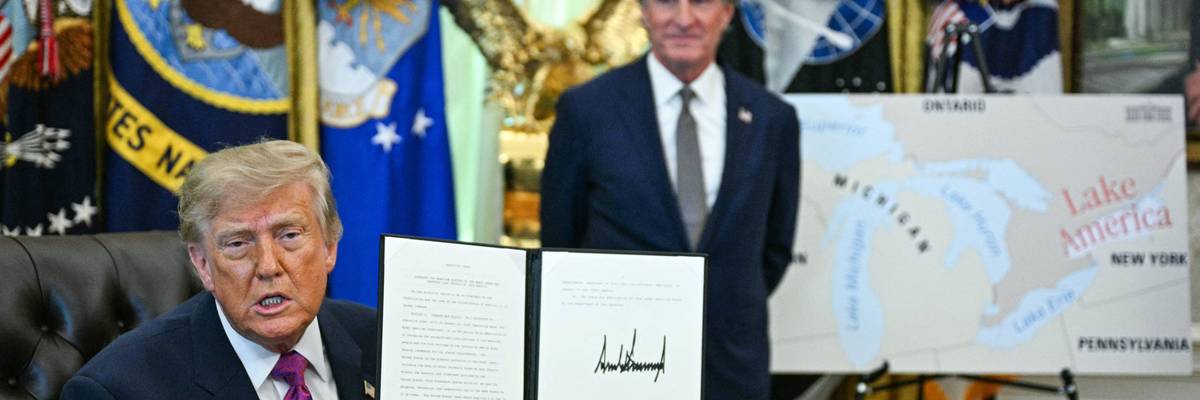

US President Donald Trump, alongside Interior Secretary Doug Burgum, displays an executive order renaming Lake Ontario to Lake America in the Oval Office of the White House on August 27, 2026.
(Photo by Jim Watson/AFP via Getty Images)

Jake Johnson
Aug 27, 2026
COMMON DREAMS


The United States is locked in another Middle East quagmire, the American economy is shedding jobs, wage growth is decelerating, and the costs of essentials are rising, but President Donald Trump on Thursday took time to hold an Oval Office event for the signing of an executive order renaming Lake Ontario to “Lake America,” as his damaging trade war with Canada intensifies.

“We’d really prefer affordable healthcare,” the consumer advocacy group Public Citizen wrote in response to the president’s order, which was widely derided as idiotic and pointless, particularly amid skyrocketing health insurance premiums, large-scale loss of food aid, and other crises sparked by Trump and his Republican allies in Congress.

“No, President Trump,” Sen. Bernie Sanders (I-Vt.) wrote following the White House event. “The American people don’t want to rename Lake Ontario Lake America. They want affordable healthcare, childcare, housing, education, nutrition assistance—all of which you have massively cut in order to pay for your $1 trillion tax break to the top 1%.”

Trump—who recently admitted that he doesn’t “think about Americans’ financial situation” when considering the impacts of waging war on Iran—said Thursday that the “Lake America” name change was something he had been “thinking about for a long time, actually.”


Trump’s order instructs the US interior secretary to, within 30 days, “take all appropriate actions to rename as ‘Lake America’ the body of water currently named as Lake Ontario.”

“We’re on it, Mr. President!” Interior Secretary Doug Burgum wrote on social media in response to Trump’s directive.

After Trump floated the name change earlier this week, Canadian Industry Minister Mélanie Joly responded that “we’ll always call it Lake Ontario.”

“We’re proud of the Great Lakes... and we’ll stand up for what we have,” said Joly. “I really think that, with all these shenanigans happening, we’ll just be smart and we’ll be strategic, and we’ll fight back.”

New York Gov. Kathy Hochul, who leads the only US state that touches Lake Ontario, said Wednesday that the Trump administration “should be focusing on ways to mend relationships with Canada so our farmers and our consumers and our families do not continue suffering from this inane war over tariffs.”

“The fact that [the name change] is even part of the conversation shows how absurd the Trump administration is,” said Hochul.


'Can you imagine?' Trump hurls tantrum as Dem dubs 'Lake America' rename a 'SHAME'


Kathleen Culliton
August 29, 2026 
RAW STORY

President Donald Trump admitted to befuddlement late Friday night when he took to Truth Social to rage at a political foe.

Trump lashed out at New York Gov. Kathy Hochul (D) after she refused to start calling Lake Ontario "Lake America" and cast blame on the president for prioritizing semantics over serious issues such as inflation.

"Governor Kathy Hochul is for Canada, a Country that has been ripping off New York State for years, especially under her Administration, instead of the good ‘ol U.S.A," Trump raged. "Can you imagine her saying that she won’t respect or acknowledge LAKE AMERICA."

While Trump argued "Dumocrats" such as Hochul were "bad for our country," Hochul argued his mounting war with Iran and trade war with Canada were worse.

"New York families are being hit with higher costs for energy, groceries, and prescription drugs because of Trump's actions," Hochul wrote on X. "Instead of fixing these issues, the president is trying to rename Lake Ontario. Shame on him for deflecting from the real needs of Americans.

Hochul also argued Trump's rename was telling, as it changed the acronym students use to remember the great lakes (Huron, Ontario, Michigan, Erie and Superior) from HOMES to SHAME.

Trump's Thursday order to rename Lake Ontario has drawn much criticism from analysts who say it's risky to antagonize one of the nation's top trading partners with a rehash of a past move that was deeply unpopular ahead of the midterm elections.


'It gets dumber': Jim Acosta Show dumbfounded as Trump floats renaming oceans

Erik De La Garza
August 28, 2026 
RAW STORY
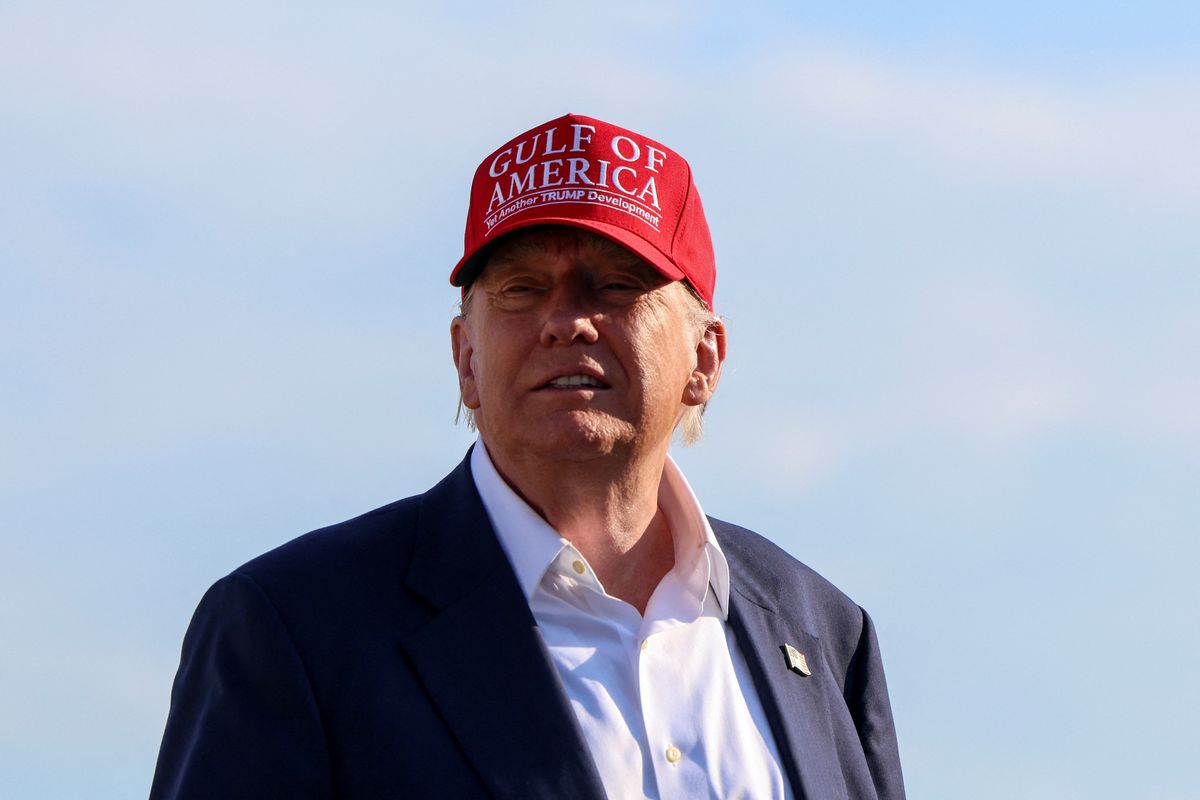

U.S. President Donald Trump wears a "Gulf of America" hat as he departs en route to Florida, at Joint Base Andrews, Maryland, U.S., July 1, 2025. REUTERS/Evelyn Hockstein

President Donald Trump’s push to slap America’s name on major bodies of water could soon expand to the Atlantic and Pacific oceans, an idea that left The Jim Acosta Show dumbfounded.

Trump floated renaming one or both oceans Thursday while celebrating his decision to change Lake Ontario to “Lake America” amid escalating tensions with Canada.

“As you know, we took something called the Gulf of Mexico and we changed it, and now it’s very routinely the Gulf of America,” Trump said. “So, if you think about it, we have a gulf and we have a lake, now all we need is an ocean.”

“Maybe we’ll have to change the name of the Atlantic and/or the Pacific,” he added. “Maybe we’ll change them both.”

Writing Friday for The Jim Acosta Show’s morning newsletter, Tommy Christopher warned readers: “It gets dumber.”

Christopher described Trump as having gone “MAXIMUM toddler” and went on to call his White House an “idiot admin.”

Multiple media outlets highlighted Trump’s suggestion that the Atlantic or Pacific could be next, although no replacement names for the two oceans have been floated by the president.

Illinois Gov. J.B. Pritzker responded to Trump’s lake announcement with a renaming decision of his own.

“EFFECTIVE IMMEDIATELY: Trump Tower is renamed to NATALIE TOWER!” Pritzker wrote, invoking Trump aide Natalie Harp.


Trump's Lake Ontario gambit provokes shocking CNN theory: 'Even Republicans are balking'

Kathleen Culliton
August 28, 2026 
RAW STORY
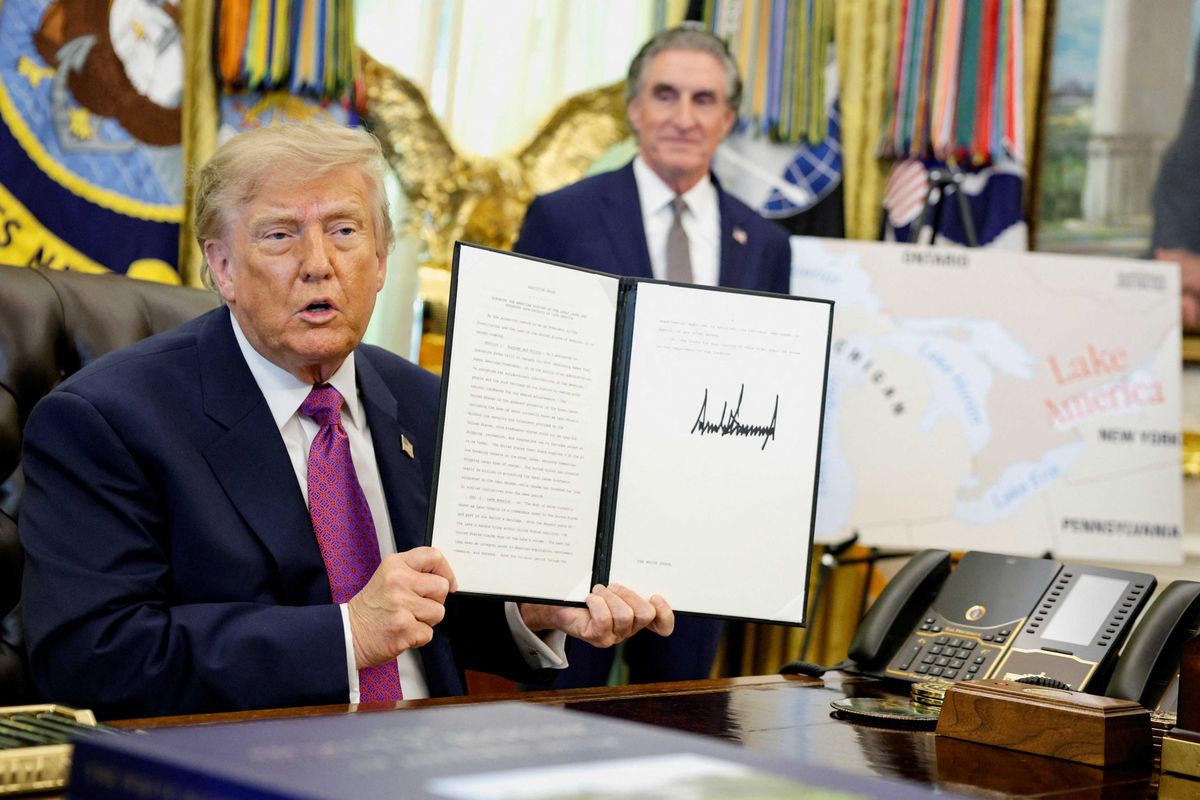

U.S. President Donald Trump holds up an executive order to rename Lake Ontario as Lake America after signing it at the Oval Office of the White House in Washington, D.C., U.S., August 27, 2026. REUTERS/Evan Vucci

President Donald Trump's desperate attempt to engage his MAGA base with a terrible rehash of a previously unpopular move provoked a strange theory from a prominent political analyst Friday morning.

Trump's executive order renaming Lake Ontario as Lake America will underline to conservative voters his obsession with trivialities and remind them of one the most unpopular moves he made at the beginning of his second term, CNN's Aaron Blake argued.

"The move recalls one of Trump’s splashiest (so to speak) moves on his first day back in office last year, when he signed an order renaming the Gulf of Mexico as the 'Gulf of America,'" wrote Blake. "That went over like a lead balloon."

Polls show Trump's decision to rename the Gulf was more unpopular than his pardons of Jan. 6 defendants with 70 percent of Americans opposing it in multiple polls.

Blake noted those polls were taken before Trump's renaming spree.

"Americans have taken a pretty dim view of Trump’s penchant for renaming things — including after himself," he wrote. After his handpicked board of loyalists tried to rename the Kennedy Center after Trump, Americans said by a 2-to-1 margin that he had 'gone too far.'"

Trump faces shorter odds of winning approval for "Lake America" considering the current political context — prices are rising as his war with Iran wages on, Blake argued.

Also — Americans like Canada, he wrote.

"These kinds of stunts might have felt a little cuter when Trump was riding higher early in his term, they now risk reinforcing how preoccupied he is with not just trifles, but things that Americans decidedly do not want," he wrote.

"Even some Republicans are balking, with the GOP nominee for Wisconsin governor, Rep. Tom Tiffany, saying Thursday that the name should stay the same."

So why did Trump decide to escalate hostilities with Canada? Blake has a surprising theory.

"You could say he’s playing the hits. But it’s really playing the flops," wrote Blake. "It increasingly feels as though President Donald Trump is trying to do unpopular things."

Trump-Loving FIFA Boss Faces Criminal Probe for Scheme to Sell World Cup Profits to Jared Kushner’s Brother

Gianni Infantino has long been a target of criticism from football fans, in no small part due to his relationship with President Donald Trump.


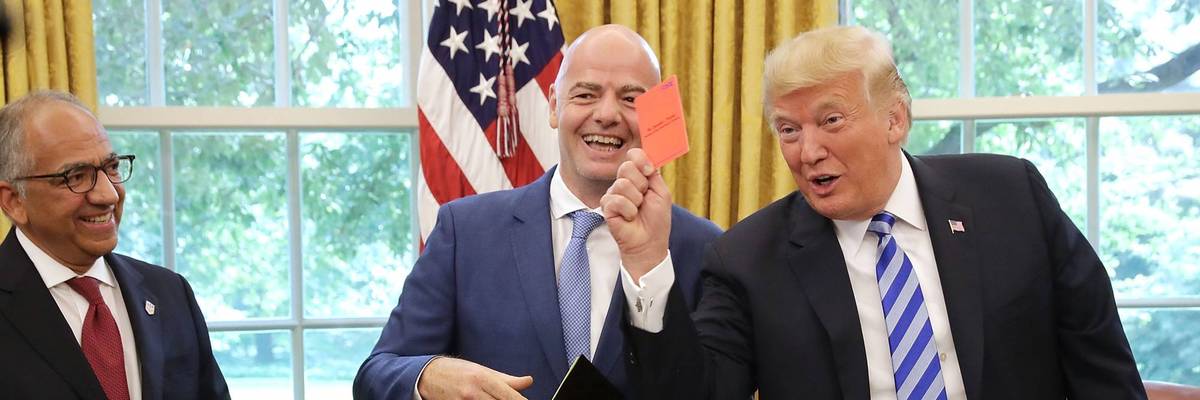
President Donald Trump pretends to give a red card to members of the news media while meeting with FIFA President Gianni Infantino on August 28, 2018 in Washington, DC.
(Photo by Chip Somodevilla/Getty Images)

Brad Reed
Aug 27, 2026
COMMON DREAMS

Gianni Infantino, president of the Fédération Internationale de Football Association, is facing a criminal probe over his ill-fated scheme to sell profits generated by the World Cup to private equity investors.

According to a Thursday report in The Associated Press, attorneys representing the Union of European Football Associations (UEFA), the governing body of European football, filed discovery requests with two US courts seeking documents related to the scheme, which Infantino abandoned earlier this month after near-universal pushback from other football organizations.

In New York, UEFA asked the court to subpoena Thrive Capital Management, a venture capital firm founded by Josh Kushner, the younger brother of Jared Kushner, President Donald Trump’s son-in-law.

“Thrive and Kushner were to be the anchor investors intending to pay FIFA $4.2 billion for a 20% stake in a subsidiary that would run the soccer body’s commercial events, including the World Cup,” reported the AP.

In Florida, UEFA requested subpoenas for files held by FIFA Americas and FWC2026, two FIFA businesses based in the state.

UEFA attorneys revealed that they “are contemplating a Swiss criminal proceeding against Infantino and possibly other FIFA officials for criminal mismanagement” related to the failed sell-off scheme.

The attorneys also accused the FIFA boss of creating a vehicle so that he and his allies could “acquire a permanent stake in and otherwise profit from FIFA’s most valuable assets to the detriment of FIFA, its members, and other parties within the football family.”

Infantino has long been a target of criticism from football fans, in no small part due to his relationship with Trump.

The FIFA boss was widely ridiculed last year when he awarded Trump the first-ever “FIFA Peace Prize” less than two months before the president would launch an illegal war against Iran.

And during this year’s World Cup, Trump and his administration led a pressure campaign that successfully got FIFA to drop a one-game ban for Folarin Balogun, a top player on the US Men’s National Team, drawing widespread accusations of corruption and favoritism.
Big Oil Stocks Surged Due to Iran War—and New Filings Show How President Trump Cashed In

The president is making “significant profits on the global instability he’s inciting,” said one government ethics expert. “It’s profoundly unethical.”


US President Donald Trump gestures as he meets with British Prime Minister Keir Starmer on July 28, 2025 in Turnberry, Scotland.
(Photo by Christopher Furlong/Getty Images)

Julia Conley
Aug 27, 2026
COMMON DREAMS

In a mandated filing with the Office of Government Ethics released Thursday, President Donald Trump was found to have made more than 1,000 stock transactions in June, including thousands of dollars invested in energy companies that were reaping record profits from the war Trump started with Iran.

Trump submitted financial disclosure forms to the OGE covering the second quarter of 2026, during which the Iran War continued, was paused for a ceasefire, and restarted again.

CBS News pointed to a “notable large transaction” on April 7, the day Trump declared a ceasefire with Iran after having threatened to destroy the country’s “entire civilization.” His investment accounts sold between $500,000 and $1 million of ExxonMobil stock that same day.

The filings were submitted days after Democrats on the Joint Economic Committee (JEC) estimated that Trump’s oil and gas stocks have soared in value since before he began attacking Iran in February—an act that raised oil prices due to Iran’s retaliatory closing of the Strait of Hormuz. The holdings were estimated at $13 million to $46 million at the start of 2026 and $17 million to $61 million this month.

“President Trump saw his wealth go up by as much as $15.5 million just through stocks he owned in oil and gas companies at the end of 2025,” said the JEC Democrats. “These companies’ profits and stock values are rising because Trump’s reckless war in Iran has caused gas and oil prices to skyrocket.”

The JEC’s estimates were based on his holdings in 2025 and did not account for the trades he continued to make as the war dragged on.

“Trump’s war in Iran has inflicted higher energy and gas prices on the American people,” said Citizens for Responsibility and Ethics in Washington (CREW). “Meanwhile, Trump’s brokers have been trading oil and gas stocks for him, helping him profit on the global instability he’s inciting. It’s profoundly unethical.”


The White House said the president does not make trades himself, but CREW president Donald Sherman told CBS News that Trump should not be making “significant profits on the global instability he’s inciting.”

“President Trump’s war of choice in Iran has cost the American people in the form of higher energy and gas prices and higher shipping costs,” Sherman said. “Meanwhile, Trump’s brokers have been trading oil and gas stocks for him... It doesn’t matter whether he’s trading the stocks himself—the president has a duty to avoid conflicts of interest between his finances and what’s best for the American people.”

Unlike other US presidents, Trump has refused to place his assets in a blind trust, instead continuing to hold stocks that are visible to him in all 11 sectors involved in the stock market.

In June, the president’s stock portfolio made a series of energy trades, including two sales and one purchase of ExxonMobil stock that were valued between $1,001 and $15,000. He also bought and sold Chevron stocks three times and made three sales of ConocoPhillips holdings.

Sen. Kirsten Gillibrand (D-NY) said that the new filings show “Trump’s only focus is enriching himself at the expense of the American people.”
Senate Resolution Will Demand Answers on Extremist Israeli Settler Violence Against US Citizens

“The United States cannot keep bankrolling this violence and looking the other way—it’s time to end our complicity, once and for all,” said US Sen. Bernie Sanders.


A Palestinian girl looks at Israeli soldiers patroling as Palestinian residents remain confined inside their homes in the village of Qusra, south of Nablus in the West Bank, on August 20, 2026.
(Photo by Issam Rimawi/Anadolu via Getty Images)

Brad Reed
Aug 27, 2026
COMMON DREAMS

A group of Senate Democrats on Thursday announced plans to introduce a privileged resolution requiring the Trump administration to give Congress more information about violence carried out by extremist settlers in the Israeli-occupied West Bank.

Led by Sens. Chris Van Hollen (D-Md.), Tim Kaine (D-Va.), and Bernie Sanders (I-Vt.), who caucuses with Democrats, the lawmakers are demanding the US Department of State produce reports detailing investigations into the killings of nine US citizens at the hands of Israeli settlers in recent years, as well as assessments on the human rights impact of Israeli policies such as the detention of Palestinian children.


Amnesty, UN Office Condemn Israeli Settlers’ Siege of Palestinian Homes in West Bank


Van Hollen said the resolution was necessary because the Trump administration has done nothing to hold the Israeli government accountable for the deaths of US citizens.

“As we’ve seen violence rise in the West Bank, American citizens have been killed time and again, and they have received no justice and no accountability,” said Van Hollen. “It’s past time we get answers on their deaths—and on the growing violent instability in the West Bank and the injustices facing Palestinian civilians on a daily basis.”

Sanders accused the Israeli government of offering “impunity” to settlers who carry out “horrific violence” against Palestinian civilians regularly.

“Enough is enough,” said Sanders. “The United States cannot keep bankrolling this violence and looking the other way—it’s time to end our complicity, once and for all.”

Kaine described the Israeli government’s “lack of response” to the settler violence as “unacceptable,” saying it “threatens the long-term safety and security of the entire region.”

“Friends need to listen to each other,” said Kaine, “and my colleagues and I have repeatedly urged Israeli leaders to take firmer action to curtail illegal settlements in the West Bank, prosecute violent settlers, and protect Palestinian residents as well as American citizens living in or visiting the West Bank.”

Sen. Elizabeth Warren (D-Mass.), who is also supporting the resolution, slammed the Trump White House’s complicity in the Israeli settler attacks, nothing that the administration “has even gone so far as to reverse sanctions against individuals connected to this pattern of horrific violence.”

“It’s long past time for the US government to stand up for human rights,” said Warren, “investigate this violence against Americans and Palestinian civilians, provide full information to Congress, and hold the perpetrators accountable.”

By introducing the measure as a privileged resolution, the Democrats can force a vote on it on the floor of the US Senate if the chamber’s Foreign Relations Committee fails to act on it within 10 days of its introduction.

Human rights organizations for months have been sounding the alarm about the situation in the West Bank, where Israeli settlers have routinely attacked Palestinians at their own homes.

An analysis published by the Carter Center last month found that “settler attacks are now the leading cause of Palestinian injuries in the West Bank,” as “more than 3,200 Palestinians have been displaced by settler attacks and home demolitions this year—double the daily rate of the previous three years.”
Investigation Exposes Massive New Jersey Data Center Operating Army of Polluting Generators Without Permits

“It seems that this industry, in particular, values speed to market more than almost anything else.”


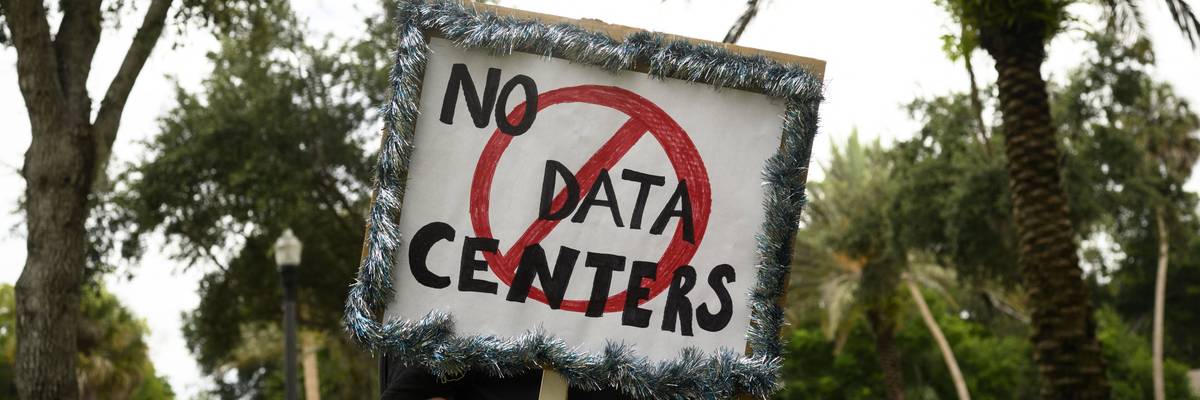
A person holds signs during a nationwide protest against AI data center expansion outside Peace Hall in New Port Richey, Florida on July 18, 2026.
(Photo by Thomas Simonetti / AFP via Getty Images)

Brad Reed
Aug 27, 2026
COMMON DREAMS

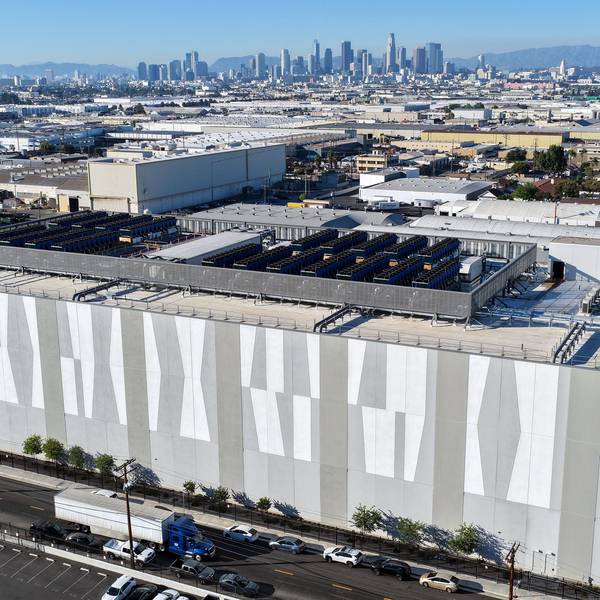
A joint investigative report published by Floodlight and The Guardian on Thursday revealed that one of the largest planned artificial intelligence data centers on the East Coast is operating dozens of gas-powered generators without permits in a possible violation of federal law.

Using a thermal drone to take footage of the Microsoft-backed DataOne facility in Vineland, New Jersey last week, Floodlight determined that the data center was operating 45 generators at once.


Trump EPA Urged to Withdraw Rule to Let Data Centers Obtain Pollution Permits in Secret


Trump Regulators Issue Key Permit for Proposed $100 Million Underwater Data Center Off Maine Coast


The investigation noted that the generators were operating roughly one mile from two different schools, and that the gas-powered generators used as the facility “emit substantial amounts of health-harming air pollution linked to asthma, heart attacks, and even premature death.”

Bruce Buckheit, who previously served as air enforcement chief at the Environmental Protection Agency (EPA), told Floodlight that DataOne is likely violating federal law with its unpermitted generators, and he said the government should make the facility pay a fine for “illegal emissions.”

Buckheit added that DataOne’s apparent disregard for regulations appeared to be a common trait in the AI industry.

“It seems that this industry, in particular, values speed to market more than almost anything else,” he said.

A New Jersey Department of Environmental Protection spokesperson told Floodlight that the agency is investigating DataOne’s use of gas generators but has yet to reach “a full compliance determination.”

Local residents told Floodlight that they have for months complained about the nonstop humming produced by the facility, which they suspect is being caused by the generators.

“It’s just constant,” resident Andrew Groetsch told Floodlight of the noise coming from the facility. “It never goes away.”

DataOne, which is projected to cover 2.5 million square feet upon its completion, has long been controversial.

In an interview with NBC Philadelphia published earlier this month, Vineland resident Peggy Schumacher said that the noise from the data center has gotten so bad that it’s making her neighborhood “unlivable.”

“We are a mile away,” Schumacher explained, “and the vibration in our house is horrible now.”

Fellow Vineland resident Tallis West offered a similar description of living near DataOne in an interview with CBS News published in May.

“Outside is not even enjoyable to sit outside because of the noise sometimes,” West said. “We can’t enjoy being outside anymore.”

Despite the objections of many local residents, the Vineland Planning Board earlier this month voted to approve the second phase of construction at the facility.

The tech industry’s rapid buildout of AI data centers is getting major pushback from voters across the US, as residents issue complaints about both pollution and energy consumption that has been raising their utility bills.

Sen. Bernie Sanders (I-Vt.) and Rep. Alexandria Ocasio-Cortez (D-NY) earlier this year proposed a moratorium on new data center construction.
Study Suggests Climate Crisis Is Supercharging ‘Godzilla’ El Niños

“We are seeing a trend of stronger El Niños, and the one we have now is consistent with that trend,” said the lead author. “That is bad news for climate hazards and for people.”


A study published August 27, 2026 in the journal Science concludes that fossil fuel-driven global warming has intensified the warm phase of the El Niño-Southern Oscillation in the Pacific Ocean.
(Photo by Julia Cole/Science)

Jessica Corbett
Aug 27, 2026
COMMON DREAMS

As the flooding disaster in Tibet and Nepal demonstrates the deadly consequences of the climate emergency, experts wrote Thursday in the journal Science that fossil fuel-driven global heating has intensified the warm phase of a key pattern in the Pacific Ocean.

The El Niño-Southern Oscillation (ENSO) has a warm phase, called El Niño, as well as a neutral phase and a cold one, La Niña. In June, scientists declared the start of a warm event nicknamed “Godzilla,” which helped push last month’s average global ocean surface temperature to the hottest ever recorded in July.

The current event is expected to become not only a super El Niño, but the most intense one on record—and it could contribute to 2027 possibly being the hottest year humanity has ever endured.

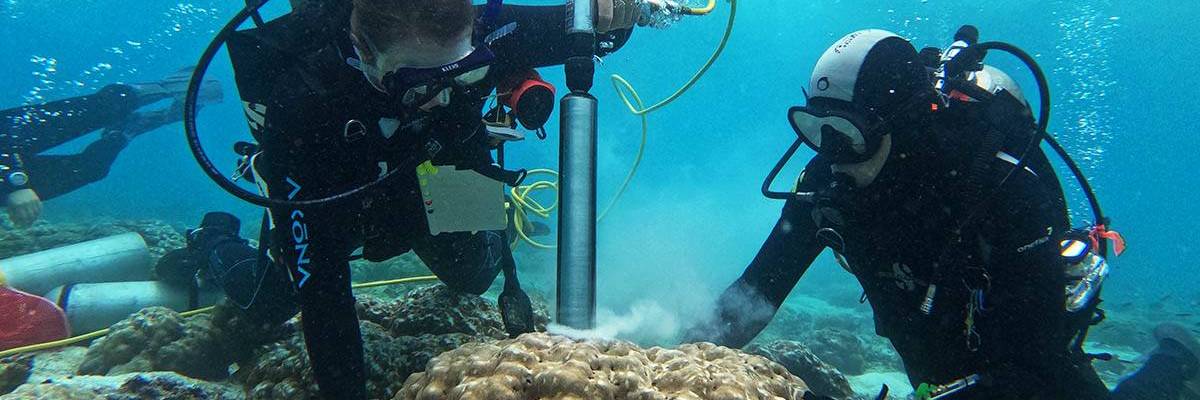
While ENSO is a naturally occurring phenomenon, the scientists behind the new paper studied coral skeletons from the Galápagos Islands and concluded that global warming—tied to humans continuing to burn fossil fuels—has intensified El Niño phases.

“Our findings suggest El Niño can supercharge global warming, but also global warming can supercharge El Niño—that is what we are seeing,” said lead author Julia Cole, who chairs the University of Michigan’s Department of Earth and Environmental Sciences.

The scientist also spoke with Inside Climate News, which noted that “the first documented super El Niño in 1982-83 killed about 95% of the shallow-water corals around the Galápagos Islands, right around the time Cole began her research career.”

Based on the team’s analysis, “after the El Niño in 1982, we start seeing much more variability; it’s a lot more extreme and looks like nothing in the previous 1,000 years,” Cole told The Guardian. “What surprised me was how consistent it was. There is just such a large, distinct difference between what has been happening in the last 40 years compared to preindustrial times.”

As Inside Climate News reported:
When Cole visited the islands in 1989, many of the large mapped corals that could have served as sample material were gone, wiped out by the El Niño early in the decade and then decomposed quickly by organisms in the biologically active waters. But in 2006, her team discovered fossil coral remnants, often perched as boulders near remote east-facing coastlines, tossed inland by large waves or tsunamis.

Cole said the signal of El Niños intensified by human-caused warming would have been even stronger if the study had included the most recent occurrences. All the events categorized as super El Niños have occurred since the 1980s and have triggered flooding in East Africa, led to disease outbreaks, and intensified tropical storms. This year’s El Niño is intensifying drought in Indonesia, fueling widespread fires that are sending smoke and hazardous air pollution across Southeast Asia, Cole said. Her team is currently analyzing corals to show the changes from the El Niños in 2015-16 and 2023-24, she added.

“We are seeing a trend of stronger El Niños, and the one we have now is consistent with that trend—it’s not a fluke. We are seeing a shift where El Niño doesn’t look like what it did prior to industrial times,” Cole said. “That is bad news for climate hazards and for people, particularly those who are badly impacted and yet have done little to cause climate change.”

According to the United States’ National Oceanic and Atmospheric Administration, consequences of El Niño include “increased rainfall across the southern tier of the US and in Peru, which has caused destructive flooding, and drought in the West Pacific, sometimes associated with devastating brush fires in Australia.”

Dalhousie University marine scientist Boris Worm wasn’t involved with the new study but told The Associated Press on Thursday that “El Niño is the most violent aspect of climate variability worldwide, with effects ranging from local fisheries collapse, to widespread coral die-offs to severe droughts, and food shortages around the world.”

Experts are already worried about the latest El Niño’s impact on food security and prices, with the United Nations World Food Program projecting earlier this month that almost 50 million more people worldwide face the prospect of acute hunger.

Pointing to late climate scientist Wallace Broecker’s warning that “the climate system is an angry beast and we are poking it with sticks,” Worm said that “human emissions are the stick, and El Niño is [one] of the ‘angry’ outbursts that can be so threatening to our collective safety.”
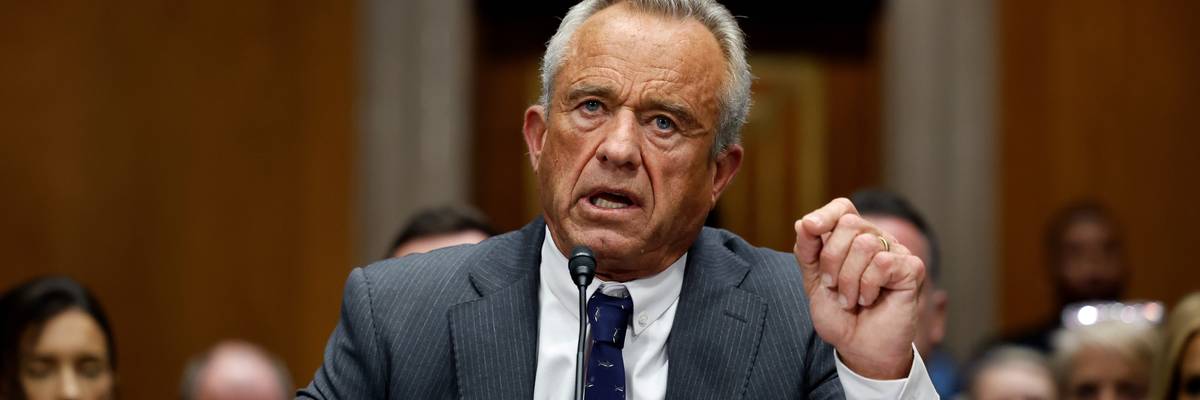
‘RFK Jr. Lied to Congress’: Criminal Probe Sought Over Samoa Trip Linked to 83 Measles Deaths

“He told us his Samoa trip had nothing to do with vaccines—now this letter shows that was false,” Sen. Ed Markey said of President Donald Trump’s health and human services secretary.


US Health and Human Services Secretary Robert F. Kennedy Jr. testifies before the US Senate during his confirmation hearings on Capitol Hill in Washington, DC on January 30, 2025.
(Photo by Kevin Dietsch/Getty Images)


Brett Wilkins
Aug 27, 2026
COMMON DREAMS

US Health and Human Services Secretary Robert F. Kennedy Jr. on Thursday faced calls for a criminal investigation after newly published documents appear to contradict his repeated testimony during Senate confirmation hearings that his 2019 trip to Samoa, which is linked to 83 measles deaths, “had nothing to do with vaccines.”

The advocacy group American Oversight on Thursday asked the US Department of Justice to investigate whether Kennedy knowingly made materially false statements during his 2025 Senate confirmation hearings. The request follows the publication of a January 2019 letter, signed by Kennedy and addressed to Samoa’s then-prime minister, Tuilaʻepa Saʻilele Malielegaoi, that explicitly proposed a vaccine-focused assessment of the Pacific island nation’s measles, mumps, and rubella (MMR) program.

“Robert F. Kennedy Jr. repeatedly testified before two separate Senate committees that his trip to Samoa had nothing to do with vaccines. But a letter he wrote to Samoa’s prime minister six years earlier appears to contradict that testimony,” American Oversight executive director Chioma Chukwu said Thursday in a statement.

“Congress relies on truthful testimony to do its job, particularly on matters as consequential as public health,” Chukwu added. “If Kennedy lied to the Senate while seeking confirmation as the nation’s top health official, the Justice Department must investigate and hold him accountable.”

Questioned by Sen. Ron Wyden (D-Ore.) before the Senate Finance Committee, Kennedy said his trip had “nothing to do with vaccines,” describing it instead as an effort to introduce a medical informatics system to digitize the nation’s health records.

The following day, when Sen. Ed Markey (D-Mass.) pressed him on the same issue before the Senate Health, Education, Labor, and Pensions Committee, Kennedy again said his trip had “nothing to do with vaccines.”

Markey’s office released a statement Thursday noting that Kennedy “traveled to Samoa in 2019 to promote disinformation about the measles vaccine. Shortly after his trip, Samoa experienced a deadly outbreak of measles that killed over 80 people and has been attributed to mass vaccine disinformation.”


Of the 83 measles deaths during the outbreak, 72 were children under the age of 5. More than 1,860 hospitalizations in Samoa have been linked to the outbreak.

“New documents confirm what we already knew: RFK Jr. lied to Congress,” Markey said. “He told us his Samoa trip had nothing to do with vaccines—now this letter shows that was false, just like it was false when he denied his role in the deadly outbreak that followed.”

“This is a pattern, not a slip,” he added. “RFK Jr. has lied to the Senate, lied to the American people, and jeopardized the health of children to advance his anti-vaccine agenda. He should never have been confirmed, and he cannot be trusted to run [the US Department of Health and Human Services] for even one more day.”

Democratic Hawaii Gov. Josh Green, who is a physician, was invited by the Samoan government to help lead the measles response and recovery in the South Pacific archipelago.

“Misinformation and measles are a deadly combination—I saw that firsthand in Samoa,” Green said on Thursday. “The truth is, this is a disease we know how to prevent. The MMR shot is the only proven and effective way to prevent the spread of measles.”

“Vaccines save lives,” he added. “Our public health decisions must be guided by doctors, scientists, and evidence—not conspiracy theories or political convenience. We owe it to every family to protect our children and communities, and make sure no one else dies from a preventable disease.”

The group 314 Action, which recruits, trains, and works to elect Democrats with expertise in science, published a statement Thursday noting that “now, America is facing its worst measles crisis in decades, and two more Americans have lost their lives to a disease we have long known how to prevent.”

Public health experts have warned that the US is on track to lose its measles elimination status, which the country achieved in 2000, and blame the regression on declining vaccination driven by misinformation and conspiracy theories, including that vaccines are dangerous and even deadly.

Earlier this month, President Donald Trump signed an executive order overhauling federal recommendations for children that calls for separating the MMR vaccine into three individual shots.

“The only thing ‘lethal’ about vaccines is listening to RFK Jr.'s lies about them,” said 314 Action. “America needs more leaders like Gov. Green who are willing to stand up to Trump and RFK Jr. and put public health over politics. We won’t stop fighting until RFK Jr. is fired or removed from office.”
A Nuclear Bomb Took My Arms Before I Was Born; We Must Not Let One Take Our Future

I want to be among the last people whose bodies carry the legacy of the nuclear age; whether I am depends on decisions that are still within our reach.


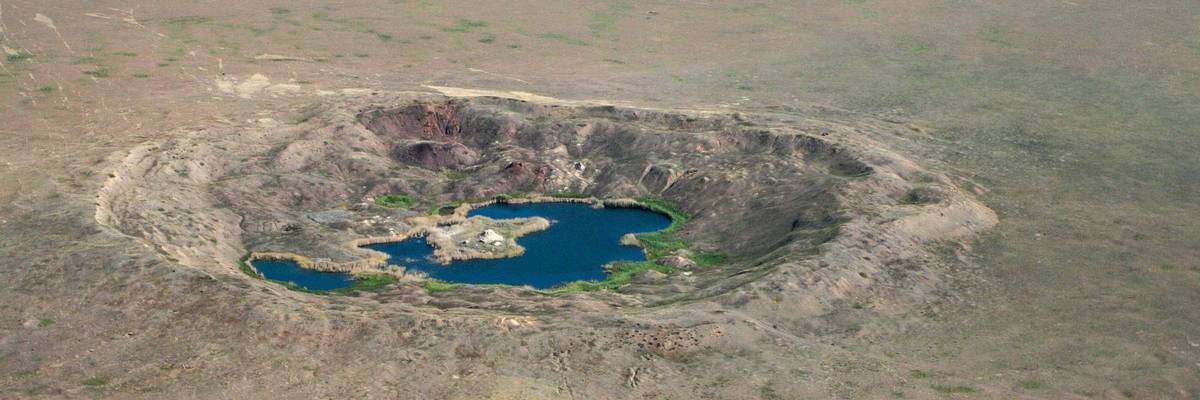
A crater from nuclear tests in former Soviet Union nuclear test site Semipalatinsk is shown in Kazakhstan.
(Photo by the Official CTBTO Photostream - Crater/ CC BY 2.0)


Karipbek Kuyukov
Aug 29, 2026
Common Dreams

I paint with a brush held between my teeth or my toes. I was born without arms in 1968 about 100 kilometers from the Semipalatinsk nuclear test site in eastern Kazakhstan. My parents’ generation watched mushroom clouds rise over the steppe without being told what the explosions could do to their bodies or their children.

For four decades, the Soviet Union conducted more than 450 nuclear tests at Semipalatinsk. The fallout left cancers, disabilities, trauma, and contaminated land. Today, when leaders discuss nuclear weapons in the language of “deterrence” and “strategic balance,” I think of families paying for decisions in which they had no voice. The bomb is not an abstraction to me. Its history is written on my body.

August 29 carries two memories. On that date in 1949, the Soviet Union detonated its first atomic device at Semipalatinsk. On the same date in 1991, Kazakhstan closed the test site. At Kazakhstan’s initiative, the United Nations later proclaimed August 29 the International Day against Nuclear Tests. It is not simply a day of commemoration. It is a warning from the past about choices being made now.

In 2026, that warning is urgent. The Stockholm International Peace Research Institute estimates that the world began this year with 12,187 nuclear warheads. All nine nuclear-armed states continued strengthening their arsenals last year, while up to 2,200 warheads remained on high operational alert. In February, New START, the last treaty limiting the strategic arsenals of the United States and Russia, expired without a successor. In May, the review conference of the Nuclear Non-Proliferation Treaty (NPT) ended without consensus for the third consecutive time.

I paint the future I want to see: clean land, an unthreatened sky, and children born without the burden my generation inherited.

The world is not merely failing to disarm. It is learning to rely on the bomb again. There is growing rhetoric that nuclear weapons are the ultimate guarantor of peace and security. In moments of heightened tension, some states and strategic thinkers argue that only nuclear capability can prevent coercion, deter conflict, or preserve sovereignty. This logic of “nuclear reassurance” is being normalized not only in official doctrine but in public debate, where deterrence is recast as stability and restraint is portrayed as risk. Yet this framing erodes the very foundation of non-proliferation. It suggests that safety flows from the possession of the most destructive weapons ever created, rather than from law, diplomacy, and mutual restraint.

A non-proliferation system cannot endure if abstinence is portrayed as vulnerability while possession is equated with safety and status. The NPT rests on a bargain: Non-nuclear states agree not to acquire nuclear weapons, while nuclear-weapon states undertake to pursue disarmament. Both sides must keep their word. Rules cannot bind the weak and excuse the powerful.

Kazakhstan chose another logic. When we became independent, 1,410 Soviet strategic nuclear warheads remained on our territory, giving us what was then the world’s fourth-largest nuclear arsenal. We could have treated them as a shortcut to status or a shield against an uncertain future. Instead, a society that knew the price of radiation demanded a different kind of security. We closed Semipalatinsk, relinquished the weapons, and joined the NPT as a non-nuclear state. That choice did not erase the damage, but it showed that renunciation can be an act of sovereignty and strength.

Kazakhstan has tried to turn that experience into institutions. We helped establish the Central Asian Nuclear-Weapon-Free Zone, signed and ratified the Comprehensive Nuclear-Test-Ban Treaty, joined the Treaty on the Prohibition of Nuclear Weapons, and host the International Atomic Energy Agency (IAEA) Low Enriched Uranium Bank.

Our message is not “no” to nuclear science. Peaceful nuclear energy, subject to rigorous safeguards, can serve human development. It is “no” to weapons whose effects no border, hospital, or government can control.

The immediate path is clear. The nine remaining states whose ratification is required must bring the test-ban treaty into force. The United States and Russia must negotiate new verifiable limits, and all nuclear-armed states must join the work of reduction. Iran and the United States must restore full IAEA access through an enforceable agreement. More countries should join the prohibition treaty, while nuclear-armed states should engage with it even before they are ready to accede. Nations must also fund healthcare, victim assistance, and environmental repair. Disarmament cannot speak only about the future while abandoning those living with the past.

Some will call a world without nuclear weapons naive. I have learned what is truly naive: believing that thousands of warheads can remain ready for use indefinitely without error, miscalculation, rage, or technical failure. Deterrence requires every leader to remain rational, every warning system to be accurate, and every crisis to stay controlled—forever. Humanity has never met such a standard.

An artist begins with a blank canvas and believes another reality can be created. I paint the future I want to see: clean land, an unthreatened sky, and children born without the burden my generation inherited.

I want to be among the last people whose bodies carry the legacy of the nuclear age. Whether I am depends on decisions that are still within our reach. Kazakhstan turned away from the bomb. The world can do so too.


Our work is licensed under Creative Commons (CC BY-NC-ND 3.0). Feel free to republish and share widely.


Karipbek Kuyukov
Karipbek Kuyukov is a Kazakh artist and nuclear non-proliferation activist born without arms as a result of exposure to radiation from nuclear weapons testing at Semipalatinsk. Kuyukov is a global advocate for worldwide nuclear disarmament.
Full Bio >
You Could Be Next: Trump’s Gestapo Tactics Are Getting Worse

Wake up, America. You’re living in a nightmare.


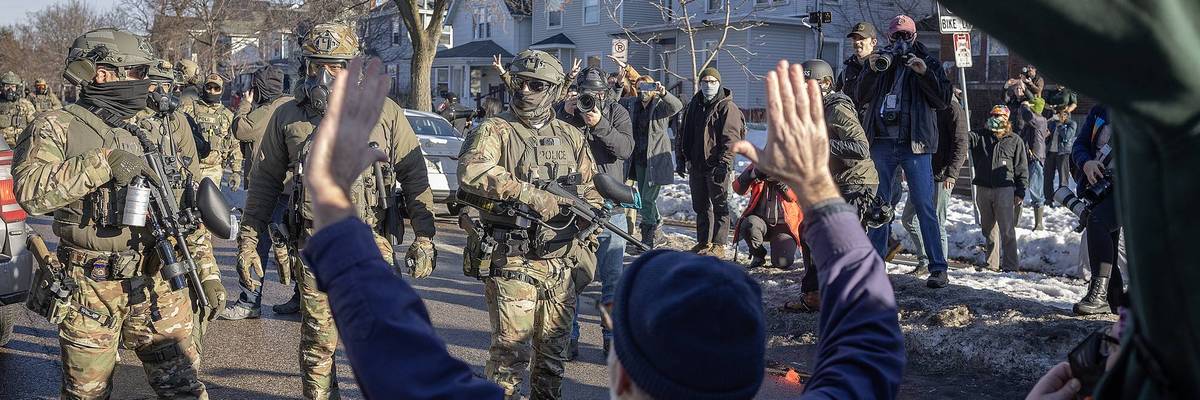
Protestors and ICE agents near the area where Renee Good was killed by a federal immigration agent the previous week, in Minneapolis, Minn., on Tuesday, Jan. 13, 2026.
(Photo by Elizabeth Flores/The Minnesota Star Tribune)


Robert Reich
Aug 29, 2026
Inequality Media

Imagine living in a country that can arrest and imprison you whenever it wants, without any judge or jury deciding you did anything wrong. It can call you a “domestic terrorist” and put you in prison for life. It can even execute you on the basis of nothing more than its own decision that you’re dangerous.

Well, I have bad news for you. You’re living in that country right now.


As he loses power and popularity — and faces mounting resistance abroad and at home — Trump is enlarging his police state.

His regime is having ever more people arrested, imprisoned, and deported without any judge or jury deciding they did anything wrong. It’s using racial profiling in deciding whom to target. It’s making warrantless searches and seizures of people, their cars, and their homes. All of this violates the US Constitution.

Trump’s police state not only continues, but it is growing larger by the day.

According to a new analysis by The New York Times, the regime’s surge in immigration arrests this summer has swept up thousands of people, most of whom have not been charged with or convicted of a crime (less than 4 percent had a past violent criminal conviction).

Those being arrested, imprisoned, and potentially deported include some married to US citizens, others who entered the US legally and are pursuing asylum claims, and some who came here with temporary legal status that the Trump regime has decided to revoke.

In other words, they were all here legally.

If you have temporary protected status because you escaped from inhumane conditions in another country, ICE might now summon you to an ICE office and put a monitor around your ankle — even if you have no criminal history and are in full compliance with your immigration status. The Trump regime has unilaterally revoked temporary protected status and claims the ankle monitors are necessary to track people whom it may want to deport at some point.

You’re not even safe if you’re a US citizen born in America. ProPublica has found that more than 170 US citizens have been wrongfully detained by ICE agents in raids and protests over a recent nine-month span. It described cases involving alleged force and multiday detention without access to counsel or communication.

Some estimates put the number of US citizens subjected to ICE as much higher, but there’s no way of knowing because there’s no legal process for filtering out and protecting American citizens, just as there’s no legal process for protecting anyone else who’s here legally. Trump’s police state is extrajudicial, and it’s being done in secret.

You might even be murdered, without a trial finding you guilty of anything. In addition to Renee Good and Alex Pretti in Minnesota last January, ICE agents have murdered two others just this summer.

One was Lorenzo Salgado Araujo, murdered by ICE in Houston on July 7, 2026. Salgado Araujo had lived in the US for decades. ICE agents pursued him in unmarked cars and shot him while he was driving a work crew to a job site. The Department of Homeland Security claims Salgado Araujo tried to use his vehicle as a weapon against an officer, but witnesses dispute this account.

The other was Johan Sebastian Durán Guerrero, murdered by ICE on July 13, 2026, in Biddeford, Maine. Durán Guerrero was a 25-year-old immigrant from Colombia. Agents pursued him while he was driving to work. The Department of Homeland Security claims its agent feared for public safety as Durán Guerrero tried to drive away, but elected officials and family members dispute this account, noting that Durán Guerrero was not an intended target of the immigration operation.

None of these murders has been fully investigated.

You might also be murdered without a trial if you happen to be on a vessel off Latin America’s Caribbean coast or in the eastern Pacific Ocean. A mere accusation of drug trafficking is enough to kill you, without any evidence presented before any court of law or neutral magistrate.

Historians looking back on this shameful period will wonder how this was allowed.

The US military announced Monday that it had again carried out a strike on a vessel in the eastern Pacific Ocean, killing two people it accused of trafficking drugs — bringing the overall death toll to 223 people killed in 67 strikes during the nearly yearlong US campaign of bombing boats alleged to be smuggling drugs.

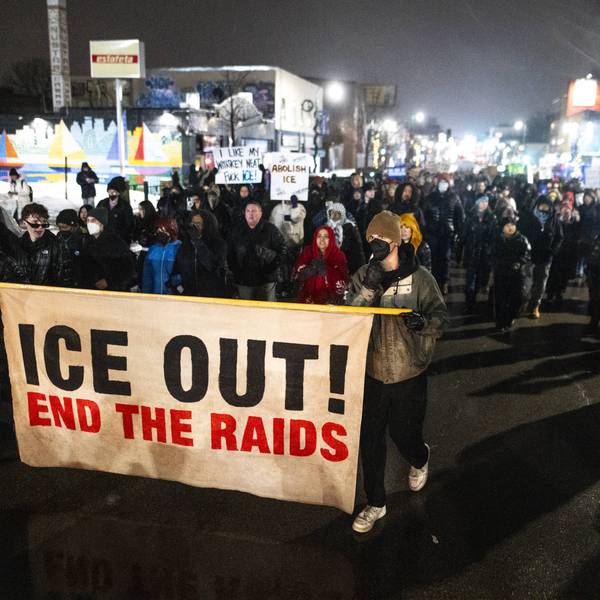
Finally, the Trump regime is imprisoning Americans who demonstrate against its police state.

In June, in two federal courts sentenced nine people who protested outside an immigrant detention facility in Texas to 30 to 100 years in prison, after the regime accused them of being members of Antifa. During the protest, a police officer was shot; he survived.

Those sentences are longer than the harshest sentence handed down to any of the convicted rioters in the January 6 attack on the US Capitol in 2021 (all of whom have since received pardons or commutations from Trump).

These cases are the first to incorporate new guidance from the regime that classifies Antifa as a “domestic terrorist organization.” That’s despite the fact that Antifa is a decentralized movement rather than a single organization and that there is no federal charge of domestic terrorism under existing US law.

I want to make three concluding points about all this.

First, Trump’s police state not only continues, but it is growing larger by the day. Kristi Noem’s replacement as secretary of homeland security, Markwayne Mullin, along with his boss in the White House, Stephen Miller, and the secretary of defense, Pete Hegseth, have more money, manpower, and firepower than ever. They are ramping up all of their extrajudicial arrests, detentions, deportations, and murders.

The only difference between last year and now is they’re no longer announcing what they’re doing with fanfare and braggadocio, because the American public has grown wary of it.

Second, none of us is safe from this because the arrests, installations of ankle bracelets, imprisonments, deportations, and murders are made without any judge, jury, or neutral party deciding that the assumptions on which they’re based are adequate and truthful.

Not even “domestic terrorism” arrests and lengthy prison sentences necessitate judicial inquiry into what exactly is meant by “domestic terrorism” and whether defendants have done anything to justify that appellation.

Finally, this growing menace is cruel, inhumane, and likely unconstitutional. It is causing hundreds of thousands of families in our country extreme mental distress; many people are not leaving their homes for fear of being arrested or worse. It is likely chilling First Amendment rights to speak up and protest against these atrocities.

Historians looking back on this shameful period will wonder how this was allowed. How can one maniacal man in the Oval Office, his fanatical assistant, and two suck-up Cabinet secretaries have been so cruel and oblivious to basic human rights? How can their Republican enablers in Congress have been willing to go along? How can the American public have been so quiet?


© 2025 Robert Reich

Robert Reich
Robert Reich is professor emeritus of public policy at Berkeley and former US secretary of labor. His latest book is the No. 1 New York Times best-seller, "Coming Up Short."
Full Bio >
CEOs Get Rich Underpaying Their Workers and Then Don’t Stand Up for Them

Low-Wage 100 CEOs have raised nary a peep about ICE attacks on their employees or the gutting of our social safety net. And, with few exceptions, they have obediently rolled back DEI programs.


A Lowe’s home improvement store worker climbs down a ladder while checking inventory  in San Bruno, California.
(Photo by Justin Sullivan/Getty Images)


Sarah Anderson
Aug 29, 2026
Inequality.org

Low-wage US workers have faced multiple rising threats to their economic and personal security over the past year.

Aggressive Immigration and Customs Enforcement (ICE) actions have terrorized immigrant workers, who are disproportionately represented at the bottom of the corporate ladder. Congress approved the largest cuts in history to public assistance programs that millions of low-wage workers have to rely on to get by. And the Trump administration has attacked diversity, equity, and inclusion (DEI) programs designed to expand opportunities for disadvantaged employees.


Lowest-Paying US Corporations Have Poured Over $700 Billion Into Buybacks Since 2019

How have the largest employers of low-wage workers responded to these threats? This year’s edition of the annual Institute for Policy Studies Executive Excess report takes a look by zeroing in on the 100 S&P 500 firms with the lowest median wages, a group we’ve dubbed the “Low-Wage 100.” The country’s most profitable retailers, fast food chains, and hospitality firms dominate the list.
Low-Wage 100 CEOs Have Remained Silent About Threats to Workers

Our key finding: Low-Wage 100 CEOs have raised nary a peep about ICE attacks on their employees or the gutting of our social safety net. And, with few exceptions, they have obediently rolled back DEI programs.

By looking the other way as low-wage workers face surging threats, corporate CEOs have shown even more clearly that we cannot rely on them to voluntarily do the right thing.

How did these corporate leaders choose to deploy their vast political power instead? Passage of the July 2025 budget bill was a top priority. This legislation will throw millions of Americans off Medicaid and the Supplemental Nutrition Assistance Program (SNAP) to pay for more tax cuts for the rich and a massive increase in ICE funding.

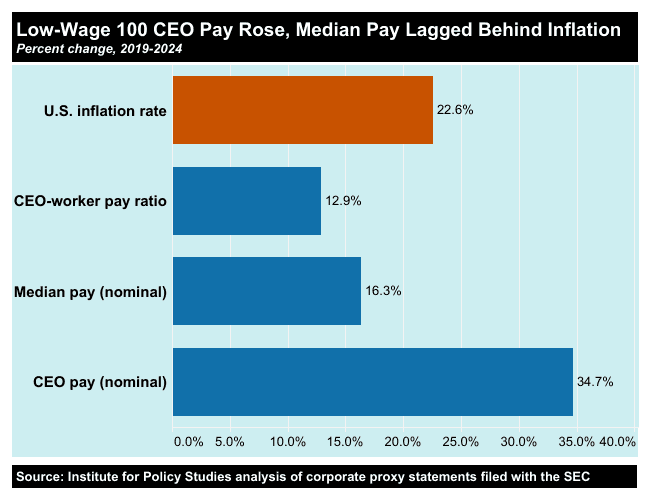
Under the bill’s reduced top marginal tax rate, chief executives will be able to take home an even greater share of their fat paychecks. In 2025, average CEO compensation within the Low-Wage 100 hit $17.5 million. By contrast, the group’s average median worker pay sat at just $36,571 and their average CEO-worker pay gap came to 614 to 1.
Low-Wage 100 Firms Won Tax Cuts for the Rich, Paid for With Cuts to Aid Programs Their Employees Rely On

We reviewed public statements about this budget legislation by Low-Wage 100 firms and the corporate lobby groups that represent them. Each statement cheered the law’s tax cuts, which will overwhelmingly benefit the wealthy. The International Franchise Association even praised the doubling of the estate tax exemption, a tax break that will benefit less than 0.2% of the population.

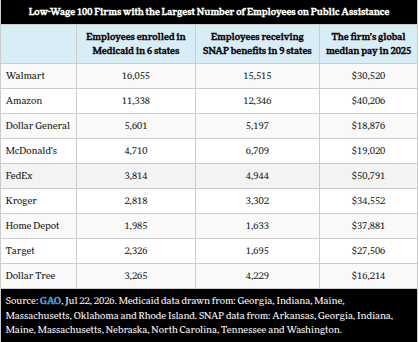
Not one statement expressed concern about the law’s drastic Medicaid and SNAP cuts. A recent Government Accountability Office report lists the top employers of workers receiving Medicaid and SNAP in a sampling of states where this information is available. Low-Wage 100 firms dominate the lists.


Long-Term Trends of Executive Excess

Given past trends, Low-Wage 100 CEOs’ muted response to the increased threats against their employees is hardly a surprise. The pandemic opened the eyes of many Americans to the essential value of frontline low-wage workers. But even that national crisis did not lead to more equitable sharing of corporate wealth.

Between 2019 and 2025, the Low-Wage 100’s average CEO pay rose 41.4%, double the 20.7% increase in their average median worker pay.


A technical note: we did not adjust these figures for US inflation because median pay figures in corporate SEC filings are based on a company’s global workforce. But many Low-Wage 100 firms have the vast majority of their employees in the United States. In fact, that’s the case for 5 of the 10 Low-Wage 100 corporations with the lowest median pay (Ross Stores, Ulta Beauty, TJX, Yum! Brands, and Dollar Tree).
Buybacks Bonanza

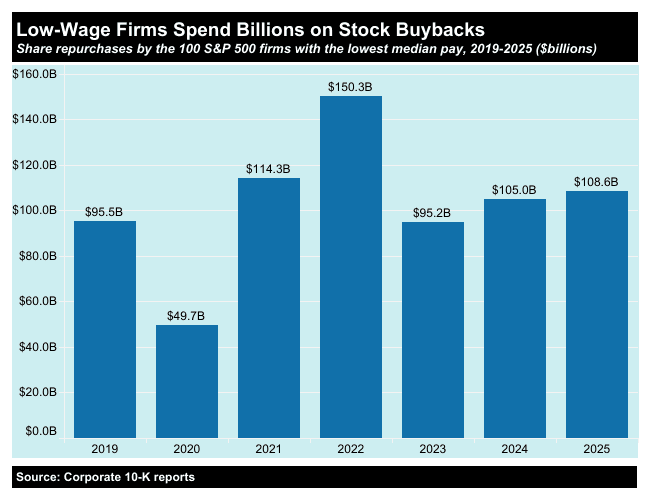
To further enrich their wealthy executives, Low-Wage 100 firms have spent over $718 billion repurchasing their own stock over the past seven years. This formerly illegal financial maneuver artificially boosts the value of a company’s shares and, in the process, pumps up the value of the stock-based compensation that makes up about 80% of corporate CEO compensation.

Every dollar spent on buybacks represents a dollar not spent on worker wages or long-term productive investments. The Lowe’s home improvement store’s $46.8 billion expenditures on buybacks over the past seven years could have covered the cost of a $24,235 bonus for each of their 276,000 employees every year during that period. Median pay at Lowe’s in 2025: $37,371.


Policy Changes to Curb Executive Excess

The Low-Wage 100 represent a business model designed to deliver staggering personal gains for top executives by squeezing their workers. This predominant model is shredding our social fabric and threatening our democracy. We clearly need to build worker power and raise the minimum wage to a living wage. But to solve this problem we also need to curb runaway CEO pay.

Governments at all levels should explore options for leveraging tax policies and procurement and subsidy policies against executive excess. These policy solutions have serious bipartisan potential.

For instance, one survey found that 89% of Democratic and 71% of Republican likely voters support a tax hike on corporations that pay their CEO over 50 or more times what they pay their median employees. A bipartisan provision in the pending Senate defense authorization bill would bar military contractors from engaging in CEO pay-inflating stock buybacks.


Congress should also increase the existing 1% stock buybacks tax, ideally to a level high enough to discourage this activity. But even if companies continued the wasteful practice, hiking this tax would generate additional revenue for combatting inequality. If a 4% buyback levy had been in place between 2023 and 2025, the Low-Wage 100 would have owed approximately $9.3 billion in additional federal taxes.

By looking the other way as low-wage workers face surging threats, corporate CEOs have shown even more clearly that we cannot rely on them to voluntarily do the right thing. Lawmakers must take responsible action to narrow our dangerous economic divides.


This work is licensed under a Creative Commons Attribution-Share Alike 3.0 License.

Sarah Anderson
Sarah Anderson directs the Global Economy Project of the Institute for Policy Studies, and is a co-editor of Inequality.org.
Full Bio >


 ‘Yet Another Trump Grift’: Congress Called to Stop US Takeover of Venezuelan Oil Fields


“Handing over Venezuela’s oil wealth to the US contravenes the Constitution and is not in the interest of the Venezuelan people—much more when it is done at gunpoint,” said one analyst.


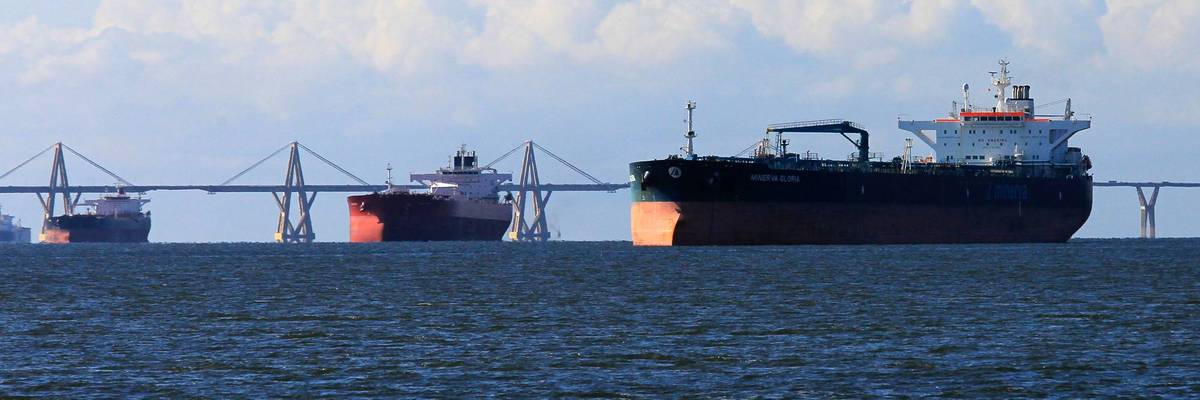
Oil tankers are seen anchored in Lake Maracaibo, Venezuela after loading crude oil at the Bajo Grande Refinery port.
(Photo by Jose Bula Urrutia/UCG/Universal Images Group via Getty Images)

Julia Conley
Aug 28, 2026
COMMON DREAMS

Trump administration officials are claiming that talks between US Secretary of State Marco Rubio and the Venezuelan government regarding control of the country’s oil fields will ultimately secure “America’s energy future for generations to come”—but analysts on Friday called on lawmakers to halt President Donald Trump’s “colonial” push to take over the reserves.

As Axios reported, officials including Rubio and Deputy White House Chief of Staff Stephen Miller have been involved in talks with Venezuelan acting President Delcy Rodriguez about taking an ownership stake in more than a dozen oil fields in the Orinoco Belt and Lake Maracaibo regions, which have about 90 billion barrels of oil reserves. In all, Venezuela’s vast reserves—the world’s largest—contain about 300 billion barrels.

The deal would double US oil reserves at a time when Americans have seen gas prices skyrocket and oil firms reap profits as a result of Trump’s war on Iran and the closure of the Strait of Hormuz—events to which countries that have expanded renewable energy sources have proven far more resilient, according to data from JP Morgan Commodities research.

Despite that resilience, the Trump administration has reportedly approached the talks as a way to lock the US into generations of continued reliance on planet-heating oil extraction. According to Bloomberg, one deal under consideration is a 100-year lease on the oil fields.

Axios reported that in return for giving the US an ownership stake—something Trump began privately discussing before US forces invaded Venezuela and abducted President Nicolás Maduro in January—Venezuela “would benefit from private companies, including American firms, developing the fields and returning more oil revenue” to the South American country.

Tyler Slocum, director of Public Citizen’s energy program, said that if the deal is finalized, “Trump will likely transfer operational control to US oil companies,” which donated heavily to his campaign.

The proposed deal would open “the door to Trump’s typical bilateral transactional corruption” and bestow “lucrative opportunities for the oil companies he chooses to reward,” said Slocum.

“In the nearly eight months since Trump’s illegal January 2026 Venezuelan invasion, the Trump administration has managed a $13 billion slush fund gleaned from its control over Venezuelan oil sales, with zero transparency, and little to no public oversight or accounting,” Slocum continued. “The president has no authority to negotiate a deal where the federal government takes control over foreign oil production facilities, and Congress must intervene and put an end to Trump’s oil-fueled imperialism.”

One opposition leader in Venezuela, where Energy Secretary Chris Wright is expected to travel next week to discuss increasing oil production by US companies, said the deals currently being discussed amount to “a land grab—a massive land grab.”

Francisco Rodríguez, a senior research fellow at the Center for Economic and Policy Research and author of The Collapse of Venezuela, said the country’s National Assembly “should deny authorization for this predatory deal.”


Following Trump’s invasion of Venezuela in January, energy historian and Eurasia Group analyst Gregory Brew told The Guardian, “US dominance over Venezuelan oil reserves allows the US to regard Venezuelan reserves as its own reserves: a source of oil from which the United States can draw and that nobody else has access to.”

“I think that’s how the administration is conceiving of this—excluding China, excluding Russia, but I think also excluding other potential customers for Venezuelan oil,” Brew said. “It sounds colonial, because it is.”

The president’s “effort to establish a South American kleptocracy is an outrage,” said Slocum. “There’s been no improvement in human rights in Venezuela, so Trump’s move is further evidence that his illegal actions in Venezuela are all about controlling oil with no public accounting, transparency, or oversight. This is yet another Trump gift for Big Oil.”


US strikes deal to control 65 billion barrels of Venezuela's oil reserves, Trump says

Copyright Copyright 2026 The Associated Press. All rights reserved.

By Nathan Rennolds
Published on

Trump has long been candid about his desire for the US to secure Venezuelan oil and has urged oil companies to invest in the South American nation.

The US and Venezuela have agreed terms on a huge oil deal that could see Washington take control of more than 65 billion barrels Venezuela's oil reserves.

US President Donald Trump had announced the agreement on Friday in a post on Truth Social, calling it the "biggest oil deal in world history."

"This Historic Transaction MORE THAN DOUBLES American Oil Reserves, greatly increases our Oil Supply, and will substantially lower Gas Prices for all Americans," he wrote, adding that it would also help "set Venezuela on a course toward Tremendous Success and Great Prosperity."

Delcy Rodríguez, the acting president of Venezuela - which has the world's largest proven oil reserves - later confirmed the "historic" deal in a statement posted to social media.

According to Rodríguez, the agreement "calls for the development of 17 strategic fields" and could see investment of "more than $100 billion, and more than $209 billion in taxes for the state."

Trump has long been candid about his desire for the US to secure Venezuelan oil and has urged oil companies to invest in the South American nation.

Many firms have remained wary, however, with concerns over aging infrastructure and political uncertainty both at home and in Venezuela.

In a post on X, US Secretary of State Marco Rubio hailed the deal as a "huge win for both the American and Venezuelan people."

"It demonstrates how President Trump's bold foreign policy is driving America First wins: securing stable reserves and low-cost oil in our Hemisphere and lowering gas prices here at home," he wrote.

"For the Venezuelan people, this deal will bring nearly $100 billion in private investment, support thousands of high-paying jobs, and drive the reconstruction of Venezuela's economy," Rubio added.

Washington has been keeping a close watch on Caracas since US forces conducted an operation to capture former leader Nicolás Maduro in January. Following the operation, Trump pledged to pump billions into Venezuela and said US firms would rebuild the country's oil industry.


Trump's big oil deal lambasted across the


board: 'Corruption at epic scale'


Kathleen Culliton
August 29, 2026  
RAW STORY

Call it socialism, imperialism, corruption or theft — senators, conservatives, journalists, former ambassadors and economists all agree President Donald Trump's "deal" to control 65 billion barrels of Venezuelan oil is a very bad move.

Trump's Truth Social announcement on Friday of a deal with Delcy Rodríguez — who became Venezuela's acting president in January after the U.S. military captured former President Nicolás Maduro — spurred an uproar over cries of corruption.

"Using our troops for a private oil grab is corruption at epic scale," said Sen. Tim Kaine (D-VA). "Here’s a guarantee—this will pad the pockets of Trump family and Big Oil companies and delay transition to cleaner energy."

Kaine was not the only U.S. senator to condemn Trump's deal with Venezuela — or to claim corruption was the cause.

"This isn't a win," said Sen. Chris Van Hollen (D-MD). "This is proof Trump put our service members at risk to get Venezuelan oil for his billionaire buddies. Putting our soldiers’ lives on the line for private profit is a gross dereliction of his constitutional duty."

Independent journalist Juliet Jeske of Decoding Fox News also looked at the deal from a humanitarian perspective.

"Trump is stealing oil from country that just had a catastrophic earthquake and where most of the populace lives in extreme poverty," Jeske wrote on X. "I don’t think he ever really cared about Maduro. He just wanted their oil."

This perspective was shared by Michael McFaul, a Stanford University professor of political science who served as U.S. Ambassador to Russia from 2012 to 2014.

"Delcy Rodriguez is a dictator," McFaul wrote. "Cutting a deal with her to steal Venezuelan oil to benefit Americans is both immoral and impractical. The Venezuelan people will never go along with this deal."

McFaul fumed that Trump had yanked the U.S. back to the 19th century and the age of imperialism.

"We are now acting like a typical imperialist empire," McFaul said. "His Venezuelan oil deal is just that- straight-up imperialism, using military force to seize the assets of a country in the south. Deeply regrettable."

CNN's Jim Acosta echoed this concern — arguing the president had taken the U.S. back to the 1700s — but added a jab at Trump's rising gas-price problems.

"Trump is desperate," Acosta wrote. "Trump is choosing oil over freedom for the Venezuelan people. Experts say this won’t lower gas prices right away."

Even some conservatives fumed at Trump's fuel fix, among them conservative think tank Cato Institute economics expert Scott Lincicome.

"So, after taking 31 US government equity stakes in private companies over the last year, Trump just announced a MAJORITY-STATE-OWNED oil company?" wrote Lincicome. "This isn't even 'creeping' socialism anymore."

Independent journalist Aaron Rupar likened the "deal" to a form of socialism as well — National Socialism.

"Nazi Germany also pillaged the natural resources of countries it conquered," Rupar wrote.