It’s possible that I shall make an ass of myself. But in that case one can always get out of it with a little dialectic. I have, of course, so worded my proposition as to be right either way (K.Marx, Letter to F.Engels on the Indian Mutiny)
Friday, August 28, 2026
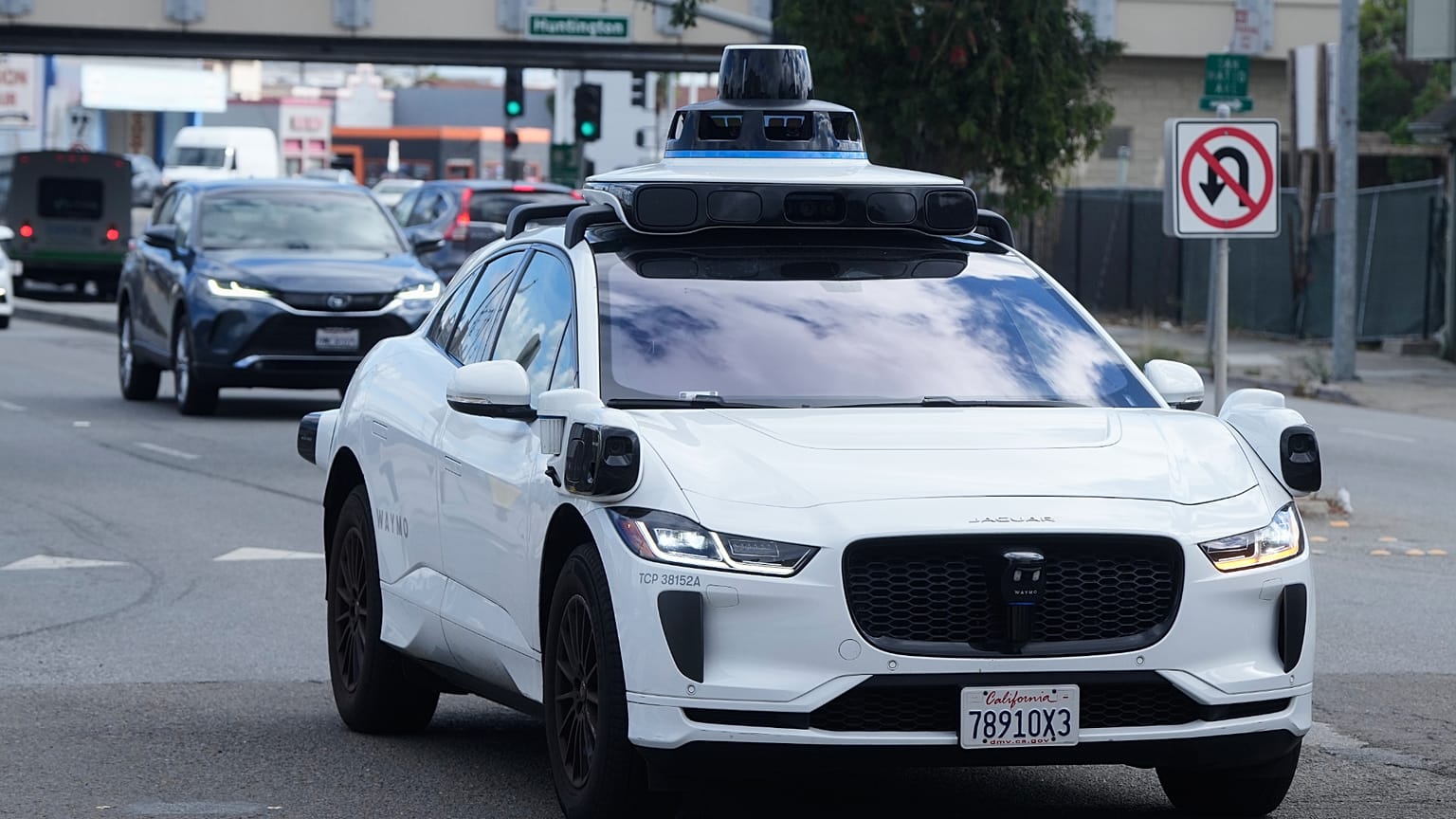
Waymo in Munich: Could autonomous vehicles make Europe's roads safer?
Copyright Copyright 2025 The Associated Press. All rights reserved
By Fred Roeder, EU Tech Loop with Euronews
Published on
Waymo is bringing driverless taxis to Munich, its third city outside the US, as data suggests autonomous vehicles are far safer than human drivers.
Following technology news about Europe on social media can be frustrating, as positive news is often overshadowed by complaints that consumers lack access to the latest innovative technologies and services due to a plethora of regulations from Brussels.
The autonomous vehicle (AV) sector, however, looks positive in Europe this year — the United States’ leading autonomous vehicle company, Waymo, just announced that Munich will be its latest addition to its ongoing global expansion.
While Waymo already offers services in dozens of cities across the United States, it recently began its international rollout, with London, Tokyo and Munich as the first three cities abroad.
This is not the first good news for Europe’s consumers, lazy drivers and AV-enthusiasts this year.
Yael Ossowski recently pointed out that a Dutch decision to greenlight Tesla’s Full Self-Driving Supervised (FSD) led to a domino effect of approvals, with Danish, Lithuanian and Estonian regulators quickly following suit and giving Tesla owners more choice in how much they trust their car's semi-autonomous features.
AV taxis are 12 to 20 times safer than human-driven taxis
Waymo coming to Munich’s streets is not just good news for passengers dreading the music choice of local taxi drivers but also has wider implications for road safety.
Nobel laureate Daniel Kahneman suggested early on that machines will ultimately be better and safer than humans at decisions about navigation and driving. A few years later, we do have hard data to back this up.
Data from major US cities show that AV-taxis are between 12 and 20 times safer than human-driven taxis, helping prevent many accidents and injuries.
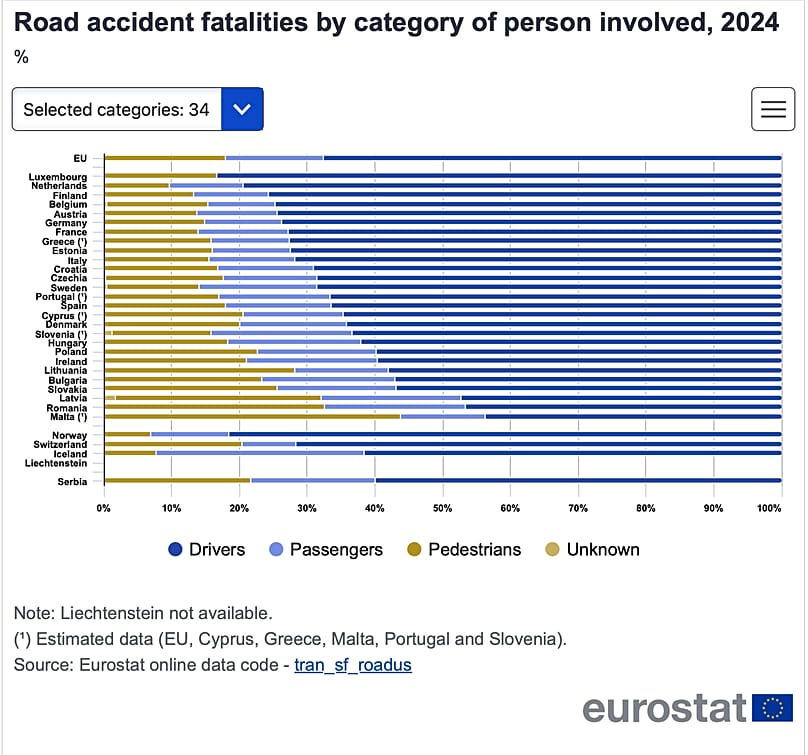
Given that we still have around 20,000 road fatalities in Europe every year, where 67% of all accidents happen due to the drivers’ fault, it should be in the interest of consumers and policymakers to reduce this by enabling cutting-edge technology.
Copyright Eurostat. Euronews courtesty of EU Tech LoopAll rights reserved
With Munich taxi fares from the airport to downtown ranging from €80 to €90 per trip, AV taxis could be a game-changer for many passengers across the EU, especially those living in remote areas with no access to public transport or many late-night flights.
Although, in the past, ride-hailing apps have created a competitive challenge to traditional taxis, the expansion of AV taxis can add to it, ultimately making rides more affordable for average consumers.
Companies like Waymo should also not be seen as competitors to the car industry but as companies that program and build your driver.
Especially for the German automotive industry, this might be a huge opportunity to partner up and plug into the AV ecosystem so that, one day, visitors from all over the world can be chauffeured in a driverless, locally manufactured BMW or Audi through Munich.
This story was originally published onEU Tech Loopand has been shared on Euronews as part of a syndication agreement.
'Grief, anger, rage': Former Nazi camp site becomes business park, sparking anger in Austria
Construction of a business park on part of a former Nazi concentration camp site has prompted calls for its surviving remains to be preserved.
A few crumbling concrete blocks in an overgrown field are all that remains visible of what was once a sprawling Nazi forced labour complex around the Austrian town of Leobersdorf.
Now, plans to build a business park on the site, including a cold storage warehouse and a store operated by the discount supermarket chain Lidl, have sparked anger in the Alpine nation, which long neglected to address its Nazi past.
"For me, it's a sad feeling, because a place burdened by history is being built over, sacrificed to the economy," Erich Strobl, head of a local campaign to preserve part of the site, told AFP.
After Nazi Germany annexed Austria in 1938, the Weinberglager complex was used for thousands of prisoners of war and forced labourers.
It later included the Hirtenberg subcamp of the Mauthausen concentration camp — one of Austria's largest camps exclusively for women.
Around 400 women, mainly from the Soviet Union but also from Italy and Poland, were imprisoned at the Hirtenberg subcamp between September 1944 and April 1945 and forced to manufacture infantry munitions at a nearby factory complex.
Although some factory ruins survive, the camp barracks and most other structures were gradually demolished, repurposed or destroyed after the war.
But Bertrand Perz, a historian specialising in the Mauthausen camp, told AFP the Hirtenberg site remains "historically important," partly because "women prisoners in Mauthausen have been marginalised in the culture of remembrance".
Plans to build a business park on the plot about 40 kilometres (25 miles) south of Vienna, including on land that once formed part of the concentration camp, were made public in 2024.
Relate
'Grief, anger, rage'
Archaeological investigations have identified surviving traces of the former camp complex, but Austria's Federal Monuments Office concluded that the remains were "not sufficient" for monument protection.
With the bulldozers now moving in, activists have renewed their calls for the site to be preserved.
"A former concentration camp must not be built over with new structures," the International Mauthausen Committee said.
Standing in front of the site, where grey columns already rise from the ground, Josef Pumberger, a board member of the Mauthausen Committee Austria, told AFP he felt "grief, anger, rage, that something like this can happen in Austria in the year 2026".
The project has also attracted controversy because the land was previously owned by a company linked to the local mayor, Andreas Ramharter, which sold it in 2022 and 2023 for more than €15 million, according to local media reports.
Austrian company TRA LEO GmbH & Co KG, which bought the plot, told AFP it had offered to support the creation of a memorial on the site.
Lidl confirmed plans to open a store in the planned business park, but stressed that it would be located "not directly on the site of the former concentration camp, but on an adjacent plot of land".
Stele memorial
In the aftermath of the Second World War, Austria long presented itself as a victim of the Nazis, ignoring the complicity of many Austrians
It was only from the late 1980s that the country where Adolf Hitler was born began to examine its responsibility in the Holocaust.
Perz, the historian, said a debate like the one now taking place over the Hirtenberg site "would have been impossible in the 1980s," adding that there is now "more sensitivity" towards former Nazi sites.
However, in contemporary Austria, demands for remembrance are increasingly clashing with "the opposite tendency, namely to say: 'Now this really has to stop'," he said.
The far-right FPÖ, founded by former Nazis, topped Austria's 2024 parliamentary election, though it failed to find partners to govern. But it is part of the governing coalition in five of the country's nine states.
In central Leobersdorf, locals approached by AFP had either not heard about the development or did not want to talk about it.
A stele memorial was erected in 2024 to commemorate the victims of the Hirtenberg camp.
But for Pumberger, that is not enough.
"It is very important to have tangible evidence of the buildings in which the Nazis imprisoned people, tortured them, killed them," he said.
"Otherwise it becomes a virtual act of remembrance, or one that exists only in books and photos and films."
Climate change leaves 560 million children facing extra heat stress every year, study finds
As many as 560 million children are already living through at least one extra month of dangerous heat every year because of climate change, a threat that puts them at serious health risk.
Children today are exposed to significantly more heat stress days per year than previous generations — a burden that is expected to increase, according to a new study.
Researchers at the Vrije Universiteit Brussel found that younger populations face disproportionate health risks, including direct physiological strain and indirect threats like food and water insecurity.
The findings, published in the Science Advances journal, showed that up to 560 million children aged 0-9 years old are living through at least one additional month of heat stress every year due to human-induced climate change.
“Climate change is already causing hundreds of millions of children to suffer from dangerous heat worldwide, posing severe risks to their health,” said Rosa Pietroiusti, lead author of the study.
“At the same time, poverty, inadequate housing, limited access to cooling, and overstretched healthcare systems leave many children with few ways to protect themselves from the heat.”
Vulnerability to heat stress varies with age, the researchers noted, with older adults, newborns and young children being particularly at risk.
“Children are particularly vulnerable to climate change impacts and will face intensifying effects of climate change during their lifetimes,” the authors wrote.
The study found that children’s exposure outpaces that of any other age group, nearly tripling the 190 million people aged 60-69 who experience this additional health threat.
Excessive heat is dangerous for the body as it hinders its ability to thermoregulate, aggravates existing health conditions and increases the risk of heatstroke, kidney failure and lung damage.
In children, the impact is even greater when they are undergoing physical development and have lower capacity for body temperature regulation. They sweat less per kilogram of body weight and have a higher metabolic rate, causing them to heat up more quickly during periods of extreme heat.
According to the researchers, there are multiple factors that increase children’s exposure to dangerous heat.
The largest increases in humid heat caused by climate change are occurring in tropical regions and poorer countries with younger populations — South Asia, Southeast Asia and West Africa — which have the highest number of children exposed to dangerous heat stress today.
They also noted that children in the worst-affected areas are likely to be more socioeconomically vulnerable, and affected by heat through both direct pathways such as heat strain and indirect pathways, including the spread of mosquito-borne diseases, disrupted child feeding practices and complications at birth.
According to temperature projections, the researchers found that children will remain disproportionately exposed to heat stress, even as global populations age.
In a scenario in which the world is 1.5°C warmer, an estimated 620 million children aged 0-9 would experience at least one additional month of heat stress per year, and 390 million are projected to experience at least five total months of heat stress.
If the temperature increases reach 2.0°C, estimates project 650 million children facing
one additional month of heat stress per year, and 420 million at least five total months of heat stress.
EU sea defence: the new race to protect cables, pipelines and trade
Is the deep blue sea the next frontier for defence? Global economies are increasingly dependent on vulnerable subsea data and energy pipelines. So, the EU and its members are shifting budgets towards maritime defence tools.
In just the last decade, the EU has spent almost €118 billion in maritime defence, with a sharp 23.6 percent increase in 2022 after Russia’s invasion of Ukraine.
Data from the EU Blue Economy Observatory show a sharp rise in domestic maritime defence spending, reaching a record high of €11.6 billion. Submarines alone account for 27 percent of the EU's total production value; the rest includes surface ships, aircraft, and other types of warfare.
The bloc decided to transition from a purely commercial ‘blue’ economy approach to a securitised maritime strategy. In 2023, it updated its European Union Maritime Security Strategy (EUMSS) to protect critical seabed infrastructure.
Then it locked in its strategic defence priorities by launching dedicated European Defence Projects of Common Interest and implementing a Submarine Cable Security Toolbox to counter grey-zone threats and protect underwater networks.
Protecting international trade
The global economy relies almost completely on secure, open seas. More than 95 percent of international digital traffic moves through them. Financial transfers happen through over 1.4 million kilometres of submarine fibre-optic cables, which carry an estimated €9.2 trillion in financial transactions every single day. Approximately two-thirds of the world’s oil and gas is either extracted at sea or transported by water.
80 percent of global trade volume is transported by ocean shipping. For the EU, maritime transport accounts for 75.6 percent of all imports and 73 percent of all exports. It totals around €1.126 trillion in goods annually. A disruption at key maritime chokepoints risks triggering inflation and global manufacturing shortages.
An attack on these sea lanes and underwater assets would paralyse Europe, so it needs more than traditional naval patrols. “Underwater Domain Awareness is a critical activity to know what is happening below the surface, particularly around cables, pipelines and offshore energy infrastructure, prioritising those identified as critical for the security of the Union”, said Jürgen Scraback, Head of the Maritime Domain Unit at the European Defence Agency (EDA).
As threats increasingly come from low-cost drones, uncrewed underwater vehicles and mine warfare, governments are investing in autonomous technologies and surveillance systems. Between 2016 and 2025, the EU's annual production value of crewless vehicles, including aerial and submarine drones, increased by 132 percent to €847 million. Fixed-wing unmanned systems accounted for one third of that output, worth €277 million, while production of traditional unmanned submarine platforms fell by 23 percent over the same period.
Fleet modernisation continues to focus on both conventional naval assets and autonomous platforms. Manned surface ships now account for 65 percent of EU maritime defence vehicle production value and serve as the primary platforms for command, logistics and force projection.
Submarines represent another 27 percent of production, supported by new procurement programmes and investment in next-generation underwater weapons. At the same time, autonomous surface vessels and unmanned underwater vehicles are becoming increasingly important for surveillance, reconnaissance and infrastructure monitoring missions.
EU27 maritime defence industry: production by function of vehicle, 2016-2025
Investments also extend to digital tech for maritime surveillance, with European operators deploying AI-enabled unmanned systems to monitor ports, offshore energy infrastructure, and submarine cables, detecting threats across large areas
For Scraback, “autonomous and unmanned systems combined with AI-enabled data fusion are among the technologies likely to have the greatest impact. They can provide persistent surveillance over large areas without requiring expensive crewed platforms to remain almost permanently deployed”.
How is the EU boosting maritime defence?
The 2014 Maritime Security Strategy guides Europe's maritime strategy, protecting citizens, the economy, infrastructure, and borders, while redefining Europe’s approach to maritime defence.
“The new strategy calls for a greater emphasis on the hard power aspects of maritime defence and security, where the EU had previously faced challenges in establishing a role and identity”, said Chris Kremidas-Courtney, senior advisor at the European Policy Centre and associate fellow at the Geneva Centre for Security Policy. It identifies “the protection of critical infrastructure in the maritime domain as a key priority”, they added.
The Industrial Maritime Strategy, adopted in March 2026, backs this shift. It boosts Europe's naval production through a new EU Industrial Maritime Value Chain Alliance and reinforces naval, underwater, and dual-use capabilities, including a dual-use ferry construction programme.
By July, Europe allocated €325 million to five European Defence Projects of Common Interest, including one maritime and seabed defence project to strengthen its industrial base. Since February, a new Counter-Drone Action Plan has shifted production towards unmanned naval drones and counter-drone systems for aerial, surface, and underwater threats.
The EU funds its naval ramp-up through defence tools, such as the European Defence Industrial Strategy and the €1.5 billion European Defence Industry Programme. The Readiness 2030 roadmap totals over €800 billion, including naval capabilities and sea lines of communication protection.
The bloc also invests in detection and surveillance technologies to fight threats and sabotage to seabed cables. As cables cover large areas, are privately owned and can be easily damaged, “the best approach is a layered resilience system designed to make interference detectable, limit the disruption caused by a successful attack and restore service quickly”, Kremidas-Courtney explained.
This thinking now drives EU policy. The Action Plan on Cable Security (2025) strengthens Europe’s ability to prevent, detect, respond to, and recover from cable incidents that disrupt critical functions like communication and energy supply. The €92 million OceanEye expands maritime awareness using AI, autonomous sensors, and digital twins.
Under Horizon Europe, the UnderSect and Smart Maritime and Underwater Guardian projects invest nearly €6 million each in underwater threat-detection systems for ports and maritime infrastructure. European Defence Fund (EDF) projects, such as SHIELD and SOUND2, develop AI systems to detect threats using underwater acoustic signals.
Ramping up maritime defence goes beyond detecting and repairing cable breaks. For Kremidas-Courtney, authorities should identify behavioural patterns such as unexplained slowing, shipping lane deviations, and manipulation of identification signals.
“The most effective solution to me is an integrated information-and-action network that fuses undersea sensors, AIS data, coastal radar, satellite imagery, intelligence and port records into a continuously staffed existing regional maritime operations centre”, Kremidas-Courtney explained.
Who invests the most?
Between 2016 and 2025, cumulative EU production of maritime defence vehicles and equipment reached €117.8 billion. According to the EU Commission’s Blue Economy Observatory, production remained concentrated in four countries. France, Germany, Italy and Spain together account for 87 percent of the bloc's maritime defence industrial output. The Netherlands, Sweden and Poland contribute a further 8 percent, largely through surveillance technologies and maritime security systems.
In 2025, France generated 37 percent of the EU’s total production of maritime defence vehicles. Germany and Italy each contributed 19 percent, and Spain followed with 8 percent. These four countries accounted for 82 percent of the EU’s total output value and 60 percent of the EU's total defence expenditure. This shows that defence spending remains higher in member states with a long tradition of armaments.
EU maritime defence industry: total output value by member state, 2016-2025, billion EUR
“A few large navies can provide scarce high-end capabilities, but they can’t secure every coastline, patrol the sea lanes, and protect every piece of undersea infrastructure. Europe doesn’t need everyone to build a fleet to match Italy's or France's, but it does need credible, distributed forces connected by interoperable systems and a shared maritime picture. The only way to make that work is a whole-of-Europe approach which includes the UK and Norway”, Kremidas-Courtney warned.
At company level, the France-based Naval Group led with 24 percent of the EU’s total output, producing advanced surface combatants (frigates and corvettes), nuclear-powered submarines, and unmanned surface and underwater systems. Italy’s Fincantieri (15 percent) specialises in warships and underwater defence systems, including torpedoes and sonars.
The German Thyssenkrupp Marine Systems accounted for 8 percent of the EU’s overall market for maritime defence vehicles, focusing on surface vessels and submarine construction. Spain’s Navantia (7 percent) builds multi-mission frigates, AIP-equipped submarines, aircraft carriers and patrol vessels.
The EDF supports European companies in developing joint defence technologies and equipment. It invests €2.7 billion in collaborative defence research and €5.3 billion in collaborative capability development for the period 2021-2027. The 2025 EDF totals €1.07 billion and funds 57 projects, including E-DOMINION, which develops a digital architecture and combat cloud for European navies.
According to Scraback, “we need to continue shifting from fragmented national solutions towards interoperable, scalable and jointly developed capabilities”. He explained that the European Defence Project of Common Interest on Integrated Maritime and Seabed Defence “can be a key vehicle for this, bringing Member States, existing European programmes and investments together under one coherent framework”.
EU pours billions into maritime defence as threats to its seas persist
From undersea cables to warships, the EU is spending record sums to defend its waters. Watch the video.
The EU is increasing maritime defence spending as threats to its ports, undersea cables and offshore infrastructure grow.
90 percent of EU trade, energy supplies and internet data move by sea. This exposes the bloc to hybrid and cyber attacks, border tensions and infrastructure sabotage, including from Russia.
Brussels updated its Maritime Security Strategy in March 2023 and funding followed. EU countries spent €343 billion on defence in 2024, up 19 percent year-on-year. Equipment procurement jumped 39 percent. Spending hit a record €392 billion in 2025, much of it through the €150 billion SAFE fund under the EU's Readiness 2030 roadmap.
A large share goes to building ships. The bloc's maritime defence industry produced €13.7 billion worth of vessels in 2025, two-thirds surface ships. France, Germany, Italy and Spain accounted for 82% of output. Shipbuilders Naval Group, Fincantieri, Thyssenkrupp Marine Systems and Navantia cooperate on the European Patrol Corvette project while securing multi-billion-euro export deals with Norway and Indonesia.
Which EU countries invest more in maritime defence and why?
Europe's naval rearmament is rising. Which countries drive the maritime defence boom and why the map may be misleading.
Europe’s militaries are pouring money into the sea. EU defence expenditure rose to €418 billion in 2025, a 20 percent increase from the previous year, and is projected to reach €454 billion in 2026, equivalent to 2.4 percent of GDP. Maritime defence is one of the fastest-growing sectors. Production of naval vehicles and equipment across the bloc has reached €117.8 billion since 2016, with output hitting €13.7 billion in 2025 alone.
Who’s building Europe’s navies
On paper, four countries dominate that output. France, Germany, Italy and Spain account for 87 percent of the EU’s maritime defence industrial base and captured 82 percent of its total output value last year. France alone produced 37 percent of the bloc’s maritime defence vehicles in 2025, followed by Germany and Italy at 19 percent each, and Spain at 8 percent. Together, the four also account for 60 percent of the EU’s total defence expenditure.
For Christophe Tytgat, Secretary General of SEA Europe, the shipyards and maritime equipment association, that pattern is no accident: “the concentration is real and structural, not incidental,” reflecting decades of naval-industrial history and geography concentrated in a handful of states. Submarines are also a growth area, now 27 percent of EU maritime defence output, with the same four countries producing 93 percent of the bloc’s naval exports.
A skewed picture?
But industrial output isn’t the same as military commitment, according to Chris Kremidas-Courtney, senior advisor at the European Policy Centre, who argues the four-country narrative overlooks some of Europe’s most exposed navies. “Industrial concentration is not the same as maritime-defence commitment,” they said, naming Greece and Sweden as “conspicuous omissions.”
Greece runs one of Europe’s strongest conventional submarine fleets and maintains a demanding operational posture across the Aegean, Eastern Mediterranean and Red Sea. Sweden’s smaller navy is purpose-built for the Baltic and backed by a serious domestic defence industry.
The real test, Kremidas-Courtney says, is integration rather than size. “Europe doesn’t need everyone to build a fleet to match Italy or France, but it does need credible distributed forces connected by interoperable systems and a shared maritime picture”, an approach they argue must extend beyond the bloc to include the UK and Norway.
Measured against GDP rather than raw output, the map zooms towards the east. Poland spends the largest share of any EU state on defence at 4.48 percent of GDP, ahead of Lithuania (4.00 percent), Latvia (3.73 percent) and Estonia (3.38 percent), all frontline states bordering Russia or its ally Belarus. Germany has more than doubled its share of GDP since 2021, from 1.27 percent to 2.14 percent, and aims to reach €162 billion in annual defence spending by 2029.
Tytgat argues neither the industrial giants nor the frontline states can carry EU maritime security alone: “only four EU countries cannot substitute for broad-based EU maritime security, because collective security strategy requires interoperable capability, resilient supply chains and genuine burden-sharing across the whole Union.”
What’s driving this spending
Behind all this spending is Russia’s war on Ukraine and the maritime threats that followed. A “shadow fleet” of sanctioned tankers allegedly used for surveillance and sabotage has put the EU on alert. A series of undersea cable cuts in the Baltic Sea, including the BCS East-West Interlink, C-Lion1 and Estlink 2 incidents in late 2024, pushed Brussels to adopt a Cable Security Action Plan in 2025, alongside NATO’s “Baltic Sentry” naval patrol mission.
The EU revised its Maritime Security Strategy in 2023. The previous strategy was built with a focus on “piracy, illegal fishing, migration flows”; the updated one is built to confront state-based threats, Tytgat explains. He also warns the current strategy lacks teeth: “the tools have multiplied, but the financing and governance architecture to actually translate the strategy into tangible action is still lacking.”
How is the EU helping with funding?
A Commission subsea infrastructure package announced in February 2026 carries €347 million, alongside a separate €92 million ocean-observation initiative launched mid-2026. Tytgat calls both “a first step,” but says the sums are “far from enough if the EU wants to face the daily threats it deals with appropriately.”
Brussels is trying to close that gap through other channels: the €150 billion SAFE loan facility under its “Readiness 2030” roadmap, the European Defence Fund, 68.4% of which has gone to France, Germany, Italy and Spain, and PESCO’s joint shipbuilding projects, including the Italian-led European Patrol Corvette.
In March 2026, the EU also launched an Industrial Maritime Strategy, folding shipbuilding into a bloc-wide industrial framework for the first time rather than leaving it to national champions and earmarked €325 million for naval and undersea defence projects.
The real test for burden-sharing will be when the European Commission releases its progress report on the maritime strategy in October 2026. For now, Tytgat says the EU should focus on ensuring it has “the necessary tools and investment to meet the current challenges it faces in its vicinities but also in all global chokepoints that create threats to the EU's security of supply, trade and economy."
Chinese imports plunge 30% to 40% after EU tax on small parcels
Since 1 July, the EU has levied a €3 customs duty on parcels worth under €150 and the measure is already biting as imports, especially from China, have slumped by 30% to 40%.
For years, small parcels from China have been flooding European letterboxes. Clothes, accessories, gadgets and everyday items ordered on Shein, Temu or AliExpress were arriving directly at consumers’ homes, at very low prices.
A system, an invasion for some, that the EU has seriously reined in.
Since 1 July, parcels worth less than or equal to €150 have been subject to a flat customs duty of €3 per product category. Until now, these small consignments were exempt from customs duties.
According to French customs figures cited on Thursday by the economy ministry, the number of small parcels imported into the EU has fallen by 30 to 40% since the introduction of the tax.
The French government sees this as proof that tighter regulation can change consumer behaviour and the market dominance of major Chinese platforms.
Between June and July, sales volumes slumped on Temu (-50%) and AliExpress (-37%).
Shein has held up better (-15%), buoyed by the planned opening of a new warehouse in Poland at the end of 2025, which will help to ease the tax burden.
Why has Europe decided to act?
In 2025, 5.9 billion low-value items entered the EU, the equivalent of more than 16 million parcels a day.
For Brussels, the system gave large foreign platforms an advantage over European retailers, who have to comply with the same rules and pay duties on imports.
The European Commission has also highlighted safety concerns.
According to a survey carried out in 2025 in the EU, more than 60% of low-value products inspected did not comply with European requirements or safety standards.
The new rules therefore also allow customs authorities to better identify products that pose a risk.
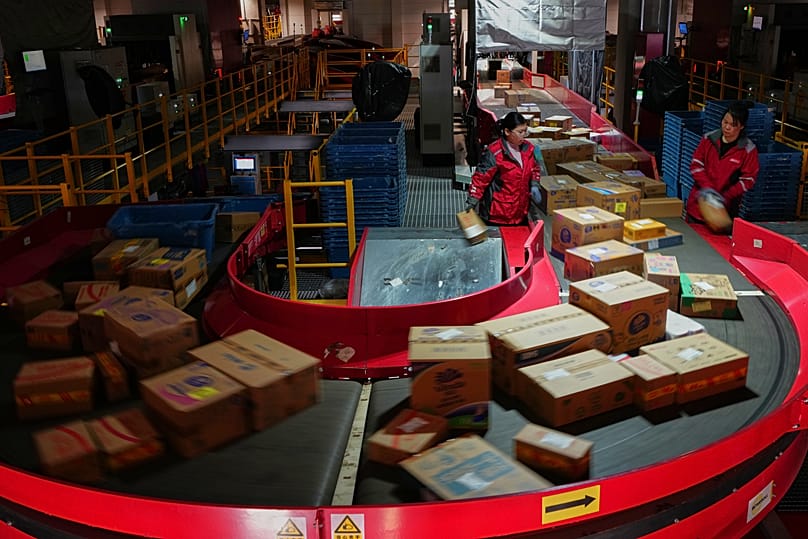
A sorting centre in Beijing in 2025Andy Wong/Copyright 2025 The AP. All rights reserved
Although effective, the measure is not permanent.
It is intended to accompany a broader reform of the European customs system in 2028.
Another step could come already in November, when additional fees to fund parcel handling may also be added.
The Shein figures also hint at what comes next.
A duty levied at the border can be sidestepped by moving the warehouse inside it, and a €3 charge that reshapes buying habits in a month is also a €3 charge that platforms can absorb, split across categories or price back into the product.
Brussels has proved it can slow the flow but whether it has changed where these goods ultimately come from is a question for the next two years.