Tuesday, January 23, 2024


CAIR Condemns Israel’s Execution of Civilians, ‘Torture’ of Detainees, Desecration of Cemeteries

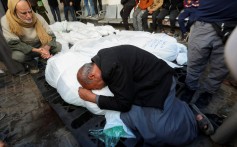
(WASHINGTON, D.C., 1/20/2024) – The Council on American-Islamic Relations (CAIR), the nation’s largest Muslim civil rights and advocacy organization, today condemned the latest “Israeli war crimes of the day” in Gaza, including eyewitness reports of the execution of civilians by Israeli forces, reports of the “torture” of detainees and the ongoing desecration of cemeteries.  

NOTEIsrael has now killed almost 25,000 Gazans, mostly women and children, with least 165 killed and 280 injured in the last 24 hours.

Eyewitness reports are shown on video in the aftermath of a summary execution of more than a dozen men in a Gaza apartment last month. Muhammad Shehada, of the Euro-Mediterranean Human Rights Monitor in Copenhagen, told Al Jazeera he believes there is a pattern of a “systematic” killing taking place on the ground. 

The reports of summary executions of Gaza civilians come as the Head of UN Human Rights Office Occupied Palestinian Territory Ajith Sunghay called for an end to the mistreatment of Palestinian detainees by Israeli forces in Gaza. He wrote: “During my time here, I have managed to meet a number of released detainees. These are men who were detained by Israeli Security Forces in unknown locations for between 30 to 55 days. They described being beaten, humiliated, subjected to ill-treatment, and to what may amount to torture.” 

CNN reported on the damage left to cemeteries in Gaza after Israeli forces bulldozed them, uprooting graves. The Israeli military has desecrated at least 16 cemeteries in Gaza.

In a statement, CAIR National Communications Director Ibrahim Hooper said:

“These war crimes – the execution of civilians, the torture of detainees and the desecration of cemeteries – are symptoms of the decades-long dehumanization of the Palestinian people and the dismissal of their right to freedom and justice. Only when Palestinians are recognized as human beings that deserve freedom and dignity will the international community wake up to the injustices it has supported for so long.”

Hooper added that yesterday, CAIR condemned the killing of a Palestinian-American teen by the forces of the far-right Israeli government in the occupied West Bank.

He noted that CAIR previously called on the Biden administration to condemn the far-right Israeli government’s targeted murder of journalists in Gaza. 

An investigation by the Committee to Protect Journalists reports at least 83 journalists and media workers were among the almost 25,000 people killed by Israel in Gaza since the war began. 

CAIR also called on President Biden to condemn Israeli Prime Minister Benjamin Netanyahu and take action after he admitted to being opposed to the existence of a Palestinian state in any scenario. 

Also yesterday, CAIR condemned what it called the latest “Israeli war crimes of the day,” including a new call for ethnic cleansing of Gaza by a top Israeli government official, the demolition of a Gaza university, attacks near a Gaza hospital, video of Israeli troops mocking Palestinian suffering, and Israeli actions forcing women to give birth in the streets. 

SEE: CAIR Condemns ‘Israeli War Crimes of the Day,’ Including New Call for Ethnic Cleansing of Gaza 

CAIR’s mission is to protect civil rights, enhance understanding of Islam, promote justice, and empower American Muslims.              

La misión de CAIR es proteger las libertades civiles, mejorar la comprensión del Islam, promover la justicia, y empoderar a los musulmanes en los Estados Unidos.             

Become a Fan of CAIR on Facebook          

http://www.facebook.com/CAIRNational            

Subscribe to CAIR’s Email List          

https://action.cair.com/a/newsletters

Subscribe to CAIR’s Twitter Feed          

http://twitter.com/cairnational           

Subscribe to CAIR’s YouTube Channel          

http://www.youtube.com/cairtv           

Follow CAIR on Instagram          

https://www.instagram.com/cair_national/

Donate to CAIR          

https://action.cair.com/a/donate

Do you like reading CAIR press releases and taking part in our action alerts? You can help contribute to CAIR’s work of defending civil rights and empowering American Muslims across the country by making a one-time contribution or becoming a monthly donor. Supporters like you make CAIR’s advocacy work possible and defeating Islamophobia an achievable goal. Click here to donate to CAIR.                    

You are receiving this email due to your interest selection from commercial media databases. If you would like to join CAIR’s media list, please sign up here: https://action.cair.com/a/newsletters — For more information, email: info@cair.com, CC ihooper@cair.com   

END   


Look who’s committing genocide according to American media

China is guilty by investing in infrastructure, providing free education … and forcing tourists to pay to enter Xinjiang’s most sacred mosque


SCMP Columnist
My Take
by Alex Lo
21 Jan, 2024

It’s that dreaded G-word again. Given the dangerous state of the world, but especially in Palestine, where do you think “the greatest persecution of Muslims at the hands of non-Muslims since at least the Yugoslav wars is taking place”? In the parallel universe of the US news media, it’s China, of course!

“The silent genocide of Uygurs and other Muslim minorities in Xinjiang is the greatest persecution of Muslims at the hands of non-Muslims since at least the Yugoslav wars,” so thundered, last Friday, an op-ed from The Hill, the most widely circulated publication in Washington, that is, throughout the US Congress and the White House. “China is conducting what Israel’s harshest critics accuse the Israeli Defense Forces of: a systemic cleansing of innocent Muslims at the hands of infidels. That genocide is also a guarded secret …”

“Silent”? “Guarded secret”? Seriously! Until recently, you couldn’t open a newspaper or a website from the Anglo-American media without reading about how Beijing was intent on wiping out the Uygurs. And if you tried to point out that their population was growing and that their birth rate far exceeded the dominant Han Chinese population, the critics said well, it was all about wiping out their culture and language.

If you also point out that the vast majority of Uygurs freely speak their own language at home and in public, and that their culture is actually showcased – showcased! – as a tourist attraction, well, that’s just screaming cultural genocide!

As a report from CBS News puts it this month, “What we didn’t see was evidence of the detention centres and prison …” Absence of evidence is evidence enough that they must exist because they have been hidden away. Okay?

Chinese firm fights ‘guilty until proven innocent’ US forced labour law
5 Jan 2024


CBS continues: “The government has been investing heavily in Xinjiang, including a multibillion-dollar high-speed train. Everywhere we saw evidence of the eye-watering money China is spending on infrastructure, like wind farms, and tourist development. The message: forget human rights abuses, take in the sights.”

Are there military roadblocks everywhere, guarded by heavily-armed soldiers? Not quite, reported CBS, but that’s just more invisible repression: “At night in Urumqi, we did see some heavy security presence. But overall, with facial recognition cameras everywhere, the policing and the atmosphere were relaxed …” Relaxed?

“In the Xinjiang bazaars, Uygurs have been Disneyfied. Even the sacred Id Kah Mosque sells tickets to tourists,” it said.
DAILY
Opinion Newsletter
Thought-provoking commentary and Op-ed content, curated daily by our world-class editorial team.

GET OUR NEWSLETTER
By registering, you agree to ourT&CandPrivacy Policy

Selling tickets before allowing tourists into the most sacred mosque! If that’s not cultural genocide, I don’t know what is. So is investing heavily in infrastructure, providing free education and healthcare, building more roads and highways, mosques, schools and hospitals.


But guess what IS NOT genocide according to US media and Washington: murdering en masse the civilian population of you-know-who, especially women and children; bombing an entire territory with American-made weapons; levelling mosques, schools, hospitals, universities, historical sites … and killing and jailing journalists by the hundreds, and targeting medics and UN workers in complete disregard of the Geneva Conventions and the laws of war. No, that’s not genocide, more like blood libel.

The Hill’s editorial complains that the Arabs have failed to see China as the worst genocidal monster against Muslims: “In June, Arab League representatives visited Xinjiang, only to conclude that the reports of the genocide are false. That same month, [Palestinian leader] Mahmoud Abbas visited Beijing and supported Chinese policies in Xinjiang.”

UN expert says Israel’s Gaza offensive breaches international law
19 Jan 2024


Obviously, the Arabs have no idea who’s really persecuting and killing their brethren.

“To prevent Beijing from becoming the dominant external power in the Middle East,” The Hill argued, “the United States should make China, among Middle Easterners, a synonym for the genocide.”

The State Department must get on with it, it says, as does its main propaganda organ, the US Agency for Global Media, which runs such august outlets of stellar journalism as Voice of America and Radio Free Asia.

“A synonym for genocide”? I think Middle-Easterners have already identified, correctly, that one.

INDIA
Women's panel seeks detailed report on DMK leader's son torturing Dalit woman

The National Commission for Women strongly condemned the alleged harassment and physical torture faced by the woman, calling for swift and urgent action.


The matter case came to light when an 18-year-old Dalit woman, employed as a domestic help at the residence of Tamil Nadu DMK MLA I Karunanithi's son, alleged physical torture. 
(Photo: Facebook/Screengrab)


Shilpa Nair
UPDATED: Jan 20, 2024 
Edited By: Vadapalli Nithin Kumar

The National Commission for Women (NCW) has demanded a detailed report within two days regarding the alleged abuse of a Dalit woman in Tamil Nadu. The 18-year-old Dalit woman was employed as a domestic help at the residence of Tamil Nadu DMK MLA I Karunanithi's son and had alleged physical torture and denial of medical care by her employers.

The women's panel strongly condemned the alleged harassment and physical torture faced by the woman, calling for swift and urgent action. It also sought a copy of the FIR within two days.

"We urge the concerned police officer to invoke the mentioned provisions in the FIR, ensuring a fair and time-bound investigation. The accused must be apprehended at the earliest, and the victim should receive free medical treatment," the women's panel said in a statement.

"We stand firm in our commitment to ensuring justice for survivors and ending violence against women," the panel added.

The NCW has prima facie observed that the reported crime falls under the provisions of the Indian Penal Code, 1860, specifically Sections 323 (voluntarily causing hurt) and 354 (assault or criminal force to woman with intent to outrage her modesty).

Seeking medical treatment during the Pongal festival for injuries sustained during the incident in her hometown of Kallakuruchi district, the victim's case was reported to the local police by the hospital.

Karunanithi, however, denied the woman's allegations, asserting that his son's family treated her well and only "corrected her when she did something wrong."

In a video shared by the non-profit organization Evidence, the Dalit woman claimed to have completed 12th grade and secured employment as a domestic help through an agent.

Employed for seven months at the residence of Karunanithi’s son Anto Mathivanan and his wife Marlina in Chennai, she alleged facing physical assaults and non-payment of wages.

Published By:
Vadapalli Nithin Kumar
Published On:
Jan 20, 2024
France MPs slam FM's opposition to Israel genocide case

Two French left-wing MPs have criticised Stephane Sejourne’s remarks, saying that Israel's continued atrocities in Gaza very much constituted genocide.


Stephane Sejourne drew anger for saying that accusing Israel of genocide "crosses a moral threshold" [Getty/file photo]

The New Arab Staff
20 January, 2024

A number of French opposition MPs have condemned Foreign Minister Stephane Sejourne's comments saying that accusing Israel of genocide would be "crossing a moral threshold".

Thomas Portes, a member of the left-wing France Insoumise (France Unbowed) party, said that the Foreign Minister’s comments "endorse with deafening silence" the ongoing atrocities in Gaza by "refusing to condemn Israeli war criminals" in a post on X.

Portes shared a video of Palestinian victims killed by Israel in Gaza, wrapped in shrouds, in accompaniment with his comments.

In his post, the French lawmaker described what was happening in the video as a "typical morning in Gaza. Bodies piling up, the majority of them women and children".

"Yes @StephaneSejourne, it’s a genocide. A GENOCIDE," he added.


On Wednesday, Sejourne made a statement saying that France does not back the case filed against Israel by South Africa at the International Court of Justice, which accused Tel Aviv of carrying out genocide against the Palestinian people amid the war in Gaza.

Close to 25,000 people have been killed since October 7 – mostly women and children, while Israel has obliterated universities and libraries, and targeted mosques, schools and hospitals in its relentless bombardment.

Pretoria said that Tel Aviv’s onslaught breaches the 1948 UN Genocide Convention, and has asked the court to immediately halt the deadly military offensive carried out by Israel.


"Accusing the Jewish state of genocide crosses a moral threshold. The notion of genocide cannot be exploited for political gains," Sejourne said in parliament earlier this week.

The 38-year-old was made foreign minister earlier this month following the appointment of Gabriel Attal as the country’s newest prime minister.

His comments concerning South Africa’s genocide case were met with backlash from activists online, accusing the French government of double standards and hypocrisy given that Paris is a founding member of the ICJ.

Another French left-wing politician, Daniele Obono, also slammed Sejourne's remarks. The France Unbowed member said: "No, it’s committing a genocide that crosses a legal and moral threshold."

"Israel is above neither law nor morality," she added.

Portes, who is a member of France’s National Assembly, has taken to social media to raise awareness of Israel’s military campaign in Gaza on numerous occasions.


In December last year, the lawmaker called for French nationals who have committed war crimes while serving in the Israeli army to be be brought to justice.
The UK needs to break with neoliberalism to deliver economic growth

19 January, 2024 

'Political parties incessantly talk about low economic growth but none are willing to address the major issues'

This week, the UK economy narrowly avoided tipping into a recession, but sustainable economic growth remains elusive. The modest rates of economic growth were halted by the 2007-08 banking crash. Between 2010 and 2021, the real economy grew by just 1.2% a year. Under the weight of Brexit, never-ending austerity and low investment, the economy is growing at the slowest rate for two centuries. Masses don’t have the purchasing power to revive the economy.

Political parties incessantly talk about low economic growth but none are willing to address the major issues, which include low household incomes and investment. None of these can be addressed without equitable distribution of income and wealth, and curbs on corporate power.

In 2010, the UK had 54 billionaires with wealth of £58.1bn. By 2023, it grew to 171 billionaires with wealth of £684bn. Just 50 families have more wealth than half of the population, comprising 33.5m people. The richest 1% are wealthier than 70% of the population combined. They own 36.5% of all financial assets, with a value of £1.8tn.

The concentration of wealth means that governments rely upon a small section of the population to build a sustainable economy. The last 40 years have shown that such a task is virtually impossible. The inequalities have emboldened the super-rich to discipline elected governments by demanding laws and policies that promote their interests. Rather than curbing the power of the wealthy elites, the government has reduced the income of low and middle income families through austerity, real cuts in wages, state pension and benefits. Without good purchasing power, people can’t buy goods and services, and economic stagnation follows.

A large proportion of the population has been pushed into poverty as part of an economic experiment to produce a docile and obedient workforce. In 1976, at the height of trade union membership, workers’ share of the gross domestic product (GDP), in the form wages and salaries, was 65.1%. At the end of September 2023, after the onslaught of anti-trade union laws, fire and rehiring of workers on low pay, zero-hour contracts and more, workers’ share of GDP has declined to around 49% of GDP.

Ministers boast that since 2010, GDP has grown by 24%, but the benefits have hardly trickled-down. The average real wage has returned to the 2005 level. In 2023, the annual median wage in money (nominal) terms were £29,669; and mean wage was £35,404. The Joseph Rowntree Foundation estimates that a single person needs to earn £29,500 a year to reach a minimum acceptable standard of living. A couple with two children need to earn £50,000 between them. Some 19m adults have annual income of less than £12,570. Nearly 50% of the population is teetering on the edge of economic survival and does not have the reserves to boost economic revival. The standard of living of the poorest Britons is 20% lower than their counterparts in Slovenia.

The purchasing power of low and middle income families is under constant attacks by corporations using their market political and financial power to extract profits from a captive population. A sustained economy can’t be built without checking the monopolistic power of corporations.

The Balanced Economy Project reported that the average profit mark-up by the world’s top 20 companies, whose market value is equivalent to the GDP of France, Germany, India, Brazil, South Africa and the United Kingdom combined, is 50% compared to 25% average for smaller firms. This gets multiplied several times in the supply chain. The tech industry is dominated by few companies and its mark-up is currently at around 75% or more, and has been as high as 1,000%, meaning they charged people for goods and services ten times as much as the cost of producing them.

The finance industry piles on the pressure on cost-of-living crisis through speculation on virtually everything whilst producing little or nothing. For example, hedge funds made £1.5bn profit by speculating on food prices by betting on the Ukraine-Russia war. In 2022, investment banks made $20bn by trading and financing commodities like oil, gas and metals. High commodity prices are a major reason for higher inflation and poverty.

In the UK, unchecked corporate profiteering is the real reason for inflation and poverty. Shell, BP, British Gas, National Grid, coal and energy companies have excelled at profiteering. Gas producers and electricity generators are expected to make £170bn “excess” profits. Research by Unite reported that FTSE 350 companies hiked their profit margins by more than 89%. Between 2019 and 2021, agribusiness corporations increased profits by 255%. Pharmaceutical companies have raised prices of vital medicines by over 10,000%. Internet and mobile phone companies operate as a cartel and every year increase prices by inflation plus 3.9%, regardless of their cost. Water companies in England enjoy a monopoly and since privatisation in 1989 have hiked prices by 40% in real terms.

Despite £75.2bn subsidy in the last 10 years, rail companies find new ways to pick people’s pockets. The companies were keen to close all ticket offices and force people to use machines at stations. Evidence shows that for many journeys ticket machines are charging double online price. Of course, not everyone can afford to go online.

The vast wealth of the corporations and their controllers has not been used to improve wages and working conditions. It has been used to fund political parties, legislators and think-tanks to demand special privileges. For example, they demand that return on wealth in the form of dividends and capital gains be taxed at lower rates than wages. Their ability to dodge taxes by shifting profits and incomes to low/no tax jurisdictions remains unchecked. As the Post Office scandal shows, their power is used to silence victims and critics.

Economic crisis management policies are devised to hurt the poor and enrich the rich. Consider the case of a person suffering from some ailment. S/he visits a physician who dusts an old book and prescribes the same medicine, regardless of the cause of the ailment. The patient may survive but is in worst condition than before and picks up more ailments.

That is the case with the government’s inflation management policy. The current bout of inflation is caused by profiteering by corporations. It is not caused by higher wages, which are lagging prices. But instead of removing cash from those flushed with it through taxes on wealth, return on investment, dividends and capital gains, the government uses the old neoliberal remedy of hiking interest rates. This hurts small businesses, raises mortgage costs, rents and prices, further depleting the spending power of the low and middle income families. Their lack of spending power erodes possibilities of building a sustainable economy. Meanwhile the rich with financial assets get richer, profiteering continues unchecked, inequalities widen and banking corporations continue to create money.

The UK economy has suffered from chronic levels of underinvestment compared to other major economies. It has fallen from 23% of GDP in the late 1980s to around 17% from 2000 onwards, compared to 20-25% in major industrialised economies. This inevitably has a knock-on effect on the rates of productivity.

In the OECD league table of investment, the UK occupies 27th place for private investment, 23rd for public investment, and 35th spot overall out of 38 countries. This is despite a plethora of subsidies and tax incentives. There are two reasons for this. Firstly, poor purchasing power of the masses is a major disincentive for investment. Secondly, the private sector prioritises short-term gains and does not have the appetite for long-term risks. That is why the state invested and launched information technology, biotechnology, aerospace and other industries. The blind faith in markets has been counterproductive.

Now any mention of borrowing to invest sends neoliberals to a cold sweat, but that is what is needed as we are on the cusp of the fourth industrial revolution. After the Second World War, the government rebuilt the economy, launched the National Health Service and the welfare state by borrowing. In 1946, public debt hit 270% of GDP . The private sector was direct beneficiary of this policy as the state bought its goods and services, and that stimulated private investment. The expanded economy provided employment and boosted tax revenues. By 1976, the public debt declined to 49% of GDP. Without restoring the investment role of the state, the UK economy is unlikely to be revived.

In order to revive the economy, the UK needs to make a decisive break from neoliberal policies. Workers’ share of GDP needs to be increased through a higher living wage and secure employment. Equitable distribution of income and wealth needs to be aided by progressive taxation. The tax perks of the rich need to be withdrawn. For example, there is no justification for taxing returns on wealth, in the form of capital gains and dividends, at a lower rate than the returns on the investment of human capital (wages). Giant corporations need to be broken-up to encourage competition and reduce their ability to exploit people and hold governments to ransom. Industries in which no effective competition is possible, such as water, rail, energy, need to be brought into public ownership. All large business entities should have employee and consumer elected directors to ensure that people’s voice is heard.

There is no invisible hand of fate and our destinies are governed by the visible hand of politics and institutions of government. People have the power to secure emancipatory change. We are many, they are few.

Prem Sikka is an Emeritus Professor of Accounting at the University of Essex and the University of Sheffield, a Labour member of the House of Lords, and Contributing Editor at Left Foot Forward.

In an age of mass protest, why aren’t we winning?

NO GLOBAL MASS REVOLUTIONARY ORG.


Mike Phipps reviews If We Burn: The Mass Protest Decade and the Missing Revolution, by Vincent Bevins, published by Wildfire.

Based on 200 interviews in a dozen countries, this is an ambitious book which perhaps tries to cover too much. In 2013 Vincent Bevins was a young journalist working in SĆ£o Paulo in Brazil. He became an eye-witness reporter of the mass movement that sprang up in protest against a rise in the city’s public transport charges – and of the police’s brutal response.

The campaign actually won. Moreover, Brazil’s then President Dilma Rousseff, although condemning a destructive minority, praised on national TV the spirit of the protests, which “proved the energy of our democracy.”

There was just one problem. During those three critical weeks of protest, the President’s poll ratings fell from 57% to 30%. They never recovered.

The movement evaporated. Had it been primarily about advancing the socioeconomic needs of ordinary people, or was the agenda one of institutional change? Its success may have depended on this ambiguity – but it also highlighted the dilemma facing all such successful campaigns. Was the next step to engage with – and risk being coopted by – institutional politics, or to risk irrelevance by maintaining a party-free, consensus-based grassroots movement?

From this first-hand experience, Bevins tries to explore a wider problem. From 2010 to 2020, more people took part in protests than at any other time in human history – the Arab Spring, student direct action in Chile, democracy activism in Hong Kong and Ukraine, to name a few. Why, asks Bevins, has success proved so elusive, in many cases the outcome being the opposite of what the protesters wanted?

Bevins describes the processes whereby the right regained the initiative – in particular, in Brazil, which he knows best. There this was done on the basis of a highly selective anti-corruption drive, backed by state institutions and a pliant media, yet based on deceit and led by law-breaking officials whose main priority was to stop former President Lula from running for a further term. It’s more difficult, however, to explain why this could happen.

Certainly, the structurelessness of mass single issue campaigns organised on a horizontal basis may hobble their effectiveness. Better-funded NGOs and political parties, often with a different agenda, can take control of events. The capacity of social media for distorting reality is also relevant. Victories achieved by the left are unlikely to be permanent. The right is well resourced and endlessly inventive at defending its own interests.

For the left, power is elusive. It includes electoral representation, but is not reducible to that alone. It is tied into a wide and not always obvious network of institutions and processes. When left wing Presidents in Peru and Brazil are elected, they face being impeached out of office, in processes backed by the police and most mainstream media. In Guatemala last year, the newly elected left wing President was nearly prevented by institutional obstruction from taking office at all. But in Argentina, when a right wing extremist is elected with minimal support in Congress, he is allowed to bypass the elected legislature and rule by decree.

Clearly the odds are stacked against progressive change. One response from the left is to reject engagement with the formal power structures. Official politics is a sewer. The abandonment of alternative economic policies by most democratic socialist parties and their capitulation to neoliberalism makes it easier to dismiss all official parties as the same  – a ‘caste’, as Podemos characterised the political elite in Spain in its successful insurgent phase.

But this populist grandstanding gets you only so far. In truth, not all political parties are the same and a belief that they are leaves the left ill-prepared when it needs to work with forces to its right, as in Spain and Portugal recently. Then new problems emerge: compromise, corruption, capitulation. This itself feeds an anti-politics populism, which tends to favour a well-funded and resourceful far right.

Events in Chile in 2019 express these contradictions. When the right wing President PiƱera declared a state of siege in response to student protests against high public transport fares, neighbourhood assemblies sprang up across the country to discuss their grievances with the government. As protests escalated, Congressional leaders proposed a ‘peace accord’ – a referendum on a new Chilean constitution.

Most of the protest leaders rejected the deal outright. The only radical leftist to sign it was the former student leader Gabriel Boric who was widely denounced for his stance at  the time.

Yet in 2021, Boric was elected Chilean President at the age of 35 amid much jubilation on the left. Was this a vindication of his position of two years earlier? That’s more complicated: in 2022, the left’s new constitution was put to a referendum and roundly defeated. Was this the wrong priority, not tied to the immediate economic needs of the Chilean masses? Certainly, the momentum of Boric’s government stalled. But he remains President: the fight goes on.

Bevins’ book doesn’t address all these issues. One lesson he draws from the failed movements of the last decade is that there is no such thing as a political vacuum. If you take away the power from those who have it and don’t seize it yourself, then someone else will. That’s true, as far as it goes.

One activist told the author: “Organize. Create an organized movement. And don’t be afraid of representation. We thought representation was elitism but actually it is the essence of democracy.”

That’s more helpful. It was echoed elsewhere: “Any revolution with no organized labor party will just give more power to the economic elites.”

One Egyptian activist was blunter: “In New York or Paris, if you do a horizontal, leaderless, and post-ideological uprising, and it doesn’t work out, you just get a media or academic career afterward. Out here in the real world, if a revolution fails, all your friends go to jail or end up dead.”

That sounds bleak, but learning the lessons from these experiences is essential, win or lose. “You can learn more from a failure than from a success – if you recognise it as such,” argued the late Mike Marqusee. This is something that we in the UK, where we have not faced death or been thrown jail in the aftermath of the Corbyn movement’s defeat in 2019, must remember.

This book is well worth reading. It may not have all the answers but it is at least asking the right questions, ones we should all be grappling with.

Mike Phipps’ book Don’t Stop Thinking About Tomorrow: The Labour Party after Jeremy Corbyn (OR Books, 2022) can be ordered here.

http://www.threads.net/@labour_hub

UK

Power to the people? The first Labour government a century on


JANUARY 22, 2024

A hundred years ago today, Ramsay MacDonald formed the first ever Labour government. Richard Price assesses its achievement.

We’ve become used to thinking that we live in politically exceptional times. By the end of this year, we will in all likelihood have had four general elections and six prime ministers in nine years. Yet the six years following the end of the First World War were even more frenetic. Britain had four general elections and four different prime ministers covering seven periods in office.

Ramsay MacDonald’s Labour government – the sixth in this sequence – was not the first government in the world with working class credentials. In 1871, the Paris Commune had briefly brought a coalition of Proudhonists, Blanquistes and Jacobins to power. Chris Watson’s Australian Labour Party government was in office for seven months in 1904. In November 1917, the Bolsheviks seized power in the former Tsarist empire. Six months later, Mensheviks in Georgia proclaimed independence from the Soviet Union. Germany’s social democrats came to power on the back of the November 1918 revolution.

Yet there was no doubting the symbolic importance of the first Labour government that took office a century ago on 22nd January 1924. George V wrote in his diary: “Today 23 years ago dear Grandmama died. I wonder what she would have thought of a Labour Government.”

The Manchester Guardian noted that a majority of the members of the new government “are drawn from the humblest rank of society.” Peter Clark’s recent book, The Men of 1924, points out that its social composition was a sharp break with the past. Replacing the Tories were a group of men, the majority of whom had left school by the age of 15, and headed by the illegitimate son of a farm labourer and a housemaid. Five members of the government had started work by the age of 12, three had started working down coal mines before their teens, another was born to a single mother, one had been a foundling, and three were of Irish immigrant heritage.

The window of opportunity for Labour to form a government was the product of several years of extreme political instability. The end of war saw the rapid contraction of war industries, causing an initial recession, accompanied by the growth of trade union militancy. A short boom was followed by a sharp recession in 1920-21, accompanied by rising unemployment, which touched 23.4% in May 1921. Trade union membership, which had peaked at 8.3 million in 1920, fell back to 5.4 million in 1923. Deflationary trends saw prices fall.

Internationally, the Russian Revolution threatened to upend the international order. Germany, with the Ruhr occupied by France, was gripped by economic crisis. Ireland achieved independence at the cost of a bloody civil war. British rule was increasingly challenged in India.

For the only time in British history, there were three general elections in three successive years. The two parties of the British ruling class, the Tories and the Liberals, were riven by internal splits and feuds, and the growth of Labour’s electoral support inaugurated a decade of three-party politics, in which political calculations became much more complex.

At the 1922 general election, Labour made net gains of 85 seats and became the official opposition for the first time. Ramsay MacDonald became Party leader, which now became an official title, in addition to being Chairman of the Parliamentary Labour Party. He still retained some credit with the growing anti-war wing of the Party for his stance during the First World War. Anti-war MPs had lost their seats in the Khaki election of 1918, but the pendulum was beginning to swing, and by the mid-1920s, Labour was moving towards the kind of semi-pacifism it would hold to for the next decade.

The election saw the victory of five Red Clydesiders, who supported MacDonald for the leadership – something they would subsequently regret. Among the new intake were more MPs who weren’t sponsored by unions. Many were Independent Labour Party socialists, who tended to lean to the left of their trade union colleagues. At the same time, there was a steady drip-drip of Liberal defectors joining Labour.

While Churchill and his close ally Lord Birkenhead claimed that Labour was ‘unfit to govern’, Labour stressed its moderation and fiscal responsibility, promising to address “the difficulties of employers”. J.R. Clynes, who led the party up to the 1922 general election, and became deputy leader to MacDonald after, rejected the idea that there was any “mysterious reservoir of wealth” that could fund wage increases.

Meanwhile, the Labour leaders were fighting a war on their left flank against the influence of the Communist Party among the Labour left, and throughout the mid-1920 they took a series of administrative measures against it. Despite a membership of below 4,000 at the end of 1923, CP members were active as individuals in local Labour parties. But Labour Conference in July 1923 decisively rejected the latest attempt at Communist affiliation by 2,880,000 to 366,000.

After only eight months of the Tory ministry, Premier Andrew Bonar Law resigned, having been diagnosed as terminally ill. Stanley Baldwin, who took over, wanted to reverse Tory policy in favour of protectionist tariffs on imports, and incautiously called another election on 6th December 1923 to win a mandate. Labour’s main manifesto pledge was a capital levy on all individual fortunes in excess of £5,000. 

It was a serious miscalculation on Baldwin’s part. Protectionism was unpopular – the public feared it would lead to higher food prices – and when the votes were counted the Tories had lost 86 seats. Labour gained 49 and the Liberals gained 43, leaving the Tories as the largest party, but unable to command a majority. Remarkably, this large number of seats changed hands without any major shift in the main parties’ support in the country. The Tories were down only 0.5%, Labour up 1% and the Liberals up 0.9%.

The parliamentary recess ran for five weeks, for the rest of December and well into January. In the days following the election there was talk of a coalition, and MacDonald’s support for a cross-party government of the centre was canvassed. As in the Blair years, there was some talk of a Labour-Liberal realignment of the centre, but it came to nothing. But by the middle of December the National Executive, the Executive of the Parliamentary Party and the TUC had ruled out a coalition. For the time being, Baldwin remained in office.

While the negotiations went on there was a right wing press campaign predicting doom, gloom and Bolshevism. As the Palace dithered as to who it would invite to form a government, railway workers’ leader Jimmy Thomas – who would cross the floor to join MacDonald’s National Government in 1931 – let it be known that Labour would introduce “no extreme legislation or violent administrative changes” and that MacDonald would not “play up to the Clyde division”. He went further, committing the incoming government to accepting the outgoing government’s budget and shelving plans for a Capital Levy.

Baldwin held on until January but when Parliament finally resumed on 22nd January Labour and the Liberals combined to vote down the King’s Speech by 72 votes, leaving the king no option but to call upon MacDonald to form a minority government. MacDonald caused amusement by attending the Palace in a frock coat of the type rarely seen since the First World War.

The election was notable for the victory of first three women Labour MPs, Margaret Bondfield, Susan Lawrence and Dorothy Jewson. Bondfield – a former shop assistant – became the first woman to serve in government when she was appointed Parliamentary Secretary to the Minister of Labour.

Very few Labour MPs had any experience of government. Arthur Henderson had served in both Asquith’s and Lloyd George’s wartime coalitions, with a few others in minor posts. The day after Labour took office, former Liberal Noel Buxton, who became Minister of Agriculture, told his outgoing Tory predecessor that “MacDonald’s idea is to show how respectable they are.” To demonstrate ‘continuity’, MacDonald drafted in forces outside the Labour Party. His Cabinet contained four ex-Liberals, two Tories and one ex-Tory. Labour had only three members of the House of Lords, but MacDonald declined to create significantly more.

In opposition Labour had often spoken about unemployment. Although it had fallen from its peak in 1921 to 11.9% when Labour took office, it remained stubbornly high, rarely dipping below 10% the rest of the decade. In government, Labour failed to take adequate measures. Its leaders thought the way to cure unemployment was a better foreign policy – “the re-establishment of normal peaceful conditions throughout the world” – rather than any assault on the bastions of power, wealth and privilege. To this end, MacDonald served as his own Foreign Secretary. There was no significant interventionist programme of public works, with the result that when the government fell in October 1924 it had hardly made a dent in the unemployment rate, which remained at 10.9%.

The new left in the Party was largely side-lined except for Clydesider John Wheatley at Health. Fred Jowett as Commissioner of Works was the left’s only other representative. Philip Snowden as Chancellor of the Exchequer had moved a long way from his socialist evangelism in the early years of the century to a grey, rigid orthodoxy. He too would cross the floor in 1931.

The British Empire covered about one-quarter of the world’s land surface and ruled over one-fifth of its population. But the incoming government had little in the way of progressive ideas. Right winger Jimmy Thomas was Colonial Secretary and former Liberal Imperialist Richard Haldane chaired the Committee of Imperial Defence like a ‘private empire’. While claiming to be working towards Dominion Home Rule in India, the government warned Indian Congress leaders not to take any “ill-considered or premature action.” There was one break with the past, with the diplomatic recognition of the Soviet Union in February 1924. An Anglo-Soviet trade agreement followed in August.

The one piece of government legislation that had a lasting impact was John Wheatley’s Housing Act. It increased government subsidies paid to local authorities to build municipal housing for rent to low paid workers. It specified decent space standards and the provision of bathrooms. The act remained in operation until 1933 and produced 508,000 houses, all but 15,000 of which were built by local authorities. There were also a number of modest yet worthy social reforms, including increases in benefits, some improvements in welfare facilities and extension of educational opportunities.

Wheatley was also responsible for another victory for the left. In 1922 Poplar Council had been issued with an Order by the then Liberal Minister of Health that made paying unemployment relief at a scale higher than the official one illegal. Wheatley rescinded it unilaterally without consulting MacDonald.

With barely 30% of the seats in the Commons and heavily dependent on Liberal votes, MacDonald’s government was never likely to last long. Yet MacDonald’s aim was to remain in power as long as possible. In reality, the only choice available was to influence the manner of his downfall. The Parliamentary Party’s Liaison Committee, chaired by Robert Smillie, called on the government to “deal drastically and fundamentally” with some of the accumulated “great social evils” and if defeated, that it should go to the country with a clear alternative platform. Instead, MacDonald soldiered on, emphasising the government’s responsibility and moderation, and most histories of the period repeat the line that its one achievement was to show that Labour was ‘fit to govern’.

In its 25th July 1924 edition, the Communist Workers Weekly carried an open letter to members of the forces by its editor J.R. Campbell, calling upon them not to shoot strikers. The government’s Attorney General, Sir Patrick Hastings recommended prosecution under the 1797 Mutiny Act, but pressure from Labour backbenchers caused it to be withdrawn. Tories, Liberals and the right wing press responded by claiming the government was in hock to extremists.

A Tory motion of censure was defeated, but a Liberal motion in favour of a Select Committee to investigate the circumstances leading to the prosecution being dropped was carried. MacDonald treated this as an issue of confidence, and requested a dissolution of Parliament and a fresh election.

The red scare that had been generated put Labour on the defensive. It deepened with the publication of the infamous ‘Zinoviev Letter’ in the Daily Mail, four days before the election on 29th October. The letter purported to be a letter to the British Communists, urging them to take advantage of the normalisation of relations with the Soviet Union to press forward revolutionary action. It is now widely accepted to have been a White Russian forgery, with some involvement by MI5.

The election result saw sweeping Tory gains that gave them 412 seats on a swing of 8.8%. Although the Zinoviev Letter is widely credited with Labour’s defeat, the extent is debatable. Labour’s vote actually rose by just over a million votes, and its vote share by 2.6%, although this was partly due to it contesting more seats. Despite this, Labour lost 40 seats, although the big losers were the Liberals who lost 118 seats as middle class voters rallied to the Tories as the party of order.

So are there ‘lessons for today’ to be drawn in the time-honoured way from events 100 years ago? Perhaps what we should note is how contemporary so many of MacDonald’s traits seem – the scrapping of pledges to tax the rich; the marginalisation of the left of the Party, while reaching out to forces to its right; the pose of acting as an honest broker between employers and workers; the retreat in the face of witch-hunting; the absence of an over-arching narrative and mission; abiding by inherited Tory budgets.

Richard Price is a member of Leyton & Wanstead CLP.

Image: Ramsay MacDonald. https://picryl.com/media/ramsay-macdonald-cropped-975b23. Creator: National Portrait Gallery London | Credit: National Portrait Gallery London via Picryl.com Copyright: public domain PDM 1.0 DEED Public Domain Mark 1.0 Universal


http://www.threads.net/@labour_hub


Thérèse Coffey: lone voice against the Wakanda genocide

By David Osland

JANUARY 20, 2024

Brexiteers talk freely of ‘Brussels’ as a shorthand label for unaccountable European Union bureaucracy, while critics of US foreign policy frequently employ ‘Washington’ by way of an easily understandable synonym.

There is even a technical term for such figures of speech. Metonymy is defined as “the substitution of the name of an attribute or adjunct for that of the thing meant.” Put more simply, the reference is to the part but implies the whole.

So when Labour’s Yvette Cooper spoke of “the Kigali government” in this week’s Commons debate on the Safety of Rwanda (Asylum and Immigration) Bill, she must have had the reasonable expectation that MPs would take that as a reference to the dictatorship of Paul Kagame. What else could she even have meant?

Step forward ThĆ©rĆØse Coffey, a Tory politician whose stint in the cabinet will be long remembered for her failure to tackle water companies dumping sewage in Britain’s rivers.

“I was somewhat astonished by the speech of the shadow home secretary, who cannot even get the name of the country right, talking about the Kigali government when we are talking about Rwanda,” the princess of poo boldly declaimed.

The comment is a strong early contender for the 2024 Failed Attempted Zinger of the Year Award. Unkind observers have even seized on the remark to suggest her grasp of African politics is not all it might be. But I for one will never forget she was often an outspoken lone voice against the Wakanda genocide.

Coffey is the product of a fee-paying school, who secured a place at Oxford University, before she was required to withdraw on academic grounds. But her humiliating display of ignorance raises issues beyond her personal intelligence.

The Rwanda bill comes too late in this parliamentary term to be dubbed flagship legislation, because the Tory Titanic sank some time ago. Think of it as life raft legislation instead.

It is a calculated appeal to the presumed indelible racism of the Conservatives’ target demographic, in the probably forlorn hope of mitigating annihilation at the next general election.

Not only is this rancid attempt to send asylum seekers to deportation camps on another continent in obvious breach of international law, but it has already cost the taxpayer £240m, with another tranche of £40m already lined up. That is far more than the meagre £200m Sunak allocated to fund the NHS winter emergency.

Yet not a single asylum seeker has yet been sent to “the Kigali government” – see what I did there, ThĆ©rĆØse? – and the likelihood that any ever will be is increasingly remote.

Even the very object of the bill is blitheringly incoherent. Westminster – gotta love metonymy, right? – can no more declare that Rwanda is safe than it can rule that black is white or that cats are dogs.

It is true that a thousand years ago, King Cnut placed his throne on the beach and commanded the waves to turn back. But at least he was doing this to teach a lesson to sycophantic courtiers.

Sunak doesn’t even have that excuse. Indeed, this week he has found sycophantic courtiers in short supply.

Worse still, Kagame is getting sniffy about the money and is threatening to send it back. Let no one ever say that African military strongmen do not adhere to basic moral standards. Even if the Tories don’t.

That brings me to Labour’s moral standards on this issue. If you Google hard enough, you can find frontbenchers condemning the Rwanda scheme on ethical grounds. But that critique has rarely been front and centre.

The objections have instead focused on cost and practicality. They are legitimate, as far as they go. But they don’t go far enough. Such is callow electoral expediency.

The Safety of Rwanda (Asylum and Immigration) Bill now goes to the House of Lords, at which stage Green peers will make a doomed attempt to gut it and Labour peers will see it through, in the hope of prolonging Tory agony.

It then returns to the Commons. Any MPs under the misapprehension that “Kigali” is an independent sovereign state should recuse themselves from the vote on grounds of stupidity. They are not sufficiently well informed to offer considered judgement.

David Osland is a member of Hackney North & Stoke Newington CLP and a long-time left wing journalist and author and writes for Labour Research magazine. Follow him on Twitter at @David__Osland

Image: ThĆ©rĆØse Coffey. 

Source: https://api20170418155059.azure-api.net/photo/CsHBoP4f.jpeg?crop=MCU_3:2&quality=80&download=true. Author: Chris_McAndrew, licensed under the Creative Commons Attribution 3.0 Unported license.

http://www.threads.net/@labour_hub