Tuesday, January 23, 2024

A Massive Tsunami Could Have Wiped Out Populations in Stone Age Britain

NATURE
By JENNY MCGRATH, BUSINESS INSIDER


The rocky coastline of Howick, England, at sunrise. (Craig Richards/Getty Images)


About 8,200 years ago, an underwater landslide known as the Storegga slide near Norway triggered a tsunami that engulfed parts of northern Europe.

Around the same time, there was a massive dip in Britain's population.

Researchers at the University of York and the University of Leeds looked at whether the disaster contributed to the population decline, or if other factors were at play.

"The suggested population decline occurred immediately after the Storegga tsunami occurred," Patrick Sharrocks, the lead author on the paper detailing the research, told Business Insider via email. "However, a cold period coincided with the tsunami so it was unclear which event had a greater impact."

The researchers built computer simulations of how far the tsunami's waves could have reached inland.

Based on their results, the researchers concluded that the tsunami could have wiped out a significant portion of the population at Howick, Northumberland in northern England.

They recently published their findings in the peer-reviewed Journal of Quaternary Science.

65-foot waves slammed the Shetland Islands

When the landslides triggered the massive waves, they had widespread impacts. Evidence of the Storegga tsunami has been found in Norway, England, Denmark, Greenland, and Scotland, including the Shetland Islands.

Around the mainland of the UK, waves may have reached 10 to 20 feet. Off the coast of Scotland, the Shetland Islands' narrow valleys may have magnified the effects, causing waves of over 65 feet to flood the land.

There aren't written records of the disaster. Instead, the story is in the sediment deposits from lakes, lagoons, and other bodies of water that formed during the tsunami. The wave eroded sediment on land but also brought in more from the sea.

While these layers are distinctive, they often erode with time and human activity. However, they can give scientists clues about how far inland a wave traveled and how often similar events occurred.
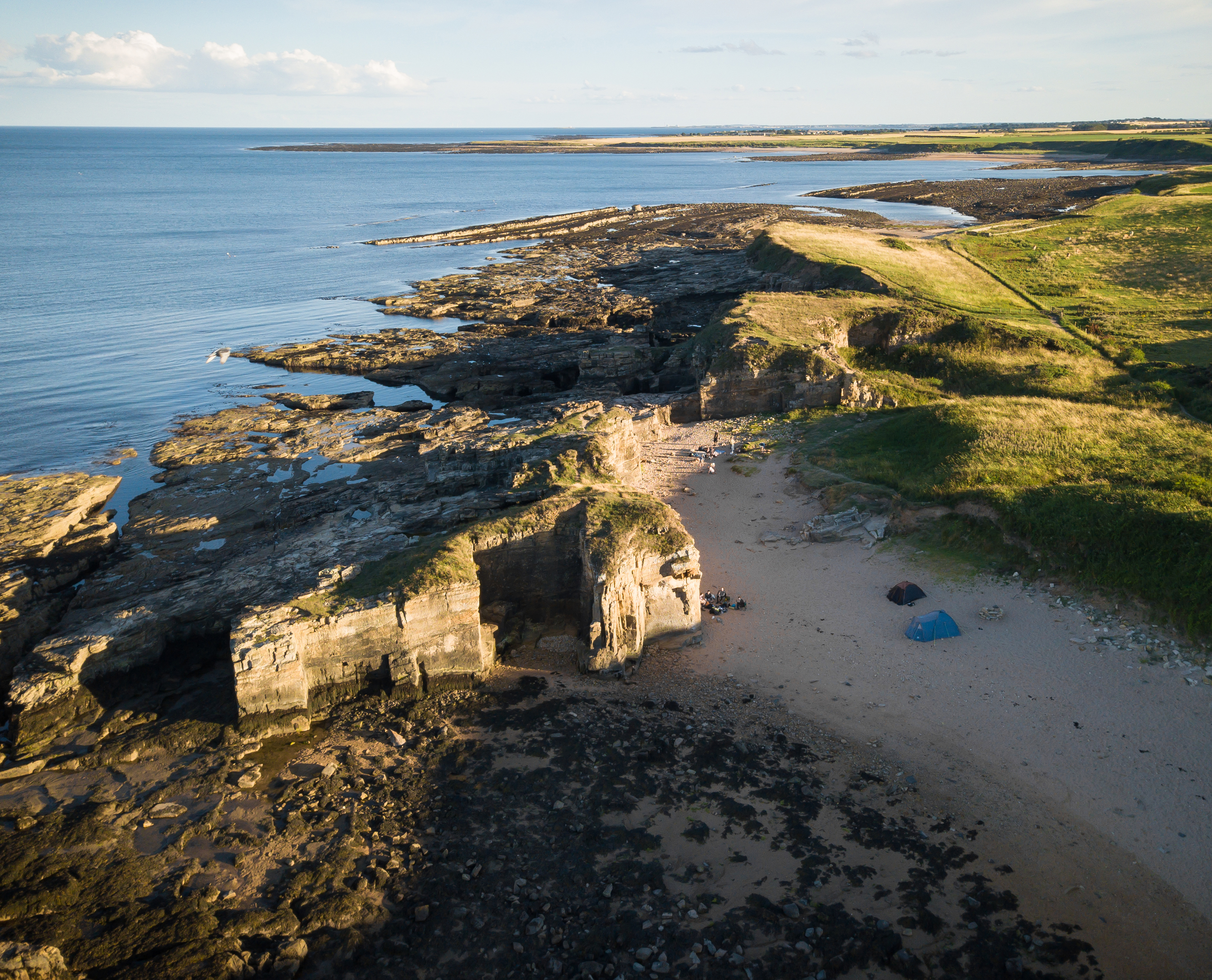
Present-day Howick, England, where a tsunami may have hit over 8,000 years ago. (Craig Richards/Getty Images)
People camping on a rugged section of the coast near Howick, Northumberland Coast Path, Northumberland, England. August 8, 2018. (Marc Guitard/Getty Images)

It's possible the huge waves didn't reach Howick at all. The location has sediment that seems to be the result of a sudden event. Yet it's coarser than the finer sand found elsewhere attributed to the Storegga waves.

"Further sedimentary research at Howick could accurately identify whether deposits were produced by the tsunami at this location," Sharrocks said.

A population unprepared for a tsunami

Tsunamis are rare in the British Isles. The Mesolithic population likely never experienced one before the Storegga landslide, according to the study.

The researchers speculate that the receding sea that precedes a giant wave may have drawn people to the water to collect stranded shellfish.

If that happened, the tsunami could have drowned a significant percentage of the population. The destruction of resources, like hazel trees, could have also led to famine among survivors.

Numerical models "can reconstruct the Storegga tsunami but can never be fully representative of past events," Sharrocks said. The event was so long ago that there was a lot of uncertainty around the relative sea level position, topography, and elevation at the time.

According to the researchers' models, only if the tsunami hit at high tide would it have affected Howick.

In another paper from 2021, researchers suggested the tsunami may have destroyed evidence of human habitation in Norway, Britain, and other regions. But they also noted that "there remain very few archaeological sites with direct evidence of tsunami deposits," which makes it difficult to assess "the extent to which this event was a disaster for the coastal communities."

Future British tsunamis

For years, scientists thought the Storegga tsunami was a unique event. Recent research, however, found tsunamis hit Shetland 5,000 and 1,500 years ago.

That frequency means another one isn't out of the question.

"It means that the hazard, the risk, is far more serious than we thought previously," Dave Tappin of the British Geological Survey told the BBC in 2018.

That's why it's important to understand disasters from the past, even prehistoric ones.

"Identifying and assessing the magnitude of similar precursor events can help predict where, when, and how large future events may be in a certain area," Sharrocks said.


DOJ Calls Police Response to Uvalde Shooting a ‘Failure’

By Tariro Mzezewa, the Cut's morning blogger.

Photo: MARK FELIX/AFP /AFP via Getty Images

A new report by the Department of Justice concludes that lives could have been saved had police responded more quickly to the 2022 mass shooting at Robb Elementary School in Uvalde, Texas, which left 19 children and two teachers dead. The scathing 575-page report, which was delivered by Attorney General Merrick Garland in Uvalde on Thursday, blames police for “cascading failures” in their response to the massacre.

On the morning of May 24, Salvador Ramos, 18, walked into Robb Elementary with an AR-15 and opened fire in a fourth-grade classroom, killing 21 people. Seventy-seven minutes later, Ramos was killed by a U.S. Border Patrol agent — not local or state police, sparking outrage about why police didn’t act faster. Following the shooting, state police blamed local police for the slow response; but soon after, it was revealed that state police who were also at the scene failed to confront the gunman.

“Had law enforcement agencies followed generally accepted practices in an active-shooter situation and gone right after the shooter to stop him, lives would have been saved and people would have survived,” Garland told reporters and families. The report outlines failures in leadership and communication, saying the Uvalde Police Department, the Uvalde Consolidated Independent School District, the Uvalde County Sheriff’s Office, and the Texas Department of Public Safety “demonstrated no urgency for establishing a command and control structure, which led to challenges related to information sharing, lack of situational statuses, and limited-to-no direction for personnel in the hallway or on the perimeter.”

Thursday’s DOJ report found that local police who got to the school within minutes of the shooting intended to enter the school but were instructed by their chief, Pete Arredondo, not to. His decisions, including attempts to negotiate with the shooter, the report says, slowed down the response. “The most significant failure was that responding officers should have immediately recognized the incident as an active-shooter situation” and done everything they could to enter the classrooms.

Most of the officials who were working on the day of the shooting have retired or been fired, but no criminal charges have been pressed against them. Thursday’s report led families of the victims to once again call for accountability. “I’m very surprised that no one has ended up in prison,” Velma Lisa Duran, whose sister Irma Garcia was one of the two teachers killed in the shooting, told the Associated Press. “It’s sort of a slap in the face that all we get is a review … we deserve justice.”

Following the report, President Biden issued a statement acknowledging that “There were multiple points of failure that hold lessons for the future” and calling for tighter gun-control laws. “We need universal background checks, we need a national red-flag law, and we must ban assault weapons and high-capacity magazines,” he said. “The families of Uvalde — and all American communities — deserve nothing less.”
Guardian’s ‘Hamas Mass Rape’ Story Doesn’t Add Up

Jonathan Cook addresses the latest in a continuous cycle of stories about the events of Oct. 7.


The Guardian building in London, 2012. (Bryantbob, CC BY-SA 3.0, Wikimedia Commons)

By Jonathan Cook
January 21, 2024
Jonathan-Cook.net

T
he Guardian has just published the latest in the Western media’s endless cycle of stories claiming Hamas committed “systematic, mass rape” on Oct. 7.

Its article is headlined: “Evidence points to systematic use of rape and sexual violence by Hamas in 7 October attacks.”

The biggest problem with these stories isn’t just the continuing absence of any meaningful evidence for “systematic” rape; or Israel’s long track record of lying to justify state terrorism; or Israel’s refusal to cooperate with independent investigators; or the racist, anti-Arab tropes that pass for sophisticated analysis in western circles.

It is simply the outrageous improbability of so many of the evidence-poor rape stories being advanced.

The Guardian recycles a supposed eyewitness account of a group of Hamas fighters taking turns to rape a woman at the Nova festival on Oct. 7, then cutting off her breast to play a football-like game with it at the side of the road.

We are supposed to believe this happened when we also know – from facts provided by the Israeli media – that Hamas stumbled on to the Nova festival totally unprepared and on their way to what they assumed would be a major confrontation with the Israeli military at a nearby army base; that its fighters were quickly confronted by paramilitary Israeli police who engaged them in gun battles; and that Israeli Apache helicopters, with little intelligence to work on, were firing Hellfire missiles at anything that moved, based on the “Hannibal directive” to prevent hostage-taking at all costs.

Does any of that add up? Did Hamas’ most disciplined elite fighters – training for years and knowing that this might be their their only, brief moment to take on the Israeli army in a near-fair fight or drag hostages back to Gaza for a prisoner swap before the Israeli military used its air power to overwhelm them – really take time out to indulge in a sick game involving a woman’s breast?

How is it that no one – The Guardian reporter, her section editors, the paper’s editors – stopped for a moment and thought “Is this really plausible?” and “Am I being played to advance a nefarious agenda?” — in this case, genocide.

Or did they simply recite in their minds — as Israel knew they would — “Believe women!”, especially if they are confirming a racist assumption that Arab men are blood-thirsty, sex-obsessed primitives.

Sourcing


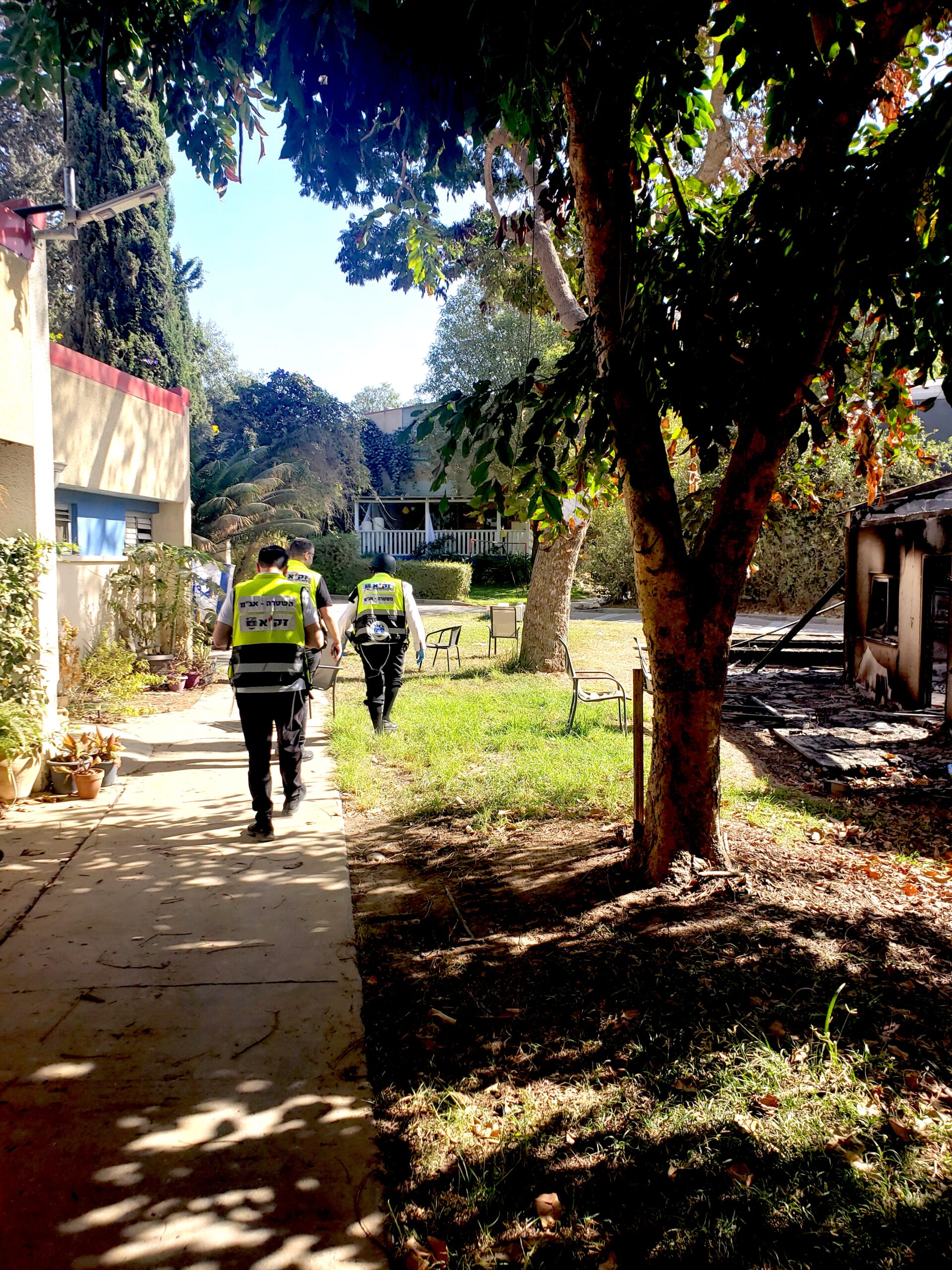
ZAKA volunteers in Be’eri kibbutz in October 2023.
 (Tomer Persico, Wikimedia Commons, CC BY-SA 3.0)

In fact, the Zaka volunteers who are being heavily relied on in this Guardian “report” are Jewish religious extremist men, also with a proven record of lying: they came up with the complete fabrication of “40 beheaded babies” when no babies were beheaded. Two infants are recorded dying that day.

The woman leading the “Hamas mass rape” campaign — now an academic – is a former spokesperson for the Israeli military. Their job, as any honest reporter will tell you, is to lie to journalists to excuse Israel’s incessant war crimes.

What we now know — from multiple credible Israeli sources – is that Israel killed lots of its own civilians on Oct. 7.

Ynet, Israel’s biggest media outlet, has just published an investigation in Hebrew showing that Hamas successfully took out Israel’s all-seeing drone “eyes” over Gaza that day, leaving the Israeli military blind about what was happening.

Panicked, Israeli commanders invoked the Hannibal directive, allowing those in the field to order tanks and helicopters to fire at anything that moved.

It was Israel that incinerated the hundreds of cars trying to flee the Nova festival, killing potentially hundreds of the 1,140 Israeli civilians that died that day, as well as Hamas fighters.

It was an Israeli tank that incinerated 13 Israeli civilians, and 40 Hamas fighters, holed up in a house in Kibbutz Be’eri by blasting a shell through its front wall.

Israel, of course, wants no one, least of all the Western media, talking about any of that. What it needs instead is anything that will help to distract from its crimes against its citizens and justify its committing of genocide against the people of Gaza.

So it has every reason to serve up the “Hamas mass rape” story, feeding what it rightly assumes are the Islamophobic prejudices of most Israeli Jews and Western reporters.

Journalists at The Guardian, the BBC and the rest of the establishment media are paid to play their role in regurgitating these lies to advance Western foreign policy goals. You are not. So please hold on to your humanity — and refuse to play along with Israel and the media’s racist disinformation campaign.

I have written previously about the media’s peddling of deceptions about Oct. 7. You can find those articles at these links:  
 Jonathan Cook.net

Jonathan Cook is an award-winning British journalist. He was based in Nazareth, Israel, for 20 years. He returned to the U.K. in 2021.He is the author of three books on the Israel-Palestine conflict: Blood and Religion: The Unmasking of the Jewish State (2006), Israel and the Clash of Civilisations: Iraq, Iran and the Plan to Remake the Middle East (2008) and Disappearing Palestine: Israel’s Experiments in Human Despair (2008).

The views expressed are solely those of the author and may or may not reflect those of Consortium News.


UK
Why Are Meteorologists Saying Storm Isha Is 'Unusual' And 'Rare'?

Kate Nicholson
Sun, 21 January 2024 

The UK is blanketed by "unusual" danger-to-life wind warnings ahead of Storm Isha.

Storm Isha is on its way – but, as the ninth named storm the UK has faced since summer ended, why are meteorologists calling it “unusual”?
Why is Isha a ‘rare’ storm?

The UK has seen plenty of storms recently, particularly named ones – after all, Storm Henk was only earlier this month.


If a storm has been named, it means they pose a threat to life.

The Met Office names them in alphabetically order. Isha is the ninth storm of the winter season (which technically begins in September) so it is named after the ninth letter.

The Met Office has explained that storm was triggered by the subsiding of the cold Arctic air which had been hanging over the UK – meaning air from the Atlantic came in.

The weather has therefore become much milder in temperature, but it’s much wetter and windier, too.

And that’s why meteorologists keep saying Isha is of particular interest – the UK does not often see storms which see the whole country hit by weather warnings.

According to Sky News, Met Office forecaster Ellie Glaisyer said that the “main thing” about Isha is that it is “very widespread” – and it’s “relatively rare” to have the whole of the UK covered by a warning.

“That’s the main difference to previous storms we have seen,” she said.

Channel 4 weather presenter Liam Dutton echoed this, writing on X (formerly Twitter): “Storm Isha is unusual because the disruptive winds cover a very large area.”

What weather will Isha bring?

The Met Office has already issued an amber weather warning for wind for the north and south-west of England, Wales, large parts of Northern Ireland and central and southern Scotland, from Sunday into Monday.

Another warning will be introduced for Sussex and Kent from Monday morning.

Winds of up to 80mph are expected along the UK coasts, and many places will see gusts of 50-60mph inland.

There’s a risk to life in coastal areas, and yellow flood warnings are expected for the next two days.

Ireland’s meteorological service, Met Eireann, has also introduced amber wind warnings for Sunday, which will escalate into a red storm warning for coastal areas in the north of the country on Monday.

Amber means there’s a good chance of power cuts, and other services could be impacts. Buildings may be damaged, journeys may be lengthened or cancelled altogether and some roads and bridges may close.

It also means injuries and danger to life likely from large waves and beach material thrown onto coastal roads, sea fronts and property.

A red weather warning means people need to seek cover and protect themselves or their properties.

A yellow wind warning will be in place covering Northern Ireland, north Wales, northern England and much of Scotland from Tuesday until midday on Wednesday.

The winds will gradually east throughout Monday, and overnight it should be a “calmer interlude” according to the Met Office – although it will be wet and windy again on Tuesday.
Five dead as Storm Isha brings winds of 107mph


ITV News reports from up and down the country as winds surpass 100mph in some areas

Monday 22 January 2024 


Five people have died across the UK and Ireland as Storm Isha continues to cause disruption, leaving thousands without power.

Gales reached over 100mph in places after wind warnings were issued by the Met Office on Monday.

Transport Scotland said a gust of 107mph was recorded on the Tay Bridge, while the Met Office is recording the highest wind speed as 99mph at Brizlee Wood in Northumberland.

The bad weather has caused a series of fatal accidents, including a man reportedly falling into an exposed manhole Bradford.


Severe travel disruption as trains and flights cancelled


Storm Jocelyn is coming hot on the heels of Storm Isha


Meanwhile, an 84-year-old man died after riding as a passenger in a car that crashed into a fallen tree in Grangemouth, Falkirk, on Sunday, Police Scotland have said.

He was sat in front seat and was declared dead at the scene, the force confirmed. The other occupants of the Hyundai were not injured.

First Minister Humza Yousaf paid tribute to the man, and warned of further disruption from the upcoming Storm Jocelyn.

Commuters were warned that ScotRail services would stop at 7pm on Tuesday, with no rush hour services on Wednesday morning – the second cancellation this week.

A 60-year-old man died in a road collision involving two vans and a fallen tree in Limavady, County Londonderry.

The Police Service of Northern Ireland has confirmed the man was killed on Sunday.

In Ireland, two people have died in separate road incidents. A man in his 40s died in Mayo on Sunday after a storm-related car crash.

A woman in her 20s, who was a passenger in a van, also died after it hit a tree in Co Louth at 1.50am on Monday.

Multiple other people have been taken to hospital with serious injuries as a result of the storm.

It comes as the powerful storm swept in on Sunday battering the UK and Ireland and causing forecasters to enforce "unusual" danger-to-life wind warnings, with concerns a tornado may hit parts of Britain.

A number of weather warnings, including two amber wind alerts, were put in place by the Met Office across the UK, with a Status Red wind warning issued for several Republic of Ireland counties.

The next storm due to hit the UK and Ireland has been named by the Irish Meteorological Service as Storm Jocelyn, which is expected to cause strong winds from Tuesday night into Wednesday morning.

CCTV footage from Lincolnshire shows the moment a roof is ripped from a house and narrowly misses a moving car


Rail, air and sea travel disruption

Rail, sea and air travellers are facing significant disruption, with closures, cancellations and delays across a number of services after Storm Isha tore through the UK.

Rush-hour trains have been axed for many on Monday after the storm battered parts of the country, bringing warnings of possible tornadoes and danger-to-life winds.

Network Rail says routes continue to be impacted by Storm Isha after previously imposing 50mph speed restrictions to keep passengers and trains safe from falling trees and debris blown onto tracks.
Severe travel disruption as trains and flights cancelled
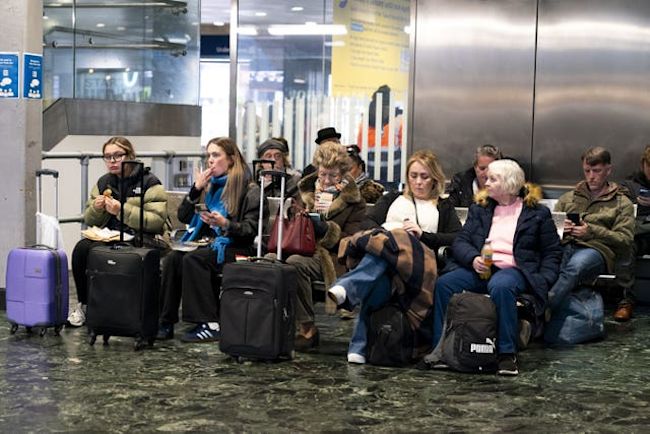
Passengers at London’s Euston station on Sunday following train delays as Storm Isha brought severe disruption to rail services
Credit: Jordan Pettit/PA

Meanwhile, air traffic control restrictions were in place, leading to flight cancellations and causing some planes to divert.

In Scotland, the Irish Sea and the English Channel many ferry trips have been cancelled.

Power blackouts, flying debris and fallen trees as weather warnings continue

Northern Ireland Electricity Networks said 45,000 customers were without power, while Electricity North West also said thousands of properties in north-west England had lost their supply.

Widespread power cuts in the Republic of Ireland were affecting more than 170,000 properties.

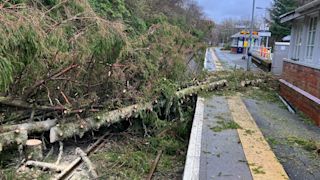
Fallen trees have affected transport, with Traffic Scotland reporting stretches of the M9 and M74 were among roads closed throughout the night, while the A1 southbound was closed at Thorntonloch due to an overturned lorry.

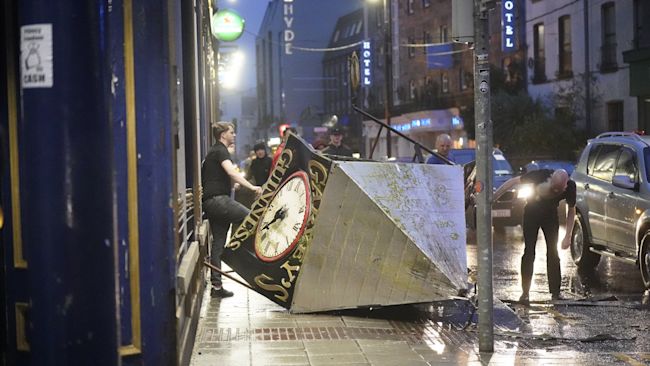
A clock tower falls to the ground in Eyre Square, Galway, during Storm Isha.
Credit: PA

The Met Office has said “everybody” will be affected by the storm, while ITV Weather's Manali Lukha said it is "really unusual to see the whole country covered in wind warnings".

According to the forecaster, the highest recorded wind speed during Storm Isha was 99mph at Brizlee Wood in Northumberland, with gusts of 90mph at Capel Curig in Snowdonia on Sunday.

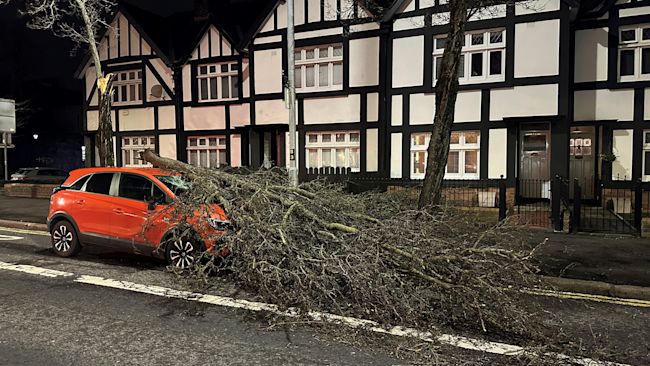
A tree branch fallen on a car on Lisburn Road in Belfast during Storm Isha.
Credit: PA

Transport Scotland said a gust of 107mph was recorded on the Tay Bridge and the Met Office said there was one of 84mph at Salsburgh, North Lanarkshire.

A rare red warning for wind in north-east Scotland was in place until 5am on Monday, with amber warnings covering much of the UK until 6am and further yellow warnings covering the entire country until noon.

A further yellow warning for wind for Scotland, Northern Ireland, north Wales and northern England is active from 4pm on Tuesday until noon on Wednesday.

Heavy downpours battered some places, with 28 flood warnings in place in England and 50 in Scotland.


Storm Isha began swooping across the UK and Ireland on Sunday afternoon.
Credit: PA

Why is the UK experiencing so many named storms?

Storm Isha is the ninth named storm to hit the UK since the season began in September.

Each storm is named when it poses a risk to people and they are given names beginning with consecutive letters of the alphabet.

The record number of named storms in one year is when the Met Office began the practice in 2015-16, with Storm Katie being the 11th and final storm of the season.

If there are three more named storms between next week and August, this year will mark a new record.

Cold Arctic air pushing south into North America is making the jet stream more active, the Met Office said, and because it flows from west to east, it is bringing stormier weather to the UK.


GROUP LINKED TO SAM ALTMAN LAUNCHES AI TO DEFEAT JOE BIDEN

JACQUELYN MARTIN / MIKE COPPOLA VIA GETTY / FUTURISM

A super PAC with deep ties to OpenAI CEO Sam Altman launched an AI chatbot this week in a bid to deny President Joe Biden from winning a second term in office, The Washington Post reports.

The group, We Deserve Better, launched the Dean.Bot as an AI stand-in for Dean Phillips, a Minnesota congressman who's running a quixotic campaign to challenge Biden in the Democratic primary.

Phillips has attracted the attention of Altman and other Silicon Valley elites, who say they're concerned about Biden's recent low poll numbers and his chances against former President Donald Trump, the likely winner of the Republican primary.

But tellingly, the formation of the super PAC to support Phillips occurred in early December, soon after Biden signed a sweeping executive order that seeks to regulate AI tech.

Altman and other AI proponents have said in the past that they want regulation and safeguards on AI, but that stance often changes when proposals become reality. For example, Altman earlier threatened that OpenAI would quit operating in Europe if certain AI regulations came to pass, and has also lobbied hard to water down those same regulations.

So it's interesting that a group with deep ties to Altman would launch an AI-powered chatbot to try to unseat Biden, who wants to curb AI technology. One of the founders of the super PAC, Matt Krisiloff, used to be an employee of OpenAI and apparently dated Altman.

Strikingly, OpenAI's ChatGPT once powered the chatbot, but now it relies on open source models, according to WaPo.

The Dean.Bot is clearly labeled as an AI chatbot and has disclaimers such as: "Feel free to ask it anything, but please take answers with a grain of salt!"

If you ask him about any recent campaign controversy, the Dean.Bot, like any seasoned politician, passes the buck.

For example, the Phillips campaign quietly changed a header on its website that once read "Diversity, Equity, and Inclusion," The New York Times reports. It now reads instead "Equity and Restorative Justice."

This change comes after the Phillips campaign received an infusion of $1 million from Bill Ackman, the billionaire hedge fund manager who's mounted a recent assault on DEI initiatives.

When you ask the Dean.Bot about the recent removal of DEI from the Phillips campaign website, the chatbot says that "I must clarify that as a digital clone, I don't control the content of websites or make decisions about what is posted or removed."

"However, I can tell you that my commitment to diversity, equity, and inclusion is unwavering," the chatbot continues. "My actions and policies consistently reflect the importance of these principles in creating a fair and just society for all. If there have been changes to my website, they would be made with the intent to best represent my current focus and priorities in serving the people."

As it stands, the Biden campaign probably shouldn't worry too much about the chatbot, because it's still pretty clunky when compared to dealing with a real flesh and blood human being, more an election year curiosity than anything else.

Beyond the chatbot being an avatar for a monied class who want to influence elections, though, it does feel like a prototype of how AI and tech may change politics going into the future.

Late last year, the campaign of Pennsylvania Democrat politician Shamaine Daniels ran a chatbot called Ashley to help in her phone banking efforts.

Both Dean.Bot and Ashley have been clearly labeled as AI chatbots, but they could be laying the groundwork for a reality in which bad actors can release chatbots that can lie or obfuscate rival politicians' policy platforms.

"I see this as a Pandora’s box problem," New York University Stern Center for Business and Human Rights' deputy director Paul Barrett told WaPo. "Once we have AI versions of candidates chatting up voters, it’s a short step to bots used by political opponents to fool voters into thinking that politicians are saying things they never said. And soon, everyone gets so cynical about all of this fake communication that no one believes anything anyone is saying."


José “Pepe” Mujica criticizes Milei's fanaticism, fears an authoritarian shift in Argentina

Monday, January 22nd 2024 - 
“I hope Argentina rebounds, but I fear that these policies may lead to an authoritarian government,” Mujica said.

In a press conference on Sunday, former Uruguayan President José Mujica shared his thoughts on the policies of Argentine President Javier Milei since taking office on December 10.

“I don't expect anything good for now because Mr. Milei gives the impression of being a fanatic,” Mujica said, adding, “Besides, talking to the dog on the other side...”

When asked about coexisting with Argentina, the leftist leader replied, “We have to coexist because countries don't move.”

“I hope Argentina rebounds, but I fear that these policies may lead to an authoritarian government because afterward, the Argentine will inevitably buck, and I don't know what they will do next,” he asserted.

Mujica acknowledged the flaws within Mercosur but emphasized the need to find alternatives without abandoning existing ties. “The dilemma we face is finding another vine to swing on but not letting go of the one we have,” he explained, mentioning Brazil as a potential option.

“It's the only place where we are selling value-added [products],” Mujica added


Argentina: New oil spill recorded off Bahía Blanca

Thursday, January 18th 2024 - 
The German oil company Oiltanking was involved in both incidents a fortnight apart

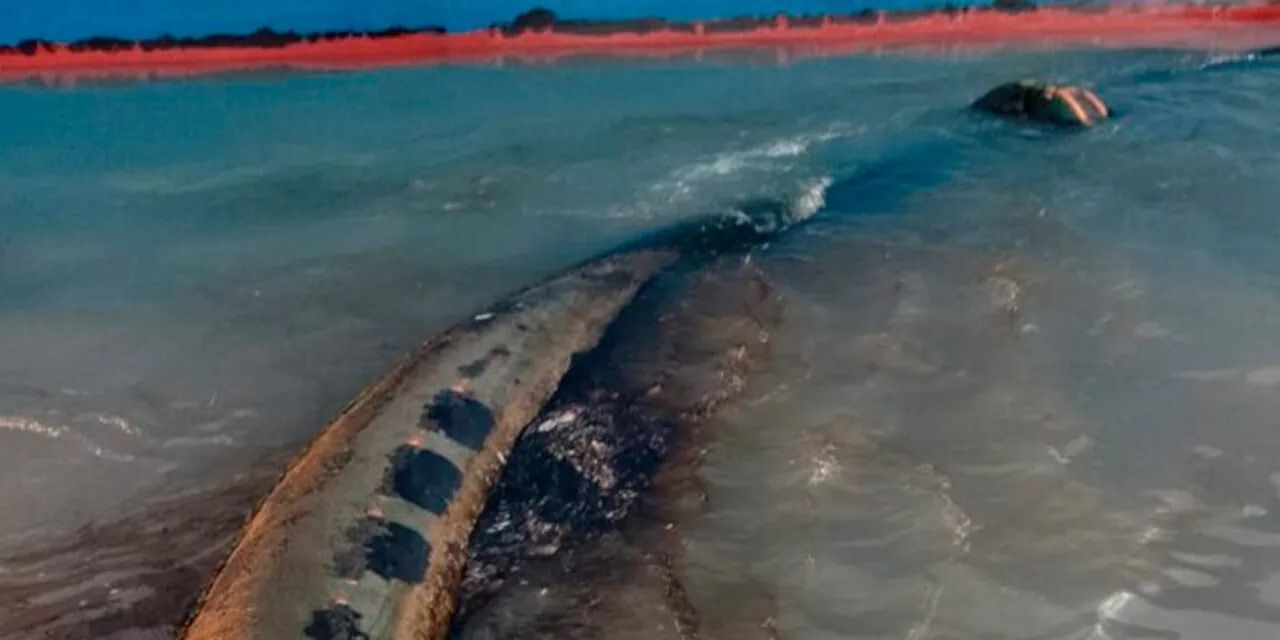
Argentine authorities in the city port of Bahía Blanca in the province of Buenos Aires said a new oil spill had been reported after the one late last month. However, this time around the damage would have been controlled in less time, it was explained.

The new spill Wednesday at 5.30 am was due to a malfunction in an unloading maneuver in the monobuoy operated by the company Oiltanking, which said in a statement that this time it acted more quickly to contain the leak. The incident also involved the tanker San Matías.

”The contingency plan for spills of hydrocarbons in water (PLANACON) was activated by notifying the Argentine Coast Guard (PNA), Bahía Blanca District,“ the document read.

The accident occurred when a tanker was unloading crude oil through the monobuoy, which connects to a pipeline at the terminal. The crude is stored or sent by pipeline to different refineries, explained the company.

It also mentioned that a pressure measurement element failed, causing a leak that was observed by company personnel on board, forcing an ”immediate interruption of operations“ and ”remedial work“ to be set in motion for the containment, control, and total removal of the spill.

The company added that ”containment and control works were carried out on the slick by means of barriers and absorbent booms, in charge of the contractor company CINTRA, which contained the entire spill.“

Environmentalists and representatives of the fishing sector condemned the incident: ”Once again it happened at the Punta Cigüeña monobuoy in front of Punta Alta. As far as I know, this time the containment system worked, but, of course, it is never 100% what can be recovered, damage is always generated in the water,” said Lucas Beier, a legal representative of the artisanal fishermen, in a radio interview.

The Environment Ministry of the province of Buenos Aires halted all operations by Oiltanking and requested an immediate review by the federal Energy Secretariat to determine if the company may continue operating.

Sloppy maneuvering mooring the vessel Cabo Sounión to another Oiltanking monobuoy on Dec. 26 in the afternoon produced a spill but no action was taken until 3 pm the following day. As a result of that incident, the communities of Bahía Blanca and Coronel Rosales filed a criminal complaint against Oiltanking Ebytem S.A. Puerto Rosales Maritime Terminal. They claim that the company did not communicate the problem in time or properly activate the contingency plan.

After the first episode, the company (which has been operating an oil pipeline in the region since 2008) began a remediation plan that is being reviewed by the Ministry of the Environment of the Province of Buenos Aires.

Endangered Andean cat sighted in Argentine province of Neuquén

Saturday, January 20th 2024
The Andean cat inhabits the highlands of the Andes and elevations of the Patagonian steppe in Argentina

The environmental organization WCS Argentina Friday reported having sighted a rare cat near the city of Loncopué in the Argentine province of Neuquén.

The feat was achieved through a monitoring system with “camera traps” with motion sensors in places where the species is believed to live and wander. With this deployment, it was possible to identify the nocturnal passage of a solitary Andean cat, it was explained.

“After several years of work to record it, which had been reported by a local producer, we confirmed the presence of this species which, given its endangered status, has few individuals throughout its distribution range,” said WCS Argentina Regenerative Management head María José Bolgeri.

“Every new data surveyed is important, giving hope and increasing the commitment for its long-term conservation,” she added.

The Andean cat is a species considered endangered and inhabits the highlands of the Andes and elevations of the Patagonian steppe in Argentina.

The finding is said to be highly significant for scientific research and the conservation of the species because it was the first confirmed record in the western area of Neuquén which extends the animal's geographic distribution in Argentine Patagonia.

According to current studies, the Patagonian population of the Andean cat would begin in Malargüe, south of the province of Mendoza, and reach Chihuidos to the south, and Loncopué to the west.

WCS Argentina also noted that the Patagonian population of the Andean cat has been geographically isolated from the rest of the populations of the species - distributed in Andean and Puna areas in Peru, Bolivia, Chile, and Argentina, due to which it could be a different genetic unit.

The genetic diversity of a species, as well as its geographic distribution, is fundamental for designing preservation strategies, the organization also pointed out.

The Andean cat is one of the most endangered felines in the world, with an estimated 1,500 individuals left. One of the main reasons for it to be nearing extinction is hunting to avoid livestock predation, it was explained.


Breaking the chains of poverty: examining the influence of smartphone usage on multidimensional poverty in rural settings

Abstract

We analyze the impact of smartphone usage on multidimensional poverty reduction. Utilizing the A-F approach, we compute a multidimensional poverty index based on five dimensions: education, health, income, living standard, and labor force. This index categorizes multidimensional poverty into three levels: Vulnerable Multidimensional Poverty Index (VMPI), General Multidimensional Poverty Index (GMPI), and Extreme Multidimensional Poverty Index (EMPI), following MPI criteria. Furthermore, we investigate the mediating role of social capital in the smartphone-multidimensional poverty relationship through a mediating effects analysis. We used the survey data of 382 sample out-of-poverty rural households in Jiangxi, China, in 2020. Our results indicated that: (1) Education (37.80%), labor force (29.7%), and health (20.40%) were identified as the primary contributors to multidimensional poverty. (2) Increasing deprivation categories correlated with declining multidimensional poverty index, following an inverted U-shaped pattern. (3) Smartphone usage significantly reduced VMPI (57.6%), GMPI (52.6%), and EMPI (5%). (4) Social capital fully mediated EMPI reduction through smartphones (91.67%), and partially mediated VMPI (14.09%) and GMPI (20.84%) reduction. These insights inform targeted policy formulation for rural multidimensional poverty reduction.

READ ON Breaking the chains of poverty: examining the influence of smartphone usage on multidimensional poverty in rural settings | Humanities and Social Sciences Communications (nature.com)