Tuesday, May 06, 2025

OpenAI abandons plan to become for-profit company


By AFP
May 5, 2025


'OpenAI is not a normal company and never will be,' OpenAI CEO Sam Altman wrote in an email to staff posted on the company's website - Copyright AFP JOEL SAGET

OpenAI CEO Sam Altman announced Monday that the company behind ChatGPT will continue to be run as a nonprofit, abandoning a contested plan to convert into a for-profit organization.

The structural issue had become a significant point of contention for the artificial intelligence (AI) pioneer, with major investors pushing for the change to better secure their returns.

AI safety advocates had expressed concerns about pursuing substantial profits from such powerful technology without the oversight of a nonprofit board of directors acting in society’s interest rather than for shareholder profits.

“OpenAI is not a normal company and never will be,” Altman wrote in an email to staff posted on the company’s website.

“We made the decision for the nonprofit to stay in control after hearing from civic leaders and having discussions with the offices of the Attorneys General of California and Delaware,” he added.

OpenAI was founded as a nonprofit in 2015 and later created a “capped” for-profit entity allowing limited profit-making to attract investors, with cloud computing giant Microsoft becoming the largest early backer.

This arrangement nearly collapsed in 2023 when the board unexpectedly fired Altman. Staff revolted, leading to Altman’s reinstatement while those responsible for his dismissal departed.

Alarmed by the instability, investors demanded OpenAI transition to a more traditional for-profit structure within two years.

Under its initial reform plan revealed last year, OpenAI would have become an outright for-profit public benefit corporation (PBC), reassuring investors considering the tens of billions of dollars necessary to fulfill the company’s ambitions.

Any status change, however, requires approval from state governments in California and Delaware, where the company is headquartered and registered, respectively.

The plan faced strong criticism from AI safety activists and co-founder Elon Musk, who sued the company he left in 2018, claiming the proposal violated its founding philosophy.

In the revised plan, OpenAI’s money-making arm will now be fully open to generate profits but, crucially, will remain under the nonprofit board’s supervision.

“We believe this sets us up to continue to make rapid, safe progress and to put great AI in the hands of everyone,” Altman said.

– SoftBank sign-off –

OpenAI’s major investors will likely have a say in this proposal, with Japanese investment giant SoftBank having made the change to being a for-profit a condition for their massive $30 billion investment announced on March 31.

In an official document, SoftBank stated its total investment could be reduced to $20 billion if OpenAI does not restructure into a for-profit entity by year-end.

The substantial cash injections are needed to cover OpenAI’s colossal computing requirements to build increasingly energy-intensive and complex AI models.

The company’s original vision did not contemplate “the needs for hundreds of billions of dollars of compute to train models and serve users,” Altman said.

SoftBank’s contribution in March represented the majority of the $40 billion raised in a funding round that valued the ChatGPT maker at $300 billion, marking the largest capital-raising event ever for a startup.

The company, led by Altman, has become one of Silicon Valley’s most successful startups, propelled to prominence in 2022 with the release of ChatGPT, its generative AI chatbot.

New Zealand PM proposes banning under-16s from social media


By AFP
May 6, 2025


Regulators the world over are wrestling with how to keep children safe online - Copyright GETTY IMAGES NORTH AMERICA/AFP SPENCER PLATT

New Zealand’s prime minister on Tuesday proposed banning children under 16 from social media, stressing the need to protect them from the perils of big tech platforms.

Regulators the world over are wrestling with how to keep children safe online, as social media is increasingly flooded with violent and disturbing content.

Prime Minister Christopher Luxon unveiled draft laws that would force social media companies to verify users were at least 16 years old, or face fines of up to NZ$2 million (US$1.2 million).

The proposed ban was modelled on that of Australia, which sits at the forefront of global efforts to regulate social media.

“This is about protecting our children. It’s about making sure social media companies are playing their role in keeping our kids safe,” Luxon said.

It was not clear when the legislation would be introduced to parliament, but Luxon said he was hopeful of garnering support across the chamber.

The laws were drafted by Luxon’s centre-right National Party, the biggest member in New Zealand’s three-way governing coalition.


Australian legislation could force social media firms to take steps to prevent those under 16 years of age from accessing platforms such as X, TikTok, Facebook and Instagram – Copyright GETTY IMAGES NORTH AMERICA/AFP/File Michael M. Santiago

To be passed they would need the support of Luxon’s two other coalition partners.

“Parents are constantly telling us that they are really worried about the impact that social media is having on their children,” Luxon said.

“And they say they are really struggling to manage access to social media.”

Australia passed landmark laws in November banning under-16s from social media — one of the world’s toughest crackdowns on popular sites such as Facebook, Instagram and X.

The move sparked a fierce backlash from big tech companies who variously described the laws as “rushed”, “vague”, and “problematic”.
FUCKING OVER UKRAINE

Order by Hegseth to cancel Ukraine weapons caught White House off guard

By Erin Banco, Phil Stewart, Gram Slattery and Mike Stone
REUTERS
May 6, 2025


 U.S. Defense Secretary Pete Hegseth looks on, as President Donald Trump delivers remarks, in the Oval Office at the White House, in Washington, D.C., U.S., March 21, 2025. REUTERS/Carlos Barria/File Photo


Summary

Hegseth's order caused confusion among national security officials

White House claims Hegseth followed Trump's directive to pause aid

Internal disputes have sometimes led to haphazard Ukraine policies

NEW YORK/WASHINGTON, May 6 (Reuters) - Roughly a week after Donald Trump started his second term as president, the U.S. military issued an order to three freight airlines operating out of Dover Air Force Base in Delaware and a U.S. base in Qatar: Stop 11 flights loaded with artillery shells and other weaponry and bound for Ukraine.
In a matter of hours, frantic questions reached Washington from Ukrainians in Kyiv and from officials in Poland, where the shipments were coordinated. Who had ordered the U.S. Transportation Command, known as TRANSCOM, to halt the flights? Was it a permanent pause on all aid? Or just some?

Top national security officials — in the White House, the Pentagon and the State Department — couldn’t provide answers. Within one week, flights were back in the air.
The verbal order originated from the office of Pete Hegseth, the secretary of defense, according to TRANSCOM records reviewed by Reuters. A TRANSCOM spokesperson said the command received the order via the Pentagon's Joint Staff.
The cancelations came after Trump wrapped up a January 30 Oval Office meeting about Ukraine that included Hegseth and other top national security officials, according to three sources familiar with the situation. During the meeting, the idea of stopping Ukraine aid came up, said two people with knowledge of the meeting, but the president issued no instruction to stop aid to Ukraine.

The president was unaware of Hegseth’s order, as were other top national security officials in the meeting, according to two sources briefed on the private White House discussions and another with direct knowledge of the matter.
Asked to comment on this report, the White House told Reuters that Hegseth had followed a directive from Trump to pause aid to Ukraine, which it said was the administration's position at the time. It did not explain why, according to those who spoke to Reuters, top national security officials in the normal decision making process didn’t know about the order or why it was so swiftly reversed.
“Negotiating an end to the Russia-Ukraine War has been a complex and fluid situation. We are not going to detail every conversation among top administration officials throughout the process,” said Karoline Leavitt, the White House spokeswoman. “The bottom line is the war is much closer to an end today than it was when President Trump took office.”

The cancelations cost TRANSCOM $2.2 million, according to the records reviewed by Reuters. In response to a request for comment, TRANSCOM said that the total cost was $1.6 million – 11 flights were canceled but one incurred no charge.
An order halting military aid authorized under the Biden administration went into effect officially a month later, on March 4, with a White House announcement.
The story of how flights were canceled, detailed by Reuters for the first time, points to an at-times haphazard policy-making process within the Trump administration and a command structure that is unclear even to its own ranking members.
The multiday pause of the flights, confirmed by five people with knowledge of it, also shows confusion in how the administration has created and implemented national security policy. At the Pentagon, the disarray is an open secret, with many current and former officials saying the department is plagued by internal disagreements on foreign policy, deep-seated grudges, and inexperienced staff.

Reuters couldn’t establish exactly when Hegseth’s office ordered the freight flights canceled. Two sources said Ukrainian and European officials began asking about the pause on February 2. The TRANSCOM records indicate that there was a verbal order from “SECDEF” – the secretary of defense – that stopped the flights and that they had resumed by February 5.
“This is consistent with the administration's policy to move fast, break things and sort it out later. That is their managing philosophy,” said Mark Cancian, a retired Marine officer and defense expert with the Center for Strategic and International Studies think tank. “That is great for Silicon Valley. But when you’re talking about institutions that have been around for hundreds of years, you are going to run into problems.”

The stop in shipments caused consternation in Kyiv.
The Ukrainians quickly asked the administration through multiple channels but had difficulty obtaining any useful information, according to a Ukrainian official with direct knowledge of the situation. In later conversations with the Ukrainians, the administration wrote off the pause as “internal politics,” said the source. Ukrainian officials did not respond to requests for comment.
The shipping of American weapons to Ukraine requires sign-off from multiple agencies and can take weeks or even months to complete, depending on the size of the cargo. The majority of US military assistance goes through a logistics hub in Poland before being picked up by Ukrainian representatives and transported into the country.
That hub can hold shipments for extended periods of time. It’s not clear if the 11 canceled flights were the only ones scheduled that week in February, how much aid was already stockpiled in Poland and if it continued to flow into Ukraine despite the U.S. military's orders.
The revelations come at a time of upheaval in the department. Several of Hegseth’s top advisers were escorted from the building April 15 after being accused of unauthorized disclosure of classified information. The secretary continues to face scrutiny, including from Congress, about his own communications. Previously he’s attributed allegations of upheaval to disgruntled employees.
The canceled flights contained weapons that had long been approved by the Biden administration, authorized by lawmakers on Capitol Hill.
Reuters couldn’t determine if Hegseth or his team knew how the order to TRANSCOM would play out or that the order would be a substantial change in U.S. policy on Ukraine. Three sources familiar with the situation said Hegseth misinterpreted discussions with the president about Ukraine policy and aid shipments without elaborating further.
Four other people briefed on the situation said a small cadre of staffers inside the Pentagon, many of whom have never held a government job and who have for years spoken out against U.S. aid to Ukraine, advised Hegseth to consider pausing aid to the country.
Two people familiar with the matter denied there was a true cutoff in aid. One of them described it as a logistical pause.
“(They) just wanted to get a handle on what was going on and people, as a result, misinterpreted that as: ‘You need to stop everything,’” said one.
FLIGHTS CANCELED
According to two sources with knowledge of the meeting, Hegseth arrived at the January 30 Oval Office meeting with Trump with a memo drafted by some of his top policy advisers, advocating that their boss push the White House to consider pausing weapons deliveries to Ukraine to gain leverage in peace negotiations with Russia.
The sources said the secretary attended the meeting with other top officials involved in Ukraine policy, including National Security Adviser Mike Waltz and Ukraine envoy Keith Kellogg. The group broadly discussed U.S. policy on Ukraine and Russia, including potentially tightening sanctions on Moscow.
It’s not clear the extent to which Hegseth proposed stopping aid during the meeting, but the idea came up in discussions, said one of the sources and another person familiar with the meeting.
Since the beginning of Russia’s full-scale invasion in February 2022, the U.S. had approved billions of dollars worth of military aid to Ukraine. Most was delivered under the Biden administration. But a few shipments remained in the pipeline, scheduled into this summer.
Trump had threatened to freeze aid repeatedly on the campaign trail, but had yet to do so. And during the meeting, he again declined to stop aid to Ukraine or order Hegseth to implement any policy changes when it came to sending equipment to Kyiv, the sources said.
An order effectively freezing any military support for an ally would normally be discussed intensively among top national security officials and approved by the president. It requires the coordination of multiple agencies and often multiple freight companies.
None of that discussion or coordination happened when Hegseth’s office canceled the scheduled flights carrying American artillery shells and ammunition to Poland from Al Udeid military base in the United Arab Emirates and the Dover U.S. military base in Delaware, three of the sources said.
The pause came as Ukraine’s military was struggling to fend off Russian forces in eastern Ukraine and in the consequential battle for the Kursk region of Russia, where Ukrainian forces were losing ground and have since all but been expelled.
Close Trump advisers got tipped off to the pause by Pentagon staffers and discussed with the president whether to restore the aid shipments, according to two sources. By then, TRANSCOM had canceled 11 flights, according to the records reviewed by Reuters. Some media outlets, including Reuters, wrote about the pause but Hegseth’s role was previously unknown.
It’s unclear if Trump subsequently questioned or reprimanded Hegseth. One source with direct knowledge of the matter said National Security Adviser Waltz ultimately intervened to reverse the cancelations. Waltz was forced out on Thursday and is expected to be nominated as U.S. ambassador to the United Nations.
GROWING INFIGHTING
When Trump entered office, aid to Ukraine continued flowing and he pledged to work with Ukraine and Russia to end the war – or at the very least broker a ceasefire.
Two of his most prominent envoys, Kellogg, a supporter of Kyiv who worked with Trump in his first administration, and Steve Witkoff, a real-estate magnate and close friend of the president, set out to negotiate with both parties.
Separately, at the Pentagon, some of Hegseth’s policy advisers privately started drafting proposals to pull back American support for Ukraine, according to two sources briefed on the matter.
That group of staffers align themselves closely with the anti-interventionist philosophy.
Some have previously advised Republican lawmakers advocating for an America-first approach to foreign policy and have called publicly, in writings and talks, for the U.S. to pull back from military commitments in the Mideast and Europe – a view similarly held by Vice President JD Vance. Several have advocated that the U.S. instead focus on China.
Supporters of the staffers have slammed those pushing back on the anti-interventionist movement in the administration, claiming Vance and others are merely trying to save the lives of people living in warzones like Ukraine and prevent future American military deaths.
The infighting has complicated the policy-making process, according to a person familiar with the matter and four other sources. At a time when Kellogg and Witkoff are trying to broker a peace deal with Russia and Ukraine, the staffers have advocated behind the scenes for the U.S. to draw back its support for Kyiv – a policy that has angered Ukrainian officials and pressured European allies to fill the gap, five people with knowledge of the situation said.
Washington has signed a deal with Kyiv for rights to its rare earth minerals – an agreement U.S. officials say is an attempt to recoup money America has spent to prop up Ukraine’s war effort.
At least one of the staffers who had previously pushed for the administration to pull back its support for Kyiv, Dan Caldwell, was escorted out of the Pentagon for a leak he claims never happened. Caldwell, a veteran, served as one of Hegseth’s chief advisers, including on Ukraine.
Despite the brief pause in February and the longer one that began in early March, the Trump administration has resumed sending the last of the aid approved under U.S. President Joe Biden. No new policy has been announced.

Reporting by Erin Banco, Phil Stewart, Gram Slattery and Mike Stone. Editing by Don Durfee and Lori Hinnant.

Loophole that could let Trump take third term in White House discovered by NY Times


Story by Krystina Alarcon Carroll
• RAW STORY


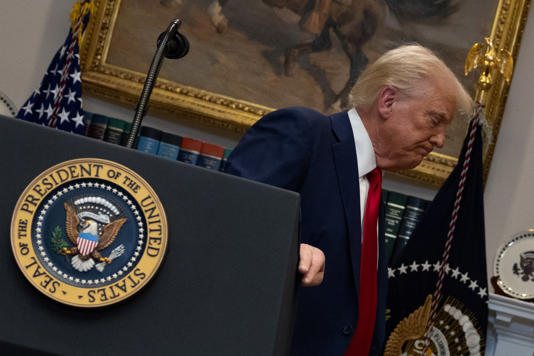
U.S. President Donald Trump leaves after delivering remarks on AI infrastructure at the Roosevelt room at White House in Washington, U.S., January 21, 2025. REUTERS/Carlos Barria© provided by RawStory

President Donald Trump has said there is a method by which he might return to serve a third term as president — and the New York Times Editorial Board might have figured it out..

The board recalled the words of Congressman John Jennings Jr. (R-TN), uttered in 1947. After President Franklin D. Roosevelt’s fourth term election, Jennings was promoting legislation which would limit a president to two sessions in office.

While advocating for what is now the 22nd Amendment, Jennings warned that a president “backed by a ‘subservient Congress’ and a compliant Supreme Court' could ‘sweep aside and overthrow the safeguards of the Constitution,’" the Times wrote.


Jennings left office in 1951 and, later that year, the country ratified the 22nd Amendment.


Today, the Times echoed Jennings' warning, applying his words to Trump: “President Trump is a man of vaulting ambition,” the board wrote. “Congress is largely subservient to his agenda. And he keeps mentioning the idea of a third term.”

The 22nd Amendment says no person shall be “elected” to the office of president more than twice. However, the Times points out, it doesn’t say that no president shall serve more than twice.

This opens up the question — can a term-limited president run as a vice president and then be handed the Oval Office when his running mate resigns?

“I suspect I won’t be running again unless you say, ‘He’s so good, we’ve got to figure something else out,’” Trump said after being re-elected in November.

In March, Trump noted that he was “not joking” and that “there are methods which you could do it.”

But the Times concluded with the belief that the 22nd amendment loophole could blocked by “another amendment — the 12th — [that] appears to rule out that possibility.”

The board's final sentence declares that “no person constitutionally ineligible to the office of president shall be eligible to that of vice president of the United States.”

“Together, the two amendments make clear that Mr. Trump’s time in office cannot extend beyond his current term,” the Times wrote. “Mr. Trump’s third-term fantasizing is more dangerous than this response suggests, and it deserves more forceful pushback.”
MARK HAMILL CALLS TRUMP  A 'SITH LORD'


One of the latest – but hardly the least – critics to jump into the recent Star Wars fan pushback over Donald Trump is none other than Mark Hamill, who’s the original Luke Skywalker in the movie series.

Hamill weighed in on a White House social media post on “Star Wars Day,” May 4, featuring a super-muscled version of the president wielding a lightsaber from Star Wars.

“Happy May the 4th to all, including the Radical Left Lunatics who are fighting so hard to to bring Sith Lords, Murderers, Drug Lords, Dangerous Prisoners ... back into our Galaxy,” said the post. “You’re not the Rebellion — you’re the Empire. May the 4th be with you.”

The big blunder was that Trump was holding a red lightsaber, which just about everyone knows is the weapon used by the very same evil Sith lords named in the post and in the Star Wars movies – not the good guys.


Hamill flamed Trump for the goof-up, saying it “proved” Trump is “full of Sith.”


Hamill’s post on Bluesky triggered a parade of insulting Trump images, and a suggestion that he would better be represented by arch Star Wars villain Jabba the Hut.

Trump has yet to slap back at Hamill’s dig.

Hamill is no stranger to criticizing Trump. His attacks go back years to the president’s first administration, and he often uses a play on lines from Star Wars to attack Trump and his supporters.

At the Democratic National Convention last year, Hamill urged his followers in a TikTok video: “We're at a time in our history we're fighting against real evil, so I beg you, please, don't go to the orange side.”

He also fired off a stinging rebuke to a social media post of a family photo by the president’s daughter, Ivanka Trump, and husband, Jared Kushner, while the two were both White House aides in Trump’s first administration.

The force is strong in my family,” the first daughter posted.

Hamill responded: “You misspelled ‘Fraud.’”


Mark Hamill as Luke Skywalker in ‘The Last Jedi' (Lucasfilm)


The Independent 
Ford sees $1.5 bn tariff hit this year, suspends 2025 forecast


By AFP
May 5, 2025


Ford displayed its new Lincoln Navigator at an auto show in Shanghai last month - Copyright AFP/File Hector RETAMAL

Ford reported a 65 percent drop in first-quarter profits Monday, citing a near-term drag on auto sales from new vehicle launches, as it withdrew its forecast amid tariff uncertainty.

The carmaker estimated a full-year hit of about $1.5 billion in adjusted operating earnings following President Donald Trump’s myriad tariff actions since returning to the White House in January.

Profits came in at $471 million, beating analyst expectations but just over a third of the level in the 2024 period, with revenues falling five percent to $40.7 billion.

In the first quarter, Ford wholesale units fell seven percent from the year-ago level, a drop the automaker had previously telegraphed due to slowed output at plants in Kentucky and Michigan where new vehicles are being launched.

In March, Ford began shipping the new Ford Expedition and Lincoln Navigator to customers.

Profits fell in Ford’s “Pro” division, which is geared toward fleet and sales to businesses, and in its “Blue” division, which consists of conventional internal combustion engine cars. But losses declined in Ford’s electric vehicle division.

Ford described its underlying business as “strong,” saying it had been on track with the prior projection of between $7 and $8.5 billion in adjusted operating earnings, excluding tariff-related impacts.

Ford is “suspending” its guidance due to myriad uncertainties. Besides tariffs and potential retaliatory tariffs, Ford cited other “material near-term” risks as including potential supply chain disruption and uncertainty over emissions policy changes in Washington.

“These are substantial industry risks, which could have significant impacts on financial results, and that make updating full year guidance challenging right now given the potential range of outcomes,” Ford said.

The company expects 2025 pricing to be flat to slightly higher.

As far as car sales, “we’re seeing a strong first half in the industry,” Chief Financial Officer Sherry House said of a period that included an uptick in sales to buyers who wanted to get ahead of tariffs.

House expects “some potential compression” in sales in the second half of 2025 when prices could tick higher amid tariffs, resulting in a net for all of 2025 of flat or up about one percent.

Ford fell 2.2 percent in after-hours trading.
After Trump vows tariffs on foreign movies, the Canadian film industry says he's lost the plot

Story by Jenna Benchetrit
• CBC


Cast and crew film a scene for the movie Die Alone in Saskatchewan's Qu'appelle Valley in summer 2023. Many provinces offer tax incentives to lure film and TV productions. (Die Alone Productions)


U.S. President Donald Trump says he wants to impose a 100 per cent tariff on movies produced outside the country, a move that could devastate the Canadian film landscape — but experts are scratching their heads over how such a tax would work, given how intertwined the global film industry is.

Trump, in a Truth Social post on Sunday night, said he directed the Department of Commerce and the U.S. Trade Representative to "immediately begin the process" of imposing the tariff. He hasn't signed an executive order, and the White House said on Monday that no final decisions had been made.

Other countries "are offering all sorts of incentives to draw out filmmakers and studios away from the United States," Trump wrote.

"Hollywood, and many other areas within the U.S.A., are being devastated," he went on, framing it as a matter of national security.

Asked if he'd float the issue during his meeting with Prime Minister Mark Carney on Tuesday, Trump responded that Canada is "only one of many countries" that uses tax incentives to lure U.S. film productions.

He offered few details on what this latest plank in his tariff regime would entail, or how it would be executed — including whether it would impact co-productions, or films made entirely abroad and exhibited in the U.S., not to mention those that appear on streaming services and at film
 festivals.


Related video: Hollywood North preparing to be latest victim in U.S. trade war (Global News)   Duration 2:11


Greg Denny, a Canadian film producer whose most recent credits include The Apprentice, a biopic about Trump that was partially shot in Toronto, says movies are rarely the product of a single country.

"We're not creating a good here. We're creating a movie. How do you put a tariff on top of that?" he asked. "This is many countries working together at all times, creating footage and content... It's not really something I see you can put a tariff on."

The announcement also drew swift rebukes from the Canadian Media Producers Association (CMPA) and the Alliance of Canadian Cinema, Television and Radio Artists (ACTRA), the actors' union.

B.C. Premier David Eby called the proposal "incredibly hard to understand," while Ontario's Doug Ford lamented that it's "something new with [Trump]" every day.
Why Hollywood goes north

Like other parts of its economy, Canada's film industry is deeply intertwined with that of its southern neighbour. Oscar-winners like Titanic, The Revenant and Juno were all filmed at least partly on Canadian soil; and Hollywood filmmakers from Guillermo Del Toro to Christopher Nolan have shot multiple movies here.

That means Canada is also vulnerable to crises that originate in Hollywood, like the 2023 Writers Guild of America and SAG-AFTRA strikes, which further wounded an industry still recovering from pandemic-related shutdowns.



Leonardo DiCaprio, right, and Kate Winslet appear in a scene from 1997's Titanic, which was partly shot in Canada. (Paramount Pictures/Associated Press)

Canada is highly appealing to U.S. film producers, according to experts. The filmmaking workforce is highly skilled, but costs less to pay, and Toronto, Montreal, Vancouver, Calgary and Halifax are frequently used as stand-ins for other cities in the U.S., Europe and Asia. U.S. film production creates 30,000 jobs and has a $2.6 billion economic impact in Toronto alone, according to Mayor Olivia Chow.

Most importantly, the federal government offers a 16 per cent refundable tax credit, which is used to attract foreign productions from Hollywood and elsewhere to Canada.

Provinces also have their own tax incentives, some of which — like Ontario's — can be harmonized with the federal credit. B.C., meanwhile, announced just a few months ago that it would up its production tax incentives, and give a 2 per cent bonus to productions that spend big in the province.



Crew members prepare to film actor Colin Hanks on the set of the TV series Fargo in Calgary on March 11, 2014. U.S. President Donald Trump says he wants to put a 100 per cent tariff on movies produced in other countries, though the details remain murky. (Todd Korol/Reuters)

CBC News reached out to several major U.S. studios for their reaction, but none have responded. Trump said on Monday that he'd meet with the industry to discuss the proposal.

"I'm not looking to hurt the industry. I want to help," he said. "I want to make sure they're happy with it because we're all about jobs."

'The consumer still wants to consume'

Charlie Keil, professor at the University of Toronto's Cinema Studies Institute, says a U.S. film industry exodus from Canada would have a "devastating impact" on the domestic sector.

But it's hard to know how a tariff like the one Trump is proposing would be imposed, and to which movies it would apply.

"There's a whole spectrum here, between films that are primarily made in the U.S. but might have some post-production work done in another country, to films that are entirely made by another country," he said.



Noah Segal, the co-founder of Toronto-based film distributor Elevation Pictures, said major streamers are unlikely to get on board with Trump's proposal. (Aizick Grimman/CBC)

There's also the question of who would absorb the cost of the tariff. After years of price hikes and hidden junk fees, a more expensive movie ticket likely wouldn't fly with audiences, says Keil.

That would mean theatre owners would eat the cost themselves or split it with a distributor, which would make production itself more expensive. Retaliatory tariffs would further complicate things, given that the global box office is deeply important to the success of a blockbuster, Keil notes.


And what about U.S. streaming services? Netflix, for example, has seen success with foreign-made content — being the primary distributor for Oscar fare like Spain's Society of the Snow and South Korea's Okja.

Noah Segal, the co-president of the Toronto-based film distributor Elevation Pictures, says major streamers are unlikely to get on board with Trump's proposal.

"I think that they want to get localized content going because they know there's certain [niches] that they can't get through American content," he said.

However, if a U.S. tariff is imposed globally on other filmmaking countries, Segal argues that it could be a boon for Canada's domestic industry.

"If there's less content, the consumer still wants to consume as much as the consumer wants to consume. So therefore, it may be a great opportunity for Canadian content, Canadian culture and Canadian industry," he said.


‘Aussiewood’ courts Hollywood as Trump film tariffs loom


By AFP
May 6, 2025


'Crocodile Dundee' helped put Australia's fledgling film industry on the map in America - Copyright AFP Patrick T. Fallon

Australia still wants to make “great films” with the United States, Foreign Minister Penny Wong said Tuesday, as new tariffs threaten the home of Hollywood hits like The Matrix, Elvis and Crocodile Dundee.

US President Donald Trump on Sunday announced 100 percent tariffs for all films produced in “foreign lands”, saying struggling Tinsel Town would be better served by “movies made in America”.

So-called “Aussiewood” has for years used generous tax breaks and other cash incentives to lure foreign filmmakers Down Under, producing a string of hits for major Hollywood studios.

Although little is known about how the tariffs might work, Australia’s top diplomat Wong said they risk ultimately proving a flop with filmgoers.

“Our message is we make great films together,” she told national broadcaster ABC.

“We have films, American films, which are filmed here in Australia. The collaboration is a good thing. So, let’s not get in the way of that.”

“Crocodile Dundee”, a 1986 comedy about an Australian bushman transplanted to New York City, helped put Australia’s fledgling film industry on the map in America.

Since then, some of Hollywood’s hottest directors have used Australia to film Marvel blockbusters, Mission Impossible instalments, and box office winners like Elvis.

The tariffs could also trouble neighbouring New Zealand, which famously lent its spectacular scenery to the beloved Lord of the Rings trilogy.

New Zealand Film Commission boss Annie Murray said they were still trying to untangle how the tariffs might work.

“We’re mindful, however, this is an evolving situation and it’s too early to speculate on what this could mean,” she told AFP.

The tariffs appear to target a business model favoured by American studios who obtain tax breaks to film in countries such as Britain, Canada, Ireland and Australia.

A recent survey of studio executives found that their top five favoured production locations were all outside the United States.

At the start of this year, Trump appointed veteran stars Sylvester Stallone, Mel Gibson and Jon Voight to bring Hollywood back “bigger, better and stronger than ever before”.


‘Makes no sense’: Hollywood shocked by Trump’s film tariffs announcement


By AFP
May 6, 2025


Most movie studios and other industry organizations had yet to officially react Monday but Trump's announcement triggered crisis meetings - Copyright AFP DAVID SWANSON
Romain FONSEGRIVES

Hollywood reacted Monday with skepticism to US President Donald Trump’s announcement of 100 percent tariffs on foreign films, with movie insiders calling it a policy made up on the fly by a president who fails to understand how the industry works.

“It makes no sense,” entertainment lawyer Jonathan Handel said of Trump’s idea.

Handel explained to AFP that many US productions, from James Bond flicks to the “Mission Impossible” franchise, are filmed abroad for obvious creative reasons.

“If the stunt is Tom Cruise climbing up the Eiffel Tower, what are we supposed to do, shoot at the replica Eiffel Tower in Las Vegas?” Handel said. “I mean, it’s just nonsensical.”

Writing Sunday on his platform Truth Social, Trump said: “I am authorizing the Department of Commerce, and the United States Trade Representative, to immediately begin the process of instituting a 100% Tariff on any and all Movies coming into our Country that are produced in Foreign Lands.”

Trump added: “WE WANT MOVIES MADE IN AMERICA, AGAIN!”

His words plunged the movie industry into uncertainty, as entertainment companies saw their stock prices fall, unions struggled to understand if the bombshell also applies to TV series and everyone wondered if the policy could even be enforced.

Handel noted that movies involve intellectual property.

“You can buy a movie ticket, but you don’t buy a movie the way you buy a piece of clothing or an automobile,” which can be taxed as they cross a border into the United States, he said.

Even if a system could be devised to impose tariffs on movies filmed outside the United States, these levies would do more harm than good to the US industry, the lawyer added.

“The result of that would be to reduce production, to increase the cost of movies, to reduce the number of movies available for movie theaters and streamers to show, which would damage the distribution side of the business,” Handel argued.

– ‘Confusion’ –

Unions for actors and other media and entertainment workers said they awaited more details of Trump’s plan but supported the goal of increasing production of movies, TV and streaming in the United States.

“We will continue to advocate for policies that strengthen our competitive position, accelerate economic growth and create good middle-class jobs for American workers,” said one such guild, SAG-AFTRA.

Many movie studios and other industry organizations had yet to officially react Monday but Trump’s announcement triggered crisis meetings, Hollywood press outlets reported, publishing skeptical comments from insiders speaking on condition of anonymity.

“I can’t see his target here other than confusion and distraction,” the showbiz news outlet Deadline quoted a top distribution executive as saying.

“Let’s hope this only encourages desperately needed increases in US state tax incentives being implemented ASAP,” that person added.

Such incentives offered by other countries — like Britain, Canada and Ireland, among others — are a lure for US movie studios to film outside the country.

While Trump’s idea is divisive, there is widespread agreement that the US movie industry is in dire straits.

Since the historic strikes by actors and writers that shut it down in 2023, Hollywood has struggled to get back on its feet.

In Los Angeles, the number of filming days hit a record low in 2024, if one excludes the total shutdown in 2020 because of the Covid pandemic.

This is in part because many movies are now filmed in a growing number of countries that offer incentives such as tax rebates.

Deadline quoted a Hollywood movie financier as saying he actually agrees with Trump’s goal of having more movies filmed in the United States.

“But obviously the need is for rebates, not tariffs. Tariffs will just choke the remaining life out of the business,” they were quoted as saying.

As Hollywood fretted over Trump’s announcement, the White House said no decision on foreign film tariffs has been made.

“The Administration is exploring all options to deliver on President Trump’s directive to safeguard our country’s national and economic security while Making Hollywood Great Again,” the White House said in a statement.

Trump told reporters Monday, “I’m not looking to hurt the industry. I want to help the industry. But they’re given financing by other countries.”

That seemingly conciliatory remark stopped short of walking back the film tariff announcement, as Trump criticized California Governor Gavin Newsom, who is pushing for his state to double the tax credits it grants to the movie industry.

“Our film industry has been decimated by other countries taking them out, and also by incompetence,” Trump said, attacking Newsom.

“He’s just allowed it to be taken away from, you know, Hollywood.”

As Trump tariffs sink in, Canadian companies pivot from US to new markets


FILE PHOTO: A car hauler drives towards the Ambassador Bridge to Detroit, Michigan from Windsor, Ontario, Canada, March 4, 2025. REUTERS/Rebecca Cook/File Photo/File Photo© Thomson Reuters

By Promit Mukherjee

OTTAWA (Reuters) -A manufacturer of capsules and tablets for the pharmaceuticals industry is scouting Asia for new partners. A steel component maker, with a client base in the United States stretching back 35 years, is telling customers to expect to pay higher prices. Another company, that produces mascot costumes for sporting or school events, is lowering its prices so as not to lose American customers.


FILE PHOTO: Canada's Prime Minister Mark Carney holds his first press conference since forming government in Ottawa, Ontario, Canada May 2, 2025. REUTERS/Blair Gable/File Photo© Thomson Reuters

President Donald Trump's tariff war - and his repeated threats to annex Canada - are upending decades of close trade ties between the two North American neighbors, and prompting many small-scale Canadian manufacturing firms to revise their long-term business strategies.


FILE PHOTO: Unifor union members give the elbows up sign during a 'Save Canadian Jobs' rally in Windsor, Ontario, Canada, April 26, 2025. REUTERS/Rebecca Cook/File Photo© Thomson Reuters

Prime Minister Mark Carney, who led the Liberal party to victory last month by campaigning to stand up to Trump, is scheduled to meet the U.S. President at the White House on Tuesday. He has repeatedly said the old relationship with the United States is over.

Even if the U.S. forges a new trade agreement with Canada, Trump's erratic policy and the uncertainty of doing business with the U.S. will persist, according to interviews with more than a dozen companies, advisors, trade lawyers and associations.

"If you are a smart, savvy business person, you are not going to jump right back into another arrangement where you are totally reliant on a U.S. partner," said Mike Chisholm, who runs a consultancy for Canadian exporters.

"Owners want stability, banks want stability, private equity funds want stability," he said. "They are just going to be very, very careful."

Canada, which has historically depended on U.S. markets for 75% of its exports, was one of the first countries hit by Trump's tariffs.

Trump has justified the tariffs as a way to hold Canada accountable for fentanyl entering the U.S. - although data shows less than 1% of all seizures come from across the Canadian border.

In March, Trump imposed a 25% tariff on all steel and aluminum imports coming into the U.S. and then slapped another 25% tariff on cars and parts that did not comply with a North American free trade agreement, although he stopped short of a broad reciprocal tariff imposed on some countries in early April.

Related video: Duty free shops fear Trump’s trade war will force them out of business (cbc.ca)

Experts have said that adding reciprocal tariffs on Canada would have spiked bankruptcies in the manufacturing sector.

The manufacturing sector ships 42% of its output into the U.S and 41% of its roughly 1.7 million workers rely on U.S. imports, according to government figures.

Carney's office declined to provide fresh comment on the impact of tariffs.

When asked for comment, White House spokesman Kush Desai said: "Canadian companies won't have to worry at all about tariffs when Canada becomes our cherished 51st state."

'WE NEED TO PIVOT'

PNP Pharmaceuticals, a contract manufacturer for drug makers in British Columbia, responded to Trump's tariff moves by trying to find customers in Asia, Alan Urmeneta, Partnership Sourcing Manager, said in an interview.

"We are now venturing into other markets as we see that we need to pivot," Urmeneta said. He declined to identify specific countries.

While it does not currently face tariffs, LabelPak Printing Inc., a British Columbia-based distributor of packaging products sourced from Asia, is considering focusing exclusively on the Canadian market and gradually reducing the 15% in sales that come from the U.S.

"If he (Trump) gets mad ... and decides to throw a 50% tariff on Canadian goods... it's going to really put us out of the market," Ken Gallie, the company's founder, said. "We are going to put more emphasis on the Canadian business."

While some Canadian companies have lost trust, those reliant on the U.S. market cannot entirely replace it, especially smaller firms, companies and industry associations have said.

Canada's economy is less than a tenth the size of its neighbor and shipping overseas is costly.

Chisholm, the consultant, says some of the companies he advises are setting up offices and hiring sales agents in Europe and Asia to try to reduce their operations in the U.S.

"There are markets all over the world that we have free-trade agreements with. Where can I do business is what many are thinking," he said.

DIFFICULT CONVERSATIONS

Other companies are having difficult conversations with U.S. customers, several executives told Reuters.

"We are talking to these businesses and telling them, unfortunately, their government has chosen to have them pay more," James White, CEO of Wellmaster, which makes steel components used in the energy and water supply sectors.

Joyce Banda, CEO of Ontario-based Concept Factory Inc., which creates mascot costumes for sporting or school events, said she dropped her prices in anticipation of tariffs to try to keep U.S. customers. Now she is going to have to bear that loss even after Trump held off on imposing reciprocal tariffs, she said.

For Natalie Gaudreault, owner of Fusion TG, a tool steel distributor, Trump's tariffs piled up as a double whammy on her Montreal-based business.

Her company imports almost 70% of all its steel requirement from China, molds it to customers' specifications and supplies it to tool and die makers and roll formers. A fifth of her sales are to the U.S.

She was first hit by 25% tariffs that Canada imposed on China in October. Then came Trump's 25% tariff. With other taxes, she estimates her products going into the U.S. will more than double in cost.

"I am not going to absorb the cost. I have to charge it to them," she said, adding that her sales shrunk by a third in the first quarter.

Meanwhile, some firms are taking the rare step of trying to re-open contracts with clients, including clauses on sharing tariff costs, complicating business relations, said Clifford Sosnow, partner and chair of the international trade and investment group at law firm Fasken.

"It's a hot knife through butter," he said of such negotiations. "It doesn't work without creating damage."

(Reporting by Promit Mukherjee; Editing by Caroline Stauffer and Suzanne Goldenberg)

Canada's trade deficit narrows more than expected in March


FILE PHOTO: A drone view shows shipping containers and transport trucks at the Port of Montreal in Montreal, Quebec, Canada April 14, 2025. REUTERS/Carlos Osorio/File photo© Thomson Reuters

By Promit Mukherjee

OTTAWA (Reuters) -Canada's trade deficit narrowed to C$506 million ($366.34 million) in March, beating expectations as imports fell at a faster rate than the drop in exports, data showed on Tuesday.

Imports of goods dropped 1.5% in March, driven by a 2.9% slump in imports from the United States after Canada imposed retaliatory tariffs on its neighbor following President Donald Trump's 25% tariff on Canadian steel and aluminum from March 12.

Exports to the United States also dropped by 6.6% but was almost compensated by an increase in exports to the rest of the world, Statistics Canada said.

Analysts polled by Reuters had estimated that the total trade deficit would widen to C$1.56 billion in March, up from a revised C$1.41 billion in February.

Trump's tariff threats at the end of last year and the beginning of this year pushed Canadian firms to advance supplies south of the border, boosting trade surpluses in December and January. But as tariffs took hold, shipments to the United States have been squeezed.

The United States is Canada's biggest trading partner and Trump's tariffs have hurt trade, investments and jobs on both sides of the border.

Canadian Prime Minister Mark Carney will meet with Trump on Tuesday to start talks on a comprehensive trade and security deal, which experts have said could eventually lead to reducing the burden of tariffs on Canada.

Economists and analysts have said that as the impact of tariffs flow through the economy, growth would take a hit. This is already evident in investment and hiring intentions of companies and consumer spending.

The Bank of Canada has said that it would act quickly and decisively if the economy takes a sharp hit, with money markets now estimating almost a 52% chance of a rate cut of 25 basis points in June.

The Canadian dollar was up 0.18% to trade at 1.3801 to the U.S. dollar, or 72.46 U.S. cents. Bond yields for the government's two-year bonds were down 0.5 basis points to 2.557%.

Canada's overall exports for March came in at C$69.9 billion, down from C$70.04 billion in February, led by the United States. This was the second month in a row when exports fell.

"Despite the two consecutive monthly declines, export levels remained relatively high in March, posting a 10.2% increase compared with the same month a year earlier," Statscan said, adding that lower prices primarily led to the drop.

In volume terms, exports were up 1.8% in March, it said.

However, imports fell in both value and volume terms.

They dropped for the first time in five months, with the largest contributors being metal and non-metallic mineral products by 15.8% and energy products by 18.8%. In volume terms, total imports edged down 0.1% in March.

Imports in March were at C$70.40 billion, down from C$71.44 billion.

(Reporting by Promit Mukherjee; Editing by Dale Smith and Mark Porter)

Carney meets Trump, stresses Canada will never be for sale


U.S. President Donald Trump greets Canadian Prime Minister Mark Carney at the White House in Washington, D.C., U.S., May 6, 2025. REUTERS/Kent Nishimura© Thomson Reuters

By David Ljunggren and Steve Holland

WASHINGTON (Reuters) -U.S. President Donald Trump began his first talks with Canadian Prime Minister Mark Carney on Tuesday and vowed to bring up "tough points" that are dividing the two countries since Trump imposed tariffs.

Their meeting started with smiles and a handshake despite Trump's desire to make Canada the 51st U.S. state, a prospect that has chilled bilateral relations. The subject quickly came up as they took questions from reporters.


"We're not going to be discussing that unless somebody wants to discuss it," Trump said. "It would really be a wonderful marriage."

Carney put down the idea firmly.

"It's not for sale, it won't be for sale - ever," he told Trump in the Oval Office.

"Never say never, never say never," Trump said.

Trump, whose tariff policy has rattled world markets, said he and Carney would discuss "tough points," an allusion to the president's belief that the United States can do without Canadian products.

"Regardless of anything, we're going to be friends with Canada," he said.

Carney's Liberal Party won the April 28 election on promises to tackle Trump and create a new bilateral economic and security relationship with the United States.

Shortly before Carney arrived, Trump posted a message on social media.

"I very much want to work with him, but cannot understand one simple TRUTH — Why is America subsidizing Canada by $200 Billion Dollars a year, in addition to giving them FREE Military Protection, and many other things? We don’t need their Cars, we don’t need their Energy, we don’t need their Lumber, we don’t need ANYTHING they have, other than their friendship, which hopefully we will always maintain. They, on the other hand, need EVERYTHING from us!"


U.S. President Donald Trump and Canadian Prime Minister Mark Carney meet at the White House in Washington, D.C., U.S., May 6, 2025. REUTERS/Kent Nishimura© Thomson Reuters

Trump appeared to be referring to the trade deficit the U.S. has with Canada due mostly to American imports of Canadian oil, although Canada's merchandise trade surplus was C$102.3 billion ($74.25 billion) in 2024.

Carney, a 60-year-old ex-central banker with no previous political experience, was elected Liberal leader in March to replace Justin Trudeau, who had a poor relationship with Trump.

Canada is the U.S.' second-largest individual trading partner after Mexico, and the largest export market for U.S. goods. More than $760 billion in goods flowed between the two countries last year.


FILE PHOTO: Canada's Prime Minister Mark Carney waves as he boards his plane for Washington, D.C., in Ottawa, Ontario, Canada, May 5, 2025. REUTERS/Patrick Doyle/File Photo© Thomson Reuters

Ahead of the meeting, the U.S. Commerce Department reported on Tuesday Canada's goods trade surplus with the U.S. narrowed to a five-month low in March, the month when Trump's hefty tariffs on imported steel and aluminum took effect. Canadian exports to the U.S. plunged by $3.7 billion, the second-largest drop on record.

Related video: Carney tells Trump Canada won't ever be sale (The Canadian Press)


Canadian data showed the drop in U.S. exports was almost compensated by an increase to the rest of the world, as Canadian companies sought new markets.

Trump in March imposed a 25% tariff on all steel and aluminum imports and then slapped another 25% tariff on cars and parts that did not comply with a North American free trade agreement.

On Sunday, Trump said he would put a 100% tariff on all movies produced outside the U.S., without giving details, in a potential blow to Canada's film industry.

(With additional reporting by Andrea Shalal and Doina Chiacu in Washington; Editing by Nia Williams and Rod Nickel)


Mark Carney met with Donald Trump at the White House and said Canada is 'never for sale'

Story by Lisa Belmonte
NARCITY


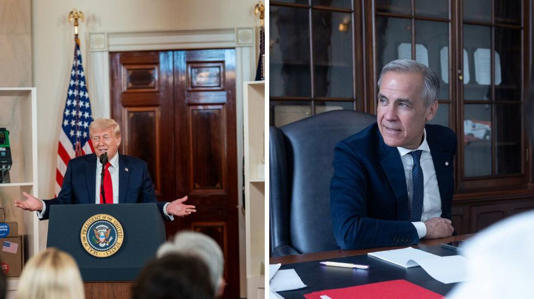
donald trump at a podium in front of an american flag. right: mark carney sitting at a desk

Prime Minister Mark Carney just met with U.S. President Donald Trump at the White House.

The leaders discussed the federal election, tariffs, the president's belief that Canada should be the 51st state, and more.

Carney joined Trump in the Oval Office on May 6, 2025, for the first in-person meeting between the leaders since Canada's federal election.

Trump congratulated Carney on winning the federal election and called him prime minister, not governor, like he did with Justin Trudeau.

"I think I was probably the greatest thing that happened to him," Trump said of Carney's election victory.

He also said it might be "one of the greatest comebacks in the history of politics."

"You're a transformational president with a focus on the economy," Carney said to Trump.

Then, reporters started to ask questions about trade between Canada and the U.S., tariffs and Trump's 51st state comments.

"We're going to be friends with Canada. Regardless of anything, we're going to be friends with Canada," Trump said.

"Canada is a very special place to me," he continued. "I love Canada."

When someone asked about Canada becoming the 51st state, Trump said, "I still believe that, but it takes two to tango."

"We're not going to be discussing that unless somebody wants to discuss it," the U.S. president said.

Carney jumped in and told Trump, "There are some places that are never for sale."

"Having met with the owners of Canada over the course of the campaign in the last several months, it's not for sale, won't be for sale ever," he said. "But the opportunity is in the partnership and what we can build together."

"Never say never," Trump said.

Then, Carney looked at the cameras, shook his head and mouthed "never, never."

When asked if Carney's comments about Canada not being for sale would have an impact on negotiations, Trump said, "No, not at all."

But then he seemed to walk back on that and said, "Time will tell."

Later, Trump took shots at Trudeau and Chrystia Freeland related to USMCA, the free trade agreement between Canada, the U.S., and Mexico.

"I won't say this about Mark, but I didn't like his predecessor. I didn't like a person that worked — she was terrible actually, she was a terrible person and she really hurt that deal very badly because she tried to take advantage of the deal and she didn't get away with it."

Trump turned to Carney and said, "You know who I'm talking about."

"We had a bad relationship having to do with the fact that we disagreed with the way they viewed the deal," the president said.

Carney said that the agreement is the basis for broader negotiations.

"Some things about it are going to have to change, and part of the way you've conducted these tariffs has taken advantage of existing aspects of USMCA, so it's going to have to change," the prime minister told Trump.

Later in the meeting, Trump also said that calling Trudeau a governor probably didn't help him in the election.

Love this? Check out our Narcity noticeboard for details on jobs, benefits, travel info and more!

'Never': Carney just shut down Trump's 51st state idea during first White House visit


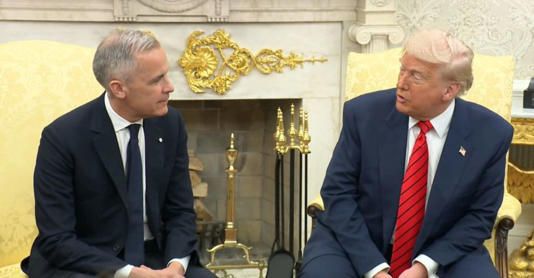
Mark Carney and Dponald Trump sit for a meeting in the White House.

MTL BLOG

MAY 6, 2025

During their first official meeting at the White House on Tuesday, newly elected Canadian Prime Minister Mark Carney and U.S. President Donald Trump kept things mostly cordial. But the tone shifted when an old Trump talking point came up: the idea of Canada becoming America's 51st state.

The leaders met for about 35 minutes on Tuesday
 in Washington, with members of the press present for part of the conversation.

Trump, who initiated heavy tariffs on Canada earlier this year, opened the chat by calling the Liberals' election victory "one of the greatest comebacks in the history of politics."

"Maybe even greater than mine," he added, jokingly.

While the exchange was mostly polite, especially compared to Trump's tense February meeting with Ukrainian President Volodymyr Zelenskyy, things got more pointed when Trump brought up his long-running, tongue-in-cheek claim that Canada is "for sale."

Carney, who's been quick to shut that narrative down during his campaign and early days in office, was quick to chime in.

"As you know from real estate, there are some places that are never for sale," Carney told the former businessman.

"That's true," Trump responded.

"Having met with the owners of Canada over the course of the campaign for the last several months, I can say it's not for sale and won't ever be for sale," the Northwest Territories native added.

Nevertheless, Trump said he "still believes" Canada should become the 51st state, citing a number of "advantages" that include tax cuts, military, and healthcare.

"It would really be a wonderful marriage," he said. "Never say never."

Carney then looked into a camera and mouthed the word "never."


Related video: Carney tells Trump Canada won't ever be sale (The Canadian Press)


Later, a reporter asked Trump if the day’s meetings might sway him on lifting tariffs against Canada.

The president's response was blunt: "No. That's just the way it is."

While they're far from being on the same page, Trump seems keen on maintaining a good relationship with his northern neighbours going forward.

"Regardless of anything, we're going to be friends with Canada."

Carney is scheduled to speak to reporters at the Canadian Embassy at 3 p.m. ET.


MTL Blog noticeboard 

AI tools may have been used to support the creation or distribution of this content; however, it has been carefully edited and fact-checked by a member of MTL Blog's Editorial team. For more information on our use of AI, please visit our Editorial Standards page.


Canadian PM asks Trump to stop calling his country 'the 51st state'

David Edwards
RAW STORY

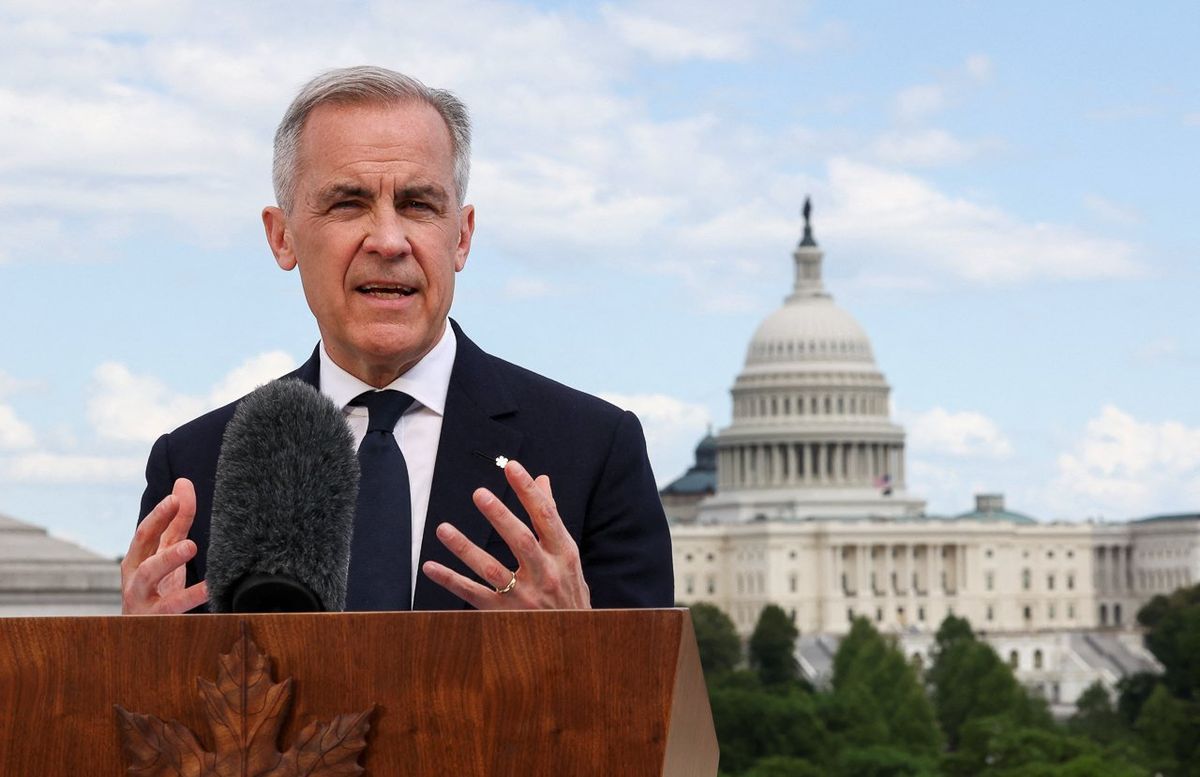
With the U.S. Capitol in the background, Canadian Prime Minister Mark Carney speaks to reporters after his meeting with U.S. President Donald Trump, during a press conference at the Canadian Embassy in Washington, D.C., U.S., May 6, 2025. REUTERS/Kevin Lamarque

Canadian Prime Minister Mark Carney revealed that he asked President Donald Trump to stop calling Canada the "51st state."

Carney spoke about his conversation with Trump following a meeting at the White House.

"Many Canadians are offended and deeply angered by the fact that he keeps repeating this comment," a reporter with the National Post told Carney. "So, have you asked the President to stop calling Canada the 51st state?"


"Yes," the prime minister replied.

"Specifically, what did you ask him?" the reporter wondered.

"Exactly what you just said," Carney said. "Look, I gave you an answer."


"What was his answer?" the reporter pressed.

ALSO READ:‘Pain. Grief. Anger’: Families heartbroken as Trump backlash smashes adoption dreams

"I don't know — he's the president, he's his own person," Carney lamented. "I would go back to showing the difference between a wish and a reality. We're very clear."

During his Oval Office meeting, Carney insisted that Canada would never be the 51st state.

"There are some places that are never for sale," he told Trump. "And having met with the owners of Canada over the course of the campaign, the last several months, it's not for sale, won't be for sale ever."

Watch the video below.


'It's imaginary!' CNN fact-checker smacks down Trump's new 'wildly inaccurate' claims

Sarah K. Burris
May 6, 2025 
RAW STORY


CNN fact-checker Daniel Dale (Photo: screen capture via CNN video)

CNN fact-checker Daniel Dale appeared Tuesday afternoon to address the recent Oval Office press availability with President Donald Trump and new Canadian Prime Minister Mark Carney.

Dale said Trump "did not repeat a lot of the lies about Canada that I've been fact-checking for months," as he counted "at least 11 false claims" from the president this year. During the meeting on Tuesday, which lasted under an hour, Trump repeated just two of those claims about Canada.

One of those is Trump's claim that the United States is "subsidizing Canada" to the tune of $200 billion a year.


ALSO READ: Trump's toadies are peddling a dangerous lie to America's working class

"So this $200 billion figure he uses to describe the trade deficit with Canada, and it's imaginary," Dale said. "The deficit with Canada isn't even close to that high."

He explained that it's a little closer to $36 billion.

"Even if you only count goods trade, ignore the services trade, at which the U.S. excels, about $71 billion," Dale said. "So, just wrong."

The other claim from Trump was that the United States "doesn't do much business with Canada from our standpoint. They do a lot of business with us. We're at like 4%."

"So, that 4% figure is wildly inaccurate, again," Dale said. "About 17% of U.S. exports go to Canada. I can't definitively fact-check this claim that 'we don't do much business with Canada.' But Canada was the No. 1 buyer of U.S. exports in 2024. Again, through March this year, is year, the number three source of U.S. imports."

He said that by "any reasonable standard," Canada is "a major business partner/trading partner of the United States.


CARNEY TRUMP WHITE HOUSE MEETING


President Donald Trump meets Canadian Prime Minister Mark Carney in the Oval Office of the White House, Tuesday, May 6, 2025, in Washington.

Prime Minister Mark Carney met U.S. President Donald Trump in person for the first time at the Oval Office on Tuesday. Carney was due to arrive at the White House at 11:30 a.m. but he arrived at about 11:55 a.m. after a reported delay on the U.S. side. Carney was greeted by Trump with a handshake and they both raised a fist to the cameras. He met with Trump in the Oval Office for about 30 minutes, in front of the press. The meeting was due to begin at 11:45 a.m. but was delayed until about 12:10 p.m. They are now in a private working luncheon with their teams in the Cabinet Room.

The U.S. delegation is: Vice President JD Vance, U.S. Secretary of State Marco Rubio, U.S. Secretary of Commerce Howard Lutnick, U.S. Trade Representative Jamieson, White House Chief of Staff Susie Wiles, White House Deputy Chief of Staff Stephen Miller, U.S. Ambassador to Canada Pete Hoekstra

The Canadian delegation is: Minister of Intergovernmental Affairs Dominic LeBlanc, Foreign Affairs Minister Mélanie Joly, Public Safety Minister David McGuinty, Canada’s Ambassador to the U.S. Kirsten Hillman, Clerk of the Privy Council John Hannaford, Carney’s Chief of Staff Marco Mendecino, Canada-U.S. trade adviser Lisa Jorgensen.

Carney was supposed to leave the White House at 1:20 p.m. but is now expected to leave after 2 p.m. Follow National Post’s live coverage, below. Can’t see the live blog? View it at nationalpost.com .


Related video: 'You know who I’m talking about:' Trump takes veiled shot at 'terrible' Chrystia Freeland during Carney meeting (Global News)

Ahead of Carney’s arrival, Trump criticized Canada in a post on his social media account on Truth Social, insisting the U.S. does not need Canadian cars, energy and lumber.

Trump wrote that his “only question of consequence” will be why America is propping up the Canadian economy and providing “free” military protection.

Carney has said he expects “difficult” but “constructive” conversations with Trump, who has repeatedly threatened to make Canada the “51st state.” Trump said in an interview with NBC’s Meet the Press that aired Sunday that the border is an “artificial line” that prevents the two territories from forming a “beautiful country.”

Carney told Trump on Tuesday that Canada will never be for sale. Trump said he believes Canada would be better as a U.S. state but that it “takes two to tango.”

“We’re going to be friends with Canada,” Trump said, after he was asked what concessions he would demand from Carney.

Trump told reporters on Monday that he wasn’t quite sure why Carney was visiting.

“I’m not sure what he wants to see me about,” Trump said. “But I guess he wants to make a deal.”

U.S. Commerce Secretary Howard Lutnick further stoked doubts about their interest in repairing the relationship with Canada in a Monday interview on Fox Business Network’s Kudlow show.


Asked if the U.S. could make a deal with Canada, Lutnick called the country a “socialist regime” that has been “basically feeding off America.” Lutnick said Tuesday’s meeting would be “fascinating.”

National Post, with additional reporting from The Associated Press


The Latest: Carney meets with Trump in Washington to talk trade, security

Story by David Baxter
CANADIAN PRESS
MAY 6, 2025


Prime Minister Mark Carney is set to meet with U.S. President Donald Trump in Washington Tuesday. This composite image shows Prime Minister Mark Carney, left, in Kitchener, Ont. on March 26, 2025 and President Donald Trump, right, in Washington on March 26, 2025. THE CANADIAN PRESS/Frank Gunn/AP — Pool© The Canadian Press

OTTAWA — Prime Minister Mark Carney faced the first major test of his term today — meeting with U.S. President Donald Trump in Washington.

Carney said last week he expected a "difficult but constructive" conversation. The prime minister said he sees this meeting as the beginning of discussions on a broader economic and security agreement between Canada and the U.S.


Prime Minister Mark Carney disembarks a government plane Monday May 5, 2025 as he arrives in Washington, D.C. THE CANADIAN PRESS/Adrian Wyld© The Canadian Press

While Trump said Monday he wasn't sure what Carney wanted to meet about, the two leaders agreed in a phone call early in the recent election campaign that Trump would meet with the winner of that vote.

Since returning to office, Trump has threatened Canada with broad-based tariffs and has talked about wanting to make Canada a U.S. state.


Here's the latest on the day's events. All times Eastern.

---


3:35 p.m.

Prime Minister Mark Carney is asked if Canada plans to continue with its retaliatory tariffs, since U.S. President Donald Trump has said one of his tariff goals is to drive auto manufacturing out of Canada and into the United States.

Carney replies that he and his team of ministers stressed the strategic position of the North American auto industry in their meeting with Trump today, arguing that a broader manufacturing base can “enhance the competitiveness” of American automakers facing competition from Asian companies.

Carney describes the meeting as “a very complex” negotiation on a wide range of issues.

When a reporter asks in French about Alberta Premier Danielle Smith's talk of a future separation referendum, Carney says Canada is “stronger together” and that as an Albertan, he knows how he would respond.


Related video: Trump says the U.S. doesn't want steel, aluminum, cars from Canada (The Canadian Press)  Duration 2:18


Carney says he feels better about Canada U.S. relations because the tone of the discussion with Trump matched what happens “when you’re trying to find solutions."

The prime minister says he “pressed the case” on lifting U.S. tariffs. Carny points to increased spending on border security to deal with the Trump administration's stated concerns about fentanyl and says “huge results” are starting to be seen. The original 25 per cent tariff threat on all Canadian and Mexican imports was based on stated American concerns about fentanyl and illegal border crossers coming from Canada and Mexico.

Carney is asked about Trump continually saying Canada should be a U.S. state. Carney says he asked Trump to stop saying that. When pressed on how the president responded, Carney says that Trump is his own person.

The prime minister says this is a negotiation between sovereign nations and Trump knows Canada will only accept a deal that's in the country's best interest.

---

3:30 p.m.

At a press conference at the Canadian Embassy in Washington, Carney says he had a "constructive" discussion with Trump as the leaders of two "sovereign nations."

He says this marks "the end of the beginning" of a new stage in the Canada-U.S. relationship. The prime minister says the future direction of that relationship will be determined by the outcome of trade and security talks.

Carney says the two sides are committed to meeting again in the future, with the next face-to-face meeting between himself and Trump set for next month at the G7 summit in Kananaskis, Alta.

A journalist asks Carney what was going through his mind when Trump talked about "erasing" the "artificial line" that separates Canada and the U.S.

Carney says he made it clear that Canada is not for sale. "Some things will never be for sale, and he (Trump) agreed to that," he adds.

---

3:00 p.m.

Ontario Premier Doug Ford says it looks like Carney "held his own" in his meeting today with Trump.

Ford says it's a good start to a productive relationship.

He says it's promising that Trump seems to like Carney a lot more than he liked former prime minister Justin Trudeau.

---

2:30 p.m.

Alberta Premier Danielle Smith says she hopes Carney and Trump can start negotiating an update to CUSMA behind closed doors.

Smith says she doesn't "think it's any secret" that the relationship between Trump and Trudeau was "very poor" and links that dynamic to the "challenges" of the last five or six months.

Smith adds she's "hopeful" that Carney can "reset" that relationship.

---

2:14 p.m.

Carney and the Canadian delegation leave the White House after meeting with Trump and senior members of his administration.

The two leaders took several questions from reporters prior to the private portion of their meeting, which lasted about an hour.


Carney did not take questions from reporters before leaving the White House grounds in a black SUV.

Carney is scheduled to hold a press conference at the Canadian Embassy in Washington at 3:20 p.m.

---

12:35 p.m.

Carney and Trump continue to take questions from reporters.

Trump is asked when the investments he talks about will start to be reflected in broader economic data.

Trump claims it’s already happening and then goes off on a long digression about California Gov. Gavin Newsom. At one point he asks the room, "Did you ever hear of Gavin Newscum?"

When asked if there’s anything Carney could say to change his mind about tariffs, Trump says “no.” When asked why, Trump responds, “Just the way it is.”

Carney repeats that Canada will never be a state and says discussions with the U.S. will take time.

Trump says this is a “friendly conversation” and there won’t be a “blow-up” like there was when he met with Ukrainian President Volodymyr Zelenskyy in the Oval Office earlier this year.


The president says that he doesn’t want cars or steel from Canada. Trump claims again that American taxpayers are subsidizing Canada to the tune of “$200 billion, or whatever the number might be.”

---

12:25 p.m.

Carney and Trump take questions from reporters before the private portion of their meeting and working lunch begins.

Speaking about tariffs, Trump says that companies can avoid the duties if they move production to the United States. He compares the United States to a "luxury mall" that the rest of the world has been ripping off for the last "50 years."

Trump says he "didn't like" Carney's predecessor Justin Trudeau and "a person who worked for him" — a reference to former deputy prime minister Chrystia Freeland.

Trump doesn't refer to Freeland by name but calls her "a terrible person," says "you know who I'm talking about" and claims she tried to "take advantage" of CUSMA.


Carney says that some aspects of the North American trade deal will have to change.

Trump is then asked about Carney's commitment to do more business with other countries. Trump says he's not worried about that and claims that Canada buys more from the U.S. than the U.S. does from Canada.

Trump says the U.S. makes "the best military equipment" and countries always come back to U.S. suppliers.

---

12:13 p.m.

When asked if the CUSMA trade deal is dead, Trump says it is not. He says NAFTA was "the worst trade deal" and CUSMA is up for review next year.

When asked what kind of concessions he is looking for, Trump says that he just wants "friendship" from Canada.

A question comes up about Trump's rhetoric about annexing Canada. Trump says that it would mean lower taxes and free military protection for Canadians and calls the border an "artificially drawn line" crafted "many years ago."


The president says that statehood for Canada is not on the agenda, unless someone wants to change that.

Carney says that some places are "never for sale."

He adds that he sees the benefit in continued partnership with the U.S., which he credits for the revitalized push for higher military spending among NATO allies.

Trump is asked what Canada's refusal to consider U.S. statehood means for trade talks. "Never say never," Trump replies.

Trump says trade talks with China are not happening right now but insists that a meeting with Beijing will happen eventually. Trump says the U.S. isn't losing anything through its trade war with China.

---

12:10 p.m.

Trump congratulates Carney on his election win, saying that he watched the campaign closely.

Trump says there will be tough conversations with Carney on various topics, including the Ukraine-Russia war.


Carney thanks Trump for his hospitality and refers to him as a "transformational" president.

Carney says he also plans to transform Canada by developing jobs, securing the border against fentanyl and securing the Arctic.

Carney says things are better when Canada and the U.S. work together and he sees many ways the two countries can collaborate.

---

11:55 a.m.

Prime Minister Mark Carney is greeted at the White House by U.S. President Donald Trump.

Trump gives a thumbs-up just before Carney's car pulls up. The two men shake hands and exchange words briefly before posing for a photograph.

Nearby reporters shout questions but the two leaders did not respond before heading inside.

---

11:30 a.m.

Prime Minister Mark Carney arrives at the White House to meet with U.S. President Donald Trump.

The meeting is scheduled to start soon and will include a working lunch.


In a post on Truth Social, Trump said he plans to ask Carney why the U.S. is "subsidizing Canada by $200 Billion Dollars a year, in addition to giving them FREE Military Protection, and many other things."

Carney is scheduled to hold a press conference at the Canadian embassy in Washington after the meeting ends.

The Canadian delegation joining Carney at the meeting includes Trade Minister Dominic LeBlanc, Foreign Affairs Minister Mélanie Joly, Public Safety Minister David McGuinty, Ambassador to the U.S. Kirsten Hillman, Privy Council Clerk John Hannaford, chief of staff Marco Mendicino and senior adviser Lisa Jorgensen.

In addition to Trump, the U.S. side will include Vice President J.D. Vance, Secretary of State Marco Rubio, Commerce Secretary Howard Lutnick, U.S. Trade Representative Jamieson Greer, chief of staff Susie Wiles, Homeland Security adviser Stephen Miller and U.S. Ambassador to Canada Pete Hoekstra.


---

9:30 a.m.

Prime Minister Mark Carney is preparing for a critical meeting with U.S. President Donald Trump.

Carney arrived in Washington Monday, joined by Trade Minister Dominic LeBlanc, Foreign Affairs Minister Mélanie Joly and Public Safety Minister David McGuinty.

The meeting at the White House was scheduled to start at 11:45 a.m. with a working lunch.

This report by The Canadian Press was first published May 6, 2025.

David Baxter, The Canadian Press