Tuesday, May 06, 2025

'Don't see how this is possible': Expert slams Trump's push to resettle white Afrikaners


Matthew Chapman
May 6, 2025 
RAW STORY
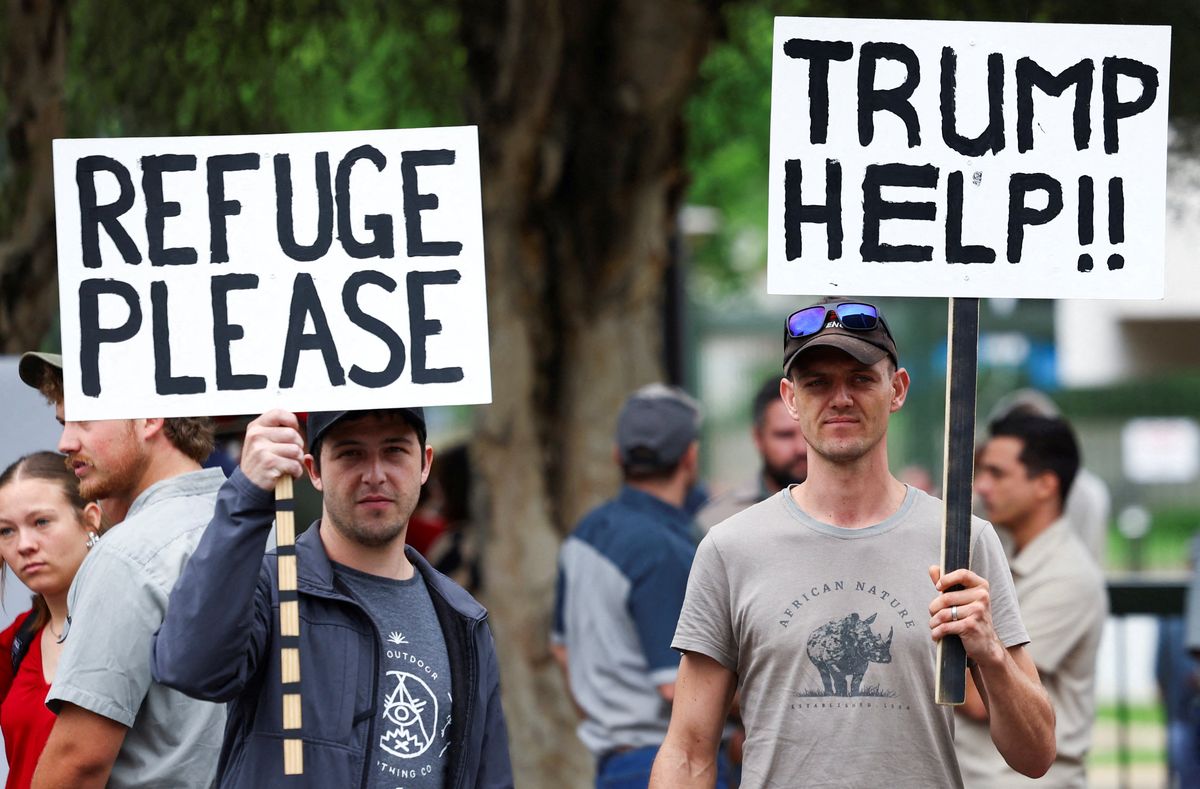


FILE PHOTO: Demonstrators hold placards in support of U.S. President Donald Trump's stance against what he calls racist laws, land expropriation, and farm attacks, outside the American Embassy in Pretoria, South Africa, February 15, 2025. REUTERS/Siphiwe Sibeko/File Photo/File Photo


An immigration law expert is suspicious of President Donald Trump's reported new efforts to resettle white South Africans into the United States.


Trump signed a controversial executive order in February extending refugee status to Afrikaners, a move long desired by white supremacists and that appears to have been a pet issue of Trump's longtime ally and South African immigrant Elon Musk, who has said that country's government has enacted racist policies against the group responsible for Apartheid.

But a new report by The Lever suggests these efforts could be taking a dramatic new step, even as the Trump administration has essentially shut down the refugee resettlement program for everyone else.


ALSO READ: ‘Pain. Grief. Anger’: Families heartbroken as Trump backlash smashes adoption dreams

"The first group of Dutch-descended Afrikaners is scheduled to arrive in the United States imminently, and they will be receiving emergency support from the federal Office of Refugee Resettlement, a division of the Department of Health and Human Services, according to the memo, which was signed by Health and Human Services Secretary Robert F. Kennedy and Office of Refugee Resettlement assistant secretary Andrew Gradison," reported Katya Schwenk.

American Immigration Council attorney Aaron Reichlin-Melnick, however, expressed doubts about this whole thing in a post on X.


"I am skeptical," he wrote. "I don't see how this is legally or even physically possible; the refugee resettlement organizations which are necessary to complete this process have been iced out completely and people would need to be screened by Refugee Officers before they could come."

Trump's executive order back in February raised eyebrows because it focused not just on South Africa's new land expropriation policy, but on "violent attacks" on white farmers, which echoes longstanding white nationalist conspiracy theories pushed by Tucker Carlson and others on the far right that there is a plot to ethnically cleanse white people from the nation.
A big 'flashing red warning sign' just arrived on US soil: CNN host

Sarah K. Burris
May 6, 2025 
RAW STORY


CNN host Kasie Hunt (Photo: Screen capture via CNN video)

CNN host Kasie Hunt began her Tuesday show citing "one flashing red economic warning sign arriving on American soil."

At the top of her show, Hunt described the first shipping container vessel containing Chinese goods that floated into the Port of Los Angeles as only "half full."

President Donald Trump issued a 145% tariff on many goods coming into the U.S. from China.

Because those ships are so empty, Hunt said, "In just a matter of weeks, Americans are set to be faced with higher prices, shortages on store shelves, the prospect of fewer jobs."

The head of the L.A. Port told CNN Tuesday, "that getting things from China to the U.S. is now costing about two and a half times more than they did just last month."

"Just think about your own household budget and what it would look like if suddenly everything costs two and a half times what it costs right now," Hunt said. "So, with those very tangible impacts, is there some hope for some deal somewhere, anywhere?"

Trump met with Canadian Prime Minister Mark Carney on Tuesday morning. One of the questions from a reporter was whether Carney could say anything to Trump that would get Trump to lift the tariffs on Canada. Trump said, "no."

See the clip below or at the link here.


Trail technology on trial: Do digital devices harm the trail experience?


By Dr. Tim Sandle
DIGITAL JOURNAL
May 4, 2025


Along the Appalachian Trail. Image by Patorjk CC3.0

The Appalachian Trail passes through 14 states and stretches approximately 2,200 miles from Georgia to Maine. Each year, at least 3 million people hike parts of it or the whole trail. March marks the month that thousands set out on the journey. It is said to be the longest hiking trail in the world.

This historic trail is facing a modern challenge – the pervasive use of digital technology. Armed with smartphones, smartwatches, iPads, and more, today’s Appalachian Trail hikers are more digitally connected than ever.

Research from Virginia Tech reveals that hikers’ connectivity with the Internet makes trail management much more challenging than the days before mobile devices.

Professor Shalini Misra, who leads the Public Interest Technology Lab in Arlington, decided to explore how or if people experience solitude in wilderness settings with digital devices. Misra studies the psychological and social impacts of digital technologies in a variety of settings.

“We wanted to understand how digital technologies transform hikers’ wilderness experiences,” she says. “We also wanted to understand how trail managers perceive these changes and how they view the potential opportunities and challenges of digital technologies for sustainable trail management.”

The researchers interviewed 18 Appalachian Trail resource managers over two years. The resource managers reported that technology, specifically social media, has led to the trail’s degradation, overcrowding, and the spread of misinformation among hikers.

For example, when photos and videos are posted across social media channels, those sites often become hiker magnets, leading to overcrowding. This includes Max Patch, a popular Appalachian Trail spot in North Carolina known for its 360-degree views.

Trail visitor centre staff have described regular demands from hikers wanting to know where a specific photo was taken so they can visit that exact spot. Such Instagram-popular locations include Virginia’s McAfee Knob, where there has been a spike in visitors in recent years, with up to 600 a day.

With an increase in trail foot traffic comes soil erosion, root exposure, littering, vandalism, and a host of other ecological problems, trail managers reported. Also, some hikers camp in illegal or inappropriate locations along the trail and then share that information through popular mobile hiking apps, such a FarOut.

Users of hiking apps read the information and camp in the same locations. Some trail stewards said they have contacted app managers to ask that inaccurate information is removed. Yet there is so much information across websites that it is not easy for trail managers to respond to and monitor all of the reports.

There is also a change in ethos, for those seeking solitude. Is today’s landscape truly a wilderness experience? And are mobile devices giving hikers a false sense of security? Technology certainly has changed the concept of unplugging in nature.

The findings appear in the journal Environmental Management, titled “Toward a management framework for smart and sustainable resource management: The case of the Appalachian Trail.”
CYBERPUNKING

Facing a broken economy, Ghana’s tech-savvy teens turn to fraud


By AFP
May 5, 2025


Ghana's economy has been hit by brutal inflation for years - Copyright AFP Aris MESSINIS
Winifred Lartey

In the dusty alleys of Nima, a shanty town in the heart of Ghana’s capital, a 17-year-old called Ghost reclines on a faded plastic chair inside a dimly lit internet cafe.

Outside, barefoot children chase a punctured football. Inside, Ghost’s fingers dance across the keyboard, his eyes locked on WhatsApp as he engineers a phishing scam that could earn him thousands of cedis in just a few hours.

“I made GHC12,000 ($770) last month,” Ghost told AFP, his voice low and calculated, describing an online store he set up on Instagram.

“People bought phones and laptops. None of it existed.”

Ghost, a pseudonym he gave AFP, is one of a growing number of Accra’s teenagers turning to cybercrime to survive in a country mired in economic crisis, battling both youth unemployment and broken dreams.

From mobile money fraud to investment scams, a murky digital underworld is sucking in minors, many working from their bedrooms or small kiosks operating in plain sight — anywhere with a stable internet connection.


– Too good to be true –


Nima’s 441 neighbourhood is a tightly packed, working-class community of corrugated iron housing and open drains. Opportunities are scarce — but mobile phones are not.

Ghana’s Cyber Security Authority (CSA) has raised the alarm over a surge in cyberfraud, with financial losses tallying $282,776 between January and March 2025, nearly doubling the $154,241 recorded during the same period in 2024.

Officials warn that youth-led scams, powered by social media and peer pressure, are driving the spike.

Phishing scams, brand impersonation and fake online shops dominate the scene, with teenagers posing on Snapchat and TikTok as vendors with offers that are too good to be true.

Mercy Adumoah, 20, was one such victim.

“I saw a page on Snapchat selling heels. I needed a pair for an event, so I paid without thinking twice,” she recounted.

After they received the money, the sellers blocked her account.

Experts say these crimes have become systemic in a country with a battered economy that is still recovering from a 2023 debt default. Inflation shot above 54 percent in 2022 and has remained above 20 percent into 2025.

At a junior high school near Nima, teacher Mohammed Inusah has witnessed a transformation.

“Some of my students have iPhones more expensive than my salary,” he told AFP. “They flaunt cash, buy designer clothes and sneakers.”

“The parents are either unaware or too afraid to confront them.”


– ‘I know it’s wrong’ –


A soft-spoken boy with a mop of dreadlocks who gave the name Tricky said he got his start in scamming by copying scripts from online forums in Nigeria.

Later, his cousin taught him mobile money fraud — how to pose as an agent from the local telecom company to get access to people’s accounts.

Tricky claims his biggest hit since in his two years of scamming was $500 — twice the monthly salary of a public health nurse or a teacher.

“I bought clothes, helped my mum pay rent,” he said. “I know it’s wrong, but tell me, what else can I do?”

The CSA has also flagged a dramatic rise in online investment fraud. Between January and August 2024 alone, 149 cases were recorded with losses nearing $128,534.

“I fell for one,” admits 18-year-old “Bronzy”, who went from victim to perpetrator. “A guy scammed me using a fake forex trading site. So I learnt the game.”

He now runs a group on Telegram promising 20 percent weekly returns.

“People invest and I disappear,” he said.

Abubakar Issaka, president of the Cyber Security Experts Association of Ghana, said the situation is only getting worse.

“The regulations exist… but enforcement is weak. The number of professionals is not growing fast enough to match the fraud cases,” he said.

Tracing perpetrators “is a challenge due to poor data integration” between telecoms operators and the national ID database, he added.

In some cases, the phone numbers used in frauds “belong to people who died years ago. Fraudsters are steps ahead.”


– No end in sight –


Victims suffer anxiety and financial ruin. Scammers are not untouched. Ghost admits he’s often afraid.

“Sometimes, I can’t sleep. I wonder if the police will knock. But when I see my friends living large, I feel like I must keep going.”

As dusk settles over Nima, Ghost logs off, pockets his burner phone, and steps into the fading light.

He didn’t make any money that day. His world is one of quick, fickle wins and quiet fear. But with Ghana’s economy showing no signs of rapid recovery, many more are likely to follow him into the shadows.

strs/nro/cw
France, EU take aim at Trump’s assault on science, seek to lure US researchers


By AFP
May 5, 2025


Macron (L) and von der Leyen took aim at Trump's assault on science and research - Copyright AFP Peter PARKS
Pierre Celerier and Jurgen Hecker

French President Emmanuel Macron and European Commission head Ursula von der Leyen took aim at Donald Trump’s policies on science on Monday, as the European Union seeks to encourage disgruntled US researchers to relocate to Europe.

Von der Leyen told a conference at Paris’s Sorbonne university that the EU would launch a new incentives package worth 500 million euros ($567 million) to make the 27-nation bloc “a magnet for researchers”.

“We have to offer the right incentives,” she said.

Without mentioning Trump directly, von der Leyen told the “Choose Europe for Science” conference that the role of science was being put in question “in today’s world” and condemned such views as “a gigantic miscalculation”.

Universities and research facilities in the United States have come under increasing political and financial pressure under Trump, including with threats of massive federal funding cuts.

“Nobody could have imagined that this great global democracy, whose economic model depends so heavily on free science,.. was going to commit such an error,” Macron said.

He added: “We refuse a diktat consisting of any government being able to say you cannot research this or that.”

– ‘A sanctuary’ –


In the context of “threats” against independent research and “global apprehension”, Macron said, “Europe must become a sanctuary.”

In the United States, research programmes face closure, tens of thousands of federal workers have been fired and foreign students fear possible deportation for their political views.

European commissioners, scientists, academics and ministers for research from EU member countries took part in Monday’s conference, as did representatives from non-EU members Norway, Britain and Switzerland.

The French president has already appealed to foreign, notably US, researchers to “choose France”.

Last month he unveiled plans for a funding programme to help universities and other research bodies cover the cost of bringing foreign scientists to the country.

Aix Marseille University in the south of France announced in March it would open its doors to US scientists threatened by cuts.

It says its “Safe Place for Science” scheme has already received a flood of applicants.

Last week, France’s flagship scientific research centre, the CNRS, launched another initiative aimed at attracting foreign researchers whose work is threatened.

– Bridging the pay gap –


It is also seeking to tempt back French researchers working abroad, some of whom “don’t want to live and raise their children in Trump’s United States”, according to CNRS President Antoine Petit.

An official in Macron’s office said Monday’s conference came “at a time when academic freedoms are retreating and under threat in a number of cases”.

One obstacle, experts say, is the fact that while EU countries can offer competitive research infrastructure and a high quality of life, research funding and researchers’ remuneration both lag far behind US levels.

But the CNRS’s Petit said last week he hoped the pay gap would seem less significant once the lower cost of education and health, and more generous social benefits were taken into account.

Macron’s office said France and the European Union were targeting researchers in a number of specific sectors, including health, climate, biodiversity, artificial intelligence and space.

Macron said his government would earmark “an additional” 100 million euros to help attract foreign talent.

The French government could finance up to 50 percent of selected research projects, an official in the presidential office said, while assistance could also be offered in the form of tax incentives.

burs-jh/ekf/gil
Who are the Middle East’s Druze religious community?


By AFP
May 5, 2025


The Druze are spread across Syria, Lebanon and Israel - Copyright AFP Peter PARKS
Karim Abou Merhi

The Druze are a prominent religious community of more than a million people spread mainly across Syria, Lebanon and Israel, who for centuries have sought to preserve a distinct identity.

In Syria, Druze fighters recently clashed with forces loyal to the country’s new Islamist rulers, highlighting the struggles they and other minority groups have faced with shifts in regional power dynamics.

“The Druze are a kind of an ultra-tribe which transcends space and geography,” said Makram Rabah, assistant professor of history at the American University of Beirut.

Despite being a minority in a majority Sunni Muslim region, the Middle East’s Druze have played “a very important role”, Rabah said.

Here is a look at the community:


– Religion and customs –


The Druze emerged in Egypt in the early 11th century as a branch of the Ismaili sect of Shiite Islam.

They are monotheistic and call themselves “muwahhidun”, or unitarians.

The sect is highly secretive and includes mystical elements like reincarnation.

It does not allow new converts and marriage outside the community is strongly discouraged.

A source familiar with Druze rituals, requesting anonymity to discuss matters considered sensitive, said the faith’s emergence was influenced by other religious and philosophical teachings, including those of Greek philosopher Plato.

Some Druze religious occasions align with those of other Islamic sects.

Traditional Druze garb is black, with men wearing white caps or turbans and women covering their heads and part of their faces with a flowing white scarf.


– Where are they? –


“The Druze don’t really recognise borders,” Rabah said.

“You have marriages and you have standing relationships between the Druze across the region,” he said, adding that “clerics play a very important role in keeping this relationship alive.”

Before Syria’s civil war erupted in 2011, the community was estimated at around 700,000 people.

According to “The Druze Faith” by historian Sami Makarem, Druze have been migrating to southern Syria since the 16th century, to an area now known as Jabal al-Druze, meaning Druze Mountain, in Sweida province.

Syria’s Druze are now mainly concentrated in their Sweida heartland, as well as nearby Quneitra province, with smaller pockets in the Damascus suburbs, notably Jaramana and Sahnaya, which recently saw sectarian violence.

In Lebanon, an estimated 200,000 Druze are concentrated in the mountainous centre as well as in the south near Israel and Syria.

In Israel, some 153,000 Druze are Israeli citizens, living mainly in the north. Unlike other Arab Israelis, Druze serve in the Israeli army.

In the Israeli-annexed Syrian Golan Heights, more than 22,000 Druze hold permanent resident status. Only around 1,600 have become Israeli citizens, while others remain attached to their Syrian identity.

Israel seized much of the Golan from Syria in 1967, annexing the area in 1981 in a move largely unrecognised internationally.

The move separated extended families, though Druze in the annexed Golan were often able to cross into Syria to study, attend weddings or sell produce.

Some Druze from southern Syria also settled in neighbouring Jordan, where the community is estimated at 15,000 to 20,000.

Two delegations of Syrian Druze clerics have made pilgrimages to a holy site in Israel this year, even though the two countries are technically at war with each other.

Outside the Middle East, Druze have migrated to regions including the Americas and Australia.

Well-known Druze include prominent human rights lawyer Amal Alamuddin Clooney and Jordanian Foreign Minister Ayman Safadi.


– Leading role –


Despite their minority status, Druze “have filled an important and sometimes a leading role in the political and social life” of the Middle East, according to historian Makarem.

In Syria, Druze Sultan Pasha al-Atrash led a nationalist revolt against the French mandatory power which had established a Druze statelet in southern Syria during the 1920s and 1930s.

In Lebanon, Druze leader Kamal Jumblatt played a key role in politics from the 1950s until his 1977 assassination, and his son Walid is a powerful politician.

Jumblatt last month urged Syria’s Druze to reject “Israeli interference”, after Israel warned the Islamist authorities who ousted president Bashar al-Assad against harming the minority.

Druze leaders have declared their loyalty to a united Syria, though some have called for international protection following recent sectarian violence.

Israeli Druze spiritual leader Sheikh Mowafaq Tarif has urged Israel to protect Syria’s Druze.

Rabah said there was a Druze “power struggle across three states”, adding that he believes Syria’s community does not aspire to statehood.

The Druze largely stayed on the sidelines of Syria’s war after it erupted in 2011, focusing on defending their heartland.

Most Druze armed groups have yet to reach a settlement with the new authorities.
Philips turns in a profit but China, tariffs weigh


By AFP
May 6, 2025


Philips gets into the green - Copyright AFP Patrick T. Fallon

Dutch medical device maker Philips reported a net profit for the first time in three quarters Tuesday despite weak sales in China but warned of “intensified” uncertainties due to tariffs.

Net profits came in at 72 million euros ($82 million), compared to a net loss of 998 million euros in the same quarter last year and 333 million euros in the fourth quarter of 2024.

“It’s an encouraging start to the year,” the firm’s chief executive Roy Jakobs told reporters.

Jakobs predicted that the second half of the year would be stronger for the firm than the first half.

“In an uncertain macro environment that has intensified due to the potential impact of tariffs, we are focused on what we can control,” he added.

The company estimated a hit of between 250-300 million euros from tariffs over the year.

Philips maintained its forecast for between one and three percent growth in sales for 2025, but slightly cut its projection for earnings before special items (EBITA).

The firm pointed to a two-percent growth in orders globally, with China again proving a drag. Without China, the order growth would have been four percent, Philips said.

However, global sales were down two percent compared to the same quarter last year due to a “double-digit decline” in China, the firm said.

Philips has previous warned that a slowing Chinese economy was hurting consumer demand for products and the government’s anti-corruption drive was hitting procurement.

Once famous for making lightbulbs and televisions among other products, Amsterdam-based Philips in recent years has sold off subsidiaries to focus on medical care technology.

Since 2021, the company has been battling a series of crises over its DreamStation machines for sleep apnoea, a disorder in which breathing stops and starts during sleep.

Millions of devices were recalled over concerns that users were at risk of inhaling pieces of noise-cancelling foams and fears it could potentially cause cancer.

In April 2024, it announced it had reached a $1.1 billion deal to settle US lawsuits over the faulty machines.
CULTUS WATCH

Mennonite communities raise hackles in Peruvian Amazon


By AFP
May 5, 2025


David Klassen, one of the founders of the Mennonite community at Masisea in the Peruvian Amazon, poses for a picture with his family - Copyright AFP DAVID SWANSON
Hector Velasco

When they saw men with arrows and machetes bearing down on them, Daniel Braun and other Mennonites living in the Peruvian Amazon fled across rice paddies, some of their barns ablaze behind them.

In Masisea, a remote settlement near Peru’s border with Brazil accessible only by boat along a tributary of the Amazon or over dirt paths, members of the austere Protestant sect are under siege.

Here, as in several other South American countries, the reclusive Christians, who have roots in 16th-century Europe and who eschew modernity, are accused of destroying forests as they expand their agricultural imprint on the continent.

In 2024, Peruvian prosecutors charged 44 men from the Masisea Mennonite colony with destroying 894 hectares (2,209 acres) of virgin forest and requested that each be sentenced to between eight and 10 years in prison.

The trial would be the first of a Mennonite colony in Latin America for environmental crimes.

The men’s lawyer, Carlos Sifuentes, argues that the land was “already cleared” when the community bought it.


– Rich versus poor –


A 2021 study carried out by researchers at Canada’s McGill University counted 214 Mennonite colonies in Latin America occupying some 3.9 million hectares, an area bigger than the Netherlands.

In Peru, Mennonites have established five thriving colonies in the Amazon in the past decade.

Their presence is a thorn in the side of the 780-strong Shipibo-Konibo Indigenous community, which lives on the shores of Lake Imiria about 10 miles (16 kilometers) from Masisea.

The Shipibo-Konibo live in wooden huts of palm or zinc roofs with no electricity or running water, surviving off fishing and subsistence farming.

They accuse the wealthier Mennonites, whom they call “forest termites,” of illegally occupying around 600 hectares of their 5,000-hectare territory.

“The Mennonites build ranches on communal land… They engage in deforestation. What they are doing is a crime against the environment,” Indigenous leader Abner Ancon, 54, told AFP.


– Horse-drawn carriages –


The Mennonites arrived in Peru from neighboring Bolivia.

David Klassen, a 45-year-old father of five children ranging in age from seven to 20, said they were driven to emigrate because of a shortage of farmland and because of Bolivia’s “radical left” policies.

Today, the self-sufficient enclave is comprised of some 63 families who raise cattle and pigs and grow rice and soybeans on 3,200 hectares while using diesel generators for power.

The men and boys wear checked shirts, suspenders and hats or caps, The women and girls wear long dresses, with their hair pulled back in tight braids or buns.

The community, which speaks a German dialect but whose leaders speak passable Spanish, has little contact with the outside world, relying on tractors and horse-drawn carriages as its main modes of transport.

After 10 years of peaceful coexistence with their Indigenous neighbors, the settlement came under attack last July.

Braun said he was sitting with other men outside a barn when a group of Shipibo-Konibo appeared out of nowhere.

“They came with arrows and machetes. They said you have one or two hours to leave,” the 39-year-old recalled, adding that they set fire to property.

No one was injured in the standoff but the charred remains of a shed and a barn and zinc roofs were visible through the long grass.

Ancon admitted that his community’s Indigenous guard had chased the Mennonites but “without resorting to violence.”


– A fraction of the damage –


A lawyer for the Shipibo-Konibo, Linda Vigo, accused the settlers of hiring contractors to clear forest, “and when it’s all cleared, the Mennonites come in with their tractors, flatten everything, and then you go in afterwards and find it all cultivated.”

Pedro Favaron, a specialist on Indigenous peoples at the Pontifical Catholic University of Peru, acknowledged that the Mennonite farming model failed to meet “environmental expectations.”

But he argued that the land they bought from mixed-race settlers in Masisea “was already degraded.”

The independent Monitoring of the Andes Amazon Program, which tracks deforestation and fires, estimates the area cleared by Mennonites in Peru since 2017 at 8,660 hectares.

It’s a tiny fraction of the 3 million hectares of forest lost over the past three decades in the Andean country, mainly due to fires, illegal mining and deforestation by other groups.

Standing in the middle of a verdant rice field, Klassen assured: “We love the countryside… We don’t want to destroy everything.”
'Luigi: The Musical' Premiere Run Already Sold Out in San Francisco

"This show is not a celebration of violence of any kind, nor is it an attempt to pass judgment on an ongoing legal matter," say the producers. "Instead, Luigi: the Musical uses satire to ask deeper cultural questions."


Image from "Luigi: The Musical," described by its producers as "a comedy that imagines the surreal scenario of Luigi Mangione, the man accused of killing UnitedHealthcare CEO Brian Thompson, sharing a prison with real-life inmates Sam Bankman-Fried and Sean 'Diddy' Combs."
(Image: LuigitheMusical.info)

Jon Queally
May 02, 2025
COMMON DREAMS

A stage musical based on the life and actions of accused murderer Luigi Mangione, charged with killing UnitedHealth chief executive Brian Thompson earlier this year, will debut in San Francisco next month—and the run of the show featuring the high-profile case is already sold out.

Mangione—who has taken on cult status in some quarters over the brazen and cold-blooded killing that served to highlight the nation's cruel, profit-driven healthcare system—is facing a possible death sentence if found guilty on federal charges related to Thompson's murder.

"Why did a figure like Luigi become a kind of folk hero in certain corners of the internet? What does that say about how we see institutions in America today?"

The producers "Luigi: The Musical," who describe the play as a "wildly irreverant, razor-sharp comedy" about the "alleged corporate assassin turned accidental folk hero," also acknowledge how inherently controversial and provocative the show will be. According to the play's website:
This show is not a celebration of violence of any kind, nor is it an attempt to pass judgment on an ongoing legal matter. Our hearts go out to the family of Brian Thompson, and we acknowledge the pain and complexity surrounding this case.

Instead, Luigi: the Musical uses satire to ask deeper cultural questions. Why did this case strike such a chord with so many people? Why did a figure like Luigi become a kind of folk hero in certain corners of the internet? What does that say about how we see institutions in America today?


The show will run at the Taylor Street Theater in the city, premiering on June 13th for an initial two-week run. As of this writing, all shows are sold out, but new dates for an extended run are set to be announced.

Produced by Caleb Zeringue and directed by Nova Bradford, the script was written by the pair alongside Arielle Johnson and Andre Margatini. The original music and lyrics for the show were composed by Johnson and Bradford.

In the show's imagination, Mangione finds himself in a jail cell with convicted crypto-banker Sam Bankman-Fried and indicted hip-hop producer Sean "Diddy" Combs. While absurd in some ways, the origin story of the play is based on the fact that all three men were, for a period, all held at the same detention facility.

In an interview last week with the San Francisco Chronicle, Zeringue said all three men "represent these big pillars of institutions in society that are failing in their trust: healthcare, Hollywood, and then big tech."

Bradford, also speaking to the Chronicle, said that the play seeks to explore society's tendency "to project meaning onto these types of figures," but that the show is "not valorizing" any of them, nor "trivializing any of their action or alleged actions."

"Our hope is that Luigi: the Musical," say the producers in their show notes, "makes people laugh—and think. We're not here to make moral proclamations. We're here to explore, with humor and heart, how it feels to live through a time when the systems we're supposed to trust have stopped feeling trustworthy."
Poll Shows 3 in 4 Oppose Medicaid Cuts as GOP Targets Program to Fund Tax Breaks for Rich


A majority also said the the Trump administration "is recklessly making broad cuts to programs and staff, including some that are necessary for agencies to function."


Medicaid recipient Emily Gabriella protests outside the U.S. Supreme Court as oral arguments are delivered in the case of Medina v. Planned Parenthood South Atlantic on April 2, 2025 in Washington D.C.
(Photo: Kayla Bartkowski/Getty Images)

Jessica Corbett
May 01, 2025
COMMON DREAMS

As congressional Republicans consider slashing the federal safety net to fund tax giveaways for the wealthy, polling published Thursday by KFF shows that a large majority of Americans oppose cuts to health programs, including Medicaid.

The research group asked respondents about potential funding cuts for various programs, and found that 84% oppose cuts to Social Security, 79% oppose cuts to Medicare, and 76% oppose cuts to Medicaid, a key target for the GOP's tax ambitions.

There is also strong opposition to slashing funds for mental health and addiction prevention services, tracking infectious disease outbreaks, medical research, HIV prevention, and helping people with Affordable Care Act premiums.


KFF found that 61% generally oppose "major cuts to staff and spending at federal government health agencies," a figure that rose to 72% after respondents heard arguments that the reductions "would negatively impact these agencies' abilities to serve the public."

Pollsters also asked about actions by President Donald Trump's so-called Department of Government Efficiency, led by billionaire Elon Musk. A majority (54%) said the administration and DOGE had gone "too far" with cuts at federal health agencies.

Similarly, 59% of respondents—including 92% of Democrats, 65% of Independents, and 18% of Republicans—agreed that "the administration is recklessly making broad cuts to programs and staff, including some that are necessary for agencies to function."

Majorities said they oppose staffing cuts at the Department of Veterans Affairs, Centers for Medicare and Medicaid Services, Social Security Administration, Centers for Disease Control and Prevention, Food and Drug Administration, National Institutes of Health, and the Department of Health and Human Services' Office of Infectious Disease and HIV/AIDS Policy.

Sharing the poll on social media, KFF CEO and president Drew Altman said: "Everyone—Dems, R's, Independents—are against big Medicaid cuts. Not really surprising. What is: MAGA supporters are divided on cutting Medicaid."

"As Steve Bannon said: 'lots of MAGAs on Medicaid,'" Altman added, referring to the far-right media executive and former Trump adviser.

The fact that so many residents of "red states" rely on Medicaid could be a problem for GOP leaders attacking the program that provides healthcare for low-income Americans in hopes of lowering taxes for the rich. Some Republicans in both chambers have expressed concern about how major cuts would impact their constituents—and, as a result, their reelection chances.


Congressman Don Bacon (R-Neb.), a critical swing vote in the House of Representatives, said Tuesday that his "red line" for Medicaid cuts in the GOP's reconciliation package is $500 billion—a figure that, as Families USA executive director Anthony Wright noted, would be "the biggest cut in the history of Medicaid, one that would force millions of Americans to lose coverage."

Bacon also expressed support for adding work requirements to Medicaid, despite evidence that they strip coverage from people in need. A Center on Budget and Policy Priorities (CBPP) analysis from February found that imposing such mandates for Medicaid recipients could put 36 million Americans, or 44% of the program's enrollees, at risk of losing their health insurance.

"Senate Republicans are closely watching how their House colleagues restructure federal funding for Medicaid, and will likely propose changes when the entire 11-bill package comes over from the House later this year," States Newsroom reported Thursday. "Several GOP senators told reporters at the Capitol on Wednesday they will judge the package based on how changes to Medicaid will impact their constituents."

States Newsroom shared remarks from Republican Sens. Susan Collins (Maine), Josh Hawley (Mo.), Jerry Moran (Kan.), and John Hoeven (N.D.), who said that said "the challenge is going to be to find savings in line with what the president has described."

"He said he doesn't want any cuts to Medicaid," Hoeven continued. "But how do you make sure that you eliminate waste, fraud, and abuse? And that the folks that should be getting it are getting it, rather than an able-bodied person who should be out there working and is able to do that and take care of themselves."


Politico similarly reported Wednesday that "while Trump has agreed to target waste, fraud and abuse, he remains profoundly wary about pursuing anything that might be construed as 'cuts' to a program he has vowed over and over again to protect, according to six White House officials and top allies of the president."

Medicaid isn't the only program for the poor in the GOP's crosshairs. Republicans are also considering cuts to and work requirements for the Supplemental Nutrition Assistance Program (SNAP).

CBPP said Wednesday that "nearly 11 million people—about 1 in 4 SNAP participants, including more than 4 million children and more than half a million adults aged 65 or older and adults with disabilities—live in households that would be at risk of losing at least some of their food assistance" under Congressman Dusty Johnson's (R-S.D.) proposal.