Wednesday, May 07, 2025


Reporting and representation of race and ethnicity in clinical trials of pharmacotherapy for mental disorders


JAMA Psychiatry


About The Study: 

The findings of this meta-analysis suggest that differences in reporting race and ethnicity across geographic locations and underrepresentation of certain racial and ethnic groups in U.S.-based randomized clinical trials highlight the need for international guidelines to ensure equitable recruitment and reporting in clinical trials. 

Corresponding Author: To contact the corresponding author, Alessio Bellato, PhD, email a.bellato@soton.ac.uk.

To access the embargoed study: Visit our For The Media website at this link https://media.jamanetwork.com/

(10.1001/jamapsychiatry.2025.0666)

Editor’s Note: Please see the article for additional information, including other authors, author contributions and affiliations, conflict of interest and financial disclosures, and funding and support.

#  #  #

Embed this link to provide your readers free access to the full-text article 

https://jamanetwork.com/journals/jamapsychiatry/fullarticle/10.1001/jamapsychiatry.2025.0666?guestAccessKey=6a7e637c-9712-4ad0-8e5e-8d7804f08e15&utm_source=for_the_media&utm_medium=referral&utm_campaign=ftm_links&utm_content=tfl&utm_term=050725


Clinical and neuropathological evaluations of the New Brunswick neurological syndrome of unknown cause


JAMA Neurology


About The Study: There was no evidence supporting a diagnosis of neurological syndrome of unknown cause (NSUC) in this cohort. The data inclusive of independent examinations and neuropathology strongly supported the presence of several neurodegenerative and non-neurodegenerative conditions. Unfounded concerns that a potentially fatal mystery disease, possibly induced by an environmental toxin, is causing the patients’ neurological symptoms has been amplified in traditional and social media. Second, independent clinical evaluations are needed for any patient given a diagnosis of NSUC.


Corresponding Author: To contact the corresponding author, Anthony E. Lang, MD, email anthony.lang@uhn.ca.

To access the embargoed study: Visit our For The Media website at this link https://media.jamanetwork.com/

(doi:10.1001/jamaneurol.2025.1718)

Editor’s Note: Please see the article for additional information, including other authors, author contributions and affiliations, conflict of interest and financial disclosures, and funding and support.

#  #  #

Embed this link to provide your readers free access to the full-text article 

 https://jamanetwork.com/journals/jamaneurology/fullarticle/10.1001/jamaneurol.2025.1718?guestAccessKey=f0ce6d56-973c-4c47-922b-ba20bb733830&utm_source=for_the_media&utm_medium=referral&utm_campaign=ftm_links&utm_content=tfl&utm_term=050725


Neuroscientists pinpoint where (and how) brain circuits are reshaped as we learn new movements


Discovery of physical modifications across brain regions holds important clues for possible new therapies for brain disorders


University of California - San Diego

Neuronal activity 

image: 

Neuronal activity traces reveal how brain circuits evolve as mice learn a motor task. Left: example field of view recorded during behavior; each color marks a different neuron. Right: activity traces from selected neurons.

view more 

Credit: Komiyama Lab, UC San Diego


A landmark study published by scientists at the University of California San Diego is redefining science’s understanding of the way learning takes place. The findings, published in the journal Nature and supported by the National Institutes of Health and U.S. National Science Foundation, provide novel insights on how brain wiring changes during learning periods, offering a path to new therapies and technologies that aid neurological disorders.

For many years, neuroscientists have isolated the brain’s primary motor cortex (M1), an area in the frontal lobe region, as a hub for sending out signals related to complex movements during episodes of learning. More recently, the motor thalamus, located in the center of the brain, has been implicated as an area that influences M1 during motor learning functions.

But even with such advancements, evidence was lacking on how this learning process unfolds, mainly due to the complex nature of monitoring the interactions of cells across brain areas.

A research team led by Professor Takaki Komiyama’s laboratory used powerful neurobiological research techniques to describe these mechanisms in mice for the first time. Using high-tech imaging and a novel data analysis method, the researchers identified the thalamocortical pathway, a communication bridge between the thalamus and the cortex, as the key area that is modified during learning.

Beyond identifying the main pathway, the researchers found that links between regions physically change during learning. Motor learning does much more than adjust activity levels, it sculpts the circuit’s wiring, refining the conversation between the thalamus and cortex at a cellular level.

“Our findings show that learning goes beyond local changes — it reshapes the communication between brain regions, making it faster, stronger and more precise,” said Assaf Ramot, the study’s lead author and a postdoctoral scholar in the Komiyama Lab. “Learning doesn’t just change what the brain does — it changes how the brain is wired to do it.”

The study, during which mice learned specific movements, revealed that learning causes a focused reorganization of the thalamus and cortex interaction. During times of learning, the thalamus was found to activate M1 neurons to encode the learned movement and to halt the activation of neurons not involved with the movement being learned.

“During learning, these parallel and precise changes are generated by the thalamus activating a specific subset of M1 neurons, which then activate other M1 neurons to generate a learned activity pattern,” said Komiyama, a professor in the Departments of Neurobiology (School of Biological Sciences) and Neurosciences (School of Medicine), with appointments in the Halıcıoğlu Data Science Institute (School of Computing, Information and Data Sciences) and Kavli Institute for Brain and Mind.

To bring the activity of specific neurons into focus — a key insight of the study — the researchers developed a novel analytical method called ShaReD (Shared Representation Discovery) with Neurobiology Assistant Professor Marcus Benna and graduate student Felix Taschbach, study coauthors.

According to Taschbach, who spearheaded development of the data analysis procedure, identifying behaviors that are commonly encoded across different subjects presents a significant challenge because behaviors and their neural representations can vary substantially between animals. To address this issue, the researchers developed ShaReD, which identifies a single shared behavioral representation that correlates with neural activity across different subjects, allowing them to map subtle behavioral features to the activity of different neurons in each animal.

Existing methods typically enforce artificial alignment to reduce individual variability — similar to requiring everyone to follow exactly the same route to a destination. In contrast, ShaReD functions more like identifying which landmarks consistently help travelers navigate, regardless of their specific route choices. The ShaReD method was critical to the study’s findings.

“This new method allows us to combine data from multiple experiments to make detailed discoveries that would not have been possible using only the limited number of relevant neurons recorded in an individual brain,” said Benna, a computational neuroscientist and co-corresponding author of this study.

The new study is the second recently led by the Komiyama lab that illuminates how our brains learn. In April, William Wright, Nathan Hedrick and Komiyama published a study in Science that describes the multiple rules that neurons follow during episodes of learning, with synapses in different regions following different rules.

With the Nature study’s findings, the researchers further science’s understanding of the learning process with a new comprehensive model of how the neural circuits underlying learned movements emerge during learning. The new information also offers hope for those who suffer from neurological disorders.

“The study shows that learning isn’t just repetition,” said Ramot. “It’s about your brain literally rewiring itself in a targeted way. Whether you’re learning a new skill, recovering from a stroke or using a neuroprosthetic, understanding how brain regions reorganize their communication helps us design better therapies and technologies that work with the brain’s natural learning mechanisms.”

The paper is dedicated to the memory of An Wu, an assistant project scientist in Komiyama’s lab who tragically died in a 2023 Montreal building fire. She is remembered as a brilliant neuroscientist who elevated the many lives she touched.


Scientists map tongue’s sweet sensor, may lead to new ways to curb sugar cravings


Discovery reveals the workings of the key molecule responsible for our insatiable attraction to sugar.


The Zuckerman Institute at Columbia University

Scientists Map Tongue’s Sweet Sensor, May Lead to New Ways to Curb Sugar Cravings 

video: 

Cryo-EM map of the human sweet taste receptor (blue and green) changing shape as it binds a molecule that tastes sweet (red and green).

view more 

Credit: J. Zhang et al.


NEW YORK — Our attraction to sugar has grown to an unhealthy level. The average person in the United States now consumes more than 100 pounds of the sweet stuff every year, up from 18 pounds in 1800.

With new research published May 7, in Cell, Columbia University scientists have taken a major step toward dealing with this public health crisis. For the first time, they have mapped the 3-D structure of the human sweet taste receptor, the molecular machine that allows us to taste sweet things. This could lead to the discovery of new regulators of the receptor that would significantly alter our attraction to and appetite for sugar.

"The leading role that sugar plays in obesity cannot be overlooked," said study co-first author Juen Zhang, PhD, a postdoctoral fellow in the lab of Charles Zuker, PhD, at Columbia’s Zuckerman Institute and at the Howard Hughes Medical Institute. “The artificial sweeteners that we use today to replace sugar just don’t meaningfully change our desire for sugar. Now that we know what the receptor looks like, we might be able to design something better.”

The sweet receptors on our tongue can detect a large number of different chemicals that taste sweet, from common table sugar (also known as sucrose) to antimicrobial enzymes in chicken eggs. Unlike other receptors—for bitter, sour, or other tastes—our sweet sensors evolved to not be very sensitive. This helps us focus on sugar-rich foods for energy, and drives a need for a lot of sweets to satisfy our sweet tooth.

Determining the structure of the human sweet receptor is key to comprehending how it helps us detect sweet taste, fundamentally advancing our understanding of taste perception. More than 20 years ago, Dr. Zuker and his colleagues uncovered the genes behind the mammalian sweet taste receptor. This landmark work revealed its chemical formula, but until now no one knew its precise shape, much like how knowing a cake's recipe will not tell you what the pastry will look like when finished.

Without this knowledge, understanding the molecular basis of sweet detection to rationally design ways to regulate the function of this essential receptor has been a challenge, said Dr. Zuker, in whose laboratory this new work was also carried out.

 "All the artificial sweeteners that we use today were either discovered by accident or based on known sweet-tasting molecules," said study co-author Brian Wang, a research assistant in the Zuker lab. "As a result, most artificial sweeteners have drawbacks.”

The new work maps the structure of the human sweet taste receptor in unprecedented detail, to a resolution as good as 2.8 angstroms. In comparison, the smallest atom, hydrogen, is slightly more than 1 angstrom wide.

It took the researchers innovative approaches and about three years to map the human sweet taste receptor's structure, in large part because it proved difficult to grow this protein on cells in lab dishes. 

“Just getting the purified protein we needed to map the structure took more than 150 different preparations over the course of three years," said study co-first author Zhengyuan Lu, a doctoral student at the Zuker lab. 

The scientists then used cryo-electron microscopy (cryo-EM) to analyze the human sweet taste receptor. This technique fires beams of electrons at molecules that have been frozen in solution, helping researchers capture snapshots of those molecules from different perspectives, from which they can reconstruct their three-dimensional structures at the atomic level.

Of particular importance, cryo-EM revealed the receptor’s binding pocket: the cavity where sweet things stick and trigger the set of reactions that drive our strong appetite for sweets.

"Defining the binding pocket of this receptor very accurately is absolutely vital to understanding its function," said study co-author Anthony Fitzpatrick, PhD, a principal investigator at Columbia’s Zuckerman Institute. “By knowing its exact shape, we can see why sweeteners attach to it, and how to make or find better molecules that activate the receptor or regulate its function,” added Dr. Fitzpatrick, who is also an assistant professor of biochemistry and molecular biophysics at Columbia’s Vagelos College of Physicians and Surgeons.

The human sweet taste receptor consists of two main halves. One of these, named TAS1R2, possesses the binding pocket, a component resembling a Venus flytrap. Knowing the structure of this part may also help us understand why people differ in how sensitive they are to sweets.

The scientists mapped the receptor's structure as it bound to two of the most commonly used artificial sweeteners, aspartame and sucralose. These are, respectively, 200 and 600 times sweeter than sucrose.

The researchers then systematically altered tiny parts of the receptor. This helped shed light on the role each of these parts play in binding onto the sweeteners, said study co-author Ruihuan Yu, a doctoral student at the Zuker lab. 

"We're trying to move our understanding of science forward to be able to help people," said study co-author Andrew Chang, a research technician at the Fitzpatrick lab.

Although the human sweet taste receptor is found mostly on taste buds in the mouth, Dr. Zhang noted it is also scattered throughout the body, where it may play a role in the function of organs such as the pancreas. As such, the new map of this receptor’s structure might support research investigating our metabolism, as well as in disorders such as diabetes. 

###

The paper, "The structure of human sweetness," was published in Cell on May 7, 2025.

The full list of authors includes Juen Zhang, Zhengyuan Lu, Ruihuan Yu, Andrew N. Chang, Brian Wang, Anthony W.P. Fitzpatrick and Charles S. Zuker.

The authors report no competing interests.


Eating avocados during pregnancy associated with lower food allergy risk in baby


First-of-its-kind research links a specific food in maternal diet to lower odds of food allergies in child’s first year of life


Hass Avocado Board

Colorful Banana, Strawberry, and Avocado Smoothie Bowl 

image: 

New research supports eating avocados during pregnancy may lower food allergy risk in baby.

view more 

Credit: Image courtesy of Avocados - Love One Today.


MISSION VIEJO, Calif. (May 7, 2025)  -- An observational study among 2,272 mother-child pairs in Finland found that infants had 44% lower odds of developing food allergies at 12 months if their mother consumed fresh avocado during pregnancy, after adjusting for other lifestyle, delivery, and maternal health factors.

Decades of research have explored the relationship between maternal diet and allergic outcomes in infants, but this is the first published study to link avocados in the maternal diet to a lower risk of infant food allergies—a growing public health concern that affects nearly one in 13 children, or roughly two in every classroom, according to Food Allergy Research and Education (FARE).  

Given food allergy has reached epidemic levels, the Avocado Nutrition Center supported this research to grow the world’s understanding of how avocado, a food with nutrients that support fetal and infant development, may further benefit children.

“As a caregiver, the growing prevalence of food allergy feels very scary and out of my control,” says Sari Hantunen, study author and Senior University Lecturer at the University of Eastern Finland. “There is no cure for food allergy, but promising prevention and therapeutic strategies are in development as well as emerging research such as this. Based on these findings, it’s encouraging to know that eating avocados may provide even more value to maternal and children’s health, beyond the benefits that have already been established through scientific research.”

Researchers analyzed data collected from 2013 to 2022 as part of the Kuopio Birth Cohort (KuBiCo). Avocado intake was assessed using an online food frequency questionnaire during the first and third trimesters. Participants who reported eating any avocado (>0 grams) in either trimester were defined as avocado consumers, and non-consumers were those who did not report consuming any avocado in either trimester.

Infant allergic outcomes, including rhinitis, paroxysmal wheezing, eczema, and food allergy, were evaluated at 12-months of age. After adjusting for factors such as maternal and gestational age at delivery, education, diet quality, smoking, alcohol consumption, BMI in the first trimester, and breastfeeding, food allergy was found to be significantly higher in infants of non-avocado consumers (4.2%) versus avocado consumers (2.4%). No associations were found for other allergic conditions when all other factors were considered.

Mothers who consumed avocado during pregnancy tended to be older at delivery, be less likely to undergo a caesarean delivery, be a non-smoker, breastfeed for a longer duration, have higher diet quality scores, and have lower BMI levels in the first trimester.  

Findings from this study cannot establish causation or be applied to all audiences, and while more research is needed to understand the exact mechanism, they underscore the value of avocados which provide the following nutrients per serving (1/3 medium avocado):

  • A good source of fiber, a nutrient most Americans under-consume
  • A good source of folate, essential for fetal neural and heart development
  • Lutein (136 mcg), critical for proper eye development in utero
  • Naturally good fats (mono- and polyunsaturated fats), vital for early structural and functional brain development

The Dietary Guidelines for Americans recommends pregnant women eat 2 ½ to 3 ½ cups of vegetables a day and toddlers aged 12-23 months eat 2/3 - 1 cup per day. One avocado counts as a cup. 

To help healthcare providers encourage healthy dietary habits from the start and further the food is medicine movement, a free resource, Healthy Beginnings: A Health Professional’s Roadmap to Cultivating Healthy Habits in Moms, Babies, Children and Adolescents is available here.

About Avocados – Love One Today®

Avocados – Love One Today® is a leading source of the healthiest reasons and tastiest ways to enjoy fresh avocados. A science-based resource, it provides facts about fresh avocados in relevant and credible ways to help make it easy for health professionals and consumers to learn more about the nutritional benefits of fresh avocados and ways to include them in everyday menus. Visit www.LoveOneToday.com for avocado nutrition, recipes, and tips.

# # #

Donald Trump plans to transport illegal immigrants to Libya

LIBYA IS IN THE MIDST OF A CIVIL WAR


Donald Trump© Getty Images, 2025 Getty Images

Donald Trump's administration plans to transport illegal immigrants to Libya using an American military plane. This decision raises numerous controversies and concerns regarding safety.

Key information

Trump's administration plans to deport immigrants to Libya.

The operation could begin as early as Wednesday, Eastern Time.

Human rights organizations warn about dangers in Libya.


Donald Trump's administration intends to transport illegal immigrants to Libya using an American military plane. This information was reported by "The New York Times," noting that the operation could begin as early as Wednesday. This decision is seen as an escalation of Trump's administration's deportation policy.

Read also:

The choice of Libya as a deportation destination raises particular concerns. The country is mired in conflict, and the social situation is unstable. Human rights organizations are warning that detention centres for migrants in Libya are "horrific" and "deplorable". The U.S. Department of State advises against travelling to Libya due to numerous threats.

The United States has formal relations only with the Tripoli government. But Mr. Haftar’s son, Saddam, was in Washington last week, and met with several Trump administration officials. Mr. Trump had friendly dealings in his first term with Mr. Haftar, who controls most of Libya’s lucrative oil fields, notes "The New York Times."
Controversies surrounding deportation policy

The plans to deport to Libya are another controversial move by Trump's administration. Previously, Venezuelans were deported to El Salvador, and hundreds of migrants were sent to Panama and Costa Rica. Secretary of State Marco Rubio announced that more countries willing to receive and imprison deportees will be identified.

Read also:

Trump's administration's actions are seen as a signal intended to discourage potential illegal immigrants. The prospect of harsh conditions after deportation is meant to deter attempts at illegally crossing U.S. borders.
Trump renames Persian Gulf amid rising Middle East tensions

Story by Kamila Gurgul


Trump wants to do it again. There will be another geographical name change.© Google Maps, PAP

President Donald Trump intends to announce this coming week that the United States will use the name Arab Gulf instead of the Persian Gulf. This information was reported by the Associated Press, indicating that this decision coincides with a planned visit by American representatives to the region and the growing tensions in relations with Iran.

What do you need to know?

Donald Trump plans to change the name of the Persian Gulf to the Arab Gulf.

The Associated Press notes that the decision coincides with Trump's planned visit to Saudi Arabia.
Trump has already changed geographical names. In January, he ordered the Gulf of Mexico to be renamed the American Gulf.


Two officials from the American administration, who wished to remain anonymous, told AP that soon the name Arab Gulf is expected to become commonly used instead of the Persian Gulf. Media outlets emphasize that this move is in response to the calls of the Arab countries surrounding this body of water. Tehran, however, does not change its stance and still maintains historical ties with the gulf, including its name.

Experts highlight that the US administration aims to strengthen relations with the countries of the Persian Gulf. Washington seeks to attract investments to the United States and gain support in regional conflicts, such as the Israel-Hamas war or limiting Iran's nuclear potential.

The AP agency reminds us that the name Persian Gulf has been used since the 16th century, although in many Middle Eastern countries, the version with "Arab" is preferred. In 2012, the Iranian government, formerly known as Persia, threatened a lawsuit against Google for not labelling this body of water on maps.

For many years, the American military has used the term Arab Gulf instead of Persian Gulf in its statements and recordings.

Donald Trump to visit the capital of Saudi Arabia

AP notes that this decision coincides with Donald Trump's visit to the Middle East. U.S. President Donald Trump plans to visit Riyadh, where he will meet with the leaders of the six Gulf Cooperation Council (GCC) countries. The visit will take place in mid-May, and its purpose is to strengthen economic and investment cooperation with the Gulf countries.

On the morning of May 14, the Gulf Cooperation Council summit will be opened. In the afternoon of the same day, Trump will travel to Doha to meet with the Emir of Qatar, Sheikh Tamim bin Hamad Al Thani. Then, on May 15, he will visit Abu Dhabi, where he will talk with UAE President Mohammed bin Zayed Al Nahyan. The White House announced that the details of the trip will soon be officially released.

This will be Donald Trump's first foreign visit in this term (besides the visit to the Vatican for the unexpected funeral of Pope Francis).

Trump previously changed the name of a gulf

In January, Donald Trump ordered the Gulf of Mexico to be renamed the American Gulf. "As directed by the President, the Gulf of Mexico will now officially be known as the Gulf of America and North America’s highest peak will once again bear the name Mount McKinley," announced the Department of the Interior.

Previously, Mexican President Claudia Sheinbaum jokingly suggested renaming a part of North America, based on how it looked on maps from 1607 - Mexican America, that sounds nice - said Sheinbaum.

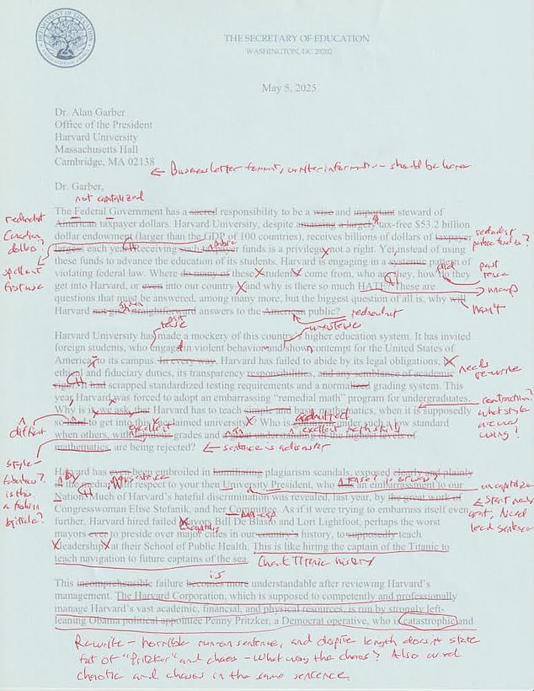
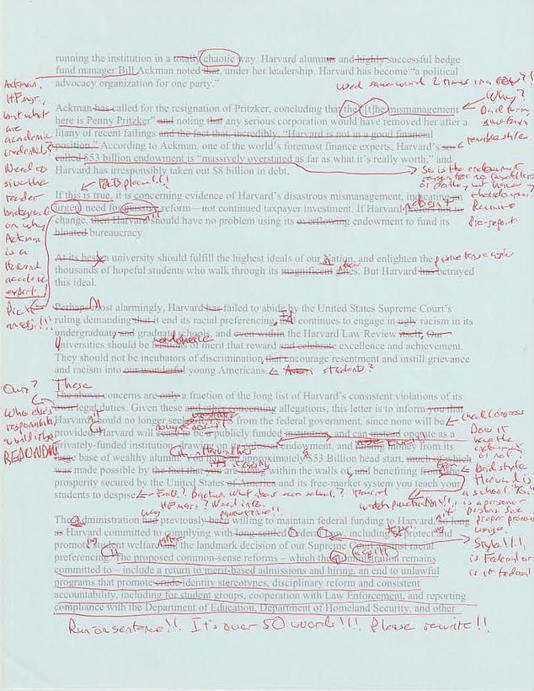
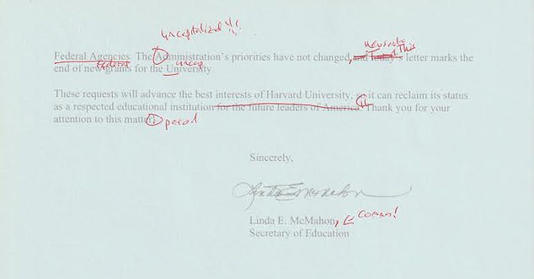
Trump Education Secretary mocked after critics spot (SP), grammatical errors in Harvard letter


Story by Katelyn Caralle, Senior U.S. Political Reporter In Washington, D.C.
• DAILY MAIL , MAY 6. 2025

 
Social media users were quick to hop on editing a letter sent by President Donald Trump's Education Secretary to Harvard informing the Ivy League it would no longer receive federal grants.

Education Secretary Linda McMahon ramped up the administrations' war with the college on Monday by sending a letter informing Harvard's President Dr. Alan Garber his institution will not be eligible to receive money from the federal government until they fall in line with what Trump wants to see from colleges.

But the letter was swiftly lambasted by social media critics who noticed a slew of mistakes made by the woman in charge of helping dismantle the Education Department.

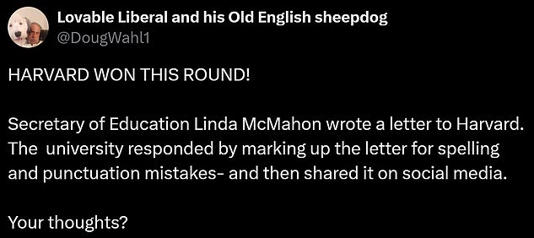
Harvard even edited the letter professor-style and sent it back to McMahon with the errors noted in red pen, according to a few posts made to X with a picture of the marked-up three pages.

'Harvard is engaging in a systemic (sic) pattern of violating federal law,' McMahon wrote in her letter, which both the university and others who edited the letter noted was likely meant to say 'systematic.'

'Where do many of these 'students' come from, who are they, how do they get into Harvard, or even into our country—and why is there so much HATE?' Secretary McMahon continued in the opening paragraph.


Education Secretary Linda McMahon was excoriated on social media when critics marked-up and red-lined her mistake-ridden letter to Harvard


A few different versions began circulating social media with professor-style red pen editing of McMahon's letter to Harvard threatening to pull federal grants


The notes call out randomly capitalized letters, run-on and incomplete sentences and even improper use of words and punctuation


Trump Education Secretary mocked after critics spot grammatical errors in Harvard letter

The letter goes on to mock Harvard's educational standards, despite McMahon's own mistakes. She goes after the Ivy League for the teaching of 'remedial math' and calls attention to plagiarism scandals at the school.

White House correspondent Andrew Feinberg with the Independent wrote on X of the letter: 'Whoever wrote this is barely literate.'

Another reporter questioned if it was written by Artificial Intelligence (AI).

An official previewed the action on a Monday night call before McMahon posted the letter on social media.

'For Harvard to become eligible for those competitions again, it would have to enter into a negotiation with the government to satisfy what the government says is in compliance with all federal laws,' the official said.

Research grants would be impacted by this action - but not federal student aid, which funnels through universities before going to students and providing them with financial relief.

Social media users said that Harvard 'won' this round of the war with the administration because of the numerous mistakes in the letter.

Right off the bat, McMahon wrote 'Federal Government,' which critics said was improper because she capitalized the letters 'F' and 'G' when it is not a proper noun.


Trump Education Secretary mocked after critics spot grammatical errors in Harvard letter


One version, social media users claim, was marked-up and sent back to McMahon by Harvard – leading them to dub the Ivy League the winner of this round of the war with the Trump administration

The other mark-ups include noting run-on and incomplete sentences, inconsistent tensing and randomly capitalized words.

Trump has voiced displeasure with universities allowing pro-Palestinian demonstrations to run amok on campuses.

Officials within the president's team have also taken issue with what they consider to be lack of diversity in higher education - with too few conservatives on staff.

'They have become monolithically leftist and that DEI ideology connects to the anti-Semitism problem because they're teaching young people to make snap judgments about each other based on identity and skin color,' the senior official said.

The latest move represents a major escalation in a months-long war against the prominent institution.

Trump previously froze $2.2 billion in federal grants to Harvard and said he's looking into stripping the Ivy of its tax-exempt status.

A Department of Education official said in Monday's call that Harvard's endowment is 'virtually untaxed' and 'massive.'

'It's larger than the GDP of many countries and it was only possible for them to amass that thanks to the blessings of this country that they do business in,' the official said.

Garber has previously said he won't bend to the government.

The university sued last month to overturn the funding freeze, pushing back against the government's 'sweeping and intrusive demands.'

In the letter, released on White House officials' social media accounts, McMahon said that receiving taxpayer funds was a 'privilege, not a right' and claimed that Harvard was breaking federal law.

The letter started out by focusing on the immigration status of students - likely those involved in the pro-Palestinian demonstrations - with McMahon saying they were engaged in 'violent behavior.'  
IRONIC CONSIDERING SHE IS HALF OWNER OF THE WWE 
ALONG WITH HUBBY VINCE.