It’s possible that I shall make an ass of myself. But in that case one can always get out of it with a little dialectic. I have, of course, so worded my proposition as to be right either way (K.Marx, Letter to F.Engels on the Indian Mutiny)
Saturday, May 24, 2025
Women's jobs three times more vulnerable to being taken by AI than men's, new report warns
A new UN-led report found that women's jobs in high-income countries are more likely to be replaced or touched by artificial intelligence than their male peers.
Women's jobs are at a higher risk of automation by artificial intelligence (AI) than those occupied by men, according to a new study from the United Nations.
The recent report from the UN's International Labour Organisation (ILO) and Poland's National Research Institute of the Ministry of Digital Affairs (NASK) found that automation could replace just under 10 per cent of female-dominated positions in high-income countries compared to the 3.5 per cent it could replace for men.
The biggest disparity between male and female-dominated jobs happens in high-income countries, where 41 percent of all high-income work for women could be exposed to AI, compared to 28 percent of men’s jobs.
In Europe and Central Asia, 39 per cent of women’s jobs could be affected compared to 26 percent of men.
The patterns identified by the study "reflect both occupational structures," and that AI-exposed jobs are "concentrated in higher-income countries".
Overall, the ILO found that one in four workers globally work in an occupation with some AI exposure.
Full replacement by AI still 'limited'
To reach these findings, the survey was conducted with1,640 people employed in various fields in Poland, with the results analysed by a small group of international experts.
Researchers then developed an AI that used this survey data alongside national job information to identify how likely 2,500 professions and over 29,000 work tasks would be automated.
The study found that clerical occupations like data entry clerks, typists, word processing operators, accountants, and bookkeeping clerks are the most exposed to AI, due to some of the tasks performed in those professions, like taking meeting notes or scheduling appointments.
Other professions identified with a large AI exposure are web and media developers, database specialists, financial, and software-related jobs.
The study notes that these numbers reflect the "potential exposure," but that they don't reflect any actual job losses.
Full replacement by AI is still "limited," the report continued, noting that human involvement is still needed to oversee certain tasks.
"As most occupations consist of tasks that require human input, transformation of jobs is the most likely impact of generative AI," the report reads.
What could impact the number of jobs lost or AI adoption more broadly are technological constraints, infrastructure gaps, and skills shortages, the report continued.
The report asks governments, employees, and workers organisations to shape "inclusive strategies" that can help protect job quality and productivity in endangered fields.
"It's easy to get lost in the AI hype," Janine Berg, senior economist at the ILO, said in a statement. "What we need is clarity and context".
Lawyer challenging Trump’s trade war says tariffs are ‘illegal and abusive’
"This administration is also characterized by severe economic illiteracy."
U.S. President Donald Trump speaks during an event to announce new tariffs in the Rose Garden at the White House, April 2, 2025, in Washington. (AP Photo/Mark Schiefelbein)
WASHINGTON — U.S. President Donald Trump's global trade war is an "illegal and abusive" use of power, said a lawyer representing small businesses who are challenging the tariffs.
George Mason University law professor Ilya Somin, along with the Liberty Justice Center, represents five American small businesses who had a hearing before the U.S. Court of International Trade last week in an effort to block Trump's sweeping "reciprocal" tariff agenda.
"He's sort of breaking various precedents and doing things which are highly illegal and obviously our contention is that this is highly illegal," Somin said in an interview Thursday.
The president is facing at least seven lawsuits that argue Trump has acted beyond his powers by wielding tariffs through the International Economic Emergency Powers Act of 1977.
The act, usually referred to by the acronym IEEPA, is a national security statute that gives the U.S. president authority to control economic transactions after declaring an emergency.
While its predecessor, the Trading With The Enemy Act, was used during the Nixon administration to briefly impose a 10 per cent tariff on all imports into the U.S., no president has used IEEPA for tariffs.
Somin said the statute does not mention tariffs, nor is there even a synonym, such as duties. The U.S. Constitution gives power over taxes and tariffs to Congress and Somin said Trump is misusing the statute.
"Our most basic argument, and also that of others challenging various uses of IEEPA to impose tariffs including against Canada, is that this statute does not authorize tariffs at all," Somin said.
Trump declared an emergency at the northern border in order to use IEEPA to slap Canada with tariffs in March. He partially paused the duties a few days later for imports under the Canada-U.S.-Mexico Agreement on trade.
At the same time he used the same presidential power to hit Mexico and China with tariffs, citing the flow of people and deadly fentanyl into the United States as the emergency for all three countries.
U.S. government data shows a minuscule volume of fentanyl is seized at the northern border.
Trump also declared an emergency around trade deficits in April, using IEEPA to take his trade war to the world with "reciprocal" tariffs. The president walked back the most devastating duties a few hours later, saying the 90-day pause would give countries time to negotiate a deal. He kept a 10 per cent universal levy in place.
Trump on Friday threatened to increase tariffs on imports from the European Union to 50 per cent next month. In a separate social media post, Trump said if Apple doesn't move iPhone manufacturing to the U.S., it will face 25 per cent tariffs.
Markets have been in turmoil with Trump's inconsistent tariff agenda.
Twelve states argued before the Court of International Trade in New York on Wednesday that tariffs make U.S. trade policy dependent on Trump's whims.
Lawyers for Arizona, Colorado, Connecticut, Delaware, Illinois, Maine, Minnesota, Nevada, New Mexico, New York, Oregon and Vermont argued the president exceeded his authority with the tariffs, including by hitting Canada with duties.
Lawyers for the Trump administration countered that Congress, not the courts, determines if the president's rationale for declaring an emergency complies with the law.
Somin's case is separate and only deals with Trump's "reciprocal" tariffs but many arguments are similar. The statute said the emergency must be "extraordinary and unusual " and Somin said they argue that does not apply to Trump's tariff rationale.
Somin said in both hearings the three-judge panel was "highly skeptical" of the claim that Trump has virtually unlimited tariff power.
Somin said he expects the judges to expedite their decision but whichever party loses is almost certainly going to appeal to the federal circuit. Somin said it could end up in front of the Supreme Court.
In the meantime, Somin said the tariffs are causing business uncertainty and economic harm.
"This administration is also characterized by severe economic illiteracy."
— With files from The Associated Press
This report by The Canadian Press was first published May 23, 2025.
U.S. President Donald Trump’s tariff decisions since he took office on January 20 have shocked financial markets and sent a wave of uncertainty through the global economy.
Here is a timeline of the major developments:
February 1 - Trump imposes 25% tariffs on Mexican and most Canadian imports and 10% on goods from China, demanding they curb the flow of fentanyl and illegal immigrants into the United States.
February 3 - Trump suspends his threat of tariffs on Mexico and Canada, agreeing to a 30-day pause in return for concessions on border and crime enforcement. The U.S. does not reach such a deal with China.
February 7 - Trump delays tariffs on de minimis, or low-cost, packages from China until the Commerce Department can confirm that procedures and systems are in place to process them and collect tariff revenue.
February 10 - Trump raises tariffs on steel and aluminum to a flat 25% “without exceptions or exemptions.”
March 3 - Trump says 25% tariffs on goods from Mexico and Canada will take effect from March 4 and doubles fentanyl-related tariffs on all Chinese imports to 20%.
March 5 - The president agrees to delay tariffs for one month on some vehicles built in Canada and Mexico after a call with the CEOs of General Motors GM.N and Ford F.N and the chair of Stellantis STLAM.MI.
March 6 - Trump exempts goods from Canada and Mexico under a North American trade pact for a month from the 25% tariffs.
March 26 - Trump unveils a 25% tariff on imported cars and light trucks.
April 2 - Trump announces global tariffs with a baseline of 10% across all imports and significantly higher duties on some of the U.S.’ biggest trading partners.
April 9 - Trump pauses for 90 days most of his country-specific tariffs that kicked in less than 24 hours earlier following an upheaval in financial markets that erased trillions of dollars from bourses around the world.
The 10% blanket duty on almost all U.S. imports stays in place.
Trump says he will raise the tariff on Chinese imports to 125% from the 104% level that took effect a day earlier. This pushes the extra duties on Chinese goods to 145%, including the fentanyl-related tariffs imposed earlier.
April 13 - The U.S. administration grants exclusions from steep tariffs on smartphones, computers and some other electronics imported largely from China.
April 22 - The Trump administration launches national security probes under Section 232 of the Trade Act of 1962 into imports of both pharmaceuticals and semiconductors as part of a bid to impose tariffs on both sectors.
May 4 - Trump imposes a 100% tariff on all movies produced outside the U.S.
May 9 - Trump and British Prime Minister Keir Starmer announce a limited bilateral trade agreement that leaves in place 10% tariffs on British exports, modestly expands agricultural access for both countries and lowers prohibitive U.S. duties on British car exports.
May 12 - The U.S. and China agree to temporarily slash reciprocal tariffs. Under the 90-day truce, the U.S. will cut the extra tariffs it imposed on Chinese imports to 30% from 145%, while China’s duties on U.S. imports will be slashed to 10% from 125%.
May 13 - The U.S. cuts the low value “de minimis” tariff on China shipments, reducing duties for items valued at up to $800 to 54% from 120%.
May 23 - Trump says he is recommending a straight 50% tariff on goods from the European Union starting on June 1.
He also warned Apple AAPL.O it would face 25% tariff if phones it sold in the U.S. were manufactured outside of the country.
Paolo Laudani and Mateusz Rabiega in Gdansk, editing by Jan Harvey, Kate Mayberry and Milla Nissi-Prussak, Reuters
‘Investment, not tariffs,’ says Japan's PM Ishiba after telephone talks with Trump before 3rd round of talks
Workers, back, unload vehicles while a car, centre front, is moved to another location of the area, where export vehicles are parked at the Daikoku vehicle terminal center in Yokohama, near Tokyo, April 8, 2025. (AP Photo/Hiro Komae)
TOKYO — Japan’s Prime Minister Shigeru Ishiba said Friday that he held telephone talks with U.S. President Donald Trump and agreed to hold “productive” discussions at an upcoming tariff talks between the two sides.
“Investment, not tariffs,” Ishiba told reporters after the talks. He said Japan’s position to keep pushing Washington to drop all recent tariff measures is unchanged and that he stands by plans to push for Japanese investment to create more jobs in the U.S. in exchange.
The two leaders held talks just after Economic Revitalization Minister Ryosei Akazawa, Japan’s chief tariff negotiator, headed to Washington for a third round of talks with his U.S. counterparts. In the earlier rounds of talks, the U.S. had not agreed to the Japanese requests.
Ishiba said he reminded Trump that Japan’s position was for the U.S. administration to scrap all recent tariffs on imports from Japan, to which the U.S. president made no specific response.
“I expressed my expectations for productive discussion to be held, and we agreed,” Ishiba told reporters.
The U.S. is charging a 25% tariff on imports of autos, a mainstay of Japan’s trade with the U.S. and a key driver of growth for the economy. Trump has relaxed some of those tariffs but has kept in place higher tariffs on steel and aluminum.
Friday’s talks were requested by Trump and the two leaders discussed about 45 minutes on range of topics that also included security cooperation between the two allies and the U.S. president’s recent visit to the Middle East, Ishiba said.
He said the two leaders also agreed to hold talks when they both attend the Group of Seven summit in Canada next month.
Mari Yamaguchi, The Associated Press
New Canadian energy minister vows an end to lengthy project approvals
Minister of Energy and Natural Resources Tim Hodgson arrives for a meeting of the federal cabinet in West Block on Parliament Hill in Ottawa on Wednesday, May 14, 2025. THE CANADIAN PRESS/Justin Tang (Justin Tang/The Canadian Press)
Canada’s new Natural Resources Minister Tim Hodgson vowed to speed up the permitting process for major projects on Friday, in a speech welcomed by oil and gas executives eager to see Ottawa reset its regulatory approach to energy development.
It was Hodgson’s first speech in Canada’s corporate oil capital of Calgary, Alberta, since being sworn in as part of Prime Minister Mark Carney’s new cabinet.
The oil and gas sector had a tense relationship with former Prime Minister Justin Trudeau’s government, which it viewed as prioritizing climate action over economic development, but Carney has pledged to help diversify energy export markets amid a trade dispute with Canada’s No. 1 customer, the United States.
“In the new economy we are building, Canada will no longer be defined by delay, we will be defined by delivery,” Hodgson said at an event hosted by the Calgary Chamber of Commerce.
A former Goldman Sachs banker who was elected in a Toronto riding, Hodgson pledged to be a voice for western Canada and help the country’s energy sector improverelations with Ottawa.
He said he will work to identify and fast-track projects of national interest aimed at helping the country become a conventional and clean energy superpower. Canada is the world’s fourth-largest oil producer.
“No more five-year reviews. Decisions will come in two years for all projects to make that happen,” Hodgson said.
Hodgson said responsibly produced Canadian oil could displace oil produced in authoritarian regimes, but the country needed infrastructure to get its energy to ports for export to markets beyond the U.S.
In recent years, major Canadian oil pipelines have faced years of regulatory delay and legal challenges, leading to cancellations for some projects and spiraling costs for others, like the Trans Mountain expansion.
The CEOs of many of Canada’s biggest oil and gas companies said they were encouraged by Hodgson’s background in finance as well as the pro-development tone of his remarks.
“The renewed sense of collaboration is welcomed and genuinely appreciated,” said John Whelan, president of Imperial Oil IMO.TO, after the speech.
Hodgson also said the federal government, the province of Alberta, and industry leaders must work together to build a proposed oil sands carbon capture and storage project.
Six of Canada’s largest oil sands companies have proposed building a C$16 billion carbon capture network to reduce emissions from the sector, but negotiations with both levels of government have stalled.
Kendall Dilling, president of the Pathways Alliance consortium behind the proposed project, said on Friday he is optimistic that under Canada’s new government, the project will proceed.
“I do think the time is now,” Dilling said.
Reporting by Amanda Stephenson; Writing by David Ljunggren; Editing by Mark Porter, Reuters
The Bank of Canada is seen in Ottawa, on Wednesday, April 16, 2025. THE CANADIAN PRESS/Justin Tang (Justin Tang/The Canadian Press)
The latest economic forecasts from TD Bank, BMO, National Bank and Deloitte all suggest that Canada could be heading towards a recession this year.
Those financial institutions predict that Canada’s gross domestic product (GDP) will shrink in the second and third quarters of 2025. Two quarters, or six months, of negative economic growth meets the traditional definition of a recession, although there are many other indicators. A recession is essentially a temporary period of economic decline characterized by reduced spending, a drop in business activity and a rise in job losses.
Dalhousie University economics professor Lars Osberg says GDP changes don’t provide a full picture and Canada could already be in the midst of a recession.
“The unemployment rate’s been ticking up for some time, labour force participation is trending down, average income is declining,” Osberg told CTVNews.ca. “We’ve been in that situation for a little while. The trade war comes along and makes it a whole lot worse.”
U.S. President Donald Trump’s tariffs have upended international trade and pushed up prices. But even if Canada is able to come to a quick agreement with the U.S. on a new trade deal, the uncertainty created by Trump could still linger.
“The impact of tariff uncertainty on investment is going to depress economic activity going forward even if we manage to design a new agreement, because we don’t really know how long that agreement is going to last,” Osberg said. “Suddenly in the last few months, we’ve had a massive increase in uncertainty.” Recession and job losses
“The problem that the Bank of Canada and the government is facing is that a trade war, a tariff war, is affecting both inflation and unemployment in negative ways,” Osberg said. “We get higher unemployment because we’ve got lower investment, lower exports, less consumer spending; and we get higher prices because of course the tariffs are bumping up prices.”
According to TD’s forecast, Canada’s GDP will shrink by 1 per cent in the second quarter of 2025, and 0.2 per cent in the third quarter. BMO puts the decline at 1 per cent in both quarters. The National Bank forecasts the largest decline at 1.1 and 1 per cent. Deloitte forecasts a similar GDP drop of 1.1 and 0.9 per cent.
That assessment is not shared by other major Canadian banks like RBC and Scotiabank, which forecast low but positive growth in both quarters. CIBC meanwhile is forecasting only one negative quarter.
All predict a return to positive GDP growth in the first quarter of 2026. Economic slowdown, not a recession
Concordia University senior economics lecturer Moshe Lander also doesn’t predict Canada will enter a recession, but he says we are in the midst of an “economic slowdown.”
“That doesn’t necessarily require two consecutive quarters of declining GDP, just we’re not going to grow as fast as we could, should or did,” Lander explained. “The stock market could soften, the housing market could soften, the labour market could soften. We could start to see be more and more people caught up in financial distress because of job losses, or that their income isn’t growing as fast as it otherwise could or should.”
Like Osberg, Lander says Canada’s economic problems were not created by the Trump administration.
“We probably would have experienced a slowdown anyway, it’s just we’re experiencing a more severe slowdown or a more sudden slowdown because of the tariff talk,” he said. “So it is certainly a major contributor, but the economy was already showing signs of stress.”
Lander says the difference in economic forecasts boils down to it being an “imperfect science.”
“It’s the joke among economists that they’ve successfully predicted nine of the last five recessions,” he said. “Inherently there’s going to be variability… those could be things like, how long do they think the tariffs are going to last, or how high are they going to go?”
York University associate economics professor George Georgopoulos says recent deals with countries like the U.K. show that U.S. trade tensions could be thawing.
“While I expect GDP growth to slow down in Canada over the second and third quarter, I do not expect negative GDP growth in either quarter,” Georgopoulos told CTVNews.ca. “The environment now is more conciliatory and open to a healthy discussion on reducing tariff rates.” Daniel Otis CTVNews.ca Journalist
The head of the $714.7 billion investment arm of the Canada Pension Plan (CPP) says he sees opportunity in large-scale domestic infrastructure projects proposed by Prime Minister Mark Carney.
John Graham told The Canadian Press this week there could be value in giant infrastructure projects like bridges and pipelines for the millions of Canadians invested in the public workplace pension.
“We think that there may be the will to actually build some of these things,” he said. Investing for Canada by investing in Canada
The comments come as Canada moves to decrease its economic reliance on the United States, stoke the domestic economy, and strengthen ties with the rest world.
The move by the CPP Investment Board (CPPIB) to increase its stake in Canada would be a reversal of a decades-long push to diversify beyond Canada.
Canadian public equities account for under three per cent of global equities and two-thirds of that tiny sliver are tied to the resource and finance sectors. Investing too much in Canada concentrates risk and blocks opportunity in the remaining 97 per cent of the world.
As of March 31, 47 per cent of the fund remained invested in the U.S. compared with 12 per cent in Canada. 19 per cent was invested in Europe, 17 per cent in the Asia Pacific region and five per cent in Latin America.
Holdings are further diversified among asset classes and sectors.
Diversification pays off for investors
The comments from John Graham come as CPP Investments reported a net return of 9.3 per cent for its latest fiscal year - a bit short of its benchmark return of 10.9 per cent.
The biggest gains came from public equities in the U.S. and China despite the threat of a global trade war.
Results also got a boost from a weak loonie in relation to other currencies when foreign gains are converted to Canadian dollars. By any standard, long-term performance has been stellar. In its May 2025 report, state-run investment fund tracker Global SWF ranked CPP Investments second among 25 global pension funds for 10-year returns from 2015 to 2024 with an average annual return of 9.2 per cent.
Only Sweden’s AP7 pension ranked higher. In a 2012 report, the Office of the Chief Actuary of Canada estimated the CPP investment fund would only need a real rate of return of four per cent annually until 2087 to sustain the entire plan at the current contribution rate.
How much Canada is too much Canada?
On one hand, investing Canadian retirement dollars in Canadian infrastructure and the Canadian economy seems like a win-win. But if geographic diversification is the key to bigger returns and less risk, over-investment in Canada could compromise future returns.
That really depends on how much Canada the CPPIB is prepared to take on.
Canadian investment industry groups have suggested preferential tax treatment to encourage domestic investments. Up until the 1990s registered retirement saving plans (RRSPs) were restricted from holding more than twenty per cent of assets outside Canada.
There’s a risk politics and patriotism could take priority over sound investment decisions, but one guardrail is the fact that the CPP is a crown corporation and not a sovereign wealth fund. Technically, it operates at arm’s length from the government and solely manages contributions paid by workers and employers, not public funds. What it means for your retirement portfolio
In most cases, CPP benefits are intended as a supplement to other retirement savings like RRSPs and company pensions. In 2025 the maximum annual payout at age 65 is $17,200 but few Canadians actually reach that amount.
Individual benefits are calculated based on the amount contributed, average earnings throughout your working life, and the age you start collecting.
One big bonus is that CPP benefits are adjusted to the cost of living and that creates an inflation hedge most pensions don’t have.
Canada's first SMR project: How is CAD20.9 billion cost calculated?
Friday, 23 May 2025
World Nuclear News
The go-ahead has been given for Ontario Power Generation to begin construction of the first of four small modular reactors at the Darlington New Nuclear Project site - the total projected cost is CAD20.9 billion (USD15.1 billion), but what does that figure include?
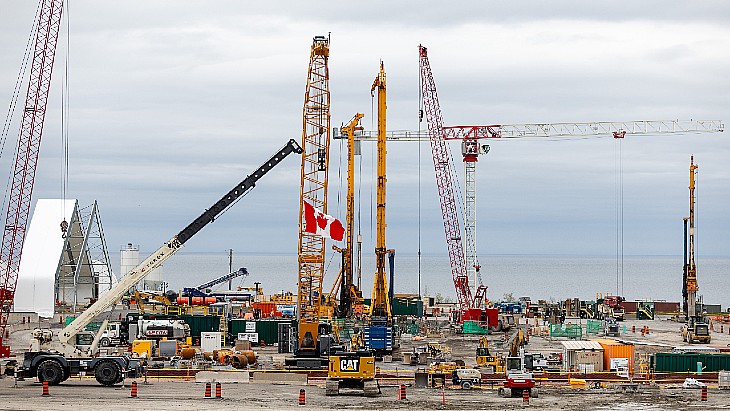
The Darlington New Nuclear Project site is alongside the existing Darlington Nuclear Generating Station (Image: OPG)
Firstly, what is the project?
The Province of Ontario on 8 May announced its final investment decision to give the green light to Ontario Power Generation (OPG) for construction of what is expected to be the first operating commercial small modular reactor (SMR) in any G7 country. The plan is to eventually have four of GE Vernova Hitachi Nuclear Energy's BWRX-300 SMRs at the site - each able to generate 300 MW, enough to power about 300,000 homes.
What is the small modular reactor chosen?
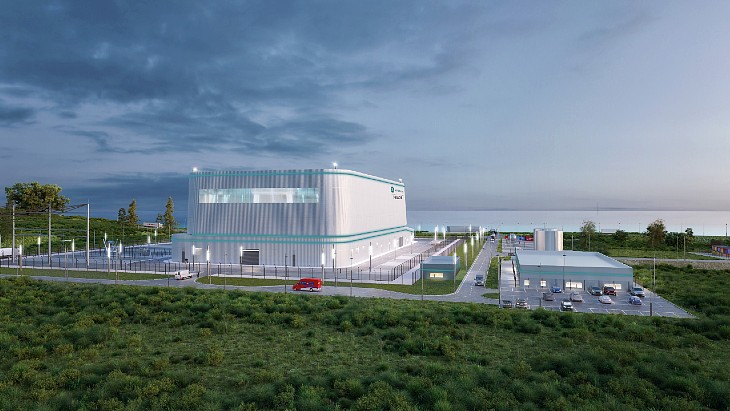
A small modular reactor is widely defined as a nuclear reactor that produces up to about 300 MW - that output is about a third, or a quarter, of the output of the traditional large nuclear power plant. They are called modular because the aim is to be able to factory-produce and preassemble many of the parts on what would effectively be a production line, and then assemble some on-site. They are slated to take up a lot less space than a traditional nuclear power plant - one BWRX-300 reactor and associated building structures takes up about the same space as a football field. Here's a rendering of how one might look:
(Image: GE Vernova Hitachi Nuclear Energy)
The BWRX-300 is a 300 MWe water-cooled, natural circulation SMR with passive safety systems that leverages the design and licensing basis of GE Vernova Hitachi's 1500 MW (ie a traditional large-scale unit) ESBWR boiling water reactor.
How much will the project cost?
The total cost of the four-SMR project is CAD20.9 billion. That's USD15.1 billion, GBP11.2 billion or EUR13.3 billion.
How much will the first SMR cost?
The initial SMR is forecast to cost CAD6.1 billion. In addition, a series of infrastructure and services will be needed to be developed for the site - such as roads, sewers, bridges, ancillary buildings, fibre lines and tunnels for cooling water supplies - which will eventually service all four SMRs. That will cost CAD1.6 billion. So, in total there is a budget of CAD7.7 billion for the first SMR and the shared or common infrastructure.
How final are the estimates for the second, third and fourth SMRs?
OPG says that together with its project partners "it will continue to refine the total estimated project cost during the definition phase of the remaining three units, incorporating lessons learned from the construction of the first SMR", similar to the manner in which the Darlington Refurbishment project is being executed. Planning and licensing efforts are currently taking place for the next three SMRs and the provincial government provided CAD55 million in funding in March to support the development of the plans for these three units.
What does the total project cost estimate include?
OPG says that it includes everything needed to build the new nuclear plant, including licensing, engineering, procurement, construction, operations readiness, contingency, interest and escalation. Often, when discussing or comparing energy generation projects, people refer to 'overnight costs', which is the theoretical cost of constructing a project overnight, so will not include the impact of interest and other charges on the money borrowed to finance a scheme. Some estimates only include costs borne by the technology developer and not the owner's costs. By contrast the Darlington New Nuclear Project estimate of CAD20.9 billion includes all costs, including interest charges and escalation costs. Escalation costs refers to inflation's impacts on equipment and labour costs and has been calculated for the entire 10-year project horizon (including the planning stages).
What about contingency costs?
There is also a contingency element within the project budget, although its size has not been published. This is estimated by identifying known risks and applying a contingency figure to them with OPG saying "over the course of the project, we will use contingency for risk that cannot be fully mitigated. This is an extremely prudent project management approach that includes highly detailed analysis".
How can a budget be solid when it's a first-of-a-kind project?
OPG says that it has taken lessons on board from its Darlington Refurbishment programme, which is in the ninth year of a 10-year execution phase and remains on time and on budget. That project involved the massive refurbishment of four nuclear power units and OPG says it intends to again use the system of "staged execution" to "ensure we can apply learnings from the first unit’s construction to deliver cost and time savings on subsequent units". Refurbishment work on the second unit was completed 250 days faster than the first.
Will this project demonstrate the cost benefits of modularity?
OPG says that the figure for the cost of the first unit is a "release-quality estimate". This basically means it is a well-informed figure with maturity in engineering design, procurement and schedule. The estimates for the second, third and fourth units are not yet as far developed, but see a gradual reduction in costs for each successive unit to CAD4.1 billion (USD2.9 billion) for the fourth unit - that makes it about 33% cheaper than the first unit.
So are they going to be built as four separate projects?
No. The plan is for OPG to build the first-of-a-kind BWRX-300 SMR and learn every lesson they can from the process and then implement the lessons into the subsequent units. The plan is effectively to build the one unit, then develop an optimised plan to build the future units. The remaining three will overlap during construction and be executed as a rolling programme.
What is the timeline for the project?
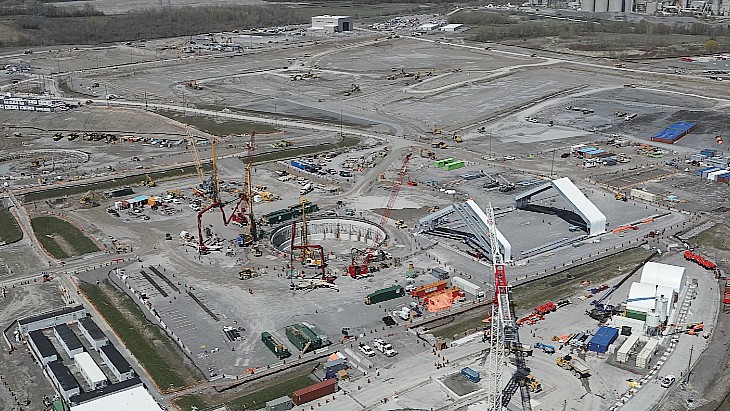
The timeline for the first unit is to complete construction by the end of the decade and in service in 2030. The remaining three units will be completed in the mid-2030s. Preparation work on the site has been advancing for all four units, ahead of the construction go-ahead:
(Image: OPG)
What will be the economic benefits of the new nuclear units?
The Conference Board of Canada estimates that the deployment and operation of the four SMR units will increase Ontario's GDP by CAD35.1 billion (in 2024 dollars) over 65 years and Canada's GDP by CAD38.5 billion. It will also sustain 18,000 jobs during the construction phase and 2,500 jobs over the projected 60 years of operation. The economic multiplier - the ratio of increased GDP to spending - is estimated as 0.91 (so one dollar spent will boost GDP by 91 cents).
What do we know about the cost of the electricity generated?
The Ontario Energy Board will review the recovery of the costs for the project in future proceedings for OPG's regulated prices. The province is exploring potential financial policy tools that would benefit ratepayers, and OPG "continues to explore optimal financing arrangements in support of funding requirements for the planned capital investments". OPG will be recouping the cost of the unit(s) from customers' bills over the 60-year generating life of the units and says the projected cost of about 14.9 cents per kWh would be comparable with alternative renewable energy sources. OPG points to Ontario’s Independent Electricity System Operator evaluating the new nuclear project against viable non-emitting alternatives which found that replacing the project with wind, solar, and battery storage would require 5,600 to 8,900 MW of capacity at a cost of 13.5–18.4 cents per kWh compared with the 14.9 cents.
What are seen as the broader benefits?
Nuclear energy is seen as producing baseload clean energy, without the harmful climate emissions of fossil fuels - and without the land use and new transmission infrastructure requirements associated with alternative renewable energy sources. It produces energy around-the-clock, so can help in terms of energy security for Canada and help power things such as data centres which need huge amounts of reliable energy.
Why is the Canadian project getting so much attention?
In the past decade or two the promise and potential of small modular reactors has been well documented. There are more than 70 different designs in development and numerous projects being proposed. You can check out the projects being proposed on this World Nuclear Association tracker:
By going ahead now with the Darlington project Canada looks set to have the first commercial SMR operating in North America, or anywhere in G7. (Russia and China are in the lead with SMR construction and Argentina has a pilot SMR under construction). Poland, the USA and the UK are among a range of countries currently looking at BWRX-300 deployment. OPG says that "as the first mover on small modular reactors, the Darlington SMR project will create jobs for Canadian workers, contracts for Canada's booming supply chain and showcase Canada's capabilities and expertise to the world to further grow the industry while strengthening Canada's energy security".
Polish supply chain gears up for country's first nuclear project
By Warwick Pipe
World Nuclear News, in Warsaw
Thursday, 22 May 2025
The Polish government expects a significant share of work on the country's first nuclear power plant to be awarded to local companies, but there are steps needing to be taken by the Polish supply chain, the World Nuclear Supply Chain conference in Warsaw heard.
(Image: World Nuclear Association)
In November 2022, the then Polish government selected Westinghouse AP1000 reactor technology for construction at the Lubiatowo-Kopalino site in the Choczewo municipality in Pomerania in northern Poland. An agreement setting a plan for the delivery of the plant was signed in May last year by Westinghouse, Bechtel and Polskie Elektrownie Jądrowe (PEJ) - a special-purpose vehicle 100% owned by Poland's State Treasury. The Ministry of Climate and Environment in July issued a decision-in-principle for PEJ to construct the three-unit plant. The aim is for Poland's first AP1000 reactor to enter commercial operation in 2033. The total investment costs of the project are estimated to be about PLN192 billion (USD49 billion).
The government expects Polish companies to supply at least 40% of the components and services for the country's first nuclear power plant.
"We are starting our adventure [in nuclear power]," Andrzej Sidlo, counsellor at the Polish Ministry of Industry told the event, organised by World Nuclear Association. "However, we are not starting from scratch ... we don't yet have nuclear in our energy mix, however we have a lot of experienced nuclear companies because of export projects and because of international cooperation."
Monika Silva, Deputy General Director of IGEOS Nuclear - part of the Chamber of Commerce for Energy and Environmental Protection - told those attending that, overall, Polish companies have already supplied components and services to 44 nuclear power plant projects, two nuclear laboratories and two nuclear facilities in 26 countries around the world.
In March, international law firm Baker McKenzie - which acted as a legal counsel to Korea Electric Power Cooperation in relation to all aspects of the development, financing and refinancing of the UAE's Barakah project - published a report assessing the current state of readiness of the Polish nuclear sector in respect of the construction of the country's first nuclear power plant. The report also describes the further actions needed to bring Poland closer to completing the project.
The report, using the Nuclear Energy Readiness Index, found that Poland was about 58% ready to start construction of the Choczewo plant, scoring the highest scores for the political (9/10), regulatory and social (8/10) aspects of the undertaking. The lowest score was in the technology field (3/10). Investment and systemic issues, which consist of finance, human resources, accompanying investments and preparation of public administration, received 4 points each.
"It's very surprising that we have a very high score on the Polish political readiness because we are a pretty divided country when it comes to politics," said Agnieszka Skorupinska, Partner, Head of Sustainability and Energy Transition at Baker McKenzie. "But here we all agree we need to have nuclear, so this is a very important development and very important conclusion."
However, the Baker McKenzie report found that the preparedness of the country's supply chain was low, with local companies particularly needing guidance on norms and standards.
"We did rate it rather low, but not in the sense of companies being not fit or not prepared, but simply where the first nuclear project is ... the problem they have is that they really don't know 100% what is expected from them," Silva said. "I think when the information is clear - we need you to do this and that and this will be our requirements for that product - then it will be much easier for the Polish companies to show their real potential."
She said that the Polish industry was quite divided into two distinct groups - one that is "already involved, very developed, very skilled, having all of the levels of the requirement fulfilled". The second group are those that for many years did not believe that the Polish nuclear power plant project would materialise, so now need to take steps to prepare for it.
According to a survey released earlier this year by the Polish Economic Institute, more than 70% of Polish companies said they have experience in the energy sector that can be used in a nuclear project. One-third of companies declare experience from other projects in the nuclear sector abroad. The survey questioned more than 100 Polish companies, including more than 30% of the sample from the Pomeranian Voivodeship, where the project of the first Polish nuclear power plant is being implemented. The study included companies from the construction sector (30%), engineering and construction (28%) and machinery (22%).
Most of the surveyed companies have experience in large infrastructure projects, of which almost half (45%) have worked on the construction of gas or coal-fired power plants, and almost one-third (29%) have experience in nuclear energy. The study also showed that as many as three-quarters of Polish companies have experience in implementing at least one project in the energy sector.
The factors most frequently mentioned among those attracting domestic entrepreneurs to the Polish nuclear project included the opportunity to enter the nuclear energy sector, the possibility of developing and increasing the scale of operations, increasing employee competences and obtaining valuable references, as well as the ambitious and demanding nature of the project.
The companies surveyed were also aware of possible difficulties in joining the project. They mainly indicate a lack of financial support, a competence gap, too high investment requirements and difficulty in recruiting suitably qualified employees.
Westinghouse fuel arrives at Temelin nuclear power plant
Friday, 23 May 2025
The Czech Republic has taken delivery of the first 30 fuel assemblies for the Temelin nuclear power plant from Westinghouse as it replaces its previous supplier from Russia.
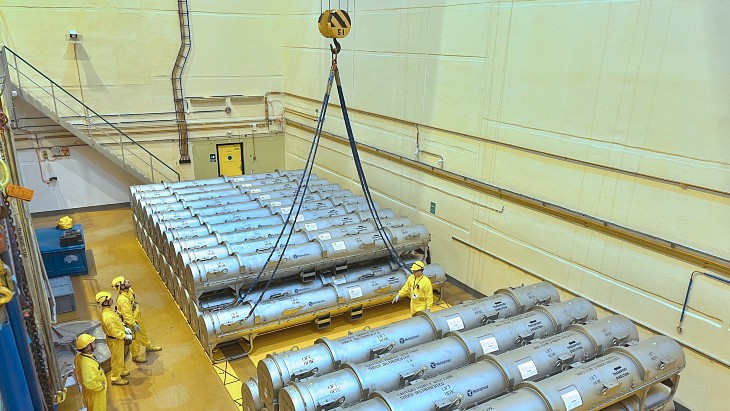
(Image: CEZ)
The country's nuclear power plant operator ČEZ began work to diversify its nuclear fuel suppliers in 2018, signing a contract for the supply of fuel assemblies for the Temelin plant with Westinghouse, and France's Framatome, in 2022. The company said it is expecting new fuel from Framatome next year.
The Czech Republic currently gets about one-third of its electricity from two VVER-1000 units in operation at Temelín, which came into operation in 2000 and 2002 and four VVER-440 units at Dukovany, which began operating between 1985 and 1987.
The diversification of nuclear fuel suppliers - and increases in fuel reserves - is seen as increasing energy security among European Union countries using Russia's TVEL for fuel for their VVER reactors which were designed in the Soviet Union era. ČEZ has also contracted Westinghouse to supply the Dukovany nuclear power plant, and is in negotiations with Framatome to follow suit.
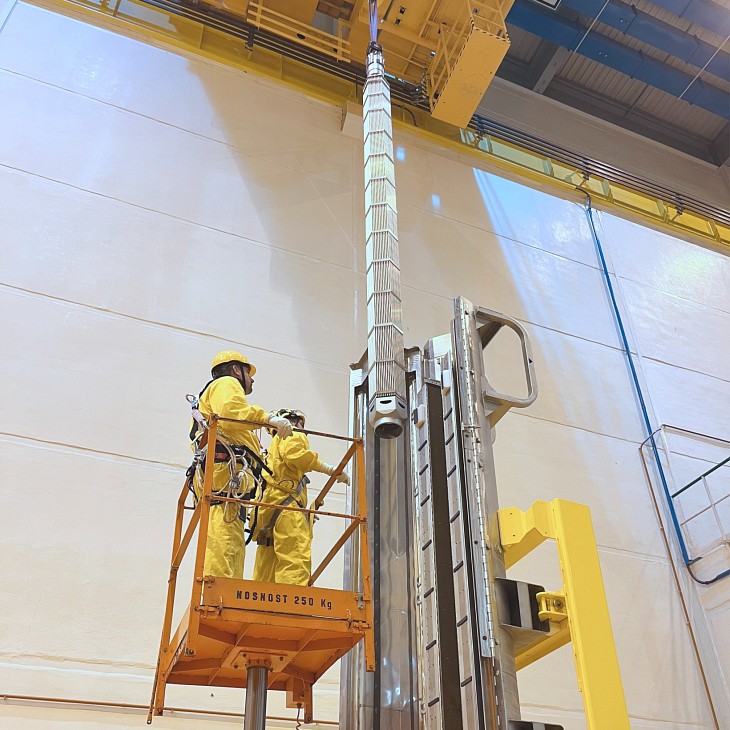
Acceptance checks are currently taking place with specialists verifying the weight of the fuel and performing visual inspections. Bohdan Zronek, director of ČEZ's nuclear energy division, said: "One of the first steps is to check the accelerometers. This is a special device that indicates inappropriate handling during transport."
(Image: ČEZ)
The company says that there had been a five-year series of analyses and tests as part of ensuring the new fuel meets the strictest safety requirements. The new fuel requires a permit from the State Office for Nuclear Safety, with ČEZ currently preparing to submit its application.
The new fuel will also enable longer fuel campaigns of 18 months at Temelin and 16 months at Dukovany, and Daniel Beneš, ČEZ chairman and CEO, said: "This is a step that significantly increases the energy security of the Czech Republic. In addition, to diversifying nuclear fuel suppliers, we also hold strategic reserves in both of our nuclear power plants."
Date set for Taiwan referendum on nuclear restart
Friday, 23 May 2025
A motion to hold a referendum on restarting the recently shut-down Maanshan nuclear power plant was passed in Taiwan's Legislative Yuan, and the Central Election Commission has now approved the proposal.
Maanshan (Image: Taipower)
The commission, which is an independent agency established to handle referendum issues, considered two referendum proposals, rejecting one relating to the the judicial death penalty process, judging that it did not fit the requirements of the Referendum Act.
However, the commission said that the referendum question on nuclear energy - 'Do you agree that the third nuclear power plant (Maanshan) will continue to operate after the competent authority agrees to confirm that there are no safety concerns?' - complied with the provisions of the Referendum Act.
"This referendum proposal is about energy policy, and it is about whether the third nuclear power plant, which stopped operating on 17 May 2025, should be put to a referendum to decide whether to continue operating. It should fall into the category of 'initiative or referendum on major policies'," it said.
It announced that the date for the referendum would be 23 August with voting from 08:00 to 16:00.
The background
Taiwan's Democratic Progressive Party (DPP) was elected to government in January 2016 with a policy of creating a "nuclear-free" Taiwan by 2025. Under this policy, Taiwan's six operable power reactors would be decommissioned as their 40-year operating licences expire. Shortly after taking office, the DPP government passed an amendment to the Electricity Act, passing its phase-out policy into law. The government aims for an energy mix of 20% from renewable sources, 50% from liquefied natural gas and 30% from coal.
As Taiwan's last operating reactor, Maanshan 2 had been providing about 3% of its electricity. On Saturday, it was disconnected from the grid and is set to be decommissioned following the expiry of its 40-year operating licence, in accordance with Taiwan's nuclear phase-out policy.
Last week, Taiwan's Legislative Yuan passed an amendment to the Nuclear Reactor Facilities Regulation Act that allows nuclear power plant operators to apply for a 20-year licence renewal beyond the existing 40-year limit, potentially extending a plant's operating lifespan to 60 years, the Central News Agency reported. The final vote saw the main opposition Kuomintang and the Taiwan People's Party push the amendment through with 60 votes in favour, defeating the ruling DPP's 51 votes.
Separately, Taipei Times reported last week that Taiwan's National Atomic Research Institute (NARI) has launched a large-scale, four-year small modular reactor research project with a budget exceeding TWD100 million (USD3.3 million). President William Lai has said he remains open to the use of advanced nuclear technologies as long as three conditions are met: nuclear safety, proper management of nuclear waste and societal consensus. Anticipating the potential commercial debut of SMRs by 2030, NARI said its goal was to provide a reference for industrial or national policies.
The vote for the referendum to be held on restarting Maanshan 2 was held just three days after it was disconnected from the grid. The proposal was passed by 58 votes to 49, and was supported by the main opposition Kuomintang and the Taiwan's People's Party.
Sweden passes bill on state aid for new reactors
Friday, 23 May 2025
Sweden's parliament - the Riksdag - has approved the government's proposals for providing state aid to companies that want to invest in new nuclear reactors in the country. The new law will enter into force later this year.
The Riksdag's East Wing (Image: Swedish Parliament)
In October 2022, Sweden's incoming centre-right coalition government adopted a positive stance towards nuclear energy. In November 2023, it unveiled a roadmap which envisages the construction of new nuclear generating capacity equivalent to at least two large-scale reactors by 2035, with up to 10 new large-scale reactors coming online by 2045.
In a bill submitted to parliament on 27 March this year, the Swedish government proposed a new law regarding state support for nuclear power investments. In the bill it proposed providing state loans to finance new reactors as well as a contract-for-difference power price mechanism.
The loans - aimed at lowering the cost of financing new nuclear - will be limited to the equivalent of four large-scale reactors (about 5000 MWe of capacity). The government noted that support may only be granted if the new reactors are located at the same location and have a total installed output of at least 300 MWe. The two-way Contracts for Difference may be entered into once a new reactor has become operational and has been licensed to produce electricity at full capacity.
The Riksdag has now approved the government's proposal. The new act on state aid enters into force on 1 August. Interested companies may apply for the aid from that date.
"This is a historic announcement that takes responsibility for public financing and tax payers' money when we enable actors to build new nuclear energy," said Minister for Financial Markets Niklas Wykman. "An expansion of nuclear power is expected to result in greater price stability and lower system costs, which helps households as well as businesses. With new nuclear reactors, we are paving the way for higher growth, more jobs and better conditions to achieve the climate transition."
The government appointed Mats Dillén in December 2023 to produce and submit proposals for models for financing and risk sharing for the construction of new nuclear power reactors. According to the mandate, the proposed models must be designed so that nuclear power with a total output of at least 2500 MWe - equivalent to the output of two large-scale reactors - must be in place by 2035 at the latest.
Dillén presented the findings of the study in August last year. His report said the investigation "identified conditions which give rise to a discrepancy between a private investor's business case for new nuclear power and the socioeconomic equivalent. It is concluded that efficiency reasons give a rationale for the state to support investments in nuclear power".
His proposed financing and risk sharing model consists of three main components that lead to a lower cost of capital that facilitates new investments in nuclear power at a low cost. The components are: state loans to finance investments in new nuclear power, which lowers the cost of capital; a two-way contract-for-difference signed between the state and the nuclear power producer; and a risk and gain-share mechanism that gives investors a minimum return on equity.
Article researched and written by WNN's Warwick Pipe
Finnish regulator on track for repository decision by year-end
Friday, 23 May 2025
Finland's Radiation and Nuclear Safety Authority has said it remains on track to complete its assessment of Posiva Oy's operating licence application for the world's first used nuclear fuel repository despite deficiencies in the materials submitted for review.
(Image: Posiva)
Radioactive waste management company Posiva submitted its application, together with related information, to the Ministry of Economic Affairs and Employment on 30 December 2021 for an operating licence for the used fuel encapsulation plant and final disposal facility currently under construction at Olkiluoto. The repository is expected to begin operations in the mid-2020s. Posiva is applying for an operating licence for a period from March 2024 to the end of 2070.
The government will make the final decision on Posiva's application, but a positive opinion by the Radiation and Nuclear Safety Authority (STUK) is required beforehand. The regulator began its review in May 2022 after concluding Posiva had provided sufficient material. The ministry had requested STUK's opinion on the application by the end of 2023. However, in January last year, STUK requested the deadline for its opinion be extended until the end of 2024. In December, the ministry extended the deadline for the regulator's opinion to 31 December 2025.
STUK has now said that there are still deficiencies in the materials submitted for review by Posiva, "which the company must correct". The regulator also noted that Posiva has made changes to its original plans, which has required updating the materials. "The updates have delayed STUK's work more than expected in the early part of the year," it said.
Although STUK's assessment of the application is in the final stages, the statement and safety assessment cannot be completed until it has assessed and approved all of Posiva's operating licence application materials.
"As soon as we receive the remaining materials we need and the supplements we requested, the assessment can be made and the statement can be completed," said STUK Project Manager Antti Tynkkynen.
"If future Posiva data updates do not cause further clarification, it is possible that the review of the licence application data will be completed well before the end of this year," STUK said.
At the repository, used fuel will be placed in the bedrock, at a depth of about 430 metres. The disposal system consists of a tightly sealed iron-copper canister, a bentonite buffer enclosing the canister, a tunnel backfilling material made of swellable clay, the seal structures of the tunnels and premises, and the enclosing rock.
Posiva announced in late August the start of a trial run - expected to take several months - of the operation of the final disposal facility, albeit still without the used fuel.
"One of the time-consuming issues has been the supervision of the test runs of the disposal facility," STUK said. "During the first quarter of 2025, STUK required Posiva to investigate the status of the systems used in the encapsulation and disposal facility and the test runs for the entire facility. STUK has not yet received most of the test run reports for the safety-classified systems and has not been able to assess the test runs as a whole."
STUK is also assessing the readiness of Posiva's organisation to start operating the final disposal facility. In the autumn of 2024, STUK began enhanced supervision of Posiva's organisation. In parallel, STUK introduced incident investigation methods at the beginning of the year in order to deepen its understanding regarding the observations it has made concerning Posiva's organisation as well as the factors underlying them. At the same time, STUK is looking for ways to plan, target and develop its own supervision.
"I find it positive that, in addition to our own estimates, the authority is taking steps to independently ensure that our operations meet all the set safety requirements," said Ilkka Poikolainen, President and CEO for Posiva.
The government granted Posiva a construction licence for the project in November 2015 and construction work on the repository started in December 2016. Once it receives the operating licence, Posiva can start the final disposal of the used fuel generated from the operation of TVO's Olkiluoto and Fortum's Loviisa nuclear power plants. The operation will last for about 100 years before the repository is closed.
Article researched and written by WNN's Warwick Pipe
WAIT, WHAT?!
Russia 'ready to keep supplying enriched uranium to USA'
Friday, 23 May 2025
World Nuclear News,
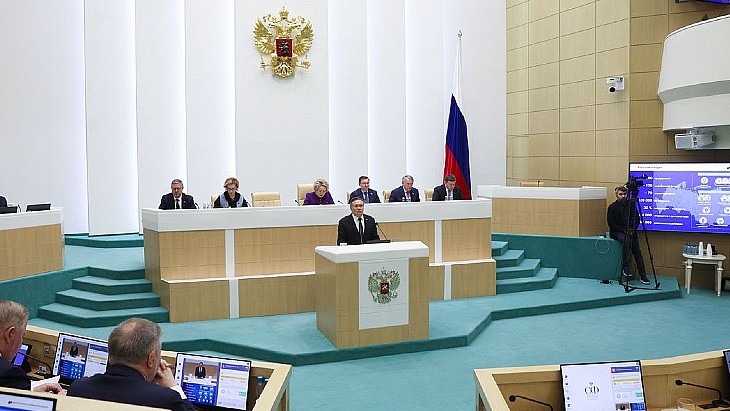
Rosatom Director General Alexey Likhachev has said the USA continues to buy enriched uranium from Russia and "in the context of the ongoing negotiations between the US and the Russian Federation ... we can expand the agenda of this cooperation".
The Rosatom director general speaking at the Federation Council (Image: Rosatom)
The comments to media, reported in multiple news outlets in Russia including the official Tass news agency, also included Likhachev saying that "despite all bans, the Americans buy it" because price-wise "it makes sense for them".
He was speaking after addressing the Federation Council of the Federal Assembly, where he set out the state of the nuclear energy sector and the state corporation's future plans, including to build 38 large, medium and small nuclear power units by 2042 and increase nuclear's share of energy generation to 25% by the mid-2040s.
He was asked during the Federation Council session about the impact of sanctions, and said that although "it doesn't make our lives easier" it had not stopped its developments - apart from in Finland - adding: "We will be present in the European market one way or another, and will cooperate in uranium supplies with the United States of America, unless another decision is made." He said that about 20% of Rosatom's overseas earnings came from "unfriendly" countries, while trade with "friendly" countries grows.
The then US President Joe Biden's Prohibiting Russian Uranium Imports Act came into force in August 2024 and lasts until 2040. Until 2028 waivers may be granted to allow the import of limited amounts of Russian-origin low enriched uranium. According to US Energy Information Administration data, while US facilities provided 28% of the uranium enrichment services - measured in separative work units, or SWU - purchased by US owners and operators in 2023, 27% came from Russia, more than any other foreign supplier.
The US legislation was followed by Russia responding by imposing a ban on exports of enriched uranium to the USA, although exemptions would be made for deliveries under one-off licences issued by the Russian Federal Service for Technical and Export Control.
Since those tit-for-tat measures were imposed there has been a change of president in the USA and there have been detailed contacts and talks between the USA and Russia relating to the Ukraine war and wider relations.
Khokhlovskoye uranium deposit
Meanwhile JSC Rusburmash, part of Rosatom's mining division, announced it had finished the construction of facilities for developing the Eastern deposit of the Khokhlovskoye uranium deposit in the Shumikhinsky District of the Kurgan Region which lies on Russia's southern border with Kazakhstan. It said that over two years "the Vostochnaya local sorption unit, an underground water intake site, utility network overpasses and process pipelines, and other facilities were built".
"Currently, the Central and Western deposits are being developed, and production has begun in the Eastern one. Further plans include developing the Far Eastern and Dyuryaginskaya deposits," said Dinis Ezhurov, General Director of JSC Dalur, which is developing the Khokhlovskoye deposit and which is the first enterprise in the country to mine uranium using the borehole in-situ leaching method.
The company said that digital tools are being used to manage the development of uranium deposits which makes it possible "to identify and evaluate the additional volume of uranium reserves ... and allow for a reliable assessment of the mining and geological conditions of the developed areas of deposits, modeling development options, conducting an accurate analysis of the work performed, promptly making decisions when analysing and forecasting the development of the deposit, geological modeling and planning".



_52327.jpg)
_48620(1)_58208_19595.jpg)
_34368.jpg)