Saturday, May 24, 2025

Espionage, Elections, Ethnic Tension: What’s Behind The Latest Hungary-Ukraine Spat? – Analysis


By 

Ukraine’s arrest of suspected Hungarian intelligence operatives in Transcarpathia has revived fears about Budapest’s intentions towards the region. But experts think the incident says more about Orban’s electoral vulnerability than his territorial ambitions.


By Alexander Faludy

Ukraine’s relationship with the US has improved over the last month with President Donald Trump expressing growing impatience with Russian counterpart Vladimir Putin’s tactical dissimulation over ending the war. Conversely, the already poor dynamic between Ukraine and one of its immediate neighbours, Hungary, appears to have worsened significantly.

On May 9, the Ukrainian authorities disclosed that they had detained two Ukrainian citizens in the western region of Zarkapatia (Transcarpathia) who, they alleged, were working for Hungarian intelligence.

The Transcarpathian region boasts an ethnic-Hungarian community estimated at about 100,000 prior to Russia’s full-scale invasion of Ukraine in 2022. Kyiv has long accused Hungary of undue interference in the province, while Hungary has cited concerns about the welfare of the Hungarian minority as a pretext for blocking closer relations between Ukraine and both the EU and NATO.

Ukraine’s counter-intelligence service, the SBU, claims that the two operatives were tasked with gathering information “about military security in Transcarpathia, to identify weak points in the region’s ground and air defences, and to study the socio-political views of local residents, particularly with regard to their expected behaviour in the event of Hungarian troops entering the region.”


Additionally, one of the two individuals is alleged to have been investigating what kinds of military equipment could be purchased on the black market in Transcarpathia.

Budapest responded rapidly with a strongly worded statement from Foreign Minister Peter Szijjarto, accusing Ukraine of “anti-Hungarian propaganda”, and the expulsion of two Ukrainian embassy staff in Budapest that it accused of spying under diplomatic cover. Kyiv immediately reciprocated by expelling two Hungarian diplomats. Ukraine had also been due to send a high-level representative to the Budapest Energy and Security Talks (BEST) – a NATO-sponsored security conference in the Hungarian capital that took place on May 19-20 – but then withdrew from participation.

Ukrainian revelations about Hungary’s alleged espionage in Transcarpathia were followed on May 10 by the publication of photographs purporting to show a Hungarian military build-up near the Ukrainian border 48 hours before Russia launched its full-scale invasion of its neighbour on February 24, 2022. The deployment, according to the American-based Robert Lansing Institute security think tank which published the photos, appeared to involve heavy armour and artillery as well as troops.

Since 2022, the Hungarian government has claimed consistently that its troop build-up was geared to providing logistical, medical and public order support to local civil authorities in the event of a refugee influx. The Robert Lansing Institute, however, asserted that, “the decision to mobilise heavily mechanized units… seems disproportionate and strategically incongruent with the stated objective.”

In the think tank’s view, “since at least 2014, the Hungarian government has maintained… contingency plans for an incursion into Western Ukraine —plans that may be informally coordinated with Moscow.”

International experts sceptical

Security analysts are generally cautious both about the significance of the spying scandal and the plausibility of Hungarian military intervention in Ukraine.

“Data on Ukrainian ground and air defences in Transcarpathia would be of little use to the Hungarian army,” argued a May 17 opinion piece by Anton Shekhovtsov of Vienna’s Centre for Democratic Integrity. Shekhovtsov believes that given Hungary’s own general lack of military preparedness relative to Ukraine, “the only actor likely to benefit from such intelligence is Russia.”

Kurt Volker, the US special envoy to Ukraine under the first Trump administration, took a more critical line when engaging with journalists this week at BEST. Hungary’s general posture towards Ukraine is, Volker noted, “very concerning, it’s Hungary seeming to take sides with Russia against Ukraine.”

Regarding the spying allegations, however, he was more cautious. “Nations engage in espionage, I don’t think this is a shock,” Volker said, pointing out that even allies spy on one another.

Fomenting civil strife on the other hand would, he acknowledged, be more worrying, but he believes there is insufficient information to draw any conclusions. “I think we probably need to learn a little more about what this operation was and what [those] people were doing – and we probably never will,” he said.

Experts also doubt that bilateral frictions would allow Hungary to obstruct the creation of any new European security architecture which includes Ukraine. “We’ve noted these problems, but don’t see them as major road blocks,” Peer Teschendorf, desk officer for European Foreign and Security Policy at the Friedrich Ebert Foundation in Berlin, told BIRN.

Domestic dimension

Adding to the intrigue is that Ukraine’s announcement of the two arrests in Transcarpathia occurred 24 hours after the release of a secret recording of Hungarian Defence Minister Kristof Szalay-Bobrovniczky made in April 2023. In the recording, released by Peter Magyar, the rising star of Hungary’s opposition Tisza party, the defence minister can be heard urging his colleagues to “break with the peace mentality and move into phase zero of the road to war.”

The coincidence has prompted some critics of the ruling Fidesz party to speculate that Szalay-Bobrovniczky’s words might refer to Hungarian ambitions in Transcarpathia.

Szalay-Bobrovniczky, and other government representatives, acknowledged the veracity of the recording while maintaining that the minister’s remarks have been misconstrued. Communication from Fidesz has asserted that Ukraine’s disclosure of the arrests constitutes an effort both to support Magyar’s electoral ambitions and to sway an ongoing postal vote in Hungary on Ukraine’s possible EU membership. This “consultative referendum”, called Voks2025 (Vote2025), lacks a clear legal basis and has been dismissed by commentators as an effort by Fidesz to regain control of the communication space from Magyar.

In a Facebook post on May 13 following a special meeting of the government’s Defence Council, Hungarian Prime Minister Viktor Orban claimed that, “a concerted disinformation campaign against Hungary has been launched by Ukraine in order to derail our ballot initiative on its EU membership.”

The prime minister further claimed that during the meeting it emerged “the Ukrainians have resumed cooperation with their contacts within Hungary… With the help of a Hungarian party, [the Ukrainians] have launched an attack on the Hungarian Defence Forces.”

Ironically, some of Fidesz’s critics also connect the espionage allegations with domestic electoral processes, but in a radically different way. A retired senior Hungarian diplomat who did not wish to be named told BIRN: “I can’t help wondering if this incident actually tells us rather more about Fidesz’s plans for Hungary than its plans for Ukraine.”

Like Shekhovtsov, the diplomat believes that despite some recent long-overdue retooling, Hungary’s armed forces remain inadequately prepared for a real hostile encounter with Ukraine’s military. Nonetheless, he said, “I don’t think we can rule out the possibility that Orban might provoke – or just simulate – a small ‘border incident’ early next year.”

Noting the opposition Tisza party’s current 14-point poll lead over Fidesz, he continued: “Such an incident would provide an excellent excuse for Orban to cancel the [next spring’s general] election, which he otherwise seems destined to lose.”



Balkan Insight

The Balkan Insight (formerly the Balkin Investigative Reporting Network, BIRN) is a close group of editors and trainers that enables journalists in the region to produce in-depth analytical and investigative journalism on complex political, economic and social themes. BIRN emerged from the Balkan programme of the Institute for War & Peace Reporting, IWPR, in 2005. The original IWPR Balkans team was mandated to localise that programme and make it sustainable, in light of changing realities in the region and the maturity of the IWPR intervention. Since then, its work in publishing, media training and public debate activities has become synonymous with quality, reliability and impartiality. A fully-independent and local network, it is now developing as an efficient and self-sustainable regional institution to enhance the capacity for journalism that pushes for public debate on European-oriented political and economic reform.

Mexico skirts recession in first quarter despite Trump uncertainty

Mexico skirts recession in first quarter despite Trump uncertainty
Economic activity experienced a first quarter filled with uncertainty amid tariff threats from the US president, though between January and March 2025, imposed tariffs on steel, aluminium, auto parts and automobiles had not yet taken effect. / unsplash


By bne IntelliNews May 23, 2025

Mexico avoided falling into technical recession during the first quarter of 2025, when the country experienced uncertainty from Donald Trump's early days in the White House and implementation of his protectionist tariff-based policies, Bloomberg Línea reported.

The economy grew 0.2% in real terms during the first quarter of 2025 compared to the immediate previous quarter, according to definitive Gross Domestic Product (GDP) data published by the National Institute of Statistics and Geography (Inegi).

A month ago, Inegi preliminarily reported 0.2% quarterly growth in its Timely GDP Estimate. The definitive GDP data confirmed Mexico avoided a technical recession, which occurs when two quarters register consecutive negative quarterly growth.

Economic activity experienced a first quarter filled with instability amid tariff threats from the US president, though between January and March 2025, imposed tariffs on steel, aluminium, auto parts and automobiles had not yet taken effect.

By economic sectors during January-March with seasonally adjusted series, primary activities GDP increased 7.8%, whilst secondary and tertiary activities declined 0.1%.

At annual rates, definitive GDP data showed the economy grew 0.6%. By sectors, primary activities rose 6.7% and tertiary activities 1.1%, whilst secondary activities GDP fell 1.3%.

Mexico's Economic Cycle Dating Committee determined insufficient elements exist to determine a new turning point in the economy pointing toward recession. The Mexican association of finance executives (IMEF) met recently to deliberate whether available economic indicators permit identifying a new turning point marking the end of the expansive phase begun in June 2020.

In a May 21 statement, the committee indicated it would remain attentive to economic indicator evolution, noting determinations are based on "hard and definitive data" rather than speculation or forecasts.

IMEF has cut its 2025 growth forecast for a fourth straight month, blaming US trade tariffs.
The May survey expects GDP to rise just 0.1%, down from 0.2% in April. Respondents predicting economic contraction jumped to 16 from nine in April.

"We're already seeing the [US tariffs'] impacts," said IMEF economic studies director Victor Herrera, predicting that May trade data will likely show a sharp drop in Mexican exports to the US despite a number of exceptions granted by Washington under the USMCA framework.


China launches first offshore carbon capture project to support emissions goals

China launches first offshore carbon capture project to support emissions goals
China National Offshore Oil Corporation has launched the first offshore carbon capture and storage facility in the Pearl River Mouth Basin that will dramatically reduce emissions and increase oil production at the same time. / bne IntelliNews


By Ben Aris in Berlin May 24, 2025

China National Offshore Oil Corporation (CNOOC) has commenced operations at the country’s first offshore carbon capture and storage (CCS) facility, located in the Pearl River Mouth Basin, as part of Beijing’s efforts to curb industrial emissions and enhance crude oil production.

The Enping 15-1 project, situated approximately 200 km southwest of Shenzhen, captures carbon dioxide produced during oil extraction, processes it into a supercritical state and injects it into subsea reservoirs. The platform, Asia’s largest offshore oil production site, operates at a water depth of around 90 metres and produces over 7,500 tonnes per day (tpd) of crude oil.

China has emerged as the global green energy champion and this month reported the first reduction in CO₂ emissions for the first time, due purely to the increasing share of renewables in its energy mix. However, Beijing needs to keep up the momentum as recent reports suggest there is a growing gap between China’s green transition effort and its Paris Agreement commitments.

CNOOC said last week that the new CCS facility currently injects carbon dioxide into underground storage at a rate of eight tonnes per hour. “Over the next decade, we will inject more than 1mn tonnes of carbon dioxide on a large scale and drive an increase in crude oil production of 200,000 tonnes, which is significant for ensuring national energy security and advancing toward carbon peak and carbon neutrality goals,” said Wan Nianhui, General Manager of CNOOC’s Enping oilfield operation area, as cited by Xinhua.

The oilfield contains high concentrations of carbon dioxide that would otherwise be released into the atmosphere or cause corrosion to platform infrastructure and submarine pipelines. CNOOC noted that the CCUS process addresses these risks while supporting emissions reductions.

Globally, 65 commercial CCS facilities are currently in operation, though the vast majority are onshore. The Enping project represents one of the few large-scale offshore implementations and marks a comprehensive technological upgrade for China’s offshore carbon capture capabilities, according to CNOOC.

Since the project’s initial launch in June 2023, nearly 200,000 tonnes of carbon dioxide have been injected. The company stated that with further equipment upgrades, injection rates could rise to 17 tonnes per hour, with potential annual production increases of up to 15,000 tonnes per well.

The project forms part of China’s broader climate strategy. In 2020, Beijing committed to reaching peak carbon emissions before 2030 and carbon neutrality before 2060. According to a report by Xinhua released earlier this year, China aims to cut its carbon emission intensity more rapidly than any other country and has developed the world’s largest carbon market.

The same report noted that China leads the world in installed capacity for hydropower, wind, solar and biomass energy, and has topped global new energy vehicle production for ten consecutive years.

CCS has long been seen as a silver bullet to combat global warning, but the feasibility of CCS, a central pillar in global climate change mitigation strategies, has come into question. While the Enping facility is welcome and will significantly reduce emissions connected to its oil production, CCS was promoted at the  COP28 meeting as a panacea but a recent study by Imperial College London published in the journal Nature Communications suggests that the Intergovernmental Panel on Climate Change (IPCC) has badly overestimated the amount of CO₂ that can be captured and stored underground long-term. That makes current plans to keep temperature rises to 1.5C above the pre-industrial baseline unrealistic.

As bne IntelliNews reported, the countdown to disaster has begun and the timelines to cross temperature thresholds has been calculated by the leading climate models: the 1.5C Paris Agreement temperature increase will be crossed in 2026 and the 2C upper limit will be crossed some eight years later in around 2037.

“The IPCC’s Sixth Assessment Report projects subsurface carbon storage capacity to reach between 1 and 30 gigatonnes of CO₂ per year by 2050. However, the latest analysis highlights key oversights in these estimates, particularly regarding geological, geographical and economic constraints,” the study says.

The lead author Yuting Zhang concluded that while storing up to 16 gigatonnes of CO₂ underground annually by mid-century is technically possible, the monumental increases in investment, storage capacity and deployment rates are not happening, leaving a large gap between the realities and expectations.

“The amount of carbon dioxide that can be realistically stored underground each year is less than UN estimates show,” the study argues. “Existing projections are unlikely to be feasible,” warns the report.


Countdown to disaster: timelines to cross temperature thresholds tabulated

Countdown to disaster: timelines to cross temperature thresholds tabulated
A collation of the leading climate databases all predict that the 1.5C Paris Agreement target will be broached by next year and the 2C upper limit crossed a little over ten years after that. The data suggests the earth is firmly on course for an ecological catastrophe. / bne IntelliNews''


By Ben Aris in Berlin May 23, 2025

The Climate Crisis is accelerating and all the main players predict that the world will warm by more than the 1.5C Paris Agreement target by next year. They also predict that the average global temperatures will also broach the Paris maximum of 2C by 2036 or 2039 at the very latest, according to statistician Grant Foster and Stefan Rahmstorf, a German oceanographer and climatologist.

The researchers tabulated the best guess estimates of the leading institutions studying climate change, forecasting when the various temperate levels will be reached.

“The most important insight from these adjusted data is that there is no longer any doubt regarding a recent increase in the warming rate. Although the world may not continue warming at such a fast pace [~0.43/dec], it could likewise continue accelerating to even faster rates,” well known climatologist Lee Simmons said in a social media post.

According to scientists, any temperature increase of more than 2C above the pre-industrial baseline will result in catastrophic and irreversible ecological damage. At increases of above 3C-4C sea levels will rise several metres, large parts of the globe will become uninhabitable, humanity’s food security will be threatened and large numbers of plant and animal species will become extinct.


Temperature rising threshold expectations, ending value in °C, rate in °C/decade

Data

value

rate

cross +1.5°C

cross +2.0°C

cross +2.5°C

cross +3.0°C

cross +3.5°C

cross +4.0°C

NASA

1.45

0.42

2026

2037

2049

2061

2073

2085

NOAA

1.45

0.42

2026

2037

2049

2061

2073

2085

HadCRU

1.42

0.39

2026

2039

2052

2065

2077

2090

Berkeley

1.45

0.43

2026

2037

2048

2060

2072

2083

ERA5

1.54

0.48

2024

2034

2044

2054

2065

2075

Average

1.46

0.43

2026

2037

2048

2060

2072

2084

Source: Grant Foster and Stefan Rahmstorf (2025 preprint)

The table paints a stark picture of the rapidly closing window for global climate action. Based on projections from six key temperature datasets – NASA, National Oceanic and Atmospheric Administration (NOAA), Hadley Centre/Climatic Research Unit (HadCRU), Berkeley Earth, European Centre for Medium-Range Weather Forecasts (ERA5), and a calculated average – global warming is not only accelerating but is also likely to breach critical temperature thresholds far sooner than previously expected. Scientists say the 1.5C-2C range has already been missed and temperatures are currently on track for a 2.7C-3.1C rise by 2050 as a best case scenario.

Notably, all these leading datasets project that the 1.5°C threshold will be crossed by 2026, with ERA5 – widely considered one of the most sensitive reanalysis datasets – forecasting that this milestone has already arrived last year, the first year when monthly temperatures were above the 1.5C every month of the year.

(The confusion is that the 1.5C Paris goal is supposed to exclude annual fluctuations caused by things like the El Niño effect and other variables, so nominal temperature increases are not necessarily the same as the adjusted temperature increases cited by the Paris Agreement.)

Nevertheless, there is no doubt that temperatures are continuing to rise and that the rate of the rise has accelerated and is growing faster than any of the models used in 2015 when the Paris accord was signed. The convergence amongst the predictions strongly reinforces the message from the Intergovernmental Panel on Climate Change (IPCC) that the 1.5°C limit is not a distant benchmark, but an imminent reality.

Beyond that, the projected timelines diverge slightly but all show the steady increase in temperatures towards catastrophic levels.

The 2°C mark is expected to be hit within just over a decade in 2037, with ERA5 again predicting an earlier breach in 2034. For the 3°C threshold, the average across all datasets is 2060, with ERA5 consistently forecasting earlier crossings than the rest – indicative of its higher estimated warming rate (0.48°C/decade compared to an average of 0.43°C/decade).

The further we go into the future, the wider the spread becomes. HadCRU consistently predicts later arrival of each threshold, estimating a breach of 4.0°C only by 2090, compared to 2084 on average and 2075 under the ERA5 model.

What is clear across all projections is the trajectory: without immediate and large-scale emissions cuts, the world is locked into a steep warming path. The fact that even conservative models now expect a 2°C breach within a little over a decade should serve as a wake-up call for policymakers. Every additional fraction of a degree will escalate climate impacts – raising sea levels, increasing the intensity of extreme weather events, and threatening food and water security across the globe.

Specifically, scientists best guess of what will happen as each of these thresholds are cross include:

At 2°C of global warming, the Earth crosses a threshold long described by scientists as “perilous.” Coral reefs, vital to marine biodiversity and coastal protection, are expected to all but vanish, with over 99% bleaching or dying. Heatwaves will become more frequent, longer and deadlier – posing direct threats even to healthy populations. Water shortages will intensify across regions such as South Asia and North Africa, with hundreds of millions forced to migrate to cooler climes. Global food security begins to fray, as yields of staple crops like wheat and maize fall in vulnerable regions and the rice crisis that has already appeared in Asia intensifying. Although northern Europe and some high-latitude zones may temporarily benefit, the global balance tilts towards growing insecurity, with economic impacts felt most severely in the Global South.

At 3°C of warming, the climate crisis escalates into a state of catastrophe. Entire ecosystems face collapse, including parts of the Amazon rainforest, which may flip from carbon sink to carbon source. Coastal cities experience chronic flooding as sea levels rise faster than adaptation efforts can keep up. Agricultural systems struggle under the combined pressure of heat, drought and erratic rainfall, with global grain supplies under sustained threat. Deadly heatwaves become an annual event, and wildfire activity triples across regions such as southern Europe, California and Australia. Human displacement increases dramatically, with food and water stress fuelling political instability and cross-border tensions.

At 4°C, the Earth enters an unfamiliar and extremely dangerous state. Major parts of the tropics and subtropics become effectively uninhabitable due to extreme heat and humidity. The northern permafrost will be almost completely gone and release up to 1,000 gigatonnes of primordial CO₂ into the atmosphere, potentially triggering runaway warming. Sea levels rise by several metres over time, threatening the survival of major coastal megacities. London and most of the capital of the west coast of Africa will be underwater. Agricultural systems in large parts of the world collapse, undermining global food trade and leading to widespread famine. Freshwater becomes scarce for over a billion people, and mass migration – possibly hundreds of millions – puts unprecedented pressure on borders and governments. The global economy shrinks, insurance systems fail and the foundations of international stability are placed at risk.


Europe's troublemakers meet in Belgrade

Europe's troublemakers meet in Belgrade
Europe's troublemakers, Viktor Orban (Hungary) and Aleksandar Vucic (Serbia) meet in Belgrade / Facebook: buducnostsrbijeavucic


By bne IntelliNews May 23, 2025

Hungarian Prime Minister Viktor Orban met Serbian President Aleksandar Vucic in Belgrade on May 23, in a display of solidarity between two of Europe’s most defiant political figures.

The visit, part of a broader working mission by a Hungarian delegation, underscores a deepening strategic alignment between Hungary and Serbia, at a time of heightened geopolitical uncertainty in the Western Balkans.

The pair, known for their illiberal governance styles and independent foreign policies, held what Vucic described as “a full day of consultations” covering geopolitics, defence, economic cooperation and bilateral strategic coordination.

"Today we are conducting a strategic dialogue on the most important issues for our two countries," Vucic wrote on social media, hailing what he called the "best relations in Serbian-Hungarian history."

The meeting comes amid growing friction within the European Union over Hungary’s adversarial stance toward Brussels. Orban has long positioned himself as a contrarian within the bloc, while simultaneously championing Serbia’s bid for EU membership. Hungary remains one of Belgrade’s most vocal advocates in Brussels, most recently supporting Serbia’s calls for the United States to delay sanctions on the majority-Russian-owned oil company NIS, citing concerns over energy security in the region.

Orban and Vucic have repeatedly demonstrated their mutual political affinity, maintaining close ties with Moscow and Beijing even as much of Europe seeks to recalibrate its dependencies following Russia’s invasion of Ukraine. Both men have rejected the mainstream EU consensus on several key issues, fostering a shared image as “sovereignist” leaders charting independent foreign policy paths.

Their alignment was starkly illustrated last year when Hungary stood alone among EU member states in voting against a United Nations General Assembly resolution on the 1995 Srebrenica genocide – siding with Serbia and the Bosnian Serb leadership in a move that drew condemnation from Western capitals.

The Belgrade talks follow an April announcement by Vucic of plans to build a full-fledged military alliance between the two countries. This followed the signing of a strategic defence partnership and came in response to a trilateral pact between Albania, Croatia and Kosovo – an agreement Serbia sharply criticised as destabilising. Vucic warned at the time that the pact could trigger an arms race in the Balkans.

The Hungarian leader, for his part, has maintained that Serbia’s accession to the EU remains critical for regional stability and has repeatedly called for an accelerated path for Belgrade’s membership. Orban’s strong advocacy has been reciprocated by Vucic, who described his counterpart on Friday as "a great friend" and a key partner in Serbia’s European ambitions.

As the EU's influence in the Western Balkans is tested by growing geopolitical competition from Russia and China, the Orban-Vucic axis is emerging as a significant counterweight to pro-Western currents in the region – one that could test the EU’s unity and undermine its influence in its immediate neighbourhood.

From frustration to innovation: Retired firefighter’s invention helps save homes from wildfires

Heli-Hydrants give firefighting helicopters quicker access to water, helping crews battle California wildfires faster.


Copyright AP Photo/Brittany Peterson

By Dorany Pineda & Brittany Peterson with AP
Published on 24/05/2025 -

Mark Whaling and a crew raced up and down a hill in a tanker truck as they battled a wildfire in Los Angeles County, scrambling to get water from a street hydrant in time to stay ahead of flames moving up a ridge.

A helicopter flew in to drop water, but it had to fly a long distance to refill and a fire that might have been stopped went on to destroy homes.

As they fought that early 2000s blaze, Whaling says, he spotted a sealed water tank nearby that firefighters had no way of accessing. He thought that was ridiculous.

“We don’t tell fire engines, ‘Protect the city and go find your own water.’ We put fire hydrants every 600 feet (182 metres) all around cities,” said Whaling, who has since retired from the county fire department.

“But when it comes to the helicopters, we weren’t supporting them as robustly as we should.”

His frustration sparked an idea: the Heli-Hydrant, a relatively small, open tank that can be rapidly filled with water, enabling helicopters to fill up faster for urban fires rather than flying to sometimes distant lakes or ponds.

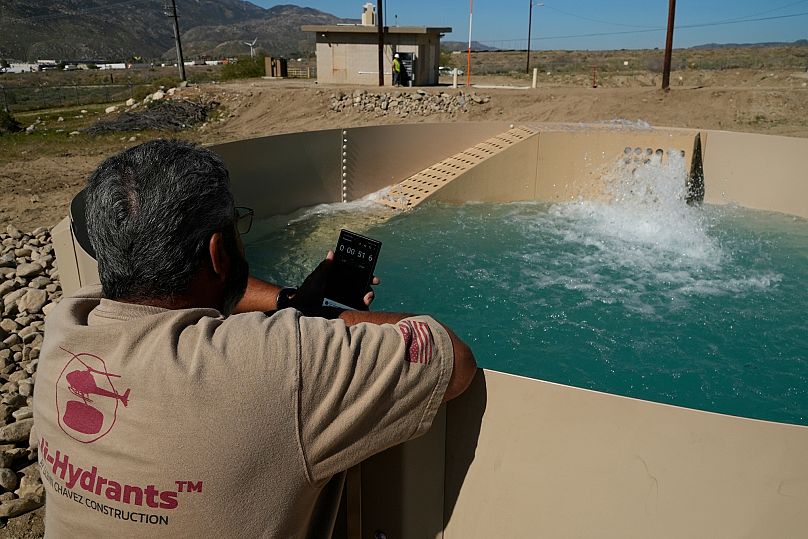
Glenn Chavez sets a timer as water fills a newly installed Heli-Hydrant.AP Photo/Brittany Peterson

As wildfires become more frequent, Whaling's invention is getting the attention of officials eager to boost preparedness. First used for the 2020 Blue Ridge Fire in Yorba Linda, 10 Heli-Hydrants have been built across Southern California and 16 more are in progress, according to Whaling.

Helicopters are essential for firefighting. They can drop about 3,785 litres of water at once - some much more. That's far more than hoses than get on a fire all at once, and can be the best way to attack fires that are difficult for ground crews to reach.

But pilots sometimes have to fly a long way to scoop up water, and in drought-prone areas, natural sources can sometimes dry up or diminish so they're hard to draw from. In Southern California's Riverside County, helicopters have had to fly up to about 16 kilometres to find water, eating critical time from battling fires.

Heli-Hydrants: An innovative solution


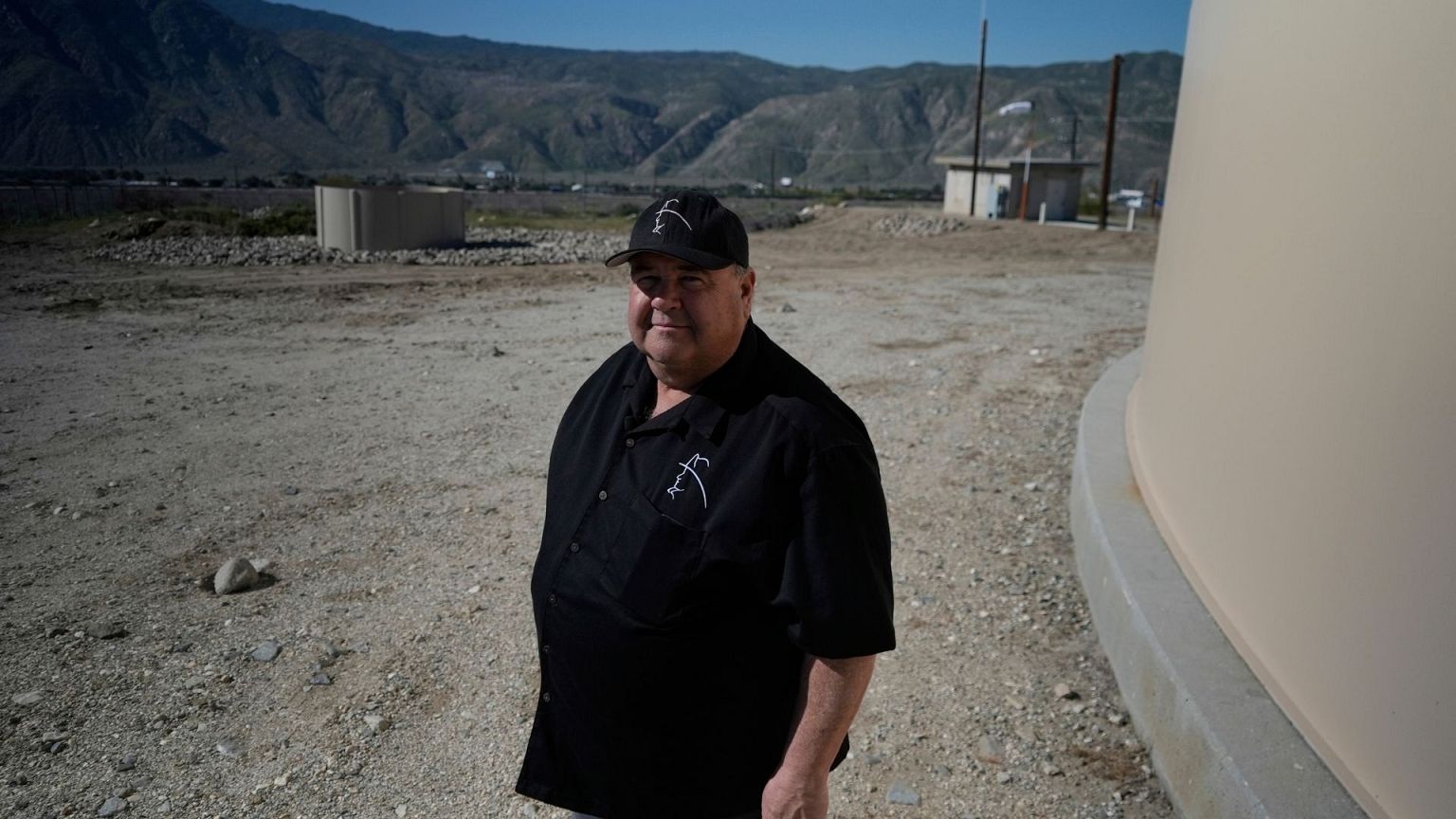
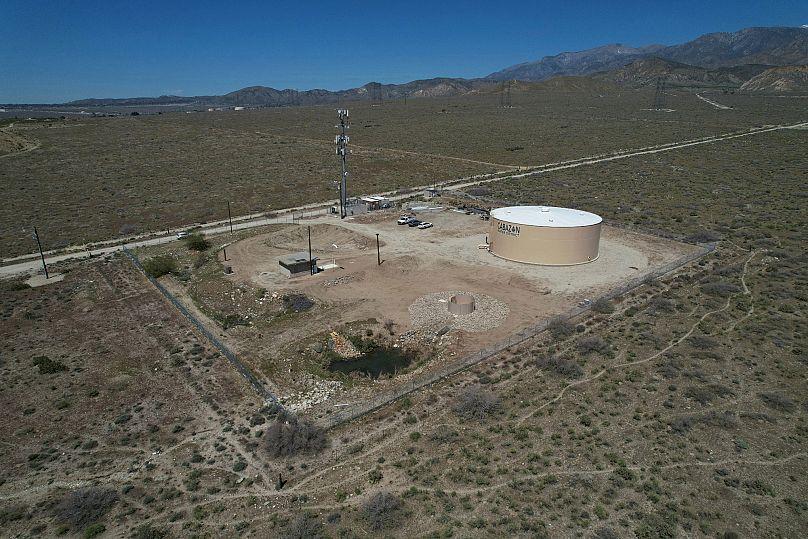
On a remote plot in the Southern California town of Cabazon, contractor Glenn Chavez stood on a ladder and peered into an empty Heli-Hydrant. A radio in hand, he clicked a button to activate the system and watched as water roared into the tank. In about six minutes, it filled with 32,176 liters.

Chavez, a general contractor, was testing the Cabazon Water District’s lastest investment — a second Heli-Hydrant that local officials are counting on to help protect the town. At $300,000 (€265,000), it costs slightly less than the average price of a single home in Cabazon.

“Living in a beautiful desert community, you're going to have risks of fire," said Michael Pollack, the district's general manager. "And to have these Heli-Hydrants is a major advantage. People will have a little bit of comfort knowing that they have another tool for fighting fires in their community."
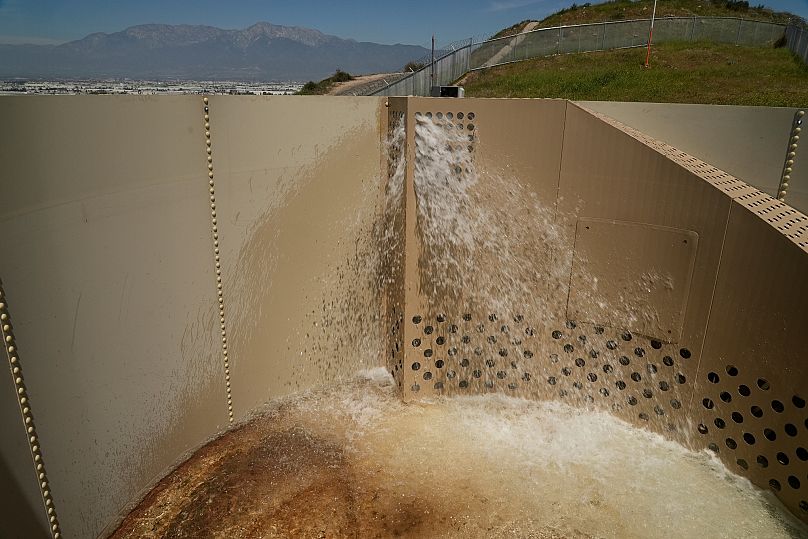
A Heli-Hydrant, a small, open tank that helicopters can rely on to get water faster for urban fires, fills with water during a demonstration.AP Photo/Brittany Peterson

Pilots can remotely activate the tanks from half a mile away, with the tank typically filling quickly from a city's water system. Helicopters can fill up in less than a minute. Once it's activated, solar panels and backup batteries ensure the system can still be used during power outages. And at night, lights from the tank and a tower nearby guide pilots toward it.

In November, fire responders in San Diego put the product to the test when the 19.5 hectare Garden Fire in Fallbrook, a community known for its avocado groves, prompted evacuation orders and warnings. Helicopters tapped the tank nearly 40 times.

Pilot Ben Brown said its proximity to the fire saved not just time but fuel.

“They’re great for when you don’t have other water sources,” he said. "The more dip sites, especially in some of the more arid environments in the county, the better.”
The Heli-Hydrants can't always help

Heli-Hydrants have raised some concerns about their placement in urban areas where houses, buildings and power lines can be obstacles to flight and they might have to squeeze into tighter spaces.

In those cases, firefighters may choose to fly farther to a natural source that gives the helicopter more room, said Warren Voth, a deputy pilot with the San Diego County Sheriff's Department. A pilot's goal is to always to face the wind while entering and exiting an area, for safety, and they need room to accomplish that.

In some cases, the municipal systems needed to fill Heli-Hydrants could go empty during major fires. As the Palisades Fire in Los Angeles burned, three nearly 3.8 million litre tanks that helped pressurize city hydrants in the Pacific Palisades ran dry as demand soared and burning pipes leaked water.

Heli-Hydrant, a small, open tank that helicopters can rely on to get water faster for urban fires.AP Photo/Brittany Peterson

Other times, helicopters just can't access them. When winds are fierce, flying is nearly impossible; hurricane-force winds that supercharged the Los Angeles infernos initially grounded firefighting aircraft. When multiple helicopters respond to large blazes, they can't all use the Heli-Hydrant. And smoke can make it hard to see it.

Portable water tanks can accomplish some of the things that Heli-Hydrants do, but can require time, people and equipment to set up.
A Heli-Hydrant gives one community hope

Areas where wildland vegetation intersects with human development have always been vulnerable to fires, but more people are living in them today, and climate change is creating conditions that can make these regions drier and more flammable.

Jake Wiley has seen intensifying wildfires devastate his community. Two blazes in 2007 and 2017 collectively scorched more than 400 structures in San Diego. The last one forced Wiley, now general manager for the Rainbow Municipal Water District, to evacuate.

That fire also prompted local agencies to install a Heli-Hydrant — and when the Garden Fire erupted in November, it played a big role helping firefighters protect homes.

“It seems like when you've seen the worst, you haven't yet,” Wiley said. “Anything we can do helps.”