Sunday, June 01, 2025

THE BOSSES VIEW

Industry Standards at the Heart of Global Ship Management

nternational Chamber of Shipping (ICS)
Nicholas Rich, Director of Fleet Management at Bernhard Schulte Shipmanagement (BSM)

Published May 31, 2025 7:54 AM by The Maritime Executive


[By: International Chamber of Shipping]

When managing a fleet of 450 vessels across the world's oceans, standardisation and best practices aren't just beneficial, they're essential. For Nicholas Rich, Director of Fleet Management at Bernhard Schulte Shipmanagement (BSM), ICS’s publications serve as a cornerstone of the company's commitment to safety, compliance, and operational excellence.

"ICS’s publications are crucial for our operations," states Rich. "They provide industry-standard guidance that helps us maintain consistent practices across our extensive and diverse fleet."

BSM was formed in 2008 through the merger of four Schulte Group ship management companies, Hanseatic Shipping, Dorchester Atlantic Marine, Eurasia Group, and Vorsetzen Bereederungs-und Schiffahrtskontor, which have been providing third-party ship management services since the 1970s. Today, this family-owned company has experience with all major vessel types, including tankers, gas carriers, bulk carriers, and container ships, as well as specialised vessels like offshore and cruise ships.

Operating through 11 regional ship management centres in key shipping hubs worldwide, BSM maintains an extensive crew recruitment network and world-class training facilities. At the heart of its operations is an unwavering commitment to safety.

"BSM puts safety at the heart of our ship management solutions," Rich explains. "We have strong safety and company cultures, along with robust systems and policies in place to prevent and minimise incidents at sea and onshore."

Central to maintaining these standards, is BSM's utilisation of 18 different ICS publications that span various aspects of maritime operations. These include maritime security guides, tanker safety guides, and shipboard inspection guides.

"The ICS publications serve as our reference point for gap analysis," says Rich. "They help us ensure compliance with industry standards and provide clear guidance for our crew members."

As the maritime industry evolves, so too does BSM's approach to utilising ICS publications. Rich notes that the company is increasingly adopting digital versions of these guides, making essential information more accessible to personnel both onshore and at sea.

"We provide our people with easy access to information and reporting opportunities via mobile applications and tablets onboard vessels," Rich states. "The digital format of ICS publications fits perfectly into this strategy."

As a member of key industry bodies such as Intertanko, the Maritime Anti-Corruption Network, Container Ship Safety Forum, RightShip, and the Society of International Gas Tanker and Terminal Operators (SIGTTO), BSM plays an active role in formulating strategies and policies to improve safe operations throughout the shipping industry.

Rich himself has contributed to ICS’s sixth edition of the Bridge Procedures Guide, and the forthcoming Deck Procedures Guide, along with other industry publications, highlighting BSM's commitment to giving back to the maritime community.

"It's vitally important for active ship owners to contribute to these guides," Rich comments. "They bring practical insights that ensure the publications remain relevant and effective in real-world operations."

This collaborative approach ensures that ICS publications continue to evolve with the industry, incorporating the latest best practices and addressing emerging challenges.

As BSM continues to manage its extensive fleet across global waters, ICS publications will remain an integral part of its operational framework. The standardised language and clear guidance these publications provide are invaluable in maintaining consistency across diverse vessel types and operational contexts.

"In an industry as complex and regulated as shipping, having trusted resources like ICS publications is invaluable," concludes Rich. "They help us maintain the highest standards of safety and compliance while navigating an ever-changing regulatory landscape."

Through its continued engagement with industry bodies and active contribution to publications, BSM exemplifies how shipping companies can both benefit from and contribute to the collective knowledge and best practices that keep our seas safe and our global supply chains moving efficiently.

The products and services herein described in this press release are not endorsed by The Maritime Executive.

 

Newport News Shipbuilding Immediately Furloughs 471 Salaried Employees

Newport News Shipbuilding
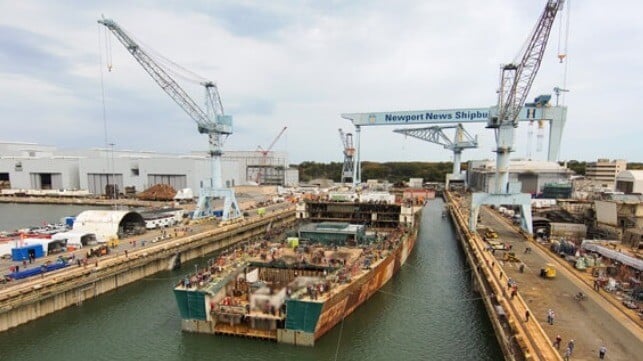
Newport News floated the under construction carrier Enterprise to prepare for work on a second Ford-class carrier (Newport News Shipbuilding)

Published May 30, 2025 7:47 PM by The Maritime Executive


In a surprise announcement that leaked out on Friday, May 30, Newport News Shipbuilding is furloughing about two percent of its workforce – 471 salaried employees – effective immediately. The shipyard which recently highlighted for the first time it would be simultaneously working on building two massive Ford-class aircraft carriers is citing the need for increased accountability and efficiency.

News of the furloughs is being widely reported by the media in the Hampton Roads area of Virginia which points out that Newport News is Virginia’s largest industrial employer. The reports said the company employs approximately 26,000 people and was conducting hiring efforts. Virginia Business reports the company added about 3,000 people in 2024 and had said it expected a similar increase this year.

The company confirmed the action in a statement sent to the Virginia media. “After careful review of our salaried workforce and business needs, we have furloughed 471 salaried shipbuilders across HII‘s Newport News Shipbuilding division,” the statement said. “This decision was not made lightly given its impact on affected team members. We take this step, however, to increase accountability and efficiency, and to improve overall performance in meeting our current and future commitments to the U.S. Navy.”

The shipbuilder is emphasizing changes in the industry and during the first quarter report, its parent company HII announced that Newport News’ revenues had decreased by 2.6 percent ($38 million) in the quarter. It cited lower volumes in aircraft carriers and naval nuclear support services, partially offset by higher volumes in the Columbia-class submarine program.

The company had recently reported securing new government contracts but the Trump administration while promising increases in military spending has been putting pressure on efficiency and cost-cutting. The Department of Defense has promised to increase efficiency while the newly created Department of Government Efficiency (DOGE) has a stated objective to modernize information technology, maximize productivity and efficiency, and cut wasteful spending.

Newport News in December christened the thirteenth Virginia-class submarine it has built for the U.S. Navy. That followed repositioning the under-construction carrier Enterprise in the dry dock to create a position to start work in 2025 on the next carrier, the Doris Miller. It also announced the acquisition of a South Carolina-based complex metal fabricator specializing in the manufacture of shipbuilding structures, modules, and assemblies to expand Newport News’ capacity.

The furloughs will impact engineers and other salaried positions at the shipbuilder and are currently expected to last up to five months. The company spokesperson is emphasizing that it is a temporary non-work, non-pay status, not terminating or reassigning any employees. However, they cannot work for contractors during this period. They were informed of the action the media reports said in an email on Friday and told it was effective as of Monday.

The spokesperson told the Virginia media that the company would continue to evaluate its staffing needs.


Vessel and Crew Abandonment Surge in 2025 on Course for Worst Year

Abandoned crew trapped on vessel
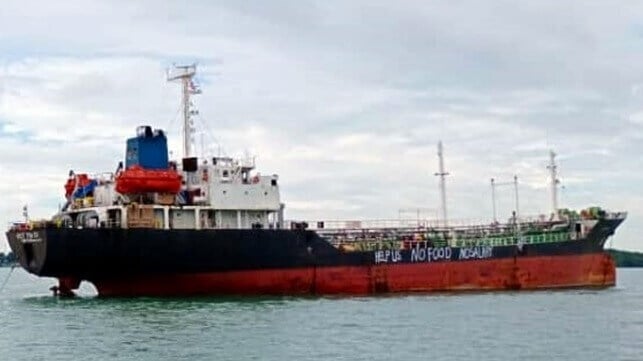
An abandoned crew in 2020 painted a message pleading for help on the hull of their vessel (NUSPM)

Published May 30, 2025 6:19 PM by The Maritime Executive


The abandonment of vessels and their crews is running significantly ahead of the rate in 2024 and is on track to a new record warns the International Transport Workers’ Federation. The association of transport unions is reiterating its long-standing call for more action and a crackdown both on shipowners and the registries that fail to respect seafarers.

“Abandonment is a growing, systemic problem,” said Stephen Cotton, ITF General Secretary. “Behind every number is a human being who has been failed by the industry and the governments responsible for regulating it. The fact that we're on track to break last year’s appalling record is a sign that urgent reform is needed.”


INDENTURED SERVITUDE AKA SLAVERY

The ITF calculates that vessel abandonment is up 33 percent year-over-year in 2025. It says as of May this year it had recorded 158 cases of vessel abandonment, up from 119 at the same point in 2024. These cases represent more than 1,501 seafarers who have reached out to the ITF for assistance, many of whom were left unpaid, without food, water, or access to ports, often for months at a time.

They highlight in 2024 its inspectors and teams were able to recover $13.5 million for abandoned seafarers. Last year, it said there was a record 3,100 seafarers abandoned. In total, the ITF reports in 2024 it recovered more than $58.1 million in unpaid wages due to seafarers. Already in 2025, they report ITF inspectors have helped to recover $4.1 million for seafarers affected by abandonment. 

“We’re dealing with owners who walk away from their obligations, often while sub-standard registers look on and do nothing,” said Steve Trowsdale, Head of the ITF Inspectorate. “In many cases, it's impossible to identify the owner, and flag states are either unwilling or unable to act. This is what makes the rise in cases so dangerous – impunity is growing across the board.”

As the number of cases climb, the ITF says it is increasingly concerned by the limits on enforcement. It calculates that half of the world’s fleet operates under a “flag of convenience,” and notes that more than 80 percent of abandoned vessels are also operating under a flag of convenience. The ITF highlights that it has a list of 45 countries that provide a flag of convenience. It added Tuvalu and Guinea-Bissau to its list of problematic registries that lack enforcement along with the 2024 addition of Gabon and Eswatini. In 2023, it added San Marino to the target list.

The group is calling for reforms to the registry system to ensure that every vessel can provide transparent, traceable links to its beneficial owner. The ITF says registries must be “armed – and willing – to detain and penalize those who walk away from their crews.”

The leading members of the International Maritime Organization have also raised concerns about the proliferation of suspect flags that do not properly enforce regulations. In addition, the U.S. Federal Maritime Commission just over a week ago announced that it was starting an investigation into these registries. It, too, cited the lack of regulations and enforcement saying it had the potential to create unfavorable conditions in the foreign trade of the United States.

While the Maritime Labor Convention stipulates basic standards for wages and transportation for seafarers to and from their ships and homes, enforcement remains a problem. Flag states have a legal responsibility when vessel owners and operators abandon their crews or fail to pay their wages and provide basic welfare conditions. States such as Australia highlight their efforts during port state inspections, but frequently it falls to the unions and charities to aid abandoned seafarers.

The Crown’s Khalid Abdalla releases ‘A simple song’ as a tribute to Palestine’s children


'And when they said never again, it was not for us,' the British actor sings in the song.


DAWN
31 May, 2025

\
Khalid Abdalla, the British actor who played the ill-fated Dodi Al-Fayed on Netflix’s The Crown, has released a new song called ‘A simple song’, dedicated to “the children of Palestine, past, present and future” and to “all children of genocide”.

Abdalla, who also starred in the 2007 film The Kite Runner, has been a vocal proponent of the Palestinian cause. During the 2024 Emmy Awards, he wrote “Never again” on his hand in reference to the violence being perpetrated against Palestinians and wore two pins, a dove signifying the city of Bethlehem and scales representing the International Court of Justice, which, at the time, was hearing a case filed against Israel for war crimes in Gaza by South Africa.

The song he wrote and sung, shared on social media on Saturday afternoon, was accompanied by a caption that read, “May it meet this moment in hope, while the tide of global consciousness is changing, so the child born now grows up in a world with a free Palestine, and what that will mean for every child everywhere.”

View this post on Instagram


The song itself has a simple refrain — “This is a simple song, about simple things”. Those “simple things” include children being killed, an apartheid-like regime that has different laws for different people and politicians prioritising money over lives.

The video accompanying the song includes shots of Abdalla playing a grand piano as well as a single, continuous shot of children’s clothing lined up on Bournemouth beach. The shot begins with a slow closeup of some clothes and slowly starts panning out as it moves along the beach, eventually showing an aerial shot of an impossibly long line of clothes. The clothes likely represent all the children killed in Israel’s assault on Gaza.

“They took our land, and then they occupied us, and when we fall, they call us terrorists,” Abdalla sings in the video. “And when they said never again, it was not for us. If you want peace give me justice.” The phrase ‘never again’ is associated with the Holocaust and the promise to never let such an atrocity happen again.

Abdalla said the full song will be out on other platforms soon, with a full release through Gülbaba Music, an Istanbul-based management agency with a sister label called Gülbaba Records.
Sherry Rehman ‘seriously concerned’ over Pakistan topping list of countries most affected by climate change


May 31, 2025
DAWN


PPP Vice President Senator Sherry Rehman on Saturday expressed “serious concern” over Pakistan topping the list of countries most affected by climate change, stating that training Pakistanis to protect themselves from severe weather is the need of the hour.

The Climate Risk Index (CRI), published by Germanwatch, ranks countries by the human and economic toll of extreme weather. The latest edition highlights increasing losses and the urgent need for stronger climate resilience and action.


In the report published in February, Pakistan was ranked as the most vulnerable country to climate change in 2022, followed by Belize and Italy. Rehman shared the report to her X page, stating that Pakistan had been listed in the report as the country most affected by climate change.

“CRI ranks countries by the human and economic toll of extreme weather, measuring realised risk,” she wrote, adding that the report “should serve as a huge wake-up call”.


In a longer statement published by the PPP, Rehman regretted that Pakistan is now the most vulnerable country in the world to climate risks.

“Now it would be wrong to say that Pakistan is in the top 10, unfortunately, we are number one,” Rehman was quoted as saying. “The sharp increase in the risks of stormy rains, hailstorms [and] glacier melting shows the seriousness of the situation.”

Noting that Pakistan has suffered the most from climate change despite minimal impact on the environment, the senator asked why the country is suffering the consequences of the international community’s contributions to global warming.

“Both lives and the economy are at risk from environmental events. Why should countries like us be punished for the world’s massive use of carbon? The time for environmental justice has come,” Rehman was quoted as saying.

“The international community cannot have sustainable development without environmental justice,” she added. “Take a real account of global warming, only then will developing and poor countries be able to escape the effects of climate change.”

The senator also noted in the statement that “the imposition of an environmental emergency, policy reforms and global aid have become imperative for Pakistan”.

Pakistan has seen the effects of climate change in unprecedented floods in 2022, primarily caused by record-breaking monsoon rainfall, glacial lake outburst floods, and other factors.

The CRI highlighted that over 33 million people were affected and over 1,700 lives were lost due to the floods. It also says that climate change made the severity of extreme monsoon rainfall increase by 50 per cent.

Not only that, over eight million people lost their homes and were internally displaced due to the 2022 floods, while 1.3 million houses were damaged. The issue was compounded by a lack of drinking water availability and a surge in waterborne diseases, such as diarrhoea, cholera, dengue, malaria, and skin infections.

Saturday, May 31, 2025

President Zardari signs bill to curb child marriage into law


Nadir Guramani
Published May 30, 2025
DAWN
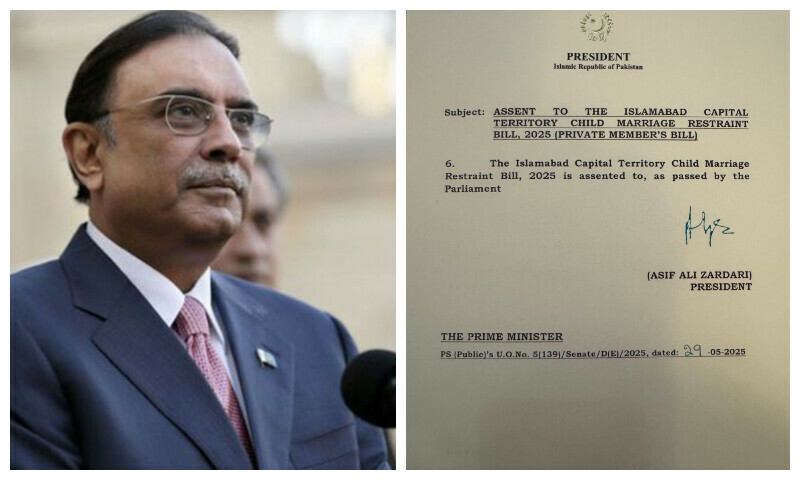
A collage of President Asif Ali Zardari and his assent to the Islamabad Capital Territory Child Marriage Restraint Bill. —File/Sherry Rehman X

President Asif Ali Zardari on Friday accorded his assent to the Islamabad Capital Territory Child Marriage Restraint Bill, according to a notification by the Presidency shared by PPP Senator Sherry Rehman on X.

The bill, which seeks to protect the rights of children and eventually eradicate marriages of children under the age of 18, reached the presidency on May 27 after sailing through both houses of parliament.

However, the move attracted strong opposition from religious segments of society, with the CII ruling that classifying marriage under the age of 18 as rape did not conform with Islamic law.

“The Islamabad Capital Territory Child Marriage Restraint Bill, 2025 is assented to, as passed by the Parliament,” the notification read.

“Pakistan has reached a milestone in the enactment of important legislation against child marriages,” Rehman said in a statement.

She said that the approval of the bill was successful despite resistance from various sections, adding that President Zardari signed the bill despite pressure.

“The signing of the Child Marriage Restraint Bill is a symbol of a new era of reforms in Pakistan,” she said.

She hailed the approval as a victory for the protection of the rights of women and children, adding, “This law was possible after a long and difficult struggle.”

“This bill is not just a law, it is a commitment that our girls have the right to education, health and a prosperous life,” Rehman continued.

She thanked PPP Chairman Bilawal Bhutto-Zardari, party leaders, other political parties, representatives of the opposition and the public for their support for the bill.

She also called on other provinces to take steps towards this important legislation.

Earlier, CII member Maulana Jalaludin, who belongs to the JUI-F, said Presi­dent Zardari should prevent anarchy in society and not sign the bill.

Incidentally, members bel­ong­ing to different sects opposed the bill.

Responding to a query, the CII member had said the assembly could not be above the Holy Quran and Sunnah. “This bill is not only against the norms of Sharia but also contrary to the values of our society and our traditions,” Maulana Jalaluddin reasoned, terming the move a western conspiracy to destroy ‘family system’.

The ‘bad intentions’ were evident as the bill was not forwarded to the CII, but approved by parliament ‘in secrecy’, he said.

However, PPP MNA Sharmila Faruqi, who tabled the bill in the National Assembly, said the matter of marriage of girls below 18 years of age, should not be given a religious colour and instead be considered in the context of human rights.

“We are not against marriages. We say marrying girls as young as 13 or 14 years is unfair when girls under 18 years of age do not have right to vote, cannot obtain national identity cards and driving licence,” she added.

In this regard, the PPP lawmaker referred to a decision by Federal Shariat Court of 2022 that allowed the state to set the marriage age.
Save the girls

Published May 31, 2025 
DAWN


SOME traditions that hinder individual progress are a heavy cross for society to bear. In Pakistan’s deeply patriarchal environment, where a female child’s agency is determined by her biological age, President Asif Zardari’s assent to the Islamabad Capital Territory Child Marriage Restraint Bill, 2025, despite resistance from the Council of Islamic Ideology — which said that classifying under-18 marriages as rape was in conflict with religious law — deserves applause. Pakistan, where some 19m girls are married off before they turn 18, is home to the sixth highest number of child brides in the world. Almost half of these youngsters become pregnant before the age of 18, and a mere 13pc complete secondary school. The bill is now law; however, its desperately needed implementation will depend on the government’s political commitment to safeguarding the girl child’s right to health, education and opportunities to realise their potential.


The lethal mix of regressive customs and socioeconomic distress leads to early marriage. The new video campaign from Unicef, featuring its National Ambassador for Child Rights, actor Saba Qamar, is a timely move that promises to reach scores, open minds and drive change. It encourages society to question the practice, spells out the consequences of underage nuptials for girls and calls for the empowerment and protection of young females in Pakistan. Child marriage is no child’s play; it means lost childhoods, vulnerability to domestic violence, death during childbirth, poor health and even cervical cancer; the second most common cancer among females between 15 and 44 years. As a signatory to the Convention on the Rights of the Child, Pakistan cannot afford lethargy. It is also hoped that lawmakers will not allow conservative sections to hold constitutional liberties, including the safety and dignity of women and children, hostage to their whims. The CII has an advisory role, and there should be no pressure on lawmakers to comply with all its wishes.

Published in Dawn, May 31st, 2025


FICTITIOUS ASSETS


Khurram Husain 
Published May 29, 2025 
DAWN

The writer is a business and economy journalist.


SOME sort of a crypto bug seems to have gripped the government and perhaps some of it is warranted.

From the details reported in the international media we learn that at least some of the efforts of the Pakistani government in the crypto domain are geared towards procuring influence in Washington DC, with those close to the Trump administration coming to Pakistan for crypto-related discussions.

To that extent we can look at what is happening and say “it is what it is” and leave it at that. But the moment the government begins to take crypto seriously as a business proposition it becomes dangerous. And it is important to keep this distinction in mind, between crypto as an influence peddling tool versus a serious business proposition, because the resources the government will put at risk if it ventures into the world of crypto are public resources.


In the past few weeks, since the Crypto Council was announced by the government, we have seen suggestions appear in print on how Pakistan can expand its participation in the wider world of cryptocurrencies. One suggestion was to place a portion of Pakistan’s foreign exchange reserves in crypto, and the individual making this suggestion deployed a classic tactic used by small-time stock brokers or real estate agents selling junk to gullible clients. He pointed to the rise in the value of Bitcoin over the past decade, and asked the reader to imagine if Pakistan had placed a certain amount of its reserves in this asset, how much that value would have multiplied by today.

What was not mentioned in the article was the sheer volatility of currency over that same time period. Sovereign reserves are never gambled with in volatile assets. They are, as a rule, always invested in fixed-income instruments. It’s the same principle when managing pension funds or other institutional savings. The principles are low-volatility, low-risk, fixed return.

The resources the government will put at risk if it ventures into the world of crypto are public resources.

Another argument encouraged the state to go into crypto mining by offering the right “incentives”. The right incentives apparently include providing them with electricity at around five to six cents per unit. For comparison consider that you and I pay somewhere around 20 cents per unit for our electricity, with industry somewhere around 14 cents. The most obvious question to ask when considering this proposition is this: if Pakistan has electricity to give at five cents per unit, why should crypto miners be the first to get it?

A puzzling press release from the finance ministry a few days ago added to the confusion. It announced that the government has “allocated” 2000MW for crypto mining. It was puzzling because there was no mention of price (the single most important thing to mention in such an announcement), but more importantly, there is literally no such thing as electricity allocations in Pakistan. There are no quotas of who gets how much electricity. So what exactly is being announced in this press release?

The third suggestion that has been floated is to create on-shore crypto exchanges in Pakistan, much like we already have a commodities exchange. This is probably the most benign of the suggestions since all it does is make crypto trading a regulated activity without putting any state resources into play.

It is critical to keep in mind that crypto is a fictitious asset. It is not the first, nor the last of these. Fictitious assets are those that exist only in the mind of the holder. If enough people buy into the fiction they can become liquid, meaning you can trade them for real goods and services. Money, for example, is a fictitious asset as is gold. But both are highly liquid. I can pay my bills with money, buy my groceries, because almost everyone in my society buys into the fiction that money (or gold) represent.

Not so with crypto. This is purely a speculative asset, created for speculative purposes, given prominence by speculator interests, and currently in the process of being pumped by a massive speculative scheme being launched by the White House itself. This endows it with a great deal of speculative value. But none of it is real.

In the past we have seen fictitious assets grow to unmanageable proportions and pose risks to the entire global financial system. Collateralised Debt Obligations (CDOs) were fictitious assets when left unregulated, because those creating them were able to bundle junk mortgages by illiquid borrowers into their offering and sell them as a AAA-rated financial product. This scam became so large in the late 2000s that it lay at the root of the greatest financial collapse since the Great Depression.

CDOs are still around, but as a regulated product they now pose little risk of growing into a threat to the financial order. But speculator capital has its own ingenuity. Think of plot files being sold by unscrupulous property developers, in housing projects they haven’t even begun acquiring land for yet. That is a fictitious asset, and trading in it brings enormous risks that should not be taken by retail investors or those entrusted to manage the wealth of others, such as sovereigns or pension fund managers.

Fictitious assets have always been around in the modern world. The South Sea Bubble in the early 18th century was created by massive investments in the stock of a company that had no prospects of actually being able to do the business it was supposed to do (sell slaves to the Spanish colonies of South America).

They are around in our time too and crypto is just one of their manifestations. It’s fine for those who wish to trade in these sorts of fictitious assets with their own money. But the state should beware the wiles with which the salesmen of this snake oil try to lure you into their racket.

Published in Dawn, May 29th, 2025


Crypto policy in disarray as SBP, ministry insist ban is still in place

Published May 30, 2025 
DAWN


• SBP exec says crypto transactions illegal, cases being referred to law enforcement

• Finance secretary says legal framework will only be introduced if govt legalises crypto

• Pakistan unveils first govt-led Strategic Bitcoin Reserve


ISLAMABAD: Amid growing official promotion of Bitcoin adoption, both the State Bank of Pakistan (SBP) and the Ministry of Finance (MoF) on Thursday said that cryptocurrency remains banned in the country and all its transactions are illegal under current regulations.

During a meeting of the National Assembly’s Standing Committee on Finance and Revenue, Finance Secretary Imdadullah Bosal said that although the prime minister had recently formed a Crypto Council — chaired by the finance minister — through an executive order to explore digital asset policy, a cryptocurrency ban is intact under SBP and SECP regulations.

“There will be a legal framework only when the government formally takes a decision, but the current legal status is that crypto is not a legal tender in Pakistan,” Mr Bosal said, conceding that no parliamentary backing exists for cryptocurrency use.

Mr Bosal also reconfirmed later to journalists that the federal budget would be announced on June 10 and discussions with the International Monetary Fund were ongoing virtually on budget estimates and proposed measures. He said the Asian Development Bank was expected to approve an $800 million loan to Pakistan on June 3.

Committee members expre­ssed confusion over the government’s approach. Mirza Ikhtiar Baig questioned why the public was being encouraged to invest in crypto when it remained legally banned, warning that investors could face serious consequences.

Mohammad Mobeen wondered why the government was dealing with the subject of Bitcoins and cryptocurrency instead of the SBP. He stressed that while the government was calling crypto illegal, it had simultaneously allocated power capacity for mining operations.

Further highlighting the policy inconsistency, he pointed out that Bilal Bin Saqib, CEO of the Pakistan Crypto Council (PCC), had been holding meetings with high-profile global leaders.

Shahram Tarakai said the country’s foreign exchange would flow out of the country very soon through cryptos and the government would then be in a fix.

Other members raised questions about whether the crypto mining would be in government or private sector hands, and noted that illegal hawala channels would likely be replaced by unregulated digital transfers.

Sohail Jawad, an executive director of the SBP, said the central bank had issued a directive in 2024, declaring the legal status of Bitcoin and other cryptocurrencies illegal, and that stance was still intact.

In fact, the Financial Monitoring Unit (FMU) is still referring crypto-related cases to law enforcement agencies for further action, he said.

He said a national working group of digital currency had been established and suggestions had also been given to the Pakistan Crypto Council. He said El Salvador was the only country with legalised cryptocurrency in the world, and even that nation was reconsidering the decision.

The State Bank of Pakistan does not recognise crypto assets, which are digital currencies in which transactions are verified and recorded by a decentralised system. The SBP issued a formal notice in 2022 advising the general public to be cautious of and refrain from trading cryptocurrencies.

Need for regulation


The committee discussion on cryptocurrency was triggered by a bill on digital currency regulations proposed by MNA Sharmila Farooqi. She argued that Pakistan needed to regulate crypto to prevent money laundering, especially after its exit from the Financial Action Task Force’s grey list.

The Pakistan Crypto Council was officially launched in March this year to “regulate and integrate blockchain technology and digital assets” into the country’s financial landscape.

Strategic Bitcoin Reserve


The debate coincided with the unveiling of the country’s first government-led Strategic Bitcoin Reserve by Pakistan Crypto Council CEO Bilal Bin Saqib, the newly promoted special assistant to the prime minister on crypto and blockchain.

An official statement released by the Ministry of Finance said the unveiling was held at Las Vegas, United States, at an event for an elite audience that included US Vice President J.D. Vance, and the sons of US President Donald Trump — Eric Trump and Donald Trump Jr.

“This wasn’t just a policy moment — it was a rebranding of a nation,” the statement said, adding that Mr Saqib conveyed a bold message that Pakistan was no longer defined by its past.

Speaking at the event, Mr Saqib said Pakistan is “being reborn as a forward-looking hub of digital innovation — powered by its youth, sharpened by necessity, and led by a new generation of tech statesmen.”

He added, “I’m not just here as a minister. I’m here as the voice of a generation — a generation that is online, on-chain, and unstoppable.”

A statement issued by Mr Saqib’s office said that while “other leaders talk about potential, Bilal is unlocking it — with bold national moves that put Pakistan at the centre of the global crypto conversation”.

He also announced the establishment of a national Bitcoin wallet, holding digital assets already in state custody — not for sale or speculation, but as a sovereign reserve signalling long-term belief in decentralised finance.

He also thanked President Trump for his role as a peacemaker in the recent India-Pakistan conflict and for his commitment to crypto adoption.

Published in Dawn, May 30th, 2025


Crypto Council to meet on June 2 for digital currency regulations


Published May 30, 2025 
DAWN


The Pakistan Crypto Council (PCC) will hold a meeting on June 2 to discuss digital currency regulations, the Ministry of Finance said on Friday.

The PCC was officially launched in March to “regulate and integrate blockchain technology and digital assets” into the country’s financial landscape.

According to a press release by the finance ministry, the meeting will be chaired by the Finance Minister Muhammad Aurangzeb, serving as a “strategic forum to deliberate on the evolving regulatory and legal framework surrounding digital currency and the broader crypto landscape in Pakistan”.

PCC Chief Executive Officer Bilal Bin Saqib will also participate in the meeting, along with other PCC members, the press release said.

It also said, “Key items on the agenda include the development of a robust regulatory framework to govern digital and virtual assets in Pakistan, in alignment with global standards and technological advancements.

“A focal point of discussion will be the groundwork for the establishment of the Pakistan Virtual Assets Regulatory Authority (PVARA) — a proposed autonomous body to oversee the digital finance and crypto ecosystem in the country.”

The finance ministry said the PCC aims to establish a “secure, transparent, and innovation-friendly regulatory environment”, to promote “responsible adoption of blockchain technology, protecting investors, and enhancing financial inclusion”.

“The upcoming meeting underscores the government’s commitment to shaping a future-ready financial infrastructure while ensuring stability and compliance in the emerging digital economy,” it added.

A day earlier, the National Assembly Standing Committee on Finance held a meeting, where PPP MNA Sharmila Farooqi introduced a bill on digital currency regulations. Finance Secretary Imdadullah Bosal said that the ban on cryptocurrency was still in place across Pakistan, stressing the need for its regulation during the meeting.

The same day, Saqib had unveiled the country’s first government-led Strategic Bitcoin Reserve. In his keynote speech, he announced the establishment of a national bitcoin wallet, “holding digital assets already in state custody — not for sale or speculation, but as a sovereign reserve signalling long-term belief in decentralised finance”.

Cryptocurrencies are gaining momentum globally as the number of use cases is increasing and many countries are now making them legal. However, it has had a mixed reception by regulators globally.

In some countries, like El Salvador, it has legal tender status, while in others, including Pakistan, India and China, it is not accepted as payment for goods and services, nor can one own it legally, though it is not officially banned either.


Pakistan unveils first govt-led Strategic Bitcoin Reserve

Tahir Sherani 
Published May 29, 2025
DAWN

Pakistan Crypto Council CEO Bilal Bin Saqib delivers a keynote address at the Bitcoin Vegas 2025 conference in Las Vegas. — Office of SAPM


Pakistan Crypto Council (PCC) Chief Executive Officer Bilal Bin Saqib has unveiled the country’s first government-led Strategic Bitcoin Reserve.

Saqib was recently appointed as Special Assistant to the Prime Minister for Crypto and Blockchain, with the status of a minister of state. He has been on a tour of the United States seeking investment in Pakistan’s crypto markets.

He made the announcement about the reserve after delivering a keynote address before an elite audience, which included United States Vice President JD Vance, Eric Trump and Donald Trump Jr, at the Bitcoin Vegas 2025 in Las Vegas.

“Pakistan is no longer defined by its past. It is being reborn as a forward-looking hub of digital innovation — powered by its youth, sharpened by necessity, and led by a new generation of tech statesmen,” said Saqib, in a statement issued by his office.

“I’m not just here as a minister,” he said. “I’m here as the voice of a generation — a generation that is online, on-chain, and unstoppable.”

In his keynote speech, Saqib announced the establishment of a national bitcoin wallet, “holding digital assets already in state custody — not for sale or speculation, but as a sovereign reserve signalling long-term belief in decentralised finance.”


He also thanked Trump for his role as a peacemaker in the recent India-Pakistan conflict and for his commitment to crypto adoption.

He revealed that the government had allocated 2,000 megawatts of surplus electricity in first phase for bitcoin mining and AI data centres, opening doors to sovereign miners, tech firms, and clean energy partners around the world.

The statement noted Pakistan having over 40 million crypto wallets and one of the “largest and most active freelancer economies in the world”.

It added that Saqib was leading the creation of the Pakistan Digital Assets Authority (PDAA) — a regulatory body designed to empower builders, protect investors, and formalise digital finance frameworks for the future.

“Both Pakistan and bitcoin have suffered from bad PR,” Saqib declared. “But if you look past the headlines, you’ll see something else: talent, resilience, and vision.”

He called on global crypto builders to come and invest in Pakistan. “If you’re building something real — come build it in Pakistan. Come build wallets for the unbanked. Come tokenise land. Come scale your mission with our youth and our unstoppable grit.”

During his keynote, Saqib delivered a “blueprint for the future of emerging markets in Web3 that positions Pakistan as a tech-forward, youth-powered, and opportunity-rich nation ready to lead,” the statement concluded.

On February 25, the government had announced it was considering establishing a National Crypto Council to adopt emerging digital currencies in line with global trends. In March, it appointed Saqib as the chief adviser to the finance minister on the PCC and later made him the council’s CEO.

According to a press release, Saqib will now be responsible for developing a comprehensive, FATF-compliant regulatory framework for digital assets, launching bitcoin mining initiatives, and overseeing blockchain integration in governance, finance, and land records.


Additionally, he will also facilitate “licensing and oversight of virtual asset service providers (VASPs)” and champion “investor protection and Web3 ecosystem growth” in the country.

Furthermore, the government has announced the allocation of 2,000 megawatts (MW) of electricity in the first phase of a national initiative to power bitcoin mining and artificial intelligence (AI) data centres.

According to the Finance Division, the ambitious initiative was part of a broader strategy to “monetise surplus electricity, create high-tech jobs, attract billions of dollars in foreign direct investment, and generate billions of dollars for the government”.


MIGRATION: PERILS OF THE PROMISED LAND

Munib Ali Daudpoto 
Published May 25, 2025
EOS/DAWN

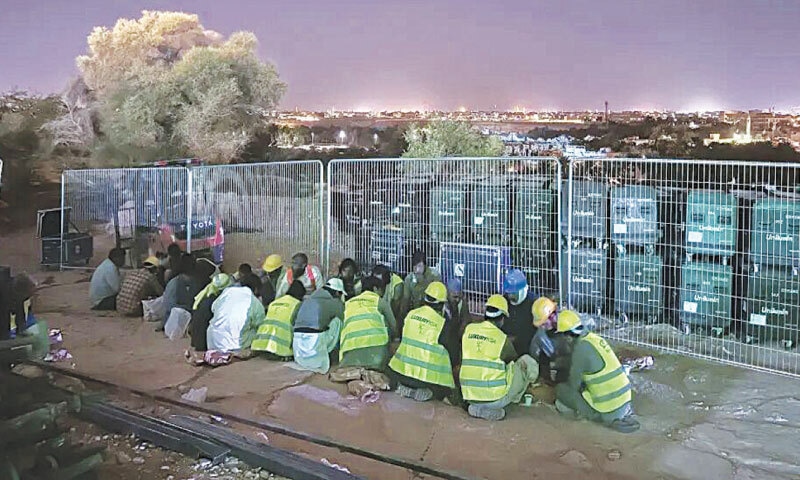
Migrant workers at a construction site near Riyadh, Saudi Arabia in March 2024 | AP


At 23, Ahmed Faraz left Karachi for Saudi Arabia for a better future. A recruitment agent had promised him a stable hotel job in Saudi Arabia with good pay, benefits, and even days off. Like thousands of young Pakistanis each year, he sold family assets — in his case, jewellery — to pay the agent’s fee and boarded a plane full of hope.

But upon landing in Riyadh, Faraz’s dream quickly unravelled.

“I was unemployed for three months,” he tells Eos, his voice still carrying the shock of that experience. “The agent had lied about everything — there was no job waiting, no company expecting me,” he says. “When there’s no job and the kafeel [sponsor] starts demanding more money, many workers have no choice but to become fugitives to avoid deportation or jail.”

Faraz’s story represents just one thread in a vast tapestry of migrant suffering. Conversations with dozens of Pakistani workers across the Gulf reveal a disturbing, systemic pattern of exploitation. Unscrupulous agents routinely lure workers with false promises, charge exorbitant fees and then abandon them to navigate the treacherous waters of the kafala [sponsorship] system alone.

Every year, hundreds of thousands of Pakistanis sell everything for a shot at Gulf prosperity, only to find themselves trapped in a system of debt and control. Why does their home country ignore their suffering?

The Kafala Trap

At the heart of this exploitation lies the kafala system, a sponsorship framework that originated in the 1950s to regulate temporary migrant labour in the Gulf states. The system legally binds a worker’s residency status to their employer, requiring sponsor approval for everything from job changes to exit visas. While all Gulf Cooperation Council (GCC) countries employ some version of this system, Saudi Arabia and Qatar maintain particularly strict implementations.

The International Labour Organisation (ILO) has repeatedly condemned kafala as “a breeding ground for forced labour and abuse.” In practice, it creates a power imbalance so severe that workers often tolerate unpaid wages, excessive working hours and even physical abuse rather than risk deportation.

Shamsul Alam’s story illustrates this dynamic perfectly. Now 64 and back in his hometown of Abbottabad after two decades in the United Arab Emirates (UAE), he recounts how his agent promised 850 dirhams (about $230) monthly for work as a night watchman. “In reality, I received half that amount,” he tells Eos. “Being illiterate, I didn’t understand I should have demanded a contract. The kafeel knew this and exploited it fully.”

Success Amidst the Struggle

Not all experiences are uniformly negative. Shahzaman Majid, 25, works at a visa consultancy firm in Riyadh and represents one of the success stories. “For skilled workers with proper documentation, the Gulf can offer opportunities unimaginable in Pakistan. I’ve tripled what I could earn back home,” he tells Eos via email.

Yet even successful migrants such as Majid acknowledge the system’s flaws. “The biggest challenge comes when you want to progress,” he notes. “Finding a better job means begging your current employer to release you. Many would rather keep you trapped than see you advance.”
Pakistani construction workers at a construction site in the Saudi city of Medina | University of Nevada


THE REMITTANCE ROLODEX

The economic significance of these migrant workers cannot be overstated. According to Pakistan’s central bank, the State Bank of Pakistan, remittances hit a staggering $4.1 billion in May 2025 alone — enough to cover nearly half of Pakistan’s monthly import bill. These flows represent the nation’s single largest source of foreign exchange, consistently outperforming exports and foreign direct investment combined.

The Bureau of Emigration & Overseas Employment reports that over 450,000 Pakistanis migrated to Saudi Arabia in 2024, with another 64,130 choosing the UAE. These numbers, while impressive, only tell part of the story. The Ministry of Overseas Pakistanis data reveals that approximately 3.2 million citizens — about 1.3 percent of the population — have left over the past five years, with Gulf states absorbing the overwhelming majority.

Economist Dr Ayesha Khan, who studies migration patterns at the Lahore University of Management Sciences, explains: “Every one of these workers supports an average of five family members back home. Their remittances don’t just prevent household poverty — they fund education, healthcare and small businesses that employ others,” she tells Eos.

Yet this economic lifeline comes at tremendous personal cost. Many migrants endure years of separation from families, harsh working conditions and psychological trauma — all the while knowing their homeland offers few alternatives.

Half-Measures: The Limits of Gulf Reforms

In March 2021, Saudi Arabia announced landmark labour reforms, theoretically allowing workers to change jobs without sponsor consent after one year. Other Gulf states have implemented similar measures, responding to international pressure following high-profile cases of abuse, particularly in the run-up to Qatar’s 2022 World Cup.

However, as Human Rights Watch researcher Hiba Zayadin explains, these reforms contain critical loopholes. “Employers still control visa renewals and residency status,” she tells Eos. “Many workers report being forced to sign ‘voluntary’ resignation letters when they arrive, effectively nullifying the new protections,” she adds.

The financial exploitation begins even before migration. Despite regulations banning recruitment fees, Pakistani workers routinely pay agents between Rs300,000 to Rs500,000 (between $1,100 - $1,800), often going into crippling debt. Upon arrival, many face bait-and-switch scenarios, where promised salaries are halved or jobs are completely different than described.

Pakistan’s Failure to Protect Its Own

Perhaps, most damning is the Pakistani government’s failure to protect its overseas citizens. Multiple interviewees described consular services as indifferent at best, hostile at worst.

Amir Basharat, a Pakistani expat in Riyadh since 1996, recounted his experience. “At the consulate, they treat us like criminals, asking for favours rather than citizens seeking rights,” he tells Eos. The attitude, Basharat says, seems to be: ‘You chose to come here, now deal with it.’

This neglect persists despite migrants’ economic importance. While Pakistan has laws against illegal recruitment practices, enforcement remains weak. The Protectorate of Emigrants offices, meant to oversee the migration process, is often understaffed and underfunded.

When asked why they endure such conditions, most migrants give variations of the same answer: “What alternative do we have?”

Faraz, now working at a Riyadh restaurant after months of struggle, explains: “My father was a shopowner who has passed away. My younger siblings’ education depends on my earnings. Returning isn’t an option.”

Shamsul Alam, despite his bitter experience, admits: “If I had the chance, I’d go back to the UAE tomorrow. Here in Pakistan, I might earn 25,000 rupees [per month] if I’m lucky. There, even exploited, I could save more.”

This heartbreaking calculus underscores Pakistan’s fundamental failure to create viable economic opportunities at home. Until meaningful job creation accompanies serious labour protections for migrants, the cycle of exploitation will continue — sustained by desperation and enabled by indifference.

The writer is a member of staff. He can be contacted at munibalxo@gmail.com

Published in Dawn, EOS, May 25th, 2025
PAKISTAN

Govt mulls tax break to avert cotton sector collapse


DAWN
The Newspaper's Staff Reporter 
Published May 31, 2025 

Cotton cultivation in Punjab has exceeded 3.011 million acres during the current Kharif season (2025-26), up from 2.940m acres planted during the same period last year.—APP/file

LAHORE: Pakistan’s cotton sector is facing its gravest financial crisis in decades, prompting swift government attention after urgent appeals from the Pakis­tan Cotton Ginners Association (PCGA) and the All Pakistan Tex­­tile Mills Association (Aptma).

Both associations have launched a high-profile lobbying campaign, writing to Prime Minister Shehbaz Sharif and initiating a nationwide media blitz, demanding the immediate abolition of the Export Facilitation Scheme (EFS) or the removal of sales tax on domestically produced cotton and its byproducts.

The premier subsequently sou­­ght policy recommendations from the Ministry of National Food Security and Research (MNFSR).

In response, the ministry has formally endorsed the industry’s proposals.

In a letter to PCGA President Dr Jassu Mal, Cotton Commis­sioner Dr Khadim Hussain stated that the government has recommended that the 18pc sales tax on domestic cotton, cottonseed, oilcake, and cottonseed oil be lifted immediately, or that imports of cotton, yarn, and grey cloth be taxed at the same rate.

The ministry’s recommendations, forwarded to safeguard farmers’ incomes, revive local production, and stem Pakistan’s soaring dependence on costly cotton imports, it says.

The communiqué notes that Punjab has implemented targeted subsidies for farmers to increase their incomes and reduce production costs for various crops.

Industry data reveals that textile mills have imported over 300 million kgs of cotton yarn and two million bales of cotton during the first nine months of 2024-25, draining billions of dollars in foreign exchange.

Despite this, domestic production has fallen to a historic low of just 5.5m bales. Meanwhile, more than 200,000 bales of unsold cotton and vast stocks of yarn remain idle in factories, with demand at a standstill.

Cotton Ginners Forum Chairman Ihsanul Haq says the fallout has been devastating as over 800 ginning units and 120 spinning mills have ceased to function, while hundreds more textile units are barely functioning.

“If the current policy persists, the sector risks total collapse,” he warns, adding that Pakistan may soon be forced to import not only cotton but also edible oil, compounding the country’s financial woes.

The MNFSR’s recommendations underscore the urgency, recommending immediate tax relief for domestic producers or the imposition of equal taxes on imports to restore a level playing field. All eyes are now on the federal government, as the fate of Pakistan’s cotton and textile industry hangs in the balance.

Published in Dawn, May 31st, 2025Follow Dawn Business on X, LinkedIn, Instagram and Facebook for insights on business, finance and tech from Pakistan and across the world.