Monday, June 02, 2025


Keynes Meets Trump In A Fractured World – OpEd

John Maynard Keynes (right) and the US representative Harry Dexter White at the inaugural meeting of the International Monetary Fund's Board of Governors in Savannah, Georgia in 1946. Photo Credit: International Monetary Fund, Wikipedia Commons


By 

Since Covid-19, the World economy has been going through cycles of ups and downs and the roads are still bumpy. This is because the world economy is not only war-ravaged but also having geo-economic disturbances due to emergence of new geo-politico- economic shocks disrupting the recovery by unexpected changes thanks to ‘Animal Spirits’ driving exuberance of ‘irrational sentiments or self-fulfilling prophecy”. It’s the ripe moment to conjure the valuable lessons from the ‘Father of Modern Macroeconomics’, John Maynard Keynes, emphasizing the role of effectiveness of government policy. Why now? That’s because next week on June 5, it is his 142nd birthday. 


The source of the problem lies as much in politics as in economics. And, now apart from continuing Russia-Ukraine and Israel-Palestine war in Gaza, another war of different nature is plaguing the economy in a post-pandemic world. That is the Tariff War waged between nations such as, big players like China, EU, Canada, India, South Korea and the US led by second term of Trumponomics due to rise of sentiments for mercantilism and protectionist policies as it was during the Great Depression in 1930s when Smoot-Hawley Tariff Act of 1930. It was to protect or shield domestic employment and production and was pursued more by business houses than sensible economists at that time. The result was protracted depression as—thanks to reciprocal retaliatory tariffs–trade nosedived as demand evaporated.

The story is different now from that time as the world is facing turbulence, fragility and security issues are serious even though globalization has spread its wings. Global Value Chain, Global Production Network and fragmentation via supply chain, and flow of people and ideas have gripped us unlike in the 1930s when it was not the golden age of globalization. Keynesianism was born out of this crisis as panacea to overcome the downturn. Franklin Roosevelt’s ‘New Deal’ was the brainchild of this idea of this Great Thinker. During 2008-09 Global Financial Crisis, we saw the return of the master—after the short stint of pause during late 1980s—90s–as Keynesian policy’s effectiveness was felt once more to revive the world economy from the systemic crisis of food perils, financial debacle, and climate change.

However, right at this juncture, the master stroke of Keynesian policy is utterly necessary. I discern this policy-dilemma as tax versus the tariffs, the former is in the domain of economics while the latter is more political with economic fallouts as trade relations between nations in a globalized world are crumbling with the spread of unilateralism at the expense of liberal multilateralism. Taxing ‘low’ is a popular expansionary policy a la Keynesian multiplier effects provided budget deficits are not too high to create savings shortage or deficit. Imposition of high escalating tariffs is—according to current policy stance in the US—for compensating that deficit. It is apprehended that extremely high reciprocal tariffs will hurt many businesses including the SMEs, MSMEs as import and exports both are affected by demand-crunch as well as supply-shortage causing voluntary recession resetting trade (VRRT) with a much higher tariff rate of 3% in 2018. This setback is due to uncertainty for consumer spending decisions and setbacks for business planning. Slowing down of the US economy due to this tariff war ripples through the South Korean economy as well as for others, viz., India, China, Central Asia, etc. 

When Axel Leijjonehufvoud wrote his famous “Keynes and the Classics”, the argument was to rebuff Say’s Law—’Supply creates its own Demand’. Now, it seems that despite ‘glut’ both sides of the scissors that economists are used to hold—Supply and Demand–needs sharpening, as two sides are blunt by razor’s edge problem as both Supply and Demand are on the verge of collapse. Keynesian policy — couched as effective demand management via a working model by Hicks-Hansen in 1937–calls for revamping demand to induce businesses to supply more so that weakening demand, rising unemployment and retrenchment are overcome.  However, the role of tariffs for protecting real wages and domestic employment and production—known famously as Stolper-Samuelson (later winning Nobel in Economic Sciences)—is well-known.

Keynes himself was in favor of tariffs as expounded in his 1933 “National Self-Sufficiency” insofar as it does not go too high to exacerbate demand via rise in cost of living, inflation and prices.  To quote him: “I sympathise, therefore, with those who would minimise, rather than with those who would maximise, economic entanglement between nations. Ideas, knowledge, science, hospitality, travel these are the things which should of their nature be international. But let goods be homespun whenever it is reasonably and conveniently possible, and, above all, let finance be primarily national.” With recommendation of 15% on manufactured and semi-manufactured goods, and 5% on all foodstuffs and certain raw materials, Keynes was more in favor of promoting trade–balancing economic internationalism with mutual benefits to the trade partners’ national objectives—national objectives contributing to global welfare after Great Depression. 


However, despite full-fledged globalization and spread of supply chain and MFN clause—unlike Keynes’s time—the current spate of high tariffs fluctuating from 10%, 25% to 100% exorbitantly high prohibitive tariff escalation is detrimental to the world economy’s predicament. This acts counter to Keynes’s idea of marginal propensity of consumption of any goods when countries engage in trade with respective comparative cost advantages. Demand is severely affected as high tariffs causing higher prices has slowed down spending in USA, EU, major emerging markets, including in South Korea with unstable inflation and unsteady unemployment. This is what not Keynes—had he been alive-would have recommended as these dampen consumers as well as investors’ sentiments esp for the middle-income earners. With reciprocal tariff threat—as we see in East Asia and other nations including in the USA—price hike concerns are causing macroeconomic turbulences, core inflation, and CPI.

Now unlike in the Keynesian era, these pass-through effects work with direct and indirect effects via engagement in the supply chain where trade in imported intermediates dominates production and supply. We see weakening demand for export-oriented economies like S. Korea where semi-conductors, cars and consumer goods are suffering from demand-switching and spending crunch.  Not only shifting away from US products is happening, as we see in EU and other nations, also substitution for homespun goods for foreign goods are occurring with severe supply shock. Hence, Keynesian demand crunch channel is manifest as a supply debacle as well. This is the beauty and relevance of Keynes and his idea of “Animal Spirits’ where unanchored expectation of inflationary spiral and deflation, interest rate could further squeeze the global economy.    

If we think about East Asia, as China is part of these reciprocal tariff games, her trade partners—South Korea and Japan—are not immune to this ricochet effects as regional supply chain or value chain will cause chain reaction of cascading effects although the economy. Particularly, in case of S Korea, as a major trade partner of the United States and China, the trade block will cause demand and supply shocks as markets are rattled through cost-push and demand-pull effects affecting internal demand. 

On top of that the presidential election is knocking at the door with lots of uncertainty about stability of government and hence, policy effectiveness. The election is crucial on two grounds: in terms of appropriate trade, industrial and labor policy as well as balancing geo-political competition with internal snags.  In case of Korea, a three-pronged crisis is plaguing the economy: political instability with forthcoming national election knocking on the door (June 3, 2025), demographic decline for past several years with no light so far at the end of the tunnel, and fragile domestic security along with geo-political tension.

On top of these trilemma, the dilemma of balancing economic allies with China and USA is emerging as a grave concern with losing comparative advantage in major technology-intensive sectors and excessive past dependence on export-biased growth. Exports are expected to fall by 3.7% in May due to a fall in chip demand. Korea needs to reconsider strategic alliance with India (as a trade partner with huge domestic market and thriving democracy), Japan, as well as investing in frontier technologies, such as, AI, Green Energy, Electric vehicles, and medical tourism via digital health care, to name a few. 

In fact, if AI and emerging technologies are used via extracting value from ‘big data’ to deliver ‘social goods’ to the needy people, then that would help sustain the multiplier effect under fiscal or monetary policy. In other words, alongside the Keynesian demand management Korea as well as other emerging nations like India need to take advantage of the cutting-edge technology, build a manufacturing sector which could generate job, boost growth, and participate in the GVC in the process. This could sustain the demand side boost-up as spillovers form both sides would—as a symphony of harmony of different tunes—conjointly deliver the desired objectives. Any elected new government needs a viable alternative that helps Korea and the world economy to escape from the root cause of current economic, political and social malaise.

What is the role of the Government? The role of a conductor in an orchestra is to orchestrate the movement of rhythms or pulses of different instruments of fiscal and monetary policy. As Mazucatto said, role of entrepreneurial state is necessary to unbind the ‘Prometheus’, not Leviathan. A new cohort of entrepreneurial talent needs to be developed for serving dual purpose –creating new jobs, formalization of informal economy, structural transformation as well as generating demand via job creation, and new sources of development.   

A poster child, Korea needs revamping its policy tools. Because of tariff war, the Korean industry has one of the worst situations with labor market disruptions. The government should prepare for the risks, and the government has to make some social insurance, so the risk of unpredicted catastrophe is hedged. 

Semblance of normality is possible only with great caution, vigilance, and removal of abnormalities of policy management crippling the economy. The casualties of all these “wars” and wrong policy are divisiveness, trust in the illiberal democracy, centralization of power, waning consumer confidence. Fall in investors’ confidence slackening investment rate is retarding the growth. Wrong politics and motley of inappropriate policies is unholy muddle. Keynes in The End of Laissez Faire (1926, 46) said: ‘The important thing for Government is not to do things which individuals are doing already, and to do them a little better or a little worse; but to do those things which at present are not done at all.” 

The government needs to boost the economy a la Keynes. To boost, we need a ‘Gardener’ mechanism so that supportive measures like removing weeds to nurture the trees, through managing in multiple dimensions as mentioned above.  For that we need vision, transparency, accountability and moral compass, not narrow parochialism based on divisiveness.  Institutions curbing authoritarianism and enhancing efficacy of policy implementation via decentralized decision-making is important. Crisis plans need to be clear headed. Otherwise, any business or venture will collapse without diagnosis of the disease. As Julius Caesar said: “the fault, dear Brutus, is not in our stars, but in ourselves, that we are underlings” –to create—as per Adam Smith–‘a tolerable administration of justice’. Lord Keynes is really ‘Baack!’ We should wish him a Very Happy Birthday to steer the right path out of crisis for the global economy.


Gouranga Gopal Das

Gouranga Gopal Das is Professor of Economics at the Department of Economics, Hanyang University, South Korea. Prior to this appointment, he worked as a Visiting Professor of Economics at Kyungpook National University, Korea and as a Post-Doctoral Research Fellow at the University of Florida. He obtained his M.Phil and PhD in Economics from Jawaharlal Nehru University, India and Monash University, Melbourne, Australia respectively. He has been a visiting researcher in the International Monetary Fund (IMF), University of Antwerp, Belgium and UNU-World Institute of Development Economics Research at Helsinki. Primary fields of his research focus on Trade and Development, Computable General Equilibrium Modeling, Technological Change, Outsourcing. He has published widely in journals such as World Economy, Journal of Policy modeling, Journal of Asian Economics, Journal of Policy Reform, Technological Forecasting and Social /change, Books from Springer Nature and Cambridge University Press among several others. Recently he has been awarded the Editor of Distinction Award 2025 by Springer Nature.

 

Emerging Technology: The Growing Use Of USVs In Maritime Operations


By 

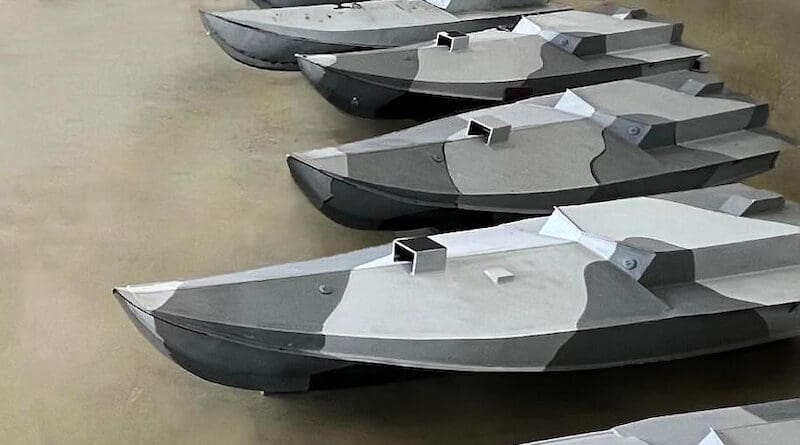
Unmanned surface vehicles are becoming increasingly popular in the fight against sea crimes, including illegal fishing.


Such vehicles, also known as USVs or maritime drones, can be used to detect suspicious activities without endangering personnel and can be equipped with artificial intelligence autonomy systems to gather, process and transmit information. Their enhanced communication systems enable seamless data sharing with command centers and improve situational awareness through persistent surveillance and reconnaissance missions.

According to Engineering News, cutting-edge USVs include sensor suites with cameras, sonar, radar and acoustic systems to give operators a complete picture of the environment. They may include military-grade sensors and modular payloads.

“Many USVs also feature swarm capabilities, enabling multiple units to work collaboratively,” wrote Mike Ball, an editor at Defense Advancement. “By leveraging inter-vehicle communication, these platforms can execute coordinated maneuvers, such as area surveillance or search-and-rescue missions. This networked approach enhances operational efficiency and provides a scalable solution for covering expansive maritime regions.”

USVs can be fully autonomous or remotely controlled, depending on their navigation systems and a mission’s requirements. They are often used for patrols, detecting mines, anti-submarine warfare and anti-piracy operations. Compared to traditional naval vessels, USVs are typically smaller, more fuel-efficient and require fewer personnel, resulting in lower costs.

In Africa, where patrol capacity is limited, USVs could be used to observe, detect and deter illegal, unreported and unregulated fishing in areas where a nation’s manned military vessels are unavailable for extended periods. Data collected by USVs could support global transparency efforts, supply regional allies with critical maritime information, and inform authorities about areas of concentrated fishing efforts. USVs could also help identify fishing vessel activity and support search-and-rescue operations.


“For Africa, adopting this technology could revolutionize maritime security by providing cost-effective solutions tailored to the continent’s unique challenges,” Guy Martin wrote for defenceWeb. “As African nations seek to secure their waters against evolving threats, USVs offer a promising path forward.”

As Ball noted, USVs also contribute to harbor and port security through routine patrols and inspections. They can identify unauthorized vessels, monitor infrastructure and respond rapidly to threats.

“USVs also play a central role in multi-domain operations,” Ball wrote. “By acting as a node within larger networked systems, they integrate seamlessly with manned vessels, submarines, and aerial platforms. This interoperability allows for synchronized missions where data flows across multiple assets, ensuring a unified operational picture.”

The Nigerian Navy recognized the benefits of using USVs to more effectively monitor its waters, which for at least two decades have been plagued by illegal fishing, particularly by Chinese industrial trawlers. The scourge costs the country about $70 million annually.

Last year, the Nigerian Navy acquired two SwiftSea Stalker USVs from Swiftship, a shipbuilder in the United States. These USVs were to be used in the Gulf of Guinea, the Niger Delta and Lake Chad Region, areas where insecurity and criminal activities persist. In South Africa, shipbuilder Legacy Marine is building a 9.5-meter USV that uses AI and robotics to navigate. It is believed to be the first USV fully built and tested in South Africa.

“USV technology is rapidly evolving, and the platforms are increasingly utilized within naval and defense forces,” Ball wrote. “Advancements in swarm intelligence, autonomous collaboration, and AI integration will enable USVs to undertake more complex missions with greater independence.”


Africa Defense Forum

The Africa Defense Forum (ADF) magazine is a security affairs journal that focuses on all issues affecting peace, stability, and good governance in Africa. ADF is published by the U.S. Africa Command.


Is Iraq Ready To Stand Alone Against Extremist Threats If US Withdrawal Goes Ahead? – Analysis

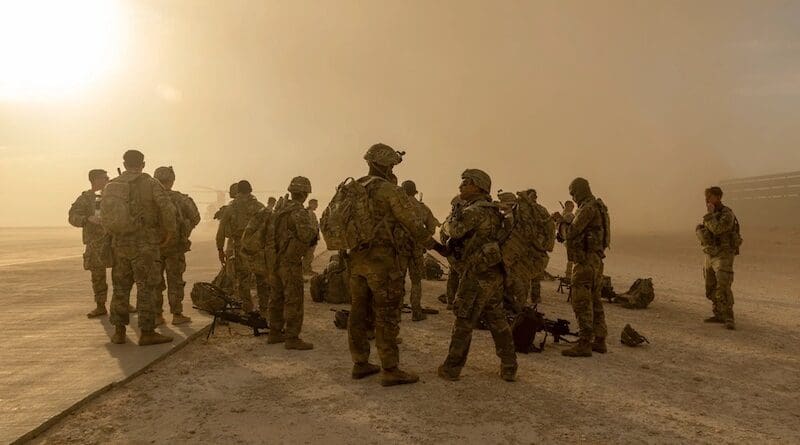
U.S. Army Soldiers conclude a training exercise in support of Combined Joint Task Force - Operation Inherent Resolve, in Western Iraq, Oct. 30, 2024. (U.S. Army photo by Spc. Tyler Becker)


By 

By Jonathan Lessware


When Daesh extremists seized control of swathes of Iraqi territory in 2014, many wondered whether the onslaught could have been prevented had US troops not withdrawn from the country three years earlier.

As the militants surged into Iraq’s second-largest city, Mosul, there were reports of members of the Iraqi Security Forces stripping off their uniforms as they fled.

“We can’t beat them,” an unnamed army officer told Reuters amid the chaos. “They are well-trained in street fighting, and we’re not. We need a whole army to drive them out of Mosul.”

After three years of fierce fighting that took Daesh within 25 kilometers of the capital, Baghdad, the extremists were finally driven back and Mosul was liberated.

The gargantuan military effort was spearheaded by Iraq’s elite Counter Terrorism Service, bolstered by the return of American troops and the US Air Force.


Images of the destruction in Mosul, along with the catastrophic impact of Daesh’s occupation, might be playing on the minds of Washington officials as they once again weigh whether or not to remove American troops still stationed in Iraq.

As it stands, the US and Iraq have agreed to end Operation Inherent Resolve — the US-led coalition’s mission to combat Daesh — by September. Most of the 2,500 US personnel in Iraq are scheduled to leave in the initial phase, with a small number remaining until 2026.

Many believe US President Donald Trump, acting under his isolationist tendencies, will want to hasten the withdrawal of those forces, or is unlikely to extend their stay if the Iraqi government requests it.

With reports of an increase in attacks by Daesh sleeper cells, fears of instability across the border in Syria, and with Iran looking to shore up its proxy militias in Iraq, there are concerns that another complete US withdrawal will once again leave the country vulnerable.

“The risk of premature withdrawal from Iraq is that the Iraqi Security Forces will lose critical operational and tactical support, and Daesh will seize the opportunity to reconstitute and once again terrorize the Iraqi people and state,” Dana Stroul, research director at the Washington Institute for Near East Policy and a former Pentagon official, told Arab News.

The mooted withdrawal of US troops comes more than 20 years after the US-led invasion of Iraq toppled Saddam Hussain, freeing the country from dictatorship, but ushering in a period of sectarian civil war.

US forces were drawn into cycles of violence and routinely became the target of two mutually antagonistic sectarian forces: Iran-backed militias and an insurgency in which Al-Qaeda played a prominent role.

When President Barack Obama took office in 2009, he vowed to end US involvement in the conflicts in Iraq and Afghanistan, but not without first ordering a massive troop surge in an attempt to salvage the mission.

In Iraq, where more than 100,000 people were estimated to have died in the violence, there was widespread public anger at the American presence. In the US, the war was also deeply unpopular with thousands of American soldiers having been killed.

Some American and Iraqi officials wanted to maintain a US military presence in the country, fearful of an Al-Qaeda resurgence. But attempts to negotiate an agreement for a reduced force failed and in October 2011 Obama announced that all of the remaining 39,000 US troops would be withdrawn by the end of that year, bringing a close to the mission.

The US spent $25 billion on training and equipping Iraq’s security forces up to September 2012, alongside Iraq’s own spending on fighter jets and other advanced materiel. So it was something of a surprise that Iraqi forces were so quickly overrun when Daesh launched its offensive in 2014, having emerged from the remnants of Al-Qaeda in Iraq.

Images of Daesh fighters driving around in US armored vehicles captured from the Iraqi military symbolized how quickly Iraq’s armed forces had deteriorated since the 2011 withdrawal.

As the extent of Daesh’s brutality began to emerge, including the slaughter of the Yazidi minority and the beheading of Western hostages on YouTube, the US ordered its forces back to the region, as part of an international coalition, to fight the extremists in both Iraq and Syria.

After some of the most brutal urban warfare seen since the Second World War, Iraq’s then-prime minister, Haider Al-Abadi, declared the territorial defeat of Daesh in December 2017. US forces continued to help their allies in Syria to defeat the extremists there in March 2019.

By December 2021, US forces in Iraq no longer held combat roles, instead working on training, advisory, and intelligence support for the country’s military. The remaining 2,500 US troops are spread between Baghdad, Irbil in the semi-autonomous Kurdistan region, and Ain Al-Asad air base.

However, soon after Al-Abadi’s declaration of victory over the extremists, a new threat emerged in Iraq in the shape of Iran-backed militias, originally mobilized to help defeat Daesh. Having extended their reach over Sunni and Kurdish areas, these groups began attacking US bases with rockets and drones in a bid to force their immediate withdrawal.

These attacks, sponsored by Iran’s powerful Islamic Revolutionary Guard Corps, prompted President Trump, during his first term, to order the killing of militia chief Abu Mahdi Al-Muhandis and Iranian Quds Force commander Qassem Soleimani in a drone strike on their motorcade as they left Baghdad Airport on Jan. 3, 2020.

Soleimani’s death was a major setback for Iran’s proxies throughout the region, but the attacks on US positions did not subside. In fact, with the onset of the war in Gaza in October 2023, Iraq’s Shiite militias mounted a fresh wave of strikes, ostensibly in support of Hamas.

The deadliest of these occurred on Jan. 28, 2024, when three US personnel were killed and 47 wounded in a drone attack on Tower 22 just over the border in Jordan, prompting then-US president, Joe Biden, to order a wave of airstrikes on militia positions in Iraq.

Mindful of the need to protect its proxies in Iraq, at a time where Lebanon’s Hezbollah and Yemen’s Houthis have been weakened and the sympathetic Assad regime in Syria has fallen, Iran appears to have forsworn further militia strikes on US forces.

The latest agreement to end the US presence was reached in September last year with the aim of moving to a fully bilateral security partnership in 2026.

Meanwhile, the US Defense Department announced in April it would be halving the number of troops in northeast Syria “in the coming months.”

An indication of Trump’s aversion to the continued US military presence came during a speech in Saudi Arabia while on his tour of the Gulf in May when he decried “Western interventionists.”

A clear concern surrounding a US withdrawal is whether Iraq’s security forces are now strong enough to withstand threats like the 2014 Daesh assault. The disastrous withdrawal from Afghanistan in August 2021 is also no doubt fresh in the minds of defense officials.

A recent report by the New Lines Institute think tank in New York said that a US withdrawal from Iraq would “heavily impede the intelligence and reconnaissance collection, artillery, and command-and-control capabilities of Iraqi military forces.”

The report studied quarterly independent audits for the US Congress between 2019 and 2024 to assess the capabilities of Iraqi forces. It looked at the three main forces in Iraq: the Iraqi Security Forces, Counter Terrorism Service, and the Kurdish Peshmerga.

The report said: “While segments of Iraq’s military, such as the CTS and Kurdish security forces, have proven efficient in counterterrorism operations, several gaps exist in Iraq’s conventional capabilities, including artillery, command and control, inter- and intra-branch planning, and trust.”

The think tank said there were serious questions about whether Iraq’s security forces would be able to “hedge against internal and external challenges” in the absence of the US security umbrella.

The report’s co-author Caroline Rose, a director at New Lines, says the gaps in Iraqi capabilities “could reverse over a decade of progress that Operation Inherent Resolve has made in Iraq.”

“If the objective is still to advance Iraqi forces’ operational capacity, sustain gains against Daesh, and serve as a ‘hedge’ against Iranian influence, there is work still to be done,” she told Arab News.

While Iraq has enjoyed a period of relative stability, the threats to its national security continue to lurk within and beyond its borders.

The biggest fear is of a Daesh resurgence. Although the group has been severely depleted, it continues to operate cells in rural areas of Iraq and Syria, and has since made headway in Afghanistan, the Sahel, and beyond.

“Since January, the US military is still actively supporting the Iraqis,” said the Washington Institute’s Stroul. “There have been monthly operations against Daesh, including the killing of a senior leader in western Iraq. This tells us that Daesh is still a threat, and the US support mission is still necessary.”

Another concern is that instability in Syria, where the embryonic, post-Assad government is facing significant security challenges, could again provide a breeding ground for Daesh that could spill across the border.

“There are still 9,000 Daesh detainees held in prison camps in northeast Syria,” said Stroul, adding that these present “a real risk of prison breaks that will replenish Daesh ranks and destabilize Syria, Iraq, and the rest of the region. If the security situation deteriorates in Syria, this will have seriously negative impacts in Iraq.”

And then there is the ongoing threat posed by Iran-backed militias. While these militias have been officially recognized as part of Iraq’s security apparatus, some believe the US presence in Iraq helps keep them — and, by extension, Iran — in check.

“The staging of US forces and equipment, combined with a deep Iraqi dependence on American technical and advisory support, creates an obstacle and point of distraction for Tehran and its proxies,” Rose said.

If the withdrawal of US troops from Iraq is inevitable, then how can Washington best prepare Iraq to go it alone?

For Rose, the US should play a “long game” to sustain security ties with Iraq and preserve the progress made under Operation Inherent Resolve.

She recommended the US continue investing in Iraq’s defense and security, conducting regular joint military exercises, and using its current presence in Irbil and Baghdad to build strong relations with security officials.

She also advised other international bodies, like the NATO Mission-Iraq and the EU Advisory Mission Iraq, to coordinate closely with the US as the drawdown gets underway.

Although the US appears set on pivoting away from the region to focus strategic attention on the Asia-Pacific, some still hope there could be a way for America to maintain some form of military presence, given the rapidly evolving situation in the wider Middle East.

Reports earlier this year suggested some senior Iraqi politicians aligned with Iran privately want a US presence to continue, at least until ongoing US-Iran nuclear talks reach a conclusion.

“The US military mission is one of support, advice, and assistance by mutual consent of Baghdad and Washington,” Stroul, of the Washington Institute, said. “If the Iraqi government invites the US military to remain for some period of time, there should be agreement on the supporting role that the US can play.”

If Iraq hopes to maintain lasting stability, it needs to ensure its security forces can act alone to protect the country and population from internal and external threats.

Continuing to work with the world’s foremost military power, even in a limited capacity, would go some way to ensuring the horrors of 2014 are not repeated.


Arab News

Arab News is Saudi Arabia's first English-language newspaper. It was founded in 1975 by Hisham and Mohammed Ali Hafiz. Today, it is one of 29 publications produced by Saudi Research & Publishing Company (SRPC), a subsidiary of Saudi Research & Marketing Group (SRMG).


The Indus Pause: Unpacking Fallacy Of Compliance In Bilateral Agreements – Analysis

The Ganges (Ganga) River, Varanasi, Uttar Pradesh, India. Photo by Babasteve, Wikimedia Commons.


By 

By Heena Makhija


Putting an end to escalating military hostilities, India and Pakistan agreed to a ceasefire on 10 May 2025 – but  India upheld its decision to suspend the Indus Water Treaty (IWT). One month since its announcement, the suspension marks a substantial shift in India’s long-standing policy of ‘de-linking’ water from security issues.

The IWT has been touted as a successful transboundary agreement, given its survival despite major conflicts between the parties. However, bilateral agreements rely heavily on mutual goodwill – parties have the scope to use a ‘strategic pause’ as a tool for deterrence or posturing. India’s abeyance of the IWT underscores the dependence of treaty compliance on geopolitical considerations with implications for international governance frameworks. 

Treaty ‘Abeyance’ as a Punitive Measure 

In the aftermath of the terror attack in Pahalgam, India announced a series of countermeasures, including placing the IWT “in abeyance with immediate effect”. Brokered by the World Bank in 1960, the IWT withstood the test of time and served as a testament to successful diplomacy. Suspending the treaty as a response marks a sharp shift in approach – India recognises the significance of IWT for Pakistan and has linked the treaty’s future to its policy of ‘zero tolerance’ towards terrorism.

The effects of suspending the treaty might not be evident in the short run – yet the IWT remains crucial for Pakistan. The geographical partition of the subcontinent resulted in a physically asymmetric hydrological divide – as the upper riparian nation, India controls access to the river headwaters. Pakistan, as the lower riparian, is heavily reliant on the Indus system, which accounts for nearly 80 percent of its agricultural needs and 93 percent of its total water use.      India currently does not possess the infrastructural capacity to redirect the flow of river water – the IWT barred India from constructing any storage dams. Nonetheless, Pakistan still faces the risk of excessive flooding and water shortages if India chooses to expand its hydroelectric capacity along its western rivers. In a recent interview, Pakistan’s Foreign Minister Muhammad Ishaq Dar stressed that the “ceasefire was under threat” if the “water issue” was not resolved in the upcoming talks.

Treaty Obligations and Limitations to Compliance

Bilateral treaties are based on the principle of Pacta Sunt Servanda – treaty obligations must be fulfilled in good faith. But the principle does not exist in absolute terms – as geopolitical realities take precedence, the pursuit of national interest often supersedes treaty obligations, particularly when a state’s security apparatus is violated. India’s decision to put the treaty on pause is a tactical move that does not violate international norms – it has neither abrogated the treaty nor undertaken any kinetic measures that breach its clauses. The move is aimed at ceasing cooperation as a countermeasure to Pakistan’s sponsorship of terrorism and provides India with leverage at the negotiating table.      


The IWT is a bilateral mechanism built on nuanced political compromise for the management of a shared resource. While the treaty was brokered by a third party – the World Bank – it is not governed by any international maritime law. Article 9 of the IWT does refer to the establishment of dispute resolution bodies – the Permanent Indus Commission, a Neutral Expert, and a Court of Arbitration. However, the focus of agreements such as IWT has been on fostering cooperation and information exchange, rather than establishing enforceable compliance mechanisms. 

International mediation can achieve little in settling transboundary disputes, often rendering them primarilybilateral undertakings. For instance, in the case of Kishenganga and Ratle hydroelectric projects, both countries disagree on whether the technical design of the power plant contravenes the treaty. They are also at loggerheads over the arbitration procedure to be adopted for dispute resolution. In a recent statement, World Bank President Ajay Banga clarified that the bank’s role was “limited to be(ing) a facilitator and it will not step in to resolve the current dispute”. 

Broader Implications for Governance of Shared Resources

India had the leeway to suspend the IWT without violating any international laws, and it had been signallingtowards the possibility of using the ‘pause’ as a strategic response to cross-border terrorism. While placingthe treaty in abeyance certainly impacts the bilateral relationship between the two countries, it also carriesbroader international ramifications for the governance of shared resources. Though not codified, international water law is underpinned by basic principles and norms that guide states in negotiating mutually agreeable terms for the sharing of common water sources. The threat of the ‘weaponisation’ of water and the pressing need for transboundary cooperation have prompted agreements even in some of the world’s most contested river basins, such as the Mekong and the Nile.     

India has taken a tough stand by suspending the treaty, but it remains mindful of the risks associated with the outright breakdown of the agreement and the securitisation of a resource such as water. While India has pursued the suspension as a conditional bargaining tool, it does not seek to set a precedent forwithholding treaties or disregarding international norms— particularly given shared water resources with other neighbours in the region. The temporary halt reflects a firm stance, but also signals nuanced restraint, leaving open the possibility of a return to the status quo through effective bilateral dialogue. However, any meaningful dialogue in the near future will depend on Pakistan’s ability to abjure its support for cross-borderterrorism. 


  • About the author: Heena Makhija is an Associate Fellow with the Economy and Growth Programme at the Observer Research Foundation.

Observer Research Foundation

ORF was established on 5 September 1990 as a private, not for profit, ’think tank’ to influence public policy formulation. The Foundation brought together, for the first time, leading Indian economists and policymakers to present An Agenda for Economic Reforms in India. The idea was to help develop a consensus in favour of economic reforms.