It’s possible that I shall make an ass of myself. But in that case one can always get out of it with a little dialectic. I have, of course, so worded my proposition as to be right either way (K.Marx, Letter to F.Engels on the Indian Mutiny)
Monday, June 02, 2025
UK to build 12 new submarines and six new munition factories as part of Strategic Defence Review
The British government on Monday endorsed 62 recommendations made in an externally-led Strategic Defence Review.
British Prime Minister Keir Starmer announced on Monday that the UK will build 12 new attack submarines and six new ammunition factories as part of a Strategic Defence Review.
The externally-led review outlines 62 recommendations, which the government endorsed in full, including moving the Armed Forces into a state of "warfighting readiness".
"When we are being directly threatened by states with advanced military forces, the most effective way to deter them is to be ready, and frankly, to show them that we’re ready to deliver peace through strength," Starmer said in Glasgow on Monday.
The review, he added, is "a blueprint to make Britain safer and stronger, a battle-ready, bomber-clad nation with the strongest alliances and the most advanced capabilities, equipped for the decades to come".
The 12 new conventionally armed nuclear-powered submarines will be built as part of the AUKUS programme concluded in 2021 between Australia, the UK, and the US and should all be online by the late 2030s with one built every 18 months, per Starmer.
The programme will be accompanied by a £15 billion (€17.8 billion) investment in nuclear warheads.
Another key plank of the review is the procurement of up to 7,000 UK-built long-range weapons, along with a £1.5 billion (€1.8 billion) investment to build at least six munitions and energetics factories.
One of these production capacities is expected to be "always on" to allow for production to be ramped up quickly to meet the demand of high-tempo warfare, if necessary.
"The hard-fought lessons from Putin’s illegal invasion of Ukraine show a military is only as strong as the industry that stands behind them," Defence Secretary John Healey said in a statement.
"We are strengthening the UK’s industrial base to better deter our adversaries and make the UK secure at home and strong abroad," he added.
The government will also put forward £1 billion (€1.2 billion) in a new CyberEM Command to boost cyber operations and digital capability, as well as £1.5 billion of additional funding to repair and renew armed forces housing.
The investments should make some way into Britain's goal, unveiled earlier this year, to boost defence spending to 2.5% of Gross Domestic Product by 2027 and to 3% in the next parliament.
Britain, a NATO member, will on Wednesday co-chair a meeting of the Ukraine Defence Contact Group, which aims to coordinate military support to Ukraine in response to Russia's full-scale invasion involving 56 countries.
Defence ministers from the alliance will meet on Thursday to continue talks on increasing the defence spending target from its current 2% of GDP level.
Allies appear to have landed on a 5% of GDP target, a number repeatedly called for by Trump, although it would be split in two: 3.5% of GDP for hard military spending, and a further 1.5% on defence-related spending including, for instance, infrastructure and cybersecurity.
The new target will be endorsed by NATO at a summit in The Hague later this month.
Starmer defended his aim to bring defence spending to 3% in the next parliament, therefore below the 3.5% by 2032 that NATO is set to agree on.
"Everything we do will add to the strength of NATO," he said. "The NATO alliance means something profound, that we will never fight alone. It is a fundamental source of our strategic strength".
The transformation we're driving in our defence must add up to Britain's biggest contribution to NATO since its creation," he added.
Sweden urged to stop international adoptions after probe finds abuses and fraud
A complete ban on international adoptions to Sweden has been proposed by a government-appointed commission on Monday following its inquiry, which found widespread abuses and fraud.
Results of a government probe into Sweden's adoption practices prompted its lead investigator to call for a halt to all international adoptions, domestic media reported.
"There have been irregularities in the international adoptions to Sweden," Anna Singer, the head of the Swedish Adoption Commission, said during a press conference on Monday, during which she handed over the findings of the investigation to Social Services Minister Camilla Waltersson Grönvall.
"Today, with increased respect for children's rights, we cannot accept the levels of risk that this activity is and has been associated with."
During the probe, investigators have discovered confirmed cases of child trafficking and illegal adoptions in every decade from the 1970s to the 2000s.
The commission recommended that the Swedish state acknowledge violations of human rights and formally apologise to adoptees and their families.
It also proposed that Sweden gradually phase out its international adoption activity and introduce long-term support for adoptees and their families.
Minister Waltersson Grönvall said the Swedish government takes the findings very seriously.
"We have gained even more clarity in the fact that children and parents have been affected and harmed for decades within the framework of international adoption activities," she said. It will now analyse the commission's conclusions and proposals.
Adoptionscentrum, Sweden's largest agency for international adoptions, is in favour of reviewing current practices, but questions a total ban.
"If the alternative for a child is to grow up in an institution, I think that growing up in a safe family in another country could be in the best interests of the individual child," Margret Josefsson, vice-chair of the Adoption Centre, told public broadcaster SVT.
'Stolen children'
The Adoption Committee was appointed in the autumn of 2021 following an investigation by the Swedish daily Dagens Nyheter (DN), which found examples of what journalists referred to as "stolen children" from South Korea, China, Sri Lanka and Chile, among others.
It revealed that thousands of children were adopted in Sweden with falsified background information.
While the children's documentation stated that they had been abandoned or that their parents could not afford to keep them, the DN investigation showed that, in several cases, biological parents were robbed of their children.
This was confirmed by the commission as revealed on Monday. "Children have in some cases been adopted without the voluntary and informed consent of the parents. The best interests of the child have not always been ensured," the report said.
In Chile and Colombia, mothers told of how their children had been abducted from day-care centres and hospitals. In some countries, these activities involved gangs consisting of hospital staff, lawyers, police and government officials.
The investigation by DN also found that Swedish authorities knew about child trafficking and this corruption in key adoption countries, but did not take action.
In its report, the commission stated that, in some cases, "Swedish actors were aware that irregularities had already occurred when they occurred, while in other cases it was discovered much later".
Europe-wide shift
Sweden is the latest country to examine its international adoption policies after allegations of unethical practices.
The Netherlands last year announced it would no longer allow its citizens to adopt children from abroad after a scathing report on abuses was published in 2021, including reports of child theft, child trafficking and unethical actions by officials.
Meanwhile, Denmark’s only overseas adoption agency announced last year it was “winding down” its facilitation of international adoptions after a government agency raised concerns over fabricated documents and procedures which obscured children's biological origins abroad.
Sweden's neighbour Norway is conducting probes into past adoption practices regarding adoptees from South Korea. More than 6,500 children came from the Asian country to the Nordic country.
Meanwhile, the Belgian region of Flanders has also paused international adoptions following reports of malpractice with adoptions from Ethiopia, the Gambia, Haiti and Morocco.
FASCIST SLIM WIN
Polish PM Tusk calls for confidence vote following nationalist Nawrocki's presidential victory
Polish PM Donald Tusk said Monday he would call a confidence vote to reaffirm support for his pro-EU government after nationalist Karol Nawrocki narrowly won Sunday’s presidential election. Though Tusk's coalition holds a parliamentary majority, experts warn Nawrocki’s victory could deepen existing internal divisions.
Polish Prime Minister Donald Tusk on Monday called for a parliamentary confidence vote in a bid to demonstrate continued support for his pro-EU government after a nationalist candidate won the presidential election.
In a televised address, Tusk said he would "ask for a vote of confidence in the lower house soon" in his coalition government.
"As prime minister, I will not stop for a moment my work and our common struggle for the Poland of our dreams... free, sovereign, safe and prosperous," Tusk said.
Polish PM Donald Tusk calls for confidence vote after nationalist wins presidency
Tusk's government has had a majority in parliament since it took over from the Law and Justice (PiS) party following parliamentary elections in 2023.
But there are internal divisions in the coalition which experts say could be exacerbated by Nawrocki's victory. Who is Karol Nawrocki, the nationalist historian who won Poland's presidency
Some analysts have predicted that the growing political tensions could bring down the government and prompt early parliamentary elections, which are not expected until 2027.
PiS leader Jaroslaw Kaczynski said just before Tusk spoke that Sunday's election result was a "red card" for the government.
He called for an "apolitical and technical government" of experts to take over.
Nawrocki, an admirer of US President Donald Trump, won by 51 percent to pro-EU liberal Rafal Trzaskowski's 49 percent.
(FRANCE 24 with AFP)
Conservative Karol Nawrocki wins Poland's presidential election, according to final vote count Copyright AP Photo By Euronews Published on 02/06/2025 -
The presidential runoff pitted Trzaskowski, a liberal pro-EU politician, against Nawrocki, a conservative historian backed by the right-wing Law and Justice party.
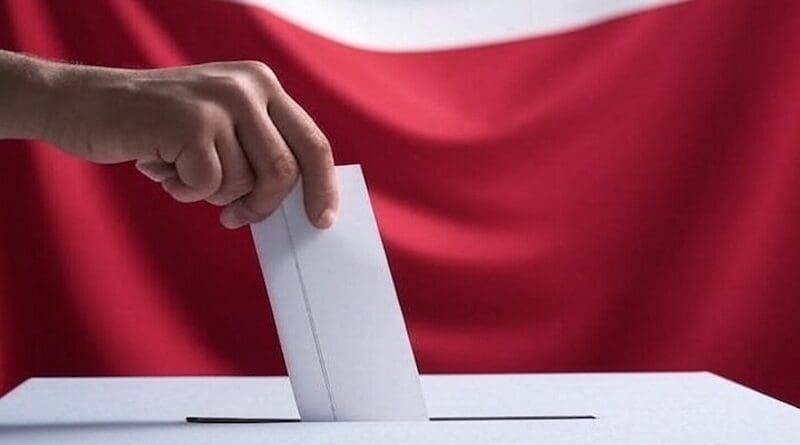
Conservative Karol Nawrocki has won Poland’s weekend presidential runoff election, according to the final vote count.
Nawrocki won 50.89% of votes in a nailbiting final race against liberal Warsaw Mayor Rafał Trzaskowski, who received 49.11%.
He will succeed conservative Andrzej Duda, whose second and final term ends on 6 August.
The close ballot had the country on edge since a first round two weeks earlier revealed deep divisions along the eastern flank of NATO and the European Union.
Although most day-to-day power lies in Poland lies with the prime minister, Donald Tusk, the president is able to influence foreign policy and, crucially, veto legislation.
Tusk, who came to power in late 2023 with a coalition government with a broad ideological divide, has been unable to muster enough support to fulfill certain electoral promises such as easing abortion law. He is expected to face further obstacles with Nawrocki as president. The 42-year-old amateur boxer and political novice belongs to the conservative Law and Justice party (PiS) which governed Poland from 2015 to 2023.
A tight race
A first exit poll initially showed Trzaskowski with a slight lead over conservative historian Nawrocki, but two hours later an updated “late poll” showed Nawrocki winning 50.7%, more than Trzaskowski with 49.3%
Turnout was 72.8% - higher than the 67.3% reported in the first round on 18 May. Voting started at 7 am and ended at 9 pm.
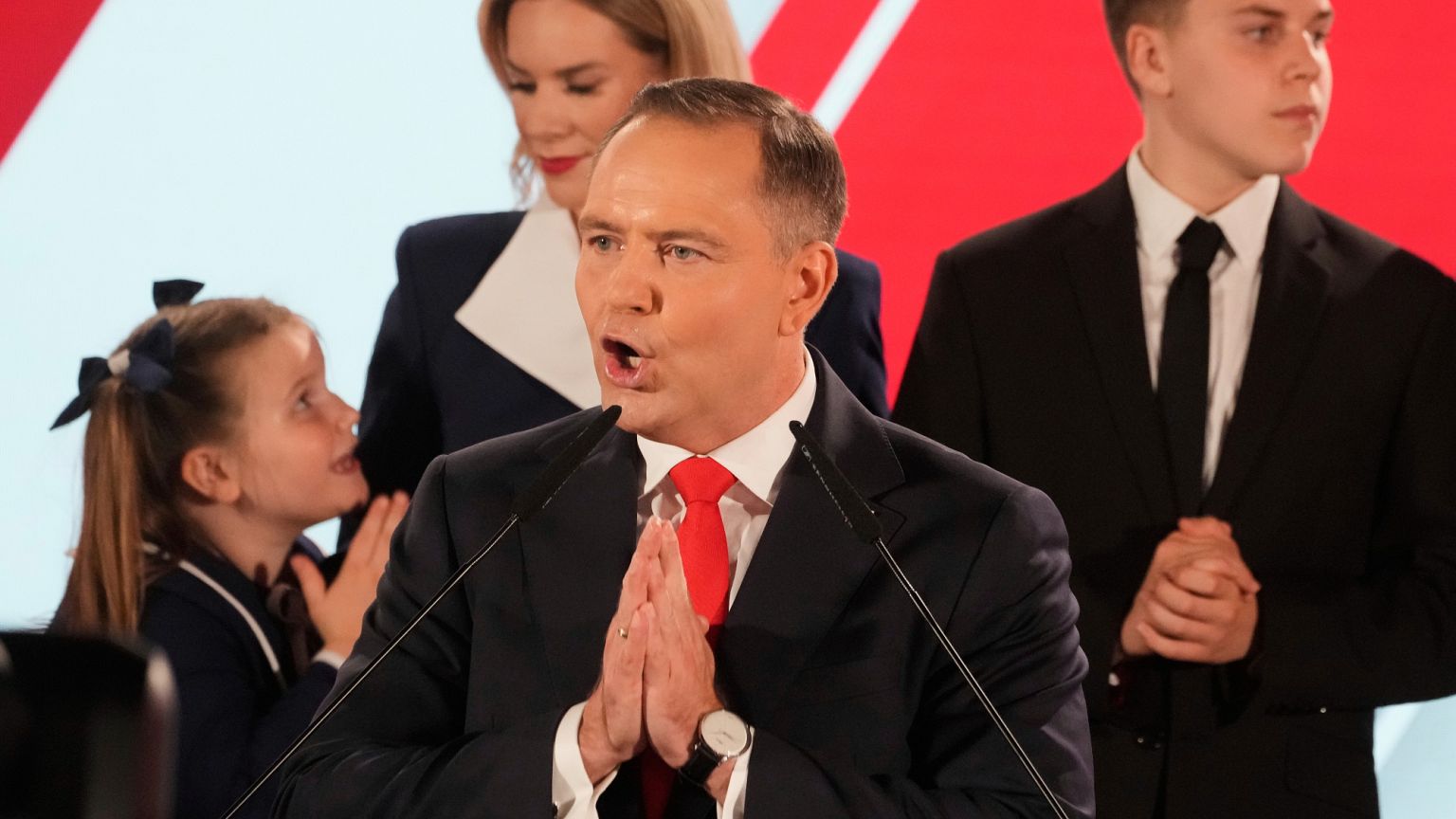
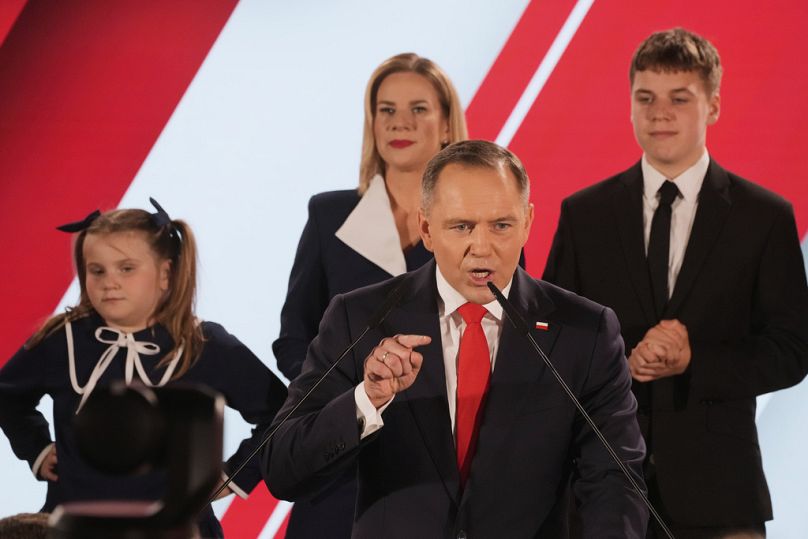
Presidential candidate Karol Nawrocki, a conservative historian backed by the right-wing Law and Justice party addresses supporters at his headquarters,in Warsaw, Poland.Czarek Sokolowski/Copyright 2025 The AP. All rights reserved
At a conference at 6:30 pm, the chairman of the Polish National Electoral Commission said incidents had been reported during the voting, with "232 possible offences" taking place.
The runoff follows a tightly contested first round of voting on May 18, in which Trzaskowski won just over 31% and Nawrocki nearly 30%. Both leaders claimed victory
Though the final result was still unclear on Sunday evening with the two locked in a near dead heat, both men claimed to have won in meetings with their supporters in Warsaw.
“We won,” Trzaskowski told his supporters to chants of “Rafał, Rafał.”
“This is truly a special moment in Poland’s history. I am convinced that it will allow us to move forward and focus on the future,” Trzaskowski said. “I will be your president.”
Nawrocki, speaking to his supporters at a separate event in Warsaw, said he believed he was on track to win. “We will win and save Poland,” he said. “We must win tonight.
Who is Poland's newly elected president, Karol Nawrocki?
The conservative candidate beat liberal Rafał Trzaskowski with a narrow 50.89% of the vote in the presidential election runoff on Sunday.
Karol Nawrocki is set to become Poland's next president after a tense race in the election runoff against liberal candidate Rafał Trzaskowski on Sunday.
The conservative politician has pledged to hinder Prime Minister Donald Tusk government's centrist, pro-EU ambitions for the remainder of its term.
These are the most essential facts to know about Poland’s newly elected conservative president.
A Gdańsk native, Nawrocki earned a degree in history from the University of Gdańsk in 2008, followed by a PhD in 2013. He also holds an international MBA from the Gdańsk University of Technology, which he earned in 2023.
During his presidential campaign, Nawrocki's critics questioned his role as head of the Institute of National Remembrance (IPN), an organisation tasked with investigating and prosecuting Nazi and communist crimes between 1917 and 1990, which gave him access to top state secrets, including those classified under special security provisions.
Nawrocki started working at the IPN in 2009. He took a break for four years, during which he served as director of the World War II Museum in Gdańsk. In 2021, he returned to the IPN as president.
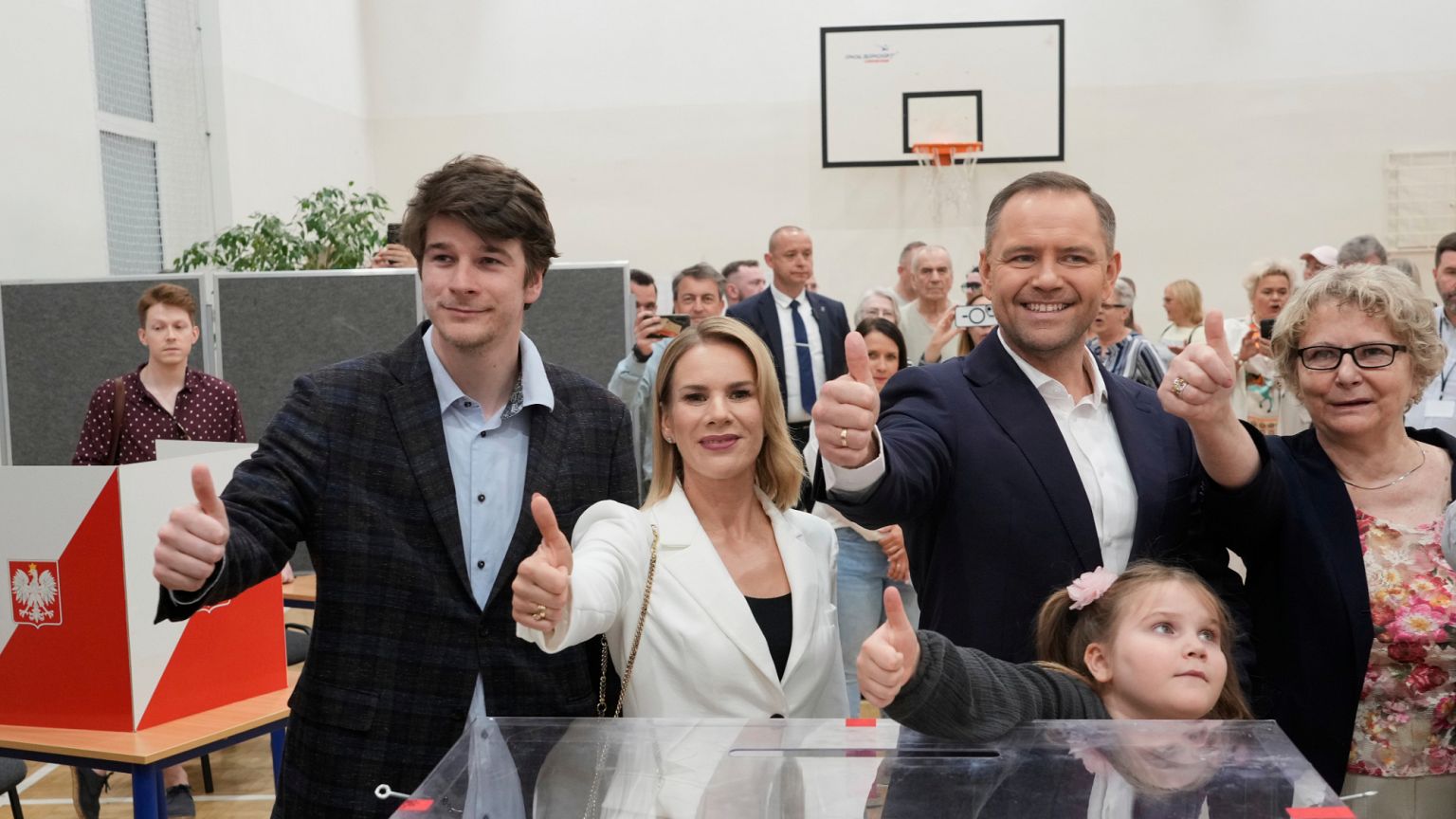
Presidential candidate Karol Nawrocki greets supporters as he arrives at his headquarters in Warsaw, Poland, Sunday, June 1, 2025.Czarek Sokolowski/Copyright 2025 The AP. All rights reserved
While at the IPN, he passed the vetting procedure of the Internal Security Agency (ABW). In the final days of the campaign, a media report claimed that ABW agents initially gave Nawrocki a negative recommendation.
The assessment was ultimately overruled by the agency's then-chief — a Law and Justice or PiS party appointee and adviser to now-former President Andrzej Duda. PiS argued the clearance was valid.
In 2024 he was put on a list of Polish nationals wanted by the Russian Interior Ministry due to his presence at the dismantling of the Red Army Gratitude Monument in Glubczyce in 2022.
Political views and opinions on economy
A candidate supported by the PiS, Nawrocki's political views are described as conservative and right-wing.
During the election campaign, he opposed compulsory vaccinations for both adults and children. He has also opposed Ukraine’s membership in NATO and the European Union until outstanding bilateral issues with the neighbouring country are resolved.
Nawrocki's election plan included, among other things, a pledge not to raise taxes and a reduction in VAT.
Other promises included the introduction of zero income tax relief for families with at least two children, tax-free inheritance, and the abolition of the Belka tax.
Nawrocki supports nuclear energy but maintains that, until Poland has its own nuclear power plant, coal should continue to be mined and used.
"I say a clear no to this. Until Poland achieves nuclear energy, Polish coal should be mined, fed into, and develop the Republic of Poland. Hands off Polish coal until we get to the atom," he said at a rally in Pajęczno in March.
"By rejecting green ideology, green taxes, and the EU ETS, and through the extraction of Polish coal, we will finally start paying normal electricity prices," he added.
Defence and conscription
Nawrocki advocated for voluntary conscription during his presidential campaign. During a presidential debate, he argued that Poland is not currently in a situation that should require forced conscription.
"I will be the president of a safe Poland in which conscription should be voluntary. It is necessary to build a strong, modern Polish army, at least 300,000 strong, with strong alliances, but it must remain voluntary, which is fundamental for me as well," Nawrocki said.
At his speech in Pajęczno, he reiterated that he would seek to expand the army. "Poland will be safe when it is militarily secure and has at least a 300,000-strong Polish army and a million reservists. This is what I will lead up to and what I will achieve as the supreme commander of the armed forces," Nawrocki said.
On 22 May, he signed a programme declaration prepared by the leader of the far-right Konfederacja or Confederation party, Sławomir Mentzen, consisting of eight demands.
Nawrocki has declared that as president he would not sign — among other things — laws restricting freedom of expression and access to weapons.
PiS-backed Karol Nawrocki wins Poland’s presidential election
PiS-backed Karol Nawrocki wins Poland’s presidential election. / bne IntelliNews
By bne IntelliNewsJune 2, 2025
Karol Nawrocki, a political newbie backed by the radical right-wing Law and Justice (PiS) party, has won Poland’s presidential election, official results showed on June 2.
Nawrocki won 50.89% of the vote, beating his centrist rival Rafał Trzaskowski, who won 49.11%. Turnout came in at 71.63%, which was high, but not high enough to secure Trzaskowski a victory.
The result is a major setback for Prime Minister Donald Tusk’s government, which will have to face a hostile president likely to veto key reforms. That is likely to deepen voter frustration – which contributed to Trzaskowski’s defeat.
To date, Tusk’s agenda has already been blocked by the outgoing PiS-aligned President Andrzej Duda. This is expected to continue after Nawrocki takes office in August.
The Tusk-led coalition is well short of a majority to override presidential vetoes. That might contribute further to the Tusk government’s losing popular support. Working against Duda, the government has seen its support figures slide to just 32% in a cyclical survey by CBOS, a state polling institution.
Nawrocki campaigned on a platform of making Poland “normal,” vowing to push back against closer ties with the EU, halt progress on LGBTQ+ rights and resist moves to liberalise abortion laws.
Nawrocki has also said he would curb the rights of Ukrainians in Poland and claimed Ukraine was taking advantage of Poland economically, using war as leverage.
His victory may also pave the way for PiS to return to power after the next general election in 2027. Party polls have already been showing that the incumbent coalition would lose a majority to PiS and the far-right Konfederacja party.
There have been no official statements from either candidate following the announcement of official results.
An exit poll, published just after polling stations closed on June 1, gave Trzaskowski a narrow lead of 0.6pp, an advantage that disappeared only two hours later after a late poll (combining exit poll data with some actual results) was out.
It was Nawrocki who had sensed a change was coming on the election night. “We are going to win tonight!” he told a crowd gathered at his election event.
The Trzaskowski camp had hoped that results from big cities, where liberals typically win by a huge margin, would tilt the final result back in its favour. The difference kept on narrowing – but not enough to change the outcome.
UPDATE: late poll has turned Poland’s presidential race on its head, with populist Nawrocki now in front
Late poll has turned Poland’s presidential race on its head, with populist Nawrocki now in front / Nawrocki's campaign/Facebook
By bne IntelliNewsJune 1, 2025
A late poll, combining exit poll data with some official results, put Karol Nawrocki ahead with 50.7%, while Rafal Trzaskowski trailed at 49.3%, a 1.4 percentage point gap, shortly before midnight Poland time on June 1.
This margin is slightly wider than the exit poll – in which Trzaskowski was the leader – and has a margin of error of just 1pp, contrary to the exit poll's 2pp, now hinting at Nawrocki as the favourite to win.
If Nawrocki wins, it would be a major setback for Prime Minister Donald Tusk’s government, which would face a hostile president likely to veto key reforms.
Tusk’s agenda has already been blocked by the outgoing PiS-aligned President Andrzej Duda, and this is expected to continue if Nawrocki takes office in August. The Tusk-led coalition is well short of a majority to override presidential vetoes.
That might contribute further to the Tusk government’s losing popular support. Working against Duda, the government has seen its support figures slide to just 32% in a cyclical survey by CBOS, a state polling institution.
Nawrocki campaigned on a platform of making Poland “normal,” vowing to push back against closer ties with the EU, halt progress on LGBTQ+ rights and resist moves to liberalise abortion laws.
Nawrocki has also said he would curb the rights of Ukrainians in Poland and claimed Ukraine was taking advantage of Poland economically, using war as leverage.
Poland: Presidency Too Close To Call As Exit Polls Show Neck-And-Neck Race
(EurActiv) — Poland was left on a knife-edge on Sunday evening as the country’s presidential race remained too close to call after first exit polls were published.
According to an Ipsos exit poll at 21:00 CEST, the second-round run-off between liberal Warsaw mayor Rafał Trzaskowski and right-wing populist Karol Nawrocki will go down to the wire.
Neither Trzaskowski, projected to take 50.3%of the vote, nor Nawrocki (49.7%) had established a clear lead.
A late poll by Ipsos around 23:30 CET – which is essentially the exit poll, updated with partial results from 50% of polling stations where they conducted the poll – offered a plot twist, according to which Nawrocki has now gone into lead with 50.7% over 49.3% for Trzaskowski.
Official results from the National Electoral Commission are expected early Monday morning.
A key factor for the tight margin was a record turnout throughout the day, according to election officials. Turnout was estimated by Ipsos at 72.8%.
Immediately after the exit poll was published, Trzaskowski claimed victory, telling a gathering of supporters in Warsaw that “we’ve won.” Nawrocki told his supporters that “we will win and save Poland… We have to win tonight and we know that we will.”
Over 200,000 people registered to vote abroad between the first and second rounds of the election, for a record total of over 700,000 voters from abroad across the two rounds.
Poland’s diaspora has historically tended to vote more conservatively.
The race, one of the tightest in Poland’s post-communist history, caps a polarising campaign in which both candidates adapted their tone to appeal to younger, far-right-leaning voters.
A victory for Trzaskowski, the candidate backed by the ruling centrist Civic Coalition (KO) and Prime Minister Donald Tusk, would loosen the political gridlock that has paralysed Poland since his party took power in parliament last year.
With a liberal in the presidential palace, Prime Minister Donald Tusk would gain a crucial ally to push forward long-delayed judicial reforms, restore media independence, and possibly liberalise abortion laws and LGBTQ+ rights.
Conversely, a Nawrocki win would cement conservative control of the presidency until at least 2030, extending the influence of the nationalist Law and Justice (PiS) party even after its loss of parliamentary control in 2023.
Nawrocki, a historian and former boxer who also gained the Trump administration’s political support, dodged a spate of scandals and campaigned on law-and-order messaging and vowed to defend “traditional Polish values.”
The far-right Confederation party, led by 38-year-old firebrand Sławomir Mentzen, did not make it to the second round but had siphoned support from both major blocs in the first round – signalling a broader reckoning over the country’s political direction.
EurActiv
EurActiv publishes free, independent policy news and facilitates open policy debates in 12 languages.
Rafał Trzaskowski comments on runoff election result with thanks and apologies
The Civic Platform candidate who lost out in Sunday's presidential runoff has spoken for the first time since the results were announced.
In a lengthy post published on X, Warsaw Mayor and PO presidential candidate Rafał Trzaskowski thanked his voters following his defeat in Sunday's presidential runoff.
"THANK YOU for every vote. I fought for us to build together a strong, safe, honest, empathetic Poland. A modern Poland where everyone will be able to fulfil their goals and aspirations. I would like to thank everyone who voted for such a Poland," he wrote.
In a dramatic turn of events, Trzaskowski lost to conservative Karol Nawrocki, who is supported by the Law and Justice (PiS) party and received 50.89% of the vote, slightly ahead of Trzaskowski's 49.11%.
Just after polling stations closed at 9 pm on Sunday, exit polls indicated that Trzaskowski had won and he acknowledged that victory during a speech in the early evening to undisguised enthusiasm and optimism among his staff.
However, later poll results published around two hours later indicated that Karol Nawrocki had won and on Monday morning, state electoral commission (PKW) data confirmed victory for the PiS candidate.
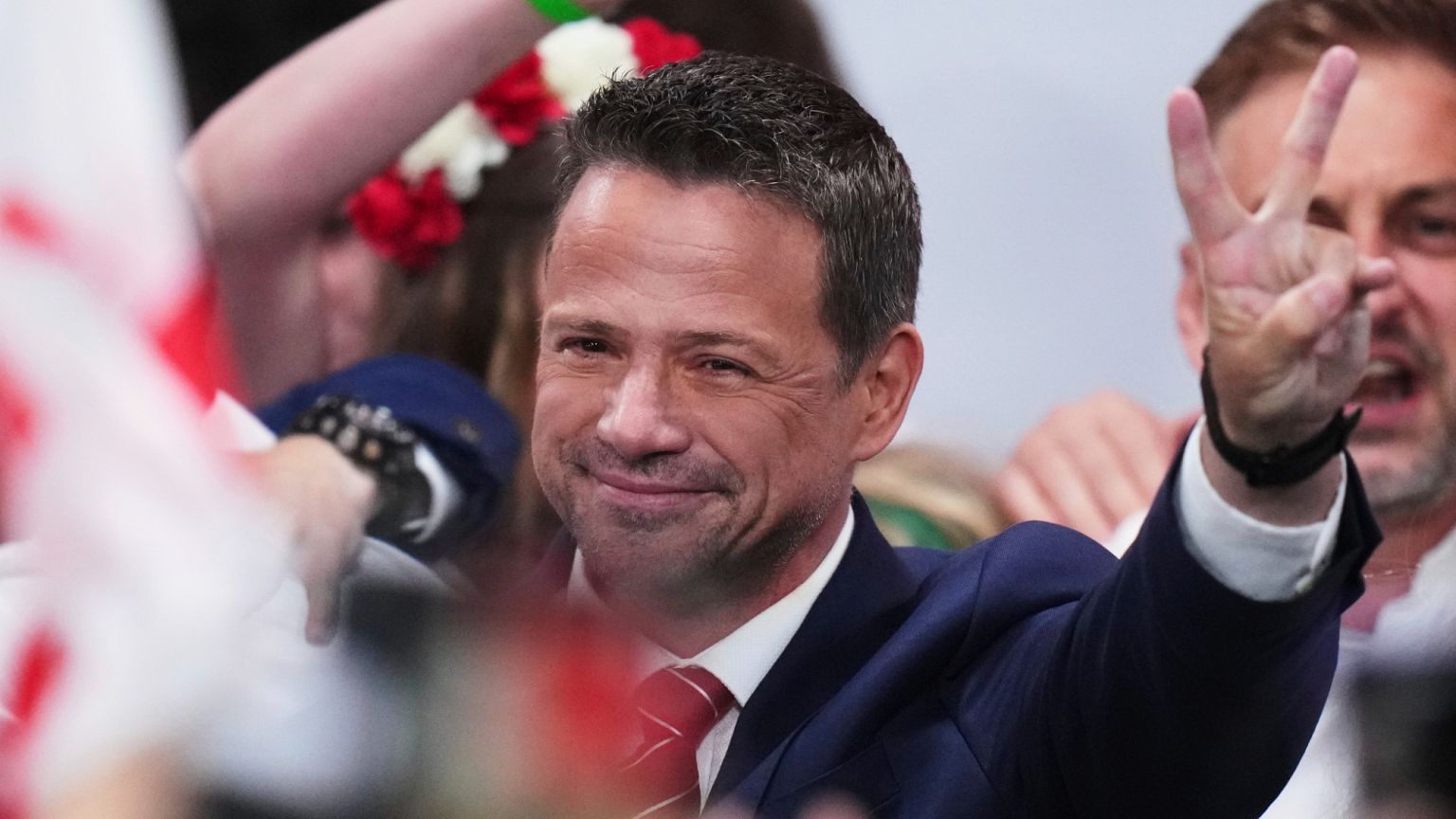
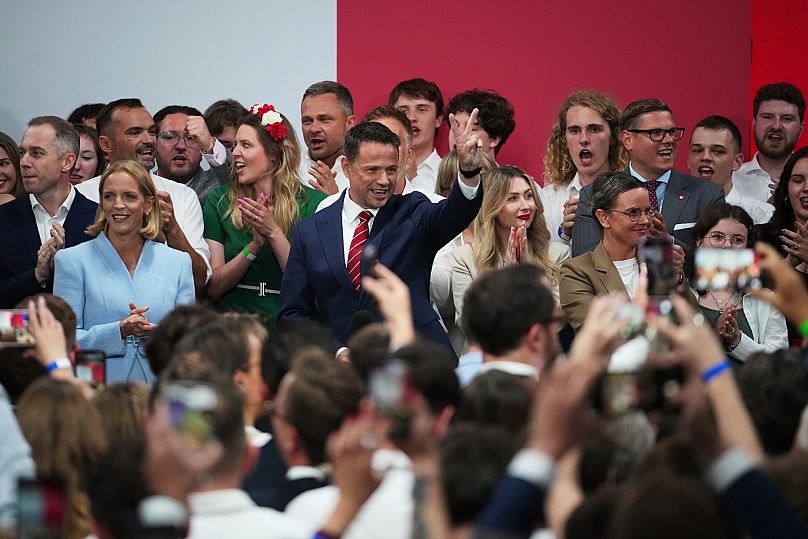
Rafał Trzaskowski greets supporters at his headquarters after the presidential election runoff in Warsaw, 1 June, 2025 AP Photo
"Thank you for your presence at the rallies. For all the kind words. For all the photos taken together, the hands shaken, for the shouts of support. For every banner displayed. Thank you for believing in me and voting for me on Sunday," Trzaskowski's X post continued.
The thanks were followed by an apology.
"And I apologise that I failed to convince the majority of citizens of my vision of Poland. I apologise that we did not win together."
Concluding that post, Trzaskowski sent a message of congratulations to the winner.
"I congratulate Karol Nawrocki on winning the presidential election. This victory is binding, especially in such difficult times. Especially with such an even result. May you keep this in mind."
Election commission data showed that Nawrocki won with 10,606,877 votes, with Trzaskowski finishing with 10,237,286.
"Thank you for everything. See you soon!" said Trzaskowski, ending his post with a hear emoji.
Japan: the land where ancient geothermal use is part of the problem
Japan: the land where ancient geothermal use is part of the problem. / Nguyen TP Hai - Unsplash
Japan, endowed with the world's third-largest geothermal resources, is actively seeking to expand its geothermal energy sector as part of its broader decarbonisation strategy. Despite this potential, geothermal energy currently contributes only a small fraction to the nation's real-time energy mix, says the country’s leading English language daily, The Japan Times.
As of the end of 2023, Japan's installed geothermal power capacity was approximately 576 MW but was climbing rapidly, at the time placing it 10th globally in geothermal capacity rankings. This figure had remained relatively stagnant since 1995, indicating limited growth over the previous 30 years, and as the number of operational geothermal power stations decreased slightly from 16 in 2020 to 14 in 2023, some saw geothermal installations as faltering.
Notably, however, in May 2024, ORIX Corporation commenced operations at the Minami-Kayabe geothermal power plant in Hokkaido, which, at 6.5 MW, is Japan's largest binary cycle geothermal facility at present.
As a result, installed geothermal capacity in Japan increased to 601 MW at the end of 2025, according to Think GEOENERGY.
Community engagement
Approximately 80% of the country's geothermal resources are located within national parks, where strict environmental regulations have historically limited development. Moreover, there is resistance from the centuries old onsen (hot spring) industry, which fears that geothermal development could adversely affect hot spring water quality and availability EIS Insight reports. Whether or not this ultimately proves correct, and as experts spoken to by AsiaElec indicate is highly unlikely if not nigh on impossible, Japan’s cultural links to onsen which date back to prehistory according to ancient tales, are not links to be taken lightly.
Onsen have long been a part of the daily lives of Japanese, and are seen as so integral to the culture as likely to trump any ‘new-fangled’ technological ideas in the eyes of many – younger Japanese included.
To address these concerns, the government is now promoting next-generation geothermal technologies, such as "closed-loop" systems, which extract heat without affecting underground water sources, thereby minimising environmental impact and alleviating concerns of hot spring operators.
Government policy and initiatives
These concepts are helped by recent policy moves and new initiatives put in place by Tokyo. Recognising the untapped potential of geothermal energy in recent years as the country struggled to supply power following the 2011 Fukushima nuclear disaster and subsequent mothballing of many of Japan’s nuclear power stations, the Japanese government has set ambitious targets to increase geothermal’s share in the national energy mix even as the highly influential onsen industry looks on.
The Ministry of Economy, Trade, and Industry (METI) aims to elevate geothermal energy's contribution to 1% by 2030 and up to 2% by 2040. But with an estimated total capacity potential of around 23 GW, the third largest amount in the world after the US and Indonesia by some estimates, albeit lower than Taiwan now on the back of recent estimates, this number will climb rapidly.
To facilitate this, METI now plans to introduce new support measures, including financial incentives for small and medium-sized geothermal projects and the establishment of agreements between local authorities, power companies and residents to streamline project development. Tokyo is also increasing subsidies for geological surveys and covering initial drilling costs through the Japan Organization for Metals and Energy Security (JOGMEC) to mitigate financial risks for companies.
Locally, one prominent example of a project already in place is the Matsuo-Hachimantai Geothermal Power Plant in Iwate Prefecture north of Tokyo. Operational since 1995, this facility generates around 50 MW of electricity – enough to power over 100,000 households. The plant utilises steam drawn from deep underground reservoirs, channelling it directly into turbines to produce electricity. This system operates continuously, providing a stable baseload power supply that is unaffected by weather conditions, unlike solar or wind which are also being developed in the area.
In Kyushu, Japan’s southernmost main island the Otake and Hatchobaru geothermal plants, managed by Kyushu Electric Power (KEPCO), stand as long-serving examples of geothermal efficiency in the country. Hatchobaru, Japan’s largest geothermal plant, generates over 110 MW and features a binary cycle system to extract additional power from lower-temperature fluids – a technology that improves efficiency and reduces environmental impact.
Meanwhile, back in northern Japan on the main island of Honshu – in Akita Prefecture – the Sumikawa Geothermal Plant, located on the outskirts of a national park, has demonstrated that geothermal projects can coexist with environmental protection efforts. With a capacity of 50 MW, it uses reinjection techniques to return spent geothermal fluid to underground reservoirs, preserving natural balance and preventing land subsidence; all concepts that worry onsen owners around the country.
Despite challenges such as regulatory restrictions and local opposition, these plants show that geothermal power beyond onsen tourism has a role to play in Japan’s path to energy resilience and carbon neutrality in the future.
Good intentions and government initiatives aside, however, Japan's geothermal energy sector stands at a crossroads on the back of actual utilisation remaining limited due to regulatory, environmental and societal challenges. However, with renewed government commitment, technological advancements and more and more local companies engaging local communities, there is a concerted push to overcome these obstacles and harness geothermal energy as a stable and sustainable component of Japan's energy future.
Indonesia's Batam raises COVID-19 alert level as virus surges in Singapore, elsewhere
The Batam municipal government in Indonesia’s Riau Islands has heightened its COVID-19 alert status following a notable rise in cases in neighbouring Singapore, a key regional transit hub just across the strait, Antaranews reported.
Didi Kusmarjadi, Head of the Batam Health Office, confirmed the city has activated its Early Warning and Response System (SKDR) to monitor potential outbreaks and respond swiftly to any signs of viral spread.
“SKDR enables weekly tracking of disease trends, allowing us to anticipate outbreaks more effectively,” Kusmarjadi said on June 30.
While Batam has yet to report a new wave of infections, Kusmarjadi stressed the city’s strategic proximity to Singapore makes proactive measures essential. The local government is urging residents to remain vigilant and continue adhering to health protocols.
To bolster public readiness, health authorities are working with local health centres to promote early detection and community awareness of COVID-19 symptoms. Kusmarjadi underscored the role of public education in preventing complacency, especially as Batam serves as a major gateway into Indonesia.
Although no mass screening has been conducted, authorities confirmed that primary vaccinations have been completed across the city.
The move follows a health ministry advisory warning of a potential resurgence in COVID-19 cases across parts of Asia, including Singapore, Malaysia, Thailand, and Hong Kong.
Thousands of Bulgarians rally against euro adoption
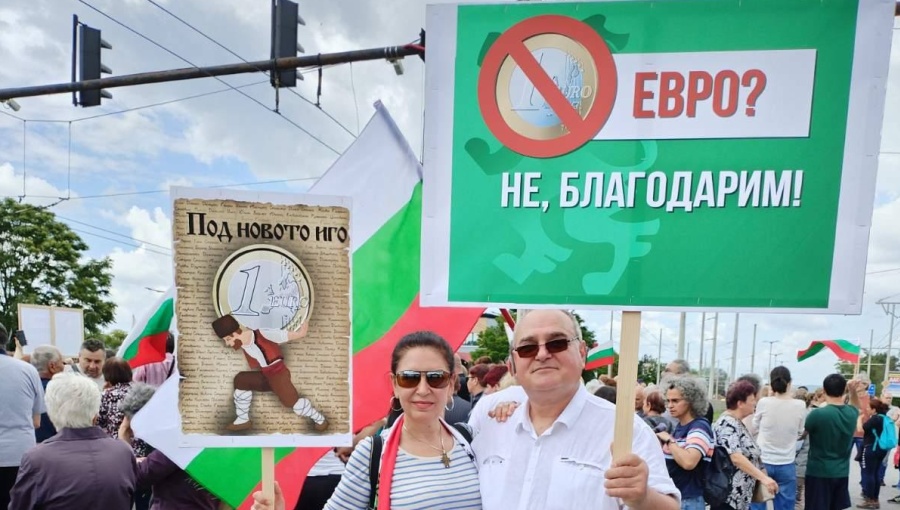
"Euro? No, thank you," says one placard at the anti-euro demonstration on May 31. / Vazrazhdane via Facebook
By Denitsa Koseva in SofiaJune 1, 2025
Thousands of Bulgarians rallied on May 31 to protest against the planned euro adoption ahead of the expected June 4 extraordinary convergence reports, waving Bulgarian and Russian flags and chanting ‘Freedom for the Bulgarian lev, death to the euro’.
The rally was organised by far-right pro-Russian Vazrazhdane party, which has intensified its campaign against euro adoption over the past weeks amid expectations that Sofia will get a green light to join the eurozone as of January 1, 2026.
While Vazrazhdane’s leader Kostadin Kostadinov, nicknamed 'Kostya Kopeykin', claimed that more than 100,000 people rallied across the country against euro adoption, local media reported that the number of protesters was less than 10,000 across the country.
Kostadinov called for another protest on June 4 when the convergence reports will be released, urging people to block parliament and prevent a decision on entry into the eurozone.
The protests follow an initiative by pro-Kremlin President Rumen Radev for a referendum on the euro adoption. The national assembly has rejected Radev’s proposal on constitutional grounds.
Polls show that Bulgarians are divided in their opinions whether the country should join the eurozone. According to the European Commission’s latest public opinion poll, 43% of Bulgarians support the introduction of the euro, while 50% remain opposed.
Meanwhile, Vazrazhdane has signed a cooperation agreement with President Vladimir Putin's United Russia, Kostadinov announced on Facebook. His party has pledged to work for “restoration of full-fledged Bulgarian-Russian relations”.
“The agreement provides for the exchange of experience, ideas and political practices between the two organisations,” Kostadinov wrote.






.jpg)