Saturday, June 07, 2025


Zen and the Art of New York Times Headline Writing


The New York Times has just published one of the most insane headlines I have ever seen it publish, which is really saying something.

Gaza’s Deadly Aid Deliveries,” the title blares.

If you were among the majority of people who only skim the headline without reading the rest of the article, you would have no idea that Israel has spent the last few days massacring starving civilians at aid sites and lying about it. You would also have no idea that it is Israel who’s been starving them in the first place.

https://x.com/AssalRad/status/1930322086767276353

The headline is written in such a passive, amorphous way that it sounds like the aid deliveries themselves are deadly. Like the bags of flour are picking up assault rifles and firing on desperate Palestinians queuing for food or something.

The sub-headline is no better: “Israel’s troops have repeatedly shot near food distribution sites.”

Oh? They’ve shot “near” food distribution sites, have they? Could their discharging their weapons in close proximity to the aid sites possibly have something to do with the aforementioned deadliness of the aid deliveries? Are we the readers supposed to connect these two pieces of information for ourselves, or are we meant to view them as two separate data points which may or may not have anything to do with one another?

The article itself makes it clear that Israel has admitted that IDF troops fired their weapons “near” people waiting for aid after they failed to respond to “warning shots”, so you don’t have to be Sherlock Holmes to figure out what happened here. But in mainstream publications, the headlines are written by editors, not by the journalists who write the articles. So, they get to frame the story in whatever way suits their propaganda agenda for the majority who never read past the headline.

https://x.com/AssalRad/status/1925342359912685809

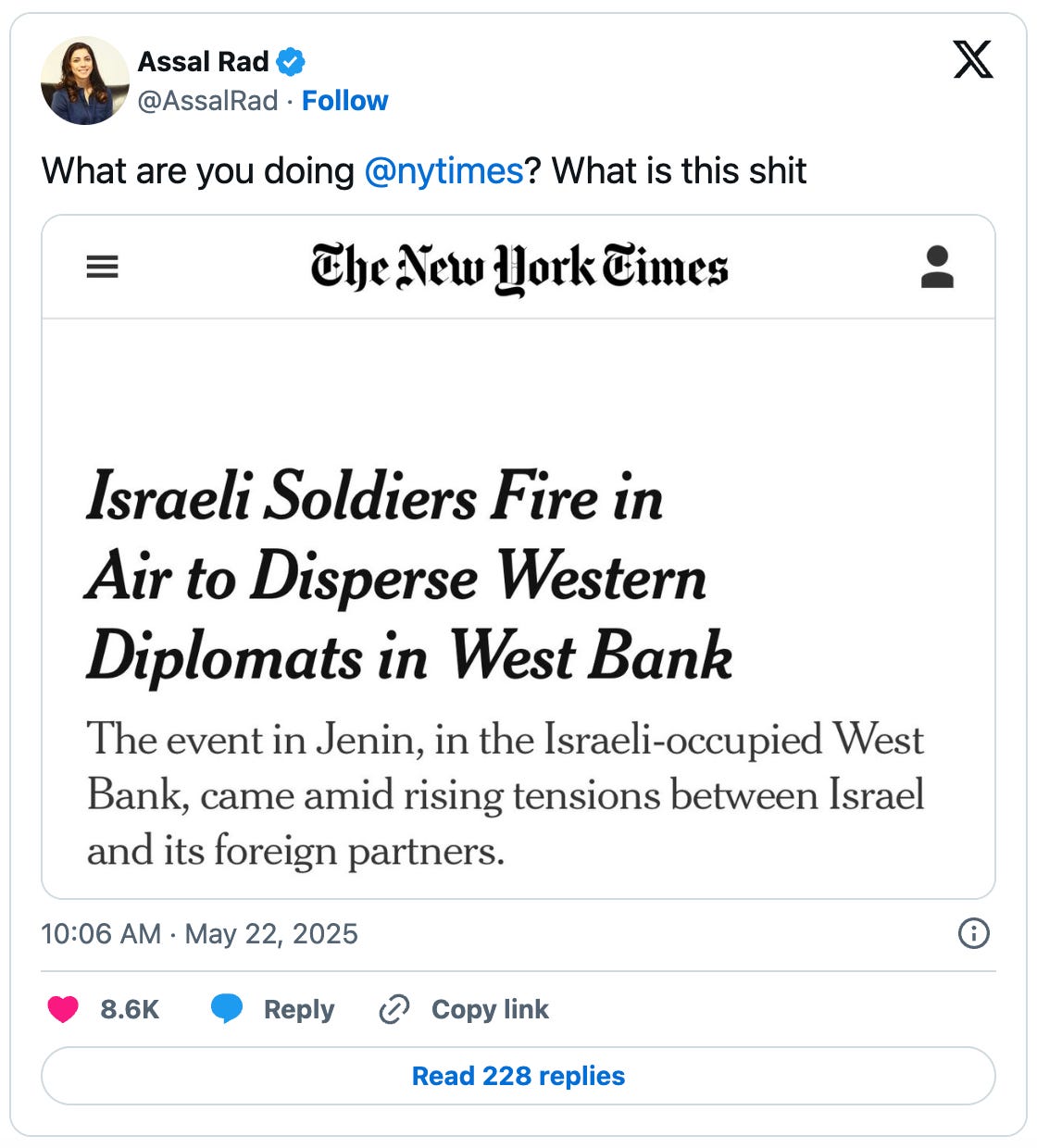
We saw another amazingly manipulative New York Times headline last month, “Israeli Soldiers Fire in Air to Disperse Western Diplomats in West Bank,” about the IDF firing “warning shots” at a delegation of foreign officials attempting to visit Jenin.

This was a story that provoked outcry and condemnation throughout the Western world, but look at the lengths the New York Times editor went to in order to frame the IDF’s actions in the most innocent way possible. They were firing into the air. They were firing “to disperse western diplomats”—like that’s a thing. Like diplomats are crows on a cornfield or something. Oh yeah, ya know ya get too many diplomats flockin’ around and ya gotta fire a few rounds to disperse ’em. Just normal stuff.

It’s amazing how creative these freaks get when they need to exonerate Israel and its Western allies of their crimes publicly. The IDF commits a war crime, and suddenly these stuffy mass media editors who’ve never created any art in their lives transform into poets, bending and twisting the English language to come up with lines that read more like Zen koans than reporting on an important news event.

It’s impossible to have too much disdain for these people.

Caitlin Johnstone has a reader-supported Newsletter. All her work is free to bootleg and use in any way, shape or form; republish it, translate it, use it on merchandise; whatever you want. Her work is entirely reader-supported, so if you enjoyed this piece and want to read more you can buy her books. The best way to make sure you see the stuff she publishes is to subscribe to the mailing list on Substack, which will get you an email notification for everything she publishes. All works are co-authored with her husband Tim Foley. Read other articles by Caitlin.


Bad Old Habits: Israel Backs Palestinian Militias in Gaza


It is one of those things that should be recorded and replayed for eternity: Israel, in order to guard some misplaced sense of security, happily backs Palestinian groups in order to divide themselves. Hamas, seen now as an existential monster, was tolerated and even supported for lengthy stints in efforts to undermine the various factions in the Palestinian Liberation Organisation represented by Fatah.

In his 2008 work, Hamas vs. Fatah, Jonathan Schanzer, writes how the Egyptian Muslim Brotherhood, the inspirational font for Hamas, was seen as an opportunity by the Israelis when taking root in Gaza. “By the late 1970s, the Israelis believed that they had found Fatah’s Achilles’ heel.” Israeli strategy permitted the Brotherhood to thrive, going so far as to allow the cleric Sheikh Ahmed Yassin to operate a network of welfare, medical and education services. These had been sorely neglected by Fatah in the Gaza Strip. This approach effectively licensed the emergence of fundamentalism, seen, curiously enough, as more manageable than the military adventurism of the PLO.

The First Intifada in 1987 spurred on the creation by Yassin and his followers of Harakat al-Muqawama al-Islamiya (“Islamic Resistance Movement”). The 1988 charter of the organisation we know as Hamas, more youthful, and leaner, and hungrier than their Fatah rivals, made its purpose clear: “There is no solution for the Palestinian question except through jihad”.

In 2009, while surveying the ruins of a neighbour’s bungalow in Moshav Tekuma, the retired Israeli officer Avner Cohen, who had served in Gaza for over two decades, was rueful. “Hamas, to my regret,” he told the Wall Street Journal, “is Israel’s creation.” Sustenance and encouragement from the Jewish state had effectively emboldened a mortal enemy.

Such a record should chasten wise legislators and leaders. But the only lesson history teaches is that its grave lessons are left unlearned, with disastrous, inimical mistakes made anew. Israeli Prime Minister Benjamin Netanyahu is proof of that contention. His various governments proudly backed the policy of division between the Gaza Strip and West Bank, defanging Palestinian Authority President Mahmoud Abbas in the latter while propping up Hamas in the former. Every now and then, the Israeli Defense Forces would keep Hamas in bloody check, a strategy that came to be called “mowing the grass”.

Israel’s support for Hamas has come in the form of work permits (up to 3,000 granted to Gazans in 2021, rising to 10,000 during the Bennett-Lapid government), and suitcases, heavy with Qatari cash, entering the Strip through crossings since 2018. In 2019, Netanyahu was quoted as telling a Likud faction meeting that opponents of a Palestinian state should support the transfer of funds to Hamas. Five years prior, Bezalel Smotrich, the current firebrand, pro-ethnic cleansing Finance Minister, declared with candour that “The Palestinian Authority is a burden, and Hamas is an asset.”

With Hamas now the target and sworn enemy, the PM feels that the same, failed experiment adopted at stages since the 1970s can be replicated: backing and encouraging yet another group of Palestinians to undermine any sovereign cause.

The central figure and beneficiary of this latest folly is the shady Yasser Abu Shabab, a Rafah resident from a Bedouin family known for a spotty criminal record. Calling itself the “Anti-Terror Service” or the Popular Forces, and possessing assault rifles and equipment seized from Hamas, his “clan”, as reports have described it, has a committed record of looting humanitarian aid in Gaza. In Netanyahu’s eyes, these rapacious poachers have turned into opportunistic game keepers, partially guarding the paltry aid that is currently being sent into Gaza under the supervision of the Israeli-backed Gaza Humanitarian Foundation.

Georgios Petropoulos, a senior United Nations official based in Gaza last year, calls Abu Shabab “the self-styled power broker of east Rafah.” For his part, Abu Shabab admits to looting aid trucks, but only “so we can eat, not so we can sell.” The looting proclivities of such groups is well noted, with the head of the UN office for the coordination of humanitarian affairs in occupied Palestinian territories, Jonathan Whittall, making a damning accusation on May 28: “The real theft of aid since the beginning of the war has been carried out by criminal gangs, under the watch of Israeli forces, and they were allowed to operate in proximity to the Kerem Shalom crossing point in Gaza.”

On May 21, Abu Shabab’s group posted on Facebook that “92 trucks were secured and entered areas under the protection of our popular forces, and exited safely under our supervision.” Details on which organisation was behind hiring the transporting vehicles were not given.

With rumours bubbling that the Israeli government had embarked on this latest course of action, Netanyahu came clean. “On the advice of security officials, we activated clans in Gaza that oppose Hamas,” he announced in a posted video with usual, glowing cynicism. “What’s wrong with that?” The strategy “only saves the lives of Israeli soldiers and publicising this only benefits Hamas.”

The advice purportedly given by Shin Bet to Netanyahu to arm Gaza militias opposed to Hamas was an expedient measure, largely occasioned by the PM’s continued refusal to involve the Palestinian Authority in the strip.

Not all Israeli lawmakers were impressed by Netanyahu’s latest effort at supposed cleverness. Yair Golan, leader of the Democrats in the Knesset, condemned him as a threat to Israeli security. “Instead of bringing about a deal, making arrangements with the moderate Sunni axis, and returning the hostages and security of Israeli citizens, he is creating a new ticking bomb in Gaza.”

The leader of the Yisrael Beiteinu party, Avigdor Lieberman, is of the view that the transfer of weapons to Abu Shabab’s outfit was done unilaterally. “The Israeli government is giving weapons to a group of criminals and felons, identified with the Islamic State group,” he told the public broadcaster Kan. “To my knowledge, this did not go through approval by the cabinet.”

With humanitarian aid now at the mercy of a group scorned by UN officials, humanitarian workers and certain Israeli politicians – a rare coming together of minds – the next round of errors is playing out with rich, quixotic stupidity. Israel further adds to its own insecurity, while Abu Shabab knows all too well the views of his family, expressed in chilling statement: “We affirm that we will not accept Yasser’s return to the family. We have no objection to those around him liquidating him immediately, and we tell you that his blood is forfeit.”

Binoy Kampmark was a Commonwealth Scholar at Selwyn College, Cambridge. He lectures at RMIT University, Melbourne. Email: bkampmark@gmail.comRead other articles by Binoy.
SPACE/COSMOS

The promise and peril of a crewed Mars mission


By AFP
June 6, 2025


This handout photo from NASA shows images from NASA's Mars 2020 Perseverance rover at its new home in Jezero Crater on February 21, 2021, after touching down on the planet several days earlier - Copyright AFP -


Issam AHMED

A crewed mission to Mars would rank among the most complex and costly undertakings in human history — and US President Donald Trump has vowed to make it a national priority.

That political momentum, coupled with SpaceX chief Elon Musk’s zeal, has breathed new life into a cause long championed by Red Planet advocates — even as major obstacles remain, including Trump and Musk’s latest feud.

– Why go? –

As NASA writes in its Moon to Mars blueprint, “exploration of the cosmos remains a great calling for humanity.”

A mission to Mars would pursue scientific objectives like determining whether Mars ever hosted life and charting the evolution of its surface, as well as answering broader space physics questions — such as the history of the Sun through studying Martian soil.

Geopolitics also looms large, as Trump has pledged to “plant the American flag on the planet Mars and even far beyond,” invoking the “unlimited promise of the American dream.”

Critics, however, say cuts to NASA’s science budget and the cancellation of key projects — including the return of rock samples collected by the Perseverance rover — are undermining the research mission.

“The purpose of exploration is not just to go somewhere,” Nobel-winning astrophysicist John Mather told AFP. “This is not a tourist thing. This is a fundamental knowledge thing.”

– Getting there –

Musk is betting SpaceX’s future on Starship, the largest rocket ever built, despite fiery failures in its nine test flights.

He’s aiming for an uncrewed launch by late 2026, timed with the next favorable Earth-Mars alignment.

But the timeline is widely seen as optimistic: Starship has yet to land its upper stage or demonstrate in-orbit refueling — both essential for deep space travel.

Some experts believe the system is fundamentally sound, while others say it’s too soon to judge.

“A lot of the pertinent and relevant technical information… is not known to us,” Kurt Polzin, chief engineer for NASA’s space nuclear propulsion project, told AFP.

He backs Nuclear Thermal Propulsion (NTP), which uses fission to heat hydrogen and generate thrust.

NTP delivers “a lot of power in a very small package,” Polzin said, eliminating the need for orbital refueling or fuel production on Mars.

Astronauts would spend seven to nine months in a cramped spacecraft, exposed to intense space radiation beyond Earth’s magnetosphere.

Ideas to improve radiation shielding range from passive methods, like using dense materials, to active concepts such as plasma fields that deflect radiation, while drugs are being developed to reduce cell damage.

Without a system to simulate gravity — such as rotational spin — crews would also need grueling exercise routines to counteract muscle and bone loss.

Mental health is another concern. Growing plants aboard — more for morale than sustenance — has proved beneficial on the ISS.

Communication delays further complicate matters.

On the station, real-time data has helped prevent an average of 1.7 potentially fatal incidents per year, said Erik Antonsen, chair of NASA’s human systems risk board — but such communication will not be possible en route to Mars.

– Life on Mars –

Once on the surface, the uncertainties grow.

Probes and rovers have found hints — organic molecules, seasonal methane — but no definitive signs of life. If it ever existed, it likely died out long ago.

Still, Earth’s own “extremophiles” offer intriguing clues — from fungi that harness Chernobyl’s radiation for energy, to microbes that survived 500,000 years in frozen stasis.

“If they can survive here in extreme environments, we have every reason to suspect they can be on Mars,” said NASA astrobiologist Jennifer Eigenbrode at the recent Humans to the Moon and Mars Summit.

And while NASA has decided nuclear fission will power surface operations, other choices — from crop selection to habitat design — remain open.

“Mars has a 24-hour, 39-minute day — that small difference creates strain, increases stress, and reduces sleep quality,” said Phnam Bagley, a space architect who designs for comfort and crew well-being — critical factors in preventing conflict.

The first trip would be around 500 days on the surface, but long-term colonization raises deeper questions.

For instance, scientists don’t yet know whether mammalian embryos can develop in low gravity — or what childbirth on Mars would entail.

“I think it’s really important to take that seriously,” said NASA’s Antonsen.

“Even if you don’t plan on it happening, people are still going to have sex, and somebody might get pregnant. Then it becomes a medical issue.”


Low-Earth Orbit Networks Meet Maritime’s Growing Connectivity Demands

Intelsat banner

Published Jun 3, 2025 9:02 PM by Intelsat


The global maritime industry faces a range of challenges highlighted by global trade uncertainties, geopolitical threats, and the always-evolving complex web of environmental and governmental regulations. These most recent challenges arrive as commercial shipping fleet owners are already navigating crippling labor shortages, aging fleets, and unrelenting demand driven by an 800% increase in e-commerce activity since 2010. Enterprise fishing fleets are dealing with their own set of challenges, including declining fish stocks, market volatility, and climate change.

Across all segments of the maritime industry, fleet owners and operators have embraced digitization to combat, manage, and overcome some of these challenges. With increased frequency, fleet owners have modernized operations and deployed a range of industry-specific and mission-critical digital applications that help to optimize operations, improve safety, ensure compliance with regulations, and offer a safe and positive working environment for crews.

However, the effectiveness of these applications and the ability of ship owners to reap the benefits of digitization are largely dependent on the presence of high-quality, robust connectivity.

Fleet owners have long relied on traditional satellite technology for safety and basic communications at sea. Geostationary (GEO) satellites, for example, have always provided consistent and reliable maritime connectivity. However, the limitations of traditional GEO satellite networks alone, including high latency and lack of coverage in polar regions, pose challenges for the evolving digitalization needs of commercial maritime industries.   

As merchant shipping and enterprise fishing owners continue to modernize operations, their connectivity needs have become more complex, pronounced, and critical. Low-Earth Orbit (LEO) satellite solutions have emerged to deliver globally available, consistent, high-speed coverage that meets the demands of a data-driven maritime landscape.

Intelsat’s Director of Maritime Products, Mike McNally, explains why LEO satellite networks are ideally suited for the maritime industry and why fleet owners should consider LEO solutions as they continue to digitize operations.

“LEO offers a range of benefits for merchant shipping and enterprise fishing operations  that can extend and amplify communications and information sharing capabilities during a voyage,” said McNally. “The proximity of LEO satellites to the Earth results in much lower latency and higher speeds that are ideal for applications like telemedicine, remote monitoring, video conferencing, or any emergency response situations where there can be no delays in the transmission of data.” 

LEO-powered solutions enable ship owners and operators  to improve voyage planning, routing, and monitoring of the performance of ships and the status of cargo in real time. Fishing crews can use LEO connectivity to enhance catch reporting processes, stream detailed weather updates, receive alerts, and communicate with ports, regulators, and suppliers. These are some of the additional ways LEO satellite networks can greatly benefit both commercial shipping and enterprise fishing fleets:

Modern Connectivity for Aging Vessels

The maritime industry has a problem with aging ships. Nearly half of all vessels are expected to be at least 21 years old by 2030. Aging ships are at a higher risk for mechanical breakdowns that result in costly repairs and revenue losses from downtime. They also pose greater safety and environmental risks, as they operate in a less fuel-efficient manner and can be more prone to accidents. LEO-powered satellite solutions offer fleet owners real-time visibility into the performance of vessels during voyages, transmitting reams of data collected from onboard sensors that can be analyzed to predict when maintenance might be needed. In this way, LEO solutions help ship owners identify and preemptively address a minor issue before it becomes a major one, keeping more ships in operation for longer periods of time.

Attracting the Next Generation of Connected Seafarers

Faced with an aging and dwindling workforce, merchant shipping and fishing fleet owners are desperately attempting to recruit the next generation of seafarers. These younger workers will not tolerate being cut off from their digital lives or disconnected from friends and family back home. Therefore, the success of any recruitment effort requires fleet owners to offer high-quality connectivity that enables access to personal connected devices, social media, live TV, and entertainment while on board. LEO networks provide the bandwidth and low latency necessary to deliver uninterrupted access to digital communications, no matter where in the world a ship makes its voyage, making maritime careers more appealing to a younger, tech-savvy, and connected generation.

Enhancing Safety and Security at Sea

Geopolitical hostility, terrorism and military activity, extreme weather events, and piracy are just a few of the safety and security concerns merchant  shipping and enterprise fishing fleet crews face at sea. On land, cybercriminals are hard at work attempting to steal sensitive information and wreak havoc at the ports. Whether navigating through piracy-prone waters or guarding against cyber intrusions, reliable LEO connectivity plays a pivotal role in protecting assets and lives. LEO satellite solutions allow fleet owners to more effectively monitor safety threats and respond with greater speed. By delivering always-on connectivity that allows for real-time threat monitoring and rapid response to emergencies, LEO solutions enhance crew safety and minimize revenue loss that can result from safety incursions.

Intelsat and OneWeb: A Unified Approach to Maritime Connectivity

As the maritime industry continues to digitize, Intelsat’s FlexMaritime LEO delivers the robust, ubiquitous, reliable connectivity fleet owners need to navigate an increasingly complex and competitive global maritime landscape.

FlexMaritime LEO combines the high speeds and low latency connectivity of Eutelsat OneWeb’s LEO network with Intelsat’s managed services and support to deliver a complete and unparalleled maritime connectivity solution for maritime operations.

With Intelsat’s FlexMaritime LEO, ship operators gain access to robust network coverage, ultra-high-speed download connections of up to 100 Mbps, and upload speeds of up to 10 Mbps even in the busiest shipping zones. Ultra-low latency performance of ~70 milliseconds enables faster application response times for sensitive applications. As a managed service, FlexMaritime LEO is backed and supported by Intelsat's 60-plus years of experience providing satellite and connectivity solutions to ships at sea.

This article is sponsored by Intelsat. For more information visit intelsat.com/maritime.

The opinions expressed herein are the author's and not necessarily those of The Maritime Executive.


 Ngugi wa Thiong’o: The Death of a Radical Writer and Novelist

Ngugi wa Thiong’o (5 January 1938-28 May 2025)

Let us now look about us. Where are our national languages now? Where are the books written in the alphabets of our national languages? Where is our own literature now? Where is the wisdom and knowledge of our fathers now? Where is the philosophy of our fathers now? The centres of wisdom that used to guard the entrance to our national homestead have been demolished; the fire of wisdom has been allowed to die; the seats around the fireside have been thrown on to a rubbish heap; the guard posts have been destroyed; and the youth of the nation has hung up its shields and spears.

— Ngugi wa Thiong’o, Devil on the Cross (Oxford: Heinemann, 1987), p. 58–9.

It was announced a few days ago that the Kenyan writer Ngugi wa Thiong’o has died at age 87 on 28 May, 2025. His daughter Wanjiku Wa Ngugi wrote on Facebook: “It is with a heavy heart that we announce the passing of our dad, Ngugi wa Thiong’o”.

Ngugi’s output of novels, plays, and critical writings is an extraordinary legacy of work which not only focused on analysing culture from a radical perspective but also producing culture with that perspective. Such novels as Devil on the Cross (Caitaani mÅ©tharaba-InÄ©)(1980), Weep Not, Child (1964), The River Between (1965), A Grain of Wheat (1967), Petals of Blood (1977), Matigari ma Njiruungi (1986), and MÅ©rogi wa Kagogo (Wizard of the Crow, 2006). His analytical writings included Barrel of a Pen: Resistance to Repression in Neo-Colonial Kenya (1983), Writing against Neo-Colonialism (1986), Decolonising the Mind: The Politics of Language in African Literature (1986), and Moving the Centre: The Struggle for Cultural Freedoms (1993).

Ngugi went one step further when he decided to write his novels and plays in Gikuyu, thereby giving hope to writers all over the world writing in minority or oppressed languages.

When I was doing my PhD on the relationship between the Irish language movement and Irish politics, I was very interested in talking to him about this linguistic aspect of his work. I had written to him from Dublin and not heard back, so when I was visiting my cousins in Connecticut I rang NYU and was put straight through to him. I told him I had written to him, and he said he had got the letter and asked if I could meet him in NYU on the following Wednesday at 1pm (6 May 1998). Naturally I was delighted. I arrived at his office at the allotted time on Wednesday and it was great to meet him.

However, after about ten minutes chat, he said that he had to go to an interview of an applicant for a performance arts masters in a different building. He said, ‘Come with me’, so I went. We went to a different building and met the applicant and the other interviewers. Ngugi asked her if it was OK for me to sit on the panel too. She said fine, and we went into another room and they interviewed her. I made a comment about my own experiences working as a designer in community theatre. Afterwards, she was told she was accepted on the course and she gave everyone a hug including me.

Ngugi wa Thiong’o and Caoimhghin Ó Croidheáin at his home in New Jersey, USA, 6 May 1998

At that point Ngugi said he had to go to New Jersey to pick up his son from school and said to me, ‘Come with me’, so I went. We got into his car and had a great discussion on the way out about language and literature. I was interested in Ngugi’s novels in his native language as a model for a radical Irish literature in the Irish language. Ngugi was fascinated with all aspects of the Irish language and Irish history and politics.

We spent more time talking about those topics than about his own work. We picked up his son and then he invited me to his house where I met his wife and other family members. We had something to eat and continued our discussion practically non-stop. Eventually Ngugi looked at his watch and at this stage it was 10pm, and he said to me that he had better get me back into New York Times Square to get my last bus back to Connecticut. We continued our chat all the way back, after he had given me a couple of his signed books and we had a photo taken together.

I had spent the whole day with him in New York discussing literature and language. It was truly a great day meeting and talking to a giant of African literature.

Caoimhghin Ó Croidheáin is an Irish artist, lecturer and writer. His artwork consists of paintings based on contemporary geopolitical themes as well as Irish history and cityscapes of Dublin. His blog of critical writing based on cinema, art and politics along with research on a database of Realist and Social Realist art from around the world can be viewed country by country here. Caoimhghin has just published his new book – Against Romanticism: From Enlightenment to Enfrightenment and the Culture of Slavery, which looks at philosophy, politics and the history of 10 different art forms arguing that Romanticism is dominating modern culture to the detriment of Enlightenment ideals. It is available on Amazon (amazon.co.uk) and the info page is hereRead other articles by Caoimhghin.

Orwell, Bradbury, Burgess, and Atwood’s 20th Century Dystopian Tales Becoming 21st Century Reality


Dystopian fantasy writers beware: Trump, MAGA, the Republican Party and its Christian nationalist allies may put you out of business!


Dystopia2.jpg

Works of dystopian fiction, from George Orwell’s Nineteen Eighty-Four and Ray Bradbury’s Fahrenheit 451, to Margaret Atwood’s The Handmaid’s Tale, and Anthony Burgess’ A Clockwork Orange, once seemed like dark fantasies of an authoritarian future. Their themes were warnings, not forecasts. Now, in 21st Century America, with the political landscape being fashioned by Donald Trump, MAGA, the Republican Party, Elon Musk’s DOGE, and their Christian nationalist and white supremacist allies, literary nightmares are no longer speculative.  What once was fiction is now the stuff of daily headlines.

Dystopian themes such as: Big Brother watching; censorship threatening; women’s rights eroding; history rewritten; and violent white gangs roaming the political landscape, once viewed as hyperbolic, are now today’s reality.

American politics is being shaped by hundreds ofexecutive orders, social media rants, and an alarming number of reactionary proposals by Republican controlled in states across the country. Some of these actions are more horrifying than plots cooked up by the best of our speculative fiction writers. And while dystopian legislation is being crafted, right-wing domestic terrorist groups are metastasizing.

The election of Donald Trump, with the Heritage Foundation’s Project 2025 blueprint at his fingertips, has set these disruptive events into motion. And the Supreme Court’s decision to overturn a woman’s right to abortion opened the floodgates to proposals that were once thought of as pure fiction.

Big Brother is Watching—And Tweeting

The Orwellian surveillance state has evolved in real-time. But it’s not just government agencies monitoring citizens; private tech giants, partisan watchdogs, and shadowy right-wing influencers are mining data, tracking dissent, and amplifying disinformation. Elon Musk’s acquisition of Twitter—rebranded as “X” — turned the site into a breeding ground for conspiracy theories and extremist propaganda. This once dystopian future, now present, isn’t just being surveilled; it’s being promoted, curated and manipulated by billionaires and bots.

In MAGA’s America, Trump is attempting to stretch surveillance society, as dissenters are targeted, reporters vilified, and protesters charged as criminals. And as state governments push for laws that would allow tracking of women’s pregnancies and menstrual cycles, Orwell’s vision seems almost quaint by comparison.

Burning Books Without Flames

Bradbury envisioned a world where books were burned to control thought. In today’s America, while book burning is rare, books are being removed from the shelves of public schools and libraries, and military academies. Conservative lawmakers and school boards are banning books en masse—particularly those that discuss race, gender, sexuality, or America’s darker historical truths. Librarians are being harassed, even doxxed.

The control of knowledge and information is power, and the MAGA movement knows it.

Reproductive Dystopia

The Supreme Court’s overturning of Roe v. Wade opened the floodgates to extremist legislation that was once confined to the realm of dystopian fiction. In Atwood’s The Handmaid’s Tale, women are stripped of autonomy and used as vessels for reproduction. Today, in America, state legislators openly float proposals to track pregnancies, criminalize miscarriages, and prosecute women for seeking abortion care. Some have even suggested the death penalty. The right’s Rolling Thunder project aims to outlaw the use of mifepristone.

No longer a slippery slope—it’s a full-on sprint toward theocracy. Red cloaks and white bonnets are no longer costumes for protest. They are warnings of what’s to come.

Rewriting the Past to Control the Future

“Who controls the past controls the future,” Orwell wrote. In some states slavery is being reframed as “involuntary relocation” or a jobs program! “Don’t Say Gay” laws muzzle teachers from acknowledging the existence of LGBTQ+ people. AP African American Studies is gutted. Teaching truth becomes a revolutionary act.

Disappearing or re-written school textbooks and on government websites, history is being edited, erased and repackaged to fit Trump and his acolytes white nationalist agenda.

A Clockwork Orange America

Meanwhile, political violence is becoming normalized. From the January 6th insurrection to armed extremists intimidating voters, the American far-right is increasingly militant and unrepentant. Anthony Burgess’s vision of a violent youth culture run amok feels unnervingly familiar—except now it’s grown men in camo, tactical gear, and MAGA hats, and ramping up talk of civil war. The MAGA movement is a coordinated ideology that seeks to replace democracy with an authoritarian state.

Project 2025: The Authoritarian Blueprint

The blueprint for much of what we are seeing is the Heritage Foundation’s Project 2025, a roadmap for dismantling the administrative state, purging government agencies of dissenters, and centralizing executive power in the White House. After claiming during the presidential campaign that he knew nothing about it, Trump has peopled his administration with Project 2025 contributors including Russel Vought Director of the Office of Management and Budget, Peter Navarro, Senior Counselor for Trade and Manufacturing, and Brendan Carr, of the Federal Communications Commission. Trump’s goal: a government loyal to him above all else.

We Are Living the Plot Twist

What were once speculative fantasies, are now the substance of our daily news. The line between fiction and reality has blurred. Orwell, Bradbury, Atwood, and Burgess wrote to warn us. They hoped their worlds would remain on the page. But in Trump’s America, the 20th century’s worst literary nightmares are becoming the 21st century’s political reality.

Bill Berkowitz is a longtime observer of the conservative movement. Read other articles by Bill.


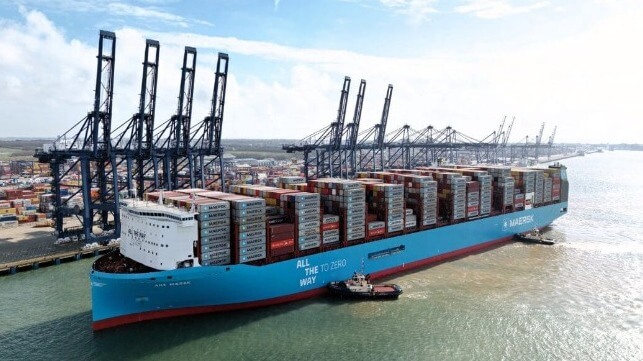
Maersk Reaches Milestone with Delivery of 12th Large Methanol Containership

Maersk methanol-fueled containership
Maersk has taken delivery on the 12 ships in its first class of dual-fuel methanol vessels

Published Jun 3, 2025 1:25 PM by The Maritime Executive


Maersk marked another milestone in the company’s efforts to prepare for the transition to alternative fuels reporting the delivery of the twelfth vessel in its first series of large dual-fuel methanol containerships. Delivery of the new vessel took place in South Korea seventeen months after the naming of the first ship in the class.

The newest is Axel Maersk, named after Axel Poul Peder Maersk Uggla, a grandson of Ane Maersk Mc-Kinney Uggla, chair of the A.P. Moller Foundation and the naming inspiration for the first vessel of the class. Maersk went with names starting with “A” for the entire class, AneAlette, Antonia, Alexandra, Alva, Astrid, AngelicaA.P. MøllerAxelAlbert, Adrian, and Arthur Maersk.

The ships were all built at the HD Hyundai Heavy Industries shipyard in Ulsan where the final vessel was named on May 27. She came two months after Adrian Maersk was named in Rotterdam. The vessels are all being deployed on the company’s new East-West Network established for the Gemini Cooperation with Hapag-Lloyd. Adrian Maersk the company reported would be sailing Asia to the Mediterranean while others in the class are sailing to Northern Europe. Axel Maersk departed for Shanghai, where it is due on June 4 on its maiden voyage.

Each of the ships is 189,500 dwt and approximately 337 meters (1,105 feet) in length with a capacity of 16,000 TEU. MAN Energy Solutions developed the dual-fuel engine which is designed for methanol or gas and can use traditional methanol as well as the future e-methanol or bio-methanol as it becomes available in sufficient quantities. They are registered in Denmark.

Maersk wrote online in announcing the delivery, “We’re proud to be onboard the enter transition. The journey continues …”

This year Maersk is scheduled to also take delivery on six additional dual-fuel methanol containerships. It placed a follow-on order with HD Hyundai in October 2022 for the additional vessels. While they will be similar to the first series the company reports the second series will have a nominal capacity of approximately 17,000 TEU for each vessel.

The ships are part of a large fleet modernization effort Maersk announced in 2024. It had previously ordered from Yangzijiang Shipbuilding Group six 9,000 TEU dual-fuel methanol vessels for delivery in 2026 and 2027. In the second half of 2024, it completed orders for a total of 20 dual-fuel vessels with a total capacity of 300,000 TEU. The order was split between Yangzijiang Shipbuilding and New Times Shipbuilding in China and Hanwha Ocean in South Korea. The vessels will each be equipped with liquified gas dual-fuel propulsion systems, although in August 2024 the company noted it had elected a mix of methanol and liquified gas dual-fuel propulsion systems as it waits for the development of production and supply chains for bio-methanol to be developed.