Saturday, June 07, 2025

India: Operation Kagar — The war on Adivasis and for a ‘Maoist-free India’ (plus CPIML Liberation statements)

[Editor’s note: Communist Party of India (Marxist-Leninist) Liberation activist N Sai Balaji will be speaking at Ecosocialism 2025, September 5-7, Naarm/Melbourne, Australia. For more information on the conference visit ecosocialism.org.au.]

First published in Liberation.

The escalated war on Maoists under “Operation Kagar”, has seen security forces in Chhattisgarh, Andhra Pradesh, Jharkhand and Maharashtra claim the lives of hundreds of Adivasis over the past year, and in particular since January 2025. The use of advanced warfare equipment including Israeli drones, fake encounters, extra-judicial violence by the state, and large-scale proliferation of security camps particularly in Bastar, Chhattisgarh, have to be seen in the context of Home Minister Amit Shah setting March 2026 as the deadline to make India Maoist-free.This alarming militarisation has been met with peaceful and sustained protests by Adivasis against the establishment of security camps in Fifth Schedule Areas without any consultation and consent of the concerned Gram Sabhas, and illegal appropriation of their forests, lands and other resources while also demanding proper schools, health facilities and other basic amenities. The Chhattisgarh government has responded by banning a people's rights organisation like the Moolvasi Bachao Manch, in October 2024, under the provisions of the draconian Chhattisgarh Special Public Security Act. More recently, the Chhattisgarh’s police has targeted Manish Kunjam, prominent Adivasi leader in the Bastar region, who has been at the forefront of the struggle seeking investigation into the irregularities of distribution of tendu patta bonus amounting to crores of rupees.

In the name of 'Naxal-mukt Bharat' the BJP-led governments have unleashed a campaign of complete militarisation of resource-rich Adivasi areas like Bastar and launch an unbridled war on the Adivasi people and all kinds of protests and people's rights campaigns. This focus on military operations rather than the socio-economic development of the region is condemnable and lays bare the true intentions of the government to enable corporate take-over of these mineral-rich regions. The reported plans to convert these military camps into so-called “integrated development centres” to provide various welfare services including hospitals, schools, rations and other services, points to a plan of permanent military presence in the region.

Speaking at the Press Conference organised by the Coordination Committee for Peace at Press Club, New Delhi on 9th May 2025, Comrade Dipankar emphasised that Bastar is passing through an entirely new phase which is qualitatively different from earlier ones like Salwa Judum, Operation Green Hunt or encounters. Whatever name the government gives it, this time around it is essentially an extrajudicial extermination campaign which is not acceptable by any democracy irrespective of ideologies. Amit Shah has fixed a March 2026 deadline which translates into a licence to kill indiscriminately. In fact, the increasing numbers of encounters coming now explicitly make it clear that people are being killed one sidedly, and on a large scale.

Com Dipankar urged that, firstly, we must recognise this as an extrajudicial extermination campaign by the government which if continues, will be fatal for the democracy. This violence by the state is a killing spree, which is unacceptable and must be stopped. Such an approach irrespective of what Maoists or any other movement, organisation or ideology have done must be opposed. Com Dipankar hope that the Coordination Committee for Peace will succeed in raising this issue throughout the country and will build enough pressure on the government, recognising the hard task at hand given that the recalcitrant attitude of the Union government which neither listens to the people’s voices nor takes any responsibility and accountability on its shortcomings, and yet efforts must be made in that direction.

Com Dipankar also made the point about Bastar and Adivasis, and that these were Scheduled areas, which are mineral rich, and has a very rich cultural and historical heritage, has been facing complete violations of Scheduled area norms and the rights of the Gram Sabhas only to facilitate militarisation and corporatisation. Com Dipankar also made it clear that mining and land acquisitions in this area cannot take place without the help of military camps even when there were no Maoists in Bastar. It is for this reason that it is not only the Maoists facing repression, but even Gandhiwadis like Himanshu Kumar were forced to leave that area. He added that it is a complete suppression of dissent and whoever talks about Adivasis through whatever angle and means are being jailed.

Com. Dipankar clarified this is not about Maoists versus Indian State, given that we are witnessing the same modus operandi all over the country. We had seen brutal repression in Tamil Nadu’s Sterlite movement where police acted like a corporate army. Fact is the state is serving the corporate interests and working for the corporate plunder in all mineral rich areas in the country. The issue here is about Adivasis and their rights under the Fifth Schedule and their needs and aspirations.

Finally Com Dipankar stated that the Maoists have made it clear that they want peace talks, and when any organisation comes forward with such a proposal, the government should respond. However, this is not the case. In fact, this government has given the slogan of “Naxal Mukt Bharat”, and has also given the “Congress Mukt Bharat” slogan. Congress is a parliamentary party hence a different route of ED and CBI was taken, but Maoists do not go for elections as they have a peculiar mode of operation. Even so, even if the Maoists had not given any offer, even then as citizens for democracy and the Constitution we must hold the government accountable for this ongoing extermination campaign and any other such campaign in any part of the country, since allowing such a campaign will only mean complete extermination of democracy itself.

The civil society as democratic medium of this country should collectively demand this because it is in the common interest of all beyond ideological leanings. Otherwise any future struggle or movement belonging to any ideology will face a similar kind of repression.

Adivasis have become the victims of collective punishment as the state wages a war against them, and the brutality of Operation Kagar is intended to strip Adivasis of any claim over the forests, land and dignity. This policy of militarisation and war on Adivasis has to end, and there must be the guarantee of a democratic space and environment for the deprived and oppressed Adivasis in Bastar and other areas of Adivasi unrest.


On Narayanpur-Bijapur extrajudicial killings

Communist Party of India (Marxist-Leninist) Liberation, May 21

CPI(ML) strongly condemns the cold-blooded extra-judicial killing of the General Secretary of CPI(Maoist) Comrade Keshav Rao and other Maoist activists and Adivasis in Narayanpur-Bijapur. 

From the celebratory post of Union Home Minister Amit Shah, it is clear that the state is spearheading Operation Kagar as an extra-judicial extermination campaign and taking credit for killing citizens and suppressing Adivasi protests against corporate plunder and militarisation in the name of combating Maoism.

We appeal to all justice-loving Indians to insist on a judicial probe into the massacre and demand an immediate end to the military operation, especially when the Maoists have declared a unilateral ceasefire. 


The Narayanpur massacre and the BJP’s sinister military campaign for a ‘Maoist-free India’

Communist Party of India (Marxist-Leninist) Liberation, May 28

Following the extra-judicial killing of CPI(Maoist) general secretary Comrade Nambala Keshav Rao alias Basavaraju in the Narayanpur massacre on 21 May, the Modi government seems to be in a celebratory mode. While Home Minister Amit Shah called it 'a landmark achievement in the battle to eliminate Naxalism', promptly endorsed as a 'remarkable success' by PM Narendra Modi, the BJP Karnataka unit used a meme showing Amit Shah holding a cauliflower. The symbolism invokes the carnage of Muslims in Bhagalpur in 1989, where killers claimed to have grown cauliflowers on the soil where more than a hundred Muslim victims in a village were reportedly buried. At the moment of the Modi government's claiming its biggest anti-Maoist military success, the BJP was quick to remember and celebrate one of India's ghastliest anti-Muslim massacres.

The Maoist deaths in the Narayanpur massacre have now also been corroborated in a press release issued on behalf of the Dandakaranya Special Zonal Committee of CPI (Maoist). According to this release, as many as 28 activists were killed in this massacre including  several women and a number of senior leaders of the party. The release says till January, Basavaraju had an immediate security system comprising more than sixty fighters, but the number was reduced since then to ensure greater mobility. The group was also affected by desertions and betrayals, and this enabled the state to plan and execute the military operation with such success. At the time of the massacre, Basavaraju was guarded by thirty four fighters, seven of whom managed to escape by breaking the encirclement of the security forces.

Basavaraju's mother, and members of families of Nageshwar Rao and other leaders, had approached the Andhra Pradesh High Court seeking custody of the dead bodies of their kin to bring them home for their funerals. The AP High Court gave a favourable order and the Chhattisgarh government had promised to the court to hand over the bodies after post mortem. But while the family members kept waiting for the bodies, the state cremated them calling them 'unclaimed bodies'. Just a few days ago, activist Soni Sori had narrated her experience of accompanying some Adivasi families to Bijapur hospital to collect the bodies of their members killed at Karregutta hills. Thousands of maggots were crawling on those decomposing bodies leaving them unrecognizable. For the Maoists and Adivasis of Bastar, the state's violence continues even after their lives are taken away.

The Modi government has fixed a deadline - 31 March 2026 - to make India Maoist-free. The security forces are being given a licence and an incentive to kill with each killing fetching guaranteed hefty rewards. There is a surrender policy for Maoists who side with the government, but the policy is not intended to rehabilitate them in what is called 'normal, peaceful life' but only to turn them into mercenaries and forcibly pit them against their former comrades, often fellow Adivasis from the same community, locality and families. With more than 60,000 security personnel from the central paramilitary forces like the CRPF and its elite CoBRA commandos and various state forces like the Chhattisgarh police, the District Reserve Guard comprising mostly surrendered Maoists, Bastar Fighters and Special Task Force, Bastar today is among India's most densely militarised regions, where the people are subjected to aerial bombardment and the use of Israeli drones.

More than 300 security camps have turned the region into a military cantonment where there is one security personnel for every eight civilians. And for Adivasis in Bastar, every aspect of life is overshadowed and administered by the security forces. The autonomy promised in the Fifth Schedule of the Constitution and the rights provided under the Forest Rights Act or Panchayat Extension to Scheduled Areas Act have all disappeared in the eerie environment of the militarised administration of a police state. The militarisation of Bastar has a long history going back to UPA-era anti-Maoist campaigns like Operation Greenhunt and Salwa Judum, which in 2011 was termed unconstitutional and ordered to be dismantled by the Supreme Court. But the Modi era began wirh a renewed offensive with intensified violence. Militarisation today is a 'permanent settlement' to facilitate massive corporate plunder.

Let us also note that in the guise of a battle against Maoism, the Modi regime is out to silence every Adivasi protest in Bastar against this nexus of militarisation and corporate plunder. Gandhian Himanshu Kumar has been banished from Chhattisgarh; writer-activist Bela Bhatia is being harassed and suppressed; long-standing popular voice of Bastar and former CPI MLA Manish Kunjam is being targeted; the anti-militarisation umbrella platform of indigenous people called Moolvasi Bachao Manch has been banned; and indiscriminate cases are being filed and people arrested under draconian laws like the Chhattisgarh Special Public Safety Act and the Unlawful Activities Prevention Act. The Supreme Court has time and again said that upholding an ideology is no crime, there are guidelines for mandatory investigation into every encounter. Today ideological witch hunt and encounter killings, increasingly described chillingly as neutralization, have become pillars of state policy.

The ramifications of Operation Kagaar are not limited to Bastar or the Maoists. They concern every movement for justice, every form of dissent against fascist tyranny. Sooner rather than later, the template being developed in Bastar will be replicated elsewhere against newer target groups. The cauliflower in Amit Shah's hands in the sinister BJP Karnataka imagery must serve as a warning for all. At a time when Maoists had declared a unilateral ceasefire, there must be a broad convergence for a political resolution through peace and dialogue. A judicially monitored probe into Narayanpur and other recent massacres perpetrated under Operation Kagar is a must for the constitutional foundation of the Indian republic to survive. And regardless of how the Maoists deal with the current juncture and try and regroup after this setback, the indigenous people of Bastar and beyond deserve the fullest solidarity and support of all democratic forces in their quest for justice and dignity. 


LA REVUE GAUCHE - Left Comment: Hinduism Is Fascism


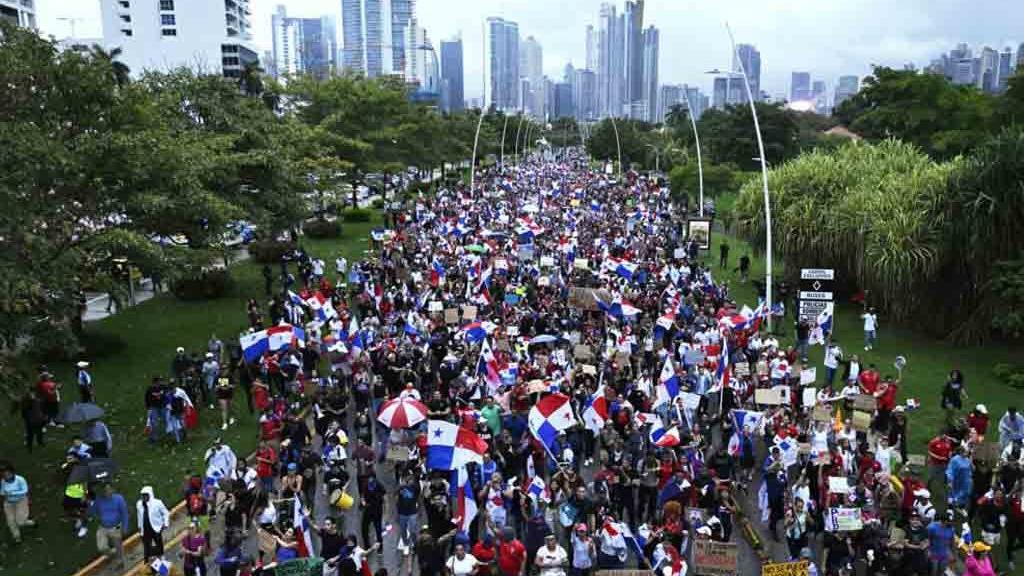
Panama is the epicentre of the struggle in Latin America


protest panama

First published in Spanish at Luís Bonilla-Molina’s blog. Translation from International Viewpoint.

A small country of 4.2 million inhabitants is showing Latin America and the world that it is possible to confront the interests of financial capital and vulture funds in the 21st century.

Just a couple of days ago, the blood of a twelve-year-old indigenous boy, seriously injured by government repression, showed that the conflict was entering a new stage. A little before that, Saúl Méndez, main leader of the powerful construction union had to seek asylum in the Bolivian embassy to avoid being presented as a trophy and placed in prison, something that already happened with two other of its leaders, Genaro López and Jaime Caballero, who have been sent to the worst prison for common criminals in that country, a union to which the previous government had already confiscated its membership dues, a measure that the new president continued to maintain, even with recent raids of its union headquarters and the closing of its cooperative. Thousands of striking teachers have been removed from the payroll and many others have been illegally placed on permanent unpaid leave.

This is taking place in the midst of an impressive global media siege corresponding to the one inside the country, which creates an information curtain that prevents the social movement and the people of the world from knowing what is happening in the small Central American country.

The origins

In 2023, after a period of rising struggles of the teachers’ movement and workers as a whole in Panama, the most important popular ecological rebellion in the world so far in the 21st century took place. After weeks of mobilization and paralyzation of the country, led by teachers, construction workers, banana workers, indigenous communities, youth, women, environmentalists, communities and a broad swath of the middle class, a decision was obtained from the Supreme Court of Justice ordering the cessation of operations of the transnational First Quantum and the closure of the mine that had generated the popular revolt. This judicial decision overturned the spurious agreement reached in the Panamanian parliament, which sought to prolong the environmental destruction of the environment.

Such counter-march of the public powers is caused by the fear of the Panamanian bourgeoisie to the popular ecological rebellion that had happened to close the most important transportation routes of the country, affecting the profits of sectors of the capital. An unprecedented ecological victory occurred.

The reaction of the Panamanian bourgeoisie and finance capital was to adopt in 2024 the presidential candidacy of José Raúl Mulino, former Minister of the Interior in the corrupt Martinelli administration and the darling of Mr. Motta, the tycoon of the Panamanian airline industry, media and other business operations. His agenda, to build a new political situation that would allow to regain the pre-ecological rebellion domination, expand the profits of finance capital in that country and fulfill the neo-colonial agenda of an imminent new Trump administration in the White House.

The novelty of the election of President Mulino was the arrival in parliament of a large group of independent deputies, who had taken advantage of the wave of the popular revolt to make room for themselves. This parliamentary renewal, which showed the intention of the electorate to produce a new political situation, was quickly betrayed by half of this new parliamentary fraction who quickly reached an agreement with the reactionary government of Mulino who, elected with only 34% of the votes, lacked a parliamentary majority.

This new correlation of forces allows him to advance in the approval of Law 462, which produces a new regression in the retirement and pension regime of the Panamanian working class, which goes from a retirement with approximately 60% of their salary to 30% or less. It also allows Panama’s wealthy families to manage the pension funds and these enter into financial market speculation. In addition, President Mulino announces the intention to reopen mining and re-enable First Quantum, bypassing the decision of the Supreme Court of Justice. The indignation was installed in all the territories of Panama.

To make matters worse, the arrival of Trump to his second term in office comes with a clear intention to return to the situation of control of the Panama Canal, something that finds the approval of the Mulino government, which signs an agreement to enable the reopening of three U.S. military bases, despite the fact that Panama by constitutional provision has no army and that a treaty in force between the two countries had established since late 1999 the end of such foreign military presence. Thus a situation of vassalage of the government of that country is configured, a fact that ends up initiating a new cycle of protests.

Five weeks of the national strike

The first to declare a strike on 23 April were the teachers, who announced that they would not return to the classrooms until Law 462 (pension and retirement system) was repealed, the closing of the mining industry was guaranteed and the military memorandum of understanding with the United States was annulled. On this occasion, the progressive phenomenon of thousands of fathers, mothers and families in schools and colleges decided in assemblies to support the strike of their children’s teachers. Once again, mobilizations of high school students reappear, since in the eighties their associations by school had been suppressed by Noriega, while the University of Panama is the epicenter of meetings, declarations, gatherings and a mega march, in spite of the inexplicable stain of the expulsion by the authorities of a student for actions of struggle and the attempts to turn the house of study into a "space of negotiation" and not of the decisive action in favor of patriotic indignation.

Daily mobilizations of teachers and professors, together with the entry into the conflict of the banana workers and the powerful construction union, have generated the incorporation into the struggle of entire populations in the interior provinces of the country. This increased the quality and number of demonstrators, which led Mr. Mulino’s government to unleash a repression unprecedented in recent decades against the social movement. Hundreds of people injured and arrested daily did not stop the protests, on the contrary, they increased them.

When the indigenous communities entered the conflict, the repression was merciless, especially against women and children of the native peoples. The balance of a 12 year old minor and a university student seriously wounded by the bullets of a government that has publicly said that it does not care if its popularity is at -50%, when polls were released that placed citizen approval of its mandate at less than 10%, reveals that we are facing an iron fist government that seeks to inflict a defeat on the social movement that will allow it to get rid of its main organizations in order to advance its nefarious plans.

This week the conflict enters a decisive stage, while the government is playing a delaying game in order to wear itself out, hoping that the protests will die down in the next few days. However, everything indicates that the mobilizations will be followed by the paralyzation of the country, for which it is necessary to multiply the voices of international solidarity.

The correct method

The Alianza Pueblo Unido por la Vida (People United for Life Alliance), the social movement coalition driving the protests, has built a broad social front to confront Mulino’s neoconservative and neocolonialist offensive.

The teachers’, trade union, environmental and community unions show that the correct path is to go beyond sectoral struggles and build alliances between nationalist, patriotic forces that defend the working class, in order to generate a broad participation of the populations to advance in the struggles and defeat financial capital, extractivist policies and North American neocolonialism.

The Panamanian bourgeoisie: between the voracity of financialization and the fear of explosion

Social. The contradiction that the Panamanian bourgeoisie has again, as in 2023, is to decide between the voracity of the financial capital that is after the pension funds and mining investments or the stability of the bourgeois regime itself. For that reason, they have bet on a crushing of the revolt, via manu policial, but if they do not succeed in doing so, they would have to decide between backing down or losing control.

Increasingly, the association of those at the top, the powerful and wealthy, has less and less contact with the people and concentrates on the propaganda of the media they own. How long this situation will last is the key question.

Revocation of presidential mandate

An intermediate solution that is beginning to resonate in the streets is the possibility of revoking the presidential mandate and calling for new elections, but this has the legal obstacle that this revocatory action has never been regulated. However, the law initiatives to make this happen continue to advance and take course, with growing sympathy from the citizens.

Mulino’s dismissal has another legal course: that the Assembly of Deputies attends to the accusation presented by the Alianza Pueblo Unido (United People’s Alliance) for violating the international personality of the State, due to the surrendering Memorandum that allows the reopening of US military bases. If the levels of community participation of 2023 are reached, it could configure a new correlation of forces that would allow to open a trial against the current president, based on the norms established in the Panamanian Constitution.

This would make it possible to reverse Law 462, leave without effect the reopening of mining and annul the Memorandum that has allowed the reopening of U.S. military bases. But this can only happen within the framework of sustaining and expanding the popular mobilizations. Therefore, the next hours will be key for the course of events.

The need to promote international solidarity

In the midst of this dramatic situation, a broad and plural international solidarity is required from the democratic and progressive forces, the social and educational movement at the international level. We cannot leave the Panamanian people alone in this hour.

For this reason, the social movement has launched, among other important initiatives, a worldwide campaign of protest and delivery of declarations of solidarity with the struggle of the Panamanian people, in front of the Panamanian embassies and consulates in each country, on 9 June 2025. This would allow to begin to break the media siege that the big news agencies have configured and establish an important network of communication and alternative solidarity.

Luís Bonilla-Molina is a Venezuelan university lecturer, critical pedagogue and president of the Venezuelan Society of Comparative Education. José Cambra is a trade-union leader in Panama.

Panama’s mass strike movement confronts Trump’s canal grab

Panama protests

First published in Portuguese at Revista Movimento. Translation by Adam Novak for Europe Solidaire Sans Frontières.

Panama is the sharpest point of class struggle on the continent, and how it develops and ends will be very important for the relationship between Latin America and Trump’s imperialist policy. In today’s Panama there is a new workers’ revolt: teachers have been on indefinite strike for two months, joined by construction workers, banana plantation workers [Panama is a major banana exporter, with plantations owned by international companies like Chiquita], health workers, and the strike is extending to other sectors. Students and parents support the strike and join the protests. There are road blockades promoted by indigenous peoples [particularly the Guna, Ngäbere, and other indigenous groups who make up about 12% of Panama’s population] with popular support and student mobilisations.

Even so, this great mobilisation has not transformed into a popular rebellion like the historic days of 2023, in which a workers’ and popular insurrection defeated the government and achieved the closure of the open-pit copper mine exploited by First Quantum [a Canadian mining company that operated the Cobre Panama mine, one of the world’s largest copper mines, until mass protests forced its closure]. But this could occur if the indefinite strike continues and expands, a situation that would provoke an open confrontation with the government and its possible fall. Since the return of the Canal to Panama in 1999 [when the US handed over control of the Panama Canal after nearly a century of American administration], the country has grown non-stop, but has not distributed wealth: it is the third country in the region with the greatest inequality. The interior [rural areas outside Panama City and Colón] suffers the most and that is why the largest popular insurgencies occur there.

Three policies of this government are what have set Panama ablaze again. The 40% cut in pension benefits and their privatisation; the government’s attempt to reopen the copper mine that popular mobilisation closed in 2023; the memorandums of agreement with Trump (to build three military bases in the country) as part of his offensive to regain control of the canal.

These measures mean that the government of José Raúl Mulino [Panama’s president since July 2024] is capitulating to Trump’s offensive on the country, whose final objective is to recover the canal, and that victory in the current struggle can prevent this. It is an unpopular government, discredited by corruption cases and its neoliberal policy serving the great Panamanian bourgeoisie, discredited in all popular sectors.

The importance of what is at stake in this country is highlighted by the New York Times in a recent article which warns: “A serious attempt to pressure the Panamanian government — through sanctions, tariffs or other coercive measures — could set the country ablaze. For Panama, the United States and the world, this could be the greatest risk of all.” This warning made by an imperialist newspaper should also serve to reinforce the need for international solidarity with this important struggle at the centre of the continent.

The struggle between the Panamanian people and imperialism, which is historic, has now become present. Forty per cent of US goods and a large part of world trade pass through the Panama Canal. In case of military conflict with China, a large part of the North American fleet would have to pass through there. Hence Trump’s policy of recovering the canal and reducing Chinese influence in the ports located at the canal exits [China operates the ports of Balboa and Cristóbal at either end of the canal through Hong Kong-based Hutchison Ports].

Historically, US imperialism dominated the canal. To build it, it manipulated Panama’s independence, which until the 19th century was part of Colombia [Panama gained independence from Colombia in 1903 with US backing specifically to facilitate canal construction]. From then on [1903-1999], a [10-mile wide] zone was created that separated the canal from the rest of the country, where the Yankee flag flew guarded by its armed forces, separated from the rest of the country by a fence. The struggle to recover the canal began in 1964 with the [9 January “Flag Riots”] mobilisation of students who invaded the canal to hoist the Panamanian flag [alongside the American flag]. The repression and deaths provoked popular indignation, which forced imperialism and the government to hoist the Panamanian flag.

It was a first step. The nationalist government of Colonel Omar Torrijos, [Panama’s military leader from 1968-1981] achieved in 1977 — in the context of the Central American uprising [in the 1970s-80s] — the agreement with the Carter government to begin a period that culminated with the handover of the canal to the Panamanian government in 1999 [the Torrijos-Carter Treaties]. With the diminishing influence of the United States, Chinese neo-imperialism began to invest in the construction of two large ports [at Balboa and Cristóbal] and to incorporate Panama into [China’s Belt and Road Initiative] as part of its policy for Latin America. Mulino withdrew in the face of pressure from the Trump government.

In response to popular mobilisation, the Mulino government has systematically repressed and persecuted demonstrations violently with police charges using truncheons, rubber bullets, gases and arresting activists. One of the main leaders of SUNTRACS [Sindicato Único Nacional de Trabajadores de la Construcción y Similares - the National Union of Construction Workers] is imprisoned and the secretary-general is in the Bolivian embassy awaiting a response to his request for political asylum; police invaded two union headquarters and froze the union’s bank accounts by government order, and the cooperative linked to the union was declared illegal. For now, this has not diminished mobilisation and has weakened the government, provoking discontent from bourgeois sectors who are inclined to carry forward negotiations that allow an exit.

If the strike extends to more sectors and popular mobilisation grows, there will be a resounding victory that will end the government’s measures. If this does not happen, as in every long strike, elements of wear and fatigue will emerge that can lead to negotiation with partial concessions or defeat of the movement. It is an open situation and, for this very reason, Latin American and international solidarity becomes fundamental. Trade union organisations, political parties, popular movements and revolutionaries must be in the front line of this solidarity.

Pedro Fuentes is a national leader of Socialism and Liberty Party (PSOL) and the Socialist Left Movement (MES) in Brazil.


Despite Trump-Musk Feud, CO2 Milestone Is the 'Important News of the Day'

Scientists said that atmospheric carbon dioxide concentrations peaked above 430 parts per million for the first time in perhaps 30 million years.


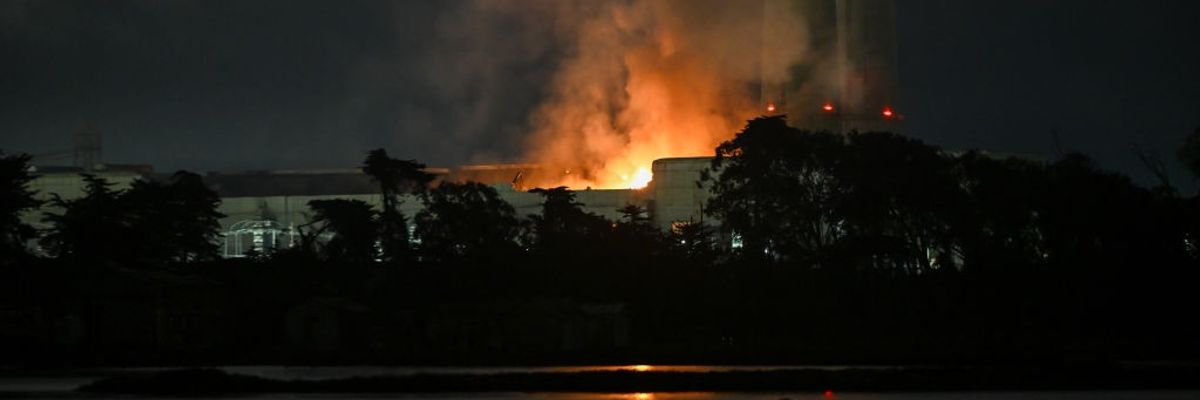
A view of flames and giant smoke is seen over the sky as a fire erupted at the natural gas Moss Landing Power Plant in Moss Landing of Monterey Bay, California, United States on January 17, 2025.
(Photo: Tayfun Coskun/Anadolu via Getty Images)


Olivia Rosane
Jun 06, 2025
COMMON DREAMS

The concentration of carbon dioxide in the atmosphere peaked above 430 parts per million in 2025—the highest it has been in millions of years—according to data released by the National Oceanic and Atmospheric Administration and Scripps Institution of Oceanography at the University of California, San Diego on Thursday.

The news was overshadowed by the explosive feud between U.S. President Donald Trump and his erstwhile backer Elon Musk, but climate activist Bill McKibben argued that it was ultimately more consequential.

"In the long run, this is actually going to be the important news of the day—CO2 in the atmosphere passes another grim milestone," McKibben wrote on social media.


Carbon dioxide has been accumulating in the atmosphere due primarily to the human burning of fossil fuels, as well as by the clearing of forests and other natural carbon sinks. There, it acts as a greenhouse gas, trapping heat from the Earth, and is the primary gas responsible for the rise of global temperatures by approximately 1.1°C from the 1850 -1900 average. This warming has already had a host of dramatic impacts, from extreme weather events to sea-level rise to polar ice melt, and scientists warn these impacts will only accelerate under current energy policies, which put the world on track for around 3°C of warming by 2100.

The last time that atmospheric CO2 concentrations topped 430 ppm was most likely more than 30 million years ago, Ralph Keeling, who directs the Scripps CO2 Program, toldNBC News.

"It's changing so fast," he said. "If humans had evolved in such a high-CO2 world, there would probably be places where we wouldn't be living now. We probably could have adapted to such a world, but we built our society and a civilization around yesterday's climate."

"While largely symbolic, passing 430 ppm should be a wake-up call."

Scripps and National Oceanic and Atmospheric Administration both measure carbon dioxide levels from NOAA's Mauna Loa Observatory in Hawaii, where Charles Keeling began taking measurements in 1958. As CO2 levels rise over time, they also follow a seasonal cycle—peaking in May before falling in the Northern Hemisphere summer and rising again in the fall.

This May, Scripps Oceanography calculated an average of 430.2 ppm for 2025, which is 3.5 ppm over the average for May 2024. NOAA's Global Monitoring Laboratory, meanwhile, calculated a monthly average of 430.5 ppm, a 3.6 ppm jump from the year before and the second-steepest yearly climb since 1958.

"Another year, another record," Keeling said in a statement. "It's sad."


The news comes two months after Mauna Loa daily measurements surpassed 430 ppm for the first time in March, which Plymouth Marine Laboratory professor Helen Findlay called "extremely disappointing and worrying."

"While largely symbolic, passing 430 ppm should be a wake-up call, especially given the accelerated response we are seeing of glaciers and ice sheets to current warming," Dr. James Kirkham, chief scientist of the Ambition on Melting Ice coalition of governments, said at the time.

"This upward trajectory is a direct result of continued fossil fuel use, likely exacerbated by emissions from extreme wildfires last year, methane leaks from fossil fuel extraction and possibly greater permafrost emissions, alongside decreased ability of very warm oceans to absorb CO2," Kirkham said.

The monthly record also comes a little more than a week after a United Nations report warned that there was a small chance global temperatures could surpass 2°C in at least 1 of the next 5 years, only a decade after world leaders pledged in the Paris agreement to keep global temperatures "well-below" that level.

"Carbon emissions are still rising, and the atmosphere is going to keep heating further until greenhouse gas concentrations stabilize," Matt Kean, who chairs Australia's Climate Change Authority, wrote in response to the Scripps and NOAA figures. "What sort of climate do we want to leave our children and those who come after them?"


Nightmare of Nightmares: New (Big) CO2 Emissions


Global warming just got a brand-new source for trapping heat as Arctic tundra turns up the dial on CO2 emissions. It’s now in the ranks of cars, trains, and planes as an official emitter of carbon dioxide, CO2. But it distinguishes itself in one critical way. There’s no “on/off” switch. Once turned on, it’ll self-reinforce continued growth, meaning ever-increasing levels of CO2 emissions year-over-year.

The National Oceanic & Atmospheric Administration, NOAA, made the official announcement only recently: “2024 Arctic Report Card: The Arctic Tundra is Now a Net Source of Carbon Dioxide.” climate.gov .

Arctic tundra covers a significant portion of the Northern Hemisphere, accounting for approximately 20% of the Earth’s surface, and nearly 25% of the land surface in the Northern Hemisphere. Obviously, this has big impact on global CO2 emissions and the many dangers attendant to rising global temperatures, e.g. BBC News May 31, 2025: “The village of Blatten has stood for centuries, then in seconds it was gone.”

It doesn’t take a brain surgeon to figure this one out, i.e., it means the planet is going to get a lot hotter a lot sooner as vital ecosystems wilt/melt/thaw and disintegrate. Already, one of Arctic tundra’s distant cousins, the Amazon rainforest, joined the CO2 Net-Emissions Club a couple of years ago. The magnificent rainforest is net-emitting CO2 in portions of the forest in harmony with cars, planes and trains. For example, The Economist recognized his unsettling event 3 years ago: “The Brazilian Amazon Has Been a Net Carbon Emitter Since 2016,” The Economist, May 21, 2022.

As for the rainforest, there are several contributing factors to CO2 emissions, for example:  Conversion of rainforest to agriculture has caused a 17 percent decrease in forest extent in the Amazon, which stretches over an area almost as large as the continental U.S.  Replacing dense, humid forest canopies with drier pastures and cropland has increased local temperatures and decreased evaporation of water from the rainforest, which deprives downwind locations of rainfall. (NOAA)

Now, the planet’s two largest warehouses, serving as carbon sinks for millions of years, over 10 million years for the Amazon, have opened business with the Anthropocene (era of human domination). Although, in all fairness, the Anthropocene doesn’t really need help in heating up the planet. It’s doing a spectacular job on its own. “Earth Shattered Heat Records in 2023 and 2024; Is Global Warming Speeding Up?” Nature, January 6, 2025.

In the case of Arctic tundra, NOAA says: “The land areas of the Arctic have been a carbon sink for thousands of years, meaning there has been a net removal of carbon dioxide from the atmosphere by plants, with long-term storage in the soil and permafrost. However, increasing surface air temperatures are causing permafrost to warm and thaw, allowing stored carbon dioxide and methane to be released into the atmosphere. Wildfires and other disturbances are adding pulse releases of carbon dioxide and methane. These changes together have shifted the Arctic tundra from a net carbon sink into a source.” (2024 Arctic Report Card).

A New Regime – Insurance/Homeowners Replace Dinosaurs

The Anthropocene has pushed the Arctic into a new, dangerous regime. Studies over the decades show that it has dramatically changed from even a decade or two ago. All of this is spearheaded by its new role as a net emitter of carbon dioxide CO2 and methane CH4. Arctic tundra stores 1,600 billion metric tons of organic carbon, mostly in permafrost. This is double the amount currently in the planet’s atmosphere, which is already causing the planet to heat up. The Amazon rainforest holds another 124 billion tons of carbon. This tandem, by increasing carbon emissions above and beyond cars, trains and planes, and industry, is likely zeroing out all of the saved CO2 via electric vehicles, and then some.

The new regime has the earmarks of a big troublemaker. It’s reminiscent of that last big encounter with climate change 65 million years ago when the villain was an asteroid, the victim, dinosaurs. Poof! Gone after 165 million years living on Earth.

Today’s version has fossil fuel playing the role of the asteroid and the property/casualty insurance industry with homeowners the victims. This sorrowful arrangement is likely how things stretch out over time because world leadership has never taken climate change seriously enough to head it off at the pass. As such, as global temperatures increase, over time, more people are displaced by repetitive high tide flooding, unlivable regions of recurring temperatures too high for survival, desertification, loss of glacial potable water, major rivers seasonally drying up, etc. It’s a long list.

For example: “Will Flooding Force Seattle’s South Park Residents to Leave?” Seattle Times, June 1, 2025: “Sea-level rise, which globally is linked to fossil fuel emissions, is expected to worsen all types of flooding in South Park and climate change is expected to make storms — and storm surges — worse. The average high tide in Elliott Bay has already risen about 10 inches since 1899, according to data from the National Oceanic and Atmospheric Administration,” Ibid.

The property/casualty insurance industry is already de facto declaring some regions uninsurable and/or so costly as to cause people flight. For Example: “Florida has lost more than 30 home insurance companies in recent years. Most recently, AAA, Farmers and Progressive made headlines for rolling back coverage availability in Florida. As of May 2024, there are 11 Florida home insurance companies in liquidation.” (“Home Insurance ‘Crisis’: First Florida, Now California — is my State Next?” Bankrate, Sept. 16, 2024)

“Florida and California may receive the most press for their home insurance problems, but the future of home insurance in other states also looks grim. Across the country, home insurance rates are on the rise,” Ibid.

And, even worse yet: “Map Shows 9 States Where Homeowners Are Losing Their Insurance,” Newsweek, March 1, 2024. In all cases of insurance crises, climate change is the villain.

The disinformed who believe climate change a hoax or no big deal should do a reality check with a casual search on Google using only six words: “homeownership and climate change insurance crisis.” They’ll spend hours and hours, likely days, reading articles about climate change ruining the property insurance industry while undermining homeownership. Then, maybe pass along findings to representatives in Congress and asked them what to do about it. Several articles already show Congress informed of climate change endangering homeownership insurance, for example: (“New Data Reveal Climate Change-Driven Insurance Crisis is Spreading,” Senate Committee on the Budget)

When conservatively managed property/casualty insurance companies complain about the damage caused by excessive global heat uprooting ecosystems that support life and structure for homeownership, you know for certain climate change is not regular ole climate change of the ages; it’s something much worse, and most certainly, it’s not a hoax! Ask y0ur insurance agent for confirmation of this obvious fact.

In fact, more to the point: Risk of extinction of the entire fabric of the capitalist system goes to the heart of a recent article written by Gunther Thallinger, Member of the Board of Management of Allianz Group (est. 1889, Munich) the world’s largest insurance company: “Climate, Risk, Insurance: The Future of Capitalism,” March 25, 2025.

Solution: It’s all about burning fossil fuels. Figure it out!

Robert Hunziker (MA, economic history, DePaul University) is a freelance writer and environmental journalist whose articles have been translated into foreign languages and appeared in over 50 journals, magazines, and sites worldwide. He can be contacted at: rlhunziker@gmail.comRead other articles by Robert.

 The Inevitable Souring: Elon Musk Falls Out with Donald Trump


Sandbox  politics is rarely edifying, and grown toddlers taking their fists to each other is unlikely to interest. But when they feature US President Donald Trump and the world’s wealthiest man, the picture alters. Disputes are bound to be on scale, rippling in their consequences.

No crystal ball was required regarding the eventual sundering of the relationship between Trump and Elon Musk. Here were noisy, brash egos who had formed a rancid union in American politics, with Musk lending his resources and public machinery to The Donald, knowing he could also have sway in the Trump administration as a “special government employee”.  That sway took the form of DOGE (Department of Government Efficiency), a crude attempt to right the wrongs of misspending in government while politicising the public service. Awaking from a narcotised daze, Musk decided to focus on his floundering companies, notably Tesla, and step back from the inferno. In doing so, he expected “to remain a friend and adviser, and if there’s anything the president wants me to do, I’m at this service.” Gazing at the raging inferno that is Trumpian policy, that convivial attitude has all but evaporated.

For one thing, Trump’s proposed tax breaks and increases in defence spending, espoused in his One Big Beautiful Bill Act, seemed to undermine the very premise of DOGE and its zealous mission of reducing government spending. The legislation promises to slash $1.5 trillion in government spending but increase the debt limit by $4 trillion. “I was disappointed to see the massive spending bill, frankly,” Musk said in an interview with CBS Sunday Morning last month. Such a plan merely inflated, not reduced, the budget deficit. “I think a bill can be big or beautiful. I don’t know if it can be both.”

This month, Musk became even more irritable. His temper had frayed. “I’m sorry, I just can’t stand it anymore,” he barked on his X platform on June 3. “This massive, outrageous, pork-filled Congressional spending bill is a disgusting abomination.” He continued to heap shame on members of Congress “who voted for it: you know you did wrong. You know it.”

On June 5, Trump expressed his disappointment “because Elon knew the inner workings of this bill”, leaving open the possibility that the billionaire might be suffering from “Trump derangement syndrome.” Musk had “only developed the problem when he found out that we’re going to have to cut the [electric vehicle] mandate.”

A blow was in the offing, coming in the form of a post on Truth Social: “The easiest way to save money in our Budget, Billions and Billions of dollars, is to terminate Elon’s Governmental Subsidies and Contracts. I was always surprised Biden didn’t do it!” Musk’s embittered retort: “Such an obvious lie. So sad.” He also proposed, in light of the President’s announcement, the decommissioning of SpaceX’s Dragon spacecraft, vehicles used by NASA to transport astronauts to and from the International Space Station. The ripples were finally getting violent.

Musk then decided to do what he called dropping “the really big bomb”. Trump, he revealed, “is in the Epstein files. This is the real reason they have not been made public.” Given Musk’s estranged relationship with reality and its facets, this can only be taken at face value. It’s a matter of record that Trump, along with a fat who’s who of power, knew the late Jeffrey Epstein, financier and convicted sex offender, for many years.

The trove of government documents known as The Epstein Files has offered the easily titillated some manna but, thus far, few bombs. On February 27, US Attorney General Pamela Bondi released what were described as the “first phase” of files relating to the financier and “his exploitation of over 250 underage girls at his homes in New York and Florida, among other locations.” In an interview with Fox News on February 21, Bondi revealed that Epstein’s client list lay “on my desk right now.”

Trump’s response to Musk’s latest gobbet of accusation proved almost melancholic. “I don’t mind Elon turning against me, but he should have done so months ago.” He went on to praise “one of the Greatest Bills ever presented to Congress.”

In characteristically bratty fashion, Musk went on to share a post agreeing with the proposition that Trump be impeached and replaced by the Vice President, J.D. Vance, advocate “a new political party in America that actually represents the 80% in the middle” (a touching billionaire’s wish), and predict “a recession in the second half of this year” caused by Trump’s global tariff regime.

In the scheme of things, Trump has survived impeachment, prosecution, litigation, and a divided US electorate that gave him a majority in both the Electoral College and the popular vote.  Like a Teflon-coated mafia don, he has made compromising people a minor art.  Musk, compromised in his support and having second thoughts, can only go noisily into the confused night.

Binoy Kampmark was a Commonwealth Scholar at Selwyn College, Cambridge. He lectures at RMIT University, Melbourne. Email: bkampmark@gmail.comRead other articles by Binoy.


Trump’s Absurd War on Education

Empires Eat Themselves


The US is at war. It has always been at war.

Whether a world war, a proxy conflict, an armed intervention, a psyop, or a regime change mission, the United States has not enjoyed a single moment of true, unadulterated peace.

And it’s not just at war with nations abroad. The US is also at war with itself.

Positive peace is not just the absence of violence, but also the absence of oppression. In all the years of this country’s existence, oppression has flourished, leaching away the lies told about the land of the free. Many pretend not to see the institutional apartheid and chronic subjection of minorities, but it lurks in every city, town, and neighborhood, right under the nose of the social theater we all take part in.

Well, the US is in hospice, and it’s lashing out—a last gasping breath of the inhumane, psychopathic systems that perpetuate violence, at home and abroad.

As Ariel Durant wrote, “A great civilization is not conquered from without until it has destroyed itself from within.” No country needs to declare war on the United States—it’s caught in its own self-destructive web.

There are many casualties in war other than people. Truth was killed a long time ago, a necessary death for the proliferation of our military and the subjugation of countries and people that act against our interests. The next casualties will be the very values we tell ourselves we stand for, written boldly in our Constitution—though weren’t they also a lie? Overseas, human rights are meaningless. We’ve bombed and murdered scores of people, over and over and over again, and we’ve smiled with rotting teeth and declared it was all for the greater good.

Turns out the rot was coming from within.

If the US is at war with the world and itself, then every battlefield is a frontline—Ukraine, Gaza, China, the entire exploited global south, the self-declared allies with no true sovereignty… and here, university campuses are merely one more frontline.

Universities have a particular power in the US. They generally enjoy the ability to intellectually critique the US, its subjection of people, and the crimes it has inflicted on the global population. They are meant to have a level of separation from government interference and operate as beacons of education and places of global interaction and community. This doesn’t always happen, but sometimes it does.

Why are educational institutions a threat? Because they have the tools needed to see through the cognitive shroud of militarized capitalism and talk about it. Students are the real change-makers because they haven’t spent a lifetime beaten down by the system, exhausted by its impossibilities, and bent hopeless by the apparent futility of trying to make change. Change is slow, but students are young, energized, hopeful, open-minded, and visionary. They are also the future.

Students observe injustice, and they act on it. They’ve protested every war we’ve decided was wrong long after the fact—Vietnam, Korea, Iraq, Afghanistan, and now Palestine. And every time, the government has cracked down on students, demanding arrests and university compliance with its global agenda. The Trump administration is not doing anything new—they’ve just crossed a few more lines and been obvious about it.

University protests and encampments protesting the Gaza genocide were the major catalyst for the most recent crackdowns on academia, providing the government justification for launching probes to investigate “antisemitism” on campuses. The Trump administration has also been actively targeting what they perceive to be “anti-American” fields of study, like postcolonialism, critical race theory, gender studies, and social theory—the very fields that act as tools to outthink the militarized capitalism thinking bubble. They emphasize a need for “patriotic education,” which is the newest terminology for imperialist propaganda.

These actions coincided with unprecedented persecution of students and professors who have actively criticized the Gaza genocide and the United States’ role in funding it. Visa and green card holders alike have been arrested and face ongoing deportations merely for having an opinion that acts in opposition to state interests… the very definition of fascism.

Harvard is an interesting case. Widely seen as a symbol of American elitism, it almost seems counterintuitive for an oligarchic government to oppose. But there are no rules here, and the internal power systems have gone rabid, turning on themselves in an effort to choke out their own active failings. Trump plays the populist card well, but he’s hiding behind a mirror of his own gross corruption. He calls to “drain the swamp,” while bringing his ragtag group of billionaire friends into the White House and giving them political power they should never have—a blatant contradiction many choose to ignore.

Initially, Harvard University refused to capitulate to Trump’s demands, arguing they directly violated the university’s independence and constitutional rights. In response, Trump ordered federal agencies to freeze over $100 million in funds and attempted to revoke Harvard’s ability to enroll international students.

Harvard president Alan Gerber remains steadfast in his refusal to surrender, saying that Harvard must “stand firm” and set an example for other universities that will continue to be targeted.

To counter Harvard’s steadfastness, the administration’s most recent move reached absurd new heights. Last week, a joint letter from three congressional committees accused Harvard of partaking in global supervillain-esque activities such as training genocidal paramilitary groups from China, partnering with the Chinese military using US defense funds, collaborating with Iranian government-backed scientists, and even potentially helping to develop next-gen spy robots and transplant technology with illegal organ-harvesters.

The letter was ridiculous, reading less like a serious national security inquiry and more like a bureaucratic fever dream fueled by a conspiracy-laced Wikipedia binge. The “training” of a Chinese paramilitary group was actually a public health course that was attended by members of a Chinese administrative body. The accusations of Iran funding was regarding medical research on the bacterial properties of particles done in conjunction between Imam Khomeini International University, Harvard Medical School, and Zhejiang University-University of Edinburgh Joint Institute—a great display of an international, collaborative scientific study that could help improve the lives of all people (There is clearly a profound misunderstanding on how scientific and medical research works. These fields are collaborative by design, and all nearly of these studies are public, peer-reviewed work).

And the most bizarre claim of all is that Harvard’s liver regeneration research is somehow aiding and abetting organ harvesting conspiracies. Do I even need to speak to that?

Ultimately, this letter has nothing to do with national security concerns and is merely another weapon for the current administration to throw at Harvard in its efforts to get it to capitulate to their demands. And if the anti-China warhawks can push their agenda a bit more by using their red-baiting, xenophobic grab-bag of buzzwords, then what’s stopping them? They will conflate academic exchange with espionage, collaboration with treason, and conference panels with covert operations as long as it helps obtain their end goal of wiping independent thinking off syllabuses and replacing it with strictly I-love-America propaganda. At the end of the day, they don’t want you to know how to think—they want to tell you what to think.

If the Trump administration thinks that defunding our top academic institutions will improve the already lagging education systems, and that censoring free speech and prohibiting collaborative research will be a boon for progress and productivity, they have another thing coming. These actions will only hurt the US and drag it further behind on its last-ditch efforts to maintain its slipping grasp on world domination.

Montesquieu wrote, “The corruption of each government almost always begins with that of its principles.” Well, the US has never represented the principles that it’s long claimed to stand for. Men have never been treated equally, speech has never been free, and liberty and liberation have always been things to strive for, never things that are. This is not a change that spontaneously occurred, but something that is inherent within the imperialist system. And now the decay is becoming visible, and the empire with its “immoderate greatness” is turning on itself—eating itself—and we are all vulnerable to its collapse.

Megan Russell is CODEPINK's China is Not Our Enemy Campaign Coordinator. She graduated from the London School of Economics with a Master’s Degree in Conflict Studies. Prior to that, she attended NYU where she studied Conflict, Culture, and International Law. Megan spent one year studying in Shanghai, and over eight years studying Chinese Mandarin. Her research focuses on the intersection between US-China affairs, peacebuilding, and international development. Read other articles by Megan.