India’s Strategic Autonomy In The Russia–Ukraine War: Analysing Challenges And Opportunities
LONG READ
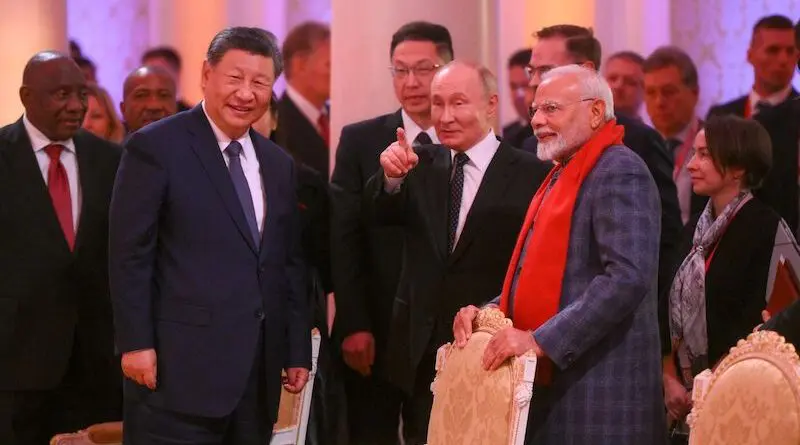
President of China Xi Jinping, President of Russia Vladimir Putin, and Prime Minister of India Narendra Modi during a concert ahead of an informal lunch for the heads of BRICS delegations held as part of the 16th BRICS summit in Kazan. Photo Credit: Alexandr Kryazhev, Photohost agency brics-russia2024.ru
Introduction
This paper critically examines India’s strategically neutral position in the Russia–Ukraine war and its implications for global diplomacy. Since the outbreak of the war in 2022, India has maintained a careful calibrated stance, emphasizing dialogue and peaceful resolution while abstaining from several key United Nations resolutions that condemned Russia’s actions, including those in the UN Security Council, the UN Human Rights Council, and the UN General Assembly. This approach reflects a broader commitment to strategic autonomy, shaped by India’s historical relationship with Russia, long-standing non-alignment policy, and evolving global priorities.
The analysis situates this stance within India’s historical ties with Russia, its long-standing commitment to non-alignment, and evolving global strategic priorities. This piece of work explores key dimensions such as defense dependence, geopolitical considerations (involving China and Pakistan), economic pressures, and diplomatic engagement with both Moscow and Kyiv.
The study highlights the challenges India faces, including international scrutiny and economic disruptions, alongside emerging opportunities like discounted energy imports, expanded trade potential, and a growing global diplomatic profile. Additionally, the paper argues that India’s approach exemplifies a calibrated exercise in strategic autonomy, reinforcing its position as a responsible global actor and potential mediator in future peace negotiations.
Background
The Russia–Ukraine war began on February 24, 2022, when Russia launched a full-scale military invasion of Ukraine. This marked a dramatic escalation of hostilities that had persisted since 2014, following Russia’s annexation of Crimea and support for separatists in eastern Ukraine. The invasion triggered a severe humanitarian crisis and drew strong global condemnation, resulting in widespread sanctions against Russia and military support for Ukraine. (Roy, 2023).
The international community has responded with a range of measures, including economic sanctions, diplomatic isolation of Russia, and military aid to Ukraine. Amid this global polarization, India has maintained a carefully balanced diplomatic position. While refusing to label Russia’s actions as an “invasion,” India has repeatedly emphasized the importance of dialogue and peaceful resolution. It has abstained from key UN resolutions condemning Russia, including in the UN Security Council, UN Human Rights Council and the UN General Assembly (Laskar, 2023).
Prime Minister Narendra Modi’s message to Putin during SCO meeting in Samarkand that “now is not an era of war” has been echoed in India’s calls for de-escalation and diplomacy (Haider, 2022). India has positioned itself as a country advocating multilateralism and peace. As a non-permanent member of the UN Security Council, India has urged both sides to prioritize humanitarian concerns, implement ceasefires and allow safe passage for civilians. While India has not taken a confrontational stance against Russia, it has provided humanitarian aid to Ukraine and engaged diplomatically with both President Putin and President Zelenskyy. Modi’s visits to both Kyiv and Moscow underscore India’s strategic engagement and aspirations to serve as a bridge-builder in international diplomacy.
The Russia–Ukraine conflict has significantly altered the global geopolitical landscape, reshaping energy routes, trade alliances, and security structures across the world. As a major democracy and a leading voice of the Global South, India’s stance carries weight in shaping alternative narratives to Western bloc politics. This paper explores India’s strategic neutrality through five key lenses: historical relations, defense cooperation, geopolitical calculations, economic management, and diplomatic initiatives under the Modi government.
India–Russia Relations from a Historical Foundations to Contemporary Dynamics
The diplomatic relationship between the Soviet Union (later Russia) and India has been defined by a long-standing policy of mutual neutrality and strategic alignment on the international stage. This partnership, rooted in historical ties and shared geopolitical interests, has evolved over decades, shaping their respective foreign policies and responses to global issues. India’s approach to the Russia-Ukraine conflict, for instance, reflects its historical commitment to non-alignment, a policy established during the Cold War to maintain independence from major power blocs. This tradition of neutrality continues to guide India’s foreign policy, allowing it to navigate complex international dynamics without direct entanglement in conflicts. (Ministry of External Affairs, 2021).)
The foundation of India-Soviet relations was laid shortly after India’s independence in 1947. During the Cold War, the Soviet Union emerged as a key supporter of India on contentious global issues. For example, in 1961, when India deployed its military to end Portuguese colonial rule over Goa, Daman, and Diu, the Soviet Union opposed a Western-backed UN resolution condemning India’s actions.
Similarly, in 1955, Soviet leader Nikita Khrushchev reaffirmed the USSR’s commitment to India by explicitly supporting its sovereignty over Kashmir, famously declaring, “We are so near that if ever you call us from the mountain tops, we will appear at your side” (Chaudhary: 2020). This alignment was further demonstrated during the 1971 Bangladesh Liberation War, when the signing of the Indo–Soviet Treaty of Peace, Friendship and Cooperation gave India diplomatic backing and strategic security. The Soviet Union also used its veto power at the UN Security Council to support India’s actions and shield it from international criticism (Attri, 2018). These instances underscore the USSR’s pivotal role in shaping India’s foreign policy choices and security calculations during a volatile regional environment.
After the dissolution of the Soviet Union in 1991, India faced the challenge of adapting to a changing global order. Despite this, Russia and India worked to sustain their strategic partnership. In 2000, Russian President Vladimir Putin and Indian Prime Minister Atal Bihari Vajpayee formalized this renewed relationship through the “Declaration of Strategic Partnership.” A decade later, in 2010, the two nations elevated their ties to a “Special and Privileged Strategic Partnership,” underscoring Russia’s continued support for India, particularly on the Kashmir issue. Russia has consistently supported India’s stance on contentious international issues. For example, it defended India’s decision to abrogate Article 370 in Jammu and Kashmir in 2019, labelling it an internal matter. Russia also opposed a China-led move in the UN to internationalize the Kashmir issue in 2020, emphasizing bilateral resolution between India and Pakistan.
Such instances reflect the enduring trust and geopolitical alignment between the two states. Dmitry Polyanskiy, Russia’s First Deputy Permanent Representative to the United Nations, reaffirmed Russia’s stance on the issue. In a tweet, he stated that the United Nations Security Council (UNSC) had discussed Kashmir during closed-door consultations. He further emphasized Russia’s firm support for the normalization of relations between India and Pakistan, expressing hope that any differences between the two nations would be resolved through bilateral negotiations (Sen, 2022).
India has reciprocated through diplomatic support in multilateral settings. For example, India opposed a UN Human Rights Commission resolution criticizing Russia’s actions during the Second Chechen War and voted against a 2008 UN resolution affirming the “right of return” for those displaced by Russia’s campaign in Abkhazia. India also abstained from UN resolutions
in 2013 and 2016 condemning the Assad regime in Syria, which was backed by Russia. Similarly, in 2014, India abstained from a UN resolution condemning Russia’s annexation of Crimea and in 2020, voted against a Ukraine-sponsored resolution on human rights violations in Crimea. These actions reflect India’s consistent diplomatic alignment with Russia, rooted in mutual trust and shared strategic interests (Ibid). In the present era of geopolitical flux, the India–Russia relationship remains an anchor of India’s foreign policy calculus defined less by ideology and more by realism, strategic autonomy and sectoral interdependence in defense, energy, and global governance.
Defence and Security Ties
The India–Russia defense partnership has long been regarded as the cornerstone of their “Special and Privileged Strategic Partnership.” While the two countries cooperate across a wide range of areas such as civil nuclear energy, space exploration, counterterrorism, and multilateral diplomacy. it is the defense and security dimension that remains most vital to India’s strategic autonomy. In the context of the Russia–Ukraine war and shifting geopolitical alliances, India’s continued military cooperation with Russia reveals both historical dependence and pragmatic strategy.
The genesis of this relationship dates back to the Cold War, particularly following India’s military setback during the 1962 Sino-Indian War. Facing increasing threats from both Pakistan and China, and wary of the Western alliance system, India found a strategic ally in the Soviet Union. The USSR not only provided military hardware but also extended favorable credit terms, political support at international forums, and importantly access to defense technology, which Western powers were reluctant to share. The ideological affinity between Prime Minister Nehru’s socialist orientation and Soviet internationalism further deepened this engagement (Hooft & Barrow, 2022: 8).
Throughout the Cold War and well into the 21st century, Russia (and earlier, the Soviet Union) became India’s principal arms supplier. According to the Stockholm International Peace Research Institute (SIPRI), around 85% of India’s military inventory is of Russian origin. This includes iconic platforms such as the MiG-29 and Sukhoi Su-30 fighter aircraft, T-90 and T-72 tanks, Kilo-class submarines, and the Smerch multiple rocket launcher systems. India has also leased nuclear submarines from Russia and received training and technical support for their operations.
Currently, India is Russia’s top defense partner, accounting for 28% of Moscow’s global arms exports. Therefore, this relationship is more than transactional. It reflects strategic depth, technological cooperation, and mutual trust. One of the most successful examples of Indo-Russian collaboration is the BrahMos supersonic cruise missile, jointly developed under a bilateral agreement and manufactured in India under the ‘Make in India’ initiative.
In 2018, India signed a landmark $5.4 billion deal to procure five S-400 Triumf air defense systems from Russia, despite considerable pressure from the United States under its Countering America’s Adversaries Through Sanctions Act (CAATSA). Deliveries began in 2021, reaffirming India’s commitment to diversify its security portfolio without compromising on strategic autonomy. (Muratbekova (2022). India’s ‘Make in India’ defense policy, launched under the Modi government, also benefits significantly from Russian collaboration. The AK-203 rifle production in Amethi, the licensed manufacture of T-90 tanks, and potential joint ventures in futuristic platforms like fifth-generation fighter jets are examples of Russia’s willingness to engage in technology transfer and co-development. (Ministry of Defence, 2022).
Moreover, Russia’s willingness to transfer critical military technologies, engage in joint production, and offer cost-effective pricing distinguishes it from many Western suppliers. Unlike the United States and several European nations, Russia does not impose intrusive end-user monitoring agreements or restrict the use of military platforms in specific operational theatres. This flexibility has allowed India to customize and integrate Russian systems with indigenous technologies, enhancing operational efficiency and self-reliance (Tellis, 2011).
India is likely to increase its procurement from Western countries and develop indigenous defense capabilities but Russia will remain a vital partner particularly in systems where India already has operational dependency or where Russian support for training and maintenance is indispensable. Additionally, as part of global defense rebalancing and evolving security architecture in Asia, India may utilize its partnership with Russia as a counterbalance to growing Sino-Russian military alignment.
Geopolitical Considerations and Strategic Neutrality
Geopolitical factors also contribute to India’s neutral stance on Russia-related global issues. India and Russia share a historically strong bond that dates back to the 1950s. During this time, the Soviet Union consistently backed India on critical international matters, notably using its UN Security Council veto to support India on the Kashmir issue. This partnership deepened throughout the Cold War, with the U.S.S.R. often acting as a mediator between India and Pakistan. Reflecting this enduring relationship, India’s External Affairs Minister, Subrahmanyam Jaishankar, described the India-Russia relationship as “the one constant in world politics” in December 2023, underscoring the deep and continuous ties between the two nations. (The Moscow Times, 2025).
One of the most significant geopolitical motivations behind India’s balanced position is the strategic challenge posed by China and Pakistan. Both countries are strengthening ties with Moscow, raising concerns in New Delhi. India views its engagement with Russia as a way to prevent Moscow from moving too close to Beijing or Islamabad. Maintaining strong bilateral ties with Russia is thus considered essential to moderate Russian policy in South Asia and protect Indian interests (Tellis, 2011: 1,2). India, Russia, and China are all part of multilateral platforms such as BRICS and the Shanghai Cooperation Organisation (SCO), which foster regional political and economic dialogue. Although India remains wary of China’s increasing assertiveness, especially in the Indo-Pacific, its participation in these groupings allows it to remain diplomatically connected while promoting a multipolar regional order (Muratbekova, 2022).
India’s defense import patterns also reflect a shift driven by strategic necessity. India bought 36% of its weapons from Russia between 2020 and 2024. This is much less than before 55% in 2015–2019 and 72% in 2010–2014. (SIPRI, 2025). This means India is now buying more weapons from other countries for instance, France and the United States that now collectively supply 46% of India’s military imports. India’s strategic realignment is further evident in its Indo-Pacific vision, particularly through its active participation in the Quadrilateral Security Dialogue (Quad), which comprises India, the United States, Japan, and Australia.
During the Quad Foreign Ministers’ Meeting in Tokyo in July 2024, External Affairs Minister S. Jaishankar emphasized the need for a coalition of “democracies, pluralistic societies, and market economies” to ensure a free and open Indo-Pacific, citing growing concerns over China’s regional posture (Chaudhary, 2024India’s involvement in naval exercises like Malabar under the Quad framework, along with its participation in the Indo-Pacific Economic Framework (IPEF), highlights its growing convergence with Western nations on issues such as maritime security and strengthening supply chain resilience (Ministry of External Affairs, 2023). Despite this strategic shift, India remains committed to its policy of “strategic autonomy,” often described as “multi-alignment.” This approach allows India to cooperate with rival global powers without entering into binding alliances. The Modi government’s emphasis on “Atmanirbhar Bharat” (self-reliant India), especially in the defense sector, aligns with this vision.
In this context, As External Affairs Minister Dr. S. Jaishankar emphasized at the Raisina Dialogue 2022, “India believes in strategic autonomy… we have strategic partnerships with different countries, based on our national interest, not alliances” (Ministry of External Affairs, 2022). While multi-alignment offers flexibility, it may also lead to strategic ambiguity. Critics caution that walking a tightrope between the West and Russia could erode trust on both sides. For example, India’s growing engagement with the Quad contrasts with its silence on Russian aggression. A lack of clear stance may limit India’s influence in future crisis mediation or security coalitions.
Modi Government’s Role in the Russia–Ukraine War
In the early days of the conflict, the Modi government launched Operation Ganga, a large-scale mission to evacuate Indian nationals, especially students, stranded in Ukraine. Beginning in late February 2022, the operation brought home over 22,500 Indians through special Air India, Indian Air Force, and chartered flights (NDTV, 2022). Indian embassies in Ukraine, Poland, Romania, and Hungary worked under intense pressure to coordinate evacuations via land corridors as Ukraine’s airspace remained closed.
Prime Minister Modi personally spoke with Presidents Vladimir Putin and Volodymyr Zelenskyy to ensure safe passage for Indian citizens, including students trapped in cities like Sumy and Kharkiv (The Hindu, 2022). He also chaired high-level meetings with senior ministers and foreign service officers to supervise the evacuation process (MEA, 2022a). This operation not only demonstrated the government’s commitment to citizen welfare abroad but also reinforced India’s neutral diplomatic credibility as both sides cooperated in facilitating safe exits for Indians (Indian Express, 2022).
In the months and years that followed, India built upon this early diplomatic engagement through sustained dialogue with both Russia and Ukraine eventually culminating in high-level visits and participation in peace summits in 2024.
In 2024, the Modi government intensified diplomatic outreach to both warring sides in a bid to assert India’s relevance as a global mediator. Prime Minister Modi became one of the few world leaders to visit both Russia and Ukraine within a short span. His July 2024 visit to Moscow coincided with ongoing Russian airstrikes, including the bombing of a children’s hospital in Ukraine, which led to international criticism and strong reactions from President Zelenskyy, who called the visit a “huge disappointment and a devastating blow to peace efforts” (Chaudhary, 2024). In response, the Indian government recalibrated by organizing Modi’s historic August 2024 visit to Kyiv, the first by any Indian prime minister since the establishment of bilateral ties in 1993.(Bajpaee & Toremark, 2024).
On August 23, 2024, Modi met with Zelenskyy in Ukraine at the latter’s invitation. This engagement highlighted India’s commitment to a peaceful resolution through diplomacy, a stance reinforced by its participation in the Summit on Peace in Ukraine, held in Burgenstock, Switzerland, in June 2024. The leaders reaffirmed their commitment to advancing bilateral relations for the mutual benefit of their nations, founded on principles of trust, respect, and transparency. They reviewed the consistent and positive development of bilateral relations, which have significantly strengthened over the past thirty years. The leaders acknowledged the importance of regular interactions between India and Ukraine at various levels, including their meetings in Apulia in June 2024 and Hiroshima in May 2023 during the G7 Summits, the visit of Ukraine’s Minister for Foreign Affairs to New Delhi in March 2024, as well as numerous interactions and phone conversations between India’s External Affairs Minister and Ukraine’s Foreign Affairs Minister, and between India’s National Security Advisor and the Head of the Office of the President of Ukraine.
These engagements, alongside the 9th round of Foreign Office Consultations held in Kyiv in July 2023, have played a crucial role in enhancing mutual understanding and cooperation (Prime Minister’s Office, 2024). India’s role in these summits is consistent with its traditional identity as a voice for the Global South, advocating for peaceful coexistence, and opposing bloc politics. India’s presence in peace talks is often framed not just as bilateral diplomacy but as part of a larger mission to reshape the global order into a multipolar, dialogue-driven system (Ministry of External Affairs, 2024; Handelsblatt Interview with S. Jaishankar, February 2024). Modi’s Kyiv visit highlighted India’s humanitarian concerns and long-standing support for the principles of territorial integrity and sovereignty under the UN Charter. This balancing act allowed India to retain credibility both with Western allies and its traditional Russian partner, without sacrificing its non-aligned identity.
In this context, CIA Director William Burns acknowledged that Prime Minister Modi’s communication with President Putin helped in de-escalating Russia’s nuclear rhetoric during high tensions in 2023. This recognition from a senior U.S. intelligence official underscore the quiet but significant influence that Indian leadership has wielded behind the scenes (Times Now, 2023). While high-level visits to Moscow and Kyiv reflect India’s proactive diplomacy, their actual impact on peace negotiations remains limited. These moves may serve more as symbolic demonstrations of neutrality than concrete steps toward mediation. Without sustained institutional engagement, India risks being seen as a cautious observer rather than an effective peace broker.
Impact on Indian Economy, Oil Sector, and Inflationary Pressures
The Russia–Ukraine war has produced profound ripple effects on the Indian economy, especially through rising energy prices, disrupted trade, and inflationary pressures. The Western sanctions regime particularly imposed by the United States and the European Union—contributed to the freezing of approximately $300 billion of Russia’s foreign exchange reserves (U.S. Treasury, 2022), which led to increased global market uncertainty and a reshuffling of energy trade flows. Both Russia and Ukraine are significant exporters of wheat, corn, and minerals such as nickel, palladium, and aluminium, whose global shortages contributed to an economic spillover, affecting India’s import costs and supply chain dynamics (World Bank, 2022). The immediate economic impact of the conflict has been felt in India’s oil sector. Rising crude oil prices have contributed to financial market volatility, widened the current account deficit, and led to currency depreciation against the U.S. dollar.
Additionally, increased fuel prices have exacerbated inflationary pressures. For example, Oil constitutes a significant portion of India’s imports from Russia. The imposition of sanctions may drive oil prices to unprecedented levels, leading to a domestic surge in petroleum product prices. This escalation in fuel costs could, in turn, intensify inflationary pressures within the country. It is noteworthy that the Economic Survey 2021–22 identified three major challenges facing the Indian economy: recurring COVID-19 waves, disruptions in supply chains, and rising inflation. The war in Ukraine directly exacerbated the latter two challenges, further widening India’s current account deficit.
To mitigate this impact, the Indian government adopted a pragmatic strategy that balanced economic necessity with geopolitical caution. India refused to join the Western-led oil price cap on Russian crude and instead increased its imports from Moscow at discounted rates. This decision was in line with India’s sovereign energy policy and was supported by major government schemes under the Atmanirbhar Bharat initiative, which emphasizes domestic resilience and policy autonomy.
By bypassing the price cap, India managed to secure oil at rates lower than the global average, helping to stabilize domestic fuel prices and keep inflation under check. he results of this strategy were economically significant. According to government trade data, bilateral trade between India and Russia doubled from $13 billion in 2021–22 to $27 billion by the end of 2022, with projections suggesting it would surpass $30 billion in 2023. Apart from crude oil, Russia became a major supplier of chemical fertilizers, another critical input for Indian agriculture. Russia emerged as the largest oil and fertilizer supplier to India by the end of 2022 (Laskar, 2023).
The government’s actions in securing affordable oil and fertilizers contributed to managing food inflation, especially at a time when global food prices were rising due to supply disruptions in Eastern Europe. India imports approximately 2.5 million tonnes of sunflower oil annually, of which nearly 70% came from Ukraine before the war (Verma & Gupta, 2023). The war significantly affected these supply lines, but the diversification into Russian oil and expanded sourcing from other regions helped mitigate shortages. In addition to managing imports, the conflict offered India new trade opportunities. With Western markets halting cargo from Russia and Ukraine’s exports reduced, Indian agricultural exporters saw increased demand for wheat, millet, maize, nuts, and processed foods. This served as a timely economic boost for Indian farmers and agri-exporters, helping them expand into new markets while maintaining domestic supplies. (Ministry of Commerce, 2023).
Conclusion
India’s position on the Russia–Ukraine war shows a careful and balanced foreign policy. Without taking sides, India has focused on promoting peace, protecting its national interests, and continuing its traditional values of non-alignment and strategic autonomy. It kept strong ties with Russia especially in defense and energy while also calling for dialogue and respect for sovereignty at international forums.
The Modi government’s balanced diplomacy visiting both Moscow and Kyiv, taking part in the Summit on Peace in Ukraine, and continuing talks with leaders on both sides has shown that India can be a trusted global partner. India also handled the economic impact of the war by buying discounted Russian oil and fertilizers, helping control inflation and protect farmers. At the same time, Indian exporters gained new market opportunities, especially in agriculture and pharmaceuticals. India’s stand is not passive neutrality—it is an active call for peace. Its strong ties with both the West and Russia give it a unique position to act as a future mediator in the conflict.
As a country trusted by many and guided by a long tradition of diplomacy, India can help bring both sides to the table. India is also increasingly seen as the voice of the Global South—speaking for developing countries on global platforms, promoting fairness, and pushing for reforms in global institutions.
This growing role was clearly recognized by UK Foreign Secretary David Cameron, who said during his visit to India on October 21, 2024,“India is a friend of Ukraine and a friend of peace, and its credibility is immense. India can play a vital role in resolving this crisis. It is time India gets a permanent seat in the UN Security Council.”
This shows that India’s balanced approach is not only helping its own people but also gaining international respect. As the war continues, India’s role as a responsible power, a peace advocate, and a leader of the Global South will become even more important. Nonetheless, India’s calibrated stance faces inherent contradictions. While aiming to serve as a peace advocate, India’s reluctance to openly condemn aggression or take a firm diplomatic lead may undercut its ambitions. If India seeks a permanent seat at the UN Security Council, it must go beyond non-alignment and demonstrate leadership grounded in principles, not just pragmatism.
Endnotes
2. Ministry of External Affairs (2022), Impact of Russia–Ukraine War on India (Question No. 3771), Lok Sabha,Government of India. URL: https://www.mea.gov.in/loksabha.htm?dtl/35061/QUESTION_NO3771_IMPACT_OF_RUSSIAUKRAINE_WAR_ON_INDIA
3. Press Information Bureau. (2024, August 23), India-Ukraine Joint Statement on the Visit of Prime Minister of India to Ukraine. Government of India. https://www.pib.gov.in/PressReleaseIframePage.aspx?PRID=2048245
4. Ministry of Finance. (2022), “Economic survey 2021-22: Vol. 1* (Chapter 1, p. 12)” Government of India.
https://www.indiabudget.gov.in/economicsurvey/doc/echapter.pdf
5. NDTV. (2024, October 21). India has credibility to mediate in Ukraine war: David Cameron at NDTV World Summit. https://www.ndtv.com/world-news/india-has-credibility-to-mediate-in-ukraine-war-david-cameron-at-ndtv-world-summit-6836810
References (* Indicates Primary Sources)
- *Ministry of Commerce & Industry (2023), Annual Report 2022–23, Government of India, New Delhi. URL: https://www.commerce.gov.in/wp-content/uploads/2023/03/Annual-Report-FY-2022-23-DoC.pdf
- *Ministry of Defence (2022), India–Russia Defence Cooperation Agreements, Government of India, New Delhi. URL: https://mod.gov.in
- *Ministry of External Affairs (2021), India–Russia Bilateral Relations, Government of India, New Delhi. URL: https://mea.gov.in/india-russia-bilateral-relations.htm
- *Ministry of External Affairs (2022), Update on Operation Ganga, Government of India, 4 March. URL: https://www.mea.gov.in/press-releases.htm?dtl/34943/Update_on_Operation_Ganga
- *Ministry of External Affairs (2022b), Remarks by External Affairs Minister at Raisina Dialogue, Government of India. URL: https://mea.gov.in/Speeches-Statements.htm?dtl/35217
- *Ministry of External Affairs (2022), Impact of Russia–Ukraine War on India (Question No. 3771), Lok Sabha, Government of India. URL: https://www.mea.gov.in/loksabha.htm?dtl/35061/QUESTION_NO3771_IMPACT_OF_RUSSIAUKRAINE_WAR_ON_INDIA
- *Ministry of External Affairs (n.d.), Official Communications and Archives, Government of India. URL: https://mea.gov.in
- *Prime Minister’s Office (2024), India–Ukraine Joint Statement on the Visit of Prime Minister of India to Ukraine, Government of India, 23 August. URL: https://www.pmindia.gov.in/en/news_updates/india-ukraine-joint-statement/
- Chaudhary, D. R. (2020), “Russian Support to India on Kashmir Is Rooted in History”, The Economic Times, New Delhi, 20 January 2020.
- Chaudhary, D. R. (2020), India’s Strategic Choices in International Forums, New Delhi: Policy Research India.
- Chaudhary, S. D. (2024), “Modi Visits Ukraine in Show of ‘Strategic Autonomy’”, Asia Pacific Foundation of Canada, 21 December. [Online: web] Accessed 16 Dec. 2024.
- Haider, S. (2022), “Modi Tells Vladimir Putin ‘Now is Not an Era of War’”, The Hindu, New Delhi, 17 September, 2022.
- Hooft, P. A. and Barrow, A. (2022), India’s Approach to the Russian Invasion of Ukraine: An Example of the BJP’s ‘India First’ Thinking and What It Means for the West, The Hague: The Hague Centre for Strategic Studies, [Online: web] Accessed 17 Dec. 2024, URL: https://hcss.nl/wp-content/uploads/2023/03/PDF-Indias-approach-to-the-Russian-Invasion-of-Ukraine-An-Example-of-the-BJPs-India-First-Thinking-and-What-it-Means-for-the-West-3.pdf
- Indian Express (2022), “Explained: What is Operation Ganga, India’s Evacuation Mission in Ukraine?”, The Indian Express, New Delhi, 9 March, 2022.
- Jaishankar, S. (2024), Why Bharat matters, India: HarperCollins Publishers
- Laskar, R. H. (2023), “India Explains Why It Abstained at UN Vote on Ukraine with 3 Piercing Questions”, Hindustan Times, New Delhi, 25 February, 2023.
- Laskar, R. H. (2023), “India–Russia Trade Up by $27 bn but ‘Too One Sided’, Says Indian Envoy”, Hindustan Times, New Delhi, 15 December, 2023. URL: https://www.hindustantimes.com/india-news/india-russia-trade-up-by-27-bn-but-too-one-sided-says-indian-envoy-101702555678455.html
- NDTV (2022), “Over 22,500 Indians Brought Back from Ukraine under Operation Ganga, Says Centre”, NDTV, New Delhi, 6 March, 2022. URL: https://www.ndtv.com/india-news/over-22-500-indians-brought-back-from-ukraine-under-operation-ganga-says-centre-2804324
- Pant, H. V. (2016), Indian foreign policy: An overview, Manchester :Manchester University Press.
- The Hindu (2022), “Modi Speaks to Putin, Zelenskyy on Safe Passage of Indians”, The Hindu, New Delhi, 7 March, 2022. URL: https://www.thehindu.com/news/national/modi-speaks-to-putin-zelenskyy-on-safe-passage-of-indians/article65096671.ece
- Times Now (2023), “PM Modi’s Words on War Had Impact on Russians: CIA Chief”, Times Now, New Delhi, 9 March, 2023. URL: https://www.timesnownews.com/international/pm-modis-words-on-war-had-impact-on-russians-cia-chief-article-98567890
- Verma, J. S. and Gupta, S. D. (2023), “Russia–Ukraine War: India’s Balancing Act”, The Hindu BusinessLine, 24 February, 2023.

Dr. Sunita Meena
Dr. Sunita Meena is currently working as an Assistant Professor in the Department of Political Science at Kalindi College, University of Delhi. She holds an M.A. in Politics (with specialization in International Relations), and has earned her M.Phil. and Ph.D. from the Centre for Russian and Central Asian Studies, School of International Studies, Jawaharlal Nehru University (JNU), New Delhi. Her areas of interest include international relations, Indian foreign policy and Eurasian geopolitics.