Wednesday, June 11, 2025

Freedom Flotilla


Israel to expel French 'Freedom Flotilla' activists, MEP Rima Hassan held in solitary confinement

Four French activists who are being detained by Israel after being intercepted on board the Madleen humanitarian aid boat sailing for Gaza will be sent back to France on Thursday or Friday, Foreign Minister Jean-Noël Barrot said Wednesday. One of the activists, MEP Rima Hassan, was briefly held in solitary confinement, an NGO representing the activists said.


Issued on: 11/06/2025 -
By:FRANCE 24
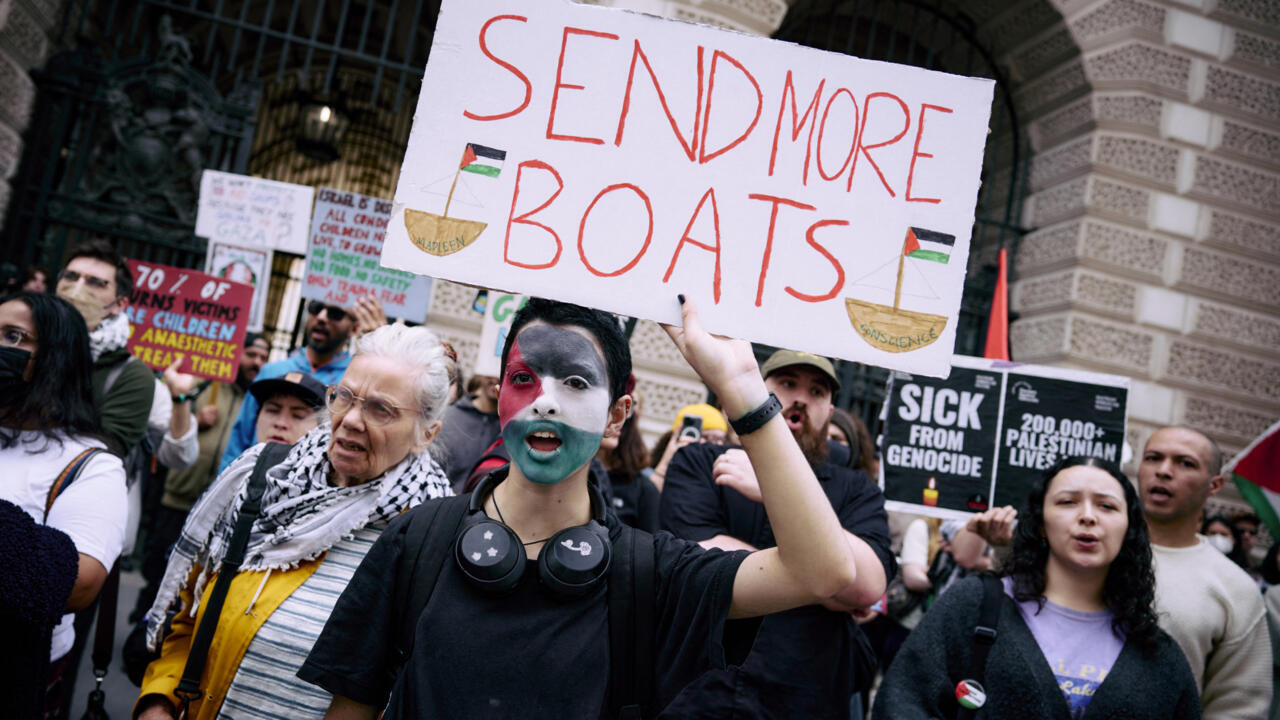

Protesters gather outside the Foreign Office in central London on June 9, 2025 to demand that the UK government protect the crew of the "Gaza Freedom Flotilla" boat Madleen. © Benjamin Cremel, AFP

Israel is to expel by the end of the week four French nationals held after security forces intercepted their Gaza-bound aid boat, France's foreign minister said Wednesday, as an Israeli NGO said one of the French campaigners was briefly put in solitary confinement.

Rima Hassan, a member of European Parliament from the hard-left France Unbowed (LFI) party who is of Palestinian descent, was placed in solitary confinement, as was Brazilian activist Thiago Avila, with Hassan later removed, Israeli human rights group Adalah said.

"Israeli authorities transferred two of the volunteers, the Brazilian volunteer Thiago Avila and the French-Palestinian European Parliament member Rima Hassan – to separate prison facilities, away from the others, and placed them in solitary confinement," Adalah said in a statement.

The NGO later said that Hassan had been moved back to Givon prison in Ramla, near Tel Aviv, while Avila remained in isolation.

Adalah said Hassan was put in isolation after writing "Free Palestine" on a prison wall.

Israeli forces on Monday intercepted the Madleen sailboat and its 12 crew members in international waters off the besieged Palestinian territory.

Four French activists who were on board the Madleen will be expelled by Israel by the end of the week, French Foreign Minister Jean-Noël Barrot said Wednesday.

The four, who include Hassan, will be deported on Thursday and Friday, the minister said on X.

Another four, who are not French, were also taken into custody.

The remaining four, including two French citizens and Swedish campaigner Greta Thunberg, agreed to be deported immediately after being banned from Israel for 100 years.

Read more
Greta Thunberg tells FRANCE 24 she was 'kidnapped' by Israel

France's prime minister on Wednesday accused the French activists who sailed on the Madleen of capitalising on the Israeli-Palestinian conflict for political attention.

"These activists obtained the effect they wanted, but it's a form of instrumentalisation to which we should not lend ourselves," Prime Minister François Bayrou said in the National Assembly.

It's "through diplomatic action, and efforts to bring together several states to pressure the Israeli government, that we can obtain the only possible solution" to the conflict, he added.

Watch more
Aid ship seized by Israel named after Gaza's only fisherwoman, Madleen Kullab

Barrot added that priority in Gaza should be "an immediate ceasefire, the release of all hostages held by Hamas, as well as immediate, unimpeded and massive humanitarian aid access to abridge the suffering of civilian populations".

"In no way whatsoever do the gesticulations of Ms Rima Hassan, her instrumentalisation of the suffering of Gazans, help to achieve these goals," he added.

He said the French consul had visited all four French activists in Israeli detention.

(FRANCE 24 with AFP and Reuters)


Entertainment world reacts to Greta Thunberg interception in Gaza-bound aid boat
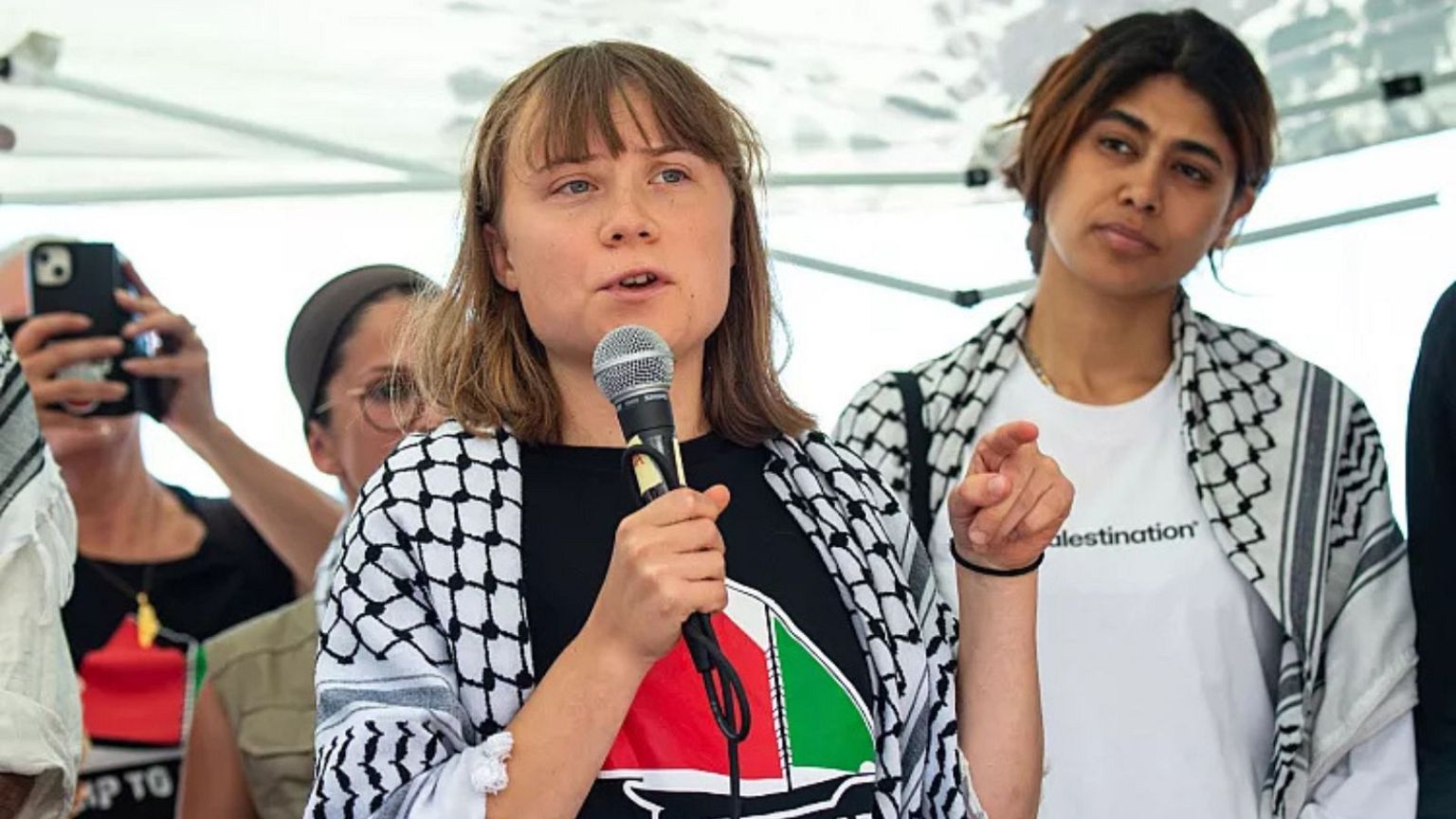
Climate activist Greta Thunberg with other activists meet with journalists in Catania - 1 June 2025
Copyright AP Photo


By David Mouriquand
Published on 

Israeli forces seized the Gaza-bound Madleen early on Monday morning. The entertainment world has responded to the action, which saw activists including Greta Thunberg attempt to raise awareness of the humanitarian crisis.

Early on Monday morning, Israeli forces intercepted and seized a boat called the Madleen, which was heading to Gaza to deliver humanitarian aid in what activists said was a protest against Israel's ongoing military campaign in the Gaza Strip. 

A group of activists, including Greta Thunberg, will be returned to their home countries after the Gaza-bound boat they were travelling on was seized, Israeli authorities said. 

Israel's Foreign Ministry dismissed the voyage as a public relations stunt, saying in a post on X that "the 'selfie yacht' of the 'celebrities' is safely making its way to the shores of Israel." 

Thunberg shared news of the campaign in a video update on 2 June that saw her wear a Fontaines D.C. charity jerseyand raise awareness for the ‘Freedom Flotilla’ trip, with the boat departing from Italy.  

The group has claimed that authorities had “forcibly intercepted” the boat and acted with “total impunity.”  

Huwaida Arraf, a Freedom Flotilla organiser, shared: “Israel has no legal authority to detain international volunteers aboard the Madleen. These volunteers are not subject to Israeli jurisdiction and cannot be criminalised for delivering aid or challenging an illegal blockade - their detention is arbitrary, unlawful, and must end immediately.” 

Thunberg accused Israel of "kidnapping" her and reached out for global support. In a statement, she said: “I urge all my friends, family, and comrades to put pressure on the Swedish government to release me and the others as soon as possible”. 

The entertainment world has responded to the interception of the boat.  

Legendary rock band Garbage reshared a post that called for “the release of all involved immediately,” and before posting an update with the caption: “All eyes on the @gazafreedomflotilla .  Let aid in. What is happening to the Palestinians is monstrous. How many more dead children do we have to see before the world acts?!?”

Singer-songwriter Cat Power shared an update on Instagram pushing for the release of Thunberg and the activists. “We demand the immediate release of all 12 hostages taken by Israel in violation of international law,” the singer shared in the caption, before listing out the names of those who were onboard the Madleen. “THE WORLD MUST ACT NOW. THIS IS A CRISIS.”

Norwegian singer Aurora shared an update that claimed the Israeli government offered Thunberg the option to “attack, arrest, or turn back”, while Irish rap group Kneecap shared an earlier update that said: “Solidarity with Liam Cunningham (Game Of Thrones actor) and all on the ‘freedom flotilla’ to Gaza”. 

British singer-songwriter Nadine Shah also shared a video made by an activist on the Madleen, which said: “This is not the world you want to leave behind to your children. When you look into the faces of your children, know there are children in Gaza, the same age, and they have the same rights. They have the right to live in dignity, they have the right to live free. They have the right to just live. Do everything in your power, keep your eyes on us and remember why we are here. You need to do the real work, and that is to stop your government from sending weapons to Israel to commit these war crimes and atrocities.” 

Bambie Thug, last year’s Eurovision entry for Ireland, also reposted an update that read: “We demand that Madleen is allowed to land safely and peacefully in Gaza with all activists unharmed”, while author Matt Haig shared the following regarding Greta Thunberg and the criticism aimed at the young activist: “Like her. Don’t like her. But she is the opposite of ‘performative’. She is literally heading into a genocide with a target on her back.” 

After an almost three-month blockade aimed at pressuring Hamas, Israel started allowing some basic aid into Gaza last month. Humanitarian workers and experts say it is not enough and have warned of famine unless the blockade is lifted and Israel ends its military offensive. 

An attempt last month by Freedom Flotilla to reach Gaza by sea failed after another of the group's vessels was attacked by two drones while sailing in international waters off Malta, organisers said. 

The group blamed Israel for the attack, which damaged the front section of the ship.


French MEP Rima Hassan detained in Israel following 'illegal entry'

Member of European Parliament Rima Hassan speaks during a pro-Palestinian demonstration outside the European Parliament in Strasbourg, France
Copyright AP Photo

By Vincenzo Genovese
Published on 

The European lawmaker from France Unbowed, whose parliamentary immunity is not valid outside the EU, was a member of the Freedom Flotilla, which was intercepted by Israeli authorities on Monday.

French leftist MEP Rima Hassan has remained in Israeli custody and was awaiting a hearing on Tuesday before an Israeli judge, after being detained the day before alongside seven other people. 

Hassan was part of the “Freedom Flotilla”, a group of activists who set off on 3 June from Catania, Italy, to try to deliver humanitarian aid to Gaza by boat but were intercepted by Israel’s authorities about 200 kilometres from the coast on Sunday evening.

The Israeli Foreign Affairs Ministry said then that the crew of the Madleen vessel had been provided with water and sandwiches but Hassan’s team said that after a brief, filmed, distribution of sandwiches during the arrest, no water or food was provided during the 16-hour journey to the port of Ashdod, which the crew was forced to spend on the ship’s deck until nightfall.

The 12 Freedom Flotilla members were then presented with a document urging them to recognise they had entered Israeli territory illegally. Signing it meant immediate expulsion, while refusal would result in being brought before a judge. 

Four of them chose the first option, including Swedish activist Greta Thunberg, Spaniard Sergio Toribio, and two French nationals, Baptiste Andre and Omar Faiad.

But the other eight refused to sign the document, arguing that the Freedom Flotilla was intercepted in international waters and rejecting the claim that they entered illegally.

These eight people are now detained awaiting a new hearing before an Israeli judge, who could order their expulsion in the coming days.

Hassan’s parliamentary immunity guarantees her freedom of expression and protects her from legal action stemming from any EU member state, but does not apply outside of EU territory.

The MEP’s team denounced the document presented as “a propaganda operation aimed at legitimising an illegal arrest and detention” and claimed it is “a blatant violation of her parliamentary immunity”. 

“We strongly affirm that their humanitarian mission to Gaza was legal, necessary, and urgent; the arrest violates international law; the detention is illegal and arbitrary," the statement from Hassan's team also reads. 

The European Parliament told Euronews on Tuesday that its President Roberta Metsola has been in constant contact with the Israeli authorities to ensure the safety and security of Hassan.

“We will remain in round-the-clock contact with all parties until it is resolved safely," a Parliament spokesperson said. 

Were other MEPs ever detained?

This is not the first time a MEP was detained in a third country.

In February 2025, three MEPs - Isabel Serra (Spain),  Catarina Martins (Portugal), Jussi Saramo (Finland), all from the Left group - were detained and subsequently expelled from El Aaiún, the main city of the disputed territory of Western Sahara, where they had gone to carry out a human rights observation mission.

“The European Parliament will always insist that all its members are kept safe and treated with respect as elected representatives of the people of Europe wherever they are in the world", the Parliament also said in its statement to Euronews.

Her detention and the Freedom Flotilla’s seizure have become a much-debated political issue in France and in Brussels.

France Unbowed published an appeal calling for the immediate release of the passengers and the lifting of the Israeli blockade on Gaza.

Its leader Jean-Luc Mélenchon and MEP Manon Aubry also called for urgent intervention from President Macron and European and international bodies, declaring they bear a moral responsibility to defend these activists. A rally they organised in Paris on Monday to protest against the detention and Israel’s actions in Gaza gathered tens of thousands of people, according to Mélenchon. 

In the European Parliament, The Left, the Socialists and Democrats and the Greens/European Free Alliance co-signed a statement asking for all the activists to be released.


Thunberg claims Israel 'kidnapped' Gaza flotilla activists in international waters

Thunberg claims Israel 'kidnapped' Gaza flotilla activists in international waters
 / bne IntelliNews
By bnm Gulf bureau June 10, 2025

Swedish rights activist Greta Thunberg has accused Israel of "kidnapping" her Gaza-bound aid flotilla in international waters and committing a crime, speaking to reporters after arriving in Paris following her deportation on June 10.

The Swedish climate activist, who has become a pro-Palestinian campaigner, said upon landing: "They kidnapped us in international waters and committed a crime, but this is nothing compared to the genocide happening in Gaza."

Thunberg claimed Israeli authorities tried to make the activists watch "propaganda videos" but said she refused to look. "This is nothing compared to what's happening in Gaza, which desperately needs humanitarian aid," she told reporters at Charles de Gaulle Airport.

The 22-year-old activist responded to Defence Minister Israel Katz's claims that the flotilla was a publicity stunt, calling it "ironic that they say this, given their own propaganda videos."

Thunberg and 11 other activists were detained June 9 after Israeli naval forces intercepted their UK-flagged vessel Madleen near Gaza's territorial waters. The group had sailed for nine days attempting to deliver humanitarian aid to the blockaded territory.

The ship was towed to Ashdod port, where Israeli authorities processed the activists for deportation. Those refusing to sign deportation documents were to be brought before judicial authorities under Israeli law.

Katz said the activists were shown footage of Hamas's October 7 attacks upon arrival but "refused to continue watching when they saw what it was about."

"The antisemitic flotilla members close their eyes to the truth, proving again they prefer murderers over victims," Katz added.

Israel maintains its 18-year naval blockade of Gaza is necessary for security, whilst critics argue it constitutes collective punishment.

Israel deports Greta Thunberg after intercepting Gaza-bound aid boat

By AFP
June 10, 2025


Israeli forces intercepted the Gaza-bound Madleen aid boat, operated by the Freedom Flotilla Coalition, in international waters on Monday - Copyright Indian Coast Guard (ICG)/AFP -

Nir Kafri with Alice Chancellor in Jerusalem

Israel said campaigner Greta Thunberg left the country on a flight to Sweden via France on Tuesday, after she was detained along with other activists aboard a Gaza-bound aid boat.

Of the 12 people on board the Madleen carrying food and supplies for Gaza, five French activists were taken into custody after they refused to leave Israel voluntarily.

Israeli forces intercepted the boat, operated by the Freedom Flotilla Coalition, in international waters on Monday and towed it to the port of Ashdod. They were then transferred to Ben Gurion Airport near Tel Aviv, the foreign ministry said.

“Greta Thunberg just departed Israel on a flight to Sweden (via France),” Israel’s foreign ministry said on its official X account on Tuesday, along with a photo of the activist sitting on board a plane.

Five French activists who were also aboard the Madleen were set to face an Israeli judge, the French foreign minister said.

“Our consul was able to see the six French nationals arrested by the Israeli authorities last night,” Foreign Minister Jean-Noel Barrot said on X.

“One of them has agreed to leave voluntarily and should return today. The other five will be subject to forced deportation proceedings.”

In the early hours of Tuesday, Israel’s foreign ministry said the activist group had arrived at Ben Gurion airport to “return to their home countries”.

“Those who refuse to sign deportation documents and leave Israel will be brought before a judicial authority,” it said on X.

The vessel carrying French, German, Brazilian, Turkish, Swedish, Spanish and Dutch activists had the stated aim of delivering humanitarian aid and breaking the Israeli blockade on the Palestinian territory.

– Dire humanitarian conditions –

Israel’s interception of the Madleen about 185 kilometres (115 miles) west of the coast of Gaza, was condemned by Turkey as a “heinous attack” and Iran denounced it as “a form of piracy” in international waters.

In May, another Freedom Flotilla ship, the Conscience, was damaged in international waters off Malta as it headed to Gaza, with the activists saying they suspected an Israeli drone attack.

A 2010 Israeli commando raid on the Turkish ship Mavi Marmara, which was part of a similar attempt to breach the naval blockade, left 10 civilians dead.

On Sunday, Defence Minister Israel Katz said the blockade, in place for years before the Israel-Hamas war, was needed to prevent Palestinian militants from importing weapons.

Israel is facing mounting pressure to allow more aid into Gaza to alleviate widespread shortages of food and basic supplies.

Israel recently allowed some deliveries to resume after barring them for more than two months and began working with the newly formed, US-backed Gaza Humanitarian Foundation.

But humanitarian agencies have criticised the GHF and the United Nations refuses to work with it, citing concerns over its practices and neutrality.

Dozens of people have been killed near GHF distribution points since late May, according to Gaza’s civil defence agency.

The October 7, 2023 Hamas attack that triggered the war resulted in the deaths of 1,219 people on the Israeli side, mostly civilians, according to an AFP tally of official figures.

The health ministry in Hamas-run Gaza says at least 54,927 people, the majority civilians, have been killed in the territory since the start of the war. The UN considers these figures reliable.

Out of 251 taken hostage during the Hamas attack, 54 are still held in Gaza including 32 the Israeli military says are dead.


Israeli forces intercept Gaza-bound aid flotilla with Greta Thunberg in overnight raid

Israeli forces seized a charity boat attempting to breach Gaza’s naval blockade in a raid early Monday. The Madleen, carrying 12 crew including activist Greta Thunberg and Rima Hassan, a French member of the European Parliament, was diverted to an Israeli port. The Freedom Flotilla Coalition (FFC) aimed to deliver symbolic aid and highlight Gaza’s humanitarian crisis.


Photograph of Swedish activist Greta Thunberg released by the Israeli Foreign Ministry shortly after a June 9, 2025 early morning Israeli raid on an aid flotilla bound for Gaza. © Israeli Foreign Ministry via X

Israel said it diverted a Gaza-bound boat on Monday after the activists onboard, including Swedish campaigner Greta Thunberg, said they were intercepted as they sought to provide relief to the blockaded Palestinian territory.

The Madleen departed from Italy on June 1 to bring awareness to food shortages in Gaza, which the United Nations has referred to as the "hungriest place on Earth", with the entire population at risk of famine.

The Israeli government had directed its forces to stop the "celebrities yacht" from reaching Gaza.

AFP lost contact with the activists onboard the Madleen early Monday morning after the organisers said alarms sounded and life jackets were being prepared.

"If you see this video we have been intercepted and kidnapped in international waters," Thunberg said in a pre-recorded video shared by the Freedom Flotilla Coalition, the activist group operating the vessel.

In a statement, the coalition said the Israeli military intercepted the Madleen around 3:02am CET (01:02 GMT) just off the coast of Gaza. 

Israel's foreign ministry said it had redirected the boat towards Israeli shores, and expected those onboard to return to their home countries.

"All the passengers of the 'selfie yacht' are safe and unharmed. They were provided with sandwiches and water," the ministry posted on X.

"The tiny amount of aid that was on the yacht and not consumed by the 'celebrities' will be transferred to Gaza through real humanitarian channels," the ministry added.

In addition to Thunberg, the team on board the Madleen included Rima Hassan, a French member of the European Parliament.

A photograph on Hassan's X account showed the crew seated on the boat, all wearing life jackets, with their hands in the air.

"The crew of the Freedom Flotilla was arrested by the Israeli army in international waters around 2am" Hassan posted on X.

A message from Hassan's team posted on X said they had lost contact with the French-Palestinian politician and other Madleen crew members after they were arrested in international waters.

France seeks 'swift return' of citizens 

France on Monday said it would work to ensure the rapid return home of French citizens aboard the Madleen.

President Emmanuel Macron has requested that the six French nationals aboard the boat "be allowed to return to France as soon as possible", a presidential official said, asking not to be named, while Foreign Minister Jean-Noël Barrot said that Paris would work "to facilitate their swift return to France".

Israel is facing mounting international pressure to allow more aid into Gaza, after a more than two-month total blockade led to widespread shortages of food and basic supplies.

Turkey on Monday slammed Israel for intercepting the aid boat,  describing it as a "heinous attack".

"The intervention by Israeli forces on the 'Madleen' ship.. while sailing in international waters is a clear violation of international law," it said, describing it as a "heinous attack" by the government of Israeli Prime Minister Benjamin Netanyahu.

The UN's special rapporteur on human rights in the Palestinian territories, Francesca Albanese, has supported the FFC operation and called on other boats to challenge the Gaza blockade.

In a post on X, Albanese called for the release of the Madleen and its crew immediately. "Every Mediterranean port should send boats with aid, solidarity, and humanity to Gaza," she said, adding that breaking the siege was a "legal duty for states, and a moral imperative for all of us".

Israel recently started working with the newly formed, US-backed Gaza Humanitarian Foundation (GHF) to distribute aid via a handful of centres in south and central Gaza.

But humanitarian agencies have criticised the GHF and the UN refuses to work with it, citing concerns over its practices and neutrality.

Dozens of people have been killed near GHF distribution points since late May, according to Gaza's civil defence agency.

It said Israeli attacks killed at least 10 people on Sunday, including five civilians hit by gunfire near an aid distribution centre.

'Risked their lives' for food

Civil defence spokesman Mahmud Bassal and witnesses said the civilians had been heading to a site west of Rafah, in southern Gaza, run by the US-backed Gaza Humanitarian Foundation.

Witness Abdallah Nour al-Din told AFP that "people started gathering in the Al-Alam area of Rafah" in the early morning.

"After about an hour and a half, hundreds moved towards the site and the army opened fire," he said.

The Israeli military said it fired on people who "continued advancing in a way that endangered the soldiers" despite warnings.

The GHF said in a statement there had been no incidents "at any of our three sites" on Sunday.

It said it had distributed more than a million meals, including more than 600,000 through a trial of "direct to community distribution" via "community leaders".

Outside Nasser Hospital, where the emergency workers brought the casualties, AFPTV footage showed mourners crying over blood-stained body bags.

"I can't see you like this," said Lin al-Daghma by her father's body.

She spoke of the struggle to access food aid after more than two months of a total Israeli blockade of Gaza, despite a recent easing.

At a charity kitchen in Gaza City, displaced Palestinian Umm Ghassan told AFP she had been unable to collect aid from a GHF site "because there were so many people, and there was a lot of shooting. I was afraid to go in, but there were people who risked their lives for their children and families".

Sinwar

Also on Sunday, the Israeli military said it had located and identified the body of Mohammed Sinwar, presumed Hamas leader in Gaza, in an "underground tunnel route beneath the European Hospital in Khan Younis", in southern Gaza.

The military, which until Sunday had not confirmed his death, said Israeli forces killed Sinwar on May 13.

Sinwar was the younger brother of slain Hamas leader Yahya Sinwar, accused by Israel of masterminding the 2023 attack that triggered the war.

The Hamas attack resulted in the deaths of 1,218 people on the Israeli side, mostly civilians, according to an AFP tally of official figures.

The health ministry in Hamas-run Gaza says at least 54,880 people, the majority civilians, have been killed in the territory since the start of the war. The UN considers these figures reliable.

After the deaths of several Hamas leaders, Mohammed Sinwar was thought to be at the heart of decisions on indirect negotiations with Israel.

The military said that alongside Sinwar's body, forces had found "additional intelligence" at the Khan Younis site "underneath the hospital, right under the emergency room".

Experts said he likely took over as the head of Hamas's armed wing, the Ezzedine al-Qassam Brigades, after its leader Mohammed Deif was killed by Israel.

The Palestinian group has remained tight-lipped over the names of its top ranks.

(FRANCE 24 with AFP and Reuters)


SPACE/COSMOS

From paralympian to astronaut: breaking barriers in space and beyond

Paris – In a groundbreaking move that marks both a personal triumph and a cultural shift in space exploration, John McFall—a medal-winning Paralympian, trauma and orthopaedic surgeon, and member of the European Space Agency (ESA) Astronaut Reserve—has become the first person with a physical disability medically cleared for a long-duration space mission.


Issued on: 11/06/2025 - RFI

VIDEO
06:16John McFall training for ESA space mission © RFI/ESA

By: Dhananjay Khadilikar and David Roe


McFall lost his right leg in a motorcycle accident at age 19 and now uses a prosthetic limb. His journey from that life-changing moment to the cusp of spaceflight has been anything but ordinary.

“When I heard that I was medically certified to fly on a long-duration mission, I was relieved, but I was hugely proud. It meant all the hard work we’d done as part of the feasibility study had actually paid off.”

Astronauts and disability

That study—the Fly! Feasibility Project, launched in 2023—set out to determine whether an astronaut with a physical disability could safely and effectively live and work aboard the International Space Station (ISS). The process was exhaustive, evaluating five key domains: training, spacecraft operations, ISS operations, medical safety, and crew support.

ESA at 50: looking back and launching forward

“Ultimately we concluded that there was no technical showstopper for someone with a disability like mine flying to the International Space Station for a long-duration mission,” McFall explained.

The study included unique assessments—such as how microgravity might affect the volume of his residual limb—and put McFall through rigorous survival training scenarios. For him, some of those experiences were highlights.

“I really enjoyed the winter survival training—being in the mountains felt like home. But the real reward has been working as a team. This isn’t just about me; I’m so proud of the quality of the work we’ve done together.”

McFall’s potential mission would not take place before 2027, assuming it is greenlit at ESA’s Ministerial Council in 2025. If approved, he would then undergo at least 18 months of intense training. But the implications of his selection are already clear.

“This is more than just about certifying me to go to space. For me, this is a cultural shift… recognizing that with the right understanding and effort, we can allow people with a wider range of abilities to fly to space.”

Inside Europe’s simulated lunar surface: preparing for the moon in Cologne

The final frontier?

McFall’s journey comes at a symbolic moment in ESA’s history. As the agency prepares to celebrate its 50th anniversary in 2025, his selection represents more than a technological achievement—it reflects a vision for a more inclusive and forward-thinking era in European space exploration.

“ESA turning 50 isn’t just about looking back at five decades of space milestones,” McFall said. “It’s about what we want the next 50 years to look like—and who we want to take with us.”

From the track at the Beijing 2008 Paralympics, to the operating room, and now to the edge of space, McFall says the path has been anything but planned.

First commercial launch of Europe's Ariane 6 carrying French military satellite

“All I’ve really done is try to create the conditions where I want to get out of bed each day to do something I enjoy. It’s been an organic journey—one that’s brought me here to this chapter of my life.”

For aspiring astronauts around the world—especially those with disabilities—John McFall’s story is a powerful reminder: the final frontier is becoming more inclusive, one determined step at a time


Canada town near Vancouver ready to evacuate as fire approaches

Squamish (Canada) (AFP) – Residents of a town near Vancouver were on stand-by to evacuate Wednesday as Canada's devastating wildfire season worsened, with officials warning weather conditions through the summer were ripe for further blazes.


Issued on: 11/06/2025 - RFI

 © - / Satellite image ©2025 Maxar Technologies/AFP
Advertising


A state of emergency has been declared in Squamish, British Columbia, just 64 kilometres (40 miles) north of Vancouver, a city where the greater metropolitan area population exceeds three million.

British Columbia's emergency management department warned in a late Tuesday post on X that some residents of Squamish district "must be ready to leave on short notice."

Max Whittenburg, a 19-year-old Squamish resident, told AFP he was "in shock" to see the fire encroach so close to the community.

"I've never seen a fire in Squamish, at all, ever," the skateboard coach said.

"We've already prepared most of the stuff in our house just in case we do have to evacuate," he added. "We'll be ready to go."

Luke Procter, also 19, said he was staying up late and rising early to prepare, including by helping his father "hook up the trailer to our jeep just in case we need to go."

Marc-Andre Parisien, a researcher at the Canadian Forest Service, said fires near the coast like the one threatening Squamish are particularly worrying because "these are areas that did not traditionally burn."

They remain less intense than fires further inland, but "we have more and more of them," he told AFP.

Two years after a historically devastating summer, Canada is once again facing a massive fire season, with burned areas already exceeding year-to-date averages from recent years.

More than 220 active fires were burning across the country Tuesday, with half of them considered out of control.

More than 3.3 million hectares (12,700 square miles) have already been consumed by flames -- an area equivalent to the country of Belgium.

Smoke from Canadian fires has reached Europe after drifting across the Atlantic Ocean.
Increased risk

In recent years, Canada has experienced warming at least twice as fast as the rest of the globe.

Linked to human-induced climate change, rising temperatures lead to reduced snow, shorter and milder winters, and earlier summer conditions that promote fires, experts say.

Environment Canada forecast this week that much of Canada was likely to see higher than normal temperatures throughout the summer.

That, combined with dry spring conditions in several areas, "could increase the risk of wildfires in the coming months," Environment Canada said.

Two provinces in central Canada -- Saskatchewan and Manitoba -- were hard-hit with rough starts to fire season, and had to declare a state of emergency at the end of May.

Mega wildfires are now burning in western Alberta and British Columbia, as well as in northern Ontario, the country's most populous province.

Now, more than a dozen new fires are detected daily across Canada -- often started accidentally by humans, but sometimes ignited by lightning strikes.

© 2025 AFP
New T-Rex ancestor discovered in drawers of Mongolian institute

Paris (AFP) – Misidentified bones that languished in the drawers of a Mongolian institute for 50 years belong to a new species of tyrannosaur that rewrites the family history of the mighty T-Rex, scientists said Wednesday.

ANOTHER FIND IN THE MUSEUM STORAGE ROOM


Issued on: 11/06/2025 
RFI

© Julius CSOTONYI / University of Calgary/AFP

This slender ancestor of the massive Tyrannosaurus Rex was around four metres (13 feet) long and weighed three quarters of a tonne, according to a new study in the journal Nature.

"It would have been the size of a very large horse," study co-author Darla Zelenitsky of Canada's University of Calgary told AFP.

The fossils were first dug up in southeastern Mongolia in the early 1970s but at the time were identified as belonging to a different tyrannosaur, Alectrosaurus.


For half a century, the fossils sat in the drawers at the Institute of Paleontology of the Mongolian Academy of Sciences in the capital Ulaanbaatar.

Sahleselasie Melaku, head of paleontology at Ethiopia’s National Museum, examines fossil remains in Addis Ababa, November 2024. ahleselasie Melaku, head of paleontology at Ethiopia’s National Museum, examines fossil remains in Addis Ababa, November 19, 2024. Long-forgotten fossils stored in museum drawers -- like those that led to the discovery of a new tyrannosaur species in Mongolia -- can still reshape scientific understanding decades after they are unearthed. © Amanuel Sileshi / AFP

Then PhD student Jared Voris, who was on a trip to Mongolia, started looking through the drawers and noticed something was wrong, Zelenitsky said.

It turned out the fossils were well-preserved, partial skeletons of two different individuals of a completely new species.

"It is quite possible that discoveries like this are sitting in other museums that just have not been recognised," Zelenitsky added.

'Messy' family history

They named the new species Khankhuuluu mongoliensis, which roughly means the dragon prince of Mongolia because it is smaller than the "king" T-Rex.

Zelenitsky said the discovery "helped us clarify a lot about the family history of the tyrannosaur group because it was really messy previously".

Visitors view animatronic and sculpted dinosaurs during a preview of 'Jurassic World: The Experience' at Cloud Forest, Gardens by the Bay in Singapore, May 26, 2025. The fascination with T-Rex continues as scientists identify a new, smaller ancestor of the iconic predator from 50-year-old fossils found in Mongolia. © Roslan RAHMAN / AFP

The T-Rex represented the end of the family line.

It was the apex predator in North America until 66 million years ago, when an asteroid bigger than Mount Everest slammed into the Gulf of Mexico.

Three quarters of life on Earth was wiped out, including all the dinosaurs that did not evolve into birds.

Around 20 million years earlier, Khankhuuluu -- or another closely related family member -- is now believed to have migrated from Asia to North America using the land bridge that once connected Siberia and Alaska.

This led to tyrannosaurs evolving across North America.

Then one of these species is thought to have crossed back over to Asia, where two tyrannosaur subgroups emerged.

One was much smaller, weighing under a tonne, and was nicknamed Pinocchio rex for its long snout.

The other subgroup was huge and included behemoths like the Tarbosaurus, which was only a little smaller than the T-rex.

One of the gigantic dinosaurs then left Asia again for North America, eventually giving rise to the T-Rex, which dominated for just two million years -- until the asteroid struck.

© 2025 AFP

Protecting our oceans: 'Int'l community and private sector need to be challenged'


Issued on: 10/06/2025 - FRANCE24


Eighteen countries ratified the High Seas Treaty on Monday, bringing the total to 49 — just 11 short of the 60 needed for the ocean agreement to enter into force. The surge in support, occurring during the U.N. Ocean Conference in Nice, France, adds momentum to what could become a historic shift in how the world governs the open ocean. For in-depth analysis and a deeper perspective, FRANCE 24's Eve Irvine welcomes Axel Van Trotsenburg, World Bank's Senior Managing Director,

Video by: Eve IRVINE


'Protecting our oceans: Behavioural change comes from laws and changing of the system'

The international treaty on the high seas, which focuses on conservation of maritime areas beyond national jurisdictions, has received sufficient support to take effect early in 2026, French President Emmanuel Macron said on Monday. Speaking at the third United Nations Oceans Conference in Nice, Macron said 55 countries' ratifications of the treaty have been completed, around 15 are in progress with a definite date, and another 15 will be completed by the end of the year, meaning that the required 60 will be achieved. FRANCE 24's Mark Owen welcomes Merijn Tinga, activist, biologist and world-renowned "Plastic Soup Surfer".


'We can't continue to allow people to retreat from science,' John Kerry says


Video by:
Antonia KERRIGAN
01:10
© France 24
Issued on: 10/06/2025 - 

Speaking to FRANCE 24 on the sidelines of the UN Ocean Conference in Nice, former US secretary of state John Kerry stressed that "we can't continue to allow people to retreat from science" when fighting climate change.


Niue, the tiny island selling the sea to save it from destruction


Nice, France – On a remote raised coral atoll in the South Pacific, the tiny island nation of Niue is quietly protecting one of the world’s most ambitious marine reserves. While global leaders at the UN oceans gathering in Nice debate how to scale up efforts to safeguard the seas, Niue – population around 1,700 – has already put 40 percent of its waters under full protection and is crowdfunding to help keep them pristine.


Issued on: 11/06/2025 - RFI

Niue’s conservation model is designed not just to protect the ocean, but to fund its guardianship for a generation. AP - Jacob Asher


Under a marine spatial plan adopted in 2022, Niue’s entire economic zone is divided into five areas – balancing strict conservation with sustainable fishing and tourism.

“We are the astronauts of the Pacific,” says Coral Pasisi, president of the local nonprofit Tofia Niue and one of the architects of the move to sell 20-year conservation pledges for individual square kilometres of ocean.

“Our culture is shaped by the ocean around us.”

Pasisi is in Nice this week in her capacity as a scientist and regional leader. She is also director of climate change and sustainability at the Pacific Community (SPC), where she works with island governments on long-term strategies to manage the impacts of climate change and protect ocean resources.


The big blue blindspot: why the ocean floor is still an unmapped mystery


Identity and survival

Niueans depend on the sea not just for food – which supplies more than 70 percent of their protein – but for stories, identity and survival.

“We are surrounded by the ocean. We live off the ocean,” Pasisi told RFI.

When a scientific expedition with National Geographic’s Pristine Seas team filmed the abundance of life beneath their waters in 2016, it brought many residents face to face with their marine heritage for the first time.

The result was a groundswell of support to protect the island’s 127,000 square kilometre exclusive economic zone.

Coral Pasisi, president of the nonprofit Tofia Niue and director of climate change and sustainability at the Pacific Community, SPC, at the UN Oceans Conference in Nice on 10 June 2025. © Amanda Morrow / RFI

Longevity blueprint

Niue’s conservation model is designed not just to protect the ocean, but to fund its guardianship for a generation.

It centres on Ocean Conservation Commitments, which are 20‑year sponsorships that help cover the costs of monitoring, enforcement and local stewardship.

Within its waters lies the Moana Mahu Marine Protected Area – a zone covering 40 percent of Niue’s waters, where all fishing and extractive activity is banned.

Ocean’s survival hinges on finding the billions needed to save it

At its heart is Beveridge Reef, a submerged coral atoll teeming with life: schools of grey reef sharks, singing humpback whales and the katuali – a rare venomous sea snake found nowhere else on Earth.

“On every dive at Beveridge Reef, we saw sharks – up to 80 grey reef sharks at a time,” said Alan Friedlander, chief scientist at Pristine Seas.

According to the organisation, the reef has “some of the highest densities of this species found anywhere in the world”.

Under a marine spatial plan adopted in 2022, Niue’s entire economic zone is divided into five areas – balancing strict conservation with sustainable fishing and tourism. AP - Nick Perry

Generational wisdom

The conservation sponsorships treat the Moana Mahu sanctuary as a shared global asset, absorbing carbon dioxide and preserving biodiversity.

“What we basically did was democratise that area into square kilometres ... to help make sure that this is not a paper park – that we can actually protect it robustly,” Pasisi says.

Behind Niue’s ocean strategy is a deeper legacy – one rooted in lived experience and generational wisdom.

“When I take my children out to fish and spearfish, when I teach them what to shoot and what not to shoot, what to take and what not to take, it's not my Western system of education and learning that taught me that,” Pasisi explains.

“It is the knowledge that was passed down to me from my father, my mother and their parents. And that's 4,000 years of knowledge.

“The ocean made us who we are. Now we're making sure it's there for those who come after us.”
How the global shipping industry has grown over the years

05:40
BUSINESS © FRANCE 24


Issued on: 09/06/2025 - 

As France hosts a UN conference on protecting the ocean, NGOs have denounced the fact that large shipping companies are sponsoring the event, calling them some of the biggest polluters. The maritime transport sector accounts for 3 percent of global CO2 emissions, as dry cargo shipments have more than doubled since 2000. Plus, the US and China have started a new round trade talks in London, with Beijing's export control of rare earths firmly in focus. 


Sails, batteries and AI: What a green revolution in maritime transport might look like

Analysis


The maritime transport sector emits as much greenhouse gas as the aviation industry, which is why the world’s major private maritime players now face the challenge of creating their own green transition plan. As the UN Ocean Conference gets under way in Nice, FRANCE 24 takes a look at where the sector currently stands and what options are on the table for a greener future at sea.


Issued on: 09/06/2025 - 
FRAJCE24
By: Cyrielle CABOT

The world's first self-propelled, electric container ship MV Yara Birkeland is moored at Langkaia in Oslo, on November 19, 2021. © Torstein Boe, NTB, AFP/ File picture


Over the weekend, it was time for the key players of the maritime industry – ship owners, port authorities and others – to meet in Monaco for the Blue Economy and Finance Forum, one of the many special events held on the sidelines of the June 9-13 United Nations Ocean Conference. The key goal of the meeting was to come up with a plan on how to decarbonise maritime transport. Because while the UN summit focuses on protecting the oceans, the many ships that cross them are also a big part of the problem.

Today, the shipping sector accounts for around 3 percent of the world’s CO2 emissions – almost the same amount as the aviation industry. In Europe, it is even worse, and accounts for 14.2 percent of transport-related greenhouse gases, and about 4 percent of all emissions. The reason for this is that most ships are powered by heavy fuel oil, a dirty by-product of oil refining and one of the worst offenders when it comes to pollution and greenhouse gases.

Although international measures have helped reduce emissions for individual ships in the past few years, the growing number of freight vessels – the biggest polluters – means that total emissions still continue to climb.

Net-zero by 2050: a huge challenge


To come to terms with this, the International Maritime Organization (IMO) has set an ambitious target for the shipping industry of net-zero emissions by 2050.

It is a huge challenge. “Shipping is one of the most difficult sectors to decarbonise,” said Pierre Marty, a maritime transport expert and lecturer at the French engineering school Centrale Nantes. “For cars, the solution came quickly with the development of electric vehicles and batteries. For planes, the industry immediately went for synthetic kerosene. But it’s harder for the shipping sector because there is no one-size-fits-all solution,” he said.


From leisure yachts to bulk carriers and container ships, they all have different needs depending on their size, the distance they travel and how many port stops they do. “What works for one ship might be useless for another,” Marty said, but noted they all have one common challenge: “to meet high energy demands in the often limited space on board”.

To make a real difference, he said, the focus needs to be on larger vessels. Although they only make up 25 percent of the global fleet, container ships, bulk carriers, LNG and chemical tankers account for around 80 percent of maritime CO2 emissions. They also often travel longer distances and use more energy.

Electric ships?


Among the many solutions that have been studied in recent years, electrification is one of the most promising so far. As with cars, it would involve equipping a ship with a battery that would be recharged when docked in port.


“This solution has already been adopted by some leisure boats and smaller container ships,” Fanny Pointet, head of maritime transport at the NGO Transport and Environment, said. “But it’s not at all adapted to long-distance vessels. You can’t recharge batteries in the middle of the ocean,” she said.

“An intermediary and alternative solution would be to use the batteries just for moving in and out of ports,” she suggested. “This would not only help reduce emissions, but also lower air pollution.” British-owned P&O Ferries is one of the companies that has already announced it is equipping its Dover-Calais ferries with hybrid engines for this purpose.

Biofuels, LNG and synthetic fuels

Another option is for vessels to switch to alternative fuels like biomethanol. In September, Danish shipping giant Maersk surprised the industry by presenting a 32,000-ton container ship (capable of carrying 2,100 containers) powered by biomethanol from forestry and agricultural waste.

“But again, this isn’t scalable in the long term because we don’t have enough biomass to meet global demand,” Pointet remarked.

Some civilian actors have instead turned to liquefied natural gas (LNG), but that, too, has its consequences. LNG is mostly made up of methane, which is a potent greenhouse gas, and the European Environment Agency and the European Maritime Safety Agency have both warned of the rise in methane emissions because of the sector’s increased use of LNG.

“That leaves green hydrogen and synthetic fuels, which are widely seen as the most sustainable solutions,” Pointet said. But, Marty added, “these [technologies] are in between development and commercialisation at the moment. They are not mature enough yet, and therefore very expensive.”

Shapes, speed and AI


Aside from turning to greener fuels, another key lever is to make ships more energy efficient in and of themselves.

This is where ship design would come in, with designers potentially equipping vessels with sails, propulsion-enhanced propellers and optimising their hull shapes.

Artificial Intelligence (AI) can also help make the industry greener.

“With AI, it is possible to plot routes that would require the least energy by taking winds and currents into account,” Pointet said.

Another point of discussion is reducing engine power and speed limits. One recent study showed that by just lowering average global speeds by 10 percent, CO2 emissions would be reduced by 13 percent. It would also halve the risk of whale collisions and slash underwater noise by 42 percent.

“In the end, the ship of the future will most likely combine a bit of everything; hybrid engines, better hull designs and alternative fuels – all adapted to the specific needs of each vessel,” Pointet said.

And if the ships advance, so will the ports that host them. “The priority here is electrification in ports,” Pointet said. “Because even when ships are docked, many of them, like passenger ships, often need to keep their engines running to maintain services onboard.”


The massive cost of going green


But, both experts concluded, massive investments – to the tune of between $8 billion and $28 billion (€7.5 billion and €26 billion) a year – are needed until 2050 to embark on this green maritime revolution . And that is without counting the infrastructure that would be needed to make and distribute green fuels.

To anticipate these massive costs, some 100 delegations brought together by the IMO in April agreed to create a global carbon pricing mechanism. According to the plan, all ships will as of 2028 have to meet CO2 emissions quotas by using cleaner fuels. Those who exceed the limits will be fined hundreds of euros per ton of CO2 emitted.

According to researchers working at the shipping and ocean transport department at the University College of London, this measure alone could generate between $30-40 billion in revenues by 2030.

But, Pointet warned, exemptions of various kinds could undermine the measure's impact. “And there are still many other questions pending, especially [regarding] what kind of fuels will qualify as clean energy.”

Before going into effect, the carbon pricing mechanism must be approved in a second IMO vote scheduled for October. That means that the industry heavyweights and oil-rich nations opposing the plan still have time to try to sink the deal.

This article was adapted from the original in French by Louise Nordstrom.
Plastic Odyssey and Unesco sign deal to restore marine World Heritage sites

At the United Nations Ocean Conference in Nice, Unesco and the Plastic Odyssey expedition have announced a partnership aimed at restoring the world’s most endangered marine World Heritage sites, increasingly under threat from plastic pollution.


Issued on: 11/06/2025 - RFI

Simon Bernard, CEO of Plastic Odyssey, during a stopover at the international Port of Manila on 27 November, 2024. © AFP - Ted Aljibe


By: Isabelle Martinetti


Drawing inspiration from a successful 2024 clean-up on Henderson Island in the South Pacific – during which 9.3 tonnes of plastic waste were removed – the organisations plan to replicate the operation at 50 Unesco-listed marine sites worldwide, in an agreement signed on Tuesday, 10 June.

"Thanks to this new partnership, Plastic Odyssey and Unesco will act together to reduce plastic pollution in marine World Heritage sites," said Audrey Azoulay, director general of Unesco, during her address in the Whale Hall at the United Nations Ocean Conference in Nice.

Jean-Noël Barrot, France’s Minister for Europe and Foreign Affairs, also took part in the signing ceremony, underlining France’s commitment to the initiative.

Plastic Odyssey sets off on round-the-world mission to fight marine pollution

Community impact

Each mission will focus on a four-pronged approach: waste removal, scientific research, education and the development of sustainable, income-generating recycling systems.

The initiative aims to address both environmental degradation and local socio-economic challenges, with Azoulay saying: "These expeditions will also help create recycling systems that benefit local and indigenous communities."

French Polynesia unveils world's largest marine protected zone

The next field mission is scheduled for October at the Aldabra Atoll in the Seychelles. A team from Plastic Odyssey and Unesco will carry out a scouting operation to map plastic waste, test extraction methods and establish monitoring protocols – setting the stage for full-scale operations starting in 2026.

Aldabra Atoll in the Seychelles in the Indian Ocean is one of the largest raised coral reefs in the world. This atoll, consisting of coral islands ringing a shallow lagoon, is known for the hundreds of endemic species—including the Aldabra giant tortoise—that live there. It was designated a UNESCO World Heritage site in 1982. © Wikimedia /CC/NASA Earth Observatory

"This marks a turning point in the fight against ocean plastic," said Simon Bernard, co-founder and president of Plastic Odyssey. "These sites are ecological treasures, and plastic traps. It’s time to bring global attention and resources to places the world can’t afford to ignore."

The Plastic Odyssey expedition left France more than two years ago with the objective of finding ways to reduce marine plastic pollution in the 30 countries most affected.

The NGO is now seeking €50 million to fund this new initiative with Unesco over the next decade.
At UN ocean summit, 95 countries back ‘wake-up call’ to cap plastic production

Nice – Ministers from 95 countries – including France – on Tuesday backed calls for a global treaty to restrict plastic production, on the sidelines of the 2025 UN Ocean Conference in Nice.


Issued on: 11/06/2025 - RFI

Marine pollution, mainly made up of plastic bottles and polystyrene, in Hinnavaru Harbour, Maldives, Indian Ocean. 
Getty Images - Rosemary Calvert

Talks on the treaty held in Busan, South Korea, in late 2024 collapsed, with countries unable to agree on how to stop millions of tonnes of plastic waste from entering the environment each year.

Ahead of the next round of negotiations to be held in Geneva in August, ministers from 95 countries have now issued a symbolic call for a binding treaty that caps plastic production and phases out harmful chemicals.

"This declaration sends a clear and strong message: we will not give up," France's environment minister Agnes Pannier-Runacher said. "We must reduce our production and consumption of plastics."

The London-based Environmental Investigation Agency (EIA), which investigates and campaigns against environmental crime and abuse, was among 234 civil society and rightsholder groups to welcome the renewed commitment.


EIA Ocean Campaign lead Christina Dixon said: “EIA enthusiastically supports the governments sending this clear political signal... ahead of the critical last round of negotiations in August. With the future health of the planet, its oceans and inhabitants at stake, this is not just a wake-up call, it’s an emergency siren.”

French Polynesia unveils world's largest marine protected zone
Caps on plastic production

So-called "high-ambition" nations have long pushed for the accord to include caps on the manufacture of new plastic, which is largely made from chemicals derived from fossil fuels.

An opposing group of countries – mostly oil and petrochemical giants – have rejected calls for production limits, and pushed instead for a treaty that prioritises waste management.

Mexico's environment minister Alicia Barcena said caps on plastic were critical "to send a message on the root of the plastic crisis" and recycling and waste management alone would not solve the problem.

Land pollution is drowning the oceans in plastic, French experts warn

In 2019, the world produced around 460 million tonnes of plastic, a figure that has doubled since 2000, according to the Organisation for Economic Co-operation and Development. Plastic production is expected to triple by 2060.

Just 9 percent of plastic is recycled globally, and every day the equivalent of 2,000 garbage trucks worth of plastic waste is dumped into oceans, rivers and lakes.

Greenpeace stressed the need for a cap on production, with its head of delegation to the Global Plastics Treaty negotiations, Graham Forbes, saying: "Governments are finally saying the quiet part out loud: we cannot end plastic pollution without cutting plastic production. Full stop.

“We welcome the call for a legally binding global cap on plastic production, and real rules to phase out the most toxic plastic products and chemicals. For too long, treaty talks have been stuck in circular conversations, while plastic pollution chokes our oceans, poisons our bodies and fuels the climate crisis."
'Beyond vague promises'

"We are heartened to see this demonstration of ambition from the majority of countries, who are showing a united front against the small number of petro-chemical states trying to prevent a strong treaty," said Ana Rocha from GAIA, an alliance of activist groups.

The declaration also called for the elimination of "chemicals of concern" in plastics, which are harmful to human health and the environment. Plastic pollution is so ubiquitous that microplastics have been found atop Mount Everest, in the deepest ocean trench, and in human blood and breastmilk.

Niue, the tiny island selling the sea to save it from destruction

Andres del Castillo, senior attorney at the Center for International Environmental Law, welcomed the declaration, but warned that more must be done to achieve a truly ambitious treaty.

“For the Global Plastics Treaty to succeed, member states must move beyond vague promises and define how they are going to deliver, including through clear, legally binding measures and a human rights-based approach," he said.

"Come August in Geneva, political statements will not be enough. We must see member states stand up to petrostate and fossil fuel interests on the floor of the negotiations. Their actions will speak louder than words."

(with AFP)