Saturday, June 14, 2025

This horrific chaos kills any lingering doubts about America

John Stoehr
June 14, 2025
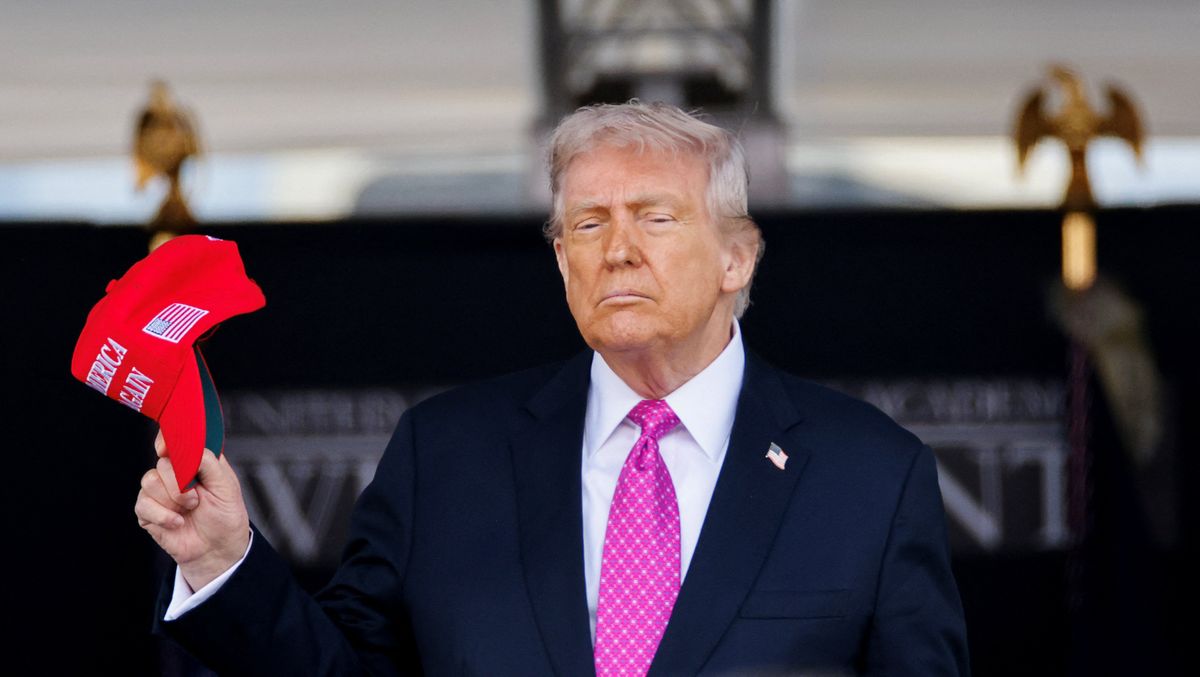

U.S. President Donald Trump holds a 'Make America Great Again' (MAGA) hat as he attends the commencement ceremony at West Point Military Academy in West Point, New York, U.S., May 24, 2025. REUTERS/Eduardo Munoz

The top news item about the president’s recent address at Fort Bragg was that the Army vetted the soldiers who appeared behind Donald Trump so that only his supporters were seen in video of the event.

The second news item was that none of them were fat.

All that is terrible enough, but it isn’t the worst part.

The worst part is what the event suggests about the enduring appeal of Trumpism, which is to say, the power of America’s totalitarian drift.

Is it temporary or permanent? Will it die with Trump?

The president’s public breakup with billionaire Elon Musk seemed to suggest it might. Writer Daniel Roberts told me recently that it exposed the fragility deep in the heart of the Trump coalition.

“Without Trump as a unifying figure (and, again, I use ‘unifying’ loosely), it has always seemed obvious to me that this coalition collapses,” Dan said. “They might all still vote Republican, but without Trump, it’s going to be constant internecine warfare between them.”

But then, less than a week later, Musk relented, saying that he went too far. The Trump coalition may be more resilient than we think.

Then there’s Fort Bragg.

It was basically a campaign rally featuring all the familiar gripes and grievances. The difference was the audience, men and women in uniform who enthusiastically cheered and jeered. Trump slandered Joe Biden. He smeared American cities. He railed against “wokeness.”

And they roared in response.

The backdrop, of course, was Los Angeles. The president had dispatched 700 Marines. He commandeered 4,000 of California’s National Guard. ICE and Border Patrol are acting like the president’s secret police, snatching people in the night, attacking citizens for expressing their right of free speech, wearing masks to hide their identity and prevent any attempt at accountability. And officials are using the language of warfare to describe their intended goals.

“We are not going away,” Homeland Secretary Kristi Noem said. “We are staying here to liberate [Los Angeles] from the socialists and the burdensome leadership that this governor and that this mayor have placed on this country and what they have tried to insert into the city.”

This is in addition to the hard-to-pin-down sense that politics is coming to an end and that disagreements will be settled by force. This sense has been ambient, but it snapped into hard focus yesterday. Instead of answering questions raised by Sen. Alex Padilla (D-CA) during a press briefing, Noem had him thrown out and handcuffed.

Liberals looked on that moment in disbelief in the same way they disbelieve the regime can accomplish what it’s setting out to do, namely, making America white again. The country is just too diverse, liberals tell themselves. It can’t get rid of millions of people. For that reason, state violence in LA is really the outcome of its impotence.


Yet the president is reportedly planning to expand the use of the Guard in a broader immigration crackdown. In his Fort Bragg speech, he smears Los Angeles, calling it a “trash heap,” invoking the memory of “enemies within” that are, he has said, worse than enemies abroad.

And they whooped and hollered, like the president’s personal army.

Then there’s the fact that Trump is spending tens of millions of dollars on a military parade this weekend, on his birthday, in the wake of his regime’s illegal impoundment of congressionally approved money for everything from cancer research to public libraries. And if you have a problem with the parade, he said, forget about expressing dissent.

Any protest will be met with “a very heavy force,” he said.

If you think handcuffing Padilla was bad, just wait.

“Understand: Nothing Trump does with our military will be to protect the citizens of the United States of America,” D. Earl Stephens told me. “Everything Trump does with our military will be to protect himself from the citizens of the United States of America. Will he succeed?

Earl publishes the newsletter Enough Already and is a regular contributor to Raw Story.

“We are at the most dangerous juncture in America since the beginning of the Civil War,” he told me Thursday.


Modi's G7 visit: Can India, Canada reset strained ties?

Murali Krishnan in New Delhi
DW
June 13, 2025

Indian Prime Minister Narendra Modi's trip to Canada for the G7 summit presents a rare opportunity for high-level bilateral engagement after ties were marred by tensions and mistrust over killings of Sikh activists.


The upcoming visit will be Modi's first to Canada in a decade

Image: Sean Kilpatrick/AP/picture alliance

Indian Prime Minister Narendra Modi is visiting Canada next week after he was invited by his Canadian counterpart, Mark Carney, to attend the Group of Seven (G7) leaders' summit, from June 15 to 17, in Kananaskis, Alberta.

Carney extended the invitation to the Indian premier despite strained ties between the two countries.

India is not a member of the G7, which comprises Britain, Canada, France, Germany, Italy, Japan and the United States.

But New Delhi has been invited to the grouping's summits since 2019, reflecting India's growing geopolitical and economic significance.

"India is the fifth-largest economy in the world, the most populous country in the world and central to supply chains," Carney told media last week.

This will be Modi's first visit to Canada since 2015.

"As vibrant democracies bound by deep people-to-people ties, India and Canada will work together with renewed vigor, guided by mutual respect and shared interests. Look forward to our meeting at the summit," Modi said in a statement.
Chance to reset ties?

Political analysts in India have said Modi's visit will likely offer a chance to reset ties with Canada.

Relations between the two countries have deteriorated since Canada accused agents linked to the Indian government of carrying out the assassination of 45-year-old naturalized Canadian citizen Hardeep Singh Nijjar, a longtime campaigner for the creation of a separate homeland for Sikhs carved out of India.

New Delhi has dismissed the allegations as "absurd" and "preposterous."


The row strained India-Canada ties so much that both sides expelled each other's diplomats in 2023 and 2024.

But there have been expectations of a thaw in ties since Carney replaced Justin Trudeau as Canada's prime minister in March.

Meera Shankar, a former Indian envoy to the US, said Modi's trip will "hopefully mark the beginning of a reset in India's relations with Canada, which have plummeted in recent years over the Canadian allegations on the Nijjar case and India's belief that Canada indulges Sikh extremism directed against India."

She stressed that both sides have much to gain "if the relationship is stabilized, especially in a volatile world."

India and Canada share strong trade and people-to-people ties, with bilateral commerce amounting to around $9 billion in 2023 and Canadian pension funds cumulatively investing around $55 billion in India.

Canada is also home to nearly 2 million members of the Indian diaspora, who make up about 5% of the country's total population. The North American nation is also a top destination for Indian students pursuing higher education, alongside the US.

Unresolved issues and likely impact on ties

Despite both New Delhi and Ottawa seemingly making efforts to repair ties, the unsolved investigation into the assassination of Nijjar remains.

Furthermore, Canada is home to the world's largest Sikh diaspora community, with about 800,000 people.

The community includes activists for "Khalistan," a fringe separatist movement seeking an independent state for the Sikh religious minority carved out of Indian territory.

New Delhi has demanded stricter action against the Khalistan movement, which is banned in India.


Canada, on the other hand, has accused India of carrying out a broad campaign targeting Sikh activists on Canadian soil, which Ottawa says has included intimidation, threats and violence.

Against this backdrop, Carney's invitation to Modi drew sharp criticism from fringe Canadian Sikh groups. Protests are expected to take place during Modi's visit.

Nevertheless, David Mckinnon, a former Canadian diplomat, believes Carney made the right decision by inviting Modi to the G7 summit.

"The politics of this decision in Canada, and particularly within the Liberal Party, were not easy, but Carney made the right choice. It's also notable that the leader of the opposition, Pierre Poilievre, quickly welcomed it," he told DW.

Mckinnon said, however, that it's too early to say that everything is back to normal between the two sides.

"A big outstanding question is whether this trip leads to a mutually agreeable off-ramp from the allegations of Indian government interference in Canada, including involvement in the Nijjar murder, and India's allegations about Khalistani activities in Canada," he underlined.

Focusing on mutual interests

Last month, India's Foreign Minister Subrahmanyam Jaishankar and his Canadian counterpart Anita Anand spoke to each other over phone and discussed ways to deepen the bilateral economic cooperation and advance shared priorities.

Ajay Bisaria, India's former high commissioner to Canada, said Modi's presence at the G7 summit offers a chance to stabilize the bilateral partnership, putting an economic and geopolitical focus on ties.

"It always presents a strategic opportunity for Modi to discuss the global commons like climate, trade, supply chains and the broader development agenda with the developed world," said Bisaria.


He also stressed that the gathering will also provide Modi the opportunity to call for a tougher posture toward Pakistan, pointing to recent clashes between the two nuclear-armed archrivals following a deadly attack on tourists in India-administered Kashmir.

New Delhi has blamed Pakistan for backing the attackers, a charge Islamabad denied.

The G7 gathering presents "a diplomatic opportunity to present India's current concerns to key world leaders, while China and Pakistan are out of the room," said Bisaria.

Edited by: Srinivas Mazumdaru

Murali Krishnan Journalist based in New Delhi, focusing on Indian politics, society and business@mkrish11

The cuppa that connects us: Coffee drinking across cultures
DW
June 13, 2025

The beverage's global consumption has been rooted in culture, colonialism, rebellion — and TikTok fame.


An Ethiopian woman pours coffee out of a jebena during a traditional coffee ritual
Image: Michael Tewelde/Xinhua/picture alliance


Coffee's pop icon status is firmly established — from Starbucks' iconic Frappuccino turning 30 this year to the latest Tiktok trends leading us to try Dalgona or cloud coffee. But beyond fads, coffee has been brewed in ceremonies and sipped in salons across time and geography. Its history is steeped in colonialism; establishments serving it have also fueled revolutionary thinkers.

Today, rising global temperatures and erratic rainfall are hitting farmers hard, leading coffee prices to soar to record highs. But the beverage remains — at least for now — an intrinsic part of world culture. Here's a (non-exhaustive) look at how and why it came to be that around 2 billion cups of coffee are reportedly drunk daily worldwide.

Mythical and spiritual roots

Legend credits an Ethiopian goatherd named Kaldi with discovering coffee after he'd noticed his goats becoming frisky from eating red berries. While the story is likely apocryphal, coffee — namely the Arabica variety — is indeed native to Ethiopia's Kaffa region, where it still plays a ritual role.

The Ethiopian coffee ceremony, where beans are roasted over an open flame and brewed in a clay jebena, is a moment of pause, hospitality and community.

In Senegal, cafe Touba — infused with Guinea pepper and cloves — originated from Islamic Sufi traditions and is both a beverage and spiritual practice.

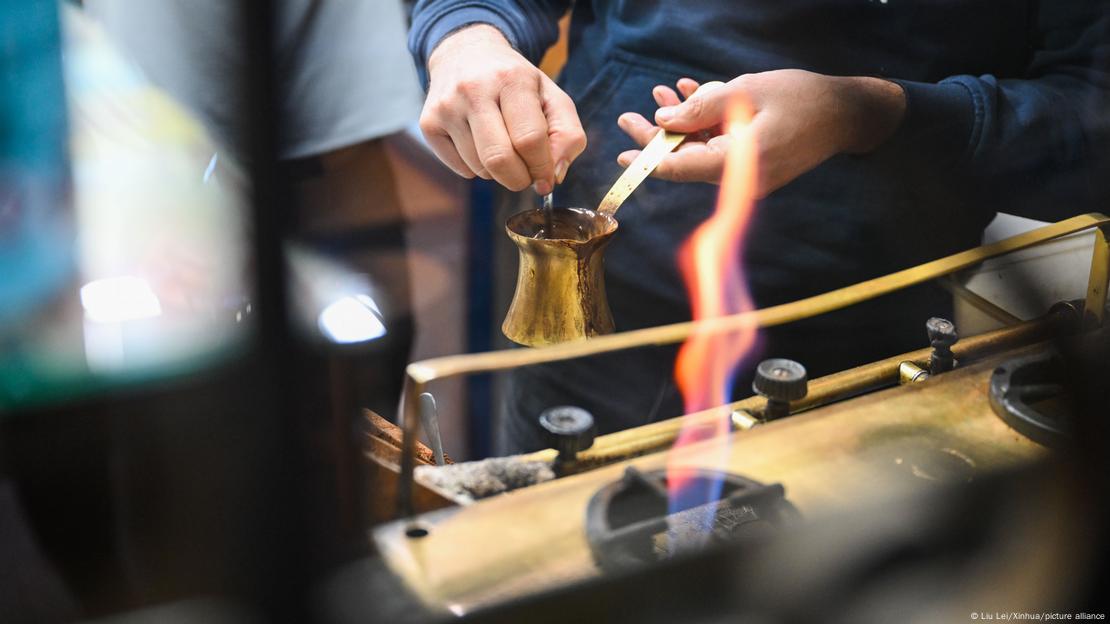
Turkish coffee culture and tradition was listed as UNESCO Intangible Cultural Heritage in 2013
Image: Liu Lei/Xinhua/picture alliance

In Turkey, unfiltered coffee brewed in a copper cezve is often followed by a reading of the leftover grounds, a centuries-old tradition that is still cherished, even among Turkey's Gen Zs.

In Brazil, the cafezinho — a tiny, sweet shot of coffee — is a symbol of welcome, offered everywhere from homes to street corners.

Finally in 2020, as the world hunkered down during the COVID lockdown, South Korea's Dalgona coffee — instant coffee whipped with sugar and water — exploded on TikTok. Beyond aesthetics, the trend offered people a simple, soothing ritual.

Unique flavors: Cheese, egg and … poop?


Across cultures, coffee has taken wildly inventive forms. In Nordic countries like Finland and Sweden, black boiled coffee is sometimes poured over cubes of kaffeost, or "coffee cheese," made from cow or reindeer milk, in a centuries-old tradition.

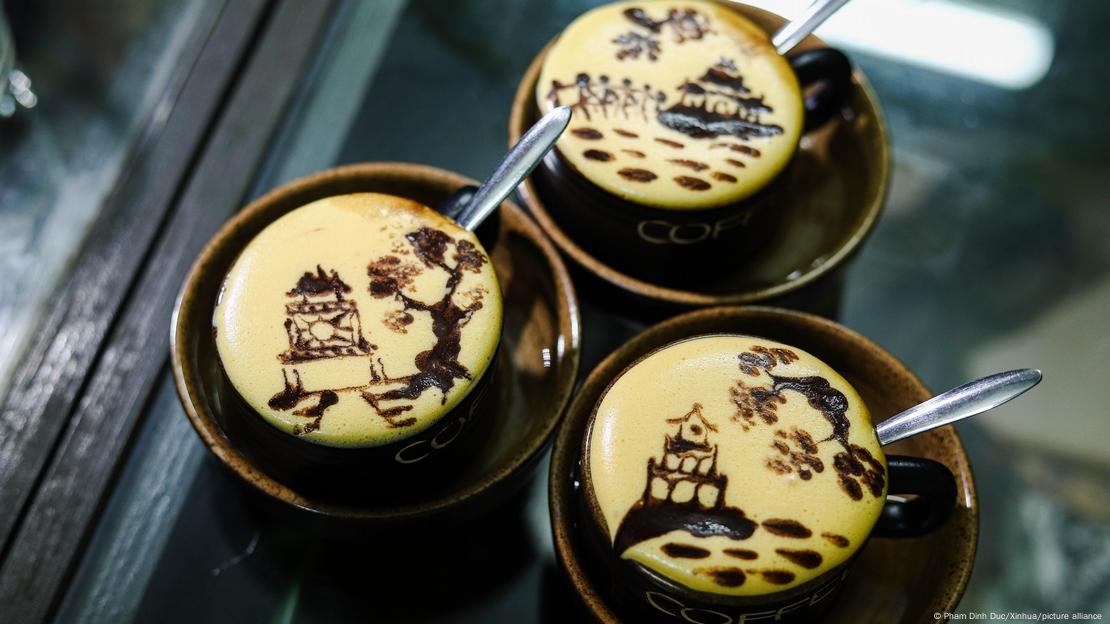
Vietnamese egg coffee with foam featuring patterns of Hanoi's landmarks
Image: Pham Dinh Duc/Xinhua/picture alliance

Vietnam's ca phe trung (or egg coffee) blends whipped egg yolk with sweetened condensed milk — a wartime improvisation that is now ubiquitous.

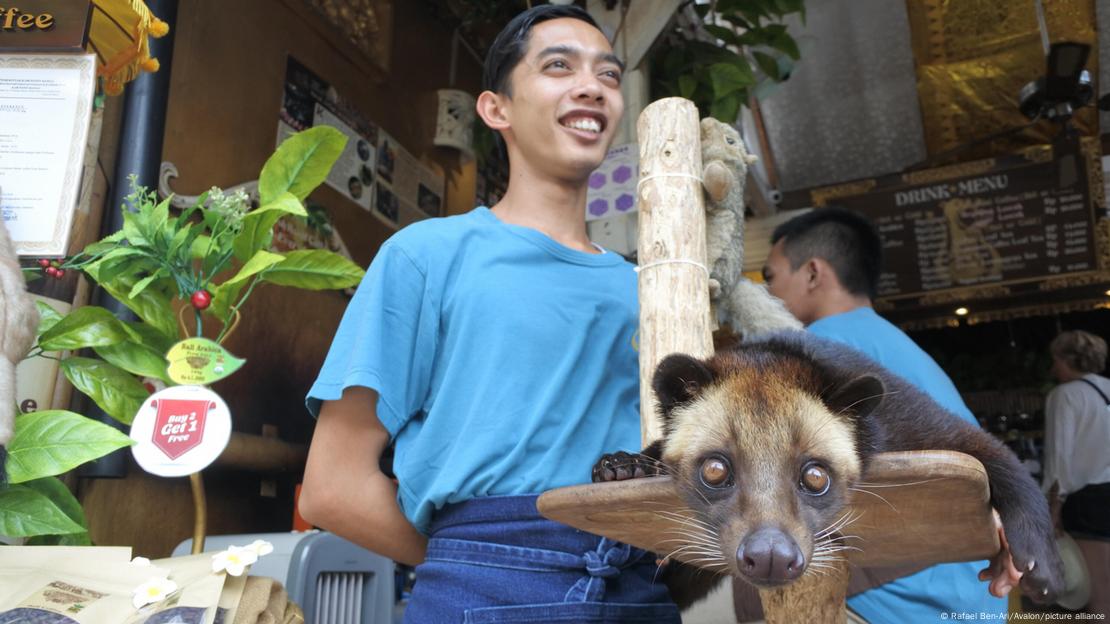
Then there's Indonesia's kopi luwak, often called the "Holy Grail of Coffees," made from partially digested beans that have been eaten and defecated by the Asian palm civet. Though prized for its smooth, fermented flavor, kopi luwak has been ethically controversial. High demand has led some producers to cage and force-feed civets. Others now promote "wild-sourced" versions from free-roaming animals, but third-party verification has been inconsistent.


The ethical harvest of kopi luwak remains moot despite assurances to that effect
Image: Rafael Ben-Ari/Avalon/picture alliance


From sacred brew to global commodity

Coffee didn't just travel in sacks — it traveled with trade winds, spiritual journeys and imperial ambitions.

Though discovered in Ethiopia, the earliest written evidence of coffee cultivation points to Yemen. There, it earned the Arabic term "qahwa" — originally meaning wine — which gave rise to the words coffee and cafe.

Sufi mystics drank it to maintain spiritual focus during long night chants. The port of Mocha on Yemen's Red Sea coast became a center of trade, shipping beans across the Islamic world and into Asia.

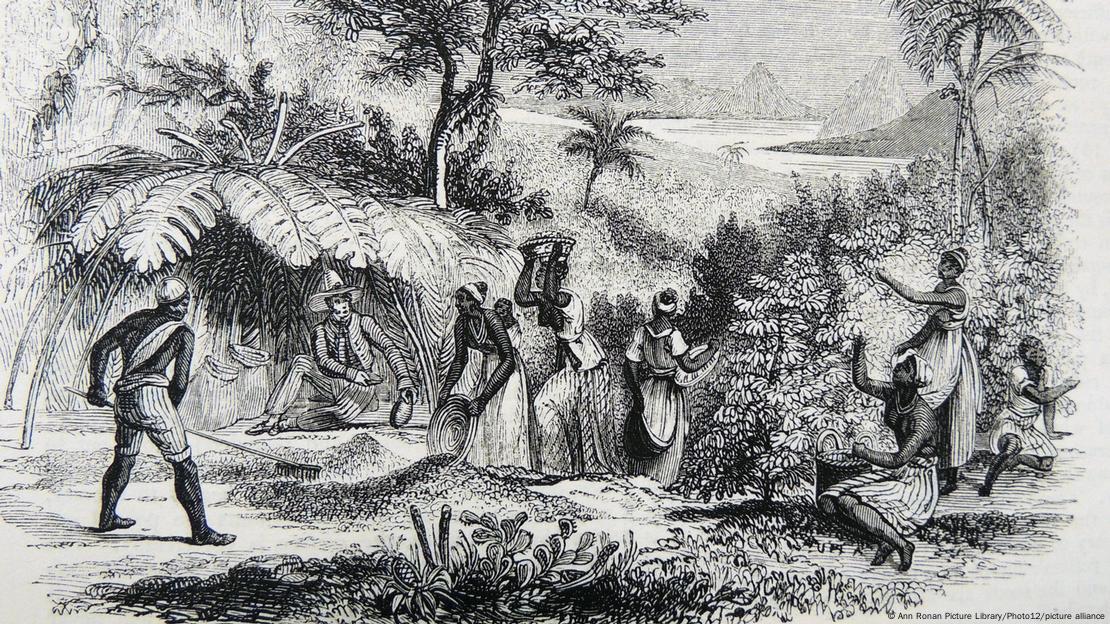
An 1850 engraving of people working at a coffee plantation in Brazil
Image: Ann Ronan Picture Library/Photo12/picture alliance

Another legend says that an Indian Sufi saint, Baba Budan, smuggled seven fertile beans from Yemen to southern India in the 17th century, defying an Arab monopoly. That act seeded coffee plantations in Karnataka's Chikmagalur region.

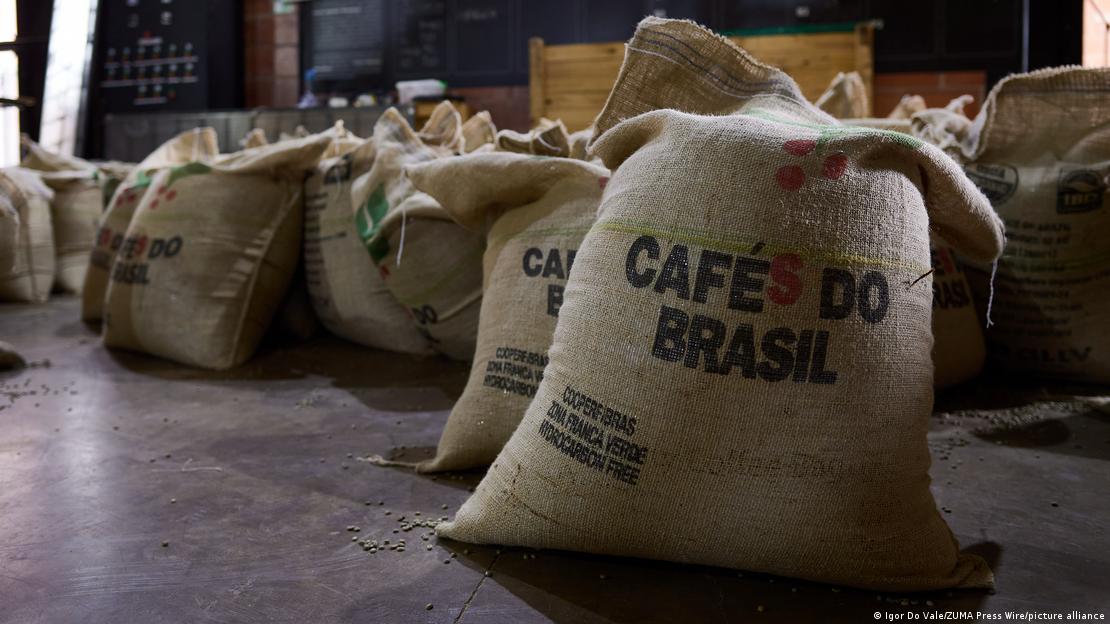
Soon, European colonial powers also grasped the bean's potential. The Dutch planted it in Java, the French in the Caribbean and the Portuguese in Brazil — each expansion driven by empire and built on the backs of enslaved labor. Brazil, introduced to coffee in the 1700s, would grow into the world's largest producer.

Even Australia, a latecomer, has developed a robust coffee culture. Fun fact: Both Australia and New Zealand claim to have invented the flat white in the 1980s.


Brazil, the world's largest coffee producer, has been impacted by climate change and soaring prices
Image: Igor Do Vale/ZUMA Press Wire/picture alliance


Cafes: Conspiracies, civil unrest and cats


Throughout history, cafes have been more than watering holes — they've been incubators of ideas, art and revolution.

In 16th-century Istanbul, authorities repeatedly tried to ban them, fearing that caffeine-fueled gatherings could spark unrest.

In Enlightenment-era Europe, cafes offered a cup of coffee and a heady dose of radical thought, frequented by thinkers like Voltaire and Rousseau.

In colonial America, coffee became a patriotic substitute for British-taxed tea. Boston's Green Dragon Tavern, dubbed the "Headquarters of the Revolution," hosted meetings of the Sons of Liberty — activists who organized resistance against British rule, particularly unfair taxation and policies that eventually led to the American Revolution.

Over the past decades, cafes have returned as a "third place" — neither home nor office, but somewhere in between. Coffeehouses have also evolved into refuges for modern life.

In the early 1990s, when home internet access was not yet widespread, many cafes started providing public internet access, which drew people to start working from those spaces.

Meanwhile, other cafe owners came up with unusual perks for their businesses.

In Taipei, the world's first cat cafe — Cat Flower Garden — opened in 1998, giving urbanites a cozy space to sip and socialize among feline companions. The trend exploded in Japan and now thrives worldwide, where the blend of caffeine and calm continues to comfort overstimulated cities.

Inside one of Vienna's oldest coffeehouses   04:44


Edited by: Elizabeth Grenier

Brenda Haas Writer and editor for DW Culture
Brazil rules social media platforms liable for users' posts

Emmy Sasipornkarn | Jenipher Camino Gonzalez 
with AP, Reuters
June 12, 2025

The Supreme Court decision could pave the way for the companies to face potential fines for not removing posts in Brazil.


Brazil's Supreme Court did not agree on what types of content would be considered illegalImage: Yui Mok/empics/picture alliance

Brazil's Supreme Court has ruled that social media companies can be held accountable for some types of content published by users on their platforms.

The decision could clear the way for the companies to face potential fines for not removing some users' posts in Brazil.

A slim majority of six out of 11 Supreme Court judges backed the ruling on Wednesday, but they did not agree on what types of content would be considered illegal.

The regulation of social media platforms has become a pressing issue in Brazil in the aftermath of the January 8, 2023, riot, when supporters of former conservative President Jair Bolsonaro stormed government buildings in the capital, Brasilia. The riot came after Bolsonaro lost the 2022 Brazilian presidential election to leftist candidate Luiz Inacio Lula da Silva.

When will the court ruling become law?

The social media proposal would become law once voting is finished. Four judges must still vote.

Votes previously cast can still be changed, but that is not common.

Only one justice has so far voted not to change the current legislation on the matter. Andre Mendonca's vote was made public last week.

He highlighted that free speech on social media is key for the publication of information that "holds powerful public institutions to account, including governments, political elites and digital platforms."

The current law states that social media companies can only be held responsible for third-party content on their platforms if they do not remove the content after a court order.

Edited by: John Silk, Wesley Dockery

Emmy Sasipornkarn Multimedia journalist with a focus on Asia
Do You Hear the People Sing


Drag queens living it up at "Les Misérables"
Photo by Julian Applebaum

Abby Zimet
Jun 14, 2025
COMMON DREAMS

In honor of Pride Month, singular acts of courage and "being brave, strong and gorgeous," cue the glad spectacle of four drag queens dolled up to kill, see Les Misérables, and crash Dear Leader's first visit to a Kennedy Center purportedly scrubbed of wokeness. Yet here they were - buoyant, sparkling, cheered by a crowd that moments before had loudly booed the ugly tyrant and his MAGA cohort. The queens' gist, said Mari Con Carne: "You can’t erase us."

The queens turned up for an evening already bursting with irony if any MAGA goons and losers were capable of it. Amidst a Pride Month he refused to recognize - and fierce pushback to his hate - the Bigot-In-Chief who already decimated a time-honored institution devoted to art and open-mindedness witlessly chose to attend a beloved show about an oppressed people fighting back against tyranny much like his.

Accompanied by the grotesque likes of Vance, Bondi, Loomer, RFK Jr., Kellyanne Conway and a fragile Gym Jordan who visibly cringed when he walked past four people who don't look like him, Trump et al were roundly booed by the modest crowd. There were also shouts of "Felon!" and "Rapist!" - what a time to be alive - along with a muted, incongruous chant of "USA!" on behalf of the cretins who are working so hard to destroy it.

In full, defiant finery, the four drag queens - Tara Hoot, Ricky Rosé, Vagenesis, and Mari Con Carne - were greeted by the audience with joyful whoops, cheers and applause as they sashayed in and took their seats below the presidential box. Their tickets had been donated by season ticket-holders through Qommittee, a national advocacy network of drag artists and allies led by survivors of high-profile hate crimes like the Pulse and Club Q mass shootings.


"It was delightful,” said Hoot, stressing their "message of inclusivity" but adding, "I love musicals. I mean, I’m a drag queen." "Kudos to all bringing art to the world," she said. "Unfortunately, there were some other people there too, but I think we brightened the audience as much as we could." In family story time events, she noted, "I often read books about being brave (and) true to who you are. Showing up (here) with my fellow drag stars allowed me to live those words. Here's to being brave, strong, and gorgeous."

Trump, ever uncouth, left before the lights came up. Still, Mari Con Carne felt it was "crucial" to be there before him. As a drag queen and an immigrant, "I wanted it to be known you can prevent us from performing on your stages, but you can’t erase us...We aren’t going anywhere and we will face you head-on with every ounce of courage we have." When Victor Hugo wrote Les Misérables, he was shocked by thesilence of his compatriots before "the negation of all law, equilibrium resting on iniquity." This week's troupe of "delightfully audacious" drag queens might give him hope.

- YouTubewww.youtube.com
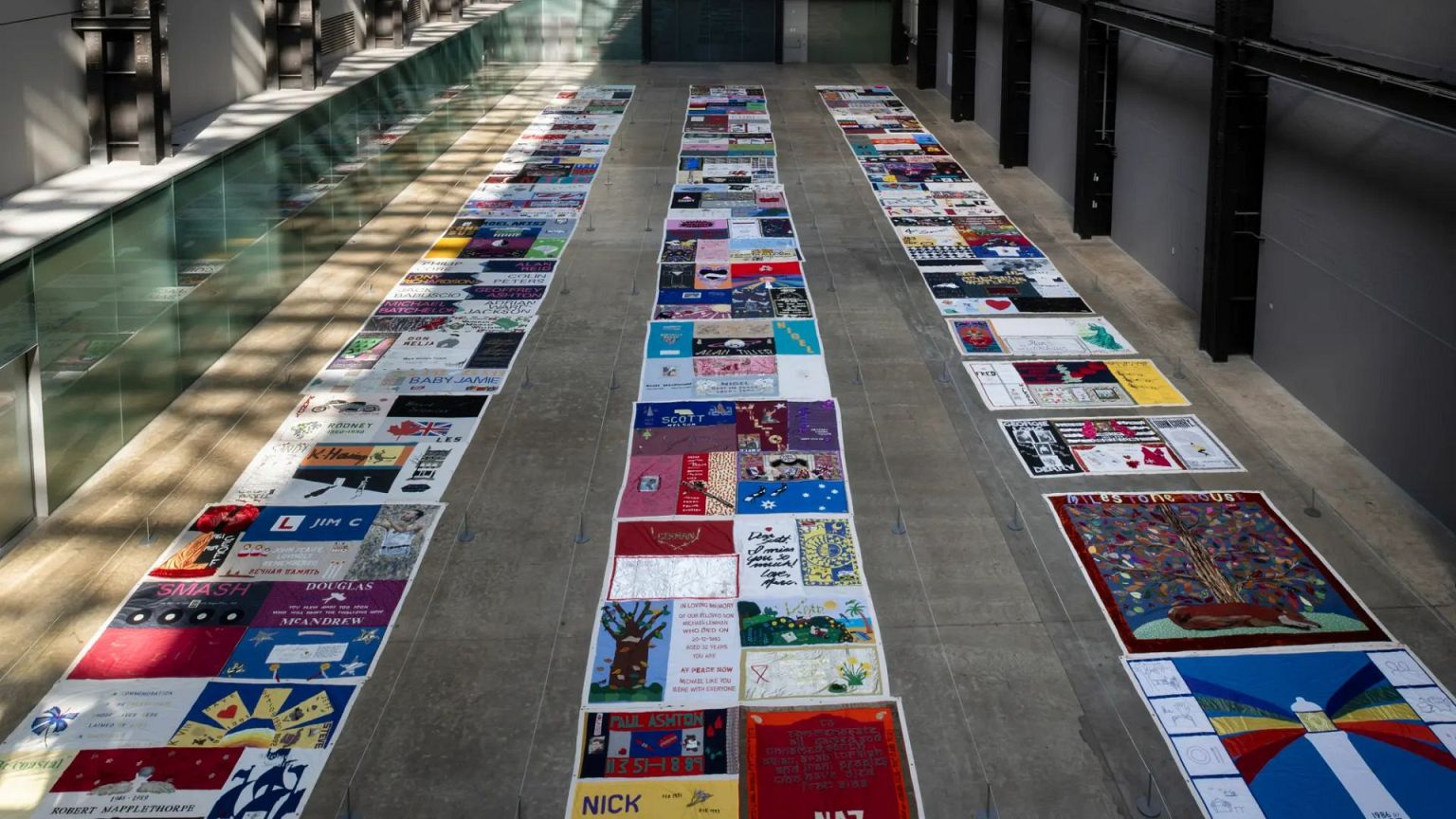
UK AIDS Memorial Quilt unveiled at Tate Modern amid Trump-era HIV funding cuts

The UK AIDS Memorial Quilt has been unveiled at London’s Tate Modern, marking the first time the powerful installation has been shown in a major British gallery.


Copyright Credit: Tate Modern

By Theo Farrant & AP
Published on 13/06/2025 - 

Each stitched panel honours someone who died from AIDS-related illness, forming part of a vast global project that began in the 1980s at the height of the epidemic. Created by loved ones, the quilt is both a tribute and a protest.

The project was started by American activist Cleve Jones, who began sewing panels after losing dozens of friends and witnessing government inaction.

Speaking at the Tate, Jones condemned recent cuts to global HIV funding by the Trump administration, calling them “unconscionable.” Campaigners warn the loss of U.S. aid will cost hundreds of thousands of lives, especially in vulnerable regions.


Thousands celebrate South Korean Pride parade in Seoul


Seoul (AFP) – Tens of thousands of LGBTQ South Koreans and supporters gathered in central Seoul for annual Pride celebrations on Saturday, with a central government agency represented for the first time.


Issued on: 14/06/2025 - FRANCE24

Participants in South Korea's annual Pride parade in Seoul carry a huge flag in support of LGBTQ rights past opponents holding a banner that reads "Homosexuality is sin!" 
© Anthony WALLACE / AFP


Same-sex marriage remains unrecognised in Asia's fourth-largest economy and activists have long emphasised the need for legislation outlawing discrimination on the basis of sexual orientation.

The parade, one of Asia's largest, is celebrating its 26th edition and went ahead after South Korea endured one of the worst political crises in its recent history.

LGBTQ Koreans joined mass protests in recent months against ousted president Yoon Suk Yeol's failed martial law bid in December.

Yoon, whose hardline evangelical supporters have long been hostile to sexual minorities, is now on trial for insurrection.


"This year, amid growing political uncertainty, there was deep deliberation over whether to hold the event," organisers said in a statement.

"Though the times may appear to be progressing, they have in many ways regressed... And yet, because of this, in spite of this... we will never stop living as our true selves."

The Korea Disease Control and Prevention Agency joined the parade, the first central government body to do so.

"We joined today's event as it draws many young people... making it an ideal (space) for public outreach on prevention," Hyun Jung-hee, a senior staff scientist, told AFP.

Participants beamed beneath rainbow flags, some blowing bubbles with joy while others handed out colourful bouquets.

Across the street, evangelical Christians shouted slogans such as "Homosexuality is a sin!" while performing a traditional Korean fan dance.

One 29-year-old parade participant, who gave her nickname as Door, said the event opened her eyes to new possibilities.

"All kinds of people come here. Some say, 'I don't think I'm queer, but I get them'," she told AFP.

"Seeing that kind of diversity made me realise the world is bigger than I thought -- and that's why I keep coming back."

© 2025 AFP


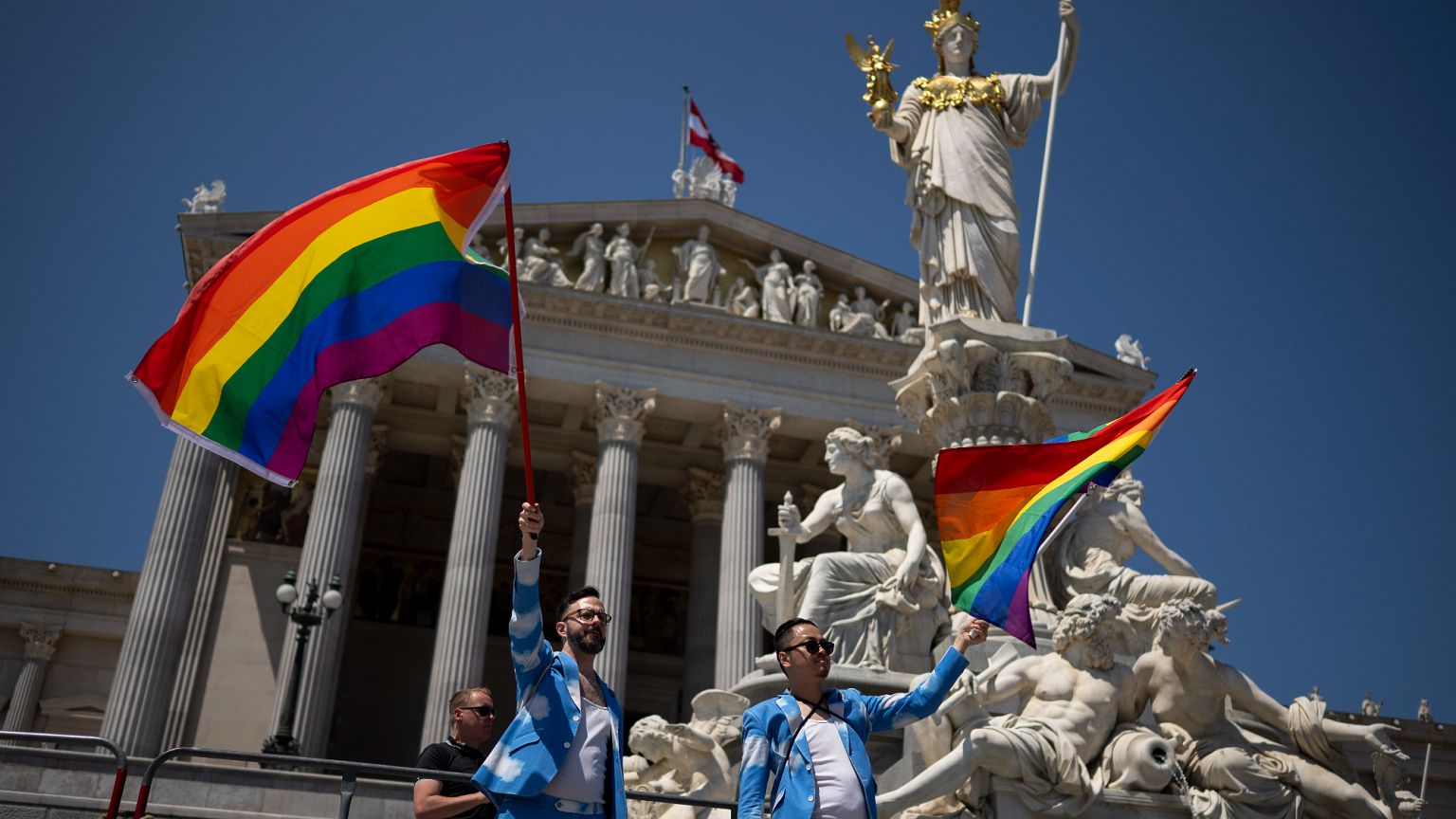
LGBT+ pride parades held in several of Europe's capitals

LGBT pride parade in Vienna.
Copyright Copyright 2024 The Associated Press. All rights reserved

By Katarzyna-Maria Skiba & Fortunato Pinto, Panos Kitsikopoulos with AP
Published on 

Vienna, Warsaw, Rome, and Athens all held pride parades on Saturday, with attendees demanding political change on LGBTQ+ issues as well as celebrating Pride Month.

Thousands of pride parade attendees took to the streets in Vienna, Warsaw, Rome and Athens on Saturday, waving rainbow flags and holding up signs of protest as they celebrated pride month, while also demanding political and social equality for the LGBTQ+ community in their respective countri

In Warsaw, 'Love is the answer'

Warsaw's pride parade went through the city centre and headed through the Old Town. The "Equality Parade" began on Saturday afternoon, and was attended by thousands of demonstrators.

Under the slogan "Love is the answer", the event's organisers expressed the hope that they could help others to express their LGBTQ+ identity openly and without fear.

"We don't want to talk about such matters somewhere underground, we don't want to hide in basements - we come to the surface to talk about it," said Rafał Dembe, president of the Equality Volunteering Foundation at a press conference ahead of the march.

During the conference, the organisers said that the demonstration in Warsaw is the largest of its kind in the country.

Among the most notable attendees of the parade were mayor of Warsaw RafaÅ‚ Trzaskowski, who recently found himself on the losing side of the country's presidential election, member of the European Parliament Robert BiedroÅ„ and Minister of Equality Katarzyna Kotula.

Four days earlier, Kotula submitted a bill to parliament to introduce civil partnerships, including for same-sex couples.

Speaking to the crowd at the start of the parade, Trzaskowski said "Remember that I have been saying for many years that together we are building Warsaw, which is an open and tolerant city, where these values ​​are not only appreciated but also promoted."

Rome's pride march goes ahead in scorching hot weather

Braving the scorching hot 35 degree weather, thousands of people walked the city of Rome from Piazza della Repubblica to Via Cavour to participate in the Italian capital's pride march. Three motorcyclists with roaring engines kicked off the parade. Right behind them was the leader of the parade, holding a large banner with the word "Outlaw", written on it. The banner is in protest of what organisers see as the conservative incumbent government's lack of support for LGBTQ+ rights.

Among those taking part in the demonstration were the spokesperson of the Capitoline parade, Mario Colamarino, and the mayor of Rome, Roberto Gualtieri.

''We are here for the rights of all, to have a more inclusive and equal Italy, better than the one we have now. 'Outlaws' is what we are in this country today, we must fight and we must be many," said Colamarino.

The event in Rome was held not only to celebrate LGBTQ+ pride, but also to protest the ongoing conflict in Gaza, for which a one-minute silence was held. Many Palestinian flags and banners were waved alongside rainbow flags, as people chanted slogans for free love and equality. Along with house and pop music, the Italian partisan anthem "Bella Ciao" was also sung by the demonstrators.

A float satirically depicting Hungarian Prime Miniser Viktor Orban - whose government was last week denied a request to hold a pride march in Budapest - was also rolled out, an initiative by the Italian +Europa party.

"Today, more than ever, it is important to attend pride at a time when in the world there are autocracies, illiberal democracies, fundamentalist regimes that attack civil rights and individual freedoms in Hungary, as well as in Russia and Trump's United States, where some words, such as 'gay', are banned on institutional websites", said the party's secretary, Riccardo Magi.

Pride parade in Rome.
Pride parade in Rome.Copyright 2025 The Associated Press. All rights reserved

Demonstrators in Athens make their voice heard

2025 marks the 20th year since the first Athens Pride was held, and this year's slogan is "We Count". This has a double meaning in Greek - the phrase can either mean "we matter", but can also mean to take stock of something. The latter is in reference to recollecting everything that has happened since June 2005, when the first Athens pride parade was held.

According to the organisers, this includes joy, such as the pride and liberation of the first years, losses due to hate and homophobic attacks, victories such as same-sex civic union and marriage, but also disappointment such as the stigma that remains, as well as the fight for visibility and rights.

"Now, more than ever, the global context shows us that no acquis (law) can be taken for granted. Instead, our rights and our very existence are being challenged every day. The rise of the far right and the normalisation of hate speech in political and media discourse are a threat to all of us. The exclusion of LGBTQ+ refugees and migrants is intensifying, leading to the exclusion of people on the basis of racist, sexist, homophobic and/or transphobic motives," the organisers say on their website.

"For all this, our presence in the public space will continue to be our undeniable right, a historical duty and an act of resistance against a public discourse of abuse that seeks to erase us. The struggle for equality is ongoing and remains unabated. We are and will be here to keep them going," the organisers say on their website.

Pride month is celebrated in Athens with a variety of cultural events, screenings, performances, parties, shows, panel discussions, workshops and seminars, many of point to the now 20-year history of pride in the Greek capital, with diversity, equity and inclusion initiatives also taking centre stage.

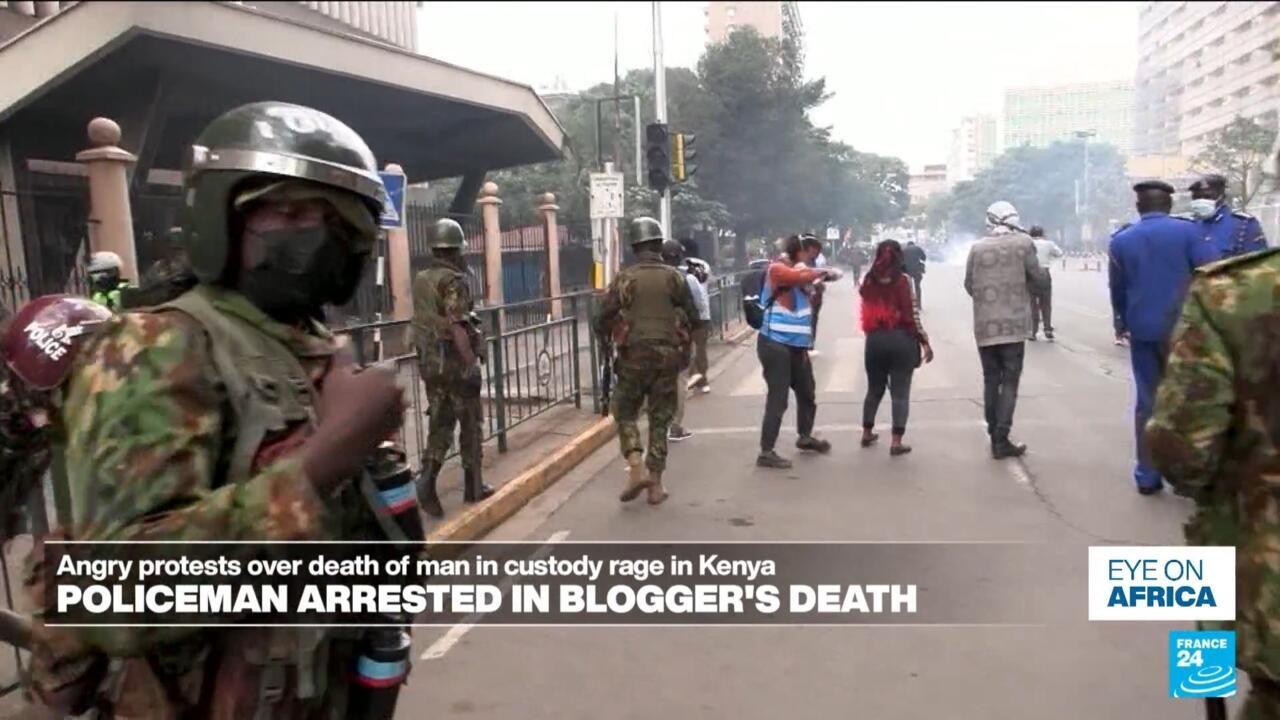
Kenyan policeman arrested in blogger's death as hundreds protest


EYE ON AFRICA © FRANCE 24
Issued on: 12/06/2025 - 

In tonight's edition: Kenyan authorities arrest a police constable over the death of a political blogger in custody, as angry protests rage in Nairobi. Also, Gambians have been growing increasingly worried by the devastation being caused by a growing fishmeal processing industry on their shores. Plus Nigeria's cost-of-living crisis has reached the relatively affluent class of dog owners, who are struggling to feed their pets because of soaring food costs.


15:21 min
From the show
EU courts international scientists, but is Europe attractive enough?


Issued on: 13/06/2025 

The EU says science is the key to its future. But is it putting its money where its mouth is? Earlier this year, the French government agreed to cuts in the country's research budget and over the past year, science powerhouses such as Germany, Italy and the Netherlands have proposed or implemented cuts in their research sectors. Those working in universities and research centres say there is a stark gap between the way the EU is presenting itself as a magnet for global talent – the pitch that the French government and the European Commission made at their "Choose Europe for Science" conference in Paris in early May – and the reality.


To make Europe more attractive, the EU executive says a €500 million package will be proposed for the 2025-2027 period. Part of that outreach is aimed at American researchers, who say their work is being jeopardised by the Trump administration's cuts. But the €500 million sum is the equivalent of just a fraction of the yearly endowment of a top US university such as Harvard or Yale.

We delve into the issue with two MEPs.

Programme produced by Perrine Desplats, Isabelle Romero and Luke Brown

Our guests
Martin SCHIRDEWAN
German MEP, Co-chair of The Left group

Ivars IJABS
Latvian MEP, Renew Europe


11:35
TALKING EUROPE © FRANCE 24