Sunday, June 15, 2025

Israel, Iran, and the War Machine’s Global Lust for the Rapture

Donald Trump, like Joe Biden before him, was unable—or unwilling—to restrain Israel from genocide, lawlessness, and slaughter.
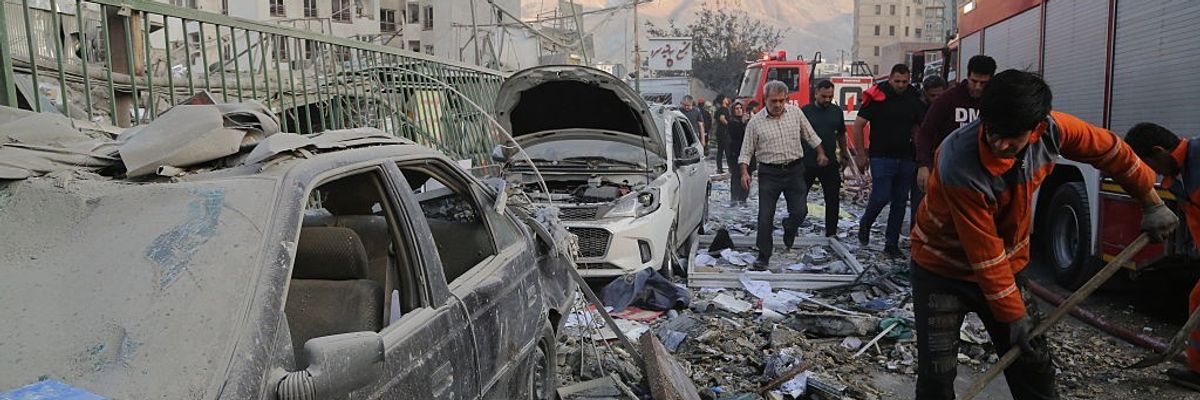


A view of a damaged building in the Iranian capital, Tehran, following an Israeli attack, on June 13, 2025. Firefighting teams are dispatched to the area. Israeli Defense Minister Israel Katz has announced that Israel conducted strikes on Iran.
(Photo by Fatemeh Bahrami/Anadolu via Getty Images)


Richard Eskow
Jun 15, 2025
Common Dreams


For a while, at least, Donald Trump talked a good game about diplomacy, including negotiations with Iran and Israel. But Israel is America’s id. We can’t restrain Israel because Israel is the skull beneath the American mask.

The “id” was Sigmund Freud’s term for the hidden reservoir of passions and desires that fuels the personality. The ego—“what we call reason and sanity,” as Freud phrased it—tries to restrain those passions by riding them “like a man on horseback.”

The horse has thrown its rider once again.

Read the newspaper today. Watch cable news tonight. See if they mention the plain fact that Israel’s attack is a violation of international law.

“Monsters from the id!” That's what Dr. Morbius shouts at the end of the 1956 science-fiction movie Forbidden Planet, as he tries to shut down the all-powerful alien engines he’s learned to control with his thoughts. His subconscious urges and desires have begun to destroy his deep-space paradise, and he’s powerless to stop them. The vast machinery is serving his true self, not the civilized veneer he presents to himself and others.

So it is with military might. Just as Israel is the American id, America is the id for a financialized planet driven by greed and exploitation. American war machinery is global lust made manifest: lust for power, lust for wealth, lust for more.

Donald Trump, like Joe Biden before him, was unable to restrain Israel from genocide, lawlessness, and slaughter. Both presidents aided and abetted snuff-movie violence on a massive scale, because that violence reflects the shadow self of the nation they represent.

If “the sleep of reason produces monsters,” we’ve been in a coma for a long time.

John F. Kennedy may have been an imperfect vessel for change, but he spoke often and well about the need for international law and world institutions. “We must create even as we destroy (nuclear arms),” he said, “creating worldwide law and law enforcement as we outlaw worldwide war and weapons.”

Read the newspaper today. Watch cable news tonight. See if they mention the plain fact that Israel’s attack is a violation of international law. The mass assassination of another country’s leaders and the under-reported deaths of civilians will be debated in tactical terms, while moral and legal questions receive little (if any) attention.

These attacks may temporarily serve Israeli and U.S. interests, but their benefits won’t last. Iran isn’t Gaza, impoverished and defenseless and populated primarily by women and children. Iran is home to 91 million people and possesses considerable resources. Trump was already forced to back down from a confrontation with the Iran-allied Ansar Allah (the Houthis) in the Red Sea, and they’re essentially desert fighters. This attack may weaken Iran, but what will happen if, and when, it regroups and retaliates?

The Israeli state isn’t acting rationally; neither is the American national security state. But how could it be otherwise?

Like the passions of Dr. Morbius, the drive to kill inevitably becomes self-destructive. “In 20 of the 24 countries surveyed,” Pew Research reports, “around half of adults or more have an unfavorable view of Israel.” That’s from a poll published June 3. Those figures may well be even lower now. Pew continues, “Around three-quarters or more hold this view in Australia, Greece, Indonesia, Japan, the Netherlands, Spain, Sweden, and Turkey.”

In the United States, the percentage of adults with a negative view of Israel has risen 11 points since March 2022; 53% of Americans polled now hold “a somewhat or very unfavorable opinion of Israel.”

This trend represents an existential threat to both the Jewish state and the American military empire. The political consensus in Washington, however, remains unchanged.

The Israeli state isn’t acting rationally; neither is the American national security state. But how could it be otherwise? They are the manifestation of our own cravings. Our warlike impulses are leading us down the path of conflict and confrontation, seemingly oblivious to peaceful alternatives. By refusing to cooperate with China and the rising nations, we are surrendering our future to them.

That is, if we even have a future.

The head of the International Atomic Energy Agency tried to remind the world that “armed attacks on nuclear facilities could result in radioactive releases with grave consequences within and beyond the boundaries of the State which has been attacked.”

The world didn’t seem very interested.

Evangelical Christians—some of them, at least—are undoubtedly thrilled. With this development From the Bible (Matthew 24:6-7):
And ye shall hear of wars and rumors of wars: see that ye be not troubled: for all these things must come to pass, but the end is not yet.

For nation shall rise against nation, and kingdom against kingdom: and there shall be famines, and pestilences, and earthquakes, in diverse places.

Meanwhile, Americans have forgotten the words of their fallen president. “Mankind must put an end to war,” said John Kennedy, “or war will put an end to mankind.”

Some Americans consider Matthew’s prophecy a harbinger of deliverance—for them, not for the rest of us. They’re counting on eventual, if selective, salvation through rapture.

The rest of us, believers and nonbelievers alike, will have to conclude with the verse that follows:

All these are the beginning of sorrows.


The Ignorance That Pervades Us


The uncalled for attack on Iran by the most insane group of people who ever inhabited this planet is expected; what do the insane do, they do the insane. Not expected is that recognized people do not recognize the insanity of the action. Put in simple. Iranians are not eager to have a nuclear bomb. Why would they when knowing Israel cannot be attacked with a weapon that will release radioactivity in Egypt, Saudi Arabia, Lebanon, Jordan, and Syria, and they will be labelled as international killers. An attempt to nuke anyone will be retaliated by a devastation that will erase their ancestral Persian land and its inhabitants from the Earth. It is obvious to their educated minds. Why isn’t it obvious to the rest of the world?

The only reason that the Islamic Republic might pursue a nuclear weapon is for the same reason the U.S. and the Soviet Union rattled against one another, for deterrence. Only Iran stands in the way of genocidal Israel’s constant attacks on humanity. If Iran stalls Israel’s belligerent efforts, assuredly, Israel, who has shown contempt for the entire human race, and would even use the atomic bomb against the United States, will drop “Big Boy” on the Islamic Republic, but only if the Mullahs do not have a reprisal weapon.

Unlike media portrayals, history shows that Iran has never been and is not now a threat to any nation. Iran has not attacked another nation and has built only defensive positions. Compared to the United States and Israel, who have started several wars and slaughtered millions of innocents throughout the globe, Iran is a cherub.

Israel did not attack Iran to prevent Iran from developing a bomb it could never use and whose progress in attainment was at a time when Iran was years away from having something workable, tested, and mated to a workable and tested delivery system. Israel attacked Iran because it knew it had the military power to subdue Iran and could get away with the nefarious deed by reciting the usual, “we were ready to be attacked by anti-Semites and had to defend ourselves.” Now, Israel can carry on with the genocide of the Palestinians, seize the oilfields of the Gaza coast, take over the Haram al-Sharif, push the Palestinians out of the West Bank and all the way to Amman while it takes the East Bank of the Jordan River, move its checkerboard boundaries to the Litany River in Lebanon, and close to Damascus in Syria, and seize all the remaining aquifers in the Levant.

Summarizing the previous paragraphs — Iran cannot use atomic weapons for an offensive purpose and might need them as a defensive measure to deter a nuclear attack by Israel. Israel has no defensive need for atomic weapons and has developed them for offensive tactics.

Not realizing that Israel has attacked a sovereign nation that has not posed a threat to its people and has continued on its merciless onslaught against the civilized world emphasizes the ignorance that pervades us. No call for a Security Council meeting to defend a nation’s sovereignty. Instead we have an American president gloating over his deception, telling ABC News Chief Washington Correspondent Jonathan Karl, “I think it’s been excellent.” We gave them a chance and they didn’t take it. They got hit hard, very hard. They got hit about as hard as you’re going to get hit. And there’s more to come, a lot more.”

What chance did Trump give Iran; the same chance he took away from the Islamic Republic when he terminated United States participation in the JCPOA, a treaty that already prevented Iran from enriching Uranium and would be renegotiated, but could not after Trump had unilaterally terminated it. Trump’s termination of the JCPOA initiated the havoc, another mindless scheme from an unstable derelict.

Added to the distress is media interpretation of the attack, with nobody, from what I have read, attributing the purpose to Israel knowing it had the military power to subdue Iran, could get away with the nefarious deed, and then accelerate its war against civilization.

As an example, New York Times columnist, Bret Stephens, headlines an article with “Israel Had the Courage to Do What Needed to Be Done,” and continues with “All the other options have run their course.” His closing paragraph,

But for those who worry about a future in which one of the world’s most awful regimes takes advantage of international irresolution to gain possession of the most dangerous weapons, Israel’s strike is a display of clarity and courage for which we may all one day be grateful.

Reworded for clarity and reality,

Now we must worry about a future in which the world’s most awful regime, Israel, takes advantage of international ignorance to maintain unique possession of the most dangerous weapons. Israel’s strike is a display of scheming madness for which we should all be fearful and will one day regret.

Not knowing where this madness will lead, except to know the madness will not be calmed and will lead into more madness, I will calm myself by closing Word and playing a game of online scrabble.

Dan Lieberman publishes commentaries on foreign policy, economics, and politics at substack.com.  He is author of the non-fiction books A Third Party Can Succeed in AmericaNot until They Were GoneThink Tanks of DCThe Artistry of a Dog, and a novel: The Victory (under a pen name, David L. McWellan). Read other articles by Dan.
ECOCIDE

What Israel’s attacks on Iran’s oil, gas facilities could mean for the global industry

Any disruption in Iran's oil production may impact global prices as Saudi Arabia and UAE are the only Opec+ members that can boost output.


Published June 15, 202

As Israel set Iran’s oil and gas sites ablaze for the first time on Saturday night, triggering another exchange of strikes between the two countries, experts detailed how it could impact the global petroleum industry.

The recent military exchange began on Friday when Israel launched an air offensive against Iran, killing commanders and scientists and bombing nuclear sites in a stated bid to stop Tehran building an atomic weapon. Iran has consistently denied that, saying its uranium enrichment programme is for civilian purposes.

After an Israeli strike caused a fire at the South Pars gas field, Iran partially suspended production there, Tasnim news agency said. The fire broke out in one of the four units of Phase 14 of South Pars, halting production of 12 million cubic metres of gas.

According to Al Jazeera, the South Pars gas field accounts for nearly 20 per cent of known global reserves. It is located offshore in Iran’s southern Bushehr province and is responsible for the lion’s share of gas production in Iran — the world’s third-largest gas producer after the United States and Russia.

Iran shares the field with Qatar, which calls it the North Field. Qatar produces 77 million tonnes of liquefied gas from the field with the help of global majors such as Exxon and Shell, supplying the gas to Europe and Asia.

While the fire at the field was extinguished, according to the Iranian oil ministry, concerns about its impact on the global oil industry remain.


A fire burns at South Pars gas field, in Tonbak, Bushehr Province, Iran, in this screen grab from a handout video released on June 14, 2025. — Social Media/via Reuters

The Hindustan Times noted there could be a potential disturbance in the global oil pricing as the attack heightened the risk to the oil infrastructure in Iran — third-biggest producer of the Organisation of the Petroleum Exporting Countries (Opec) — and to shipments from elsewhere in the region.

Jorge Leon, an analyst at Rystad Energy who previously worked at the Opec secretariat, termed it a “significant escalation” in a Bloomberg report.

“This is probably the most important attack on oil and gas infrastructure since Abqaiq,” Leon said, referring to the 2019 strike that briefly crippled one of Saudi Arabia’s key oil-processing plants.

“It’s going to be pretty significant,” Richard Bronze, head of geopolitics at consultant Energy Aspects Ltd, said about the attacks.

“We appear to be in an escalatory cycle,” he observed, adding there would be “questions about whether Israel is going to target more Iranian energy infrastructure”.

Threat to global oil supply

Meanwhile, Iran has also threatened to close off the Strait of Hormuz, a crucial point for global energy transportation.

An Iranian general, Esmail Kosari, said yesterday that Tehran was reviewing whether to close the Strait of Hormuz, controlling access to the Gulf for tankers.

The Strait is the exit route from the Middle East Gulf for around 20pc of the world’s oil supply, including Saudi, UAE, Kuwaiti, Iraqi and Iranian exports.

“If Iran responds by disrupting oil flows through the Strait of Hormuz, targeting regional oil infrastructure, or striking US military assets, the market reaction could be much more severe, potentially pushing prices up by $20 per barrel or more,” said former Opec official Leon.

Jamal Abdi, the president of the National Iranian American Council, described the threat as “Iran’s trump card”.

“The view is [that] this would sort of strangle the global economy, have massive economic impacts, and it’s a very small body of water, so the type of sabotage necessary to make that a choke point, Iran likely does have,” he told Al Jazeera.

After Israel attacked Iran and Tehran pledged to retaliate on Friday, oil prices jumped as much as 13 per cent to their highest since January, even though Israel spared Iran’s oil and gas on the first day of its attacks.

Part of the reason for the rapid spike was that spare capacity among Opec and allies to pump more oil to offset any disruption is roughly equivalent to Iran’s output, Reuters reported, citing analysts and Opec watchers.

Iran produces more than 3 million barrels per day (bpd) of crude oil.

Saudi Arabia and the United Arab Emirates are the only Opec+ members capable of quickly boosting output and could pump around 3.5m bpd more, analysts and industry sources said.

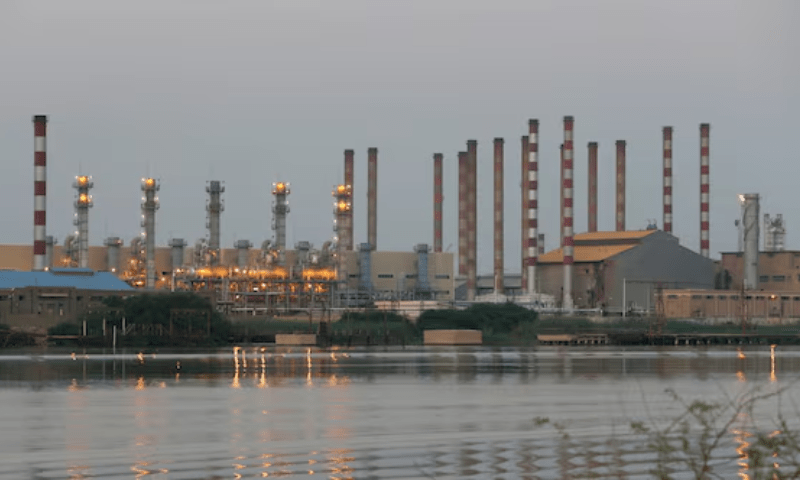
A general view of Abadan oil refinery in southwest Iran, is pictured from Iraqi side of Shatt al-Arab in Al-Faw south of Basra, Iraq on Sept 21, 2019. — Reuters/Essam Al-Sudani/File

“Following the July hike, most Opec members, excluding Saudi Arabia, appear to be producing at or near maximum capacity,” J.P. Morgan said in a note.

Outside of Saudi Arabia and the UAE, spare capacity was negligible, said a senior industry source who works with Opec+ producers.

“Saudis are the only ones with real barrels, the rest is paper,” the source said. He asked not to be named due to the sensitivity of the matter.

Russia, the second-largest producer inside Opec+, claims it can pump above 12m bpd.

J.P. Morgan estimates, however, that Moscow can only ramp up output by 250,000 bpd to 9.5m bpd over the next three months and will struggle to raise output further due to sanctions.

Iran produces around 275 billion cubic metres (bcm) of gas per year or some 6.5pc of global gas output. However, it consumes the produce domestically because of US sanctions on exports.

Yet despite the US-led sanctions, Iran has been able to increase crude exports since the first Trump administration imposed full US sanctions in May 2019.

China is the largest importer of Iranian oil, raising concerns of a possible impact on it if Israel further attacks Iran’s oil and gas industry.

Teapot refiners are private Chinese refineries that are the primary purchasers of Iranian oil, with one being sanctioned by the US this year and another in 2022.
Which Iranian sites were attacked?

Israel also attacked the Shahran depot and the Fajr Jam Gas Refining Company, the Iranian petroleum ministry said, according to Al Jazeera.

Smoke from an Israeli attack rises from Shahran Oil depot, following Israeli strikes on Iran, in Tehran on June 15, 2025. — Majid Asgaripour/Wana via Reuters


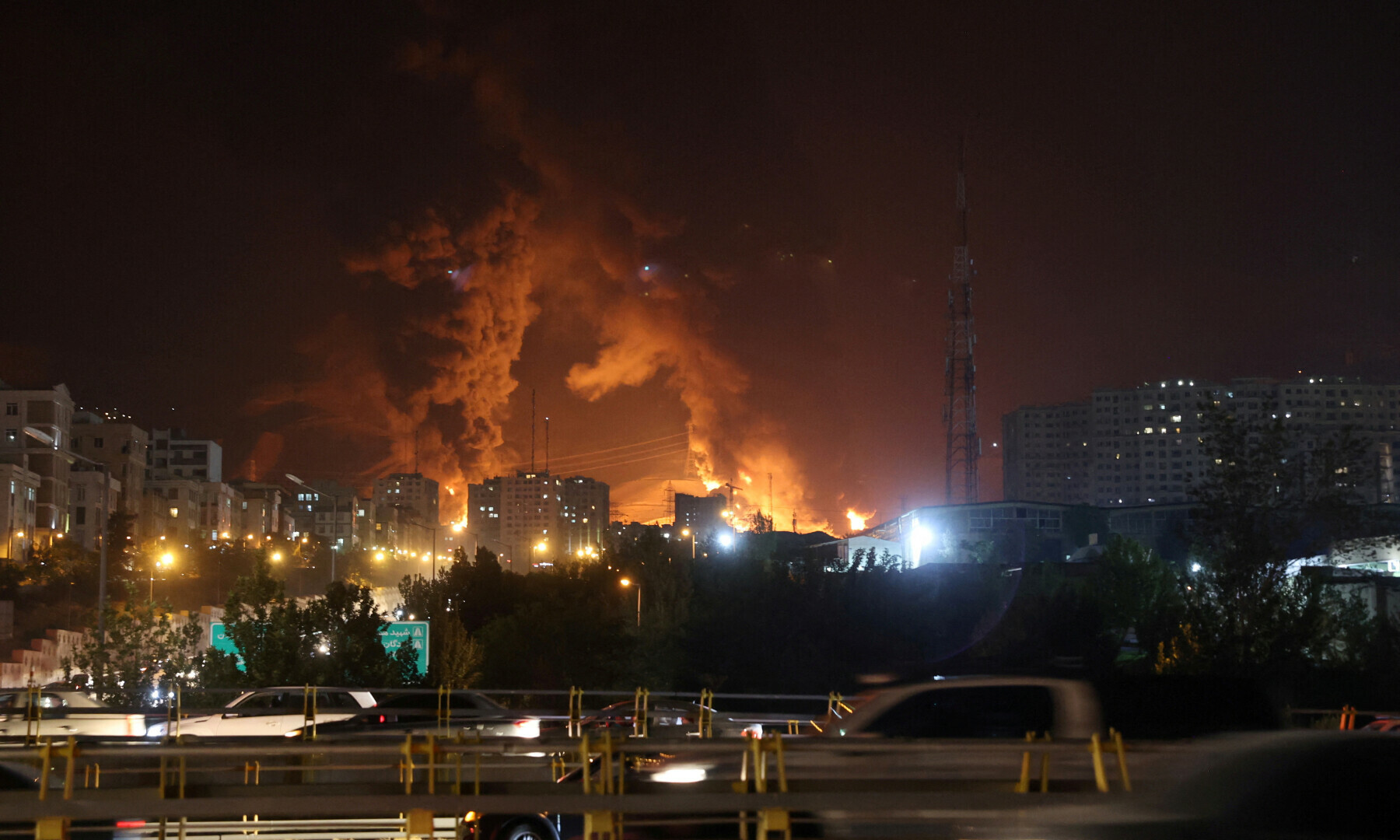
Major fires broke out at two opposing ends of Tehran — the Shahran fuel and gas depot to the northwest, and one of Iran’s biggest oil refineries in Shahr Rey to the south, the report added.

While Iran’s Student News Network denied that the Shahr Rey refinery had been struck by Israel, and claimed it was still operating, it said that a fuel tank outside the refinery had caught fire.

With nearly 260m litres of storage capacity across 11 tanks, the Shahran oil depot is one of Tehran’s largest fuel storage and distribution hubs, Al Jazeera noted.

It termed it a “vital node” in Tehran’s urban fuel grid, distributing petrol, diesel and aviation fuel to several terminals in the capital.

The report quoted experts as warning that any disruption to the state-owned Tehran Oil Refinery could strain fuel logistics in Iran’s most populous and economically significant region.


This illustration by Al Jazeera shows the locations of Iranian oil and gas facilities that came under Israeli attacks on June 14, 2025. — Al Jazeera Labs based on Reuters


Header image: A plume of heavy smoke and fire rises over an oil refinery in southern Tehran, after it was hit in an overnight Israeli strike, on June 15. — AFP
Bernie Sanders (DSA) Senator,
 Says US Must Not Be 'Dragged Into Another Netanyahu War'

The independent U.S. senator condemned the "illegal unilateral attack on Iran" by Israel that "risks a full-blown regional war."


A rescuer carries an injured girl on his back in an area hit by a missile fired from Iran, in Ramat Gan near Tel Aviv on June 13, 2025. Iran fired a barrage of ballistic missiles at Israel in a counter-strike in the evening on June 13, after an unprovoked onslaught hammered nuclear facilities, bases, and residential targets in Iran.
(Photo by Jack Guez / AFP via Getty Images)


Jon Queally
Jun 13, 2025
EDITOR
COMMON DREAMS

As Iranian missiles were being shot down over Israel on Friday following the IDF's unprovoked bombings of Iranian targets earlier in the day, Sen. Bernie Sanders (I-Vt.) condemned the government of "extremist" Prime Minister Benjamin Netanayahu for his "ongoing deviance of international law" that has made the "world more dangerous and unstable" and trying to drag the United States into dangerous new war in the Middle East.

"First, he uses the starvation of children in Gaza as a tool of war, a barbaric violation of the Geneva Conventions," declared Sanders in a statement. "Now, his illegal unilateral attack on Iran risks a full-blown regional war."

Sanders said Israel's Friday bombings and assassination attacks against Iranian targets, including nuclear program facilities, "directly contravened the express wishes of the United States, which was seeking a diplomatic resolution to the long-standing tensions around Iran's nuclear program."

While a new round of diplomatic talks between the U.S. and Iran were slated to begin Sunday, said Sanders, "Netanyahu chose instead to launch an attack"—a move seen by critics as an overt effort to sabotage a negotiated agreement.

"The U.S. must make it clear that we will not be dragged into another Netanyahu war," said Sanders. "Along with the international community, we should do everything possible to prevent an escalation of this conflict and bring the warring parties to the negotiating table."
House GOP Vote to Take Back Funds for NPR/PBS Imperils 'Future of Public Broadcasting'

"President Trump is determined to destroy any news outlets that hold him accountable for his actions," said one free press advocate.

THIS A CONSERVATIVE WET DREAM FOR FIFTY YEARS
THEY HATE PUBLIC BROADCASTING


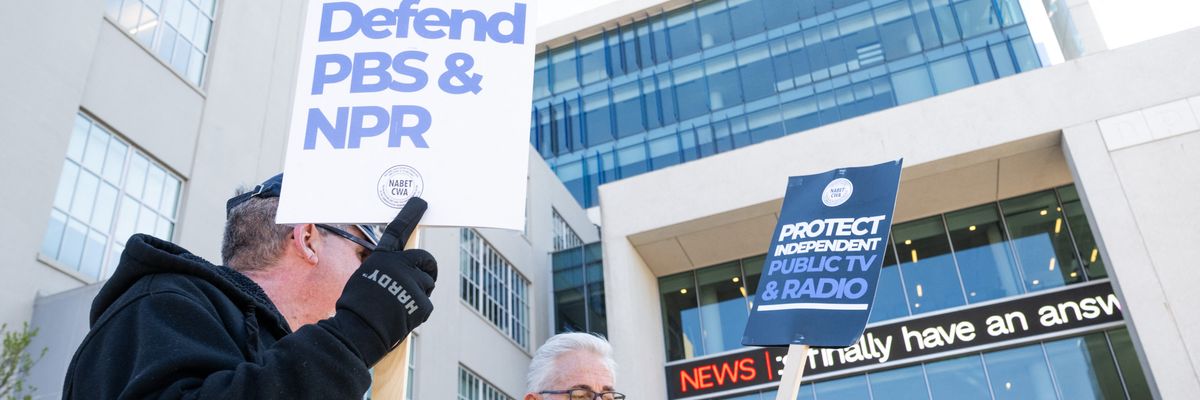
People participate in a rally to call on Congress to protect funding for U.S. public broadcasters, Public Broadcasting Service (PBS) and National Public Radio (NPR), outside the NPR headquarters in Washington, D.C., on March 26, 2025.
(Photo: Saul Loeb/AFP via Getty Images)


loise Goldsmith
Jun 13, 2025
COMMON DREAMS

The U.S. House of Representatives on Thursday narrowly approved a rescission package that would take back funding for PBS and NPR, as well international aid programs—a move that supporters of public media quickly decried.

Earlier in June, the Trump White House formally asked Congress to rescind over $9 billion in approved spending, the vast majority of which would go toward foreign aid programs. However, it also includes a take back of more than $1 billion in already approved funding for the Corporation for Public Broadcasting (CPB), the congressionally funded and created company that supports public media in the United States. CPB distributes nearly all of those funds to local television and radio stations, according to NPR. The funding clawback impacts funding for the next two fiscal years.

"Public media delivers unmatched value to the American taxpayer," said Patricia Harrison, president and CEO of CPB, in a statement on Thursday. "It serves every family in every part of America."

The package passed with a 214 to 212 vote. All House Republicans except for four voted in favor of the measure, and all Democrats voted against it. It now heads to the Senate.

"From life-saving emergency alerts to local reporting and storytelling, and educational resources that support families, job seekers and teachers—these services exist because public media is committed to serving everyone, regardless of income or zip code. In many rural and underserved areas, the loss could be total," Protect My Public Media, a grassroots advocacy campaign focused on preserving federal funding for public media stations, wrote in response to the House vote. The group is driving emails to the Senate to urge lawmakers to vote against the package.

Co-CEO of the advocacy group Free Press Action, Craig Aaron, said Thursday that there is broad support for federal funding for public broadcasting.

"President [Donald] Trump is determined to destroy any news outlets that hold him accountable for his actions. As they prepare to vote on his request, senators need to know that supporting public media is healthy for their communities and our democracy. Publicly funded news outlets act as counterbalances to a commercial media system that too often puts profits before the public interest," Aaron said.

Big picture, Free Press Action says that the House vote puts the "future of public broadcasting in doubt."

In addition to slashing federal funding for NPR and PBS, the package would cut money for peacekeeping efforts, dollars for health programs that fund activities related to child and maternal health, HIV/AIDS, and infectious diseases, and funding for climate projects.

Lisa Gilbert, co-president of the watchdog group Public Citizen, highlighted some of these other cuts, as well as those to public media, and added that "Republican senators should reflect on how the rescission package threatens to blow up the annual appropriations process."

"The minority party has no reason to agree to bipartisan appropriations legislation if the president and one party alone can undo the deal," she said.
Horror in Minnesota is all on Trump


D. Earl Stephens
June 14, 2025 
RAW STORY


Officers gather after the shooting of Democratic lawmakers in Minneapolis. REUTERS/Ellen Schmidt TPX

As I was typing a piece on Saturday morning, endeavoring to stitch together Flag Day, our army’s birthday, and the peaceful marches against tyranny that were going off all over the United States of America, I got a chilling news bulletin — that two Minnesota lawmakers and their spouses had been shot in their homes by a madman impersonating a police officer.

This is what I knew as my fingers hit the keyboard:
State Representative Melissa Hortman and husband, Mark, have died in the attack at their home in the Minneapolis suburbs. State Senator John A. Hoffman and his wife, Yvette, were also shot multiple times at their house in a nearby suburb, but remain alive.

Minnesota Gov.Tim Walz has called this a “political assassination.”

This will be a developing, gruesome, and very American story for some time to come. I want to be careful to honor the victims while channeling my sadness and rage at the state of things in my country in as precise a manner as possible.


So let me start here:
What happened in Minnesota can surprise ABSOLUTELY NOBODY who has been paying even the slightest amount of attention to the sickly state of America in 2025.


It is perhaps the most predictable thing I have seen coming in the roiling wake of a week in which we have seen a U.S. senator — a son of Los Angeles — tackled and handcuffed for simply asking a puppy-shooting, ineffectual wax figure to explain herself, and to stop lying about the reason for her agency’s invasion of the city he grew up in. There were no apologies for this disgusting incident.

We have watched helplessly while human beings, one after another, have been swept off our streets by masked monsters, who may or may not be impersonating government law enforcement officers.


We have watched as this grotesque president whipped young, impressionable soldiers into a frenzy and made sure to empty their pockets and fill his by selling them his warped MAGA memorabilia on one of our army bases.

We have gone so far past the unimaginable, it is impossible to know where to begin to connect with the normal.

But let me be crystal clear on this: ALL OF IT lies at the fat little feet of the convicted felon, who attacked this country on January 6, 2021, did nothing to stop that attack for hours and instead rooted for its success, and has continued to intentionally throw gasoline on the raging fires he has so eagerly stoked, starting in the vicinity of 2010 when he questioned President Obama’s citizenship.


THAT was the catalyst for everything that has followed, and has lead us to lawmakers and their families now being slaughtered in their homes.

IT IS ALL ON HIM.

Perhaps I am not helping right now, but like so many of you I have grown weary and disgusted waiting for people with heft and alleged status to say what we all know to be true.


The gaslighting has gone on long enough.

My God, this mess of a man stood in our nation’s capital in that odd way he does … ample ass out, jutted, orange chin forward … and did his best Mussolini impression by keeping the tanks running on time on their way down our streets.

Are you reading this????????


TANKS.

All this to honor himself on his 79th birthday. If there is any good news here, and you have to squint hard to see it, he has climbed another notch on the actuarial life table.

I have said enough for now, my friends. Like you I am aching inside. My fury wringing out tears …

I took part in our march here in Madison, Wisconsin, joining tens of thousands of other hearty souls who love their country enough to assemble peacefully on her behalf.

We are still the lucky ones. Nobody has turned their guns on us — yet.

(D. Earl Stephens is the author of “Toxic Tales: A Caustic Collection of Donald J. Trump’s Very Important Letters” and finished up a 30-year career in journalism as the Managing Editor of Stars and Stripes. You can find all his work here.)


THE ONLY AMENDMENT TRUMP ABIDES BY


'Humiliating': Onlookers mock Trump's 'sad little tank parade' for low turnout

David McAfee
June 14, 2025 
RAW STORY


U.S. President Donald Trump listens to remarks during a swearing-in ceremony for Administrator of the Centers for Medicare and Medicaid Services Mehmet Oz in the Oval Office in Washington, D.C., U.S., April 18, 2025. REUTERS/Nathan Howard

Donald Trump was ridiculed on Saturday for a "sad little tank parade" with a purportedly low turnout rate.

The New York Times was one of the first major outlets to flag what could be considered signs of failure for the MAGA event. One reporter noted that "hordes" of people were trying to leave before Trump even spoke, while another called the parade and crowd "listless."

But the Times wasn't the only one to get in on the action.

On social media, several commentators and observers circulated images of the less-than-expected MAGA crowd.

Comedian and writer Mike Drucker shared a video from the event, and wrote, "This is genuinely humiliating to see."

Drucker in a separate post added a photo of Trump, and said, "It’s your birthday. It’s Saturday night. But you made one critical mistake: You threw a $45 million parade for yourself without realizing you’d be bored out of your mind."

Democratic strategist Mike Nellis said, "America's army won WWI and WWII, and this is the best they could f------ do with $45 million for this parade?"

"I get the weather, but this is embarrassing," he added.

NBC reporter Mark Segraves said, "The #Army250 parade starting 30 minutes early due to incoming weather. Crowd nowhere near the 200,000 expected," to which former GOP lawmaker Barbara Comstock said, "Newsmax is saying about 10,000 there. That’s small for some protest rallies today and a huge waste of our military $$$ when the world is on fire."

Conservative Tim Miller gave his "main takeaway" from the event.

"Lame and embarrassing Trump having a sad little tank parade while Israel is wrecking the entire IRGC with precision strikes just underscores our decline," the strategist added.


All hail the king


Rafia Zakaria 
Published June 14, 2025  
 DAWN

The writer is an attorney teaching constitutional law and political philosophy.


MILITARY parades are not uncommon in many parts of the world. Lines of tanks, contingents of marching soldiers, missiles, along with fighter jets and helicopters flying overhead, create just the sort of martial theatre that makes watching crowds feel nationalistic and strong. When the fates of leaders and their armies rely on such a spectacle, it follows that they are not infrequent.

This is not the case in the US, at least not until now. Since the end of the Cold War, America has projected itself as the world’s diplomat. Even as it has waged wars all over the world, the domestic population remains largely disconnected from the military and its hardware. It may also be the case that when you know you are the superpower and have the deadliest weapons in the world, you need not show them off. It would not be incorrect to say that American projections of power have not been parades but actual decades of wars and occupations.

This is about to change. On Saturday, a military parade is supposed to take place in Washington, D.C. The timing is portentous; it is the 250th anniversary of the US Army. It is also American President Donald Trump’s birthday. The confluence may have made it possible for Trump to stage the $45-million parade that will include 6,600 soldiers. Even Republicans have smelled the rancid odour coming from a wannabe authoritarian holding a military parade on his birthday. To use the lingo of Gen Z, it’s giving dictatorship, it’s giving Dear Leader, it’s giving a man who thinks he is king.

If the stench of the parade was not terrible enough, the timing adds to the mess. For the entire preceding week, the Trump administration almost gleefully cracked down on protesters in Los Angeles, who have been thwarting deportation raids by ICE officers.

In the first few days of the protests, angry demonstrators confronted by masked Immigration and Customs Enforcement officials armed with military equipment grew violent and burned some businesses and cars.

The administration, which has been chomping at the bit to have a confrontation of just this sort; began to reiterate its line about all migrants being criminals and, in the words of Secretary of Homeland Security Kristi Noem, Los Angeles itself being a “city of criminals”.


Over 1,600 protests are expected against Trump’s military parade.

To drive home this point, Trump who has a long-standing enmity with California Governor Gavin Newsom, decided to call out the National Guard to assist ICE officials in California against the state’s wishes. The move, no doubt motivated by Trump’s contempt for California (a Democratic state), where the majority are racial minorities, was seen as overreach. Then, even though the protests had been quelled and were restricted to a couple of blocks in a city of millions, Trump insisted on deploying the Marines in California.

It is important to understand the consequence of such a move. While those who have lived under authoritarian regimes may be attracted to Trump and his strongman moves, the American public is less tolerant of such exercises.

First, protest is a protected right under the First Amendment. Second, the idea that the Marines, a force trained to kill, would be called out against unarmed protesters is the sort of overkill that Trump loves and everyone else detests. Finally, the cost itself — Americans point out that the parade is simply not good use of money.

Over 1,600 protests are expected to take place in the US against Trump’s military parade. Saturday has been dubbed ‘No Kings Day’, alluding to Trump’s predilection for believing that he is indeed the King of the United States of America. His constant allusions to contesting elections for a third term and his infatuation with the kings he encounters in the Middle East do not help in this regard. Even those who do not protest are beginning to dislike him. Polls show that his appro­val ratings plunged to an 80-year-low recently. Trump has also lost public confidence in his handling of immigration as the travel bans, ICE raids, border harassment and general rounding up of anyone thought to be a migrant have unfolded.

Saturday’s parade is seen as the use of presidential power to stage a spectacle whose only real purpose is to nourish the ego of a man who will turn 79 on that day. No one is impressed. The fact that he has decided to call out the military in Los Angeles, forcing troops trained to kill to crack down on unarmed protesters, creates a ghastly image of the downfall of America that is visible to all but Trump. The poorly thought-out move, and the price tag attached, may well be the beginning of the end of Trump’s honeymoon period. Six months into his presidency, Americans have not seen the economic gains that he promised, while the things he is delivering on are ones that no one wants.


rafia.zakaria@gmail.com

Published in Dawn, June 14th, 2025

‘No one can stop’ Duterte impeachment trial: Philippine House prosecutors

By AFP
June 11, 2025


Philippine senators pose before taking their oaths as jurors in the impeachment trial of Vice President Sara Duterte - Copyright AFP Ted ALJIBE

Pam CASTRO, Cecil MORELLA

House of Representatives prosecutors said Wednesday that Philippine Vice President Sara Duterte’s impeachment trial could not be stopped despite the Senate sending the case back to them hours after convening as a court.

Prosecutors told an afternoon press briefing their case had complied strictly with the constitution, adding they would seek clarification over what they called “confusing” Senate orders.

Duterte was impeached in early February on charges of graft, corruption and an alleged assassination plot against former ally and running mate President Ferdinand Marcos.

A guilty verdict would see her removed from office and permanently barred from politics.

“No one can stop this anymore, because jurisdiction has been acquired already by the impeachment court,” said Congresswoman Gerville Luistro, pointing to the Senate’s issuing of a summons for Duterte late Wednesday night.

“There will be no… withdrawal (of the impeachment case) by the House. That is not allowed by the constitution.”

Tuesday night’s 18-5 Senate vote ordered the House to certify it had not violated the constitution by hearing three impeachment complaints before the one that ultimately went to a vote.

The constitution bars subjecting anyone to multiple impeachment proceedings within the same year.

But House member Ysabel Maria Zamora said the final impeachment complaint had “consolidated all the articles” of the first three into one.

A second order to guarantee the case would move forward after new House members take their seats on June 30 was “impossible” to fulfill as they could not speak for a future Congress, prosecutors said.


– ‘Political survival’ –


The Senate’s vote to remand was as much a matter of “political survival” as anything, lawyer and former senator Leila de Lima told AFP Wednesday.

De Lima, who warned more than a week ago the Senate could move to kill the impeachment, said the spectre of a still-powerful Duterte was likely on lawmakers’ minds.

“Loyalty, friendship, political survival. Maybe they are thinking the Dutertes are very much around even if the patriarch (ex-president Rodrigo Duterte) is in The Hague,” she said.

The elder Duterte has been imprisoned since March when he was arrested and transferred to the International Criminal Court to face charges tied to his deadly drug war.

His daughter has been widely mooted as a presidential candidate in 2028 should she survive the impeachment process.

Senators “were trying to protect their political ambitions,” agreed Congresswoman France Castro, who endorsed an early impeachment complaint against the vice president.

Asked at Wednesday’s press briefing if he believed the Senate was deliberately delaying the trial, Congressman Keith Flores said the answer was clear.

“I cannot speak for everyone but for me, yes.”

ATTN: EARTHLINGS

May 2025 second warmest on record: EU climate monitor


By AFP
June 11, 2025


2025: the second warmest May on record - Copyright AFP PAUL FAITH


Julien MIVIELLE

Global heating continued as the new norm, with last month the second warmest May on record on land and in the oceans, according to the European Union’s climate monitoring service.

The planet’s average surface temperature dipped below the threshold of 1.5 degree Celsius above preindustrial levels, just shy of the record for May set last year, according to the Copernicus Climate Change Service.

The same held for the world’s oceans. With a surface temperature of 20.79C, last month was second only to May 2024, with some unprecedented warmth regionally.

“Large areas in the northeast North Atlantic, which experienced a marine heatwave, had record surface temperatures for the month,” Copernicus reported. “Most of the Mediterranean Sea was much warmer than average.”

The increasingly dire state of the oceans is front-and-centre at the third UN Ocean Conference (UNOC), which kicked off Monday in Nice, France.

Ocean heatwaves are driving marine species to migrate, damaging ecosystems, and reducing the ability of ocean layers to mix, thus hindering the distribution of nutrients.

Covering 70 percent of the globe’s surface, oceans redistribute heat and play a crucial role in regulating Earth’s climate.

Surface water warmed by climate change drive increasingly powerful storms, causing new levels of destruction and flooding in their wake.

Some parts of Europe, meanwhile, “experienced their lowest levels of precipitation and soil moisture since at least 1979,” Copernicus noted.

Britain has been in the grips of its most intense drought in decades, with Denmark and the Netherlands also suffering from a lack of rain.


– ‘Brief respite’ –


Earth’s surface last month was 1.4C above the preindustrial benchmark, defined as the average temperature from 1850 to 1900, before the massive use of fossil fuels caused the climate to dramatically warm.

“May 2025 interrupts an unprecedentedly long sequence of months above 1.5C,” noted Carlo Buontempo, director of the Copernicus Climate Change Service.

All but one of the previous 22 months crossed this critical threshold, which marks the 2015 Paris Agreement’s most ambitious target for capping global warming.

“This may offer a brief respite for the planet, but we expect the 1.5C threshold to be exceeded again in the near future due to the continued warming of the climate system,” he added.

Over the 12-month period June 2024 to May 2025, warming averaged 1.57C compared to the 1850-1900 benchmark.

The Paris treaty target, however, is pegged to a 20-year average, in order to account for the influence of natural variability.

The UN’s climate science advisory panel, the IPCC, has said there’s a 50-percent change of breaching the 1.5C barrier in line with these criteria between 2030 and 2035.

Using this method of calculation, the world today has warmed by at least 1.3C.

The UN’s World Meterological Organization (WMO), meanwhile, has said there’s a 70 percent chance the five-year period 2025-2029, on average, will exceed the 1.5C limit.

Scientists stress the importance of limiting global warming as soon and as much as possible because every fraction of a degree increases the risks of more deadly and destructive impacts, on land and in the sea.

Limiting warming to 1.5C rather than 2C would significantly reduce the most catastrophic consequences, the IPCC concluded in a major report in 2018.
Steel startup aims to keep Sweden’s green industry dream alive


By AFP
June 11, 2025


The bankruptcy of Northvolt has not deterred the Stegra company from pursuing its green steel project in northern Sweden - Copyright US Treasury Department/AFP HANDOUT


Johannes LEDEL

The spectacular fall of battery maker Northvolt led to fears over several Swedish green industry projects, but startup steelmaker Stegra believes it can confound the doubters.

Just outside the town of Boden in Sweden’s far north a massive worksite is teeming with activity.

The metal skeletons rising out of the ground hint at the brand new mill which will produce steel using technology that the company says gives off 95 percent less CO2 emissions than traditional methods.

“Right now, we got the pole position,” Denis Hennessy, Stegra’s vice president for steel, said during a site tour.

“We’re in a very unique position to do some things first in the industry,” Hennessy said as he described the benefits of building a completely new plant.

Among heavy industries, iron and steel production is the number one CO2 emitter, according to the International Energy Agency.

The traditional process gives off nearly two tonnes of CO2 for every tonne of steel made.

– Hydrogen –


The iron ore that comes out of a mine is usually rich in oxides, chemical compounds made up of iron and oxygen, and this oxygen has to be removed — usually by heating it with coke in a blast furnace — which is when most of the CO2 is released.

Stegra will remove the oxygen by circulating heated hydrogen gas which binds the oxygen — creating water as a byproduct

The hydrogen is also to be produced on site at an electrolyzer plant powered by renewable energy.

Access to cheap renewable energy, such as hydro power in Sweden’s north, is key to Stegra’s business model, according to CEO Henrik Henriksson.

He told a group of investors and reporters that most established European steel firms are paying three times as much for their electricity.

“That gives us a relatively huge cost advantage,” he added.

While traditional steelmaking is still cheaper, Stegra thinks it will benefit by being able to charge a premium for “green” steel.

When the company first announced plans for a new plant in 2021, it was called H2 Green Steel and had an ambitious target of starting production in 2024. It also aimed for annual output of five million tonnes of steel — more than all of Sweden’s current annual output — by 2030.


– Northvolt’s shadow –


It is now targeting to turn on the mills in the second half of 2026, with an initial capacity of 2.5 million tonnes of steel per year, which they hope to eventually double.

This is a still a drop in the ocean compared to the near 1.9 billion tonnes of steel shipped worldwide in 2024, according to the World Steel Association.

Behind Stegra is investment firm Vargas Holding, which was also a co-founder of battery maker Northvolt.

Northvolt was seen as a cornerstone in European efforts to catch up with Chinese battery producers before production delays and a debt mountain led it to declare bankruptcy in March.

As Northvolt was seen as a leader in a green industrial boom in Sweden, its demise has dampened optimism.

A review by Dagens Arbete, a magazine published by three labour unions, found that 20 out 30 “green industrial projects” in Sweden were either delayed or had been cancelled.

Stegra also has detractors.

Magnus Henrekson, a professor at the Research Institute of Industrial Economics (IFN), told AFP that the first problem with the startup was the inland location without the infrastructure to transport large amounts of steel to nearby ports.

“And this is to be done by a startup, without previous experience of steel production,” Henrekson said, adding that he thought that given Stegra’s massive power needs, it was over optimistic to think electricity prices would remain competitive.


– No Chinese competitor –


Henrekson also noted that there are signs that the wider steel industry has lost faith in hydrogen reduced iron, highlighting ArcelorMittal’s announcement in November that it was holding off decisions on several direct reduction plants — citing both market and technology concerns.

Despite the challenges, Stegra’s Henriksson stressed that the company was “different” from Northvolt.

“We are a different team. We are a different setup,” he said, adding that there was “no green steel business” in China to provide competition.

Henriksson also said that a key difference was also steel as a product was much different from battery packs for vehicles — which require customers to adapt software, technology and design.

Producers who want to reduce their carbon footprint can simply use Stegra’s steel, he said.

“On Monday … you can run brown steel. And on Tuesday, you can run green.”
Waymo leads autonomous taxi race in the US


By AFP
June 11, 2025


In San Francisco, locals barely notice the steering wheels turning by themselves anymore, with Waymo's fleet of Jaguars also available in parts of Silicon Valley - Copyright AFP -


Julie JAMMOT

Waymo’s autonomous vehicles have become part of the everyday landscape in a growing number of US cities, serving as safe transport options, tourist attractions, and symbols of a not-so-distant future. Their market dominance, however, is far from guaranteed.

As Tesla preps to launch its first driverless taxi service in Austin, Texas, this month after numerous delays, Waymo already claims to have more than 250,000 weekly rides across Phoenix, San Francisco, Los Angeles and Austin (in a partnership with Uber).

In San Francisco, locals barely notice the steering wheels turning by themselves anymore, with Waymo’s fleet of Jaguars also available in parts of Silicon Valley.

But for tourists and business travelers, their first Waymo ride often becomes the most memorable part of a trip to the Golden Gate city.

In Los Angeles, the vehicles also became a target of protesters against the White House’s immigration policies, who set Waymos on fire or covered them in graffiti.

That blip aside, Waymo has been going from strength to strength, with the company — a subsidiary of Google-parent Alphabet — capturing 27 percent of San Francisco’s market share, according to YipitData.

The data shows that Waymo has surpassed Lyft, the United States’ second-largest ride-hailing service, in the city, while Uber maintains a dominant 50-plus percent market share.

Remarkably, Waymo only launched commercial service in San Francisco in 2023 and opened to the general public just one year ago.

“People quickly feel comfortable because they perceive these cars as safer than human-driven vehicles,” explained Billy Riggs, an engineering professor at the University of San Francisco who studies such vehicles and their integration into daily life.

– Better than humans –

Despite typically higher fares than Uber and longer wait times, Riggs’s research reveals that more than a third of users earn less than $100,000 annually –- the median salary in the tech capital.

Three factors drive this success: safety, the absence of a driver (no need to haggle over what music to play), and well-maintained vehicles.

According to a recent Waymo study covering more than 90 million kilometers (56 million miles) of driving, their autonomous vehicles achieved a 92 percent reduction in pedestrian-involved accidents and a 96 percent reduction in injury-causing collisions at intersections.

“Even when humans challenge them, the vehicles don’t respond aggressively. They’re better versions of ourselves,” Riggs joked.

While better than humans, these vehicles are less passive and hesitant than in their early days.

Through continuous data collection on driver behavior and algorithmic adjustments by engineers, Waymo cars have developed “humanistic driving behavior.”

“That’s everything from being able to creep into the intersection if there’s a potential blind right turn or nudging into a left-hand turn” against oncoming traffic.

Both are legal, “but they would be seen as more aggressive, rather than defensive, human, driving maneuvers.”

The vehicles have also gained recognition for their smooth accelerations and braking.

“My boys say, it’s like butter. When they ride with me in our Tesla, I make them sick,” he added.

– $100,000 taxi –

The collapse of Waymo’s main competitor, Cruise — due to high costs and following poor crisis management after a San Francisco accident — has propelled Waymo to market leadership.

It plans to expand to Atlanta, Miami and Washington by 2026.

True large-scale deployment, however, requires adapting to different regulations and, more critically, acquiring many more vehicles.

The company currently operates 1,500 vehicles across four cities.

In early May, Waymo announced plans to build 2,000 additional electric Jaguar I-Pace vehicles next year, all equipped with autonomous driving technology.

These vehicles cost approximately $100,000 each, according to an interview with Waymo executive Dmitri Dolgov on the Shack15 Conversations podcast.

That means profitability remains a distant goal.

In the first quarter, Alphabet’s “Other Bets” division, which includes Waymo, recorded net losses of $1.2 billion.

“There still could be a scenario where Waymo loses. It’s not unrealistic that some Chinese competitor comes in and wins,” Riggs said.