Sunday, June 15, 2025

PAKISTAN

Dashed hopes
 June 15, 2025 
DAWN

WITH the real economy in a deep slump and macroeconomic indicators stable, how should we describe the current state of the economy and the direction in which we are heading?

According to the just released Pakistan Economic Survey 2024-25, whatever spin you may want to give it, the economy is in a deep downturn given the collapse of the crop sector and the drastic decline in incomes in rural areas, where almost 60 per cent of the population lives and where extreme poverty is concentrated.

Severe decline in rural incomes and little success in increasing exports have led to poor growth in manufacturing. A combination of the two has slowed down the services sector, which now makes up nearly 60pc of our GDP.

The resulting overall economic growth is dismal at around 2.5pc, while we need a minimum growth of at least 6.5pc to absorb the increase in the labour force and reduce the prevalent high levels of poverty, which, according to a recent World Bank report, has risen dramatically, post-Covid, to near 50pc.

At the same time, there is no denying the fact that the economy has stabilised. There is no threat of default given our current reserves, a stable exchange rate (though it has come under pressure), a current account surplus (thanks to a surge in remittances), and inflation at an all-time low (it is expected hover around 5-6pc). For this, the government can take full credit — a fact recognised by the IMF and rating agencies.


Relief was hardly given to those who deserve it most.

So, is the price that we have had to pay for macroeconomic stability a drastic contraction of the real economy? While the stabilisation measures have indeed helped, I would strongly argue that the poor sequencing of these measures and economic reforms by our policymakers are chiefly to blame.

A prime example is the agricultural sector. The cold-blooded way in which the government removed the wheat support price shows the anti-rural, pro-urban bias of the current regime. Without first ensuring the development of an alternative market, it left the farmers — both small and large — to suffer huge losses at the hands of the middlemen.

Now let’s turn to what the future holds for the economy under IMF tutelage.

In his budget speech, Finance Minister Muhammad Aurangzeb emphatically stated that we have launched on a mission ‘to change the DNA of the economy from its currents inefficient uncompetitive path to one of high productivity and sustained economic growth’ — or words to that effect.

To put it more simply, he promised to implement economic reforms that will root out the current incentive structure, which breeds inefficiencies and inequalities and results in recurring stop-go cycles. We waited with bated breath to hear of the far-reaching reforms that are intended to usher in this process of creative destruction and the birth of a new economic order, but have been extremely disappointed.

Yes, some worn-out, positive steps were announced, which have been repeatedly tried before, with little success. This includes a tariff reform package — in the works since 1988 — with a maximum upper limit on import duties of 15pc in five years and four slabs. Significantly, there was no mention of a reduction in import duties on products of our most inefficient industries (for example, autos) to improve their competitiveness. This demonstrates a lack of reluctance to take on entrenched business interests.

The privatisation of the same old state-owned enterprises, such as PIA, the power distribution companies, etc, was promised. Hopefully, this time, the process will be successfully completed. A lot of faith was placed in the digital economy and increasing its export earnings (with ambitious targets), though concrete measures in this direction were difficult to discern.

Relief was given under strong pressure to the real estate sector and traders, despite high hopes to the contrary, and hardly any to those who deserve it most — the working poor. And technology and data were waved around to bring more tax evaders into the tax net as if these have never been available before. Agriculture income tax was left to the provinces.

Key issues related to investment in people (health, education, social protection) were rattled off, highlighting initiatives and projects by the prime minister, but the fact that we are cutting down on their already meagre share in the federal development programme, which itself has fallen to its lowest level in living memory to around 1pc of GDP, was not mentioned. Ultimately, this left us with roads and highways and infrastructure which would transform the economy.

And we had envisaged this budget in the shape of a reform package to change our DNA!

The writer is professor at the Lahore School of Economics and former VC of the Pakistan Institute of Development Economics.

Published in Dawn, June 15th, 2025
.
A woman’s worth


Muna Khan 
Published June 15, 2025 
 DAWN


The writer is an instructor of journalism.


I WAS editing The Review in the early 2000s when Tahir Mirza moved to Dawn, Karachi, to take up the position of news editor and our magazine’s supervisor. I learned a lot from him, mainly how to think about issues — what’s new here and/or why should I care? He helped me submit my first editorial on how fashion weeks could boost the economy. We had not had a fashion week in the country yet. On the face of it, it was about fashion, a topic usually relegated to the magazine — ie, ‘not serious’ — but because I wrote about it from an economics angle, it worked.

A year later, I was transferred to the leader writing team (a lesson on perseverance, kids) where my supervisors taught me more about how to write, especially when it’s about the same issue. What more can you say about (insert act of injustice) without sounding like a broken record?

Sometimes you have no choice but to bang that drum.

It is with this in mind that I thought about the murder of the TikToker Sana Yousaf, shot dead on her 17th birthday by a man slighted by her indifference. I have nothing to add to the voices condemning this gruesome act, but I’m taking a cue from Mirza sahib when I ask, ‘what’s new here?’


No country has reached gender equality.

Nothing. But a new approach is needed.

Nothing can change unless people and corporations stop profiting from misogyny. Influencers like Andrew Tate speak against women, corrupting young boys and normalising incel culture, while leaders like Imran Khan say men are not robots and our TV dramas glamorise gender-based violence. These views must be shunned and challenged, not promoted. There should be no money in misogyny.

Women just haven’t been seen as valuable members of society who can contribute to the country’s growth. Spare me the stories about the valiant female heroes who fought for this country’s independence. I am not denying their contribution, but retelling their stories amounts to nought when Pakistan is not a safe country for women.

We need to count the cost of women dropping out of the workforce, or not even making it to the workforce because they do not feel safe. Only 25 per cent of Pakistan’s women are in the formal labour force, according to the Asian Development Bank. When a woman steps out of her home to earn an income, like Sana Yousaf may have been attempting to do as a content creator — a fine career option — she may be killed and her death feted by men on social media.

No country can progress if its women lag behind. No country has reached gender equality, and no country seems to make that its priority. In 2015, McKinsey estimated that advancing gender equality could add $12 trillion to global GDP by 2025. While that has not happened, some countries have made strides in the last few decades.

After the 1994 genocide in Rwanda, policymakers made gender equality a priority in their quest to rebuild their country. A 30pc quota for women in all state decision-making bodies was included in their constitution. It became the first country in the world to have a female majority in parliament. Six of the country’s 11 banks are run by women, according to a story in Le Monde last year. Women-owned businesses significantly contribute to the country’s economy. Earlier, governments invited highly skilled diaspora to return to rebuild their country. (The less said about our diaspora, the better.)

This has happened in 30 years.

I have written extensively about Vietnam’s progress following the American War, where they too created quotas and made great efforts to improve women’s access to education and work opportunities. Last year, 69.1pc of women were in the labour force.

We can also learn from Bangladesh, which invested in women from the get go. They recognised their future was tied to women’s independence and participation in the labour force, which grew steadily to 44pc last year.

To increase women’s participation in the labour force, Chile’s education reforms included childcare subsidies, which enabled mothers to work. Their participation rate has grown since 1990 to 52pc. Chile introduced entrepreneurship as a central economic development strategy and saw women’s entrepreneurship grow. This contributed to SME growth and innovation, making Chile one of the fastest-growing and most stable economies in South America.

As I was writing this on Thursday, news came that Pakistan ranked last among 148 nations in the World Economic Forum’s Global Gender Gap Report 2025.

In 2023, the IMF said “narrowing the gap between the share of men and women who work is one of the very important reforms policymakers can make to revive economies”. Maybe that will prompt leaders to safeguard our lives, and their future.


Published in Dawn, June 15th, 2025


We Have a Choice: Weapons and War or Food and Health Care


 June 13, 2025

Photograph by Nathaniel St. Clair

For weeks, Congress has been wrapped up in passing President Trump’s big, brutal budget — the one that pays for tax cuts for the wealthy and a trillion-dollar Pentagon budget by taking food stamps and Medicaid away from people struggling to get by.

The GOP-controlled House of Representatives just barely passed this bill — it squeaked through by a single vote. Now the Senate is considering it.

Alongside trillions in tax cuts for the wealthy, the bill also gives big handouts to the Pentagon and the president’s plans to separate immigrant families. It would result in the country’s first-ever trillion-dollar Pentagon budget — and triple annual spending on the mass detention of immigrants.

There’s an army of contractors ready to profit — from the wasteful military contractors who vacuum up more than half the Pentagon budget to the private prison companies that warehouse soccer momspediatric cancer patients, and other immigrants caught up in the administration’s dragnet.

To fund those cruel contractors, the president’s big brutal bill cuts Medicaid and food stamps, among other programs that benefit regular people.

The human costs could be staggering. Researchers have found that the cuts to Medicaid and other health programs could lead to 51,000 preventable deaths a year. And millions of Americans who rely on food stamps could go hungry, including four million children.

None of this needs to happen.

I recently co-authored a report looking at what we could fund instead with that extra money for the Pentagon and this anti-immigrant agenda. If lawmakers just rolled back those increases alone, we could more than cover the annual cuts to Medicaid, food stamps, and the Child Tax Credit combined.

In other words, by just letting the Pentagon and deportation budgets stay where they are now, we can save all of those programs — and potentially save lives.

Nationally, we found that these massive increases would be more than enough to cover the 13.7 million people at risk of losing health care — and the 11 million people at risk of losing food stamps.

That report also looked at what the bill does in every state and congressional district. In Maine, for example, the first year of additional spending on the Pentagon and deportations could keep 107,000 people on Medicaid. In Alaska, 87,000 people could stay on food stamps.

In Arizona’s 5th Congressional District, the increase just for the President’s dream of a “Golden Dome” missile shield could keep 7,500 people on Medicaid. In Kentucky’s 4th district, 6,200 people could stay on Medicaid.

Experts have said that the president’s promises for the system are too good to be true. That’s not worth risking lives by cutting medical benefits in any congressional district.

Then there’s the billions set aside for “killer robots,” drones that can use AI to target and kill people — a nightmare that could lead to more deaths in war and kill more civilians.

In California’s 5th district, the money for these dangerous weapons could instead keep more than 13,600 people on food stamps for a year. In Ohio’s 8th district, more than 11,300 people could keep their SNAP benefits.

This is truly a situation of trading life for death: we can feed hungry people, or we can create new dystopian weapons.

There’s an exceedingly simple solution to all of this: drop the extra money for the Pentagon and attacking immigrants — and keep Medicaid and food stamps available to as many people who need them as possible.

In 2024, the average U.S. taxpayer paid $3,804 for the Pentagon and war, deportations, and border militarization — an already astounding figure. We shouldn’t ask people to pay any more to line the pockets of military contractors and private prison CEOs while Americans go hungry and without health care.

Lindsay Koshgarian directs the National Priorities Project at the Institute for Policy Studies. She’s the lead author of the new report State of Insecurity: The Cost of Militarization Since 9/11.


'Up in Arms': Ben & Jerry's Co-Founder Launches New Campaign Against Bloated Pentagon Budget


"If we take half the money budgeted for the Pentagon and invested in the things people need and want," said Ben Cohen, "the American Dream can become a reality again."


Participants gather for the launch of the Up in Arms campaign against military and nuclear weapons spending on June 12, 2025 in Washington, D.C.
(Photo: Ploughshares)


Brett Wilkins
Jun 14, 2025
COMMON DREAMS


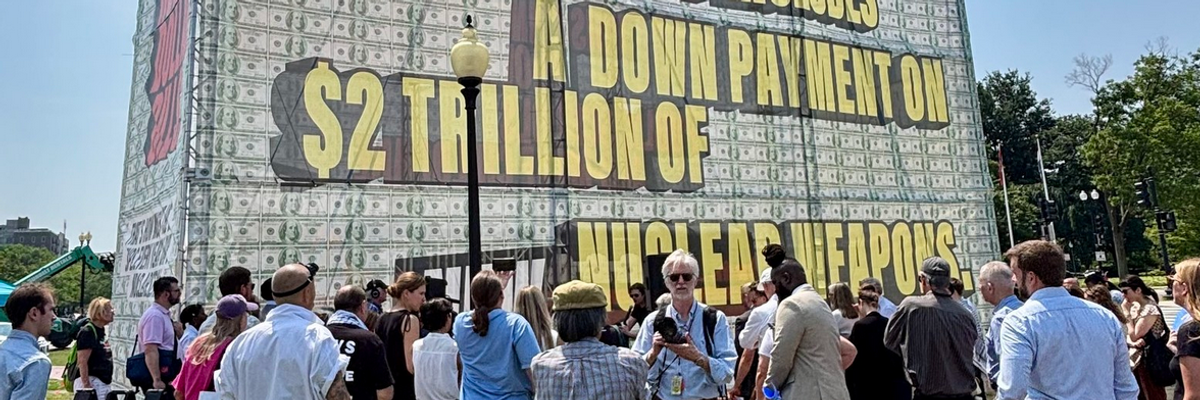
Joined by retired military officers and national security experts, Ben & Jerry's co-founder Ben Cohen on Thursday launched a campaign targeting the nearly $900 billion Pentagon budget and the $100 billion spent on nuclear weapons and "to get our country to start funding the American Dream instead of the death of millions of people."

Standing near Union Station in Washington, D.C. beside a towering sculpture showing what $100 billion looks like, supporters of the Up in Arms campaign—a planned four-year public education and advocacy project "to bring common sense to the Department of Defense and the country's budgetary bottom line"—chanted, "Money for the poor, not nuclear war!"

"There will be no peace, there will be no security, until we start using our resources to provide for the needs of our people at home and around the world," Cohen said at the event. "And we have the money to do it, at no additional taxpayer expense. If we take half the money budgeted for the Pentagon and invested in the things people need and want, the American Dream can become a reality again."


The peace group Ploughshares, which moderated a press conference for the launch of Up in Arms, said that the faux-$100 billion installation could be the tallest protest structure ever erected in Washington, D.C.

"This is a structure that represents the $100 billion that our country spends each year on nuclear weapons," Cohen said while standing in front of the tower and embracing Medea Benjamin, the co-founder of the peace group CodePink. "Fifty percent of that is for a whole new generation of nuclear weapons."

"Ice cream not bombs!" Benjamin said next. "Ice cream not nuclear weapons!"


The $100 billion figure includes spending on modernizing the nuclear arsenal, supporting its infrastructure, and addressing legacy issues like nuclear waste.

"Congress could make it easier for Americans to buy homes and save on gas or they could tackle the opioid epidemic–but those are clearly NOT their priorities," Up in Arms says on its website. "We have all the money we need to create a good life for all Americans. For half the money we spend on nuclear bombs, we could stop poisoning kids with lead, provide funding for public schools, and make childcare affordable."

Former U.S. military officers-turned-peace defenders Dennis Laich, Lawrence Wilkerson, Ann Wright, Karen Kwiatkowski, William Astore, and Dennis Fritz, as well as FBI whistleblower Coleen Rowley and former CIA officer Ray McGovern, are taking part in the Up in Arms campaign.

"We're here today to say we don't want our money spent this way, we want our money spent… on things that keep people alive, not on things that kill people," said Wright, a former U.S. Army colonel and current member of the Eisenhower Media Network and Veterans Against Genocide.

"We're up in arms and down on these damn nuclear weapons," she added, "and We the People have to be able to go to each one of these congresspeople and say, 'We don't care how much money you're getting from all of these companies that make a killing out if killing with these nuclear weapons.'"

Laich, a former U.S. Army general also with the Eisenhower Media Network, noted that the U.S. military budget "is larger than the next 10 countries combined, and what do we get for it?"

"Since World War II, we tied in Korea, we lost in Vietnam, we won the first Gulf War, we lost in Iraq, and we lost in Afghanistan," he said. "They always say we have the greatest military on earth; I don't buy it."

President Donald Trump is proposing a record $1 trillion Pentagon budget for fiscal year 2026 while backing legislation that would dramatically slash spending on vital social programs in order to fund a massive tax break that would overwhelmingly benefit the rich and corporations.

On Friday, the International Campaign to Abolish Nuclear Weapons—which earned the 2017 Nobel Peace Prize for spearheading the landmark Treaty on the Prohibition of Nuclear Weapons—published an analysis showing the world's nine nuclear powers spent a combined baseline $100 billion on their arsenals last year, an 11% increase from 2023. The United States alone accounted for well over half of that amount.

Cohen is a longtime anti-war activist. Last month, he was arrested after disrupting a Senate hearing, shouting, "Congress kills poor kids in Gaza by buying bombs and pays for it by kicking kids off Medicaid in the U.S." as he was hauled off by police.


War Profiteers Benefit as Nuclear Weapons Spending Soared Above $100 Billion Last Year

New analysis reveals that global nuclear weapons spending "could feed all of the 345 million people currently facing the most severe levels of hunger globally, including starvation, for nearly two years."


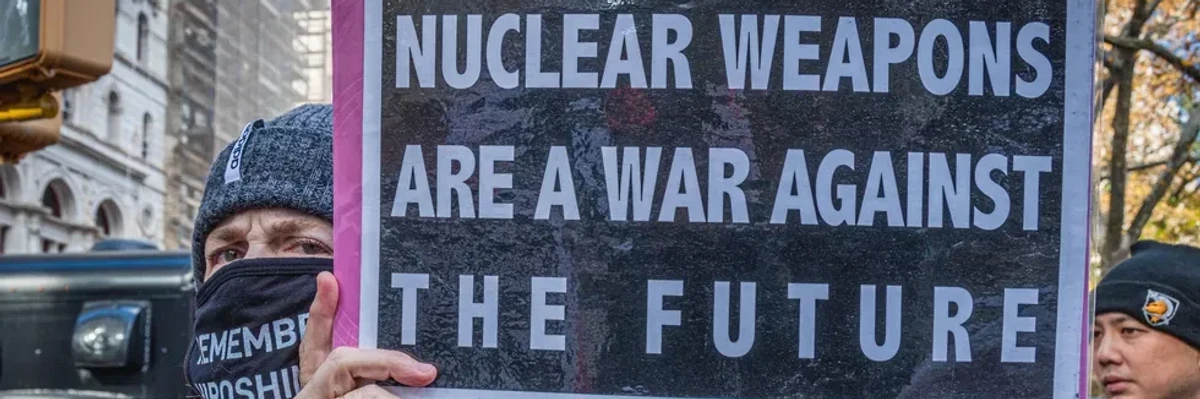
A protester holds a sign reading, "Nuclear weapons are a war against the future" at a demonstration in New York City 
(Photo: Erik McGregor/LightRocket via Getty Images)


Brett Wilkins
Jun 13, 2025
COMMON DREAMS


The world's nine nuclear-armed nations spent more than $100 billion on their atomic arsenals last year—up 11% from 2023—with the United States accounting for both the largest share and biggest increase in expenditures, a report published Friday by the International Campaign to Abolish Nuclear Weapons reveals.

The new ICAN analysis identifies a $9.9 billion increase in global nuclear weapons spending in 2024, with the U.S.—the only country to ever carry out a nuclear attack on another nation—spending $56.8 billion, more than the combined expenditures of the eight other countries with nukes. In addition to the U.S., Russia, China, France, the United Kingdom, India, Pakistan, Israel, and North Korea have nuclear arsenals. The $5.3 billion annual spending increase by the U.S. was also more than any other nuclear power.


All that spending on doomsday weapons padded the profits of major arms makers. According to the report:
In 2024, at least twenty-six companies working on nuclear weapons development and maintenance held significant contracts for their work. These companies earned at least $43.5 billion in the year and hold at least $463 billion in outstanding contracts. In 2024, new contracts worth around $20 billion were awarded to these companies. The companies identified in this report paid lobbyists in France and the United States more than $128 million to represent their interests last year. They also had 196 meetings with high-level U.K. officials including 18 with the prime minister's office in 2024.

"Nuclear-armed countries could have paid the United Nations' budget 28 times with what they spent to build and maintain nuclear weapons in 2024," the report states. "They could feed all of the 345 million people currently facing the most severe levels of hunger globally, including starvation, for nearly two years."

Noting that "98 countries have signed, ratified, or acceded" to the Treaty on the Prohibition of Nuclear Weapons (TPNW), ICAN—which was awarded the 2017 Nobel Peace Prize for its work on the landmark accord—asserted that "it is up to each government, and the citizens of that country, to decide which path they will choose."

ICAN asserted that the stakes are higher than at any time in a generation.

"With two major wars involving nuclear-armed states in Ukraine and Gaza, as well as nuclear tensions escalating between India and Pakistan and on the Korean Peninsula, the risk that nuclear weapons could be used in combat is widely regarded as the highest it has been since the Cold War and possibly ever," the group warned Friday in a separate statement. "In response, the nuclear-armed states are clinging to the doctrine of deterrence which is based on brinkmanship and the threat to use nuclear weapons, exacerbating the risk of conflict."

Susi Snyder, ICAN program coordinator and report co-author, said Friday that the global crisis of nuclear proliferation and out-of-control spending can be solved, but that "doing so means understanding the vested interests fiercely defending the option for nine countries to indiscriminately murder civilians."

"The good news," she added, "is a majority are going in another direction. Ninety-eight states, supported by over 700 civil society organizations, have either signed, ratified, or directly acceded to the... TPNW that came into force four years ago."


This year's ICAN report highlighted the "hidden costs" of nuclear weapons.

"It's an affront to democracy that citizens and lawmakers in countries that boast of their democratic credentials are not allowed to know that nuclear weapons from other countries are based on their soil or how much of their taxes is being spent on them," ICAN policy and research coordinator and report co-author Alicia Sanders-Zakre said. "It is time for these democratically elected leaders to heed the call of their people to remove nuclear weapons from their countries and work for their total elimination."

Responding to the report, Oliver Meier, policy and research director at the European Leadership Network, a London-based think tank, said, "At a time when better transparency and accountability of nuclear weapon states range high on the agenda of many non-nuclear weapon states, the absolute secrecy and lack of engagement on the costs of Russian and NATO nuclear sharing arrangements are an anachronism."

"In democratic societies, legislators and other stakeholders must have opportunities to review these arrangements, including relevant expenditure," he added.

The day before ICAN published the report, Ben Cohen, co-founder of Ben & Jerry's ice cream, was joined by retired military officers and national security experts in Washington, D.C. for the launch of Up In Arms, a four-year campaign "to bring common sense to the Department of Defense and the country's budgetary bottom line."

"There will be no peace, there will be no security, until we start using our resources to provide for the needs of our people at home and around the world," said Cohen. "And we have the money to do it, at no additional taxpayer expense. If we take half the money budgeted for the Pentagon and invested in the things people need and want, the American Dream can become a reality again."


A catastrophe called Israel

Published June 15, 2025
DAWN

The writer is a former editor of Dawn.


ANY military campaign must have clearly defined objectives, and Israel said its main aim of starting a war with Iran, through its ongoing massive air attacks with tacit backing from US and Western governments, was to stop Tehran’s march towards the acquisition of nuclear weapons.

It may not have been so openly stated, but one important objective is regime change in Iran in order to try and usher in a regime more like Israel’s other Middle Eastern/ regional neighbours, who are happy to be friends with Tel Aviv. That is why they offer only perfunctory condemnation of Israel’s ethnic-cleansing of Palestinians not just in Gaza, but also the West Bank.

A wider war also helps shift the focus from the worst ethnic cleansing of this century in Gaza by relentless bombing, other military means, and mass starvation. It is the food blockade which was beginning to create a little unease among at least Israel’s European allies, who have so far offered unconditional material and diplomatic support to it on Gaza.

At least the European allies, I say, because the US administration solidly supports the apartheid state, which is executing the American president’s Gaza Riviera Plan. It visualises beachside resorts after the forceful displacement of two million Palestinians to unspecified countries, presumably Muslim.

The Gaza genocide has really not been about Israeli hostages taken during the October 2023 atrocity. Ample evidence of this can be found in the conduct of presidential envoy Steve Witkoff, whose family members are crypto business partners with the Trump family. He has walked away twice, if not more times, from deals that could have secured the release or exchange of the remaining hostages in Hamas captivity. Meanwhile, hundreds of Palestinians remain in Israeli captivity who are no more than hostages.

How long can Iran’s arsenal of reportedly 2,000 ballistic missiles last?

Despite this unconditional support to Israel, President Donald Trump so far seems unprepared to commit US forces in any open confrontation. Over the coming days, Israeli Prime Minister Benjamin Netanyahu’s efforts will be directed towards somehow sucking in the US to commit forces into the war with Iran.

After the Iranian missile retaliation against the Israeli air campaign, which killed several senior Iranian military commanders, leaders of the Islamic Revolutionary Guard Corps, and targeted nuclear sites, former Israeli prime minister and military chief Ehud Barak picked off some of these objectives one by one in an interview with CNN’s Christiane Amanpour.

Ehud Barak was categorical in saying that Israel’s air campaign may have ‘delayed’ by a few weeks Iran’s acquisition of a nuclear weapon but, he said, even if the US joined the air campaign, it would delay it by no more than a few months at best. “They have 400 kilograms of 60 per cent enriched uranium and it can be enriched to 90pc in a garage with the right equipment and they will have a crude bomb,” he said.

Quoting the chief of the IAEA (the internati­o­nal nuclear watchdog), who said that many of Iran’s key facilities are “hundreds of yards” und­erground in old mines, etc, Mr Barak maintained these were “out of our reach”. “I have no illusions we’ll do anything more than damage or hurt them.”

The former IDF chief said the initial successes of the air campaign, which exceeded expectations, should be used to push through a nuclear deal with Iran, stop the war in Gaza, and go for peace in the wider region, including Saudi Arabia, which would take time and won’t be easy but still needs to be done.

He said going further for Israel without US logistics support will be difficult, so it should say ‘we have done all we could do, now it is up to you’. At a time when Israeli intelligence’s targeting of the Iranian military’s key leaders is being seen as a manifestation of internal divisions, Ehud Barak also addressed the issue of regime change.

Saying it did not appear possible without US ground troops on Iranian soil, he listed wars from Korea to Vietnam to Afghanistan that the US entered but was unable to win: “How did those wars go?” he asked, while doubting that President Trump, or any other US leader or the American public for that matter, would have the appetite to commit US boots to the ground.

It is true that in 2018, Trump unilaterally scuppered an Obama-led deal that stopped Iran’s nuclear weapons march in exchange for sanctions relief. But the scrapping pushed Tehran back to restarting its enrichment levels closer to weapons grade. So, in a sense, this war hasn’t been about Iran’s nuclear arms quest but more about getting it to bow to Israeli-US will.

Therefore, it is important to see who is eventually likely to get the upper hand in this conflict. With the US and entire Western production, stores and supplies of modern weaponry at its disposal, it would be safe to assume Israel can outlast Iran in a war of attrition. For all practical purposes, Iran has no air force, and its air defence system appears inadequate.

How long can its arsenal of reportedly 2,000 ballistic missiles last? What happens beyond that? These are some of the questions that need to be answered. So far, Iran has taken massive hits and yet has been able to remain defiant and retaliate. Can it sustain this in the medium to long term, and will there be any third-party mediation to stop the war?

Or, if cornered further, will Iran lash out dire­c­tly at US bases and assets in the region and even nations hosting them in order to expand the conflict as a means of stopping it? The impact of any such eventuality will not only be on millions of lives in the region but also on the global economy.

abbas.nasir@hotmail.com

Published in Dawn, June 15th, 2025


Deepening conflict

June 15, 2025
DAWN


AS hostilities between Iran and Israel continued for the second day on Saturday, following Tel Aviv’s provocative strikes against the Islamic Republic on Friday, many around the world worried about the diminishing chances of de-escalation.

While Israel had struck multiple sites and killed several senior Iranian military leaders and scientists on Friday, Tehran hit back, sending barrages of drones and missiles towards the Zionist state later in the day.

As the conflict grinds on, there are dangers it may expand, particularly if the US gets involved. Such a development would be devastating for the region, sending shockwaves across the globe.

Some media reports say that the US had shipped hundreds of missiles to Israel before the attack on Iran, while there are also indications that American forces helped shoot down Iranian missiles headed for Israel. Tehran has said it will hit American as well as British and French bases if these states defend Tel Aviv.

In the midst of conflict, President Donald Trump must be asked why he did not do more to stop Israel’s attack on Iran. Tel Aviv’s justification that it is waging ‘pre-emptive’ strikes to prevent Iran from acquiring a nuclear bomb rings hollow, coming from a state believed to have a clandestine nuclear programme itself, and which has violated the sovereignty of nearly all its neighbours.

Mr Trump had billed himself a ‘man of peace’, but in this instance he is standing by as Israeli warmongers, flush with American cash and arms, have embarked on a destructive adventure that can set the Middle East alight.

Even some of Mr Trump’s ardent supporters in the MAGA movement have criticised the Israeli war and potential American involvement. The US president’s calls for Tehran to resume dialogue on the nuclear issue are laughable, especially at a time when Iran is facing an onslaught from America’s key ally.

Similarly, Prime Minister Benjamin Netanyahu’s appeals for Iranians to rise up against their government and seek ‘freedom’ are the stuff of black humour, as Israel has killed and injured numerous ordinary Iranians in the ongoing aggression. Mr Netanyahu, so concerned about Iranians’ freedom, clearly does not feel Palestinians are also entitled to life and liberty, as the Gaza genocide has shown.

With prospects for peace looking dim, the world, particularly Iran’s neighbours — including Pakistan and the Middle East states — must be prepared for prolonged geopolitical turbulence and economic tremors. The region is amongst the world’s trade and energy hubs, and if the conflict continues and intensifies, the global order will feel the heat.

Pakistan, as a neighbour of Iran, is particularly vulnerable, and the state must be ready for what lies ahead, while also making efforts to safely bring home Pakistani zaireen and visitors in Iran.

Published in Dawn, June 15th, 2025


‘Declaration of war’

Editorial 
Published June 14, 2025 
DAWN


ISRAEL’S provocative behaviour has, once again, brought the Middle East to the precipice of a full-blown war.


The Zionist state’s attack on Iran, which began early on Friday morning and was continuing at the time these lines were being written, has the potential of setting the already fragile region on fire, and sending the global economy into a tailspin. A large number of fatalities have been reported, including women and children, and residential areas have been hit along with military targets.

Among the victims have been the Iranian army’s chief of staff, as well as the head of the powerful Pasdaran, along with several senior scientists. Several Iranian cities have been attacked, indicating that Israel had deep intelligence about key Iranian facilities and personnel. It is no wonder that Tehran has termed Israel’s reckless attack a ‘declaration of war’.

Tel Aviv has said it attacked Iran because of the supposed threat it posed to “Israel’s very survival”. This is contrary to the facts. It has been Israel that has constantly been provoking Iran. The bombing of Iranian diplomatic facilities in Damascus as well as the assassination of Hamas leader Ismail Haniyeh in Tehran last year, which resulted in two separate Iranian missile and drone barrages targeting Israel, are proof.

In fact, Israel has continuously been threatening regional peace for decades by attacking and pillaging other countries. Over the last few years, along with the murderous rampage in Gaza, Israel has attacked SyriaLebanonYemen and now Iran. So Tel Aviv’s ‘self-defence’ alibi is hardly believable. The plain truth is that Israeli behaviour is a threat to world peace.

There has been condemnation of the Israeli attacks from several states, particularly the Muslim bloc. The Pakistani leadership as well as parliament have denounced Tel Aviv’s aggression and expressed solidarity with Tehran.

Yet others see the aggression differently; for example, US President Donald Trump says the offensive was “excellent” and has boasted that there is more in store. But he has also perplexingly asked Iran to return to the negotiating table. It is unlikely Iran will negotiate with a gun to its head. The Iranian leadership has promised to avenge the attack. It should be remembered that Iran has survived a brutal eight-year war with Iraq, and the Iranians are adept at playing the long game.

Israel has threatened that the attacks will continue for as long as needed; the Iranians may just take them up on the ‘offer’. The world stands at a very dangerous crossroads here. If the US joins in the ‘defence’ of Israel, matters may spiral out of control. The UNSC is meeting to address the issue, and though expectations should be modest, full efforts are needed to stop this new war.

Published in Dawn, June 14th, 2025