Saturday, June 21, 2025


20,000 Malicious IPs And Domains Taken Down In INTERPOL Infostealer Crackdown

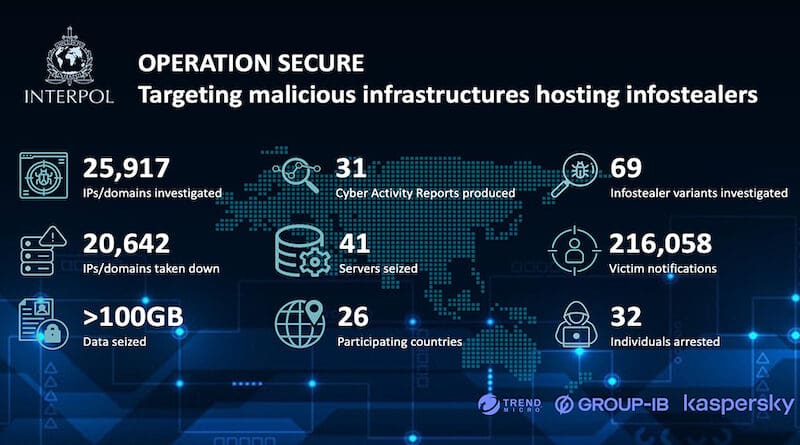
Operation Secure. Credit: INTERPOL


By 

More than 20,000 malicious IP addresses or domains linked to information stealers have been taken down in an INTERPOL-coordinated operation against cybercriminal infrastructure.


During Operation Secure (January – April 2025) law enforcement agencies from 26 countries worked to locate servers, map physical networks and execute targeted takedowns.

Ahead of the operation, INTERPOL cooperated with private-sector partners Group-IB, Kaspersky and Trend Micro to produce Cyber Activity Reports, sharing critical intelligence with cyber teams across Asia. These coordinated efforts resulted in the takedown of 79 per cent of identified suspicious IP addresses.

Participating countries reported the seizure of 41 servers and over 100 GB of data, as well as the arrest of 32 suspects linked to illegal cyber activities.

What are infostealers?

Infostealer malware is a primary tool for gaining unauthorized access to organizational networks. This type of malicious software extracts sensitive data from infected devices, often referred to as bots. The stolen information typically includes browser credentials, passwords, cookies, credit card details and cryptocurrency wallet data.

Additionally, logs harvested by infostealers are increasingly traded on the cybercriminal underground and are frequently used as a gateway for further attacks. These logs often enable initial access for ransomware deployments, data breaches, and cyber-enabled fraud schemes such as Business Email Compromise (BEC).


Following the operation, authorities notified over 216,000 victims and potential victims so they could take immediate action – such as changing passwords, freezing accounts, or removing unauthorized access.

Operational highlights

Vietnamese police arrested 18 suspects, seizing devices from their homes and workplaces. The group’s leader was found with over VND 300 million (USD 11,500) in cash, SIM cards and business registration documents, pointing to a scheme to open and sell corporate accounts.

House raids were carried out by authorities in Sri Lanka leading to 12 arrests and the identification of 31 victims.

The Hong Kong Police analysed over 1,700 pieces of intelligence provided by INTERPOL and identified 117 command-and-control servers hosted across 89 internet service providers. These servers were used by cybercriminals as central hubs to launch and manage malicious campaigns, including phishing, online fraud and social media scams.

Neal Jetton, INTERPOL’s Director of Cybercrime, said: “INTERPOL continues to support practical, collaborative action against global cyber threats. Operation Secure has once again shown the power of intelligence sharing in disrupting malicious infrastructure and preventing large-scale harm to both individuals and businesses.”

POLYCRISIS

Is This What Collapse Looks Like? – OpEd

file photo dystopian futuristic police state Image: Grok


By 

What is happening to the world? It’s a question being asked with growing urgency around the globe. Wars rage on, systems and institutions are faltering; divisions of all kinds, including widening inequalities, are deepening—heightening the risk of conflict. The environmental emergency is accelerating, and uncertainty reigns, fuelling a global mental health epidemic.


Is poor leadership and geopolitical mismanagement at the root of our problems—or are we witnessing the slow, perhaps inevitable, collapse of civilisation itself?

Civilizations do not collapse overnight, but unravel over centuries as established systems, values, and ways of living decay. The underlying structures—economic, political, social, ecological—gradually fracture, until the mechanisms that once held everything together can no longer absorb the strain.

As pressures such as extreme inequality and ecological breakdown reach critical thresholds, tipping points are triggered—points beyond which reversal becomes impossible, at least in the short to medium term. Despite this, warning signs are routinely ignored, deferring action to an imagined future, when things will miraculously improve.

The refusal to respond proportionately to the risk ensures that systemic failure—and in some cases, outright collapse within particular domains—is virtually inevitable. Such breakdown often results from a system’s carrying capacity being exceeded—the point beyond which it can no longer sustain existing levels of demand, tension, or pressure. Once that threshold is crossed, the only remaining question is when collapse will occur, not if.

While breaching carrying capacity may be the structural trigger for collapse, the deeper causes are more complex and multi-layered: a toxic mix of hubris, ideological rigidity, denial of stark realities, systemic inertia—and, arguably, deeper energetic shifts. Today, these dynamics are reinforced by political complacency and corporate influence/power, ensuring the survival of unjust systems—no matter the cost.


Crisis Cascade

The consequences of entrenched resistance to change—and the arrogance that fuels it—are now starkly visible: multiple systems are under extreme stress, many of them either approaching or already breaching their carrying capacity.

Critical areas, themselves symptomatic of deeper systemic pressures, include social injustice/exploitation, economic inequality, armed conflict, and mass displacement, while the environmental emergency stands out as the defining existential threat of our time. Key planetary boundaries—from biodiversity to climate stability—are being crossed, bringing irreversible tipping points dangerously close.

Economic inequality is intensifying, spiralling debt traps entire populations in cycles of generational hardship, and poverty is becoming endemic—from low-income households in the West to indebted nations across the Global South.

These and other conditions are feeding a series of interconnected fires: social unrest, widespread psychological distress, deepening political polarisation, and the rise of far-right extremism. Exploitative, dangerous politicians are being empowered, while civic trust, institutional credibility, and the foundations of democracy continue to erode.

In parallel, armed conflicts persist, and the legal and moral frameworks meant to govern warfare are being flagrantly disregarded—nowhere more so than in Israel, where the state is committing grave violations of international humanitarian law, including genocide against the Palestinian people.

These crises are not separate or isolated. They are interwoven, each reinforcing the next, accelerating the risk of cascading breakdown. Climate change and ecological stress destabilise economies; economic exclusion and systemic injustice fuel extremism, division, and violence—driving displacement and mass migration. Institutional fragility compounds political inaction, paving the way for authoritarianism and the collapse of democratic norms.

Transitional times

While the scale and interconnectedness of today’s challenges are unprecedented, civilisational breakdown itself is not new.

From Rome to the Maya and Mesopotamia, history reveals societies that underwent seismic transformation—events often painful, yet ultimately generative. Such collapses acted as a kind of clearing agent, creating space for new forms to emerge: evolving social orders, cosmologies, and ways of living that more closely reflected the needs of a changing epoch.

There are myriad signs suggesting we may be experiencing the birth pangs of such a global transition—a profound shift with the potential to reimagine civilisation and transform human consciousness.

Yet resistance to change remains fierce—entrenched powers cling to fading worldviews and obsolete systems, rather than adapt to emerging realities or create the space for transformative thought. And with resistance comes conflict: the old must give way to the new—or as one wise voice put it, “The old bottles must be broken; the new wine deserves better.”

The clash between progressive forces seeking transformation and those clinging to power is no abstraction—it is expressed daily in competing values, visions, and worldviews, with divisions growing more polarised year by year. Since the fall of the Soviet Union, the global landscape has been shaped by two opposing currents.

One is a rising tide of people demanding change—calling for justice, equality, ecological repair, and a reimagining of how we live. From the Arab Spring to Occupy, from climate marches to Black Lives Matter, this is the powerful voice of a world community desperate for new ways of living.

The other is a shrinking but determined reactionary minority, which in many cases holds political and corporate power. Wedded to outdated structures and backward-looking worldviews, they are increasingly resorting to extreme tactics to maintain the cruel, unjust status quo and the dysfunctional systems that underpin it.

These reactionary elites—age-old deniers to progress, justice and equality—are not merely indifferent to change; they are actively hostile to it. Their resistance is not only ideological but existential, driven by the recognition that the collapse of the old order threatens their power and control.

In their attempts to preserve decaying systems and suppress the inevitability of transformation, they deepen the crises destabilising our world. As a result, instead of a peaceful, evolutionary transition from one age or civilisation to another, we face conflict and division—an existential battle, the outcome of which will shape the future for generations to come.


Graham Peebles

Graham Peebles is an independent writer and charity worker. He set up The Create Trust in 2005 and has run education projects in India, Sri Lanka and Ethiopia where he lived for two years working with acutely disadvantaged children and conducting teacher training programmes. Website: https://grahampeebles.org/


Five Challenges For South Korean President Lee Jae-Myung – Analysis

South Korea's President Lee Jae-myung. Photo Credit: Tasnim News Agency


By 

By Dr. Sandip Kumar Mishra


Lee Jae-myung became the 21st President of South Korea on 4 June 2025 after a tumultuous six months for South Korean politics, which began with the sudden announcement of emergency martial law by the previous President Yoon Suk-yeol on the night of 3 December 2024. Although martial law was withdrawn within six hours as the National Assembly rejected the decision, the process of President Yoon Suk-yeol’s impeachment and the election of a new leader were cumbersome. Once the Constitutional Court of South Korea approved the impeachment on 4 April 2025, the whole process of choosing a new leader was completed within two months.

The Democratic Party of South Korea, which enjoys a comfortable majority in the National Assembly, was swift in choosing its candidate for president, but the People’s Power Party (PPP) took longer to get it done. In post-martial law South Korea, the People’s Power Party hasn’t been able to decide if it should fully distance itself from Yoon Suk-yeol or not. The dilemma has created a gap between their formal pronouncements and their actual behaviour.

However, election results show that despite martial law, factionalism in the PPP, and the late announcement of the presidential candidate, PPP candidate Kim Moon-soo was able to get 41.15 per cent of the votes. This means that most of the support bases of the PPP remain loyal. The election results also show that South Korean men in their 20s and 30s are feeling discontented with the Democratic Party along with the older generation which generally supports the conservative party.

After assuming the president’s post, Lee Jae-myung has talked about the need to unite a divided South Korean society. He has promised to communicate more with opposition party leaders and people, and has also promised greater cooperation and transparency in the making and implementation of policies. However, the task ahead is not easy. His pledges of constitutional reform and reforming the judiciary and the prosecutor’s office as well as instituting a two four-year term limit on the presidency will be challenging. The Democratic Party, because of its comfortable majority in the National Assembly, will try to take up all these issues, leading to political contestation with the opposition PPP. Uniting the Korean people and political reform will be the first challenge for Lee Jae-myung.

The second challenge for Lee Jae-myung will be revitalising the sluggish economy. He said that he considers it the most important task ahead. South Korea’s growth rate in 2025 is projected to be 0.8 per cent. For several years, the country’s growth rate has been slow and the ‘citizen economy’ needs to be dealt with urgently. Lee has already created a task force to address it. It remains to be seen how he will bring back economic vitality to South Korea’s export-led economy when many regions of the world are facing military conflict.


The third big challenge for Lee Jae-myung will be to determine how to engage with China in the economic domain while moving closer to South Korea’s military ally, the US. With the US, Lee Jae-myung has to resolve tariff issues that are looming large. He also has to convince Trump to maintain the status quo in cost-sharing for American soldiers stationed in South Korea. The US may demand more active participation from South Korea in areas of contestation with China and Russia. Lee Jae-myung may do so, but he will likely be less loud than his predecessor.

The fourth challenge for Lee Jae-myung will be to determine his approach towards North Korea. His party and he have been in favour of engagement with North Korea, but at present North Korea doesn’t appear keen. North Korea has a more sophisticated missile and nuclear inventory than in the past, is relatively less isolated after the mutual defence agreement with Russia last year, has also officially abandoned the goal of unification, and designated South Korea as a “hostile state.” Immediately after coming to power, Lee put a stop to the broadcasting of propaganda loudspeakers at the border and also wanted to stop sending propaganda balloons to North Korea. North Korea responded positively to his moves by also stopping North Korean loudspeakers, but moving forward would be a test of the president’s resolve, tactfulness, and sincerity.

The fifth challenge will be to maintain and improve relations with Japan. Usually, under progressive presidents in South Korea, except Kim Dae-jung, South Korea’s relations with Japan have deteriorated. Lee Jae-myung has to show he is a leader like Kim Dae-jung, who can build good relations with Japan as well as with other regional countries.

In brief, the new president of South Korea faces formidable domestic and foreign policy challenges. That said, Lee Jae-myung is considered a pragmatic, sharp, decisive, and hardworking leader, and he will certainly try to deal with these challenges positively.

  • About the author: Dr. Sandip Kumar Mishra is Professor at the Centre for East Asian Studies in SIS, JNU, and Distinguished Fellow, IPCS.
  • Source: This article was published by IPCS


IPCS

IPCS (Institute for Peace and Conflict Studies) conducts independent research on conventional and non-conventional security issues in the region and shares its findings with policy makers and the public. It provides a forum for discussion with the strategic community on strategic issues and strives to explore alternatives. Moreover, it works towards building capacity among young scholars for greater refinement of their analyses of South Asian security.


The Swiss Mountain Village That Inspired A Nobel Prize And Digital Governance – Analysis

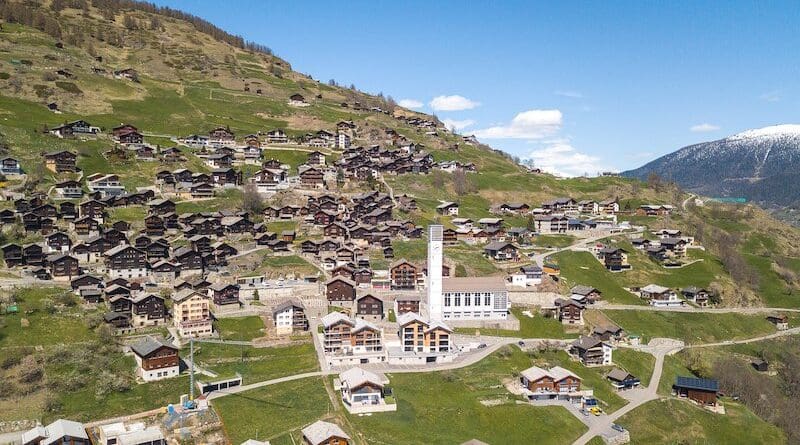
Törbel, Switzerland. Photo Credit: Daniel Reust, Wikipedia Commons


By 

Törbel is a small Swiss mountain village that has attracted the attention of international scientists. Their findings on how mountain farmers utilise water and pastures are shaping the way science addresses collective digital resources today. 


By Benjamin von Wyl 

In 1483, Swiss farmers who lived in a mountain village concluded a contract on water and pasture utilisation. This has proven so sustainable that open-source advocates from the Mozilla Foundation, known for its web browser Firefox, today want to apply the same principles to shared digital resources, or what are called “digital commons” today.

How did this come about?

Large meadows and forests in many regions of modern-day Switzerland have been managed collectively by local populations for over 500 years. In mountain regions in particular, these corporations and communities still manage common agricultural areas, known as Allmenden (in German), according to clear rules and sustainable principles.

Farmers did exactly this for centuries in the southern Swiss Alpine village of Törbel in canton Valais. Törbel is famous among scientists not least because of the 1483 treaty.


Why an anthropologist headed to a Swiss mountain village

One expert called it “the over-researched village” when speaking to Swissinfo. Scientists from Zurich were the first to show an interest in Törbel. But in 1970, the American Robert McC. Netting arrived. “Why is an anthropologist and Africanist going to Alpine Switzerland?” He was often asked this question, according to his book, Balancing on an Alp.

In the ten years between his first visit and the publication of his book, Netting spent about one and a half years in the village, but also “one summer in a windowless university office”, where he filled index cards with the data about the lives of those who had dwelt in Törbel over the centuries.

The “village universe is not very big, even if you extend it to three centuries”, he writes in Balancing on an Alp. This manageable cosmos was one of the reasons why the Africanist, who had previously researched the Kofyar in northern Nigeria, was drawn to Törbel. Netting was interested in how a small-scale farming community forms an ecosystem with its environment.

His book describes many facets of a fairly homogeneous community. In Törbel, Netting says, for at least the last seven centuries “there was no resident aristocracy or landowning class, only a few full-time craftsmen or merchants, and no recognisable group of landless workers”. It was purely a farming village.

Women from the outside could marry in and become villagers, but the priest was always an outsider, Netting reports; even political orientation was passed down from father to son in the Törbel microcosm. Netting was interested in many aspects of community life. But above all, his research showed how the people of Törbel lived with their environment and practised agriculture, in which common land played a major role. Since the treaty of 1483, the collective use of meadow, forest and water channels was clearly regulated.

Elinor Ostrom and her principles for common goods

This also awakened the interest of Elinor Ostrom, a political scientist. Ostrom was awarded the Nobel Prize in Economics in 2009 for Governing the Commons: The Evolution of Institutions for Collective Action. In her work, which was published in 1990, the American developed criteria for the successful management of common goods.

Törbel is the first, fundamental case study in her book. Ostrom also scrutinised Japanese mountain villages, Spain and the Philippines. Everywhere she went, she discovered systems through which communities found a sustainable way of dealing with common goods – be it with millions of hectares of land in the villages of Hirano, Nagaike and Yamanaka, or the water court of Valencia.

Ostrom wrote in 1990 that analysing case studies could provide a deeper understanding of how people shape “situations within which individuals must make decisions and bear the consequences of actions taken on a day-to-day basis”.

Her research has given the tradition and lore of Törbel a place in the world. It has made the people of Törbel bearers of knowledge that could make living together better elsewhere.

Before that, the consensus was that if several owners farmed the same property, everyone wanted to maximise their share, and they would thereby overexploit the common property. However, Ostrom derived principles from her research that prevent common goods from being exhausted and the “tragedy of the commons” from taking its course. These include clear boundaries between users and non-users of the commons, as well as harmonisation with local social and ecological conditions.

Rural corporations, urban cooperatives

Törbel is a rural community. According to the historian Daniel Schläppi, however, these communal corporations have more similarities with left-wing, urban co-operatives than either side realised – at least until Olstrom’s research was published.

It is not only the open-source advocates of the Mozilla Foundation who are committed to collective resources on the Internet and studying Ostrom’s findings, but also the International Cooperative Alliance and, with it, co-operative enterprises all over the world.

‘Pillars of Switzerland’

Ostrom’s principles were recently called “pillars of Switzerland” by Swiss Environment Minister Albert Rösti.

In May 2025, the agronomist and politician from the right-wing conservative Swiss People’s Party spoke at the Association of Swiss Corporations about Törbel and how it had served as a model for the conditions under which communities with collective property can function.

Rösti drew a comparison between the clear rules demanded by Ostrom and the Swiss constitutional state. He linked these “clear boundaries” with “sovereignty and independence”. The way communities organise themselves and make participatory decisions aligns with direct democracy in Switzerland, he said. The fact that local circumstances are taken into account is what “we call federalism”, the minister said.

Corporations are still an important player in the modern economy, but they have also shaped the “principles of our state”, he added. Switzerland would not exist “in its current form” without the “long history of corporations”.

The openness of the people in Törbel

Another reason these “pillars of Switzerland” have become part of world science is that the people of Törbel were open to scientists 50 years ago. Netting was a “devoted friend to us simple mountain dwellers”, said a letter from Törbel to Netting’s wife.

For Ostrom, the village held a big reception in 2011. The economist Bruno S. Frey, who still finds Ostrom’s research groundbreaking today, remembered a “parade with an orchestra through the village” in a conversation with Swissinfo.

It was a special moment for Ostrom, who died in 2012. She told Frey this after the ceremony in Törbel. To date, Ostrom is the only woman to have been honoured with the Nobel Prize in Economics.

Scientists look to the future with Törbel

Today, a new generation of scientists is in the village. Part of a Horizon Europe project in Törbel is currently investigating how rural regions could overcome “depopulation and a growing digital divide compared to urban areas” and become “Rural Innovation Ecosystems”.

Mariana Melnykovych, who heads the project, told Swissinfo that it is the “enduring, well-documented community organisations that are still functioning today” that keep scientists coming to Törbel. She and her team want to work with the same approaches as Netting in Törbel, but also incorporate innovations and the changing climate. Ostrom’s research also played a role in the choice of Törbel.

“Törbel is a small place with a big impact,” Melnykovych said. Researchers would be able to observe here how “rural communities adapt to change while preserving fundamental social and ecological values.”

She and her team are not just looking back into the past. “It’s about finding out how a village rooted in history masters the future, with its people, its knowledge and its intact community assets,” said Melnykovych.


SwissInfo

swissinfo is an enterprise of the Swiss Broadcasting Corporation (SBC). Its role is to inform Swiss living abroad about events in their homeland and to raise awareness of Switzerland in other countries. swissinfo achieves this through its nine-language internet news and information platform.