It’s possible that I shall make an ass of myself. But in that case one can always get out of it with a little dialectic. I have, of course, so worded my proposition as to be right either way (K.Marx, Letter to F.Engels on the Indian Mutiny)
Wednesday, July 02, 2025
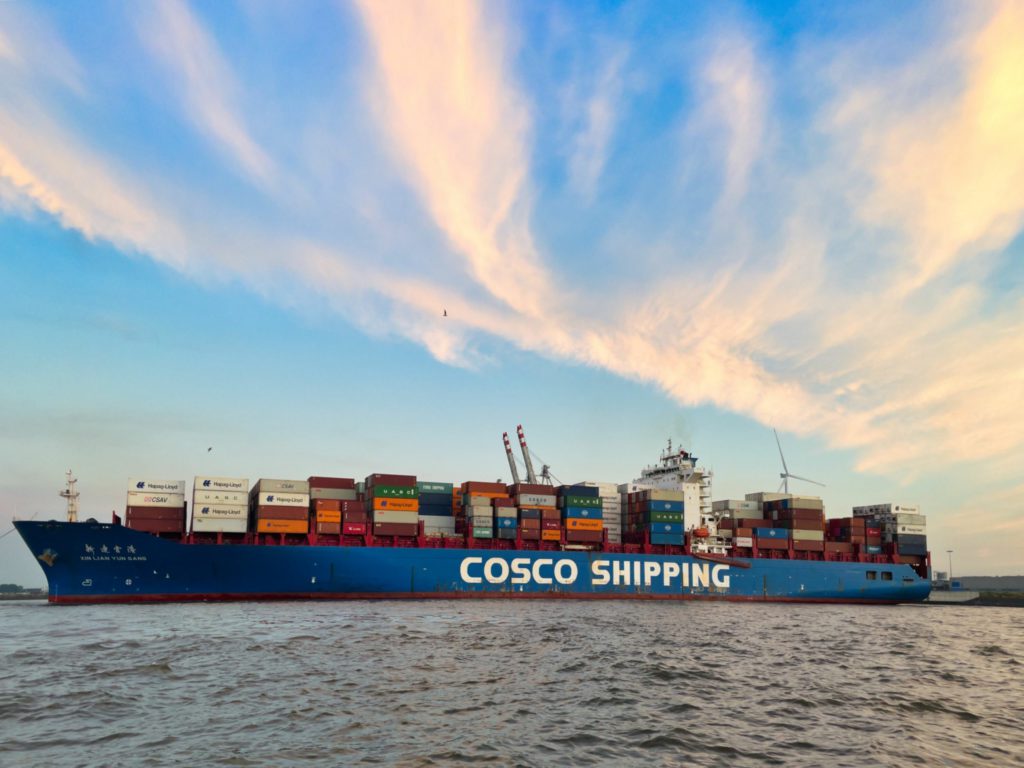
BHP contracts COSCO for two ammonia-powered vessels
BHP (ASX, LSE: BHP) announced Wednesday it has signed contracts with COSCO Shipping Group for the charter of two ammonia dual-fuelled bulk carriers for transporting iron ore from Western Australia to Northeast Asia.
The new vessels to be built under this arrangement will be two of only a handful of vessels in the world capable of using ammonia as a marine fuel, the Australian miner said.
According to COSCO, ammonia is one of the most promising marine fuels with zero-carbon potential. Its ammonia-powered Newcastlemax vessels will stand at the forefront of technological and environmental advancement for the broader dry bulk sector.
The charter contracts for the two vessels are expected to run for five years, with first delivery anticipated from 2028.
BHP estimates that the vessels could greenhouse gas (GHG) emissions by at least 50% and up to 95% on a per voyage basis compared to a conventionally fuelled voyage, and it expects them to contribute towards a reduction in the GHG emissions intensity of the company’s chartered shipping.
This announcement represents an important step toward lowering GHG emissions in the iron ore seaborne market and moving the maritime sector towards a decarbonized future, BHP stated, adding that it should also strengthen the demand for lower or low to zero GHG emissions marine fuels.
These contracts will also contribute to BHP’s commitment as part of the First Movers Coalition, that by 2030, 10% of the group’s total products shipped to its customers using the company’s time charter vessels be shipped using zero GHG emissions fuels.
Longstanding relationship
BHP said it selected the Chinese state-owned COSCO following a rigorous expression of interest process, which evaluated safety, technical and commercial considerations. The two companies have a longstanding relationship and will work closely together alongside key regulatory bodies to ensure the vessels are delivered and operated safely.
Meanwhile, BHP continues to work with the maritime industry to develop an ammonia bunkering plan – the process of fuelling ships with ammonia – for the two vessels when they are delivered from 2028. Sourcing lower and low to zero GHG emissions ammonia is subject to an ongoing tender process.
“This is an exciting moment for BHP, COSCO Shipping and the maritime sector,” Emma Roberts, BHP’s vice-president of maritime and supply chain excellence, stated in a press release. “Together we are contributing to the industry’s ambition towards abatement of maritime greenhouse gas emissions through these first-generation ammonia dual-fuelled vessels.”
“The contracts we are signing today—for two 210K DWT ammonia dual-fuel bulk carriers—are part of more than just a project to enable alternative marine fuels,” COSCO Shipping vice president Ji Lin said. “It also reflects the real progress being made to the Australia–China Green Shipping Corridor.”
“Looking ahead, COSCO Shipping will continue to work closely with BHP to help accelerate the transition to net-zero shipping, scale up innovation, and help shape a more sustainable and resilient global supply chain,” Lin added.
Coal used to make steel gets break in Trump’s tax bill
Monongalia County coal mine in West Virginia. (Stock image by Steve Konya II.)
Coal used to make steel got a break in the latest version of President Donald Trump’s tax bill, a subsidy that could be worth hundreds of millions of dollars over 10 years for a fuel that is mostly exported to countries including China.
In April, Trump signed executive orders that directed Chris Wright, the energy secretary and former fracking CEO, to determine whether metallurgical, or met, coal is a “critical mineral” which he did in May.
In the latest version of Trump’s so-called One Big Beautiful Bill that the Senate released over the weekend, met coal can claim an advanced manufacturing production tax credit, available for critical minerals, that would pay 2.5% of costs for the fuel.
Sonia Aggarwal, CEO of Energy Innovation, a non-profit group, called allowing met coal to get the credit insane, as it could harm efforts to move to fuels that are less carbon-intensive.
The subsidy would “send hundreds of millions of taxpayer dollars to China to subsidize dirty steel,” Aggarwal said in a post on X.
Robbie Orvis, a director of analysis at Energy Innovation, estimated that the credit could be worth $300 million to met coal producers sending coal to China over ten years and said the subsidy could help China compete with US-made steel.
Giving met coal the critical mineral classification, typically reserved for minerals needed for high-tech defense systems, could also set the table for Trump’s use of emergency powers to raise production.
Conor Bernstein, a spokesperson for the National Mining Association, said the bill supports US jobs, manufacturing and the economy. “Providing incentives to spur steel-making coal production accomplishes each of those objectives.”
The Metallurgical Coal Producers Association of West Virginia did not immediately respond to requests for comment about how the tax credit would benefit producers.
West Virginia, one of the top US mining states, has suffered several met coal layoffs in recent months hitting hundreds of miners. In local media, Ben Beakes, the president of the West Virginia met coal association, has blamed the layoffs on inflation.
(By Timothy Gardner; Editing by Marguerita Choy)
Private Equity Firm Takes Control of Louis Dreyfus and Names New CEO
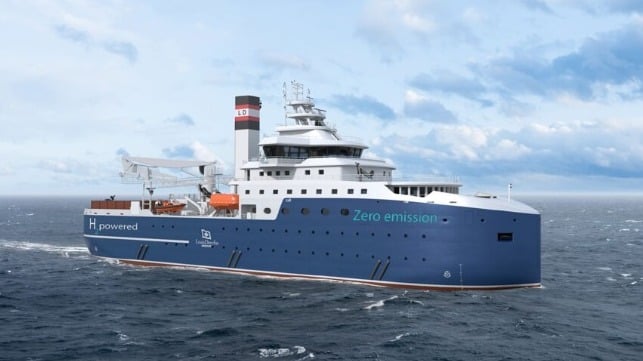
LDA recent received design approvals for its next-generation liquid hydrogen-powered SOC (LDA)
France’s Louis Dreyfus Amateurs, which today is focused on offshore services, cargo and port operations, and logistics, has been sold to private equity investment group InfraVia Capital Partners. The companies had announced in February that the Louis-Dreyfus family was negotiating to sell the majority of its holdings and that it would be an opportunity to grow the operations.
InfraVia reports that one of its funds has acquired an 80 percent stake in LDA with the family continuing to hold the remaining 20 percent. The business, which traces its origins to 1890 and had remained in the family, will now be renamed LD Armateurs with Samira Draousa named the new CEO, while Edouard Louis-Dreyfus will remain as president.
The new owners are promising to invest €1 billion (nearly $1.2 billion) in the company over the coming years. The companies had said when first announcing the discussions that the investment called for more than doubling the current fleet. LDA operates 23 vessels including RoRo vessels and offshore support ships to provide maintenance of offshore wind farms, and installation and maintenance of submarine telecom and power cables.
“This investment will enable the group to more than double its fleet and accelerate its growth in technological innovation, energy transition, and the development of next-generation maritime services and navigation modes,” the companies said, announcing completion of the sale.
Overseeing the new company will be Samira Draoua, who becomes the chief executive officer of LDA. She has a long career spanning finance, digital transformation, and maritime operations. She was serving as CEO of Econocom France, an IT consulting firm. Also at the group, she was president of Les Abeilles International, a tug and offshore services company that was providing salvage and rescue services to the French government. Les Abeilles was sold in 2024 to Boluda.
LDA has been in the maritime business for more than 100 years, when it started with a small fleet of grain feeders navigating on the Sea of Azov and the Black Sea under the Russian flag. After the First World War and the Russian Revolution, the company transitioned in the 1920s to a fleet of ocean-going cargo ships and more recently, added RoRo, offshore, and port logistics. The last of the cargo ships was sold in the early 2020s.
LDA has become a leader in offshore services, realizing the opportunities in the sector. It expanded to offshore wind services as the sector emerged. It recently unveiled designs for a floating offshore ammonia cracking platform and its next-generation design for a liquid hydrogen-fueled service operations vessel (SOV) for servicing offshore operations.
HMS Prince of Wales Continues Extended Pacific Voyage
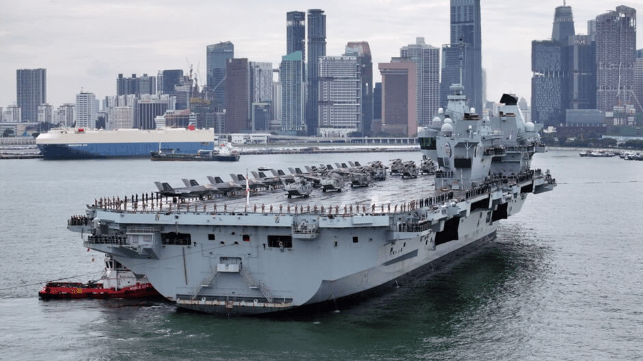
HMS Prince of Wales docks at Singapore’s new Marina Bay Cruise Centre (RAF)
The UK-led carrier strike group led by HMS Prince of Wales (R09), has now left Singapore after a week-long port visit, and is heading further east to Indonesia, a series of Australian-led exercises, and then northwards past Taiwan to South Korea and Japan.
The multinational group escorting the flagship now comprises the Canadian Halifax Class frigate HMCS Ville de Quebec (F332), New Zealand ANZAC Class frigate HMNZS Te Kaha (F77), Norwegian Nansen Class frigate HNoMS Roald Amundsen (F311), Spanish Álvaro de Bazán Class frigate ESPS Mendez Nunez (F104), Type 45 destroyer HMS Dauntless (D33) and Type 23 frigate HMS Richmond (F239), with logistic support provided by RFA Tidespring (A136). There will also no doubt be an Astute Class submarine shadowing the CSG.
With some vessels of the CSG splitting off to make other port calls in the area, the focus of the visit to Singapore has been defense diplomacy and technological cooperation, reinforcing the UK’s commitment to the Five Power Defence Arrangement, a mutual defense treaty organization created in 1971 between Australia, Malaysia, New Zealand Singapore and the United Kingdom,
The CSG will participate this month in the Australian-led Exercise Talisman Sabre 2025, which involves US forces and other multinational partners, and training in all three land, air and sea operational environments. HMS Prince of Wales will be calling in at Darwin as part of the exercise.
The CSG will then head north to exercise with and make port calls in South Korea and Japan, with the focus en route being on which elements of the CSG will exercise rights of navigation through international waters in the Taiwan Strait.
Meanwhile, the Royal Air Force F-35B from HMS Prince of Wales which made a forced landing on June 14 at Thiruvananthapuram in Kerala remains under repair, now attended to by a specialist tow vehicle and 40 UK engineers flown out from the UK to fix the aircraft’s hydraulic systems. The classification of the F-35Bs systems has inevitably been a concern, with the Indian press noting that the aircraft’s pilot, identified as ‘Flight Lieutenant Mike’, had remained in the cockpit for an extended period after touching down while security arrangements were put in place.
The Indian authorities, who are believed to be interested in an F-35 purchase, would inevitably have a keen interest in the F-35’s technical systems. But UK authorities were assured that the stealth aircraft would be safe from prying eyes, with one local commenting that the aircraft was likely to better guarded in India than in the UK, where protestors found it easy to enter the RAF largest airbase at Brize Norton last week and damage a parked aircraft.
Report: Iran Loaded Out Naval Mines in Preparation to Close Hormuz
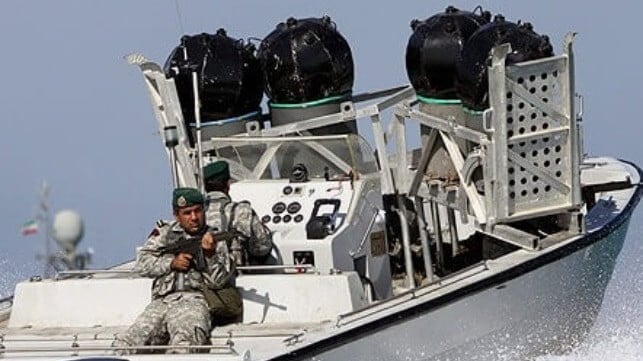
Iran's naval forces were loading up mines in preparation for a possible closure of the Strait of Hormuz, two U.S. officials told Reuters this week. The closure would have been damaging to Iran's own diplomatic and economic interests, and never occurred, but the mine loadout may suggest that Iranian leadership was actively considering the option.
Mine warfare would be one of Iran's most potent options for causing havoc for its Western adversaries. The Strait of Hormuz handles about 20 percent of the world's oil and LNG, along with an increasing volume of containerized trade for the GCC states. Even a partial shutdown would disrupt trade and send the price of oil north of $100 per barrel, according to Goldman Sachs.
Targeted attacks are one possibility for Iran, which has an array of anti-ship ballistic missiles, drones, cruise missiles, and suicide drone boats to bring to bear on maritime targets. But mines offer something more. They are comparatively cheap, easy to deploy, hard to remove and psychologically intimidating. A tethered mine or bottom mine is undetectable to most vessels, so to a crew, the threat could be anywhere. And when one does go off, it is harder to place blame on the offending party, since the vessel that laid the mine has already long since departed.
If Iran had wanted to use its mines in the strait, it would have had a large stockpile to draw on. Iran possesses about 5-6,000 naval mines of various types, including Russian-made MDM-6 bottom mines and powerful Chinese-made EM-52 rocket-propelled mines. It can deploy them covertly with its mini-submarine fleet or less subtly with its surface vessels. Gav Don, a former British naval intelligence officer, told BNE that marine insurers would suspend coverage for the strait if it were mined, forcing tankers to go to anchor and bringing traffic to a halt.
Iran has used mines on traffic in the strait before. During the Iran-Iraq Tanker War in the late 1980s, Iran deployed sea mines to target U.S. Navy convoys in the Persian Gulf and Strait of Hormuz, prompting a comprehensive U.S. military response. After an Iranian mine nearly sank the frigate USS Samuel B. Roberts, the U.S. Navy retaliated with Operation Praying Mantis - a comprehensive strike that sank one frigate, one gunboat and three speedboats, destroyed two oil platforms and left another frigate badly damaged. More than 50 Iranian servicemembers were killed.
India’s Mazagon Shipbuilders to Acquire Colombo Dockyard
India’s state-owned Mazagon Shipbuilders has revealed its proposed acquisition of a controlling stake in Sri Lanka’s Colombo Dockyard. If successful, this will become the first international acquisition by an Indian yard, at a time the country is intensifying efforts to capture a bigger share of the global shipbuilding market.
The deal is valued at $52.96 million, representing at least 51 percent equity in Colombo Dockyard. This stake was earlier held by Japan’s Onomichi Dockyard, which announced plans to divest the ownership in December. Mazagon said that it has signed an agreement with Onomichi, giving a green light on acquisition of its stake. The deal is awaiting statutory and regulatory approvals, added Mazagon in a stock exchange filing on Friday.
Colombo Dockyard is Sri Lanka’s largest shipbuilding and repair facility. However, the yard has been experiencing financial difficulties, exacerbated by losses made on some shipbuilding contracts struck at lower prices before the Covid pandemic. In 2023, the company declared its worst financial performance, with a record loss of about $38 million. On the other hand, Mazagon is almost debt-free and reported revenue of $1.13 billion for the year ended March 2025.
According to Mazagon managing director Capt. Jagmohan, the acquisition of Colombo Dockyard will expand his company’s presence in the Indian Ocean region, strengthening its ability to serve global maritime clients. With over 50 years of experience in shipbuilding and repair, Colombo Dockyard has been able to build a global client base, including major European shipowners. Its current order pipeline is worth $300 million.
The Colombo deal is part of a major expansion drive by Mazagon, which holds the title of India’s top warship and submarine builder. Mazagon has said that its expansion initiative is guided by its growing order book. In a recent earnings call, the company indicated that it is seeing significant tailwinds for defense and commercial shipbuilding owing to the current geopolitical situation. Mazagon projects that its order book will cross $10 billion by 2026 from its current $3.7 billion.
Convicted Pirate Gets Another Three Years in Prison for 2017 Attack
A convicted pirate leader has had another three years added onto his sentence for a kidnapping in the Gulf of Guinea in 2017 - a rare example of a court proceeding for a pirate from the Niger Delta.
The story of the arrest of Itoruboemi Benson Lobia begins in earnest in 2018, when he led the hijacking of the Dutch-owned freighter FWN Rapide off the coast of Port Harcourt. At Lobia's instruction, the gang kidnapped 11 members of the crew, injuring one with gunfire and causing organ damage to another due to untreated malaria. After a month of negotiations, operator ForestWave talked the pirates down to a final ransom payment of $340,000, a cost reduction of more than 80 percent compared to the criminals' original demand.
After the kidnapping, Dutch authorities decided to go after Lobia. Using inquiries about his knowledge of piracy and dangling the possibility of a job, they lured him to fly to Johannesburg - where he was promptly arrested on an Interpol warrant. He was extradited to the Netherlands to stand for a vanishingly-rare criminal trial for piracy.
The Rotterdam District Court found Lobia guilty of acting as the leader of the hijacking gang, and he was sentenced to a term of 8.5 years in Dutch prison for the FWN Rapide attack.
However, it turned out that the FWN Rapide was not the only ship he had hijacked. The year before, in 2017, he had been involved in the kidnapping aboard the German-operated cargo ship BBC Caribbean in the Gulf of Guinea. In that earlier hijacking, Lobia and his gang abducted eight seafarers and brought them back into the remote waterways of the Niger Delta. After a month of negotiations, the hostages were ransomed for an undisclosed sum.
Meanwhile, three crewmembers remained aboard BBC Caribbean, and they navigated all the way to safety in Las Palmas. On arrival, the ship was searched; among other evidence, police collected a cigarette butt that carried Lobia's DNA, prosecutors said. Crewmembers also testified that they recognized his distinctive dolphin-shaped necklace from the hijacking.
Last year, Lobia was charged a second time for the attack on the BBC Caribbean. This month, the district court in Rotterdam found him guilty and sentenced him to another three years in prison. This was less than the 5.5 years that Dutch prosecutors requested, in part because the judge took Lobia's original motive - poverty - into account.
GAO Finds Opportunities for Improvement in MARAD's Shipyard Programs
The Government Accountability Office has completed a review of MARAD's promotional programs for shipbuilding, and has found room for improvement - primarily in goal-setting and tracking. Ever under-resourced, MARAD carries out its statutorily-mandated programs but does not always have internal goals for what these programs should accomplish - nor has it likely been asked by anyone before GAO arrived. GAO also found that there may be room for improvement in the Small Shipyard Grant program, with potential to enlarge it and to increase its transparency.
The Small Shipyard Grant program awards minor federal support funding to yards, typically totaling about $10-20 million per year. The number of applications outstrips the supply of funding, and so MARAD staff use a scoring system to weigh the merits of each application. After rating about 100 factors per project, they pick the best candidates and present them to the Maritime Administrator (or acting administrator) for final approval.
The administrator decides which applicants get grants, which are typically small sums in the range of $300,000-$1 million - not enough for a full modernization, but enough to buy a crane or train a new cohort of apprentices. But the reasons for picking projects are not written down or presented to the successful shipyards, GAO said, nor do unsuccessful applicants find out why their project was turned down (at least not in a formal, documented way).
"While grantees have benefitted . . . the Maritime Administration cannot determine to what extent the Small Shipyard Grant program is achieving its intended outcomes because it does not have measurable goals and does not assess the performance of the program," GAO found. "A better understanding of the impact of the Small Shipyard Grant program could help inform the Maritime Administration’s broader efforts to support the U.S. maritime industry."
GAO also recommended writing down the reasons why each grant is approved or disapproved in order to make the process more transparent and consistent. It has previously made the same recommendation for all of the Department of Transportation, MARAD's parent agency.
A bigger Small Shipyard Grant program could help struggling yards to modernize, GAO found. In a survey of shipbuilders conducted for the study, 92 out of 105 reported that their outdated infrastructure impeded efficiency, and 89 out of 105 said that it was hard to finance infrastructure improvements with private capital. "Expanding the Small Shipyard Grant program could allow shipyards to invest more in new equipment, according to nine out of 10 industry groups and shipbuilding or repair companies that discussed the program with us," GAO reported.
In its review of MARAD's twin newbuild financing programs, the Capital Construction Fund Program and the Construction Reserve Fund Program, GAO found that recent statutory changes have made them both about the same. They are both run by the same staffers at MARAD, a total of two people, and at least one owner uses the programs interchangeably. GAO recommended merging the programs to reduce duplication.
Workforce woes
Beyond MARAD, GAO also took input from shipbuilders in a general survey about market conditions, and relayed familiar news about the availability of willing and capable workers. "Boom-and-bust" shipbuilding has made it difficult to retain good welders and shipfitters, and now the industry is competing with service-sector employers too. "One shipyard representative said that at one point, the shipyard had 1,000 employees, but now that number is down to 200, in part because younger generations are not getting into the shipbuilding and repair industry," GAO reported.
The agency also took the time to talk to foreign officials in the UK, Singapore and South Korea, and all reported a hard time recruiting young people. Unlike the United States, Singapore and South Korea use foreign guest workers to round out their payrolls, subject to percentage limits.
A consistent government procurement program would help smooth out the boom-and-bust cycles for American shipbuilders, participants told GAO. These could include American-made newbuilds for the aging Ready Reserve Fleet, as proposed and funded in the FY2024 budget for MARAD. To further stimulate fleet growth, GAO held up the example of the multi-billion-dollar procurement programs in South Korea and Canada, and called for setting specific goals for vessel construction numbers and types.
Huntington Ingalls Tries Out AI to Fight Schedule Delays
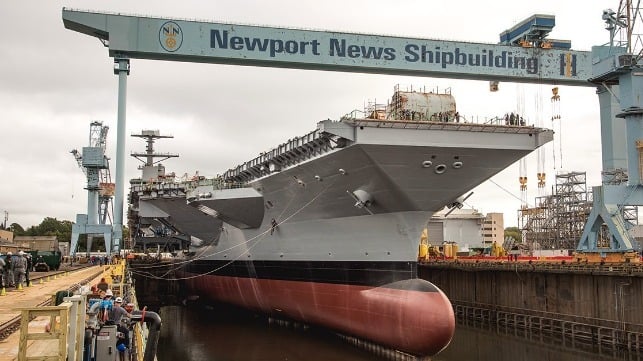
Launch of USS John F. Kennedy (CVN 79) in 2019. The Navy confirms that Kennedy will miss its latest revised delivery date in 2025, and a new date has not been provided (USN)
Huntington Ingalls Industries' shipbuilding programs for the U.S. Navy face significant delays, particularly for the Ford-class aircraft carrier program, which is running years behind. To speed up work, HII is working with publicly-listed enterprise AI company C3 AI to put advanced algorithms behind the wheel for its yards' work scheduling and planning.
HII and C3 tried out a six-month trial production deployment program at Ingalls Shipbuilding, the yard that builds all U.S. Navy amphibs and most Arleigh Burke-class destroyers. During the trial, C3's agentic enterprise AI systems adjusted and optimized work schedules for Ingalls. The platform showed significant improvements in schedule performance, HII said - significant enough that the shipbuilder now wants to scale it up across all of its yards.
HII also runs Newport News Shipbuilding, the only builder of nuclear-powered carriers in the world and one of two builders of the U.S. Navy's Columbia-class and Virginia-class submarines. Both Ingalls and NNS will now begin using C3 AI for planning and scheduling for their programs.
"This collaboration underscores our growing role as a strategic provider to the U.S. government and defense sector,” said Thomas M. Siebel, Chairman and CEO, C3 AI. “By deploying Enterprise AI across planning, operations, and the supply chain, we are powering a modern, intelligent infrastructure to ensure America’s edge in naval readiness.”
The handful of shipyards that build surface combatants and subs for the U.S. Navy are under scrutiny, and Acting CNO Adm. James Kilby reports that all of the service's newbuild programs are now behind schedule. "We are behind in every ship class [by] different rates, but at least years," Kilby said.
All shipbuilding contracts are under review, Navy Secretary John Phelan said earlier this year. Two big contracts - the next follow-on order for the Constellation-class frigate and the much-discussed block buy for two future Ford-class carriers - are not funded in the Navy's proposed FY2026 budget.
U.S. Navy Budget Request Leaves Out Next Constellation-Class Frigate
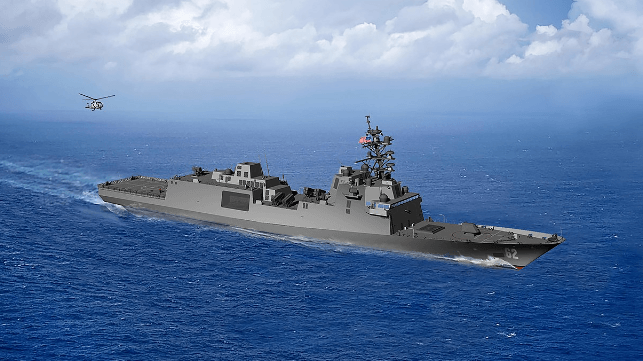
Each year's proposed Navy budget gets a lot of attention for what's in and what's out, but this year has some big surprises. The next order for a Constellation-class frigate is zeroed out - no frigates are in the budget request. But the Pentagon has asked Congress to set aside $1.7 billion for on-water autonomous systems, along with $730 million for underwater autonomous capabilities.
A senior Navy official told DefenseScoop that the unmanned line items include "new efforts in unmanned undersea and in unmanned surface, to include procuring our medium unmanned surface vessel [MUSV]."
GAO reports that the Navy is consolidating its two ship-like unmanned surface vessel programs, the MUSV and the larger LUSV. The plan, GAO reported earlier this month, is to start development of a single hull design under a major capability acquisition pathway by FY2027.
The news for the manned fleet is mixed. Fleet size would remain the same under the budget, but the much-delayed Constellation-class frigate program appears to be facing an executive-level decision, according to USNI: Pentagon officials told the outlet that "the Trump administration has not yet decided whether it will move forward" with the frigate.
The Constellation-class faces a long list of challenges. Originally intended as a quick and low-risk adaptation of an existing French-Italian design, the program office opted to alter about 85 percent of the vessel, lengthening it and changing its internal arrangements so that it has little in common with the original. It is running three years behind schedule, the design is not yet complete, and it is on track to deliver about 13 percent overweight, according to GAO; if not corrected, this would reduce margin for future system installations, and could affect performance. The shipbuilder's costs also appear to have gone up, though the Navy has not released the amount of the yard's requests for payment adjustment.
This budget is a one-year request without a 30-year plan, and does not forecast future-year carrier acquisitions - like a much-discussed block buy for the fifth and sixth Ford-class hulls. But it does include $600 million for advanced procurement for the fifth hull, a signal that the Pentagon is committed to the program. Also on the plus side for the carrier (and submarine) industrial base, the proposed budget includes no less than $2.5 billion for "nuclear shipyard productivity enhancements."
U.S. Navy is Using AI to Plan Out Drone Swarm Operations
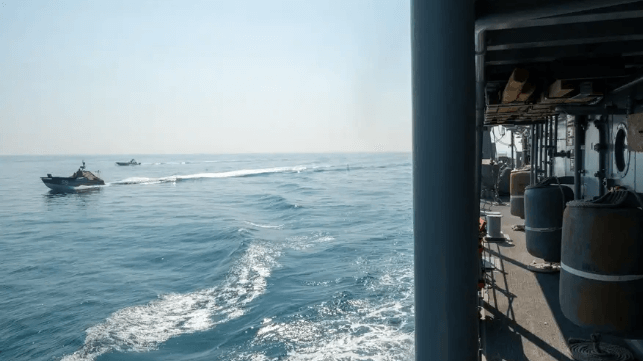
Drone boats operating alongside a Navy minesweeper in the Arabian Gulf last year (USN)
Drones are already playing a key role in combat at sea, as seen in the Black Sea and in the recent Red Sea crisis. Leading navies are investing in drone technology in all domains, and are learning how to orchestrate drone capabilities to work together to maximum effect. In the U.S., Naval Air Warfare Center Aircraft Division (NAWCAD) is using AI to plan out the actions of unmanned air, surface and subsurface assets all at once.
NAWCAD's newly-developed Optimized Cross Domain Swarm Sensing (OCDSS) software system helps Navy operational planners set up unmanned swarms for success. The new program simulates different combinations of aerial, surface and subsurface drones and sensors to achieve various mission objectives. The software was trialed at the NSWC Port Hueneme Coastal Trident exercise last year.
“OCDSS quickly runs thousands of simulations to predict how different unmanned systems might perform together,” said NAWCAD Mechanical Engineer Raymond Koehler, OCDSS’ lead software developer. "OCDSS levels-up how unmanned systems are used in a wide range of missions, and we’re ready to scale this autonomy to operational teams or test programs across the Navy and Marine Corps."
For his contributions to swarm autonomy, Koehler won an "emergent engineer" award from the Assistant Secretary of the Navy in 2025, and his team won a command-level award for the same project.
The technology could find application in the Navy's new push towards unmanned systems at sea. It would dovetail with procurement efforts aimed at large numbers of hulls, like the Defense Innovation Unit's Production-Ready, Inexpensive, Maritime Expeditionary (PRIME) Small Unmanned Surface Vehicle program, which aims to deliver attritable small craft that could chase down a target vessel.
The PRIME project goes beyond current state-of-the-art in drone boat operations. Ukraine's drone boats can attack targets at long range and high speed, but only with a human operator in control by satellite uplink. DIU wants to develop an unmanned surface vessel system that can "operate in cohesive groups and execute complex autonomous behaviors that adapt to the dynamic, evasive movements of the pursued vessel" on its own, even if the remote connection to a manned control center is lost. A software-driven "collaborative intercept capability" is a stated goal.
Regional Ban on Scrubber Wash Among Environmental Steps Adopted by OSPAR
White vapor is a telltale sign of scrubbers in use to clean a vessel's exhaust (Allan Jordan)
Representatives from 16 countries meeting in Virgo, Spain, announced today, June 27, that they had adopted the first regional ban on the discharge of scrubber wash water among a series of new environmental actions. NGOs hailed the action, which expands on localized bans, but said the ministers failed to take the action far enough to the full extent of territorial seas.
Ministers expressed serious concern about hazardous discharges from all types of exhaust gas cleaning systems aboard ships. Activists such as the NGO Seas at Risk contend scrubbers, which use seawater to wash sulfur from a vessel’s exhaust, discharge wash that contains contaminants including polycyclic aromatic hydrocarbons and heavy metals. The NGO was advocating for a total ban on the discharge into all coastal waters.
“Turning air pollution into ocean pollution is not an acceptable trade-off,” said Maarten Verdaasdonk, Project Manager, North Sea Foundation. “It is vital that all OSPAR Members support the proposal to extend the ban to territorial waters, especially as cleaner, widely available alternatives exist. Such a ban will improve water quality and protect marine life in the coastal areas of the entire North-East Atlantic.”
The members adopted a two-stage ban starting with the wash from open-loop scrubbers starting in July 2027 for the region known as the North-East Atlantic, covering the coastline from Spain to Norway and west to Greenland. Further, while closed-loop scrubbers produce less volume, it however also contain hazardous material, so the ministers adopted a discharge ban on this wash water to be in effect by January 2029.
The ban as adopted, however, only covers internal waters and the areas in and around ports. The NGO wanted the ban on all territorial waters within the 12 nautical mile range from the coastline. OSPAR members agreed to discuss the range of the ban in 2027 after receiving further studies on the impact in territorial seas.
The ban is seen as a critical action as the shipping industry looks to all methods to extend the life of ships and meet emerging environmental regulations. With the strict emissions regulations already adopted, many ships installed scrubbers to continue the use of less expensive sulfur fuels, and many new ships are being built with a range of exhaust wash systems.
The minister took other actions, including expanding the organization's maritime area by over 2.5 million square kilometers. They are going to include the waters of Macaronesia, the Azores, Madeira, and the Canary Islands. They said it would bring additional biodiversity-rich areas under OSPAR protection while recognizing the importance of regional cooperation.
Other decisions included new actions on marine litter, a ban on plastic pollution from pontoons and buoys, and a new regional plan on underwater noise. They also moved to strengthen protection in the Arctic, including beginning to identify potential Marine Protected Areas. They also reiterated their 1998 statement not to treat the seas as a dumping ground and reiterated the requirement to remove disused offshore installations.
OSPAR was formed in the 1970s coming from UN-sponsored conventions in Oslo and Paris to reduce marine pollution. The member countries include Belgium, Denmark, Finland, France, Germany, Iceland, Ireland, Luxembourg, Netherlands, Norway, Portugal, Spain, Sweden, Switzerland, and the United Kingdom.
Hanwha Ocean to Build New Polar Research Vessel for South Korea
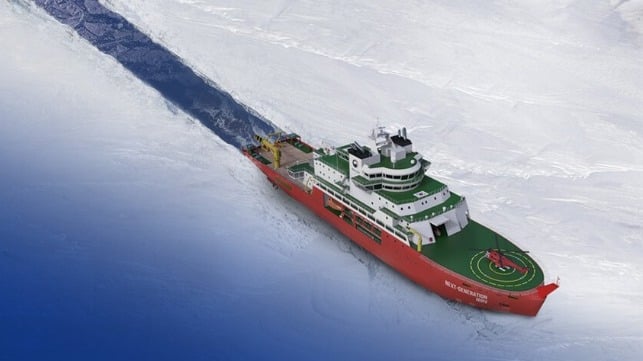
Korea selected Hanwha Ocean to build a larger, more capable polar research vessel (Hanwha Ocean)
Hanwha Ocean has been selected as the preferred bidder for the construction of a new government-owned polar research vessel. The contract comes as more nations race to expand their presence in the polar regions, which the shipyard notes is creating a new business opportunity.
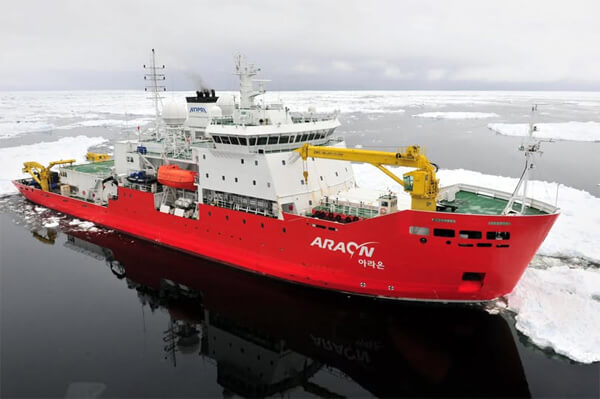
Korea built its first polar research vessel, Araon (6,950 GT), starting in 2008 and at Hanjin Heavy Industries and commissioned the vessel in 2012 for year-round polar research between the Arctic and Antarctic. The vessel was built at a cost of over 100 billion won (US$74 million at current exchange rates). It can accommodate 85 people, including 25 crew and 60 researchers, and has 25 key pieces of research equipment.
The vessel has a range of 17,000 nautical miles and can break flat ice of 1 meter thickness at a speed of 3 knots. It carries 31 TEU for equipment and supplies. It is currently completing regular maintenance and will soon depart for the Arctic, where it will remain till September. After another quick overhaul, it will depart in October and remain till April 2026 in Antarctica.
Korea has operated Araon for more than a decade as its first polar research vessel (KOPRI)
The Ministry of Oceans and Fisheries led the search for a shipyard to undertake the project for the next-generation vessel, which will be operated by the Korea Polar Research Institute. Hanwha Ocean was selected and the government expects to complete a contract this month. Design work will begin for the new vessel, which will be completed by December 2029 to expand Korea’s polar research efforts.
Hanwha Ocean reports that the next-generation icebreaking research vessel will have a total tonnage of 16,560 tons, more than twice that of the Araon. It will be equipped with an LNG dual-fuel electric propulsion system, and will be a PC (Polar Class) 3 vessel with a bidirectional icebreaking capability that can break through 1.5 meter thick ice, and has a cold resistance of -45 degrees Celsius. For the comfort and productivity of the staff working on board, the project calls for the accommodations to be designed to the standards of a “top-class passenger ship.”
Korean officials stress the importance of adding the new vessel as the scope of research capacity expands, caused by changes in the polar environment. Hanwha Ocean notes the increasing interest in the polar regions for commercial operations. Japan recently launched its first dedicated ice-class Arctic research vessel while India announced an agreement with Norway and Japan for its first polar research vessel.
The shipbuilder, which was formerly Daewoo Shipbuilding and Marine Engineering, highlights that it began working on icebreaking designs in 2008 in anticipation of the possibility of the Arctic route. It became a leader in icebreaking LNG carriers, having built a total of 21 vessels, including 15 in 2014 and six in 2020.
Hanwha Ocean plans to devote more effort to the research and construction of icebreakers. It sees emerging opportunities in the capability as a possible future growth engine for the business.
Korea’s move in the sector comes as others, including Canada and Finland, look to leverage their capabilities in icebreaking ship construction. The Trump administration continues to highlight the U.S.’s desire for more icebreaking vessels, which is seen as a potential driver for the market.