Friday, July 04, 2025

'An Act of Retaliation': EPA Suspends 140+ Employees for Signing 'Declaration of Dissent'

The employees were put on leave after they signed a letter saying the Trump EPA's actions "endanger public health and erode scientific progress."
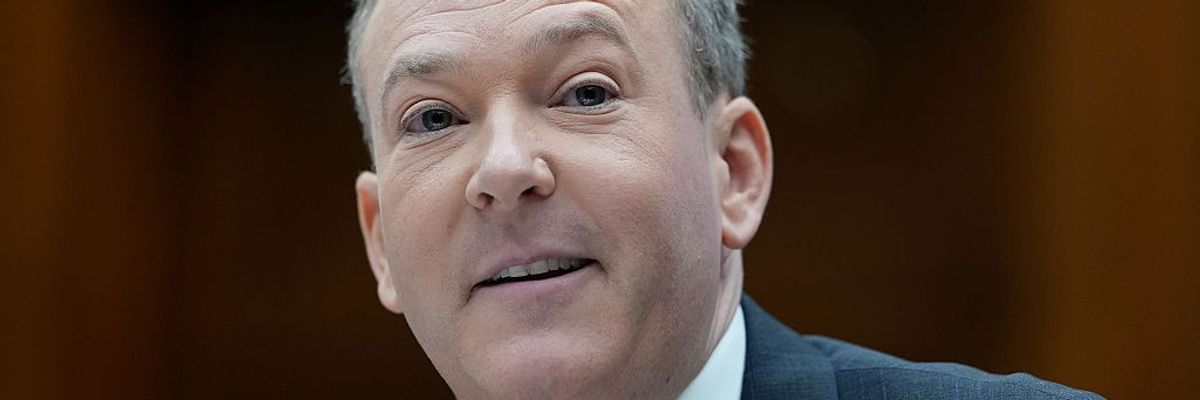


Environmental Protection Agency (EPA) Administrator Lee Zeldin testifies before the House Committee on Energy and Commerce Subcommittee on Environment in the Rayburn House Office Building on May 20, 2025.
(Photo: Kevin Dietsch/Getty Images)


Stephen Prager
Jul 04, 2025
COMMON DREAMS

The Environmental Protection Agency (EPA) has put 144 employees on leave after they signed a letter criticizing the Trump administration's "harmful" policies.

EPA press secretary Brigit Hirsch accused the employees of "undermining, sabotaging, and undercutting the administration's agenda." But the union that represents these employees is calling it an act of illegal "retaliation."

The "declaration of dissent", published by Stand Up for Science Monday, had been signed by 620 people as of Thursday. Addressed to EPA Administrator Lee Zeldin, the letter accused the administration of "recklessly undermining" the agency's mission under his watch. It accused the administration of "ignoring scientific consensus to benefit polluters."

"This administration's actions directly contradict EPA's own scientific assessments on human health risks, most notably regarding asbestos, mercury, and greenhouse gases," the letter said.

Since Trump retook office, the administration has eviscerated policies meant to contain pollution, slashing funding for green energy production and electric vehicles while championing increased fossil fuel drilling and consumption. It has also rolled back the enforcement of limits on cancer-causing "forever chemicals" in water.

The signatories also pointed to the Trump EPA's "undermining of public trust" by using official channels to trumpet "misinformation and overtly partisan rhetoric."

They called out EPA press releases, which have referred to climate science as a "religion," EPA grants as "green slush funds," and "clean coal" as "beautiful." The letter also suggested the EPA had violated the Hatch Act by promoting political initiatives like Trump's tariffs and the Republican budget reconciliation bill.

"Make no mistake: your actions endanger public health and erode scientific progress—not only in America—but around the world," the letter said.

The employees also accused the administration of "promoting a culture of fear." They cited comments by top Trump officials, such as Office of Management and Budget Director Russell Vought, who has said he wanted to put EPA employees "in trauma" and make them unable "to go to work because they are increasingly viewed as the villains."

While some signatories signed their names, many others chose to remain anonymous for fear of retaliation. That retaliation came Thursday, when—according to The New York Times—144 employees received an email putting them on leave for the next two weeks "pending an administrative investigation."

The decision was widely criticized as a violation of the employees' First Amendment rights.

Tim Whitehouse, the executive director of Public Employees for Environmental Responsibility, which has previously represented EPA and other employees, said federal employees are allowed to publicly criticize the administration they work for.

"The letter of dissent did really nothing to undermine or sabotage the agenda of the administration," Whitehouse told The Washington Post. "We believe strongly that the EPA should protect the First Amendment rights of their employees."

Bill Wolfe, a former environmental policy professional with Public Employees for Environmental Responsibility, said that the letter "was a classic form of whistleblowing that is protected by federal whistleblower laws and the 1st Amendment, as upheld by federal courts."

Justin Chen, the union representative for EPA employees under the American Federation of Government Employees, told the Times that the agency's actions were "clearly an act of retaliation" and said the union would "protect our members to the full extent of the law."

Despite the punishment, one of the signatories anonymously told The Post that they had no regrets.

"I took the risk knowing what was up," the employee wrote. "I'll say it before, and now it rings even more true … if this is the EPA they want me to work for, then I don't want to work for the EPA."
'Highly Inspiring' Court Ruling Affirms Nations' Legal Duty to Combat Climate Emergency

"While the United States and some other major polluters have chosen to ignore climate science, the rest of the international community is advancing protections," said one observer.


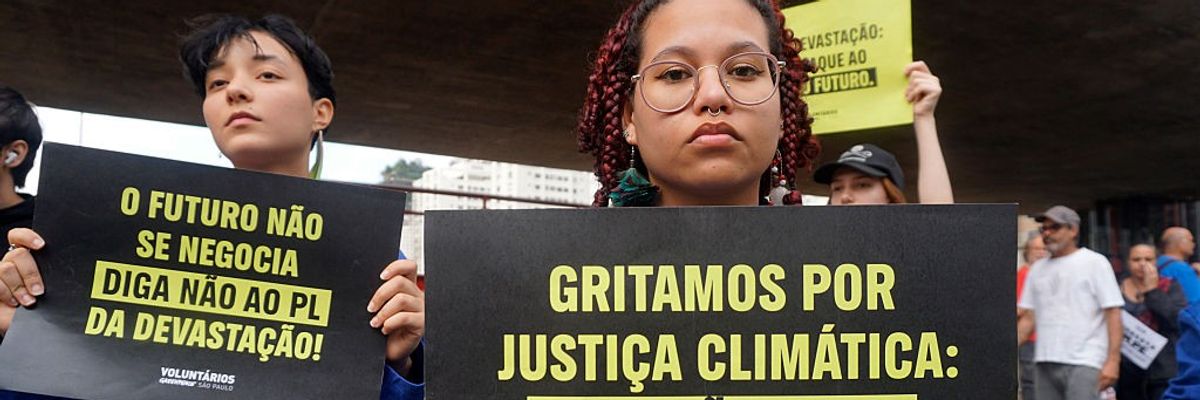
Climate defenders, including a young woman with a sign reading, "We are crying for climate justice," protest in São Paulo on June 7, 2025.
(Photo: Faga Almeida/UCG/Universal Images Group via Getty Images)


Brett Wilkins
Jul 04, 2025
COMMON DREAMS

In a landmark advisory opinion published Thursday, the Inter-American Court of Human Rights—of which the United States, the world's second-biggest carbon polluter, is not a member—affirmed the right to a stable climate and underscored nations' duty to act to protect it and address the worsening planetary emergency.

"States must refrain from any conduct that reverses, slows down, or truncates the outcome of measures necessary to protect human rights in the face of the impacts of climate change," a summary of the 234-page ruling states. "Any rollback of climate or environmental policies that affect human rights must be exceptional, duly justified based on objective criteria, and comply with standards of necessity and proportionality."

"The court also held that... states must take all necessary measures to reduce the risks arising, on the one hand, from the degradation of the global climate system and, on the other, from exposure and vulnerability to the effects of such degradation," the summary adds.

"States must refrain from any conduct that reverses, slows down, or truncates the outcome of measures necessary to protect human rights in the face of the impacts of climate change."

The case was brought before the Costa-Rica based IACtHR by Chile and Colombia, both of which "face the daily challenge of dealing with the consequences of the climate emergency, including the proliferation of droughts, floods, landslides, and fires, among others."

"These phenomena highlight the need to respond urgently and based on the principles of equity, justice, cooperation, and sustainability, with a human rights-based approach," the court asserted.

IACtHR President Judge Nancy Hernández López said following the ruling that "states must not only refrain from causing significant environmental damage but have the positive obligation to take measures to guarantee the protection, restoration, and regeneration of ecosystems."

"Causing massive and irreversible environmental harm...alters the conditions for a healthy life on Earth to such an extent that it creates consequences of existential proportions," she added. "Therefore, it demands universal and effective legal responses."

The advisory opinion builds on two landmark decisions last year. In April 2024, the European Court of Human Rights ruled that the Swiss government violated senior citizens' human rights by refusing to abide by scientists' warnings to rapidly phase out fossil fuel production.

The following month, the International Tribunal for the Law of the Sea found in an advisory opinion that greenhouse gas emissions are marine pollution under the United Nations Convention on the Law of the Sea and that signatories to the accord "have the specific obligation to adopt laws and regulations to prevent, reduce, and control" them.

The IACtHR advisory opinion is expected to boost climate and human rights lawsuits throughout the Americas, and to impact talks ahead of November's United Nations Climate Change Conference, or COP30, in Belém, Brazil.

Climate defenders around the world hailed Thursday's advisory opinion, with United Nations High Commissioner for Human Rights Volker Türk calling it "a landmark step forward for the region—and beyond."

"As the impact of climate change becomes ever more visible across the world, the court is clear: People have a right to a stable climate and a healthy environment," Türk added. "States have a bedrock obligation under international law not to take steps that cause irreversible climate and environmental damage, and they have a duty to act urgently to take the necessary measures to protect the lives and rights of everyone—both those alive now and the interests of future generations."

Amnesty International head of strategic litigation Mandi Mudarikwa said, "Today, the Inter-American Court affirmed and clarified the obligations of states to respect, ensure, prevent, and cooperate in order to realize human rights in the context of the climate crisis."

"Crucially, the court recognized the autonomous right to a healthy climate for both individuals and communities, linked to the right to a healthy environment," Mudarikwa added. "The court also underscored the obligation of states to protect cross-border climate-displaced persons, including through the issuance of humanitarian visas and protection from deportation."


Delta Merner, lead scientist at the Science Hub for Climate Litigation at the Union of Concerned Scientists, said in a statement that "this opinion sets an important precedent affirming that governments have a legal duty to regulate corporate conduct that drives climate harm."

"Though the United States is not a party to the treaty governing the Inter-American Court of Human Rights, this opinion should be a clarion call for transnational fossil fuel companies that have deceived the public for decades about the risks of their products," Merner added. "The era of accountability is here."

Markus Gehring, a fellow and director of studies in law at Hughes Hall at the University of Cambridge in England, called the advisory opinion "highly inspiring" and "seminal."

Drew Caputo, vice president of litigation for lands, wildlife, and oceans at Earthjustice, said that "the Inter-American Court's ruling makes clear that climate change is an overriding threat to human rights in the world."

"Governments must act to cut carbon emissions drastically," Caputo stressed. "While the United States and some other major polluters have chosen to ignore climate science, the rest of the international community is advancing protections for all from the realities of climate harm."

Climate litigation is increasing globally in the wake of the 2015 Paris climate agreement. In the Americas, Indigenous peopleschildren, and green groups are among those who have been seeking climate justice via litigation.

However, in the United States, instead of acknowledging the climate emergency, President Donald Trump has declared an "energy emergency" while pursuing a "drill, baby, drill" policy of fossil fuel extraction and expansion.


Inter-American court says states must protect people from climate change


By AFP
July 3, 2025


The Inter-American Court of Human Rights ruling means that around 20 countries across Latin America and the Caribbean must undertake legal reforms 'to reduce the risks arising... from the degradation of the global climate system' 
- Copyright AFP/File Olivier MORIN

The Inter-American Court of Human Rights ruled Thursday that countries belonging to the Organization of American States (OAS) have an obligation to take “all necessary measures” to protect populations from climate change.

The decision means that around 20 countries across Latin America and the Caribbean that recognize the court’s jurisdiction must undertake legal reforms that could increase the requirements imposed on businesses, something environmentists have long advocated.

“States must adopt all necessary measures to reduce the risks arising… from the degradation of the global climate system,” the Costa Rica-based court said in response to a request submitted by Colombia and Chile.

It underlined that “the right to a healthy environment” is included among the rights protected by the American Convention on Human Rights.

The court is an autonomous legal institution that interprets and applies the American Convention, which has been ratified by more than 20 countries including Argentina, Brazil, Chile, Mexico and Peru.

The court said countries must “adopt legislative and other measures to prevent human rights violations committed by state and private companies.”

“States must urge all companies domiciled or operating in their territory to adopt effective measures to combat climate change and its impacts on human rights,” it said.

The first government reaction to the decision came not from one of the OAS member states, but from the small Pacific island of Vanuatu, which hailed it as “groundbreaking.”

The ruling was also welcomed by environmentalists.

The Center for International Environmental Law (CIEL), which was involved in the case, said such “advisory opinions” were “authoritative statements of binding international law and carry substantial legal weight.”

“The court has broken new ground and set a powerful precedent,” said Nikki Reisch, the organization’s climate and energy program director.

“The court’s conclusions should put big polluters, like the fossil fuel industry, on notice: climate-destructive conduct violates the law.”

Viviana Krsticevic, executive director of the Center for Justice and International Law (CEJIL), said the ruling established “legally binding standards” for the protection of the right to a healthy environment.

Marcella Ribeiro, an attorney with the Interamerican Association for Environmental Defense, said that it was the first time an international court had “directly addressed climate change as a legal and structural human rights issue.”
CNN panel laughs after GOP strategist fails to define communism

Robert Davis
July 3, 2025 
RAW STORY


NewsNight with Abby Phillip on July 3, 2025 (CNN Screen shot)

The panel on CNN's "NewsNight with Abby Phillip" erupted with laughter after GOP strategist Scott Jennings failed to define communism after claiming New York Democrat Zohran Mamdani is a member of the political party.

Jennings' comments come at a time when the GOP is actively trying to brand Mamdani as a communist. Mamdani is a member of the Democratic Socialists of America and has said he wants to implement programs to provide free child care and transportation to New Yorkers.

Joel Payne, a Democratic strategist, asked Jennings why he thinks Mamdani is a communist.

"Because he uses the phrase 'seize the means of production,'" Jennings said.


The panel laughed as host Abby Phillip said, "That's not the distinction between socialism and communism."


Neera Tanden, CEO of the Center for American Progress, brought up the hypocrisy in Jennings' attacks. She mentioned that President Donald Trump controls the so-called "golden share" power in the U.S. Steel-Nippon deal, the Associated Press reported. That means Trump has the power to appoint a board member and make decisions about the business activities of the two companies following their merger.

"Can I just give an example of a person who has seized the means of production?" Tanden said. "It is a fascinating thing that the federal government has a stake now in a steel company. That has never happened before. It was actually Donald Trump who decided to have the government own the production of a company."

"Usually, conservatives would have criticized that, but I guess not anymore," Tanden added


Trump administration wants to expand anti-Nazi law to target critics: report


Tom Boggioni
July 4, 2025 
RAW STORY

Based upon a memo issued by the Justice Department last month, Donald Trump's administration wants to ramp up efforts to purge the country not only of undocumented immigrants but also naturalized citizens.

CNN is reporting that the president's DOJ has been examining ways to expand the scope of a law that will allow them "to target a much broader swath of individuals – anyone who may “pose a potential danger to national security.”

At the center of the argument is a seldom-used law that allowed the DOJ "to deport hundreds of people who assisted the Nazis" who hid their involvement.

According to the CNN report, "The directive appears to be a push towards a larger denaturalization effort that fits with the Trump administration’s hardline immigration policies. These could leave some of the millions of naturalized American citizens at risk of losing their status and being deported. "

That led Cassandra Burke Robertson, a law professor at Case Western Reserve University, to warn, "The politicization of citizenship rights is something that really worries me, I think it’s just flatly inconsistent with our democratic system," because it can be used to target critics of the president.

The report adds, "... current and former DOJ officials who spoke to CNN said that the beyond instructing lawyers to file as many denaturalization cases as possible, the memo is so broad that it could allow the Justice Department to invoke vague or unsubstantiated claims to expel people from the country."

You can read more here.
New Delhi says fuel ban on old vehicles not feasible


By AFP
July 3, 2025


The fuel restriction was introduced Tuesday to reinforce an already-existing but widely disregarded ban on petrol cars older than 15 years, and diesel vehicles older than 10 - Copyright AFP Arun SANKAR

Two days after India’s capital stopped fuel sales to ageing vehicles to tackle the sprawling megacity’s hazardous air pollution, authorities on Thursday said the ban was not practical.

New Delhi is regularly ranked as one of the most polluted capitals globally with vehicular emissions being one of the worst offenders, according to several studies.

At the peak of the smog, levels of PM2.5 pollutants — dangerous cancer-causing microparticles small enough to enter the bloodstream through the lungs — surge to more than 60 times the World Health Organization’s recommended daily maximum.

The fuel restriction was introduced Tuesday to reinforce an already-existing but widely disregarded ban on petrol cars older than 15 years, and diesel vehicles older than 10.

But Delhi’s environment minister, Manjinder Singh Sirsa, told reporters the fuel ban was not feasible because of “crucial issues related to technological glitches”.

Number plate-recognising cameras and loudspeakers installed at fuelling stations were “malfunctioning”, Sirsa said, leading to “fights and arguments”.

The ban had resulted in public “discontent”, he added.

Sirsa said he had written to the area’s pollution control authority, explaining the problems in implementing the ban.

“Unless there is a robust system and the ban is everywhere, it will not work,” he added.

The ban was to be extended to satellite cities around the capital, an area home to more than 32 million people, from November.

A study in The Lancet medical journal attributed 1.67 million premature deaths in India to air pollution in 2019.

Each winter, vehicle and factory emissions coupled with farm fires from surrounding states wrap the city in a dystopian haze.

Cooler temperatures and slow-moving winds worsen the situation by trapping deadly pollutants.

Piecemeal government initiatives, such as partial restrictions on fossil fuel-powered transport and water trucks spraying mist to clear particulate matter from the air, have failed to make a noticeable impact.
Ten years after Brazil mine disaster, pollution persists


By AFP
July 3, 2025


The Fundao tailings dam at an iron ore mine in Minas Gerais state was managed by Samarco, co-owned by BHP and Brazilian miner Vale 
- Copyright POOL/AFP/File Win McNamee

Olivier DEVOS

A decade after a dam collapsed in Brazil, sending a deluge of toxic mud into villages and waterways, residents complain of an inadequate cleanup and compensation by international mining firms.

The 2015 dam collapse which killed 19 people was one of Brazil’s worst environmental disasters, with survivors saying the Doce River region north of Rio de Janeiro remains heavily polluted.

“The entire ecosystem around the river was destroyed,” Marcelo Krenak, a leader of the Krenak Indigenous people, told AFP on the sidelines of a hearing in London held this week.

The hearing is part of a large-scale legal action brought by claimants seeking compensation from Australian mining giant BHP — which, at the time of the disaster, had one of its global headquarters in the UK.

“My people, the culture, has always been linked to the river,” Krenak said, wearing a traditional headdress with striking blue feathers.

“The medicinal plants that only existed in the river are contaminated, the soil is contaminated, so you cannot plant, you cannot use the river water for animals,” he added.

Following a mega-trial that concluded in March, the claimants now await a decision from the British High Court in the coming weeks regarding BHP’s liability for the disaster.

The Fundao tailings dam at an iron ore mine in Minas Gerais state was managed by Samarco, co-owned by BHP and Brazilian miner Vale.

The High Court is already preparing the second phase of the case to determine potential damages and compensation, which could begin in October 2026 if BHP is found liable.


– ‘Terrible tragedy’ –


The company told AFP that “the recovery of the Doce River, the water quality of which had already returned to pre-dam failure levels, remained a focus”.

Acknowledging the “terrible tragedy”, BHP said it is “committed to supporting Samarco to do what’s right by the Brazilian people, communities, organisations, and environments affected by the dam failure”.

BHP maintains that the compensation agreement it reached last year in Brazil — worth around $31 billion — provides a resolution.

However, a majority of the 620,000 claimants, including 46 municipalities, argue that they are not sufficiently covered by the deal and are instead seeking around £35 billion ($49 billion) in damages.

Krenak said the claimants will at a potential future hearing present “visual evidence, photos and videos of what was done, what caused it, and the damage it is causing to this day”.

The city of Mariana, one of the areas hardest hit by the disaster, is seeking 28 billion Brazilian real ($5 billion) in compensation.

“Our hope is that here in London, the municipality will be heard because, in Brazil, we were not heard,” Mayor of Mariana, Juliano Duarte, told AFP.

Duarte said he believes the British legal system will hold BHP accountable, which could pressure the company to negotiate directly with the claimants.

He said the municipality is “open” to negotiation but “will not accept crumbs like those that were offered in Brazil”.
Geerlings-Simons set to be Suriname’s first woman president


By AFP
July 3, 2025


Jennifer Geerlings-Simons casts her vote in Suriname elections - Copyright AFP/File Juan BARRETO

Opposition leader Jennifer Geerlings-Simons is set to become Suriname’s first woman president after her rivals decided Thursday against nominating their own candidate to lead the small South American country.

The move cleared the way for legislators to elect Geerlings-Simons, 71, in a vote scheduled for Sunday, after her party won the most seats in legislative elections in May.

The former Dutch colony of 600,000 inhabitants, one of the poorest countries in South America, is hoping that an oil boon will bring prosperity.

Geerlings-Simons’ National Democratic Party (NDP) won 18 of the 51 seats in congress, more than those of the centrist VHP party of outgoing president Chan Santokhi.

The NDP had already entered into an agreement with five other parties with which it jointly holds 34 seats in parliament.

The NDP was founded by former coup leader and autocrat-turned-elected-president Desi Bouterse, who died in hiding in December 2024.

Santokhi’s party had also hoped to form a coalition to remain in power, but said in a statement that it had decided not to oppose Geerlings-Simons’ election.

Parliament Speaker Ashin Adhin told reporters that the legislature had received only the NDP’s nomination, supported by 34 legislators, the necessary supermajority.

Suriname, a diverse country made up of descendants of people from India, Indonesia, China, the Netherlands, Indigenous groups and African slaves, marks its 50th anniversary of independence from the Dutch throne this November.

In recent years, it has looked increasingly toward China as a political ally and trading partner and, in 2019, became one of the first Latin American countries to join the Asian giant’s Belt and Road infrastructure drive.


South American bloc looks to Asia, Europe in face of Trump trade war

By AFP
July 3, 2025


Brazil's President Luiz Inacio Lula da Silva and Argentina's President Javier Milei pose for a photo at a Mercosur summit in Buenos Aires - Copyright AFP SAUL LOEB


Martin Raschinsky and Tomas Viola

South America’s Mercosur bloc sought Thursday to expand its markets in the face of US President Donald Trump’s global trade war, with Brazil calling for closer ties with dynamic Asian economies.

“It’s time for Mercosur to look toward Asia,” President Luiz Inacio Lula da Silva said, extolling the potential benefits of deeper relations with Japan, China, South Korea, India, Vietnam and Indonesia.

In a reflection of regional tensions, however, Argentina’s President Javier Milei threatened to go it alone if necessary to secure a free trade deal with the United States.

“We will embark on the path of freedom, and we will do so together or alone because Argentina cannot wait,” Milei warned, calling for “more freedom” to negotiate.

The libertarian leader, a huge fan of Trump, has made no secret of his disdain for Lula, referring to him in the past as “corrupt” and a “Communist.”

Lula, on his first trip to Argentina since Milei took office in December 2023, had no bilateral talks scheduled with the self-declared “anarcho-capitalist.”

The veteran Brazilian leftist, who took over Mercosur’s rotating presidency from his Argentine counterpart, has accused Milei of talking “nonsense.”

Lula said that under his leadership, Mercosur would aim to “strengthen inter-bloc trade with external partners” and to implement a landmark trade agreement with the European Union.

Brussels in December struck a deal with Mercosur’s founding members — Argentina, Brazil, Paraguay and Uruguay — to create a free trade zone of around 700 million consumers.

The agreement has been 25 years in the making, but still needs to be ratified by EU member states.

It has faced stiff opposition from France, where farmers worry about being undercut by less-regulated Latin American peers.


– Climate change on agenda –


Uruguayan President Yamandu Orsi said that it was now “time to resume negotiations with key partners such as South Korea and Canada.”

Uruguay has for decades sought a relaxation of the bloc’s rules, which prevent agreements with other countries without the consent of all partners.

Climate change, the energy transition, combating organized crime and promoting technological development would be Mercosur’s main objectives during the next six months, Lula said.

Steps were discussed to make progress on trade agreements with the United Arab Emirates and Canada, as well as update accords with Colombia, Ecuador, Panama and the Dominican Republic, and to advance regional gas integration.

On Wednesday, Mercosur foreign ministers announced a free trade agreement with the European Free Trade Association, made up of non-EU members Iceland, Liechtenstein, Norway and Switzerland.

Adding to the tense atmosphere surrounding the summit, Lula took the time to visit his ally Cristina Kirchner, the former Argentine president who is under house arrest.

Lula, who was granted permission by a court to see Kirchner, spent almost an hour at her apartment in Buenos Aires before leaving without speaking to supporters and journalists waiting outside.

Kirchner, the standard-bearer of the Argentine left for over two decades, was convicted of “fraudulent administration” while president between 2007 and 2015.

The 72-year-old, who says her trial was an attempt to silence her criticism of the right, began a six-year sentence last month after losing a Supreme Court appeal.

Brazil’s Lula vists Argentina’s Kirchner, under house arrest


By AFP
July 3, 2025


Brazil's President Luiz Inacio Lula da Silva leaves the home of former Argentine leader Cristina Kirchner in Buenos Aires on July 3, 2025 - Copyright AFP CRISTINA SILLE

Brazil’s President Luiz Inacio Lula da Silva visited left-wing ally Cristina Kirchner on Thursday in Buenos Aires, where the former Argentine leader is under house arrest, wishing her “the strength to continue fighting.”

Lula arrived at Kirchner’s home to the cheers of around 100 supporters of the former president.

He emerged almost an hour later, but did not speak to the crowd.

Kirchner, the standard-bearer of the Argentine left for over two decades, was convicted of “fraudulent administration” while president between 2007 and 2015.

The 72-year-old began serving a six-year sentence last month after losing a Supreme Court appeal, and has also been barred from holding public office again.

Lula found Kirchner “in good health, strong and determined to fight,” he said in a message on social media platform X.

“In addition to expressing my solidarity with her for everything she has been through, I wished her all the strength she needed to continue fighting, with the same determination that has characterized her career,” he wrote.

Kirchner hailed the visit as “much more than a personal gesture: it was a political act of solidarity,” in her own message on X.

She drew a parallel between her fate and that of Lula’s, describing how he also was imprisoned — in his case, for bribe-taking and money-laundering — before being voted back into office.

The meeting took center stage on Thursday at the biannual summit of the Mercosur regional bloc, made up of Brazil, Argentina, Uruguay, Paraguay, and Bolivia.

There, Lula was the guest of Argentina’s libertarian President Javier Milei — who has made no secret of his disdain of the leftist leader, previously branding him a “Communist” and “corrupt.”

The two had no bilateral meetings on Thursday.

Lula took over the rotating presidency of the bloc from Milei at the end of the summit.
UN expert says firms ‘profiting’ from ‘genocide’ of Palestinians


By AFP
July 3, 2025


A wide range of businesses had facilitated 'this machinery of erasure' said Francesca Albanese - Copyright AFP SAUL LOEB

UN rights expert Francesca Albanese on Thursday denounced companies she said “profited from the Israeli economy of illegal occupation, apartheid, and now genocide”, in a report that provoked a furious response from Israel.

Some of the companies named in her report also raised objections.

Albanese presented her report, investigating “the corporate machinery sustaining the Israeli settler-colonial project of displacement and replacement of the Palestinians”, to the UN Human Rights Council.

Companies should stop all business activities and relationships that caused or contributed to rights violations and international crimes, she argued.

In response, Israel’s mission in Geneva said Albanese’s report was motivated by her “obsessive, hate-driven agenda to delegitimise the state of Israel”.

It was “legally groundless, defamatory and a flagrant abuse of office”, it added.

Swiss mining and commodity trading giant Glencore, named in the report, also denounced her allegations as “unfounded”.


– Machinery of erasure’ –


Albanese is the UN’s special rapporteur on the rights situation in the Palestinian territories occupied since 1967.

She described the situation in the Gaza Strip and the West Bank as “apocalyptic” as she presented the report.

“In Gaza, Palestinians continue to endure suffering beyond imagination,” she added.

Businesses from arms makers to supermarkets and universities had facilitated “this machinery of erasure”, Albanese told the UN’s top rights body.

Some had supplied the financial and general infrastructure for Israeli settlements on occupied Palestinian territories, she said.

“All have helped entrench apartheid and enable the slow, inexorable destruction of Palestinian life.”

Her presentation Thursday was received with applause in the chamber.

But Albanese has faced harsh criticism, allegations of anti-Semitism and demands for her removal, from Israel and some of its allies, over her relentless criticism and long-standing accusations of “genocide”.

While appointed by the Human Rights Council she does not speak on behalf of the United Nations itself.


– ‘Profited from the violence’ –


Albanese told journalists she had contacted all 48 companies named in her report, entitled “From economy of occupation to economy of genocide”.

Eighteen had responded and “only a small number engaged with me in good faith”, most of them saying “there was absolutely nothing wrong”.

“There have been people and organisations who have profited from the violence, the killing,” she said.

“My report exposes a system, something that is so structural and so widespread and so systemic that there is no possibility to fix it and redress it: it needs to be dismantled.”

Albanese said the first responsibility to take action was on countries, then on companies, then their consumers.

However, “we are part of a system where we are all entangled and choices that we make… have an impact elsewhere”, she said.

“There is a possibility for consumers to hold these companies accountable, because somewhat we vote through our wallets.”


– ‘Unsubstantiated’ –


AFP sought a comment from several companies named in the report. Some did not respond.

Travel platform Booking.com said: “Our mission is to make it easier for everyone to experience the world and as such we believe it’s not our place to decide where someone can or cannot travel.”

A communications firm representing Microsoft said the tech giant “doesn’t have anything to share”.

Danish shipping giant Maersk said it disagreed with many of Albanese’s assertions.

Maersk “remains committed to following international standards for responsible business conduct”, it said.

Since the war between Israel and Hamas began, “we have maintained a strict policy of not shipping weapons or ammunition to Israel”, it added.

A Volvo Group spokesman told AFP: “We obviously respect human rights in accordance with the United Nations framework.

“We have no operations of our own, either in Palestine or in Israel, but rather sell through resellers,” he added.

Glencore, in its response, said: “We categorically reject all the allegations appearing in this report and consider them unsubstantiated and devoid of any legal basis.”

Hamas’s October 7, 2023 attack that prompted the Israeli offensive resulted in the deaths of 1,219 people, mostly civilians, according to an AFP tally based on Israeli official figures.

Israel’s retaliatory military campaign has killed at least 57,130 people in Gaza, also mostly civilians, according to the Hamas-run territory’s health ministry. The United Nations considers its figures reliable.

Israel has occupied the West Bank since 1967 and violence has surged in the territory since October 2023.

rjm-burs/vog/jj
Making connections in Myanmar’s fractured state


By AFP
July 3, 2025


Four years of civil war between Myanmar's military and its myriad opponents have shattered communications networks - Copyright AFP STR

In a riverine battleground in western Myanmar, an entrepreneur hunts for reception using a makeshift bamboo antenna, his payphone kiosk providing locals a lifeline to connect with their loved ones.

In commercial capital Yangon, a student flicks through apps that cloak his online identity so he can skirt social media bans that accompanied the 2021 coup.

And in the mountainous east, customers at an internet cafe feverishly scroll for news from the outside, dependent on Elon Musk-owned satellites.

Four years of civil war between Myanmar’s military and its myriad opponents have shattered communications networks.

In response, people have resorted to methods ranging from the old-fashioned to the ingenious to the hyper-modern.

“I don’t want to be cut off from the world,” Hnin Sandar Soe, 20, said at an internet cafe in eastern Karenni state where she reads headlines, studies online and reaches out to friends and family.

“It always brings a warm and comforting feeling to keep in touch with them.”


– Payphone lifeline –


Myanmar has been under military rule for most of its post-independence history, but a decade-long democratic thaw starting in 2010 was accompanied by an astronomical growth in connectivity.

That year, SIM cards cost $1,000 and fewer than five percent of the population owned a mobile phone, according to World Bank figures.

Seven years later, that figure was 82 percent, as citizens seized on the rapidly developing cellular networks and novelty of free speech.

But since the military toppled the civilian government and ignited the war, there has been a slide back into digital darkness.

The junta has banned a slew of apps, conflict has eviscerated infrastructure and blackouts are weaponised by all sides.

In western Rakhine state, where civil war has intensified long-running conflict, reliable communications are now a dim memory.

Witnessing his neighbours hiking hills for mobile signal, Saw Thein Maung founded an old-fashioned payphone business six months ago.

Today, he operates three phones wired to antennas on 10-metre (33-foot) poles that wobble in the wind above the delta town of Ponnagyun.

The business earns him a relative fortune of up to $23 a day as customers clamour to dial out.

“They don’t want to stop speaking with their children elsewhere. They don’t care how much they have to pay,” Saw Thein Maung said.

Customer Tun Lin, 27, uses the payphone to ring city-dwelling contacts to enquire about job openings.

“Making phone calls is the only way,” the unemployed former NGO worker said.


– Satellite solutions –


Activist group the Myanmar Internet Project (MIP) says there have been nearly 400 regional internet shutdowns since the junta takeover.

What it calls a “digital coup” has slowed emergency responses, hampered education and hobbled the economy.

“The public is experiencing hardship as a result of this insult added to injury,” said MIP spokesman Han, who goes by one name. “They are looking for all kinds of ways to resist.”

In Karenni state, an internet cafe with a glowing blue router offers an oasis of connectivity, bypassing restrictions by tethering to Musk’s Starlink satellite system.

The junta has not licensed the technology, meaning it is illegal to operate.

Cafe owner Marino had it smuggled over the border to his shop, where the cutting-edge web link contrasts with the corrugated roof and tarpaulin walls.

“We need the internet to know what is happening in our country or the world and if our friends are doing well or not,” he said.

Nearby, an elderly woman chatted on her phone and a gaggle of teens played online games.


– Dodging disconnection –


Major cities under junta control retain reliable internet, but Facebook, Instagram, X and WhatsApp — where opposition groups have typically organised — are all banned.

In Yangon, virtual private networks (VPNs) provide a way to dodge the bans.

After the junta started blocking VPNs last year, a whisper network rippled through the city, with people sharing free options that still function.

One week the best is 1.1.1.1, before JumpJumpVPN emerges as more popular, and then everyone moves to Now VPN.

But the junta security forces now conduct spot checks for VPNs, said one 23-year-old student, speaking on condition of anonymity because he uses the outlawed apps.

“Other countries have internet freedom and young people can learn freely,” he said. “It is different in our country where everything is restricted. I feel our rights are blocked.”

He remains undeterred. “We young people have a mindset that we will overcome any restrictions.”