Wednesday, July 09, 2025

Riots Are A Symptom Of The Statist Disease – OpEd

police law enforcement swat team

THE LIBERTARIAN ALTERNATIVE TO THE STATE 

IS PRIVATE INSURANCE CORPORATIONS


By 

By Landen Terrell


Once again, rioters have taken to the streets of Los Angeles—this time to oppose President Donald Trump’s deportation efforts. What began as peaceful, constitutionally-protected demonstrations quickly turned “overwhelmingly peaceful”—or, in other words, into fiery, violent chaos: cars ablaze, local businesses ransacked—the whole nine yards.

Never fear, however: the Trump administration promptly deployed the National Guard and the US Marines to help local police suppress the mayhem—or, in other words, to do just enough to make the angry mobs even angrier: tear gas, rubber bullets, batons—not even close to the whole nine yards.

The purpose here is not to question the might of America’s armed forces. Rather, it is to bring to light the nature of the regimeitself—and to explain how the interplay of constitutional rights, public property, optics, and the state’s monopoly-claim on security not only causes these riots in the first place but also prolongs them.

This is especially true given that it is precisely the US government themselves these actions are directed against. When the very regime being protested assumes responsibility for keeping their own protestors at bay—all while trying to preserve some semblance of favorable optics amongst them and the broader public—it should come as no surprise to anyone that chaos inevitably ensues. Regrettably, the regime we have falls far short of the one we need.

The State as Provocateur

Before we analyze the state’s actions and priorities when handling riots, we must first consider the causal mechanisms behindthem in the first place. We must consider the initial motivations of the rioters: protesting state actions. It becomes readily apparent that the state is the target of nearly all protests—particularly those that turn violent.


The reason is obvious: the state becomes the natural target of protests and riots because their monopoly on violence is directed against the protesters’ interests. Whether it be instances of police brutality, immigration crackdowns, abortion laws—you name it—the perpetrator of all these initial interventions is the state.

Dissidents, feeling their constitutionally-protected right to assemble and vocalize their disagreements to be disappointingly lacking, oftentimes escalate their efforts well beyond the shield of the law. They recognize that their frustration—bottlenecked into public protest—is hardly enough to get the attention of political leaders—much less convince them to change their policies. So, naturally, they resort to nearly indiscriminate violence and looting. This assumes, of course, that violence isn’t first sparked by “opportunity-alert” hooligans with no real interest in political activism and a particular aptitude for ransacking local businesses.

On your way home from the night shift? Steer clear of the mob-occupied streets unless you wish to be ripped from your soon-to-be-torched car. Don’t attempt to drive around them, either—they might let you run them over, and the virtuous state might just stick you with a felony charge. The masked arsonists will probably get off scot-free, of course.

Now, should a legion of mall cops courageously take to the streets with two loaded magazines to suppress the riotous mob, the state would undoubtedly put a stop to it. They promise they’ll handle it—but they don’t.

The State as “Savior”

Most notably, the state’s response isn’t motivated by a desire to protect lives and property. Rather, it is shaped—and therefore constrained—by the need to manage public perception. The result? Soft-handed leniency toward the culprits, lest the authorities appear to trample anyone’s constitutional right to protest.

Even more ironically, it is frequently unimplicated parties—journalists via rubber bullet, for example—who seem to find themselves on the receiving end of the state’s “righteous justice.” This markedly backward approach only prolongs the violence, leading to even greater destruction of property. This is costly, not just in terms of property, but often in terms of lives.

This, of course, is not to advocate a heavy-handed response by the state per se. If they insist upon taking up the mantle of defending lives and property, doing so effectively is paramount. The point is: they don’t. Instead, they often only rile up the mobs—inciting and enabling further violence, sometimes quite openly and directly.

While the state plays both virus and cure, let us now consider the free-market alternative to this roundabout dilemma.


The Private Solution

In a free market—where property rights are respected—those who are unsatisfied with a firm’s goods or services can simply choose not to patronize that firm. If they are so appalled by their legitimate (i.e., respectful of property rights) actions that they do not believe the firm should stay in business, they are free to organize boycotts or even start their own competing business, so long as property rights are not violated.

It is important to reiterate: these uprisings are aimed at the state. In the absence of the state, the mantle of defense falls on individuals voluntary associations and, by extension, for-profit firms specializing in the defense of property rights.

A property rights social order would not only rid society of the primary target of nearly all cases of civil unrest—thereby reducing the likelihood that unrest occurs at all—but would also enable individual property owners, through their own means or via private security firms, to swiftly and justifiably vanquish violent mobs with a simple yet decisive litmus test: Have they violated my property rights? If yes, a property owner—or the firm he employs—would be both morally and legally vindicated in forcefully retaliating against the invasion.

In the unlikely event that a violent mob—absent the state and, therefore, absent government policies to protest—does take to the streets to ransack a business or drag people from their cars, we must recall: these streets would not be owned by “the public.” They would be owned by an individual (or, more precisely, by a few or many individuals). These individuals—whose property bounds are clearly established and delineated—would undoubtedly be well within their right to repel aggressors by whatever means necessary.

While taking on the mobs themselves would be perfectly justified under a libertarian social order (this fact alone renders riots unlikely), it is also plausible that this task would fall to the above-mentioned private defense firms—who exist on the market due to a demand for protection services.

Hans-Hermann Hoppe describes a system where individual property owners are protected by insurance agencies who specialize in the defense of property rights. Fees would be assessed based on the risk involved in taking on individual clients—as potential victims and as potential aggressors. Hoppe explains:

Most if not all aggressors, being bad risks, would be left without any insurance whatever… All aggressors would be specific individuals or groups, located at specific places and equipped with specific resources. In response to attacks on their clients, insurance agencies would specifically target these locations and resources for retaliation…

Most notably, this creates a powerful incentive against aggression, as committing such acts would effectively constitute forfeiting one’s own protection and, by extension, one’s good reputation amongst firms of all kinds (other insurance firms, their own employers, etc.) with whom they do business. The best-case scenario for those who insist on violent behavior would be ostracization from the bulk of society—far from the slap-on-the-wrist status quo. On the other hand: “[The insurance agencies] would want to avoid any collateral damage as they would otherwise become entangled with and liable to other insurers.”

Not only would this approach drastically reduce the likelihood of victimization by a vicious horde, but it would also ensure the accountability of those enforcing property rights who—unlike the state—are just as susceptible to profit and loss as any other firm on the market. Ultimately, it would be the firms who are best at keeping the peace that would thrive—while firms as reckless and ineffective (and in many cases, outright malevolent) as the state is today would quickly drown under the superior services offered by competitors.

I must reiterate: this hypothetical response to riots would largely be unnecessary in the first place under a libertarian social order. Without the catalyst of these uprisings—the state—and with a prevailing orientation toward respecting property rights, protests-turned-pandemonium would become a relic of a less civilized age. The state preserves disorder. The upholding of property rights is order.

  • About the author: Landen Terrell is a 2025 Mises Academic Summer Intern and an undergraduate student at Oklahoma State University studying economics. He is also President of OSU’s Free Enterprise Society. He has attended numerous Mises Institute events including Mises University, Rothbard Graduate Seminar, the Libertarian Scholar’s Conference, and the Austrian Economics Research Conference.


MISES

The Mises Institute, founded in 1982, teaches the scholarship of Austrian economics, freedom, and peace. The liberal intellectual tradition of Ludwig von Mises (1881-1973) and Murray N. Rothbard (1926-1995) guides us. Accordingly, the Mises Institute seeks a profound and radical shift in the intellectual climate: away from statism and toward a private property order. The Mises Institute encourages critical historical research, and stands against political correctness.




Russia Trying To Find Way Out Of Azerbaijan Deadlock

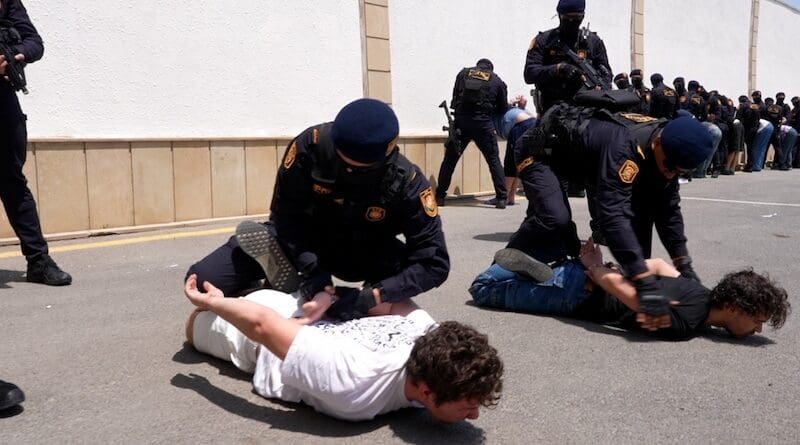
Baku arrests Russian citizens. (Screenshot of a video released by Azerbaijani authorities)


By 

(Eurasianet) — Russia is trying to pull the emergency break on what is threatening to become a runaway train of deteriorating relations with Azerbaijan.


Alexander Kurenkov, Russia’s minister for emergency situations and a trusted lieutenant of Kremlin kingpin Vladimir Putin, arrived in Baku on July 8, ostensibly to participate in a gathering of civil defense officials. But the chief objective of his trip, many observers in Baku and Moscow believe, is to try to mend fences with Azerbaijan.

Bilateral relations have been flash frozen over the past week after Baku retaliated for a late June incident during which two Azerbaijani citizens died in custody amid a police security sweep in the Siberian city of Ekaterinburg. The late June incident compounded already hard feelings within Azerbaijani leader Ilham Aliyev’s administration, due to Russia’s continuing refusal to take responsibility for the accidental shoot-down of an Azerbaijani civilian jetliner in December.

Despite being the instigator of multiple diplomatic confrontations, Moscow is now calling on Baku to back down, hinting that it is in the economic interests of both countries to set aside their current differences.

“We believe that logic speaks of only one thing: that Russia and Azerbaijan recognize and should remain the closest partners, allies and countries that share a common history, a common present and a common future,” the Interfax news agency quoted Kremlin spokesman Dmitry Peskov as saying July 7. “All problems that arise must be resolved in a constructive way.”

It does not appear that Azerbaijan will be easily assuaged. For Aliyev, the current crisis revolves around the matter of mutual respect, or the lack thereof, political observers in Baku say. Azerbaijani officials, it seems, have reached a breaking point where they are no longer willing to tolerate the Kremlin’s high-handed behavior towards former constituent entities of the former Soviet Union, practices rooted in Russia’s imperialist past. Some Azerbaijani analysts say Russia expects all former Soviet republics to be subservient like Belarus.

The growing belief in Baku is that Russian behavior will not change until its leaders undergo a fundamental shift in their approach, recognizing the limitations and realities imposed by the ongoing war in Ukraine, and embracing collaborative and respectful tactics rather than relying on bullying to get their way.

In punching back at Moscow amid the current diplomatic spat, via the arrest of a bevy of Russian citizens, including two key employees of the Baku bureau of the Russia Today media outlet, Azerbaijan is exposing Russia’s underlying economic and diplomatic weakness amid the Kremlin’s grinding, inconclusive campaign in Ukraine. The idea is dawning on Baku that Russia now needs Azerbaijan economically more than vice versa.

commentary published July 6 by the state-connected Azerbaijani media outlet Caliber sheds light on the official thinking in Baku. The piece begins with an apocryphal quote attributed to Tsar Alexander III, who allegedly stated that Russia’s only trusted, reliable allies were its army and fleet. It then proceeds to highlight the failures of Russia’s go-it-alone reliance on brute force to achieve its geopolitical goals.

“All successful world powers were established precisely thanks to unions and coalitions – the entire history of the United States after the Second World War is an example of that,” the analysis states. “Modern Russia has not learned this lesson.”

It goes on to note that all Moscow-led economic, security or political groupings of states, including the Commonwealth of Independent States, the Eurasian Economic Union and the Collective Security Treaty Organization are all dysfunctional or, at best, underperforming. Fear of Russian retaliation is what keeps these organizations from disintegration. “Who is a close ally of Russia? Probably, Belarus?”  

“The following point testifies to the systemic problems of Russian politics: we repeatedly observe how Russian officials manage to quarrel with countries that oppose each other,” the commentary notes. “The current simultaneous worsening of relations with Azerbaijan and Armenia is one of those examples.”

“Russian politics is not even ‘divide and rule.’ It is a disregard for non-Western countries, supplemented by a bet on brute force and threats,” the commentary continues. “Does it work? Ukraine, about which the Russians have said for years that ‘it does not exist,’ that it was ‘invented by the Bolsheviks,’ can provide [an answer]: this stupidity led Russia to a strategic impasse.”


Eurasianet

Originally published at Eurasianet. Eurasianet is an independent news organization that covers news from and about the South Caucasus and Central Asia, providing on-the-ground reporting and critical perspectives on the most important developments in the region. A tax-exempt [501(c)3] organization, Eurasianet is based at Columbia University’s Harriman Institute, one of the leading centers in North America of scholarship on Eurasia. Read more at eurasianet.org.


By 

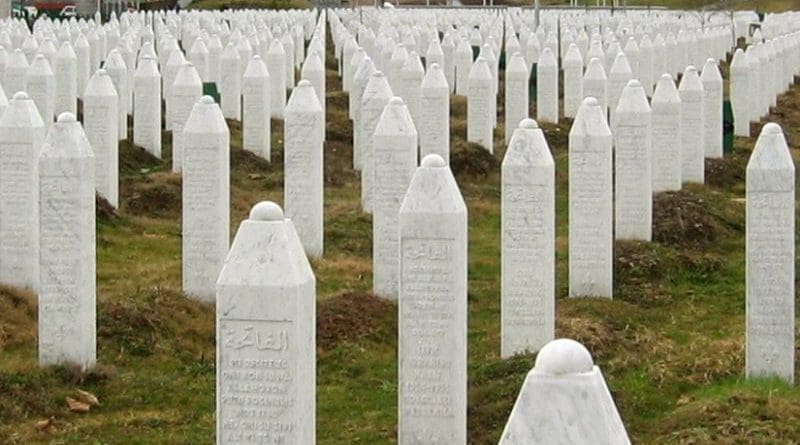
At the UN General Assembly on Tuesday, survivors of the Srebrenica genocide joined top officials in marking 30 years since thousands of Bosnian Muslims were systematically killed in the worst atrocity on European soil since World War II. The affirmed the need to counter denial, support survivors and promote lasting peace. 


“I have survived a genocide,” said Munira Subašić, whose youngest son – her favourite – and 21 other family members were murdered in the July 1995 Srebrenica massacre.

“And the world and Europe was just watching in silence.”

Now president of the Mothers of Srebrenica and Žepa, Ms. Subašić spoke at a special commemoration, urging global leaders not to forget the past and to deliver justice for the victims and survivors.

“When you kill a mother’s child, you have killed a part of her,” Ms. Subašic said.

Europe’s worst atrocity since World War II

The 1995 genocide, perpetrated by the Bosnian Serb army, led to the killing of at least 8,372 men and boys, the displacement of thousands and destruction of entire communities in Srebrenica – which had been designed a “safe area” by the UN Security Council.


A small and lightly armed unit of Dutch peacekeepers under the UN flag were unable to resist the large Bosnian Serb force, which overran the town of Srebrenica.

The massacre has been formally recognized as genocide by both the International Court of Justice (ICJ) and the International Criminal Tribunal for the former Yugoslavia (ICTY).

Last year, the General Assembly designated 11 July as the International Day of Reflection and Commemoration for the 1995 Genocide in Srebrenica.  

An exhibition marking the 30-year anniversary of the 1995 genocide in Srebrenica is held at UN headquarters in New York.

Remember and honour the victims 

Speaking on behalf of UN Secretary-General António Guterres, Chef de Cabinet Courtenay Rattray paid tribute to those who lost their lives and to the courage of their families. 

“Today we remember and honour the victims. We pay tribute to the strength, dignity and resilience of the survivors,” he said.      

Mr. Guterres, in his message, said the international community must continue to stand against hatred, division, and denial.

“Only by recognizing the suffering of all victims can we build mutual understanding, trust, and lasting peace,” he said. “We must ensure the voices of Srebrenica survivors continue to be heard – countering denial, distortion and revisionism.”  

The dangers of forgetting  

UN officials expressed concern over ongoing efforts to deny the genocide and glorify those convicted of war crimes. They warned that such narratives can fuel division and hinder reconciliation.

“Education remains our strongest defence against the erosion of memory,” said Philémon Yang, President of the General Assembly. “We must not only remember history, but learn from it so that tragedies like Srebrenica are never repeated.”

Learning from the past is especially important today – the Secretary-General noted that the same “dangerous currents” which led to the genocide in Srebrenica are present again in the world today.  

“After Srebrenica, the world said – once again – ‘Never Again.’ Yet, hate speech is on the rise again, fuelling discrimination, extremism and violence,” Mr. Guterres said.

A family scattered

Mirela Osmanović, a young professional at the Srebrenica Memorial Center, was born after the genocide but lives with its impact. Two of her brothers were killed. Some of their remains were found, but parts of their bodies are still missing. Their absence, she said, weighs on her family daily.

“My parents forbade themselves any joy while their sons, my brothers, lay somewhere in the ground, incomplete, scattered across mass graves – as if every smile would be betrayal, as if happiness might mean forgetting.”

The pain of this loss is always with her family even as the world promised that Srebrenica would never happen again.  

“We were given words, resolutions, statements, solemn promises of ‘never again,’” she said. “And yet, 30 years later, we are still asking what does ‘never again’ mean?”

A new generation, still asking questions

Ms. Osmanović speaks frequently with young people around the world who ask what happens when violence ends.

“What happens when the headlines fade, when the graves are found and facts are clear? Does justice follow?”

Her answer is that justice does not follow often enough.  

“Justice if it comes too late or only on paper cannot restore trust. And peace without dignity is not peace at all.”

Years of commemoration

In 2015, UN News spoke to Adama Dieng, the Secretary-General’s special advisor on the prevention of genocide, who underlined the importance of remembering the Srebrenica genocide.