Wednesday, July 09, 2025

Trump hosts five African leaders in landmark summit on trade, investment and security

US President Donald Trump will host the leaders of five West and Central African countries at the White House on Wednesday at the start of an unprecedented two-day summit. Trade, investment and security are expected to top the agenda as Washington pivots away from foreign development aid.


Issued on: 09/07/2025 -RFI

US Donald Trump has invited five African leaders to a working lunch in Washington on Wednesday to kick off an unprecedented two-day summit. © Evan Vucci / AP

The presidents of Senegal, Liberia, Guinea-Bissau, Mauritania and Gabon – all Atlantic coast nations – are meeting at Trump’s invitation.

While the White House has disclosed few details, a senior US official said the aim is to foster “open dialogue” and to “listen to [Africa’s] concerns and priorities”, with the goal of promoting private sector investment and deeper economic partnerships.

Though lacking the mineral wealth of nations like the Democratic Republic of Congo, the invited countries possess underexploited resources – such as Gabon’s manganese and uranium – that have drawn Washington’s interest.

In return, Trump may offer enhanced security cooperation, particularly in combating piracy in the Gulf of Guinea, a region of growing strategic importance to the United States.

Guinea-Bissau has become a key transit point for cocaine trafficked from Latin America to Europe. In April, it handed over four convicted smugglers to US authorities.

Guinea-Bissau's president, Umaro Sissoco Embalo, called the visit “very important”, citing hopes for economic support.

Migration, trade

Migration and trade are also key issues. All five countries are coastal and part of active migration routes.

For Senegal, the stakes are high: over 20,000 Senegalese were intercepted at the US-Mexico border in the first half of 2024, a tenfold increase from two years earlier.

Senegalese President Bassirou Diomaye Faye is also expected to raise the issue of his country’s debt crisis. Senegal’s public debt stands at 111.4 percent of GDP, and Dakar is pressing for the release of a $1.8 billion IMF loan, suspended over data irregularities under the previous administration.

Liberian President Joseph Boakai aims to position his country as a trade partner, not just an aid recipient, his press secretary said.

Gabonese officials also cited industrial development as a key interest.

Beyond aid dependency


The meeting comes as the Trump administration pivots away from traditional foreign aid, following the closure of USAID, and as Washington looks to secure supply chains and counter Chinese and Russian influence in Africa.

Beijing has invested heavily across the continent, while Moscow has backed the new Alliance of Sahel States – Mali, Burkina Faso and Niger – which border some of the visiting countries.

No press appearances are scheduled for Wednesday’s meeting. Past White House meetings have proven problematic, including the one when Trump showed South African President Cyril Ramaphosa a video promoting false claims of white genocide.

Gabon, Liberia, Mauritania and Senegal are among 36 countries under review for possible inclusion in a US travel ban, according to a recent internal memo.

(with newswires)


Trade tensions rise as US targets South Africa
EYE ON AFRICA © FRANCE 24


Issued on: 08/07/2025 - 
14:26 min


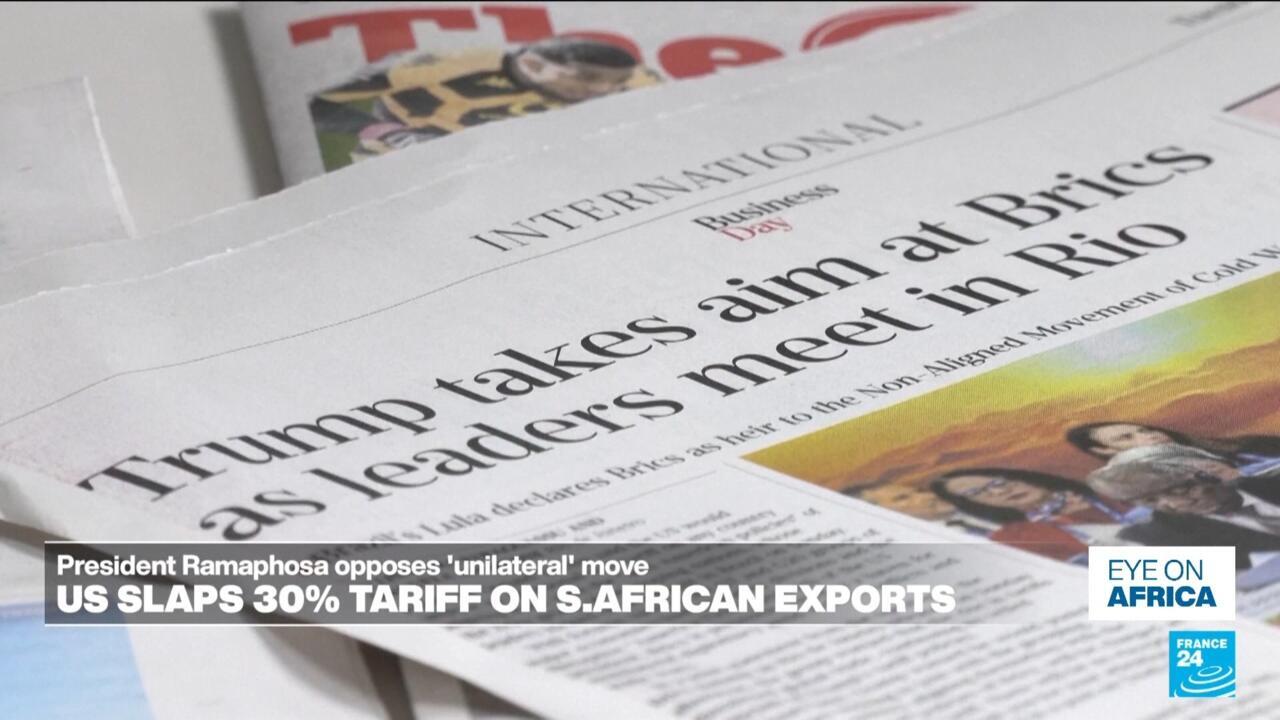
South African President Cyril Ramaphosa has strongly condemned US President Donald Trump's decision to impose a 30 percent tariff on South African goods, targeting 14 countries accused of unfair trade. Trump also threatened an additional 10 percent levy on nations working with the BRICS bloc. Ramaphosa calls it a misinterpretation of data. The tariffs could seriously harm South Africa's economy, as the US remains its largest trading partner.

Also in this edition:

In Nigeria and Malawi, where clinical trials have been conducted, the first drug specifically designed to treat malaria in babies and young children has just been approved. The approval could speed up its rollout across eight African countries.

Finally, France's parliament has voted to return a historic drum to Ivory Coast, after it was seized by French colonial forces over a century ago. The move follows President Emmanuel Macron’s 2018 pledge to return stolen African artworks, but tens of thousands of objects remain in French museums.

By:

Yinka OYETADE

Aurelie KOUMAN

Charlotte HUGHES

Emily BOYLE


Canada’s new immigration policy fuels wave of scams in Africa

Ottawa's 2023 decision to open its borders to citizens from French-speaking Africa has led to a surge in well-organised scams targeting hopeful immigrants. Authorities warn that the number of victims is steadily increasing.

Issued on: 07/07/2025 - RFI

An application form for immigration to Canada. © Getty Images/iStockphoto/Manjurul

By 2027, Canada plans to welcome nearly 80,000 new French-speaking residents from Africa, according to data from Immigration, Refugees and Citizenship Canada (IRCC).

Looking to leave the African continent for a fresh start, Marie decided to fly to Canada with her husband and children.

In 2024, a friend recommended a Facebook page for a specialised agency. The comments under the posts lauded praise on the "consultant".

"So I contacted him, sent him my profile, and he told me it was quite good. That’s how it all started," Marie, not her real name, told RFI.

Exchanges and promises ensued – permanent residency for Marie and her family, the offer of a job.

The consultant promised that everything would be settled within six months – provided she paid.

"He kept insisting on how quickly I needed to send the money. He assured me that the Canadian government was looking for profiles like mine and that the faster I sent the money, the sooner I’d sign the documents and get my permanent residency."

Marie didn’t suspect a thing. She borrowed money from friends and sold her furniture. In total, she paid $15,000 (€12,800) to the scammer.

According to Nicholas Avramis, a consultant whose company, Beaver Immigration, is based in South Africa and certified by the College of Immigration and Citizenship Consultants (CICC), scammers operate using different methods.

Some take an initial cash transfer and then vanish into thin air, while others make big promises. Scammers have been located in the capitals of some French-speaking African countries as well as in Toronto.

Fake documents are delivered on time. "Once the money was transferred first in my country, then to Canada, he simply blocked me from all apps," Marie regrets.

Some are "posing as Canadian embassy staff", Avramis says. "They claim the file has entered the system but needs more money to cover processing fees."

He says he alone has received 24 testimonies like Marie’s since the beginning of the year. But he believes the real figure is far greater.

"Victims are embarrassed. They know the process seemed shady, and they realise they might have done something illegal. So why report it to the authorities?," he said.

Marie hasn't dared to file a complaint. Deep in debt, she urges others to be cautious and hasn’t given up hope of one day making it to Canada.

This story was adapted from the original version in French.
Seven Nobel laureates urge France to adopt tax on 'ultra-rich'

Seven Nobel Prize-winning economists have called on France to implement a minimum tax on wealthiest households, endorsing a measure inspired by the so-called "Zucman tax" that was rejected by the French Senate last month. The proposal comes as the French government looks for new sources of public revenue to balance its strained public finances.


Issued on: 07/07/2025 - RFI

The French ultra-rich hold nearly 30 percent of France’s GDP in wealth. © pixabay.com

In a joint op-ed published Monday in Le Monde, the laureates argue that France has a chance "once again to show the way to the rest of the world," by taking the lead on taxing extreme wealth.

Signatories include 2024 Nobel laureates Daron Acemoglu and Simon Johnson, 2019 winners Esther Duflo and Abhijit Banerjee, 2001 laureates George Akerlof and Joseph Stiglitz, and 2008 laureate Paul Krugman. Most are American citizens and globally influential figures in the field of economics.

According to the economists, "the ultra-rich are particularly prosperous in France". While global billionaires hold assets equivalent to 14 percent of global GDP, French billionaires control wealth worth nearly 30 percent of their country's GDP, they note, citing data from Forbes magazine.


Leading by example

The group argues that a floor tax on wealth – expressed as a fixed percentage – would be both effective and fair. "It is efficient because it targets all forms of tax avoidance, regardless of their nature," they write.

"It is also targeted – affecting mainly the wealthiest taxpayers who engage in aggressive tax optimisation."

The authors also welcome ongoing international discussions around wealth taxation, including a G20 proposal for a global minimum tax on billionaires equivalent to 2 percent of their net wealth.

The initiative failed to advance last year but the economists say momentum is building.

"There is no reason to wait for the finalisation of an international agreement," they write. "On the contrary, countries should take the lead by example, just as France did in the past" with the introduction of VAT in 1954.


Divided over Zucman tax

The open letter comes after the French Senate in June rejected a wealth tax targeting the ultra-rich, known as the Zucman tax.

The bill was based on proposals by French economist Gabriel Zucman. Initially passed by the National Assembly, the bill would have introduced a "differential contribution" ensuring that individuals with more than €100 million in assets pay at least 2 percent of their annual wealth in taxes.

The aim was to curb the kinds of avoidance strategies employed by some ultra-wealthy individuals, who are often able to structure their assets in ways that greatly reduce their tax burdens.

The bill sparked a heated debate among economists – some championed the measure as a step towards fiscal justice while opponents saw it as economically harmful or difficult to apply.

(with AFP)


Zimbabwe’s elephant boom fuels conflict alongside conservation wins

Harare, Zimbabwe – Southern Africa’s elephant population has grown to over 230,000 – a conservation success that is creating new problems for people living alongside the animals. Zimbabwe, at the centre of this growth, is trying to balance protecting nature with keeping communities safe and the environment sustainable.


Issued on:  09/07/2025 - 

Elephants are seen in Addo Elephant National Park in South Africa 2023.
 © AFP - MICHELE SPATARI

By: Gift Msipa in Harare

Zimbabwe’s elephant population has grown steadily over the past decade thanks to intensive national and regional conservation strategies.

According to Tinashe Farawo, spokesperson for the Zimbabwe Parks and Wildlife Management Authority (ZimParks), the country’s elephant count has risen from around 84,000-90,000 in 2014 to over 100,000 today, growing by roughly 5 percent per year.

This success is supported by both local initiatives and international partnerships. The European Union, Germany, and the International Union for Conservation of Nature (IUCN), among others, have poured millions into biodiversity efforts.

Under its Natural Africa Programme, the EU alone has allocated $36 million toward conservation, sustainable economic development, and improved park management across Southern Africa.

Zimbabwe is a key player in the region’s Transfrontier Conservation Areas (TFCAs). They are cross-border protected zones that enable wildlife to roam freely across 11 international boundaries.

These include areas like Kavango-Zambezi, Great Limpopo, and Mana Pools, designed to preserve migration corridors for elephants, rhinos, and other species.


Zibabwe's conservation efforts are producing results 
© RFI/Gift Msipa


The human cost of conservation

With animal populations booming, local communities are facing growing dangers. Farawo notes that elephants are increasingly forced to venture outside protected areas in search of food and water, bringing them into direct conflict with people.

“We’ve translocated over 200 elephants in the Save Valley over the last five years,” says Farawo. “But it’s a drop in the ocean. Long-term solutions are expensive and require major investment.”

Tensions are high in places like Hwange, Chiredzi, Kariba and Mbire, where elephants trample crops and predators attack livestock or even villagers.

Domingos Gove, Director for Food, Agriculture, and Natural Resources at the SADC Secretariat, reported that dozens of people are killed by wildlife annually across the region.

Traditional leaders and local advocates stress the need for communities to see tangible benefits from conservation, such as employment, schools, clinics, and infrastructure – if they are to become true stewards of the land.
Building community-led solutions

Professor Andrew Nambota, head of the Peace Parks Foundation, says meaningful local participation is essential.

“Communities are not just stakeholders – they're custodians. They should be at the decision-making table and drive economic development in their regions.”

Itai Chibaya, Country Director for WWF Zimbabwe, agrees.


“In the Hwange-Kazuma-Chobe corridor, sustainable conservation supports livelihoods,” he says. “Nature tourism accounts for up to 10 percent of GDP in several SADC countries and supports over three million jobs, including many for youth and women.”

But Chibaya warns that climate change, underfunded projects, and fragmented habitats from mining and infrastructure threaten long-term sustainability. WWF and other partners are working to develop ecotourism models that return value directly to villages, not just capital cities.

Call for new conservation models

At the recent SADC Transfrontier Conservation Areas Summit in Harare – held under the theme 25 Years of Cooperation for Regional Integration and Sustainable Development – leaders called for broader, more inclusive conservation strategies.

President Emmerson Mnangagwa highlighted Zimbabwe’s launch of a blockchain-based national carbon registry, aimed at generating transparent revenue through climate action.

“This shows our determination to contribute to new global standards with accountability and sustainability,” he said.

Experts argue that carbon credits from reforestation and other efforts could become a critical funding source for conservation if communities are properly included in benefit-sharing models.

Meanwhile, Zimbabwe holds over 130 tonnes of ivory from natural deaths and anti-poaching operations worth an estimated $600 million. Yet international bans under CITES prevent the country from selling the stockpile, limiting potential funding for future conservation work.

As the SADC summit concluded, leaders urged member states to develop tailored solutions for rising human-wildlife conflict and push for legislative and financial reforms to ensure the long-term viability of shared conservation goals.
Wake-up call for France as climate experts push for new action on emissions

France’s top climate advisory body has called for renewed urgency in tackling climate change, warning that recent setbacks and a slowdown in decarbonisation efforts risk undermining the country’s environmental goals.


Issued on: 03/07/2025 - RFI

The top section of the Eiffel Tower was closed on 1 July as Paris was put on the highest level of alert for extreme heat. AFP - THIBAUD MORITZ

France is falling behind on its climate promises as extreme weather claims lives, hits food supply chains and strains public budgets, the country’s top climate advisory council warned on Thursday.

In its annual report, the High Council for the Climate (HCC) painted a bleak picture of France's fight to cut greenhouse gas emissions. Political instability and stop-start funding are holding back the changes needed to adapt to a fast-warming world, it said.

France’s climate plan has “stalled” this year, the HCC added, blaming a lack of clear leadership and poor coordination between government ministries.

“Is there still a pilot on this plane while the turbulence is getting worse?” the report asked. The HCC, created in 2018, was renewed for five years last year.

It comprises 12 independent experts and is chaired by Jean-François Soussana, an agronomist and the vice-president of France’s national research institute for agriculture and the environment.


France warming faster than average


The council’s seventh annual report landed during a heatwave that has swept across France and the rest of Europe – the fastest-warming continent. It shows the country is not on track to reach carbon neutrality by 2050, and that it is heating up faster than the global average.

Over the last 10 years, mainland France has warmed by 2.2°C. If the global average rises by 1.5°C, on the current trajectory that will means a rise of around 2°C for France.

If the world reaches 2°C, France could see 2.7°C, and a global rise of 3°C would mean a 4°C rise in France, the HCC said.


It warned that the occurrence of heatwaves could triple in the next five years, and become five times more common by 2050 compared with the late 20th century.

Pointing to the consequences of rising temperatures, the report said: "In recent years, impacts have reached levels never seen before."

In 2024, heat caused more than 3,700 deaths during the summer in France. Cereal harvests fell to their lowest in 40 years. The cost of floods last winter reached €615 million.

Cuts in emissions too slow

Although France did meet its second carbon budget, from 2019 to 2023, progress has declined sharply since then. France’s greenhouse gas emissions fell by 6.7 percent between 2022 and 2023, but only dropped 1.8 percent between 2023 and 2024.

Next year’s drop is likely to be just 1.3 percent – a figure which needs to be doubled to reach the 2030 target.

The building sector, which contributes 15 percent of emissions, needs to cut emissions nine times faster than it currently does. But sales of gas boilers rose by 15 percent this year, while sales of heat pumps have fallen by 40 percent.

The waste sector has increased its emissions, and must cut them by a factor of 29.

The HCC also said that only one third of emissions cuts came from climate policies this year, with the rest due to temporary factors such as increased nuclear energy, fewer cattle, a mild winter and good rainfall which benefited hydropower.


Policy rollbacks


“The strengthening of existing policies would help restart the drop in emissions,” the HCC wrote. But this will need “strong political support” and steady funding, both of which were lacking last year.

The council listed a series of rollbacks: social leasing for electric cars was paused, support for home insulation was cut, low-emission zones were scrapped and rules to protect soil from construction were weakened.

Agriculture too remains a sticking point. The HCC said the French government’s response to farmers’ protests at the start of the year had weakened efforts to cut farm emissions.

“The political response to the farmers’ protests has slowed the sector’s agro-ecological transition,” the report said, adding that new laws risk locking agriculture into high-emission models instead of shifting to greener, more sustainable methods.


Key plans delayed

In addition, France’s climate plans are behind schedule. The third National Adaptation Plan came out in March but the new Low Carbon Strategy will not be ready before the end of this year, while the new energy plan is expected by the end of summer.

“Without these, France risks missing its 2030 and 2050 targets,” the HCC warned. Diane Strauss, a member of the council and an expert on transport and energy, said: "Government uncertainty weighs on the survival of public policies."

France’s main planning office for climate action, the SGPE, lost its head in February. Antoine Pellion, who had led the office since it was set up in 2022, resigned over cuts to green policies and lack of political support.


Public trust at risk

The Climate Action Network, which brings together 40 environmental groups, released its own list of “more than 43 environmental rollbacks” by the government or parliament over the last six months.

It added a 44th when President Emmanuel Macron said he wanted to revisit the EU’s goal to cut emissions by 90 percent by 2040. “Where is the compass of the French government?” the group asked.

Soussana warned that climate policies must benefit everyone to maintain public support, as climate change worsens social divides.

“There is a temptation to polarise the debate on climate and ecology, which could threaten targets and budgets," he said. "Some people feel policies have not helped everyone equally, so there is some support for tearing them down. But all French people suffer during heatwaves, so we need policies that help everyone."
Fanon at 100: reflecting on a revolutionary legacy


Podcasts
Spotlight on Africa
Issued on: 09/07/2025 - 
Play - 34:41


This season of Spotlight on Africa concludes ahead of the summer break with a focus on Frantz Fanon in the year of his centenary. It also highlights a groundbreaking new report by UNESCO on the state of the publishing industry across the continent.


Frantz Fanon and M'Hamed Yazid representing the Algerian National Liberation Front at the Pan-African Conference in Leopoldville, formerly the Belgian Congo, on 27 August 1960. © AFP

This week, we begin in Harlem, New York City, USA, with Rico Speight, a film and theatre director.

His film, Rediscovering Fanon, was screened in Paris on 5 July in partnership with the Frantz-Fanon Foundation, as this year marks the centenary of one of the inspirational figures of the anti-colonial movement. The film will also be screened acorss France and in Martinque later in the year.

According to Speight, Frantz Omar Fanon (1925–1961), whose ideas have stirred the hearts of progressives since the 1950s, continues to inspire even decades after his death.

With Speight's latest documentary, the filmmaker said he "aims to reveal the man behind the legend and analyse the relevance of his prolific theories in a globalised, post-racial millennium."

Biopic explores the life and legacy of Frantz Fanon, a century after his birth

We also head to Unesco in Paris, where Spotlight on Africa spoke to Caroline Munier about the UN agency's new report on the state of the publishing industry on the African continent.

Episode mixed by Melissa Chemam and Erwan Rome.

Spotlight on Africa is produced by Radio France Internationale's English language service.

36 / The Wretched of the Earth lives of the men and women who are colonized. But the possibility of this change is equally experienced in the form of a ...


Mediterranean sea experienced marine heatwaves of 'record intensity'

The Mediterranean Sea has just experienced its hottest June on record, with marine heatwaves of "record intensity" affecting 62 percent of its surface, Mercator Ocean International announced Tuesday.


Issued on: 09/07/2025 - RFI

The yellow stony coral Oculina patagonica undergoing bleaching due to rising sea surface temperatures in the Eastern Mediterranean sea basin, off the coast of Lebanon's northern city of Batroun. © AFP - Ibrahim Chalhoub


The average surface temperature of this enclosed sea, which is warming faster than the rest of the ocean, reached an average of 23.86°C in June, breaking its previous June record from 2022 (23.72°C), according to Mercator Ocean International, the operator of the European Union’s Copernicus Marine Service.

Almost the entire Mediterranean basin (88 percent) experienced above-average temperatures in June, particularly in its western half, which underwent marine heatwaves "reaching record levels in intensity, duration, and extent," according to a press release.

More killer heat and rising seas likely in next five years, UN warns

Marine heatwaves

As a result, 62 percent of the surface of the Mediterranean Sea was affected by marine heatwaves in June 2025, "the highest extent ever recorded," Mercator explained.

"June was marked by the presence of a heat dome over Europe, which had a significant impact on the Mediterranean Sea with a lack of clouds, no wind, and increased solar radiation," said oceanographer Simon Van Gennip.

Marine heatwaves can fuel hurricanes and cyclones, damage ecosystems, and cause mass die-offs of marine species, he reminded, noting that corals, gorgonians, and bivalves (such as mussels) are the most threatened species in the Mediterranean.

World's coral reefs pushed to brink as bleaching crisis worsens

The first half of 2025 was also the warmest ever recorded in the Mediterranean.

By 12 July, Mercator expects a noticeable decrease in marine heatwaves in the region, thanks to a return of winds that should help better distribute heat into deeper ocean layers.

As for the global ocean, this year recorded its third-warmest June ever, after 2023 and 2024, according to Mercator, with an average surface temperature of 20.75°C.

What are the main ocean threats?

One-fifth of the global ocean surface was affected by high-intensity marine heatwaves at the end of June.

Oceans play a climate-regulating role by absorbing 90 percent of the excess heat generated by human activity.

(with AFP)

Russian journalist exiled in Paris has 'no regrets' over criticising Ukraine war


Journalist Ekaterina Barabash was under house arrest in Moscow for 'telling the truth about the war in Ukraine'. Rather than risk a decade in Putin's prisons she chose to flee, crossing the forests of Belarus alone. Having been in Paris for two months now, she spoke to RFI about leaving everything behind and building a new life, and why she had no choice but to defend the dignity of her profession.


Issued on: 09/07/2025 - RFI

Ekaterina Barabash at the Paris headquarters of RSF, which helped her escape from Russia. © A.Hird/RFI
01:28

By: Alison Hird

Barabash still finds it hard to believe she's living in Paris. "I ask my son sometimes, do you really think that now I live in Paris?" she says, speaking from the offices of Reporters Without Borders (RSF) – the press freedom NGO that helped organise her extradition from Moscow. "For me it still feels a bit unreal. It's something like a dream."

The knock on the door came on 25 February, shortly after the 64-year-old Russian journalist returned from reporting at the Berlin Film Festival. Detained for a day and stripped of her electronic devices, she was then placed under house arrest on 21 April, and was facing up to 10 years in prison for criticising Russia's war in Ukraine.

Her crime was writing "the truth about this war" on Facebook, she says. After Russia introduced its draconian "fake news" law in 2022, making it effectively illegal to criticise the military, authorities began monitoring Barabash's posts. One, written in March 2022, described how Russia had "bombed the country" and "razed whole cities to the ground".
A woman walks through her destroyed neighbourhood in Mariupol, Russian-controlled Ukraine, 15 February, 2023. REUTERS - ALEXANDER ERMOCHENKO

Ties to Ukraine


For Barabash, a film critic who has spent decades writing about cinema, speaking out wasn't just her professional duty – it was deeply personal. Born in Kharkiv when it was part of the Soviet Union, she has strong family ties to Ukraine. Her son has lived there for 17 years, and her late father was a renowned Ukrainian literature expert who wrote openly against the war before his death last November.

"If there were not my personal links with Ukraine, if I didn't imagine each night how the missiles are attacking my son's house, maybe I would have been quieter," she said.

Her transformation from culture journalist to wanted dissident began long before Russia's full-scale invasion in February 2022. As Russia's aggression toward Ukraine escalated, she found herself unable to separate art from politics.

"When the war began – not this invasion in February 2022 but before that, after Crimea and the first attacks on the east of Ukraine, [that] was the beginning of the war – that's the moment I understood that it wasn't possible to write only about culture. Culture is very tightly connected with politics."

She cites a Russian saying: "If you don't [take an] interest in politics, politics will [take an interest] in you."

A woman clears snow at the location of a mass grave in the churchyard of St. Andrew's Church in Bucha, Ukraine on 10 February, 2024. AFP - SERGEI SUPINSKY


After her lawyers gave her an estimated 50-80 percent chance of imprisonment, Barabash made the decision to flee. She was approached by a network of volunteers – "some Russian people in exile and some Russian people in Russia" – who had helped others, including TV journalist Marina Ovsyannikova, to escape.

"They found a way to me and proposed to help me escape. They said that if I agree, they'll prepare all the operation," she said.

The escape began with a car ride from Moscow to Belarus, driven by a volunteer who then returned to Russia, leaving her alone to follow encrypted instructions. For the most dangerous part of her journey, she went completely offline. "I turned off all the equipment and I was without any connection for almost 10 days. I didn't know if my mother, my family, my friends, knew where I was," she recalls.


Bodies are placed into a mass grave on the outskirts of Mariupol, Ukraine in March 2022, as people cannot bury their dead because of the heavy shelling by Russian forces. AP - Evgeniy Maloletka


'It's difficult to scare me'


Her route to freedom took her through the forests of Belarus, sleeping rough for nights on end, guided only by encrypted messages from anonymous volunteers. At times, she admits, the journey felt more dangerous than staying in Russia to face trial.

"I had to sleep in the forest, in the fields," she recalls. "I understood only afterwards that it was very dangerous. But at the time I didn't think about it. I had my freedom, that's all."

Sleeping rough in forests was challenging for a woman in her sixties, but Barabash had forged a lot of inner strength. "I'm a strong Russian woman. I'm a former sportswoman," she says, referring to her background in gymnastics. "So it's very, very difficult to scare me. It's my character."

The journey took two and a half weeks, with RSF coordinating the final stages. The NGO's director Thibaut Bruttin later admitted the organisation had feared the worst several times: "Once, we thought she was dead."

Barabash crossed into European Union territory on 26 April, her 64th birthday. "I crossed the border illegally. But there were people who helped me on the other side of the border. And then people from RSF came and took me to Paris."

The mother of a Russian soldier killed in Ukraine kneels near a tree planted in memory of her son at the Alley of Heroes in Sevastopol, Crimea on 25 February, 2023. © AP

'A symbol of hope'


The transition hasn't been easy. "I came with this, with my backpack," she says, pointing to a small bag on the floor. "And so for a few days after my arrival here, I was wearing my friends' clothes."

The separation from her family, too, is hard. Her 96-year-old mother remains in Moscow, while her son and grandson are trapped in Ukraine. "I left everything – my property, my family, my mother. I see the pictures of my previous life and I try to close them in my mind. It's very dramatic, but I am trying to be involved in this life, in France."

RSF is helping her claim political asylum and she lives with a good Russian-born friend. Unable to work legally in France, she writes a little for Russian-language media based elsewhere in Europe.

"I'm a strong Russian woman, a former sportswoman. It's very, very difficult to scare me."  
Ekaterina Barabash 

RSF has described her as a "symbol of hope" but she shakes her head at this. For her, proper Russian journalists are now either in jail or living in exile, while the others consider her "as a symbol of stupidity".

"They say, why? You have such an old mother, you have property, you should be silent. We are against the war, but we are keeping silent. You'll end up in prison."

Roman Ivanov was sentenced to seven years in prison in March 2024 for social media posts criticising Russia’s military offensive in Ukraine, including comments on the Bucha atrocities. AFP - STRINGER


As a journalist she felt obliged to break that silence. "The journalist profession is... for those who have to say the truth. And especially in such dark times as now in Russia."

Does she have any regrets?

"Je ne regrette rien," she says, quoting Edith Piaf. "I was saving my dignity. The dignity of my profession." She adds that if even one person read her articles and it helped them to change their mind about the war, then it was worth it.


After two months in France, Ekaterina Barabash is trying to put images of her former life behind her. © A.Hird/RFI
EU prosecutor's office probes alleged misuse of funds by far-right lawmakers

EU financial prosecutors have opened a formal investigation into alleged misuse of 4.3 million euros of European Parliament funds by Identity and Democracy – a now-defunct far-right group that included Marine Le Pen's National Rally party.


Issued on: 09/07/2025 -  RFI

\
Marine Le Pen and Jordan Bardella of France's far-right National Rally – one of the parties allegedly involved in the misuse of EU funds as part of the now-disbanded Identity and Democracy group. © Thibaud Moritz / AFP

Media outlets in several countries reported last week that a draft audit by the European Parliament had found that parties linked to the far-right Identity and Democracy (ID) group had performed improper procurement procedures and had given donations to non-parliamentary activities.

The report said ID was suspected of improperly spending 4.3 million euros between 2019 and 2024.

The ID group contained MEPs from a range of eurosceptic parties including the National Rally of Marine Le Pen – the longtime standard bearer of the French far right – Italy's League and the Alternative for Germany.

According to the reports by a consortium of European media, the bulk of the allegedly misused funds benefited companies belonging to Frédéric Chatillon, a former advisor to Le Pen, and his wife Sighild Blanc.

"The European Public Prosecutor's Office has opened an investigation," a spokesperson for the agency, which probes financial crimes against the bloc, said.

The European Parliament said it "takes note of the decision" by the prosecutors to open the probe, first reported by Euractiv on Tuesday.

"As always, parliament cooperates fully with national or European authorities if requested so," the parliament said.

Fake jobs scam

The Identity and Democracy grouping was unveiled by French politician Le Pen in 2019, uniting eurosceptics from across the continent who aimed to devolve power from Brussels back to capitals. It was formally disbanded after elections last year and was succeeded by a new grouping Patriots for Europe.

Jordan Bardella, who now heads the Patriots group, said the probe represented a "new harassment operation by the European Parliament".

The EU investigation comes after Le Pen suffered a blow in March when a French court convicted her and other party officials over an EU parliament fake jobs scam.

'We are the future': European far right makes show of force

The ruling, which Le Pen has appealed, banned her from standing for office for five years, effectively ruling her out of running in the 2027 presidential vote.

(with newswires)

France’s far-right RN under investigation for misuse of campaign funds


Issued on: 09/07/2025 - 

French police have raided the headquarters of the far-right National Rally (RN) as part of an investigation into the misuse of public campaign funds. The probe centres on allegations of inflated invoices and irregular financing linked to recent elections, including the 2022 presidential and 2024 European campaigns. Party leader Jordan Bardella denounced the inquiry as political harassment.


French police raid HQ of far-right National Rally party in campaign financing probe


Police seized documents from the far-right National Rally party's headquarters Wednesday, a raid prosecutors said was linked to a probe into alleged illegal campaign financing.


Issued on: 09/07/2025 - 
By:  FRANCE 24

French's National Rally President Jordan Bardella attends a briefing for the Patriots for Europe Group at the European Parliament in Strasbourg, on July 8, 2025. © Jean-Christophe Verhaegen, AFP

French police raided Marine Le Pen's National Rally (RN) headquarters on Wednesday over alleged campaign finance violations and fraud, prompting its president Jordan Bardella to decry a "new harassment campaign" against the far-right party.

The raid represents a fresh blow for the RN after Le Pen was convicted in March of embezzling EU funds and barred from running in the 2027 election. The RN has become France's largest single parliamentary party, but still remains toxic for many due to its history of anti-Semitism and racism.

Bardella broke the news of Wednesday's raid on X.

"Since 8:50 this morning, the headquarters of the National Rally, including the offices of its leaders, have been subjected to a raid conducted by approximately twenty police officers ... accompanied by two investigating judges," Bardella wrote.

The Paris prosecutor's office confirmed the searches, which it said related to a probe into an unnamed person opened last week following several reports from institutional sources. It said searches were carried out at the RN's headquarters, as well as at the head offices of several unnamed companies and at the homes of those companies' executives.

The probe involves acts that may constitute fraud against a public figure, loans exceeding campaign-finance regulations, regular loans made to a political party and the party's acceptance of them, regular loans made to a candidate during a campaign and the candidate's acceptance of them, aggravated laundering of fraud, forgery and use of forged documents between 2020 and 2024, Paris prosecutors said.

The alleged violations were related to the financing of campaigns during the 2022 presidential, 2022 legislative and 2024 European campaigns, the office said. No person or legal entity has been charged in the probe and the investigation is still ongoing, the office said.

Though the once-taboo RN has managed to improve its reputation, it has struggled to shrug off accusations of financial impropriety during its rise from a scrappy fringe outsider to one of France's most powerful parties.

In a separate probe, EU financial prosecutors said Tuesday they had opened an investigation into alleged misuse of €4.3 million ($5.04 million) by Identity and Democracy, a now-defunct far-right European Parliament bloc that included the RN.

Le Pen aims to get her March conviction overturned so that she can run in the 2027 election, her fourth attempt at top office, but Bardella has said he will run if she cannot.

(FRANCE 24 with Reuters and AFP)
ET CALL HOME

How Airports Like Heathrow And Gatwick Could Help Aliens Spot Earth


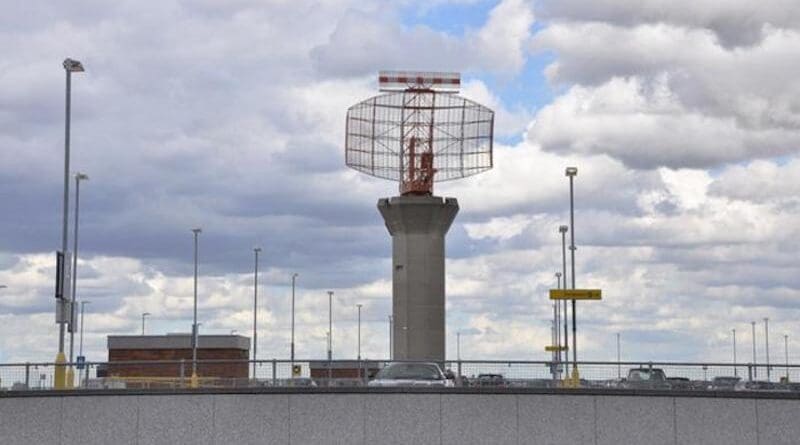
Radar systems used by civilian airports (like this at Heathrow) and military operations are inadvertently revealing our existence to potential advanced alien civilisations because of the hidden electromagnetic leakage they emit. CREDIT: Mick Lobb / Radar scanner - Heathrow

July 9, 2025

By Eurasia Review


Radar systems used by civilian airports and military operations are inadvertently revealing our existence to potential advanced alien civilisations, new research shows.


The study explored how hidden electromagnetic leakage might look to extraterrestrials up to 200 light-years from Earth, if they had state-of-the-art radio telescopes like our own. Theoretically, it also suggests this is how far we would be able to look to spot aliens who have evolved to use a similar level of technology.

Preliminary results revealed at the Royal Astronomical Society’s National Astronomy Meeting 2025 in Durham show how worldwide aviation hubs such as Heathrow, Gatwick and New York’s JFK International Airport give off clues to our existence.

By carefully simulating how these radar signals spread out from Earth over time and space, the researchers looked at how visible they would be from nearby stars such as Barnard’s Star and AU Microscopii.

They found that airport radar systems, which sweep the skies for airplanes, send out a combined radio signal of 2×10¹⁵ watts, enough to be picked up as far as 200 light-years away by telescopes comparable to the Green Bank Telescope in West Virginia.

To put that distance into context, the nearest potentially habitable world beyond our solar system is Proxima Centauri b, which is 4 light-years away. That would still take a spacecraft using current technology thousands of years to get there.


Military radar systems, which are more focused and directional, create a unique pattern – like a lighthouse beam sweeping the sky – have an accumulated peak emission reaching about 1×10¹⁴ watts in a given field-of-view of the observer.

This, lead researcher Ramiro Caisse Saide at the University of Manchester said, would look “clearly artificial to anyone watching from interstellar distances with powerful radio telescopes”.

“In fact, these military signals can appear up to a hundred times stronger from certain points in space, depending on where an observer is located,” the PhD student added.

“Our findings suggest that radar signals – produced unintentionally by any planet with advanced technology and complex aviation system – could act as a universal sign of intelligent life.”

He said the research not only helps guide the search for extraterrestrial civilisations by identifying promising technosignatures, but also deepens our understanding of how human technology may be seen from space.

“By learning how our signals travel through space, we gain valuable insights into how to protect the radio spectrum for communications and design future radar systems,” said co-researcher Professor Michael Garrett, of the University of Manchester.

“The methods developed for modelling and detecting these weak signals can also be used in astronomy, planetary defence, and even in monitoring the impact of human technology on our space environment.”

Caisse Saide, a PhD student, added: “In this way, our work supports both the scientific quest to answer the question ‘Are we alone?’ and practical efforts to manage the influence of technology on our world and beyond.”