Thursday, July 10, 2025


Forgotten Swiss Peace Pact Has Lessons For Europe On Ending Bloodshed – Analysis
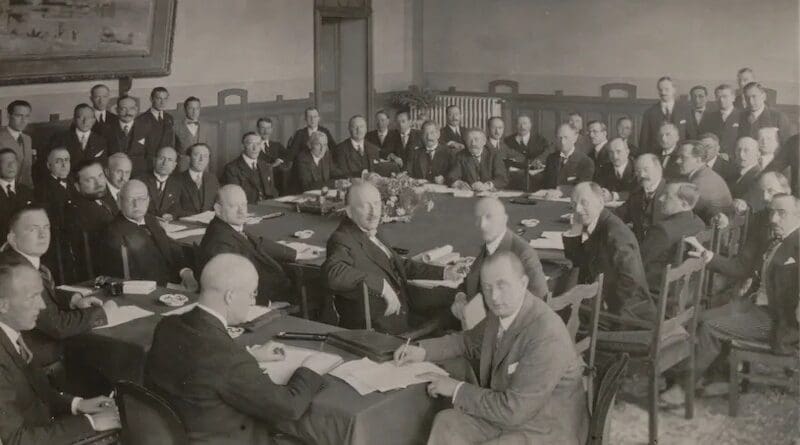
Among the delegates at Locarno were British foreign secretary Austen Chamberlain, his French and German counterparts Aristide Briand and Gustav Stresemann, respectively, and Italian prime minister Benito Mussolini. Photo Credit: City of Locarno Archives


By 

Hailed in 1925 as a diplomatic triumph, the Locarno Pact – named after the Swiss city where it was negotiated – ushered in a brief period of peace after the First World War. What can today’s peacemakers learn as Europe once again deals with war, rising American isolationism, and shifting power among the great states? 


By Geraldine Wong Sak Hoi 

Popular histories mark the end of the First World War with the Treaty of Versailles in 1919, when Germany was forced to accept responsibility for the bloodiest conflict then known.

Yet many historians argue that a true settlement was only reached six years later in Switzerland. There, diplomats spent ten days hammering out treaties of the lesser-known Locarno Pact. The main signatories, Germany, France, Britain, Italy and Belgium, renounced force in all cases but self-defence.

The Pact was celebrated as a diplomatic milestone, capping years of confrontation between the major European powers.

“It was the most fundamntal agreement for the stabilisation of Europe after World War I,” said Sacha Zala, director of the Diplomatic Documents of Switzerland (Dodis) research centre.


The Pact confirmed Germany’s borders with France and Belgium and reaffirmed the demilitarised status of the Rhineland established at Versailles. It was significant enough to earn the main negotiators – the foreign ministers of France, Germany and Britain – the Nobel Peace Prize.

But reconciliation was short-lived. In 1936, Adolf Hitler, by then chancellor of Germany, broke the accord by sending troops into the Rhineland. The Second World War erupted just three years later.

Now, on the centenary of the Pact and with Russia waging a war of attrition in Ukraine on Europe’s eastern flank, experts believe that Locarno offers lessons – both constructive and cautionary – for how to once again bring peace to the continent.

Securing Europe as the US turns away

One thing that Europe can relearn is to avoid relying on the United States for its security. After fighting alongside the British and French during the First World War, the Americans refused to sign the Treaty of Versailles or join the League of Nations, even though President Woodrow Wilson had been a leading architect of the precursor to the United Nations.

While the US pursued an isolationist policy and stayed away from Locarno, the European states negotiated amongst themselves. Under the Pact, Germany agreed to resolve any territorial disputes with France, Belgium, Czechoslovakia and Poland through independent arbitration, with mediation by a neutral third party. Locarno paved the way for Germany to join the League of Nations the following year.

“The key powers were talking about peace for the peoples of Europe – there was a lot of reference to Europe as this kind of collective entity,” said Peter Jackson, a history professor at the University of Glasgow and an expert on the interwar period.

The echoes reverberate today. A US turn away from Europe, particularly under the presidency of Donald Trump, is again being felt. The president has created a transatlantic rift by imposing trade tariffs, forcefully accusing allies of spending too little on defence, and threatening to withdraw US troops stationed on the continent. This has created uncertainty among North Atlantic Treaty Organization (NATO) allies over whether the US would fulfil its obligation to come to any member’s aid if they were attacked.

Looking back at Locarno, said Zala, the “lesson [for] Europe is to take its security into its own hands.”

It’s now heeding that call. European Union member states are increasing their defence expenditures, with many even committing to allocating 5% of GDP to defence by 2035 – up from the current 2% target – at a NATO summit in June. There’s also talk of pooling a nuclear deterrent independent of the US, and boosting European countries’ defence industries to reduce their reliance on American military equipment and technology, which has included fighter jets, missiles and artillery.

A multilateral approach

Locarno’s formula for achieving peace is also instructive. In 1925, Europeans worked out their differences jointly instead of resorting to bilateral fixes.

“It was an attempt to end the balance-of-power politics as the key logic of international diplomacy, and replace it with something more attuned to cooperation,” said Jackson.

Fast forward to 2025, and the US is not only casting doubt on collective security but it’s also “deeply suspicious of multilateral institutions”, said the Glasgow professor. Trump prefers the kind of bilateral deals that lead to “powers in adversarial positions”, he added.

Germany’s Third Reich undid the multilateral system by signing individual agreements that it never intended to honour, Jackson noted. Coming after tit-for-tat trade protectionism following the 1929 Wall Street crash and economic downturns in the US and large parts of Europe, the events ultimately contributed to the outbreak of the Second World War in 1939.

“Once again, we’re seeing the same kind of turning inward and tariff barriers going up – all the things that deepened the global economic crisis in the 1930s,” said Jackson.

An indivisible European security system

Locarno itself also offers lessons of what to avoid.

One of the Pact’s major flaws was its silence on Germany’s eastern borders with Poland and Czechoslovakia, which effectively left Eastern Europe out of the regional security arrangement. German political leaders took advantage of simmering territorial disputes with these new nations. In 1938, Hitler demanded that Czechoslovakia hand over the mainly German-speaking Sudetenland, pushing the continent closer to conflict.

Nearly a century on, Russia’s full-scale invasion of Ukraine in 2022, eight years after the annexation of its neighbour’s territory in Crimea, has belatedly awakened Europe. “We in Germany ignored the warnings of our Baltic neighbours about Russia for too long,” Chancellor Friedrich Merz said in June. “We have recognised this mistake.”

“It seems that European policymakers have understood that security is not divisible and that Ukraine’s security is an element of European security,” said Jackson.

Trump’s repeated delays in US military assistance for Kyiv have seen European capitals double down on pledges to shore up Ukraine’s defences. They’re also looking ahead, with France and Britain proposing a “coalition of the willing” to support the Eastern European state after a ceasefire, though avoiding a specific troop commitment. 

Switzerland and the ‘Spirit of Locarno’

As an attempt to restore political stability and rebuild economies after the war, the Locarno Pact was a positive development for the host state, Switzerland, said Zala. The Pact promised the reintegration of Germany, one of its most important trade partners, into Europe. “To have peace in Europe and stable neighbours is the best thing for developing one’s economy,” said the historian.

As a neutral country, Switzerland did not participate in the Locarno talks, but its foreign policy today reflects the spirit of cooperation and collective security they embodied. Peace promotion is inscribed in its constitution.

Last year the country, which so far has given CHF5.16 billion ($6.4 billion) of assistance to Ukraine, hosted a conference on the prospects for peace in Eastern Europe. Though not a member of NATO, it depends on the alliance for its security and participates in joint exercises.

The concept of arbitration at the heart of the Locarno Pact remains a key element of Switzerland’s role on the world stage, with the Alpine nation often serving as a mediator to resolve conflicts between states.

But amid growing great power rivalry and global economic uncertainty, the rules-based order that Switzerland prizes is at risk, said Jackson. Although the efforts in the city of Locarno 100 years ago didn’t prevail in the decades that followed, the professor is convinced it’s the best route to peace today. 

“[Locarno] envisioned law as a source of security,” he said. “It was one of those hopeful moments in international politics – a new way to settle differences peacefully.”


SwissInfo

swissinfo is an enterprise of the Swiss Broadcasting Corporation (SBC). Its role is to inform Swiss living abroad about events in their homeland and to raise awareness of Switzerland in other countries. swissinfo achieves this through its nine-language internet news and information platform.

Study suggests lemurs age differently than humans


Research can offer clues into why we suffer from age-related conditions


Duke University

Coquerel's sifaka 

image: 

A female Coquerel's sifaka clings to a tree at the Duke Lemur Center.

view more 

Credit: Duke Lemur Center


What can lemurs tell us about inflammation and aging, aka “inflammaging” in humans? That’s the question Elaine Guevara, a biological anthropologist who studies the evolution of life history and aging in primates, set out to understand.

In newly published research on age-related inflammation in ring-tailed and sifaka lemurs, Guevara discovered that perhaps we should rethink the inevitability of inflammaging in humans.

Although similar in many ways, ring-tailed and sifaka lemurs show differences in life pacing and lifespan, making useful comparisons. Because lemurs and humans are primates and share a common ancestor that lived millions of years ago, they offer valuable insights into human evolution.

Her findings, she said, were “surprising.”

“Contrary to our predictions, neither species showed age-related change in either marker of oxidative stress. Neither lemur species exhibited age-related change in inflammation; if anything, contrary to our prediction, ring-tailed lemurs showed marginal declines in inflammation with age,” Guevara said.

This finding, consistent with a few recent studies of other non-human primates, suggests that lemurs avoid the phenomenon of “inflammaging” widely observed in humans.

The study shows inflammaging is not a universal feature of primates, pointing to some differences that might suggest it turns out it's not even a universal feature of humans, according to Christine Drea, a professor of evolutionary anthropology who was one of the researchers working with Guevara.

What is Inflammaging?

As we grow older, low-grade chronic inflammation sets in, which in turn can cause health problems such as heart disease, strokes, diabetes, cancer and osteoarthritis.

Why inflammaging increases with age in humans, what causes it and how it can be prevented are answers to questions that can unlock critical information to help humans live longer and healthier lives.

Collecting Data from Lemurs

Drea said the team first had to find a way to measure oxidative stress, which can be found in blood, urine and saliva. They settled on urine.

“Our role at the beginning was planning, designing, brainstorming, comparing and getting these samples,” said Drea, who has worked with the Duke Lemur Center since 1999. The Lemur Center does not allow research that will harm the animals.

The next step says Guevara is to conduct similar research with lemurs in the wild.

“There are a lot of good reasons to think that aging can be quite different in captivity and in the wild, and that in itself, is informative to evaluating the degree to which human inflammation is intrinsic versus environmental,” she said.

In the meantime, Guevara says this study serves as the first step in unraveling the question of why humans are suffering from inflammatory-related and age-related conditions and finding ways to treat them.

With a rapidly aging global population, “these insights are essential for mitigating disability and improving quality of life in later years,” she said.

Citation: “Comparison of age-related inflammation and oxidative stress in two lemur species,” Elaine E. Guevara, Nicholas M. Grebe, Richard R. Lawler, Anne Crowley, Savannah Lo, Elise N. Paietta, Janet L. Huebner, Virginia B. Kraus & Christine M. Drea, Journal of Comparative Physiology B, 2 Jul 2025 DOI: 10.1007/s00360-025-01619-y


How lakes connect to groundwater critical for resilience to climate change, research finds


Research presented at the Goldschmidt Conference in Prague


European Association of Geochemistry

Rimov Reservoir, Czech Republic 

image: 

Rimov reservoir in the Czech Republic.

view more 

Credit: Petr Znachor


Understanding whether lakes are fed predominantly by groundwater or rainwater is critical to managing our water resources in the face of droughts and shortages, new research has found.

The study drew on data from 350 lakes across 18 European countries, collected between 2022 and 2024, to provide a comprehensive picture of how the continent’s lakes are coping with climate change. The research is presented today [Wednesday 9 July, 2025] at the Goldschmidt Conference in Prague.

The researchers, from the Czech Academy of Sciences, analysed the proportions of stable hydrogen and oxygen isotopes (18O and 2H) in the lakes’ water. These isotopic signatures help reveal the influence of rainfall, assess the potential connection between groundwater and lakes, and determine the extent to which incoming water offsets losses from evaporation.

The team combined these variables with open access environmental data, including meteorological variables (mean annual temperature and precipitation, climate type, relative humidity), percentage of land use (bare land, cropland, forest, grassland, snow, urban), and catchment characteristics (lake type, size, maximum depth and altitude). Using a machine learning model, they identified the key factors sustaining a healthy water balance for each lake and predicted the impact in 2050 of changes in rainfall and temperature linked to climate change.

The study found that lakes with high potential connection from groundwater maintain more stable water levels and are more likely to be able to buffer the impacts of climate change. Shallow lakes, which tend to have a high surface area in relation to their volume, experience high evaporation rates compared to inflow, making them more vulnerable to rising temperatures and reduced rainfall.

The modelling highlighted that lakes in lowland areas are the most likely to reach critical evaporation to inflow ratios by 2050, leading to water scarcity and contamination, with artificial lakes such as reservoirs most at risk. This is because lakes in lowland areas tend to be shallower and often less connected to groundwater, which destabilises the balance between evaporation and inflow. Additionally, these lakes are more likely to be located in regions of intensive agriculture, where runoff from fertilizers and other inputs can lead to elevated nutrient levels and degraded water quality.

Lakes in higher-altitude or alpine areas were found to be most resilient, benefiting from lower temperatures, reduced evaporation rates, and often better connections to groundwater inflow. These lakes are currently less exposed to surrounding agricultural activity and so face fewer issues related to nutrient runoff. However, the researchers caution that agricultural land use is migrating to higher altitude, which could affect the water quality and availability of these lakes in the future.

Dr Ma. Cristina Paule-Mercado, from the Biology Centre, at the Czech Academy of Sciences, is presenting the research at the Goldschmidt Conference. She said: “We initially expected the same controlling factors to apply across all lakes, but that wasn't the case. While we can draw some general insights from the analysis, we also observed how each region has different dynamics driven by the interaction of multiple variables. This highlights the importance of considering all these factors – and particularly groundwater-lake connectivity – when designing sustainable management strategies to address climate change and water scarcity.”

The team continues to expand their dataset – now incorporating over 400 lakes – with an ambition to make this a global resource. While some of the environmental data come from open-access sources, the researchers also collect samples annually from hundreds of lakes, collaborate with other scientists, an engage in citizen science initiatives. These efforts help broaden their coverage and strengthen community involvement.

The Goldschmidt Conference is the world’s foremost geochemistry conference. It is a joint congress of the European Association of Geochemistry and the Geochemical Society (US), and over 4000 delegates attend. It takes place in Prague, Czech Republic, from 6-11 July 2025.


WSU study provides detailed look at the declining groundwater in regional aquifer system


Washington State University


PULLMAN, Wash. -- Groundwater is declining across Eastern Washington’s complex, interconnected aquifer system, as people draw on it for irrigation, drinking and other uses at a pace that threatens its sustainability, according to a new study by a Washington State University researcher.

In certain “hot spots” – such as the Odessa region and the Yakima Basin – the rates of decline are particularly significant, with groundwater levels dropping two to three feet a year or more.

The data is built upon a new metric of water vulnerability; rather than simply calculating how much groundwater there is, it measures how much is actually accessible with current wells.

 “With these numbers we can say, ‘Hey, this is a problem now,’” said Sasha McLarty, an assistant professor in the Department of Civil and Environmental Engineering at WSU and the corresponding author of the new study. “It’s not a problem in the future, it’s a problem now.”

The research, published in the journal Groundwater for Sustainable Development, provides a detailed new picture of the Columbia Plateau Regional Aquifer System. Although not all areas in the system showed declines, the study lends urgency to the need for increased water supplies, for example through water conservation, additional use of surface water, and aquifer-recharging projects.

The paper focuses on a little-studied element of the aquifer system – its variability in both geographic location and depth below the surface. The system underlies the Columbia River Basin in Washington, Idaho and Oregon, providing a quarter to a third of irrigation water across the region.

It is comprised of four main geological layers—three basalt layers formed at different periods in history, and a top layer of sedimentary materials.

 “Imagine a layer cake, where you have these chunks of actual cake, which is mostly fractured basalt in this case, and then there’s frosting in between, the parts where water moves more easily,” McLarty said. “That’s our aquifer.”

Unlike a layer cake, however, the layers don’t sit atop each other in a neat, orderly pattern.

“From location to location, that layering looks different,” she said. “Our paper is the first to really quantify that variability, based on observations, in both trends in water level and vulnerability across the entire aquifer.”

Previous groundwater studies have compared the rate of water usage with the volume of water in the aquifer layers, a metric known as saturated thickness. But a lot of that water lies below the depth of current wells. McLarty’s paper measures the water accessible to the current well infrastructure, which they define as available drawdown (ADD), and is a more useful metric to assess how vulnerable groundwater users may be to declines.

“If you have groundwater 15,000 feet deep, that doesn’t help anybody,” McLarty said.

Using state Department of Ecology data collected from nearly 3,000 wells drawing water from the aquifers, researchers calculated trends in the four aquifer layers. The thickest basalt layer—known as the Grand Ronde—had the steepest declines in groundwater, at 1.86 feet per year on average and up to about 7 feet per year. The top layer of sedimentary materials, known as the Overburden layer, had the smallest annual decreases, at 0.22 feet per year.

But the Overburden layer is still vulnerable because it has less available drawdown, the study shows.


Most but not all are in decline

McLarty focused on 15 geographic subareas within the state, which highlighted the points of greatest concern. One of these is the Odessa area in Eastern Washington, which is on a pace to consume 10% of available drawdown by 2040—and half within 70 years.

Wells in the Yakima Basin showed a similar trend to those in Odessa, and most subareas showed a pattern of declining groundwater. However, not every area did. The Spokane Aquifer is gaining water, one of three subareas with a positive trend. McLarty said that this is thanks to very active management and monitoring efforts, including a designated Aquifer Protection Area. Other areas are more complex with some layers declining and some increasing even in the same area, like in the Rock Glade Water Resources Inventory Area. The study shows that you can’t just view groundwater as a single bucket.

McLarty hopes that the new research will encourage efforts to improve groundwater sustainability.

“What I care about most is will people and ecosystems have groundwater in the future to the extent that they need it?” she said. “I hope these data can be used to help prioritize investments in improving water security, by showing where that effort is needed.”

McLarty partners with conservation districts in the aquifer area for groundwater monitoring. If you are interested in having your groundwater monitored, please reach out to McLarty (sasha.richey@wsu.edu) to learn more.