Thursday, July 10, 2025


Four African billionaires richer than 750 million people living on the continent

Africa’s wealth disparity has reached unprecedented levels, with just four billionaires now holding more wealth than 750 million people combined – half the continent’s population.


Issued on: 10/07/2025 - RFI

A child being tested for malnutrition by the World Food Programme at a camp in El Fasher, Darfur, Sudan on 27 March, here seen in a screengrab from a video. via REUTERS - WFP

According to a report from Oxfam entitled Africa’s Inequality Crisis and the Rise of the Super-Rich, released on Thusday, Nigerian billionaire Aliko Dangote, South Africans Johann Rupert and Nicky Oppenheimer and Egyptian businessman Nassef Sawiris control a combined $57.4 billion (€49.07bn).

This staggering concentration of wealth highlights the deepening inequality across the continent, the report warns.


Since the year 2000, when Africa had no billionaires, their number has risen to 23 today, with their combined wealth increasing by 56 per cent over the past five years, reaching $112.6 billion.

The richest 5 percent of Africans now hold nearly $4 trillion – more than double the combined wealth of the remaining 95 percent of the population.

"This growing divide is exacerbating poverty, threatening economic development and undermining democratic governance," the report adds.
Policy failures

The report also examines how government policies across Africa have failed to address this inequality. African governments collect just 0.3 percent of GDP in wealth taxes – the lowest rate globally – and this share has fallen by nearly 25 per cent in the past decade.

Meanwhile, governments raise almost three times more revenue from indirect taxes such as VAT, which disproportionately impact poorer citizens.

The majority of African countries with active International Monetary Fund and World Bank loans cut spending on essential services such as education, health and social protection in 2023 and 2024 in order to meet debt repayments.

Illicit financial flows further drain resources, with an estimated $88.6bn leaving the continent annually.

"These policies continue to favour the wealthy elite while essential public services are starved of funding," the report reads.


Social and political consequences

Oxfam reports that almost 850 million Africans are now moderately or severely food insecure, an increase of 20 million since 2022.

Seven out of 10 people living in extreme poverty worldwide are in Africa today, compared to just one in 10 in 1990. Men hold three times more wealth than women, representing the widest gender wealth gap globally.

Political participation is also undermined in some countries. In Nigeria, for example, the high cost of entering politics and widespread vote-buying restrict democratic representation, favouring wealthy elites.

"Africa’s wealth is not missing," Fati N’Zi-Hassane, director of Oxfam in Africa, said in a statement. "It’s being siphoned off by a rigged system that allows a small elite to amass vast fortunes while denying hundreds of millions even the most basic services. This is an utter policy failure — unjust, avoidable and entirely reversible."


Taxing the super-rich

To tackle the problem, Oxfam says modest tax reforms to fund essential services are needed across the continent.

It points out that a 1 percent increase in wealth tax and a 10 percent rise in income tax on the richest 1 percent could generate $66bn annually, equivalent to 2.29 percent of Africa’s GDP.

This would be sufficient to close critical gaps in free quality education and universal electricity access, the report adds.

Citing a number of examples, Oxfam points out that some African countries have shown that fairer tax systems are possible. Morocco and South Africa collect 1.5 percent and 1.2 percent respectively of their GDP from property taxes – among the highest rates on the continent.


In the Seychelles, since 2000 the poorest half of the population have increased their income share by 76 percent, while the richest 1 percent have lost two-thirds of theirs. Seychelles also guarantees universal healthcare, free education and a robust welfare system.

Despite these examples, many African governments have backtracked on tax policies, labour rights and the minimum wage since 2022, risking the continuation of poverty and inequality.

The report warns that without decisive action to tax the super-rich and invest in the majority, Africa risks perpetuating instability and economic hardship for decades to come.







Africans accuse Trump of chasing minerals and mocking their presidents

People across Africa have hit out at this week’s high-profile summit between Donald Trump and five African leaders, saying the US president showed little respect during a White House lunch and is only chasing the continent’s minerals.


Five heads of state from Mauritania, Guinea-Bissau, LiberiaSenegal and Gabon are in Washington for a three-day summit that began on Wednesday with a lunch at the White House.

Trump told the visiting presidents the talks would focus on “incredible commercial opportunities” that could move relations “from aid to trade”.

Many are not convinced. On Thursday, callers to RFI’s Appels sur l’Actualité programme said the US wants to block Chinese influence in Africa while securing valuable resources for itself.

“The United States is only interested in accessing our rare minerals,” said Estimé from Libreville, Gabon’s capital. “This so-called win-win situation is not really in our favour.”

Others said the US wants to stop African countries leaning on China as a top partner and undermine France’s influence in the region.

Another caller, Lydie in Libreville, said the five leaders showed they lacked the skills to negotiate with powerful countries and “someone like Trump”.

Mauritania’s President Mohamed Ould Ghazouani began to talk about his country’s uranium, manganese and lithium but was cut off by Trump, who said: “We're gonna have to go a little bit quicker than this, because we have a whole schedule. If I could just ask your name, and your country, would be great."

Investment push

Gabon President Brice Clotaire Oligui Nguema told Trump his country has “a great deal of resources”, including rare earth minerals. Gabon has about a quarter of the world’s known manganese reserves and supplies 22 percent of China’s needs.

“Our country is free, open to one and all,” Nguema said. “You are welcome to come and invest. Otherwise, other countries might come instead of you.”

China has invested heavily in Africa and signed over 4.3 billion dollars in deals with Gabon alone.

Liberia’s President Joseph Boakai thanked Trump for the meeting. Liberia has suffered since US aid was cut, losing 48 percent of its health budget.

“Liberia is a longtime friend of the United States and we believe in your policy of making America great again,” Boakai said. “We just want to thank you so much for this opportunity.”

French mining group digs in as Gabon tightens grip on manganese exports

Language gaffe

Trump responded by praising Boakai’s English. “Such good English,” Trump said. “Where did you learn to speak so beautifully?”

“In Liberia?” Trump asked. “Yes sir,” Boakai replied. “That’s very interesting,” Trump said. “I have people at this table who can’t speak nearly as well.”

Claudy in Dakar, Senegal’s capital, said Trump “showed nothing but contempt towards the African leaders”.

“They looked like five candidates applying for a job. Trump did not even know the names of the presidents he invited. He did not even know that English is the official language of Liberia,” Claudy said.

“Trump’s only focus in Africa is to do business and make money. He is not interested in our development, he has cut down aid towards Africa and stopped giving visas to many African citizens,” Claudy said.

Senegalese golf course?

Senegal’s President Bassirou Diomaye Faye complimented Trump’s golf skills and invited him to build a course in Senegal.

“Thank you very much. Very nice. Thank you. I didn't know I'd be treated this nicely. This is great,” Trump said. “We could do this all day long.”

Faye also spoke of plans for a “tech city” in Dakar with “views of the sea” and asked US investors to get involved.

Critics in Africa were unimpressed. Mokhtar in Nouakchott, Mauritania’s capital, said: “I am very disappointed by my president who looks like he went begging to the American president. All of them, in fact, in the way they had to list out their resources. Trump should already know all this.”

Jean-Martin in Cameroun said: “The hunted cannot negotiate with the hunter. We, the young Africans, we want the transformation of our minerals to be undertaken in our countries.”

The five African nations face 10 percent tariffs on goods exported to the United States. They also hold reserves of gold, oil, manganese, gas, wood and zircon.

Trump hosts African leaders as aid cuts threaten millions of deaths


Issued on: 09/07/2025 - 
14:30 min

From the show


In tonight's edition: US President Donald Trump told leaders from five African nations on Wednesday that he was shifting the US approach to the continent from aid to trade. Also, Lesotho has declared a national "state of disaster" over soaring unemployment and mass job losses as it reels from the economic fallout of US tariffs and aid cuts. Plus Egypt's deepening economic crisis makes marriage a luxury some simply can't afford.

By:

Yinka OYETADE

Tom CANETTI

Laurent BERSTECHER

Mathilde DELVIGNE


Trump vs. Brazil: The Political Weapon of Tariffs

Analysis

The president of the United States links the threat of higher taxes to the fate of far-right ex-president Jair Bolsonaro. An unprecedented approach in more ways than one.


Published: 10/07/2025 - FRANCE24
By: Sébastian SEIBT

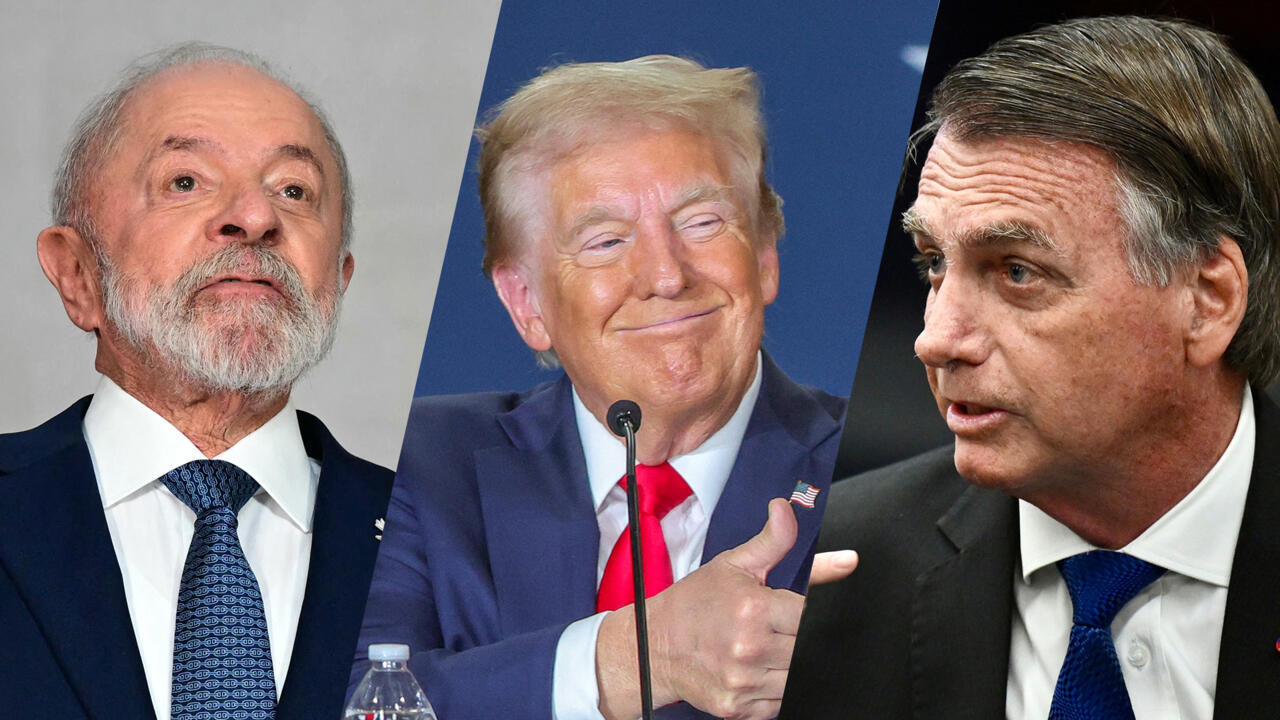
Brazilian President Lula (left) is under pressure from Donald Trump (center), who wants to help former Brazilian president Jair Bolsonaro (right), who is accused of plotting a coup. © Graphic Studio France Médias Monde

For Donald Trump, this is a personal matter. The letter he sent to Brazilian President Lula on Wednesday, July 9, begins with "I". This style is very different from the models of the missives he has also sent to several Asian leaders since the beginning of the week to inform them of American intentions in terms of customs duties.

"I knew, and I had to deal with, former President Jair Bolsonaro [2019-2022, editor's note] whom I respect a lot," Donald Trump said in the preamble. What does this have to do with US tariffs? However, they are the raison d'être of his letters sent by the American president to kick off possible negotiations before the imposition of American taxes on Brazilian exports to the United States, scheduled for August 1.
Tariffs to end 'witch hunt'

In this case, Donald Trump is making a direct link between the fate of Jair Bolsonaro and the 50% tariffs that the U.S. president wants to impose on Brazilian products. The former Brazilian president is accused of trying to organize a coup d'état at the end of 2023 to overturn the results of the last presidential election that saw the victory of Lula... whom he would also have sought to have assassinated. Jair Bolsonaro faces a sentence of up to 40 years in prison if the court finds him guilty of the facts.

But for Donald Trump, his "Brazilian friend" is the victim of a "witch hunt" that must stop "immediately". The president of the United States "does not bother to provide an economic justification for his threats of tariffs," Paul Krugman, the 2008 Nobel Prize in Economics who has become a great critic of Donald Trump, said on his blog.


Indeed, until now, Donald Trump's tariff vendetta was presented as a way of sanctioning countries that were accused of "profiting commercially" from the United States. Which, in Trumpian language, amounted to putting all the countries with a trade surplus in the same basket. And Brazil is one of the few countries to have a trade deficit with the United States.

In other words, "it is difficult not to consider the latest threats of tariffs as a kind of personal and political vendetta by Donald Trump against the Brazilian government," said Natasha Lindstaedt, an expert on authoritarian regimes at the University of Essex.

"The two leaders have a very bad relationship," the expert continues. Donald Trump criticises Lula not only for the way his government "treats" Jair Bolsonaro, but also for his very left-wing political positioning and "the barriers that the country has erected against the penetration of the Brazilian market by US digital platforms [X, Facebook etc.]", adds Thiemo Fetzer, an economist at the University of Warwick who has worked on the trade war led by Donald Trump.


Tariffs as an ideological tool


The US president also refers in his letter to what he calls Brazil's "insidious attacks" against these North American social networks. Brazil had blocked access to X, accused of being a tool of disinformation, in the summer of 2024.

For Thiemo Fetzer, Donald Trump's "technological" grievances against Lula are not just a footnote in the ideological tug-of-war between the two presidents. "Americans see these barriers to entry for their digital services in a market as large as Brazil as a danger to the projection of North American soft power," the economist said.


The guest at the heart of the France 24 news ©
12:36


This is not the first time that the United States has used an economic weapon for political or geopolitical purposes. "But until now, it has been more under the guise of advancing the democratic cause in the world, as for example when they reduced military aid to the Philippines at the end of Ferdinand Marcos' reign in 1985 [to promote democratic reforms]," Lindstaedt said.

For her, Donald Trump is hijacking this strategy for the purpose of promoting authoritarian leaders. "He is using tariffs as an ideological tool to punish Lula and a government that has been particularly at the forefront of the fight against autocratic excesses in his country," Lindstaedt said. According to her, this is a way for Washington to make the rest of the world understand the risks that a government runs if it places itself in the "wrong" ideological camp in the eyes of Donald Trump.

But Brazil also has to pay because Lula's government "is one of the main promoters of an international tax system within the G20 and, in particular, the taxation of billionaires. And this is something that Donald Trump does not want or rather an area where the United States wants to impose its solution," says Thiemo Fetzer. In other words, the threat of exorbitant tariffs would also aim to bring Brazil back into line.

Backlash for Washington?


But are customs duties the best weapon to make Brazil give in? "Coercion only works if the targeted country does not have the means to retaliate and if it really needs to have access to the American market for its exports," said Manfred Elsig, deputy director of the World Trade Institute at the University of Bern.

In both respects, Brazil may not be as dependent on the United States as Donald Trump might believe. Lula has already announced that his country will retaliate against a possible increase in customs duties. "Americans' breakfast is likely to cost more because a third of the coffee they drink and half of the oranges they consume come from Brazil," said the Spanish daily El Pais.

In addition, "Lula will be all the more inclined not to negotiate with Donald Trump because he has built part of his popularity on his desire to stand up to the United States," adds Natasha Lindstaedt.

And then exports to the United States represent only 2% of Brazilian GDP. The economic shock should be able to be absorbed by Brazil. Ironically, the first trade war launched by Donald Trump in 2018 against Beijing "greatly benefited Brazil, which was able to increase its exports to China," says Thiemo Fetzer.

In other words, Donald Trump has, in turn, made Brazil less likely to be subject to North American trade blackmail. And for the experts interviewed, these new threats could bring Brazil even closer to China, "which would be the opposite of what Donald Trump is looking for".
Forty years after the Rainbow Warrior bombing, activists still under attack

Forty years ago this week, the Greenpeace vessel Rainbow Warrior was sunk by two bombs planted by French secret service operatives. The bombing, which killed photographer Fernando Pereira, was intended to halt Greenpeace’s campaign against French nuclear testing at Moruroa Atoll. Instead, it galvanised the global environmental movement and left a lasting stain on France’s international reputation.


Issued on: 10/07/2025 - RFI


The Greenpeace ship Rainbow Warrior after the explosion on 10 July, 1985. 
© Greenpeace

By:Jan van der Made

On the night of 10 July 1985, the Rainbow Warrior was moored in Auckland, New Zealand, preparing to lead a flotilla of protest vessels to Moruroa, in French Polynesia, where France had been conducting nuclear tests for decades.

Greenpeace’s mission in the Pacific was clear: to bear witness, document and physically disrupt the tests, amplifying the voices of Pacific islanders and anti-nuclear campaigners who had long decried the impact of radioactive fallout on the environment and human health.

The Rainbow Warrior had recently helped relocate Marshall Islanders affected by United States nuclear testing, further cementing its role as a symbol of peaceful protest.

'Opération Satanique'

Shortly before midnight, two underwater bombs detonated against the hull of the vessel. The first explosion prompted an evacuation, but as crew members returned to assess the damage, a second blast tore through the vessel.

Fernando Pereira, a Portugese-Dutch photographer with Greenpeace, who had gone below deck to retrieve his camera equipment, drowned as the ship rapidly sank.

The attack was quickly revealed to be the work of French agents, part of a covert operation code named Opération Satanique, which was authorised at the highest levels of the French government

.


The fallout was immediate and severe. New Zealand authorities arrested two French operatives, Dominique Prieur and Alain Mafart, who were later convicted of manslaughter and sentenced to 10 years’ imprisonment.

However, under diplomatic pressure, they served less than two years, confined to a French military base in Polynesia before being repatriated.


France was forced to apologise and pay reparations to New Zealand, Pereira’s family and Greenpeace, and French Defence Minister Eugène Charles Hernu resigned in disgrace.

The operation’s planning and execution became the subject of intense scrutiny. Among the team of agents involved was Gérard Royal, the brother of future French presidential candidate Ségolène Royal.

Members of Greenpeace are participating in a commemoration of the 20th anniversary of the attack on the Rainbow Warrior, on 2 July, 2005. AFP - PASCAL PAVANI

While Gérard Royal has never been formally charged, investigations by established French media including Le Monde, Les Echos and Le Figaro, as well as statements from former officials, have alleged his direct involvement in the operation, fuelling controversy in France for decades.

Ségolène Royal has repeatedly distanced her family from the affair, but the allegations remain a footnote in the saga of the Rainbow Warrior.
Opposite effect

Far from silencing Greenpeace, the bombing had the opposite effect. Public outrage surged in New Zealand and internationally, with donations and support for Greenpeace flooding in.

According to Mads Christensen, executive director of Greenpeace International, the sinking of the Rainbow Warrior "proved what many in Greenpeace said and are still saying – namely, that first they ignore you, then they laugh at you, then they fight you and then you win. It basically showed that that kind of resistance against Greenpeace does not work. It has the opposite effect. It builds strength".

Mads Christensen, executive director of Greenpeace International
Jan van der Made

The organisation quickly dispatched another vessel to Moruroa, ensuring the protests went ahead as planned.

The Rainbow Warrior became a potent symbol of resistance, and the incident is widely credited with strengthening the anti-nuclear movement in the Pacific and beyond.

"It is much more than just a ship that was bombed by the French," Christensen told RFI.

"They tried to silence a movement, an opposition to their plans to do nuclear testing in the Pacific. And the aftermath showed that Greenpeace just grew stronger, as did the movement."

A French nuclear test – one of some 200 atomic explosions – detonated at Mururoa Atoll, French Polynesia in 1970. © Pierre J./Flickr


In the years since, Greenpeace has expanded its operations, becoming one of the world’s best known environmental groups.

The lessons of the Rainbow Warrior have shaped its approach: a stubborn commitment to non-violent direct action, meticulous security protocols and a determination to expose environmental wrongdoing, regardless of the risks.

Today, the Rainbow Warrior rests on the seabed off New Zealand’s coast, transformed into a living reef.


Intimidation and attacks


Meanwhile, the repression of environmental activists persists in new forms.

According to a statement issued by Greenpeace on 9 July, Greenpeace USA and Greenpeace International faced a "record-breaking" Strategic Lawsuit Against Public Participation (SLAPP) in the US, launched by oil and gas company Energy Transfer, resulting in a €563 million fine.

Worldwide, according to NGO Global Witness, one environmental defender is killed every two days. The UN Special Rapporteur on Environmental Defenders also expressed concern over the disproportionate use of force during environmental protests, including in France.

According to Greenpeace, attacks on activists – whether physical, legal, political or media-driven – "reflect a clear intent to silence those who challenge exploitative and destructive models".


"The numerous attempts to intimidate non-violent activists underscore the urgent need to guarantee freedom [of expression], protect whistleblowers and defend all those working for climate justice, the preservation of life and fundamental rights,” said Jean-François Julliard, executive director of Greenpeace France.

Forty years after the Rainbow Warrior attack, the organisation says its "determination remains undiminished".

Throughout the summer, activists from the organisation's local groups are mobilising across France to pay tribute to activists, calling on the public to join the Time to Resist campaign, the aim of which is to "ignite a global wave of resistance to push back against billionaires’ greed, legal bullying and attacks on our right to protest and speak up for the planet – and for each other".
Rights court says Olympic runner Semenya did not get fair trial in gender case

Strasbourg (AFP) – A top European court Thursday said a Swiss court did not give double Olympic champion Caster Semenya a fair trial in a much-awaited appeals ruling over contested gender testing.


Issued on: 10/07/2025 - RFI


Caster Semenya has been unable to compete in her favoured 800m category since 2018. © Phill Magakoe / AFP/File

The European Court of Human Rights' decision comes after a row engulfed the 2024 Paris Olympics over the gender of an Algerian boxing champion.

Semenya, a 34-year-old South African runner, is classed as having "differences in sexual development", but has always been legally identified as female.

She has been unable to compete in her favoured 800m category since 2018, after she refused to take drugs to reduce her testosterone levels under new rules from World Athletics, the governing body for track and field.

Semenya told journalists the ECHR's decision was a "positive outcome".

"We need to respect athletes, we need to put their rights first," said the athlete, who was the Olympic 800m champion in 2012 and 2016 and world gold medallist in 2009, 2011 and 2017.

"It's just a reminder to the leaders to say priorities lie on the protection of athletes."

Semenya has embarked on a long legal marathon to contest the World Athletics rules.

The Lausanne-based Court of Arbitration for Sport ruled against her in 2019 and the decision was validated by the Swiss Federal Court in Lausanne in 2020.

It judged that a testosterone level comparable to that of men gave female athletes "an insurmountable advantage".

The ECHR found that the case had required a "rigorous judicial review that was commensurate with the seriousness of the personal rights at issue", but the Swiss federal court's review had "fallen short of that requirement".

It ruled that, as such, Semenya "had not benefitted from the safeguards provided for" in the European Convention on Human Rights, and ordered Switzerland to pay the athlete 80,000 euros ($93,000) for her expenses.


'Fight never over'

A lower chamber at the ECHR in 2023 ruled that Semenya was the victim of discrimination by the Court of Arbitration for Sport.

Its decision was however largely symbolic as it did not call into question the World Athletics ruling nor allow Semenya to return to competition without taking medication.

Swiss authorities, supported by World Athletics, appealed to the European court's 17-member Grand Chamber, leading to Thursday's ruling.

Semenya had also hoped that the Grand Chamber would uphold that she had been victim of discrimination, but it said those complaints were inadmissible as they did not fall under Switzerland's jurisdiction.

She said on Thursday she would continue to demand dignity and respect for athletes.

"The fight will never be over," she said. "As long as we have injustice, we fight till the court."

There are many types of "differences in sexual development", a group of rare conditions involving genes, hormones and reproductive organs.

Formerly known as intersexuality, they occur in approximately one in 1,000 to 4,500 births.

Semenya was born with the "46 XY" chromosome, rather than the XX chromosome most women have.

Before the 2009 world championships, where Semenya won the 800m gold aged just 18, she was forced to undergo gender testing.

She was subsequently put on medication to reduce testosterone levels.

But Semenya said she felt she was being treated like a "human guinea pig" and vowed to never again allow it.

Testosterone is produced by men and women, but men produce 20 times more of the sex hormone.

But how much the hormone boosts performance remains a matter of debate.
'Degrading'

The International Olympic Committee is weighing reintroducing gender testing.

World Athletics and World Boxing have already adopted chromosomal testing -- generally a cheek swab to check for the SRY gene, which reveals the presence of the Y chromosome.

World Aquatics in 2023 adopted a policy that foresees such testing.

Supporters say such screening simplifies access to women's competition, and UN rapporteur Reem Alsalem has said such tests are "reliable and non-invasive".

But Madeleine Pape, a sociologist of gender in sport, says there is a lack of research proving that transgender athletes or those with one of the many forms of DSD gain a "disproportionate advantage" over XX competitors.

Human Rights Watch has argued that World Athletics regulations "are degrading and invasive of privacy, on grounds that are scientifically contested".

The gender debate reignited in June around Paris Olympic boxing champion Imane Khelif.

Donald Trump, Italian Prime Minister Giorgia Meloni, and Harry Potter author J.K. Rowling were among those who stoked a row over the Algerian's gender.
COMMODITY FETISH

The $10 mn bag: Original Birkin smashes records at Paris auction

Paris (AFP) – The first-ever Birkin bag designed by French luxury brand Hermes for celebrity Jane Birkin sold for 8.58 million euros ($10 million) at a Sotheby's auction in Paris on Thursday, smashing previous price records for a handbag.


Issued on: 10/07/2025 - RFI

The "Birkin" bag and its owner © ALAIN JOCARD, Gilles LEIMDORFER / AFP

The modern design classic, owned by a Paris-based handbag collector, sparked a telephone bidding war up to seven million euros, with the final sale price set at 8.58 million with commission and fees, the Sotheby's website showed.

"After weeks of anticipation, the bidding opened at 1 million euros — prompting a gasp from the room," Sotheby's said in a statement.

The final buyer, who eclipsed eight other rivals, was a "private collector from Japan", the auction house added, without giving further details.

The previous record price for a handbag at auction was set by a diamond-encrusted crocodile skin Hermes Kelly 28, which fetched $513,000 in 2021 at Christie's in Hong Kong.

Sotheby's had advised that the Birkin prototype was expected to beat that level during its sale.

But the staggering price tag for a well-worn item is in keeping with the fashion world's recent flashy aesthetics.

After years of so-called "quiet luxury" dominating catwalks, designers have embraced more ostentatious looks in recent seasons that have been dubbed "boom boom" by some trend forecasters.

Modern-day Birkin bags are offered by Hermes to loyal clients, with prices starting at around $10,000.

'Nostalgic'


The original Birkin has changed hands twice since being put up for sale by Birkin at an auction in 1994 where the proceeds went to an AIDS charity, according to Sotheby's.

The boss of Hermes made the bag for Birkin after an encounter on a plane 
© Joël SAGET / AFP


Thursday's sale represents an extraordinary pay day for owner Catherine Benier, who has a boutique in the upmarket 6th district in Left Bank Paris.

She said she was "astonished at the result" in a statement sent by Sotheby's.

"I’m already very nostalgic at the thought of knowing the bag is no longer mine but extremely happy it has found a new loving home," she added.

She told The New York Times before the sale that the bag, which she bought at auction 25 years ago, was the "jewel in my collection".

The bag is now the second-most expensive fashion item ever sold at auction, Sotheby's said.

The record was established by a pair of ruby red slippers worn by actor Judy Garland from The Wizard of Oz in 1939, which sold for $32.5 million in 2024 in Dallas, Texas.
'Many years of use'

The birth of the Birkin bag has become a modern fashion legend.

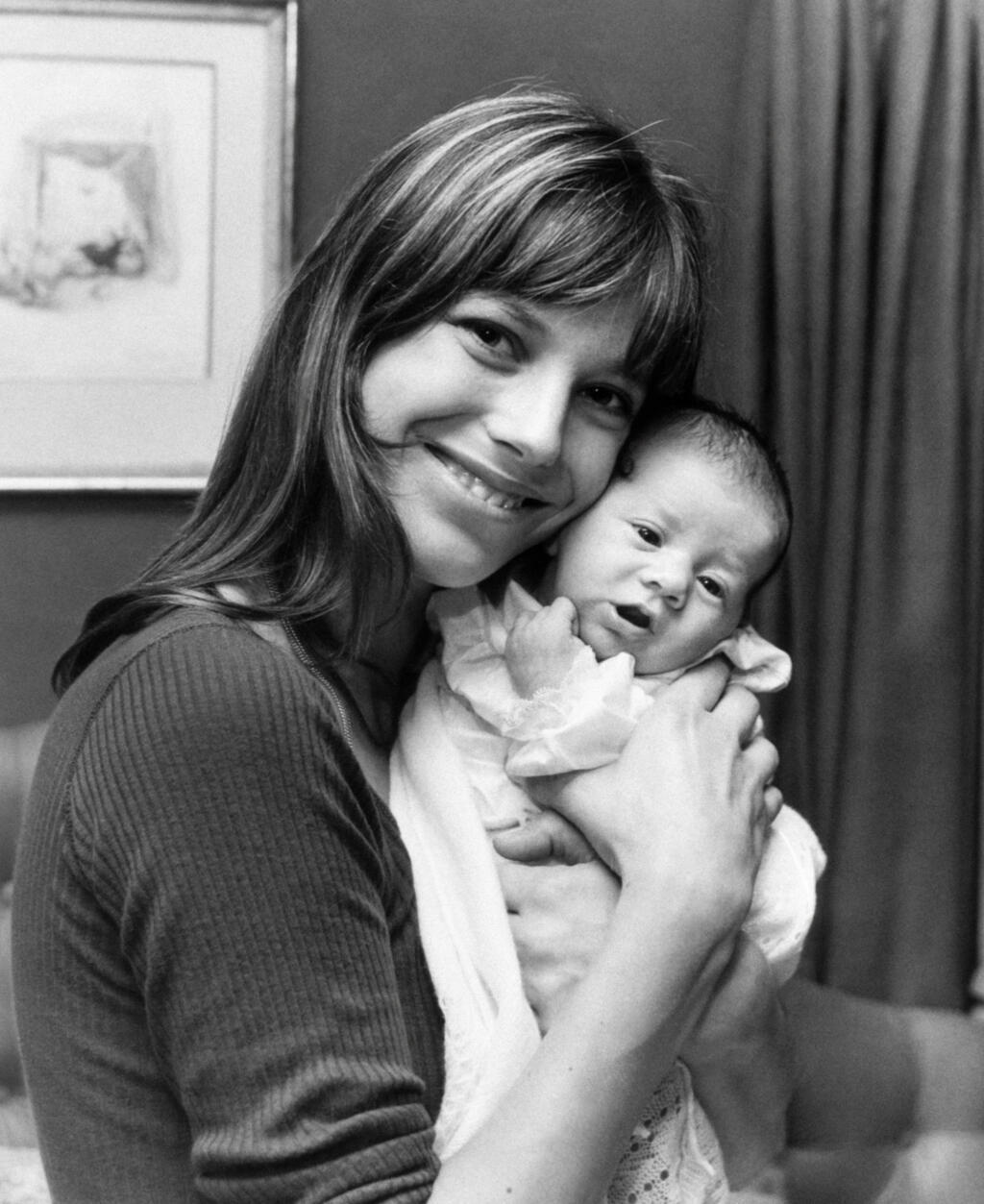
During a Paris-London flight, the singer and film star -- who died in 2023 -- complained to fellow traveller Jean-Louis Dumas, then head of Hermes, about not being able to find a bag suited to her needs as a young mother.


Singer Jane Birkin with her actor daughter Charlotte Gainsbourg weeks after her birth in 1971 © - / CENTRAL PRESS/AFP


The result of their conversation was a spacious tote with room for baby bottles, created in 1984 and named the Birkin.

The protoype, which Birkin regularly carried with her and customised with stickers, is engraved with the initials J.B. and has several unique features, including closed metal rings, a non-detachable shoulder strap and a built-in nail clipper.

Its condition "reflects the many years of use by the actress and singer", Sotheby's said beforehand.

A slightly differently sized version of the original has become the flagship product of the immensely profitable family-owned Hermes ever since.

Produced in very limited numbers, the bag has maintained an aura of exclusivity and is beloved by celebrities from the Kardashians, Jennifer Lopez to Victoria Beckham.

Frustrated fashionistas in America even sued Hermes in a class-action suit in California last year after they were refused access to the bags.

Birkin had a sometimes strained relationship with Hermes, once threatening to take her name off the bags because of the group's treatment of crocodiles whose skins are used for its products.

The former wife of French singing legend Serge Gainsbourg championed a host of causes, including animal rights.

© 2025 AFP
EU brokers deal with Israel to allow 'substantial' humanitarian aid into Gaza

As the population in Gaza faces famine, Israel has agreed to increase aid access in a deal negotiated with the European Union that would allow more food trucks to enter the territory and open some border crossings.


Issued on: 10/07/2025 - RFI


Displaced Palestinians flee an Israeli ground offensive in Khan Younis, Gaza, 10 July. REUTERS - Hatem Khaled

The EU and Israel came to an understanding that "aid at scale must be delivered directly to the population", EU foreign affairs chief Kaja Kallas said in a statement on Thursday.

EU member states have been divided over sanctions on Israel over its war in Gaza. However the bloc has used its trade ties as leverage, with France and other countries saying they would review the EU-Israel Association Agreement if Israel did not allow aid into Gaza.

Israel has restricted aid since a ceasefire deal fell through in March. As a result, Gaza's two million residents are facing hunger and even famine in some areas.

'Substantial increase' in aid

In the coming days there will be a "substantial increase" in daily trucks bringing food and other aid into Gaza, via the reopening of border crossings in the north and the south and routes through Jordan and Egypt.

The deal includes protection for aid workers, including safe passages for convoys, as well as the repair of infrastructure such as power supplies and water desalination.

Fuel deliveries will also restart, allowing hospitals to remain open and bakeries and public kitchens to operate and help distribute food.

The EU said it "stands ready to co-ordinate" with humanitarian organisations and NGOs on the ground to ensure that the aid is distributed.

The deal also includes measures to “ensure that there is no aid diversion to Hamas”.

“We count on Israel to implement every measure agreed," Kallas said on X (formerly Twitter).


Ceasefire talks

Meanwhile, Israeli and Hamas negotiators are continuing indirect talks in Qatar over a proposed 60-day ceasefire and a hostage release plan.

On Wednesday, Hamas said it would release 10 more of the hostages taken during the 7 October, 2023 attack, which triggered Israel’s war on Gaza – which has now killed more than 57,000 people, according to Palestinian health authorities.

Of 251 hostages seized during the assault on Israeli border communities near Gaza, 49 are still being held in the territory, including 27 the Israeli military says are dead.

Hamas said that although the negotiations "remain difficult due to the intransigence of the occupation" it wanted to show the "necessary flexibility" by agreeing to release the hostages.

Attacks on medical infrastructure

Israel, meanwhile, has been continuing to attack Gaza, killing 52 people on Thursday according to Gaza’s civil defence.

These attacks included a strike on a medical centre in Deir al-Balah that killed 16 people, including children, according to the Gaza health ministry.

Israel's military said it had struck a militant who took part in the 7 October attack, and that it was aware of reports regarding injuries and that the incident was under review.

The United Nations has condemned Israeli attacks on Palestinian health facilities, its detention of medics and its restrictions on allowing medical supplies into the territory.

The UN’s OCHA humanitarian agency said in May that the UN had documented at least 686 attacks impacting healthcare in Gaza since the war began.

(with newswires)
#METOO

Twelve new accusers say French priest Abbé Pierre sexually abused them


A year after the first claims of sexual abuse by the French priest and charity founder Abbé Pierre, 12 more people say they were assaulted. Seven of them say they were minors at the time. The Catholic Church and Emmaüs, the charity organisation founded by Abbé Pierre, have put in place a compensation fund.


Issued on: 10/07/2025 -  RFI

A poster depicting Abbé Pierre is displayed through railings in Paris in 2007 after he died. © Joel Saget/AFP

Henri Grouès, known as Abbé Pierre, died in 2007. He has now been accused of 45 acts of sexual violence. Twelve new testimonies have been collected since January by Égaé, the helpline for victims.

“Seven of these testimonies concern people who were minors" as young as 10 years old at the time of the events, said the expert firm commissioned by Emmaus to shed light on the matter in a report posted on the Emmaus France website.

Among them are two sisters, one of whom “recounted Abbé Pierre masturbating her" when she was 11 years old in the mid-1970s. Her sister said she had been forced to perform oral sex on him when she was 15, which is considered rape.

Another victim said she was 17 when the priest touched her under her skirt on a train in 1953. She said the nuns who met her told her she had imagined everything.

Financial reparations

Emmaus and the French Bishops' Conference (CEF) said they will set up a joint financial reparation scheme in September to “mark material recognition of the violence and consequences suffered".

The Commission for Recognition and Reparation (CRR) will run the scheme. The CRR was set up by the CEF in 2021 after widespread reports of sexual abuse in the Church since the 1950s.

The church’s other reparation body, Inirr, said it will handle claims for three victims of Abbé Pierre who have come forward.

Both the CRR and Inirr are collecting testimonies and offering up to €60,000 in compensation.
'Transparency' on Abbé Pierre

Emmaus said it wants “transparency" on the abuse. Its research commission plans to publish a full report in early 2027.

Archives opened last September showed the church hierarchy stayed silent from the 1950s about Abbé Pierre’s actions. A book released in April said the Vatican knew as well.

Despite calls from the CEF, there will be no criminal investigation. Abbé Pierre died in 2007 and the statute of limitations has expired.

(with AFP)


LAST COLONY   VIVA INDEPENDENCE

France approves €4bn plan to rebuild Mayotte and tighten migration rules

Seven months after cyclone Chido struck Mayotte, France’s poorest department, parliament has passed a sweeping plan to help rebuild the island, address social divisions and tighten migration rules.


Issued on: 10/07/2025 - 

More than six months after cyclone Chido, the National Assembly has adopted the bill to rebuild Mayotte, France's poorest department, which faced major challenges even before the cyclone. © PATRICK MEINHARDT / AFP

The plan, which was approved by the Senate on Thursday, promises €4 billion in public investment over six years. It also aims to increase social benefits in Mayotte to match mainland France by 2031.

Currently 77 percent of people in Mayotte live below the national poverty line and payments such as the minimum income benefit RSA remain half as high as in the rest of France.

Cyclone Chido hit Mayotte on 14 December, 2024, damaging homes and roads.

The Mayotte Departmental Council said it remains committed to supporting the local economy. "Our priority was to act quickly and with ambition. This interest-free loan is not only immediate help for rebuilding, but a real boost for the local economy,” Bibi Chanfi, vice president in charge of economic development, told local paper Le Journal de Mayotte.

The council has given €4 million to Initiative Mayotte, a non-profit organisation that supports local businesses with zero-interest loans, to help firms hit by the storm. Another €35 million has been added to the 2025 budget for new port and urban projects.

Comoros marks 50 years of independence amid ongoing dispute over Mayotte
Tighter immigration rules

The new law also targets what authorities have deemed two major problems: illegal immigration and informal housing.

Overseas Territories Minister Manuel Valls said the bill shows an unprecedented political ambition to make good on the Republic’s promise to Mayotte.

Nearly half the island’s population is foreign-born. The new law will make it harder to obtain residence permits and gives officials more power to clear illegal settlements.

One rule allows authorities to skip the usual obligation to offer new housing when tearing down shanty towns. Around one third of homes on the island are informal.

During debates, Valls said Mayotte risked being rebuilt on “sand” if these issues were not tackled.


Political divisions

The plan received backing from the government’s coalition and the far-right National Rally, which called it “a political victory”. Some on the left voted against it or abstained, saying it puts too much focus on immigration.

“In Mayotte, the normal law no longer applies. It has become a security lab for laws we would never dare use elsewhere in France,” Green Party senator Antoinette Guhl said.

Mayotte MP Anchya Bamana said the island still struggles with basic needs. She pointed to longterm water cuts. “How can we justify one billion to swim in the Seine? But nothing to respond to the urgent need for drinking water access for Mayotte residents,” she asked.


Key changes

The law will also scrap the special visa that prevents Mayotte residents from travelling freely to mainland France by 2030 – a change many locals see as overdue.

The plan also includes a full population count, to take place this year. Local leaders say Mayotte’s true population is often undercounted, leaving schools and hospitals overstretched.

One plan to make it easier for the government to take land for new projects was dropped after strong local protests.

Despite the government describing the plan as “unprecedented”, “massive” and “historic”, some MPs argue that it overlooks challenges such as water supply, healthcare and the green transition.

The Mayotte plan was the last bill passed before parliament breaks for the summer.


Turkish Court Orders Block On X’s Grok For Insulting Leaders

Grok. Illustration: Unsplash/Mariia Shalabaieva


By 

By Hamdi Firat Buyuk


The Prosecutors’ Office in Ankara said it had started an investigation into insulting language on X’s AI tool Grok after it shared vulgar posts about President Recep Tayyip Erdogan, his mother and the Prophet Muhammad among others.

“Following Grok’s insults against [Turkey’s founder, Mustafa Kemal] Ataturk, our esteemed President [Recep Tayyip Erdogan], and the Prophet Muhammad, the Ankara Chief Public Prosecutor’s Office .. applied to the criminal court … for an access ban. The court issued the access restriction order and forwarded it to the Information and Communication Technologies Authority (BTK) to be delivered to the internet service provider,” the prosecutors’ office wrote on Wednesday.

The BTK is expected to block access to Grok. But, at the time of publication, Grok remains accessible and it is also not clear how Grok will be blocked technically, given that it is deeply integrated within the X platform.

‘X’ has accepted that Grok’s language has been “inappropriate”.

“We are aware of recent posts made by Grok and are actively working to remove the inappropriate posts. Since being made aware of the content, xAI has taken action to ban hate speech before Grok posts on X. xAI is training only truth-seeking and thanks to the millions of users on X, we are able to quickly identify and update the model where training could be improved,” X said.


Since a recent update that X owner Elon Musk announced on July 6, Grok has started to use insulting language across the globe about various politically and sensitive topics.

Under President Erdogan’s rule, Turkey has blocked many social media platforms, including YouTube, Wikipedia, X, Instagram and TikTok, using draconian laws and regulations.

Courts and public agencies are increasingly ordering access blocks to social media content. The watchdog Freedom House’s Internet Freedom Status ranking classifies Turkey as “not free”.


Balkan Insight

The Balkan Insight (formerly the Balkin Investigative Reporting Network, BIRN) is a close group of editors and trainers that enables journalists in the region to produce in-depth analytical and investigative journalism on complex political, economic and social themes. BIRN emerged from the Balkan programme of the Institute for War & Peace Reporting, IWPR, in 2005. The original IWPR Balkans team was mandated to localise that programme and make it sustainable, in light of changing realities in the region and the maturity of the IWPR intervention. Since then, its work in publishing, media training and public debate activities has become synonymous with quality, reliability and impartiality. A fully-independent and local network, it is now developing as an efficient and self-sustainable regional institution to enhance the capacity for journalism that pushes for public debate on European-oriented political and economic reform.