Tuesday, July 15, 2025

Japanese Internment — Topaz Utah, with a Caucasian Family Assisting Farming


Earnie's 93 and all there, and his experience back then 80 years ago, almost, is the blueprint for Jewish Stephen Miller and Racist in Chief Trump's White Man's House


Spend an hour with me and Earnie Bell, of Newport, Oregon, as we look at his past as his California father was hired to assist this concentration camp feeding itself with vegetables and meat.

KYAQ. Ran in March of 2025.   Listen and Eat Your Heart Out — Earnie is ALL there, man.

A heck of an experience, for the Bell kiddos and the parents, and this is the shame, man, the continual criminal enterprise of this country, so when the Democrats complain about Trump and his Billions for ICE CBP Alcatraz Alligator Gulag, well well, just burp up some history, folks, this country of a good Indian is a dead Indian, Chinese Exclusion Act, the whole Nine Yards until today, with legal residents and card holders and someone like me, a fucking US Passport Carrying Citizen born in San Pedro California but raised in Azores and France and UK and Germany, well well, I have ZERO Loyalty to the State of Genocide, and ZERO Loyalty for State of Oregon and the other Fifty States, including especially the 51st state of Israel.

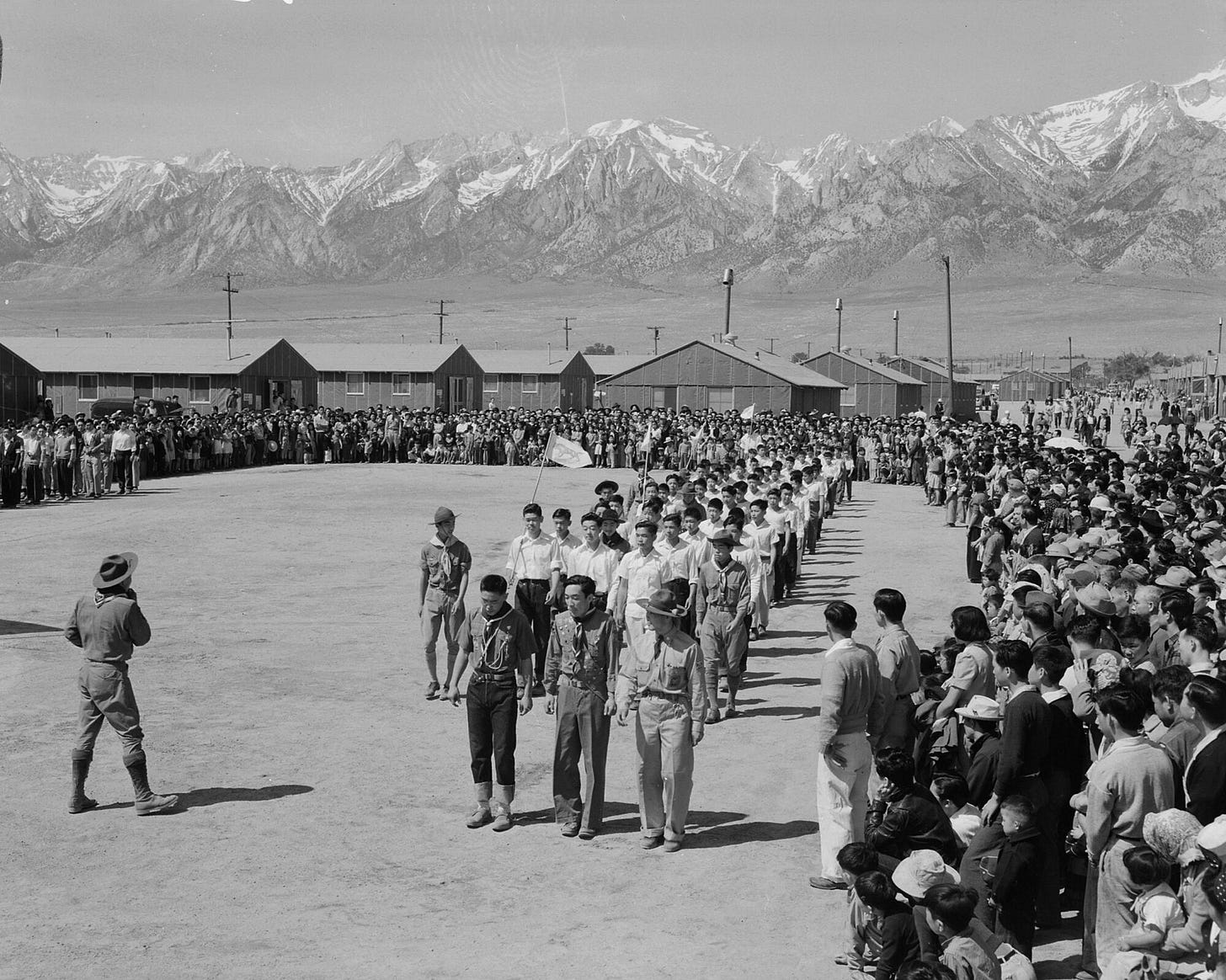
A crowd of people in Manzanar, Calif., in 1942

I had David Suzuki on my radio show in Spokane, and introduced him for a reading with a poem I wrote him. On my show, he talked about Canadian Concentration Camps, and the one he was put in with his family.

Lucky you:  David Suzuki — scientist, environmentalist, author and documentary producer interviewed by Paul Haeder, Tipping Points: Voices from the Edge, KYRS-FM, Spokane:

In 1989, David Suzuki’s award-winning radio series It’s a Matter of Survival sounded an alarm of where the planet was heading. Over 17,000 of his shocked fans sent him letters asking for ways to avert the catastrophe. A group of people urged David Suzuki and Tara Cullis to create a new, solutions-based organization. That November, they hosted a gathering with a dozen thinkers and activists on Pender Island, B.C. By the end of the meeting, something significant was afoot. And after many planning meetings, on Sept. 14, 1990, the David Suzuki Foundation was incorporated.

spokane

Background —

Manzanar, California, too:

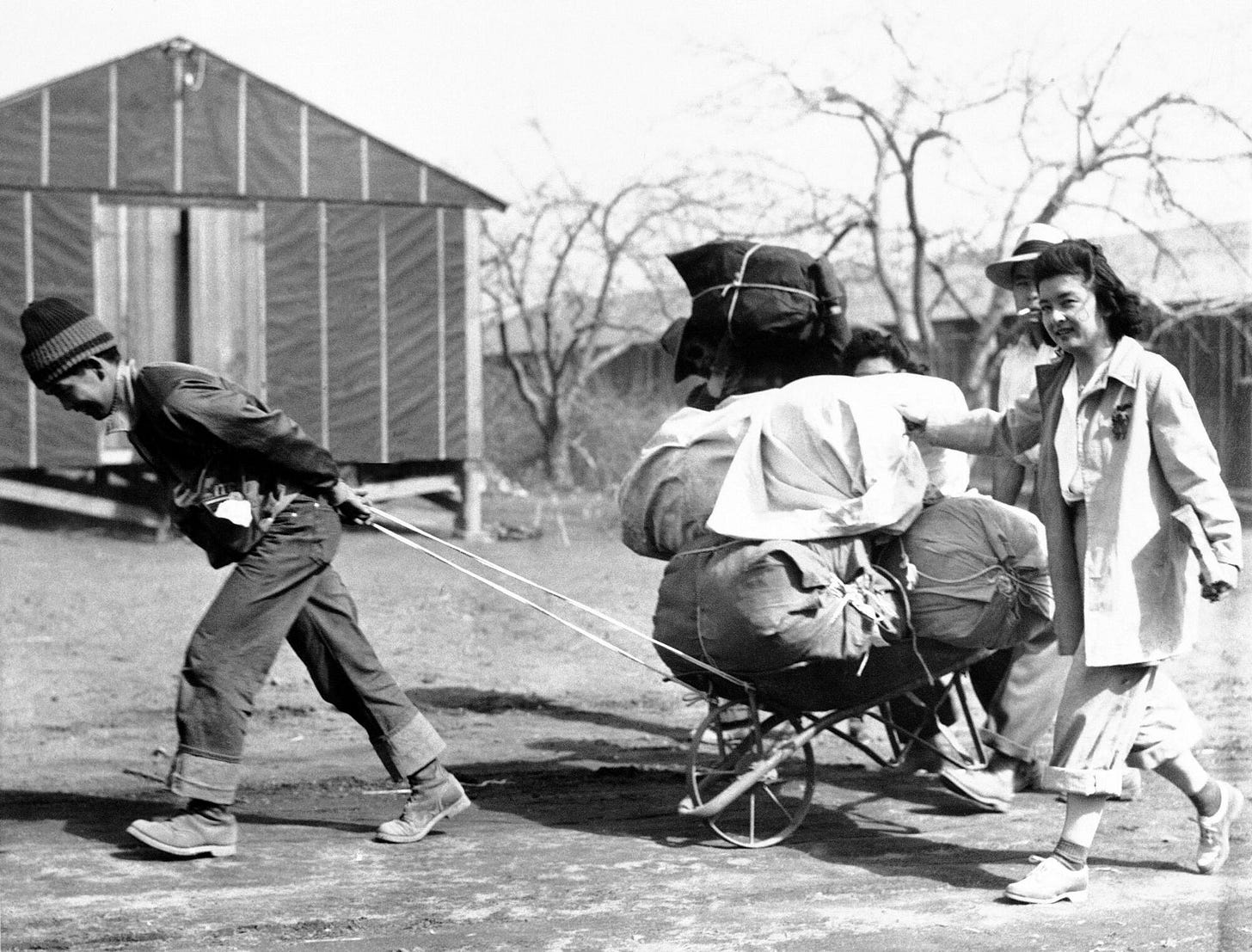
People drag bundles of belongings

 Japanese Americans at Manzanar internment camp

Source:

September 11, 2019

The “Central Utah Relocation Center”—more popularly known as Topaz—was located at a dusty site in the Sevier Desert and had one of the most urban and most homogeneous populations of the camps, with nearly its entire inmate population coming from the San Francisco Bay Area. Topaz is perhaps best known as the site of the fatal shooting of an inmate by an overzealous camp sentry in April 1943 and for its art school, which included a faculty roster of notable Issei and Nisei artists. It was also the site of significant protest against the “loyalty questionnaire” in the spring of 1943 and of a variety of labor disputes.

The second least populous of the War Relocation Authority camps (to Amache), Topaz had a peak population of 8,130 inmates. The Topaz Museum, which opened to the public in 2015, is located in nearby Delta, Utah and today owns much of the land on which the camp was once built.

Here are ten little-known stories from Topaz concentration camp:

“Swirling Masses of Sand in the Air”
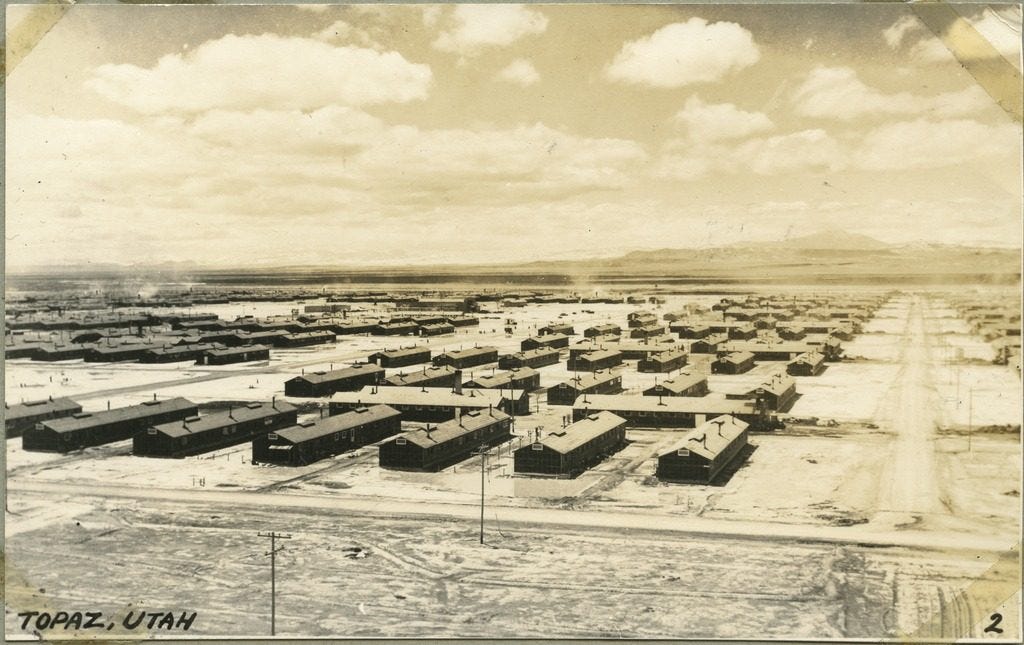
While dust storms took place at many of the WRA camps and are part of the standard narrative about these sites, they seemed to be particularly bad at Topaz even by WRA standards. Tony O’Brien, the acting project attorney, wrote in a November 1942 memo that the “dust storms are much worse than those encountered at Minidoka. The dust is more powdery in texture and penetrates every crevice on the project,” he wrote.

Maxim Shapiro, a visitor to the camp, wrote of the dust in December 1942 that “no one who has not seen it can imagine its ill effects. It penetrates everything—it fills your mouth, nostrils, the pores of your skin, your clothing—and all efforts to keep yourself or your room clean are just futile efforts…”

“We could barely see one inch ahead of us,” wrote Japanese American Evacuation and Resettlement Study (JERS) fieldworker Doris Hayashi of a dust storm in November 1942. “It swept around us in great thrusting gusts, flinging swirling masses of sand in the air and engulfing us in a thick cloud…,” wrote Yoshiko Uchida in her memoir.

The Offal Was Awful

In the spring and summer of 1943, the camp was unable to purchase sufficient meat due to outside shortages, and began serving a succession of organ meats—livers, hearts, tripe, etc.—that most inmates found unpalatable. Widespread complaints followed, including appeals to the Spanish Consul and the State Department, and calls for the firing of the chief steward. The situation was eventually resolved when the camp farming operation began to deliver beef and pork to mess halls in August 1943.

The Topaz Music School

Two girls wearing patterned kimono and playing koto, next to a woman wearing a plain dark kimono and playing a shamisen. All three are seated on a stage, with a curtain in the background and three microphones in the foreground.

A musical recital in Topaz, c.1943-1944. Photo courtesy of the Utah State Historical Society, The KUED Topaz (Utah) Residents Photograph Collection.

While the Topaz Art School is relatively well-known, the equally notable Topaz Music School is much less well documented. “It is very strange because a lot of people didn’t know that there was a music studio except the people who actually went there, and even some of those people can’t remember the details about it,” recalled Kazuko Iwahashi in a 2011 Densho interview.

As with the art school, the impetus for its creation came from the relatively large number of artists/musicians among Topaz’s urban population. First organized in the Block 35 Recreation Hall, it later moved to Barrack 6 of Block 1. Teachers and students and their families spent ten days putting up walls, ceilings, and sheet rock prior to the November 1 school opening. The school offered courses in piano, vocal, violin, solfeggio, harmony, history of music, choir, ensemble, orchestra, and noh drama. The peak enrollment at the school was 653, ranging from four-year-olds to a seventy year old choral student. The school put on regular recital programs featuring the students.

As with other education endeavors, supplies and equipment were an issue. In particular, there was the matter of pianos. Though the school had access to seven pianos—many came from individual inmates and Japanese American churches in the Bay Area—this was not sufficient, and piano students were limited to mere minutes of weekly practice time. Violin students had to provide their own instruments. Nonetheless, the music school and its various performance programs provided a welcome diversion for students, teachers, and the community alike.

The Santa Anitans

Concentration camp life created some unusual groupings, alliances, and, sometimes, out groups. One of the oddest instances of the last was the fate of Santa Anitans at Topaz. Essentially the entire population of Topaz came from the San Francisco Bay Area, and nearly all came through the Tanforan Assembly Center. But one of the first groups to be removed from San Francisco in April 1942 was sent to Santa Anita instead, since Tanforan had still not been completed. This group spent nearly six months at Santa Anita and was among the last to arrive at Topaz on October 7. Even though this group shared common Bay Area roots with the rest of the Topaz population, it seems their time at Santa Anita had changed them.

Their long incarceration at Santa Anita along with the miserable conditions they faced as late arrivals at Topaz led to their being viewed by other inmates as having “a cocky attitude” and having “a chip on their shoulder.” Community Services Chief Lorne Bell described them as “something of a problem, reflecting to some degree the very unfortunate conditions which must have prevailed at that center [Santa Anita].” Their incarceration with Los Angeles people also seemed to have changed them in the view of the Bay Area people. Fred Hoshiyama, who was working as a JERS field worker, described their arrival with some degree of bewilderment:

Many of the young nisei boys who were conservative dressers came off of the bus in “zute (sic) suits” and other flashy dress wear. The girls wore their hair in styles different from the Tanforan group ala Hollywood glamour styles—either long like Veronica Lake or short and put up. Their language, their attitudes, their mannerism changed to the extent that It was easily discernible and many of the Tanforan girls and boys expressed surprise as well.

The Santa Anita group was housed in Blocks 33, 34, and 40 and apparently remained somewhat distinct from the rest of the population.

The Hawaiʻi Group

Topaz was one of two WRA camps to have a sizable contingent who had been shipped from Hawaiʻi. (Jerome was the other.) The group of 226 arrived in March of 1943 and were housed in Block 1. Most—176—were single men, most of them Kibei. Inmates and WRA staff went through great efforts to welcome them upon their arrival. Many had been interned at Sand Island previously or were family members of such internees. Most of them eventually ended up going to Tule Lake after segregation and many went on to Japan.

Hostile Reception for Outside Farm Workers
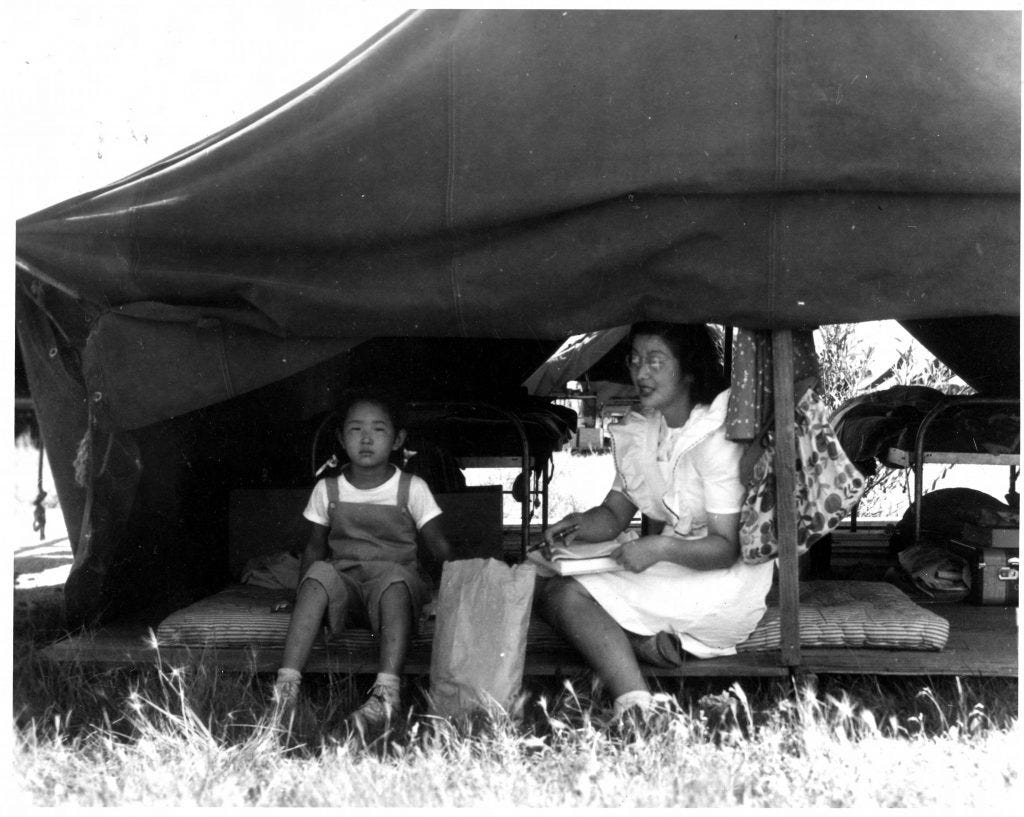
A Japanese American woman and child sitting inside a tent in a farm labor camp.

Harvest tent city near Provo, UT, where Topaz inmates were recruited to do farm labor. During the harvest, local residents fired rifles into the tent city and three inmates were wounded. Photo courtesy of the Utah State Historical Society, KUED Topaz (Utah) Residents Photograph Collection.

As at many camps, inmates were encouraged to go out on short term leave during the harvest season to do agricultural work in states like Utah, Idaho, and Colorado. Because so many workers were moving to the coast to take relatively well-paying war industry jobs, there were serious shortages of agricultural workers, leading to many farmers attempting to recruit incarcerated Japanese Americans. Thousands of Japanese Americans did do this, particularly in the falls of 1942 and 1943. So many left some of the camps in fact, that they created labor shortages in those camps.

While some at Topaz did leave to do such seasonal outside labor, the numbers were fewer for a couple of reasons. One was that the Topaz population was a largely urban one that included relatively few experienced farm workers. Another factor was the poor reception some farm workers received. One of the areas where laborers were most needed was in Utah County, where the WRA set up a housing camp in Provo that could house up to 400 Japanese American workers. Some of the workers reported that stores and restaurants wouldn’t serve them and that locals harassed them on the streets. In October 1943, some local youths even fired shots into the labor camp while the inmates were present. They refused to return to work until their safety could be guaranteed. Armed guards were quickly brought in, and the inmates did go back to work. But such incidents did little to encourage others to go out.

Issei and Nisei Resistance to Registration

Widespread resistance to registration emerged at Topaz, with Issei and Nisei alike questioning various aspects of the “loyalty questionnaire” and the segregated Nisei combat unit, delaying the scheduled February 10, 1943, start of registration a week.

As detailed by Cherston Lyon in her 2011 monograph Prisons and Patriots: Japanese American Wartime Citizenship, Civil Disobedience, and Historical Memory, Issei objected to the wording of question 28 that asked a population that was prohibited by law from becoming U.S. citizens to “forswear any form of allegiance or obedience to the Japanese Emperor.” They organized a committee of nine to ask that the question be changed and refused to register until the issue was resolved. With similar complaints coming from other camps, the WRA and army agreed to change the wording of the question.

Nisei also organized a Committee of 33 to demand the restoration of their civil rights before they would agree to register. But a hard line response—included threats of prosecution for violating the Espionage Act—by both local and national WRA officials along with counter protests by professed Nisei patriots broke the Nisei protest. Registration began in earnest on February 17 and was completed by February 27. While the initial number of Nisei who volunteered for the army was low, a group of volunteers formed the Resident Council for Japanese American Civil Rights, which spearheaded a propaganda campaign that helped recruit additional volunteers.

A year later, when Nisei eligibility for the draft was restored in early 1944, two groups formed to protest the continued segregation of Nisei in the army, the Topaz Citizens Committee and Mothers of Topaz. Though a faction of the former advocated draft resistance, the majority opted to protest segregation in the army but not to actively resist conscription. The latter sent a petition signed by 1,141 mothers to President Roosevelt and other national leaders objecting to the segregated Nisei military unit and to the fact that Nisei were banned from all branches of the military except the army.

Gambling Boom

Gambling became an issue at many of the WRA camps. But whereas gambling problems were mostly fueled by shadowy underground operations at other camps, they took an unusual form at Topaz. By the fall of 1943, many blocks had started bingo games as fundraisers, often for the purchase of athletic equipment. While they were effective in raising money, they had the unwanted side effect of creating bingo addicts, many of whom were children. As reports circulated of children raiding family kitties to fund their addiction, the Topaz Community Council passed an ordinance banning the bingo games, though some previously planned events were allowed to proceed at the end of the year.

To be sure, the other kind of gambling also existed at Topaz. The professional gamblers particularly targeted those who left the camp to pick sugar beets and returned to camp with a lot of cash. “The guys who stayed behind in the gambling place in camp took it all away from them in a short time,” recalled one gambler in a 1944 interview.

The Antelope Springs recreation camp

A unique aspect of Topaz was the existence of a separate recreation camp for kids. The camp education department made arrangements with the Department of the Interior to use a former CCC camp near Mt. Swasey, about forty miles west of Topaz named Antelope Springs. It served as a campsite mostly for children between the ages of twelve and fourteen, often in groups organized by the Boy Scouts, Girl Reserves or YMCA. About seventy-five kids at a time went out for stays of up to one week, accompanied by adult inmate leaders. The site was at a 7,300 foot elevation, providing a respite from summer heat, and included running mountain water, and level ground for camping.

In her Densho interview, Kazuko Iwahahsi recalled, “we slept in pup tents, two of us to a pup tent, and had open dining hall.”

“And boy, June on the lake bed out there at Topaz must have been well over a hundred degrees,” remembered Kinge Okauchi. “So this [Antelope Springs] was a great sort of respite from the hot summer.” During the summer of 1943, 338 campers went to the Antelope Springs in seven weeks.

An Extensive Library Program

In perhaps another nod to the urban roots of the Topaz inmate population, Topaz had perhaps the most extensive library system of any of the WRA camps that included a main Topaz Public Library (TPL), a library for Japanese language material, and libraries at the high school and each of the two elementary schools.

The TPL began as essentially a continuation of the library at the Tanforan Assembly Center, with books from that library being shipped to Topaz and two former library workers from there, Ida Shimanouchi and Alice Watanabe, taking the lead in setting up the new library. Work began on the library in Recreation Hall 32 on October 2, 1942. The space was unfinished and unheated, leading to days when work had to be canceled due to the cold. Inmates contributed books and magazines to the Tanforan collection, and the library was able to open to the public with a collection of nearly 7,000 books on December 1. The TPL soon moved to the Block 16 recreation hall, essentially an entire unpartitioned barrack with mess hall tables and benches running down the middle and inmate built shelves lining the walls. The collection grew to include fifty-two periodicals, including major national newspapers as well the Oakland Tribune and San Francisco Chronicle, as well as a rental collection of new books that rented for 5¢ a week.

In January 1943, the TPL was able to rotate in some books from the Salt Lake County Library at Midvale and also initiated interlibrary loan service with college libraries in Utah and the University of California at Berkeley. By the end of March 1943, the collection had grown to over 8,500 books and patronage peaked at nearly 500 a day. It became a popular place for young people to gather to socialize and do homework. Motomu Akashi recalled spending many hours in the library, since “[i]t was much more comfortable than our apartment, especially during the winter.” He called the library “my salvation” that “brought me just that small pleasure needed to overcome my depression.”

To serve the Issei and Kibei population, a Japanese language collection was formed out of donations from inmates. Opening as a part of the regular TPL in February 1943, the Japanese section became so popular that it moved to its own space in Recreation Hall 40 in May, later moving to Recreation Hall 31 in February 1944. The collection began with about 1,000 books and eventually grew to 5,000, with daily attendance of three hundred. The inmates from Hawaiʻi became frequent users of the library and put on a popular exhibition of craft items in Hawaiʻi. Later, the Japanese library hosted exhibitions of artists from the art school.

*****

By Brian Niiya, Densho Content Director

The information presented here has been excerpted from Densho’s new and improved Sites of Shame project. Full citations will be included there, but feel free to post questions in the comments or email us at gro.ohsned@ofni in the meantime!

[Header image: Japanese American inmates and new arrivals at the Topaz “induction center” in 1942. Photo courtesy of the Utah State Historical Society, KUED Topaz (Utah) Residents Photograph Collection.]
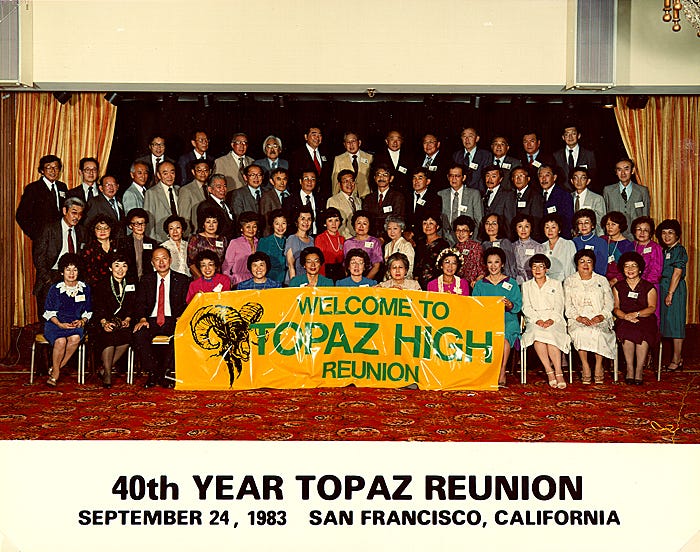
A large group of former students gathered for the 40th Topaz High reunion, holding a colorful banner, in San Francisco, 1983.

Life Behind Barbed Wire

The single internment camp located in Utah was at Topaz, Utah, sixteen miles west of Delta, Utah. Named for a nearby mountain, Topaz was in the middle of an area charitably described as a “barren, sand-choked wasteland.” The first internees were moved into Topaz in September, 1942, and it was closed in October, 1945. At its peak, Topaz held 9,408 people in barracks of tarpaper and wood.

The George G. Murakami Collection

The items in this exhibit were graciously lent to the University of Utah by George G. Murakami, a young American from Berkeley, California, who was interned in Topaz.
KYAQ Home -
Man oh man, Spokesman Review didn’t scrub all my stuff:  David Suzuki
Public Notices | The Spokesman-Review
David Suzuki is an internationally known environmental activist and scientist. Although he is well known for his radio broadcasts in Canada, he’s become an international celebrity through the television show The Nature of Things. Suzuki also cofounded the David Suzuki Foundation for the promotion of living in balance with the natural world. He’s got more than 50 books under his name.
Paul Haeder's been a teacher, social worker, newspaperman, environmental activist, and marginalized muckraker, union organizer. Paul's book, Reimagining Sanity: Voices Beyond the Echo Chamber (2016), looks at 10 years (now going on 17 years) of his writing at Dissident Voice. Read his musings at LA Progressive. Read (purchase) his short story collection, Wide Open Eyes: Surfacing from Vietnam now out, published by Cirque Journal. Here's his Amazon page with more published work AmazonRead other articles by Paul, or visit Paul's website.

To Each According to Their Need


To whatever extent we reach our potential in this world, my grandmother would be furious if I didn’t say that it was due to a combination of our individual talents and the societal conditions – the real existing material conditions, as a good Marxist might say – that have shaped our lives. But while she would probably not admit it, the faith in her eyes – the challenge to imagine with others a better world and actively move with them towards it, to engage in collective struggle to achieve a more humanistic society – that faith will always remain with us.

— Dorothy Ray Healey remembrance, Jewish Women’s Archive

“Without vision, the people perish.” This famous quote from Proverbs 29:18 in the Old Testament is absolutely on target, based on my experiences over many years. A variation of this quote—if you don’t know where you’re going, any road will get you there—underlines the danger of not having a vision. A road to nowhere is a dangerous road.

Karl Marx and Friedrich Engels had a vision, summed up in the phrase, “from each according to their ability, to each according to their need.” Was this an original idea back then, 177 years ago? I don’t think so.

In his younger years Marx was connected to religion; he was baptized as a Lutheran at the age of six. He studied religion, ultimately leading him to develop his well-known critique of it as an “opiate of the people.”

The book of Acts is a religiously oriented history of the first years and decades of the Christian church after Jesus of Nazareth was killed. In chapters two and four, it is made clear that in these early days of the Christian religion, the concept of “from each according to their ability, to each according to their need” was a central vision.

Here’s how it is described in Acts 2: 44-45: “All who believed were together and had all things in common; they would sell their possessions and goods and distribute the proceeds to all as any had need.” And similarly in Acts 4: 32 and 34: “Now the whole group of those who believed were of one heart and soul, and no one claimed private ownership of any possessions, but everything they owned was held in common… There was not a needy person among them, for as many as owned lands or houses sold them and brought the proceeds of what was sold.”

I’m pretty sure that Dorothy Healey got this. She was the first socialist I ever heard quote Bible verses as she made her case from the podium speaking to hundreds of mostly young people at a national conference of the now-defunct New American Movement in 1974. I don’t remember exactly what she said, but I remember thinking that I wished I could do that. Why did I feel that way?

One reason is that I had generally positive experiences growing up in the church my parents took me to every Sunday, as well as with others in my extended family, especially my grandparents, who were devout Christians. But it was also because, as I became a peace and justice and impeach Nixon activist in my late teens and early 20’s, and as I was exposed to individuals who looked to Marx and Engels and “scientific socialism” as their “bible,” it seemed to me that one thing both had in common was a vision for a very different kind of society than the one dominating much of the world.

And let’s be real: what both also have in common is the corruption of the original vision of their founders as they grew politically stronger and more institutionalized. That is a reality that can never be forgotten, something those of us today need to study and learn from going forward.

Healey tried to put the two positive visions together. She believed in Christian/Marxist unity. She may or may not have been an atheist, I don’t know, but her life was grounded in the best of both those worlds.

All of us have a responsibility to “imagine with others a better world and actively move with them towards it, to engage in collective struggle to achieve a more humanistic society” with the long term goal, one many of us will not see, of human societies where the abilities of all are used to meet the economic, social and cultural needs of all. We must hold fast to this vision whatever the odds against us right now.

Ted Glick works with Beyond Extreme Energy and is president of 350NJ-Rockland. Past writings and other information, including about Burglar for Peace and 21st Century Revolution, two books published by him in 2020 and 2021, can be found at https://tedglick.com. He can be followed on Twitter at twitter.com/jtglickRead other articles by Ted.


Mass Killings, Media Control, and the Machinery of US Soft Power

Dismantling the ideological architecture of the U.S. empire by exposing how atrocity becomes infrastructure and propaganda becomes profession. From the Ford Foundation’s role in Indonesia’s Cold War genocide to the rise of figures like Orville Schell and Johnny Harris, KJ unpacks how soft power functions as a weapon: manufacturing consent, laundering imperial violence, and shaping global narratives. How US think tanks, journalism schools, and digital platforms are not just media ecosystems, but actually, ideological battlegrounds built atop bloodshed.

K.J. Noh is a long time activist, writer, and teacher. He is a member of Veterans for Peace and works on global justice issues. He can be reached at: k.j.noh48@gmail.comRead other articles by K.J..

Russophobia by the Collective West Opens the Doors of the Cold War 2.0


The 2018 Skripal Attack Case

The current orchestrated Western policy of total Russophobia, directed by Collective West, can be recorded to start by the British Cabinet of Theresa May – the focal servant-dog to US global imperialism, followed by the creation of the War Cabinet of the US President Donald Trump (first administration), was a nothing else than a jumping to the new stage of the post-WWII Cold War (2.0) which was originally started (1.0) by the US and never was over as its main task of total economic, political, and financial subordination or/and occupation of Russia still is not realized. The Russian, at that time just diplomatic, an exodus from the Western jaw was a “punishment for Russia’s alleged nerve gas poisoning of a former Russian/MI6 double-agent, Sergei Skripal (66) and his daughter Yulia (33), who was visiting her father from Moscow”i (March, 2018).

However, it was quite obvious that “blaming Russia for Skripal attack is similar to ‘Jews poisoning our wells’ in the Middle Ages”.ii In other words, the 2018 Skripal Attack Case was just another Western “false flag” in international relations with a very precise geopolitical purpose – to continue the Cold War 1.0 against revived post-Yeltsin’s Russia. We have to remember that originally American administration started the Cold War 1.0 as it was “the Truman administration (1945−1953) used the myth of Soviet expansionism to mask the nature of American foreign policy, which included the creation of a global system to advance the interests of American capitalism”.iii However, the current Western virus of total Russophobia (the Cold War 2.0) is a natural continuation of historical Western anti-Russian policy, which looked like to be over with the peaceful dismemberment of the USSR in 1989−1991.

S. P. Huntington’s Warnings and International Relations (IR)

Samuel P. Huntington was quite clear and correct in his opinion that the foundation of every civilization is based on religion (i.e., on metaphysical irrational beliefs).iv S. P. Huntington’s warnings about the future development of global politics that can take the form of a direct clash of different cultures (in fact, separate and antagonistic civilizations) are, unfortunately, already on the agenda of international relations. Here we came to the crux of the matter in regard to the Western relations with Russia from both historical and contemporary perspectives: the Western civilization, as based on the Western type of Christianity (the Roman Catholicism and all Protestant denominations) has traditional animosity and hostility toward all nations and states of the East Christian (Orthodox) confession. As Russia was and is the biggest and most powerful Christian Orthodox country, the Eurasian geopolitical conflicts between the West and Russia started from the time when the German Teutonic knights and the Sweds from the Baltic were constantly attacking northern Russian territories up to the fateful battle in 1240, which the Sweds lost to the Russian Prince of Novgorod Alexander Nevski at the Battle of Neva. However, only three decades later, the ruler of the Grand Duchy of Lithuania, Algirdas (1345‒1377), started to occupy the Russian lands – the process to be continued by the Roman Catholic common state of the Kingdom of Poland and the Grand Duchy of Lithuania when it launched its confessional-civilizational imperialistic wars against the Grand Duchy of Moscow at the very end of the 14th century; i.e., after 1385 when Poland and Lithuania became united as a personal union of two sovereign states (the Union of Krewo).v

A Role of the Vatican

The present-day territories of Ukraine (which at that time did not exist under this name) and Byelorus (Belarus, White Russia) became the first victims of Vatican policy to proselytize the Eastern Slavs. Therefore, the biggest part of present-day Ukraine became occupied and annexed by Lithuania till 1569vi and after the Polish-Lithuanian 1569 Lublin Union by Poland. In the period from 1522 to 1569, there were 63% of the East Slavs lived on the territory of the Grand Duchy of Lithuania out of its total population.vii From the Russian perspective, an aggressive Vatican policy of reconversion of the Christian Orthodox population and their denationalization could be prevented only by military counterattacks to liberate the occupied territories. However, when it happened from the mid-17th century till the end of the 18th century, a huge number of the former Christian Orthodox population had already become Roman Catholics and the Uniates, losing their original national identity.

A conversion to the Roman Catholicism and making the Union with the Vatican on the territories occupied by the Polish-Lithuanian common state till the end of the 18th century divided the Russian national body into two parts: the Christian Orthodox, who remained to be the Russians and the pro-Western oriented converts who, basically, lost their initial ethnonational identity. This is especially true in Ukraine – a country with the biggest number of Uniates in the world due to the Brest Union signed in 1596 with the Vatican.

The Uniate Church in (West) Ukraine openly collaborated with the Nazi regime during WWII and for that reason, it was banned after the war till 1989. Nevertheless, it was exactly the Uniate Church in Ukraine which propagated an ideology that the “Ukrainians” were not (Little) Russians but instead a separate nation who are in no ethnolinguistic and confessional connection with the Russians. Therefore, a way was opened to the successful Ukrainization of the Little Russians (and Minor Russia), Ruthenians, and Carpatho-Russians during Soviet (anti-Russian) rule. After the dissolution of the USSR, the Ukrainians became an instrument of the realization of the Western anti-Russian geopolitical interests in Eastern Europe.viii

The unscrupulous Jesuits became the fundamental West European anti-Russian and anti-Christian Orthodox hawks to propagate the idea that a Christian Orthodox Russia is not belonging to a real (Western) Europe. Due to such Vatican propaganda activity, the West gradually became antagonistic to Russia, and Russian culture was seen as disgusting and inferior, i.e., barbaric, as a continuation of the Byzantine Christian Orthodox civilization. Unfortunately, such a negative attitude toward Russia and the East Christianity is accepted by a contemporary US-led Collective West for whom Russophobia has become an ideological foundation for its geopolitical projects and ambitions.ix Therefore, all real or potential Russia’s supporters became geopolitical enemies of a Pax Americana, like the Serbs, Armenians, Greeks, Byelorussians, etc.

Western Defeats and Russian Blowback

A new moment in the West-Russia geopolitical struggles started when the Protestant Sweden became directly involved in the Western confessional-imperialistic wars against Russia in 1700 (the Great Northern War of 1700−1721) which Sweden lost after the Battle of Poltava in 1709 when Russia of Peter the Great finally became a member of the concert of the Great European Powers.x

A century later, that was a Napoleonic France to take a role in the historical process of “Eurocivilizing” of “schismatic” Russia in 1812, that also finished by the West European fiascoxi, similar to Pan-Germanic warmongers during both world wars.

However, after 1945 up to the present, the “civilizational” role of the Westernization of Russia is assumed by NATO and the EU. The Collective West, immediately after the dissolution of the USSR, by imposing its client satellite Boris Yeltsin as the President of Russia, achieved an enormous geopolitical achievement around Russia, especially in the territories of the former Soviet Union and the Balkans.

Nevertheless, the Collective West started to experience a Russian geopolitical blowback from 2001 onward when the B. Yeltsin’s time pro-Western political clients (Russian liberals) became gradually removed from the decision-making positions in Russia’s governmental structures. What a new Russia’s political establishment correctly understood is that a Westernization policy of Russia is nothing else but just an ideological mask for economic-political transformation of the country into the colony of the Collective West led by the US Neocon administrationxii alongside with the task of the US/EU to externalize their own values and norms permanently. This „externalization policy“ is grounded on the thesis of The End of History by Francis Fukuyama:xiii

“…that the philosophy of economic and political liberalism has triumphed throughout the world, ending the contest between market democracies and centrally planned governance”.xiv

Therefore, after the formal ending of the Cold War 1.0 in 1989/1990, the fundamental Western global geopolitical project was The West and The Rest, according to which the rest of the world was obliged to accept all fundamental Western values and norms according to the Hegemonic Stability Theory of a unipolar system of the world security.xv Nevertheless, behind such doctrinal unilateralism as a project of the US hegemony in global governance in the new century clearly stands the unipolar hegemonic concept of a Pax Americana, but with Russia and China as the crucial opponents to it.

Stability Theories and IR

According to the Hegemonic Stability Theory, a global peace can occur only when one hegemonic center of power (state) acquires enough power to deter all other expansionist and imperialistic ambitions and intentions. The theory is based on a presumption that the concentration of (hyper) power will reduce the chances of a classical world war (but not and local confrontations) as it allows a single hyperpower to maintain peace and manage the system of international relations between the states.xvi Examples of ex-Pax Romana and Pax-Britannica clearly offered support by the American hegemons for an imperialistic idea that (the US-led) unipolarity will bring global peace and, henceforth, inspired the viewpoint that the world in a post-Cold War 1.0 era under a Pax Americana will be stable and prosperous as long as the US global dominance prevails. Therefore, a hegemony, according to this viewpoint, is a necessary precondition for economic order and free trade in a global dimension, suggesting that the existence of a predominant hyperpower state willing and able to use its economic and military power to promote global stability is both a divine and rational order of the day. As a tool to achieve this goal the hegemon has to use a coercive diplomacy based on the ultimatum demand that puts a time limit on the target to comply and a threat of punishment for resistance as, for example, it was a case in January 1999 during the “negotiations” on Kosovo status between the US diplomacy and Yugoslavia’s Government in Rambouillet (France).

However, in contrast to both the Hegemonic Stability Theory and the Bipolar Stability Theory, a post-Yeltsin Russian political establishment advocates that a multipolar system of international relations is the least war-prone in comparison with all other proposed systems. This Multipolar Stability Theory is based on a concept that a polarized global politics does not concentrate power, as it is supported by the unipolar system, and does not divide the globe into two antagonistic superpower blocs, as in a bipolar system, which promote a constant struggle for global dominance (for example, during the Cold War 1.0). The multipolarity theory perceives polarized international relations as a stable system because it encompasses a larger number of autonomous and sovereign actors in global politics, which as well as giving rise to a greater number of political alliances. This theory is, in essence, presenting a peace-through model of pacifying international relations as it is fundamentally based on counter-balancing relations between the states in the global arena. Under such a system, an aggressive policy is quite hard to implement in reality as it is prevented by the multiple power centers.xvii

A New Policy of Russia and Cold War 2.0

A new policy of international relations adopted by Moscow after 2000 is based on a principle of a globe without hegemonic leadership – a policy which started to be implemented at the time when the global power of the US as a post Cold War 1.0 hegemon declines because it makes costly global commitments above ability to fulfill them followed by the immense US trade deficit – even today the cancer of American economy which the current US President desperately wants to heal. The US share of global gross production has been in the process of constant decline since the end of WWII. Another serious symptom of American erosion in international politics is that the US share of global financial reserves has drastically declined, especially in comparison to the Russian and Chinese shares. The US is today the largest world debtor and even the biggest debtor that ever existed in history (36.21 trillion dollars or 124 percent of the GDP), mainly, but not exclusively, due to huge military spending, alongside tax cuts that reduced the US federal revenue. The deficit in the current account balance with the rest of the world (in 2004, for instance, it was $650 billion), the US administration is covering by borrowing from private investors (mostly from abroad) and foreign central banks (most important are those of China and Japan). Therefore, such US financial dependence on foreigners to provide the funds needed to pay the interest on the American public debt leaves the USA extremely vulnerable, especially if China and/or Japan decide to stop buying the US bonds or sell them. Subsequently, the world’s strongest military power is at the same time the greatest global debtor, with China and Japan being direct financial collaborators of the US hegemonic leadership’s policy of a Pax Americana after 1989/1990.

It is without any doubts that the US foreign policy after 1989/1990 is still unrealistically following the French concept of raison d’état that indicates the Realist justification for policies pursued by state authority, but in the American eyes, first and foremost of these justifications or criteria is the US global hegemony as the best guarantee for the national security, followed by all other interests and associated goals. Therefore, the US foreign policy is still based on a realpolitik concept that is a German term referring to the state foreign policy ordered or motivated by power politics: the strong do what they will, and the weak do what they must. However, the US is becoming weaker and weaker, and Russia and China are more and more becoming stronger and stronger.

Final Words

Finally, it seems to be true that such a reality in contemporary global politics and international relations is, unfortunately, not properly understood and recognized by the current US President Donald Trump as he is going to be just another Trojan horse of the US Neocon concept of a Pax Americana followed by the megalomanic Zionist concept of a Greater Israel of “From the River to the River”xviii, and, therefore, there are no real chances to get rid of the US imperialism in the recent future and to establish international relations on a more democratic and multilateral foundation. Therefore, the US-led Western turbo Russophobia since 2014 has already driven the world into a new stage of the post-WWII Cold War–2.0.

ENDNOTES:

i Peter Koenig, “Russian Exodus from the West”, Global Research – Centre for Research on Globalization, 2018-03-31: https://www.globalresearch.ca/russian-exodus-from-the-west/5634121.

ii John Laughland, “Blaming Russia for Skripal Attack is Similar to ‘Jews Poisoning our Wells’ in Middle Ages”, Ron Paul Institute for Peace and Prosperity, 2018-03-16: http://www.ronpaulinstitute.org/archives/featured-articles/2018/march/16/blaming-russia-for-skripal-attack-is-similar-to-jews-poisoning-our-wells-in-middle-ages/.

iii David Gowland, Richard Dunphy, The European Mosaic, Third Edition, Harlow, England−Pearson Education, 2006, 277.

iv Samuel P. Huntington, The Clash of Civilization and the Remaking of World Order, London: The Free Press, 2002.

v Zigmantas Kiaupa, Jūratė Kiaupienė, Albinas Kuncevičius, The History of Lithuania Before 1795, Vilnius: Lithuanian Institute of History, 2000, 106‒131.

vi On the Lithuanian occupation period of the present-day Ukraine, see: [Alfredas Bumblauskas, Genutė Kirkienė, Feliksas Šabuldo (sudarytojai), Ukraina: Lietuvos epocha, 1320−1569, Vilnius: Mokslo ir enciklopedijų leidybos centras, 2010].

vii Ignas Kapleris, Antanas Meištas, Istorijos egzamino gidas. Nauja programa nuo A iki Ž, Vilnius: Leidykla “Briedas”, 2013, 123.

viii About this issue, see more in [Зоран Милошевић, Од Малоруса до Украјинаца, Источно Сарајево: Завод за уџбенике и наставна средства, 2008].

ix Срђан Перишић, Нова геополитика Русије, Београд: Медија центар „Одбрана“, 2015, 42−46.

x David Kirbz, Šiaurės Europa ankstyvaisiais naujaisiais amžiais: Baltijos šalys 1492−1772 metais, Vilnius: Atviros Lietuvos knyga, 2000, 333−363; Peter Englund, The Battle that Shook Europe: Poltava and the Birth of the Russian Empire, London: I.B.Tauris & Co Ltd, 2003.

xi On Napoleon’s military campaign on Russia in 1812 and its fiasco, see [Paul Britten Austin, The Great Retreat Told by the Survivors, London−Mechanicsburg, PA: Greenhill Books, 1996; Adam Zamoyski, 1812: Napoleon’s Fatal March on Moscow, New York: Harper Press, 2005].

xii The US-led NATO bombing of the Federal Republic of Yugoslavia in 1999 is only one example of a gangster’s policy of a violation of the international law and the law on war when the civilian objects became legitimate military targets. Therefore, the attack on Serbia’s television station in the downtown of Belgrade on April 23rd, 1999 attracted criticism by many human rights activists as it was apparently selected for bombing as „media responsible for broadcasting propaganda“ [The Independent, April 1st, 2003]. By the same gangsters the same bombing policy was repeated in 2003 in Iraq when the main television station in Baghdad was hit by cruise missiles in March 2003 followed next day by the destruction of the state radio and television station in Basra [A. P. V. Rogers, Law on the Battlefield, Second edition, Manchester: Manchester University Press, 2004, 82−83]. According to the international law expert Richard Falk, the 2003 Iraq War was a „crime against Peace of the sort punished at the Nuremberg trials“ [Richard Falk, Frontline, India, No. 8, April 12−25th, 2003].

xiii Francis Fukuyama, The End of History and the Last Man, Harmondsworth: Penguin, 1992.

xiv Charles W. Kegley, Jr., Eugene R. Wittkopf, World Politics: Trend and Transformation, Tenth edition, USA: Thomson−Wadsworth, 2006, 588; Andrew F. Cooper, Jorge Heine, Ramesh Thakur (eds.), The Oxford Handbook of Modern Diplomacy, New York: Oxford University Press, 2015, 54−55.

xv David P. Forsythe, Patrice C. McMahon, Andrew Wedeman (eds.), American Foreign Policy in a Globalized World, New York−London: Routledge, Taylor & Francis Group, 2006, 31−50.

xvi William C. Wohlforth, „The Stability of a Unipolar World“, International Security, No. 24, 1999, 5−41.

xvii Charles W. Kegley, Jr., Eugene R. Wittkopf, World Politics: Trend and Transformation, Tenth edition, USA: Thomson−Wadsworth, 2006, 524.

xviii On the policy of Zionist movement, see [Ilan Pappe, Ten Myths about Israel, London‒New York: Verso, 2024, 23‒49.

Vladislav B. Sotirovic is a former University Professor in Vilnius, Lithuania and a Research Fellow at the Center for Geostrategic Studies in Belgrade, Serbia. He can be reached at: sotirovic1967@gmail.comRead other articles by Vladislav, or visit Vladislav's website.