Friday, August 01, 2025

EU urged to act on forests' faltering absorption of carbon

Paris (AFP) – The amount of carbon dioxide absorbed by European forests has reduced dramatically in recent years putting the EU's climate targets at risk, researchers said Wednesday, calling for urgent action to halt the decline.


Issued on: 30/07/2025 - FRANCE24

This aerial view taken on July 9, 2023 shows former logging areas in Romania's Tarhaus Valley © Ionut IORDACHESCU / AFP/File

Forests, which cover 40 percent of the European Union's territory, are expected to play a crucial role in efforts to meet targets for overall reductions of the bloc's emissions of planet-warming gases.

But human and climate pressures, from logging to extreme weather and insect attacks, means their ability to absorb CO2 is "rapidly declining", according to an article, led by the European Commission's Joint Research Centre.

"Reversing the decline in European forests' ability to store carbon is essential -- and still possible -- with bold, science-based action today," said co-author Giacomo Grassi, who is a member of the UN's IPCC expert task force on greenhouse gas inventories.

Solutions include rapid reductions in carbon emissions, combined with efforts to improve management to make forests more resilient to climate impacts, and comprehensive monitoring.

Many European countries still rely on periodic inventories, which cannot keep up with rapid changes to forest health.

The authors emphasize the need to better understand forest dynamics.

They call in particular for better measuring of carbon flows between the soil, vegetation, and atmosphere, as well as improving predictions of how extreme weather will affect carbon sinks in the future.

'Steeper decline'


The research looked at official 2024 data showing that the amount carbon absorbed by Europe's forests, ecosystems and changes to land use plummeted by around a third in the 2020 to 2022 period, compared to 2010 to 2014.

The authors said 2025 figures "suggest an even steeper decline".

"This trend, combined with the declining climate resilience of European forests, indicates that the EU's climate targets, which rely on an increasing carbon sink, might be at risk," the authors said.

Earlier this week another study in the Nature journal Communications Earth & Environment found that land accounts for a quarter of global emissions reductions in countries' climate plans and warned that a lack of funding and conservation focus was putting these in jeopardy.

Piers Forster, Director of the Priestley Centre for Climate Futures at Leeds University, who was not involved in Wednesday's study said it underscores the urgent need to slash emissions across the board.

"We can't bet our future on carbon removal -- either from planting more trees, from protecting forests, or from emerging technologies such as direct air capture and storage -- without understanding what is already happening to the land and natural systems," he said.

Scientists have warned that it is still unclear how carbon sinks might behave as the planet warms in future, and exactly how much heat-trapping carbon dioxide they might soak up from the atmosphere.

In April, research by Climate Analytics, a policy institute that independently assesses countries' climate plans, warned that major economies are overstating how much carbon their forests can absorb in a climate accounting fudge that could allow them to use even more fossil fuels.

© 2025 AFP
A BIG ONE
Russia relieved as tsunami spares far east from major damage

Moscow (AFP) – Russia lifted a tsunami alert on Wednesday after a massive quake and tsunami largely spared the country's sparsely populated far east from casualties and major damage.


Issued on: 30/07/2025 - FRANCE24
Authorities said residents in the northern Kuril islands were evacuated to safety 
© Handout / Geophysical Service of the Russian Academy of Sciences/AFP

An 8.8 magnitude earthquake struck off the coast of Russia's far eastern Kamchatka peninsula earlier, prompting evacuations and tsunami alerts across parts of the Pacific coast.


Russian state television on Wednesday aired footage of a tsunami wave sweeping through Severo-Kurilsk, a coastal town on an island close to Japan, carrying buildings and debris into the sea.

Giant waves crashed through the port area and submerged a fishing plant in the town of about 2,000 people, some 350 kilometres (217 miles) southwest of the earthquake's underwater epicentre, according to authorities.

The epicentre was 47 kilometres (30 miles) beneath the sea level and sent shock waves at a range of 300 kilometres (200 miles), Russia's geophysical survey told state news agency RIA Novosti.


The waves, which were up to four metres high in some areas, reached as far as the town's World War II monument about 400 metres (1,312 feet) from the shoreline, according to mayor Alexander Ovsyannikov.

Most of the town lies on higher ground safe from flooding, he added.

"Everyone was evacuated. There was enough time, a whole hour. So everyone was evacuated, all the people are in the tsunami safety zone," he said at a crisis meeting with officials earlier.

A tsunami warning for Kamchatka was lifted later on Wednesday.


'Everyone acted quickly'


"Thank God, there were no casualties," Kremlin spokesman Dmitry Peskov told reporters, saying the region's warning system had helped.

CCTV footage released by the Kamchatka region's health minister, Oleg Melnikov, showed surgeons holding down a patient on an operating table when the earthquake rocked the area.

Regional governor Vladimir Solodov said on Telegram he would nominate the doctors for state awards, adding: "Such courage deserves the highest praise."

An expedition group from the Russian Geographical Society was on the Kuril island of Shumshu when the tsunami swept away their tent camp.

"When the wave hit, all we could do was run to higher ground. It's very difficult to do that in boots on slippery grass and in fog," group member Vera Kostamo told Russian tabloid Komsomolskaya Pravda.

"All the tents and structures were swept away by the wave, and our belongings were scattered across the beach for hundreds of metres.

"We have no casualties, everyone acted quickly, but we lost all our belongings."

Authorities in the Sakhalin region, which includes the northern Kuril Islands, declared a state of emergency.

The regional seismic monitoring service said the earthquake was the region's strongest since 1952.

"Strong aftershocks with a magnitude of up to 7.5 should be expected," it added.

© 2025 AFP

Tsunami alerts due to Russian quake downgraded in several nations

Issued on: 30/07/2025 - FRANCE24

A powerful magnitude 8.8 earthquake struck off Russia’s Kamchatka Peninsula on July 30, 2025, triggering tsunami warnings across the Pacific rim—including Japan, Hawaii, Alaska, and several Central and South American countries. While initial alerts led to evacuations, many were later downgraded after no major damage was reported. Monitoring continues due to potential aftershocks.


USCG Reopens All Harbors in Hawai After Tsunami Advisory

USCG
Courtesy USCG

Published Jul 30, 2025 10:36 PM by The Maritime Executive


[By USCG]

 The Coast Guard Captain of the Port Honolulu reopened all commercial harbors in the Hawaiian Islands following the end of the tsunami advisory Wednesday.  

Coast Guard crews including an HC-130 Hercules airplane crew from Air Station Barbers Point conducted port assessments and overflights of harbors, waterways, and aids to navigation throughout the Hawaiian Islands. 

No observable hazards or pollution were reported.  

“The safety of all mariners has been our top priority throughout the tsunami warning in Hawaii,” said Capt. Nicholas Worst, commander of Coast Guard Sector Honolulu and Captain of the Port Honolulu. “While the ports are now fully reopened to maritime traffic, we are working continuously with our federal, state, local agency, and industry partners to assess any potential hazards and keep commerce flowing safely. Strong teamwork with our partners helps safeguard the maritime transportation system, which facilitates the delivery of over 98% of Hawaii’s goods.” 

The Coast Guard is urging all mariners to proceed with caution due to the potential for shoaling and unmarked hazards. Vessels and facilities should immediately report any dangerous situations or navigation discrepancies to the Sector Honolulu command center at (808) 842-2600.   

The products and services herein described in this press release are not endorsed by The Maritime Executive.


Major Earthquake Off Kamchatka Prompts Tsunami Warnings Around the Pacific

Kamchatka quake
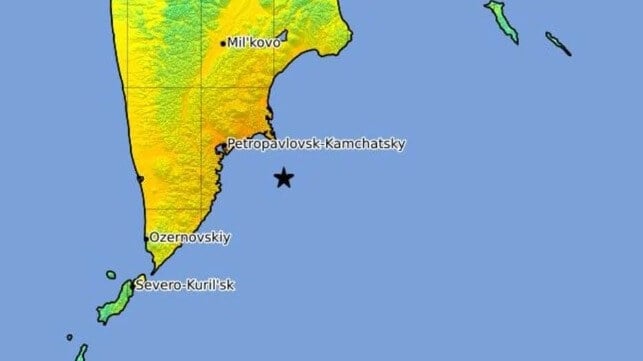
Location of the quake off Petropavlovsk-Kamchatsky (USGS)

Published Jul 29, 2025 10:16 PM by The Maritime Executive


A massive magnitude 8.8 earthquake shook the seabed off the Kamchatka Peninsula in the early hours of Wednesday morning, and officials around the Pacific have responded with tsunami warnings for shoreside communities. 

In far northern Japan, at the port of Ishinomaki, a minor tsunami of about 1.5 feet in height was observed Wednesday. More than one wave was noted, as is typical for the ripple effects from a major subsea earthquake. Tsunamis and quakes are taken seriously in Japan, and officials advised evacuation for more than 100 towns up and down the nation's eastern shorelines. 

Small tsunami waves of less than one foot came ashore in the eastern Aleutian Islands and were observed in Adak, according to the AP. No significant impacts were reported. In Hawaii, a tsunami warning and evacuation order were in effect Tuesday evening, and U.S. Coast Guard Oceania ordered all commercial vessels out of all Hawaiian harbors as a precautionary measure.

Even in New Zealand, far on the other side of the equator, officials have warned of potentially serious effects on currents in coastal waters. The public has been cautioned to stay clear of the waterfront when the waves begin to arrive. 

In Kamchatka, nearest the epicenter, minor damage and power outages occurred in the regional capital of Petropavlovsk-Kamchatsky from the effects of the quake, and several injuries were reported. The quake was among the strongest ever recorded, but it was about 75 miles off the coast and was too remote to cause major direct damage. Tsunami waves of up to about 13 feet were reported in some parts of the peninsula, resulting in localized flooding but no reported fatalities. 

The Kamchatka quake registered in at 8.8 on the Richter scale, powerful enough to tie for sixth place on the all-time list of the most powerful earthquakes on record. Kamchatka is known for seismic activity, and the fifth quake on the list was also in the province - the 1952 Severo-Kurilsk earthquake, a magnitude 9.0 giant that caused a major tsunami event. Multiple waves of up to 60 feet high hit the small fishing port of Severo-Kurilsk in the Kuril Islands, killing more than 2,000 people and obliterating the town. 

The port was hit hard again in Tuesday's quake, based on footage circulating online. Waterfront facilities in Severo-Kurilsk appear to have been inundated by at least one high wave. 


DIALECTICAL MAGICK

Physicists still divided about quantum world, 100 years on

Paris (AFP) – The theory of quantum mechanics has transformed daily life since being proposed a century ago, yet how it works remains a mystery -- and physicists are deeply divided about what is actually going on, a survey in the journal Nature said Wednesday.


Issued on: 30/07/2025 - FRANCE24

Quantum mechanics have led to the development of vast amounts of tech, such as lasers or transistors used phones © Ludovic MARIN / AFP/File

"Shut up and calculate!" is a famous quote in quantum physics that illustrates the frustration of scientists struggling to unravel one of the world's great paradoxes.

For the last century, equations based on quantum mechanics have consistently and accurately described the behaviour of extremely small objects.

However, no one knows what is happening in the physical reality behind the mathematics.

The problem started at the turn of the 20th century, when scientists realised that the classical principles of physics did not apply to things on the level on atoms.


Bafflingly, photons and electrons appear to behave like both particles and waves. They can also be in different positions simultaneously -- and have different speeds or levels of energy.

In 1925, Austrian physicist Erwin Schroedinger and Germany's Werner Heisenberg developed a set of complex mathematical tools that describe quantum mechanics using probabilities.

This "wave function" made it possible to predict the results of measurements of a particle.

These equations led to the development of a huge amount of modern technology, including lasers, LED lights, MRI scanners and the transistors used in computers and phones.

But the question remained: what exactly is happening in the world beyond the maths?


A confusing cat

To mark the 100th year of quantum mechanics, many of the world's leading physicists gathered last month on the German island of Heligoland, where Heisenberg wrote his famous equation.

More than 1,100 of them responded to a survey conducted by the leading scientific journal Nature.

The results showed there is a "striking lack of consensus among physicists about what quantum theory says about reality", Nature said in a statement.

More than a third -- 36 percent -- of the respondents favoured the mostly widely accepted theory, known as the Copenhagen interpretation.

In the classical world, everything has defined properties -- such as position or speed -- whether we observe them or not.

But this is not the case in the quantum realm, according to the Copenhagen interpretation developed by Heisenberg and Danish physicist Niels Bohr in the 1920s.

It is only when an observer measures a quantum object that it settles on a specific state from the possible options, goes the theory. This is described as its wave function "collapsing" into a single possibility.

The most famous depiction of this idea is Schroedinger's cat, which remains simultaneously alive and dead in a box -- until someone peeks inside.

The Copenhagen interpretation "is the simplest we have", Brazilian physics philosopher Decio Krause told Nature after responding to the survey.

Despite the theory's problems -- such as not explaining why measurement has this effect -- the alternatives "present other problems which, to me, are worse," he said.

Enter the multiverse


But the majority of the physicists supported other ideas.

Fifteen percent of the respondents opted for the "many worlds" interpretation, one of several theories in physics that propose we live in a multiverse.

It asserts that the wave function does not collapse, but instead branches off into as many universes as there are possible outcomes.

So when an observer measures a particle, they get the position for their world -- but it is in all other possible positions across many parallel universes.

"It requires a dramatic readjustment of our intuitions about the world, but to me that's just what we should expect from a fundamental theory of reality," US theoretical physicist Sean Carroll said in the survey.

The quantum experts were split on other big questions facing the field.

Is there some kind of boundary between the quantum and classical worlds, where the laws of physics suddenly change?

Forty-five percent of the physicists responded yes to this question -- and the exact same percentage responded no.

Just 24 percent said they were confident the quantum interpretation they chose was correct.

And three quarters believed that it will be replaced by a more comprehensive theory one day.

© 2025 AFP


France, Saudi Arabia spearhead framework for two-state solution between Israel, Palestine

Issued on: 31/07/2025 - FRANCE24

FRANCE 24 correspondent Pamela Falk reports from Washington, DC, after France and Saudi Arabia at a UN conference on July 29 jointly released a declaration endorsed by fourteen other nations laying out a roadmap to achieving a two-state solution between Israel and Palestine. The declaration also contains the first condemnation of Hamas by Arab nations.

Video by: Pamela FALK


ZIONIST INVASION; NAKBA II
'Ours forever': would-be Israeli settlers march on Gaza

Nir Am (Israel) (AFP) – Within sight of Gaza, the devastated Palestinian enclave ravaged by nearly 22 months of war, hundreds of Israeli settlers marched Wednesday to stake their claim to the battered territory.


Issued on: 30/07/2025 - FRANCE24


Israeli settlement activists gather on a hill overlooking war-devastated Gaza to stake their claim to the battered territory. © Menahem KAHANA / AFP

Waving Israeli flags alongside the orange banners of Gush Katif -- a bloc of settlements dismantled in 2005 -- the marchers went from the town of Sderot to the Asaf Siboni observation point, overlooking the ruins of Beit Hanun.

Israel's withdrawal from Gaza 20 years ago ended 38 years of military presence. About 8,000 settlers were evacuated and 21 communities demolished.

But a vocal fringe never gave up the dream of return -- and now, amid war with Hamas and with hardliners in government, some believe the time is ripe.

Veterans of Gush Katif have been joined by a new generation of would-be settlers ready to move in if the army gets out of their way.

"As a movement, 1,000 families -- you see them today marching -- we are ready to move now, as things stand, and to live in tents," said 79-year-old Daniella Weiss, a former mayor of the West Bank settlement of Kedumim.

"We are ready with our children to move into the Gaza area right away, because we believe this is the way to bring quiet, peace, to put an end to Hamas," she told AFP.

"It's only when we hold on to the soil, to the grains of sand, that the army will raise a white flag," she said.

Far-right groups joined the protest, marching toward the border chanting: "Gaza, ours forever!" Loudspeakers blared: "The way to defeat Hamas is to take back our land."

'God and the government'


Much of Gaza has been ruined by the Israeli offensive launched in response to the Hamas attacks of October 7, 2023, which left 1,200 dead and more than 250 taken hostage.

More than 60,000 Palestinians have been killed since, according to the Hamas-run territory's health ministry. International NGOs have accused Israel of forcibly displacing civilians and committing war crimes -- with some alleging genocide, a charge Israel fiercely rejects.

The official policy of Prime Minister Benjamin Netanyahu's government is that the Gaza operation was launched to destroy Hamas and rescue Israeli hostages -- not to restore settlements.

But the would-be settlers say they have been in talks with hardline members of the ruling coalition and believe there may be a political opening, despite the fact that reoccupation is deemed illegal under international law.

They were further buoyed this week when Finance Minister Bezalel Smotrich, in a speech at the Gush Katif museum, declared: "It's closer than ever. It's a realistic work plan.

"We didn't sacrifice all this to transfer Gaza from one Arab to another Arab. Gaza is an inseparable part of the land of Israel.

"I don't want to go back to Gush Katif -- it's too small. It needs to be much bigger. Gaza today allows us to think a little bigger."

The marchers heard him.


"I have faith in God and in the government," said Sharon Emouna, 58, who came from her settlement in the occupied West Bank to support the Gaza return movement.

"I'm just here in support, to say that the land of Israel is promised to the Jewish people and it's our right to settle there," she said.

And if any Palestinians want to remain in Gaza, Emouna added, they would benefit from living alongside the settlers.

On Wednesday, however, it was Israeli soldiers who blocked the final short walk to Gaza, across a parched landscape of low brush scorched by the summer sun.

A continuous stream of families approached the border, close enough to glimpse the apocalyptic silhouette of smashed Palestinian homes left by the fighting -- and, perhaps, what they hope will become home again.

© 2025 AFP


Palestinian activist Owdeh Hathaleen killed by Israeli settler in West bank


Issued on: 30/07/2025 - 

Owdeh Hathaleen, a 31-year‑old Palestinian activist, teacher, and filmmaker behind the Oscar-winning documentary No Other Land, was shot dead by an Israeli settler near the village of Umm al‑Khair in the South Hebron Hills. Witnesses say settler Yinon Levi, previously under EU and U.S. sanctions, opened fire during a confrontation sparked by land seizure and bulldozer activity. Hathaleen fell after being hit in the chest and later died in hospital.


'It's too late: We have not prevented this genocide, but pressure is building to stop it'

Issued on: 30/07/2025 - FRANCE24

When two human rights groups became the first major voices in Israel to accuse the state of committing genocide in Gaza, breaking a taboo in a country founded after the Holocaust, they were prepared for a backlash. B'Tselem and Physicians for Human Rights Israel released reports at a press conference in Jerusalem, saying Israel was carrying out "coordinated, deliberate action to destroy Palestinian society in the Gaza Strip". For in-depth analysis and a deeper perspective, FRANCE 24's Delano D'Souza welcomes Tirza Leibowitz, Deputy Director at Physicians for Human Rights Israel (PHRI) and Deputy Director at Open Society Foundations.

Video by: Delano D'SOUZA


From skies over Gaza, Jordanian crew drops lifeline to civilians

Amman (AFP) – Aboard a Jordanian military plane, aid crates are parachuted into Gaza, where war and blockade have pushed more than two million Palestinians to the brink of famine.


Issued on: 30/07/2025 - FRANCE24

A Royal Jordanian Air Force C-130 Hercules military transport prepares to take off from King Abdullah II airbase with a consignment of aid to airdrop over Gaza.
 © Ahmad SHOURA / AFP

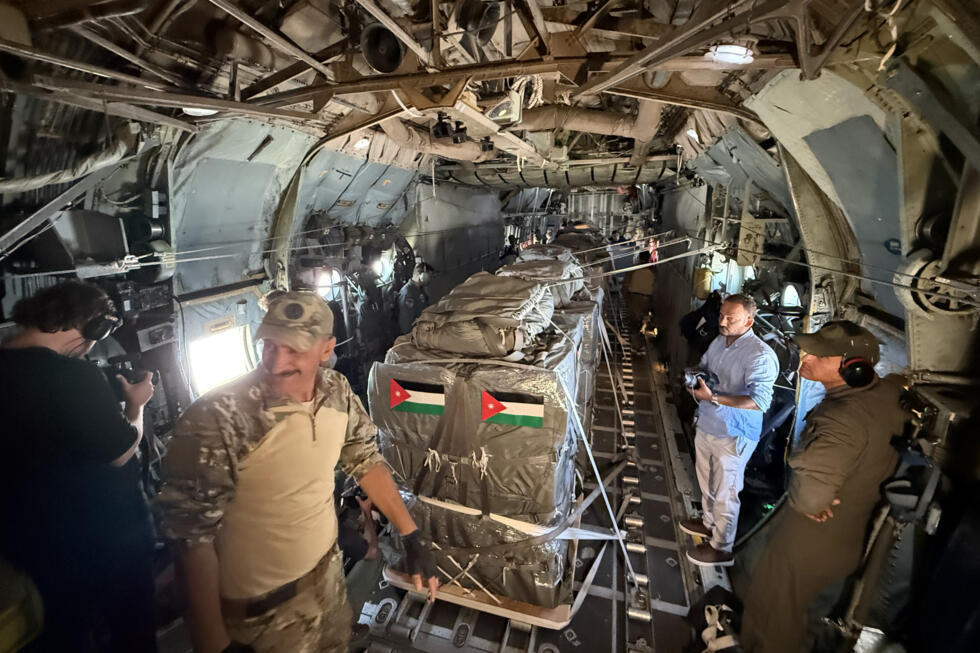
The Jordanian Air Force C-130's crew of eight soldiers pushes pallets of food out of the rear hatch.

Parachutes unfurl, and the crates -- stamped with the Jordanian flag -- drift toward the devastated Gaza Strip, nearly 22 months into the war, an AFP journalist on board reported.

Journalists were only allowed to film the airdrop operation but not the vast swathes of destruction during the two-hour flight, which overflew Palestinian territory for just a few minutes.

The flight departed a base near Amman and was joined by a second plane from the United Arab Emirates.

Approaching Gaza by sea, the aircraft released aid packages containing sugar, pulses and baby milk.

Aid agencies, while grateful, stress that airdrops -- first launched in early 2024 -- are no substitute for overland access.


'Tragic'


This latest round of airdrops, authorised by Israel last week, is led by Jordan and the UAE.

The United Kingdom carried out its first drop on Tuesday, while France plans to deliver 40 tonnes of aid starting Friday.

Inside the aircraft, crew members whispered prayers as the packages were released.

In this photo taken during a tour organised by the Jordanian military, airmen ready aid pallets to be dropped by parachute over Gaza. © Ahmad SHOURA / AFP

"There's a big difference between what we see of Gaza on television and what we see now, and what (Gaza) was like before," said the captain, peering down at the landscape from 2,000 feet (600 metres).

"It's a tragic and very sad scene -- entire neighborhoods are being razed."

The pilot, who asked not to be identified, said he could see people on the ground tracking the plane's path.

"It shows how bad their situation is," he said.

Israel imposed a total blockade on aid entering Gaza in March, before allowing very limited quantities in late May.

Jordan's King Abdullah II on Wednesday said the "humanitarian catastrophe" in Gaza was the worst in modern history, and said current levels of aid were far from sufficient.

- 'Humanitarian catastrophe'-


UN-backed experts warned Tuesday that a "worst-case scenario" famine was happening in Gaza that cannot be reversed unless humanitarian groups get immediate and unimpeded access.

The Rome-based Integrated Food Security Phase Classification Initiative (IPC) said airdrops over Gaza, announced by various countries in recent days, would not be enough to avert the "humanitarian catastrophe".

"The worst-case scenario of famine is now unfolding in the Gaza Strip," the IPC said in a statement.

The World Food Programme, UNICEF and the Food and Agriculture Organisation warned time was running out and that Gaza was "on the brink of a full-scale famine".

"We need to flood Gaza with large-scale food aid, immediately and without obstruction, and keep it flowing each and every day to prevent mass starvation," WFP executive director Cindy McCain said in a joint statement by the three UN agencies.

Facing intense international pressure, Israel announced on Sunday a daytime pause in hostilities in certain areas for humanitarian purposes.

© 2025 AFP

US tariffs corrode steelmaker ArcelorMittal's profitability

Paris (AFP) – The world's number two steelmaker, ArcelorMittal, said on Thursday its half-year net profit jumped on exceptional items but US tariffs began to eat into its margin.


Issued on: 31/07/2025 - FRANCE24

Steel coils sitting in the yard at ArcelorMittal Dofasco's steel mill in Hamilton, Canada, which now face 50 percent tariffs to enter the United States 
© Cole Burston / GETTY IMAGES NORTH AMERICA/AFP/File

Net profit for the period from January through June rose 39 percent from the same period in 2024 to hit $2.6 billion, thanks to a $1.7 billion exceptional gain from acquiring a stake in a US unit ceded by Nippon Steel.

But operating earnings that strip out interest costs, depreciation and taxes, slid by 10 percent to $3.4 billion, notably due to US tariffs on steel imports.

US President Donald Trump doubled tariffs on steel and aluminium to 50 percent at the beginning of June, including on its neighbour Canada which is the largest foreign supplier to the United States, as well as Mexico.

ArcelorMittal says its global footprint, it produces steel in 15 countries and serves customers in 129, enables it to benefit from high-growth markets such as India and Brazil.

However the introduction of US steel tariffs complicates ArcelorMittal's operations in North America, where it has factories in Canada, Mexico and the United States.

First half sales slid 5.5 percent to $30.7 billion, but that 7.5 percent drop in average steel prices.

"The underlying strength of the business is good, but like every company we must navigate the backdrop of ongoing geopolitical and tariff disruptions," chief executive Aditya Mittal said in a statement.

"Despite the many challenges facing global business today, I am confident that ArcelorMittal has a profile that will enable us to continue to grow and thrive," he added.

Mittal said gaining full ownership in Calvert by acquiring the stake from Nippon Steel strengthens its capabilities to produce high-quality steel products for a range of customers including the automotive industry.

He urged the European Union to detail the measures it plans to take to protect its market from a flood of cheap Chinese steel imports.

"It remains a crucial year for European steelmaking, and I sincerely hope that Europe will hold good onto its commitment to defend and prioritize its domestic steel industry," said Mittal.

He added that the trend in Europe to boost government spending on defence and infrastructure was positive for the steel industry.

ArcelorMittal's shares slumped 3.9 percent in Paris where the CAC 40 index was up 0.4 percent.

© 2025 AFP


Trump gets his way on tariffs, but global trade system intact for now

Paris (AFP) – President Donald Trump has succeeded in strong-arming nations to accept higher tariffs on US exports, yet for now experts see little threat to the postwar trend of lower duties in the pursuit of greater wealth all around.


Issued on: 31/07/2025 - FRANCE24


President Donald Trump has long accused other nations of 'ripping off' the United States © Brendan SMIALOWSKI / AFP


Since World War II, most politicians and economists view free trade as a pillar of globalisation, enshrined in the 1947 signing of the GATT accord.

It was the precursor to the World Trade Organization, which now has 166 members and covers 98 percent of global commerce.

"What we've learned in the postwar is that lower tariffs are better for prosperity of your own country," said Richard Baldwin, a professor at the IMD Business School in Switzerland.

"And it's also good if other countries lower their tariffs, so we have a vibrant international economy," Baldwin, who was a member of US president George Bush's Council of Economic Advisors, told AFP

Trump however has embarked on a punishing trade war, claiming that deficits with other nations show they are "ripping off" the United States.

He has recently landed accords with Japan, the Philippines, Indonesia and, most importantly, the European Union.

For dozens of other nations, US "reciprocal" tariffs are to jump from 10 percent to various steeper levels come August 1, including powerhouse economies such as South Korea, India and Taiwan.

"To me, the most beautiful word in the dictionary is 'tariff'," Trump repeatedly said during the 2024 election campaign that returned him to office.


'Pyrrhic victory'

Despite the headline figures, many economists expect the fallout for the global trade system overall to be limited.

US importers may well decide to procure more from American producers as the tariffs are applied, or pass along the higher costs to consumers.

"That won't have a systemic impact" outside the United States, Pascal Lamy, a former WTO chief, told AFP, calling the tariffs a "Pyrrhic victory" for Trump.

He noted that Trump is targeting only the US deficits for goods and not services, "the part of global trade that is increasing the fastest".

"You need to change your outlook when it comes to international trade," Lamy said, adding that "Donald Trump has a medieval view" of the issue.

And instead of making a country more prosperous, the accepted economic wisdom is that by making goods more expensive, tariffs weigh on economic growth for everyone involved.

"Putting up your own tariffs is not a way to make yourself richer -- that's something that people have given up on many years ago," Baldwin said.

"Trump has not screwed up the entire world trading system yet because the rest of the world hasn't changed their opinion as to whether trade is good or bad," he said.

"And generally speaking, it's good."

Bucking the trend

Global trade has risen sharply in recent decades, totalling nearly $24 trillion in 2023, according to WTO figures.

US imports represent just 13 percent of overall imports -- meaning the vast majority of international commerce will not be directly affected by Trump's levies.

"It's significant, but it's only a small part of imports worldwide, and the rest of the world still wants the system of engagement and interdependence to work," said Elvire Fabry, a specialist in geopolitical economics at the Jacques Delors Institute.

Several countries have moved in recent years to forge new trade deals, a trend Trump's tariffs blitz could accelerate.

In March, Japan, South Korea and China pledged to speed up negotiations on an accord, while Brazil's President Luiz Inacio Lula da Silva has called for a deal between the Mercosur Latin America bloc and Japan.

The European Union has also signed a free-trade deal with Mercosur, though its ratification has been held up, in particular by France over concerns about unfair agriculture competition.

The EU has also relaunched efforts to secure a deal with Malaysia and countries in Central Asia.

In April, the WTO said world merchandise trade would fall 0.2 percent this year before a "modest" recovery to growth of 2.5 percent in 2026.

But those forecasts took into account only the tariffs Trump had announced up to then -- not the more severe levels he has threatened to put in place starting August 1 for countries that have not signed deals with Washington.

© 2025 AFP


Laos braced for blow of Trump tariff threat

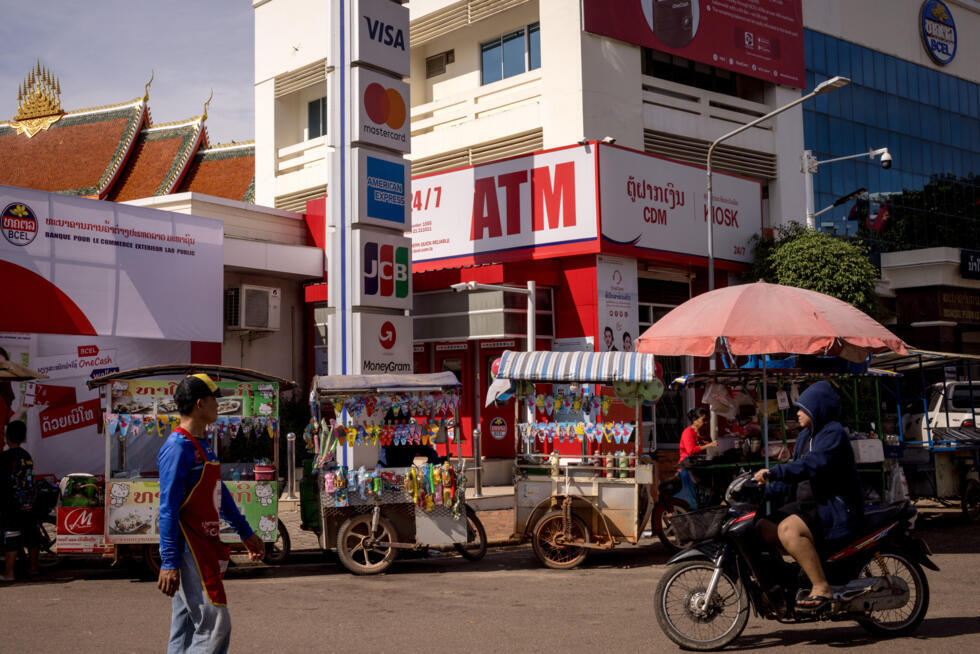
Vientiane (AFP) – Hawking clothes outside the garment factory where her daughter toils inside, a Laos vendor weighs US President Donald Trump's threat of trade tariffs that may soon snarl both their livelihoods.

Issued on: 31/07/2025 - FRANCE24

Laos is already struggling with elevated inflation and a severe labour shortage, fuelling fears that Donald Trump's tariffs could have a devastating effect
 © Nhac NGUYEN / AFP/File

"I just live day by day. For now, I still have my business, and the factory is operating as usual," she told AFP, speaking on condition of anonymity in the capital Vientiane.

"I'm not too worried about my daughter's job yet," she added. Then again, she says: "I don't know anything about what the US will decide."

Landlocked Laos -- a country of only eight million -- has a gloomy outlook as it counts down to a Friday deadline when Trump says a 40 per cent levy will kick in unless a trade deal is sealed.

The rate is among the highest Trump has touted in his global tariff blitz, which has yielded a handful of deals with countries including Britain, Japan and Vietnam but left dozens others scrambling for a pact.

Laos has limited exports, little leverage and supply chains deeply entwined with US trade rival China.

The United States had a trade deficit of more than $760 million with Laos last year -- singling it out for steep tolls alongside other nations Trump sees as imbalanced business partners.

"A 40 percent tariff is just a nail in the coffin for any industry trying to ship to the United States," said John F. Somers, head of garment manufacturing firm Diep Vu Co.

Only a handful of factories, mostly in the capital, supply the US market and sales make up only between three and six percent of the country's gross domestic product.

But with the Southeast Asian country already suffering from high inflation and a severe labour shortage, Trump's default tariff could still have a devastating effect, industry insiders say.

'Cause for suspicion'

"We estimate about 20,000 workers or more could be impacted," said Xaybandith Rasphone, head of the Association of the Lao Garment Industry.

"We're not certain about the exact number yet, but it could easily be higher if companies shut down," said Xaybandith, who is also vice-president of the Lao National Chamber of Commerce and Industry (LNCCI).

He warned between 35 and 40 factories could be affected if buyers are spooked by the tariffs.

Laos is set to graduate from 'Least Developed Country' status next year, meaning will lose duty-free access to the European Union, dealing another blow
 © Jack TAYLOR / AFP/File


"If the tariff stays in place, some factories will definitely close," he said. "Finding alternative markets takes time, negotiations and a lot of effort. It could take years."

Like neighbouring Cambodia and Vietnam, Laos is a hub of the garment industry -- producing brands for western markets including Dr. Martens.

But the production of mattresses, silicone products and solar panels also stands to be impacted.

Solar panel manufacturing has exploded in Laos since 2023 and driven up its export figures after Trump hit China with a 50 percent tariff on the renewable power sources.

However the US trade offensive has focussed on "transshipment" -- a practice it alleges some countries use to help China dodge American tariffs by repackaging its goods for American markets.

Casey Tolzman, head of the Lao-American Business Association (LABA), said the explosion of Laos' solar industry had likely been "a cause for suspicion" in Washington.
'A big question'

Rules governing the source of materials and the level of Laotian labour required to define products as domestically produced may prove the country's biggest bargaining chip.

"A big question for countries like Cambodia and Laos is what they can offer the US that's attractive enough to reach a deal," Tolzman said.

"Any deal would probably need to see Laos enforce stricter rules on transshipment and country of origin, to ensure products aren't just coming from China and getting a Laos label slapped on."

The US may also ask Vientiane to crack down on internet scam centres targeting wealthy Americans from compounds in Laos, or seek concessions for American goods to enter the market, he added.

The LABA and LNCCI say they are helping the government draft an appeal asking for tariffs to drop back to previous levels, or at least be capped at 20 percent.

But Diep Vu Co boss Somers warns even if Laos manages to reach a deal with Washington, a bigger test soon lies ahead.

Laos is on track to graduate from "Least Developed Country" status next year, meaning it is set to lose duty-free access to the European Union -- dealing another blow.

"We'll be at a competitive disadvantage, our industry will probably collapse within a few years," Somers warned.

"The real discussion is the EU relationship with Laos, not just what the US is doing."

© 2025 AFP


Tata Motors to buy Italy's Iveco for $4.4 bn

Rome (AFP) – Tata Motors of India will buy Italy's Iveco Group for 3.8 billion euros ($4.4 billion) in a bid to create a "global champion" in the commercial vehicles sector, the two companies said Wednesday.


Issued on: 30/07/2025 - FRANCE24

Truck and car maker Tata Motors will buy Iveco of Italy © INDRANIL MUKHERJEE / AFP

The deal excludes Iveco's defence division for armoured vehicles, which is to be sold to Italian defence and aerospace group Leonardo, in a 1.7-billion-euro deal announced earlier Wednesday.

The combined company after Tata's takeover aims to sell around 540,000 vehicles a year for total annual revenues of 22 billion euros, of which half would come from Europe, 35 percent from India and 15 percent from the Americas.

Tata and Iveco -- which also makes engines and buses -- said in a joint statement there was "no overlap in their industrial and geographic footprints, creating a stronger, more diversified entity" which would use a shared strategic vision to drive long-term growth.

The deal is expected to close in the first quarter of 2026, underscoring the status of Tata in Europe, with Jaguar Land Rover notably a wholly owned subsidiary of Tata Motors.

"The reinforced prospects of the new combination are strongly positive in terms of the security of employment and industrial footprint of Iveco Group as a whole," Iveco's chairwoman Suzanne Heywood said in the statement.


Iveco defence unit sold

For Natarajan Chandrasekaran, chairman of Tata Motors, "this is a logical next step following the demerger of the Tata Motors Commercial Vehicle business and will allow the combined group to compete on a truly global basis with two strategic home markets in India and Europe.

"The combined group's complementary businesses and greater reach will enhance our ability to invest boldly. I look forward to securing the necessary approvals and concluding the transaction in the coming months," he added in the statement.

Iveco Group's CEO Olof Persson said the merger was "unlocking new potential to further enhance our industrial capabilities, accelerate innovation in zero-emission transport, and expand our reach in key global markets."

He added: "This combination will allow us to better serve our customers with a broader, more advanced product portfolio and deliver long-term value to all stakeholders."

Separately, Iveco's armoured vehicles unit will be sold to Leonardo, whose chief Roberto Cingolani said the move would make it a "reference player in the European land defence market".

Leonardo has announced it plans to integrate its electronic systems, including new-generation combat sensors, into Iveco Defence vehicles to "guarantee optimal effectiveness of operational solutions offered".

© 2025 AFP


US proposes revoking law regulating gas emissions


Issued on: 30/07/2025 - FRANCE24

The Trump administration said on Tuesday it will rescind the long-standing finding that greenhouse gas emissions endanger human health, removing the legal foundation for all U.S. greenhouse gas regulations. If finalized, the repeal would end current limits on greenhouse gas pollution from vehicle tailpipes, power plant smokestacks and other sources, and hamper future U.S. efforts to combat global warming.

Video by:  Morgan AYRE


Trump's abrupt reversal on climate policy a 'dreadful blow' to the battle against global warming

Issued on: 31/07/2025 - FRANCE24

Under Donald Trump, the US has abruptly reversed course on climate policy, withdrawing from the Paris Agreement and rolling back key environmental regulations. This dramatic shift has weakened global climate cooperation and empowered polluting nations and the fossil fuel industry. Clean energy progress has taken a back seat, while extreme weather becomes more prevalent, hitting vulnerable communities hard that are already bearing the brunt of climate change. For in-depth analysis and a deeper perspective, FRANCE 24's Sharon Gaffney welcomes Dan Becker, Director of the Center for Biological Diversity’s Safe Climate Transport Campaign.

Video by: Sharon GAFFNEY


Portugal battles three large wildfires

Issued on: 30/07/2025 - FRANCE24

Almost 2,700 firefighters battled Tuesday to contain forest blazes across Portugal that have led to almost the whole country being put on high alert for fires. Seventeen major fires blazed with the most serious in the centre and north of the country.


'Silent killer': the science of tracing climate deaths in heatwaves

Paris (AFP) – A heatwave scorching Europe had barely subsided in early July when scientists published estimates that 2,300 people may have died across a dozen major cities during the extreme, climate-fuelled episode.


Issued on: 31/07/2025 - FRANCE24

Climate change is making heatwaves stronger and longer, putting lives at greater risk during summertime 
© Angelos TZORTZINIS / AFP


The figure was supposed to "grab some attention" and sound a timely warning in the hope of avoiding more needless deaths, said Friederike Otto, one of the scientists involved in the research.

"We are still relatively early in the summer, so this will not have been the last heatwave. There is a lot that people and communities can do to save lives," Otto, a climate scientist at Imperial College London, told AFP.

Heat can claim tens of thousands of lives during European summers but it usually takes months, even years, to count the cost of this "silent killer".

Otto and colleagues published their partial estimate just a week after temperatures peaked in western Europe.

While the underlying methods were not new, the scientists said it was the first study to link heatwave deaths to climate change so soon after the event in question.

Early mortality estimates could be misunderstood as official statistics but "from a public health perspective the benefits of providing timely evidence outweigh these risks," Raquel Nunes from the University of Warwick told AFP.

"This approach could have transformative potential for both public understanding and policy prioritisation" of heatwaves, said Nunes, an expert on global warming and health who was not involved in the study.

- Big deal -


Science can show, with increasing speed and confidence, that human-caused climate change is making heatwaves hotter and more frequent.

Unlike floods and fires, heat kills quietly, with prolonged exposure causing heat stroke, organ failure, and death.

The sick and elderly are particularly vulnerable, but so are younger people exercising or toiling outdoors.

But every summer, heat kills and Otto -- a pioneer in the field of attribution science -- started wondering if the message was getting through.

"We have done attribution studies of extreme weather events and attribution studies of heatwaves for a decade... but as a society we are not prepared for these heatwaves," she said.

"People think it's 30 (degrees Celsius) instead of 27, what's the big deal? And we know it's a big deal."

When the mercury started climbing in Europe earlier this summer, scientists tweaked their approach.

Joining forces, Imperial College London and the London School of Hygiene & Tropical Medicine chose to spotlight the lethality -- not just the intensity -- of the heat between June 23 and July 2.

Combining historic weather and published mortality data, they assessed that climate change made the heatwave between 1C and 4C hotter across 12 cities, depending on location, and that 2,300 people had likely perished.

But in a notable first, they estimated that 65 percent of these deaths -- around 1,500 people across cities including London, Paris, and Athens -- would not have occurred in a world without global warming.

"That's a much stronger message," said Otto.

"It brings it much closer to home what climate change actually means and makes it much more real and human than when you say this heatwave would have been two degrees colder."
Underestimated threat

The study was just a snapshot of the wider heatwave that hit during western Europe's hottest June on record and sent temperatures soaring to 46C in Spain and Portugal.

The true toll was likely much higher, the authors said, noting that heat deaths are widely undercounted.

Since then Turkey, Greece and Bulgaria have suffered fresh heatwaves and deadly wildfires.

Though breaking new ground, the study has not been subject to peer review, a rigorous assessment process that can take more than a year.

Otto said waiting until after summer to publish -- when "no one's talking about heatwaves, no one is thinking about keeping people safe" -- would defeat the purpose.

"I think it's especially important, in this context, to get the message out there very quickly."

The study had limitations but relied on robust and well-established scientific methodology, several independent experts told AFP.

Tailoring this approach to local conditions could help cities better prepare when heatwaves loom, Abhiyant Tiwari, a health and climate expert who worked on India's first-ever heat action plan, told AFP.

"I definitely see more such studies coming out in the future," said Tiwari from NRDC India.

Otto said India, which experiences tremendously hot summers, was a "prime candidate" and with a template in place it was likely more studies would soon follow.

© 2025 AFP


Seoul breaks century-long record with 22 'tropical nights' in July

Seoul (AFP) – A streak of super-hot tropical nights broke a century-old South Korean weather record, according to official data released Thursday, as the peninsula bakes in a prolonged heatwave.


Issued on: 31/07/2025 - FRANCE24

A streak of super-hot tropical nights broke a century-old South Korean weather record, according to official data, as the peninsula bakes in a prolonged heat wave 
© Jung Yeon-je / AFP

Overnight temperatures in Seoul have sizzled above 25C for 22 consecutive days in July, officials said Thursday, marking the longest such streak for the month since modern weather records began in October 1907.

Such evenings are known as "tropical nights" in South Korea.


The capital was also on track to record its hottest July night in history on Wednesday, with the lowest temperature of the day reaching 29.3C -- unless overnight temperatures rise even higher on Thursday.

Much of the world is enduring a summer of sweltering weather, with June being the hottest month ever recorded for 12 countries, according to an AFP analysis of data from the European climate monitor Copernicus.

The intense heat in Seoul is expected to continue, according to the meteorology office.

"The warm air from the North Pacific High began affecting South Korea a bit earlier than usual," Youn Ki-han, director at Seoul's Meteorology Forecast Division, told AFP.

"As that influence gradually built up, the heat accumulated, much like interest compounding in a savings account, slowly increasing over time," said Youn.

"Normally, if it's hot for just a day, temperatures spike and then quickly return to normal. But when warm conditions persist for several days, the heat doesn't fully dissipate, it lingers and accumulates with each day," he added.

Thirteen people have died from suspected heat-related causes so far this year, triple the number from the same period last year, according to data from the Korea Disease Control and Prevention Agency.

Hundreds of thousands of livestock have also perished amid the extreme heat.

© 2025 AFP

THE OLD GODS

Puppet ban in Indonesian capital threatens buskers

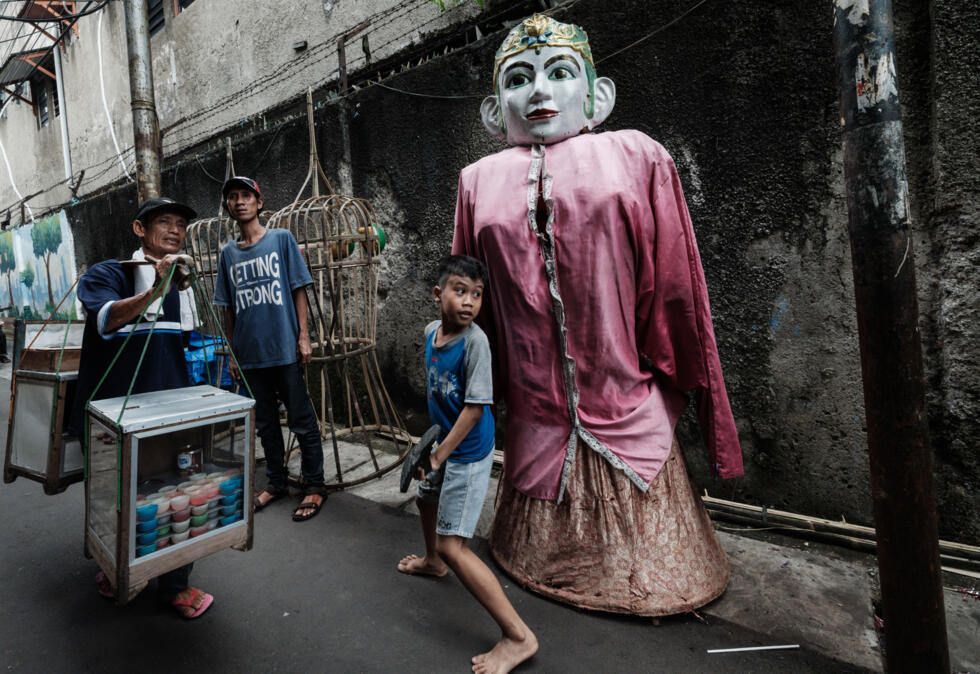
Jakarta (AFP) – In the sweltering streets of Jakarta, buskers carry towering, hollow puppets and pass around a bucket for donations. Now, they fear becoming outlaws.

Issued on: 31/07/2025 - 

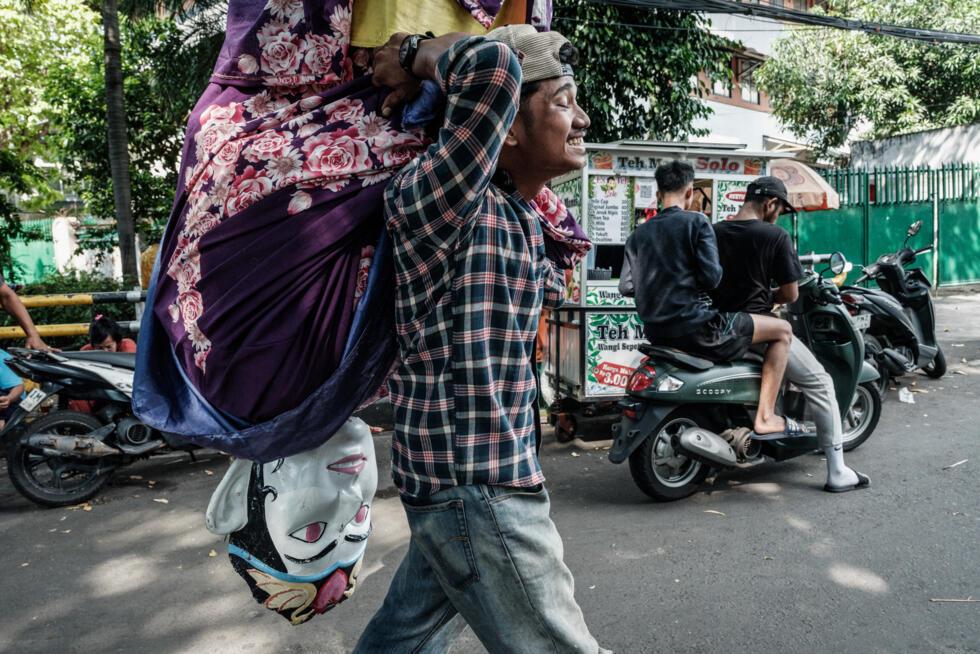
Performances featuring giant puppets known as ondel-ondel are a feature of street life in the Indonesian capital 
© Yasuyoshi CHIBA / AFP

Ondel-ondel is the pride of the native Jakarta tribe, the Betawi people.

City authorities say they will crack down on use of the sacred ondel-ondel puppets, which can stand as tall as a truck, and they are drafting legislation to remove what they view as a street nuisance.

Performances featuring the puppets -- originally used by Jakarta's Betawi people to ward off evil spirits -- will be allowed only at set events.

The ban could leave many ondel-ondel buskers in Jakarta without a job.

"I am confused and anxious. I fear getting raided or even arrested. But what can I do? I need money to eat," Adi Sutisna, a 26-year-old Jakarta native who works as an ondel-ondel busker, told AFP.

Adi, who only graduated from elementary school, has been working as an ondel-ondel busker for seven years, earning $7 on a good day to provide for his wife and five-year-old daughter.

Ondel-ondel is the pride of the native Jakarta tribe, the Betawi people.


Traditional performances were accompanied by instruments for festive and celebratory events, including weddings, circumcisions, and welcome ceremonies for honourable guests.

Cyril Raoul Hakim, spokesman for Jakarta governor Pramono Anung, told AFP the ban was still being drafted with "the preservation of Betawi culture" in mind and it would be put to legislators soon.

"We hope it will be passed not too long from now," he said.


'Very hot inside'

C
ity authorities say they will crack down on use of the long-sacred ondel-ondel puppets, which can stand as tall as a truck, and they are drafting the legislation 
© Yasuyoshi CHIBA / AFP


Over time, ondel-ondel have been increasingly used by buskers who sway the puppets to music from loudspeakers, seeking money on the roadside, at traffic lights, and in the alleyways of Jakarta's densely populated neighbourhoods.

The city administration has long wanted to ban ondel-ondel busking, arguing that the practice sullies the dignity of the cultural icon.

Bureaucrats believe roadside busking undermines the puppets' cultural significance.

But many Jakartans rely on the entertainment to bring in much-needed cash.

According to government data, the number of people living below the poverty line in metropolitan Jakarta -- a megalopolis of 11 million people -- was up from 362,000 in 2019 to 449,000 as of September 2024.

The Central Statistics Bureau says the poverty line in Indonesia in 2025 is just over one dollar a day.

"The ondel-ondel is heavy; it is very hot inside," said Adi.

"But I do it anyway because if I don't, my wife and my kid won't be able to eat."
'Bothers my soul'

The planned ban has left authentic ondel-ondel performers and makers torn about the preservation of their culture and the plight of the buskers.

Performers such as Fadillah Akbar believe the cultural symbol must be revered, and should not be used to beg for money.


The planned ban has left authentic ondel-ondel performers and makers torn about the preservation of their culture and the plight of the buskers 
© Yasuyoshi CHIBA / AFP


"The problem is that they beg on the street -- that's a disturbance, and it bothers my soul," the 33-year-old ondel-ondel artist said.

He believes ondel-ondel must come in pairs, a woman and a man, and be accompanied by traditional live music instead of a recorded song playing on loudspeakers.

"Of course, I feel bad for the buskers, especially since I know many of them, but it is a cultural icon whose dignity must be upheld," he said.

The head of Jakarta's public order agency, Satriadi Gunawan, said ondel-ondel busking disturbed road users with loudspeakers and requests for money.

"In Betawi culture, upholding ondel-ondel's dignity is important, and now it is often used to beg for money," he said.

But some historians disagree, saying limiting the puppet presence on Jakarta's streets could hurt efforts to keep the dwindling tradition alive.

"Banning ondel-ondel busking in the name of culture signifies their lack of understanding for tradition," said Jakarta-based historian JJ Rizal.

"It proves that not only does the city government not understand culture, but it also endangers the preservation of art."

© 2025 AFP


THE NEW GODS

Shanghai police bust gang selling counterfeit Labubu toys


Shanghai (AFP) – Police in Shanghai busted a gang making and selling fake Labubus this month, detaining eight people and 5,000 counterfeit toys worth $1.7 million, local state-owned media reported.


Issued on: 30/07/2025 - FRANCE24

A customer looks at Labubu figures at a Pop Mart store in Shanghai in 2025 
© STR / AFP/File

Made by Beijing-based toymaker Pop Mart, Labubu dolls have become a must-have item internationally, adorning the handbags of celebrities such as Rihanna and Dua Lipa.

The furry, fanged creatures, which typically sell for around $40, are released in limited quantities and have caused frenzies at stores around the world.

Knock-offs -- many of which are also made in China -- have flooded online platforms, dubbed "Lafufus" by social media users.

The Shanghai bust in early July uncovered 12-million-yuan ($1.7-million) worth of fake Pop Mart toys, state-run Shanghai Daily reported late Tuesday.


Pop Mart notified police when a customer reported that one purchased online was in fact fake.

This led to the discovery of an online store that sold fans, speakers and gaming consoles -- but was also a front for selling the counterfeits.

Police raided a warehouse, detaining eight people and the 5,000 toys, complete with forged trademarks and fake anti-counterfeit stickers, the report said.

It is not the first time the fluffy monsters have been associated with crime.

In Singapore, CCTV footage captured a family stealing Labubu dolls from a claw machine last year, according to online media outlet AsiaOne.

And in June, burglars broke into a store in California and took several Labubu dolls along with electronics and other valuables, US news outlet ABC reported.

© 2025 AFP