It’s possible that I shall make an ass of myself. But in that case one can always get out of it with a little dialectic. I have, of course, so worded my proposition as to be right either way (K.Marx, Letter to F.Engels on the Indian Mutiny)
Friday, August 01, 2025
Classic WWII-Era Laker Makes Final Voyage
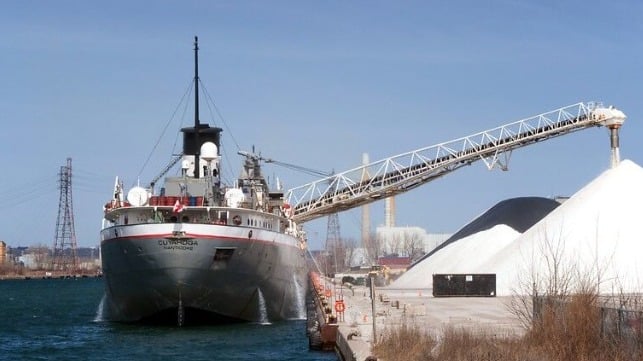
Cuyahoga's characteristic cruiser stern in better days, 2011 (Still The Oldie / CC BY NC ND 2.0)
The classic WWII-era laker Cuyahoga has completed her final voyage and arrived at a scrapyard in Port Colborne, Ontario. Damaged in a conveyor fire in 2024, the Cuyahoga was deemed unsuitable for repair and consigned to demolition.
The Cuyahoga is an 18,000 dwt self-unloader built in 1943 by the American Ship Building Company, one of 16 sister ships that were quickly delivered to transport iron ore for the Great Lakes steel mills to feed the wartime production effort. The L6 "Maritimer"-class was the first bulker design on the Lakes with a cruiser stern, a classic style now rarely seen. She was later renamed and flagged-out to a Canadian operator. At the time of decommissioning, Cuyahoga was the oldest Canadian-flagged laker in service, and the very last of her class.
Cuyahoga survived a serious engine room fire in 2023, but was thoroughly repaired and returned to service later that year. In March 2024, while in winter layup in Ashtabula County, Ohio, another fire broke out aboard Cuyahoga - this time in the conveyor belt system, reportedly ignited when a contract worker "used welding equipment to remove paint" during repairs in a cargo hold, according to OSHA. Self-unloader conveyors use thick rubber belting systems that are as flammable as rubber tires, and they burn fiercely once ignited. Local fire department crews provided boundary cooling, and the fire eventually burned out; no personnel were reported injured, but the damage was extensive. OSHA fined the repair services company $160,000 for allegedly exposing workers to fire and smoke inhalation risk.
Late last year, Cuyahoga's operator confirmed that the vessel would be scrapped in 2025, ending her 80-year run on the Great Lakes. This week, the vessel was towed the short distance across Lake Erie from Ashtabula to Port Colborne's Marine Recycling Corp. yard, where she will be dismantled for her steel.
Caribbean Island of St. Maarten Warns of Flag and Seafarer Document Fraud
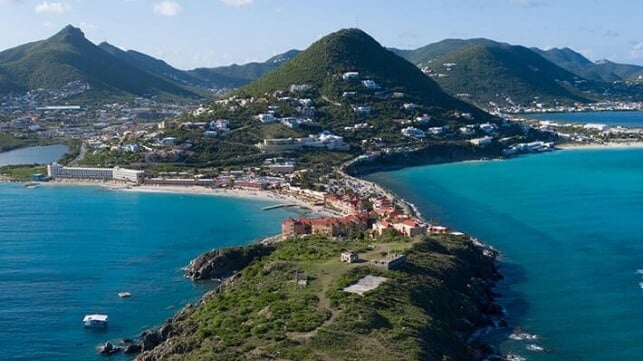
A popular tourist and cruise ship destination, St. Maarten warns it does not operate an international flag registry and does not issue seafarers' documents (St. Maarten Tourism)
The government of the independent nation of Saint Maarten in the Caribbean has become the latest to warn of fraudulent operations promoting its supposed international flag registry and the issuance of seafarer papers. It reports that it has been working with the International Maritime Organization and the Kingdom of the Netherlands to warn of these fraudulent representations and to firmly declare these operations are not authorized or associated with the country.
“Our integrity is not for sale, and our flag will not be misused,” declared Grisha Heyliger-Marten, Minister of Tourism, Economic Affairs, Transport, and Telecommunications for the Country St. Maarten. She warns that St. Maarten does not operate an international flag registry nor does it issue seafarers’ papers, documents, or ship certificates for vessels exceeding 500 gross tons.
The Equasis database currently lists 20 vessels as falsely displaying the flag of Saint Maarten. It includes a 160,000 GT crude oil tanker, a 114,000 GT LNG carrier, and a total of 16 tankers. There is also one bulker claiming to be flagged in the country.
St. Maarten reports that it first became aware of this fraud nearly five years ago when a concerned seafarer from India questioned the authenticity of his certificate. The individual told the government he had experienced difficulties verifying the legitimacy of the documents and became suspicious.
The Ministry reports it launched an investigation and immediately notified the Government of the Netherlands. Also working with the IMO and the Caribbean Memorandum of Understanding organization, an international warning went out to MOU member states and flag states around the world.
“The Ministry deeply regrets the losses incurred by innocent seafarers who, through no fault of their own, have been misled and financially harmed by these deceptive operations. We are committed to pursuing every legal avenue and collaborating with international partners to eradicate these fraudulent activities and seek justice against those responsible,” Heyliger-Marten says in the government statement.
The Ministry highlights the websites of two companies, Maritime Safety & Technical Administration (MSTA) and IMS Registry, as examples of online sites offering services for the purported registry. The Ministry says its investigation identified that “fraudulent certificates and documents” were being issued, and it declares, “These organizations falsely claim authorization from or association with Country St. Maarten.”
It further reports that the Netherlands escalated the matter with U.S. authorities. The U.S. authorities it says confirmed that the MSTA Registry “had fraudulent links to St. Maarten, Belize, and California.”
St. Maarten has continued its campaign against the fraud by alerting the IMO. It is also urging all seafarers, employers, and maritime stakeholders to verify credentials through official channels and to contact St. Maarten’s Maritime Affairs Office if there are any doubts or questions.
This is the latest example of countries reporting that their identity is being used improperly. In 2022, Equatorial Guinea reported it was also launching a crackdown on fraudulent ships. The rise of the so-called shadow fleet has also seen an increase in false flag reports. After the U.S. sanctioned five tankers in December 2024 that claimed registry in Guyana, the country’s government issued a denial, reporting it does not operate an open registry. It said only companies and individuals in Guyana can apply for its registry and denied any association with the tankers.
Stena Bulk Completes Reflagging of Stena Sunrise to Swedish Flag
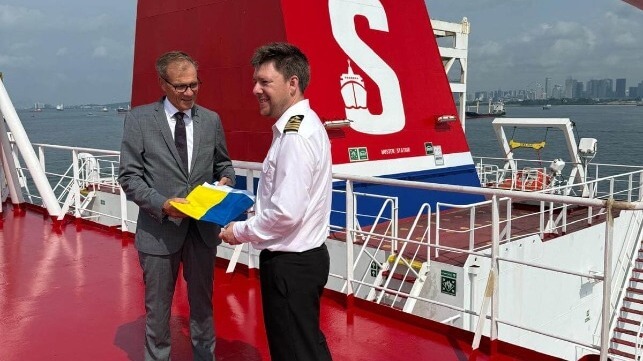
Swedish Ambassador to Singapore, Anders Sjöberg, with Captain Matija Saganic
Leading tanker shipping company Stena Bulk has today announced that its Suezmax tanker, Stena Sunrise, has been officially registered under the Swedish flag during a ceremony in Singapore. The vessel is the first Suezmax tanker in modern times to operate under the Swedish flag, marking a significant step for Sweden’s maritime presence in the global crude oil trade.
This milestone represents a historic moment for Sweden's shipping industry. While Swedish shipyards built several large crude carriers during the 1970s and 1980s, most were delivered under foreign flags. Over the past few decades, Sweden has had very limited representation in the largest crude tanker segments, with rare exceptions including the ULCC TT Nanny (1978–1984) and VLCC Vanadis (in the early 1990s), which briefly operated under Swedish registry.
Based on available records and internal knowledge, Stena Sunrise becomes the first Suezmax-class vessel to be flagged in Sweden and among only a handful of large crude carriers ever to do so.
The reflagging ceremony was attended by the Swedish Ambassador to Singapore, Anders Sjöberg, and the General Manager and Head of Stena Bulk Singapore, Johan Zander, who participated in the formal handover of the Swedish flag onboard the vessel.
Stena Sunrise is the first of five Suezmax tankers that Stena Bulk plans to transition into the Swedish Register of Shipping. The remaining vessels – Stena Superior, Stena Suede, Stena Surprise, and Stena Sunshine – will be reflagged in the coming months in accordance with commercial and operational schedules.
Erik Hånell, President and CEO of Stena Bulk, said: “We’re proud to see Stena Sunrise officially come under the Swedish flag and to have celebrated this milestone with a ceremony in Singapore. This step has only been made possible by the strong collaboration we have enjoyed with Swedish government authorities and maritime unions. We are excited to continue working together to bring four more of our Suezmax tankers under the Swedish flag in the coming months.”
As Stena Sunrise officially joins the Swedish fleet, the occasion underscores how public–private cooperation can drive meaningful progress in revitalising Sweden’s role in international shipping.
The products and services herein described in this press release are not endorsed by The Maritime Executive.
CRIMINAL CAPITALI$M
Japan’s Defense Force and Shipbuilders Colluded in Fraud Payments and Gifts
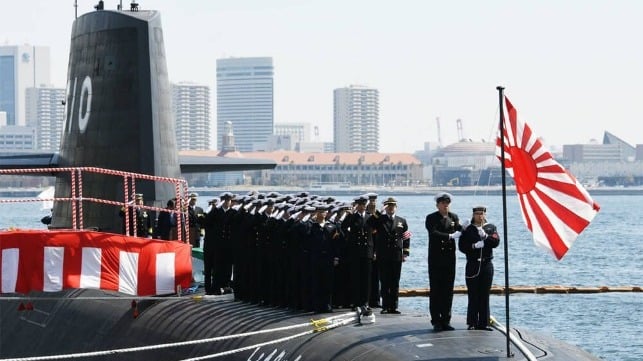
The fraud was mostly linked to Japan's submarine force (Japan Maritime Self-Defense Force)
Japan’s Ministry of Defense issued a final report detailing a more than 40-year scheme in which the country’s shipbuilders collected fraudulent payments that funded equipment used on the country’s submarines and gifts to members of the Maritime Self-Defense Force. The Ministry apologized to the country and said it is disciplining 93 members, including the Vice Defense Minister, supervisors, commanding officers, and submarine captains.
The investigation began after an audit by the Osaka Regional Taxation Bureau discovered issues with the finances of Kawasaki Heavy Industries, which, along with Mitsubishi Heavy Industries, is the main builder and repair yards for the country’s submarines and defense force. The report cites KHI for widespread involvement but says MHI, Japan Marine United, and Sasebo Heavy Industries were also involved in the fraud to a lesser degree.
The report says the scheme could be traced back to 1985 with Kawasaki Heavy Industries. The shipbuilder was reported to have been involved in fraudulent transactions and to have created a “slush fund” valued at over $11 million in the last six years. The shipbuilders submitted fraudulent bills for supposed repairs to the submarines to the government.
Kawasaki they found used some of the money to fulfill requests from submarine crewmembers for items such as refrigerators, heating units, or repair materials that were not submitted as official requests but were being used on submarines. However, they also uncovered a pattern of gifts given to members of the Defense Force. The report details 13 crewmembers and supervisors who received personal items unrelated to their duties. Valued at over $9,000, they said the gifts included gaming consoles, golf equipment, and watches. One person was reported to have received almost $3,300 worth of gifts.
Nearly $3 million was paid to subcontractors. Kawaski reportedly also used a portion of the money to purchase personal items and beer coupons.
The other shipbuilders were also involved, but the report said they mainly fulfilled requests from personnel from the Maritime Self-Defense Force. This was for items to be used on the submarines, such as monitors or chairs.
Among the 13 individuals receiving the personal gifts, three were supervisors who determined the repairs required for the submarines. They were also responsible for overseeing the suppliers. The Ministry said it would be taking separate punitive actions against those individuals.
"We deeply apologize for causing a scandal that has greatly undermined expectations and trust," said Chief of Staff Admiral Akira Saito at a news conference on Wednesday, July 30. "We will create an atmosphere in which members can say wrong things are wrong."
Saito will lose 10 percent of his salary for one month and receive an official reprimand. Vice Defense Minister Kazuo Masuda was also strongly reprimanded for not properly overseeing the Chief of Staff.
A total of 73 supervisors and two commanding officers received reprimands. A total of 17 submarine captains received warnings.
KHI, earlier this year, was ordered to pay more than $6.6 million in taxes related to the scheme. The report, however, found that the shipbuilders were mostly responding to requests from the members of the Maritime Self-Defense Force. As such, the shipbuilders are not being excluded from future dealings with the Defense Force and the Ministry.
Product Tanker Causes Protest in Australia as it Likely has Russian Oil
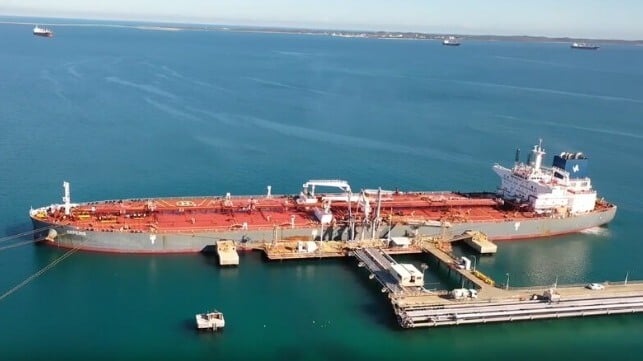
Greek-flagged tanker surfaced the issue and caused protests as the product it was delivering was like made from Russian feedstock (Australian TV on YouTube)
The issue of intermediaries in the oil supply chain surfaced in Australia this week as a tanker arrived from India, likely with Russian oil. It is leading to calls to close loopholes in the sanctions, which so far have focused on direct Russia trade but have not extended to products made from Russian crude in intermediary countries.
The European Union recently focused on this same issue, imposing sanctions on a refinery in India in which Russia’s Rosneft is an investor. Donald Trump also continues to threaten secondary sanctions on the buyers of Russian oil, including India, unless Russia moves forward with peace talks and a ceasefire in Ukraine.
The issue emerged in Australia as the Greek-owned tanker Seferis (113,839 dwt) approached Western Australia. The vessel is reported to have departed India’s Jamnagar refinery on July 11, loaded with gasoline likely refined from Russian stock.
Protestors called for the vessel to be turned away, but it was pointed out that the vessel was not in violation of the sanctions. It provided legitimate documentation that it had been loaded in India, and even the critics had to admit it is nearly impossible to determine the source of the stock. The vessel docked at Kwinana terminal, approximately 25 miles south of Perth, early on Wednesday, July 30, to offload.
Australia has imposed broad sanctions on Russia since the start of the war in Ukraine. For the first time, it also recently imposed sanctions on shadow fleet tankers.
The protestors pounced on reports that nearly half of the feedstock going into Jamnagar is coming from Russia. Calling the fuel “blood money,” they said Australia must move immediately to stop these imports.
Australia, according to data from the Centre for Research on Energy and Clean Air, imported approximately US$650 million of oil products from India in the first four months of 2025. Most of it was likely made from Russian stock. About 90 percent of Australia’s imports from India come from the Jamnagar refinery.
Western Australia’s Defense Industries Minister, Paul Papalia, speaking to the media on Tuesday, highlighted the prospect of “Russia getting around sanctions and getting its oil to market… by sneaky means.”
There are indications that the pressure building on intermediaries may be working. Reuters is reporting that India’s state refineries have all suspended purchases of Russian oil this week. They are said to be scrambling to find alternative sources, primarily in the Middle East. However, the report notes that the state refineries are not the largest buyers, which remain the private companies in India, including Reliance Industries and Nayara Energy.
After the EU sanctions against Nayara, there have been multiple reports of tankers diverting. Reuters reports that companies are demanding that their contracts be canceled due to the sanctions.
Protestors Square Off with Police and Block Cruise Ship in Amsterdam
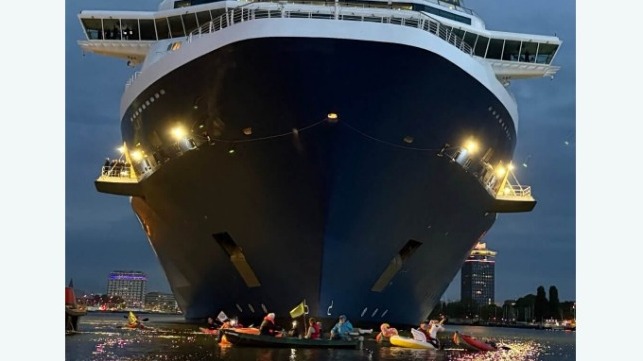
Protestors in small boats, canoes, and inflatables blocked the crusie ship from reaching the dock in Amsterdam (Extinction Rebellion)
The environmental group Extinction Rebellion renewed its protests against cruise ships docking in the Netherlands during an incident that resulted in a confrontation and arrests in Amsterdam. Last year, the same group staged several protests blocking one of the locks to enter the port, but this year they took to small boats and proudly said they were able to delay the cruise ship Celebrity Eclipse from docking.
Approximately 30 individuals positioned themselves in canoes, boats, and inflatables between the cruise ship and the dock in the heart of Amsterdam. Pictures showed some of the small boats surrounding the bow of the large cruise ship, while others were between the ship and the dock.
“They should not be allowed in Dutch waters,” the group said in a statement on social media. “We will continue the actions like this until this harmful tourist industry is banned from Amsterdam and the rest of the Netherlands.” The group cites the environmental impact of the cruise industry on “humans, nature, and the climate.”
The 121,878 gross ton cruise ship was completing an 11-day trip and was docking at the Passenger Terminal Amsterdam. According to reports, there were 2,850 passengers and approximately 1,200 crewmembers aboard.
The protestor began at approximately 4:30 a.m. local time before the cruise ship arrived, and police responded by sending launches to clear the waterway. The protestors are contending that the police ran over their inflatable boats. The incident is reported to have lasted about two hours on July 26.
The police said that five people were arrested for assault, blocking the cruise ship, and refusing to show identification. Newspaper reports said two of the individuals were quickly released.
A spokesperson for the port authority cited the dangers of this type of protest. They said these types of small boats should not have approached the 1,040-foot (315-meter) cruise ship. They cited the dangers as well as the potential that the vessel’s propellers or bow thrusters could have created dangerous conditions for the small boats.
Last year, the group was successful in getting several cruise ships to turn around or reschedule their port stops, docking outside the heart of the city, and busing passengers to Amsterdam. City officials responded by putting a limit on the number of cruise ships permitted to come to the port and said their longer-term plan is to move the cruise ship terminal outside the center of the city.
Chishan Group Reactivates Idle Chinese Shipyard, Adding to New Capacity
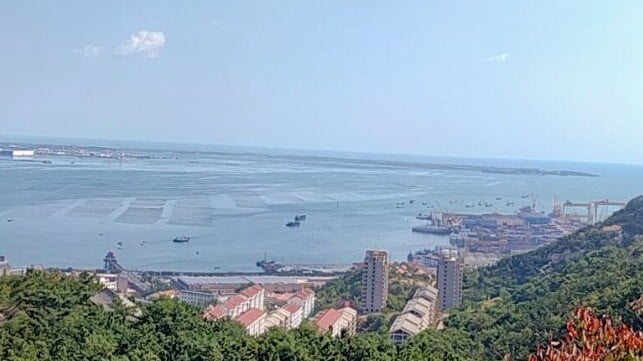
A fishing harbor and shipyard in Rongsheng, Shandong (TSVC1190 / CC BY SA 4.0)
The Chishan Group, a leading operator in China's distant-water fishing fleet and an alleged user of Uighur forced labor, has bought its own shipyard in Rongcheng, Shandong Province.
On July 22, Chishan Group closed on the acquisition of Shandong Baibuting Shipbuilding, a sizeable yard in Rongcheng that has been idle for years. It began life as Rongcheng Haida Shipbuilding in 1953, the early years of the Mao era, and specialized in vessels for China's fast-growing fishing fleet. In 2007, it was acquired by Wuhan Baibuting Group - a real estate and industrial conglomerate - and renamed Shandong Baibuting Shipbuilding.
Baibuting Group planned to grow the yard with a focus on small bulkers and freighters, but the purchase was ill-timed to the business cycle. With the onset of the Great Recession, shipbuilding demand fell, and by 2012 the company was taking in no new orders. Clarksons data suggests that its last merchant ship delivery took place in 2013. Recent satellite imaging of the site confirms that it has been unoccupied and idle, with no signs of active construction or staged materials.
The Shandong Baibuting facility is a slipway yard with no graving docks, and is capable of building and launching vessels of up to about 35,000 dwt, according to local media. Under Chishan's ownership, it will be renamed Shandong Fulton Shipbuilding, and will be retooled to compete for regional and national business. It is Chishan's first venture into shipbuilding.
Shandong Fulton Shipbuilding is about an hour and a half north by road from one of Chishan's largest installations, the Rongsheng Haibo Seafood processing complex. In 2022, the Outlaw Ocean Project found extensive evidence of the use of ethnic Uighur forced labor at this site.
China's government encourages the resettlement of participants in its involuntary reeducation program in Xinjiang, a majority-Muslim region in China's northeast where Beijing has made an all-out effort to assert political and cultural control for the past nine years. Multiple internal company newsletters - available to the public on Chishan's own website - discussed the arrival and integration of a large cohort of Uighur workers from Xinjiang, some 2,000 miles away from Shandong. Outlaw Ocean also found extensive social media video footage created by ethnic Uighurs showing their work and life at the Rongsheng Haibo plant.
The U.S. government prohibits any imports of goods produced by Uighur labor due to human rights concerns; several American importers stopped buying Rongsheng Haibo's squid after the Outlaw Ocean Project's report was published. (Chishan and its subsidiaries have denied employing any personnel from Xinjiang.)
The Outlaw Ocean team also connected Chishan's distant-water fleet to illegal fishing off the coast of North Korea, a violation of UN sanctions. Chishan vessels have also been linked to suspected labor rights and fishing rights abuses in operations off Argentina, a rich squid-fishing region where the Chinese fleet has repeatedly squared off with local authorities.
China's distant-water fleet is currently struggling due to high cost pressures, according to the Chinese agriculture ministry. In a memo distributed to state and local governments in January, the ministry recommended easing immigration controls for foreign (typically Indonesian) workers on Chinese fishing boats, speeding up subsidy payments, and encouraging new construction to replace aging distant-water vessels. By contrast, China's shipbuilding sector is booming: Chinese yards are winning the majority of the world's orders by tonnage, and countless idled shipbuilding plants are coming back online, often under new ownership.
[Brief] On Thursday, three crewmembers aboard a Republic of Korea Navy amphib were injured in a fire that broke out in a machinery space, the service reported.
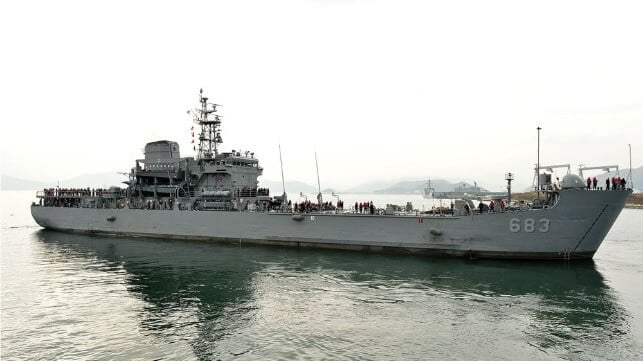
At about 1549 hours on Thursday, the tank landing ship ROKS Hyang Ro Bong caught fire while transiting into a base in the Jinhae district, just west of Busan. The blaze was sparked by one of the vessel's auxiliary engines.
180 people were evacuated from the ship for safety when it reached the pier at 1810 hours, according to Korea JoongAng Daily. Dozens of first responders arrived to help with firefighting, along with fireboats and fire trucks. As of late Thursday, the firefighting efforts were still under way.
One of the vessel's crewmembers sustained first- and second-degree burns from the fire and was taken to a hospital for medical care. The other two victims complained of breathing difficulties, and are reportedly recovering.
ROKS Hyang Ro Bong is a 1,700 dwt tank landing craft commissioned in 1999.
Search Called Off for Missing Crewmember From USS George Washington
The U.S. Navy has called off a multiday search for a sailor who is believed to have gone overboard from the carrier USS George Washington, the service said in a statement Wednesday.
On Monday, while George Washington was operating in an exercise in the Timor Sea, a sailor was reported missing and potentially overboard. The carrier and her escorts - USS Robert Smalls and USS Shoup - began a concerted search effort, aided by the carrier's air wing. The Australian Border Force and Australian Defense Force also contributed to the search.
The effort was unsuccessful, and was called off on Wednesday afternoon. The lost sailor's name has not yet been released, pending notification to the family.
At the time of the incident, the George Washington CSG was participating in a large-scale joint exercise with Australian forces, Talisman Sabre 2025. The multilateral exercise included 43,000 personnel from 19 nations, and the Royal Navy carrier HMS Prince of Wales was among the participating vessels.
George Washington has a difficult history of crewmember fatalities. During a five-year yard period from 2017-22, nine sailors assigned to the ship died by suicide, including three in April 2022 alone. A command investigation found that the crew's quality of life during the yard period was austere and demanding, and that morale aboard was low; the report led to significant changes in how the Navy assigns enlisted servicemembers to yard periods and provides for their accommodations.
South Korea Wins Trade Deal With $150 Billion U.S. Shipbuilding Pledge
The government of South Korea has secured a favorable 15 percent U.S. tariff rate by pledging a $350 billion investment package in American industry, including a $150 billion "Make American Shipbuilding Great Again" investment in U.S. shipyard capacity.
The idea of a very large Korean shipbuilding investment has been actively discussed for months as a possible bargaining chip in trade negotiations, and the rumors picked up after Japan made a $400 billion industrial investment commitment of its own. Unlike Japan's proposal, Korea's pledge has a specific carve-out for shipyards.
The objective of the fund is to provide loans, guarantees and investments that will help Korean shipbuilders to expand into the U.S. market, industry insiders told Korea Herald. President Donald Trump broadcast a different interpretation, suggesting in a social media post that "South Korea will give to the United States $350 Billion Dollars for Investments owned and controlled by the United States, and selected by myself" (caps original).
U.S. shipbuilding is largely conducted for defense purposes, and the sector has been a top expansion target for Korean yards for years. Korea's "Big Three" have a high degree of skill in complex shipbuilding but a declining market share in the commercial space, handicapped by a domestic labor shortage and fierce Chinese competition. With yards in the U.S., they could market their capabilities to the biggest shipowning enterprise in the world - the United States Navy, which has more employees, more capex resources and a more valuable fleet than any other entity. The Navy's annual expenditure on new ship construction comes to about $30 billion, equal to about 15 percent of all merchant ship orders worldwide in 2024.
"The US market is about warships rather than commercial vessels," one Korean shipbuilding executive told Korea Herald. "The warship market is huge."
Korean shipbuilder Hanwha has already begun testing the waters with overseas ship repair services for Military Sealift Command, and has received positive reviews for its work. Hanwha's business plan for its newly-acquired Philly Shipyard also proposes some amount of military sales.
Like the earlier Japanese deal, Korea's investment pledge is a handshake commitment, and does not yet include specific projects or an investment timeline. The overall $350 billion fund would amount to 70 percent of annual Korean government spending, so less costly ways of achieving the total (like loan guarantees) and an investment spread out over time may be part of the proposal.
For Korea, the short-term gains from the deal are essential. Without an agreement, U.S. tariffs on Korean autos and other exports would have risen to 25 percent, undercutting their competitiveness in the lucrative American consumer market. “We just overcame a big challenge,” South Korea’s President Lee Jae Myung said. “Today’s deal eliminated uncertainty in the export environment.”
An additional Korean pledge of $100 billion in purchases of U.S. LNG and other energy products over the remainder of Trump's current term will support energy trade volumes. The EU has previously pledged to buy $250 billion in American energy products annually over the same period, an amount that many independent analysts suggest is unlikely to be achieved.
Electrical Fire Knocks Out Power at Hyundai Samho Shipyard
Work was stopped for summer vacation as a fire damaged the yard's substation and caused all power to be turned off (file photo)
A major electrical fire that burned for nearly nine hours has caused significant damage at the HD Hyundai Samho shipyard in South Korea. Officials are reporting that all of the power has been turned off to the yard, but fortunately, the fire struck just hours after workers went on summer vacation.
The fire started around 11:20 p.m. local time on July 28 in an underground tunnel that houses a power substation for the yard and connects to key areas of the yard. The substation is located approximately 5 to 6.5 feet underground and was very difficult to reach due to the intense heat and toxic smoke.
The local fire department reports that the shipyard initially tried to fight the fire with internal resources, but it quickly spread. The fire department reports it was on scene overnight and finally declared the fire extinguished around 8:30 a.m. on July 29. They report there is extensive damage to the wiring and substation, but the transformer appears undamaged. They were speculating that the yard would not be able to reuse the existing wiring.
All power has been turned off to the shipyard facilities while they work to recover and assess the level of damage. Workers, however, had gone on summer leave starting July 28, which helped to ensure there were no casualties. Work is suspended as planned for the vacation period.
Work is scheduled to resume from the vacation period on August 8. Yard officials said it was too early to tell when work would resume as they continue to explore the level of damage and needed repairs.
The Samho yard is one of the large facilities in the HD Hyundai shipbuilding operation, with reports that it accounts for 13 percent of the company’s assets. The companies are all running at near capacity based on the strong order flow and tight production schedules.
The yard is one of the large facilities for building LNG carriers. Among the projects that were reported to be underway is construction of the first of two 174,000 cbm LNG carriers for Nakilat as part of the massive QatarEnergy shipbuilding program. Work has also just commenced for eight new container cranes being built got the Gwangyang Port in South Korea.
HD Korea Shipbuilding & Offshore Engineering, the holding company for all the shipbuilding operations, reported on July 24 that it has received so far in 2025 orders for 82 ships worth $11.22 billion, marking 62 percent of its annual target for new orders. Earlier in 2025, it was reported that the company had a nearly three-year backlog. As of the first quarter of the year, the company valued its backlog at over $74 billion.
As shipping activity heats up in the Arctic, environmental advocates are encouraging the IMO to take action on the continued use of HFO and emissions of black carbon above the 66th parallel. Black carbon - soot from the exhaust stack - settles back out of the atmosphere, and when it lands on ice, its heat-absorbent properties accelerate melting. This contributes to ice loss, enhancing ease of navigation but also causing environmental harm.
Arctic traffic has doubled in the last 10 years, and is on track to keep growing. According to advocacy group Pacific Environment and the Clean Arctic Alliance, the fix is as simple as mandatory fuel switching to a "polar" distillate, much like an ECA zone in European waters. This would close what the NGOs describe as a loophole in current rules: the IMO Polar Code banned HFO in parts of the Arctic in 2024, but the treaty's provisions allow many vessels to continue using heavy fuel oil until 2029, and certain areas in the North Atlantic and the Barents Sea are exempt.
"Despite technical assessments and calls for voluntary measures at the IMO, black carbon emissions from Arctic shipping continue to grow unchecked. Without mandatory requirements, markets lack the certainty needed to shift fleet operations toward lower black carbon options," said Kay Brown, Arctic policy director at Pacific Environment.
Progress at IMO has been slow, Pacific Environment said, in part because of lower awareness of the impacts of black carbon and in part because of political differences among member states. A ban on the use of HFO in the Arctic would raise fuel costs for a number of regional shipping interests: fishing and cruise tourism in northern Norway, Greenland and Svalbard; small local ports in northern Alaska and Canada; and the Russian-controlled Northern Sea Route, which Moscow is attempting to grow into an international thoroughfare.
"Because marine distillates are generally more expensive than the heavier HFO, VLSFO and ULSFO residual fuels, requiring the use of marine distillates could increase operational costs for shipping companies operating in the Arctic. Increased costs may lead to higher freight rates, which could affect the pricing of goods transported to and from Arctic regions," the NGOs acknowledged.
The NSR might be the highest-volume route affected by a potential fuel mandate. Voyages on the eastern half of the route are largely restricted to the warmer months because of heavy winter ice, but with investments in icebreaker tonnage and shrinking ice cover, Russia's government believes that it will soon be able to maintain year-round navigation - a long-sought goal.
Scotland Gives SSE Approval for What Could be the World's Largest Wind Farm
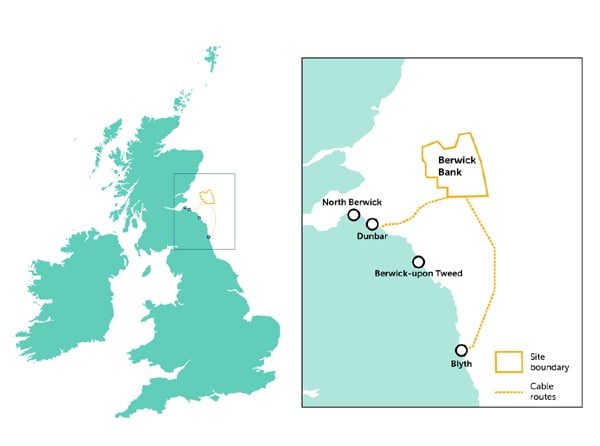
Scotland gave the last major approval for SSE's massive offshore wind farm Berwick Bank (SSE)
In what is being called a “vital step” for Scotland and the UK’s renewable energy ambitions, the Scottish Government has granted consent for the proposed Berwick Bank offshore wind farm. If the project is developed, it would supply twice the annual needs of Scotland’s households and enough power for around 17 percent of the UK’s households.
The massive project has been more than a decade in the planning highlights SSE and is one step closer to proceeding. The consent from Scotland is the last major approval necessary for the project to proceed. However, it still must win a power contract under the UK’s Contracts for Difference scheme, which will likely launch its next round in September. SSE also needs to reach its final investment decision.
The approval comes just days after Donald Trump admonished Scotland to “Stop the windmills,” during his visit. He told reporters, “You fly over and you see these windmills all over the place, running your beautiful fields, and valleys, and killing your birds, and if they’re stuck in the ocean, ruining your oceans,” reports the BBC. They highlight that Trump began opposing Scottish wind farms because they “would spoil the view from his golf course.”
The UK government, however, is strongly behind renewable energy. Prime Minister Keir Starmer outlined a plan to install up to 50 GW of capacity as part of a mass deployment of offshore wind over the next five years. The government increased the financial package for renewable energy in 2024, and it has been reported that they will further improve the support in the next round.
SSE’s plan for Berwick Bank calls for it ultimately to consist of up to 307 turbines. It would be located approximately 23 miles off the east coast of Scotland in the outer Firth of Forth. The company reports a rated capacity of 4.1 GW, which would make it the largest in the world. The UK’s Hornsea 3, which is currently under construction, would be the largest individual wind farm at 2.9 GW, and if all four phases of Hornsea were completed, it would ultimately have reached 6 GW. Ørsted, however, in May said it was discontinuing Hornsea 4 in its current form.
The Berwick Bank project has faced opposition from groups that say it would endanger birds and harm the region’s environment. SSE counters that it would create over 9,000 jobs at peak construction and could inject £8.3 billion of value into the UK economy.
SSE has not provided a target date for the project. The next CfD round is expected to announce results by early 2026.
First-of-its-Kind, Jones Act Cable Lay Barge Operated by Nexans and Crowley
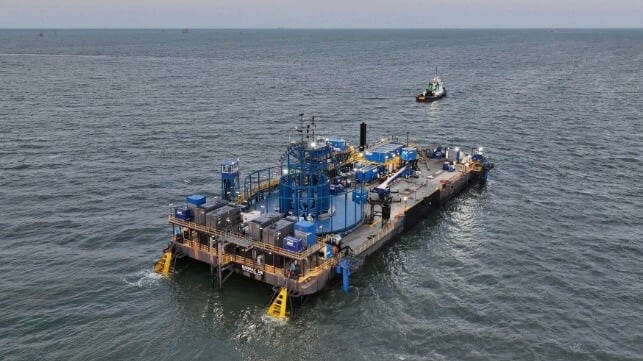
Photo provided by American Maritime Officers (AMO)
The growth of the U.S. offshore wind energy, telecommunications, and other sectors continues to contribute to the growth of U.S. shipping. Cable manufacturer Nexans and Crowley Wind Services announced a new partnership that will develop and operate a Jones Act-compliant cable lay barge.
The 300-foot, U.S.-flagged barge will be built in Louisiana and tested in the U.S. Gulf to Nexans specifications. Once completed, it will be crewed with U.S. mariners under Crowley’s operation. It is designed to support the installation of subsea transmission lines necessary for offshore wind energy, telecommunications, and other major industrial applications.
"This barge will support our existing fleet of cable laying vessels, the Nexans CLV Aurora, Nexans C/S Skagerrak, and Nexans CLV Electra, and we are pleased to be working with Crowley on developing the capability to lay nearshore subsea cable in the U.S.," said Pascal Radue, executive vice president of Nexans' PWR-Transmission Business Group, highlighting the significance of the partnership.
Among its features, the barge will be the first to have vertical injectors along with a dynamic positioning system and a multiple-anchor positioning system, which allow for accurate and efficient cable placement, even in challenging conditions. The barge has a 3,500-ton capacity carousel to lay and bury subsea cable using burial tools such as a vertical injector, a jet sled, or a jetting ROV, with the potential to be upgraded to 7,000 tons with two carousels for bundle cable lay and burial.
According to the companies, it will play a critical role in laying and burying the subsea cables needed to deliver energy from offshore to the grid onshore. It will provide solutions for the expansion of U.S. energy sources and other industrial uses that require underwater cabling.
The barge is positioned to support Equinor’s Empire Wind offshore wind farm for New York. It can also be configured to lay or repair cable for a multitude of other subsea applications.
“The cable lay barge will provide a productive supply chain solution for offshore energy, telecommunications, and other sectors,” said Graham Tyson, vice president of operations, Crowley Wind Services. “Coupled with our U.S. maritime fleet and mariners providing feedering services and other logistics and project management capabilities, we could not be better equipped to serve the needs of industries seeking subsea cable solutions.”
Crowley, a privately held, U.S.-owned and -operated maritime, energy, and logistics solutions company, formed Wind Services in 2023 as a joint venture with Morgan Stanley Investment Management. It is leading the redevelopment of the port in Salem, Massachusetts and it also ordered a Service Operations Vessel (SOV), which is bing built by Fincantieri Bay Shipbuilding and in partnership with ESVAGT. The vessel is due to go into service in 2026 to support Siemens Gamesa’s service operations on the Dominion Energy Coastal Virginia Offshore Wind project.
Canada Designates First Zones for Offshore Wind Energy off Nova Scotia
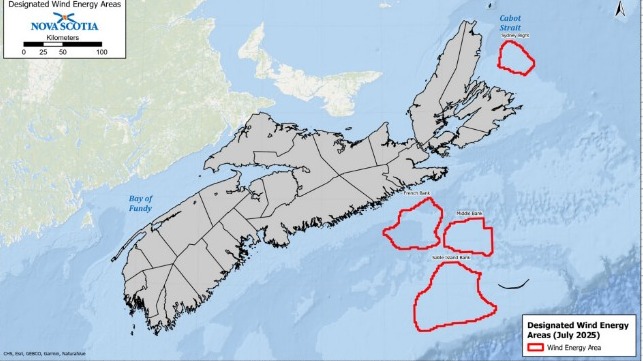
Canada selected the first four areas for bidding for offshore wind energy development (Province of Nova Scotia)
After extensive exploration, the Canadian federal government and the Province of Nova Scotia took the first definitive steps for the development of Canada’s offshore wind energy industry. Calling it a “key step,” the local and federal government jointly presented the first four zones to be made available for development in a call for bids expected by the end of the year.
Nova Scotia’s Premier, Tim Houston, has a bold vision for the industry and creating a new business for Canada’s eastern province. While Nova Scotia currently has peak electrical usage of approximately 2.4 GW of power, Houston wants to make Nova Scotia into an ”energy superpower.” He predicts the industry could grow to a generation capacity of 40 to 50 GW, making it an energy exporter. It might even benefit from Donald Trump’s avowed stance to stop wind power, as there have been reports that Massachusetts might become a power importer from Canada to make up for the loss of its plans for offshore wind power energy.
“With some of the top wind speeds in the world, Nova Scotia has the potential to become a clean energy superpower,” said Premier Tim Houston. “With the right infrastructure, we’ll have the opportunity to send our wind west to power other parts of Canada. By becoming an energy exporter, we can secure long-term prosperity for Nova Scotians.”
A total of four areas were released in today’s plan, three to the east of Nova Scotia and one to the north. Three (Middle Bank, Sable Island Bank, and Sydney Bight) would each be at least 25 kilometers (15 miles) from shore and are at depth for fixed-bottom turbines. The fourth, French Bank, would be closer at 20 kilometers (12.5 miles), and that was done on purpose because the waters are significantly deeper, meaning it could require floating turbines, but the distance is designed to ensure that it remains economical.
Houston told the audience during a press event that the province has great potential and the industry could become an economic driver for Nova Scotia. He noted that some companies are already using Nova Scotia as a staging area for offshore wind projects.
The government said the first call for bids would be for a modest 2.5 GW and would be followed by additional rounds. The goal is to license 5 GW by 2030. After designating the location, the government will now direct the Canada-Nova Scotia Offshore Energy Regulator to begin preparing the bidding process.
After the first round of licenses is awarded, four other areas identified in the January 2025 regional assessment of offshore wind development will be revisited. They include Western/Emerald Bank, which was originally included as the fifth area in the announcement in the spring. Government officials said it has been delayed due to the complexities of the site and feedback during the public comment period.