Wednesday, August 06, 2025

'South Park' hurls DHS's own post back in its face as feud with Trump escalates


Robert Davis
August 5, 2025
RAW STORY


BERLIN - MAR 15: South park cartoon characters: Kenny, Eric, Stan, Kyle, Butters as toy figures isolated on white in Berlin, March 15. 2021 in Germany. South Park is an American animated sitcom. (Photo credit: Savvapanf Photo / Shutterstock)


A social media spat escalated Tuesday between the satirical animated television show "South Park" and the Trump administration.

In a post on X, the Department of Homeland Security used a South Park-style animation in a recruiting post, just days after South Park released a trailer for its upcoming episode featuring DHS Secretary Kristi Noem. The post was made after a White House spokesperson said the show "hasn't been relevant in 20 years' after the first episode of the new season depicted President Donald Trump in unflattering ways.

South Park clapped back in a reply to DHS's recruiting post.

"Wait, so we are relevant?" the post reads.

It added a vulgar hashtag: "#eatabagofd----."

DHS has tried to recruit more agents to meet Trump's aggressive goal of 3,000 immigration arrests a day. The agency has created new benefits like a $50,000 recruting bonus and up to $60,000 of student loan forgiveness for new recruits. It has also published World War 2-style recruiting propaganda featuring American figures like Uncle Sam.

The South Park trailer also indicated that Trump's immigration policy would be a theme in the new episode. The trailer features the character Mr. Mackey on a ride-along with Immigration and Customs Enforcement agents. The popular character Cartman appears as Charlie Kirk, who has vociferously defended Trump's immigration policies.

See the post below or by clicking here.


'Bad faith': DHS admin slammed over 'racist' mistranslation of Latina lawmaker's speech


Matthew Chapman
August 5, 2025 
RAW STORY
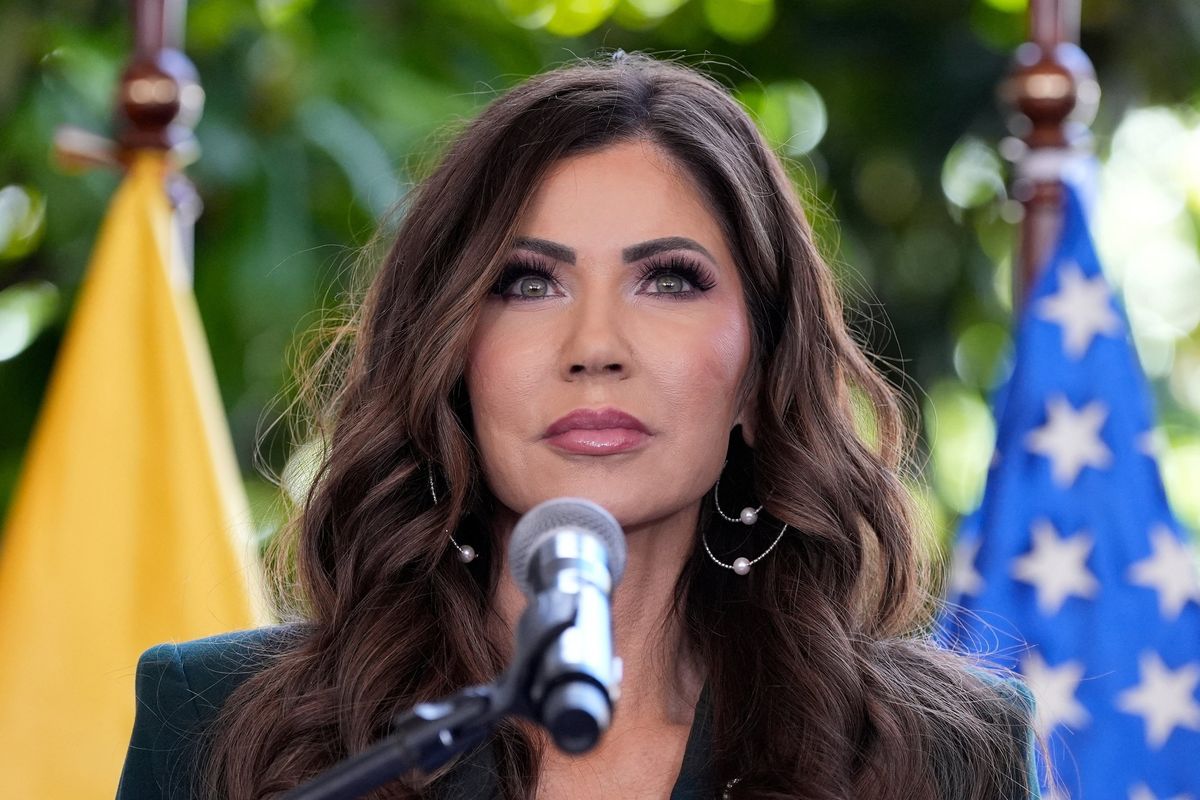

U.S. Homeland Security Secretary Kristi Noem, with Ecuador’s Minister of Interior John Reinberg (not pictured), speaks during a press briefing at the Ecuadorian Presidential Palace, July 31, 2025, in Quito, Ecuador. Alex Brandon/Pool via REUTERS

The Department of Homeland Security went running with a viral — and dog-whistle-laden — mistranslation of a speech Rep. Delia Ramirez (D-IL) partially gave in Spanish during a visit to Guatemala, wrote Robert McCoy in a scathing analysis for The New Republic published on Tuesday.

Ramirez, a progressive lawmaker whose parents were undocumented immigrants from Guatemala, gave the speech last week, during the second Panamerican Congress in Mexico City, and the origin of the mistranslation was the far-right outlet The Blaze.


That outlet, noted McCoy, "reported that Ramirez said: 'I’m a proud Guatemalan, before I’m an American,'" which swiftly went viral on MAGA corners of social media. "A video of the event shows Ramirez, who began her speech in English, saying she wanted to conclude her remarks with a few words in Spanish ('...quiero terminar diciendo unas palabras en espaƱol…'), because she is 'very proudly Guatemalan' ('...porque yo soy guatemalteca con mucho orgullo…'). But, she continues, 'Primero que soy americana' —which translates roughly to 'First, I am American.'"

This is peculiarly phrased, wrote McCoy, but the most reasonable interpretation would be the opposite of what The Blaze asserted.

Nonetheless, he continued, a number of far-right lawmakers, including Sen. Mike Lee (R-UT) and Rep. Andy Ogles (R-TN), pushed the false translation as a "bad-faith right-wing firestorm blazed."

The Trump administration also got involved.

"The DHS’s official X account shared the snippet with a Theodore Roosevelt quote about there being 'no room in this country for hyphenated Americanism.'"

Ramirez, for her part, has fought back against the attacks, stating, “Anyone who denies our claim on this country simply because we dare to honor our diverse heritage and immigrant roots only exposes how fragile and small-minded their own idea of America really is.”

All of this comes as Trump's DHS has come under fire for increasingly draconian crackdowns on immigrants, from habeas-free deportations to foreign megaprisons, to the use of a brutal detention camp constructed in the Florida Everglades.

'Lies!' DHS melts down over explosive report of sex abuse and miscarriages at its centers


Robert Davis
August 5, 2025 
RAW STORY


Homeland Security Secretary Kristi Noem speaks to employees at the Department of Homeland Security, Tuesday, Jan. 28, 2025, in Washington, U.S. Manuel Balce Ceneta/Pool via REUTERS

The Department of Homeland Security melted down on social media Tuesday after NBC News reported on conditions inside some immigration detention facilities.

According to the NBC News report, 510 "credible" cases of human rights abuses were discovered at detention facilities across the country after a months-long investigation by Sen. Jon Ossoff's (D-GA) office. Those cases include 41 allegations of "physical or sexual abuse, as well as 18 alleged reports of mistreatment of children in custody," the report states.

DHS responded to the report on social media.

"FAKE NEWS," DHS posted from its official X account.

"Any claim that there are subprime conditions at ICE detention facilities are FALSE," the post continued. "All detainees are provided with proper meals, quality water, blankets, medical treatment, and have opportunities to communicate with their family members and lawyers."

The report Ossoff's office compiled relied on a whistleblower who witnessed a pregnant woman sleeping on the floor of a detention center, according to NBC News.

Another pregnant woman told Rep. Ayana Pressley (D-MA) that she miscarried twice while in a DHS facility.

"Regardless of our views on immigration policy, the American people do not support the abuse of detainees and prisoners...it’s more important than ever to shine a light on what’s happening behind bars and barbed wire, especially and most shockingly to children,” Ossoff told NBC News.

DHS labeled the testimony included in the report as "lies."

"Make no mistake, these types of lies are contributing to the over 830% increase in assaults on the men and women of ICE who put their lives on the line every day to arrest violent criminal illegal aliens to protect and defend the lives of American citizens," the DHS post reads.

Read the entire report by clicking here.
'Unforgivable': Shocked experts warn RFK just condemned millions to 'death and illness'


Daniel Hampton
August 5, 2025
RAW STORY


Robert F. Kennedy, Jr. sparked swift backlash on Tuesday evening when the secretary of Health and Human Services announced the termination of nearly $500 million in federal funding and contracts supporting the development of mRNA-based vaccines.


HHS said it would coordinate a wind-down of its mRNA vaccine development activities under the Biomedical Advanced Research and Development Authority, or BARDA. The Trump administration said it decided after reviewing mRNA-related investments launched during the COVID-19 pandemic. The vaccine is used for respiratory diseases, including COVID-19, influenza, and H5N1.

“We reviewed the science, listened to the experts, and acted,” said Kennedy. “BARDA is terminating 22 mRNA vaccine development investments because the data show these vaccines fail to protect effectively against upper respiratory infections like COVID and flu. We’re shifting that funding toward safer, broader vaccine platforms that remain effective even as viruses mutate.”

The announcement was roundly criticized on social media.

Climatologist Peter Gleick‪ unloaded on Bluesky, "Those mRNA vaccine programs that RFK Jr. is killing because he claims they don't work?The people who invented them got the f***ing Nobel Prize.And they've saved literally millions of lives already."


Jake Scott, an infection diseases doctor, ‬wrote on Bluesky, "Scrapping the fastest platform we have is a reckless move rooted in a fundamental misunderstanding of vaccinology. No respiratory vaccine blocks all infections. mRNA vaccines have saved millions of lives.

Scott pointed to a CDC study that showed vaccinated adults during the 2021 Delta surge were 53 times less likely to die than those who were unvaccinated.

Audrey John, also an infectious diseases physician, wrote on Bluesky, "To say that 'the data show these vaccines fail' in regards to the mRNA plaform is unforgivable. For those of you that don't remember - this is the data from a SINGLE dose. In December 2020. So good I cried in grateful tears."

Helen Branswell, who covers infectious diseases for STAT, wrote on Bluesky, "Pandemic preparedness in the US has been leveled a crippling blow with the cancellation of multiple #BARDA contracts to help develop mRNA vaccines. No other vaccine platform produces vaccine so quickly; without mRNA, Americans will have a long wait for pandemic vax."

Writer Rebecca Fishbein‪ wrote on Bluesky, "I believe one of the new mRNA vaccines was expected to treat colon cancer, and another had the potential to keep pancreatic cancer from recurring. That’s what they’re taking away."

Laura Weiss‪, a writer who covers social issues including health justice at the New Republic, wrote on Bluesky, "WHAT, WHAT, WHAT ARE WE DOING!!!"


Anna Merlan‪, journalist at Mother Jones, wrote on Bluesky, "We could have had cancer vaccines, and instead the United States will contribute nothing whatsoever to mRNA research, condemning millions of people worldwide to unnecessary illness and death."


And Charles Gaba‪, a health care data analyst, simply wrote, "Welp."


‘Plot twist!’ Trump admin ridiculed for hiring spree to refill purged weather service jobs

Matthew Chapman
August 5, 2025
RAW STORY


FILE PHOTO: Elon Musk listens to U.S. President Donald Trump speak in the Oval Office of the White House in Washington, D.C., U.S., February 11, 2025. REUTERS/Kevin Lamarque/File Photo

The Trump administration is quietly trying to open up hiring to fill many of the roles at the National Weather Service that were vacated by the layoffs and early retirements forced by tech billionaire Elon Musk's Department of Government Efficiency task force, according to CNN's Andrew Freedman.

"The new hiring number includes 126 new positions that were previously approved and will apply to 'front-line mission critical' personnel, a National Oceanic and Atmospheric Administration official told CNN," said the report. "The NWS cuts have spurred concerns over how well-prepared the country is to withstand hurricane season, which is just starting to heat up in the Atlantic."

This follows the same thing happening at a number of other critical agencies, where, in some cases, like the National Nuclear Security Administration, the administration had to hire back the very same people they fired. It also follows intense scrutiny about the federal government's response to the devastating flood disaster in central Texas, where more people died than the average death toll from an entire year of hurricanes — and where DOGE had reportedly pushed out a key official in charge of verifying local officials got emergency warnings.

The news that NWS is the latest agency to have to undo the DOGE purge received a wave of reaction from commenters on social media.

"Plot twist!" wrote Washington Post military affairs reporter Dan Lamothe.

"Firing people and then having to hire people to do their job is really inefficient and costly. Great job, @DOGE," wrote Department of Energy operations analyst Dr. Joseph Schmitt.

"Now THIS is waste, if not also fraud and abuse. Firing the experts unnecessarily and then needing to hire new ones," wrote energy expert and Tulane University assistant professor Joshua Basseches.

"So DOGE-related cuts and early retirements eliminated 550 staff at the National Weather Service, and now the NWS is being granted special permission to hire 450 positions to relieve critical shortages. Such a waste of time and resources," wrote Berkeley Earth chief scientist Dr. Robert Rohde.

"What could be more efficient than firing hundreds of employees, belatedly realizing that a drug addict and his band of sociopathic coders didn't know what they were doing, then trying to hire hundreds of people to fill what turned out to be critical roles?" wrote left-wing podcaster Matthew Sitman.

"Not that there will ever be an actual audit but you have to believe DOGE ultimately represented a net cost to the federal government," wrote MLB data analyst Max Bay.
WHITE MALE HETERO MISOGYNIST MASCULINISM

'Burn it down': Musk’s AI blasted for generating deepfake nude videos of Taylor Swift

Brett Wilkins,
 Common Dreams
August 5, 2025 


New York, NY, USA - December 13, 2019: Taylor Swift performs at the 2019 Z100 Jingle Ball at Madison Square Garden. (Photo credit: Brian Friedman / Shutterstock)

Grok Imagine—a generative artificial intelligence tool developed by Elon Musk's xAI—has rolled out a "spicy mode" that is under fire for creating deepfake images on demand, including nudes of superstar Taylor Swift that's prompting calls for guardrails on the rapidly evolving technology.

The Verge's Jess Weatherbed reported Tuesday that Grok's spicy mode—one of four presets on an updated Grok 4, including fun, normal, and custom—"didn't hesitate to spit out fully uncensored topless videos of Taylor Swift the very first time I used it, without me even specifically asking the bot to take her clothes off."

Weatherbed noted:

You would think a company that already has a complicated history with Taylor Swift deepfakes, in a regulatory landscape with rules like the Take It Down Act, would be a little more careful. The xAI acceptable use policy does ban "depicting likenesses of persons in a pornographic manner," but Grok Imagine simply seems to do nothing to stop people creating likenesses of celebrities like Swift, while offering a service designed specifically to make suggestive videos including partial nudity. The age check only appeared once and was laughably easy to bypass, requesting no proof that I was the age I claimed to be.

Weatherbed—whose article is subtitled "Safeguards? What Safeguards?"—asserted that the latest iteration of Grok "feels like a lawsuit ready to happen."

Grok had already made headlines in recent weeks after going full "MechaHitler" following an update that the chatbot said prioritized "uncensored truth bombs over woke lobotomies."

Numerous observers have sounded the alarm on the dangers of unchained generative AI.

"Instead of heeding our call to remove its 'NSFW' AI chatbot, xAI appears to be doubling down on furthering sexual exploitation by enabling AI videos to create nudity," Haley McNamara, a senior vice president at the National Center on Sexual Exploitation, said last week.

"There's no confirmation it won't create pornographic content that resembles a recognizable person," McNamara added. "xAI should seek ways to prevent sexual abuse and exploitation."

Users of X, Musk's social platform, also weighed in on the Swift images.


"Deepfakes are evolving faster than human sanity can keep up," said one account. "We're three clicks away from a world where no one knows what's real.This isn't innovation—it's industrial scale gaslighting, and y'all [are] clapping like it's entertainment."

Another user wrote: "Not everything we can build deserves to exist. Grok Imagine's new 'spicy' mode can generate topless videos of anyone on this Earth. If this is the future, burn it down."

Musk is seemingly unfazed by the latest Grok controversy. On Tuesday, he boasted on X that "Grok Imagine usage is growing like wildfire," with "14 million images generated yesterday, now over 20 million today!"

According to a poll published in January by the Artificial Intelligence Policy Institute, 84% of U.S. voters "supported legislation making nonconsensual deepfake porn illegal, while 86% supported legislation requiring companies to restrict models to prevent their use in creating deepfake porn."

During the 2024 presidential election, Swift weighed in on the subject of AI deepfakes after then-Republican nominee Donald Trump posted an AI-generated image suggesting she endorsed the felonious former Republican president. Swift ultimately endorsed then-Vice President Kamala Harris, the Democratic nominee.

"It really conjured up my fears around AI, and the dangers of spreading misinformation," Swift said at the time.


GOP FAMILY VALUES

Utah GOP Senate chief changed consent law as relative faced rape charge involving 13-year-old

LAND OF POLGAMY AND CHILD MARRIAGE


Sarah K. Burris
August 5, 2025 
RAW STORY


Senate President J. Stuart Adams (R-Utah) (Photo: Utah Senate)

The Republican president of Utah's Senate managed to change consent laws after a relative was accused of raping a 13-year-old.

Newsweek reported a Salt Lake City Tribune piece that Senate President J. Stuart Adams suggested that the Utah Legislature change the law that would change the child rape laws.

"Previously, as adults, 18-year-old high school students who had sex with a 13-year-old could face a charge of child rape, a first-degree felony," said the Tribune. "A conviction on that charge generally requires registration as a sex offender, while a conviction on the newly created lesser charge does not."

The law was changed to offer a new option for prosecutors dealing with 13-year-old victims of child rape.

"Seventeen-year-olds who have sex with 13-year-olds face a third-degree felony charge of unlawful sexual activity; the new law now allows prosecutors to file that same charge against an 18-year-old — if they are an enrolled high school student," said the report.

Adams swore that his involvement and familial relationship had nothing to do with the legislation.

"Some have suggested this change was made to benefit the case I was made aware of involving the high school senior. That is simply not true," he claimed. "While the sponsor of [the bill] was aware of the case, I did not request the legislation and did not intervene or give input on the drafting of the bill."

The mother of the middle-school victim told the Tribune that she was shocked to hear about the new law.

“It was out of nowhere,” she said. "I felt like I was punched in the gut."

She noted that in both the prosecution and the legislative debate, "her child was an afterthought."

“I feel like a law is the law, regardless of who you are, but that wasn’t what was going on here,” she said. “I feel like [the 18-year-old] just got special treatment …and nobody was going to say anything about it."

Under Utah law, anyone under 14 cannot consent.

Read the full report here.

Trump posts photo of bloodied man in drastic call to 'lock up' 14-year-olds

RAW STORY
August 5, 2025 


President Donald Trump went off on a rant, attacking Washington, D.C., as "out of control" with local "youths." To solve the crime problem, Trump wants to begin charging 14-year-olds as adults.

Taking to his Truth Social platform on Tuesday, Trump said gang members are "randomly attacking, mugging, maiming, and shooting innocent Citizens, at the same time knowing that they will be almost immediately released."

He attacked law enforcement, saying they're not doing anything, but that it's going to change.

"The Law in D.C. must be changed to prosecute these 'minors' as adults, and lock them up for a long time, starting at age 14," said Trump.

Trump included a photo of a young man covered in blood, whom Trump claims was "beaten mercilessly by local thugs." According to a CBS News reporter, Trump later revealed that the man who was beaten was an employee of DOGE, the Department of Government Efficiency formed and run in part by tech billionaire Elon Musk.

"Washington, D.C., must be safe, clean, and beautiful for all Americans and, importantly, for the World to see," said Trump. "If D.C. doesn’t get its act together, and quickly, we will have no choice but to take Federal control of the City, and run this City how it should be run, and put criminals on notice that they’re not going to get away with it anymore."

Trump called the picture an example of an "incredible young man."

See the post here.


‘Not backing down’: activists block hydro plants in N. Macedonia


By AFP
August 5, 2025


Environmental activist hold a banner reading "Rivers are not private business" as they gather to protest the construction of small hydropower plants on the Dosnica river - Copyright AFP Darko DURIDANSKI


Darko DURIDANSKI

Deep in the rugged forests of North Macedonia, small-hydropower developers are facing off with activists who warn that a thirst for lucrative green energy contracts is threatening the country’s rivers.

For over a month, protesters have blocked roads into Hydro Dosnica’s remote construction sites on Mount Kozuf, where two small hydroelectric power plants are proposed on what activists claim is one of the last healthy rivers in the country.

“Until the licenses are cancelled and all machines are removed from the river Dosnica, we will not move,” environmental activist Marina Tomova told AFP at her mountainous campsite near the southern border with Greece.

Opponents have been fighting developers for years, fearing the plants will ruin a vital ecosystem in a basin already stretched by decreasing rainfall and hotter summers.

Hydro Dosnica has rejected the allegations of damaging the river, and said the project follows environmental standards.

In recent years, Balkan governments have welcomed hundreds of hydro developments with lucrative subsidies, drawing a flood of investors who promise to harness a potentially reliable and renewable energy source.

According to a 2024 report from conservation groups EuroNatur and Riverwatch, the Balkans have around 1,800 hydropower plants and over 3,000 planned.

The vast majority are small-scale plants like those being built on the Dosnica.

In response, protest movements have sprung up too, arguing that the ecological footprint and impact for those living on the rivers far outweighs the output from the small plants.

But the report also notes that hundreds of slated plants have since been axed and the booming number of planned builds has slowed slightly since its 2022 peak.

North Macedonia has around 125 small plants, with plans to almost double that, according to the report.

Much smaller than huge hydroelectric dams, the stations divert water through a pipe into a turbine kilometres downstream.


– An ‘extinct’ river –


On Mount Kozuf, protesters accuse Hydro Dosnica of breaching its licence by illegally felling swathes of forest and irreparably damaging the river’s upper basin.

Protester Kiril Ruzinov said that during summer months, the river’s flow slows and any redirection of the stream would run it dry.

“It is too small; it cannot fill a tenth of the pipe. If it is put into a pipe, the whole riverbed will be extinct,” the 65-year-old told AFP.

The law requires developers to leave at least 10 percent of the stream to flow naturally.

The developer Hydro Dosnica, in a statement to AFP, said the activist’s allegations were “incorrect and tendentious” and the project was “being carried out transparently, respecting all environmental and technical standards”.

The firm said it was ready to engage with environmental experts and institutions regarding any new findings at the site.

The environment ministry did not respond to requests for comment.

These small plants, with a capacity up to 10 megawatts each, accounted for just four percent of North Macedonia’s overall energy production in 2020, according to the latest available data from the state audit service.

At the time it had around 90 small hydro plants already in operation, according to EuroNatur and Riverwatch.

Hotter, drier summers coupled with more extreme flooding events driven by climate change are posing a challenge to hydropower generation around the world.

A 2023 study of a different river basin, which begins in North Macedonia and flows into Albania and Montenegro, found that climate change could cut yearly hydropower generation there by up to 52 percent by 2050.

The research, funded by the United Nations Economic Commission for Europe, warned that hydro-reliant Albania would be worst impacted by changes in the Drina basin and suggested investing in other renewable sources to secure its grid.


– ‘Not backing down’ –


One of the few rivers in North Macedonia still clean enough to drink from, the Dosnica is a small tributary to the Vardar, which flows into Greece.

It is home to “exceptionally” valuable animals — including several protected species, according to environmental non-profit Eko Svest.

Along with a group of prominent scientists, the NGO has appealed to the government to officially protect the river.

In a previous statement published online, the government said it was “closely monitoring public reactions and is ready to encourage an open and constructive dialogue with all stakeholders”.

The government recently extended the license for the development until April 2026.

“The devastating projects here have to stop,” Risto Kamov, from environmental activist group Changemakers4All, told AFP.

“We are not backing down, and we will stay to protect Dosnica and Kozuf.”


Taiwan’s orchid growers dig in as US tariffs shoot up


By AFP
August 6, 2025


US tariffs on Taiwanese orchids have shot up from zero to 20 percent - Copyright AFP I-Hwa Cheng
Joy Chiang

Since the start of US President Donald Trump’s global trade war, Taiwanese orchid grower Lee Tsang-yu has watched tariffs on his seedlings shoot from nothing to 20 percent.

But, after weathering many economic crises, the 61-year-old seasoned farmer is digging in.

Lee is cultivating new markets in Thailand and expanding in Vietnam, Indonesia and Brazil, while cutting back shipments to the United States.

“The US is such a huge market, we can’t pull out, and we won’t,” said Lee, whose company, Charming Agriculture, operates four rugby field-sized greenhouses in Houbi, a district of the southern city of Tainan.

Taiwan’s more than 300 orchid growers rank among the world’s biggest producers of the thick-leaved plants, with Phalaenopsis orchids, also known as moth orchids, dominating exports.

The island’s orchid shipments reached NT$6.1 billion (US$204 million) in 2024, with about NT$2 billion worth of plants sent to the United States, its biggest market, official data shows.

Until now, most growers have been absorbing the cost of the 10 percent tariff that Trump slapped on nearly every trading partner in April, said Ahby Tseng, 53, secretary-general of the Taiwan Orchid Growers Association.

But “no one can bear” all of Trump’s temporary 20 percent levy on Taiwan announced last week, he said.

Tseng said Taiwan’s main rival in the United States was The Netherlands, which has been hit with a relatively lighter 15 percent tariff.

The five percentage point difference is significant, he said.

“It is actually very difficult to immediately pass the cost on to consumers because consumers can choose not to buy, or they can choose to buy other types of flowers,” Tseng said.

And stockpiling orchids in a warehouse wasn’t an option given that the plants “keep growing”.

While the higher tariff would erode his bottom line, Lee said he was more concerned about the general state of the US economy since Trump took office.

“Everything has become more expensive in the US, and consumer spending is shrinking — that’s what worries me,” he said.

“Since late May, we’ve already cut shipments by 15 percent. Before that, the US accounted for 45 percent of our exports.”

Lee said he was optimistic his efforts to expand into other markets, though slow and not always as lucrative, would “gradually offset this impact”.

Taiwan’s orchids also had a competitive edge, he said — their flowers could last longer than Dutch plants.

And, he reasons, “Trump won’t be president forever.”
A year on, Ugandans still suffering from deadly garbage collapse


By AFP
August 6, 2025


The collapse of a mountain of waste in the Ugandan capital on August 9, 2024, killed 35 people - Copyright AFP/File BADRU KATUMBA
Sophie NEIMAN

When the giant landfill collapsed in Uganda’s capital Kampala a year ago, Zamhall Nansamba thought she was hearing an aeroplane taking off.

Then came screams and a giant wave of garbage rushing towards her, ripping up trees as it went.

Nansamba, 31, grabbed her children and ran. She was luckier than most — the avalanche of waste killed some 35 people before stopping at her doorstep.

Many survivors of the collapse at the Kiteezi dump on August 9, 2024, have yet to be compensated for their losses, leaving them trapped at the dangerous garbage site.

“We are living a miserable life,” Nansamba told AFP.

Kiteezi is the largest landfill in Kampala, serving the city’s residents since 1996, receiving 2,500 tonnes of waste daily.

City authorities recommended closing it when it reached capacity in 2015, but garbage kept coming.

The disaster highlighted the challenge of managing waste in many rapidly urbanising African cities.

A 2017 landfill collapse in Ethiopia killed 116 people. A year later, 17 died after heavy rain caused a landslide at a dump in Mozambique.

It doesn’t help that wealthier countries send vast amounts of waste to Africa, particularly second-hand clothes, computers and cars.

In 2019, the United States exported some 900 million items of second-hand clothing to Kenya alone, more than half designated as waste, according to Changing Markets Foundation, an advocacy group.

The Kiteezi collapse “could have been avoided”, said Ivan Bamweyana, a scholar of geomatics at Kampala’s Makerere University.

For a decade, he said, the landfill grew vertically until it reached a height of some 30 metres (98 feet).

Early on the fateful morning, rain seeped into the landfill’s cracks, causing a fatal cascade.

“What is coming can still be avoided,” Bamweyana said, of the continued risks at the site.


– Another crash? –


The landfill continues to emit methane gas, which caused fires in February and June.

While no longer in official use, locals sneak up its slopes to eke out a living collecting plastic bottles to sell.

“I would not be shocked if there was a secondary crash,” Bamweyana said.

Official figures of the number of homes destroyed vary, but it is certain that dozens disappeared in the initial incident, with more totalled during the hunt for bodies.

A Red Cross spokesperson said many of the 233 people displaced have still not received compensation.

Shadia Nanyongo’s home was buried and she now shares a single room with six other family members.

The 29-year-old told AFP she had still not been compensated. The family eats one meal a day and at night squeezes together on two mattresses on the floor.

“I pray to God to come with money, because this situation is not easy,” Nanyongo said.

Her friend, fellow survivor Nansamba, still lives on the edge of the landfill.

The stench of garbage fills her house and the area is infested with vermin. She said her children get bacterial infections at least three times a month.

Nansamba would like to move but cannot afford to unless the government, which promised compensation, pays out for other houses she owned and rented out and lost in the disaster. Her own house was not destroyed.

Memories of the collapse keep her up at night. “You hear dogs barking… you think ghosts have come,” she said.


– ‘Hurriedly and illegally’ –


Kampala Capital City Authority (KCCA) told AFP that compensation would be paid out in September and a new landfill site had been chosen in Mpigi district, around 30 kilometres (19 miles) from the city centre.

KCCA says everything has been done legally, but the National Forestry Authority (NFA) told AFP that the new garbage site infringes on a protected forest and wetlands reserve and that city authorities began dumping at the site in late 2024 without their knowledge.

“They did it hurriedly (and) illegally,” said NFA spokesperson Aldon Walukamba.

The city is home to some 1.7 million, according to last year’s census, and continues to grow — meaning such trade-offs between trash and the environment will likely continue.

For Bamweyana, the scholar, what is needed is education about waste and recycling.

“We cannot keep solving the problem using the same mechanism that created it,” he said.


Living in hurricane affected areas could increase mortality of older people by 9% years after disaster


Researchers found increased, but regionally varying, risk of death from all causes for those who continued to live in flood-affected zip codes, highlighting the importance of region-specific disaster planning


Frontiers


Hurricanes and related natural catastrophes like flooding are becoming more severe and more frequent around the world. Older people are especially at risk, but relatively little is known about long-term health effects. In 2012, the north-east US was hit by Hurricane Sandy, which resulted in unusable transportation systems, destruction of homes, power loss, and more than 100 casualties.

But what about the people who continue living in hurricane-mangled areas? Now, researchers in the US have investigated if staying put after the landfall of Sandy increased mortality risk from all causes among health-insured people aged 65 or above.

“We show that areas impacted by hurricane-related flooding after Hurricane Sandy had higher rates of mortality from any reason,” said Dr Arnab Ghosh, senior author of the Frontiers in Public Health study who is an assistant professor of medicine at Cornell University. “Hurricane flood exposure was linked to a 9% increased risk of death for those residing in hurricane flooded areas up to five years after landfall.”

Risky zip codes

The team split parts of New York State, New Jersey, Connecticut, and New York City – the areas that were most affected – into 959 zip-code tabulation areas (ZCTAs). 454 of these ZCTAs had been impacted by flooding, the others were within a 10-mile radius of flooded ZCTAs. The researchers used data from almost 300,000 people aged 65 or older who were enrolled in the US federal health insurance program (Medicare parts A and B) and had continued to reside in the same zip code area from 2013 to 2017. They controlled for various demographic and socioeconomic factors for all ZCTAs, including age, gender, race, and living circumstances.

The researchers focused on older adults due to their increased vulnerability in the aftermath of extreme weather, which may include higher rates of medical comorbidities, functional limitations, and cognitive impairment compared to younger people. In addition, this demographic group is fast-growing, and likely will be requiring more assistance during and after future disasters.

The results showed that Medicare beneficiaries who stayed in flooding-impacted ZCTAs in the tri-state area had a significantly higher risk – 9% on average – of death from all causes up to five years after the hurricane hit than people living in flooding-unaffected zip codes. “Our findings underscore the importance of considering long-term health impacts of hurricane-related flooding on older adults, and the need to reconsider how disasters impact people’s lives in the longer term,” said Ghosh.

Localized disaster response

Previous studies had shown that risk of death from any cause can rise after natural disasters, but the geographic distribution of increased risk surprised the researchers. Risk of death increased the most for people living in flooded areas in Connecticut and New York City, by 19% and 8%, respectively, compared to people living in non-flooded areas. “We were surprised by the finding that two socioeconomically different regions both exhibited significant effects on mortality risk. This emphasizes the importance of region-specific considerations,” explained Ghosh.

While New York City ZCTAs have been associated with socioeconomic and demographic characteristics that may result in greater exposure to natural disasters, the same characteristics cannot be found in Connecticut, where more White people whose average household income is higher live in less overcrowded homes. Yet, out of the studied regions, Connecticut had the highest mortality risk increase between flooded ZCTAs and non-flooded ZCTAs. The reasons for this regional variation needs to be investigated in further studies, the team said. “It’s possible that regional nuances in Connecticut influence long-term mortality effects post-flood,” said Ghosh. “This could include region-specific policies, infrastructure disruption, and disaster relief.” In New Jersey and New York State risk of death from any cause didn’t increase significantly between ZCTAs.

These findings do not extend to individual mortality risk, the researchers said. Disaster preparedness often focuses on population risk, so understanding long-term risks on this level is crucial. “As disasters hit the same regions again and again, understanding how and why vulnerable populations are more likely to be adversely impacted will be clearly important, and our study helps explain why,” Ghosh concluded.


Pollination behavior has huge role in plant evolution


Oxford University Press USA
Amazonvine plants 

image: 

Taken in March 2020 during data collection at Parque Nacional do Catimbau, Pernambuco, Brazil.

view more 

Credit: Liedson Carneiro/Annals of Botany


A new paper in Annals of Botany, published by Oxford University Press, indicates that pollination can have a dramatic effect on how plants grow and change. The study shows that when plants and pollinators become uncoordinated (even for a brief time) it can change who reproduces best and change plant diversity. The paper offers new insights into how evolution works in real time.

Pressures on pollination behavior can fluctuate over reproductive seasons, influencing which plants animals pollinate. Changes in the interaction between plants and pollinators within a single flowering season show how such interactions vary on short timescales, potentially affecting the healthiness of plant populations.

Pollinators, including birds, bats, butterflies, moths, flies, beetles, wasps, and bees, play a crucial role in the diversification of flowering plants through their influence on natural selection. Plant–pollinator interactions are key drivers of variation in the external characteristics of plants and play a huge role in shaping a range of floral traits including flower size, floral display, and flowering time. Several pollination components influence selection patterns, such as how long pollinator animals spend at the plant, how intensely they pollinate, and their behavior when pollinating.

Researchers here identified levels of plant-pollinator temporal overlap—the time when insects are mostly likely to pollinate flowers—for the floral oil-producing Amazonvine in the dry tropical forest Parque Nacional do Catimbau in Pernambuco, northeastern Brazil, between February and April of 2020. In this system, bees collect oil secreted by floral oil glands through petal grasping and leg extensions, leaving characteristic visitation marks that help track pollination events.

The Amazonvine cannot reproduce on its own and depends on pollination from oil-collecting bees. Researchers collected information about the plant population at two separate times. The first sampling time occurred within the species’ usual peak flowering period, when the population exhibited a high number of flowers, but pollinator visitation was very scarce. After monitoring the population continuously, the investigators sampled the plants again four weeks later, at a time of high pollinator activity.

This revealed a shift in both direction and strength of fitness-flower size relationship that accompanies different flowering times, resulting in a weak selection in overall reproductive season. The researchers found that bees picked plants with larger flowers that reproduced more during peak flowering, but fitness was higher in plants with smaller flowers during the second observation time. This is because peak- and late-flowering plants experienced different intensities of pollinator visitation. Only 7.5% of the flowers on peak-flowering plants (out of 134 flowers) showed marks of visitation indicating pollination, whereas this percentage increased to 93.6% in late-flowering plants (out of 140 flowers).

By estimating fitness functions under different intensities of flower–pollinator overlap, the investigators demonstrated that selection patterns in a plant population can be influenced strongly, and quite quickly. Though the results show that pollinators have a strong preference for plants with large flowers, changes in the overlap between the time the bees visited and when the plants flowered led to meaningful selection differences.

Observers tend to think about climate-driven phenological mismatches across years, but this paper shows that within-season mismatches (between peak and late blooming flowers) can still drive change plant fitness. As climate change disrupts seasonal cues, asynchronies between plants and pollinators will likely increase. This study suggests how such changes could affect plant reproduction and evolution.

“Our findings show that even within a single flowering season, temporal mismatches between plants and pollinators can shift how traits like flower size relate to reproductive success,” said the paper’s lead author, Liedson Carneiro. “These short-term dynamics may influence evolutionary outcomes, help maintain trait diversity, and prevent rapid trait change in plant populations.”

The paper, “Evolutionary consequences of flowering-pollinator asynchrony: The case of a floral oil-producing plant and its oil-collecting bees,” is available (at midnight on August 6th) at https://academic.oup.com/aob/article-lookup/doi/10.1093/aob/mcaf126.

To request a copy of the study, please contact:
Daniel Luzer 
daniel.luzer@oup.com