It’s possible that I shall make an ass of myself. But in that case one can always get out of it with a little dialectic. I have, of course, so worded my proposition as to be right either way (K.Marx, Letter to F.Engels on the Indian Mutiny)
Wednesday, August 06, 2025
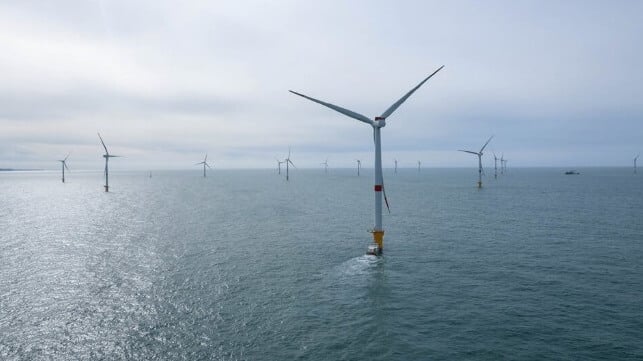
EU Approves €11 Billion French Program to Aid Offshore Wind Energy
France looks to accelerate its wind energy programs and will support floating wind projects
The European Commission approved a €11 billion (US$12.7 billion) French program designed to support offshore wind energy and accelerate the transition to clean energy. While the EU has strict rules for government aid programs, the review found that this program will contribute to the transition towards a net-zero economy and reach the renewable energy target set at the EU level for 2030.
The program will support the construction and operation of three floating offshore wind farms. One will be in the sea off the coast of Southern Brittany, and two others in the Mediterranean Sea. Each wind farm is expected to have a capacity of around 500 MW and to generate around 2.2 TWh, equivalent to the annual consumption of 450,000 French households.
The aid will be granted as part of a bidding process, which will be organized to select one beneficiary per offshore zone. According to the European Commission, in the approval of the aid package, resilience has been included as a tender prequalification and award criterion in order to diversify wind turbine and main specific components supply chains to reduce dependency on imports from China.
Under this scheme, the aid will take the form of a monthly variable premium under a two-way contract for difference (CfD), which will be calculated by comparing a reference price, determined in the tender offer of the beneficiary to the market price for electricity. When the market price is below the reference price, the beneficiaries will be entitled to receive payments equal to the difference between the two prices. When the market price is above the reference price, the beneficiary will have to pay the difference between the two prices to the French authorities.
The Commission found that the French scheme meets its conditions as it provides direct price support through a two-way CfD, awarded via a competitive bidding process. It includes safeguards to ensure markets function properly and avoid compensating producers when market prices are negative.
The Commission concluded that the French scheme is necessary, appropriate, and proportionate to accelerate the transition towards a net-zero economy and facilitate the development of certain economic activities.
Glamox Wins Contracts to Light Taiwan’s Fengmiao Offshore Wind Farm
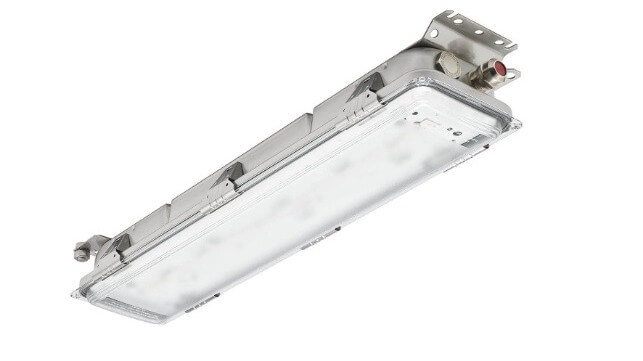
Glamox, a world leader in lighting, has won contracts to light the wind turbine foundation transition pieces for the Fengmiao wind farm, to be located offshore near Taichung, Taiwan. The company will provide approximately 920 marine-certified LED luminaires to illuminate the jacket foundation transition pieces for 33 turbines, which will generate a combined 495 MW of clean electricity. Glamox’s contracts are with the two companies building the foundation jackets: SK OceanPlant of South Korea and Taiwan’s Century Wind Power, in collaboration with ProCon Taiwan.
The transition piece is the cylindrical steel structure that connects the wind turbine to its foundation. It serves as the primary access point to the turbine tower of the V236-15.0 MW turbines supplied by Vestas. It includes boat landing systems, platforms, and ladders. It is vital that the area is well-lit for inspection and maintenance teams and that the luminaires function flawlessly in an emergency.
“This is the third Taiwanese wind farm project we have recently secured. It follows the Hai Long Wind Farm 2 and 3 and the Greater Changhua 2b and 4 projects that we announced in March 2024,” said Tommy Stranden, Chief Sales & Commercial Officer of Glamox’s Marine, Offshore & Wind business. “When people’s safety and security are concerned, you choose the best you can. Our offshore customers know they can depend on our marine-grade lighting, which is designed to withstand extreme weather conditions, vibrations, and the corrosive saltwater environment,” added Stranden.
Glamox is providing 35 RLX C floodlights and 884 MIR G2 WOF luminaires. The energy-efficient LED lighting has a designed lifespan of 100,000 hours at 45°C. Both types of light are also equipped with a three-hour battery pack in case of a power outage.
The lighting will be delivered in the summer of 2025. It will be installed by SK OceanPlant at its yard in Goseong County, South Korea, and by ProCon Taiwan at Century Wind Power’s yard in New Taipei City, Taiwan. Fengmiao is scheduled for completion by the end of 2027, providing green energy to large corporate users.
Copenhagen Infrastructure Partners (CIP) oversees the overall development and management of Fengmiao, including securing financing, supervising construction, and ensuring the project meets its operational targets.
The products and services herein described in this press release are not endorsed by The Maritime Executive.
Open Hatch Likely Caused Sinking of 122-Foot Yacht in Chesapeake Bay
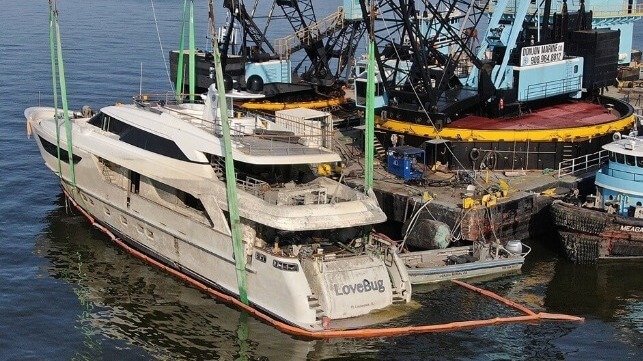
A pair of partially-open aft hatches likely caused the flooding and sinking of the yacht Lovebug on the Chesapeake Bay last year, according to the NTSB.
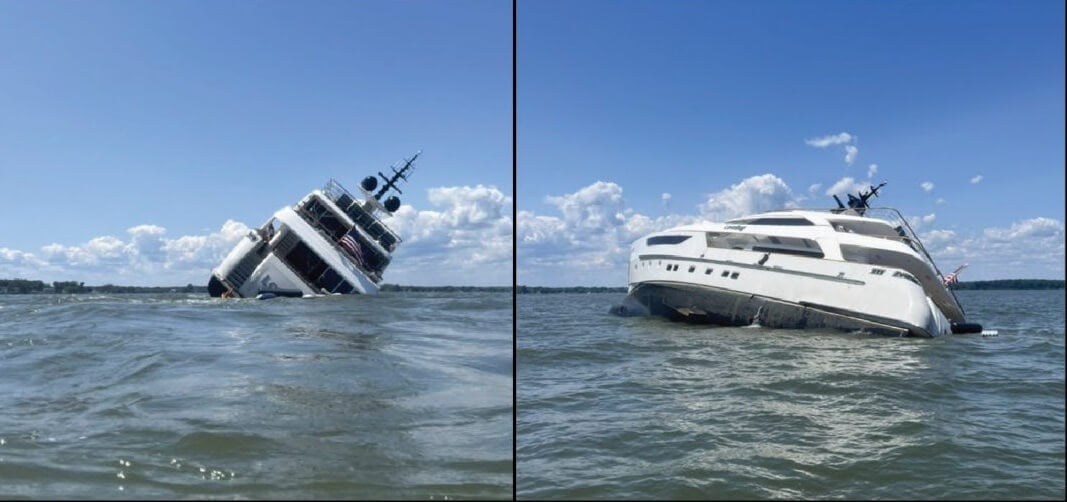
On the afternoon of July 27, 2024, the 122-foot Lovebug was under way on Chesapeake Bay near Shady Side, Maryland, making about 7-10 knots. At about 1235 hours, the yacht took on a heavy list to starboard. The captain was concerned by the worsening list and checked the stabilizers, rudder indicators and steering, without finding any technical issues. After about one minute, the vessel lost auxiliary power and the captain slowed to four knots. He ordered preparations to drop anchor, but before the crew could carry out the order, the list became so worrisome that the master ordered abandon ship. Three crewmembers and one owner went over the side, followed by the master, and Lovebug partially sank in about 12 feet of water.
One person sustained a minor injury, and minor oil pollution was observed around the vessel. The yacht was salvaged after two weeks, but the water damage to the vessel's interior was estimated at about $8 million.
Courtesy NTSB
During the salvage process, divers inspected the vessel. They found that the exterior clamshell hatch for the "garage" - the aftmost compartment, used for storage of water toys - was partially open. The watertight door from the garage to the engine room was also open. After salvage and transport to a shipyard, no hull damage or other visible breaches were found, though the interior was so filled with debris that a full inspection was impossible.
The master told investigators that he had seen the garage's clamshell hatch fully closed before getting under way. No one aboard the vessel saw the flooding happen before abandoning ship.
NTSB concluded that the Lovebug likely took on water through her garage, where the lower edge of the hatch is near the waterline, followed by flooding through the open engine room watertight hatch. As water accumulated in the garage space, her draft would have increased aft, leading to engine room flooding if the water rose above the sill of the open watertight door. The vessel's stability decreased with flooding, and her list reached an equilibrium of about 45-50 degrees to starboard, which stayed constant as she sank into the muddy bottom, NTSB concluded.
Houthis Reveal Tracking of Shipping Between Israel, Egypt and Turkey
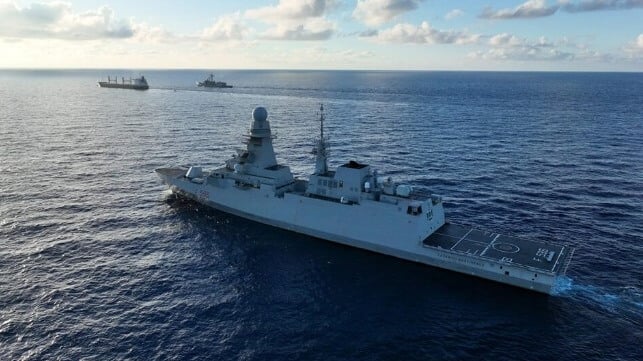
Aspides continues its protection efforts in the Red Sea as the Houthis widen their tracking of ships (EUNAVFOR Aspides)
The Houthis continue their demand that all shipping be stopped into and out of Israel as part of their so-called blockade of Israeli ports. In their latest move, the militants revealed they are tracking individual ship movements, and they called out major companies, including Maersk and MSC, revealing they are using AIS data to track the movement of ships between Egypt, Turkey, and Israel.
The group resumed its threats this summer against all shipping that had any involvement with Israel, regardless of the nationality of the shipping company. They warned that ships must stop their calls in Israel and that any company that does not would face attacks anywhere within the reach of the Houthis.
The attacks on the Magic Seas and the Eternity C, both bulkers sunk by the Houthis at the beginning of July, with the latter claiming multiple lives, were reported as retribution for the shipping companies sending vessels to Israel. Crewmembers from the Eternity C were paraded out in a video and said their vessel was going to the Port of Eilat to pick up fertilizer. At the end of July, the group expanded the threat against Cosmoshipping, which managed the Eternity C, posting a listing of the company’s other ships that sailed to Israel.
In their latest posting online and in their media outlets, the Houthis identify nine ships that they say have called in Israeli ports on August 2 and 3. All of them were coming from or going to ports in Egypt or Turkey.
The group writes, “The data highlights continued commercial activity between Turkey and the Israeli regime.” Later, it also says, “The data also revealed that Egypt is continuing to import goods from Israel.”
“This activity underscores ongoing trade relations with Israel, despite regional and international calls for economic disengagement,” the Houthis write.
They cite the containership MSC Oscar, which they said arrived at Ashdod, Israel, from Turkey’s Asia Port carrying 18,400 containers. They report the MSC Tuxpan was carrying 5,060 containers and sailed from Ashdod to Port Said, Egypt. The Maersk Narmada (referred to as a car carrier) is also listed as coming from Iskenderun, Turkey, to Haifa, and which continued to Mersin, Turkey, carrying 2,478 containers, the group says. It says two other containerships, Marla Tiger and YM Winner, also called in Israel.
Other vessels they are citing include the bulk carriers Aquis Perla, Neco K, and Pardus, as well as a cement carrier, Nova Coralia. They list a cargo ship, Halo, and the car carrier Lider Bulut, which they said traveled from Ashdod to Port Said.
Due to these increased threats, carriers, for the most part, have continued to avoid the Red Sea. Egypt’s hopes to begin restoring container vessel traffic at the Suez Canal appear to have been mostly dashed by the new threats, while in the Red Sea, EUNAVFOR Aspides continues to highlight that it is maintaining its defensive operation and providing protection for vessels transiting the Red Sea.
Sanctions Have Not Slowed the Growth of the Shadow Fleet
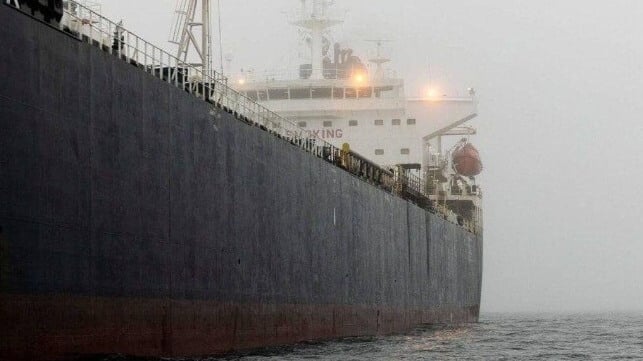
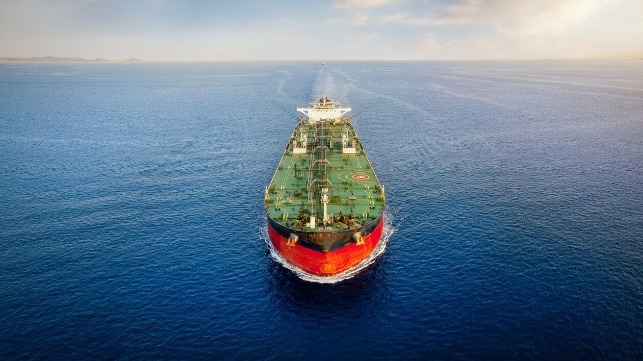
The shadow fleet of sanctions-busting tankers has grown to more than 1,100 vessels and has been adding about one ship a day for the last six months, according to brokers BRS. Fully 18 percent of the world's tanker tonnage now operates in the dark, BRS calculates, including about 300 Suezmaxes and VLCCs.
Four out of five of these ships are sanctioned by one or more nations, but the restrictions have not stopped the fleet's operations, nor the secondhand sales that fuel its expansion. Sanctions mean that the majority of these ships have questionable insurance cover, as they cannot access legitimate insurers in the West. With Panama ramping up efforts to de-flag shadow fleet tonnage, hundreds of these ships have moved over to gray- or black-list flags - like Gabon, whose overseas maritime registration agent is now sanctioned. With few port calls outside of their trading route, these vessels face little regulatory pressure to ensure quality.
The flag state oversight and insurance shortcomings are particularly concerning due to the composition of the fleet, which has been assembled by overpaying for aging tonnage. The average age of the shadow fleet is now about 20 years, and sanctioned vessels are harder to sell for scrap, reducing the incentive to upgrade. An end-of-life cash buyer recently filed suit against the owner of the shadow fleet tanker Conico Atlas for allegedly failing to disclose that it was sanctioned, and a court in Gujarat has ordered the ship's arrest as collateral. (Due diligence checks may be performed against public sanctions lists, including https://tankertrackers.com/report/sanctioned.)
Sanctioned tankers continue to operate with impunity, as evidenced by the high-volume STS activity at anchorages off Malaysia and Singapore. Just outside of the Malaysian EEZ, on the approaches to the Singapore Strait, an aggregation of shadow fleet tankers stays busy conducting nonstop transfers of Iranian and Russian oil bound for China. Sanctioned vessels offload to non-sanctioned vessels, which then ferry the crude to the destination port to maintain plausible deniability. Of 239 tankers that stopped in the area over the last month, 108 were sanctioned, according to an analysis by Windward.
Though sanctions have a mixed history of effectiveness so far, kinetic methods have succeeded in taking some Russia-serving tankers offline. Seven tank vessels with a history of Russian port calls have suffered explosions since last winter, likely caused by the covert placement of limpet mines. AIS tracking provided by Pole Star reveals that five of these ships are still idling at anchor or have gone AIS-dark. Only two have returned to visible trading post-attack.
To combat this threat, Russian President Vladimir Putin has ordered security services to ramp up pre-clearance checks - including dive inspections - before allowing foreign ships into Russian ports. Many analysts suspect Ukrainian involvement, but Kyiv has not claimed responsibility.
Sanctions and Oil Price Pressures Build on Russian Revenues
Russia is facing multiple threats to its ability to finance its war on Ukraine, with pressures about to become much worse. For the first time since Russia invaded Ukraine for the second time in February 2022, this pressure appears to be coordinated and comprehensive.
Two sets of sanctions are set to be implemented in the coming weeks. President Trump, fed up with President Putin’s negotiating prevarications, has threatened those countries purchasing Russian oil at above the set price cap with secondary sanctions, in effect adopting the Senator Lindsey Graham-led proposals made in Congress but at less punitive penalty tariff levels. India would be a principal target. The EU has pre-emptively reinforced this action in its 18th round of anti-Russian sanctions, adopting a price cap of $47.60, adjustable to be always 15% lower than the average market price for Urals crude. One or both sets of these sanctions will have an immediate impact on the revenues that Russia can earn from its oil exports, measures that also have the attraction of maintaining sufficient oil production but at lower price levels likely to encourage global economic growth.
At the same time, OPEC oil producers, seeking to recapture market share from those previously tempted to purchase heavily discounted Russian oil, have relaxed production curbs. Indeed, the UAE has been granted an additional market quota, and new production, such as from Guyana, has come on stream.
By previously restricting output and keeping oil prices high, Middle East producers saw their market share drop from 40% in 2015 to 25% this year, losing out to US shale oil producers who were encouraged to invest in output growth by the high prices. Over the same period, US market share has risen from 14% to 20%. Over the past month, the average price of crude has fallen by 3.34% to $65.63, a trend that will accelerate as increased production comes on stream. The production-boosted price fall enhances the effectiveness of the sanctions price cap, because spot market purchasers now have a wider source of low-cost supplies.
Additionally, US and EU sanctions against dark fleet shipping carrying Russian oil are being significantly tightened. In a rush of listings since July, the UK’s National Crime Agency has estimated that 400 dark fleet tankers have now been sanctioned, and have emphasized how insurance and finance companies providing cover for dark fleet shipments are as much under scrutiny as ships and owners directly. The Russian Navy now has to escort dark fleet tankers, for fear of seizure by nations though whose territorial waters they might wish to transit. This is a particular problem for Russia in the Baltic, where sea-lanes to its primary export terminals at Ust-Luga and Primorsk pass through choke points within national 12-mile limits. In seeking to test limits to rights of innocent passage, the Danish Maritime Authority for example is now asserting that it will board ships if it has information “that the safety or working conditions of the seafarers are not in compliance with international regulations including obligatory insurance requirements.” Aside from sanctions, such concerns can be justified sufficiently on environmental grounds alone, given the condition and insurance status of much of the dark fleet.
To these pressures can be added the threat to dark fleet tankers posed by unexplained limpet mine attacks. The latest in the series, the formerly Djibouti-flagged Aframax Pushpa (IMO: 9332810) was attacked while off Malta on July 16, having previously unloaded at Ust-Luga. The Marshall Island-flagged LNG tanker Eco Wizard (IMO: 9941568) was actually in Ust-Luga when it fell victim to limpet mines on July 6. Such attacks, plus the sanctioning of owners, encourages buccaneer operators and investors to withdraw from the business, leaving the financial burden of maintaining the dark fleet to Russian front companies.
A major impediment to a successful squeeze on Russian finances remains. China has a vested interest in keeping the conflict in Ukraine going, and cannot afford a Russian reverse, which would leave Western powers able to focus solely on the threat posed by China without being sidetracked. Hence Beijing may, for both political and commercial advantage, help the Russians out and increase its purchases of discounted oil. But if it does so, it will have to calculate the impact such action will have on its ongoing trade negotiations with the United States.
The opinions expressed herein are the author's and not necessarily those of The Maritime Executive.
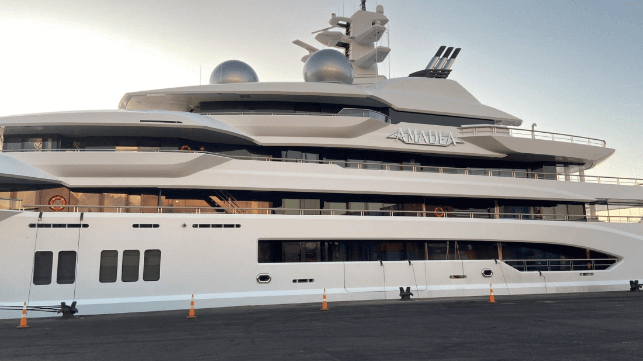
The U.S. government has reached the end of the long process to forfeit and auction off the seized Russian megayacht Amadea, which was captured by the FBI in Fiji and sailed back to San Diego in custody three years ago.
The Amadea is a 350-foot motor yacht built in Germany in 2016. U.S. authorities believe that her beneficial owner was the sanctioned Russian oligarch Suleiman Kerimov, a billionaire with ties to Russian President Vladimir Putin. Its value has been estimated in the range of $300 million.
Amadea called in Fiji in April 2022, and the U.S. Justice Department filed a request for her seizure with local courts. FBI agents were dispatched to carry out enforcement. The yacht's holding company sued, and the case worked its way up through the country's court system. After a month of litigation, Fiji's supreme court awarded custody of the vessel to the U.S. government, and the yacht was reflagged for a voyage to the United States.
“This yacht seizure should tell every corrupt Russian oligarch that they cannot hide – not even in the remotest part of the world. We will use every means of enforcing the sanctions imposed in response to Russia’s unprovoked and unjustified war in Ukraine," said then-Deputy Attorney General Lisa O. Monaco (since replaced by Todd Blanche, President Donald Trump's personal attorney).
After extended civil forfeiture proceedings in the U.S. District Court for the Southern District of New York, the Justice Department won the right to sell the yacht. Fraser Yachts, the world's leading yacht brokerage, has been appointed to promote the sale; National Maritime Services is conducting the sealed-bid auction.
The U.S. government has spent about $32 million to maintain Amadea to its current standards over the past three years, according to court documents. The cost includes insurance, crew wages and exceptional upkeep. Amadea may look much like any other megayacht on the outside, but the interior is stunning in its opulence, featuring exquisite trim work, a glass-walled central elevator, marble and parquet flooring, a spiral grand staircase, and gleaming polished wood at every turn - a testament to the skill of German yachtbuilders. (A video of the interior may be found here.)
"This is perhaps the most spectacular, exacting and beautiful ship any of us will ever see," said National Maritime Services Chairman Bob Toney. "An opportunity like this for discerning owners is exceedingly rare – maybe once in a lifetime."
Russian Mediterranean "Flotilla" Sinks to a Single Submarine
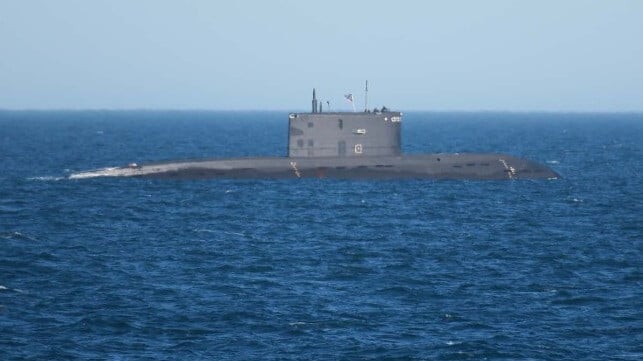
A Kilo-class sub under way (file image courtesy Royal Navy)
Based on the dedicated efforts of open source information gatherers, particularly @KaptainLOMA, @italmilradar and @key2med observing from atop the Rock of Gibraltar, it can be assessed that the visible Russian naval presence in the Mediterranean will sink this week to just a single submarine, supplemented by its lonely tugboat escort and the intelligence-collection Project 864 vessel Viktor Leonov.
The Russian Kilo Class submarine RFS Novorossiksk (B261), which used to be a frequent presence in the Mediterranean, came back though the English Channel from the Baltic on June 25. The boat then slipped through the Straits of Gibraltar to duties unknown, but supported from afar by the Goryn Class tug Yakov Grebelskiy. The submarine appears to have operated through most of July off Libya and the Levant, based on the position of its escorting tug and the tracks of NATO submarine-hunting P-8 aircraft.
Having spent much of June loitering off the coast of Syria providing cover for the stragglers of the Russian presence, Steregushchy Class corvette RFS Soobrazitelny (F531) left the Mediterranean on July 3, following the familiar track back to the Baltic. As she left, her sister ship RFS Boiky (F532) entered the Mediterranean a few days later on July 9, escorting the well-known arms carriers Sparta and tanker General Skobelev en route to Tartus.
RFS Boiky (F532), Sparta and the tanker General Skobelev were last spotted on their return journey between Malta and Sicily on August 3. If this group of ships conforms to pattern, they may refuel at sea off Al Hoceima on the Moroccan coast, replenishing from the Russian civilian oiler Vyazma, before passing westwards through the Straits of Gibraltar.
This will then leave the Kilo Class submarine RFS Novorossiksk as the only Russian naval vessel in the Mediterranean, at a time when the US carrier strike group led by USS George Washington (CVN-73) is operating at full tempo in the Timor Sea with a large NATO escort complement.
RMNS Rabhi shadowing Russian oiler Vyazma on June 22 (Royal Moroccan Navy)
The anchorage used by the Russians is closely monitored by the Royal Moroccan Navy vessels operating out of Al Hoceima, most notably by PR-72P Class patrol boat RMNS Rabhi (P310). The Russians are also likely to have used up their credit of port visits elsewhere in the Mediterranean. The final Russian foothold on Tartus as a support base appears to have fallen away with the takeover on July 13 by DP World of full management rights for the port, held since 2019 by the Russian company OAO Stroytransgaz.
Among its many purposes, the Russian Navy had used Tartus as a way station on its supply route to West Africa; to compensate, Russia last month signed a visiting forces agreement with Benin, to better support its Africa Corps operations. The Russian Navy has also sought to move forward with its plans for a presence in in the Red Sea. But this latter intent appears to be fading after the proposed locations in Port Sudan were hit by a rebel drone strike on May 6.
If this was not enough bad news for the Russian fleet, the Udaloy Class destroyer RFS Vice Admiral Kulakov (D626) had to fend off a drone threat on July 14 in the Baltic Sea. The mysterious limpet mine explosions on dark fleet tankers shipping sanctioned Russian oil have continued, with an attack on July 16 against the formerly Djibouti-flagged Aframax Pushpa (IMO: 9332810). Finally but significantly, the annual Navy Day Parade at St. Petersburg scheduled for July 27 - always a proud day for the Russian Fleet - was cancelled, presumably because of the plausible risk of Ukrainian drone strikes.
China Reports Fast Response to Containership Fire
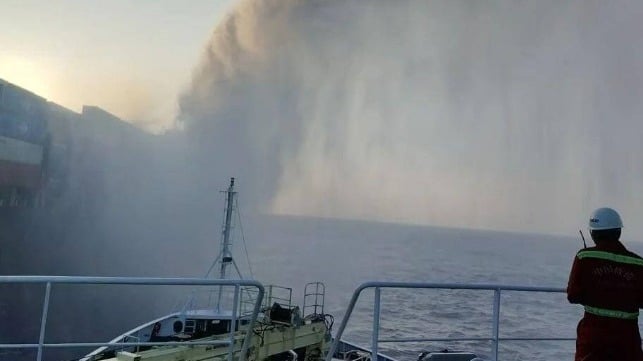
China's rescue team responding to the container fire at sea (Ministry of Transport photos)
China’s Ministry of Transport is highlighting its fast response to reports of a container fire aboard a foreign-flagged ship far out to sea. They are reporting thanks to a well-organized response, the fire was contained, saving the vessel and removing the risk to the crew.
The reports of a fire were initially received on July 28 aboard a vessel the Ministry described as a large Liberian containership with a crew of 25 aboard. Xinde Marine News identified the vessel as the Stratford (101,496 dwt) containership, which is operating under charter to OOCL. Built in 2006, the ship is managed by Oltmann of Germany and has a capacity for 8,500 TEU.
The ship was reported to be approximately 190 nautical miles northwest of the coast near the Nansha district in southern China, near Hong Kong. AIS signals show the vessel had departed from Shenzhen, China, bound for Vietnam.
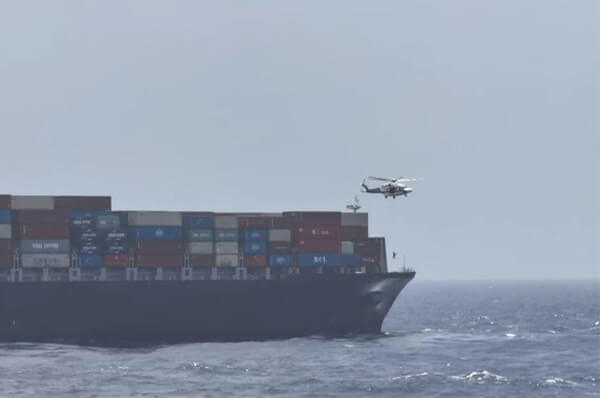
The Ministry reports that the call for assistance was passed by the Salvage Bureau to the South China Sea Rescue Bureau, and one of its ships of routine patrol ships, Nanhai Jiu 116, was dispatched. To gain a quick and full understanding of the situation, a rescue helicopter was also launched. It was able to begin an aerial survey and transmit real-time fire updates.
Helicopter was used to provide data and monitoring of the fire (Ministry of Transport)
The fire was initially located in four containers toward the front of the vessel. When the patrol boat reached the scene, it placed a specialized team aboard the containership. The operation was continuous for 20 hours. By the afternoon of July 30, they reported the temperature in the containers had returned to normal levels, and the fire was declared extinguished.
They continued to monitor for any signs of the fire rekindling. They report the fire did not restart, and the Nanhai Jiu 116 was escorting the vessel to safety. AIS signals show the containership is proceeding at a slow speed of 5.8 knots and is due to arrive in Vietnam on August 5.
The Ministry of Transport reported the incident to demonstrate China’s concern for the safety of the international shipping lanes in the South China Sea. It says the response demonstrates China’s ability to respond to rescues in “deep and distant waters.”
Freighter Loaded with Turkish Weapons Released by Puntland
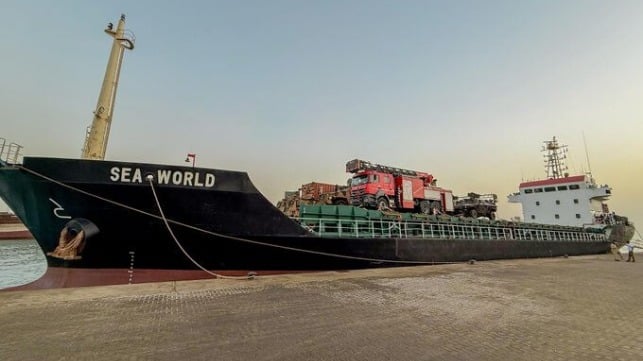
Sea World with its cargo of military equipment is being released from Puntland (Jama Deperani, spokesperson for Puntland on X)
The government of Puntland, a semi-autonomous region in Somalia, announced on Monday, August 4, that it has decided to release the cargo ship Sea World, which it has been detaining for two weeks. The vessel was found to be loaded with weaponry from Turkey and became the center of the latest standoff between the federal government in Somalia and the independent government of Puntland.
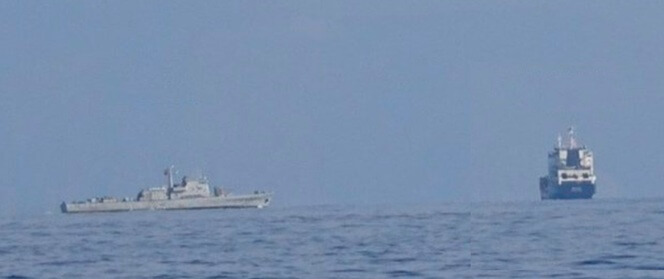
The Sea World (13,000 dwt registered in Comoros) is a rather shadowy cargo ship with Equasis listing the current managers and owners as unknown. The Puntland government reported it took control of the vessel after it spent two days loitering off the coast, in part, it contended to control access to the weapons onboard. Videos circulated online showed the vessel carrying armored vehicles, military equipment, and arms, all bearing Turkish markings. Reports said that fishermen and other locals had boarded the ship and showed pictures of some of the small arms reportedly being taken ashore.
Puntland contended in its statements that the ownership of the equipment was unclear and that it was investigating. The federal government called the actions “unlawful” and demanded the immediate release of the vessel. Observers pointed out it was part of the larger disputes over territory and control between the two governments, and fears that the arms would be used against Puntland.
Puntland said there had been ongoing discussions between its officials and representatives of Turkey. It reported on Monday that Turkey has shared evidence proving the cargo’s ownership.
“Having reviewed the evidentiary documents and completing investigations, the Puntland Government has decided to officially hand over the responsibility of MV Sea World vessel and the cargo to the Government of Turkey,” the government said in a statement. It said it considered the matter closed.
The release has been met with public anger in the ongoing disputes between the government in Mogadishu and Puntland. The central government recently said it was redistricting the region, ceding some parts of Puntland to its rivals.
Turkish has a long-standing relationship with the Mogadishu government and operates a military training base outside the city. It has contended since the beginning of the incident that the military equipment belongs to Turkey and was headed for the Turksom Military Training Center. According to the media reports, the Turkish ambassador met with the president of Puntland and presented documents saying it was a legitimate military cargo as part of the agreement with Mogadishu. '
How the small autonomous region of Puntland found success in battling Islamic State in Somalia
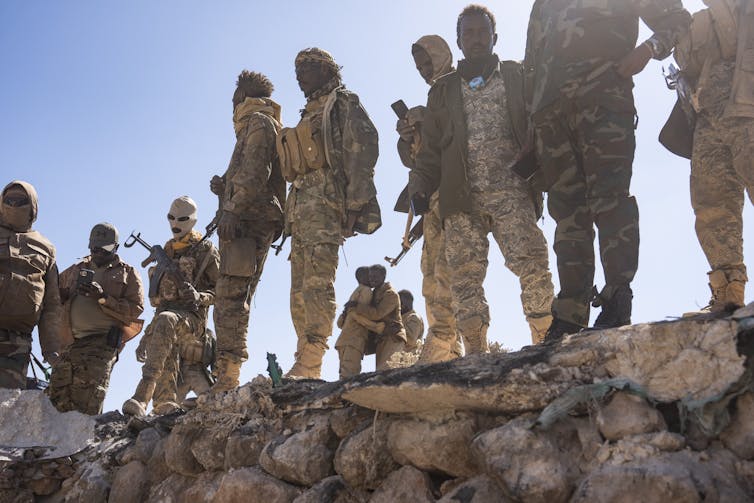
On Feb. 24, 2025, members of the Puntland Defense Forces posed next to a sign in Arabic that proclaimed the mountain town of Sheebaab as a “province” of the Islamic State group. The town, located in Somalia’s autonomous northeastern region of Puntland, was one of numerous areas that soldiers from the regional government have taken back during Operation Hilaac, an ongoing campaign against fighters from the Islamic State in Somalia – the local branch of the terrorist network – which began in late November 2024.
Puntland’s success in combating a growing Islamic State group presence in the northeastern region is particularly notable given the relative lack of success of the central Somali government’s confrontation with the al-Qaida-affiliated group Harakat al-Shabaab al-Mujahidin – more commonly known as al-Shabab – which for about two decades has waged war against federal forces.
Islamist groups have been part of Somalia’s fractured political landscape since the country’s descent into civil war in the 1980s.
They tapped into profound local dissatisfaction with warlordism, tribalism and corruption, as well as a reaction to foreign intervention by Ethiopia, the United States and other international actors.
Al-Shabab and later the Islamic State in Somalia are the most extreme manifestations of this trend.
Islamic State in Somalia emerged in 2015 when a small group of al-Shabab members led by Abdulqadir Mumin – an extremist Somali preacher who previously lived in Sweden and the United Kingdom, where he acquired citizenship – pledged allegiance to then-Islamic State group leader Abu Bakr al-Baghdadi. Having formed as a local branch – or “province” in the group’s self conception as a global entity intent on expanding territory – Islamic State in Somalia launched its first major operation in October 2016, briefly seizing the port town of Qandala in Puntland.
Thereafter, the group retreated to its strongholds in the mountain regions inside Puntland amid pressure from both the regional government and al-Shabab, which has cracked down on Islamic State supporters in its ranks. Yet from the Puntland mountains, Islamic State in Somalia grew into a key node of the terrorist group’s global network. It is now a hub for transferring funds and drawing recruits from across Africa and elsewhere via the regional coordination office it operates known as al-Karrar.
One notable Sudan-born operative killed in a 2023 U.S. raid in Puntland, Bilal al-Sudani, was known as a key foreign fighter, facilitator and financier who developed Islamic State funding networks in South Africa and helped fund the group’s branch in Afghanistan.
An NBC News report from mid-2024 cited U.S. officials who believed Mumin, head of Islamic State in Somalia, was acting as the network’s overall leader, or caliph, though other analysts have suggested he holds a top role close to caliph.
In any case, Islamic State in Somalia’s ranks have increased steadily, from an estimated 200-300 fighters in 2016 to about 1,000 as of February 2025, according to reports.
Puntland pushes back
Puntland declared itself an autonomous region of Somalia in 1998 amid the ongoing Somali civil war and has since achieved relative stability compared with the other parts of the country, which have generally been marked by decades of sectarian division and weak central governance.
Puntland is no stranger to divisions in a country that often hinges on clan loyalties, but it has achieved a greater degree of unity and has regularly raised security forces to defeat external threats, often with considerable foreign support.
The dominance of a single clan, the Majeerteen, has in part likely helped facilitate this unity. In the current operations against Islamic State in Somalia, the autonomous Puntland government under President Said Abdullahi Deni has gathered several disparate regional forces under the “Puntland Defense Forces” banner, including clan militias, the Puntland Darawish – a regional paramilitary unit – and the Puntland Maritime Police Force.
The Puntland Maritime Police Force in particular has evolved into a well-trained and experienced counterterrorism unit. Founded with United Arab Emirates money and mentored by private South African military contractors to address growing piracy, it has turned to fighting al-Shabab and Islamic State in Somalia in the mountain regions. Indeed, it played a leading role in taking Qandala from Islamic State control in 2016. It also cooperated effectively with other forces to defeat a 2016 al-Shabab attempt to attack Puntland from the sea.
The U.S. and UAE have supported the Puntland government’s campaign. In February 2025, the U.S. launched twoairstrikes on Islamic State fighters, with one on Feb. 1, 2025, killing Omani-born Ahmed Maeleninine, a key recruiter, financier and facilitator. The United States claimed another airstrike on March 25.
The UAE has conducted airstrikes too, likely from the large UAE-funded Puntland Maritime Police Force headquarters base in the major port city of Bosaso.
The Puntland government has claimed that through its latest operation it has advanced through 315 kilometers, clearing numerous villages and outposts in the mountains.
On Feb. 11, 2025, The Washington Post reported that regional security forces had killed more than 150 Islamic State members, mostly foreign fighters from countries including Morocco, Ethiopia, Saudi Arabia and Yemen, illustrating the group’s significance as a global hub for the network. In fact, one analyst counted 118 dead fighters from a single encounter in early February, indicating a possibly higher death toll. In any case, it represents heavy losses for Islamic State in Somalia, though it is not defeated yet and still numbers fighters in the hundreds.
The risk of outside interference
All in all, Puntland has leveraged past success fighting jihadist groups in making remarkable progress in its fight against Islamic State in Somalia.
It shows how local and substate forces can be more effective at fighting armed nonstate groups than the federal authorities, despite limited resources.
No doubt, support from the United States and UAE has aided Puntland’s anti-Islamic State push. But reliance on outside sources risks creating dependence on them when local forces must ultimately take ownership of the fight themselves.
And less patient foreign supporters have been known to spoil the elite units they build. This occurred with the Puntland Security Force, a U.S.-created special forces unit that splintered during a brief withdrawal of U.S. forces from Somalia in 2021 and 2022.
There are also risks that partner forces will behave badly. While the Emirati mission in Puntland – as well as in Afghanistan and Yemen – has proven effective in fighting jihadists, in Sudan it has been arguably disastrous. There, the UAE-backed Rapid Support Forces paramilitary unit helped to ignite an ongoing civil war in 2023 during which its members perpetrated alleged atrocities.
Ultimately, it will be up to Puntlanders themselves to keep fighting. Indeed, foreign support would have little impact without effective local forces on the ground with the political will to sustain the campaign. Just as Puntland has done before, so too is it now demonstrating that it is determined to fight the threat posed by jihadist groups like Islamic State in Somalia.
Author
Ido Levy PhD Candidate, School of International Service, American University School of International Service