Tuesday, August 12, 2025


Beyond the humanitarian: Palestinian health from a liberation perspective
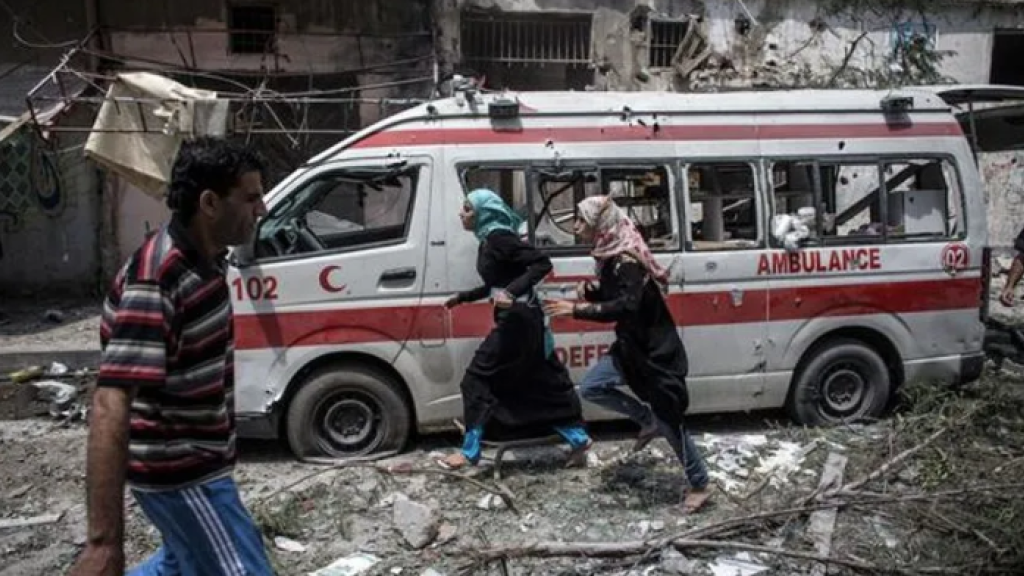

bombed ambulance Palestine

First published in French at Contretemps. Translation by Samirah Jarrar and Gwenael Velge for Academics for Palestine WA. Introduction by Academics for Palestine WA. 

Since October 2023, the situation in Gaza has been overwhelmingly described in terms of a “humanitarian catastrophe.” The dominant discourses, whether from the media, international organisations, or humanitarian institutions, primarily mobilise the language of emergency, crisis, and the right to survival. While this approach may seem legitimate given the scale of the destruction, it risks normalising the violence and erasing its structural causes and those responsible. Reducing Gaza to a disaster zone often serves to obscure the political logic that produces this crisis: that of Israeli settler colonialism.

Without a critical analysis of this colonial reality, any response — including medical, humanitarian, or academic — risks reproducing the power relations that made it possible. This article thus proposes to re-situate health in Palestine within a long history of colonial domination, by analysing its concrete effects on infrastructure, medical practices, bodies, and subjectivities. As Samirah Jarrar demonstrates in this article, the goal is to move beyond the humanitarian framework to envision a politics of care rooted in justice, sovereignty, and self-determination.


The impasse of the humanitarian response

Since 1948, the health of Palestinians has been caught in the violent reconfigurations of Zionist colonialism. The expulsion of nearly 800,000 Palestinians — about 70% of the population of Mandatory Palestine — during the Nakba led to the collapse of existing social and institutional structures. Deprived of their land, their institutions, and their sovereignty, Palestinian refugees found themselves relegated to often unsanitary camps, dependent on international humanitarian aid. In response to this catastrophe, UNRWA (United Nations Relief and Works Agency for Palestine Refugees), created in 1949, took charge of a portion of the public health of Palestinian refugees — a mission it continues to fulfill today, particularly in Gaza, the West Bank, Jordan, Lebanon, and Syria.

Since 1967, Palestinian health has been under the yoke of the Israeli occupation. After the Six-Day War, the healthcare systems in the West Bank and Gaza came under military administration. For more than two decades, they were marked by chronic underfunding, staff and equipment shortages, and a forced dependence on the Israeli hospital system. In 1975, the entire health budget for the West Bank was less than that of a single Israeli hospital. This structural asymmetry reflects a colonial logic that marginalises Palestinians while making them dependent.

In response to this systemic neglect, grassroots health initiatives, the popular health committees — often led by women — emerged in the 1970s and grew in scale during the first Intifada (1987–1993). This new wave of community health activism was characterised by decentralisation, volunteerism, and a refusal to comply with Israeli regulations.

Young urban professionals, often heavily involved in local popular committees, were at the forefront of a movement focused on access to care in rural areas, health education, and primary care. The goal was to establish mobile and permanent clinics, not limited to curative medicine but also including prevention, first aid, and medical education. These local committees were largely part of a broader movement of popular and anti-colonial resistance, structured around autonomy, sumud (perseverance on the land), sovereignty, and self-organisation.1

In parallel, the Israeli civil administration sought to integrate a Palestinian elite into its own structures, while suppressing autonomous forms of organisation from civil society. In the 1980s, it criminalised several municipal councils deemed dissident and tried unsuccessfully to replace them with figures considered more conciliatory, ready to cooperate with the occupier in exchange for resources and financial support. This was an early Israeli attempt to establish a form of so-called Palestinian self-administration under its control.

A new phase began after the Oslo Accords (1993), which were officially supposed to lead to an independent Palestinian state but, in fact, deepened the occupation and outsourced the responsibilities of the occupying Israeli regime to the Palestinian Authority (PA). The partial transfer of health responsibilities to the PA marked the beginning of a process of institutionalisation, but also of depoliticisation: the language of resistance and liberation gave way to that of development, good governance, and short-term projects.

The creation of the Palestinian Ministry of Health was accompanied by an influx of international aid, conditioned on security cooperation with Israel and increasingly aggressive neoliberal reforms. Many activist initiatives were absorbed by NGOs, the new Ministry of Health, or humanitarian programs, stripped of their political significance. Health became a sector structured around technical, managerial, and apolitical objectives, often dictated by international donors.

This approach is based on a paternalistic vision, founded on models of care that induce dependence, charity, and the individualisation of both health needs and responsibilities — in contrast to the politicised medicine advanced by the Palestinian popular committees, which aimed to build community autonomy, transmit critical medical knowledge, and put it at the service of collective care practices, anchored in justice, dignity, and solidarity.

This situation deteriorated after the 2007 political division between Hamas in Gaza and Fatah in the West Bank, following Hamas's democratic victory in the 2006 Palestinian legislative elections. Two parallel, poorly coordinated health systems developed. In the West Bank, care is undermined by checkpoints, settler violence, and territorial fragmentation. In Gaza, the Israeli blockade, reinforced by international sanctions, has led to an acute health crisis: shortages of medicine, equipment blocked at the border, and paralysed medical training. Patients often have to be transferred to the West Bank, East Jerusalem, or abroad — provided they can obtain an Israeli permit. Repeated military offensives on Gaza (2008-2009, 2012, 2014, 2021, and 2023-ongoing) have caused the destruction of hospitals, the killing of healthcare workers, and the collapse of the medical infrastructure.

Health and settler colonialism: A necessary analytical framework

For decades, international approaches to health in Palestine have adopted a depoliticised reading. Health is viewed through technical indicators, quantitative data, or humanitarian discourses focused on emergency, “crisis,” and human rights. This perspective, largely dominant in Global North institutions, has helped to mask the structural causes of Palestinian suffering. This “humanitarian health” produces epistemic violence by erasing Palestinian voices calling for justice and liberation, and by consolidating a neoliberal order where supposedly neutral experts perpetuate a colonial status quo.

In response, a critical Palestinian tradition emerged in the 1980s. Rita Giacaman, a pioneer of this thought, showed how occupation, restriction of movement, poverty, and violence shape bodies and diseases. She identifies three dominant discursive frameworks: a technocratic biomedical model; a nationalist framework focused on colonial occupation and sumud; and a third, more promising one in her view, rooted in popular, feminist, and community struggles. For Giacaman, health cannot be separated from internal and external power structures: one must fight colonialism, patriarchy, and class stratification simultaneously.

Since the Gaza war of October 2023, a turning point is occurring. A growing number of researchers are adopting the category of “settler colonialism” to analyse the determinants of health. This framework allows for understanding health not as a side effect of war or underdevelopment, but as a direct product of a colonial project aimed at the elimination of the indigenous people. The violence is not only military; it is also medical, territorial, environmental, and psychological. It affects the right to be cared for, but also the conditions of care production, solidarity networks, food, and the relationship with one's body.

From this perspective, health inequalities between Israeli Jews and Palestinians are not a matter of a “development gap” but of a structural logic of dispossession. The case of the Naqab Bedouins is striking: forced urbanisation, destruction of ecosystems, and industrialised food have caused an explosion of diabetes. Up to 70% of adult women in some villages are affected. These pathologies are neither random nor the result of “bad habits,” but of targeted colonial policies.

Finally, these analyses remind us that colonialism redraws the political body as much as biological bodies: by fragmenting territories, denying the right of return, and destroying social ties, it makes collective health impossible. The struggle for Palestinian health thus joins the struggle for liberation: it calls not for managing the crisis, but for dismantling the colonial order that is its cause.

Health, elimination, control and colonial exploitation

Health in Palestine alone embodies the intertwined logics of Israeli settler colonialism: control, exploitation, but above all elimination — the latter being the central characteristic of this regime, which is based on replacing the indigenous population with a settler society, implying its physical, social, and political erasure. In this hybrid model of domination — between direct military occupation and more diffuse colonial structures — health becomes a central instrument of power, but also of resistance.

The logic of control is emblematically manifested in the health sector through the system of medical permits: to access vital care (radiotherapy, specialised surgery), one must obtain an Israeli pass, which is often rejected or expires before the appointment date. Some are conditioned on interrogations by Israeli intelligence services. A 2008 report documents cases of patients ordered to collaborate with Israeli intelligence services in exchange for a permit. Others are summoned and then arrested. The health system thus becomes an instrument of blackmail, surveillance, and political coercion.

The logic of exploitation, for its part, is expressed in the way the Israeli state monetises access to care for Palestinians in the occupied territories, billing them for its medical services while considering them “foreign patients” — instead of assuming its responsibilities as an occupying power. At the same time, many Palestinian health workers from the West Bank are employed in Israeli hospitals in temporary, specific, and precarious positions, contributing to the smooth functioning of the system without sharing its benefits. This is a veritable colonial economy of care, in which Palestinian bodies are both exploited as a labour force and transformed into sources of income.

Finally, the logic of elimination completes and crowns this colonial triptych, with access to care constituting a strategic site for its implementation: refusal of medical permits, blocking of essential equipment like radiotherapy machines, or tactics of mutilation during military operationsChronic exposure to racist violence, trauma, and institutional humiliation generates lasting pathologies. The logic of elimination thus operates through insidious mechanisms: blockades, territorial fragmentation, destruction of collective lands, denial of access to care, and nutritional deprivation.

In Gaza, Israel's policy of “caloric restriction" explicitly aimed to keep the population “on the brink of collapse.” But these effects are not confined to the territories occupied in 1967: Palestinian citizens of Israel also experience systemic health inequality. Fewer clinics, under-equipped hospitals, longer distances, the language barrier: everything contributes to more difficult access to care, which translates into a shorter life expectancy.

Today, in Gaza, the logic of elimination reveals its genocidal nature in its most brutal form: systematic destruction of health infrastructure, assassinations, imprisonment and torture of healthcare personnel, and more broadly, the annihilation of all conditions for the maintenance and reproduction of life.

Reinventing care and solidarity: Resistance, justice and decolonisation

Through these three logics, health appears not as a neutral sector, but as a strategic space where colonial domination is played out. But this colonial medicalisation — or its denial — does not go unanswered. Despite the processes of elimination, control, and exploitation, Palestinians have always produced forms of medical resistance and counter-practices of care. In Gaza today, health professionals continue to embody sumudthey rebuild hospitals after repeated destructionstransform tents and shelters into clinics, and continue their work of care despite the collapse of the health system and the deadly and incessant attacks targeting them.

Today, in the face of the depoliticisation imposed by humanitarian and neoliberal frameworks, a decolonial and anti-colonial thought and praxis of health is re-emerging, carried by professionals, researchers, and communities — including Palestinians — who re-situate care within a political horizon of justice, international solidarity, autonomy, and liberation.

To listen to these voices is to refuse the naturalisation of violence, charity as the sole response, or compassionate victimisation. It is to recognise that Palestinians are not merely suffering bodies, but political subjects, bearers of knowledge, practices, and projects. It is to open paths towards a solidarity founded not on pity, but on co-resistance, health self-defence, dignity, and the invention of collective forms of life and care.

Samirah Jarrar is a PhD candidate at Aix-Marseille University. She would like to thank Taher Labadi, Osama Tanous, Layth Hanbali, and Larbi Benyounes for their proofreading and insightful comments.

  • 1

    Translator’s note: the Arabic term sumud (صمود( literally translates to "steadfastness." However, the term signifies much more than passive resilience. It is a core Palestinian cultural and political concept representing an active, strategic, and defiant perseverance. It involves the conscious act of remaining on one's land, maintaining cultural life, and asserting existence and identity in the face of occupation, displacement, and hardship. It is often symbolized by the deep-rooted olive tree.

How the ‘Blood Libel’ Paradox Keeps the West Silent on Israel’s Genocide

The more depraved Israel’s actions, the more antisemitic it is to point out the truth. The painful reality is that, through Israel, the West can dress up boilerplate colonialism as a 'Jewish' project


by  | Aug 12, 2025 | 

There’s a dangerous paradox that helps to dissuade people, especially public figures, from speaking up even as Israel’s genocide in Gaza grows more horrifying by the day. Let us call it the “blood libel” paradox.

It works like this. In Medieval times, Jews were accused of murdering non-Jews, particularly children, to use their blood in the performance of religious rituals. Every time a Jew is accused of murdering a non-Jew, so the thinking goes, this endangers Jews by fuelling the very kind of antisemitism that ultimately led to the gas chambers of Auschwitz.

Responsible people, or at least those with a reputation to protect, therefore avoid making any statements that might contribute to the impression that Jews – or in this case, the soldiers of the Jewish state of Israel – are killing non-Jews.

If such criticisms are made, they must be carefully couched by western politicians, the media and public figures in language that makes the killing of non-Jews – in this case, Muslim and Christian Palestinians – appear reasonable.

Israel is simply “defending itself” in killing and maiming 100,000s of civilians in Gaza after Hamas’ one-day attack on 7 October 2023.

The enclave’s masses of dead innocents are just the unfortunate price paid to secure the “return of Israeli hostages” held by Hamas.

Israel’s active, months-long starvation of Gaza’s children is a “humanitarian crisis”, not a crime against humanity.

Anyone who dissents from this narrative is denounced as an antisemite, whether they be millions of ordinary people; every respected human rights organisation in the world, including the Israeli group B’Tselem; the World Health Organisation; the International Criminal Court; genocide scholars like Omer Bartov, himself an Israeli; and so on.

It is the perfect, self-reinforcing loop, one entirely divorced from the reality being live-streamed to us daily.

Aid death traps

The outrageous consequences of the “blood libel” paradox were highlighted a year into Israel’s genocide in Gaza by the Jewish writer Howard Jacobson.

Writing in the Observer newspaper, he accused the western media of a “blood libel” for reporting the fact that children were dying in enormous numbers in Gaza – even though that same media had been keen to minimise the death toll; implicitly questioned its truthfulness by attributing the number to the “Hamas-run Gaza health ministry”; and constantly rationalised the killings as part of Israeli military operations to “defeat Hamas”.

Jacobson, like other fervent apologists for genocide, wanted more. He demanded the media avert its eyes from the slaughter entirely.

Since then, Israel’s crimes against the people of Gaza have become ever more shocking, hard though that was to imagine nearly a year ago.

Israel has stopped food from reaching Gaza except through a mercenary force it has set up with the US, misnamed the “Gaza Humanitarian Foundation”.

Its job, as whistleblowing Israeli soldiers have told us, is to lure the ablest from among the starving masses – mainly young Palestinian men – into death traps with the promise of food. Once there, Israel carries out what Doctors without Borders calls “orchestrated killing” by shooting at them.

Israel has armed and hired as its Gaza goons a criminal gang under the leadership of ISIS supporter Yasser Abu Shabab. Their job has been to loot aid trucks that try to operate outside the GHF set-up and steal aid from ordinary people, sowing further terror and chaos and allowing Israel to blame Hamas for Gaza’s starvation.

Far-right Israelis – that is, the people who elected the Netanyahu government – have been filmed stopping aid trucks trying to transport from Jordan food supposed to reach Gaza’s people, even as children are regularly dying from malnutrition.

And eminent western doctors such as Nick Maynard are returning from Gaza with the same horror stories: that they see Israeli soldiers using Palestinian children as target practice. One day the gunshot wounds in the children arriving at hospital are clustered in the head. The next day in the chest. The next day in the abdomen. The next day in the genitals.

The “blood libel” paradox means that Israel can act with ever more brazen depravity – of the kind documented above – and western leaders and media continue to ignore, or downplay, or rationalise these horrors.

It is the ultimate “get out of jail” card.

Phoney ‘fog of war’

There are several points to be made about why this is such a dangerous response to the Gaza genocide – but one, equally, that is all too useful for western capitals.

First, and most obviously. Israel is not “the Jews”. It is a state. Not just that, but it was founded as a very specific kind of state: one that is the last exemplar of a long and very ignoble tradition of western-sponsored settler-colonialism.

Settler-colonialism seeks to replace a native population with western-aligned immigrants through extreme ethnic-based violence. Think the United States, Canada, Australia and South Africa. They all committed appalling crimes against their indigenous populations.

Israel’s genocide of the Palestinians is not unusual. It is the all-too-familiar, logical consequence of a racist colonial replacement ideology. We have been here many times before in modern history. If it wasn’t a blood libel in those earlier cases – but rather an established historical fact – why should Israel’s genocide be viewed any differently?

Second, this genocide is not Israel’s. It is the West’s. This is utterly a western co-production. Israel could have done none of the destruction of Gaza, the mass slaughter, the starvation of the population, without western assistance every step of the way.

It has been US and German bombs dropped on Gaza. It is British spy flights over Gaza from RAF base Akrotiri on Cyprus that have been providing intelligence to Israel. It is western capitals that have been repressing protest and making it a terror offence to try to stop the genocide.

It is the US and Britain that have been sanctioning and threatening the International Criminal Court to force it to reverse its decision to seek Netanyahu’s arrest for starving Gaza’s population. It has been western capitals staying silent as their citizens have been taken hostage by Israel illegally in international waters for trying to bring aid to Gaza.

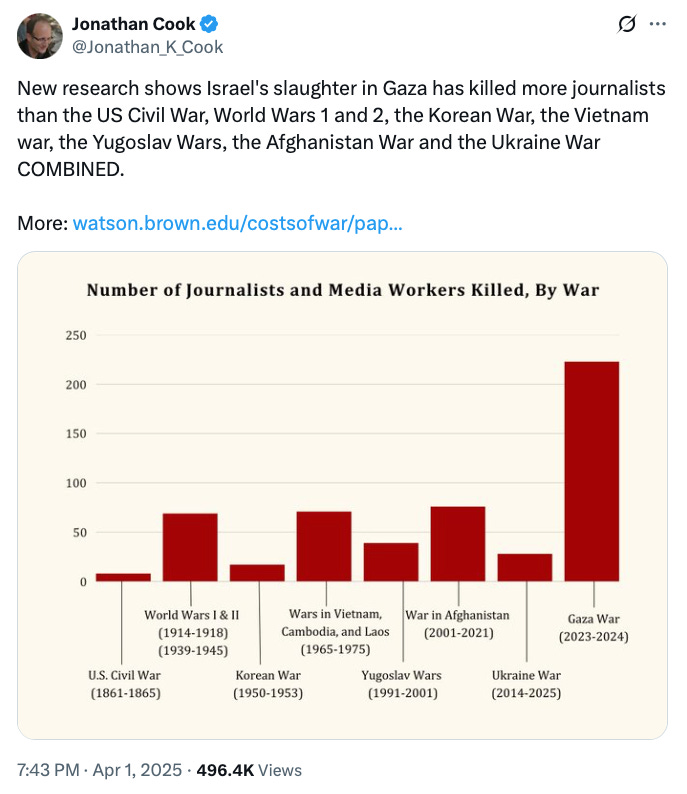
And it is the western media that first lamely accepted its exclusion from Gaza by Israel, then barely reported Israel’s unprecedented mass murder of Gaza’s local journalists, and now eagerly conscripts its exclusion as the excuse for failing to scrutinise Israel’s actions amid a supposed “fog of war”.

https://x.com/Jonathan_K_Cook/status/1907141811216568790

If noting that a genocide is taking place in Gaza amounts to a “blood libel”, then every western government is implicated in that libel. Are they all to be let off the hook? They very much hope that you will think that way.

Insurance policy

And third, it would be astonishing if Israel weren’t committing a genocide in Gaza, given that its every crime against the Palestinians has been supported decade after decade by the West.

Israel has grown emboldened. The “blood libel” paradox has been its insurance policy against scrutiny and criticism.

The West has given Israel a permanent licence to brutalise the Palestinians, to ethnically cleanse them, to steal their land, and to kill them. The worse it behaves, the more the “blood libel” kicks in to shut down criticism. The more depraved Israel’s actions are, the more antisemitic it becomes to point out the truth.

For more than a century, generation after generation of western leaders have been backing Israel to the hilt. Why would Israel not conclude that there are no red lines, that it can do as it pleases and that the West will still arm it and still justify its crimes as “defence” and “counter-terrorism”?

The “blood libel” doesn’t protect Jews from another genocide. It licences Israel to destroy the Palestinian people, and to savagely bomb its neighbours, with utter impunity, while western leaders remain tight-lipped in a way they would never do were it Russia, China or Iran committing far less egregious atrocities.

Which, of course, is exactly what encourages antisemitism. Utterly baffled by this state of affairs, some observers are fooled into imagining that the only possible reason is that Israel controls the West; that it has special, unseen powers to intimidate the US, the strongest, most militarised state in history; and that behind all this, Jews and Jewish money are what pulls the levers in western capitals.

That assumption is a flight from a far more difficult, painful reality: that Israel is the bastard child of the West. It is nothing exceptional or extraordinary. It is white, western, colonial, genocidal racism, repackaged as a supposedly “Jewish” project.

Israel can carry out its crimes in the promotion of western control over the oil-rich Middle East, and the West knows that any criticism of its imperial control and pillage can be dismissed as antisemitism.

It’s win-win for colonialism. It’s lose-lose for our humanity.


Jonathan Cook is a writer and journalist based in Nazareth, Israel. His latest books are Israel and the Clash of Civilizations: Iraq, Iran, and the Plan to Remake the Middle East (Pluto Press) and Disappearing Palestine: Israel's Experiments in Human Despair (Zed Books). Visit his Web site.
How HonestReporting Canada wages a silent war on Canadian newsrooms

Canadian journalists are finally speaking out about how the Israel lobby group HonestReporting targets newsrooms to silence Palestinian voices and perspectives.

 August 8, 2025 
MONDOWEISS

CBC headquarters in Toronto, Ontario. (Photo: Adam Moss/Wikimedia)


It’s no secret that Canadian newsrooms have long practiced the “Palestine exception” –– a pattern of bias and suppression of Palestinian voices and perspectives. While some Canadian journalists have sought to resist efforts to suppress the truth, Zionist lobbying groups such as HonestReporting and its Canadian chapter, HonestReporting Canada (HRC), have actively targeted newsrooms and journalists who highlight Palestinian perspectives.

Since its founding in 2003, HRC has positioned itself as a media watchdog to combat what it calls “anti-Israel bias” in Canadian newsrooms. But a closer look at the organization’s “Success” stories reveals something more troubling: a pattern of pressuring news outlets to reshape or retract coverage, often in ways that sanitize or suppress reporting on Palestinian suffering and settler-colonial violence.
How HonestReporting targets journalists

HRC maintains a system of “Media Alerts,” where they quickly respond to news stories they find objectionable, urging their audience to email or call editors and demand retractions, corrections, or apologies.

In the years leading up to October 2023, HRC maintained a steady stream of campaigns targeting Canadian media for language or framing that it found had pro-Palestine perspectives, which often resulted in headline tweaks, word changes, or added clarifications by editors.

In April 2023, CBC Radio aired a segment that referred to Gaza as “occupied”. Within 24 hours, following what HRC described as a “Success”, the CBC issued an on-air correction stating:

“Last night we made a reference to the Gaza Strip being ‘occupied’, the territory is not occupied, but rather has its borders controlled by Israel and Egypt.”

However, legal experts and international bodies quickly challenged the CBC’s amendment, arguing that control exercised by Israel since 2005 provides enough evidence that Israel remains the occupying power over Gaza.

After October 7, HRC significantly intensified its campaigns in both frequency and tone. Media coverage that centered Palestinian suffering or questioned Israel’s military response was swiftly condemned as “misinformation,” “bias,” or even “terror apologia.”

In 2023, HRC celebrated Palestinian journalist Zahraa Al-Akhrass’ termination with Global News, after she was accused by HRC of spreading “antisemitism” by using her social media to highlight Palestinian suffering at the hands of the Israeli government.

In another case, in May 2025 , HRC took credit for prompting Radio-Canada to issue a correction after an Oxfam official stated that Gaza’s population was being deliberately starved. Following HRC’s complaint, Radio-Canada added a clarification that the starvation of Palestinians is misinformation, despite evidence showing otherwise.

In some cases, HRC pressured newsrooms beyond factual corrections, urging removals of entire guest segments or op-eds that criticized Israeli policy. These campaigns often used pre-written complaint forms to mobilize mass email pressure on editors, contributing to what media scholars and advocacy groups have called a growing ‘chilling effect’ on Palestinian reporting.


‘I was being really hunted’


“There was a feeling that I was being really…hunted, and it was by HonestReporting Canada and outside agitators,” said Samira Mohyeddin, an award-winning journalist formerly with Canada’s public broadcaster, the CBC.

Mohyeddin worked on the CBC radio show The Current for eight years and also contributed to Tapestry, Unforked, As It Happens, alongside other CBC documentary projects. She has been a frequent target by the HRC for the last four years.

When Mohyeddin criticized the Israeli government in social media posts or mentioned the settler-colonial history of Israel, such as on CBC’s Unforked podcast in 2021, HRC ran action alerts to encourage their members to file complaints against her with the CBC’s ombudsman.

In one case, Mohyeddin called out Eylon Levy, former Israeli spokesperson, for his “rabid lies,” such as his denial of Israel’s attacks on hospitals and the intentional starvation of Palestinians in Gaza.

“I went on my social media and I called [Eylon Levy] a liar, and I was pulled into my managing editor’s office, and he said ‘You can’t call him a liar’,” Mohyeddin recalled. “I said, ‘But he’s lying’ and [the editor] said, ‘I know, but you can’t say that’.”

Many journalists shy away from criticizing the Israeli government and officials not only to curb harassment and to keep their jobs but also to avoid being labeled an anti-Semite, according to Mohyeddin.

In May 2024, an article in The Breach exposed how this fear has led to self-censorship and the softening of critical coverage regarding Israel’s actions in Gaza, highlighting instances where the CBC watered down or avoided reporting on the full extent of Israel’s military operations and their impact on Palestinian civilians.

“They would rather lie than be called antisemitic,” said Samira Mohyeddin. “At the upper echelons—managing editors, managers—there is a real fear. HonestReporting lives in the minds of managers and editors.”

Following October 7, there was an increase in resistance to criticism of Israel at the CBC, accompanied by the use of more sanitized language, according to Mohyidden.

“We never heard the term ‘Hamas-run health ministry’ before, and Hamas had been in power since 2006,” said Mohyeddin. “[The term] came from HonestReporting. HonestReporting congratulated itself in the middle of October when Canadian news media began to use that term.”

Mohyeddin, a queer reporter from Iran, obtained her undergraduate degree in religion and a master’s degree in gender and modern Middle Eastern history from the University of Toronto. She has studied media bias and particularly seen censorship evolve regarding Palestine over the past decades.

“I watch coverage from the 70s and 80s, and there is a real distinction between the way Israel was talked about, words like ‘apartheid’ and ‘occupation were used’, no problem,” said Mohyeddin. “People weren’t sensitive about calling Israel what it is, but today, you won’t find that. These are disputed terms.”


An open secret


Shift in language reflects a growing challenge for journalists, as reporting on Israel and Palestine becomes increasingly fraught with pressure to avoid terms that can lead to backlash from Zionist lobbying groups like HRC. The weight of this pressure is felt not only in editorial rooms but in the overwhelming demands placed on journalists.

“No one says it out loud, but everyone knows HRC has an impact on how managers run their newsrooms,” said Becky*, who was one of the few young journalists of color at CBC until her contract abruptly ended. She believes HRC was behind her termination.

Becky first appeared on HRC’s radar after writing an article quoting Human Rights Watch’s concerns about Israel’s war crimes in Gaza. From that point onward, HRC monitored and urged its members to report her social media activity to CBC’s upper management.

“But I really was following all of CBC’s ridiculous rules,” said Becky. “I was only reposting the sources that [CBC] would consider legitimate like The Washington Post and the UN and the Red Cross.”

Despite this, Becky says she faced increasing internal scrutiny and believes that HRC’s persistent targeting influenced the decision to end her contract.

“[CBC upper management] had a lot of meetings with me about my social media activity, which is something that HonestReporting had flagged,” said Becky. “The fact that they laid me off, it came as a complete surprise to my direct supervisors, because my work was doing really well.”

A battle for accurate coverage

HonestReporting Canada’s campaigns often begin with public social media scrutiny but escalate into coordinated pressure tactics that flood newsrooms with complaints, which are tactics many journalists say distort newsroom priorities and punish dissent.

According to HRC’s own website, the lobby group exploits that disruption by directly negotiating with editorial leadership.

In their “How to Monitor The Media” guide, the group encourages its members to make a deal with newsrooms: “If they will agree to regular meetings, you will promise to restrain your rapid-response team and to restrict your complaints to only major errors. This takes tremendous pressure off the media, who abhor being flooded with email complaints and all the bad publicity. This also creates an ongoing dialogue, whereby local editors will eventually turn to HonestReporting activists as a resource on the Israeli perspective.”

“It’s a type of threat,” said Iman Kassam, a former CTV journalist who has been a target of HRC campaigns since 2021. “It’s a type of strong-arming newsrooms into complicity.”

“This is all public on the HRC website,” Kassam said. “They teach people how to do this. These lobby groups have so much money and quite a large membership.”

Kassam was targeted after they interviewed a pro-Palestinian activist supporting Wet’suwet’en hereditary chiefs against RCMP actions in B.C. in 2021. For about three weeks, their inbox was flooded with emails from personal accounts attacking their race, gender, and religion.

“Some were saying they knew where [I] lived,” Kassam recalled. When Kassam brought the issue to their union, they were refused help.

“The attacks were really personal and that’s what people don’t understand,” Kassam said. “The more marginalized you are, the more identifiable markers, the more personal that bullying becomes.”

Growing distrust in Canadian media

HRC has positioned itself not merely as a media watchdog, but as a force that shapes who is allowed to speak, and at what cost. In March, Hossam Shabat with Al Jazeera Mubasher was killed by an Israeli airstrike in his car in Beit Lahiya.

Rather than mourn his death, HRC launched a campaign labeling him a Hamas combatant and condemned outlets that called Shabat a journalist. Days later, they targeted Hind Khoudary, another Palestinian reporter, prompting online calls for her to be treated as a “legitimate target.”

The dangers of these narratives are not abstract. At least 240 journalists have been killed in Gaza since October 7, according to a Brown University report.

Meanwhile, in Canada, former CTV reporter Kassam is now researching how the Palestine-Israel coverage has shaped Gen Z’s trust in the news and discovered that the damage is already visible.

“I was able to see in real time how profoundly their trust is ruptured,” Kassam said. “The conflict left many of these young people feeling deceived, angered, [and] skeptical.”

To rebuild that fractured trust, Kassam believes the first step is confronting the structural forces shaping Canadian media.

“80 per cent of Canadian media is owned by five companies,” Kassam said. “What does that say about freedom of the press? It calls for a recalibration of journalistic objectivity.”

The silent fear gripping newsrooms is clear: if lobby groups like HRC can dictate who speaks and the language used, what justice can journalism truly serve?