Tuesday, August 26, 2025

Clergy rally to defend Kilmar Abrego García as he is detained by ICE
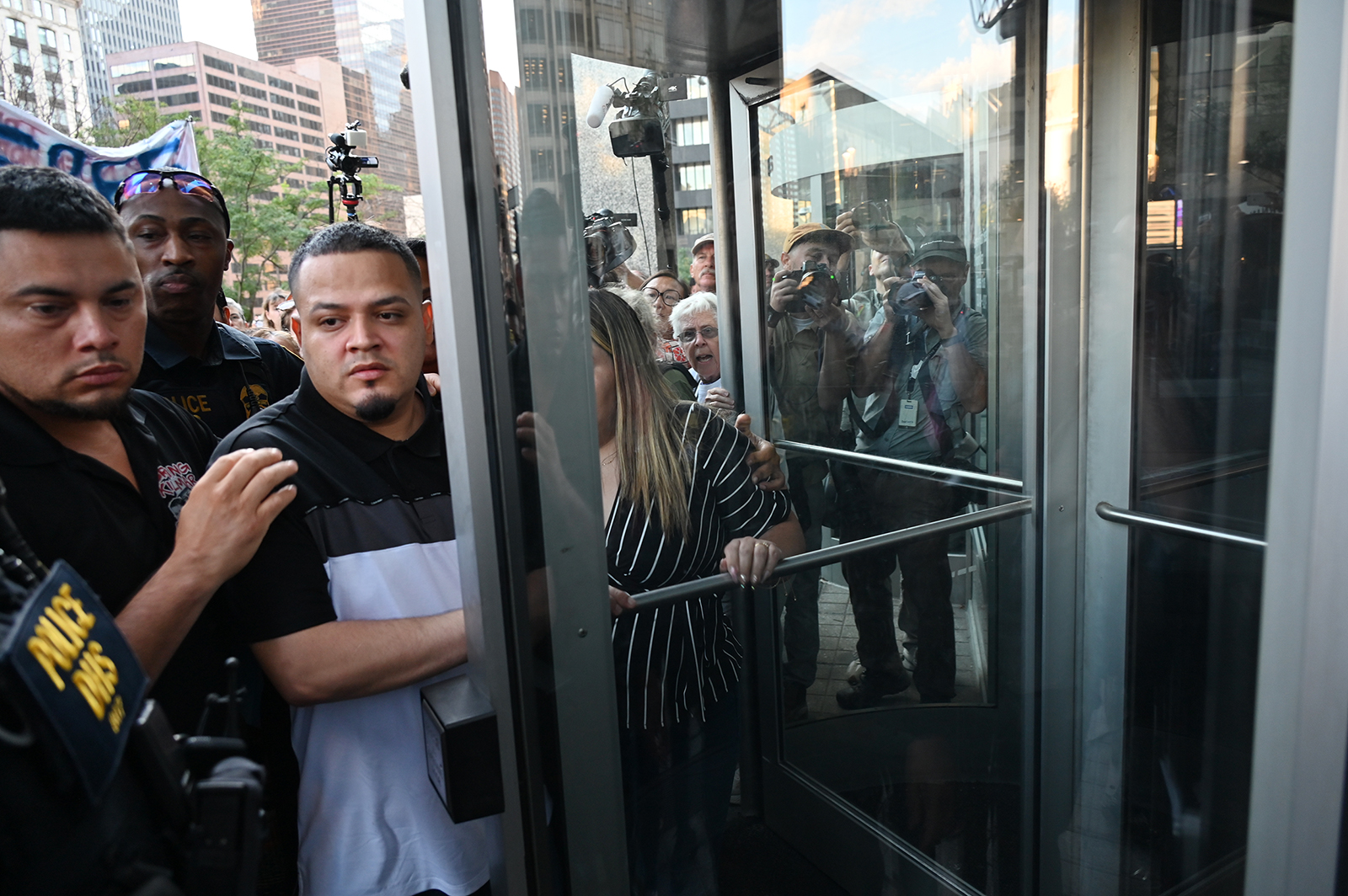
BALTIMORE (RNS) — 'God is with us, and God will never leave us,' Abrego told the crowd. 'God will bring justice to all of the injustice that we are suffering.'


Kilmar Abrego Garcia enters the Immigration and Customs Enforcement field office in Baltimore, Monday, Aug. 25, 2025. (RNS photo/Jack Jenkins)
Jack Jenkins
August 25, 2025
RNS

BALTIMORE (RNS) — Before being taken into custody by Immigration and Customs Enforcement agents Monday morning (Aug. 25), Kilmar Abrego García, the Maryland man who became a national flashpoint after he was illegally deported to El Salvador by the Trump administration, addressed a crowd gathered at ICE’s Baltimore field office in Spanish. Addressing other immigrants, he said, “God is with us, and God will never leave us.”

Abrego then added: “God will bring justice to all of the injustice that we are suffering.”

As he finished speaking, clergy from an array of religious traditions joined with U.S. Rep. Glen Ivey, of Maryland, to lay hands on Abrego, who bowed his head as the group prayed over him and a rabbi blew a shofar.

Abrego then slowly ascended the steps of the building to attend a required check-in with immigration authorities ahead of his upcoming trial on human smuggling charges, to which he has pleaded not guilty. As he pushed through a throng of reporters and entered the revolving doors, the crowd chanted “Sí, se puede!” — “Yes, we can!”

Then, in view of photographers who pressed their cameras against the windows outside, Abrego huddled one last time with his family and closest supporters. As they stood quietly, they joined in what protest organizers later said was a prayer.

Behind him on the steps, faith leaders led the crowd in singing hymns. Among them was “This Little Light of Mine,” but attendees added a new verse: “Kilmar is our neighbor, you can’t have him Trump. Leave him be, leave him be, leave him be.”
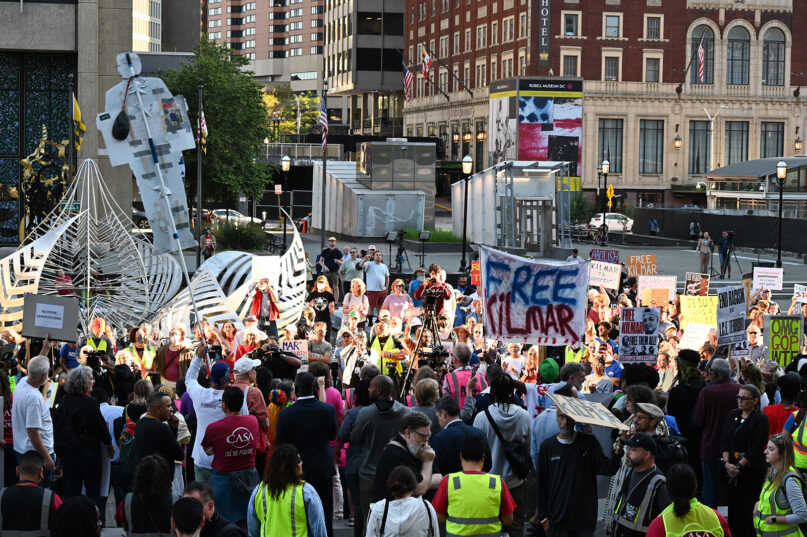


People attend a protest rally at the Immigration and Customs Enforcement field office in Baltimore, Monday, Aug. 25, 2025, to support Kilmar Abrego Garcia. (RNS photo/Jack Jenkins)

Less than an hour later, Abrego’s lawyer, Simon Sandoval-Moshenberg, informed the crowd that his client had been taken into ICE custody. Suddenly, the singing shifted into a chant of “Shame! Shame! Shame!”

The emotional, and often deeply religious, event was equal parts protest rally and vigil, with clergy and faith leaders speaking alongside union leaders and elected officials as they voiced their outrage over the administration’s treatment of Abrego and immigrants in general.

The faith presence at the rally testified to a growing religious pushback to Trump’s immigration policies. On Trump’s first day in office, Bishop Mariann Budde, the Episcopal bishop of Washington, asked the president in her Inauguration Day sermon to have mercy on migrants. Since then, clergy have staged protests against his immigration policies, even confronting masked federal agents as they have detained immigrants.

The demonstration opened with a prayer from Baptist Pastor Julio Hernandez, who leads the Congregation Action Network, which helped organize the event. “We cry today to you, oh Lord, to set Kilmar free, set this family free from oppression, and save Jennifer and his children from injustice,” he said, his prayer translated into English and Spanish. “Repent and be free, those who live to oppress and to know the power of God.”

While leading the laying on of hands for Abrego and his family, Rabbi Ariana Katz said, “As you are caught in the gnashing teeth of fascism and cruelty, as lies are shouted about who you are and who your family is, as betrayals are whispered to you, claiming that you are alone, know that you walk in truth, know you are never alone. You and your family are encircled under the wings of the Holy One.”


People pray over Kilmar Abrego Garcia, center, during a demonstration in support of him at the Immigration and Customs Enforcement field office in Baltimore, Monday, Aug. 25, 2025. (RNS photo/Jack Jenkins)

Signs sprinkled throughout the crowd were emblazoned with slogans such as “Jews against ICE,” “Jesus was a refugee” and “May God have mercy on ICE.” Others cited Scripture passages from the Gospel of Matthew and the Book of Deuteronomy: “You shall love the stranger for you were strangers.”

Abrego, in his address, recalled the joy he felt upon reuniting with his own family last week after being returned to the U.S. from El Salvador’s infamous CECOT prison.

After Abrego entered the building, the vigil continued with a litany of religious speakers from Methodist, Episcopalian, Baptist, Catholic, Jewish, Buddhist and Unitarian Universalist traditions, among others.

The Rev. Ty Hollinger, a Catholic priest, cited Jesus’ call to welcome the stranger. “For Catholics as a people of faith, when we see our sisters and our brothers like Kilmar not being treated with fundamental human dignity, fundamental human rights, the right to due process, we know that that’s an attack on the dignity of us all,” he said.

Hollinger later explained his presence at the rally by connecting his support for immigrant rights as a requirement of his faith. “The founder of my faith was a poor person born into a poor family who were migrants themselves, and who were homeless,” he said. “If that doesn’t inspire us as people of faith to first be with people that are experiencing homelessness, migration issues, poverty today, then I don’t know what our faith means.”

Another of the speakers at the vigil, the Rev. Laura Martin of Rock Hill United Church of Christ in Arlington, Virginia, said she was dismayed over Abrego’s detention.

“I believe that God’s heart is breaking, my heart is breaking, and I take hope in the words of my faith and the words that Kilmar told us before he went in today. He said, ‘Whatever happens today, I will have hope,’” Martin told RNS. “He told us to continue to resist, continue to fight and continue to love. So I will hold on to that.”

Sandoval-Moshenberg told the crowd outside the ICE field office that his firm has already filed another lawsuit in Abrego’s long legal battle. This time, the attorneys are challenging his detention and potential deportation to Uganda, where the administration has reportedly threatened to take him.

“We asked the ICE officer what the reason for his detention was. The ICE officer didn’t answer,” the lawyer said. “The ICE officer stated that he’ll be taken to the detention center. We asked the ICE officer which detention center, the ICE officer said that they weren’t able to say. We asked the ICE officer for a copy of any paperwork that’s being served on him. Today, the ICE officer wouldn’t commit to even giving us that paperwork.”

Sandoval-Moshenberg and the rest of Abrego’s legal team argue that the administration is using the threat of deportation to Uganda as a way to pressure him to plead guilty in return for being deported to Costa Rica, where Abrego has said he would accept refugee status.

“The fact that they’re holding Costa Rica as a carrot and using Uganda as a stick to coerce him is such clear evidence that they’re weaponizing the immigration system in a manner that is completely unconstitutional,” Sandoval-Moshenberg said.

Even so, faith leaders who spoke to RNS said they will continue to advocate on Abrego’s behalf, with many citing his own words to the crowd shortly before he was detained.

“Regardless of what happens today with ICE, promise me this,” Abrego said in Spanish, “that you will keep fighting, praying, believing in dignity and liberty, not just for me but for all.”









NYC faith leaders look to coordinate as federal cuts strain pantries and soup kitchens

NEW YORK (RNS) — With federal funding cuts impacting food pantry resources across the nation, faith leaders in New York pledge new collaborations to sustain the city’s food banks and soup kitchens.


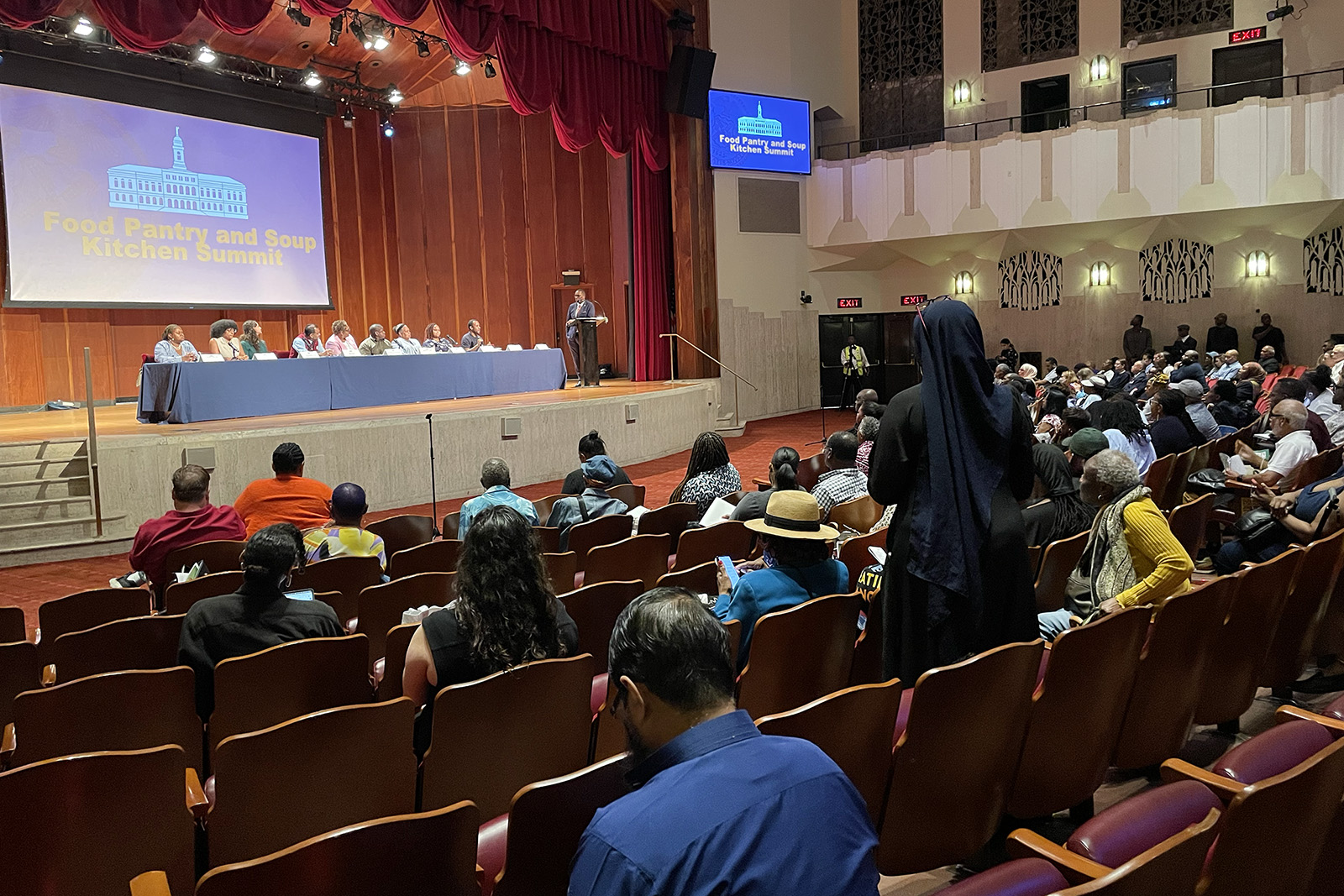
Attendees ask questions during a panel discussion at the Food Pantry and Soup Kitchen Summit, Aug. 20, 2025, at Salvation Army’s Medford Hall in New York City. 
(RNS photo/Fiona Murphy)


Fiona Murphy
August 21, 2025

NEW YORK (RNS) — About 300 faith leaders and community activists met this week in Manhattan to strategize how religious organizations can better address rising food insecurity in New York City — even as food pantries face federal funding cuts.

On Wednesday morning (Aug. 20), religious leaders from across faiths gathered at the Salvation Army’s Medford Hall for a Food Pantry and Soup Kitchen Summit hosted by the Mayor’s Office of Faith-Based and Community Partnerships, in collaboration with New York Disaster Interfaith Services and the Salvation Army.

The goal of the summit, according to the Office of Faith-Based and Community Partnerships, was to connect different faith-based food pantries and nonprofits across the city to facilitate networking, provide resources and strengthen the city’s response to food insecurity.

“To have faith-based organizations in this space, it’s very important for New York City,” said Pastor Gilford Monrose, a Brooklyn pastor and the executive director of the Mayor’s Office of Faith-Based and Community Partners. “Faith-based food pantries are the drivers. They don’t have a lot of funding. They don’t have a lot of resources, but they are very high on compassion and care for our community.”

Since February, when the Trump administration suspended the Emergency Food and Shelter Program, resources for faith-based food pantries have grown increasingly scarce. In April, the administration announced plans to cut half of all food shipments through the Emergency Food Assistance Program, a $500 million reduction that affects food banks nationwide. According to the New York governor’s office, these cuts could cost the state roughly 16 million pounds of U.S. Department of Agriculture foods this year, impacting faith-based pantries and soup kitchens in New York that directly rely on those supplies.


Pastor Gilford Monrose, right, speaks at the Food Pantry and Soup Kitchen Summit, Aug. 20, 2025, at Salvation Army’s Medford Hall in New York City. (RNS photo/Fiona Murphy)

Peter Gudaitis, executive director of NYDIS, said the impact of the loss in federal funding is already significant. “One of the big challenges is the Trump administration has eliminated the emergency food and shelter program funding,” Gudaitis said. “A lot of the social service agencies in the city that did have emergency food assistance funding now don’t have that funding anymore.”

He said NYDIS and Islamic Relief USA are planning to open a new food bank in December to help fill the gap, with a focus on smaller, faith-based pantries. The initiative will also provide equipment such as refrigerators so pantries can safely store fresh produce and proteins.

Gudaitis, who distributed a survey to hundreds of faith-based food pantries across the city to gauge their scale and needs, said that even smaller, neighborhood congregations are providing staggering levels of support to the community. “Out of the first 80 or so congregations that responded to our survey, they’re feeding 40,000 people a week. So, if 80 congregations are feeding 40,000 people a week, and we have almost 700 signed up to be here today, you’re talking about millions of meals a year provided through these small pantries.”

Larger faith-based providers, like Holy Apostles Soup Kitchen in Chelsea or the Met Council’s kosher pantry network, feed thousands each week. Together these groups form a substantial portion of New York’s food safety net and feel the strain of rising demand with dwindling resources.

RELATED: How NYC faith-based food banks, shelters are adapting to ICE fear

“The government can’t do what these faith-based organizations are doing,” Monrose said. “Government sucks at being compassionate in terms of underground and individuals. That’s the truth. Because if government could have, then we wouldn’t need our partners. They are the ones who really anchor us.”

Approximately 700 congregations across all five boroughs registered to participate in the two-hour summit, which consisted of a presentation and a panel featuring leaders from several food distribution organizations, including Jerome Nathaniel with City Harvest, one of the largest food suppliers in the state; Mohammad Razvi, founder and executive director of the Council of Peoples Organization, which operates one of the largest halal food pantries in Brooklyn; and Tara Walker, an official with the city’s Community Food Connection program, among other nonprofit directors.


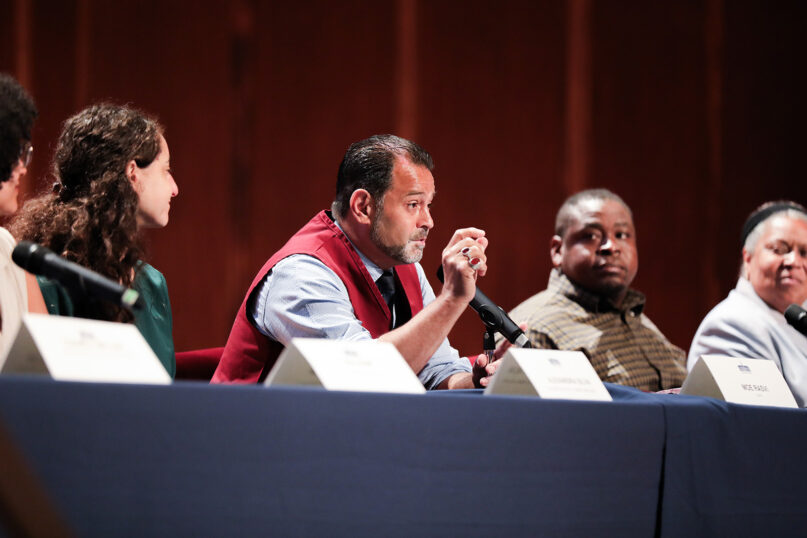
Mohammad Razvi participates in n a panel discussion during the Food Pantry and Soup Kitchen Summit, Aug. 20, 2025, at Salvation Army’s Medford Hall in New York City.
 (Photo by Austin Wideman/Salvation Army)

“Where I used to get six pallets a week from Food Bank for New York City, now I’m only getting two pallets,” Razvi said. Since COVID-19, COPO’s operation has expanded from serving 60 people per week to currently providing food to about 30,000 families. A pallet, a 4-by-4 container used in bulk shipping, can carry more than a thousand pounds of canned or fresh food.

Alongside the food, Razvi said COPO has distributed thousands of “go bags,” or emergency kits prepared in response to heightened fears of U.S. Immigration and Customs Enforcement raids in the city. About 1 in 5 people he serves are immigrants, many of them Muslim, for whom having access to halal food is a necessity. Federal cuts to food pantry funding have pushed Razvi to get more resourceful in order to feed the large population he serves

“Now,” he said, “I have to reach into my neighborhood, the grocery store owners or others who might have abundance of food that they need to get rid of.” Razvi said he is in the process of purchasing a refrigerated truck for COPO to travel around the city and pick up extra food.

RELATED: In New York, faith organizations prepare for Trump’s immigration crackdown

Latricia Davis, pastor of the Community Church of Christ in the Queens borough’s Jamaica neighborhood, operates a food pantry once a week. She said she came to the summit in hopes of expanding her collaboration network. “We’ve learned that when churches come together, we can share resources and reach more people,” Davis said. Smaller pantries like hers, which serves around a hundred people a week, she said, feel the federal funding cuts more sharply than larger churches with bigger budgets. “Our pantry lines keep getting longer, but our resources keep getting smaller.”


To adapt, her church recently adjusted its food pantry hours to better accommodate New Yorkers working 9-to-5 jobs. “For everybody, there’s a sense of fear,” Davis said. “It’s not only just for people who are unhoused or people who are unemployed, but we have middle-class working people, families that are now on our food pantry lines.”

Winston Johnson, a member of the Rastafari community in Brooklyn, attended the summit. “We wanted to know what type of resources are here and whatever help we could get,” Johnson said. He said the summit for him was successful, as he feels more aware of resources, partnerships and food suppliers in the city like City Harvest and COPO.

Johnson’s community, which follows a natural vegan diet, operated a food pantry before the pandemic, but after being unable to keep its brick-and-mortar space, the pantry was forced to close. Now, relocating to a new site, Johnson said the community is eager to restart the pantry, which previously served more than 300 people. “The information today has been useful,” Johnson said.

Monrose called Wednesday’s gathering a “great start.” He said future summits may include hands-on training on how to run a food pantry, with participants divided by experience level, allowing more tailored resources.

“I believe the next one we will do, we will have specific training on how to run a successful food pantry,” Monrose said. “I think that the information is good, but I think we need to go down to the nuts and bolts.”


Outside Newark's 1,100-bed detention center, a weekly prayer service for anxious families

NEWARK, New Jersey (RNS) — At Delaney Hall, the East Coast’s largest immigrant detention facility, families and volunteers say harsh conditions and shifting rules have urged the need for spiritual care.


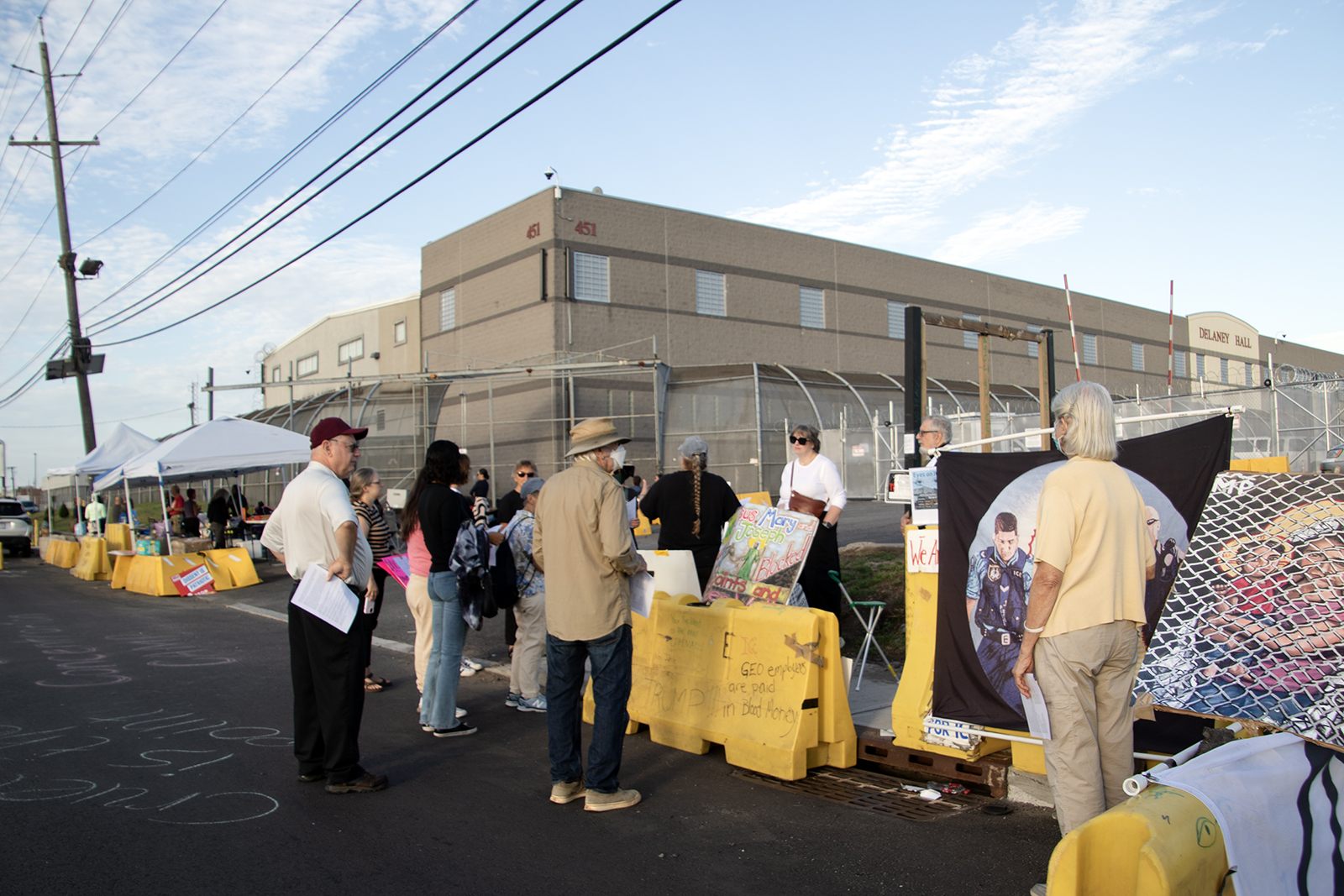
People gather for a prayer service outside the Delaney Hall detention center, Sunday, Aug. 24, 2025, in Newark, N.J. (RNS photo/Fiona Murphy)


Fiona Murphy
August 25, 2025
RNS

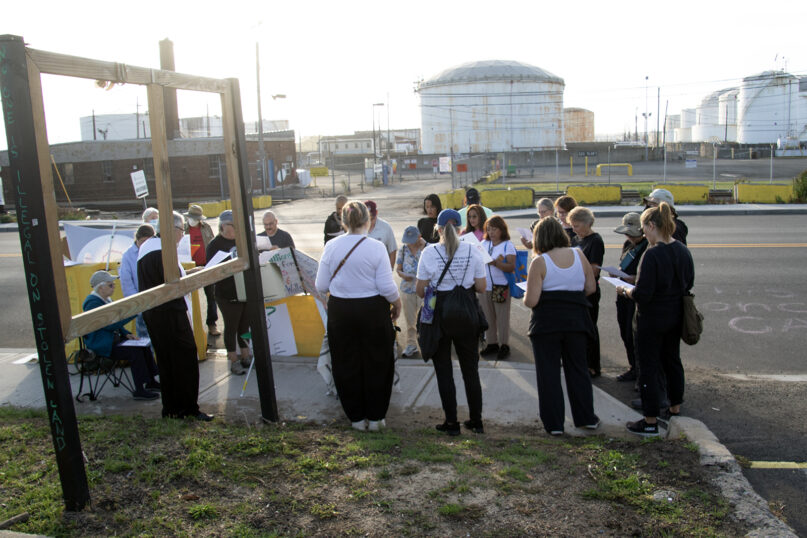
NEWARK, New Jersey (RNS) — Early on Sunday morning (Aug. 24), a dozen activists prayed in a circle before the barbed-wire gates of Delaney Hall, the 1,100-bed immigrant detention center that is the largest on the East Coast.

As a line of visitors, mostly family members of people who have been arrested, began to form in front of a guard booth, Kathy O’Leary, the organizer of the event, and Fr. Eugene Squeo led the service.

“We are here because we recognize the dignity of each and every human person,” Squeo, a retired diocesan priest of Newark, said in English, after first announcing the words in Spanish. “And no one should be treated cruelly or inhumanely.”

The “Let Us Pray” service, the first of what organizers hope will be a weekly gathering, lasted about 15 minutes and included mostly Catholic activists, with a few Protestant and secular participants joining. O’Leary, the region coordinator of New Jersey Pax Christi, a Catholic peace organization, handed out sheets of paper with songs, and the group swayed solemnly left to right as they sang in unison, “Christ be our light. Longing for light, we wait in darkness.”

A small altar sat in the middle of the circle holding sanctus bells, prayer cards and a photo of St. Frances Xavier Cabrini, the Catholic patroness of immigrants the leaders called on for intercession. Two people joined the group from the visitor’s line. Clutching the paper, both said they wished to remain anonymous and kept their eyes fixed on the sidewalk below.

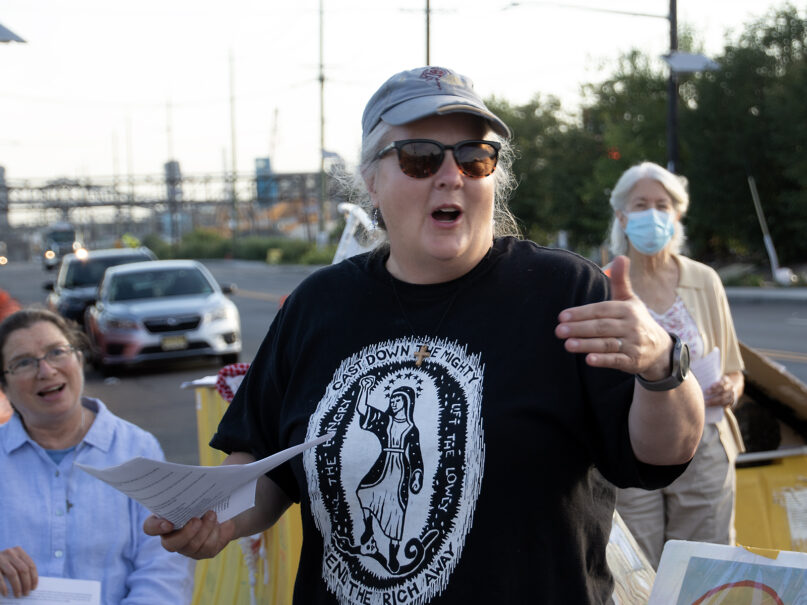
Kathy O’Leary speaks during a prayer service outside the Delaney Hall detention center, Sunday, Aug. 24, 2025, in Newark, N.J. (RNS photo/Fiona Murphy)

“It’s the idea of these spaces to steal people’s hope,” O’Leary told RNS. “Cruelty is the point. So, the perfect foil to that is love and life and beauty. We also want to lift up the fact that people are not being cared for inside spiritually, that clergy should be allowed in. So, we’re calling it Let Us Pray.”

Participants said they plan to come back every Sunday for as long as Delaney Hall remains open.

RELATED: ‘There really is no escape’: Faith leaders help immigrants face court as ICE arrests rise


Delaney Hall, first opened in 2000, is operated by the private prison company GEO Group and was used for years as a county jail. From 2011 to 2017, it housed about 450 immigrants under contract with U.S. Immigration and Customs Enforcement. This February, ICE awarded GEO a $1 billion, 15-year contract to reopen the site, and detainees, many arrested several states away, began arriving May 1.

The tents arrived soon after. Set up each weekend by volunteers, the tents have tables offering water and coffee, as well as coloring books for the many visiting children. Volunteers in the tents on Sunday handed out food and included Catholic sisters from Sisters of St. Joseph of Peace, members of Pax Christi and of First Friends, a secular nonprofit that provides support and advocacy to immigrants and asylum seekers 


The Rev. Eugene Squeo speaks outside the Delaney Hall detention center, Sunday, Aug. 24, 2025, in Newark, N.J. (RNS photo/Fiona Murphy)

The for-profit detention center requires visitors, mostly women and children, to wait in what amounts to an active driveway, sometimes for hours, for the chance at a 15-minute visit with loved ones inside. At most ICE facilities, visitors wait in dedicated reception areas or lobbies, with posted visitation schedules announced in advance — usually over the phone or online. Volunteers told RNS that visitation rules at Delaney Hall often shift without notice, leaving families standing in the sun for hours or, in some cases, turned away at the gate after traveling three or four hours and told to return the next day.

On Sunday morning, as the group gathered for the prayer service, a white bus with caged windows rolled past the visitor line and the cluster of tents outside Delaney Hall. The families standing in line strained to see the men inside the bus; two women wept.

“No one knows where they are going,” said O’Leary, who has been coming to the site for months. Many watching expressed fear that the men were being taken to the airport, bound for deportation to one of the foreign countries where the Trump administration has been sending immigrants since mid-February.

Delaney Hall’s reopening has been fraught. On May 9, Newark Mayor Ras Baraka and several members of Congress were arrested after attempting to inspect the facility without notice. A month later, four detainees escaped by breaking through a wall and scaling barbed wire with bedsheets, prompting visitation hours to be shifted from every day to weekends only.


Signs outside the Delaney Hall detention center, Sunday, Aug. 24, 2025, in Newark, N.J.
(RNS photo/Fiona Murphy)

Several reports by local immigration nonprofits claim pastoral care is being denied to detainees currently in Delaney Hall, including First Friends of NJ & NY, Faith in New Jersey and New Jersey Immigrant Justice.

Monica Aguilar, of the Newark nonprofit Action 21, has been working with immigrant families since 2007 and visiting the facility in Newark since May. Aguilar, whose single mother moved her and her four siblings from Ecuador to the United States when she was a child, knows the experience of immigration firsthand and said she grounds herself in her Catholic faith. It’s why she’s grateful to O’Leary and the Let Us Pray service.

“Immigration is a feeling of despair in people’s hearts,” said Aguilar, who emphasized the need for spiritual care for people on both sides of the barbed-wire fence.


“A prayer will reach inside those walls to people who are looking at us. Hopefully, they can see us through the windows. Sometimes at night, we can see the shadows,” she said. “I don’t know if they can see us, but it will reach their spirit.”

David Grande, a 27-year-old law student and bartender from Brooklyn, stood outside the gate Sunday morning after learning his father had been detained on Aug. 20. His father, who Grande said was a Mexican national and has lived in the New York, New Jersey area for more than 27 years, was arrested with nine others during a workplace raid in Edison, New Jersey, according to Grande.

Grande said he first heard from his father in a call from a New Jersey prison, during which his father explained he was in custody and would need to appear in court on Sept. 2.

On Sunday, Grande said he spent more than $60 on an Uber to the detention center for a 10 a.m. visit but was told by the front guard, nicknamed “Mr. Sunshine” by volunteers for his aggressive demeanor, that his appointment had been pushed to 4 p.m.

People participate in a prayer service outside the Delaney Hall detention center early Sunday, Aug. 24, 2025, in Newark, N.J. (RNS photo/Fiona Murphy)

“I never in my life thought that he’d be detained or this would be my reality,” Grande, an American citizen and Catholic, said. “I don’t just pray in good moments; I pray in bad moments, too. And, well, I don’t know what this test may be.”

Lorna and William Henkel, members of First Friends and PAX Christi New Jersey, said they found the prayer service encouraging and inclusive. William is a retired pastor in the Reformed Church in America.

“I think that this was very meaningful to me,” William said. “We belong to something larger, which we support and which supports us. So, this place becomes a faith community also.”

O’Leary said she is working with the Archdiocese of Newark to hold a Catholic Mass in the coming weeks and with the Episcopal Diocese of Newark to arrange a prayer service. The plan, she said, is to invite different denominations and faith traditions to lead services in the space beside Delaney Hall for the foreseeable future.

“We’re going to come out here, as long as we need to be out here, as long as we can be out here,” O’Leary said. “We kind of expect that eventually we’re going to irritate people, someone in power too much, and get shut down, but we’ll figure out another way then to support our neighbors. We hope that this is the beginning.”
Cymru/Wales

Meet Chloe: life as a Welsh Trans person in 2025


Tuesday 26 August 2025, by Nora Rhiannon


The more I talk with cis people on the left, the more I realise how out of touch they are with the realities faced by the trans community. Whenever the discrimination we face enters conversations, a chorus of voices responds to tell everyone that “the left” needs to “prioritise working class issues” and not be “distracted” from “genuine material concerns”. In the interest of educating cis comrades who’ve been misled by this framing, today we’re going to use a mix of studies, surveys and anecdotal evidence to explore the life of the average trans person in Wales. Let’s see how well the picture of trans people as comfortable middle class ideologues holds up to scrutiny…

Whenever the discrimination we face enters conversations, a chorus of voices responds to tell everyone that “the left” needs to “prioritise working class issues” and not be “distracted” from “genuine material concerns”. In the interest of educating cis comrades who’ve been misled by this framing, today we’re going to use a mix of studies, surveys and anecdotal evidence to explore the life of the average trans person in Wales. Let’s see how well the picture of trans people as comfortable middle class ideologues holds up to scrutiny…

Meet Chloe, a trans woman in her mid twenties. There’s about a 25% chance that she’s already been homeless at some point in her life, and if she has, then the cause is very likely to be familial rejection. It’s important not to under-estimate the seriousness of living with a transphobic family, since even without the extremes of conversion therapy, torture and physical abuse such situations routinely cause conditions like CPTSD (which studies show can seriously impact life expectancy). Housing emergencies of this kind are not unusual in the transgender community, and people in such situations often travel relatively far from where they grew up in order to stay with supportive friends. Chloe could have been born anywhere in Wales, but it’s relatively likely she moved to somewhere like Cardiff or Aberystwyth some time between the age of sixteen and twenty. Cardiff in particular is known as a “trans-flight” city because, despite all its faults, it’s a place with an active trans community that regularly shelters people fleeing discrimination.

When and if Chloe finds less precarious housing, there’s still a 48% chance it is unsuitable for habitation in some way: the flat she lives in might have mould and repair issues, inadequate disability accommodations or a lack of usable space. In 2023, research from the British Medical Journal showed that trans people disproportionately live in areas of socioeconomic deprivation. My experience is that trans housing tends to be very crowded, and while the tenancy agreement may show two or three occupants, it’s likely there are four or five people sleeping there on any given night. Chloe probably met her housemates on an online platform like discord or a dating app, through mutual friends, or at a local trans community meetup. These arrangements can forge tight community bonds and create lifelong friends, but they can also create extremely precarious or even volatile housing situations: moving in with people that you met very recently carries certain risks, and a falling-out, breakup or other dispute might end up putting you back out on the street. The worst will likely come from outside, however, since (in addition to taking a large proportion of her income in rent) Chloe’s landlord or letting agent is relatively likely (about a 25% chance according to one survey) to actively discriminate against her. Landlords might refuse to communicate with Chloe, berate or sexually harass her during surprise inspections, or kick her out without warning. Finding a safe and stable home as a trans person can be an enormous challenge, especially when estranged parents refuse to act as guarantors or help you find four months worth of rent-in-advance.

Chloe has almost certainly struggled to find employment. Census data shows that, when compared to their cis counterparts, trans people are 81% more likely to be unemployed. An LGBT health and wellbeing survey in 2021 found that 40% of respondents felt that their transness had a negative impact on their job prospects, and one in three employers outright told a 2018 survey that they’d be less likely to hire applicants that they knew were transgender. If Chloe has found work, she probably has a low-paid job in customer service: she may work at a supermarket, in a care home or as a receptionist. These roles put her in daily contact with people who treat her in an ignorant, rude and even actively hostile manner. She is expected to respond with perfect calm, composure and politeness, and if she does not her job could be at stake. Abuse from coworkers and the public can be extremely upsetting and frightening, and I’ve spoken with lots of trans people whose experiences have outright forced them out of work (temporarily or otherwise).

That income (perhaps supplemented by disability benefit, crowdfunding or a form of sex work) will need to pay not only for food, bills and rent (for herself and maybe for any unemployed housemates), but also for the various extra costs associated with gender transition. Purchase of things like shaving equipment, beauty products, new clothing (it’s wild how quickly your body can change shape during “second puberty”) haircuts etc. is hardly unique to the trans experience, but the sudden appearance of these costs and their necessity as protection against severe discomfort and discrimination make them a real burden. Many trans women report that they wear makeup, jewellery and feminine clothing not just for their own happiness but because they experience abuse and threats of violence from strangers when they don’t wear them. It’s still common advice in trans circles that you should wear high heels to the doctor’s office, because fitting cis people’s expectations and stereotypes makes it easier to get healthcare from them. Additionally, if people wish to bypass the years-long waiting lists of the NHS for therapy and transition care then they must pay exorbitant sums for consultations, blood tests, hormone therapy, laser hair removal, facial surgery, top surgery and bottom surgery. These are out of the financial reach of a great many trans people, and so for the years she sits on a waiting list Chloe’s only option may be spending a little money from each paycheck on DIY hormone therapy, something she will be taught to do safely by members of her community.

When she’s actually on the job, Chloe faces possible harassment from both customers and managers. Surveys suggest that in 2021 two-thirds of employed trans people tried to avoid such harassment by hiding their trans identity (up from half in 2016). If she is early in her transition Chloe may “boymode” at work by dressing and acting as if she is a man, and if she is later in her transition she may “go stealth” by simply not disclosing her trans status. Workplaces that fail to accommodate trans people are so much the norm that a common joke amongst non-binary people is “my pronouns are they/them, but I’m at work right now so whatever”. Around 60% of trans people experience harassment in the workplace, and when loud or violent incidents occur the response from management is often capitulation to anti-trans demands: for example I know several people whose workplaces have banned them from wearing pronoun pins “for their own protection”. The result of such policy changes is usually an increased volume of harassment and mistreatment.

Chloe is not a passive victim though, she’s getting organised. One way that trans people help support each other is through community mutual aid networks, and Chloe gives money and time to these when she can. Trans Aid Cymru, for example, facilitates a meal-share program and oversees direct redistribution of funds to help trans people pay for housing, bills, food, transport, medical care and other transition care. Chloe may also be active in her workplace trade union,in a community union like ACORN (the Cardiff branch of which is notorious for how disproportionately queer it is) or in a political organisation like the Welsh Underground Network (which in 2024 had a membership gender makeup of approximately a third men, a third women and a third non-binary). Across Wales, trans people like Chloe are out on picket lines in the mornings, marching in the streets in the afternoons and attending meetings in the evenings. Members of the community are essential to the functioning of a variety of different organisations, and they in turn are supported by a large number of other trans people.

Chloe is unfortunately rather likely to encounter a mix of misogyny and harassment in left-wing circles however, which may disillusion her with cis activists and cis-led activism. Transgender people tend to cluster together in organisations where their presence will not be questioned or challenged, specific “safe spaces” where they can get on with their organising work without unnecessary interruptions. Establishing a solid pro-trans stance and trans-inclusive culture is essential for any organisation looking to work with talented grassroots organisers like Chloe. By contrast, the anti-trans campaigners who congregate in and around leftist groups are notorious for how little they contribute and how much they demand. When I ran communications for my union, many of our posts were liked by a woman who loved to yell about “men in dresses” on twitter… I often wondered how she’d feel if she found out that the activism she admired was done by people she hated.

This has never really been a question of whether trans people can be a part of the working class movement, it’s obvious that we already are. What’s in question is our future, and whether by overworking, underappreciating, ignoring and ostracising trans people the left will lose us. Chloe is not some sad, miserable, pitiful creature begging for scraps, nor is she a dangerous outsider who’s come to divide the left’s coalition. Whether you recognise it or not, Chloe is a member of the working class, your comrade in struggle, and she deserves your recognition and solidarity. So the next time someone tells you that trans issues (or “gender ideology”) are a “bourgeois indulgence” for “liberal academics” tell them to go fuck themselves; and if you see your own story in Chloe’s, don’t hesitate to make your voice heard in left-wing spaces: you have more right to be there than any of your critics.

This article owes a huge debt to the work being done by grassroots LGBT groups and research collectives like Trans Aid Cymru and the Trans Safety Network, because without the many community-led surveys that have been done in the last decade this article could not exist. In particular I want to shout out the essay “Transphobia is a Class Issue” which inspired me to write an essay of my own for the new context of Wales in 2025.

Key links:

https://transsafety.network/posts/study-shows-trans-people-more-likely-live-deprived-areas/

https://www.lgbthealth.org.uk/wp-content/uploads/2021/08/Trans-People-and-Work-Survey-Report-LGBT-Health-Aug-2021-FINAL.pdf

https://www.peoplemanagement.co.uk/article/1743007/number-of-trans-people-who-hide-their-identity-at-work-increasing

https://www.stonewall.org.uk/resources/lgbt-britain-trans-report-2018

https://www.crisis.org.uk/ending-homelessness/about-homelessness/about-lgbtqplus-homelessness/

One in five LGBTQ+ private renters ‘experienced discrimination’ from a landlord or letting agent

Y Seren Goch


Attached documentsmeet-chloe-life-as-a-welsh-trans-person-in-2025_a9143.pdf (PDF - 918.4 KiB)
Extraction PDF [->article9143]

LGBT
UK Supreme Court backs bigots and transphobes
Class, Race, and Gender in the 2024 elections
Trump-Musk Coup Leads to Resistance in the Courts and in the Streets
Political Review of 2024 - a view from Britain
Gender and sexualities: the reactionary offensive of the far right
Cymru/Wales

Nora Rhiannon
Nora Rhiannon is a trans woman from Wales


International Viewpoint is published under the responsibility of the Bureau of the Fourth International. Signed articles do not necessarily reflect editorial policy. Articles can be reprinted with acknowledgement, and a live link if possible.


Opinion

Dr. James Dobson’s death ends a life, but not a legacy of lies and harm

“James Dobson has died. But we survived.”


(RNS) — His radio show and books shaped generations and fueled the shame that drove queer people like me into conversion therapy.


(Photo by Pavel Danilyuk/Pexels/Creative Commons)

Timothy Schraeder Rodriguez
August 22, 2025

(RNS) — Dr. James Dobson, founder of Focus on the Family, died Thursday at 89. For conservative Christians, he was a champion of “family values.” For LGBTQ+ people like me, his legacy was one of shame, rejection and the lie that we needed to be “cured.”

His radio show and books reached millions, and his political influence stretched from Ronald Reagan to Donald Trump. Dobson was the man who dared a generation of parents to discipline strong-willed children and to guard their homes against what he claimed were corrupting cultural influences, especially homosexuality.

Dobson once said, “The sin of homosexual behavior, like all sins, can be forgiven and healed by the grace revealed in the life and death of Christ. All sexual sin affects the human personality like no other sin, for sexual issues run deep in our character, and change is slow and uphill — but is possible nonetheless.”

For parents listening to Dobson in their minivans, for youth pastors playing his cassette tapes for their students, that wasn’t just commentary — it was a license to treat queer people as dangerous and sexuality as something that needed to, and must be, changed.

I know, because I was one of those queer kids sitting in the audience.


Love Won Out: A front row seat to Dobson’s “cure”

Determined to prove his belief that homosexuality could be “healed,” Dobson in 1995 hired John Paulk, an “ex-gay” man, to lead Focus on the Family’s Homosexuality and Gender Division. Alongside his wife, Anne, an “ex-gay” herself, Paulk became the face of Dobson’s agenda.

Paulk went on to launch Love Won Out in 1998, a traveling conference series that toured the country and regularly drew thousands. Parents were taught to look for “warning signs” in their kids. Testimonies from so-called “ex-gays” described walking away from homosexuality like a bad habit. And at the center of it all stood the Paulks, smiling from the cover of Newsweek, appearing on “The Oprah Winfrey Show” and standing onstage as the movement’s poster family — proof that change was possible.

For teenagers like me in the audience, those conferences planted shame deep in our hearts and convinced us God could not love us as we were. I would spend eight years in conversion therapy, chasing a false promise that only deepened my shame.

Years later, Paulk publicly came out as gay and began speaking openly, most notably in the Netflix documentary Pray Away, about the damage caused by the “ex-gay” movement, including the harm he himself had perpetrated.

“I lied to the people I preached to, but I was lying to myself the most. I had become brainwashed by the false narrative that sexual orientation was changeable when it was not. Every headline that proclaimed me ‘cured’ drove me deeper into despair, because I knew the truth hadn’t budged,” Paulk told me on Thursday evening, the day Dobson died.

“I remember nights alone in hotel rooms before a conference, curled on the floor, sobbing until I vomited. Minutes later, I’d put on a suit, step onstage and tell the crowd exactly what they came to hear. That split, between the man on the stage and the man on the hotel room floor, nearly destroyed me.”

In the wake of Dobson’s death, Paulk says, “Conversion therapy didn’t make me straight. It made me ashamed, hollow and nearly hopeless. When I read that James Dobson is being remembered as a man who cared about families, I think instead about the families torn apart by his message. Parents were taught to fear their own children. Spouses trapped in marriages built on self-denial. Young people who looked at me, the smiling ‘success story’ on the magazine cover, walked away believing they were broken beyond repair because they couldn’t replicate my lie.”


From Focus on the Family to Exodus International


Dobson and Focus on the Family eventually handed the Love Won Out brand to Exodus International, the umbrella network for “ex-gay” ministries across the world, in 2003. Exodus carried the torch until 2013, when its president, Alan Chambers, admitted publicly that conversion therapy did not work and apologized for the harm it caused. The organization closed its doors soon after.

This might sound like the end of the story, but it wasn’t.

According to a 2023 report by The Trevor Project, conversion therapy is still being practiced today by more than 1,300 practitioners in 48 states. An estimated 700,000 people in the United States alone have undergone conversion therapy, and their data shows that LGBTQ+ youth subjected to it are more than twice as likely to attempt suicide. In other words, the pipeline Dobson helped build is still running, causing irreparable harm to a new generation of young queer people.

Organizations like the Changed Movement and the Restored Hope Network, run by Anne Edwards, John Paulk’s ex-wife, no longer promise to make gay people straight. Instead, they cloak the same harmful ideology in the language of “sexual integrity” and “biblical discipleship” and teach queer people that the only godly paths are celibacy or straight marriage.

These groups operate strategically within religious exemptions that shield them from state conversion therapy bans. By framing their work as spiritual guidance rather than medical treatment, they exploit a loophole that allows them to continue unchecked, even in states where conversion therapy is technically illegal.


The legacy we remember

Conservatives mourning Dobson this week will call him a defender of the family. Franklin Graham praised him as someone who “stood for morality and Biblical values.” Others say his impact will echo for generations.

They’re not wrong.

But for LGBTQ+ people like me, his legacy means broken families, rejection and years lost to self-hatred.

As John Paulk put it, “Dobson’s empire baptized cruelty and called it love. That is his true legacy.”

I do not celebrate James Dobson’s death. But I will not mourn him the way his followers do. His influence shaped American evangelicalism for nearly half a century, and for LGBTQ+ people, that influence was beyond toxic — it was tragic.

His death doesn’t heal the lives or families torn apart by his teachings. And it doesn’t absolve him of the shame and hatred he spread in the name of Christian love.

While some call him a pioneer of the faith, others of us will carry scars for the rest of our lives because of the vision he preached. Our work now is to break that cycle so queer kids never again believe their existence is a mistake. That they would know instead that their sexuality is not something broken that needs to be fixed and that they are beloved, just as they are. They deserve better than the legacy James Dobson leaves behind.

As Paulk reflected, “James Dobson has died. But we survived.”

(Timothy Schraeder Rodriguez is a writer and LGBTQ+ advocate whose work explores the intersection of faith, sexuality and belonging. His forthcoming memoir, “Conversion Therapy Dropout: A Queer Story of Faith and Belonging,” tells the story of his eight years in conversion therapy and his journey to healing. The views reflected in this column do not necessarily reflect those of Religion News Service.)


The Stolen Children


 August 22, 2025

Image courtesy The Cleveland Museum of Art.

Amongst the worst things I have been exposed to as a Doctor of International Conflict Management is the abuse of children. I am not so naïve as to have forgotten that US Presidents have participated in human bondage, starting with George Washington, who “owned” at least 13 slaves; I know the institution is far from infallible, yet I never expected to hear “he stole her” from a person in such a place of public trust in the 160 years since the end of owning humans in the US.

Virginia Giuffre was a child when she was “recruited” or “stolen” from Trump’s Mar-a-Lago, depending on which version of the story you believe. It is hard to imagine what exactly Donald must have been thinking or remembering when he chose those words. “Stolen:” taking a belonging without permission. Far from a reflection on a life, potential, or the future, the word reflects upon an object. He never shows a reflection of sympathy or remorse.

I have interviewed hundreds of people, read their memoirs, and reviewed evidence on the atrocities they have experienced. There is no limit to things people have endured to prevent the suffering and abuse of a child. Many chose to take the abuse on themselves to spare the child, not just their own children, but any child. Here there is no indication of that shared humanity, no hint of saving this child from the abuse she experienced.

Virginia Giuffre had more courage than Trump ever will. One of the first to come forward as a victim or a survivor, describing the offenses of Ghislaine Maxwell and Jeffrey Epstein she experienced; Trump has done more to protect the abusers than to pursue justice or aid for those who were abused. Giuffre started Speak Out, Act, Reclaim (SOAR) a nonprofit tasked with advocating and providing education for victims of trafficking: “a safe and empowering space for survivors of sex trafficking to reclaim their stories and stand up for themselves and each other.”

One can ponder the abuse Trump could have prevented in the past and could address now, if he chose to think about the stolen children and the steps he is empowered to take on their behalf. At this point a thousand FBI agents have been tasked with redacting Trump’s name from the Epstein file. He has taken more initiative to address the comfort of Ghislaine Maxwell than the children she molested.

The children who were stolen were threatened, a common terrorist tactic employed in abuse; the abusers told the children “nobody will believe you” and in the words of another brave survivor, Sarah Ransome, “It was made very clear to me, that first trip, that if I ever went to the authorities, if I told my parents, if I told my friends, if I ever left, Jeffrey said to me, ‘I will kill you. I will hunt your mother and father down, and I will kill them.'”

They were silenced by abusers. They reported the offenses, and they were ignored. Now, it seems, they are being silenced again. But the spectacle is anything but quiet. The victims, survivors, and their families are not enjoying the circus. Sky Roberts, Giuffre’s brother, reminds everyone: “She wasn’t stolen, she was preyed upon at his property, at President Trump’s property.”

There were words spoken to provide some justice to victims, they came from US Attorney Damian Williams, who said:

“[the] sentence holds Ghislaine Maxwell accountable for perpetrating heinous crimes against children. This sentence sends a strong message that no one is above the law and it is never too late for justice. We again express our gratitude to Epstein and Maxwell’s victims for their courage in coming forward, in testifying at trial, and in sharing their stories as part of today’s sentencing.”

They groomed, molested, and abused children. Trump lied about making the information about the abusers and those who aided and participated in their crimes public. Now, Trump is prioritizing his own protection over children and victims of abuse—their privacy has not been safeguarded–only his has, it seems. It is an unspeakable evil; it is our responsibility to prevent the cover up and finally take these crimes seriously.

“Dear United States,” a survivor wrote before indicting the behavior:

“I wish you would have handled and would handle the whole ‘Epstein Files’ with more respect towards and for the victims. I am not some pawn in your political warfare. What you have done and continue to do is eating at me day after day as you help to perpetuate this story indefinitely.”

Trump and his DOJ’s abuse needs to be stopped, the children were robbed, but now the survivors need a chance to get their lives back. Justice must be served, not merely on Maxwell, but on everyone who criminally enabled or participated in these heinous acts, for that to happen.

Wim Laven has a PhD in International Conflict Management, he teaches courses in political science and conflict resolution, and is on the Executive Boards of the International Peace Research Association and the Peace and Justice Studies Association.