It’s possible that I shall make an ass of myself. But in that case one can always get out of it with a little dialectic. I have, of course, so worded my proposition as to be right either way (K.Marx, Letter to F.Engels on the Indian Mutiny)
Saturday, August 30, 2025
Vale, Brazil fail to reach deal for railway concessions renegotiation
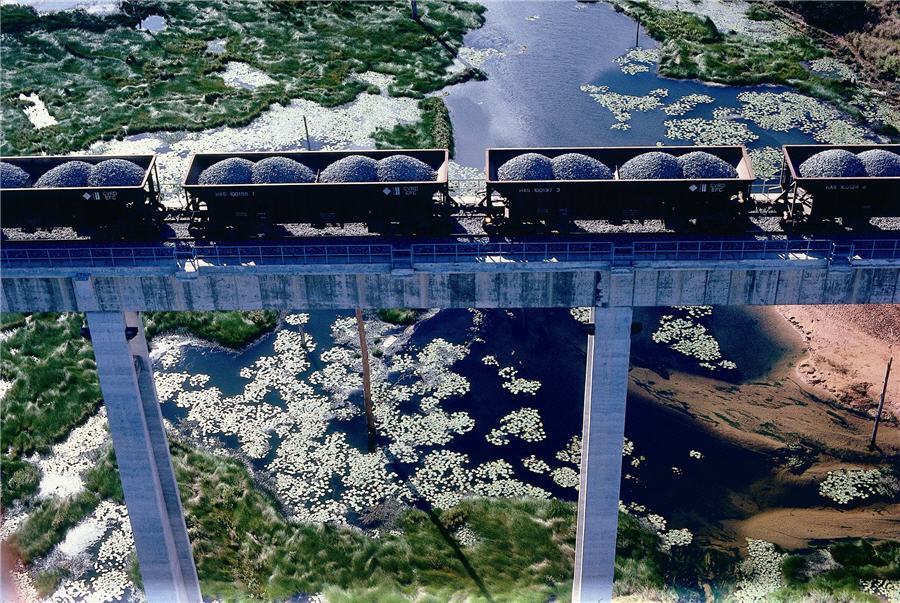
Railroad transporting iron ore from Vale’s Carajás complex in Brazil. Image courtesy of Vale.
Vale said on Thursday that it has not reached a consensus with the Brazilian government and local land transport agency ANTT for the renegotiation of two railway concession contracts within a previously established deadline.
In a securities filing, Vale said the contracts for the Carajas and Vitoria-a-Minas railway concessions, which in 2020 had been extended until 2057, remain in effect.
(By Andre Romani; Editing by Leslie Adler)
Arctic town seeks Swedish state help with relocation due to mine
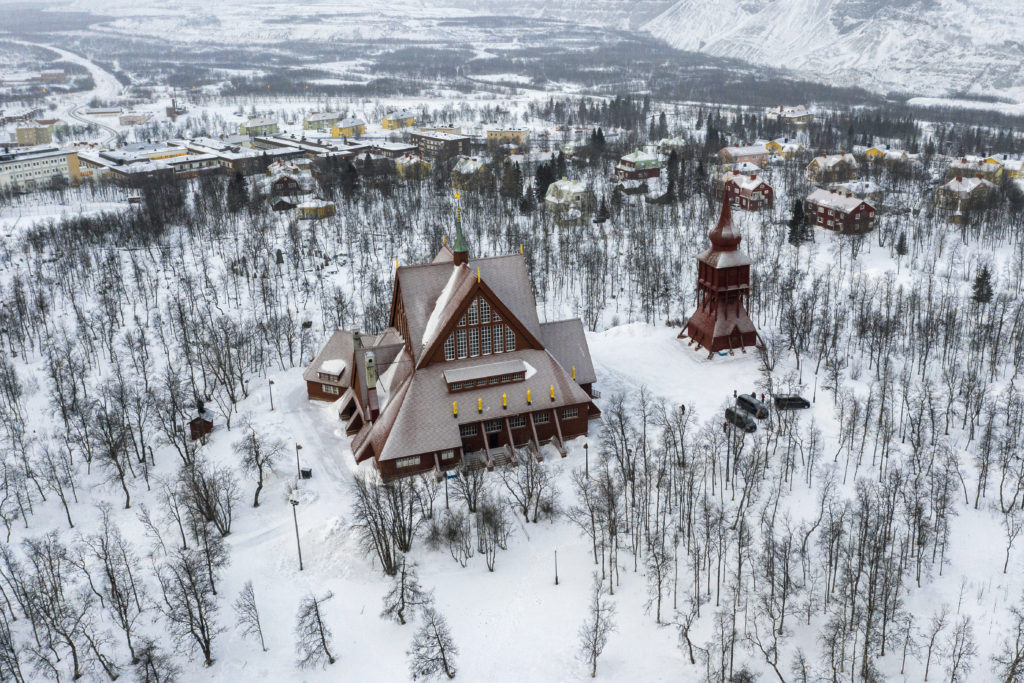
Bird view of wooden church in Kiruna. Stock image.
Sweden’s Arctic municipality of Kiruna called for government help to relocate a third of its residents to allow the expansion of the world’s largest underground iron ore mine.
Kiruna has won fame for being moved in its entirety — a process started in 2004 — to accommodate the growth of the state-owned LKAB’s mine. In updated forecasts on Thursday, LKAB said it now expected 2,700 more homes and 6,000 more people, a third of the town’s population, to be directly affected by its expansion plans over the coming decade.
“I call on the Swedish government to contact Kiruna municipality as quickly as possible,” municipal leader Mats Taaveniku told a news conference earlier on Friday. “We can’t manage without help from the state and the government in this situation,” he said.
In 2022, a new retail area was opened 3 kilometers (1.9 miles) from Kiruna’s previous center, and earlier this month, the town’s historic church was wheeled to a new site. The company said Thursday that relocation “must start now to secure operations until and beyond 2035.”
Sweden’s Minister for Energy, Business and Industry Ebba Busch said in a separate statement on Friday the government had contacted the municipality and understood the challenges it was facing, including how to “prioritize between different national interests.” LKAB “has been clear that it will take part in the compensation,” she said.
She added that it was positive that LKAB continues to make large investments in Kiruna’s home county of Norrbotten as this would help secure jobs and a supply of raw materials which did not rely “on dangerous states.”
(By Charlie Duxbury)
A critical moment: The importance of restoring domestic tungsten production in the US
When you picture an American jet fighter on a critical mission or the latest electric vehicle (EV) rolling off a factory line, you may not realize that several of the key materials that drive these technologies, including tungsten, come from halfway across the world.
Although tungsten is a critical mineral prized for its unmatched density, high melting point and hardness, the US has gone more than ten years without producing a single ounce domestically, relying instead on foreign suppliers to fuel innovation.
This gap creates US national defense implications and leaves high-tech manufacturing industries vulnerable to disruptions in the supply chain at any time and underscores the urgent need to secure a reliable supply at home.
To further understand the stakes and why the current US supply gap is so concerning, let’s examine how tungsten is produced and who controls it worldwide.
Current state of tungsten supply
Today, the global tungsten market is overwhelmingly dominated by China, which produces roughly 80 to 90% of the world’s supply. Other countries contribute only small fractions, leaving the US highly dependent on foreign sources for this critical mineral.
Historically, the US once had a modest tungsten industry, peaking during the mid-20th century when domestic mines supplied defense and industrial needs. Over time, however, production declined due to competition from cheaper imports, high extraction costs and dwindling reserves, eventually reaching zero over a decade ago.
This absence of domestic supply has left the US vulnerable to shifts in global markets, trade disputes and geopolitical tensions. In other words, relying almost entirely on foreign producers, particularly one nation with outsized control, significantly decreases our ability to respond quickly and independently in moments of crisis.
National security implications
Therefore, restoring a domestic supply of tungsten is about more than just mining a mineral—it’s a matter of national security, industrial resilience and economic strength.
The US reliance on foreign tungsten leaves defense programs, from aircraft to armor-piercing munitions and advanced weapon systems, vulnerable to export restrictions, tariffs and geopolitical tensions. A secure domestic supply would ensure uninterrupted access for critical defense applications, reducing vulnerabilities in military supply chains and safeguarding the operational readiness of US forces.
At the same time, tungsten powers high-tech industries such as semiconductors, electronics and EVs, making reliable access essential for innovation and growth. It also plays a key role in emerging technologies, including fusion energy research, which could shape the future of sustainable power.
Bringing tungsten production home would provide a stable foundation for defense, empower industries to develop new technologies without supply chain uncertainty, create high-skilled jobs and strengthen regional economies.
In short, restoring domestic tungsten supply would transform a vulnerability into a competitive advantage for both national security and technological leadership, making it something the country can no longer afford to ignore.
Restoring domestic supply
Restoring domestic tungsten supply will require a coordinated effort across government, industry and research institutions. Identifying and developing untapped domestic deposits is the first step, followed by investing in modern mining and processing facilities capable of producing high-purity tungsten for both defense and industrial applications.
Industries from aerospace and defense to electronics, semiconductors and EVs all depend on tungsten, and even short-term shortages could stall innovation, delay production timelines and drive up costs across these critical sectors, underscoring the urgency of building a stable domestic supply.
Public-private partnerships and targeted incentives could encourage companies to take on the upfront costs of extraction and refinement, while research into more efficient and environmentally responsible methods could make domestic production economically sustainable in the long term.
Strategic stockpiling and supply chain planning would further ensure that critical industries and military programs maintain uninterrupted access, even during global disruptions. Together, these measures could establish a resilient supply chain that strengthens both economic growth and technological competitiveness.
Conclusion
As we see it, restoring domestic tungsten supply is crucial. Securing reliable access would strengthen national defense, reduce reliance on foreign sources, and empower industries from aerospace to electronics, semiconductors and EVs to innovate without the constant risk of supply disruptions.
A stable domestic supply would create high-tech jobs, bolster regional economies, and provide the US with a strategic advantage in both security and technology. It would also mitigate risks associated with overreliance on foreign suppliers, particularly China, ensuring that critical materials remain accessible even amid global uncertainties.
Although the challenges are real, the opportunity is clear: by investing in domestic tungsten production, the US can transform a long-standing vulnerability into a foundation for resilience, innovation and global leadership.
* Brodie Sutherland is CEO of Patriot Critical Minerals Corp., and a geologist with over a decade of experience leading mineral exploration across 20+ countries.
The world is going to need a lot of copper and other critical metals if it is going to pivot away from fossil fuels. But can the mining industry deliver?
The challenges are huge. Ore grades at existing copper mines are steadily falling, big new discoveries are becoming rarer and development times can stretch up to a decade.
Part of the solution is to increase the efficiency of the mining process, which has historically been both highly polluting and wasteful.
Back to the future
The world dug up 650 million metric tons of copper between 1910 and 2010 but 100 million tons never made it to market, according to a 2020 research paper by Germany’s Fraunhofer Institute.
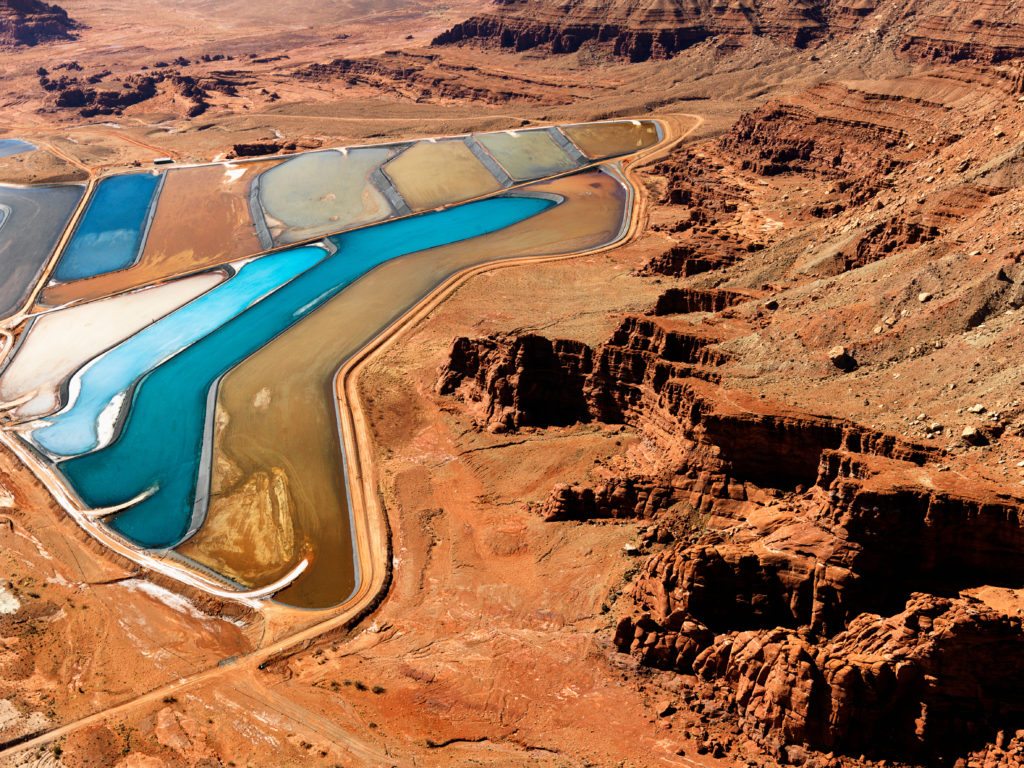
All that metal is still there lying in tailings ponds, a potentially massive resource awaiting the right technology to unlock it.
Others are now looking at ways to extract value from the vast legacy of past mining activity.
Hudbay Minerals, for example, is evaluating the potential for re-mining tailings at the Flin Flon site in Canada’s Manitoba. The mine closed in 2022, leaving nearly a century’s worth of minerals-rich waste.
Australia’s Cobalt Blue Holdings, which has been collaborating on the Flin Flon project, has also signed an agreement with the Mount Isa city council in Queensland to explore re-working pyrite tailings as a potential alternative source of sulphur once the town’s copper smelter closes.
These and many similar projects are still only at conceptual or pilot stage but India’s Hindustan Zinc is scaling up with a $438 million commitment to process 10 million tons per year of tailings at its Rampura Agucha mine, the world’s largest zinc mine.
Less waste
While miners are collectively reassessing the value of legacy waste, they are also working out how to produce less waste in the first place.
This comes with both economic and environmental upside. The mining industry currently generates over seven billion tons of tailings per year and the amount is rising as ore grades fall.
Much of the work in this area is incremental in nature. Glencore Technology, for example, has been steadily improving its ISAMill grinder to handle increasingly coarser particle sizes. The aim is to reduce the amount of ore grinding to save water and reduce tailings waste.
The company’s Albion Process for leaching can lift copper recovery rates to over 99% and reduce operating costs by up to a third, allowing development of complex ore-bodies that wouldn’t be viable with traditional technologies.
Others such as Allonnia, which describes itself as a bio-ingenuity company, are pioneering more revolutionary approaches.
The company’s D-Solve technology uses microbes to selectively extract impurities such as magnesium from concentrates.
Allonnia has just partnered with the Eagle nickel mine in the United States for an onsite unit to pilot technology that in laboratory tests can improve nickel grades by 18% and cut magnesium impurities by 40%.
Big tech meets old tech
The new overarching technology that can bind all these innovations together is artificial intelligence (AI).
Majors such as Rio Tinto and BHP are already using AI in autonomous haulage systems and to predict maintenance downtime rather than reacting to equipment failures.
Generative AI is the next big leap forward. BHP uses it in combination with “digital twin” technology, a real-time virtual replica of the mining process, at its South Australian copper mine and the giant Escondida mine in Chile.
GenAI models at Escondida “inform ore blasting and blending strategies, identify mine areas with challenging ore characteristics, and support the implementation of SAG mill model predictive control,” according to BHP.
US copper producer Freeport-McMoRan has partnered with consultancy group McKinsey to use AI to boost production at its North American operations, which were facing declining output due to mature mines and aging process technology.
Integrating traditional mining with data engineering allows for real-time adjustments to processing rates to handle variable ores. When AI was trialled at the Baghdad mine in Arizona, it led to a 5%-10% increase in copper production.
Rolling it out across the company’s other American operations is projected to lift output by 90,000 tons each year.
That’s equivalent to a new processing plant, which would come at a cost of over $1.5 billion and a timeline of eight to ten years for planning, construction and commissioning.
Future mining
Mining, it is often said, is a dirty business.
The proof lies in the billions of tons of sludge sitting in tailings ponds around the world. The consequence is public antipathy to new mine projects, which is one of the reasons it takes so long to build and commission a new one.
Mining has also been a highly inefficient business in the past. Too much mineral value has been either discarded as waste or simply left in the ground because the technology didn’t exist to treat such low-grade ore.
That’s changing as one of the world’s oldest industries rapidly modernizes, combining innovations in traditional processing with new technologies such as bio-engineering and AI.
This is a quiet revolution playing out in multiple laboratories, pilot plants and data centres around the world.
But the promise is one of a much cleaner and more efficient sector, which may just mean the world isn’t going to run out of copper after all.
(The opinions expressed here are those of the author, Andy Home, a columnist for Reuters.)
(Editing by Elaine Hardcastle)
Burkina Faso’s nationalization rattles West Africa’s gold sector
Burkina Faso is accelerating its drive to nationalize natural resources, requesting this week to acquire another 35% of West African Resources’ (ASX: WAF) Kiaka gold mine — a move that forced the miner into a trading halt on Thursday.
The company said the government wants to raise its stake in Kiaka, which poured first gold in June, “for valuable paid consideration”. It added the trading should resume Monday.
WAF has grown from a struggling explorer into one of West Africa’s biggest success stories, producing about 500,000 ounces of gold a year at low cost. The company says it has already paid hundreds of millions of dollars in taxes and royalties to Burkina Faso, with revenues expected to reach the billions once Kiaka ramps up.
Orezone Gold (ASX, TSX: ORE), which operates the Bomboré mine, also halted trading after the news. The company said it has received no similar request from the government but plans to meet with officials this weekend.
The development highlights the fragile investment climate in West Africa, already rattled by political instability in Mali.
Burkina Faso, Africa’s fourth-largest gold producer, has added key assets to the portfolio of its new state-owned miner, Société de Participation Minière du Burkina (SOPAMIB).
In June, five gold mines and exploration permits, previously held by Endeavour Mining and Lilium, were transferred to SOPAMIB. The push began in August 2024, when the government nationalized the Boungou and Wahgnion mines for about $80 million, a fraction of the $300 million their sale had been valued at.
Other operators remain exposed. Canada’s IAMGOLD (TSX: IMG) continues to run the Essakane mine, in which the government holds a 10% stake. Security concerns, however, weigh heavily on its operations.
A popular leader
The policy shift reflects the growing influence of Ibrahim Traoré, the 37-year-old military leader who seized power in 2022 and declared himself president. Traoré has called on his ministers to expand state control over resources while framing his rule as part of a broader Pan-African and anti-Western revival.
His supporters see him as a bulwark against foreign interference. In April, thousands rallied in Ouagadougou after an alleged counter-coup attempt failed. They also denounced comments by US Africa Command chief Gen. Michael Langley, who accused Traoré of misusing gold reserves. Demonstrations spread to London, Kingston and Montego Bay, where members of the African diaspora voiced solidarity and praised him as a “Black liberator.”
Whether Traoré can stabilize Burkina Faso and repel a long-running Islamist insurgency will determine how far his resource nationalism spreads across the region.
New ‘safe’ destinations
For foreign miners, the upheaval underscores how quickly long-term agreements can collapse. Countries such as Ghana, Egypt, Namibia and Botswana continue to offer more predictable frameworks, while Côte d’Ivoire and Guinea are emerging as new magnets for investment.
Rio Tinto’s (ASX, LON: RIO) multibillion-dollar Simandou iron ore project highlights growing confidence in Guinea’s commitment to the rule of law.
Yet the risks remain high. Success in much of Africa often depends on global majors with world-class mines, diversified portfolios and close government ties. Canada’s Barrick Mining (TSX: ABX)(NYSE: B) continues to navigate these challenges in Mali, but smaller players such as WAF now face sharper uncertainty.
Tsuneishi’s China Shipyard Launches Next-Gen Methanol Containership
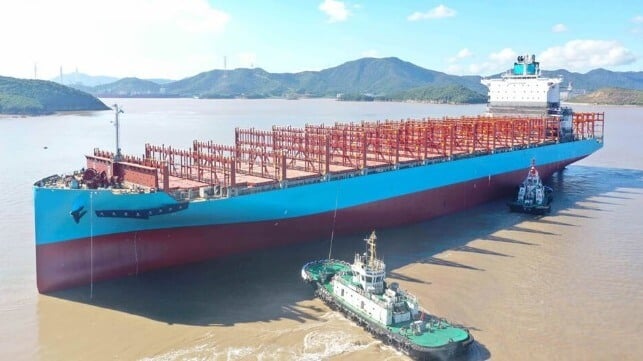
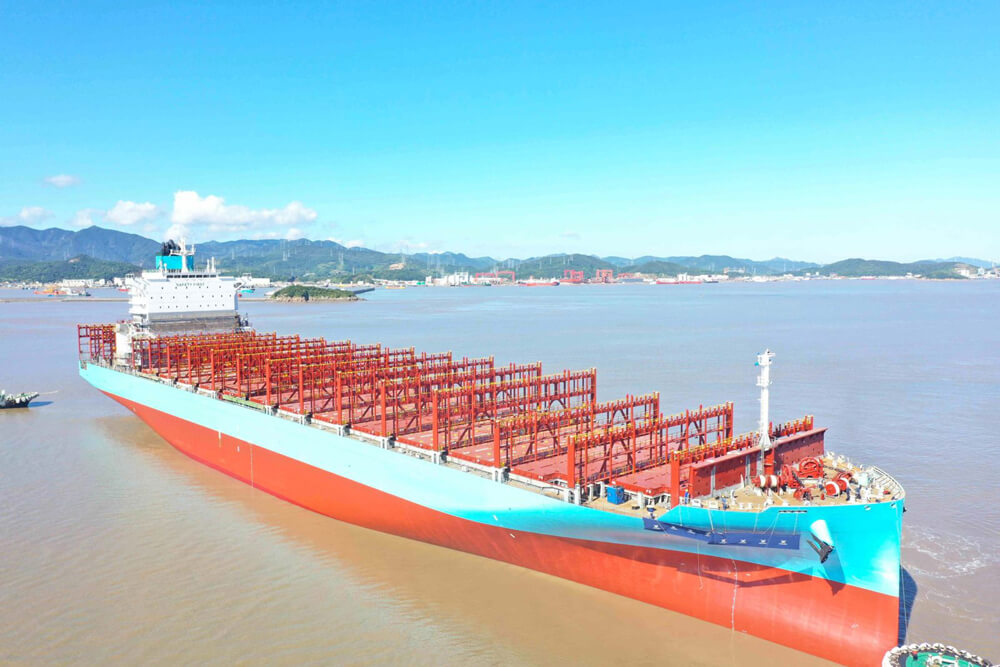
5,900 TEU methanol dual-fuel containership is the largest build by Tsuneishi Group
The Chinese shipyard in the Tsuneishi Shipbuilding group marked a milestone on August 27 as it floated the first of its next-generation energy-efficient methanol dual-fuel containership. The vessel is also the largest container vessel built by the Tsuneishi Group and part of its efforts to build leadership in methanol-fueled vessels.
The newly launched containership will have a capacity of 5,915 TEU. The yard also notes that in response to the growing demand for refrigerated transport in recent years, the vessel can also carry up to 1,400 reefer containers.
The name of the vessel and its details were not released by the yard, but the blue livery and funnel markings are distinctive. Maersk is currently completing the introduction of its large, 16,000-plus TEU dual-fuel methanol containerships and in 2023 reported it had also entered a contract with Yangzijiang Shipbuilding Group for six 9,000 TEU dual-fuel methanol containerships due doe delivery in late 2026 and to be completed by March 2027. Maersk’s fleet strategy announced in August 2024 called for orders reaching a total of 50 to 60 vessels, equaling 800,000 TEU for delivery between 2026 and 2030.
Tsuneishi highlights its new class of vessels incorporates an improved hull form and the group’s proprietary energy-saving technology, MT-FAST, an energy-saving device that improves propulsion efficiency by approximately four percent by regulating water flow through the installation of multiple fins in front of the propeller.
They also highlight the vessel employing a concept known as a “final solution” towards achieving zero CO2 emissions. It will be capable of using green methanol as its primary fuel. The main engine and also the on-board generators – including the HiMSEN engine (8H32DF-LM) manufactured by HD Hyundai – are capable of operating on methanol fuel. It also adopts a large-capacity shaft generator that enables what Tsuneiship says will be “outstanding fuel efficiency.” It is also designed for shore power.
Assembly of the first of the new ships began in April 2025. The vessel launched this week is scheduled for delivery in February 2026.
Tsuneishi Shipbuilding says it will continue to advance the practical application of methanol dual-fuelled vessels. In July, the group’s yard in the Philippines launched the world’s first methanol dual-fueled Kamsarmax, and before that, in May, it introduced a methanol dual-fueled Ultramax built at its yard in Japan.
DUI AT SEA
Arrest Warrant Issued After Captain Skips Hearing on Intoxication Charge
Arrest warrant was issued for the captain after he failed to attend a court hearing
The containership captain, who was arrested on charges that he was operating his vessel while intoxicated, failed to show for a court hearing this week. The King County District Court in Washington State issued a $10,000 warrant for his arrest on August 27 after both the captain and his lawyer did not attend a scheduled pre-trial hearing.
Oleh Danylin, age 48 and a Ukrainian citizen, was charged on August 25 with operating the vessel, the MSC Jubilee IX (108,770 dwt / 8,800 TEU), while intoxicated after having been reported by a Puget Sound pilot. The first officer of the containership had assumed command of the vessel and, along with the pilot, navigated the ship from the anchorage in Everett, Washington, to the berth in Seattle. The ship was detained until MSC Mediterranean Shipping Company supplied a replacement captain.
The court had ordered Danylin to remain in the state, not to consume alcohol, and that his passport should be in the custody of the U.S. Coast Guard.
Court papers from when he was charged reflect that he was requesting an interpreter, but pleaded not guilty to the charge. A U.S. Coast Guard boarding team and the Coast Guard Investigative Service had boarded the ship, and according to court papers, the captain agreed to a sobriety test. Court papers said he was performing so poorly, the investigators stopped the test for his own safety.
He later told investigators that he had not consumed alcohol in two months. He said the smell the pilot reported was “likely mouthwash” he used 10 minutes prior. However, he had agreed to the sobriety test and then a chemical breath test given by the Coast Guard, which showed 0.24 percent blood alcohol. He took two additional breath tests administered that same afternoon by the Washington State Patrol, and both registered 0.25 percent blood alcohol content.
The Coast Guard imposed $1,000 civil penalty, and Danylin was charged and appeared before the judge on August 25. The arrest warrant was issued after he failed to attend a pre-trial hearing on Wednesday.