Monday, September 01, 2025

Trump's lickspittle-in-chief just made a very dumb move indee

Ray Hartmann
September 1, 2025
RAW STORY


Donald Trump gestures during a cabinet meeting at the White House. REUTERS/Jonathan Ernst

Donald Trump’s narcissistic personality disorder took quite a jolt last week.

Here’s what some are saying happened: Vice President JD Vance somehow short‑circuited his electric fence and gave an interview to USA Today where he spoke openly — and maybe a little too eagerly — about that moment in the future when he might have to replace Trump as president.

“I've gotten a lot of good on‑the‑job training over the last 200 days," Vance said in an exclusive interview published Aug. 27, when asked if he was ready to assume the role of commander‑in‑chief.

"Yes, terrible tragedies happen,” he added. “But I feel very confident the president of the United States is in good shape, is going to serve out the remainder of his term, and do great things for the American people.”


Oh no you didn’t, JD.

By the time he started flipping around like a vice‑presidential seal, blathering about Trump’s supposed super‑stamina, it had to be too late.

Did Vance really not get the memo that Trump leaves office when Trump decides to leave office? That’s the last we all heard.


He might want to revisit the North Korean manual on speculating about the Leader’s health. We know he owns a copy — the whole Cabinet just performed it in unison in meeting with Trump last week.

We don’t have details as to how Trump exploded upon learning of the blasphemy from Vance, but it’s safe to assume he wasn’t swelling with pride. So, he thought he’d teach Vance a little lesson.

Oops. Wrong vice president.

Where can we go to get a president with cognitive acuity?

There’s nothing funny about the story that Trump revoked Secret Service protection for former Vice President Kamala Harris — as he’s done with other political targets. In fact, it’s disgusting that the topic is even being debated.

But liberals might not want to seize the bait too quickly on this one. As the New York Times reported, vice presidents typically receive six months of protection after leaving office as a matter of standard procedure.

President Joe Biden had extended that period by a year through executive order, given the unusually high threat level faced by Harris, the Times reported. Biden had done the right thing in the right way, which is to say quietly.

But it wasn’t a permanent step because the nation does not give lifetime Secret Service protections to former vice presidents and their families (unlike presidents). Maybe it should, but it does not.

I didn’t know that, and I’m guessing neither did you. But its important context because Trump and his right-wing state media wants our heads to explode on this one. Or any outrage that doesn’t involve mention of “Epstein.”

This doesn’t excuse the stench of Trump gleefully promoting diminished safety for his political opponents. It’s just the public version of how he privately chokes loyalty out of Republicans, in this view.

As a mobster, Trump has reveled in each opportunity to proclaim the withdrawal of Secret Service details from individuals — which would have taken place quietly under a decent president. He gets to thrill his bloodthirsty followers with the closest thing to “lock them up” presently at hand.

Best of all, Trump gets to bask in dishing out the one thing he’s never had to fake: brazen cruelty. Just another ugly trademark.

Meanwhile, the person who ought to be swallowing hardest is JD Vance.

After all, Trump tried to have his last vice president killed by a mob.
'A totally one sided disaster!' Trump scrambles as key ally meets with Putin and Xi

Tom Boggioni
September 1, 2025
RAW STORY


Russian President Vladimir Putin and Indian Prime Minister Narendra Modi attend a meeting on the sidelines of the Shanghai Cooperation Organisation (SCO) summit in Tianjin, China, September 1, 2025. Sputnik/Vladimir Smirnov/Pool via REUTERS


On the same morning when the New York Times was headlining a report about Prime Minister Narendra Modi of India and President Vladimir V. Putin of Russia holding hands and meeting with President Xi Jinping of China, Donald Trump attempted to downplay the summit that could portend a shift in world power alliances.

With the Times noting, the display of comity seemed aimed at getting the attention of the U.S. president, that observation turned out to be valid with Trump jumping on Truth Social to downplay the entire affair.

According to the Times, “The bonhomie between Mr. Xi and Mr. Putin was meant to convey a close bond between them as leaders of an alternative world order challenging the United States. Mr. Modi sought to show that India has other important friends — including China, regardless of an unresolved border dispute — if the Trump administration chooses to continue alienating New Delhi with tariffs.”

On Truth Social, Trump attempted to blow off worries about the alliance by writing, “What few people understand is that we do very little business with India, but they do a tremendous amount of business with us. In other words, they sell us massive amounts of goods, their biggest ‘client,’ but we sell them very little - Until now a totally one sided relationship, and it has been for many decades,” he claimed.

He then added, “The reason is that India has charged us, until now, such high Tariffs, the most of any country, that our businesses are unable to sell into India. It has been a totally one sided disaster! Also, India buys most of its oil and military products from Russia, very little from the U.S. They have now offered to cut their Tariffs to nothing, but it’s getting late. They should have done so years ago.”

“Just some simple facts for people to ponder!!!” he suggested.

You can see his post here.
'Is she that stupid?' Noem ridiculed for saying 'LA wouldn't be standing' if not for Trump

David Edwards
August 31, 2025
RAW STORY


CBS/screen grab

Department of Homeland Security Secretary Kristi Noem faced backlash after claiming Los Angeles "wouldn't be standing" if President Donald Trump hadn't deployed the National Guard in response to protests.

During a Sunday interview on CBS, host Ed O'Keefe asked Noem if she expected Trump to deploy troops to Chicago.

"You know, that always is a prerogative of President Trump and his decision," the secretary replied. "I won't speak to the specifics of the operations that are planned in other cities, but I do know that L.A. wouldn't be standing today if President Trump hadn't taken action, then that city would have burned down if left to the devices of the mayor and the governor of that state."

"You said L.A. wouldn't be standing, if not for these federal deployments?" the shocked host clarified.

"So many of those homes and businesses that were in downtown L.A. and in those areas were dealing with riots and violence, and coming in and bringing those federal law enforcement officers in was incredibly important to keeping peace," Noem insisted. "And so we are grateful that President Trump was willing to send resources and people in in order to enforce the law."


Noem's remarks were met with criticism.

"Kristi Noem just said on Face the Nation that her actions kept LA from being burned down by rioters," one Los Angeles commenter wrote on X. "She neglected to mention that her actions caused people to riot."

"So NOEM is saying that LA would have burned to the ground if not for them!" Jean Toth noted. "There were RIOTS & fires blah blah blah! It IS BECAUSE of ICE & the NATIONAL GUARD that the riots started! Is SHE THAT STUPID?"

"The NATIONAL GUARD did NOT sign up FOR THIS!"


Can artificial photosynthesis lead to new, carbon-neutral fuels?


By Dr. Tim Sandle
EDITOR AT LARGE SCIENCE
DIGITAL JOURNAL
August 27, 2025


Without photosynthesis we wouldn’t have food because it converts energy from the sun into chemical energy for the food chains. Image by Tim Sandle

Scientists from the University of Basel, Switzerland, have created a plant-inspired molecule capable of storing four charges using sunlight. This is regarded as a key step toward achieving the long-sought-after artificial photosynthesis. As a complexity, the process of artificial photosynthesis requires multi-electron reactions.

Whereas past attempts have failed, this process works under conditions of dimmer light, edging technology closer to real-world solar fuel production. Under the influence of light, the molecule stores two positive and two negative charges at the same time.

The intermediate storage of multiple charges is a key prerequisite for converting sunlight into chemical energy. Under this condiiton, the charges can be used to drive reactions – for example, to split water into hydrogen and oxygen.

Photosynthesis

Plants use the energy of sunlight to convert carbon dioxide into energy-rich sugar molecules; this is the foundation of virtually all life. Animals and humans can “burn” the carbohydrates produced in this way again and use the energy stored within them. This once more produces carbon dioxide, closing out the cycle. Photosynthesis arose early in Earth’s history.

This process could also be the key to environmentally friendly fuels. For several years, scientists have been working to replicate natural photosynthesis by using sunlight to produce high-energy compounds. This includes so-termed ‘solar fuels’, such as hydrogen, methanol and synthetic petrol. If burned, such fuels would produce only as much carbon dioxide as needed to produce useful fuels. These would be carbon-neutral.

New molecule

The new molecule consists of five parts. These are linked in a series and each performs a specific task. One side of the molecule has two parts that release electrons and are positively charged in the process. Two on the other side pick up the electrons, which causes them to become negatively charged. In the middle, the chemists placed a component that captures sunlight and starts the reaction (electron transfer).

To generate the four charges, the researchers innovated photochemistry, in terms of taking a stepwise approach using two flashes of light. The first flash of light strikes the molecule and triggers a reaction in which a positive and a negative charge are generated. These charges travel outward to the opposite ends of the molecule. With the second flash of light, the same reaction occurs again, resulting in the molecule containing two positive and two negative charges.

The stepwise excitation makes it possible to use significantly dimmer light. This means moving closer to the intensity of sunlight. Earlier research required extremely strong laser light, some way from artificial photosynthesis.

The new findings from the study should help to improve understanding of the electron transfers that are central to artificial photosynthesis.

The research appears in the journal Nature Chemistry, titled “Photoinduced double charge accumulation in a molecular compound.”
Cookie crunch: Are consumers starting to push back on Internet tracking?


By Dr. Tim Sandle
EDITOR AT LARGE SCIENCE
DIGITAL JOURNAL
August 28, 2025


OpenAI is making internet search available to all ChatGPT users, allowing people to engage conversationally with the chatbot while seeking answers or information from the internet - © AFP Kirill KUDRYAVTSEV

Consumers remain unsure what cookies are and what the impact is when searching online (for the uninitiated, cookies are small files that store information on your device). According to a new survey, fewer than 2 in 5 (39%) of those polled have a strong understanding of what Internet cookies are used for. It follows that nearly one-quarter (24%) of respondents blindly accept internet cookies when they visit a webpage.

Websites must obtain your active and informed consent before storing most types of cookies. However, a large proportion of people opt to simply accept them so they can quickly access the web page content.

As the survey indicates, less than one-third of participants knew that cookies are also used to authenticate users and accounts. More than one-fifth of respondents (22%) said they think sites use cookies to sign users up for email lists involuntarily, and 13% said they have no idea at all what cookies do.

The firm All About Cookies has undertaken analysis on data privacy and online security. This is through a relaunch of the company’s Internet Cookies Trends report with updated statistics. The survey focuses on the U.S. market.

To collect the data for this survey, the company surveyed 1,000 U.S. adults in September 2023 and August 2025. These surveys were conducted via Pollfish. All respondents were U.S. citizens over the age of 18, and remained anonymous.

One key change, since the survey was last conducted, highlights how Internet users feel about cookie-based personalized adverts. It turns out that the vast majority (87%) find them invasive.

While cookies are useful for site functionality and user experience, they can also track your online activity, raising privacy concerns that necessitate legal compliance and informed user consent.

Yet for those knowledgeable about web cookies, there is an increased pushback against their use, with many users increasingly savvy about data privacy.

As the survey states: “Anyone who uses the internet on a regular basis has encountered cookies, whether through pop-ups asking for cookie permissions or by clearing cookies out of their browser. For how often we’re confronted with cookies, the assumption is that people know what they are.”

One common type of cookies is called a tracking cookie, which tracks a user’s behaviour and sells that data to other companies that use it to send targeted advertising to other websites that the user visits. It is this form of cookie that consumers are most resistant towards.

All About Cookies recommends the following tips for a safer web-browsing experience:Use an ad blocker to achieve a more secure browsing experience. Familiarize yourself with the best ad blockers and choose the features most necessary for your personal online safety.Be mindful of pop-up notifications. When should you accept cookies? Every website’s policy varies and it’s important to understand how your information could be used for advertising and retargeting.Enhance your privacy. Figure out how to clear computer cookies based on your preferred browser, and complete the necessary steps.
Sweet nectar: New study aids bee conservation


By Dr. Tim Sandle
EDITOR AT LARGE SCIENCE
August 28, 2025


Bumble bee on a plant. Image by Tim Sandle

A new study looking at how to conserve bees has tracked eight bumble bee species in the wild across eight years. Scientists from Northwestern University and the Chicago Botanic Garden recorded which flowers bees visited and calculated macronutrients in pollen from 35 flower species.

It was found that bee species occupy two distinct diet groups: one prefers protein, and another prefers fat and carbs. This more nuanced finding could help conservationists design pollinator gardens with flowers that meet bees’ nutritional needs.

Such findings are important due to the decline in bee populations globally. With this comes a decline in pollinators and an impact throughout the food chain. As Digital Journal pointed out a decade ago: “The causes of this decline are multiple. Reasons include loss of habitat from intensive farming, pesticide use, urban development and climate change. Each of these environmental pressures carries equal weight.”

The new study focused on pollen consumption, indicating that coexisting bee species occupy two distinct nutrient niches. Larger bodied bees with longer tongues prefer pollen that’s high in protein but lower in sugars and fats. Bees with shorter tongues, however, tend to gather pollen that’s richer in carbs and fats.

The scientists also found individual bees adjust their diets as their colonies grow and develop, reflecting changing nutritional needs throughout the season.

By dividing up nutritional resources, wild bumble bees can avoid competition, thrive together and keep their colonies buzzing strong all season long.

In terms of the variations with diets, while adult bees sip nectar for a quick burst of energy, they also collect pollen for their babies, or larvae, to help them grow. Worker bees gather pollen from various flowers, pack it into special “baskets” on their hind legs and ferry it home to feed their young.

The researchers developed a comprehensive nutritional map by examining a collection of bumble bee species in the wild to determine how species divide nutritional resources. The researchers tracked which flowers each bee species visited for pollen and then collected pollen samples from these plant species to understand their nutrient content.

The scientists took pollen samples back into the laboratory, where they measured the macronutrient content of each pollen sample, specifically calculating the concentrations of protein, fat and carbohydrates. The full dataset included nutritional profiles for 35 different plant species.

After determining the macros for each pollen sample, the researchers compared each bee species’ diet with their physical traits (like tongue length) and with seasonal shifts in flower availability. Immediately, clear patterns emerged.

Not only did pollen’s nutrient content vary substantially among plants, but it also changed throughout the season. Spring flowers, for example, have more protein-rich pollen, while late-summer flowers are richer in fats and carbs. Interestingly, this shift in protein aligned with bees’ nutritional preferences across the season.

The researchers also noticed the eight bumble bee species naturally divided into two diet groups. Long-tongued species collected pollen with higher protein and lower fat and sugar. Shorter-tongued species collected pollen with lower protein and higher sugar and fat. These differences seem to be associated with how tongue length influences which flowers bees can access.

As global pollinator populations face threats from habitat loss, climate change and poor nutrition, these findings highlight the need for conservation efforts that focus on nutritional diversity — not just floral diversity. Providing a mix of plants with nutrition could help support the specific dietary needs of different wild bumble bee species.

The research appears in the journal Proceedings of the Royal Society B, titled “Nutrient niche dynamics among wild pollinators.”
Fans pour into S.Africa Comic Con despite few celebrity headliners

By AFP
August 30, 2025


Around 70,000 people are expected to attend Comic-Con Africa in Johannesburg - Copyright AFP Phill Magakoe


Hillary ORINDE

A 16-year-old in a yellow spandex Wolverine suit, claws fashioned from plastic straws, squared off against a stockier Deadpool two years his junior at Comic Con Africa, the continent’s largest pop culture gathering.

At this year’s festival — held at the same venue set to host G20 leaders in November — the stars weren’t on stage. They were the fans.

Thousands of self-professed nerds, comic book lovers, superhero fans and anime obsessives descended on the Johannesburg venue, undeterred by a noticeably slimmed-down celebrity lineup.

Highlights nonetheless included Dan Fogler, best known for playing Jacob Kowalski in the Harry Potter spin-off “Fantastic Beasts”.

Around 70,000 people were expected to attend the convention, which runs from Thursday through Sunday.

Among them was Tshegofatso Nabe, attending for the fourth year in a row.

The teenager left nothing to chance this time, maxing out her savings on a striking blonde-and-blue wig, coloured contact lenses, high platform shoes and delicate angel wings that seemed to sprout from the back of her head.

Her inspiration? Sunday, a villain from “Honkai: Star Rail”, a Chinese-built game where anime characters battle space monsters.

“The cosplay community is so kind and this is the only time in the year when I can experience the joy of wearing this costume outside without someone looking at me weirdly,” she told AFP, as Wonder Woman, Darth Vader and Spider-Man mingled nearby.

“There aren’t many conventions in Africa, and this is the only chance to express ourselves and connect with people who are in the same fandom,” she added.

South Africa, often considered one of Africa’s most progressive countries, still grapples with conservative attitudes that sometimes view cosplay and fandom culture as trivial.

– Here ‘for the vibes’ –


Originally, Comic Con began as a grassroots event for comic books fans to meet but it has grown exponentially and is today used by studios to launch their latest blockbuster movies and TV shows.

At the Johannesburg event, competitors also battled it out in popular eSports games like “FIFA”, with contests interspersed with music.

In another corner, rows of teenagers with headphones clamped to their ears gazed into curved screens, their gaming stage bathed in the pulsating glow of strobe lights.

“We are on par with Comic Con festivals in Europe and America,” said exhibitor and former gaming champion Elias Machete. “People are trying to look at the numbers but the quality here is so beautiful.”

Damian Wilson, a 31-year-old salesman who returned for the third year, agreed: “We are just here for the vibes.”
In Argentina, the tango keeps Parkinson’s symptoms at bay

By AFP
August 30, 2025


Women with Parkinson's disease dance in a tango therapy session in Buenos Aires - Copyright AFP JUAN MABROMATA


Sonia AVALOS

When the tango begins to play, Lidia Beltran shrugs off the Parkinson’s that plagues her, takes hold of her therapist and dances, her body fluid and her steps precise, as part of an innovative treatment program in Buenos Aires.

Some 200 patients have participated in tango workshops offered over the past 15 years at Ramos Mejia Hospital to study the impact of the dance on the symptoms of this incurable neurodegenerative disease, organizers told AFP.

“One of the main problems of the disease is gait disorder, and the tango, as a walking dance, works on starting and stopping steps, and strategies for walking,” says neurologist Nelida Garretto.

The results have been encouraging. Many patients find ways to alleviate symptoms such as the motor blocks that “freeze” their gait, says neurologist Tomoko Arakaki.

“A patient told us that when she freezes, she tries to do the ‘figure eight’ -– one of the classic tango steps — with her feet, and this enables her to get out of the freeze,” Arakaki says.

Dancing the tango helps build a “sensory pathway” that helps with walking, she says.

“We know that Parkinson’s requires pharmaceutical treatments. Tango is used to rehabilitate the motor part. With music, you can get out of complex situations,” she says.

Beltran, 66 and diagnosed with Parkinson’s two years ago, had never danced the tango. She joined the workshop on the advice of doctors.

“If it’s to stop the advance, I have to do it, I have to dance for my life,” she says.

In addition to tremors, stiffness, difficulty with balance and speech problems, Parkinson’s leads to social isolation and depression. The tango workshop can help in these areas.

Beltran reports that dancing boosts her stability and her mood. “Tomorrow I’m sure I’ll feel better because today I danced tango,” she says.

– Tuesday happiness –

Patients dance with partners not suffering from Parkinson’s, and under the guidance of dance therapists like Manuco Firmani, a professional tango dancer who has been involved with Parkinson’s rehabilitation since 2011.

Emilia, 86, doesn’t want to give her last name because she is dancing against the wishes of her son, who worries over the two-hour bus trip she takes to reach the studio in central Buenos Aires.

“For me this is the happiness of every Tuesday” says the retired teacher with a frail, bent body and whispery voice, for whom tango evokes memories of her youth.

“Every year we conduct specific evaluations to analyze the benefits of tango,” says neurologist Sergio Rodriguez. “We have measured improvements in cognitive skills, motor skills, gait and balance.”

– Multi-tasking –

Walking is at the core of the Argentine tango, specialists say. But that’s not the only reason it is an effective rehabilitation method for Parkinson’s patients.

Tango also requires dancers to follow rhythms, to move in a set direction and to interpret the physical cues of their dance partner.

“There are many simultaneous messages that must be resolved, which is very positive for this disease,” says Garretto.

At the end of class, there is applause and “an air of satisfaction” in the room, says dance therapist Laura Segade.

“After all, who can take away what they’ve danced?”
In Guyana, remote dirt road seen as future economic lifeline

By AFP
August 30, 2025


This aerial view shows 'The Trail,' a historic red dirt route through Guyana, which officials are hoping to turn into a major highway that can transform the country's economy - Copyright AFP Philip FONG


Patrick FORT

Through the vast interior of Guyana, a historic red dirt road known as “The Trail” winds through rainforest, plains and hills, linking the capital Georgetown to Lethem in the south on the border with Brazil.

Now, that nearly 500-kilometer (310-mile) link is being upgraded into a major highway, and authorities in the South American country — which possesses the world’s largest oil reserves per capita — hope the project will help transform its economy.

They also hope it can help open up Essequibo, the disputed oil-rich region administered by Guyana for decades but claimed by neighboring Venezuela.

The renovation is no small undertaking for Guyana, which goes to the polls to elect new leaders on Monday. It will cost almost $1 billion to build the four sections of highway and about 50 bridges. The most optimistic completion date is 2030.

So for the time being, truckers and others tackle The Trail, also called the Linden-Lethem road, as it is.

It takes 15 hours to make the journey end to end, and some don’t succeed. One rusty truck appears to have been abandoned on the side of the road for some time.

“It’s a very tough job,” says 27-year-old Ramdial Metleash, who is shirtless and dripping in sweat as he drives his logging truck.

Metleash explains how life on The Trail can be hard — in the rainy season, vehicles get stuck in mud. When it’s dry, there are nasty dust clouds.

He has been working this route since he was 15, earning about 60,000 Guyana dollars ($290) per trip — enough to take care of his sister and her son.

And while the oil industry hasn’t changed his bottom line, Metleash admits the completion of the road would help, especially at spots like Kurupukari, where a bridge will be built. For now, trucks cross a river on a barge.

– ‘Game changer’ –


Juan Edghill, Guyana’s minister of public works, tells AFP that the finished highway will be “a game changer in terms of where Guyana is going.”

“This road, when completed, will connect us with the Takutu Bridge, which carries you into northern Brazil. That’s a market of 20 million people,” says Edghill.

That is more than 20 times English-speaking Guyana’s population of more than 800,000.

The minister also notes that the route would link to the Palmyra deepwater port, now under construction and located not far from the border with Suriname.

For now, Brazilians need to travel “21 days down the Amazon to get goods to water for shipping,” Edghill says.

With the new road, that could be whittled down to 48 hours.

Of course, as one observer notes, the road could also easily be used to move troops and military equipment through the country, and into Essequibo, which also has valuable mineral deposits.

That region has long been neglected by the government in Georgetown, as Caracas has pressed its claims over the territory.

“Essequibo is part of Guyana,” Edghill says. “It’s the home of our Indigenous brothers and sisters. (…) Essequibo is also the home for all the large-scale mines, the home of our major forestry activity.”

The new highway would allow more people to travel for work without leaving their families for months at a time, he says, adding: “It’s a great opportunity.”

– ‘You can’t fight progress’ –


Michelle Fredericks, 53, owns a popular snack stall near the barge dock in Kurupukari.

The bridge will pass directly over where her business currently stands. It will be relocated, but will no longer receive heavy foot traffic as it does now.

Fredericks is nevertheless sanguine about the future.

“I can’t just only think about this business here,” she tells AFP.

“A lot of development is going to happen,” she predicts, noting that she plans to shift into offering services to tourists.

Already, Fredericks welcomes local and foreign tourists who want to go fishing or for hikes in the rainforest.

She expects the number of weekend visitors to increase once the new road cuts the drive time from Georgetown in half to about four hours.

“You can’t fight progress. That’s life,” Fredericks says.


Afghanistan earthquake kills more than 800

Agence France-Presse
September 1, 2025 

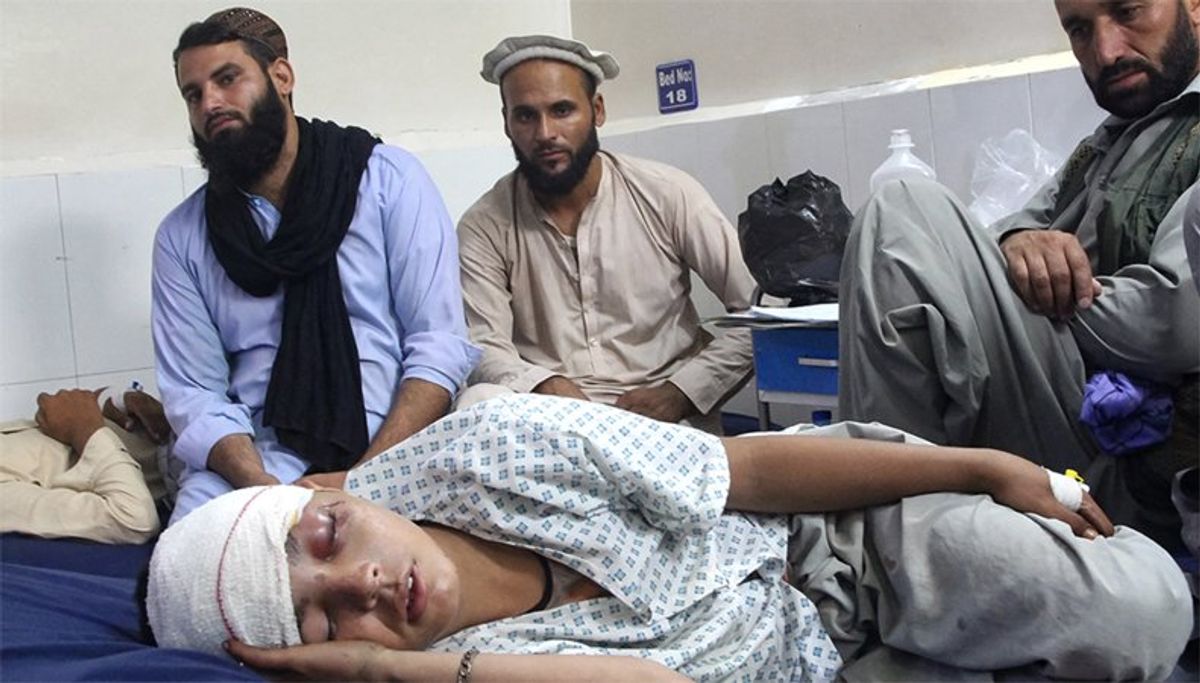
An injured Afghan boy (bottom) receives treatment at a hospital after an earthquake in Afghanistan's Jalalabad on September 1, 2025. Nine people died when a 6.0-magnitude earthquake and powerful aftershock rattled eastern Afghanistan, the provincial Nangarhar government said on 1 September 2025. (Photo credit: Aimal ZAHIR / AFP)

A massive rescue operation was underway in Afghanistan Monday, after a strong earthquake and multiple aftershocks flattened homes in a remote, mountainous region, killing more than 800 people, the Taliban authorities said.

The earthquake struck just before midnight, shaking buildings from Kabul to neighbouring Pakistan's capital, Islamabad.

More than 1.2 million people likely felt strong or very strong shaking, according to the US Geological Survey (USGS).

Near the epicentre in the east of Afghanistan, around 800 people were killed and 2,500 injured in remote Kunar province alone, chief Taliban government spokesman Zabihullah Mujahid said.

Another 12 people were killed and 255 injured in neighbouring Nangarhar province, he added.

"Numerous houses were destroyed," interior ministry spokesman Abdul Mateen Qani told AFP.

The majority of Afghans live in low-rise, mud-brick homes that are vulnerable to collapse.

Some of the most severely impacted villages in remote Kunar provinces "remain inaccessible due to road blockages", the UN migration agency warned in a statement to AFP.

The Taliban authorities and the United Nations mobilised rescue efforts to hard-hit areas. The defence ministry said 40 flight sorties had so far been carried out.

A member of the agricultural department in Kunar's Nurgal district said people had rushed to clear blocked roads to isolated villages, but that badly affected areas were remote and had limited telecoms networks.

"There is a lot of fear and tension... Children and women were screaming. We had never experienced anything like this in our lives," Ijaz Ulhaq Yaad told AFP.

He said that many living in quake-hit villages were among the more than four million Afghans who have returned to the country from Iran and Pakistan in recent years.

"They wanted to build their homes here."

The quake, which struck at a relatively shallow depth of eight kilometres, was 27 kilometres from the city of Jalalabad in Nangarhar province, according to the USGS.

Nangarhar and Kunar provinces border Pakistan, with the Torkham crossing the site of many waves of Afghan returnees deported or forced to leave, often with no work and nowhere to go.

UN Secretary-General Antonio Guterres added his condolences to those shared by the Taliban government and several nations.

"I stand in full solidarity with the people of Afghanistan after the devastating earthquake that hit the country earlier today," he said.

- Frequent quakes -

After the initial quake, a series of at least five aftershocks followed throughout the night, with the strongest being one of magnitude 5.2 just after 4:00 am (2330 GMT Sunday).

Afghanistan is frequently hit by earthquakes, especially in the Hindu Kush mountain range, near the junction of the Eurasian and Indian tectonic plates.

Nangarhar province was also hit by flooding overnight Friday to Saturday, which killed five people and destroyed crops and property, provincial authorities said.

In October 2023, western Herat province was devastated by a 6.3-magnitude earthquake, which killed more than 1,500 people and damaged or destroyed more than 63,000 homes.

In June 2022, a 5.9-magnitude quake struck the impoverished eastern border province of Paktika, killing more than 1,000 people and leaving tens of thousands homeless.

Ravaged by four decades of war, Afghanistan is already contending with a series of humanitarian crises.

Since the return of the Taliban, foreign aid to Afghanistan has been slashed, undermining the already impoverished nation's ability to respond to disasters.

Earthquake in Afghan village leaves no family untouched

Many families were asleep when the quake struck in the dead of the night.


By AFP
September 1, 2025

Taliban security personnel carry an Afghan earthquake victim evacuated by a military helicopter - Copyright AFP Wakil KOHSAR

Qubad Wali

No household was spared death or injury in the village of Wadir when a powerful earthquake shook eastern Afghanistan, reducing homes to piles of rubble.

Aftershocks from the 6.0-magnitude earthquake continued to rumble across the scenes of destruction, where remains of dead livestock jutted out from a tangle of broken beams and muddy, flattened homes.

“In every home at least one person was killed or injured,” 55-year-old resident Gul Mohammad Rasooli told AFP, himself injured.

The smell of death mingled with the sound of wailing women and scraping shovels as rescuers and residents desperately tried to find anyone still alive.

In front of what was a single-storey mud-brick home, rescuers were undeterred by a string of aftershocks that sent a din echoing between the mountains as they tried to find two children.

Their mother had been injured, a rescue worker told AFP, “and when we pulled her out she was calling out for her children”, who were still inside.

Many families were asleep when the quake struck in the dead of the night.

Every 15 minutes, the roar of a helicopter filled the air, with Taliban security personnel spilling out to unload bread and water and then refilling the aircraft with stretchers bearing those hurt worst.

Men, women and children were ferried to hospitals in the nearest city Jalalabad, capital of Nangarhar province, around 40 kilometres (25 miles) away.

Many roads through the mountainous areas that were already difficult to navigate were rendered impassable by landslides.

– ‘May not survive’ –

The grim toll of the earthquake started to become clear from the first hours after the earthquake early on Monday.

The country — one of the poorest in the world and regularly hit by natural disasters that are expected to multiply under the effects of climate change — has already counted more than 800 dead.

Thousands of injured are already crammed into hospitals, where doctors and nurses work frantically amid the constant flow of stretchers.

In Wadir, where around a 1,000 homes are tucked in the mountains of Kunar province — half of them belong to Afghans recently expelled from neighbouring Pakistan and trying to rebuild their lives — no one yet dares to give a final death toll.

“It won’t be wrong to tell you that nine out of 10 people are either dead or hurt,” said 38-year-old doctor Fazel Rabih, who was delivering first aid.

Eastern Afghanistan is no stranger to powerful earthquakes, having seen 12 with a magnitude higher than seven since 1900.


But 20-year-old Wadir resident Mohammad Jawad said he had never felt one so strong.

“When the earthquake happened it was so strong I ran out of the house and it immediately collapsed behind me,” he told AFP, saying among the 10 members of his family, one person had been killed and most of the others had been injured.

Even as the earth continues to shake under their feet, the villagers fear the worst is not over, as dark rain clouds gathered in the mountains overhead.

There is no shelter for those left behind in the scarred remnants of the village, said the village mullah Irfan Ulhaq.

“If anyone is alive under the rubble, they may not survive.”