It’s possible that I shall make an ass of myself. But in that case one can always get out of it with a little dialectic. I have, of course, so worded my proposition as to be right either way (K.Marx, Letter to F.Engels on the Indian Mutiny)
Friday, September 05, 2025
Top Indian Refiner Snubs U.S. Oil in Latest Tender
India’s top refiner, Indian Oil Corporation Ltd (IndianOil), has forgone buying U.S. crude at this week’s tender, instead opting for Middle Eastern and West African crude, sources in the oil trade industry told Reuters on Friday.
At the previous tender last week, IOC bought as many as 5 million barrels of U.S. West Texas Intermediate crude.
But this week, the biggest refiner in the world’s third-largest crude importer bought 2 million barrels of West African crude, another one million barrel of Nigeria’s Agbami and Usan crudes, and two million barrels of Middle East crude, including one million barrels of Abu Dhabi’s Das from Shell, according to Reuters’ sources.
Competitive prices for U.S. crude in an open arbitrage window to Asia have prompted Indian state and private refiners to accelerate buying of American oil in recent weeks.
A few weeks ago, rising prices of Middle Eastern grades opened the arbitrage window for West Texas Intermediate (WTI) to flow to Asia.
Key grades from the Middle East, such as Dubai and Murban, have seen their prices rise in recent weeks on the back of strong demand for high-sulfur crude in Asia and reduced shipments of Murban.
As India’s purchases are driven by economics above all else, both state and private refiners bought more U.S. crude in August to take advantage of the lower freight costs and the open arbitrage window.
The higher purchases of U.S. crude could help reduce the huge trade deficit that the United States runs with India.
With difficult U.S.-India trade talks, the Trump Administration has singled out India to punish as a buyer of Russian crude.
Indian refiners, however, are not giving up on Russian crude—they continue to seek bargain prices and are expected to import more Russian oil in September compared to August levels as discounts are deepening amid Russia’s constrained refining capacity due to Ukrainian drone strikes.
Canada’s government will not continue Trudeau’s policy mandating at least 20% electric vehicle sales from automakers as of the model year 2026, as Mark Carney’s new cabinet is looking to protect the auto industry that has been hit by the U.S. trade policies and tariffs.
The Canadian government will be announcing later on Friday that it will delay the EV sales mandate, sources with knowledge of the plans to prop up industries hit by the trade war told Bloomberg.
The previous government of Justin Trudeau enacted many policies to mandate cleaner energy and tax fossil fuels, but Carney’s cabinet is now rolling back some of these, to protect jobs and the industry during the Trump Administration’s trade blitz.
Canada will now announce it will launch a review of the “electric vehicle availability standard” to see that the EV mandate policy does not burden car manufacturers, which have been suffering from the U.S. tariffs.
Under Trudeau’s Electric Vehicle Availability Standard, auto manufacturers and importers must meet annual zero-emission vehicle (ZEV) regulated sales targets. The targets begin for the 2026 model year, and at least 20% of new light-duty vehicles offered for sale in that year should be zero emission. The requirements increase annually to 60% by 2030 and 100% by 2035.
In July, the associations representing automakers and car dealers welcomed the announcement of consultations between the province of Quebec and the auto industry, aimed at adapting the Zero-Emission Vehicle (ZEV) standard to the new realities of the market.
“The auto industry reaffirms its commitment to the energy transition, while calling for a pragmatic approach based on current economic and commercial conditions,” the Canadian Vehicle Manufacturers’ Association (CVMA) and Global Automakers of Canada (GAC) said.
“Falling demand for ZEVs exacerbated by US tariffs, a slowing economy, and counterproductive government policies have made Quebec’s ZEV sales targets impossible to achieve,” commented CVMA President and CEO Brian Kingston.
“The province needs to urgently review its targets before doing irreversible damage to the sector that will put thousands of jobs at risk”.
Fewer and fewer Canadian consumers are considering buying an electric vehicle as their next car, an AutoTrader survey showed earlier this year.
For the third consecutive year, the share of Canadians who would buy an EV has dropped. This year’s survey found that 42% of respondents say they would be considering an EV as their next vehicle, down from 46% in 2024, and down from a massive 68% considering buying an EV in 2022.
China and Russia used the Tianjin SCO summit to pitch a “Global South–first” economic and security order.
Beijing is pushing more local-currency settlement to cut dollar reliance.
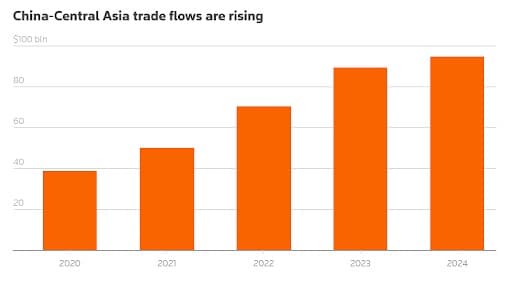
China–Central Asia trade is up about 150% since 2020 and China–SCO trade reached roughly $512 billion in 2024.
China and Russia presented their masterplan for a new global order at the Shanghai Cooperation Organisation (SCO) summit currently underway in China’s port city of Tianjin, highlighting China's growing ties with Central Asia. China’s President Xi Jinping called for a new global economic and security order that prioritizes the "Global South" in what is considered a direct challenge to the West and the United States’ hegemony.
"We must continue to take a clear stand against hegemonism and power politics, and practise true multilateralism," Xi said, in a thinly veiled swipe at President Donald Trump's tariff policies."Global governance has reached a new crossroads," he added. The meeting was attended by more than 20 leaders of non-Western countries. Xi also called for the creation of an SCO development bank, and pledged to provide 2 billion yuan ($280 million) in grants to SCO members this year alone.
Widely regarded as analternative power structure to U.S.-led international institutions, the 10-member SCO is an intergovernmental organization established in 2001 by China, Russia, Kazakhstan, Kyrgyzstan, Tajikistan, and Uzbekistan to promote cooperation and peace among member states, and foster “a new democratic, fair, and rational international political and economic order.’’ First seen as largely symbolic, China has increasingly been using the regional body to strengthen ties with Asia’s economic giants and bolster its regional influence, as Al Jazeera reports.
China’s trade flows with Central Asia have grown nearly 150% since 2020 to $94.8 billion in 2024, while China-SCO trade hit a record $512.4 billion in the same year. China exports automobiles, machinery, chemicals, and garments to its SCO partners, showcasing its manufacturing prowess. In return, China imports energy commodities including oil, gas, and coal, minerals, and agricultural goods from resource-rich countries like Russia, Iran, and Kazakhstan. China is also investing in SCO countries, with the country’s FDI into SCO countries surpassing $40 billion by mid-2025. These investments mostly span traditional sectors like energy and mining, but are increasingly venturing into renewable energy, digital infrastructure and smart cities.
Source: Reuters
Chinese firms like the state-owned Southern Power Grid and polysilicon giant GCL have been ramping up projects in Central Asia, betting on a "green energy corridor" wherein cheap electricity produced in places like Tibet and Uzbekistan will be sold to power-hungry regions such as Europe and Southeast Asia. Two years ago, Chinese firm Universal Energy announced plans to invest in two 250 MW wind farms, totaling a 500 MW capacity, in Uzbekistan's Samarkand and Jizzakh regions. Investment agreements for these projects, which include power transmission lines and a total investment of $500 million, were signed in January 2024. The electricity generated will be sold to the National Electric Networks of Uzbekistan under a 25-year purchase obligation.
Experts are predicting that yuan-based settlements are likely to become more common in China-SCO trade as electric vehicles and AI drive up power demand in the region. More usage of the Chinese currency would drive the region’s de-dollarization efforts and would arguably be Xi's biggest win against the United States and the West. China has been actively pushing theSCO to de-dollarize by encouraging member states to use local currencies in trade and finance, with the goal of reducing dependence on the U.S. dollar, mitigating risks from sanctions, and fostering regional economic integration. This initiative aligns with China's broader strategy to create a more multipolar global order. This is likely to draw Trump’s ire: Last December, Trump threatened BRICS nations with 100% tariffs if they decided to challenge the U.S. dollar’s dominance in the global economy. BRICS is an acronymdenoting the emerging national economies of Brazil, Russia, India, China, and South Africa.
“The idea that the BRICS countries are trying to move away from the dollar while we stand by and watch is OVER.,” Trump wrote in a social media post.
“We require a commitment from these countries that they will neither create a new BRICS currency nor back any other currency to replace the mighty U.S. dollar, or they will face 100 per cent tariffs and should expect to say goodbye to selling into the wonderful U.S. economy. They can go find another ‘sucker!’ There is no chance that the BRICS will replace the U.S. dollar in international trade, and any country that tries should wave goodbye to America,” the president-elect said.
While SCO is not as widely known as BRICS, the region’s rapidly growing trade ties between member nations, as well as the security implications of growing cooperation between the West’s biggest rivals, will no doubt have the United States and its allies concerned. On Tuesday, Trump accused Xi Jinping of conspiring against the U.S. with Russia and North Korea, "Please give my warmest regards to Vladimir Putin and Kim Jong Un as you conspire against the United States of America," Trump wrote on Truth Social. However, Trump has downplayed SCO’s significance, replying, "No. Not at all. China needs us," after the BBC asked if he believed that China and its allies were forming an international coalition to oppose the U.S.
Swelling US demand for electricity has the potential to boost coal consumption as much as 57%, according to mining giant Peabody Energy Corp., in what would be a major shift for an industry that’s been waning for years.
With the US seeking to meet skyrocketing demand and the Trump administration pushing to prop up the coal industry, Peabody expects utilities to ramp up output from coal plants that are running well below full speed, the company said in an investor presentation on Wednesday. Boosting usage to “historic capacity factors” could lead to more than 250 million tons of additional annual demand in the coming years, it said.
Still, analysts see this forecast as a mathematical maximum that’s unlikely to be achieved in the real world.
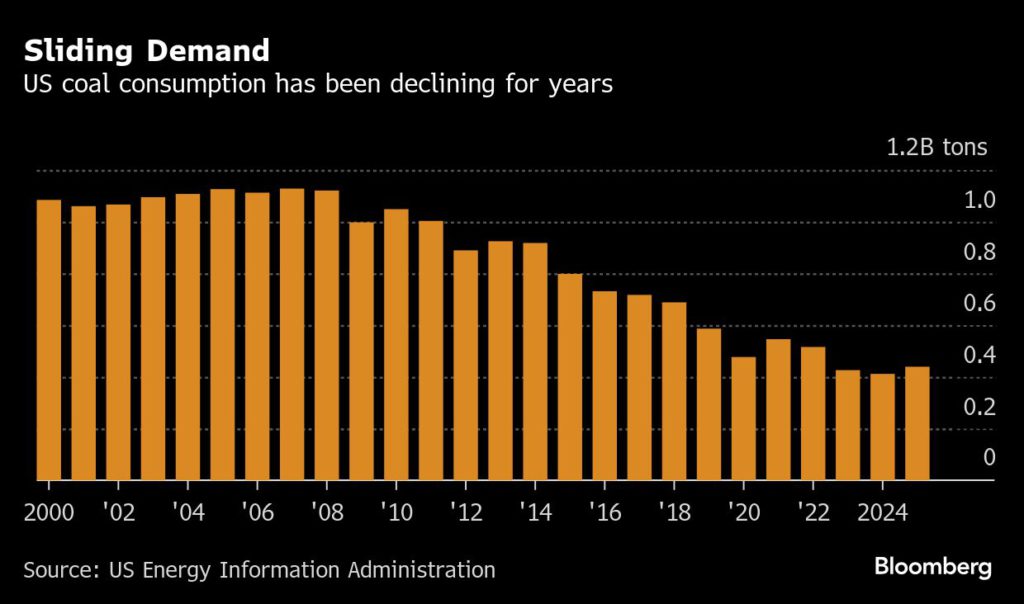
US coal usage has been steadily declining as utilities shift away from the dirtiest fossil fuel. But President Donald Trump’s pro-coal and anti-renewable approach has included blocking plans to shut down this from a Michigan power plant that burns fuel from Peabody. Total consumption is expected to be 439 million tons this year, according to the US Energy Information Administration. That’s up 6.7% from last year, but well down from its 2007 peak of 1.13 billion tons.
“Peabody sees great untapped potential for existing US coal plants,” Mark Spurbeck, chief financial officer for the St. Louis-based company, said by email.
Electricity demand in the US is set to climb 25% through 2030, driven by factories, increasingly electrified homes and especially from the booming buildout of data centers used for artificial intelligence. At the same time, supply-chain constraints have hindered utilities’ efforts to add more natural gas plants.
That’s spurring increased reliance on underused coal plants, which have significant potential to deliver more power.
The US fleet was operating at just 42% last year, according to Peabody, compared to 72% in 2008.
Still, anticipating demand to climb by 250 million tons assumes that coal plants are all ramped up close to the historic levels that preceded the global financial crisis of 2008, which is unlikely, said Andy Blumenfeld, director of data analytics at McCloskey by Opis.
“That’s a really big number,” he said. “It’s a theoretical maximum, if everything works perfectly. And they don’t.”
(By Will Wade)
JS Link America to invest $223M in rare earth magnet manufacturing plant in Georgia
Industrial facility for processing rare earth elements. Stock image.
Magnet manufacturer JS Link America announced Thursday it is investing about $223 million to establish a new rare earth permanent magnet manufacturing facility in Columbus, Georgia.
JS Link’s new manufacturing facility will be located at the Muscogee Technology Park in Columbus. The 130,000-square-foot facility is predicted to have an annual production capacity of 3,000 tons, and the company said it will create approximately 520 new jobs in Muscogee County.
JS Link America is a subsidiary of Seoul, Korea based biotechnology company JS Link that specializes in research and development. JS Link is nearing completion on a similar permanent magnet facility in Yesan, Korea, with an anticipated a pilot production run in September and annual capacity of 1,000 tons.
Rare earth metals are essential in heavy magnets that power electric vehicles, consumer electronics and military applications, and MP Materials is the only US producer, out of its Mountain Pass mine in California.
“JS Link America strengthens Georgia’s role in securing the U.S. supply chain in industries such as aerospace, mobility, and energy,” Governor Brian Kemp said in a statement.
“From day one, Georgia’s economic development team, local community leadership in Columbus, and Georgia Power all welcomed JS Link with a pro-business approach. Georgia’s universities with their engineering programs also provide ready-made labor force for JS Link America,” JS Link America CEO Jun Y. Lee added.
“JS Link plans to be a part of a value chain focused entirely on Western nations to meet the growing demand for permanent magnets sourced from strategic allies such as Korea. This new chain will cover the entire process, from the procurement of essential rare-earth materials to the final manufacturing of the magnets.”
The 130,000-square-foot facility is predicted to have an annual production capacity of 3,000 tons. Operations are expected to begin in late 2027.
Operations are expected to begin in late 2027, the company said.
Smackover Lithium’s DFS reports ‘robust economics’ for Arkansas project
LSS Koch technology in action. Image from Smackover Lithium.
Smackover Lithium, a joint venture between Standard Lithium (TSX-V, NYSE-A: SLI) and Norway’s state-owned petroleum company Equinor (NYSE: EQNR), has announced results of a definitive feasibility study (DFS) for its South West Arkansas (SWA) project.
Smackover Lithium is developing a greenfield lithium extraction and chemicals production facility in the southwestern region of Arkansas. In January, the JV received a $225 million grant from the US Department of Energy to support the construction of Phase 1 of the project.
The DFS projected an initial production capacity of 22,500 tonnes per annum (tpa) of battery-quality lithium carbonate (Li2CO3). This would make SWA the first commercial lithium production in the Smackover Formation, an underground geological formation stretching from Florida to Texas filled with lithium-rich brine.
Analysts estimate that the Smackover Formation could host more than 4 million tonnes of lithium, enough to power millions of electric vehicles and other electronic devices.
DFS results
The DFS detailed a production plan with average lithium concentration of 481 mg/L, underpinning a minimum 20-year operating life with ample opportunity for significant further expansion.
The study envisions a pre-tax net present value of $1.7 billion and an internal rate of return of 20.2%, assuming a discount rate of 8% and a lithium carbonate price of $22,400/t, the average of Fastmarket’s 20-year forward pricing curve for battery-quality lithium carbonate.
The all-in capex estimate of $1.45 billion was based on an 18-month detailed front-end engineering design (FEED) process, which yielded capital definition well beyond typical DFS studies, the company said, adding that conservative adoption of pilot plant learnings used in the FEED could lead to improved capital intensity in future expansion phases.
As a result, the DFS forecasts average cash operating costs of $4,516/t over the operating life and average all-in costs of $5,924/t.
Since completion of the prefeasibility study (PFS), the JV has re-entered wells and drilled a new in-fill well to support upgrading the resource and modeling proven and probable reserves.
The total measured and indicated resource is 1,177,000 tonnes lithium carbonate equivalent (LCE) at an average concentration of 442 mg/L for 0.5 km3 of brine volume. The proven reserves are 447,000 tonnes LCE at an average concentration of 481 mg/L for 0.2 km3 of brine volume.
First commercial DLE site in US
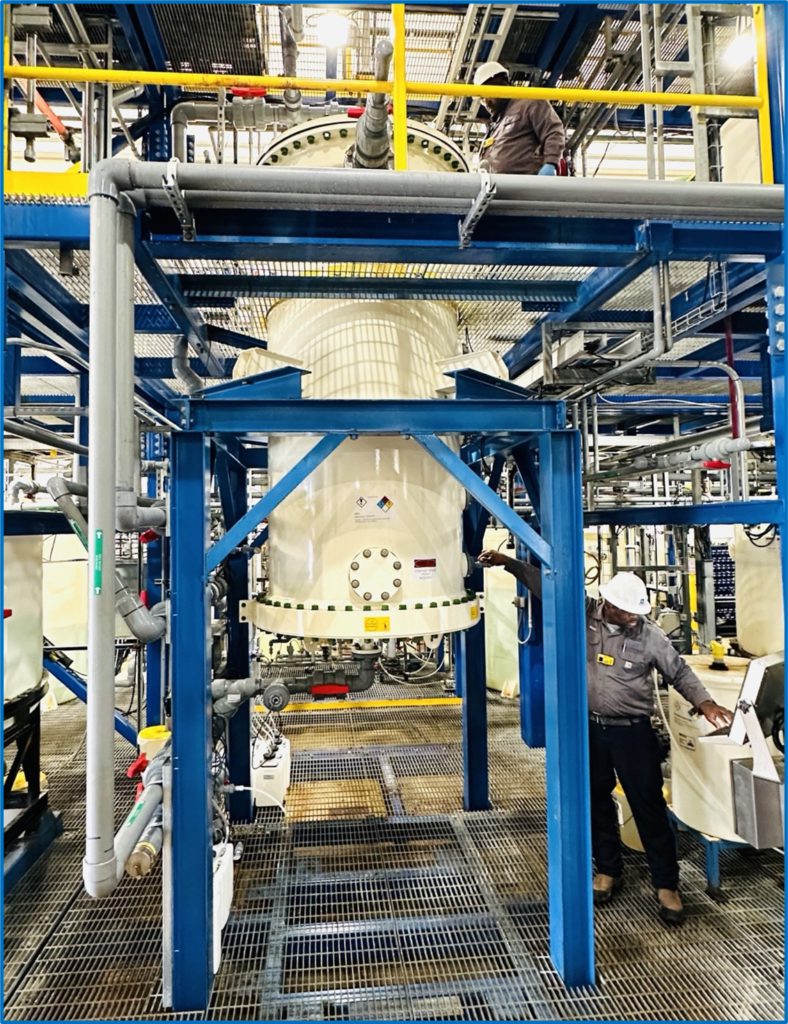
Smackover Lithium is licensing Koch Technology Solutions’ lithium selective sorption process for the initial phase of the project, which includes performance guarantees.
Opportunity exists for further operational and cost improvement on future expansion phases with regional exclusivity for the technology in the Smackover under a joint development agreement, Standard Lithium said.
“The robust economics from our SWA project DFS confirm what we’ve known for a long time – that this is a world-class asset and opportunity,” Standard Lithium’s president and COO Andy Robinson said in a news release.
“Through years of extensive testing and development we have substantially de-risked the process technology and increased our confidence in project execution,” Robinson added. “We are well-positioned to move the project towards a final investment decision and are excited by the prospect of being a domestic champion for securing critical minerals production in the United States.”
The company is targeting first production in 2028.