Friday, September 05, 2025


When getting a job makes you go hungry


University of Utah Health


Key points:

  • Utah refugees face very high levels of food insecurity.

  • Food insecurity spikes when refugees become ineligible for food assistance.

  • Proposed solutions include improving education about resources and increasing access to gardens.

IMPACT: Timely interventions to reduce food insecurity could benefit health and save the U.S. healthcare system billions.

Three months ago, you left your country fearing for your life. 

Now, you’re learning to navigate a new city, where the street signs are in a new language. You’re learning to navigate social interactions that operate on slightly different rules. You’re applying for jobs to support your family. You’ve figured out how to get to the grocery store that sells food your kids will eat—and how to use food assistance programs to get it.

Except that today, those benefits have unexpectedly stopped working. You have no job, no savings, no broader network of friends. And now, you have no food.

What will you do?

This is the situation that faces many newcomers to the U.S. Incoming refugees face very high levels of food insecurity—up to 85% for particularly vulnerable populations. Now, a new study published in PLOS One identifies unexpected “danger zones” when the risk of going hungry is highest and proposes solutions to help new residents thrive.

Patterns of hunger

Researchers interviewed Utah refugees from eight countries to learn when they were most likely to have trouble affording food—and some of the answers were “shocking,” says Nasser Sharareh, PhD, research assistant professor of population health sciences at University of Utah Health and the first author on the study. Most surprisingly, he says, “Finding a job can make refugees more food insecure.”

Resettlement agencies heavily focus on empowering refugees to attain financial independence by getting a job. But often, a refugee’s first job is unstable and low-paying. Their new income is enough to disqualify them from the Supplemental Nutrition Assistance Program (SNAP benefits, or food stamps)—but not enough to cover food on top of housing and utilities. And if that first job ends, refugees find themselves back in the deep end.

Another pressure point is when SNAP applications should be renewed. When they arrive in the U.S., refugees are enrolled into SNAP by a caseworker at a resettlement agency. But to maintain benefits, most refugees must reapply for SNAP every six months. Many aren’t informed that they need to do this—or taught how to reapply. Some people whose SNAP benefits expired went without benefits for up to two months, despite being eligible for them the whole time.

Information is key

Interviewed participants proposed a variety of strategies that could help address or reduce food insecurity—and one of the most actionable is better information. Translated information on topics like food banks and how to apply for SNAP could be a low-cost measure to help empower refugees to find enough food.

Refugees also proposed increasing access to gardens so that they could grow their own food. “Most of these refugees have a gardening and farming background,” Sharareh says. “This is what they are good at.”

A program called New Roots connects refugees with opportunities to grow food and sell it in farmers’ markets. But most interviewed refugees were unfamiliar with the program—another area where simply improving information could make a difference.

Sharareh emphasizes that reducing food insecurity will benefit the economy as a whole, due to reduced societal and health care costs from food insecurity-related diseases. “Food insecurity is costing the U.S. health care system more than $53 billion annually,” he says. “So besides having a public health impact, addressing food insecurity can have a positive economic impact on U.S. society.”

In the future, Sharareh hopes to continue to collaborate with community partners, resettlement agencies, and refugee organizations throughout Utah to develop some of the strategies refugees suggested, especially by addressing the information gap. “We can at least make sure that refugees know where to go when they need help,” he says. “These refugees are exploring a new culture, a new society, a new language, and will become U.S. citizens. They need time. But in the meantime, what if we just make sure that they have the information they need?”


If you’re having trouble getting enough food, you can call 211 or apply for SNAP here.

You can find more resources for Utah refugees here or in-person at the Utah Refugee Center.

###

The results are published in PLOS One as “Addressing food insecurity among U.S. refugees, considering the temporal patterns of food insecurity after resettlement: Qualitative insights from Utah.”

The work was supported by the Spencer Fox Eccles School of Medicine at the University of Utah’s Vice President of Research Incentive Seed Grant Competition.


U.S. Biofuel Imports Slump After Blending Mandate Change

Biodiesel imports to the United States fell to their lowest in ten years over the first half of the year after the federal government axed subsidies for such imports at the start of the year.

From 2025, the subsidies, at $1 per gallon of biodiesel and renewable diesel, remained in effect for domestic producers of the fuel only, Reuters recalled in a report on the news, which comes from the U.S. Energy Information Administration.

Per the EIA, biodiesel imports between January and June averaged 2,000 barrels per day, compared with 35,000 barrels daily for the first half of 2024. Renewable diesel imports stood at an average of 5,000 barrels daily, down from 33,000 barrels daily a year ago.

In addition to the removal of subsidies for imported biofuel, consumption was affected by doubts about the future prospects of biofuels under the Trump administration, as well as sub-zero margins for domestic biofuel refiners.

“Compared with 1H24, U.S. consumption of renewable diesel was down about 30% in 1H25, and biodiesel consumption was down about 40%. This lower consumption reduced demand for both imported and domestically produced biofuels,” the Energy Information Administration said.

Imports of biofuels are expected to remain subdued through 2026 because of the change in incentives, even though consumption of biodiesel and renewable diesel is set to increase in the second half of the year because of the fuel blending mandates under the Renewable Fuel Standard program.

Earlier this year, the Trump administration proposed an increase in biofuel blending requirements for the next two years to boost reliance on domestic supply and reduce imports. For 2026, the amount proposed by the EPA is 24.02 billion gallons, which would be up from 22.33 billion gallons for this year. For 2027, the proposed blending mandate is 24.46 billion gallons.

By Charles Kennedy for Oilprice.com

Uranium Shortage Jeopardizes Nuclear Renaissance

Tight supply of uranium could interfere with global plans for a boost in nuclear generation capacity growth, the World Nuclear Association has warned.

According to the industry body, global uranium demand is set to increase by over 30% to 86,000 tons over the next four years, further rising to 150,000 tons by 2040, the Financial Times reported.

While demand rises, however, supply will be shrinking, with output from existing mines set to fall by half in the decade between 2030 and 2040. Based on that, the World Nuclear Association said.

“As existing mines face a depletion of resources in the next decade, the need for new primary uranium supply becomes even more pressing,” the association warned. “Considerable exploration, innovative mining techniques, efficient permitting, and timely investment will be required.”

The World Nuclear Association’s warning echoes an earlier one, made by the International Energy Agency in April. In a report on nuclear energy, the IEA said the sector was enjoying renewed interest but that supply of its key ingredient was getting increasingly tight, because new nuclear power plants were being built faster than uranium mining was expanding.

“More than 70 gigawatts of new nuclear capacity is under construction globally, one of the highest levels in the last 30 years, and more than 40 countries around the world have plans to expand nuclear’s role in their energy systems,” the IEA's Fatih Birol said at the time.

The World Nuclear Association, for its part, reported that global nuclear generation capacity was on track to increase twofold to 746 GW by 2040. A lot of that new generation capacity will be in China. Meanwhile, starting a new uranium mine takes between 10 and 20 years, which would create a gap between demand and supply for the nuclear fuel.

“The whole ecosystem needs to be in equilibrium, and it’s not,” the chief executive of Energy Fuels, a U.S. uranium miner, said. “There are clouds on the horizon.”

By Irina Slav for Oilprice.com


TRUMP'S WAR ON WINDTURBINES

Ørsted Cuts Core Profit Guidance Amid Offshore Headwinds

HAS GLOBAL IMPACT

Ørsted has lowered its guidance range for core earnings for 2025, due to lower wind speeds across the portfolio and a delay of a construction project in Taiwan, as the world’s biggest offshore wind project developer grapples with challenges in the industry.

Ørsted revised down its guidance for earnings before interest, tax, depreciation, and amortization (EBITDA) to a range of $3.7 billion-4.2 billion (24 billion to 27 billion Danish crowns) for this year, down from $3.9 billion-4.4 billion (25 billion to 28 billion crowns) previously expected, the company said on Friday.  

Ørsted is holding today an extraordinary shareholders meeting to vote on a proposed $9.4 billion (60 billion Danish crowns) rights issue to raise capital from existing shareholders as challenges for the industry continue to mount.

Lower-than-normal offshore wind speeds during July and August and a delay to construction of the Greater Changhua 2b project in Taiwan will impact core earnings adversely by $235 million, warned Ørsted.

Earlier this week, Equinor, which holds 10% in Ørsted, said it would take part with $939 million in the rights issue, as the Norwegian energy major signaled “confidence in Ørsted’s underlying business, and the competitiveness of offshore wind in the future energy mix, in selected geographies.”  

Equinor said it expects consolidation and new business models to emerge from the current challenges in the industry, and believes that a closer industrial and strategic collaboration between Ørsted and Equinor can create value for all shareholders in both companies.

In a setback in the United States, Ørsted was issued a stop-work order on a nearly completed project by the U.S. Administration. Revolution Wind LLC, Ørsted’s 50/50 joint venture with Global Infrastructure Partners’ Skyborn Renewables, received a stop-work order from the U.S. Department of the Interior’s Bureau of Ocean Energy Management (BOEM).

The Revolution Wind project is 80% complete, with all offshore foundations installed and 45 out of 65 wind turbines installed. The partners in the project on Thursday sued the U.S. Administration, challenging the stop-work order.

By Tsvetana Paraskova for Oilprice.com


THE GRIFT

Japan Considers Major Investment in Alaska LNG

THERE IS NO ALASKA LNG PRODUCTION

Japan is exploring offtake agreements to buy LNG from the planned export project in Alaska as part of the Japanese pledge to buy $7 billion worth of U.S. energy products, per a joint statement on the U.S.-Japan trade deal quoted by Reuters on Friday.  

On Thursday, U.S. President Donald Trump signed an executive order to implement the U.S.-Japan trade agreement reached in July. 

Under the agreement, Japan gets a 15% tariff on its goods and pledges to buy $8 billion worth of American products per year. The Government of Japan has agreed to invest $550 billion in the United States, the White House said. 

U.S. Secretary of Commerce, Howard Lutnick, hailed the deal as “historic” and said that the U.S. would use the $500-billion Japanese investment “to build our energy infrastructure, chip manufacturing, critical minerals mining, and shipbuilding to name a few.” 

“What we’ve achieved with our Japanese partners is an absolute game changer for America’s future — and it’s exactly what the America First trade agenda is all about,” Lutnick posted on X. 

In July, as President Trump touted “the largest trade deal in history” with Japan, he also noted that the United States and Japan are set to conclude another deal to form a joint venture for LNG in Alaska. 

“We concluded the one deal ... and now we're going to conclude another one because they're forming a joint venture with us at, in Alaska, as you know, for the LNG,” President Trump said in comments on the deal to GOP lawmakers at the White House.   

Japanese companies have been considering investments in the $44-billion Alaska LNG project, but so far they have appeared to be concerned that the costs may be too high, considering the cold weather in Alaska and the scale of the pipelines needed to bring the project on stream.  

Energy companies are ready to commit to buying $115 billion worth of LNG from Alaska once President Trump’s pet energy project gets done, the company in charge of the project, Glenfarne, said in June, noting that as many as 50 companies have expressed formal interest.  

By Tsvetana Paraskova for Oilprice.com


Bangladesh Becomes LNG’s Hottest Story

  • Bangladesh has become Asia’s most active spot LNG buyer as domestic gas output falls and demand rises.

  • Long-term deals with Qatar and Oman cover only part of the gap, so spot imports have surged.

  • Reliance on spot LNG is creating financial and energy-security risks.


Bangladesh has become Asia’s most active buyer of spot LNG cargoes – an unlikely new heavyweight in one of the world’s most volatile energy markets. Once largely self-sufficient in natural gas, the country now leans heavily on imported fuel to keep its factories running and its power sector alive. The shift is dramatic: gas still meets 43% of Bangladesh’s total energy needs, but domestic production is falling, reserves are dwindling, and the gap is being filled at a soaring cost. What began as a stopgap after shortages in 2017–18 has snowballed into structural dependence, pushing Bangladesh into the spotlight of the global LNG trade – and exposing the financial and systemic weaknesses that brought it there.

Domestic production peaked at 27 bcm/y in 2018, but will have slipped to 20 bcm/y by 2025. Consumption, meanwhile, was at 29 bcm/y in 2025 and is forecast to rise even higher. The shortfall is widening, and local producers – Chevron with almost 60% of national output, Petrobangla covering slightly less than 40%, and Tullow at 2% - cannot close the gap. Chevron has proposed new onshore developments that could add 14 bcm/y of incremental output, but such projects would take years. The immediate solution is LNG, and increasingly, spot-market LNG.

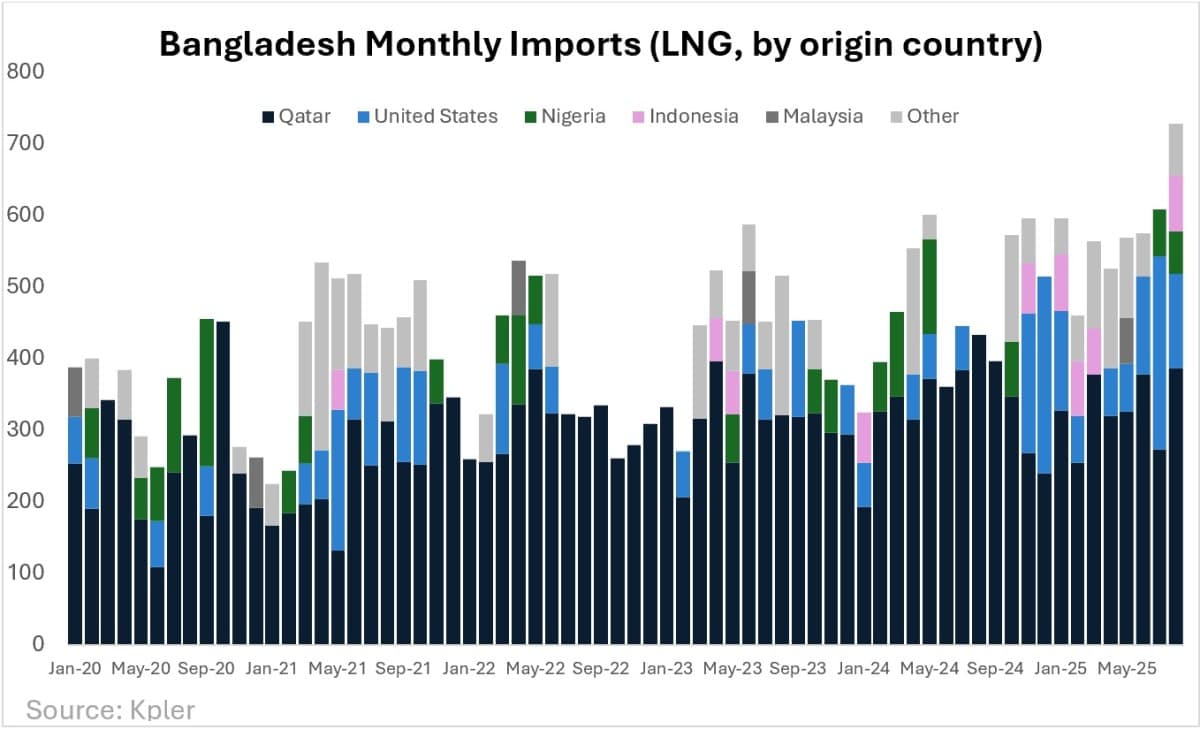
Bangladesh’s turn to LNG began in 2018, after severe gas shortages in 2017–18 disrupted power generation and industry. Qatar was first to step in with the inaugural cargo, opening the door to a broader import program. From there, purchases quickly widened beyond Doha: according to Kpler data, by 2019, total LNG inflows reached 3.9 million tons LNG, rising to 5.7 million tons in 2024 as demand kept outpacing domestic production and additional sellers – most notably the U.S., Malaysia, and Indonesia – entered the mix. Qatar remains the anchor for the brunt of Bangladesh’s gas requirements via a 2.5 million t/y long-term deal, with two more contracts due from 2026. However, other suppliers have sought to expand into the South Asian country - Oman’s OQ Trading signed a 1.2 million t/y contract in July that would make it the second-largest supplier during its term. Even so, those contracted volumes cover only part of the deficit. To bridge the rest, Bangladesh has leaned hard on the spot market: August 2025 imports hit a record 728 Kt, up 57% year-on-year from 413 Kt, and state-run RPGCL bought 35 spot cargoes in January–August versus 21 a year earlier. US LNG has seen a marked ramp-up in the process, with this year’s imports surpassing 2024 readings by mid-July and continuing to go strong ever since. All this has propelled Bangladesh into the top tier of Asian spot LNG demand, competing directly with China and India for cargoes.

Such a position brings visibility – but also systemic risk. Unlike its larger peers, Bangladesh lacks the financial depth to absorb spot price spikes. Gas accounts for approximately 43% of power generation, meaning any supply shock threatens the country’s electricity security. Gas is sold at heavily subsidized prices, far below global market levels, leaving national energy company Petrobangla with mounting deficits – $690 million projected by the end of 2025. The Bangladesh Energy Regulatory Commission has moved to rise gas tariffs: for instance, fertilizer producers are facing proposed increases of 150%. But the squeeze will pressure the backbone of Bangladesh’s economy: textiles, agriculture, and manufacturing that generate the bulk of their export earnings. Spot-market exposure magnifies the dilemma – every global price swing reverberates through domestic industry, jeopardizing competitiveness, stoking inflation, and putting the national grid at risk.

The fiscal stress has already forced Dhaka into extraordinary measures. In June, the government issued a sovereign and indemnity guarantee to the World Bank – an unprecedented step for commodity imports rather than development lending. The World Bank approved $350 million immediately and plans to mobilize another $2.1 billion in private capital over the next 7 years. These funds will keep LNG cargoes arriving and allow Petrobangla to meet obligations under long-term sales purchase agreements (SPAs). But they highlight the irony at the heart of Bangladesh’s new status: the country has become Asia’s most active spot LNG buyer not out of strength, but out of urgent necessity – and propping up its energy security only by means of financial lifelines.

Infrastructure is another significant constraint. Two floating storage and regasification units (FSRUs) at Moheshkhali, each with 3.8 million tons annual capacity, are the only gateways for LNG into the country. Rising imports and maintenance demands make this system increasingly fragile. A planned onshore terminal at Matarbari – designed for 7.5 million t/y – has stalled since the interim Yunus government cancelled the tendering process for the LNG terminal in September 2024. That leaves Bangladesh exposed: without new regasification capacity, its prominence in the spot market risks becoming a liability, with cargoes arriving faster than the country can process them.

Foreign players sense opportunity. Russia’s Novatek has proposed a 7.5 million t/y gravity-based terminal on a 25-year build-own-operate-transfer (BOOT) model. Accepting this would entrench Moscow’s role in Bangladesh’s energy sector but possibly complicate relations with Western partners. Yet for Dhaka, the choice is less geopolitical than practical: unless new terminals are built, Bangladesh cannot sustain its spot-market appetite.

Bangladesh’s rise as Asia’s leading spot LNG buyer is both a symbol and a warning. It reflects the country’s rush to keep its energy system running, but also exposes the flaws that forced it into this role: underinvestment in exploration, delayed infrastructure, and a tariff system that masks costs while bleeding public finances. By seizing a prominent place in Asia’s LNG spot trade, Bangladesh has drawn attention not only to its demand but to its fragility. Unless it rebalances with new domestic supply, credible long-term contracts, and sustainable pricing, the country risks remaining exactly what it is today: the buyer of last resort in a market it cannot control.

By Natalia Katona for Oilprice.com