Saturday, September 06, 2025

Interview

Authoritarian Wave in US Shows Democracy’s Fragility, South African Scholar Says


The racist upswell in the US looks “clearer from the outside,” says South African philosopher Nuraan Davids.

September 6, 2025
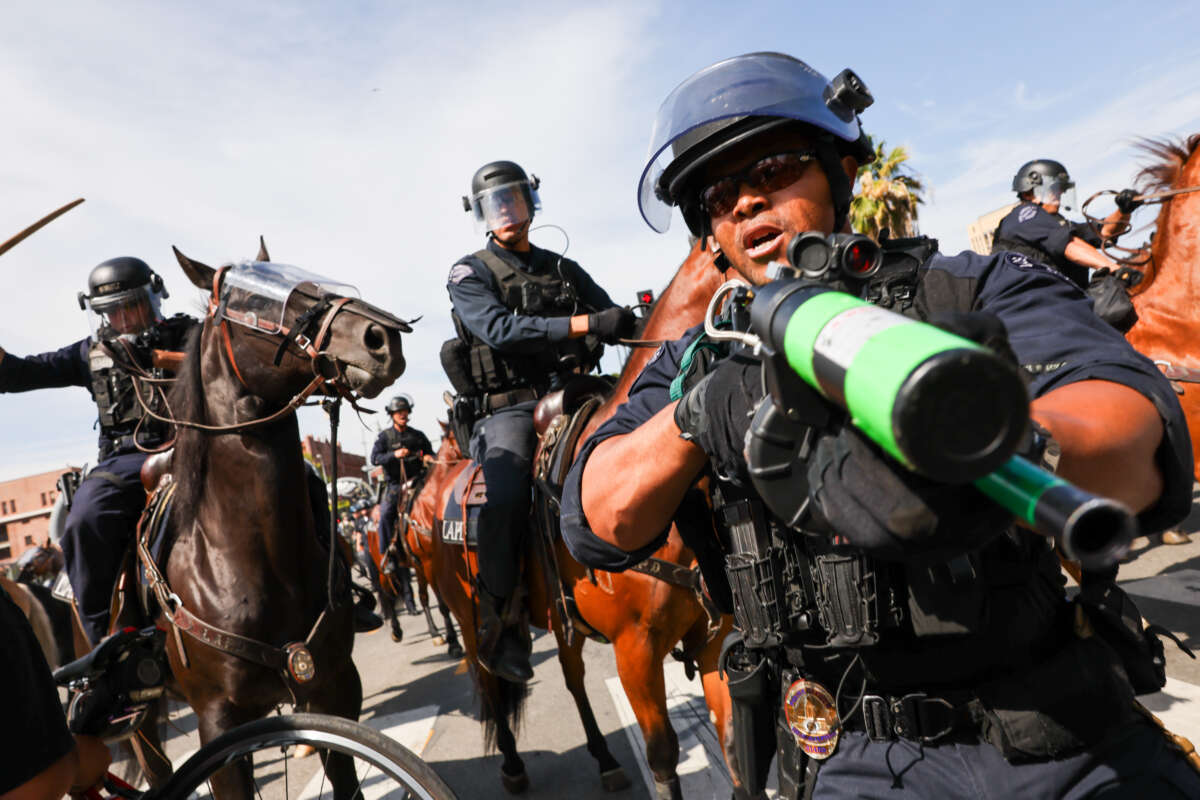
Protesters face off with police outside of a federal building in downtown Los Angeles for an anti-Trump "No Kings Day" demonstration in a city that has been the focus of protests against Trump's immigration raids on June 14, 2025, in Los Angeles, California.
Spencer Platt / Getty Images

Donald Trump’s war on diversity, equity, and inclusion (DEI) is not only an attack on the importance of education as a space for cultivating critical thought — it is also a direct attack on Black people.

Trump’s attacks are buttressed by his commitment to an authoritarian playbook that wallows in weaponizing differences against the backdrop of creating historical myths — in this case about the supremacy of whiteness.

However, we mustn’t forget that DEI can also function insidiously as a form of appeasement and deception. In other words, hegemonic whiteness, well before Trump, has never ceased to exist within this country. As such, whiteness accommodates differences but maintains its normative power. Within the context of education, this means that the appearance of difference (think here of university and college brochures that are spattered with faces of color) can exist alongside the power of whiteness and its control over what counts as knowledge or over whose history matters. Hence, as philosopher Nuraan Davids argues, “diversity is seen as an appendage to a pre-existing ethos, which remains undisturbed by how things ‘ought to be.’”

Davids is professor of philosophy of education and the chair of the Department of Education Policy Studies in the Faculty of Education at Stellenbosch University. Her most recent publications include Academic Citizenship, Identity, Knowledge, and Vulnerability (2023); and Out of Place: An Autoethnography of Postcolonial Citizenship (2022). ​​In this exclusive interview, Davids radically critiques authoritarian control over what should be a democratically functioning U.S. educational system and lays bare the perfunctory dimensions of DEI that preserve whiteness as normative, bringing in unique insights from abroad. The interview that follows has been lightly edited for clarity and length.

George Yancy: Your work has been important in terms of critiquing the ways in which concepts like “diversity” and “inclusion” actually function to conceal the continuing existence of structures of power (say, white supremacy). My point here is not to exempt Trump and the right wing from critique as they eliminate DEI and replace it with the myth of a “post-racial” and “meritocratic” U.S. I am concerned that DEI was never radical enough to begin with. Talk about how you understand the ways in which DEI can parade as a political and academic good while systems of hegemonic power continue to operate in universities.

Related Story

Op-Ed |
Pete Hegseth Has Banned 3 of My Books From the US Naval Academy
Censorship is an act of cowardice and a direct refusal of the mirror I hold up to the US’s racist past and present. By George Yancy , Truthout May 18, 2025


Nuraan Davids: As much as DEI programs are needed in some instances, there are complexities and problems with DEI as a concept and program. Diversity is deployed as a collectivist and homogenous concept, inclusive of all differences, with scant regard for the differences within differences. In turn, inclusion exists in a dyadic relationship with exclusion; inclusion cannot be understood in the absence of exclusion. Both the concept and the idea of DEI programs are taken for granted, because most universities seem to think that the mere presence of these programs means that they are doing something. What the “something” is hardly matters, because the mere presence of policies and programs is deemed as a sufficient indicator of transformation (at least by those who design the policies and programs). Yet, in deliberately setting out to let some diversity in, others are inadvertently also kept out. This is because diversity is constructed as an anomaly, in need of management and regulation — incapable of naturally finding its place in the university. Instead, it can only be ushered in to a very low saturation point, because “too much” diversity will not only negate the need for DEI programs, but more importantly, also disturb the status quo.

The point is that DEI programs are not interested in diversifying university spaces; they are interested in letting in just enough diversity to create the impression of “doing something,” as a ready response to racism. I don’t believe that DEI programs have shifted beyond the strategic placement of certain bodies. I don’t think that most of these programs are accompanied by any conscious desire to unlearn certain patterns of behavior that have kept diversity at bay, or how to relearn how to be with others. Instead, diversity is seen as an appendage to a pre-existing ethos, which remains undisturbed by how things “ought to be.” So even when diverse bodies are let in, this is not a fully encompassing entry or participation. It’s a negotiation, underscored by an unarticulated code: “We’ve let you in, so be grateful.” The code reflects the agency of the “we,” so that the subjectivity of those “let in” are reminded of their “rightful” place.

Once in, diverse bodies know that to remain “let in,” they need to contain themselves: Don’t be too Black, too gay, or too Muslim; keep your way of life and living knowledge traditions to yourself. The moment diverse bodies renege on the unspoken code, by being too visible in their diversity — whether it’s in how they dress, speak, or by having a point of view — they and the knowledge they bring are viewed as a threat. So, there are a few questions worth asking: Have DEI programs made any difference in the thinking and functioning of higher education in the U.S.? Are DEI appointments or promotions privy to the same set of academic goods and freedom as those not burdened by a diverse marker? Is the knowledge carried by diverse identities conferred the same value as the golden standard embodied by white, male academics? The treatment of Nikole Hannah Jones, as just one example, suggests not.

Much can be said about Trump’s deeply troubling onslaught on education in the U.S., but it’s a mistake to think of Trump as a singular problem. The right-wing social imaginary is hardly as imaginary as we think. It’s thriving — whether in the U.S., in Modi’s India, or in the ruins of Gaza. If anything, it’s the liberal imaginary that’s buckling under the weight of its own pretense, which begins to explain why it has been so easy for Trump to upend the DEI programs and trample on the academic freedom of universities. The U.S. has been a democracy for a much longer period than my home, South Africa. It prides itself as the world’s greatest democracy, and every single one of its universities rides on that democracy and claims to be an inclusive space. Why does the need for DEI programs persist? Why has the very idea of DEI programs not jarred university leaders, managers, administrators, and academics into introspective reflections on their institutional cultures? If the U.S. and its universities are as liberal as they would like the rest of the world to think, then why, after two-and-a-half centuries, are they struggling to include diversity without the assistance of a program?

Like you, I certainly would not want to exempt Trump, but it just seems too easy to lump what is happening in the U.S. right now at the door of one individual. That door was opened for him — twice over — by most of the American people. And what he has done, as an elected president, is to stop the parade by being quite honest about the depth and strength of white normativity. And Trump has succeeded not only because of his own authoritarianism, but also because the majority of educational institutions in the U.S. still propagate white normativity. And until this normativity is confronted, unapologetically, diversity will continue to be relegated to the margins of programs, waiting to be let in.

As a critical scholar and teacher in South Africa, as someone who sees what is happening from a distance, what are some of the horrors that you see taking place within the U.S. in terms of the Trump/right-wing attack on education? As you know, higher education demonstrates patterns of discursive closure, where the space for what is unpopular (dare I say freedom of thought itself) is placed under erasure. How do you see this erasure (which I take to be one of these horrors) taking place in the U.S.?

Let me start by saying that things always look clearer from the outside, and it’s always easier to make certain judgments when the full horror of what is happening in the U.S. does not bear down on one’s daily life and work. So, I say the following with sensitivity: I am incredibly surprised that there has not been a harder pushback from universities — students, academics — to Trump’s authoritarianism. I think of the protests that have been sparked in response to the clampdown on immigrants or the reverberating voices of Black Lives Matter, a movement which encouraged young people in South Africa to call out racism in their schools on social media, leading to an outpouring of rage against the systemic racism within the some of the country’s most elite schools. So, I cannot understand why similar kinds of protests have not erupted to preserve the integrity of what it means to be a university.

What Trump and his administration are doing far exceeds curricula, or a systematic repeal of discourses on critical race theory, gender, or systemic inequality. As someone who has endured apartheid’s systemic dehumanization and violence, and who understands the weaponization of knowledge and language, I see the crisis in higher education as an epistemological one. The U.S. is witnessing and living the flaring of the colonialist project. For those who might dismiss this claim, it is important to understand that colonialism does not only occur through a foreign occupation or the prohibition of a state formation; rather, colonialism also lives in the othering and denigration of others, their way of life and thought. Trump is seeking to (re)-invoke the hegemonic narratives of America’s past by simultaneously erasing the lived experiences of racialized America. By prohibiting books deemed as “divisive,” he is not only shutting down epistemological pluralism, critical thinking, or academic freedom. He is also not only delegitimizing certain kinds of knowledge. He is also proscribing the rights of all Americans to access and engage with certain kinds of knowledge. Importantly, the crisis being created here is neither limited to educational sites, nor is it only an educational crisis. The spillover onto American society is direct and inevitable, with Trump being unequivocally clear about the kind of society he wishes not to create, but to restore.

When citizens/students are not open to the diversity of knowledge that informs the living traditions of a pluralist and multicultural society, then it means that they will neither know about epistemological pluralism, nor how to engage with it. It also means that whatever they know would have been gained from echo chambers, which might perpetuate stereotypes, biases and blatant mistruths, all of which contribute to a society of mistrust, fear, and antagonism. What Trump is effectively doing is halting the cultivation of a pluralist and multicultural society. He is saying that in the U.S., it is sufficient to only have knowledge of white normativity. Any knowledge that detracts from this must be stopped, so that young people do not learn about that which is disagreeable to white ideological norms.

In the U.S., we are witnessing an attack on the democratic life of universities, colleges, and schools. As someone who passionately writes about, teaches about, and fights for the democratizing of universities in South Africa, what critical interventions do you suggest to teachers and students here in the U.S. as we struggle with the attack on education?

I think it’s important to recognize that universities can never be sites of complacency of consensus. The very idea of a university is to recognize and cultivate spaces for competing truths, ideas, being, and acting. The university is fundamentally a place of struggle — open to different political and social imaginaries and interests, and cognizant of its role in society. Teaching and learning, therefore, are certainly not meant to bring about comfort. Teaching ought to be provocative, and geared toward inviting curiosity about this world, others, and what we bring to this world. What I am proposing is not a critical intervention; it’s a reasonable realization and expectation that with knowledge comes responsibility.

So, my suggestions are critical, yet modest, if one considers that what I am proposing should be a natural part of what it means to be a teacher, academic, or researcher in higher education. Academics and students alike need to reclaim their (academic) freedom. They should not wait for it to be given or returned; they should simply lay claim to it, demand it! I see the presumption of academic freedom as akin to Jacques Rancière’s contention: Equality is a presupposition, an initial axiom — or it is nothing. Without academic freedom, the university is nothing.

I am sure that there are individuals or groups that are and have always been pushing back against attempts of censorship and prohibition in the U.S. But these voices need to be amplified in carefully planned movements and protests. Students played an immensely powerful role in the struggle against South Africa’s apartheid. I would go as far as saying that without their contribution, South Africa’s liberation might have been further delayed. They were unwavering in their commitment to liberation, even at the expense of education, because they understood that even if educated, they would still be without freedom. Freedom to think, question, and to pursue different kinds of knowledge evokes a critical consciousness, which equips us to call out injustices, whether in our immediate midst or elsewhere. Freedom turns us toward others, so that we understand our interconnection. Without freedom, regardless of how educated we are, we can neither defend ourselves nor others. Notably, students’ voices have not subsided in South Africa’s democracy; they have learned that democracy must be held accountable to its own ideals, and hence movements such as “fees must fall” and “Rhodes must fall,” which evolved into a transnational call for the decolonization of universities.

Crucially, the repression and authoritarianism being imposed in America right now is not an American problem. Right-wing authoritarianism is a global scourge; Trump is one player, and America is one country. It is time for American academics and students to look outward beyond their national borders to contexts that have endured much worse than what Americans are experiencing. There are no shortages of oppressive and repressive battlegrounds. More importantly, there are no shortages of epistemic resistance and values. It is important, therefore, for universities to actively forge and to learn from transnational collaborations and alliances, but this would require a shift in the mindset of how knowledge from others is viewed.

Within the South African context, you have written about trust and mistrust within pedagogical spaces. Without conflating what happens within South African pedagogical spaces and U.S. pedagogical spaces, please discuss the important dynamics of trust and mistrust. I ask for this reason: In the U.S., students and teachers who might normally feel “safe” naming the reality of systemic racism and white privilege are faced with the possibilities of serious draconian backlash. Under conditions of a Trumpian neo-fascist regime, how should students and teachers think about trust and mistrust?

Issues of trust and mistrust cut across contexts and educational systems. As much as our world has changed, advanced, and deteriorated, human nature remains the same. Most of us attach a common value to what it means to be good; we share a common bond in what it means to act with civility and trust. As human beings, we are inherently social; we co-exist with others; we foster relationships based on mutual regard, inclusion, belonging, and safety from harm. To trust someone is not only to believe in who they are, what they say and do; it also includes a belief that those who are worthy of our trust will not harm us, or act in ways that compromise our well-being. When we trust someone, we make ourselves vulnerable. Just as we trust parents to have the best interests of their children at heart, we trust teachers to act in ways that will nurture the development and progress of the child.

So, what happens when the political climate prohibits the acknowledgement of racism and white privilege — effectively forcing teachers into propagating a false narrative? How do teachers conscientize students about the normative ways of the world and its systemic racism? I think in this climate, issues of trust and mistrust become heightened. The role of the teacher, therefore, is not only to guide students in what they can trust, but also in what they should mistrust. The prohibition of a language that calls out racism and white normativity demands a reimagined language in which trust is foregrounded as an ethical encounter, based on mutual regard, compassion, and care. Concomitantly, students should be conscientized to their subjectivity as citizens — that is, they need to be made aware that they are neither neutral observers of their own citizenship and society, nor passive recipients of knowledge. Instead, they have agency and, hence, have the capacity to actively participate in the kind of society they wish to live in. While it might no longer be permissible to speak about critical race theory, for example, it becomes more important to think critically and questioningly about the world. And this includes shifting students into understanding the importance of mistrust.

This is not a call for cynicism. Rather, on the one hand, this is an argument for making young people aware of the fragility of democracy. On the other hand, it is to teach them that in authoritarian contexts, the state does not trust its own citizens to think for themselves. Independent and critical thinking are viewed as threats, and hence must be suppressed, or worse, punished. In this context, mistrust becomes a necessary socio-political response.

The ethical role of the teacher is crucial in this regard — it is up to her to cultivate safe spaces in which students can learn from one another. As one pedagogical example, sharing stories offers a powerful medium through which to subvert white normativity as the only valid ways of knowing, as well as working against the colonial epistemic frame to subvert and recreate possibilities and spaces for resistance. Sharing stories also implies a shift in how teachers come into the presence of their teaching — specifically, by recognizing that students are not only recipients of knowledge; they are also carriers of knowledge. The pedagogical conscientization of young people, therefore, does not only have to come from the teacher. By proving herself as trustworthy, it is possible for the teacher to cultivate classrooms where students feel safe to share their stories, and hence, offer insights and experiences beyond the formal (regulated) curriculum.

This article is licensed under Creative Commons (CC BY-NC-ND 4.0), and you are free to share and republish under the terms of the license.
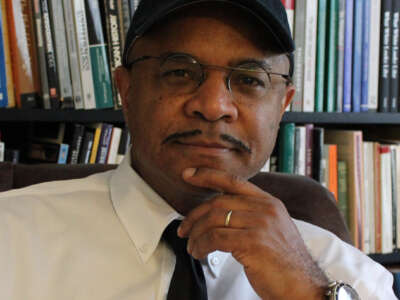

George Yancy
George Yancy is the Samuel Candler Dobbs professor of philosophy at Emory University and a Montgomery fellow at Dartmouth College. He is also the University of Pennsylvania’s inaugural fellow in the Provost’s Distinguished Faculty Fellowship Program (2019-2020 academic year). He is the author, editor and co-editor of over 25 books, including Black Bodies, White Gazes; Look, A White; Backlash: What Happens When We Talk Honestly about Racism in America; and Across Black Spaces: Essays and Interviews from an American Philosopher published by Rowman & Littlefield in 2020. His most recent books include a collection of critical interviews entitled, Until Our Lungs Give Out: Conversations on Race, Justice, and the Future (Rowman & Littlefield, 2023), and a coedited book (with philosopher Bill Bywater) entitled, In Sheep’s Clothing: The Idolatry of White Christian Nationalism (Roman & Littlefield, 2024).
Faculty Want Answers on University Supplying Equipment for “Alligator Alcatraz”


The disclosure intensified existing anger over the university’s police partnership with ICE and ongoing labor disputes.
September 3, 2025

A woman sits by a sign reading "No Human Is Illegal" during a protest as part of the Good Trouble Lives On national day of action against the Trump administration at Florida International University Green Library in Miami, Florida, on July 17, 2025.

This story was originally published at Prism.

Florida International University (FIU) is under fire from one of its own faculty members after news reports detailed that the school provided equipment to the Everglades immigration detention facility known as “Alligator Alcatraz.” The disclosure intensified existing anger over FIU’s police partnership with Immigration and Customs Enforcement (ICE) and ongoing labor disputes, fueling demands for transparency, higher pay, and accountability from administrators.

After Prism and NBC6 reported that FIU supplied an emergency operations trailer to the construction site at “Alligator Alcatraz,” university President Jeanette Nuñez confirmed in a recent NBC6 interview that the university did so at the state’s request, clarifying that the equipment is owned by the state’s Department of Emergency Management, the lead agency overseeing construction and operations of the facility.

“It is a state asset, let’s be clear,” Nuñez told anchor Jackie Nespral. “When the Department of Emergency Management requests a state asset, we have to provide it. We don’t opine, we don’t object. People want to make more out of it than what it was.”

The president was not asked about the implications for the workers who had to carry out the task. Those workers expressed concern when given the order, according to an FIU staff member who previously spoke to Prism on the condition of anonymity out of fear of retaliation. FIU has not responded to Prism’s request for comment.

Faculty leaders say Nuñez’s explanation does little to ease concerns that the university — long touted as a haven for immigrant students — is complicit in immigration enforcement.

Related Story

Organizers Call for Shutdown of Immigrant Jails as Trump Expands Incarceration
Despite public outrage, Trump is doubling down on deportation policies designed to incarcerate 100,000 immigrants. By Mike Ludwig , Truthout July 18, 2025


“FIUPD is ICE,” said Tania Cepero López, the president of the United Faculty of Florida (UFF-FIU) union, referring to the FIU Police Department. “The faculty are amazing, the students are wonderful, smart, and dedicated, and they deserve the best education in the world.”
FIU and ICE Relationship Deepens Fears on Campus

The equipment controversy comes on top of outrage over FIU’s finalized 287(g) agreement, which deputizes campus police as ICE agents. Nuñez defended the decision in the NBC6 interview, arguing that the agreement gives FIU more control.

“If ICE wants to come on campus, regardless of the agreement, they will come,” she said. “So they do have access to come into our campus. The police chief took the position, and I supported him, that he wanted to be in control [of] the situation from the get-go.”

Faculty remain unconvinced. Internal emails obtained by Prism show that the faculty union began pressing the administration in June for guidance on how faculty should respond if ICE enters classrooms in the coming school year. Only on Aug. 22 did the university provide a formal response: ICE can access public areas and enter classrooms with a warrant, consent, or exigent circumstances, and faculty should not obstruct ICE and notify FIUPD. The memo confirmed that FIUPD officers will inform faculty when acting as ICE agents, but stated that the university has “no plans to provide notifications” of ICE operations.

“The main priority right now is compliance, so that there’s no retaliation, so that we don’t lose funding, so that we don’t lose any more grants, so that we don’t lose courses in the curriculum,” Cepero López said of her impression of FIU administration’s motives. “There’s a lot of interference and a lot of oversight happening that, to me, is unprecedented.”

Cepero López added that the partnership with ICE is chilling both teaching and learning on campus. Faculty members, she said, are increasingly worried that under the new agreement, their syllabi, reading lists, and classroom discussions could become targets of political or police scrutiny.

The sense of fear is especially acute among international and undocumented students, according to Cepero López, many of whom have asked whether their classroom attendance could put them at risk if ICE officers entered a lecture hall or classroom. She said professors have reported receiving anxious questions from students regarding protocol around ICE and FIU police. Teachers themselves have been asking what they should do if an agent arrives during class and whether to continue teaching, ask for a warrant, or protect their students. Some students even fear returning to campus due to their immigration status, Cepero López said? .

The climate of uncertainty, Cepero López noted, is compounded by Florida’s broader restrictions on curriculum and diversity initiatives.

“Faculty are wondering, what’s the next thing that we’re going to be forced to do? What’s the next compliance item that we’re going to be forced to spend two hours working on instead of working on our research, instead of working on our lesson plans, instead of working on replying to student emails?” she said. “The morale is as low as I’ve ever seen it.”

Faculty say FIU’s collaboration with ICE undermines the very values that have defined the institution since its founding: diversity, inclusion, and international engagement. As Miami’s public research university, FIU has long recruited students and faculty from across Latin America and the Caribbean. Now, professors warn that that reputation is at risk.
Town Hall Invitation Denied

In an attempt to provide a space for administration to answer the community’s concerns, on Aug. 18, UFF-FIU formally invited FIU’s top leadership, including Núñez, Police Chief Alexander Casas, Provost Elizabeth Béjar, Board of Trustees Chair Carlos Duart, and General Counsel Ryan Kelley, to attend a community town hall. The union asked them to choose from three dates in September to discuss the ICE agreement, Duart’s business contracts tied to the detention camp, and FIU’s provision of state-owned assets.

“Our faculty, students, and community deserve a clear explanation of these institutional actions that affect our learning spaces and safety,” the union wrote in a letter.

Four days later, the administration declined. In a letter sent by Associate Vice President of Academic Affairs Barbara Manzano, the chief negotiator in ongoing contract negotiations between the university and the union, FIU leaders said attendance was “unnecessary.” Instead, they pointed to prior appearances at a Faculty Senate meeting in April, a town hall in May, and Núñez’s TV interviews.

“Please feel free to use this response at the forum, in lieu of our attendance,” Manzano wrote.

Faculty say the event, scheduled for Sept. 9, will proceed without FIU leadership.

“I told them we’re going to do the town hall with or without you,” Cepero López said.
Bargaining Battle Adds to Tensions

The disputes over ICE and FIU’s relationship are unfolding alongside contentious contract negotiations. Some faculty members say that FIU has refused to honor raises previously negotiated in a three-year contract, citing legislative funding shortfalls. Instead, administrators have offered one-time bonuses tied to performance evaluations, a substitute that faculty call both inadequate and demoralizing.

“We’re at that point where we are tired of being asked to do more with less, and we’re just not going to continue to do that anymore,” Cepero López said. “Good working conditions for faculty equal good working conditions for students equal good learning conditions for students.”

The rejected raises would have provided a 2 percent increase across the board and an additional 1.5 percent merit raise. The raises wouldn’t have kept pace with inflation and Miami’s skyrocketing housing market, Cepero López said, but they were still seen as a baseline commitment.

“FIU has a strong tradition of faculty and administration collaborating, and that’s what made FIU rise so quickly,” Cepero López said. “And for so long, we’ve done a lot with a lot less than other universities.”

Instead, FIU proposed bonuses as low as $1,500 for faculty whose performance reviews were “satisfactory” and $3,000 for those rated “outstanding.” Unlike raises, bonuses do not contribute to base pay, meaning that salaries remain stagnant year to year.

During the most recent bargaining session on Aug. 29, the administration presented a new counteroffer: a recurring raise of 1 percent to base salary or $1,000 (whichever is greater) for nine-month faculty, with the equivalent applied to 12-month faculty, alongside a tiered one-time merit bonus of $1,000 to $2,000 based on performance evaluations. To fund the recurring increase, FIU said it shifted $2.2 million in expenses for postdoctoral hires from recurring to nonrecurring dollars.

Faculty union leaders acknowledged the adjustment but noted that FIU remains the only preeminent public university in Florida that initially offered no recurring salary increase this year. Other universities, including the University of West Florida, which offered 4 percent merit-based raises for the second year in a row, have made more competitive offers. The union will reconvene with administrators in the coming week ahead of a ratification vote on Sept. 16 and 17.

The issue cuts to the heart of recruitment and retention. Faculty warn that without competitive salaries, FIU risks losing talent to other universities including those outside the state. Several faculty members noted that the administration has simultaneously expanded spending on compliance measures and visiting instructors? to cover ballooning freshman classes, while telling full-time faculty that there isn’t enough recurring money to honor their contracts.
Litigation Looms Over “Alligator Alcatraz”

While FIU faces growing unrest on campus, the detention center itself is under legal fire. On Aug. 21, U.S. District Judge Kathleen Williams issued a preliminary injunction halting construction, barring the admission of new detainees, and requiring operations to wind down within 60 days.

The lawsuit, brought by Friends of the Everglades, the Center for Biological Diversity, and the Miccosukee Tribe, argues that the facility violated the National Environmental Policy Act by proceeding without an environmental impact study. Litigation will continue even as the camp closes.

“This is a landmark victory for the Everglades and countless Americans who believe this imperiled wilderness should be protected, not exploited,” Eve Samples, executive director of Friends of the Everglades, said in a press release. “It sends a clear message that environmental laws must be respected by leaders at the highest levels of our government — and there are consequences for ignoring them.”

For the Miccosukee, whose homes and sacred grounds sit nearby, it was also a violation of sovereignty.

“Justice for us is people’s sovereign rights being respected on all levels,” said William “Popeye” Osceola, the secretary of the Miccosukee Tribe. “It reminds us that as much as the system is geared against us, there are still mechanisms we can engage with to fight for what we know is right, including our rights to this land. But it’s also a sovereignty issue.”

Osceola said the state and federal governments circumvented processes that the tribe has worked decades, if not centuries, to help establish. Those processes, he said, don’t just protect and benefit the tribe, but also other fellow citizens, including all Floridians, South Floridians, and any Americans visiting Big Cypress or the Everglades.

“Those who want this to happen are betting on people getting complaisant,” he said. “It’s no time to be complaisant.”

The university’s handling of these controversies mirrors a broader pattern critics say has defined the detention camp itself: decisions imposed from above without meaningful input from those most affected. For Miccosukee tribal members, who were excluded from consultation as construction encroached on their ancestral lands, that exclusion was a violation of sovereignty. For FIU faculty, it’s a breach of the university’s own stated mission of openness and inclusion, and highlights the stakes of the university’s entanglement in immigration enforcement.

“I don’t understand why they can’t communicate to us why this is happening and we have to hear from Jackie Nespral interviewing our president,” Cepero López said. “That’s not what accountability looks like.”

Prism is an independent and nonprofit newsroom led by journalists of color. We report from the ground up and at the intersections of injustice.

Alexandra Martinez is the senior news reporter at Prism. She is a Cuban-American writer based in Miami, Florida, with an interest in immigration, the economy, gender justice and the environment.


Facing Defunding, Indigenous Cultural Workers Say They Cannot Be Suppressed

The proposed elimination of the National Endowment for the Humanities threatens Indigenous libraries and arts programs.

By Marianne Dhenin ,
September 6, 2025

Jonathan Baca of Northern Colorado, center, dancing with other Native Americans during the 43rd Paumanauke Pow Wow at Tanner Park in Copiague, New York, on August 9, 2025.
J. Conrad Williams, Jr. / Newsday RM via Getty Images

The Trump administration’s efforts to reshape federal cultural institutions as part of a broader attack on what the president characterizes as “woke” or diversity, equity, and inclusion policies have left many Indigenous arts and culture institutions in a challenging position, according to leaders at those institutions as well as culture workers and advocates who spoke to Truthout.

Institutions offering Indigenous arts and culture programming, as well as those centering the histories and culture of other communities of color, are at disproportionate risk of being defunded and further marginalized under the administration’s policies. Faced with sweeping cuts to federal agencies that have historically supported cultural programming nationwide, these institutions are dipping into reserves, building new partnerships, turning to their communities for donations, and receiving added support from philanthropic organizations.

“At one level or another, we’re all impacted by this,” Estevan Rael-Galvez, executive director of Native Bound Unbound, told Truthout of his organization’s work and others in the field. Native Bound Unbound is a digital humanities project archiving histories of Indigenous slavery in the Western Hemisphere. Still, Rael-Galvez told Truthout, the Trump administration’s attack on cultural heritage programs “puts all the more fire in my belly to work towards recovering these histories.”

The Association of Tribal Archives, Libraries and Museums (ATALM) called the proposed elimination of the National Endowment for the Humanities (NEH) and the Institute of Museum and Library Services (IMLS) a threat to the future of Indigenous archives, libraries, museums, cultural centers, historic preservation offices, and language programs in the U.S. in April 2025.

Donald Trump ordered the elimination of IMLS’s non-statutory functions and the reduction of its statutory functions and personnel to the furthest extent possible under the law in a March 2025 executive order on “The Reduction of the Federal Bureaucracy.” The following month, the so-called “Department of Government Efficiency” terminated tens of millions in grant funding from NEH, which provides funding to thousands of groups nationwide, including museums, historic sites, archives, and libraries.

At the time, NEH said it was “repurposing its funding allocations in a new direction in furtherance of the President’s agenda.” Shortly after, the agency clarified that it would not support projects promoting what it called “extreme ideologies based upon race or gender.” When NEH announced a new funding round in August 2025, ATALM noted that seemingly none of the grantees’ projects “incorporates a Native perspective or benefits Native communities.” Instead, the new grant awards mostly fund projects dedicated to former presidents and statesmen, as well as the nation’s founding documents.

The National Endowment for the Arts (NEA) also terminated grants en masse in May 2025, and the Corporation for Public Broadcasting (CPB) announced in August 2025 that it would cease operations after House Republicans voted to strip $1.1 billion in funding from the 57-year-old corporation over two years. Lawsuits have since resulted in the return of some terminated grant funding.

Rebekah Crisanta de Ybarra, a Minnesota-based Indigenous artist and cultural extension officer for the Maya Lenca Nation, has seen the effects of lost funding up close. Layoffs at the Science Museum of Minnesota in St. Paul, due to state and federal budget cuts, have left the future of Indigenous programming at the institution uncertain, including an intertribal roundtable that Crisanta de Ybarra co-chairs.

An event in California at which Crisanta de Ybarra was scheduled to present earlier this year was postponed indefinitely after federal funding was withdrawn. “That would have been a really important opportunity for especially Latin American Indigenous refugee communities to get together and talk about the nuances of rematriation,” she told Truthout. Rematriation refers to the restoration of relationships between Indigenous peoples and their lands and cultural artifacts, including the return of objects and collections.

“Without being able to transmit our traditional knowledge and oral histories … it feels like we’re at the end of a long genocide.”

“Without being able to transmit our traditional knowledge and oral histories, unfortunately, it feels like we’re at the end of a long genocide, where we still have such a valuable treasure of rich cultural heritage, but we’re not able to get together and share it with the next generation,” Crisanta de Ybarra told Truthout.

Elsewhere, funding cuts have disrupted Indigenous language preservation programs, the nation’s only Hopi-language radio channel, Native American boarding school research projects, and a nationwide network that sought to advance cultural equity by strengthening folklife infrastructure nationwide.

That network, called the National Folklife Network, was launched with a renewable two-year NEA grant of $1 million in 2021 by the Southwest Folklife Alliance, in collaboration with the Alliance for California Traditional Arts and the First Peoples Fund. The alliance is a non-profit organization affiliated with the University of Arizona that researches folklore and offers cultural programming in the Greater Southwest and the U.S.-Mexico Border Corridor.

Maribel Alvarez, the network’s director and a professor at the University of Arizona, told Truthout that her organization anticipated the grant would be renewed again this October. Instead, without explanation, NEA chose not to renew the program.

Alvarez told Truthout that losses like these are about much more than funding. “The money is important because the money makes things happen in communities, but I think the intention is the emptying out and weakening of the space of civil society,” she said. “People are not going to stop singing traditional songs because they don’t get a grant. However, the possibility of me encountering that tradition bearer in a public square where they’re presenting their work and that becoming a bridge for me to know my Indigenous neighbor, that’s a thing you can curtail … The target is not the art form itself. The target is the people who produce it.”

Funding cuts are one of the most obvious ways that the Trump administration’s policies are disrupting Indigenous cultural production and heritage preservation. But there are others, too: Crackdowns on freedom of expression and immigration, as well as the Trump administration’s dehumanizing rhetoric about the nation’s communities of color, also contribute to the issue.

“I have been frozen in my work because I am afraid to bring people together. I don’t want to put anyone in harm’s way,” Crisanta de Ybarra, whose performances often gather communities of Indigenous peoples of Latin America who live in diaspora in the U.S. and could be vulnerable to the Trump administration’s increased anti-immigrant actions, told Truthout. “I’m afraid to do a performance with an audience … because I don’t want the event itself to be flagged.”

“I’m afraid to do a performance with an audience … because I don’t want the event itself to be flagged.”

The suppression of Indigenous cultural institutions and practices also threatens to worsen community health, according to organizers who spoke to Truthout. “A lot of the reason why these services and programs are so valuable for our community is because, during colonization, our people were not allowed to speak their language. They were not allowed to do their prayers or dances. They were not allowed to worship in the ways that they wanted,” Almalía Berríos-Payton, marketing and public relations officer at Native Americans for Community Action (NACA), told Truthout. “Cultural well-being is just as important as mental, spiritual and emotional well-being.”

Allie Redhorse Young, founder of Protect the Sacred, echoed Berríos-Payton. Protect the Sacred’s Connecting the Rainbow program pairs young people living in the Navajo Nation with local elders to learn storytelling and arts traditions in an effort to address disproportionately high suicide rates among Indigenous youth. “Cultural revitalization and reconnection to culture is a solution to that [and] a protective factor,” Young told Truthout. “It reconnects youth to their culture, helps them through this cultural or identity crisis that they’re facing, and helps them feel that they’re connected to a community.”

Indigenous cultural institutions nationwide are committed to resisting this escalating suppression. ATALM launched a survey earlier this year, aiming to quantify the impacts of the loss or reduction of federal funding on tribal cultural institutions and develop solutions. Now, the association is working with the progressive legal organization Democracy Forward to protect IMLS grants for tribal libraries and museums. It is currently soliciting declarations from individuals who depend on services made possible by those grants as part of that effort.

Additionally, ATALM recently appointed the first-ever director of the Tribal Library Council as part of its commitment to supporting and advancing the work of tribal libraries nationwide. That hiring was made possible by a grant from the Ford Foundation, one example of philanthropic organizations bolstering cultural institutions that the Trump administration’s rollbacks have threatened.

Berríos-Payton told Truthout that NACA accepts in-kind donations and has pursued new partnerships to grow its reach as threats to federal funding for non-profit organizations have increased. Similarly, for Rael-Galvez of Native Bound Unbound, ​​“It’s always about building partnerships, ensuring people know about the project [and] that we have continuous engagement from various partners.”

He told Truthout that “grounding [the work] in the community and in people who continue to care about telling these stories, whether it’s family members or an institution,” has given him hope that Indigenous cultural programming and heritage preservation efforts will weather the current administration’s attacks.

Alvarez echoes that cautious optimism. “I think we’ll be surprised, and the nonprofit sector will demonstrate a resiliency that comes from models of cooperation, solidarity, and innovation that are not limited to the 501(c)(3) model.”

“The services have not gone away,” Berríos-Payton emphasized to Truthout. “Everyone who works in services that are at risk is doing everything they can to be creative and find ways to continue.”


This article is licensed under Creative Commons (CC BY-NC-ND 4.0), and you are free to share and republish under the terms of the license.


Marianne Dhenin
Marianne Dhenin is an award-winning journalist and historian. Find their portfolio or contact them at mariannedhenin.com.
'Like a king': China brutally mocks Trump in new opera


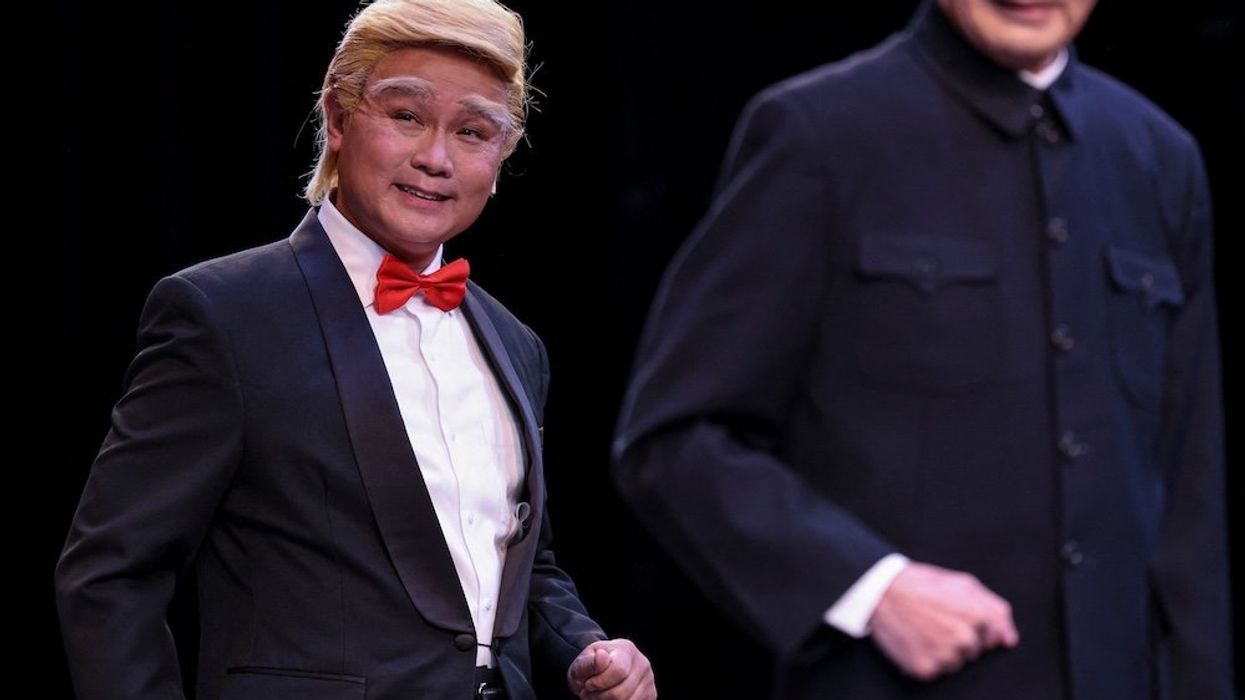
Cantonese opera actor Lung Koon-tin, portraying U.S. President Donald Trump, performs on stage in "Trump, The Twins President", in Hong Kong, China, June 5, 2025. REUTERS/Tyrone Siu

TRUTH OUT

A new stage production recently debuted in China that skewers President Donald Trump and his relationships with various world leaders.

NBC News reported Sunday that the Cantonese opera "Trump, the Twins President," just concluded a three-day run in Hong Kong's Xiqu Centre, with each showing playing to a sold-out audience. While the opera parodies multiple world leaders, the star is Trump, who is played by actor Lung Koon-tin in a garish blond wig and oversized eyebrows.

Playwright Li Kui-ming initially wrote the show in 2019, during Trump's first administration, but the newest version is updated with multiple references to Trump's second term. This includes the U.S. president referring to Canada as "the 51st state," his administration's attacks on Harvard University and even his very recent public dispute with Tesla and SpaceX CEO Elon Musk.

The opera begins with an actor portraying Trump's eldest daughter, Ivanka, having a dream in which her father has a twin brother in China named Chuan Pu (which roughly translates to "Trump" in Chinese). The show begins by chronicling the United States' initial foray with China in the 1970s, in which then-President Richard Nixon met with Chinese Premier Zhao Enlai — with a young Chuan Pu becoming disillusioned with China and moving to the U.S.

Notably, the opera also dramatizes Trump's 2024 rally in Butler, Pennsylvania. Prior to the rally, the Ivanka character asked Chuan Pu to stand in for her father, who had been abducted by Martian aliens. Chuan Pu does not survive the assassination attempt, which sets off other events throughout the production. The show ends with Trump getting into a fist fight with Ukrainian President Volodymyr Zelenskyy in the Oval Office, with the two taking turns knocking each other down.

Li, who is a former journalist, told NBC he aimed to draw parallels between Trump and former Chinese leader Mao Zedong, as they both sought to shape the world around them "like a king." However, he insisted that Trump would "love my drama," and emphasized that the show's plot is "only a dream" and that it's not meant to be taken "very seriously."

"Trump, the Twins President" debuted as the United States prepares to enter into a new round of trade negotiations with Chinese officials in hopes of ending Trump's trade war with the Asian superpower. Trump's tariffs on the United States' top trade partner has effectively paralyzed commerce between the two nations, and the dearth of Chinese imports entering the U.S. may lead to stores having rows of empty shelves this summer.

Click here to read NBC's full report.
'Don’t get lost down a rabbit hole': Major anti-vaxxer talking point destroyed in analysis


Photo by Ed Us on Unsplash
September 03, 2025 


It makes sense to approach some marketing efforts with skepticism. Scams, deepfakes, and deceptive social media posts are common, with people you don’t know seeking to profit from your behavior.

But should people extend this same skepticism to pediatricians who advise vaccines for children? Health and Human Services Secretary Robert F. Kennedy Jr. said financial bonuses are driving such recommendations.

“Doctors are being paid to vaccinate, not to evaluate,” Kennedy said in an Aug. 8 video posted on the social platform X. “They’re pressured to follow the money, not the science.”

Doctors and public health officials have been fielding questions on this topic for years.

A close look at the process by which vaccines are administered shows pediatric practices make little profit — and sometimes lose money — on vaccines. Four experienced pediatricians told us evidence-based science and medicine drive pediatricians’ childhood vaccination recommendations. Years of research and vaccine safety data also bolster these recommendations.

Christoph Diasio, a pediatrician at Sandhills Pediatrics in North Carolina, said the argument that doctors profit off vaccines is counterintuitive.

“If it was really about all the money, it would be better for kids to be sick so you’d see more sick children and get to take care of more sick children, right?” he said.

Is Your Pediatrician Profiting Off Childhood Vaccines?
by Taboola
Sponsored LinksYou May Like


Visit BC for North America’s Largest Night MarketExplore 100+ international street food vendors at the Richmond Night Market.Tourism Richmond

It costs money to stock, store, and administer a vaccine.

Pediatricians sometimes store thousands of dollars’ worth of vaccines in specialized medical-grade refrigeration units, which can be expensive. They pay to insure vaccines in case anything happens to them. Some practices buy thermostats that monitor vaccines’ temperature and backup generators to run the refrigerators in the event of a power outage. They also pay nursing staff to administer vaccines.

“Vaccines are hugely expensive,” said Jesse Hackell, a retired general pediatrician and the chair of the American Academy of Pediatrics’ Committee on Pediatric Workforce. “We lay out a lot of money up front.”

When a child with private insurance gets a vaccine, the pediatrician is paid for the vaccine product and its administration, Hackell said.

Many pediatricians also participate in a federal program that provides vaccines free of charge to eligible children whose parents can’t afford them. Participating in that program isn’t profitable because even though they get the vaccines for free, pediatricians store and insure them, and Medicaid reimbursements often don’t cover the costs. But many choose to participate and provide those vaccines anyway because it’s valuable for patients, Hackell said.

When discussing vaccine recommendations, pediatricians don’t make different recommendations based on how or if a child is insured, he said.

Jason Terk, a pediatrician at Cook Children’s Health Care System in Texas, said a practice’s ability to make a profit on vaccines depends on its situation.

Terk’s practice is part of a larger pediatric health care system, which means it doesn’t lose money on vaccines and makes a small profit, he said. Some small independent practices might not be able to secure terms with insurance companies that adequately pay for vaccines.

Suzanne Berman, a pediatrician at Plateau Pediatrics, a rural health clinic in Crossville, Tennessee, said that 75% of her practice’s patients have Medicaid and qualify for the Vaccines for Children program, which the practice loses money on. When she factored in private insurance companies’ payments, she estimated her practice roughly breaks even on vaccination.

“The goal is to not lose money on vaccines,” Terk said.

So What’s Driving Your Pediatrician’s Vaccine Recommendations?

Pediatricians typically recommend parents vaccinate their children following either the American Academy of Pediatrics’ or the Centers for Disease Control and Prevention’s recommended vaccine schedule.

Diasio said the driving force behind pediatric vaccine recommendations is straightforward: Trained physicians have seen kids die of vaccine-preventable diseases.

“I saw kids who died of invasive pneumococcal disease, which is what the Prevnar vaccine protects against,” Diasio said. “We remember those kids; we wouldn’t wish that on anyone.”

Still, your pediatrician will consider your child’s health holistically before making vaccine recommendations.

For example, a few children — less than 1% — have medical reasons they cannot receive a particular vaccine, Hackell said. This could include children with severe allergies to certain vaccine components or children who are immunosuppressed and could be at higher risk from live virus vaccines such as the measles or chickenpox vaccine.

“When people have questions about whether their kids should get vaccines, they really need to talk to their child’s doctor,” Diasio said. “Don’t get lost down a rabbit hole of the internet or on social media, which is programmed and refined to do whatever it can to keep you online longer.”r vaccine, Hackell said. This could include children with severe allergies to certain vaccine components or children who are immunosuppressed and could be at higher risk from live virus vaccines such as the measles or chickenpox vaccine.

“When people have questions about whether their kids should get vaccines, they really need to talk to their child’s doctor,” Diasio said. “Don’t get lost down a rabbit hole of the internet or on social media, which is programmed and refined to do whatever it can to keep you online longer.”
'Hit a brick wall': Trump’s 'scam' claims about the economy died hard this week


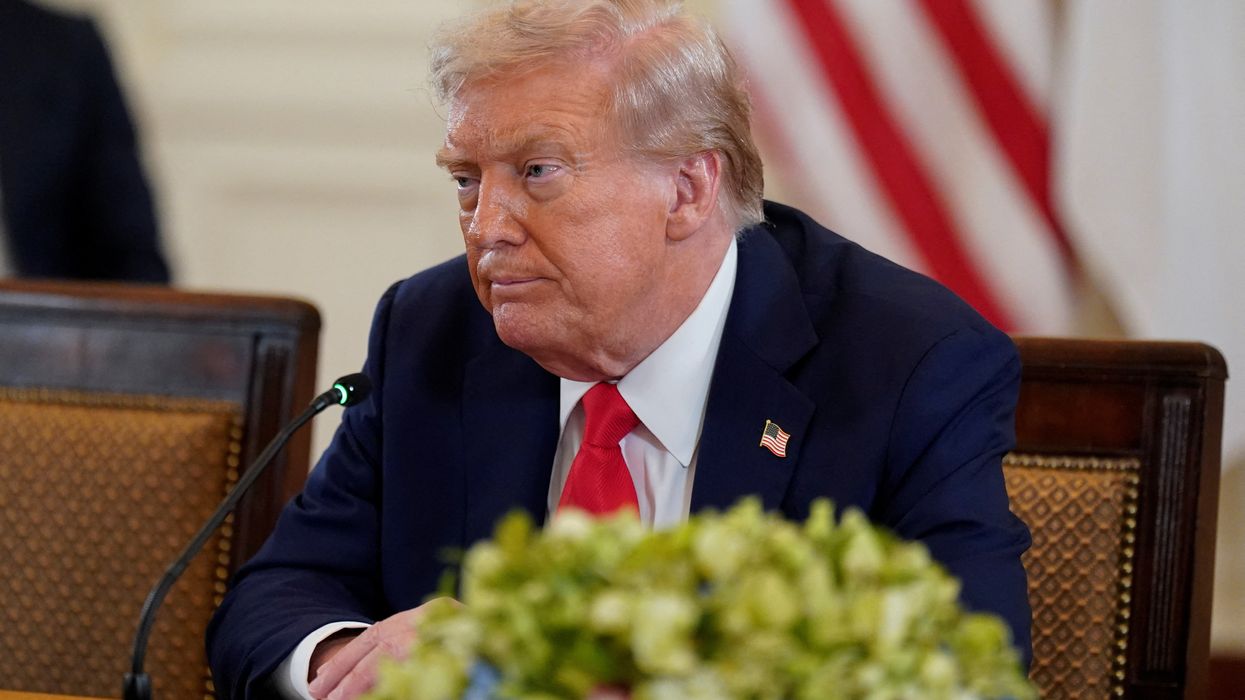
U.S. President Donald Trump listens during a meeting with Ukrainian President Volodymyr Zelenskiy (not pictured) and European leaders amid negotiations to end the Russian war in Ukraine, at the White House in Wa

September 06, 2025 
ALTERNET


CNN analyst David Goldman writes that President Donald Trump and his administration spent the last month trying to sell his July bad jobs numbers as a big lie planted by Biden sympathizers to undermine his administration.

The president called the July jobs report “rigged,” and fired Erika McEntarfer from her role as Bureau of Labor Statistics commissioner for serving them up. Afterward, officials bent themselves into pretzels trying to explain why Trump was justified in removing McEntarfer for allegedly sabotaging his administration — despite offering no proof of McEntarfer’s claimed villainy.

“That effort hit a brick wall Friday after the government produced updated jobs numbers that painted an even more concerning portrait of the U.S. economy,” wrote Goldman.

McEntarfer is gone, but Friday’s jobs report showed hiring continued to stall in Trump’s economy.

“The number of jobs actually fell in June for the first time since 2020 — all while the revisions the Trump administration so vociferously complained about were significantly less dramatic than in prior months,” Goldman said. “… In other words: The jobs data the Trump administration used to signal a scandal was neither historic nor evidence of corruption.”

The Bureau of Labor Statistics collects jobs data from two surveys, one from old-fashioned door knocking and the other from telephone, internet surveys, and automated data transfer from large corporations. The bureau follows up some information with callbacks to assure accuracy. It revises some numbers for seasonal changes and for low survey responses.

Faced with the undeniable trend, CNN reports the Trump administration has not claimed the August jobs numbers were rigged just yet. Instead Trump is trying to blame Fed Chair Jerome Powell for keeping interest rates high.

“Labor Secretary Lori Chavez-DeRemer echoed that stance,” reports Goldman. “National Economic Council Director Kevin Hassett conceded that the jobs report was a ‘disappointment,’ blaming the BLS’ inability to track summer hiring. He also, without evidence, attributed some of the hiring slump to Trump’s immigration policy, a conclusion that the jobs report does not capture.”

Meanwhile, Trump’s Commerce Secretary Howard Lutnick insists, without evidence, that “McEntarfer was rooting against Trump and America’s success, which led to skewed jobs numbers,” Goldman said.

Read the CNN report at this link


'He's managed to screw it up': Economists dismantle key Trump myth


(REUTERS)

Brad Reed
September 06, 2025 

A federal jobs report released on Friday showed the US economy added a mere 22,000 jobs in August in yet another signal of weakness in the US labor market.

Economists had projected the economy would produce 75,000 jobs on the month, which means that the Bureau of Labor Statistics (BLS) numbers released on Friday were well below the consensus estimate.

What's more, the total number of jobs created in July and June were once again revised downward, and the economy as a whole has added an average of fewer than 30,000 jobs over the last three months.

Heather Long, the chief economist at Navy Federal Credit Union, put the bad jobs report in stark terms.

"The labor market is going from frozen to cracking," she said, and then pointed to net job losses in industries including mining, construction, and manufacturing that show significant stress in the blue-collar economy. In fact, the majority of job growth came from the healthcare industry over the last month.

"The US job market is almost entirely dependent on healthcare," she observed. "That's not healthy for the economy."

Justin Wolfers, an economist at the University of Michigan, also said that the new numbers showed a continued deterioration in both the US labor market and the economy as a whole.

"I'm worried," he said. "The economy was in a good place in late 2024. That's no longer true. And the trajectory is, at a minimum, concerning. That's millions of people's lives, and millions of stories of pain."

Wolfers also zeroed in on the fact that manufacturing employment has been contracting for several months, despite US President Donald Trump's pledges to lead a manufacturing revitalization.

"But the Administration has made dramatic policy shift to boost manufacturing, and it just ain't working," he said. "Manufacturing employment fell [by 12,000 jobs], and is down [78,000 jobs] over the year."

Former BLS commissioner Erika McEntarfer, whom Trump fired last month after he baselessly accused her of concocting negative job numbers to harm him politically, argued on Bluesky that the new report's downward revisions of previous monthly estimates are indicative of a labor market that is very quickly cooling.

"The larger-than-usual downward revision last month was in large part driven by a negative skew in the job growth distribution among late reporting firms," she said. "That's unusual, but it's happened before when the pace of job growth slows rapidly. This print is more evidence that was the case."

Mike Konczal, senior director of policy and research at the Economic Security Project and former member of President Joe Biden's National Economic Council, argued the new jobs report demonstrates that "the theory of Trumponomics is failing."

"The first theory of Trumponomics was that tariffs would build up manufacturing work and federal workforce cuts would free up workers for them," he explained. "That's failed. Manufacturing lost jobs almost as fast as the federal workforce (-12 vs. -15K)."

Konczal then showed how Trump's tariffs have hurt his stated goal of bringing back well-paying jobs for blue-collar men, as industries that produce such jobs have also been harmed by his tariffs on foreign goods and materials.

He also pointed out that Trump advisers claimed that mass deportations of undocumented immigrants would create new job openings that native-born workers would rush in to fill.

"But, you guessed it, that's also failing," he said. "Amidst the broader weakening, the native-born unemployment rate is at the highest levels since the pandemic."

Elise Gould, the director of health policy research at the Economic Policy Institute, similarly noted that "there have... been sustained losses over recent months in manufacturing, construction, and mining," in recent months, which she said was "an indication that Trump's blue-collar renaissance is clearly not happening."

Alex Jacquez, chief of policy and advocacy at the progressive advocacy organization Groundwork Collaborative, called the jobs report "devastating," while laying the blame at the feet of Trump.

"Trump's promises to working families have fallen flat," he said. "The unemployment rate is the highest in nearly four years, the economy has lost nearly 40,000 manufacturing jobs this year alone, and millions of workers are unable to find full-time employment. Families are getting fewer chances to secure the American dream in Trump's economy."

Rep. Brendan Boyle (D-Pa.) reacted to the jobs report by issuing a scathing rebuke to Trump and his management of the economy.

"Donald Trump inherited an economy built on years of steady job growth," he said. "In just seven months, he's managed to screw it up—just like he's screwed up everything else in his life. Now, working families are getting squeezed from every direction: higher prices, Republicans' Big Ugly Law ripping health care away from millions, and a job market that's slowing down."

'Going in the wrong direction': Wall Street analysts raise red flags over Trump economy

Alexander Willis
September 6, 2025 
RAW STORY


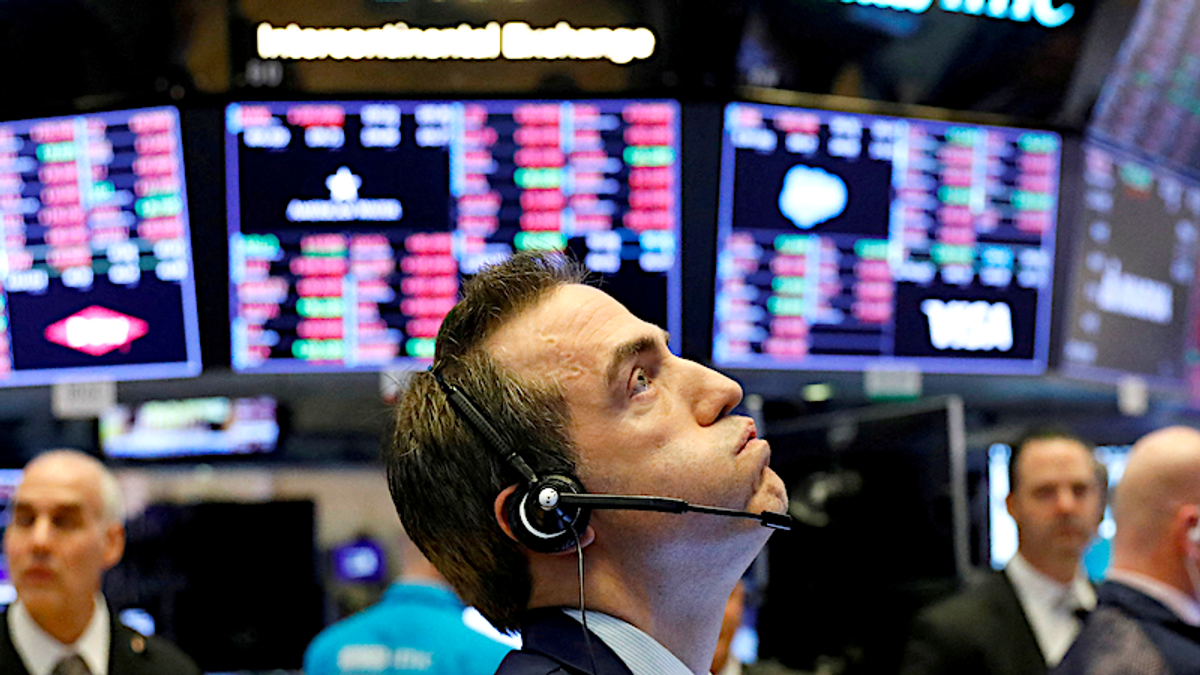
 A trader works on the floor of the New York Stock Exchange shortly before the closing bell as the market takes a significant dip in New York, U.S., February 25, 2020. REUTERS/Lucas Jackson/File Photo/File Photo

With President Donald Trump’s tariffs already being felt across the American economy, the president has told Americans to be patient, and that his trade policy would soon usher in a resurgence of domestic manufacturing jobs.

And yet, as job growth slows and prices tick up, Trump’s promise to reshore domestic manufacturing has not only not come to fruition, it appears to be “going in the wrong direction,” according to one analyst who spoke with the Washington Post Saturday.

“We aren’t even seeing the beginnings of a tariff-related recovery in manufacturing,” said Dean Baker, an economist and co-founder of the Center for Economic Policy Research in Washington, speaking with the Washington Post. “You don’t expect to see it overnight. But it’s going in the wrong direction.”

Trump’s tariff policy has already begun to take its toll on the American economy according to a number of economists; prices have risen, job growth has slowed dramatically, and inflation has ticked up.

Trump has told Americans to be patient, that his tariff policy would see the economy rebound by next year, and at the very least, the stiff tariffs would ignite an explosion of domestic manufacturing jobs, with the policies incentivizing companies to reshore their operations to avoid paying steep penalties.

However, the tariffs now appear to be having the opposite effect, with import taxes impacting supply chains, and the uncertainty of Trump’s tariff policy – with tariff rates being adjusted for specific countries multiple times, unpredictably – giving cause for companies to be hesitant with their investments.

“Uncertainty around tariff policy is limiting activity,” wrote Wells Fargo economists Shannon Grein and Tim Quinlan this week in a joint analysis. “While the higher costs associated with tariffs are a challenge, the uncertainty around where tariffs ultimately land is likely more so limiting current activity today.”

Trump voters are 'taking it on the chin': Bad job numbers are worse for 'Cletus'

Mondovi, WI USA September 28, 2020 Farmer John with his John Deere 3020 Tractor holding out a Trump Banner and also an American Flag on the tractor.
September 06, 2025   
ALTERNET

Bulwark editor Jonathan Last reminded Trump voters that the president’s latest awful job numbers include their jobs, too, in a piece entitled, "What Happens When Cletus Loses His Job?"

“Trump’s Forgotten ManTM is taking it on the chin,” said Last, acknowledging that the U.S. economy added just 22,000 jobs. “Mining, oil, and gas production lost 6,000 jobs; manufacturing lost 12,000 jobs and is net -78,000 since Trump took over.”

The health care sector was the only sector that added jobs, to the tune of 31,000 new positions. But that “22,000” overall job figure means the entire rest of the economy lost jobs.

“If you don’t work in health care, then employment in your field contracted,” Last said, while unleashing a devastating set of charts representing the drastic difference between the Biden and Trump years, with Biden’s economy showing outlandish growth in nonfarm payroll, a drop in the unemployment rate and Trump’s decline in construction spending — a reliable indicator of an encroaching recession.

“It’s complicated but I’m pretty sure that if I make the arrows big enough, even [Trump voters] … can understand it,” Last said.

“I cannot emphasize enough that all of this is volitional: America chose stagflation,” Last wrote. “We had the best economy in the world for four years. Biden’s team achieved the kind of mythical soft-landing that gives economists wet dreams. Unemployment stayed low; the inflation which crept into the system for twelve months was quickly tamed. Boat sales — my favorite indicator of Trump voter prosperity—hit historic highs.

“Yet Trump campaigned explicitly on (1) imposing massive, economy-disrupting tariffs and (2) increasing government debt,” Last said. “He told voters exactly what he was going to do. And instead of having even a basic understanding of economics, a plurality of voters said, Well s——, Lurleen. I done seen Mister Trump on the teevee and he’s a business man. He’ll do the economy good.”

Read the Bulwark report at this link


'Kind of report that gets you fired': Trump ridiculed on MSNBC over 'brutal' jobs data

Tom Boggioni
September 5, 2025
RAW STORY


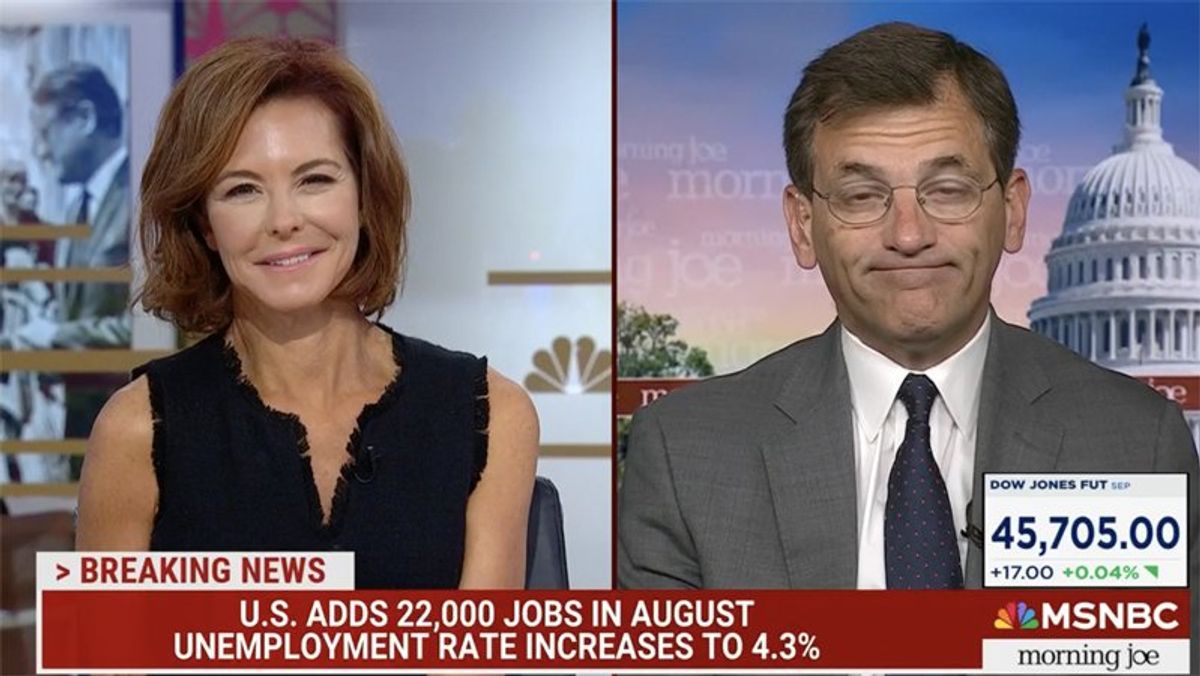
Stephanie Ruhle, Peter Baker (MSNBC screenshot)

"Brutal” and “really bad” were some of the adjectives used on MSNBC on Friday morning after the new jobs report came out, and it showed unemployment went up.

This, of course, comes after Donald Trump fired the previous head of the Bureau of Labor Statistics following several negative reports, claiming that the individual was biased against him.

Moments after the report was released, MSNBC’s Jonathan Lemire and Stephani Ruhle were ready to pounce –– and that is just what they did with an assist from the New York Times’ Peter Baker.

"The August jobs report was released moments ago, showing that the U.S. added just 22,000 jobs last month much, much less than the 75,000 that economists expected,” Lemire prompted his guests. “The unemployment rate also saw a slight increase to 4.3 percent. This, of course, the first jobs report released since President Trump fired the head of the Bureau of Labor Statistics last month after that report showed not just a weak level of job creation, but also a dramatic reduction in previous month's totals.”

“There's no way to sugarcoat this. This jobs report is brutal,” he added.

“It's not good,” Ruhle, a former Wall Street executive, agreed. “What is it showing us? What we know is the economy is slowing. It does not matter what Donald Trump tells us. It doesn't matter what [Commerce Secretary]Howard Lutnick, what he wants. The economy is slowing, so Donald Trump and the market are going to get what they want: a rate cut.”

“That is the reality that we're living in and Howard Lutnick can say, ‘Oh, you're going to like the number six months from now,’ when you bring in a Trump ally and cook the books, it doesn't change reality,” she added. “Things cost more and the tariffs are making business more difficult in the United States of America. That's our reality.”

The Times’ Baker added, “Look, this is the kind of report that gets you fired, right?” which led to laughter before adding, “It's literally documenting the same trends that we saw last month that he [Trump] said were rigged and now this post-firing report suggests that the trend lines that were so problematic a month ago, in fact, are still there.”

You can watch below or at the link.


'You have a big problem': Ex-Fox News host warns new report is bad news for Trump

Daniel Hampton
September 5, 2025
RAW STORY


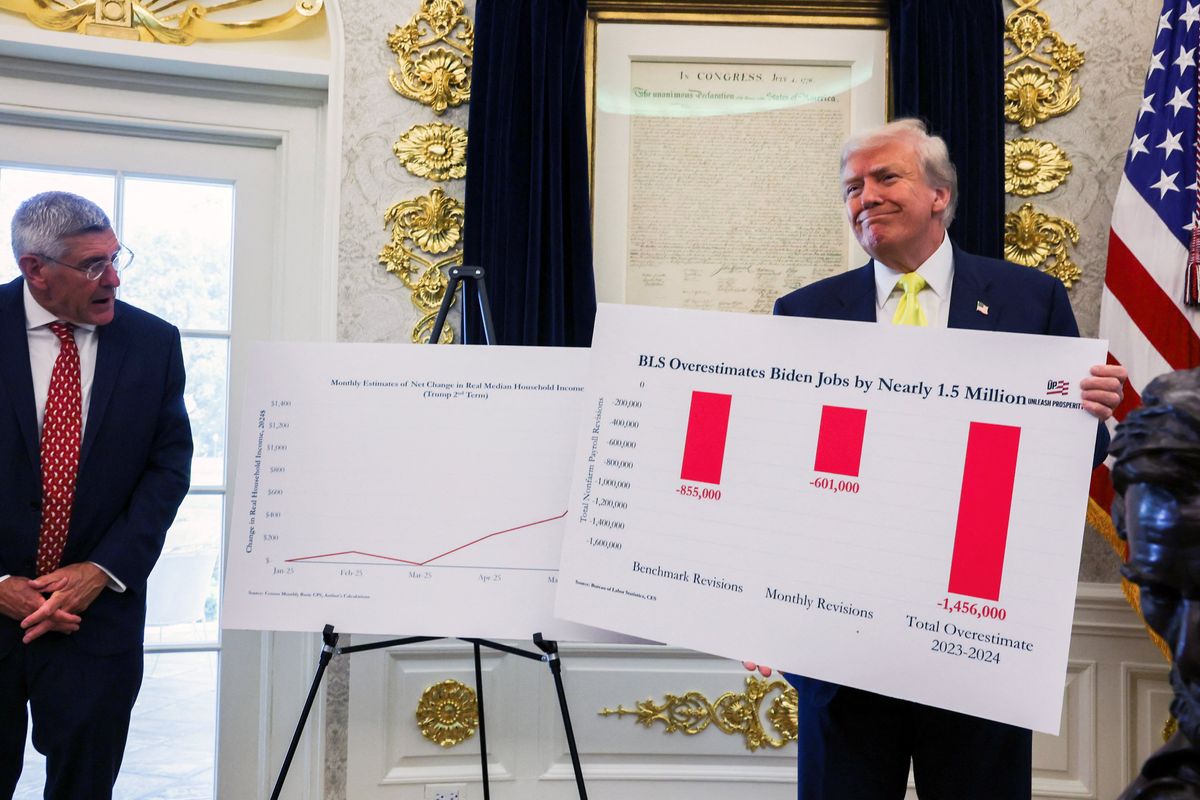
U.S. President Donald Trump holds a board sourced from Bureau of Labour Statistics, CES titled 'BLS Overestimates Biden Jobs by Nearly 1.5 Million', while Senior Visiting Fellow in Economics at The Heritage Foundation Steve Moore speaks, during an announcement on the economy, in the Oval Office at the White House in Washington, D.C., U.S., August 7, 2025. REUTERS/Jonathan Ernst

A startling new jobs report out this week earned President Donald Trump a stark warning from former Fox News host Gretchen Carlson

Carlson and senior political commentator Van Jones joined CNN's "OutFront" with host Erin Burnett on Friday afternoon to talk about he latest jobs report, which showed Black unemployment climbing to 7.5%, up from 7.2% last month, and is now at its highest level since October 2021, mid-pandemic.

Furthermore, the young adult unemployment rate soared to 10.5%, up from 10.0% the previous month.

Jones told the panel that Trump's "devastating" Department of Government Efficiency cuts helped propel the number for Black Americans.

"Smashing the backbone of the Black middle class. All those women who did the right thing, who paid their taxes, who went to school, who worked hard every day, getting wiped out. That is a big chunk here," he said.

"This is a real problem now," he added.

When asked if there could be political consequences to thrusting Americans out of work, Carlson delivered a stark warning.

"If you're asking if it's going to be a political problem, could be," Carlson replied. "Because Trump's biggest strength was the economy. I mean, that's how he got so many independents to vote for him the first time and the last time."

She warned people "aren't fond" of Trump's massive DOGE cuts, his so-called "One Big Beautiful Bill," his tariff increases, and the way his immigration crackdown has unfolded.

"You add in that they might not be happy with the economy? You have a big problem politically," she concluded, noting a Gallup survey that came out before the brutal jobs numbers found just 37 percent of Americans support Trump on the economy. That number was just 27 percent for independents.

"Keep an eye on that," she warned.

"That's the whole ball game," Jones added.

Watch the clip below or at this link.


Trump Tariff Regime Slammed as Manufacturing Jobs Crater


"The manufacturing sector is struggling more than the rest of the labor market under Trump's tariffs, and manufacturing workers' wage growth is stagnating."


Julia Conley
Sep 05, 2025
COMMON DREAMS

US President Donald Trump's tariff policies, imposing levies as high as 50% on the United States' trading partners, have not proven compatible with his campaign promise to turn the US back into a "manufacturing powerhouse," as Friday's jobs report showed.

The overall analysis was grim, with the economy adding just 22,000 jobs last month, but manufacturing employment in particular has declined since Trump made his April 2 "Liberation Day" announcement of tariffs on countries including Canada and Mexico.

Since then, the president has introduced new rounds of tariffs on imports from countries he claims have treated the US unfairly, and all the while manufacturers have tightened their belts to cope with the higher cost of supplies and materials.

Overall manufacturing employment has plummeted by 42,000 jobs, while job openings and new hires have declined by 76,000 and 18,000, respectively, according to the Center for American Progress (CAP), which released a jobs report analysis titled Trump's Trade War Squeezes Middle-Class Manufacturing Employment on Friday.

"The manufacturing sector is struggling more than the rest of the labor market under Trump's tariffs, and manufacturing workers' wage growth is stagnating," said CAP.

Last month, the sector lost 12,000 jobs, while wages for manufacturing workers stagnated.

In line with other private employees, workers in the sector saw their wages go up just 10 cents from July, earning an average of $35.50 per hour.

"Despite Trump's claims that his policies will reignite the manufacturing industry in the United States, his policies have achieved the opposite," wrote policy analyst Kennedy Andara and economist Sara Estep at CAP.

The findings are in line with the Federal Reserve Bank of Dallas' Texas Manufacturing Survey, which was taken from August 12-20 and found that 72% of manufacturing firms say the tariffs have had a negative impact on their business.

"The argument is: We're all meant to sacrifice a bit, so that tariffs can help rebuild American manufacturing. Let's ask American manufacturers whether they're helping," said University of Michigan economics professor Justin Wolfers on social media, sharing a graph that showed the survey's findings.


As Philip Luck, a former deputy chief economist with the US State Department, told the CBC last month, Trump has been promising "millions and millions of jobs" will result from his tariff regime, but those promises are out of step with the reality of manufacturing in 2025.

"We do [manufacturing] now with very few workers, we do it in a very automated way," Luck told the CBC. "Even if we do increase manufacturing I don't know that we're going to increase jobs along with it."

The outlet noted that while the number of Americans employed in manufacturing peaked in 1979, the value of manufacturing production has continuously trended up since then.

Michael Hicks, director of the Center for Business and Economic Research at Ball State University, told the CBC that "no treasure trove of jobs" is likely to come out of Trump's tariffs.

The president "walked into an economy that was seeing the largest manufacturing production in American history," Hicks said. "That is really a testament to how productive American workers are, the quality of the technology, and capital investment in manufacturing."

But the rate of hiring at manufacturing firms is far below its 2024 level, said CAP, revealing the negative impact of Trump's tariff regime.

US Rep. Ro Khanna (D-Calif.) pointed to nearly 800 workers who lost their jobs in the manufacturing sector this week, including 120 whose company's sawmill closed in Darlington, South Carolina; 101 who worked at an electronics assembly plant for Intervala in Manchester, New Hampshire; and 170 whose sawmill positions were eliminated in Estill, South Carolina.

The US Supreme Court is expected to soon review Trump's tariffs after the Court of Appeals for the Federal Circuit ruled last week that many of them are illegal.


'Stalled': WSJ editors trash Trump for bringing job market to its knees

Matthew Chapman
September 5, 2025 
RAW STORY

The conservative Wall Street Journal editorial board took stock of the latest dismal jobs report on Friday — and laid a key part of the blame for it at the feet of President Donald Trump.

"Friday’s monthly report for August confirms that job creation has stalled amid his tariff barrage," wrote the board, a frequent critic of Trump's trade policy. "Employers added a mere 22,000 jobs last month while the numbers were revised down for the previous two by a combined 21,000. This means only 107,000 new jobs were created in the last four months — an average of 27,000. Monthly job gains averaged 167,000 last year."

Even worse, the board noted, "Nearly all of the new jobs last month were in social assistance and healthcare (46,800), which rely on government spending," while manufacturing saw a loss of 38,000 jobs — meaning the public sector is propping up the Trump economy from total freefall.

It's not a mystery why any of this is happening, the board continued.

"The Occam’s razor explanation is the uncertainty and additional costs from Mr. Trump’s border taxes," they wrote. "Caterpillar estimates that tariffs will cost the equipment maker $1.8 billion this year. Deere projects a tariff hit of about $600 million, mainly from higher steel and aluminum costs. Deere is also hurting because soybean farmers have seen their market share in China shrink after its trade retaliation. Tariffs are slamming U.S. auto makers like Ford ($2 billion tariff cost this year)."

And even though Trump has done everything in his power to open up federal regulations for an oil drilling spree, "oil and gas producers say the tariffs have increased prices for materials and caused them to pull back on drilling."

The only real hope for the economy at this point, the board wrote, is if Trump loses his appeal to the Supreme Court after lower courts found his tariff scheme unconstitutional.

"What Mr. Trump needs is a broad revival in business confidence of the kind that accompanied his November victory and appeared before his tax on imports and willy-nilly interventions in private business decisions," the board concluded. "Repeat after us: Tariffs are taxes, and taxes hurt economic growth."

US private sector hiring cools more than expected: ADP

By AFP
September 4, 2025


Image: — © AFP/File SAUL LOEB

Hiring in the US private sector slowed more than anticipated in August, according to payroll firm ADP on Thursday, as all eyes turn to the jobs market to gauge the economy’s health.

Private sector employment rose by 54,000 last month, ADP said, down from a revised 106,000 in July.

“The year started with strong job growth, but that momentum has been whipsawed by uncertainty,” ADP chief economist Nela Richardson said in a statement.

She added that the hiring slowdown could be explained by issues ranging from a labor shortage to “skittish consumers.”

While there remained job gains in areas like leisure and hospitality, industries including manufacturing and trade, transportation and utilities lost jobs.

The report comes a day before the world’s biggest economy is set to report official hiring and unemployment numbers.

The most recent hiring figures showed that the key labor market was weaker than expected, sparking worries about the health of the economy.

ADP numbers, however, sometimes diverge from the government’s data.

US businesses have been grappling with heightened uncertainty this year as they face rapidly changing tariff policies announced by President Donald Trump.

After returning to the presidency in January, Trump imposed a 10-percent duty on almost all trading partners, before hiking levels for dozens of these economies.

He has also progressively rolled out separate duties on sector-specific imports such as steel, aluminum and autos.

The ADP report on Thursday showed that year-on-year pay growth was 4.4 percent for those who stayed in their jobs, and 7.1 percent for those who changed jobs.
'We’re going to flood the zone': White House mingles at conference 'filled with extremists'


Adam Lynch

September 06, 2025 
ALTERNET

The Guardian reports the Friday National Conservatism Conference in Washington, D.C. hosted a wide variety of far-right religious extremists, from men-only secret societies to theocratic right-wing pundits and associations.

Other event speakers were closely associated with the secretive Society for American Civic Renewal (SACR), an invitation-only, Christian ultra-nationalist network with “undercurrents of neo-fascist accelerationism,” according to a Middlebury Institute report.

Mingling and mixing among the theocrats, however, were Trump officials.

“NatCon is filled with extremists touting white nationalism and conspiracy theories,” said Heidi Beirich, the chief strategy officer and co-founder of the Global Project Against Hate and Extremism. “What is notable is how Trump administration officials and allies are key players in the event, showing that it is near impossible today to distinguish the far right from the administration.”

One speech by White house “border czar” Tom Homan contained warnings for the city of Chicago, which Trump is threatening to douse with federal agents and national guard troops, as he already has in Los Angeles and Washington, D.C.

“I said two months ago, we’re going to flood the zone and that’s exactly what we’re doing,” Homan told the crowd. “In Chicago, it’s coming. So, watch what happens in the very near future.”

The Guardian reports Trump’s deputy attorney general, Harmeet Dhillon, gave her own speech in which she characterized the justice department’s civil rights division as “the president’s shock troops.”

“We’re the front guard. We are going to go first and clear the way for others to do their work,” said Dhillon, who has assigned civil rights lawyers to investigate anti-genocide campus protests and perceived “anti-Christian bias.”

Other administration figures speaking at NatCon included Director of National Intelligence, Tulsi Gabbard, and Small Business Administration leader and former senator, Kelly Loeffler.

These Trump officials shared screen time with leading figures of the so-called “new right,” an anti-democratic and ultra-nationalist far-right movement “whose reactionary views have undergirded the Trump administration’s actions,” according to the Guardian. They also shared space with Society for American Civic Renewal Co-founder Charles Haywood — a regular engagement farmer on X — who recently posted: “Has a single (subcontinent) Indian ever accomplished anything of truly major note in the modern period?”

The Guardian reports the conference also featured “prominent faces from the universe of thinktanks surrounding the Trump administration who have signed on to, or even devised the Project 2025 agenda that has provided a blueprint for Trump’s actions in its first months.” This included Heritage Foundation president, Kevin Roberts, whose speech “leaned into male grievance and anti-immigrant sentiment,” according to the Guardian.

Read the full Guardian report at this link.