'Hit a brick wall': Trump’s 'scam' claims about the economy died hard this week
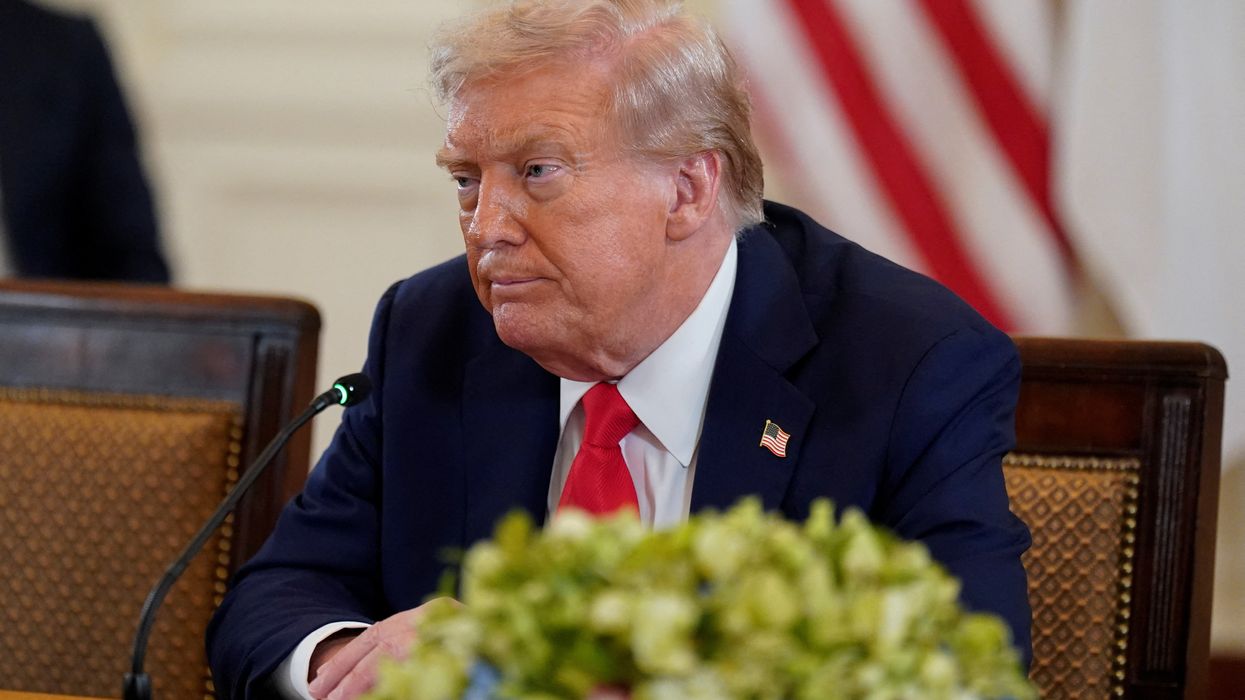
U.S. President Donald Trump listens during a meeting with Ukrainian President Volodymyr Zelenskiy (not pictured) and European leaders amid negotiations to end the Russian war in Ukraine, at the White House in Wa
CNN analyst David Goldman writes that President Donald Trump and his administration spent the last month trying to sell his July bad jobs numbers as a big lie planted by Biden sympathizers to undermine his administration.
The president called the July jobs report “rigged,” and fired Erika McEntarfer from her role as Bureau of Labor Statistics commissioner for serving them up. Afterward, officials bent themselves into pretzels trying to explain why Trump was justified in removing McEntarfer for allegedly sabotaging his administration — despite offering no proof of McEntarfer’s claimed villainy.
“That effort hit a brick wall Friday after the government produced updated jobs numbers that painted an even more concerning portrait of the U.S. economy,” wrote Goldman.
McEntarfer is gone, but Friday’s jobs report showed hiring continued to stall in Trump’s economy.
“The number of jobs actually fell in June for the first time since 2020 — all while the revisions the Trump administration so vociferously complained about were significantly less dramatic than in prior months,” Goldman said. “… In other words: The jobs data the Trump administration used to signal a scandal was neither historic nor evidence of corruption.”
The Bureau of Labor Statistics collects jobs data from two surveys, one from old-fashioned door knocking and the other from telephone, internet surveys, and automated data transfer from large corporations. The bureau follows up some information with callbacks to assure accuracy. It revises some numbers for seasonal changes and for low survey responses.
Faced with the undeniable trend, CNN reports the Trump administration has not claimed the August jobs numbers were rigged just yet. Instead Trump is trying to blame Fed Chair Jerome Powell for keeping interest rates high.
“Labor Secretary Lori Chavez-DeRemer echoed that stance,” reports Goldman. “National Economic Council Director Kevin Hassett conceded that the jobs report was a ‘disappointment,’ blaming the BLS’ inability to track summer hiring. He also, without evidence, attributed some of the hiring slump to Trump’s immigration policy, a conclusion that the jobs report does not capture.”
Meanwhile, Trump’s Commerce Secretary Howard Lutnick insists, without evidence, that “McEntarfer was rooting against Trump and America’s success, which led to skewed jobs numbers,” Goldman said.
Read the CNN report at this link
U.S. President Donald Trump listens during a meeting with Ukrainian President Volodymyr Zelenskiy (not pictured) and European leaders amid negotiations to end the Russian war in Ukraine, at the White House in Wa
September 06, 2025
ALTERNET
CNN analyst David Goldman writes that President Donald Trump and his administration spent the last month trying to sell his July bad jobs numbers as a big lie planted by Biden sympathizers to undermine his administration.
The president called the July jobs report “rigged,” and fired Erika McEntarfer from her role as Bureau of Labor Statistics commissioner for serving them up. Afterward, officials bent themselves into pretzels trying to explain why Trump was justified in removing McEntarfer for allegedly sabotaging his administration — despite offering no proof of McEntarfer’s claimed villainy.
“That effort hit a brick wall Friday after the government produced updated jobs numbers that painted an even more concerning portrait of the U.S. economy,” wrote Goldman.
McEntarfer is gone, but Friday’s jobs report showed hiring continued to stall in Trump’s economy.
“The number of jobs actually fell in June for the first time since 2020 — all while the revisions the Trump administration so vociferously complained about were significantly less dramatic than in prior months,” Goldman said. “… In other words: The jobs data the Trump administration used to signal a scandal was neither historic nor evidence of corruption.”
The Bureau of Labor Statistics collects jobs data from two surveys, one from old-fashioned door knocking and the other from telephone, internet surveys, and automated data transfer from large corporations. The bureau follows up some information with callbacks to assure accuracy. It revises some numbers for seasonal changes and for low survey responses.
Faced with the undeniable trend, CNN reports the Trump administration has not claimed the August jobs numbers were rigged just yet. Instead Trump is trying to blame Fed Chair Jerome Powell for keeping interest rates high.
“Labor Secretary Lori Chavez-DeRemer echoed that stance,” reports Goldman. “National Economic Council Director Kevin Hassett conceded that the jobs report was a ‘disappointment,’ blaming the BLS’ inability to track summer hiring. He also, without evidence, attributed some of the hiring slump to Trump’s immigration policy, a conclusion that the jobs report does not capture.”
Meanwhile, Trump’s Commerce Secretary Howard Lutnick insists, without evidence, that “McEntarfer was rooting against Trump and America’s success, which led to skewed jobs numbers,” Goldman said.
Read the CNN report at this link
'He's managed to screw it up': Economists dismantle key Trump myth
(REUTERS)
Brad Reed
(REUTERS)
Brad Reed
September 06, 2025
A federal jobs report released on Friday showed the US economy added a mere 22,000 jobs in August in yet another signal of weakness in the US labor market.
Economists had projected the economy would produce 75,000 jobs on the month, which means that the Bureau of Labor Statistics (BLS) numbers released on Friday were well below the consensus estimate.
What's more, the total number of jobs created in July and June were once again revised downward, and the economy as a whole has added an average of fewer than 30,000 jobs over the last three months.
Heather Long, the chief economist at Navy Federal Credit Union, put the bad jobs report in stark terms.
"The labor market is going from frozen to cracking," she said, and then pointed to net job losses in industries including mining, construction, and manufacturing that show significant stress in the blue-collar economy. In fact, the majority of job growth came from the healthcare industry over the last month.
"The US job market is almost entirely dependent on healthcare," she observed. "That's not healthy for the economy."
Justin Wolfers, an economist at the University of Michigan, also said that the new numbers showed a continued deterioration in both the US labor market and the economy as a whole.
"I'm worried," he said. "The economy was in a good place in late 2024. That's no longer true. And the trajectory is, at a minimum, concerning. That's millions of people's lives, and millions of stories of pain."
Wolfers also zeroed in on the fact that manufacturing employment has been contracting for several months, despite US President Donald Trump's pledges to lead a manufacturing revitalization.
"But the Administration has made dramatic policy shift to boost manufacturing, and it just ain't working," he said. "Manufacturing employment fell [by 12,000 jobs], and is down [78,000 jobs] over the year."
Former BLS commissioner Erika McEntarfer, whom Trump fired last month after he baselessly accused her of concocting negative job numbers to harm him politically, argued on Bluesky that the new report's downward revisions of previous monthly estimates are indicative of a labor market that is very quickly cooling.
"The larger-than-usual downward revision last month was in large part driven by a negative skew in the job growth distribution among late reporting firms," she said. "That's unusual, but it's happened before when the pace of job growth slows rapidly. This print is more evidence that was the case."
Mike Konczal, senior director of policy and research at the Economic Security Project and former member of President Joe Biden's National Economic Council, argued the new jobs report demonstrates that "the theory of Trumponomics is failing."
"The first theory of Trumponomics was that tariffs would build up manufacturing work and federal workforce cuts would free up workers for them," he explained. "That's failed. Manufacturing lost jobs almost as fast as the federal workforce (-12 vs. -15K)."
Konczal then showed how Trump's tariffs have hurt his stated goal of bringing back well-paying jobs for blue-collar men, as industries that produce such jobs have also been harmed by his tariffs on foreign goods and materials.
He also pointed out that Trump advisers claimed that mass deportations of undocumented immigrants would create new job openings that native-born workers would rush in to fill.
"But, you guessed it, that's also failing," he said. "Amidst the broader weakening, the native-born unemployment rate is at the highest levels since the pandemic."
Elise Gould, the director of health policy research at the Economic Policy Institute, similarly noted that "there have... been sustained losses over recent months in manufacturing, construction, and mining," in recent months, which she said was "an indication that Trump's blue-collar renaissance is clearly not happening."
Alex Jacquez, chief of policy and advocacy at the progressive advocacy organization Groundwork Collaborative, called the jobs report "devastating," while laying the blame at the feet of Trump.
"Trump's promises to working families have fallen flat," he said. "The unemployment rate is the highest in nearly four years, the economy has lost nearly 40,000 manufacturing jobs this year alone, and millions of workers are unable to find full-time employment. Families are getting fewer chances to secure the American dream in Trump's economy."
Rep. Brendan Boyle (D-Pa.) reacted to the jobs report by issuing a scathing rebuke to Trump and his management of the economy.
"Donald Trump inherited an economy built on years of steady job growth," he said. "In just seven months, he's managed to screw it up—just like he's screwed up everything else in his life. Now, working families are getting squeezed from every direction: higher prices, Republicans' Big Ugly Law ripping health care away from millions, and a job market that's slowing down."
A federal jobs report released on Friday showed the US economy added a mere 22,000 jobs in August in yet another signal of weakness in the US labor market.
Economists had projected the economy would produce 75,000 jobs on the month, which means that the Bureau of Labor Statistics (BLS) numbers released on Friday were well below the consensus estimate.
What's more, the total number of jobs created in July and June were once again revised downward, and the economy as a whole has added an average of fewer than 30,000 jobs over the last three months.
Heather Long, the chief economist at Navy Federal Credit Union, put the bad jobs report in stark terms.
"The labor market is going from frozen to cracking," she said, and then pointed to net job losses in industries including mining, construction, and manufacturing that show significant stress in the blue-collar economy. In fact, the majority of job growth came from the healthcare industry over the last month.
"The US job market is almost entirely dependent on healthcare," she observed. "That's not healthy for the economy."
Justin Wolfers, an economist at the University of Michigan, also said that the new numbers showed a continued deterioration in both the US labor market and the economy as a whole.
"I'm worried," he said. "The economy was in a good place in late 2024. That's no longer true. And the trajectory is, at a minimum, concerning. That's millions of people's lives, and millions of stories of pain."
Wolfers also zeroed in on the fact that manufacturing employment has been contracting for several months, despite US President Donald Trump's pledges to lead a manufacturing revitalization.
"But the Administration has made dramatic policy shift to boost manufacturing, and it just ain't working," he said. "Manufacturing employment fell [by 12,000 jobs], and is down [78,000 jobs] over the year."
Former BLS commissioner Erika McEntarfer, whom Trump fired last month after he baselessly accused her of concocting negative job numbers to harm him politically, argued on Bluesky that the new report's downward revisions of previous monthly estimates are indicative of a labor market that is very quickly cooling.
"The larger-than-usual downward revision last month was in large part driven by a negative skew in the job growth distribution among late reporting firms," she said. "That's unusual, but it's happened before when the pace of job growth slows rapidly. This print is more evidence that was the case."
Mike Konczal, senior director of policy and research at the Economic Security Project and former member of President Joe Biden's National Economic Council, argued the new jobs report demonstrates that "the theory of Trumponomics is failing."
"The first theory of Trumponomics was that tariffs would build up manufacturing work and federal workforce cuts would free up workers for them," he explained. "That's failed. Manufacturing lost jobs almost as fast as the federal workforce (-12 vs. -15K)."
Konczal then showed how Trump's tariffs have hurt his stated goal of bringing back well-paying jobs for blue-collar men, as industries that produce such jobs have also been harmed by his tariffs on foreign goods and materials.
He also pointed out that Trump advisers claimed that mass deportations of undocumented immigrants would create new job openings that native-born workers would rush in to fill.
"But, you guessed it, that's also failing," he said. "Amidst the broader weakening, the native-born unemployment rate is at the highest levels since the pandemic."
Elise Gould, the director of health policy research at the Economic Policy Institute, similarly noted that "there have... been sustained losses over recent months in manufacturing, construction, and mining," in recent months, which she said was "an indication that Trump's blue-collar renaissance is clearly not happening."
Alex Jacquez, chief of policy and advocacy at the progressive advocacy organization Groundwork Collaborative, called the jobs report "devastating," while laying the blame at the feet of Trump.
"Trump's promises to working families have fallen flat," he said. "The unemployment rate is the highest in nearly four years, the economy has lost nearly 40,000 manufacturing jobs this year alone, and millions of workers are unable to find full-time employment. Families are getting fewer chances to secure the American dream in Trump's economy."
Rep. Brendan Boyle (D-Pa.) reacted to the jobs report by issuing a scathing rebuke to Trump and his management of the economy.
"Donald Trump inherited an economy built on years of steady job growth," he said. "In just seven months, he's managed to screw it up—just like he's screwed up everything else in his life. Now, working families are getting squeezed from every direction: higher prices, Republicans' Big Ugly Law ripping health care away from millions, and a job market that's slowing down."
'Going in the wrong direction': Wall Street analysts raise red flags over Trump economy
Alexander Willis
September 6, 2025

A trader works on the floor of the New York Stock Exchange shortly before the closing bell as the market takes a significant dip in New York, U.S., February 25, 2020. REUTERS/Lucas Jackson/File Photo/File Photo
With President Donald Trump’s tariffs already being felt across the American economy, the president has told Americans to be patient, and that his trade policy would soon usher in a resurgence of domestic manufacturing jobs.
And yet, as job growth slows and prices tick up, Trump’s promise to reshore domestic manufacturing has not only not come to fruition, it appears to be “going in the wrong direction,” according to one analyst who spoke with the Washington Post Saturday.
“We aren’t even seeing the beginnings of a tariff-related recovery in manufacturing,” said Dean Baker, an economist and co-founder of the Center for Economic Policy Research in Washington, speaking with the Washington Post. “You don’t expect to see it overnight. But it’s going in the wrong direction.”
Trump’s tariff policy has already begun to take its toll on the American economy according to a number of economists; prices have risen, job growth has slowed dramatically, and inflation has ticked up.
Trump has told Americans to be patient, that his tariff policy would see the economy rebound by next year, and at the very least, the stiff tariffs would ignite an explosion of domestic manufacturing jobs, with the policies incentivizing companies to reshore their operations to avoid paying steep penalties.
However, the tariffs now appear to be having the opposite effect, with import taxes impacting supply chains, and the uncertainty of Trump’s tariff policy – with tariff rates being adjusted for specific countries multiple times, unpredictably – giving cause for companies to be hesitant with their investments.
“Uncertainty around tariff policy is limiting activity,” wrote Wells Fargo economists Shannon Grein and Tim Quinlan this week in a joint analysis. “While the higher costs associated with tariffs are a challenge, the uncertainty around where tariffs ultimately land is likely more so limiting current activity today.”
Alexander Willis
September 6, 2025
RAW STORY
A trader works on the floor of the New York Stock Exchange shortly before the closing bell as the market takes a significant dip in New York, U.S., February 25, 2020. REUTERS/Lucas Jackson/File Photo/File Photo
With President Donald Trump’s tariffs already being felt across the American economy, the president has told Americans to be patient, and that his trade policy would soon usher in a resurgence of domestic manufacturing jobs.
And yet, as job growth slows and prices tick up, Trump’s promise to reshore domestic manufacturing has not only not come to fruition, it appears to be “going in the wrong direction,” according to one analyst who spoke with the Washington Post Saturday.
“We aren’t even seeing the beginnings of a tariff-related recovery in manufacturing,” said Dean Baker, an economist and co-founder of the Center for Economic Policy Research in Washington, speaking with the Washington Post. “You don’t expect to see it overnight. But it’s going in the wrong direction.”
Trump’s tariff policy has already begun to take its toll on the American economy according to a number of economists; prices have risen, job growth has slowed dramatically, and inflation has ticked up.
Trump has told Americans to be patient, that his tariff policy would see the economy rebound by next year, and at the very least, the stiff tariffs would ignite an explosion of domestic manufacturing jobs, with the policies incentivizing companies to reshore their operations to avoid paying steep penalties.
However, the tariffs now appear to be having the opposite effect, with import taxes impacting supply chains, and the uncertainty of Trump’s tariff policy – with tariff rates being adjusted for specific countries multiple times, unpredictably – giving cause for companies to be hesitant with their investments.
“Uncertainty around tariff policy is limiting activity,” wrote Wells Fargo economists Shannon Grein and Tim Quinlan this week in a joint analysis. “While the higher costs associated with tariffs are a challenge, the uncertainty around where tariffs ultimately land is likely more so limiting current activity today.”
Trump voters are 'taking it on the chin': Bad job numbers are worse for 'Cletus'

Mondovi, WI USA September 28, 2020 Farmer John with his John Deere 3020 Tractor holding out a Trump Banner and also an American Flag on the tractor.
Bulwark editor Jonathan Last reminded Trump voters that the president’s latest awful job numbers include their jobs, too, in a piece entitled, "What Happens When Cletus Loses His Job?"
“Trump’s Forgotten ManTM is taking it on the chin,” said Last, acknowledging that the U.S. economy added just 22,000 jobs. “Mining, oil, and gas production lost 6,000 jobs; manufacturing lost 12,000 jobs and is net -78,000 since Trump took over.”
The health care sector was the only sector that added jobs, to the tune of 31,000 new positions. But that “22,000” overall job figure means the entire rest of the economy lost jobs.
“If you don’t work in health care, then employment in your field contracted,” Last said, while unleashing a devastating set of charts representing the drastic difference between the Biden and Trump years, with Biden’s economy showing outlandish growth in nonfarm payroll, a drop in the unemployment rate and Trump’s decline in construction spending — a reliable indicator of an encroaching recession.
“It’s complicated but I’m pretty sure that if I make the arrows big enough, even [Trump voters] … can understand it,” Last said.
“I cannot emphasize enough that all of this is volitional: America chose stagflation,” Last wrote. “We had the best economy in the world for four years. Biden’s team achieved the kind of mythical soft-landing that gives economists wet dreams. Unemployment stayed low; the inflation which crept into the system for twelve months was quickly tamed. Boat sales — my favorite indicator of Trump voter prosperity—hit historic highs.
“Yet Trump campaigned explicitly on (1) imposing massive, economy-disrupting tariffs and (2) increasing government debt,” Last said. “He told voters exactly what he was going to do. And instead of having even a basic understanding of economics, a plurality of voters said, Well s——, Lurleen. I done seen Mister Trump on the teevee and he’s a business man. He’ll do the economy good.”
Mondovi, WI USA September 28, 2020 Farmer John with his John Deere 3020 Tractor holding out a Trump Banner and also an American Flag on the tractor.
September 06, 2025
ALTERNET
Bulwark editor Jonathan Last reminded Trump voters that the president’s latest awful job numbers include their jobs, too, in a piece entitled, "What Happens When Cletus Loses His Job?"
“Trump’s Forgotten ManTM is taking it on the chin,” said Last, acknowledging that the U.S. economy added just 22,000 jobs. “Mining, oil, and gas production lost 6,000 jobs; manufacturing lost 12,000 jobs and is net -78,000 since Trump took over.”
The health care sector was the only sector that added jobs, to the tune of 31,000 new positions. But that “22,000” overall job figure means the entire rest of the economy lost jobs.
“If you don’t work in health care, then employment in your field contracted,” Last said, while unleashing a devastating set of charts representing the drastic difference between the Biden and Trump years, with Biden’s economy showing outlandish growth in nonfarm payroll, a drop in the unemployment rate and Trump’s decline in construction spending — a reliable indicator of an encroaching recession.
“It’s complicated but I’m pretty sure that if I make the arrows big enough, even [Trump voters] … can understand it,” Last said.
“I cannot emphasize enough that all of this is volitional: America chose stagflation,” Last wrote. “We had the best economy in the world for four years. Biden’s team achieved the kind of mythical soft-landing that gives economists wet dreams. Unemployment stayed low; the inflation which crept into the system for twelve months was quickly tamed. Boat sales — my favorite indicator of Trump voter prosperity—hit historic highs.
“Yet Trump campaigned explicitly on (1) imposing massive, economy-disrupting tariffs and (2) increasing government debt,” Last said. “He told voters exactly what he was going to do. And instead of having even a basic understanding of economics, a plurality of voters said, Well s——, Lurleen. I done seen Mister Trump on the teevee and he’s a business man. He’ll do the economy good.”
Read the Bulwark report at this link
'Kind of report that gets you fired': Trump ridiculed on MSNBC over 'brutal' jobs data
Tom Boggioni
September 5, 2025
Tom Boggioni
September 5, 2025
RAW STORY
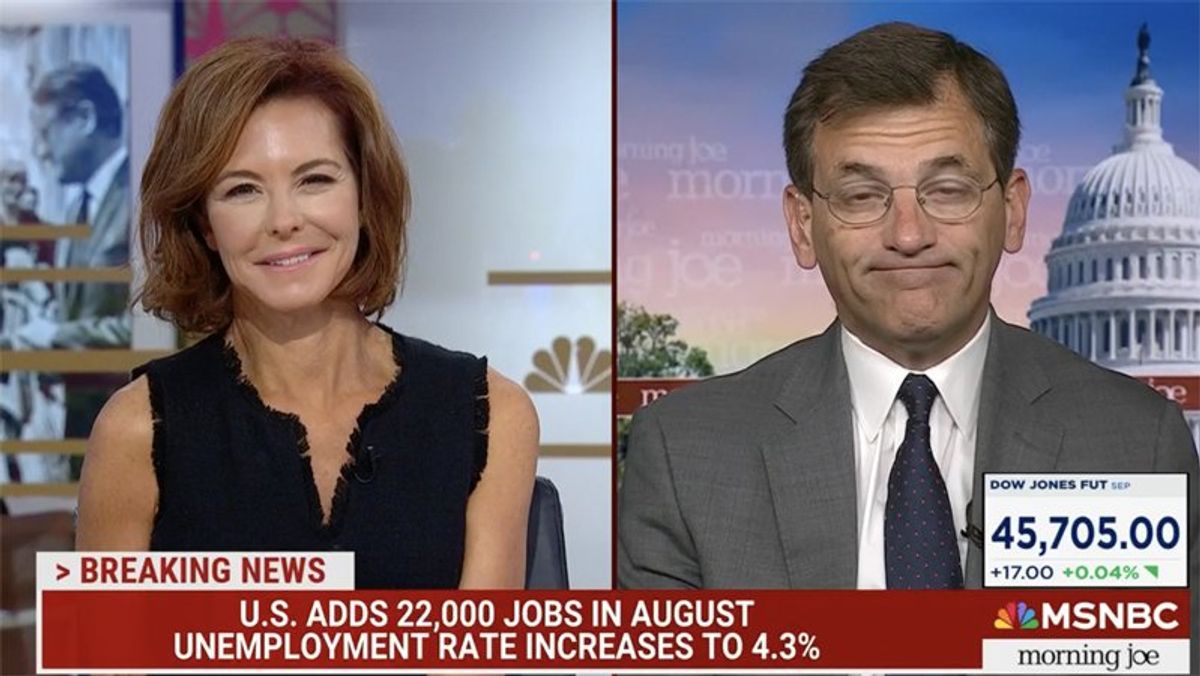
Stephanie Ruhle, Peter Baker (MSNBC screenshot)
"Brutal” and “really bad” were some of the adjectives used on MSNBC on Friday morning after the new jobs report came out, and it showed unemployment went up.
This, of course, comes after Donald Trump fired the previous head of the Bureau of Labor Statistics following several negative reports, claiming that the individual was biased against him.
Moments after the report was released, MSNBC’s Jonathan Lemire and Stephani Ruhle were ready to pounce –– and that is just what they did with an assist from the New York Times’ Peter Baker.
"The August jobs report was released moments ago, showing that the U.S. added just 22,000 jobs last month much, much less than the 75,000 that economists expected,” Lemire prompted his guests. “The unemployment rate also saw a slight increase to 4.3 percent. This, of course, the first jobs report released since President Trump fired the head of the Bureau of Labor Statistics last month after that report showed not just a weak level of job creation, but also a dramatic reduction in previous month's totals.”
“There's no way to sugarcoat this. This jobs report is brutal,” he added.
“It's not good,” Ruhle, a former Wall Street executive, agreed. “What is it showing us? What we know is the economy is slowing. It does not matter what Donald Trump tells us. It doesn't matter what [Commerce Secretary]Howard Lutnick, what he wants. The economy is slowing, so Donald Trump and the market are going to get what they want: a rate cut.”
“That is the reality that we're living in and Howard Lutnick can say, ‘Oh, you're going to like the number six months from now,’ when you bring in a Trump ally and cook the books, it doesn't change reality,” she added. “Things cost more and the tariffs are making business more difficult in the United States of America. That's our reality.”
The Times’ Baker added, “Look, this is the kind of report that gets you fired, right?” which led to laughter before adding, “It's literally documenting the same trends that we saw last month that he [Trump] said were rigged and now this post-firing report suggests that the trend lines that were so problematic a month ago, in fact, are still there.”
You can watch below or at the link.
Stephanie Ruhle, Peter Baker (MSNBC screenshot)
"Brutal” and “really bad” were some of the adjectives used on MSNBC on Friday morning after the new jobs report came out, and it showed unemployment went up.
This, of course, comes after Donald Trump fired the previous head of the Bureau of Labor Statistics following several negative reports, claiming that the individual was biased against him.
Moments after the report was released, MSNBC’s Jonathan Lemire and Stephani Ruhle were ready to pounce –– and that is just what they did with an assist from the New York Times’ Peter Baker.
"The August jobs report was released moments ago, showing that the U.S. added just 22,000 jobs last month much, much less than the 75,000 that economists expected,” Lemire prompted his guests. “The unemployment rate also saw a slight increase to 4.3 percent. This, of course, the first jobs report released since President Trump fired the head of the Bureau of Labor Statistics last month after that report showed not just a weak level of job creation, but also a dramatic reduction in previous month's totals.”
“There's no way to sugarcoat this. This jobs report is brutal,” he added.
“It's not good,” Ruhle, a former Wall Street executive, agreed. “What is it showing us? What we know is the economy is slowing. It does not matter what Donald Trump tells us. It doesn't matter what [Commerce Secretary]Howard Lutnick, what he wants. The economy is slowing, so Donald Trump and the market are going to get what they want: a rate cut.”
“That is the reality that we're living in and Howard Lutnick can say, ‘Oh, you're going to like the number six months from now,’ when you bring in a Trump ally and cook the books, it doesn't change reality,” she added. “Things cost more and the tariffs are making business more difficult in the United States of America. That's our reality.”
The Times’ Baker added, “Look, this is the kind of report that gets you fired, right?” which led to laughter before adding, “It's literally documenting the same trends that we saw last month that he [Trump] said were rigged and now this post-firing report suggests that the trend lines that were so problematic a month ago, in fact, are still there.”
You can watch below or at the link.
'You have a big problem': Ex-Fox News host warns new report is bad news for Trump
Daniel Hampton
September 5, 2025
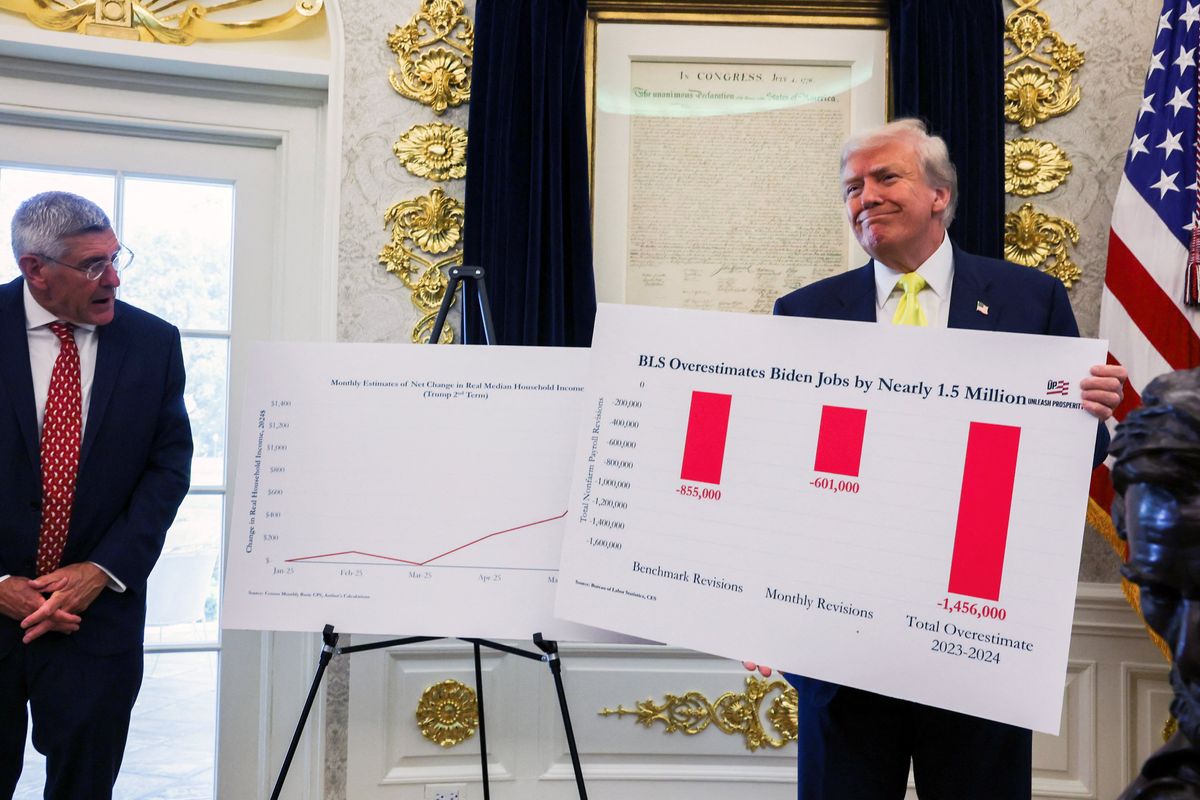
U.S. President Donald Trump holds a board sourced from Bureau of Labour Statistics, CES titled 'BLS Overestimates Biden Jobs by Nearly 1.5 Million', while Senior Visiting Fellow in Economics at The Heritage Foundation Steve Moore speaks, during an announcement on the economy, in the Oval Office at the White House in Washington, D.C., U.S., August 7, 2025. REUTERS/Jonathan Ernst
A startling new jobs report out this week earned President Donald Trump a stark warning from former Fox News host Gretchen Carlson
Carlson and senior political commentator Van Jones joined CNN's "OutFront" with host Erin Burnett on Friday afternoon to talk about he latest jobs report, which showed Black unemployment climbing to 7.5%, up from 7.2% last month, and is now at its highest level since October 2021, mid-pandemic.
Furthermore, the young adult unemployment rate soared to 10.5%, up from 10.0% the previous month.
Jones told the panel that Trump's "devastating" Department of Government Efficiency cuts helped propel the number for Black Americans.
"Smashing the backbone of the Black middle class. All those women who did the right thing, who paid their taxes, who went to school, who worked hard every day, getting wiped out. That is a big chunk here," he said.
"This is a real problem now," he added.
When asked if there could be political consequences to thrusting Americans out of work, Carlson delivered a stark warning.
"If you're asking if it's going to be a political problem, could be," Carlson replied. "Because Trump's biggest strength was the economy. I mean, that's how he got so many independents to vote for him the first time and the last time."
She warned people "aren't fond" of Trump's massive DOGE cuts, his so-called "One Big Beautiful Bill," his tariff increases, and the way his immigration crackdown has unfolded.
"You add in that they might not be happy with the economy? You have a big problem politically," she concluded, noting a Gallup survey that came out before the brutal jobs numbers found just 37 percent of Americans support Trump on the economy. That number was just 27 percent for independents.
"Keep an eye on that," she warned.
"That's the whole ball game," Jones added.
Watch the clip below or at this link.
Daniel Hampton
September 5, 2025
RAW STORY
U.S. President Donald Trump holds a board sourced from Bureau of Labour Statistics, CES titled 'BLS Overestimates Biden Jobs by Nearly 1.5 Million', while Senior Visiting Fellow in Economics at The Heritage Foundation Steve Moore speaks, during an announcement on the economy, in the Oval Office at the White House in Washington, D.C., U.S., August 7, 2025. REUTERS/Jonathan Ernst
A startling new jobs report out this week earned President Donald Trump a stark warning from former Fox News host Gretchen Carlson
Carlson and senior political commentator Van Jones joined CNN's "OutFront" with host Erin Burnett on Friday afternoon to talk about he latest jobs report, which showed Black unemployment climbing to 7.5%, up from 7.2% last month, and is now at its highest level since October 2021, mid-pandemic.
Furthermore, the young adult unemployment rate soared to 10.5%, up from 10.0% the previous month.
Jones told the panel that Trump's "devastating" Department of Government Efficiency cuts helped propel the number for Black Americans.
"Smashing the backbone of the Black middle class. All those women who did the right thing, who paid their taxes, who went to school, who worked hard every day, getting wiped out. That is a big chunk here," he said.
"This is a real problem now," he added.
When asked if there could be political consequences to thrusting Americans out of work, Carlson delivered a stark warning.
"If you're asking if it's going to be a political problem, could be," Carlson replied. "Because Trump's biggest strength was the economy. I mean, that's how he got so many independents to vote for him the first time and the last time."
She warned people "aren't fond" of Trump's massive DOGE cuts, his so-called "One Big Beautiful Bill," his tariff increases, and the way his immigration crackdown has unfolded.
"You add in that they might not be happy with the economy? You have a big problem politically," she concluded, noting a Gallup survey that came out before the brutal jobs numbers found just 37 percent of Americans support Trump on the economy. That number was just 27 percent for independents.
"Keep an eye on that," she warned.
"That's the whole ball game," Jones added.
Watch the clip below or at this link.

"The manufacturing sector is struggling more than the rest of the labor market under Trump's tariffs, and manufacturing workers' wage growth is stagnating."
Julia Conley
Sep 05, 2025
COMMON DREAMS
US President Donald Trump's tariff policies, imposing levies as high as 50% on the United States' trading partners, have not proven compatible with his campaign promise to turn the US back into a "manufacturing powerhouse," as Friday's jobs report showed.
The overall analysis was grim, with the economy adding just 22,000 jobs last month, but manufacturing employment in particular has declined since Trump made his April 2 "Liberation Day" announcement of tariffs on countries including Canada and Mexico.
Since then, the president has introduced new rounds of tariffs on imports from countries he claims have treated the US unfairly, and all the while manufacturers have tightened their belts to cope with the higher cost of supplies and materials.
Overall manufacturing employment has plummeted by 42,000 jobs, while job openings and new hires have declined by 76,000 and 18,000, respectively, according to the Center for American Progress (CAP), which released a jobs report analysis titled Trump's Trade War Squeezes Middle-Class Manufacturing Employment on Friday.
"The manufacturing sector is struggling more than the rest of the labor market under Trump's tariffs, and manufacturing workers' wage growth is stagnating," said CAP.
Last month, the sector lost 12,000 jobs, while wages for manufacturing workers stagnated.
In line with other private employees, workers in the sector saw their wages go up just 10 cents from July, earning an average of $35.50 per hour.
"Despite Trump's claims that his policies will reignite the manufacturing industry in the United States, his policies have achieved the opposite," wrote policy analyst Kennedy Andara and economist Sara Estep at CAP.
The findings are in line with the Federal Reserve Bank of Dallas' Texas Manufacturing Survey, which was taken from August 12-20 and found that 72% of manufacturing firms say the tariffs have had a negative impact on their business.
"The argument is: We're all meant to sacrifice a bit, so that tariffs can help rebuild American manufacturing. Let's ask American manufacturers whether they're helping," said University of Michigan economics professor Justin Wolfers on social media, sharing a graph that showed the survey's findings.
As Philip Luck, a former deputy chief economist with the US State Department, told the CBC last month, Trump has been promising "millions and millions of jobs" will result from his tariff regime, but those promises are out of step with the reality of manufacturing in 2025.
"We do [manufacturing] now with very few workers, we do it in a very automated way," Luck told the CBC. "Even if we do increase manufacturing I don't know that we're going to increase jobs along with it."
The outlet noted that while the number of Americans employed in manufacturing peaked in 1979, the value of manufacturing production has continuously trended up since then.
Michael Hicks, director of the Center for Business and Economic Research at Ball State University, told the CBC that "no treasure trove of jobs" is likely to come out of Trump's tariffs.
The president "walked into an economy that was seeing the largest manufacturing production in American history," Hicks said. "That is really a testament to how productive American workers are, the quality of the technology, and capital investment in manufacturing."
But the rate of hiring at manufacturing firms is far below its 2024 level, said CAP, revealing the negative impact of Trump's tariff regime.
US Rep. Ro Khanna (D-Calif.) pointed to nearly 800 workers who lost their jobs in the manufacturing sector this week, including 120 whose company's sawmill closed in Darlington, South Carolina; 101 who worked at an electronics assembly plant for Intervala in Manchester, New Hampshire; and 170 whose sawmill positions were eliminated in Estill, South Carolina.
The US Supreme Court is expected to soon review Trump's tariffs after the Court of Appeals for the Federal Circuit ruled last week that many of them are illegal.
'Stalled': WSJ editors trash Trump for bringing job market to its knees
Matthew Chapman
September 5, 2025
The conservative Wall Street Journal editorial board took stock of the latest dismal jobs report on Friday — and laid a key part of the blame for it at the feet of President Donald Trump.
"Friday’s monthly report for August confirms that job creation has stalled amid his tariff barrage," wrote the board, a frequent critic of Trump's trade policy. "Employers added a mere 22,000 jobs last month while the numbers were revised down for the previous two by a combined 21,000. This means only 107,000 new jobs were created in the last four months — an average of 27,000. Monthly job gains averaged 167,000 last year."
Even worse, the board noted, "Nearly all of the new jobs last month were in social assistance and healthcare (46,800), which rely on government spending," while manufacturing saw a loss of 38,000 jobs — meaning the public sector is propping up the Trump economy from total freefall.
It's not a mystery why any of this is happening, the board continued.
"The Occam’s razor explanation is the uncertainty and additional costs from Mr. Trump’s border taxes," they wrote. "Caterpillar estimates that tariffs will cost the equipment maker $1.8 billion this year. Deere projects a tariff hit of about $600 million, mainly from higher steel and aluminum costs. Deere is also hurting because soybean farmers have seen their market share in China shrink after its trade retaliation. Tariffs are slamming U.S. auto makers like Ford ($2 billion tariff cost this year)."
And even though Trump has done everything in his power to open up federal regulations for an oil drilling spree, "oil and gas producers say the tariffs have increased prices for materials and caused them to pull back on drilling."
The only real hope for the economy at this point, the board wrote, is if Trump loses his appeal to the Supreme Court after lower courts found his tariff scheme unconstitutional.
"What Mr. Trump needs is a broad revival in business confidence of the kind that accompanied his November victory and appeared before his tax on imports and willy-nilly interventions in private business decisions," the board concluded. "Repeat after us: Tariffs are taxes, and taxes hurt economic growth."
Matthew Chapman
September 5, 2025
RAW STORY
The conservative Wall Street Journal editorial board took stock of the latest dismal jobs report on Friday — and laid a key part of the blame for it at the feet of President Donald Trump.
"Friday’s monthly report for August confirms that job creation has stalled amid his tariff barrage," wrote the board, a frequent critic of Trump's trade policy. "Employers added a mere 22,000 jobs last month while the numbers were revised down for the previous two by a combined 21,000. This means only 107,000 new jobs were created in the last four months — an average of 27,000. Monthly job gains averaged 167,000 last year."
Even worse, the board noted, "Nearly all of the new jobs last month were in social assistance and healthcare (46,800), which rely on government spending," while manufacturing saw a loss of 38,000 jobs — meaning the public sector is propping up the Trump economy from total freefall.
It's not a mystery why any of this is happening, the board continued.
"The Occam’s razor explanation is the uncertainty and additional costs from Mr. Trump’s border taxes," they wrote. "Caterpillar estimates that tariffs will cost the equipment maker $1.8 billion this year. Deere projects a tariff hit of about $600 million, mainly from higher steel and aluminum costs. Deere is also hurting because soybean farmers have seen their market share in China shrink after its trade retaliation. Tariffs are slamming U.S. auto makers like Ford ($2 billion tariff cost this year)."
And even though Trump has done everything in his power to open up federal regulations for an oil drilling spree, "oil and gas producers say the tariffs have increased prices for materials and caused them to pull back on drilling."
The only real hope for the economy at this point, the board wrote, is if Trump loses his appeal to the Supreme Court after lower courts found his tariff scheme unconstitutional.
"What Mr. Trump needs is a broad revival in business confidence of the kind that accompanied his November victory and appeared before his tax on imports and willy-nilly interventions in private business decisions," the board concluded. "Repeat after us: Tariffs are taxes, and taxes hurt economic growth."
US private sector hiring cools more than expected: ADP
By AFP
September 4, 2025

Image: — © AFP/File SAUL LOEB
Hiring in the US private sector slowed more than anticipated in August, according to payroll firm ADP on Thursday, as all eyes turn to the jobs market to gauge the economy’s health.
Private sector employment rose by 54,000 last month, ADP said, down from a revised 106,000 in July.
“The year started with strong job growth, but that momentum has been whipsawed by uncertainty,” ADP chief economist Nela Richardson said in a statement.
She added that the hiring slowdown could be explained by issues ranging from a labor shortage to “skittish consumers.”
While there remained job gains in areas like leisure and hospitality, industries including manufacturing and trade, transportation and utilities lost jobs.
The report comes a day before the world’s biggest economy is set to report official hiring and unemployment numbers.
The most recent hiring figures showed that the key labor market was weaker than expected, sparking worries about the health of the economy.
ADP numbers, however, sometimes diverge from the government’s data.
US businesses have been grappling with heightened uncertainty this year as they face rapidly changing tariff policies announced by President Donald Trump.
After returning to the presidency in January, Trump imposed a 10-percent duty on almost all trading partners, before hiking levels for dozens of these economies.
He has also progressively rolled out separate duties on sector-specific imports such as steel, aluminum and autos.
The ADP report on Thursday showed that year-on-year pay growth was 4.4 percent for those who stayed in their jobs, and 7.1 percent for those who changed jobs.
By AFP
September 4, 2025
Image: — © AFP/File SAUL LOEB
Hiring in the US private sector slowed more than anticipated in August, according to payroll firm ADP on Thursday, as all eyes turn to the jobs market to gauge the economy’s health.
Private sector employment rose by 54,000 last month, ADP said, down from a revised 106,000 in July.
“The year started with strong job growth, but that momentum has been whipsawed by uncertainty,” ADP chief economist Nela Richardson said in a statement.
She added that the hiring slowdown could be explained by issues ranging from a labor shortage to “skittish consumers.”
While there remained job gains in areas like leisure and hospitality, industries including manufacturing and trade, transportation and utilities lost jobs.
The report comes a day before the world’s biggest economy is set to report official hiring and unemployment numbers.
The most recent hiring figures showed that the key labor market was weaker than expected, sparking worries about the health of the economy.
ADP numbers, however, sometimes diverge from the government’s data.
US businesses have been grappling with heightened uncertainty this year as they face rapidly changing tariff policies announced by President Donald Trump.
After returning to the presidency in January, Trump imposed a 10-percent duty on almost all trading partners, before hiking levels for dozens of these economies.
He has also progressively rolled out separate duties on sector-specific imports such as steel, aluminum and autos.
The ADP report on Thursday showed that year-on-year pay growth was 4.4 percent for those who stayed in their jobs, and 7.1 percent for those who changed jobs.

No comments:
Post a Comment