Saturday, September 13, 2025

WORK TO RULE

Canada Post union to lift overtime ban, stop delivering flyers
September 12, 2025 

Canada Post mail trucks are seen parked in their distribution centre in Montreal
THE CANADIAN PRESS/Christinne Muschi

The union representing Canadian postal workers is moving to end a ban on overtime work and will instead have members stop delivering commercial flyers as it seeks to get Canada Post back to the bargaining table.

The halt to flyer deliveries is set to come into effect Monday, said Canadian Union of Postal Workers president Jan Simpson, who warned of possible escalation ahead.

“Canada Post needs to get back to the table,” she said at a press conference in Ottawa on Friday.

“If Canada Post continues to stall, postal workers will have no choice but to consider stronger actions to move negotiations ahead.”

The warning comes as CUPW says Canada Post is refusing to talk until the union significantly changes its latest offer.

The union in early August voted down what Canada Post said was its final offer, and CUPW responded with its own proposal that the postal service said was a step backwards.

Simpson said the move away from an overtime ban came as the postal service has raised concerns about its impact on operations. She said she hopes the change will help restart talks and secure a deal before the lucrative holiday rush while minimizing the impact on Canadians.

“Our goal is to get collective agreements that are ratifiable before Christmastime,” she said.


Canada Post said the latest move to halt flyer delivery was a disappointment that will affect thousands of Canadian businesses that use the service.

“This latest strike activity will only increase the uncertainty that is having a major impact on the business,” said spokesman Phil Legault in a statement.

Canada Post says the gap between the two sides remains “substantial” after the union’s latest proposal maintained or hardened its positions on many issues.

“We encourage CUPW to come back with workable solutions that reflect our current reality and get the parties closer to a resolution,” said Legault.

Business groups also expressed disappointment in the latest union move.

Canadian Federation of Independent Business president Dan Kelly said there was nothing good in the latest union action as about 20 per cent of members use Canada Post for flyers as a low-cost advertising option.

“This is bad news, but even more than the loss of flyers, this inches us closer to an overall strike or lockout, and we are very close to the critical holiday season once again.”

A strike and lockout lasted more than a month in November and December last fall, ending only after then-labour minister Steven MacKinnon declared an impasse in the talks and asked the Canada Industrial Relations Board to order an end to the work stoppage.


While many might not be bothered by the loss of flyers, the Retail Council of Canada said it was very concerned by the move, especially as seniors and those in rural or underserved communities still use them to learn about potential savings.

“Canadians should not be caught in the middle of this dispute,” said Kim Furlong, head of the Retail Council, in a statement.

The impasse between the union and postal service comes as workers demand higher wages and other work improvements, while the Crown corporation has posted cumulative losses of more than $5 billion since 2018.

Kelly at the CFIB said that at some point the government will need to push through major reforms to make what is still a vital service for many Canadians and businesses a sustainable operation.

“They need to rip the Band-Aid off and get the major reforms made, and order the workers back on the job until such time as that is over.”

Simpson at CUPW said she was worried the government would indeed step in again as it did before in the Canada Post dispute and in many other times including for Air Canada, port and rail strikes.

“I’ve never seen more people on picket lines in my life, and this is because this government is enabling these employers to know they don’t have to come to the table and bargain collective agreements.”

By Ian Bickis, The Canadian Press

With files from Craig Lord in Ottawa.

This report by The Canadian Press was first published Sept. 12, 2025.


Internal government documents reveal grim housing climate in Canada

By The Canadian Press
September 12, 2025 

Minister of Housing and Infrastructure Gregor Robertson waits to appear as a witness at the House of Commons transport committee on Parliament Hill in Ottawa, on Aug. 1, 2025. THE CANADIAN PRESS/Adrian Wyld

OTTAWA — As Ottawa gears up to launch a new agency to build homes faster, internal government documents describe how dire the housing situation has become in Canada.

Briefing materials prepared for incoming Housing Minister Gregor Robertson this past May acknowledge that costly housing is hurting the economy and making it difficult for people to find places to live.

The documents say the government has fallen behind on investing in housing offered below market rates, a shortfall that is hitting newcomers and vulnerable Canadians especially hard.

Government figures show the cost of building the average home in Canada has increased 58 per cent since 2020 and could rise further, thanks to U.S. tariffs.

The federal government plans to create a new Build Canada Homes agency to ramp up the pace of affordable homebuilding and encourage builders to adopt new technologies.


Prime Minister Mark Carney said at the Liberal caucus retreat earlier this week that his government would launch the new agency in the coming days.

This report by The Canadian Press was first published Sept. 12, 2025.

Craig Lord, The Canadian Press

Ottawa is talking about building a sovereign cloud but what does that even mean?

By The Canadian Press
September 12, 2025 

Prime Minister Mark Carney announces five major projects as part of his plan for Canada to navigate changing trade relationships in Edmonton on Thursday, Sept. 11, 2025. 
THE CANADIAN PRESS/Amber Bracken

When Prime Minister Mark Carney revealed initial batch of projects Canada aims to fast-track, he mused about another endeavour that didn’t make the list: a sovereign cloud.

“This would build compute capacity and data centres that we need to underpin Canada’s competitiveness, to protect our security and to boost our independence and sovereignty,” Carney said Thursday.

“This will give Canada independent control over advanced computing power while reinforcing our leadership in artificial intelligence and quantum.”Latest updates on artificial intelligence news here

But what is a sovereign cloud? The Canadian Press asked Guillaume Beaumier, an assistant professor of political science and international studies at l’École nationale d’administration publique in Quebec, to break down the concept.
What is a sovereign cloud?

A sovereign cloud is a computing environment companies use to run services. They can be set up to comply with a specific country’s laws or core values.


Sovereign clouds can give users greater control over their data’s residency and privacy by allowing companies to decide where the information is kept, who can access it and what legal protections will safeguard it.

With a sovereign cloud, companies can ensure the data and infrastructure their services run on are confined to their own country, avoiding access from other nations, said Beaumier.
Why does Canada need a sovereign cloud?

Companies like Amazon and Microsoft have already started to develop sovereign clouds, Beaumier said.

“The issue with that is basically that since they are foreign companies, they remain subject to the laws of the United States,” said Beaumier.

The Cloud Act allows the U.S. government to ask American companies that have offices or infrastructure in other countries to hand over data they have abroad if it is needed for law enforcement.

This act and others could put Canadian data at risk, especially as the country is locked in a trade war with its southern neighbour.

“So the goal here from the current Canadian administration is to develop something that would be led by the government or by Canadian companies to avoid this risk,” Beaumier said.

What does it take to develop a sovereign cloud?

Lots of money.

Sovereign clouds are costly because they require a high number of chips and servers that can store and analyze data. They also require cooling systems that can keep them operating as they heat up, said Beaumier.

Last year, Amazon said it would invest the equivalent of about $12.7 billion in a sovereign cloud project in Europe.

In addition to money, powering sovereign clouds requires massive amounts of electricity.
Is Carney’s idea a good one?

Given the current trade war and increasing concerns about data privacy, Beaumier expects Carney to find a lot of support for a sovereign cloud.

However, he said that if the country ends up relying on one or a few Canadian companies for the cloud, it might develop a market that “lacks competition” and “we might not even get better services than before.”


“One issue with the current cloud market that we have is that it is highly concentrated. There are only a very few companies offering these services,” Beaumier said.

“(They) can then gain market power, basically, and they can try to extract more revenues from their users — either the governments or companies.”

---

Tara Deschamps, The Canadian Press

This report by The Canadian Press was first published Sept. 12, 2025.


Conservative Commentator James Moore: Carney’s ambitious ‘major projects’ is what Canada needs, but come with big risks
 September 12, 2025 
James Moore is a former federal cabinet minister under prime minister Stephen Harper, and a columnist for CTVNews.ca.

In Edmonton, Dawn Farrell, head of the new Major Projects Office (MPO) for the Government of Canada took to the podium to introduced Prime Minister Carney and summarized her mandate and the mission of the government thusly: “To get to one project, one review, one decision in a two-year timeline, (that) will set Canada apart globally and attract enormous inflows of capital.”

Yes, absolutely
.
The head of the new federal government Major Projects Office Dawn Farrell speaks, as Prime Minister Mark Carney, looks on, during the announcement of five major projects in Edmonton on Thursday, Sept. 11, 2025. THE CANADIAN PRESS/Amber Bracken

This is the clear ambition that Canada has needed for a long time. No matter what partisan commitment one might have, for Canada’s sake, we should hope this process is a success.

It did occur to me, however, that if “one project, one review, one decision in a two-year timeline” makes sense for large scale projects, why not have the same ethos for medium projects or smaller projects, of which there are plenty?

Surely if large multijurisdictional projects that require sophisticated financing, aboriginal engagement, stakeholder collaboration, strategic procurement, environmental assessments and more can be driven to such efficiency, why stop at a select few “major” projects? Why not drive the same ambition through the whole of catalogue of infrastructure opportunities, and not just a tight list of five projects every few months? I am hopeful that this question will be asked in the coming session of Parliament at some point, but I digress.Carney’s first five major projects include LNG, span across the country

None of the five projects that were announced by the prime minister were new, but they are all excellent. As a British Columbian it is great to see the Government of Canada continue to champion the expansion of Canada’s liquified natural gas opportunity by backing phase two of the LNG Canada’s expansion in Kitimat.

The terminus for the Coastal GasLink natural gas pipeline is seen at the LNG Canada export terminal under construction in Kitimat, B.C., on Sept. 28, 2022. THE CANADIAN PRESS/Darryl Dyck

A final investment decision on the expansion is expected in 2026 by LNG Canada’s owners, and I have to think that with the federal government offering their full support to drive the regulatory process to a positive outcome, the proposal to double the terminal’s capacity to almost 30 million tonnes per year could be on a path for approval to Canada’s benefit.

The Darlington New Nuclear Project has been in development for years and is already under construction. The project has already been cleared for approval by the Canadian Nuclear Safety Commission and construction is already underway with a reported finishing date in 2029.

When the project is fully operational, “Canada (will be) the first G7 country to have an operational small modular reactor (SMR), accelerating the commercialization of the technology… for use across the country and worldwide,” according to the government. Great ambition again, but there are enormous regulatory challenges to make this a reality, and I am hopeful the MPO can realize this potential.

An architect's vision of the new container terminal in Contrecoeur is shown in a handout. THE CANADIAN PRESS / Handout photo

The prime minister also highlighted the Contrecoeur Terminal Container expansion project at the Port of Montreal, the McIlvenna Bay Foran Copper Mine Project in Saskatchewan, and the Red Chris Mine Expansion in Northwest B.C. Again, all job-creating projects with billions already committed from governments before this week’s announcement.

Carney also announced projects that may be added to the fast-track list soon, including expansion of the Port of Churchill, high-speed rail through the Toronto-Ottawa-Montreal-Quebec City corridor; the “Pathways Plus” carbon capture and storage project proposed by Alberta’s biggest oilsands companies; and critical-minerals projects in Ontario’s Ring of Fire.

This is all good stuff, but two observations:

First, no oil pipelines made the first list, and that is a problem that can’t remain unresolved.

While Premier Danielle Smith remains hopeful, there is a chicken and egg dance happening where the federal government consistently suggests that there is no proposal for a pipeline, so there isn’t anything to add to a list, but the door is open if this changes.

But that won’t change in the current regulatory environment imposed by the federal government. Proposals are needed, but they won’t ever be drawn up and presented because the federal government has made moving forward a wholly unattractive enterprise.

As long as current laws on emissions caps and tanker bans remain unchanged, I don’t imagine the “Major Project Office” will be burdened with assessing many (or any) pipeline proposals.
Impressive, but risky

So, the choice is: Be sincere about nation building and change the status quo and incent a pipeline proposal; or stay as-is and stymie the energy opportunity for Canada by expanding our global market access to create wealth for Canadians.

Second, Prime Minister Carney’s decision to align himself with the fate of these individual projects – with all their complexities – is impressive leadership, and incredibly risky politics at the same time.

In his hour-long press conference, the prime minister went into significant detail on each of these projects and other prospective projects, demonstrating that he is as advertised: A substantive policy analyst who does his homework and cares about the details. This is good but comes with downside risk.

The MPO could well be announcing 20 to 30 projects for approval by next summer, and the idea that they will all be without controversy is a fantasy.

Projects of the magnitude that have been announced and those that will be announced in the future will, without question, at some point, have cost overruns, procurement controversies, delays, local opposition, shaky value propositions, questionable governance, perhaps legal challenges and more.

This will not be all smooth sailing, great photo-ops, peace and prosperity. This will get tough at times.

So, for the prime minister to take personal ownership of these projects as a direct proxy for the success or failure of his leadership is truly leading from the front and admirable.

Time will tell whether it will prove to be politically foolhardy or if this exercise will be as transformative and as nation-building as it is being advertised to be.

Day 1 was a good start, but tougher days lay ahead.
TWO AMIGOS

Mexico, Canada leaders to hold trade talks amid Trump pressure

By AFP
September 12, 2025 

The flags of Mexico and Canada fly near the Ambassador Bridge, Monday, Feb. 3, 2025, in Detroit. (AP Photo/Paul Sancya) (Paul Sancya/AP)

Mexican President Claudia Sheinbaum said Friday she will host Prime Minister Mark Carney for trade talks next week as the pair seek to protect their economies from Donald Trump’s trade war.

Mexico and Canada are, together with the United States, members of the USMCA North American free trade agreement.

U.S. leader Trump wants to renegotiate the deal, which he considers unfavorable to his country.

At the start of his presidency Trump lashed out at his neighbors to both the north and south over illegal migration and drug trafficking into the United States, repeatedly threatening them with stiff tariffs.

He has so far mostly spared Mexico punishment but hit Canadian goods not compliant with the North American trade deal with blistering 35-percent duties.


Carney and Sheinbaum will hold talks on Thursday.

“Both of us trade a lot with the United States but there is also a lot of Mexico-Canada trade,” Mexico’s leftist leader said.

The pair will also discuss Canadian investment in sectors such as Mexican mining, gas and rail, she added.

Last month, Canadian Finance Minister Francois-Philippe Champagne and Foreign Minister Anita Anand visited Mexico City to prepare for Carney’s visit.

U.S. tariffs are badly hurting Canada’s crucial auto, steel and aluminum sectors, leading to job losses.

Canada retaliated with tariffs on billions of dollars of US imports but, in a gesture aimed at facilitating a deal, Carney has since exempted US goods that fall under USMCA.
Report: Trump Administration Seeking to “Decimate” Asylum Seekers’ Rights at UN


Officials reportedly propose only allowing asylum seekers to seek protection in the first country they enter.
September 12, 2025

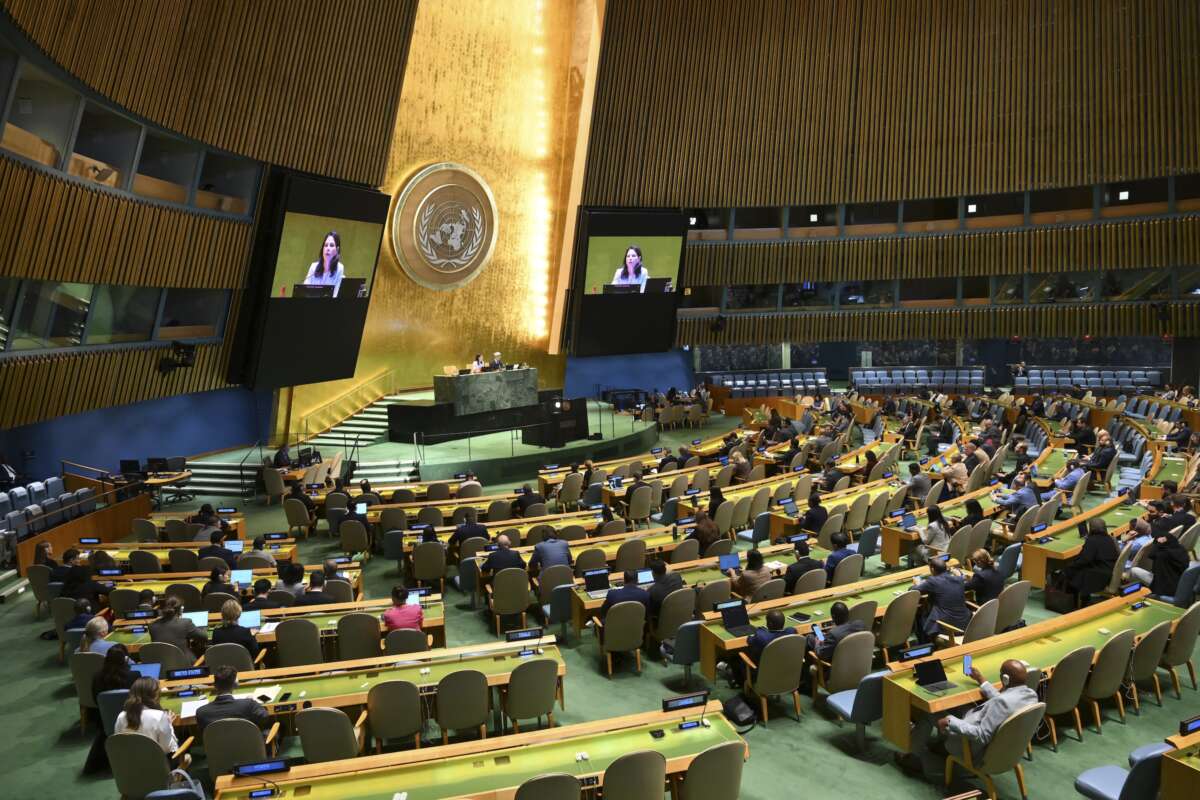
Former German Foreign Minister and President of the 80th session of the United Nations General Assembly Annalena Baerbock speaks at United Nations headquarters on September 12, 2025 in New York City.
ANGELA WEISS / AFP via Getty Images

The Trump administration is seeking sweeping changes to the rights of asylum seekers that experts say would “decimate” the global refugee system established after World War II, a new report finds.

Reuters, citing internal documents from the State Department and an agency spokesperson, finds the administration is proposing a framework in which asylum seekers would be forced to apply for protection in the first country they enter, not a country of their choosing. This asylum would be temporary, and that country would then decide when it’s safe for the refugee to return.

The administration has plans to hold an event on the sidelines of the UN General Assembly meeting later this month.

Officials have said that they sought to undo international asylum rights established after World War II. During and after the Holocaust, the U.S. denied refugees entry to the U.S., including Jewish people and other populations who had survived the Nazi Holocaust.

“Perhaps the most important root cause of the mass and illegal migration today is the abuse of refugee and asylum systems,” said Andrew Veprek, President Donald Trump’s pick to run the State Department refugee division, during a confirmation hearing on Thursday, per Reuters.

Related Story

Wealthy Countries Are Outsourcing Border Operations to Restrict Immigration
A migrant detention deal between Italy and Albania is part of a global trend that tramples on the right to asylum. By Andrea Umbrello , Truthout May 28, 2025

This is a circular statement that suggests that the effect of a phenomenon is the same as the cause. In reality, the root causes of emigration are most commonly violence in their countries of origin, as well as socioeconomic distress and climate change-fueled natural disasters.

“The current framework of international agreements and norms on migration developed after the Second World War in a completely different geopolitical and economic context. It cannot be expected to function in our modern world, and indeed it does not,” Veprek went on.

The Trump administration has already taken drastic steps to erode the right to asylum. Officials have sought to bar nearly all refugees from entering the U.S. — while giving preference to white South Africans, a blatantly racist policy.

The new proposal would severely limit options for people fleeing persecution, instability, and violence within a global system that is already extremely restrictive for refugees. Thousands of refugees die yearly trying to seek safe harbor in other countries — a crisis that could be mitigated, international migrant rights advocates say, with more permissive and safe immigration policies, or policies seeking to decrease causes of violence and economic instability.

“Trump plans to try to decimate the right to seek asylum, forcing refugees to seek asylum in the first country they enter (rarely safe) and for asylum to be temporary (so they can never rely on starting a new life),” said Kenneth Roth, former Human Rights Watch executive director and human rights advocate. “Other governments should reject his plan.”

The framework appears similar to some of the U.S.’s most restrictive and unlawful “transit” bans on asylum seekers, reflecting the U.S.’s sharp right turn on immigration and asylum policies in recent years. Europe has also become increasingly hostile to immigrants in recent decades, and The i Paper reported on Friday that the U.K.’s Home Secretary is reportedly also prepared to reform the UN-established rights to asylum to be more restrictive.
Poland pushes back on Trump comment Russian drone incursion might have been ‘mistake’

TRUMP GETS HIS INTEL FROM RT

Laura Kelly
Fri, September
 12, 2025 
THE HILL


Poland pushes back on Trump comment Russian drone incursion might have been ‘mistake’


Poland’s Foreign Minister RadosÅ‚aw Sikorski on Friday rejected President Trump’s suggestion that a Russian drone incursion into Poland earlier this week was a mistake.

Russia said it was attacking Ukraine when at least 19 of its drones crossed over into Polish airspace, triggering Polish and NATO aircraft to scramble and shoot down the drones.

Trump told reporters in Washington on Thursday, “It could have been a mistake,” mirroring Russian statements playing down the incursion.

Sikorski shot back on social media, posting in Polish, “No, that wasn’t a mistake.”

Polish Prime Minister Donald Tusk also responded, writing on social platform X, “We would also wish that the drone attack on Poland was a mistake. But it wasn’t. And we know it.”

Poland invoked NATO’s Article 4 pillar for consultations over the threats to its territory. NATO Secretary-General Mark Rutte said at the time that a full assessment of the incident ongoing, adding allies “are resolved to defend every inch of Allied territory.”

Trump told “Fox & Friends” Friday morning that his patience is running out with Russian President Vladimir Putin for failing to agree to a ceasefire and halt his war in Ukraine. Trump has imposed 50 percent tariffs on India to punish its purchase of Russian oil, but he has held back from more punitive measures targeting Russia’s war economy, despite threats of additional sanctions.

Bipartisan lawmakers on Capitol Hill have a veto-proof bill imposing tariffs on countries that enable Russia’s war in Ukraine, but Senate Majority Leader John Thune (R-S.D.) has held back bringing the bill to a vote without a green light from the White House.


'Here we go!' Trump issues 11-word statement on Russia's drone attack in Poland

Travis Gettys
September 10, 2025 
ALTERNET


U.S. President Donald Trump speaks to the press about deploying federal law enforcement agents in Washington to bolster the local police presence, in the Press Briefing Room at the White House, in Washington D.C., U.S., August 11, 2025.
 REUTERS/Jonathan Ernst

President Donald Trump issued a brief statement about the suddenly tense standoff between Poland and Russia.

Polish Prime Minister Donald Tusk warned the NATO member's parliament that Russia had crossed a line by sending drones into its airspace during an early Wednesday attack against Ukraine, saying "this situation brings us the closest we have been to open conflict since World War II," and the U.S. president briefly commented on social media.

"What’s with Russia violating Poland’s airspace with drones?" Trump posted on Truth Social at 11:09a.m. EST. "Here we go!"

European leaders condemned the incident as an escalation by the Kremlin, which has continued its attacks on Ukraine despite Trump's efforts to push Russian President Vladimir Putin and Ukraine President Volodymyr Zelenskyy into peace talks.

Polish military officials called the incursion “act of aggression" and said all of the drones were shot down with help from NATO allies, and Tusk said he has activated Article 4 of NATO’s treaty, which allows member nations to demand consultations with their allies.

That's only the eighth time since NATO was established in 1949 that Article 4, which does not trigger a military reaction, has been invoked by a member.

Trump Wants to Bury Slavery. My Family Went South to Unearth It.


Trump wants a populace unaware of the Black freedom struggle — because it is a guide for defeating his fascist plans.
September 12, 2025

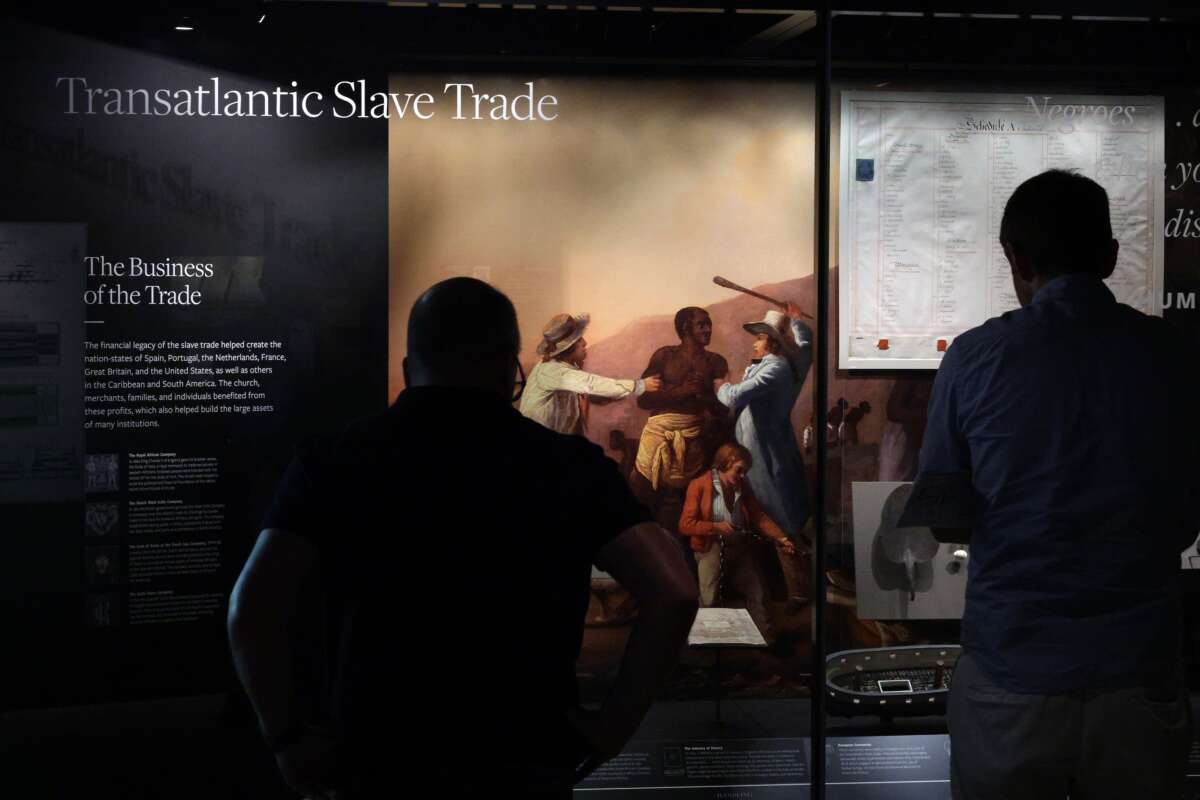
Visitors browse an exhibition about slavery in the United States at the National Museum of African American History and Culture on August 28, 2025, in Washington, D.C.Alex Wong / Getty Images
\\

Donald Trump wants slavery buried — without even a headstone to mark that it existed.

In August, he fumed that the Smithsonian was “OUT OF CONTROL” for showing “how horrible our Country is, how bad Slavery was.”

He has always trafficked in historical distortion. But his latest denial of slavery’s horrors is an escalation: It seeks to put the truth in chains, shackling history in service of his brand of MAGA fascism. Authoritarianism depends on erasing, distorting, and rewriting history so that violence and repression appear justified and inevitable. That’s why Trump has declared war on museums, schools, and curricula: If he can control the story of slavery, he can control the meaning of freedom


In a recent social media post, Trump lashed out at the Smithsonian’s National Museum of African American History and Culture, accusing it of focusing too much on slavery and not enough on the “Success” and “Brightness,” of the United States. His words came as his administration launched a 120-day review of museum exhibits, demanding curators “adjust any content” that does not sufficiently align with “American ideals.” He further boasted that he had instructed his attorneys to “go through the Museums, and start the exact same process that has been done with Colleges and Universities where tremendous progress has been made.” In other words, this was no stray rant — it was a declaration of intent to make museums the next battlefield in his war on truth.

To be clear, this isn’t the first time Trump has lied about slavery. In a June 2024 speech to the conservative Faith and Freedom Coalition, he falsely claimed that George Washington “probably didn’t” own enslaved people. In reality, Washington “owned” 123 enslaved Black people, and the total number of enslaved people on his Mount Vernon chattel labor complex (politely referred to as his plantation) swelled to 317 when he married his wife, Martha. That’s because she brought with her another 153 enslaved human beings inherited from her first husband. Washington owned Black people until his last breath, and upon his death, he bequeathed his human property to his wife.

Related Story

Trump’s Goal of Burying History Won’t Work If Teachers Refuse to Stop Teaching
Trump wants education to become indoctrination, and the Democratic Party isn’t fighting back. But we can.  By Jesse Hagopian , Truthout February 11, 2025


Washington was no “benevolent master.” He aggressively pursued runaway slaves — including Ona Judge, who escaped from his plantation and was never caught. He condoned the brutal violence that kept slavery in place. There is record of Washington ordering an enslaved man to be whipped for walking on the lawn. His secretary once recorded that “no whipping is allowed without a regular complaint & the defendant found guilty of some bad deed” — with “guilt” determined entirely by Washington or his overseers. Overseer Humphrey Knight reported to Washington in 1758: “As to the Carpenters, I have minded em all I possibly could, and has whipt em when I could see a fault.”

This was the daily terror George Washington used that kept human beings in chains.

Trump’s recent comments attempting to whitewash slavery are part of a broader movement to replace critical thinking with what I call “Uncritical Race Theory” — an ideology that denies the brutality of slavery and the centrality of it to the U.S. economy, while promoting the idea that racism either doesn’t exist; or if it does exist, primarily harms white people; or is only the product of individual prejudice, never systemic or institutional.

Uncritical Race Theory vs. Education


Uncritical Race Theory is quickly becoming official state doctrine — even if its architects are too dishonest to call it that — and it’s spreading across the country.

Florida’s official curriculum — not the Klan’s youth handbook, but the state’s actual standard — now claims slavery was of “personal benefit” to Black peoples. Under Trump, the National Park Service even scrubbed Harriet Tubman from its Underground Railroad webpage, replacing her story of defiance with a sanitized theme of “Black/White cooperation.”

In Oklahoma, the assault on truth has reached a new low. Superintendent Ryan Walters decreed that teachers moving from California or New York must pass a certification exam before entering a classroom — a modern-day loyalty oath straight out of the McCarthy era. The kicker? It’s not overseen by educators or universities but by PragerU. Despite its name, PragerU isn’t a university; it’s a $60 million right-wing media company producing slick propaganda targeting kids that is designed to normalize whitewashed myths. Already, PragerU curriculum is approved for use in classrooms in public schools in at least eight states, including Florida, Oklahoma, Texas, Montana, Louisiana, South Carolina, Idaho, and Arizona.

And at the federal level, Trump is cutting PBS funding while embracing PragerU as the White House’s preferred alternative. PragerU explicitly notes it aims to capitalize on the defunding of PBS to go “toe-to-toe with PBS Kids.”

Consider one PragerU’s cartoons: Two kids travel back to meet Christopher Columbus and ask about his enslavement of Indigenous people. Columbus shrugs: “Being taken as a slave is better than being killed, no? I don’t see the problem.” The children assure him slavery isn’t allowed in the 21st century, and Columbus convinces them it isn’t fair to judge him by the standards of the future. In short, the video teaches children not to “see the problem” with slavery, that criticism of enslavement is unfair, and that the real danger lies not in mass human bondage but in judging history too harshly.

Yet, even in his own time, Columbus faced condemnation. BartolomĂ© de las Casas, a Spanish colonist turned Dominican friar, publicly denounced the violence against the Indigenous TaĂ­no people. In his History of the Indies, de las Casas wrote that the Spanish “took infants from their mothers’ breasts, snatching them by the legs and pitching them headfirst against the crags … roaring with laughter and saying as the babies fell into the water, ‘Boil there, you offspring of the devil!’… They made some low wide gallows on which the hanged victim’s feet almost touched the ground … then set burning wood at their feet and thus burned them alive.”

His opposition proves that Columbus’s actions were not judged harshly only by later generations — they were decried by people who witnessed them firsthand.

In another video, PragerU commits a full-on memory hole rewrite by putting deceitful words into the mouth of Frederick Douglass. The cartoon depicts kids traveling back to 1852 to meet Douglass, who tells them, “Our founding fathers knew that slavery was evil and wrong … they wanted it to end … there was no real movement anywhere in the world to abolish slavery before the American founding … our system is wonderful.”

Pause for a moment to let this flagrant insult to truth and this obscene perversion of history sink in. PragerU actually portrays Frederick Douglass — a man who dedicated his life to destroying slavery — as declaring “our system is wonderful.” And not in some vague, ahistorical sense, but in 1852, the very year Douglass delivered his most blistering indictment of the United States in his famous oration, “What to the Slave is the Fourth of July?

In that speech, Douglass declared, “There is not a nation on the earth guilty of practices, more shocking and bloody, than are the people of these United States, at this very hour … for revolting barbarity and shameless hypocrisy, America reigns without a rival.”

Where Douglass eviscerated the United States for its barbarity and hypocrisy, PragerU recasts him as a cheerleader for American exceptionalism. This is not history — it is indoctrination. It erases the radical truth-telling of one of the greatest abolitionists in history and replaces it with the very lies he spent his life fighting.
Unearthing History They Want Buried

In his book How the Word Is Passed, poet, historian, and best-selling author Clint Smith writes:


The history of slavery is the history of the United States. It was not peripheral to our founding; it was central to it. It is not irrelevant to our contemporary society; it created it…. We can learn this history by standing on the land where it happened. And we can learn this history from our own families, by sitting down and having conversations with our elders and getting insight into all that they’ve seen.

While Trump and his coterie of uncritical race theorists work to bury history, I went South this summer to unearth mine.

Several years ago, my father discovered the locations of the plantations where our family had been enslaved. Since then, my father, brother, son, and I have been traveling to Lawrence County and Morgantown, Mississippi, to stand on that land and to continue work on a documentary about our family’s history of enslavement and resistance. Being there with three generations of our family was no abstract history lesson — it was an act of radical remembering.


There are still people alive today who knew those who had been enslaved. That history isn’t distant — it’s still breathing beside us.

We went to honor Thomas and Laura Lenoir, my great-great-grandparents. Laura was born in 1852, the same year Frederick Douglass delivered his scorching speech condemning slavery. That connection brought history into sharper focus. I found myself wondering: What would Laura say today about PragerU’s grotesque distortions — about the attempt to twist the year of her birth into a fable that recasts Douglass’s searing denunciation as praise for the very system that enslaved her?

Last summer, we installed a headstone to mark Thomas and Laura’s resting place and legacy. As we gathered with community members, a woman in her 90s approached me with something that stopped me cold: she had once been friends with my great-great-grandmother Laura. That revelation hit me like a thunderclap. There are still people alive today who knew those who had been enslaved. That history isn’t distant — it’s still breathing beside us.

Then she told another story I’ll never forget. During Jim Crow, Black families in her town built a preschool for their children. The Ku Klux Klan burned it down, hoping to drive them away. But the community members didn’t run. They armed themselves, rebuilt the school in a tent, and stayed. They fought back. They held on.

Later in our trip, we had the opportunity to meet with descendants of those who had enslaved our family. They gave us a rare and chilling gift that had been passed down through their family: an original copy of The Laws of Mississippi, 1823. Inside was a statute criminalizing Black education and gathering, which states: “All meetings or assemblages of slaves, or free negroes, or mulattoes, mixing and associating with such slaves, at any school or schools for teaching them reading or writing … shall be deemed and considered an unlawful assembly … The officer … shall have power to inflict … twenty lashes on his or their bare back … and shall be entitled to receive … twenty-five cents for each slave so punished.”

This was their blueprint for white supremacist control designed to choke out Black literacy before it could ever become resistance. And yet, in the face of these laws, our ancestors gathered anyway. Learned anyway. Taught anyway.

In fact, while searching courthouse records, we made a stunning discovery: the signature of my great-great-grandmother Laura Lenoir. Whereas many documents signed by formerly enslaved people had an X, Laura hand signed her name!

So we know she could write. Did she secretly learn during slavery, risking everything? Was she part of the extraordinary wave of learning during Reconstruction, when Black communities built the public schools and a movement for mass education? Did she ever feel the sting of the lash for daring to write, as that law demanded?

We may never know the details. But we know this: she learned. She wrote. And she passed the value of education for liberation on to her posterity; Laura had 15 children, with one dying as a child, and she put all 14 of her surviving children through college. Her son York Alanozo Lenoir — my great-grandfather — even became a teacher and principal and started Black schools around the South. Despite the government sanctioning beatings for literacy and the KKK burning down schools, my family and their communities refused to submit to white supremacist terror.
Radical Remembering in an Age of Lies

This is the history Trump and his allies want erased — not because it’s divisive, but because it’s powerful. Because it tells the truth about Black resistance, Black dignity, and the long shadow of slavery. The lies of today’s politicians and groups like PragerU are so dangerous because they revive the logic of those 1823 laws: controlling knowledge to control freedom.

And let’s be clear: Trump’s lies, and the policies that follow them, aren’t only about disgracing Laura and Thomas or making history palatable for those who want a fantasy version of the U.S. Trump wants a populace unaware of the Black freedom struggle — because it is a guide for defeating his fascist plans.


This isn’t the first time we’ve faced fascism in the U.S., and it isn’t the first time we’ve fought back.

“Authoritarian regimes often find history profoundly threatening,” writes Jason Stanley, in his book, Erasing History: How Fascists Rewrite the Past to Control the Future. “At every opportunity, these regimes find ways of erasing or concealing history in order to consolidate their power… All of this is true of authoritarianism in general, but it is especially true of one specific kind of authoritarian ideology: fascism.”

We are watching this fascist formula being rolled out around the country: deploying federal agents to occupy majority-Black cities under the banner of “law and order”; threatening to send the National Guard into urban areas with Black leadership; purging diversity, equity, and inclusion programs; demanding loyalty tests for teachers; and imposing Uncritical Race Theory as official curriculum.

Trump’s fascist project piles onto the U.S.’s ongoing systemic racism — the racial wealth gap, voter suppression, mass incarceration, and police terror — all legacies of slavery and Jim Crow.

When the woman in her 90s told me how her community armed itself and rebuilt their preschool in a tent after the KKK burned it down, I understood two things on a much deeper level: This isn’t the first time we’ve faced fascism in the U.S., and it isn’t the first time we’ve fought back — defending our communities and expanding our rights in the process.

Let her story summon in you the courage to join the struggles of today: to defend history in our schools and museums, to resist occupying armies in our cities, to stop immigration raids that are tearing families apart, and to reject every policy that seeks to bury truth and terrorize the vulnerable.


This article is licensed under Creative Commons (CC BY-NC-ND 4.0), and you are free to share and republish under the terms of the license.


Jesse Hagopian
Jesse Hagopian is a Seattle educator, the director of the Zinn Education Project’s Teaching for Black Lives Campaign, an editor for Rethinking Schools, and the author of the book, Teach Truth: The Struggle for Antiracist Education. You can follow him at IAmAnEducator.com, Instagram, Bluesky or Substack.
DIRTY AIR, DIRTY WATER 
In ‘Latest Pro-Polluter Move,’ Trump EPA to End Emissions Data Collection

“EPA cannot avoid the climate crisis by simply burying its head in the sand as it baselessly cuts off its main source of greenhouse gas emissions data,” said one Sierra Club campaigner.


\
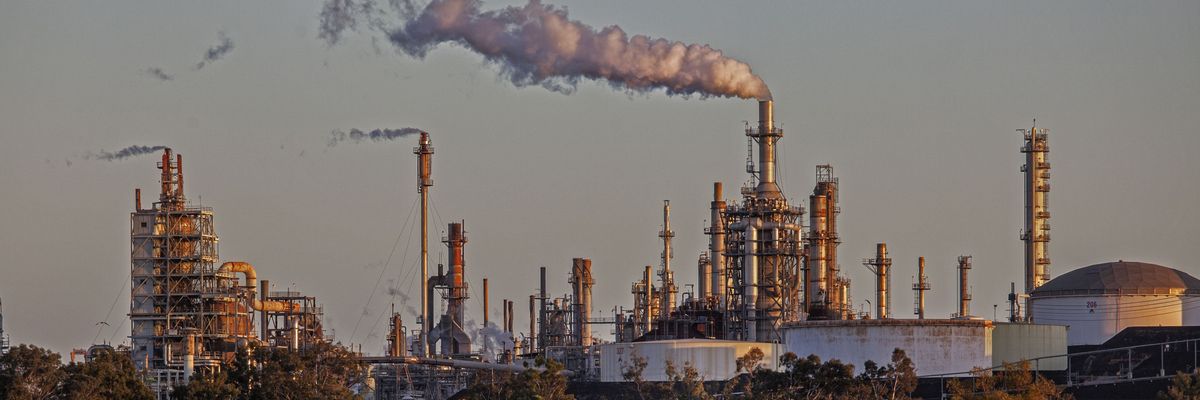
A Phillips 66 oil refinery operates in Wilmington, California.
(Photo by Citizen of the Planet/Education Images/Universal Images Group via Getty Images)

Jessica Corbett
Sep 12, 2025
COMMON DREAMS

Citing US President Donald Trump’s anti-climate executive actions, Environmental Protection Agency Administrator Lee Zeldin on Friday unveiled a proposal to end a program that requires power plants, refineries, landfills, and more to report their emissions.

While Zeldin claimed that “the Greenhouse Gas Reporting Program is nothing more than bureaucratic red tape that does nothing to improve air quality,” experts and climate advocates emphasized the importance of the data collection, which began in 2010.

“President Trump promised Americans would have the cleanest air on Earth, but once again, Trump’s EPA is taking actions that move us further from that goal,” Joseph Goffman, who led the EPA Office of Air and Radiation during the Biden administration, said in a statement from the Environmental Protection Network, a group for former agency staff.

“Cutting the Greenhouse Gas Reporting Program blinds Americans to the facts about climate pollution. Without it, policymakers, businesses, and communities cannot make sound decisions about how to cut emissions and protect public health,” he explained.

As The New York Times reported:

For the past 15 years, the Greenhouse Gas Reporting Program has collected data from about 8,000 of the country’s largest industrial facilities. That information has helped guide numerous decisions on federal policy and has been shared with the United Nations, which has required developed countries to submit tallies of their emissions.

In addition, private companies often rely on the program’s data to demonstrate to investors that their efforts to cut emissions are working. And communities often use it to determine whether local facilities are releasing air pollution that threatens public health.

“By hiding this information from the public, Administrator Zeldin is denying Americans the ability to see the damaging results of his actions on climate pollution, air quality, and public health,” Goffman said. “It’s a further addition to the deliberate blockade against future action on climate change—and yet another example of the administration putting polluters before people’s health.”

Sierra Club’s director of climate policy and advocacy, Patrick Drupp, stressed Friday that “EPA cannot avoid the climate crisis by simply burying its head in the sand as it baselessly cuts off its main source of greenhouse gas emissions data.”

“The agency has provided no defensible reason to cancel the program; this is nothing more than EPA’s latest action to deny the reality of climate change and do everything it can to put the fossil fuel industry and corporate polluters before people,” he added. “The Sierra Club will oppose this proposal every step of the way.”

Margie Alt, director of the Climate Action Campaign, similarly said that “the Trump administration’s latest pro-polluter move to eliminate the Greenhouse Gas Reporting Program is just another brazen step in their Polluters First agenda.”

Responding to the administration’s claim that the proposal would save businesses up to $2.4 billion in regulatory costs, Alt said that “under the guise of saving Americans money, this is an attempt on the part of Trump, Lee Zeldin, and their polluter buddies to hide the ball and avoid responsibility for the deadly, dangerous, and expensive pollution they produce.”

“If they succeed, the nation’s biggest polluters will spew climate-wrecking pollution without accountability,” she warned. “The idea that tracking pollution does ‘nothing to improve air quality’ is absurd,” she added. “If you don’t measure it, you can’t manage it. Hiding information and allowing fossil fuel companies to avoid accountability are the true goals of this rule.”


BlueGreen Alliance executive director Jason Walsh declared that “the Trump administration continues to prove it does not care about the American people and their basic right to breathe clean air. This flies in the face of the EPA’s core mission—to protect the environment and public health.”

“The proposal is wildly unpopular with even industry groups speaking against it because they know the value of having this emissions data available,” he noted. “Everybody in this country deserves to know the air quality in their community and how their lives can be affected when they live near high-emitting facilities.”

“Knowledge is power and—in this case—health,” he concluded. “The administration shouldn’t be keeping people in the dark about the air they and their neighbors are breathing.”

This proposal from Zeldin came a day after the EPA moved to reverse rules protecting people from unsafe levels of per- and polyfluoroalkyl substances (PFAS), often called ”forever chemicals,” in US drinking water, provoking similar criticism. Earthjustice attorney Katherine O’Brien said that his PFAS decision “prioritizes chemical industry profits and utility companies’ bottom line over the health of children and families across the country.”


EPA Seeks to Reverse Rules Protecting Drinking Water From ‘Forever Chemicals’

One environmental attorney said that the EPA proposal “prioritizes chemical industry profits and utility companies’ bottom line over the health of children and families across the country.”


A child pours tap water into a glass in this undated photo.
(Photo by Teresa Short/Getty Images)

Brett Wilkins
Sep 12, 2025
COMMON DREAM

Public health and environment defenders on Friday condemned the Trump administration’s announcement that it will no longer uphold Environmental Protection Agency rules that protect people from unsafe levels of so-called ”forever chemicals” in the nation’s drinking water.

In addition to no longer defending rules meant to protect people from dangerous quantities of per- and polyfluoroalkyl substances (PFAS)—called forever chemicals because they do not biodegrade and accumulate in the human body—the EPA is asking a federal court to toss out current limits that protect drinking water from four types of PFAS: PFNA, PFHxS, GenX, and PFBS.

The EPA first announced its intent to roll back limits on the four chemicals in May, while vowing to retain maximum limits for two other types of PFAS. The agency said the move is meant to “provide regulatory flexibility and holistically address these contaminants in drinking water.”

However, critics accuse the EPA and Administrator Lee Zeldin—a former Republican congressman from New York with an abysmal 14% lifetime rating from the League of Conservation Voters—of trying to circumvent the Safe Drinking Water Act’s robust anti-backsliding provision, which bars the EPA from rolling back any established drinking water standard.

“In essence, EPA is asking the court to do what EPA itself is not allowed to do,” Earthjustice said in a statement.

“Administrator Zeldin promised to protect the American people from PFAS-contaminated drinking water, but he’s doing the opposite,” Earthjustice attorney Katherine O’Brien alleged. “Zeldin’s plan to delay and roll back the first national limits on these forever chemicals prioritizes chemical industry profits and utility companies’ bottom line over the health of children and families across the country.”

Jared Thompson, a senior attorney with the Natural Resources Defense Council (NRDC), said that “the EPA’s request to jettison rules intended to keep drinking water safe from toxic PFAS forever chemicals is an attempted end run around the protections that Congress placed in the Safe Drinking Water Act.”

“It is also alarming, given what we know about the health harms caused by exposure to these chemicals,” Thompson added. “No one wants to drink PFAS. We will continue to defend these commonsense, lawfully enacted standards in court.”

PFAS have myriad uses, from nonstick cookware to waterproof clothing to firefighting foam. Increasing use of forever chemicals has resulted in the detection of PFAS in the blood of nearly every person in the United States and around the world.

Approximately half of the U.S. population is drinking PFAS-contaminated water, “including as many as 105 million whose water violates the new standards,” according to the NRDC, which added that “the EPA has known for decades that PFAS endangers human health, including kidney and testicular cancer, liver damage, and harm to the nervous and reproductive systems.”

Betsy Southerland, a former director of the Office of Science and Technology in the EPA’s Office of Water, said in a statement Friday:
The impact of these chemicals is clear. We know that this is significant for pregnant women who are drinking water contaminated with PFAS, because it can cause low birth weight in children. We know children have developmental effects from being exposed to it. We know there’s an increased incidence of cardiovascular disease and cancer with these chemicals.

Two of the four chemicals targeted in this motion are the ones that we expect to be the most prevalent, and only increasing contamination in the future. With this rollback, those standards would be gone.


Responding to Thursday’s developments, Environmental Advocates NY director of clean water Rob Hayes said that “the EPA’s announcement is a big win for corporate polluters and an enormous loss for New York families.”

“Administrator Zeldin wants to strip clean water protections away from millions of New Yorkers, leaving them at risk of exposure to toxic PFAS chemicals every time they turn on the tap,” he added. “New Yorkers will pay the price of this disastrous plan through medical bills—and deaths—tied to kidney cancer, thyroid disease, and other harmful illnesses linked to PFAS.”

While Trump administration officials including Agriculture Secretary Brooke Rollins and Health and Human Services Secretary Robert F. Kennedy Jr. have claimed they want to “make America healthy again” by ending PFAS use, the EPA is apparently moving in the opposite direction. Between April and June of this year, the agency sought approval of four new pesticides considered PFAS under a definition backed by experts.

“What we’re seeing right now is the new generation of pesticides, and it’s genuinely frightening,” Nathan Donley, the environmental health science director at the Center for Biological Diversitytold Civil Eats earlier this week. “At a time when most industries are transitioning away from PFAS, the pesticide industry is doubling down. They’re firmly in the business of selling PFAS.”


Democratic Senators Call for JPMorgan CEO to Testify on Bank’s Epstein Ties


“The American people deserve to know what happened at JPMorgan and other banks that financed Mr. Epstein,” they wrote.
Truthout
September 12, 2025

People walk outside of the JPMorgan Chase headquarters in New York.Eduardo Munoz Alvarez / VIEWpress


Democratic senators are calling for a congressional hearing on JPMorgan Chase and other banks’ ties to accused child sex trafficker Jeffrey Epstein.

“The American people deserve to know what happened at JPMorgan and other banks that financed Mr. Epstein,” 10 Democratic members of the Senate Banking, Housing, and Urban Affairs Committee wrote to Committee Chair Tim Scott (R-South Carolina).

“The Committee should hold a public hearing as soon as possible to examine failures and advance reforms that protect our communities,” they continued.

The letter was signed by Democratic Senators Elizabeth Warren (Massachusetts), Jack Reed (Rhode Island), Tina Smith (Minnesota), Catherine Cortez Masto (Nevada), Chris Van Hollen (Maryland), Raphael Warnock (Georgia), Andy Kim (New Jersey), Ruben Gallego (Arizona), Lisa Blunt Rochester (Delaware), and Angela Alsobrooks (Maryland).

The senators called for JPMorgan CEO Jamie Dimon to testify before the committee under oath.


The letter was spurred by an investigation published on September 8 in The New York Times Magazine. The Times reported that JPMorgan may have enabled Epstein’s crimes by continuing to work with him despite repeated warnings from employees as early as 2006.

Over the course of the bank’s relationship with Epstein, JPMorgan processed over $1 billion in transactions and opened at least 134 accounts for victims of his sex trafficking operation, according to the Times. The bank made more than $8 million in fees off of Epstein in one year alone.

“During a time when Epstein was regularly sexually abusing teenage girls and young women, JPMorgan processed more than 4,700 transactions, totaling more than $1.1 billion, for him, including payments to his victims,” the Times reported. “It also wired his money to Russian and Eastern European banks that appeared connected to Epstein’s sex-trafficking operations.”

Deutsche Bank, where Epstein was also a client, has also been accused of enabling Epstein’s sex trafficking operation. The bank subsequently paid victims of Epstein and regulators more than $100 million in settlements.

“Deutsche Bank executives, meanwhile, similarly estimated that Mr. Epstein could generate up to $4 million in annual revenues for the bank and decided to bank him in spite of his record,” the senators wrote. “So, despite repeated warnings from their employees, JPMorgan — and other financial institutions like Deutsche Bank — continued to do business with Mr. Epstein, potentially enabling his significant crimes.”

The Trump administration has moved to weaken regulations for the banking industry, but the senators say the Times investigation shows “we need more transparency, not less.”

“As the Trump Administration takes steps to loosen safeguards — such as rolling back anti-money laundering rules, halting enforcement of laws to combat anonymous shell companies, and firing bank examiners — our understanding of these vulnerabilities is more important than ever,” they wrote.

JPMorgan has faced multiple lawsuits over its relationship with Epstein. The U.S. Virgin Islands, where Epstein owned two islands, sued JPMorgan, arguing that the bank was “indispensable to the operation and concealment of the Epstein trafficking enterprise.” Epstein allegedly trapped and abused many of his victims on his Virgin Islands compound. The bank settled the case in 2023 for $75 million.

Also that year, JPMorgan settled a lawsuit filed by about 200 victims for $290 million.

Haley Robson, who was sexually abused by Epstein when she was in high school, contacted CEO Dimon directly about the bank’s integral role in Epstein’s crimes.

“I don’t understand how so many people, colleagues, knew what was going on, or had evidence and information that could have helped us, and chose not to speak up,” Haley Robson wrote in a letter to Dimon, The Daily Beast reported in 2023.

“I may not be as smart as you, but we should at least agree that the information you withheld has hurt me and many others,” she continued.

This week, federal lawmakers published a book of notes and drawings made for Epstein’s 50th birthday that was turned over by Epstein’s estate. The book reportedly includes contributions from former President Bill Clinton, Harvard law professor emeritus Alan Dershowitz, and President Donald Trump. Trump has denied he authored the note signed “Donald Trump,” which features what appears to be the outline of a woman or girl’s body.

“Happy Birthday — and may every day be another wonderful secret,” Trump allegedly wrote.

Another contribution to the book, which is unsigned, shows a drawing of Epstein at a child’s birthday party, giving three young girls balloons, and a second drawing of women in bikinis massaging him. The first picture is labeled 1983 and the second is labeled 2003. One of the women has Epstein’s initials tattooed on her exposed buttocks.

“What a great country,” the contributor wrote.


'Costs are down!' Trump declares inflation 'solved' as gas and grocery prices soar

TRUMP LIES

David Badash,
 The New Civil Rights Movement
September 12, 2025 


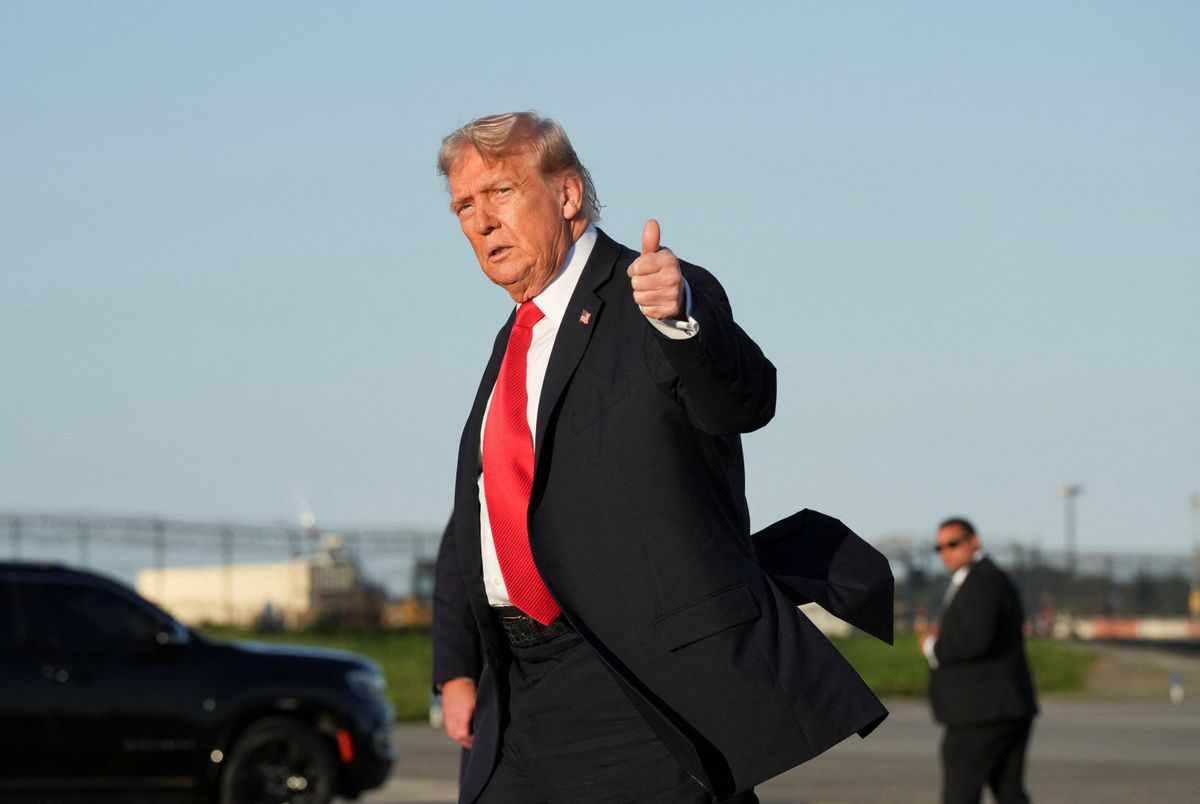
U.S. President Donald Trump gestures as he arrives at LaGuardia Airport in New York, U.S., September 11, 2025. REUTERS/Ken Cedeno

President Donald Trump has declared inflation “solved” as Americans are paying more for everyday goods like gas and groceries.

“I’ve already solved inflation,” Trump told “Fox & Friends” on Friday morning. “Costs are down.”

Inflation is now the highest it’s been since January, according to CNBC.

“Look at the energy costs,” he added. “You’re gonna have $2 gasoline pretty soon.”

The national average price of gas as of Friday is $3.19, according to AAA. Nationwide, prices are as high as $4.65 and as low as $2.71.


The president went on to boast, “I’ve solved just about every problem.”

But statistics from the U.S. Department of Labor show Americans are paying more—in some cases far more—at the pump and at the checkout line.

“Inflation inched higher last month as Americans closed out the summer paying more for both groceries and gasoline,” NPR reported on Thursday. “Consumer prices in August were up 2.9% from a year ago, according to a report Thursday from the Labor Department. That’s a sharper annual increase than the previous month, when inflation was clocked at 2.7%.”

During the 2024 presidential campaign, Donald Trump vowed to lower prices “on day one.”

Yet, due in part to his sweeping tariffs, “Virtually all major grocery categories are now more expensive than they were a year ago, some substantially so,” according to Axios. “This was the biggest month-over-month increase since August 2022, the tail end of a year of huge monthly increases in grocery prices.”

The price of coffee is up nearly 21%, the price of uncooked beef steaks is up nearly 17%, apples are up nearly 10%, and bananas are up almost 7%.

Overall, the cost of groceries in August was up 0.6% over July’s prices, and the price of gas jumped 1.9% in just one month, according to NPR.