Saturday, September 13, 2025

Silver price shoots above $42 for fresh 14-year high
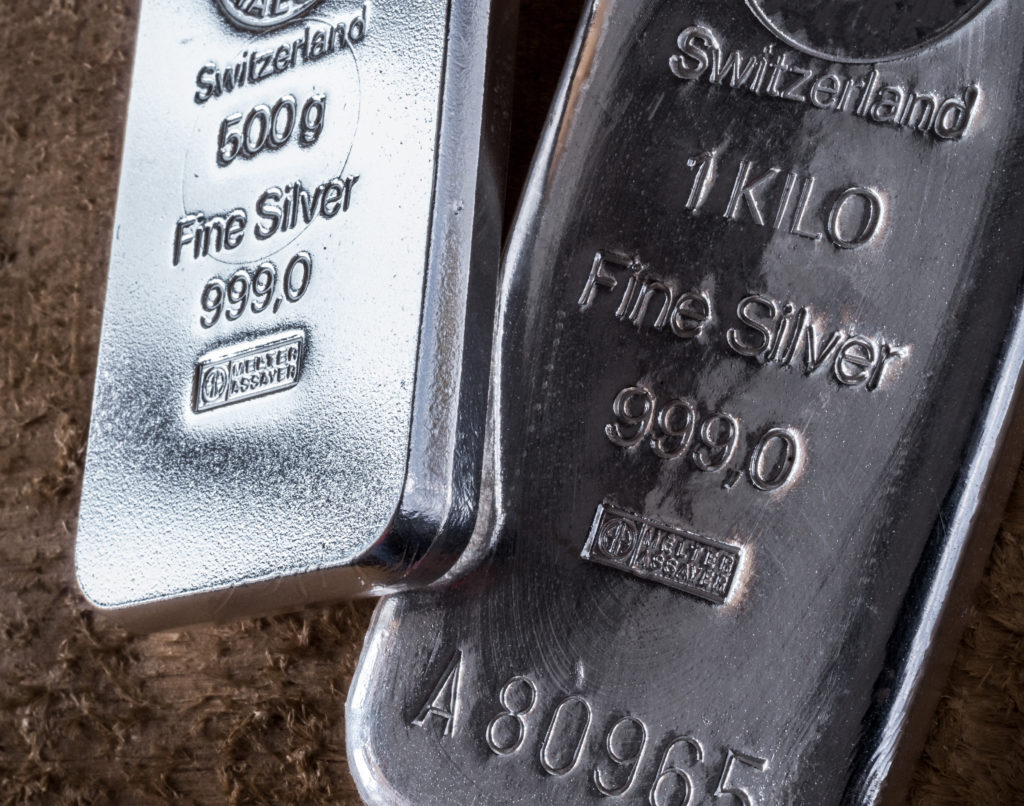

In 2025, the silver price has risen by more than 43%, even surpassing gold, making it one of the best-performing assets of the year.


Stock image.

Silver extended its winning streak for a third straight session on Friday, as an increased likelihood of a Federal Reserve rate cut next week pushed the precious metal higher.

Spot prices rallied another 1.6% to surpass the $42/oz mark. Its intraday high of $42.46 was the highest since 2011.
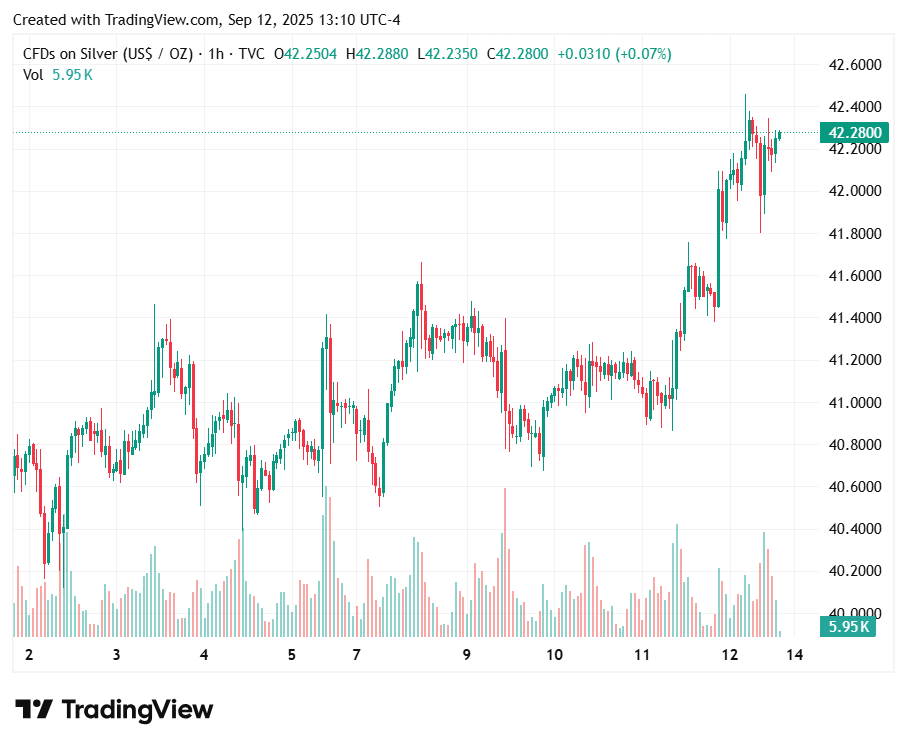
This takes silver’s weekly gains to over 3%, as a looming Fed decision on interest rates raised the prospects of non-yielding assets like silver.

The latest US jobs data pointing to an economic slowdown further cemented market-wide expectations that a 25-basis-point cut is on the cards.

“Weaker employment and spotty inflation … priced in with the Fed having to cut rates is pushing metals higher because there is the risk of longer-term inflation,” Daniel Pavilonis, senior market strategist at RJO Futures, wrote in a Reuters note.

Over a longer horizon, analysts see further room to run. A new report by Sprott builds a bullish case for precious metals, predicting a strategic shift away from the US dollar and Treasuries under the current environment and into hard assets.

In silver’s case, the case may be even stronger as the metal’s fundamentals are underpinned by powerful structural forces, namely a prolonged supply deficit and a tightening physical market.

In 2025, the silver price has risen by more than 43%, even surpassing gold, making it one of the best-performing assets of the year.


Gold price surpasses inflation-adjusted record high set in 1980


Stock image.

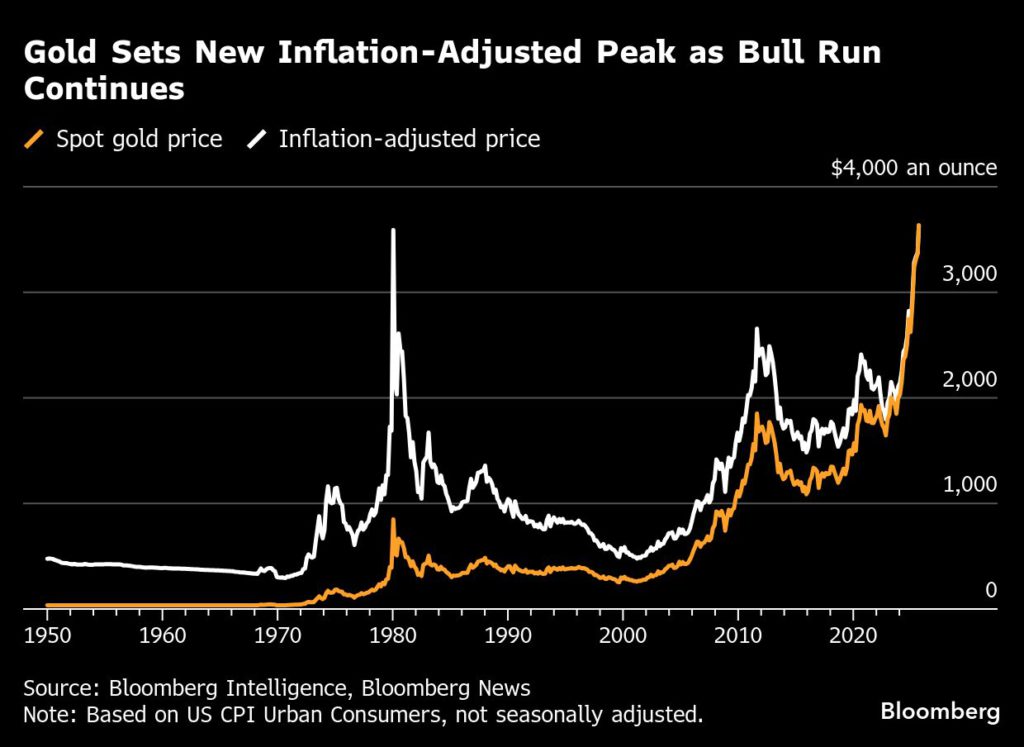
Gold has eclipsed its inflation-adjusted peak set more than 45 years ago, as growing anxiety about the US’s economic trajectory takes bullion’s blistering three-year bull run deeper into uncharted territory.

The spot price of gold has surged about 5% so far this month, with prices hitting an all-time high of $3,674.27 an ounce on Tuesday. It’s set more than 30 nominal records already in 2025, but the latest leg of the rally has also taken it through an inflation-adjusted peak set on Jan. 21, 1980, when prices topped out at $850.
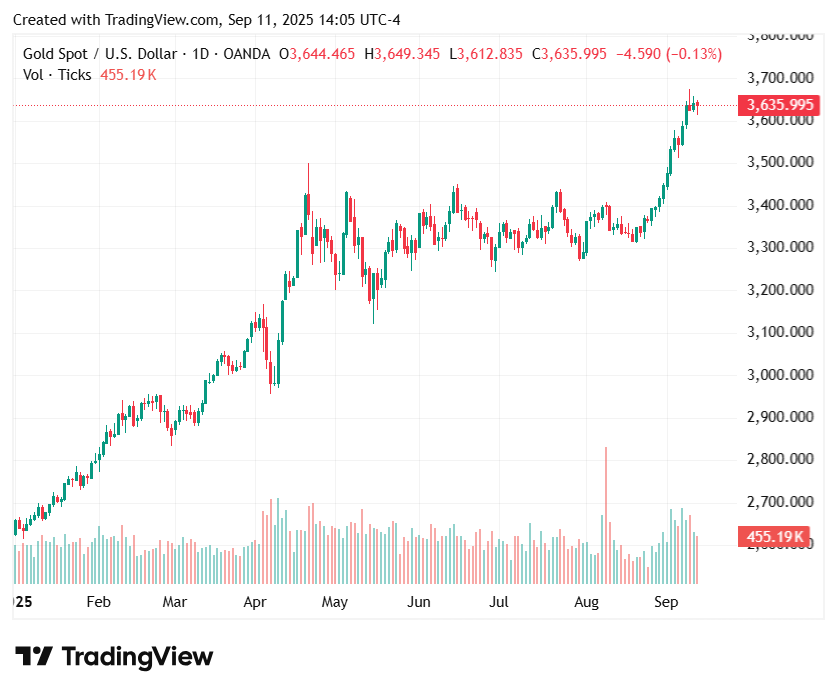
Factoring in decades of consumer price increases, that equates to about $3,590 — although there are multiple methods of adjusting for inflation, and some would put the 1980 peak at lower levels. It’s a moving target, but analysts and investors are in agreement that gold has now shot firmly through it, providing a further fillip for gold’s credentials as an age-old hedge against rising prices and weakening currencies.

“Gold is a very unique asset in its historical ability over hundreds — if not thousands — of years to play that role,” said Robert Mullin, portfolio manager at Marathon Resource Advisors. “Asset allocators are entering a period where they are justifiably concerned about the levels of both deficit spending, as well as questioning central banks’ priorities and willingness to truly fight inflation.”
The precious metal has risen nearly 40% this year as President Donald Trump has cut taxes, expanded his global trade war, and sought unprecedented influence over the Federal Reserve. A selloff in the dollar and long-term US government bonds earlier this year highlighted concerns about waning appetite for American assets, and fueling questions about whether the nation’s debt remains a haven in times of turmoil.

When gold hit $850 in January 1980, the US was grappling with a collapsing currency, a spike in inflation and an unfolding recession. The price had doubled over the previous two months, after US President Jimmy Carter issued a freeze on Iranian assets in response to a hostage crisis in Tehran, raising the perceived risk of holding dollar assets for some foreign central banks.

“Gold is only reflecting the renewed awareness that inflation can be and still is a problem, but also uncertainty about the world,” said Carmen Reinhart, a former senior vice president and chief economist at the World Bank Group. Gold’s “role as an inflation hedge was a stamp of its popularity in the 70s and 80s, but you need to look before the 1980s: Gold has always played an important role when there’s uncertainty.”

Compared with the parabolic surge to the peak in 1980 — and a precipitous collapse that followed — today’s rally has unfolded with far less volatility. That’s partly because today’s market is far more liquid and accessible to investors, and also because it’s attracting a broader base of investors who are offsetting weakness in traditional areas of demand.

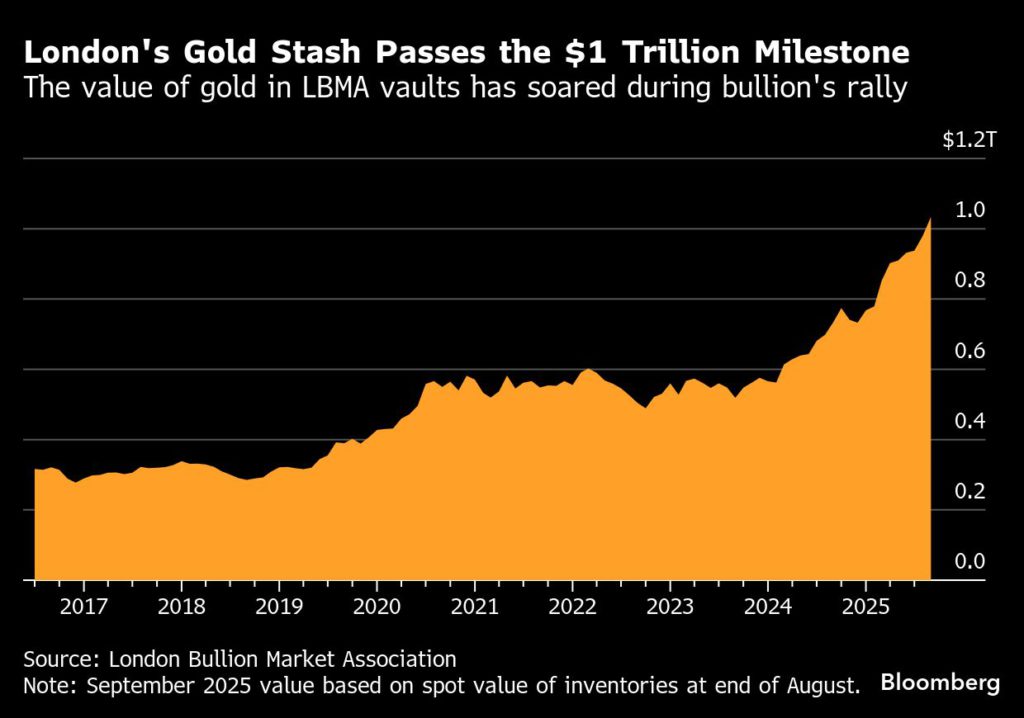
Thanks to the surge in prices, the value of bullion held in London vaults exceeded $1 trillion for the first time last month, and it’s also overtaken the euro as the second-largest asset in global central bank reserves.

Grant Sporre, global head of metals and mining at Bloomberg Intelligence, has overhauled his analytical models to take fuller account of the broad and diverse drivers behind gold’s stellar rally. They suggest gold is over-priced relative to historical norms except in one crucial aspect: Compared to US stocks, gold still looks cheap, and he says prices could vault higher still if equity markets start to creak.

“Gold’s eye-wateringly expensive, but the market is happy to pay the price in order to secure that insurance,” Sporre said.
Gold’s comeback

It’s a striking comeback for an asset that was derided by central bankers throughout the 1990s and 2000s, as the end of the Cold War, the birth of the eurozone, and China’s accession to the World Trade Organization ushered in a new era of globalization underpinned by the dollar. As stock markets took off, many private investors turned their back on gold too.

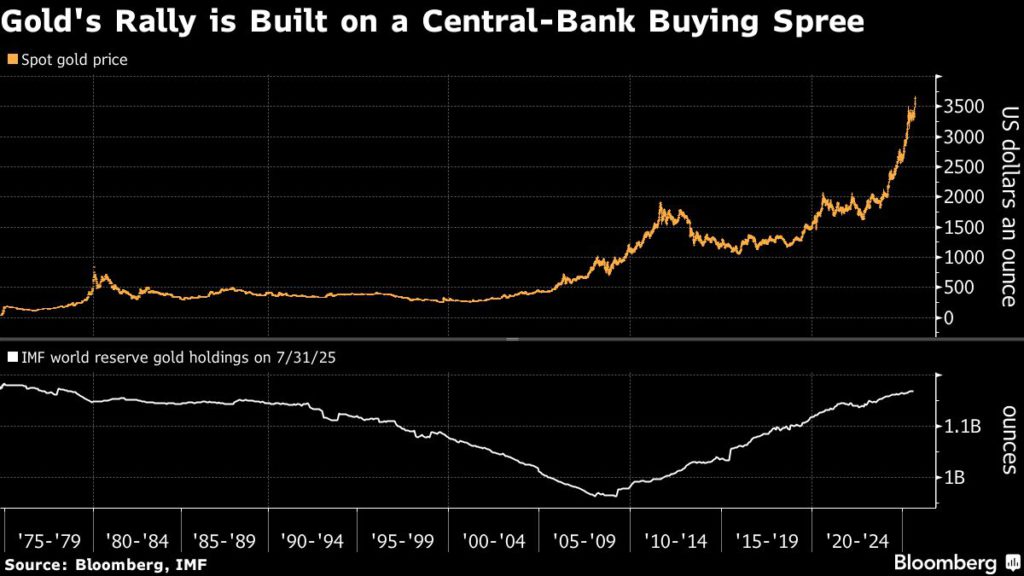
This time, many central banks are again buying gold to diversify their foreign exchange holdings from the dollar, and insulate themselves from sanctions targeting America’s adversaries. Prices have almost doubled since Russia’s invasion of Ukraine and a resulting freeze on the Kremlin’s overseas assets, with the rally broadening out as institutional investors started loading up in the wake of Trump’s inauguration.

Sporadic buying sprees in China and a resurgence in the popularity of exchange-traded funds — which have made gold more accessible to retail investors — have also lent support along the way.

“The movement from a unipolar world to a multipolar world I think has accelerated the view of gold as being an asset that central banks want to own,” said Greg Sharenow, a portfolio manager at Pacific Investment Management Co. “High net worth individuals have been viewing it similarly, and gold has been a big beneficiary of the broadening and the diversification of assets.”
Over the past two weeks, prices have erupted higher again, shooting clear of all-time nominal highs set in April after a spell of range-bound trading. The latest breakout has come as investors across financial markets bet that the Fed will soon start lowering interest rates off to head off a slowdown in hiring and and a potential economic downturn.

Historically, rate cuts have boosted gold’s appeal relative to yield-bearing assets like Treasuries, while also putting pressure on the dollar. And with Trump staging an unprecedented assault on the Fed’s independence, gold bulls are also increasingly alert to the possibility that the central bank could be compelled to cut rates aggressively even in the face of rising inflation risks.

When similar dynamics took hold in the early 1970s — with the dollar slumping as then-President Richard Nixon pressured the Fed to keep rates low in the face of inflation risks — it helped kick-start a colossal rally in gold, with the twin oil shocks of that decade helping to ultimately lift it to its $850 peak.

“I could read what was happening in the world: Every country was building up huge debt, every country was printing money and debasing their currency,” said Jim Rogers, the co-founder of the Quantum Fund alongside George Soros, who began buying bullion in the early 1970s. “And I also read enough to know that gold and silver were a way to protect yourself in times like that.”


(By Yvonne Yue Li, Yihui Xie, Jack Ryan and Sybilla Gross)

Brazil prosecutors call for halt on lithium mining in Minas Gerais

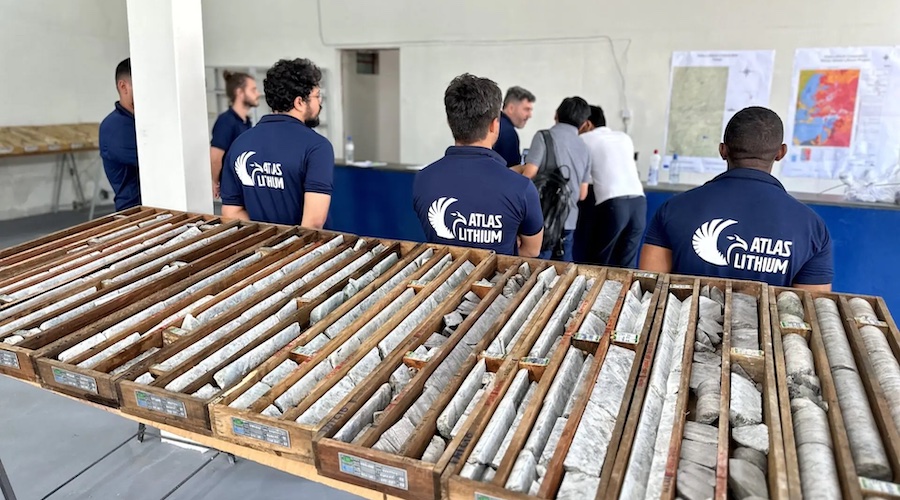
Neves lithium project in Minas Gerais. (Image courtesy of Atlas Lithium.)

Brazil’s federal prosecutors have asked the country’s mining regulator to suspend lithium projects in Minas Gerais, citing inadequate consultation with local communities and environmental risks.

The Federal Public Ministry (MPF) requested that the National Mining Agency (ANM) review exploration and extraction licences in Araçuaí and neighbouring municipalities in the Jequitinhonha Valley, the region that hosts most of Brazil’s lithium developments. The agency has 20 days to assess current permits and stop issuing new ones until proper consultations are carried out.

Prosecutors said indigenous groups, quilombola (Afro-Brazilians descendants of slaves) communities and other traditional residents were not consulted before projects were approved. They stressed that permits must follow principles of free, prior and informed consent, in good faith.

Prosecutors also claim that existing operations have already harmed local communities. Quoting “expert reports” MPF said the Neves project, operated by Atlas Lithium (NASDAQ: ATLX), disrupted water supplies when roadwork damaged community pipelines in Calhauzinho, Passagem da Goiaba and other areas.

“The reports warn that the expansion of mining will increase pressure on infrastructure and water resources,” MPF said in the statement.

Sigma Lithium’s (TSX-V, NASDAQ: SGML) subsidiary, Sigma Mineração, also came under scrutiny. A 2021 technical review identified flaws in the company’s Environmental Impact Study for the Grota do Cirilo project, particularly concerning water management in Araçuaí and Itinga, MPF said. Two planned open pits could affect the Piauí stream, the main water source for residents and rural communities, especially during dry seasons.

“If the ANM does not comply with the recommendation, the MPF may adopt other administrative and judicial measures,” it said.

Atlas and Sigma did not respond to requests for comments by the time this article was posted.

MONOPOLY CAPITALI$M

Anglo-Teck $53B merger may topple Escondida as copper leader

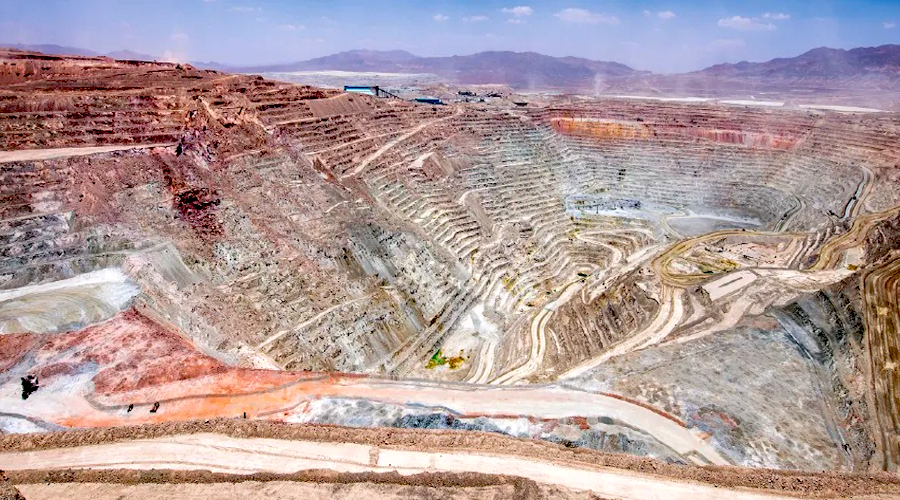
Escondida is, for now, the world’s largest copper mine. (Image courtesy of BHP.)

Anglo American (LON: AAL) and Teck Resources’ (TSX: TECK.A, TECK.B)(NYSE: TECK) planned $53 billion merger could create the world’s largest copper mine by the early 2030s, surpassing BHP’s Escondida in Chile, according to analysts.

The centrepiece of the deal is the integration of Teck’s Quebrada Blanca (QB) mine with Anglo’s Collahuasi operation. Together, they could generate about one million tonnes of copper annually, industry analysts say.

“It is absolutely feasible that a Collahuasi-QB complex could surpass Escondida’s level of copper out-turn in the early 2030s,” CRU Group analyst William Tankard said in a note.

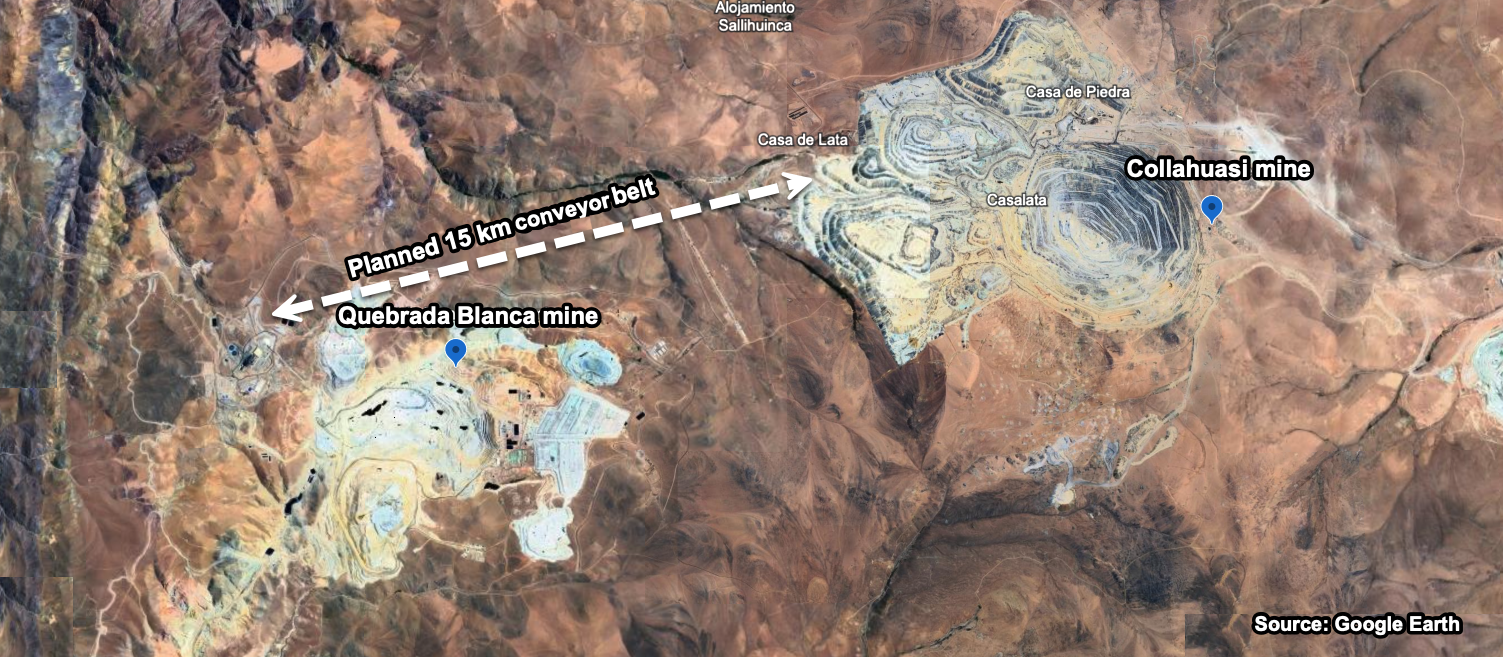
A proposed 15-kilometre conveyor would link Collahuasi’s high-grade ore to QB’s processing facilities, adding the equivalent of a new mine’s output. The system is projected to deliver an extra 175,000 tonnes of copper per year between 2030 and 2049, at lower costs and shorter timelines than a standalone development.

Anglo-Teck $53B merger may topple Escondida as copper leader
A 15-km (9.3-mile) conveyor would be built to feed Collahuasi’s high-quality ore into QB’s new processing plants. (Click on map to enlarge)

If completed, the combined Anglo-Teck entity would rank among the world’s top five copper producers, with 1.35 million tonnes in output a year. In comparison, Escondida produced about 1.28 million tonnes of copper in 2024. The deal would also mark the mining sector’s biggest transaction of the decade. 

The companies project $800 million in annual pretax synergies, and up to $1.4 billion in additional EBITDA gains from shared procurement and operational efficiencies.

“I think it’s conservative,” George Cheveley, portfolio manager at Ninety One, wrote this week. “The optionality to expand and develop that complex over multiple decades is not in that number.”

Execution risks loom large. Teck’s QB mine has struggled with cost overruns, pit instability, plant outages, and waste-storage issues. Anglo American, meanwhile, does not fully control Collahuasi, where Glencore (LON: GLEN) and other partners hold significant stakes. 

Analysts caution that operational fixes at QB are critical before the combined complex can challenge Escondida.

Wood Mackenzie values Teck at $10.8 billion on a post-tax, sum-of-the-parts basis: $13.8 billion from copper and $1.1 billion from zinc, offset by $4.1 billion in central costs through 2040. That estimate excludes potential synergies with Collahuasi, QB’s growth options and a life extension at the Red Dog mine, but also factors in downside risk from QB’s operational setbacks.

(With files from Bloomberg)


MMG’s $500M nickel deal with Anglo American faces EU doubts 


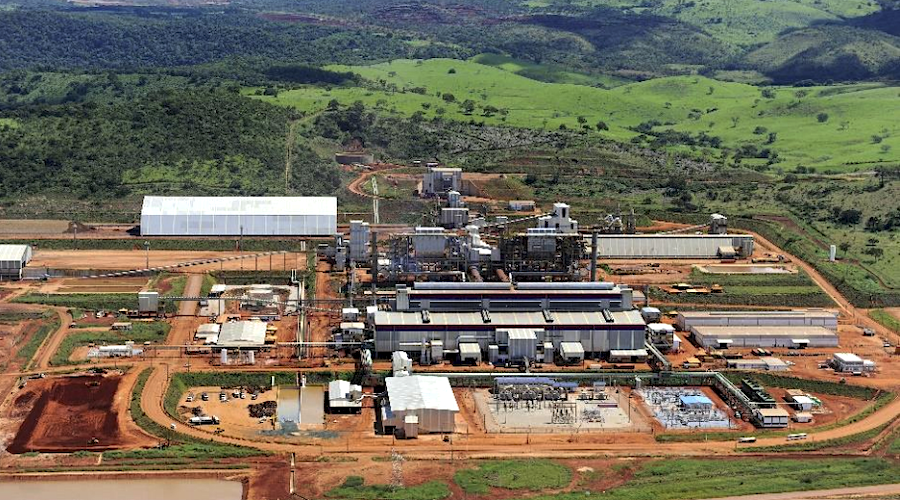
Barro Alto is a nickel-producing mine and processing plant. (Image courtesy of Anglo American.)

China-backed miner MMG expects to secure European approval for its $500 million bid to buy Anglo American’s nickel assets, even as regulators question Beijing’s grip on critical mineral supply chains.

Troy Hey, MMG’s executive general manager of corporate relations, confirmed that European antitrust officials had raised concerns about the company’s Chinese majority ownership, but said the firm is confident the deal will clear.

“From a competition basis, we’re very confident that as new entrants to this market . . . and with very strong demand in Europe, we’re in a good place,” Hey told the Financial Times.

Brazil’s competition authority has already opened a probe, as Anglo’s nickel operations are located there. Although MMG does not currently operate in Brazil, Europe remains a key destination for the ferronickel produced at Anglo’s mines, which primarily supply stainless steel manufacturers.

Steelworkers complain

The deal is also drawing scrutiny in the United States. The American Iron and Steel Institute has urged Washington to block the acquisition, arguing it would hand Beijing direct influence over major nickel reserves. Nickel is a critical material for both electric vehicle batteries and stainless steel.

The proposed sale forms part of Anglo American’s (LON: AAL) wider restructuring. The company spun off its platinum business in May, creating Valterra (JSE: VAL), and in July classified its nickel and steelmaking coal divisions as discontinued operations pending divestment.

Anglo is sharpening its focus on copper, positioning itself to become the world’s fifth-largest producer if its proposed $53 billion merger with Canada’s Teck (TSX: TECK.A TECK.B)(NYSE: TECK) goes ahead.

Anglo-Teck deal hinges on troubled copper mine in Chile


The recently expanded Quebrada Blanca mine in Chile is Teck’s largest copper project is undergoing optimization and debottlenecking. Image courtesy of Teck Resources.

At the heart of one of the mining industry’s most ambitious combinations is a plan to fix a problematic Teck Resources Ltd. copper mine high in Chile’s Atacama desert, and ultimately to integrate it with a vast neighboring operation that has long been a jewel in Anglo American Plc’s crown.

That, however, will require resolving complex operational troubles that have plagued Quebrada Blanca, known as QB — and then navigating relationships with partners in Collahuasi, a mine Anglo doesn’t control.

Teck has staked its growth plans on QB, but a major overhaul of the mine was a headache from its early days, coming in more than 80% over budget and years behind schedule. While delays and overruns are not unheard of in the industry, the operation has also since struggled with instability in the pit and plant, a ship-loader outage and now waste storage.

The travails forced Teck to trim output guidance in July, and earlier this month — just days before announcing a more than $50 billion merger agreement with Anglo — it said it would defer decisions on growth projects to focus on fixing QB.

“Quebrada Blanca has sizable technical challenges to reach capacity,” said Juan Ignacio Guzman, who heads GEM, a mineral consulting firm in Chile. “The synergies it could have with Collahuasi aren’t simple.”

Still, the benefits of a working combination would be hefty, in an industry where vast, usually distant, operations mean substantial synergies are hard to come by. Tying up with Collahuasi, specifically processing its richer ore at QB plants, could mean an average annual boost to Ebitda of $1.4 billion, the two companies said. The revenue synergies would come on top of the $800 million a year in cost savings from more standard areas like procurement and corporate functions in a combined company.

“I think it’s conservative,” said George Cheveley, portfolio manager at Ninety One, referring to the $1.4 billion boost. “The optionality to expand and develop that complex over multiple decades is not in that number.”

Under plans sketched out by the two companies this week, a roughly 15-kilometer (9.3-mile) conveyor would be built to feed Collahuasi’s high-quality ore into QB’s new processing plants. That would generate the equivalent of a new mine’s worth of supply — an incremental annual output of about 175,000 tons of copper from 2030 to 2049 — at a fraction of the time and per-ton cost.

One scenario could see combined annual output approach 1 million tons by the early 2030s, according to industry consultancy CRU Group. That could put it above BHP Group’s Escondida, though not necessarily for the long-haul, as the world’s largest copper mine.

“It is absolutely feasible that a Collahuasi-QB complex could surpass Escondida’s level of copper out-turn in the early 2030s,” said CRU analyst William Tankard.

It’s the kind of cost-saving arrangement the industry has been touting for decades, where neighboring mines gain outsized benefits with relatively small investments, helping to boost global production of a metal vital for the energy transition.

But these deals are slow and challenging. Chilean state-owned giant Codelco and Anglo have held discussions for years over ways to integrate their Los Bronces and Andina mines, and are yet to finalize an arrangement.

Collahuasi and QB have more complicated ownership structures. Collahuasi — jointly owned by Anglo and Glencore Plc, with 44% each, plus a Mitsui & Co.-led consortium holding 12% — is independently managed. At QB, Teck does own the majority share, but still has Japan’s Sumitomo Metal Mining Co. together with Sumitomo Corp. as a 30% partner, and Codelco with a 10% stake.

“Among the challenges will be governance, due to the multiplicity of partners,” said Juan Carlos Guajardo, founder of consultancy Plusmining.

Then there’s the scale of the problems at QB. To grapple with these before committing, Anglo sent technical experts to QB and sat with independent engineers, Anglo chief executive officer Duncan Wanblad told analysts this week.

The troubles are such that some Teck shareholders worry Anglo may be getting a steal by swooping in at a low point — but Anglo’s investors fear it may be getting more than bargained for.

“It’s beyond me why Teck would surrender control of one of the world’s great copper-rich mining companies for nil premium, especially when they’ve inexplicably chosen to price the deal after underperforming Anglo by so much,” said Tim Elliott, head of mining at Regal Funds Management. “Teck should fix their key asset first, then test the market properly from a position of strength.”

Unions at the site say teams have been filling cracks around the tailings dam embankment, while waste is piling up because of the filtering issues and there’s also been pipe corrosion. The slower-than-expected ramp-up, meanwhile, is squeezing production bonuses for workers.

“This hits the wallet,” said David Munoz, an official at one of the main unions at the mine. “We don’t do less work than at other mines but we get less because of these issues.”

QB uses the so-called centerline cycloned sand dam method, which splits coarse material from fines, with the sand used to raise the embankment. The slower-than-expected drainage creates a bottleneck for production.

Earlier this month, Teck stepped up efforts to resolve the tailings issues, bringing in a former senior BHP executive as special adviser. Work is focusing on mechanically raising the dam wall and improving drainage times, the company said in an emailed response, adding that dam and pipe maintenance is normal and doesn’t pose any risk.

The ramp-up troubles are not dissimilar to Anglo’s own at Quellaveco in Peru, Wanblad said, a reminder of the copper industry’s struggles to expand supply just as the world demands more of the red metal. Quellaveco uses a similar tailings system.

“The reality is that these major operations do just sometimes take time,” he said.

(By James Attwood)


Vale CEO sees copper growth driven by project pipeline over M&A


Vale CEO Gustavo Pimenta. (Image courtesy of Vale.)

Vale SA chief executive officer Gustavo Pimenta said the company “fell behind in the copper race” and will seek to regain ground by accelerating the development of its own mining assets, rather than looking at potential deals.

“Our opportunity lies more in developing our mining potential than in possibly making a transaction,” Pimenta said Wednesday on the sidelines of a conference in Sao Paulo. “Our potential for product development is greater than that of our competitors.”

The global mining industry has seen a flurry of dealmaking, driven largely by the desire to expand production of copper — a metal essential to the global energy transition. This week, Anglo American Plc agreed to acquire Canada’s Teck Resources Ltd., creating a more than $50 billion company in one of the biggest mining deals in over a decade.

Pimenta cited the Teck-Anglo combination as highlighting the favorable supply-demand outlook that’s underpinning copper.

Vale will focus on accelerating projects in Brazil’s Amazon rainforest, Pimenta said. The company earlier this year said it was spending 70 billion reais ($13 billion) on Amazon investments for iron ore and copper by 2030.

The Brazilian company produces about 350,000 tons of copper a year and forecasts doubling that amount by 2035. Speeding up copper projects including Alemao and Bacaba is a top priority, Pimenta said.

The Rio de Janeiro-based miner cut its full year capital expenditure guidance for 2025 to a $5.4 billion-$5.7 billion, from a previous $5.9 billion estimate. The reduction is concentrated in the copper and nickel business. Pimenta said the adjustments came from efficiency gains and that Vale isn’t giving up on any projects.

(By Mariana Durao and Dayanne Sousa)


Montrealer plans to sue major grocers over false ‘made in Canada’ labels

By Laurence Brisson Dubreuil
 September 13, 2025 

Canadian flag labels near milk at a grocery store in Sidney, British Columbia, Canada, on Wednesday, Feb. 26, 2025.
(James MacDonald/Bloomberg) 

Ever bought a product thinking it was made in Canada only to find out later it wasn’t?

One Montrealer says it happened to them. And now, they’re taking on major grocery chains.

Provigo, Metro, Sobeys, Walmart, and Giant Tigre are all named in a new class action.

Joey Zukran is one of the lawyers leading the case.

“This is false advertising 101,” he says.

He argues grocers used maple leaves, flags, and tags like “made in Canada” to sell products imported from elsewhere.

“When you’re telling consumers that the product is made in Canada, you’re appealing to their patriotic and moral compasses,” says Zukran.

Zukran says it’s not just about deception — he wants compensation for customers and punishment for the companies targeted.

Food distribution expert Sylvain Charlebois warns the damage goes beyond labels and is likely to further stress a frayed relationship.

“A lot of people don’t necessarily trust grocers, for a variety of reasons- pricing is certainly one of them,” he says.

And shoppers CTV news spoke to agree — this so-called maple-washing isn’t helping.

“Sometimes it’s not true. The other day I bought cheese, le Ptit Quebec, made in the States,” said Monique Langlois.

The trade war sparked a push for many Canadians to boycott American products, and some numbers reflect that.

“In the spring of 2025, American food sales in volume dropped 8-point-5 per cent- we’ve never seen that before,” says Charlebois.

The class action has yet to get the green light. But what’s at stake is more than just labels — it’s how honest Canada’s biggest grocers are with their customers.


Laurence Brisson Dubreuil

CTV News Montreal Videojournalist


Some public service jobs will be cut as Ottawa adopts AI: chief data officer


By The Canadian Press
September 12, 2025 

People walk past an illuminated sign at the All In artificial intelligence conference on Thursday, Sept. 28, 2023, in Montrea
l.THE CANADIAN PRESS/Ryan Remiorz

OTTAWA — Ottawa’s chief data officer says he thinks the introduction of artificial intelligence to federal government operations will lead to “some” job cuts in the public service.

In a recent interview with The Canadian Press, Stephen Burt said he thinks the impacts are going to vary widely and will be job-specific, with different outcomes in different areas.

While he wouldn’t identify the risk of job losses in specific areas of government, Burt said the goal will be to ensure employees receive opportunities to retrain and change jobs.

“I think there will be some, but I couldn’t tell you specifically right now what the magnitude of that is going to be or where it’s going to be felt most acutely,” Burt said when asked about job losses.

Prime Minister Mark Carney campaigned in the spring federal election on using AI to make the public service more efficient. Finance Minister François-Philippe Champagne has asked his colleagues to identify cuts to program spending of 15 per cent over the next three years.


In August, the federal government signed an agreement with Canadian artificial intelligence company Cohere to identify places where AI could enhance public service operations.

The government says it plans to launch a public registry to keep Canadians in the loop on its growing use of artificial intelligence, and to help it keep track of AI projects already underway. There is no timeline yet for the registry’s launch.

Different departments and agencies have been using AI for years for tasks like analyzing satellite imagery and weather forecasting, predicting the outcome of tax cases and sorting temporary visa applications.

Burt said AI is one of many tools the government is using to boost its efficiency.

“There are going to be many things being done to help enhance efficiency and focus across government and AI is just going to be one piece of it,” he said.

Public Service Alliance of Canada national president Sharon DeSousa said in an email statement that AI “isn’t a shortcut to better public services.”

“Canadians need real help from real people — not chatbots, automated phone trees or AI dead ends,” DeSousa said.

DeSousa said AI won’t solve the core problems in departments and that cuts to the public service mean fewer services for people who need them.

“PM Carney must consult with unions and front line public service workers before rolling out AI across government,” DeSousa said.

Catherine Connelly is a professor and business research chair in the department of human resources and management at McMaster University. She said that when Canadians hear about AI in the public service, many fear a repeat of previous government debacles involving information technology, such as the Phoenix public service pay system and the ArriveCan app.

“It’s great that they are trying to be innovative and that they’re focusing on cost and that they’re focusing on performance and productivity,” she said. “It’s just that we’ve seen this before and I think it’s natural for Canadians to have some concerns about how this will be rolled out.”


Connelly said AI is not a good substitute for human decision-making and shouldn’t be deployed in any area where there’s a risk of liability, or in hiring decisions.

The federal government has said that in cases where AI use “can have significant impacts,” such as administrative decisions, its directive on automated decision-making requires an algorithmic impact assessment. Those assessments are then published in a public register.

Burt said the best thing the government can do to help employees get through any AI transition is to be clear in its communications.

“I think we need to be open with our employees where we do see those possibilities, and there’s lots of supports in place, through the various processes governments had established for a long time on how you manage workforce changes,” he said.

Burt added that the government spends “a fair amount of time” speaking to union bargaining agents about AI.

But Sean O’Reilly, president of the Professional Institute of the Public Service of Canada, said the government isn’t keeping the union adequately informed about AI adoption.

“There’s a lot of informing the bargaining agents about AI when it does happen and it’s usually after the fact, before we’ve had any chance to consult,” O’Reilly said, adding that the union has reached out to offer Ottawa advice and guidance on AI use several times.

“There’s never been real meaningful consultation.”

O’Reilly said that while he welcomes the use of AI in government, he worries it will be introduced in a way that eliminates human judgment and jobs.

“I look at the work that public servants do in general, yes, I think there’s probably some mundane tasks that we could assign to artificial intelligence,” he said. “It would give the public servant the ability to get those off their plate.”

— With files from Anja Karadeglija

This report by The Canadian Press was first published Sept. 12, 2025.

Catherine Morrison, The Canadian Press
AI, agriculture and Africa

How AI is helping some small-scale farmers weather a changing climate


By The Associated Press
 September 12, 2025 

A farmer uses the Ulangizi AI chatbot in Mulanje, southern Malawi, Tuesday, July 29, 2025. (AP Photo/Thoko Chikondi).

MULANJE, Malawi — Alex Maere survived the destruction of Cyclone Freddy when it tore through southern Malawi in 2023. His farm didn’t.

The 59-year-old saw decades of work disappear with the precious soil that the floods stripped from his small-scale farm in the foothills of Mount Mulanje.

He was used to producing a healthy 850 kilograms (1,870 pounds) of corn each season to support his three daughters and two sons. He salvaged just 8 kilograms (17 pounds) from the wreckage of Freddy.

“This is not a joke,” he said, remembering how his farm in the village of Sazola became a wasteland of sand and rocks.

Freddy jolted Maere into action. He decided he needed to change his age-old tactics if he was to survive.


He is now one of thousands of small-scale farmers in the southern African country using a generative AI chatbot designed by the non-profit Opportunity International for farming advice.

AI suggests potatoes


The Malawi government is backing the project, having seen the agriculture-dependent nation hit recently by a series of cyclones and an El Niño-induced drought. Malawi’s food crisis, which is largely down to the struggles of small-scale farmers, is a central issue for its national elections next week.

More than 80 per cent of Malawi’s population of 21 million rely on agriculture for their livelihoods and the country has one of the highest poverty rates in the world, according to the World Bank.

The AI chatbot suggested Maere grow potatoes last year alongside his staple corn and cassava to adjust to his changed soil. He followed the instructions to the letter, he said, and cultivated half a soccer field’s worth of potatoes and made more than $800 in sales, turning around his and his children’s fortunes.

“I managed to pay for their school fees without worries,” he beamed.

AI, agriculture and Africa

Artificial intelligence has the potential to uplift agriculture in sub-Saharan Africa, where an estimated 33-50 million smallholder farms like Maere’s produce up to 70-80 per cent of the food supply, according to the U.N.’s International Fund for Agricultural Development.

Yet productivity in Africa — with the world’s fast-growing population to feed — is lagging behind despite vast tracts of arable land.

As AI’s use surges across the globe, so it is helping African farmers access new information to identify crop diseases, forecast drought, design fertilizers to boost yields, and even locate an affordable tractor. Private investment in agriculture-related tech in sub-Saharan Africa went from $10 million in 2014 to $600 million in 2022, according to the World Bank.

But not without challenges.

Africa has hundreds of languages for AI tools to learn. Even then, few farmers have smartphones and many can’t read. Electricity and internet service are patchy at best in rural areas, and often non-existent.

“One of the biggest challenges to sustainable AI use in African agriculture is accessibility,” said Daniel Mvalo, a Malawian technology specialist. “Many tools fail to account for language diversity, low literacy and poor digital infrastructure.”
The man with the smartphone

The AI tool in Malawi tries to do that. The app is called Ulangizi, which means advisor in the country’s Chichewa language. It is WhatsApp-based and works in Chichewa and English. You can type or speak your question, and it replies with an audio or text response, said Richard Chongo, Opportunity International’s country director for Malawi.

“If you can’t read or write, you can take a picture of your crop disease and ask, ‘What is this?’ And the app will respond,” he said.

But to work in Malawi, AI still needs a human touch. For Maere’s area, that is the job of 33-year-old Patrick Napanja, a farmer support agent who brings a smartphone with the app for those who have no devices. Chongo calls him the “human in the loop.”

“I used to struggle to provide answers to some farming challenges, now I use the app,” said Napanja.

Farmer support agents like Napanja generally have around 150-200 farmers to help and try to visit them in village groups once a week. But sometimes, most of an hour-long meeting is taken up waiting for responses to load because of the area’s poor connectivity, he said. Other times, they have to trudge up nearby hills to get a signal.

They are the simple but stubborn obstacles millions face taking advantage of technology that others have at their fingertips.

Trust is critical, scaling up is difficult

For African farmers living on the edge of poverty, the impact of bad advice or AI “hallucinations” can be far more devastating than for those using it to organize their emails or put together a work presentation.

Mvalo, the tech specialist, warned that inaccurate AI advice like a chatbot misidentifying crop diseases could lead to action that ruins the crop as well as a struggling farmer’s livelihood.

“Trust in AI is fragile,” he said. ”If it fails even once, many farmers may never try it again.”

The Malawian government has invested in Ulangizi and it is programmed to align with the agriculture ministry’s own official farming advice, making it more relevant for Malawians, said Webster Jassi, the agriculture extension methodologies officer at the ministry.

But he said Malawi faces challenges in getting the tool to enough communities to make an extensive difference. Those communities don’t just need smartphones, but also to be able to afford internet access.

For Malawi, the potential may be in combining AI with traditional collaboration among communities.

“Farmers who have access to the app are helping fellow farmers,” Jassi said, and that is improving productivity.

___

Gregory Gondwe, The Associated Press
Prototype farming machine first of its kind in Saskatchewan

By Jacob Carr
September 11, 2025 

WATCH: A prototype farming machine, which has the ability to seed, fertilize, and harvest crops, is the first of its kind in Saskatchewan. Jacob Carr explains.

Saskatchewan farm owner Rhett Chute is operating a prototype farming machine that’s the first of its kind in the province.

Early this summer, Chute Farms Joint Venture just outside of Caronport, Sask., was approached by German company NEXAT to collaborate and use one of its state-of-the-art prototype machines.

“They were wondering, since we have bigger fields here,” recalled Chute, a part owner at the farm.

“NEXAT had two of their machines down in Nebraska and one out in Manitoba, so they approached us wanting a little bit o

f flatter land, bigger fields type of thing.”


The NEXAT system has a main carrier vehicle and multiple attachments that can be switched out, allowing for seeding, fertilizing, and harvesting of a crop.

Chute said one of the main draws for him to agree to use the machinery was its uniqueness.

“It’s cool,” he said. “There’s nothing out there that looks like this thing, so when you can combine beside it all day, it’s definitely interesting. That’s pretty much the real reason we said yes. I said, ‘This is kind of neat, I want to see this thing work.’”

A prototype farming machine, provided by German Company NEXAT, has a main carrier vehicle and multiple attachments that allow for seeding, fertilizing, and harvesting of a crop. (Jacob Carr / CTV News)

There are only 16 of the NEXAT machines in operation worldwide, and the three situated in North America all currently reside at Chute Farms Joint Venture.

Chute told CTV News he has been impressed with the performance of the NEXAT combine, saying he hasn’t really seen a downside to them and that they are performing the work of the farm’s normal combines, plus more.

Jeremy Welter, vice-president of the Agricultural Producers Association of Saskatchewan (APAS), said the NEXAT has piqued their interest, and it may have a role to play in the future of crop production in the province and all over the world.

“The NEXAT looks quite interesting and based on some of their initial data, it does seem to provide certain improvements to sustainability, certainly less compaction over the growing areas,” he said.

How much does it cost?


Despite the NEXAT’s impressive capabilities, APAS sees the price point as a potential issue for small to medium farmsteads in Saskatchewan.


The carrier vehicle for the NEXAT comes in a $1.3 million — and with all of the attachments, that price shoots up to over $2 million, which Welter said is probably unrealistic for the average-sized farm.

“Now, does that mean that the average farmer is going to be buying it today,” he said, “or is it something that most pieces of equipment start out on the larger operations, and some of the medium to smaller operations just sort of wait for those things to come down on price so that they’re realistically affordable?”

For Chute and his farm, he says the plan with the NEXAT is to continue using it until after the next harvest.

“We could very well be in this field in the spring seeding with that thing,” he said.


Jacob Carr

Videojournalist - CTV News Regina
USDA projects record U.S. corn crop, biggest harvested acres since 1933


By Reuters
September 12, 2025 

An ear of corn from a field in Wyoming, Iowa. Monday, Sept. 16, 2024 (AP Photo/Charlie Neibergall) (Charlie Neibergall/AP)

CHICAGO — U.S. farmers will harvest the most acres of corn since 1933 and produce more of the grain than previously expected, even though crop yields will miss earlier forecasts, the U.S. Department of Agriculture said on Friday.

The agency further increased its estimate for how many acres will be harvested in a monthly supply and demand report, after surprising grain traders with a large acreage increase in August.

The production increase kept a lid on benchmark corn prices on the Chicago Board of Trade Cv1.

“It didn’t matter that USDA reduced the corn yield, because of the amount of corn acreage they found,” said Susan Stroud, founder and analyst at No Bull Agriculture.

Grain supplies were set to swell due to the large harvest, benefiting livestock producers that use the crop for feed and ethanol manufacturers.


But grain farmers have struggled with low crop prices and rising costs for inputs such as fertilizer and seeds. Cash receipts for U.S. crops have been forecast to fall for a third straight year to the lowest level since 2007, when adjusted for inflation.

The USDA raised its 2025 U.S. corn production estimate to a record 16.814 billion bushels. It projected a record average yield of 186.7 bushels per acre, down from 188.8 bushels per acre in August. Both figures were above analysts’ expectations.

Favorable crop weather for much of the summer growing season boosted yield prospects until pockets of disease and dry late-season weather clipped potential, analysts said.

End-of-season U.S. corn stocks for the 2025/26 marketing year were projected at 2.11 billion bushels, down slightly from the USDA’s forecast a month earlier as record-large U.S. exports were seen absorbing more of the crop. Still, the supply outlook was the largest since the 2018/19 season, according to USDA data.

For soybeans, the USDA projected U.S. yield at a slightly higher-than-expected 53.5 bushels per acre, compared with 53.6 bushels in August. It pegged production at 4.301 billion bushels, up from 4.292 billion bushels a month earlier as the agency increased harvested acres.

The agency raised its U.S. soybean ending stocks forecast by 10 million bushels after cutting its export projection to the lowest since a U.S. trade war with top-importer China during President Donald Trump’s first term.

Export sales have slumped again due to a renewed trade dispute with Beijing, which has not yet booked any new-crop purchases from the United States.

(Reporting by Karl Plume in Chicago. Additional reporting by PJ Huffstutter in Chicago.Editing by Marguerita Choy)


Corn diseases lurk in bumper U.S. crop, threatening yields

By Reuters
September 12, 2025 

This is a cornfield in Mill Hill, Pa., on Aug. 29, 2023. (AP Photo/Gene J. Puskar)

CHICAGO — High levels of fungal disease are lurking in corn fields across the U.S. Midwest, threatening to reduce yields of a record-large crop and cause headaches for farmers during the autumn harvest, growers and crop experts said.

The outbreaks are a blow to farmers in the world’s biggest corn-producing country as they struggle to make money due to low grain prices and rising costs for fertilizer, seed and other inputs. Farmers had hoped to produce the biggest possible yields to offset low prices, and crop diseases put that plan at risk.

“I’ve never seen disease as severe as I’ve seen this year,” Iowa State University plant pathologist Alison Robertson said.

The U.S. Department of Agriculture projected in August that farmers would produce a record-breaking yield of 188.8 bushels per acre. However, most analysts in a Reuters survey expect the government to lower its estimate in a monthly report on Friday, due partly to disease. Their estimate for a yield of 186.2 bushels per acre would still set a record and produce ample supplies.

The main culprit is southern rust, which blows northward from tropical regions and can reduce yields by up to 45 per cent, according to the Crop Protection Network, a consortium of university experts.


The disease often reaches the Midwest in August, too late to impact output much. This year, it arrived by mid-July in Iowa, the biggest corn-producing state, leaving plenty of time to wreak havoc. It was the state’s second-wettest July on record, which created favorable conditions for fungus to spread.

“We kind of had the perfect storm” for rust, Robertson said.

Participants on a tour of Midwestern farms came face to face with outbreaks last month. After trekking into fields, they emerged with rust-colored dust covering their sleeves.


DISEASES ATTACK CORN LEAVES

Another disease, tar spot, was also widely detected.

Both fungal diseases attack corn leaves and interfere with photosynthesis. In corn plants, the process converts sunlight and water into sugars needed to produce grain. Infected corn plants often produce smaller kernels, reducing yields.

Fungicides can mitigate the damage, and many farmers applied them this summer. But applications cost money at a time when some growers can hardly cover their production costs.

In southwest Iowa, farmer Roger Cerven said southern rust was so bad that he feared losses of 30 bushels an acre even on fields he sprayed.

“The fungicide was a Band-Aid, and we needed a tourniquet,” Cerven said.

The full extent of yield losses won’t be known until farmers bring crops in from the fields.

Some growers already started harvesting in areas where disease prompted plants to stop growing and turn brown prematurely, said Brent Judisch, a farmer in Cedar Falls, Iowa.


Harvesting may be difficult, as infected plants tend to cannibalize their stalks and roots for sugars needed to fill kernels. The resulting hollowed-out stalks are prone to falling over.

“Imagine driving through a pile of Pick-Up Sticks, trying to harvest all the corn,” Robertson said. “It’s just a nightmare.”

(Reporting by Julie Ingwersen. Editing by Tom Polansek and David Gregorio)