Saturday, September 13, 2025


BlackRock, Global Banks Back Aramco’s Giant Gas Play

  • With a price tag of a total $100 billion, the Jafurah development is described as the largest unconventional gas development outside the United States.

  • Investors in Saudi Aramco’s Jafurah natural gas project have approached a group of lenders to secure $10.3 billion in funding for the project.

  • According to Reuters, BlackRock, via Global Infrastructure Partners, is in talks with potential lenders interested in funding the project.

Investors in Saudi Aramco’s Jafurah natural gas project have approached a group of lenders to secure $10.3 billion in funding for the project. Jafurah is at the center of Saudi Arabia’s plans to develop its natural gas resources, diversifying from crude oil.

With a price tag of a total $100 billion, the Jafurah development is described as the largest unconventional gas development outside the United States. Its reserves are estimated at some 229 trillion cu ft of natural gas plus 75 billion barrels of condensate. Production has been scheduled to start in the current quarter.

According to Reuters, BlackRock, via Global Infrastructure Partners, is in talks with potential lenders interested in funding the project. These include JP Morgan and Sumitomo Mitsui Banking Corporation, unnamed sources in the know told the publication. The source said BlackRock will contribute $1.8 billion of its own money to the total. According to Bloomberg, which also cited unnamed sources, the funding has already been secured.

Per the Bloomberg sources, the funding package consists of a seven-year loan that could be refinanced on the bond market and a 19-year loan facility. In addition to the abovementioned banks, the banks involved in the loans also include Citi, Mitsubishi UFJ, and Mizuho.

The news of the loan deal comes a month after Aramco sealed a deal with Blackrock’s Global Infrastructure Partners to invest $11 billion in a lease deal for Jafurah. Under the agreement, the BlackRock-led group will lease midstream facilities that serve Jafurah and then lease them back to Aramco for 20 years. The two set up a subsidiary company to manage the midstream facilities that BlackRock will lease, in which Aramco got 51% and BlackRock got 49%.

Earlier in the year, Aramco also announced the signing of a slew of contracts for the Phase 2 development of Jafurah. The contracts’ total value was $12.4 billion, to involve the construction of gas compression facilities and associated pipelines, expansion of the Jafurah Gas Plant—including the construction of gas processing trains—and utilities, sulfur, and export facilities.

Another $8.8 billion worth of contractual work was awarded to companies that will expand the project’s Master Gas System to boost its total capacity by an additional 3.15 billion standard cubic feet per day by 2028 through the installation of around 4,000 km (2,485 miles) of pipelines and 17 new gas compression trains.

The billions have been piling up as Aramco moves the project closer to commercial production. While not known for being stingy, Saudi Arabia has clearly made a priority of developing its natural gas reserves and not a moment too soon, either. Despite attempts by the climate change activist lobby to discourage natural gas use due to emissions—natural gas demand has been on a strong and steady rise. The latest driver of this demand, of course, is the artificial intelligence race between IT giants that everyone in forecasting expects will fuel a veritable surge in electricity demand.

Just this week, the Energy Information Administration reiterated its prediction that electricity consumption in the United States this year and next will hit a record high. America’s power use will hit 4,187 billion kilowatt-hours in 2025 and then rise to 4,305 billion kWh in 2026, according to the latest edition of the EIA’s Short-Term Energy Outlook. The previous record of 4,097 billion kWh was set in 2024.

Gas demand is rising globally, too, opening up a growing market to Aramco, which plans to ramp up the country’s natural gas production by as much as 60% by 2030 from 2021 levels, when gas production stood at 10.1 billion cu ft, according to Aramco.

By Irina Slav for Oilprice.com


America's Grid is Nearing Its Breaking Point

  • The US power grid is under significant stress due to rapidly increasing electricity demand from AI data centers and electric vehicles, coupled with the retirement of traditional power plants.

  • The grid faces mounting vulnerabilities from extreme weather events, cybersecurity threats, and physical sabotage, while policy gridlock and infrastructure delays hinder necessary upgrades.

  • Despite challenges, the situation presents investment opportunities in grid modernization, diversified generation, and solutions for energy storage and load management.

America’s power grid is straining under the weight of a fast-changing energy landscape. Beyond the usual summer hum of air conditioners, power demand is surging from electric vehicle chargers and sprawling new data centers. At the same time, the infrastructure built to deliver reliable electricity is aging and showing its limits. From Texas heatwaves to California blackouts, the warning signs are impossible to ignore.

This isn’t a technical challenge—it’s an economic and political reckoning. If the grid fails, it won’t be because we lacked solutions. It will be because we didn’t act quickly enough. 

A Demand Surge Few Anticipated

For nearly two decades, U.S. electricity demand was flat. Now, consumption is climbing, driven by technologies that arrived faster than planners expected.

Artificial intelligence has unleashed a wave of data center construction. These facilities, dense with high-performance servers and cooling systems, are among the most power-hungry assets in the country. In 2023, AI data centers consumed about 4.4% of U.S. electricity, and that share could triple by 2028, according to Penn State’s Institute of Energy and the Environment.

Northern Virginia—“Data Center Alley”—now handles 70% of global internet traffic, pushing utilities like Dominion Energy to scramble for capacity. Meanwhile, Microsoft and Google warn that a shortage of skilled electricians could delay expansion, with estimates that the U.S. will need 500,000 more electricians in the next decade.

Electric vehicles, heat pumps, and electrified industry are adding further strain. The Pacific Northwest Utilities Conference Committee projects growth equivalent to seven Seattle-sized cities within ten years. The Energy Information Administration (EIA) expects U.S. electricity sales to rise from 4,097 billion kWh in 2024 to 4,193 billion kWh in 2025, with similar gains to follow.

And finally, there’s climate. As extreme heat events multiply, cooling demand in places like Texas and Arizona is surging—driving peak loads to new records.

The Supply Gap: Retirements Outpace Replacement

Just as demand is accelerating, the U.S. is retiring some of its most dependable sources of power.

The EIA projects 12.3 gigawatts (GW) of capacity will retire in 2025, a 65% jump over 2024. That includes 8.1 GW of coal, such as the 1,800-MW Intermountain Power Project in Utah, plus another 2.6 GW of natural gas. These plants provide round-the-clock power that intermittent sources cannot yet replace.

Wind and solar capacity continue to grow, but not fast enough. The Department of Energy’s July 2025 Resource Adequacy Report warns that only 22 GW of firm generation is expected by 2030—well short of the 104 GW needed for peak demand. Transmission bottlenecks, permitting delays, and slow adoption of long-duration storage compound the problem.

Grid operators from PJM, MISO, ERCOT, and others told Congress bluntly in March 2025: “Demand is accelerating, supply is lagging, and current tools may not be enough to bridge the gap.”

Growing Vulnerabilities: Weather, Cyber, and Sabotage

Beyond the supply-demand imbalance, the grid faces mounting risks.

Heatwaves, wildfires, and storms are stressing transmission systems nationwide. Events once considered rare—like the 2003 Northeast blackout that hit 50 million people—are now seen as precursors of larger disruptions.

As smart grids and distributed resources proliferate, so do digital entry points for hackers. In 2024, DOE funded 16 cybersecurity projects, including Georgia Tech’s AI-based “DerGuard” system to monitor risks in distributed energy.

Sabotage at substations and transmission lines is also rising. With more than 160,000 miles of high-voltage lines and 7,300 plants, much of it decades old, the system is a sprawling, exposed target. Homeland Security now classifies grid protection alongside nuclear and water infrastructure.

Policy Gridlock and Infrastructure Delays

Despite the alarms, policy responses remain sluggish.

Jurisdiction is a big part of the problem. Regional transmission operators manage the grid but don’t own generation or lines. Utilities do, while states control siting and permitting. The result is a patchwork that slows progress.

As of mid-2024, transmission projects across the U.S. faced delays of five to seven years due to permitting hurdles, interconnection bottlenecks, and supply chain constraints. By mid-2025, lead times for large power transformers had stretched beyond 30 months, with some units requiring up to four years for delivery—posing serious risks to grid reliability and expansion. 

Even bipartisan efforts like the CIRCUIT Act—introduced in February 2025 to incentivize domestic transformer production through a 10% tax credit—remain stalled in committee, despite widespread industry support and urgent supply chain concerns.

Meanwhile, subsidies continue to favor intermittent renewables over firm capacity. The Inflation Reduction Act accelerated clean energy deployment, but without parallel investment in balancing technologies, reliability risks grow.

What’s Being Done

Federal and private efforts are ramping up, though often as short-term fixes.

DOE has delayed retirements of coal and gas plants and issued reliability directives under the Federal Power Act. These measures keep the lights on but do little to build long-term resilience. DOE also aims to increase long-distance capacity 16% by 2030, adding 7,500 miles of new lines. But permitting delays and local resistance remain obstacles.

In 2025, DOE launched $32 million in pilot projects for smart EV charging, responsive buildings, and distributed energy integration. These solutions could eventually scale, but utilities and regulators must buy in.

Investor Implications: Reliability as a Premium

For investors, grid instability is a risk, but also an opportunity.

Companies like NextEra Energy, Dominion, and Avangrid are investing billions in grid modernization and diversified generation. Avangrid alone plans $20 billion through 2030 across 23 states.

Independent power producers are also benefiting from the shifting landscape. NRG Energy, one of the nation’s largest competitive power suppliers, has seen its shares climb sharply as rising demand boosts wholesale electricity prices. Unlike regulated utilities, NRG and its peers compete in deregulated markets, where higher load growth and tighter capacity directly translate into stronger margins. That dynamic could make competitive generators an overlooked winner in a strained grid environment.

Firms like Fluence, Stem Inc., and Tesla Energy are seeing growing demand for storage and microgrid solutions. Pilot programs backed by DOE may open new markets for software-driven load management.

With coal exiting and renewables constrained, power generated by nuclear energy and natural gas retain a “reliability premium.” Deloitte estimates the U.S. power sector will need $1.4 trillion in new capital between 2025 and 2030, with similar levels required through 2050. Firms able to supply firm generation or grid services stand to benefit.

Conclusion: Crisis or Course Correction?

The U.S. power grid isn’t collapsing—but it is under pressure like never before. Demand growth, baseload retirements, extreme weather, and policy paralysis are colliding to create a fragile system.

Whether this moment becomes a crisis or a correction depends on how quickly policymakers, utilities, and investors adapt. The tools exist—firm generation, smart load management, and modern transmission. But without faster coordination and realistic incentives, the U.S. risks trading energy abundance for energy fragility.

By Robert Rapier

Clean Energy Investment Faces Half-Trillion Dollar Hit

  • A Rhodium Group report says the Trump administration’s sharp policy pivot could more than halve the U.S. decarbonization pace.

  • The “One Big Beautiful Bill Act” is projected to cut new clean-power build by 53–59% over the next decade and put over $500 billion of clean-energy and transport investment at risk.

  • WoodMac/ACP report wind turbine orders down ~50% in H1 2025 and PPAs slumping.

The Trump Administration’s openly hostile policy toward wind, solar, and electric vehicles is setting the stage for much slower emissions reductions than previously anticipated, a new report says.

The U-turn in U.S. energy policies under President Donald Trump could more than halve the pace of America’s decarbonization, research provider Rhodium Group said in its annual Taking Stock 2025 analysis this week.


“Openly hostile to wind, solar, and electric vehicles”

Solar and wind installations and EV uptake could nosedive with the expiry of subsidies earlier than planned and plans to dismantle the so-called endangerment finding. This finding, from 2009, represents the U.S. federal government’s formal conclusion that greenhouse gases harm the public and cause climate change. This finding has acted as the legal foundation for many U.S. laws and regulations aimed at curbing greenhouse gas emissions.

As part of the Trump Administration’s rollback of climate laws and provisions, U.S. Environmental Protection Agency (EPA) Administrator Lee Zeldin has proposed to rescind the 2009 Endangerment Finding—a move welcomed by Energy Secretary Chris Wright as “a monumental step toward returning to commonsense policies that expand access to affordable, reliable, secure energy and improve quality of life for all Americans.”

Related: EU Court Upholds Green Label for Gas and Nuclear Energy

For the Trump Administration, reliable and affordable energy means more fossil fuels and nuclear power generation, at the expense of unreliable, weather-dependent, and heavily-subsidized (until now) wind and solar energy and EVs.

“The first seven months of the second Trump administration and 119th Congress have seen the most abrupt shift in energy and climate policy in recent memory,” Rhodium Group said in its report.

“After the Biden administration adopted meaningful policies to drive decarbonization, Congress and the White House are now enacting a policy regime that is openly hostile to wind, solar, and electric vehicles and seeks to promote increased fossil fuel production and use.”

The Chilling Effect in Solar and Wind

Taking Stock, Rhodium Group’s annual outlook of future emissions under current policy, found the U.S. is on track to reduce greenhouse gas emissions by 26-41% in 2040 relative to 2005 levels. Emissions levels will decline by 26-35% in 2035, considerably lower than the estimate in the 2024 report, which showed a steeper drop of 38-56% by 2035 compared to 2005.

The high emissions scenario, the most pessimistic of the three scenarios examined in the 2025 report, suggests the pace of decarbonization in the U.S. would more than halve through 2040, with annual average emissions reductions of just 0.4% from 2025 through 2040 compared to 1.1% from 2005 through 2024. In the mid and low emissions scenarios, the pace of decarbonization accelerates instead, with annual average reductions of 1.4% and 1.9% through 2040, respectively, representing a 22% and 70% acceleration, compared with the pace of the last two decades.

“Despite the volume of policymaking from the executive branch, the single largest climate and energy policy action came in the federal legislative realm with passage of the fiscal year 2025 budget reconciliation bill, dubbed the ‘One Big Beautiful Bill Act,’” Rhodium Group said.

The OBBBA is expected to cut the build-out of new clean power-generating capacity by 53-59% over the next decade, according to the research provider.

Overall, the Act puts more than half a trillion dollars of clean energy and transportation investment at risk of cancellation, Rhodium Group has estimated.

“It also puts new economic pressure on operating facilities that manufacture clean energy technology—tied to nearly $150 billion of investment—given greatly reduced domestic demand for these products,” it added.

The total impact on America’s clean energy could be even bigger, depending on how executive actions shape the law’s implementation, Rhodium Group says. 

For the solar industry, OBBBA will have a muted impact in the near term as developers rush to complete projects to qualify for tax incentives by 2027, Wood Mackenzie said earlier this month. However, the longer-term outlook has now worsened due to new barriers to permitting and penalties for reliance on China-based solar manufacturers.  

The latest U.S. Solar Market Insight Q3 by the Solar Energy Industries Association (SEIA) and Wood Mackenzie warns that these policies put the United States at risk of losing 44 gigawatts (GW) of solar deployment by 2030, an 18% decline.  

The report finds that 77% of all solar capacity installed this year has been built in states won by President Trump, including 8 of the top 10 states for new solar installations: Texas, Indiana, Arizona, Florida, Ohio, Missouri, Kentucky, and Arkansas.

“Instead of unleashing this American economic engine, the Trump administration is deliberately stifling investment, which is raising energy costs for families and businesses, and jeopardizing the reliability of our electric grid,” said Abigail Ross Hopper, SEIA president and CEO.

According to Michelle Davis, head of solar research at Wood Mackenzie, “Further uncertainty from federal policy actions is making the business environment for the solar industry incredibly challenging.”

Wind energy faces significant hurdles, too.

While wind installations jumped in the first quarter of the year, total turbine orders for the first half of 2025 plunged by 50%, to the lowest level since 2020, the U.S. Wind Energy Monitor report by Wood Mackenzie and the American Clean Power Association (ACP) showed.

An ACP market report found that U.S. clean power development pipeline showed virtually no growth, as solar installations declined by 23% in the first half of 2025, and Power Purchase Agreements (PPAs) plummeted. These are “early indicators of federal policy attacks and fluctuating trade policy undermining American energy security and economic growth,” the association said.

“The uncertainty created by new bureaucratic delays and unclear demands is having a chilling effect on the pipeline for future energy projects, stalling growth precisely when our nation needs more energy to power a growing economy,” ACP CEO Jason Grumet noted.

By Tsvetana Paraskova for Oilprice.com


Japan pours $7B into African corridor backing Sovereign’s project


Bulk cargo trains operating on the Nacala Corridor. (Image courtesy of Sovereign Metals.)

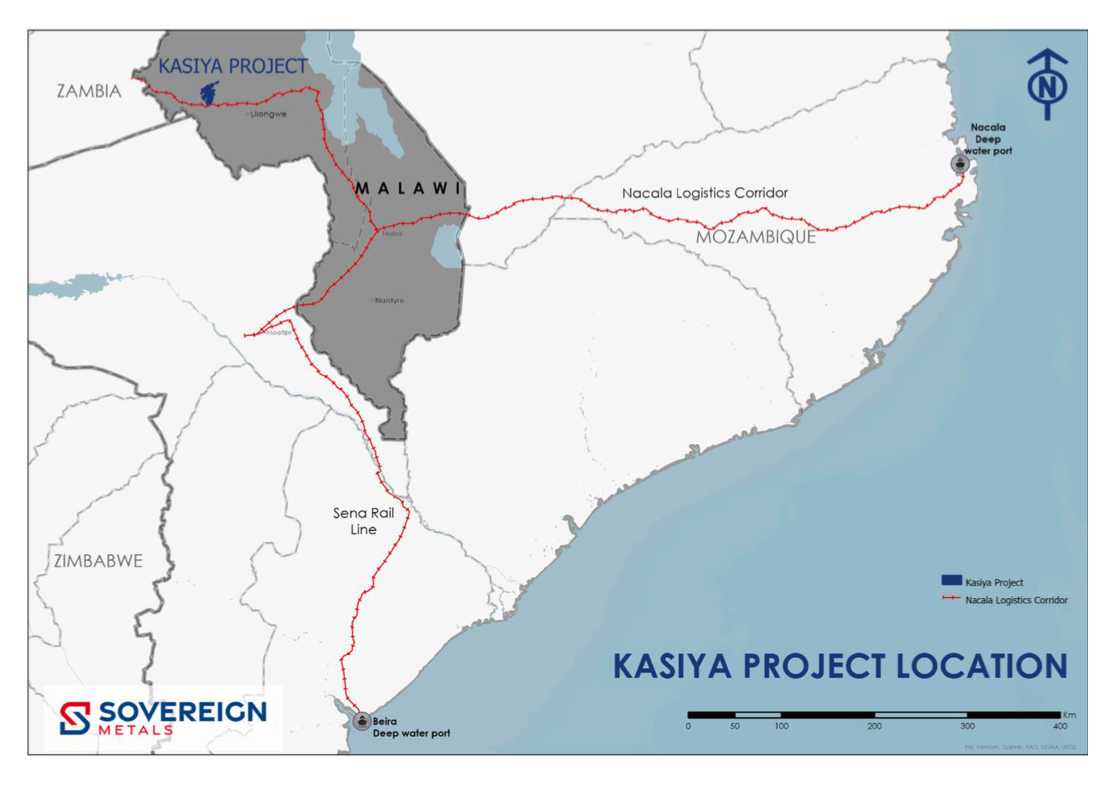
Japan has committed $7 billion to develop the Nacala Logistics Corridor, a project expected to boost Sovereign Metals’ (ASX: SVM) (LON: SVML) Kasiya rutile-graphite project in Malawi.

The Ministry of Foreign Affairs, working with the African Development Bank, will direct funds toward capacity expansion, refurbishment and resilience upgrades across Malawi, Zambia and Mozambique.

The program, called Strengthening Global Supply Chain through Nacala Corridor Development, is designed to secure critical mineral supply chains, improve transport reliability and ease congestion. Kasiya, which already has access to Japanese titanium markets, stands to benefit directly.

The investment was unveiled at the ninth Tokyo International Conference on African Development in Yokohama from August 20 to 22. It includes $5.5 billion through the Enhanced Private Sector Assistance for Africa program, which channels development funding via the African Development Bank. A further $1.5 billion will come through Japan’s development agency to support private sector projects, including mining and infrastructure.

“We will launch a new region-wide co-creation for common agenda initiative that promotes logistics in the Nacala Corridor, which contributes to strengthening mineral resource supply,” Prime Minister Shigeru Ishiba said in his keynote address.

Shares in the miner jumped on the news and were trading in London 1.5% higher at 33.5p each by mid-afternoon. That leaves the company with a market capitalization of A$427 million ($283m).

Certified quality

Japan’s Toho Titanium confirmed in June that rutile from Kasiya meets the standards required for high-performance titanium production. The certification strengthened Japan’s critical minerals strategy and validates Kasiya’s global potential.

Japan pours $7B into African corridor backing Sovereign’s project
Kasiya project on the Nacala Corridor. (Image courtesy of Sovereign Metals.)

Sovereign Metals chief executive Frank Eagar said Japan’s support reinforces the project’s economics and its role in global supply chains.

“The initiative demonstrates the highest level of government backing for the corridor that underpins our project economics, while Japan’s focus on securing critical mineral supply chains aligns perfectly with Kasiya’s world-class rutile and graphite resources,” he said.

The Nacala Corridor serves as the preferred transportation route for Sovereign’s forthcoming Definitive Feasibility Study for Kasiya.

It offers direct access to the deep-water port of Nacala, cutting transport costs and improving market reach. Sovereign plans to build a six-kilometre rail spur to connect its processing plant to the corridor and is negotiating with regional logistics providers to ensure efficient shipment of rutile and graphite to international markets.

WAIT, WHAT?!

Exxon CEO says new form of graphite boosts EV battery life, extends range

Stock image.

Exxon Mobil Corp. said it has invented a new form of graphite that can increase the life of electric-vehicle batteries by as much as 30%.

“We’ve invented a new carbon molecule that will extend the life of the battery by 30%,” chief executive officer Darren Woods said at the University of Texas at Austin’s Energy Symposium on Friday. It’s a “revolutionary step change in battery performance.”

The invention is being tested by several EV manufacturers, Woods said. Used on the anode side of the battery, the synthetic graphite allows for faster charging, a longer lifespan and longer range for electric vehicles. Exxon this week announced the acquisition of several production assets from Chicago-based Superior Graphite, which will enable the company to scale-up manufacturing, with a goal of commercial production by 2029.

The Texas oil giant doesn’t intend to become a battery maker but it plans to use its refineries, chemical plants and laboratories to produce some of the materials to be used in the energy transition. It also has plans to extract lithium, a major battery component.

“We don’t do wind and solar, we have no issues with wind and solar, but we don’t have capability in that space,” Woods said. “But we do have capability of transforming molecules and there are enormous opportunities in that space to use hydrogen and carbon molecules to meet the growing demand.”

Exxon has long been a player in the vehicle-battery space. The company invented the lithium-ion battery in the 1970s and created the plastic film for the first rechargeable version in 1991. Almost two decades ago, Exxon created a new type of material used to separate battery components.

While Exxon is moving ahead with its battery-material business, the outlook for hydrogen, another targeted growth area, is looking more challenged. The company has warned it may delay a low-carbon hydrogen and ammonia project in Baytown, Texas, due to a lack of interest from customers.

The shortening of the timeframe available to claim hydrogen tax credits under President Donald Trump’s so-called Big Beautiful Bill may also slow market development, Woods said.

“Our big concern today around low-carbon hydrogen is whether there’s enough time within that bill to incentivize the development of the market,” Woods said.

A viable hydrogen industry based on market forces is essential to supporting multi-billion dollar investments, he said.

“We can’t do it on charity.”

(By Kevin Crowley)

Bolivia raises $589 million against future gold deliveries

Credit: Dan Lundberg | Flickr, under Creative Commons licence CC BY-SA 2.0.

Dollar-strapped Bolivia is relying on increasingly sophisticated operations to raise hard currency that it can use to pay its foreign debt.

In recent months, the Bolivian central bank has raised $589 million against the delivery in a year’s time of 5.4 tons of gold, it said in a report published this month.

The futures contracts are just the latest gold operations launched by the central bank, which has been buying bullion in local currency from small domestic producers and flipping it for badly needed dollars. Bloomberg reported earlier this year how the operations allowed Bolivia to raise more than $3 billion, despite potential negative environmental impacts in places like the Amazon rainforest where much of the gold is sourced from.

“We understand that the central bank has taken all the legal provisions to carry out these forward sales operations,” Finance Minister Marcelo Montenegro said in a press conference on Wednesday. Bolivia’s reserves are low but rose to $2.9 billion, according to the central bank.

The newest operations have helped Bolivia avoid default, the bank said, but also come with a big caveat. Delivering the gold to settle the contract next year will be the responsibility of a new government.

Bolivia will hold a runoff vote for the presidency next month between a centrist and a conservative candidate, which will put an end to almost two decades of socialist rule under the MAS party.

“The new government should take provisions,” Bolivian analyst Luis Fernando Romero said. “The details of the operations should be transparent, because they are not clear.”

The central bank said in its report that between May and August it signed forward contracts for 4.32 tons and 1.08 tons of gold, generating inflows of $469m and $120m, respectively. “It is important to highlight that in these operations the central bank maintains ownership of the agreed gold”, the report said.

In August, the board also approved a “gold reserve accumulation plan” to meet the future obligations, without explaining further.

Earlier in the year, the bank sold three tons of gold through a similar hedged forward deal, though it didn’t disclose the amount of cash it raised. Romero estimates the three operations combined, covering 8.4 tons of gold, have yielded about $916 million.

Asked about details of the transactions, the central bank said that all relevant information was included in its reports.

Under Bolivian law, the central bank must maintain at least 22 tons of gold within its reserves. But the recent operations have raised eyebrows that using gold as collateral would amount to a workaround.

Right-wing candidate Jorge Tuto Quiroga has questioned the legality of the operations, threatening central bank employees with jail time in a future administration. “It is illegal to pawn gold below the 22 tons” threshold, he said.

The central bank has defended the measures. “Not carrying out these financial operations, as the candidate suggests, would have led to serious risks for the country by not meeting internal and external state obligations, causing situations such as a default,” it said.

(By Sergio Mendoza)