Saturday, September 13, 2025


HMM Continues Growing Dry Bulk as Part of Diversification Strategy
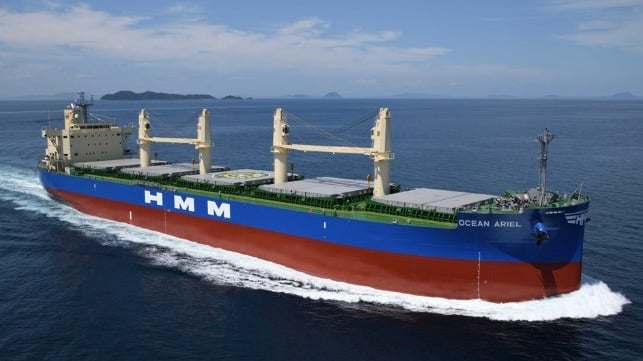
dry bulk carrier built for HMM
HMM recently took delivery from Tsuneishi of a new 42,000 dwt dry bulk vessel (Tsuneishi Shipbuilding)

Published Sep 12, 2025 6:41 PM by The Maritime Executive


HMM continues to take steps designed to execute on its strategy of diversification of its shipping operations. While the company continues its role as a leading container carrier, it is also following a strategy to expand its dry bulk operations as a means of stabilizing its financial results.

The company announced the signing of a new long-term contract of affreightment (COA) with Brazil’s Vale, one of the world’s largest mining companies. Valued at approximately $310 million, the contract is for ten years, starting in the second quarter of 2026, for the transport of iron ore using five bulk carriers. It follows a similar 10-year contract completed in May with Vale valued at more than $450 million.

“Through portfolio diversification, we aim to achieve balanced growth across various markets and secure new opportunities for long-term growth,” HMM reported while announcing the new contract. It is the strategic partnership with Vale is expected to provide stable cargo volumes and consistent revenue over the next decade.

The company highlights it has been active in the dry bulk and construction material sectors since 1977 and today operates general cargo vessels in various sizes from 30,000 DWT Handy to 60,000 DWT Supramax worldwide, including in the Americas, the Middle East, and Europe. Its current fleet list shows a total of 20 dry bulk carriers: 7 Capesize, 2 Panamax, 4 Supramax, and 7 Handy.

HMM highlights that it plans to expand its bulk fleet to 110 vessels (12.56 million DWT) by 2030, as part of its strategy to diversify beyond container shipping and pursue new growth opportunities.

As part of this strategy, the company recently took delivery of the eco-friendly Ocean Ariel, a 42,000 dwt bulker built by Japan’s Tsuneishi Shipbuilding. The shipbuilder highlights that it is a versatile design primarily for the three major bulk cargoes of iron ore, grain, and coal, but it can also carry lumber, hot coils, and sulfur, allowing for greater trade flexibility. It uses a semi-box-type hold that is also suitable for transporting steel products.

HMM, according to reports, is also pursuing secondhand dry bulk tonnage after it failed in its bid to acquire the bulk operations of South Korea’s SK Shipping.

The company in 2022 launched its new long-term strategy, reporting it would invest $10 billion to grow its operations. Its objective is to nearly double its container capacity to 1.2 million TEU while accelerating growth in the bulker segments. It has also ordered four new multi-purpose vessels and ordered car carriers that will operate under a long-term charter to Hyundai-Glovis. The company is also seeking growth in logistics, with reports that it is planning investments in terminals around the world.

 

CMA CGM Says No U.S. Surcharges Planned as Carriers Prepare for USTR Fees

containership
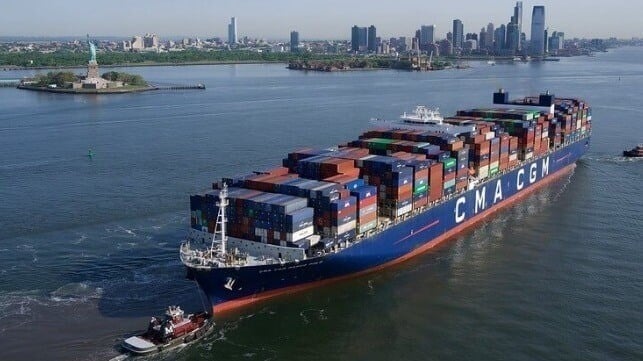
CMA CGM is adjusting its fleet to avoid the USTR fees on Chinese-built ships (Port of New York/New Jersey)

Published Sep 11, 2025 4:02 PM by The Maritime Executive


With just a month to go to the announced date that the U.S. will start charging fees to Chinese operators and vessels built in China, the shipping industry is working to blunt the impact. CMA CGM issued a customer update reporting that it is taking steps to shift deployments and, as a result, it does not plan to implement a surcharge at this time to cover the USTR-related fees. 

The French company, which has a fleet of over 740 vessels (343 owned), reports it is drawing on its flexible and diversified fleet to prepare for the upcoming implementation of the fees. While the final rules have yet to be released, it notes that, based on the April announcement by the U.S. Trade Representative, the fees will be phased in over three years. Furthermore, CMA CGM reports it used the 18—day grace period after the announcement to develop and implement an “adaptive contingency plan.”

“Thanks to the fleet and operational adjustments we are now implementing ahead of October 14th, we currently expect to both maintain our service coverage to all scheduled U.S. ports and minimize any impacts of the upcoming USTR fees,” CMA CGM advised customers.

It, however, admitted that the fees may create challenges for its operations. Based on the current structure of the fees, it says it does not plan to implement surcharges, with a caveat, “as currently structured.” The industry, however, waits for the release of the final details, while there have been unconfirmed reports that U.S. Customs and Border Protection (CBP) will be tasked with collecting the fees. 

The carrier joins others in the industry that have said they are taking steps to shift deployments to avoid the fees. Maersk has said it expects to limit the impact by avoiding putting Chinese-built ships on routes to the U.S. Chinese companies are the most exposed, with analysts warning that the fees are likely to have a significant impact. China and its state shipping company COSCO have called the fees “discriminatory” and warned investors of the impact. Recently, an analyst at HSBC projected in a report to investors that without network changes, COSCO could face over $1.5 billion in fees in 2026, while its subsidiary OOCL could incur an additional $654 million.

CMA CGM in March announced plans to make large investments into the U.S. It said it planned to triple its U.S.-flagged operations as part of an investment valued at $20 billion. The carrier, however, continues to build vessels in China and has recently been linked to reports of large future orders also with Chinese shipyards. CMA CGM currently has over 110 vessels on order, which would add 1.6 million TEU according to figures from Alphaliner, to a fleet that currently has a total capacity of approximately 4 million TEU.


Occidental Subsidiary and Enbridge Partner on Major Sequestration Hub

1PointFive, a subsidiary of Occidental, and Canadian energy company Enbridge Inc. announced a new joint venture to develop a carbon capture and sequestration hub in Louisiana. The 50-50 partnership will focus on the Pelican Sequestration Hub, a project designed to store carbon dioxide (CO2) deep underground, according to a press release issued today.

The Pelican Sequestration Hub will be located in Livingston Parish, La. According to the companies, 1PointFive will develop and operate the sequestration facilities, while Enbridge will be responsible for building and managing the pipelines that transport CO2 from industrial customers to the hub. The project aims to provide a solution for capturing emissions from industrial operations in the region.

The hub is anchored by a 25-year agreement to sequester approximately 2.3 million metric tons of CO2 per year from a planned low-carbon ammonia production facility. This facility is a joint venture between CF Industries, JERA Co., Inc., and Mitsui & Co., Ltd., and is located in Ascension Parish, La. The agreement represents a significant long-term commitment to the project's capacity.

The joint venture reflects a broader trend in the energy sector, where companies are increasingly investing in carbon capture, utilization, and storage (CCUS) technologies to meet climate targets and address emissions. This development in Louisiana aligns with the state’s focus on attracting investments in low-carbon industries. The Pelican Sequestration Hub is a notable example of how large-scale infrastructure projects are being developed to support the decarbonization of heavy industry.

By Michael Kern for Oilprice.com


GreenIT Secures €370 Million Financing for Italian Renewable Projects

GreenIT, the renewable energy joint venture backed by Eni’s Plenitude (51%) and CDP Equity (49%), has finalized a €370 million project finance agreement to accelerate the development of its Italian greenfield portfolio. The financing will support new onshore renewable projects scheduled for completion by 2028, aligning with the company’s target of reaching 1GW of installed capacity by 2030.

The deal is structured in line with the Green Loan Principles, ensuring proceeds are dedicated to sustainable investments. The European Investment Bank (EIB) provided the largest share of the financing with €220 million—€180 million in direct loans and €40 million via financial intermediaries. Additional backing came from major European lenders including BNP Paribas, Crédit Agricole, ING Bank, and Societe Générale.

“This strategic transaction strengthens GreenIT’s financial structure, providing new resources to support the investments planned for the next few years by our ambitious industrial plan,” said CEO Paolo Bellucci. “The strong confidence shown by the lending institutions reinforces GreenIT’s strategic vision to play a key role in Italy’s energy transition.”

Founded in 2021, GreenIT is tasked with developing, building, and operating renewable energy plants across Italy. The company plays a central role in supporting Italy’s Integrated National Energy and Climate Plan (PNIEC) for 2030, which aims to expand the share of renewable power generation as part of the EU’s broader decarbonization strategy.

The latest financing underscores rising investor appetite for renewable infrastructure in Europe, particularly in Italy, where growing electricity demand and EU decarbonization targets are driving strong momentum for green investments. GreenIT’s pipeline of onshore projects is expected to contribute meaningfully to Italy’s renewable capacity buildout, reinforcing the country’s progress toward meeting its climate goals.


Toyota Adapts to Changing UK Car Sales Landscape

  • Toyota's UK pre-tax profit significantly dropped in the last financial year due to a decline in market share and the challenges of complying with the Zero Emission Vehicle mandate.

  • The overall UK automotive market saw growth driven primarily by the fleet sector, while the retail market experienced a decline, impacting Toyota's new vehicle sales.
  • Toyota plans to launch additional Battery Electric Vehicles in the next financial year to address the ZEV mandate and market shifts.

Toyota’s UK profit has almost been wiped out as the carmaker battled a decline in market share and compliance with the ZEV [Zero Emission Vehicle] mandate.


The Surrey-headquartered division has posted a pre-tax profit of £462,000 for the 12 months to 31 March, 2025, down from the £11.5m it achieved in the prior year. New accounts filled with Companies House also show Toyota’s revenue fell from £3.5bn to £3.3bn over the same period.

Toyota’s revenue from the sale of new vehicles declined in the year from £2.9bn to £2.7bn while its earnings from used cars edged up from £129.6m to £151.7m.

The car maker’s market share fell from 6.5 per cent to 5.8 per cent in 2024 and further declined to 5.4 per cent in the months to March 2025.

Toyota said this was “in line with expectations as the company manages which fleet channels it chooses to operate in and also its compliance with the ZEV [Zero Emission Vehicle] mandate”.

In JuneCity AM reported that Toyota’s financial services arm’s revenue increased in the year from £941.7m to £1.1bn while its pre-tax profit also rose from £148.8m to £196.5m.

Toyota: ‘Industry hit by ZEV and economy’

Toyota said 2024 saw an increase in the overall UK automotive market registrations of 2.7 per cent to 2.3m vehicles compared to 2023.

But the company added this was”driven solely” by the fleet market which saw growth of 11 per cent while the retail market fell by 8.4 per cent.

The premium car market, in which Lexus operates, increased by 5.1 per cent but Toyota said this was “again given by fleet”.

The group added that for the start of 2025, there has been an increase of 3.9 per cent in the overall market compared to 2024 with fleet up 2.8 per cent and retail up 5.5 per cent.

A statement signed off by the board said: “The company’s new car volume is reliant in part upon the overall health of the UK car market, which the company monitors closely together with other economic factors which may influence the overall demand for new cars in the UK.

“Whilst some economic conditions of the recent years have eased, there remains pressures on households disposable income, affecting overall market demand.”

Toyota added: “We consider the overall automotive market will remain at similar levels during 2025 compared to 2024 as the industry continues to be impacted by current economic conditions and the ZEV mandate.

“The company will launch additional BEVs [Battery Electric Vehicle] in the next financial year, including the all-new Urban Cruiser.”

By City AM 


Is the AI Bubble on the Brink of Bursting?

  • The integration of AI is causing a significant increase in global energy consumption, leading to a resurgence of fossil fuel investments and higher energy bills, while shifting policymaker priorities away from clean energy.

  • Experts express skepticism about the reliability of current AI energy projections due to vague data, unproven claims about AI's energy efficiency benefits, and uncertainty about its future omnipresence.

  • Despite massive investments, there are growing indications that the AI bubble may be bursting, with large language models showing limited improvement, profits slow to materialize, and financial experts projecting significant capital misallocation.

Artificial intelligence is changing our energy landscape on a global level. Runaway AI integration is suddenly causing huge growth trends in energy consumption in developed nations where growth had previously flatlined for years. It is causing a resurgence of fossil fuel investments and raising energy bills for consumers, and it’s pushing policymakers to change their priorities away from a focus on clean energy production to producing as many new energy projects as quickly as possible to meet soaring demand projections. But are these projections reliable? Experts aren’t so sure.

recent report from the MIT Technology Review highlights three key ways in which the scope of AI’s current and future energy impact is still fuzzy at best: vague and incomplete data, unfounded claims about the role of large language models in increasing energy efficiency in other sectors, and whether AI is ever going to grow as omnipresent as current projections assume. 

There are no regulations requiring AI companies to disclose their energy usage or environmental impact, so the vast majority don’t release any official numbers. While companies like OpenAI and Google have started to become a little bit more transparent about the energy footprint of an AI query through their platforms, these numbers are not official and lack clear grounding.

Plus, individual queries are not what’s driving up AI’s energy footprint. While your chats with large language models are having some impact on AI’s energy consumption, it’s a drop in the ocean compared to the rampant integration of AI into a huge number of systems and processes both within and outside of the tech sector. 

While training and operating large language models eat up an enormous amount of energy and other resources, proponents are quick to point out that AI will be instrumental in making a huge breadth of industries more energy-efficient, with the potential to more than make up for its own energy footprint. But MIT challenges these claims, highlighting that such efficiency gains have not yet come to fruition. And while numbers on AI’s efficiency gains are lacking, new data centers are being planned at a breakneck pace. 

“AI’s integration into almost everything from customer service calls to algorithmic “bosses” to warfare is fueling enormous demand,” reports the Washington Post. “Despite dramatic efficiency improvements, pouring those gains back into bigger, hungrier models powered by fossil fuels will create the energy monster we imagine.”

But some experts wonder if these alarmist claims are warranted. In fact, there is some indication that the AI bubble might already be bursting. Despite disconcertingly enormous levels of investment, large language models aren’t getting much better at what they do. OpenAI’s launch of GPT-5 last month “was largely considered a flop, even by the company itself,” reports MIT. And it’s looking unlikely that investors are going to see a return on the billions they’ve poured into AI and data centers, with profits slow to materialize

Praetorian Capital CIO Harris Kupperman projects that the "AI datacenters to be built in 2025 will suffer $40 billion of annual depreciation, while generating somewhere between $15 and $20 billion of revenue." While he told Futurism that he recognizes the utility of AI, he went on to add: "I also recognize massive capital misallocation when I see it. I recognize an insanity bubble, and I recognize hubris."

When you look at the scale of AI’s influence on political, financial, and environmental decisionmaking, it’s quite concerning that a peek behind the curtain reveals not solid and consensus-led projections but pervasive fuzziness and mathematical acrobatics. And we’re already suffering the consequences of these potentially rash decisions. Energy poverty is creeping higher while consumers are footing the bill for the tech sector’s aggressive AI integration push. But the problem goes way beyond punishing utility bills – the whole economy could be on the line.

“Over the past few years, the tech industry's plans for artificial intelligence have grown from ambitious to outright treacherous, with the amount of money invested in the space so high it now poses a serious risk to the broader economy,” writes Futurism. 

By Haley Zaremba for Oilprice.com


Iraq’s Compensation Cuts Could Nearly Offset Production Hike By OPEC+

  • OPEC+ will lift output by just 137,000 b/d in October, and Standard Chartered says compensation cuts could cancel out most of those barrels.

  • Standard Chartered's bullish view hinges on compliance.

  • Europe’s gas prices climbed above €33/MWh on geopolitical risks.

Three days ago, the eight members of OPEC+ agreed to increase oil output from October by 137,000 barrels per day, a much lower clip compared to the 555,000 bpd increase announced for August and September and 411,000 bpd in June and July. The Sunday announcement means that the group has started unwinding the second tranche of 1.65 million bpd in production cuts more than a year ahead of schedule, having fully unwound the first tranche of 2.5 million bpd since April. Oil markets have reacted positively to the smaller-than-expected production increases, with Brent crude for October delivery rallying from Friday’s one-month low of $65.50 per barrel to $67.60 in Wednesday’s session, while WTI crude moved from $61.62 per barrel to $63.73.

And now commodity experts at Standard Chartered have weighed in, saying the market could be discounting the fact that few, if any, extra barrels will hit the markets, with compensation cuts by some OPEC+ members enough to offset any extra oil coming from the group as a whole. StanChart has noted that the 137 kb/d increase suggests an equal split of the total 1.65 million barrels per day (mb/d) spread over 12 months, meaning no more large increases going forward. OPEC+ announced that the barrels “may be returned in part or in full subject to evolving market conditions and in a gradual manner”. StanChart analysts also “reaffirmed the importance of adopting a cautious approach and retaining full flexibility to pause or reverse the additional production adjustments, including the previously implemented voluntary adjustments of the 2.2 million barrels per day announced in November 2023.”

As expected, OPEC+ outlined the proposed compensation cuts for overproduced volumes by six members. Iraq has proposed an immediate 130 kb/d adjustment from August 2025 through January 2026, before slowing to 122 kb/d in June 2026. StanChart notes that Iraq will do most of the heavy lifting, with the country’s cuts alone nearly neutralizing the increase by the rest of the members. In contrast, Kazakhstan has backloaded its compensation schedule, proposing to cut by only 35k b/d in December 2025, before increasing to 100 kb/d in January 2026, 300 kb/d in February, 450 kb/d in March, 490 kb/d in April, 550 kb/d in May, and 650 kb/d in June 2026 for a total of 2.63 mb/d.

Related: Israeli Surprise Strike on Qatar Sends Oil Prices Higher

However, the biggest risk to the bullish thesis remains potential non-compliance by Iraq and Kazakhstan, with StanChart noting that Kazakhstan’s plan to backload most of the cuts already goes contrary to previous plans to frontload them. Further, StanChart says that Iraq’s total contribution includes exports from the Kurdistan region (KRG), which is likely to return from suspension imminently, further complicating adherence to compensation cuts.

Overall, StanChart says the latest move by OPEC+ is bullish largely because the overproduction compensation schedule effectively negates production increases, if compliance is high. The commodity analysts also note that the forward curve still shows a brief period of backwardation lasting until around October 2026 before the curve moves into contango. Further, the cuts are by no means automatic, with OPEC+ promising to remain responsive to market conditions and could pause the unwinding program if market conditions worsen.

Meanwhile, Europe’s gas prices have continued to rebound, albeit at a slower pace, climbing above €33 per megawatt-hour to a two-week high with geopolitical tensions intensifying. Israel’s strike on Hamas leaders in Qatar has raised concerns, with Qatar a key supplier of LNG to Europe. A potential supply disruption to Qatar’s super-chilled gas is likely to be felt keenly ahead of the heating season. Further, Russia recently launched a barrage of drone attacks on Ukraine, with several breaching Poland’s airspace. The NATO member has labeled Russia’s offensive an “unprecedented violation,” prompting defensive action by NATO forces. The EU is now weighing new sanctions targeting Russian oil and gas firms as well as banks in a bid to pressure Moscow.

EU gas inventories have continued to climb, standing at 92.25 billion cubic metres (bcm) on 6 September, good for nearly 80% of technical maximum fill capacity. This represents an increase of 2.22 bcm w/w, 16.4 bcm lower Y/Y and 7.01 bcm below the five-year average. However, the injection rate jumped nearly 180% Y/Y, helping StanChart reaffirm its earlier prediction for inventories to reach 100.4 bcm on 2nd November.

By Alex Kimani for Oilprice.com


Britain’s Golden Refining Era Ends

  • Two refineries shut in 2025, leaving Britain with just four operational major plants.

  • Diesel deficit widens as imports climb and cracks surge past $25/bbl.

  • Net-zero goals clash with cost-of-living squeeze, delaying diesel’s demise

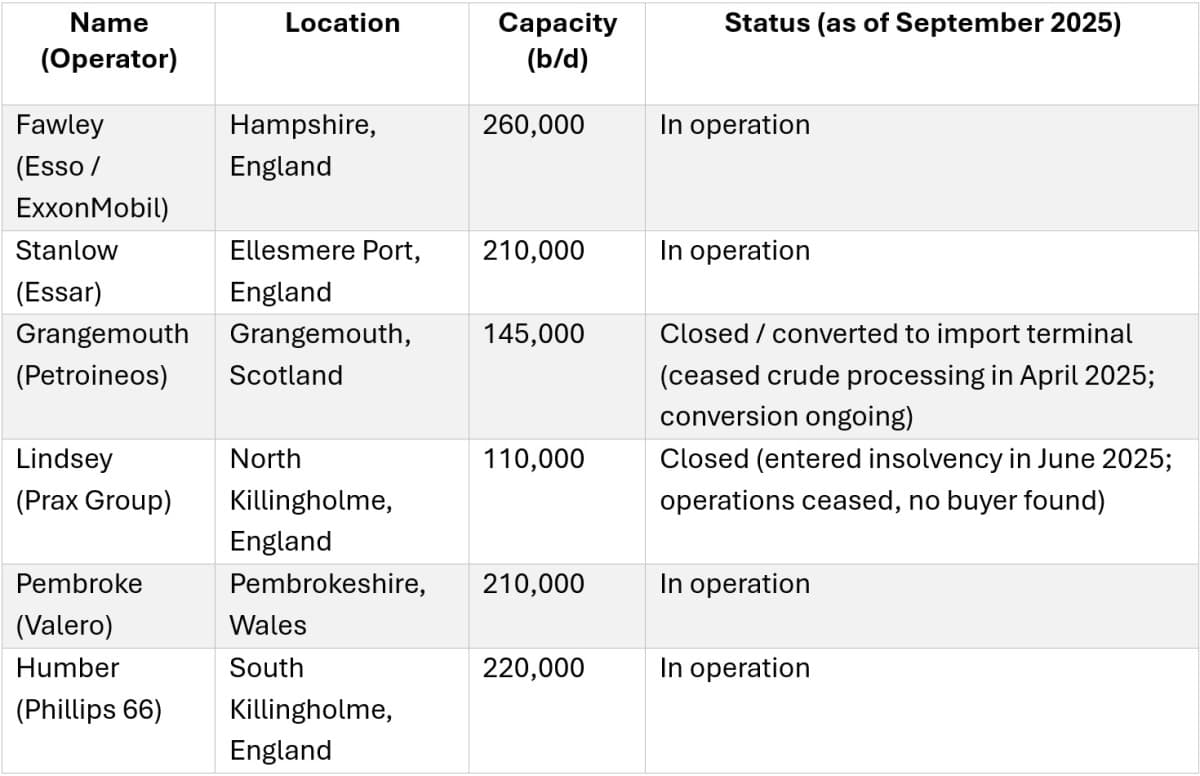
The UK’s refining landscape is undergoing its sharpest contraction in decades. On April 29, Scotland’s only refinery Grangemouth ceased operations after more than a century of crude processing. The 145,000 b/d facility operated by Petroineos (a joint venture between China’s PetroChina and privately owned Ineos) had long been flagged as uncompetitive, with management warning in late 2023 that it could no longer operate profitably. Its planned conversion into a fuel import and storage hub highlights a broader shift: rather than producing fuels at home, the UK is increasingly restructuring its infrastructure to handle higher volumes of imported supply, at least in the short run.

Just weeks later, the sector took another hit. The Lindsey refinery in Lincolnshire, with 110,000 b/d of capacity, collapsed into insolvency in June, leaving the UK with just 4 major refinery plants. The government accused owner Prax Group of running up losses of about £75 million since acquiring the site in 2021 and ordered an investigation into the company’s management and financing structure. Hopes of a sale raised expectations in the local community, but no credible buyers have materialized, and operations have been halted.

That leaves the UK dependent on 4 refineries: ExxonMobil’s Fawley in Hampshire (270,000 b/d), Stanlow in Cheshire (210,000 b/d), Valero’s Pembroke in Wales (270,000 b/d), and Phillips 66’s Humber plant in North Lincolnshire (220,000 b/d). Together, they provide just over 1 million b/d of capacity – down by roughly a third from the levels available in the early 2010s, when a wave of closures began. This shrinking base is increasingly ill-suited to the country’s fuel mix needs.

Apart from increasing its dependence on imports, the UK is also increasingly dependent on US oil majors for its refining. Of the four remaining plants, three are operated by US companies - ExxonMobil, Valero and Phillips 66. Moreover, ExxonMobil’s Fawley refinery is the only plant in the south of the country, almost single-handedly meeting the transportation fuel needs of London and the metropolitan area.

UK refineries – designed around light sweet crudes – are optimized for gasoline production. Historically, the gasoline net balance has been positive, with the product being widely exported to North America, the Netherlands and Belgium (averaging around 150,000 b/d over the last five years). However, with the closure of refineries, the narrowing gasoline surplus will mean lower exports to the New York Area of the United States, potentially also lifting gasoline prices across the Atlantic.

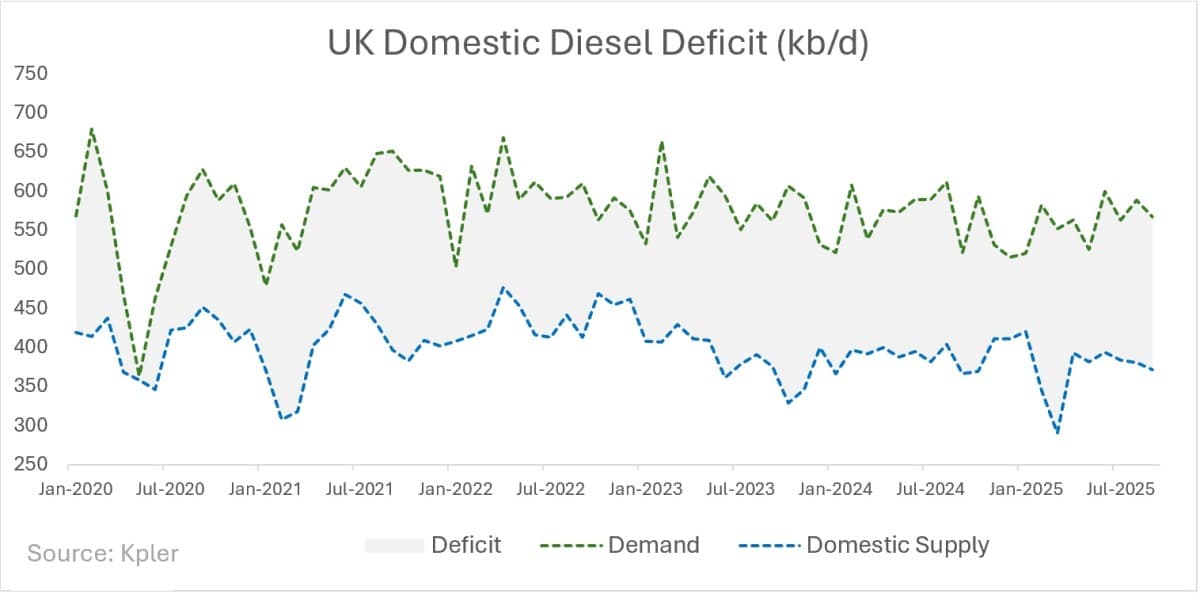
However, the structural mismatch is most visible in diesel. The country’s car fleet shifted toward diesel during the 2000s, creating a persistent deficit in the latter. Imports have filled the gap: in 2024, diesel accounted for 265,000 barrels a day (over a third) of the 624,000 b/d of clean products imported. Supplies came primarily from the US, Saudi Arabia, the Netherlands, and Belgium, the latter two advantaged by their proximity to UK terminals.

The reliance is only deepening. According to Kpler, UK diesel supply has fallen from 480,000 b/d in April 2022 to just 370,000 by September 2025, while demand – though also slightly declining – remains at 570,000 b/d. The Lindsey shutdown worsened the imbalance: ICE gasoil cracks surged from $16.50 a barrel on June 1 to $26.30 by the end of the month, and have since settled around $23, still signalling that Northwest Europe’s diesel shortage was aggravated by the unexpected refinery closure. For an economy already suffering from high inflation and energy costs, such price swings underline the vulnerability created by dwindling refining capacity.

Policy ambitions add another layer of complexity. Britain’s net-zero strategy envisages phasing out sales of new petrol and diesel cars by 2030, with the assumption that road fuel demand will steadily decline. Non-road diesel use is limited, and passenger car sales are shrinking, especially on the diesel side. Yet the transition is running up against real-world frictions: electric vehicles remain costly, battery materials are exposed to geopolitical volatility, and UK power prices have proven highly unstable. Combined with a cost-of-living crisis, these factors may push consumers to hold on to existing diesel cars longer than policymakers expect.  

This creates a paradox. On paper, the UK is moving toward a future with less refining, less diesel demand, and more electrification. In practice, the loss of two refineries in one year has tightened supply, pushed up margins, and underscored how dependent the country is on imports. Unless demand erodes faster than expected, the diesel deficit could persist, leaving policymakers with an uncomfortable choice: stick to ambitious timelines or adapt to a market reality where consumers and energy security needs force delays.

By Natalia Katona for Oilprice.com