Saturday, September 13, 2025


China's First Catapult-Equipped Carrier is Nearly Ready for Service

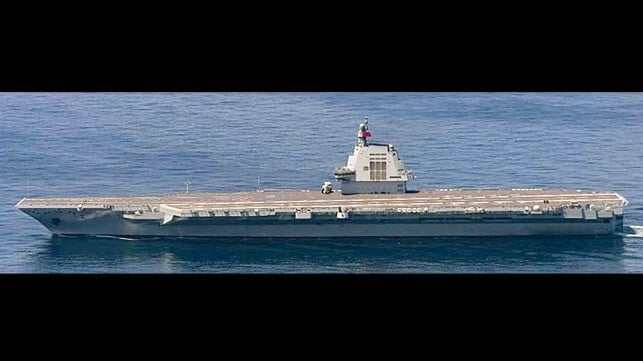
JMSDF image
Courtesy JMSDF

Published Sep 11, 2025 9:37 PM by The Maritime Executive


On Thursday, Japanese forces made their first sighting of China's third and newest aircraft carrier, the Fujian, operating in the East China Sea. It transited southbound through the Taiwan Strait and into the South China Sea, prompting speculation about whether it is about to formally enter service.

China's first two carriers were adapted Soviet-era designs with ski jump ramps at the bow. Fujian is much different: the ship has electromagnetic catapults, a technology previously found only aboard the U.S. Navy's Ford-class carriers. China's military says that Fujian is the largest conventionally-powered warship afloat. 

Fujian is to undergo testing and training exercises in the South China Sea, accompanied by the destroyers Hangzhou and Jinan, according to Chinese state media. "The cross-regional tests and training are a routine mission of the carrier’s construction process," a spokesperson said. Commissioning is expected within about one month after, according to state media, based on the test-and-delivery timeline for previous carrier Shandong. 

"Only those with ill intentions would feel nervous" about the carrier's presence, Chinese military commentator Fu Qianshao told state outlet Global Times.


Japanese Team Conducts World's First Railgun Test Shot at a Vessel

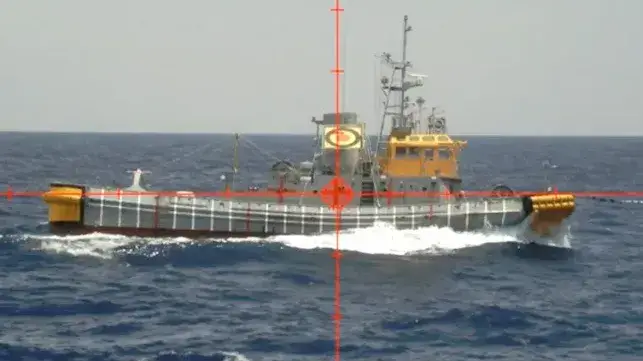
ATLA railgun target
The target vessel (courtesy ATLA)

Published Sep 11, 2025 11:27 PM by The Maritime Executive


Japan's navy has persisted in the pursuit of a usable, durable electromagnetic railgun, continuing a hunt that the U.S. Navy has (for public purposes) abandoned. Its Acquisition Technology & Logistics Agency (ATLA) has recently conducted what it believes to be the first successful test firing of a railgun at a target vessel in the world, and has released images of the trial shots.

The weapon is mounted on the bow of the test vessel JS Asuka, operating out of Yokosuka. Tests appear to have been conducted against targets on a small workboat at a position off the coast. ATLA did not provide further details of the results.

Conceptually, railguns offer tantalizing benefits for the warfighter. Compared to a conventional cannon, the rounds are smaller, cheaper, and are made of inert pieces of metal. This means that the ship's magazines can fit in more rounds per cubic foot, and they are impossible to detonate in the event of a casualty. 

Unlike lasers and microwave systems - which get lumped together with railguns as "directed energy weapons" - railgun rounds are physical objects with a ballistic trajectory, unaffected by smoke or rain. Since they go up and come down again, they can be fired at warships or shore targets out of sight, beyond the curvature of the horizon - which lasers by definition cannot do. Technologists hope that these rounds could also be swift and accurate enough to counter hypersonic missile threats in an air-defense role. 

In practice, getting a railgun to work aboard a vessel has proven to be a difficult assignment. Ejecting a piece of tungsten from the gun at 4,500 knots generates tremendous heat and force, which tends to burn out the barrel at a rapid pace. The guns also take a huge amount of power to operated - hence the prioritization of use on ships, where it is easier to arrange for the sheer mass of the power supply.


Testimony Completed in Eagle S Sabotage Trial in Finland

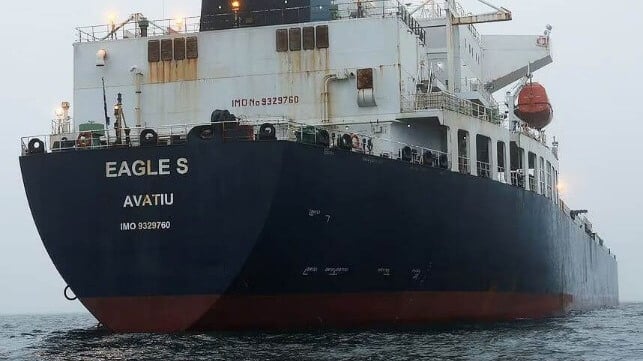
tanker Eagle S
Eagle S was detained for three months after the cable incident (Finnish Coast Guard)

Published Sep 12, 2025 2:07 PM by The Maritime Executive


Prosecutors and defense lawyers made their final statements on Friday, September 12, in Helsinki District Court in the trial of the captain and two officers from the product tanker Eagle S on charges that their negligence caused the damage on December 25, 2024, of five subsea cables running between Finland and Estonia. After broad speculation that it was a case of sabotage, the prosecution centered on the command responsibilities, citing negligence and not pursuing charges of intentional damage to the cables.

The captain, first, and second officers of the product tanker were charged with aggravated sabotage and aggravated interference with telecommunications as a result of the anchor-dragging incident. The trial began on August 25, and the court is now scheduled to issue its ruling on October 3.

The three officers of the vessel have been subjected to a travel ban since January 2025 that did not permit them to leave Finland. Others from the crew that had initially been under investigation were removed from the travel ban. The court, however, today, also ruled to lift the travel ban on the captain and two officers. Prosecutors had argued it should remain in place until the verdict. 

The case centered on whether the captain and officers should have realized that the anchor dropped and was being dragged. Investigators concluded it dropped because of poor maintenance and a broken safety pin on the chain stopper. The defense lawyers countered that the anchor windless had been serviced and tested, and further, it had withstood violent storms before the ship entered the Gulf of Finland.

The prosecution contended that they should have realized there was a problem because the vessel’s speed dropped when the anchor began dragging. The defense was that they believed it was an engine problem that caused the speed drop. In their closing remarks, the prosecution contended to the court that no evidence was presented of engine problems.

The captain, they said, is responsible for the management and condition of the ship while the two officers were on navigation watch during the time the anchor dragged 90 kilometers (55 miles) along the seabed and broke five cables. Defense said it was the chief engineer, who was not on trial, who was responsible for the condition of the machinery, including the anchor. Further, they questioned why the Finnish authorities had not informed the vessel sooner when they suspected it was dragging the anchor.

There also remains an issue of jurisdiction, and whether the vessel voluntarily entered Finnish waters. The defense argues that Finland lacked the authority because the damage occurred in international waters and the ship only entered Finnish waters when it was commanded by the police.

Prosecutors are still asking the court to sentence each of the three officers to a minimum of two and a half years in prison. The Finnish news outlet Yle says the leniency of the proposed sentences is because the cables were not intentionally broken and the overall damage was “quite minor.” The companies reported it took a few months to complete repairs at a cost of approximately €55 million ($65 million).

The incident, however, raised concerns over the safety of key infrastructure. It was followed by several other suspicious events, which led to allegations that it was part of an orchestrated plot by Russia. NATO and the Scandinavian countries increased monitoring of key assets as a result of the suspicions regarding the actions of the Eagle S.

UK Adds 70 Tankers to Russian Sanctions Along with Electronics Suppliers

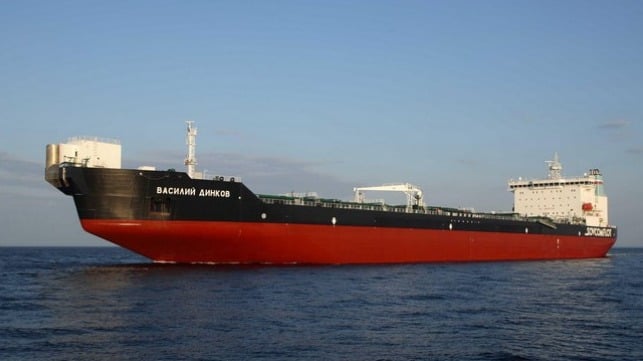
Arctic shuttle tanker sanctioend
Vasily Dinkov, an Arctic shuttle tanker, is among the 70 th UK listed today (SCF file photo)

Published Sep 12, 2025 5:00 PM by The Maritime Executive


The UK expanded its list of sanctions targeting Russia’s oil and gas industry as well as suppliers of electronics and other military components. The latest round of sanctions came as the UK’s new Foreign Secretary made her visit to Kyiv.

With the new action, the UK again claims the position as the country with the most sanctioned tankers. The long list includes vessels that have previously been listed by the United States, as well as targeting Russian majors, including Sovcomflot, Rosneft, and Gazprom. Among the ships are the Vasily Dinkov (72,700 dwt), which was introduced in 2008 by Sovcomflot as the first of three new Arctic enhanced ice-class tankers, designed to transport oil from the Varandey oil field within the Arctic Circle. There are also multiple vessels linked to Gazprom, including a gas tanker, Gazpromneft Zuid East (6,897), which was previously listed by the United States.

The UK highlighted that it continues to lead the charge against the shadow fleet. It said the goal is to reduce sources of revenue. 

The UK is now approaching 500 listed tankers, having already listed 423 tankers, a dramatic increase from just over 100 tankers sanctioned at the start of 2025. The EU, by comparison, currently has sanctions on 444 tankers, while the U.S. lags at just over 200 tankers from the Russian shadow fleet.

“International action to increase economic pressure on Russia and to cut off critical cash flows which he desperately needs to pay for this illegal war is vital,” said Foreign Secretary Yvette Cooper. “These sanctions form the next stage in the UK’s leading efforts to ramp up economic pressure alongside our security support and our work alongside the Coalition of the Willing for a just and lasting peace in Ukraine.”

She noted that Russia, in the last two weeks, has again moved to obstruct the US-led peace efforts by launching the largest air attack of the war against Ukraine. They noted that over 800 missiles and drones were fired in a single night and over 6,500 in July. Attacks, they said, are a level ten times that of a year ago.

In addition to the tankers, the UK added 30 entities and individuals that it says are propping up Russia’s war machine. They said the companies were being targeted for supplying key equipment such as electronics, chemicals, and explosives used to manufacture missiles and other weapons systems.

In addition to listing companies in Russia, the UK also targeted others supplying the effort. This included companies based in China and Turkey. They were also linked to electronics widely used in Russian weaponry, including drones and missiles.


Salvage Master on Way to Cargo Ship Grounded in Remote Canadian Arctic

vessel aground in the Arctic
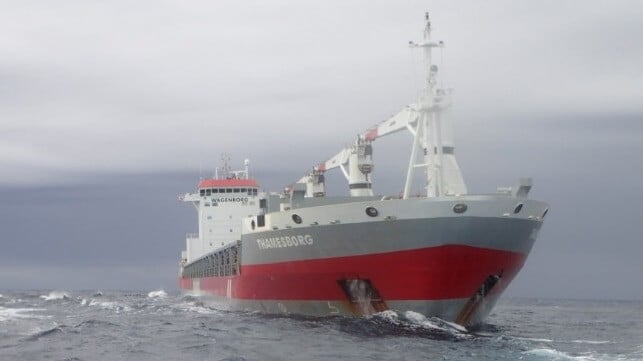
Thamesborg went aground in a remote part of the Arctic during a trip on the Northwest Passage (Canadian Coast Guard)

Published Sep 12, 2025 5:17 PM by The Maritime Executive


Nearly a week after the Dutch cargo ship Thamesborg grounded in a remote part of the Canadian Arctic during a trip on the Northwest Passage, a salvage master and naval architect were due to reach the vessel. They are working on a plan for the ship, which is reportedly stable but has taken on water in multiple ballast tanks.

The operator Royal Wagenborg, said the salvage team would reach the vessel by the end of the week. In addition, the Canadian Coast Guard vessel CCGS Sir Wilfrid Laurier is being used to transport personnel and equipment to the remote site.

The Canadian Coast Guard reported that an underwater survey was completed on September 8 using ROVs two days after the vessel went aground. The 21,359 dwt vessel was sailing from China to Baie-Comeau, Quebec, and is carrying a load of carbon blocks used for manufacturing in heavy industry. The ship went aground in the Franklin Strait in Nunavut.

A crew of 15 people is aboard the vessel along with a Canadian ice pilot. There were no injuries, but they are stranded in a remote part of Canada, away from any large settlements. The survey of the hull confirmed the damage to the ballast tanks, but the fuel tanks do not appear to be damaged, and there was no flooding in the cargo holds. A second Canadian Coast Guard vessel, CCGS Jean Goodwill, has remained on scene.

The Canadian Coast Guard reports the vessel's owner and the salvage master have organized additional equipment and personnel. Currently, the damage is being analyzed to develop the salvage plan.

The Thamesborg, built in 2013, is 564 feet (174 meters) in length. The ship, which is registered in the Netherlands, was inspected in Canada in March 2024 and 2025 with no issues reported. It has an ice class. 

Media reports from Canada highlight that only 18 percent of Canada’s Arctic waters have been mapped with modern technology. Much of the Northwest Passage, they note, lacks modern charts.

The Transportation Safety Board of Canada revealed in an announcement yesterday that this is the second grounding of the season in the same general eastern area of the Northwest Passage. It reported that an investigation team is on its way to St. John's, Newfoundland and Labrador, to interview the crew of another cargo ship, the Rosaire A. Desgagnés (12,776 dwt). The vessel, which is registered in Canada, went aground on August 23 in Pelly Bay, Nunavut. The location is to the south of where the Thamesborg is stranded, and unlike the current situation, the vessel was refloated with the tide. It was conducting a supply mission to the region and was inspected for damage after it was refloated. It is expected to reach St. John’s over the weekend.


Interior Department and Maryland Offshore Wind File Counterclaims in Court

Ocean City Maryland
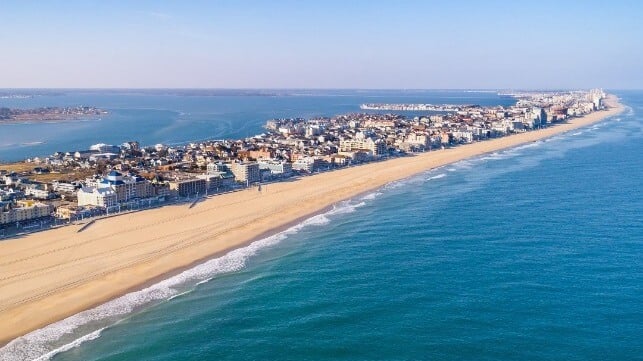
Ocean City, Maryland is a popular tourist destination (OC Tourism)

Published Sep 12, 2025 5:21 PM by The Maritime Executive


The legal battle over Maryland’s planned offshore wind project is heating up as the United States followed through on its earlier statement and filed to vacate the Construction and Operation permit granted in late 2024 to US Wind. Anticipating the move after earlier statements of intent by the Department of Justice, the offshore wind developer has already filed claims with the courts to block the moves by the Trump administration.

Maryland’s WBOC News broke the story, reporting that the Department of Justice filed on Friday afternoon, September 12, as expected to vacate the permits granted by the Biden administration. The government had declared its intent at the end of August in another court filing. The U.S. is party to a lawsuit filed by government officials in Ocean City, Maryland, seeking to block the project, the first of two US Wind was to develop on its offshore lease.

Maryland Wind was the tenth commercial-scale offshore wind project approved by the Biden administration. It calls for up to 114 wind turbines that would bring power ashore in Maryland and Delaware. The plan calls for 1,700 MW of offshore wind power generation capacity. US Wind, which is owned by funds managed by Apollo Global Management, an American investment firm, and Renexia, a subsidiary of Toto Holding, had received all of its permits from the federal government as well as both Maryland and Delaware.

Today’s court filing, WBOC reports, cites “substantial concerns” about the review and approval process for the project. It specifically points to what it says is a lack of mitigation efforts to prevent impact on Maryland’s fishing industries. Ocean City, which is a popular tourist destination, has also opposed the project, saying it would hurt its business and reduce the number of visitors.

US Wind moved at the beginning of September in anticipation of the Trump administration’s actions after DOJ declared its intent to challenge the permits. The company filed a cross claim in Maryland court, saying that the effort was politically motivated. They asserted that the president, his appointees, members of Congress, and the opponents had been unfairly pressuring the Bureau of Ocean Energy Management to cancel the licenses. The company, in its filing, asserted that the federal defendants failed to explain their action and the reversal of earlier government policies that supported the development.

Earlier this week, Interior Secretary Doug Burgum declared the U.S. offshore wind industry dead. According to a report by Bloomberg, Burgum said the U.S. was reviewing five projects, and he also cited the withdrawal of tax credits and other subsidies. The U.S. has also recently ordered a stop work on the installation of Revolution Wind, being developed by Ørsted. It also declared its intent to challenge the permits for Massachusetts’ SouthCoast Wind being developed by Ocean Wind North America, a joint venture between EDP Renewables and Engie, and New England Wind, which is being developed by Avangrid, a subsidiary of Spain’s Iberdrola.

In addition to the case filed by US Wind in Maryland, Ørsted also filed suit to force the stop work ordered to be lifted on its project, which is already 80 percent installed. A coalition of US states also filed a suit challenging the federal review of the wind energy sector ordered by Donald Trump.


Ukraine Damages Russia’s Primorsk Oil Terminal in Large Drone Assault

Russian oil terminal
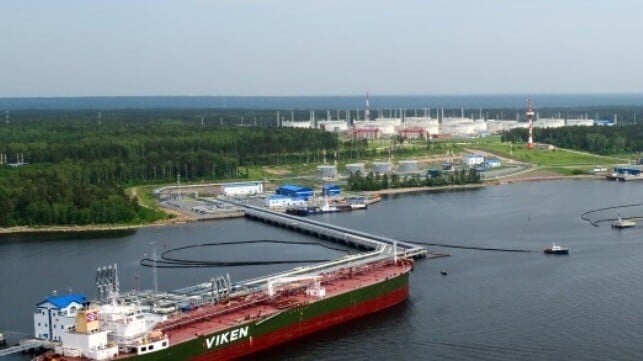
Primorsk is Russia's largest oil terminal on the Baltic (

Published Sep 12, 2025 11:59 AM by The Maritime Executive


Ukraine launched one of the largest drone assaults of the war, targeting multiple areas in Russia, including the first attack on the Primorsk oil terminal, Russia’s largest facility on the Baltic. Other reports indicate damage at the Ust-Luga terminal with Russian officials contending the attacks were targeting the facilities of Lukoil.

The Governor of the Leningrad Region confirmed the attack posting on social media warning residents to remain indoors. At first, Alexander DroZdenko said more than 20 UAVs had been destroyed, and later increased the estimate to more than 30 UAVs. There were reports of debris at various points across the region.

DroZdenko confirmed that there was a fire on one of the vessels in the port of Primorsk and later said it had been extinguished. He also confirmed a fire at a pumping station. He said there were no casualties, but reports indicate operations had been suspended at Primorsk.

Primorsk is a key part of Russian oil exports. At the terminus of the Baltic Pipeline System, it is reported to have 18 storage tanks with a total capacity of 900,000 tons of crude. Other parts of the facility handle light petroleum products. The terminal is reported to have an annual volume of 58 million tons.

Unconfirmed claims from unidentified sources at the Security Service of Ukraine told The Kyiv Independent that three pumping stations for the Ust-Luga port terminal were also damaged. It would be the second attack on that terminal in a matter of weeks.

Russian officials are claiming that a total of 221 Ukrainian drones were downed in a dozen locations across the country. Air Traffic at St. Petersburg’s airport was also delayed or diverted during the attack, which began on Thursday night and continued past midnight in the Leningrad region. It is being reported as one of the largest attacks staged by Ukraine since the start of the war three and a half years ago.

Ukrainian officials have said the attacks are in retaliation for Russia’s increased attacks and that they are targeting the income-producing oil sector. At the end of August, Ukraine attacked the Ust-Luga terminal with reports that as much as half of its capacity was taken offline. The White House later said that it also believed 20 percent of Russia’s oil refining capacity had been disabled during August.

Russian officials recently revised their estimates for oil shipments during the current month. Reuters reported that the plan called for shipping 2.1 million barrels per day, which would be an 11 percent increase over the original plan.


Norway Seizes Russian Fishing Vessel That Overstayed Its Welcome

Norwegian fishing village
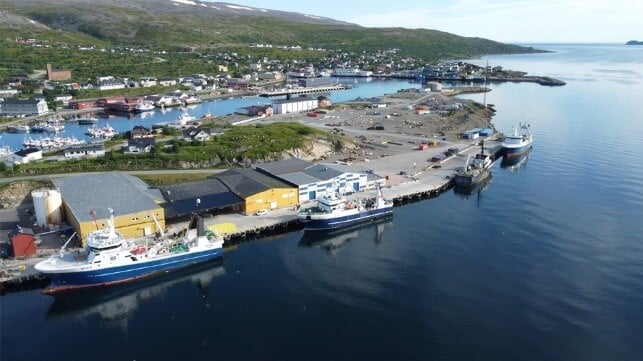
A Russian-owned fishing vessel has been in a remote Norwegian port since May 2024 (Batsfjord Havn)

Published Sep 12, 2025 7:41 PM by The Maritime Executive


The Norwegian government announced today, September 12, that after months of trying to get a Russian-owned fishing vessel to leave its port, it has resorted to seizing the vessel. The government reports it will take into consideration outstanding claims from the Port of Batsfjord, but it wants the vessel out of the port immediately.

The saga of the 39-meter (128-foot) long fishing boat Azurit began when it docked in the Port of Batsfjord, a remote fishing village on Norway’s north coast along the Barents Sea. The vessel is registered in Russia with a home port of St. Petersburg and ownership reported to a company called Oceanprom. The vessel received some repairs from a local company, but appears to have failed to pay its bills and was detained with a crew remaining aboard.

Norway changed its regulations limiting access for Russian vessels to its ports starting in 2022 and again in 2024. Access was limited to just three ports: Kirkenes, Batsfjord, and Tromsø, and some Russian companies were entirely denied fishing permits. Further, Russian vessels can only stay in Norwegian ports for five days. The government later asserted that financial claims were not a reason for vessels to remain in port beyond the time limit.

"This vessel must be removed from BÃ¥tsfjord harbour. After considering and trying various solutions, it was now absolutely necessary to make a decision on the state takeover of the vessel. The Norwegian Coastal Administration can thus implement all necessary measures to remove it," said Minister of Fisheries and the Oceans Marianne Sivertsen Naess.

Saying that the prolonged stay in Batsfjord harbor was “considered to pose a risk of national security interests being threatened,” Norway expelled the vessel on December 6 telling it that it must depart within five days. At the time, the captain told Norwegian broadcaster NRK that they were confused because they had a detention order and an eviction notice.

The ship simply never left. The Ministry reported that it considered and tried various solutions, including possibly towing the vessel. The police took steps to secure and control the vessel, but it still never left.

Media reports indicate it now owes as much as $200,000 to the port and various local businesses. The vessel is also reported to be in poor condition. NRK reports the state will cover the berthing fees.

Norway’s Secretary of State Kristoffer André Hansen said that he expects the vessel will likely be towed to a local shipyard and dismantled.


CBP Intercepts Stolen Bulldozer Being Smuggled Out at the Port of Baltimore

stolen bulldozer
CBP officers were surprised to find a stolen bulldozer being smuggled through the Port of Baltimore (CBP)

Published Sep 12, 2025 8:04 PM by The Maritime Executive


Criminal syndicates stealing vehicles in the U.S. and shipping them to countries in West Africa are becoming daring, reports U.S. Customs and Border Protection (CBP). Its officers were recently surprised when they found a stolen bulldozer being smuggled out of the Port of Baltimore was destined for Ghana.

Officers stationed at CBP’s Area Port of Baltimore are among the busiest when it comes to intercepting stolen vehicles, the bureau reports. Often, they are being smuggled out of the U.S., hidden in containers. The stolen vehicles are mostly SUVs, sedans, vans, and pickup trucks. Last year, the Baltimore Field Office ranked second nationally in terms of stolen vehicle recoveries.

On September 3, however, they encountered something that was a bit unusual. The officers were inspecting an export shipment and discovered a 2015 Caterpillar D8T bulldozer valued at about $237,000. It was in the process of being shipped to Ghana, a West African nation that CBP reports is a popular destination for stolen vehicles.

While conducting a routine export examination on the dozer, officers discovered that the vehicle identification number (VIN) matched a stolen vehicle report from Carroll County, Maryland. They contacted the Carroll County Sheriff’s Office and confirmed that the theft report remained active, resulting in the seizure of the dozer.

CBP says that the seizure of the bulldozer is an indication that criminal syndicates involved in exporting stolen vehicles from the U.S. are becoming daring. West Africa, specifically Nigeria and Ghana, they report are lucrative markets for the stolen vehicles. Last year, about 60 percent, or 151 of the 250 stolen vehicles that officers in the Baltimore Field Office recovered, were destined for West African nations. The 250 recovered stolen vehicles were collectively valued at $9.6 million

Nigeria was the top destination with officers recovering 70 vehicles destined for the country, representing 28 percent of all vehicle recoveries. A total of 28 vehicles were earmarked for shipping to Ghana.

CBP reports that during each of the previous five years, over 90 percent of recovered stolen vehicles were destined to West African nations.

“Customs and Border Protection officers continue to combat transnational criminal organizations by interrupting the international trade in stolen vehicles at our seaports,” said Jason Kropiewnicki, CBP’s Acting Area Port Director in Baltimore. “We will continue to secure our nation’s borders, recover stolen vehicle exports, and work with our federal, state, and local law enforcement partners to hold these criminal organizations accountable.”

Despite efforts to fight the crime, CBP highlights that national volumes of stolen vehicle export recoveries remain on the rise. In 2024, the agency recovered 1,445 stolen vehicles, about 10 percent more than in 2023, and 81 percent higher than in 2021.


Historic 1927 USCG Cutter McLane Sold for Scrap by Michigan Museum

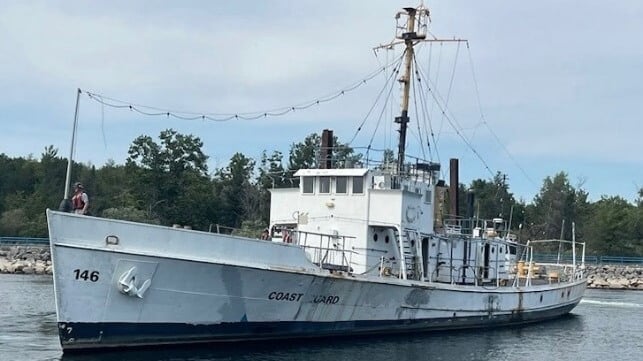
historic USCG cutter McLane
McLane was commissioned in 1927 for the U.S. Coast Guard (USS Silversides Submarine Museum)

Published Sep 12, 2025 8:45 PM by The Maritime Executive


A U.S Coast Guard cutter built in 1927 that has been part of the USS Silversides Submarine Museum exhibits in Muskegon, Michigan, for years, has been towed away and will be scrapped. The decision came following what the museum said was significant deterioration that made efforts towards continuous preservation unfeasible.

The museum announced on September 10 that after thoughtful deliberation, it had made the difficult decision to deaccession the cutter McLane from its permanent collections. The cutter has been part of exhibits for over three decades, having been moored at Muskegon harbor since 1993.

The 38-meter (125-foot) Active-class patrol cutter was commissioned in 1927 and served the USGC with distinction through multiple eras of the agency’s history. She was named after Louis McLane, who was appointed U.S. Secretary of State in 1833. Part of McLane’s active duty was patrolling the waters of the Territory of Alaska, including the Bering Strait, during World War II.

Decommissioned in 1968, McLane was donated to the USS Silversides Submarine Museum in 1993, where she has been offering visitors a glimpse into life aboard a patrol vessel. However, the vessel’s deteriorating condition had progressed, the museum says, to the point of being inaccessible for public touring. Maintenance concerns have seen the vessel closed to the public since spring of this year. The museum has now decided that it has further made her continued presence in the harbor untenable. 

The museum highlighted that while it has made efforts to explore alternative preservation options, the vessel’s conditions have meant that continued stewardship was no longer sustainable. It believes that with the cold season approaching, the combination of time, weather, and structural decline made timely action necessary to ensure the safety of the vessel and the surrounding environment.

Unable to continue preserving the vessel, the cutter was sold for scrap. King Towing undertook the task of towing the cutter from the harbor, while Pitsch Companies will handle the dismantling.
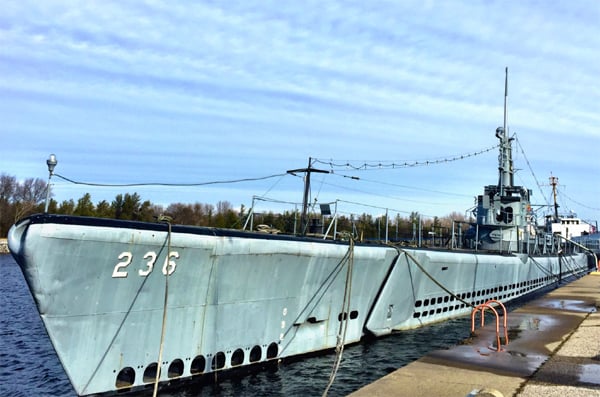
 

USS Silversides, a WWII vintage submarine (USS Silversides Submarine Museum)


To honor McLane’s legacy, all historical artifacts and interpretive materials housed aboard the vessel were removed to ensure their continued educational and historical value. These artifacts will now be part of the broader collection at the museum and shared with partner organizations.

“The McLane had been a symbol of service and strength for decades,” said Veronica Campbell, USS Silversides Submarine Museum, Executive Director. “Though it was difficult to say goodbye, we were incredibly grateful to our community partners who helped us navigate this transition with dignity and respect.”

Following the departure of McLane, the museum that originally opened as the Great Lakes Naval Memorial and Museum now intends to put its main focus on its main exhibit, the USS Silversides submarine. Part of the efforts will involve fundraising to support the restoration of Silversides.

Commissioned in December 1941, shortly after the attack on Pearl Harbor, the submarine embarked on her first war patrol in April of the following year, and went on to complete 14 war patrols in the Pacific during WWII.

She was decommissioned in 1946 and became a stationary training ship in Chicago until 1969. After retiring from service, she spent time in Chicago as a museum ship, moving to Navy Pier in 1979. In 1987, Silversides was towed across Lake Michigan to become part of the Great Lakes Naval and Memorial Museum.